
Current Performance Improvement Issues Tactical


Description: Current Performance Improvement Issues Tactical Combat Casualty Care 7 December 2012 TCCC Lessons Learned in Iraq and Afghanistan Reports from Joint Trauma System (JTS) weekly Trauma Telecons every Thursday morning Worldwide telecon to
Related Topics
Download Presentation
"Current Performance Improvement Issues Tactical" is the property of its rightful owner. Permission is granted to download and print the materials on this website for personal, non-commercial use only, and to display it on your personal computer provided you do not modify the materials and that you retain all copyright notices contained in the materials. By downloading content from our website, you accept the terms of this agreement.
Presentation Transcript
slide1. Current Performance Improvement Issues Tactical Combat Casualty Care
7 December 2012<br>
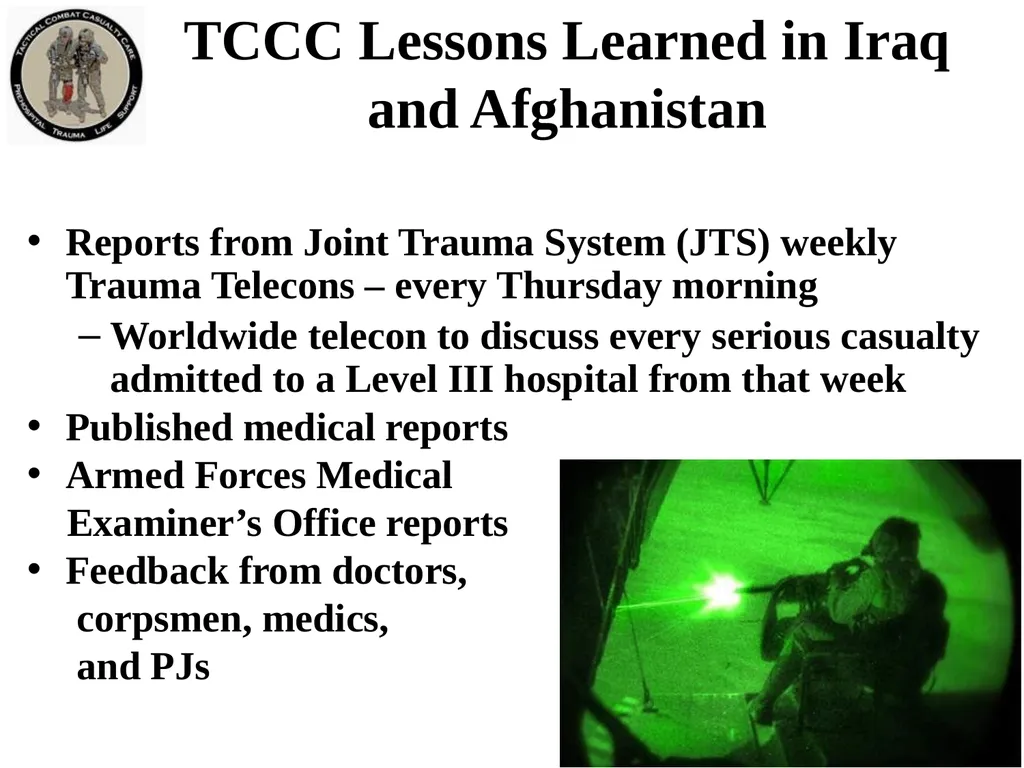
slide2. TCCC Lessons Learned in Iraq and Afghanistan Reports from Joint Trauma System (JTS) weekly Trauma Telecons – every Thursday morning
Worldwide telecon to discuss every serious casualty admitted to a Level III hospital from that week
Published medical reports
Armed Forces Medical
Examiner’s Office reports
Feedback from doctors,
corpsmen, medics,
and PJs<br>
slide3. Overcalling CAT A Evacuations<br>
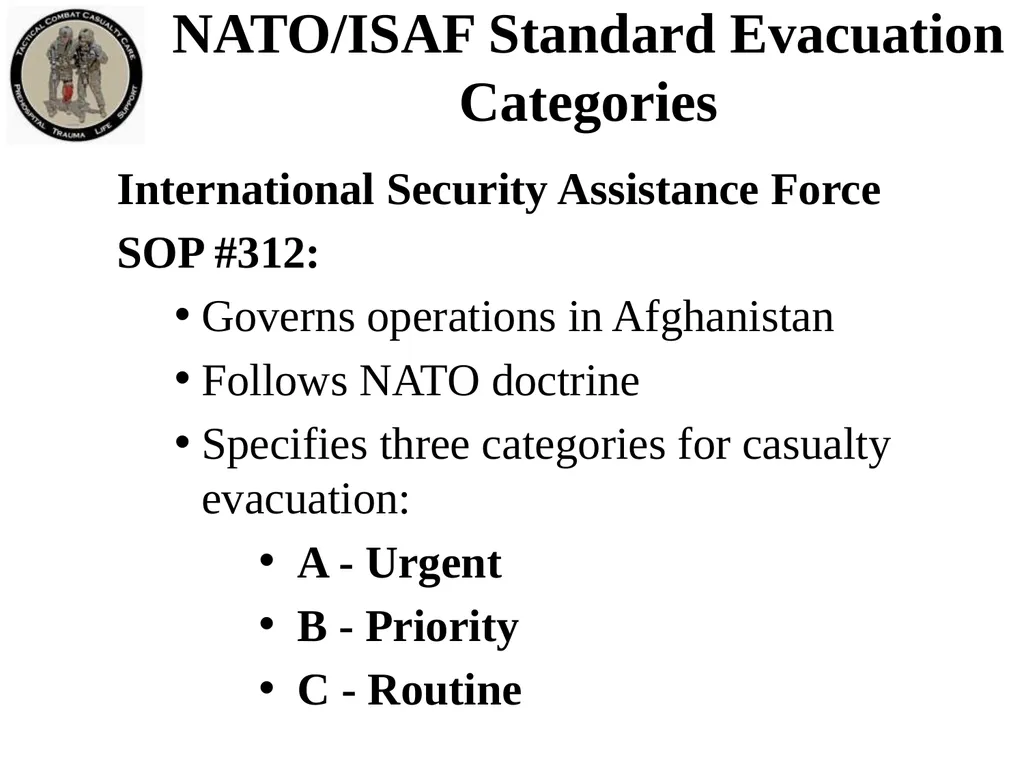
slide4. NATO/ISAF Standard Evacuation Categories International Security Assistance Force
SOP #312:
Governs operations in Afghanistan
Follows NATO doctrine
Specifies three categories for casualty evacuation:
A - Urgent
B - Priority
C - Routine<br>
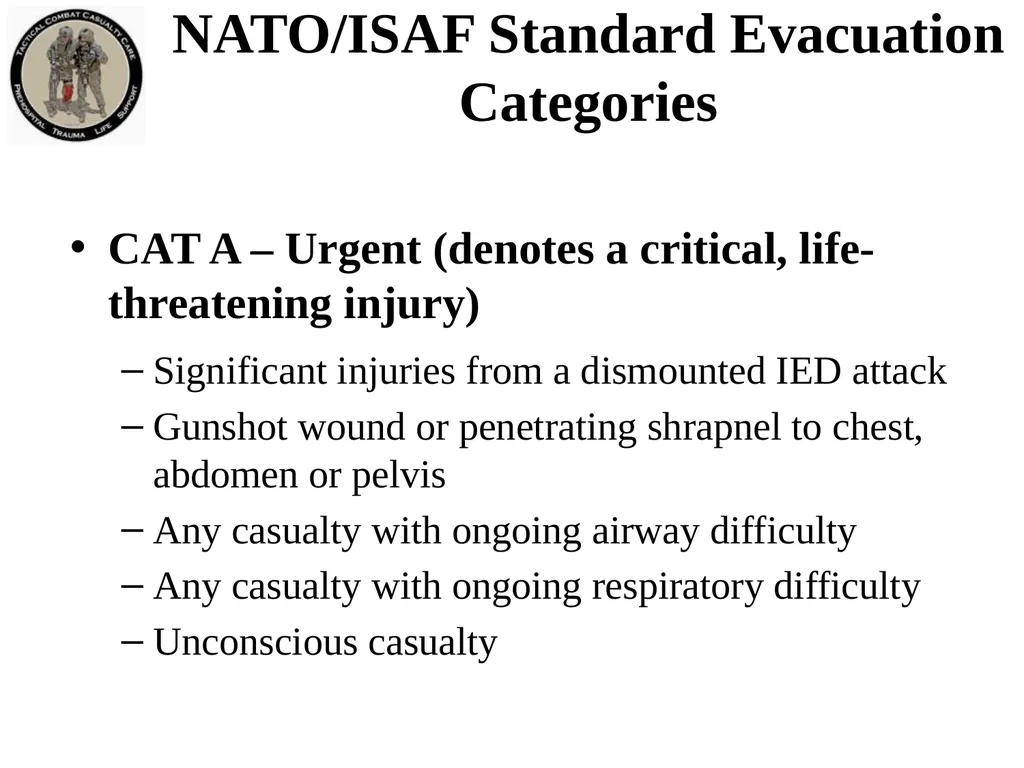
slide5. CAT A – Urgent (denotes a critical, life-threatening injury)
Significant injuries from a dismounted IED attack
Gunshot wound or penetrating shrapnel to chest, abdomen or pelvis
Any casualty with ongoing airway difficulty
Any casualty with ongoing respiratory difficulty
Unconscious casualty NATO/ISAF Standard Evacuation Categories<br>
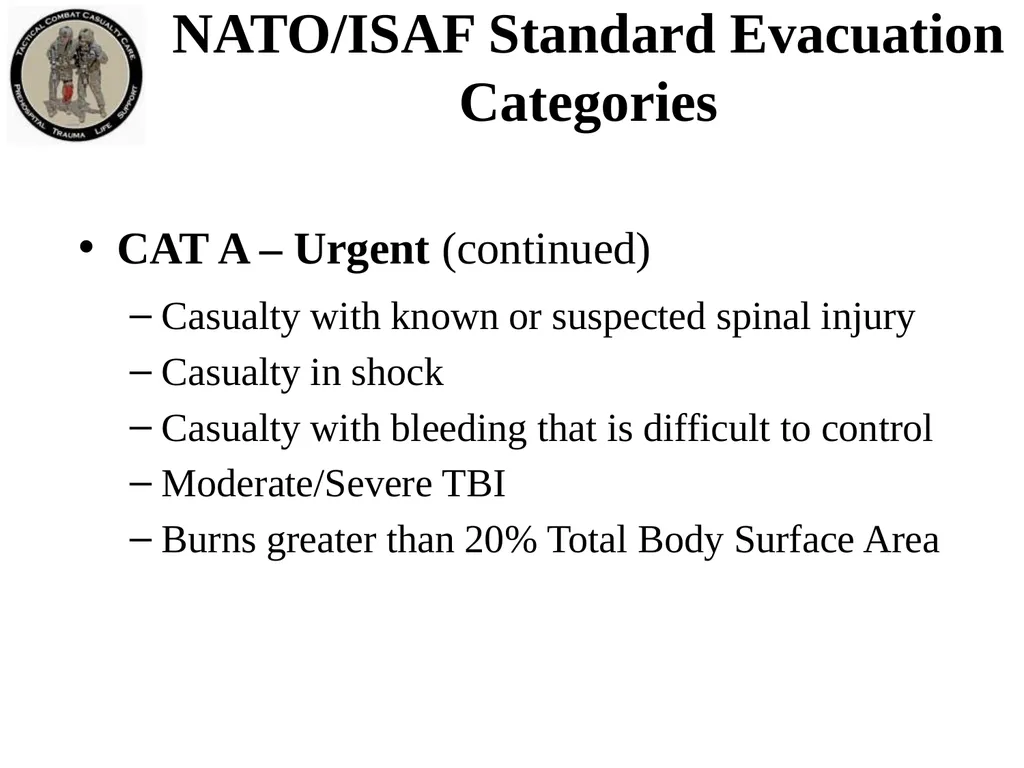
slide6. CAT A – Urgent (continued)
Casualty with known or suspected spinal injury
Casualty in shock
Casualty with bleeding that is difficult to control
Moderate/Severe TBI
Burns greater than 20% Total Body Surface Area NATO/ISAF Standard Evacuation Categories<br>
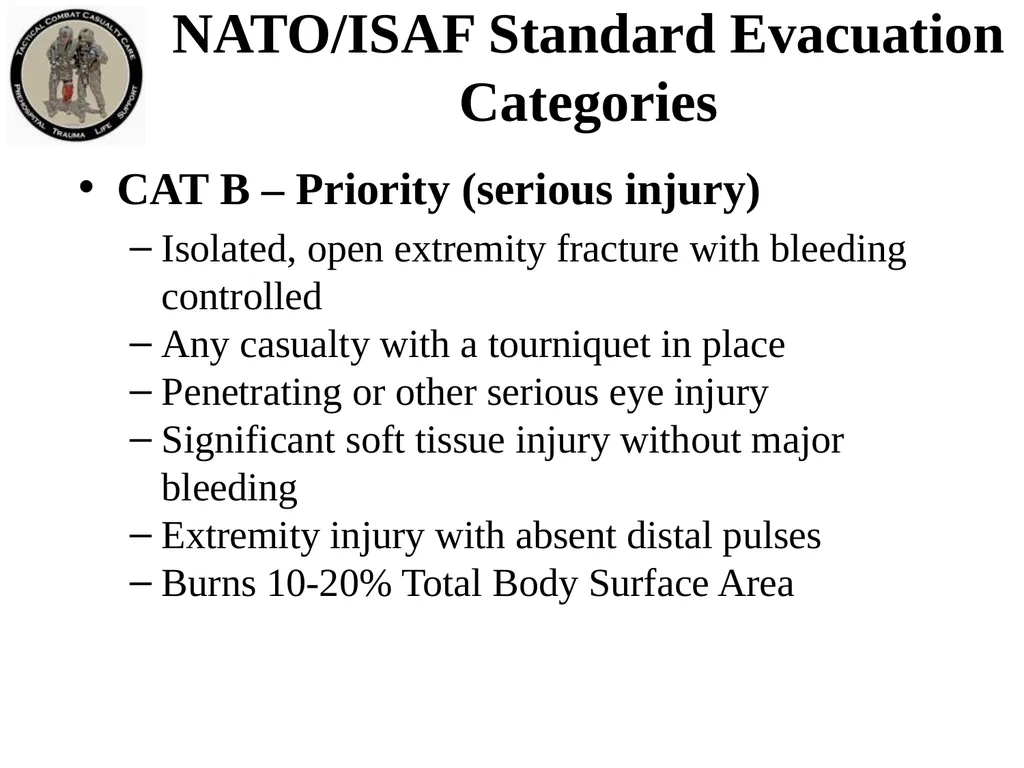
slide7. CAT B – Priority (serious injury)
Isolated, open extremity fracture with bleeding controlled
Any casualty with a tourniquet in place
Penetrating or other serious eye injury
Significant soft tissue injury without major bleeding
Extremity injury with absent distal pulses
Burns 10-20% Total Body Surface Area NATO/ISAF Standard Evacuation Categories<br>
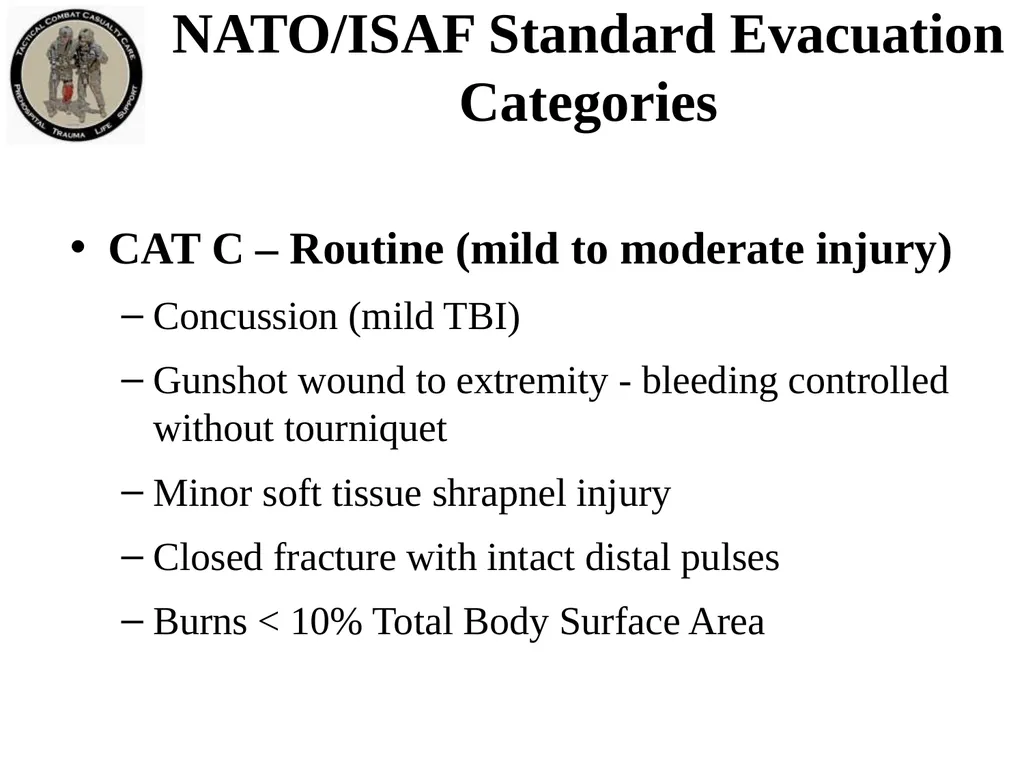
slide8. CAT C – Routine (mild to moderate injury)
Concussion (mild TBI)
Gunshot wound to extremity - bleeding controlled without tourniquet
Minor soft tissue shrapnel injury
Closed fracture with intact distal pulses
Burns < 10% Total Body Surface Area NATO/ISAF Standard Evacuation Categories<br>
slide9. Training<br>
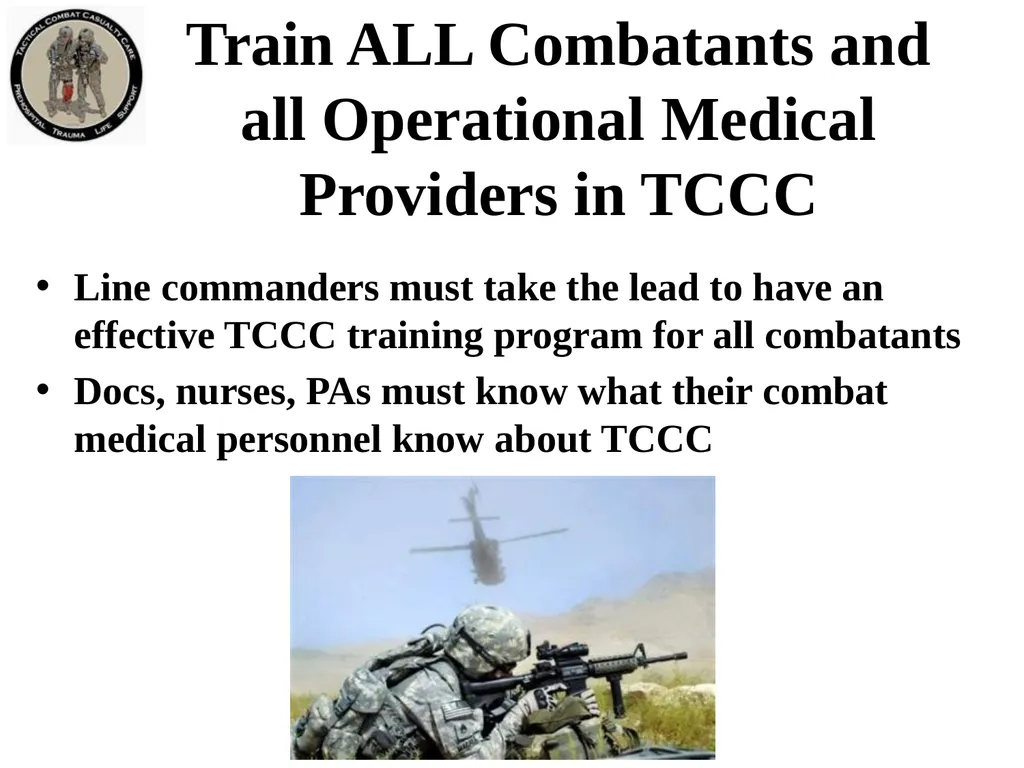
slide10. Train ALL Combatants and all Operational Medical Providers in TCCC Line commanders must take the lead to have an effective TCCC training program for all combatants
Docs, nurses, PAs must know what their combat medical personnel know about TCCC<br>
slide11. Tourniquets Being Placed Too Proximal and Not Adjusted during TFC<br>
slide12. E-mail from an orthopedic surgeon: “…. tourniquet was applied on the proximal biceps for a middle finger amputation.”<br>
slide13. Care Under Fire Guidelines 7. Stop life-threatening external hemorrhage if tactically feasible:
Direct casualty to control hemorrhage by self-aid if able.
Use a CoTCCC-recommended tourniquet for hemorrhage that is anatomically amenable to tourniquet application.
Apply the tourniquet proximal to the bleeding site, over the uniform, tighten, and move the casualty to cover.<br>
slide14. Three Key Points “Proximal to the bleeding site” does not necessarily mean at the upper biceps for a hand injury or at the upper thigh for a foot injury
The tourniquet should be moved to a skin location 2-3 inches above the bleeding site during Tactical Field Care.
Reassess the bleeding site frequently to ensure that tourniquet is still effective.<br>
slide15. Tourniquet Mistakes to Avoid! Not using one when you should
Using a tourniquet for minimal bleeding
Putting it on too proximally
Not taking it off when indicated during TFC
Taking it off when the casualty is in shock or has only a short transport time to the hospital
Not making it tight enough – the tourniquet should eliminate the distal pulse
Not using a second tourniquet if needed
Waiting too long to put the tourniquet on
Periodically loosening the tourniquet to allow blood flow to the injured extremity * These lessons learned have been written in blood. *<br>
slide16. Eye Injuries: Recent Increase in Eye Injuries from Not Wearing Eye Protection<br>
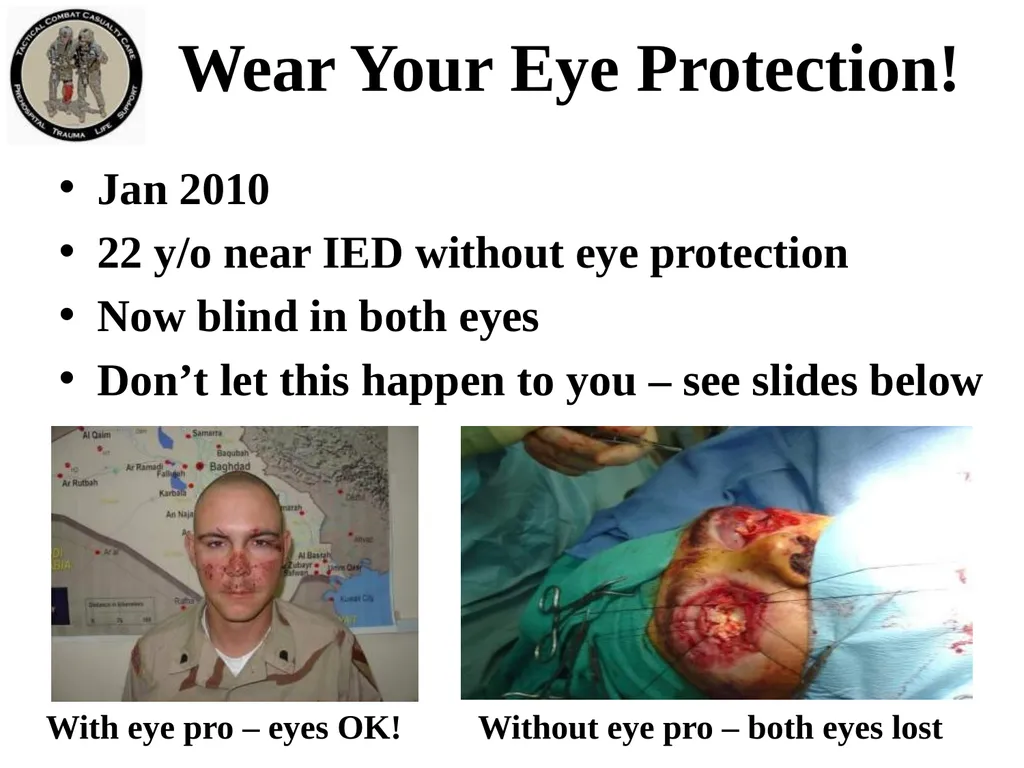
slide17. Wear Your Eye Protection! Jan 2010
22 y/o near IED without eye protection
Now blind in both eyes
Don’t let this happen to you – see slides below With eye pro – eyes OK! Without eye pro – both eyes lost<br>
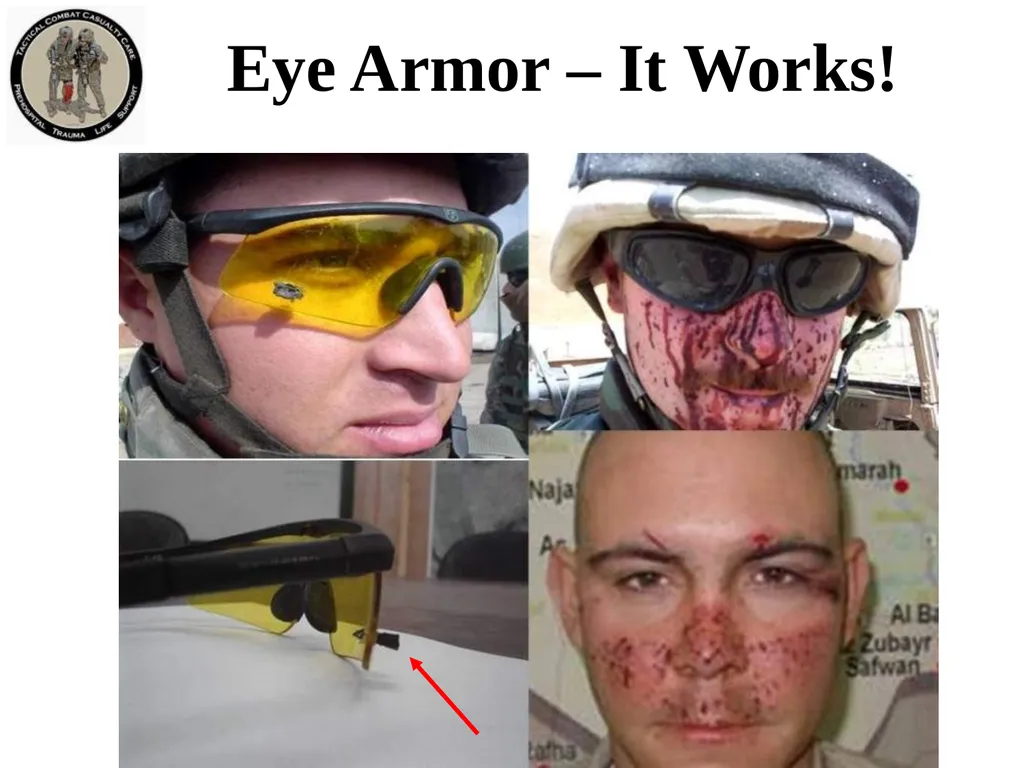
slide18. Eye Armor – It Works!<br>
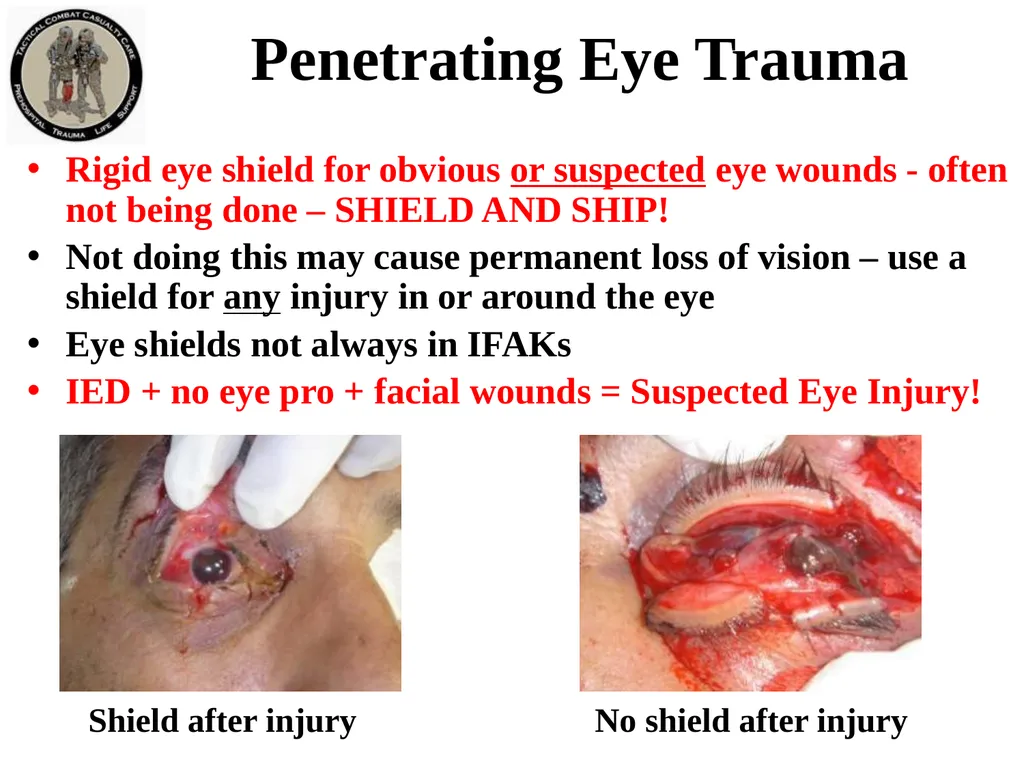
slide19. Penetrating Eye Trauma Rigid eye shield for obvious or suspected eye wounds - often not being done – SHIELD AND SHIP!
Not doing this may cause permanent loss of vision – use a shield for any injury in or around the eye
Eye shields not always in IFAKs
IED + no eye pro + facial wounds = Suspected Eye Injury! Shield after injury No shield after injury<br>
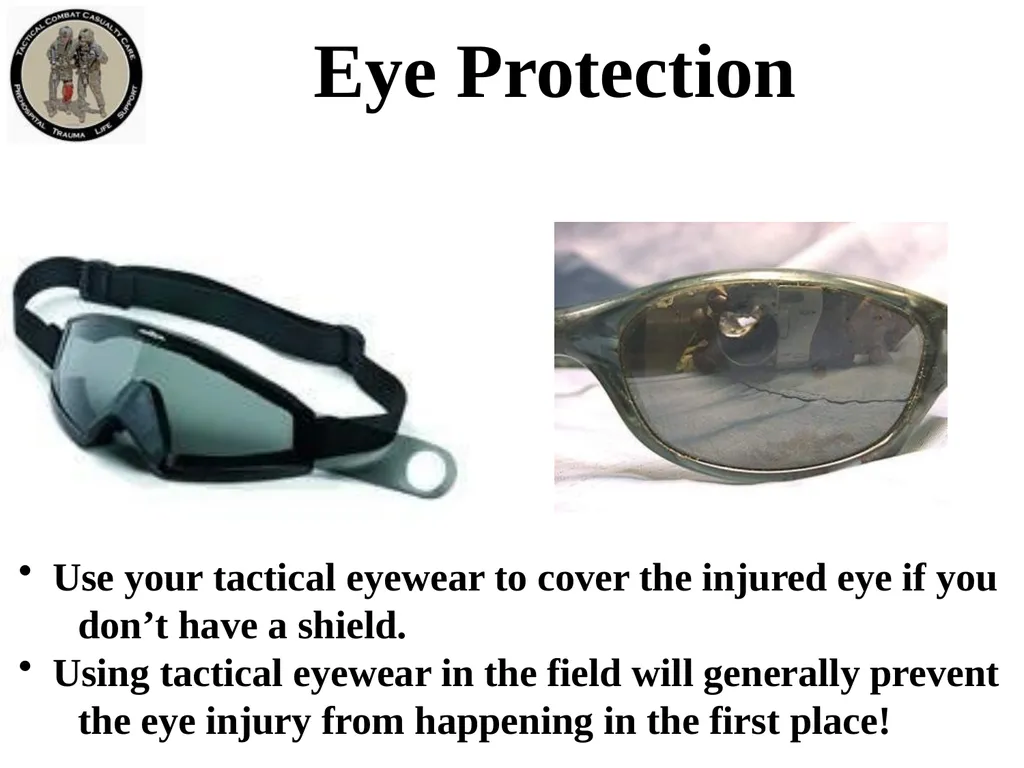
slide20. Use your tactical eyewear to cover the injured eye if you
don’t have a shield.
Using tactical eyewear in the field will generally prevent
the eye injury from happening in the first place! Eye Protection<br>
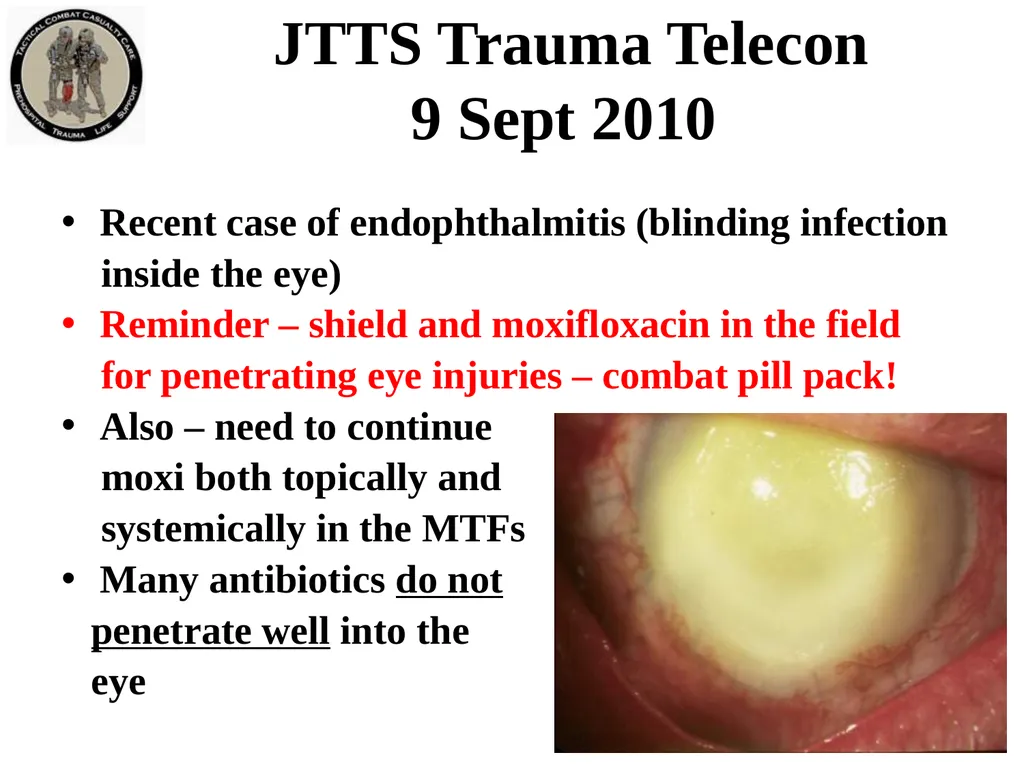
slide21. JTTS Trauma Telecon 9 Sept 2010 Recent case of endophthalmitis (blinding infection
inside the eye)
Reminder – shield and moxifloxacin in the field
for penetrating eye injuries – combat pill pack!
Also – need to continue
moxi both topically and
systemically in the MTFs
Many antibiotics do not
penetrate well into the
eye<br>
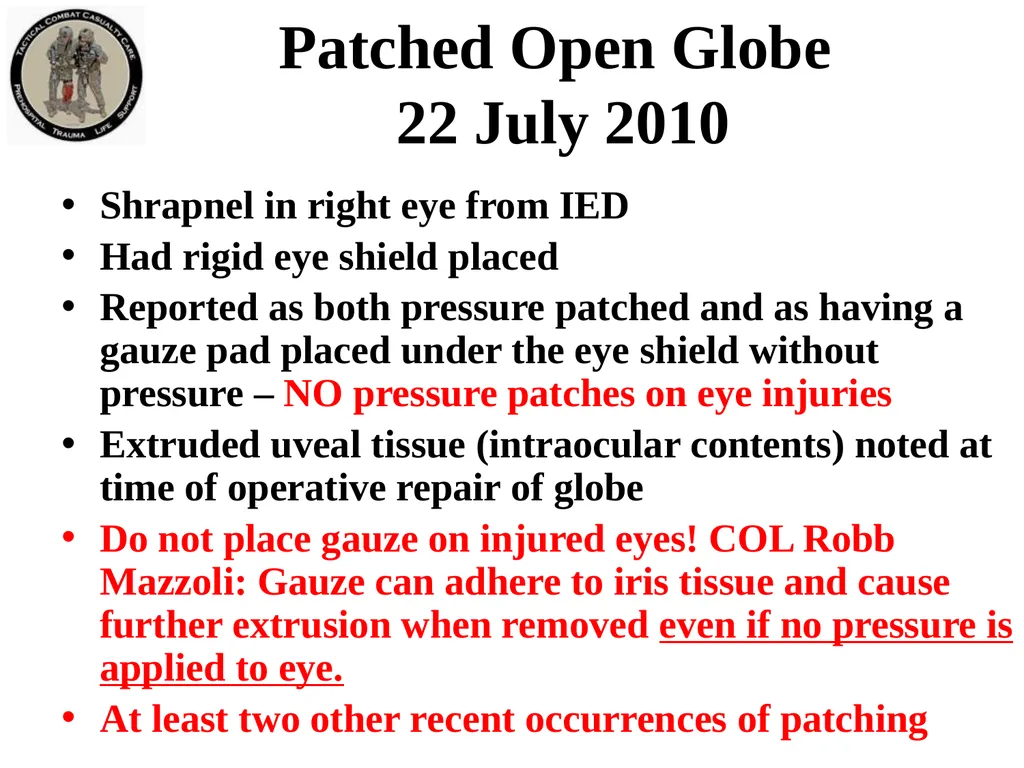
slide22. Patched Open Globe 22 July 2010 Shrapnel in right eye from IED
Had rigid eye shield placed
Reported as both pressure patched and as having a gauze pad placed under the eye shield without pressure – NO pressure patches on eye injuries
Extruded uveal tissue (intraocular contents) noted at time of operative repair of globe
Do not place gauze on injured eyes! COL Robb Mazzoli: Gauze can adhere to iris tissue and cause further extrusion when removed even if no pressure is applied to eye.
At least two other recent occurrences of patching<br>
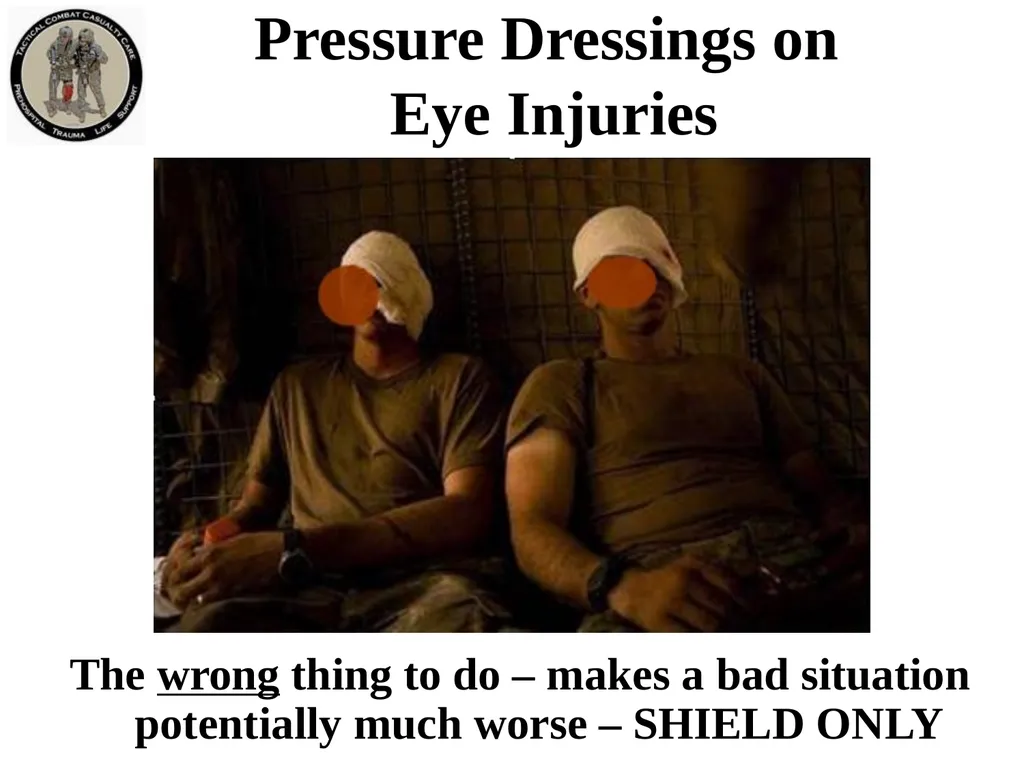
slide23. Pressure Dressings on Eye Injuries The wrong thing to do – makes a bad situation potentially much worse – SHIELD ONLY<br>
slide24. Battlefield Analgesia<br>
slide25. NO Narcotic Analgesia for Casualties in Shock Narcotics (morphine and fentanyl) are CONTRAINDICATED for casualties
who are in shock or who are likely to
go into shock; these agents may worsen
their shock and increase the risk of death
Four casualties in two successive weekly telecons were noted to have gotten narcotics and were in shock during transport or on admission to the MTFs
Use ketamine for casualties who are in shock or at risk of going into shock but are still having significant pain<br>
slide26. Case Report September 2012 Male casualty with GSW to thigh
Bleeding controlled by tourniquet
In shock – alert but hypotensive
Severe pain from tourniquet
Repeated pleas to PA to remove the tourniquet
PA did not want to use opioids because of the shock
Perfect candidate for ketamine analgesia
Not fielded at the time with this unit<br>
slide27. Platelet-Inhibiting Drugs in the Battle Space<br>
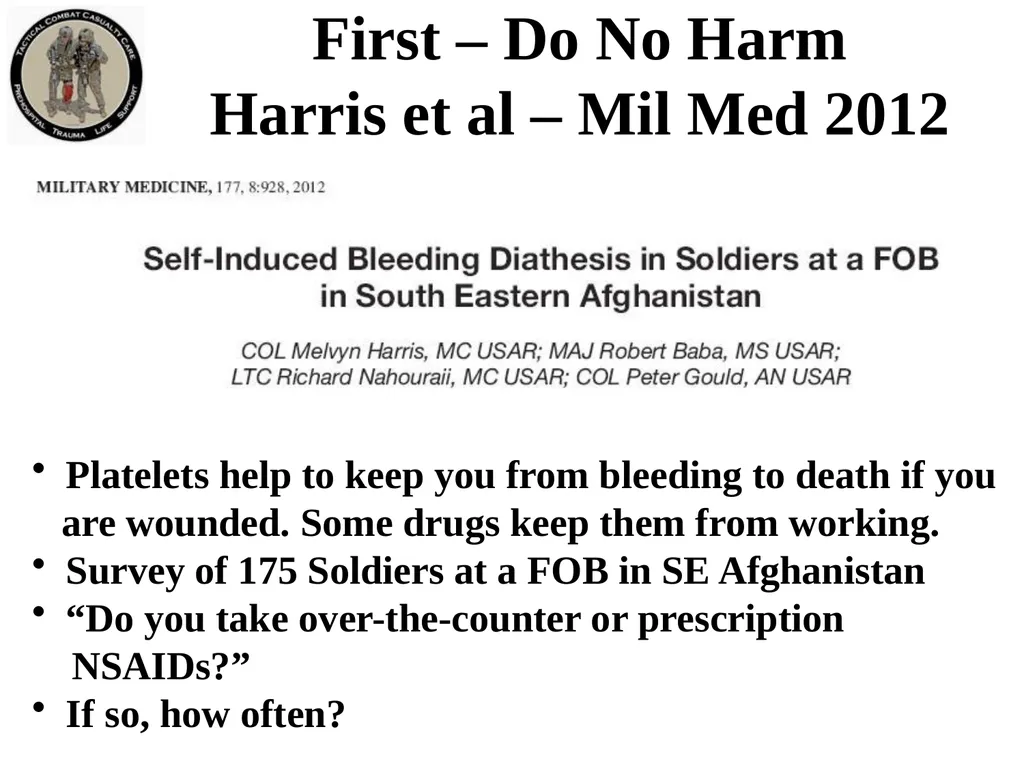
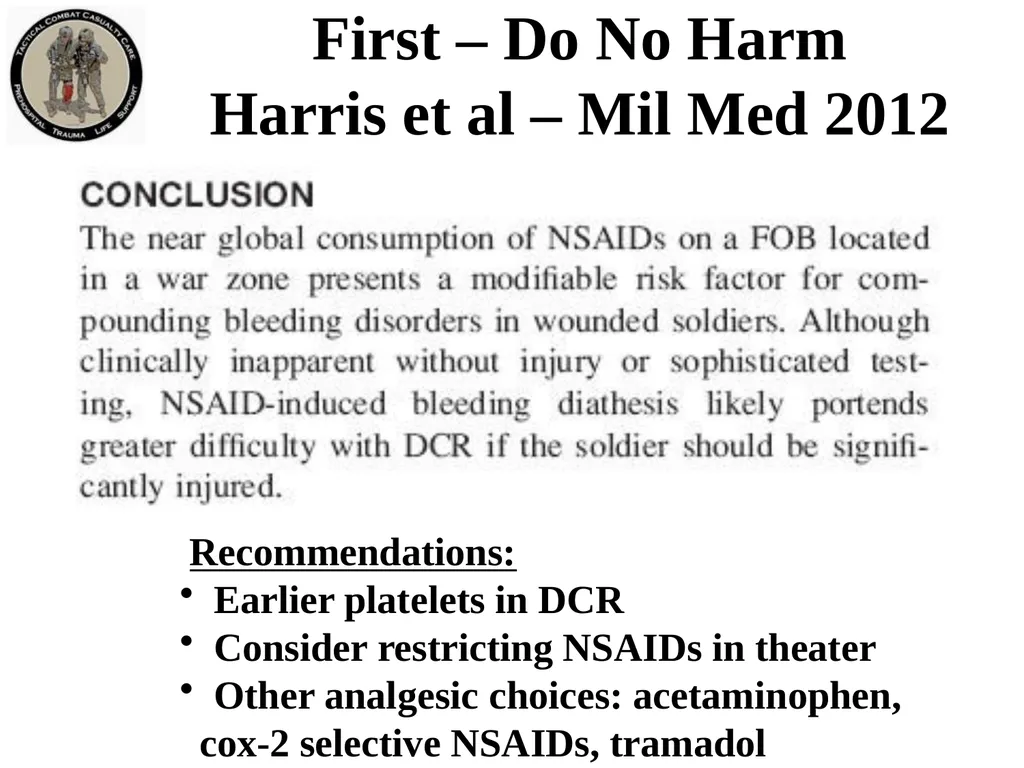
slide28. First – Do No Harm Harris et al – Mil Med 2012 Platelets help to keep you from bleeding to death if you
are wounded. Some drugs keep them from working.
Survey of 175 Soldiers at a FOB in SE Afghanistan
“Do you take over-the-counter or prescription
NSAIDs?”
If so, how often?<br>
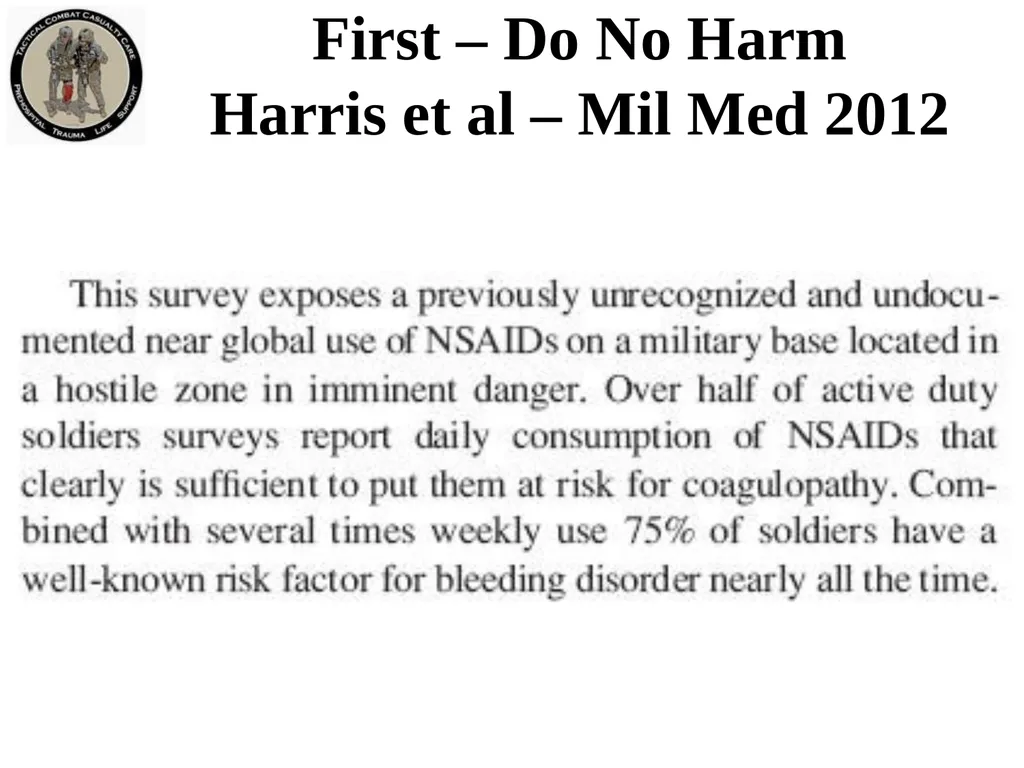
slide29. First – Do No Harm Harris et al – Mil Med 2012<br>
slide30. First – Do No Harm Harris et al – Mil Med 2012 Recommendations:
Earlier platelets in DCR
Consider restricting NSAIDs in theater
Other analgesic choices: acetaminophen,
cox-2 selective NSAIDs, tramadol<br>
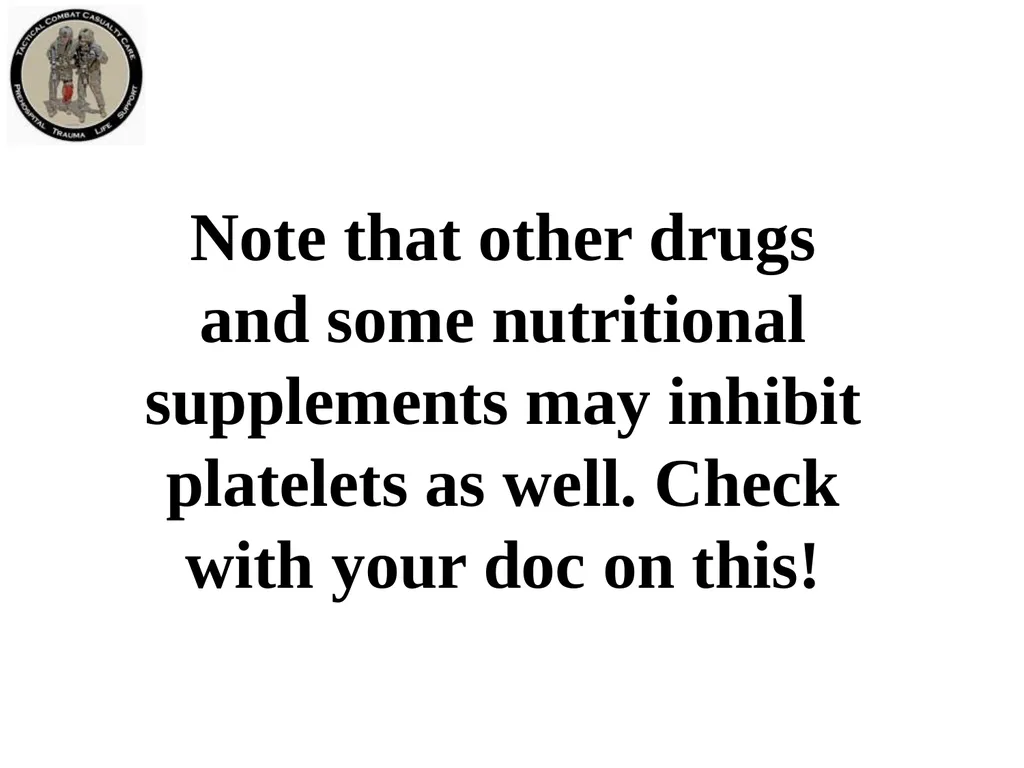
slide31. Note that other drugs and some nutritional supplements may inhibit platelets as well. Check with your doc on this!<br>
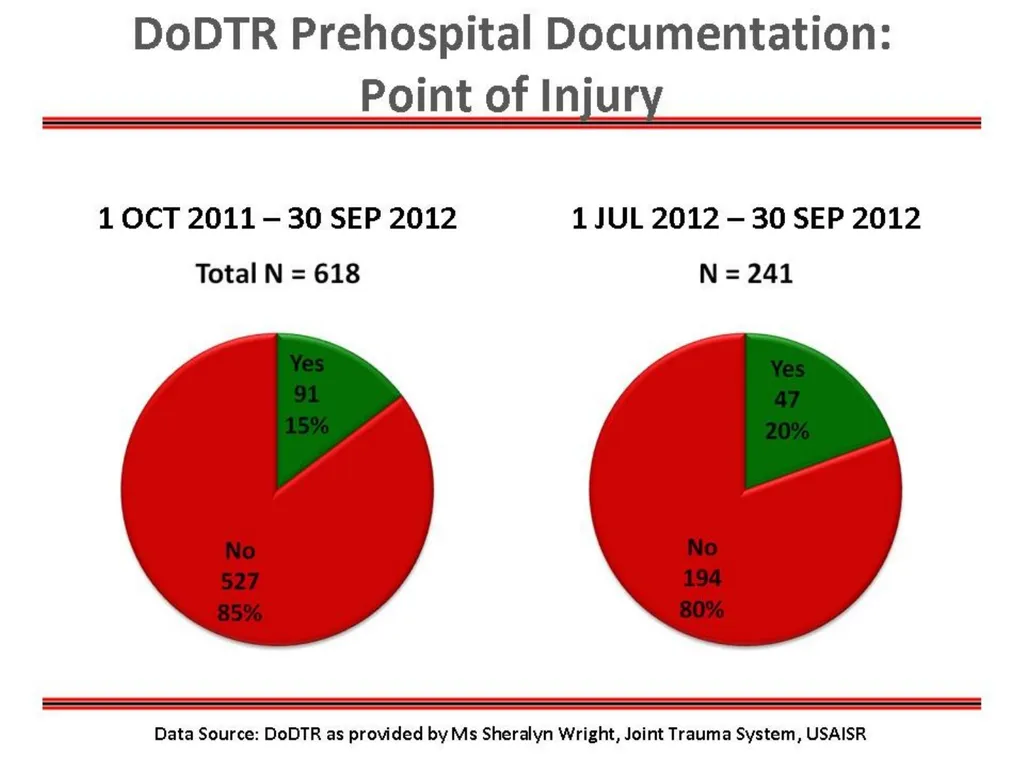
slide32. Documentation of TCCC Care<br>
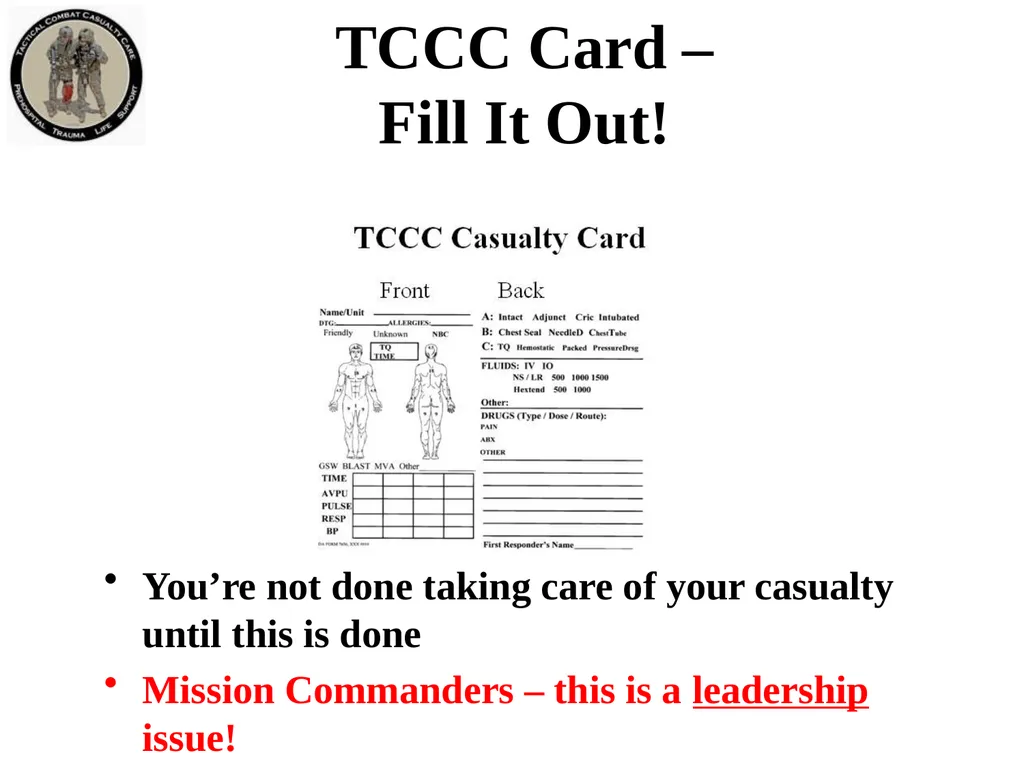
slide34. TCCC Card – Fill It Out! You’re not done taking care of your casualty until this is done
Mission Commanders – this is a leadership issue!<br>
slide35. Questions?<br>
slide2. TCCC Lessons Learned in Iraq and Afghanistan Reports from Joint Trauma System (JTS) weekly Trauma Telecons – every Thursday morning
Worldwide telecon to discuss every serious casualty admitted to a Level III hospital from that week
Published medical reports
Armed Forces Medical
Examiner’s Office reports
Feedback from doctors,
corpsmen, medics,
and PJs<br>
slide3. Overcalling CAT A Evacuations<br>
slide4. NATO/ISAF Standard Evacuation Categories International Security Assistance Force
SOP #312:
Governs operations in Afghanistan
Follows NATO doctrine
Specifies three categories for casualty evacuation:
A - Urgent
B - Priority
C - Routine<br>
slide5. CAT A – Urgent (denotes a critical, life-threatening injury)
Significant injuries from a dismounted IED attack
Gunshot wound or penetrating shrapnel to chest, abdomen or pelvis
Any casualty with ongoing airway difficulty
Any casualty with ongoing respiratory difficulty
Unconscious casualty NATO/ISAF Standard Evacuation Categories<br>
slide6. CAT A – Urgent (continued)
Casualty with known or suspected spinal injury
Casualty in shock
Casualty with bleeding that is difficult to control
Moderate/Severe TBI
Burns greater than 20% Total Body Surface Area NATO/ISAF Standard Evacuation Categories<br>
slide7. CAT B – Priority (serious injury)
Isolated, open extremity fracture with bleeding controlled
Any casualty with a tourniquet in place
Penetrating or other serious eye injury
Significant soft tissue injury without major bleeding
Extremity injury with absent distal pulses
Burns 10-20% Total Body Surface Area NATO/ISAF Standard Evacuation Categories<br>
slide8. CAT C – Routine (mild to moderate injury)
Concussion (mild TBI)
Gunshot wound to extremity - bleeding controlled without tourniquet
Minor soft tissue shrapnel injury
Closed fracture with intact distal pulses
Burns < 10% Total Body Surface Area NATO/ISAF Standard Evacuation Categories<br>
slide9. Training<br>
slide10. Train ALL Combatants and all Operational Medical Providers in TCCC Line commanders must take the lead to have an effective TCCC training program for all combatants
Docs, nurses, PAs must know what their combat medical personnel know about TCCC<br>
slide11. Tourniquets Being Placed Too Proximal and Not Adjusted during TFC<br>
slide12. E-mail from an orthopedic surgeon: “…. tourniquet was applied on the proximal biceps for a middle finger amputation.”<br>
slide13. Care Under Fire Guidelines 7. Stop life-threatening external hemorrhage if tactically feasible:
Direct casualty to control hemorrhage by self-aid if able.
Use a CoTCCC-recommended tourniquet for hemorrhage that is anatomically amenable to tourniquet application.
Apply the tourniquet proximal to the bleeding site, over the uniform, tighten, and move the casualty to cover.<br>
slide14. Three Key Points “Proximal to the bleeding site” does not necessarily mean at the upper biceps for a hand injury or at the upper thigh for a foot injury
The tourniquet should be moved to a skin location 2-3 inches above the bleeding site during Tactical Field Care.
Reassess the bleeding site frequently to ensure that tourniquet is still effective.<br>
slide15. Tourniquet Mistakes to Avoid! Not using one when you should
Using a tourniquet for minimal bleeding
Putting it on too proximally
Not taking it off when indicated during TFC
Taking it off when the casualty is in shock or has only a short transport time to the hospital
Not making it tight enough – the tourniquet should eliminate the distal pulse
Not using a second tourniquet if needed
Waiting too long to put the tourniquet on
Periodically loosening the tourniquet to allow blood flow to the injured extremity * These lessons learned have been written in blood. *<br>
slide16. Eye Injuries: Recent Increase in Eye Injuries from Not Wearing Eye Protection<br>
slide17. Wear Your Eye Protection! Jan 2010
22 y/o near IED without eye protection
Now blind in both eyes
Don’t let this happen to you – see slides below With eye pro – eyes OK! Without eye pro – both eyes lost<br>
slide18. Eye Armor – It Works!<br>
slide19. Penetrating Eye Trauma Rigid eye shield for obvious or suspected eye wounds - often not being done – SHIELD AND SHIP!
Not doing this may cause permanent loss of vision – use a shield for any injury in or around the eye
Eye shields not always in IFAKs
IED + no eye pro + facial wounds = Suspected Eye Injury! Shield after injury No shield after injury<br>
slide20. Use your tactical eyewear to cover the injured eye if you
don’t have a shield.
Using tactical eyewear in the field will generally prevent
the eye injury from happening in the first place! Eye Protection<br>
slide21. JTTS Trauma Telecon 9 Sept 2010 Recent case of endophthalmitis (blinding infection
inside the eye)
Reminder – shield and moxifloxacin in the field
for penetrating eye injuries – combat pill pack!
Also – need to continue
moxi both topically and
systemically in the MTFs
Many antibiotics do not
penetrate well into the
eye<br>
slide22. Patched Open Globe 22 July 2010 Shrapnel in right eye from IED
Had rigid eye shield placed
Reported as both pressure patched and as having a gauze pad placed under the eye shield without pressure – NO pressure patches on eye injuries
Extruded uveal tissue (intraocular contents) noted at time of operative repair of globe
Do not place gauze on injured eyes! COL Robb Mazzoli: Gauze can adhere to iris tissue and cause further extrusion when removed even if no pressure is applied to eye.
At least two other recent occurrences of patching<br>
slide23. Pressure Dressings on Eye Injuries The wrong thing to do – makes a bad situation potentially much worse – SHIELD ONLY<br>
slide24. Battlefield Analgesia<br>
slide25. NO Narcotic Analgesia for Casualties in Shock Narcotics (morphine and fentanyl) are CONTRAINDICATED for casualties
who are in shock or who are likely to
go into shock; these agents may worsen
their shock and increase the risk of death
Four casualties in two successive weekly telecons were noted to have gotten narcotics and were in shock during transport or on admission to the MTFs
Use ketamine for casualties who are in shock or at risk of going into shock but are still having significant pain<br>
slide26. Case Report September 2012 Male casualty with GSW to thigh
Bleeding controlled by tourniquet
In shock – alert but hypotensive
Severe pain from tourniquet
Repeated pleas to PA to remove the tourniquet
PA did not want to use opioids because of the shock
Perfect candidate for ketamine analgesia
Not fielded at the time with this unit<br>
slide27. Platelet-Inhibiting Drugs in the Battle Space<br>
slide28. First – Do No Harm Harris et al – Mil Med 2012 Platelets help to keep you from bleeding to death if you
are wounded. Some drugs keep them from working.
Survey of 175 Soldiers at a FOB in SE Afghanistan
“Do you take over-the-counter or prescription
NSAIDs?”
If so, how often?<br>
slide29. First – Do No Harm Harris et al – Mil Med 2012<br>
slide30. First – Do No Harm Harris et al – Mil Med 2012 Recommendations:
Earlier platelets in DCR
Consider restricting NSAIDs in theater
Other analgesic choices: acetaminophen,
cox-2 selective NSAIDs, tramadol<br>
slide31. Note that other drugs and some nutritional supplements may inhibit platelets as well. Check with your doc on this!<br>
slide32. Documentation of TCCC Care<br>
slide34. TCCC Card – Fill It Out! You’re not done taking care of your casualty until this is done
Mission Commanders – this is a leadership issue!<br>
slide35. Questions?<br>