
Curriculum Design & Teaching-Learning August, 2019
TG
Published · 51 slides · 0 views
1 / 1


Description
Curriculum Design Teaching-Learning August, 2019 Critical Terms- CO PO Short Definitions of CO, PO Program Outcomes- POs These are knowledge and skill sets that the graduates have at the time of graduations Course Outcomes- COs Again,
Related Topics
Share
Embed code
Download this presentation From Below
"Curriculum Design & Teaching-Learning August, 2019" is the property of its rightful owner. Permission is granted to download and print the materials on this website for personal, non-commercial use only, and to display it on your personal computer provided you do not modify the materials and that you retain all copyright notices contained in the materials. By downloading content from our website, you accept the terms of this agreement.
Presentation Transcript
01
Curriculum Design
&
Teaching-Learning August, 2019<br>
02
Critical Terms- CO & PO<br>
03
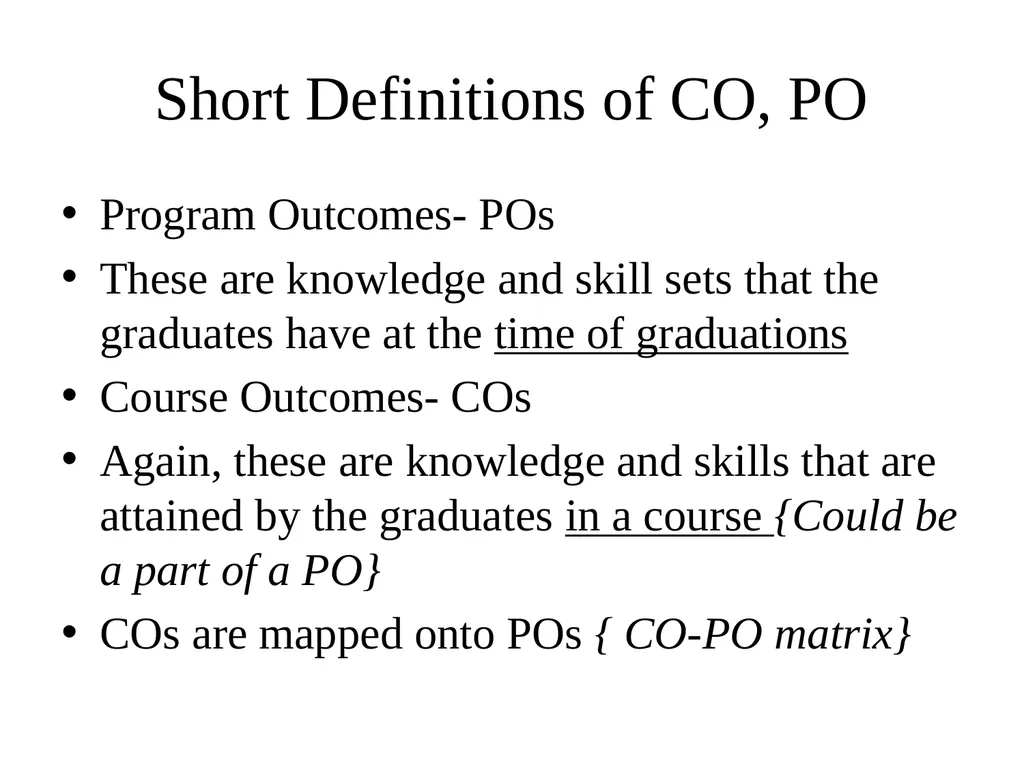
Short Definitions of CO, PO Program Outcomes- POs
These are knowledge and skill sets that the graduates have at the time of graduations
Course Outcomes- COs
Again, these are knowledge and skills that are attained by the graduates in a course {Could be a part of a PO}
COs are mapped onto POs { CO-PO matrix}<br>
These are knowledge and skill sets that the graduates have at the time of graduations
Course Outcomes- COs
Again, these are knowledge and skills that are attained by the graduates in a course {Could be a part of a PO}
COs are mapped onto POs { CO-PO matrix}<br>
04
Curriculum Curriculum, Assessment and Evaluation are the major tools by which Program Outcomes are attained. We should look at all of these together. These need to be designed well.<br>
05
In Curriculum, SAR Seeks Answers to: Process for developing the curriculum exists and has been followed?
The curriculum is well balanced?
Level of syllabi is at the degree level?
Does it allows the NBA Program Outcomes to be attained (critical)?<br>
The curriculum is well balanced?
Level of syllabi is at the degree level?
Does it allows the NBA Program Outcomes to be attained (critical)?<br>
06
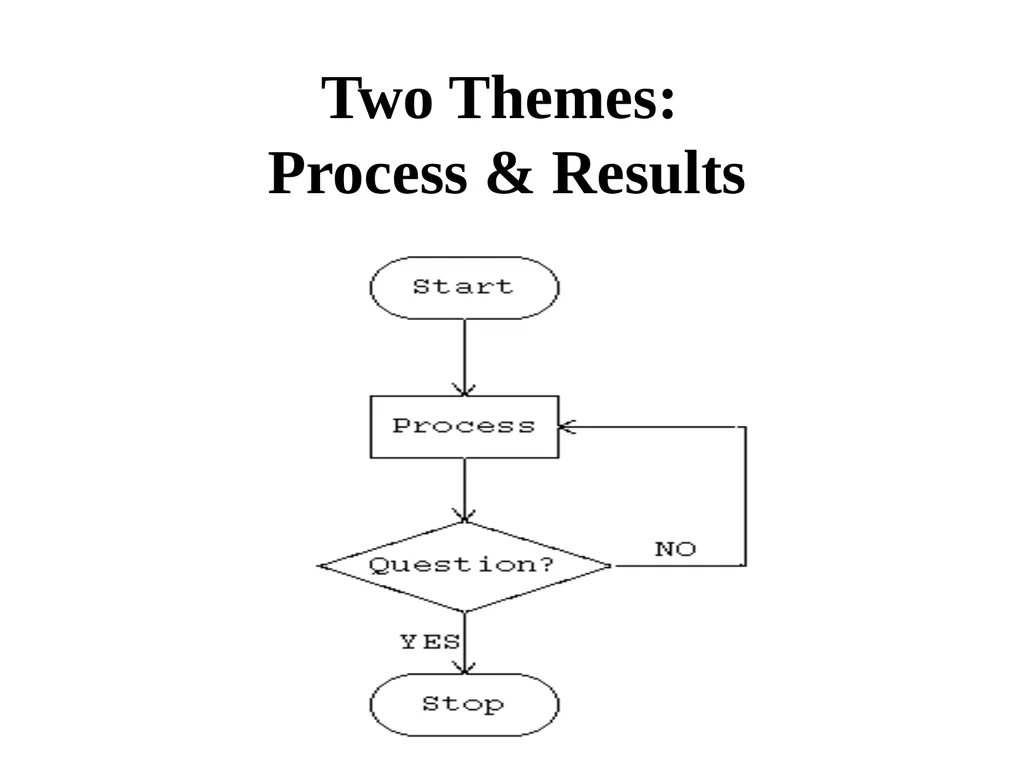
Two Themes:
Process & Results<br>
Process & Results<br>
07
Qu. Will We be able to Attain POs
Under the Curriculum?<br>
08
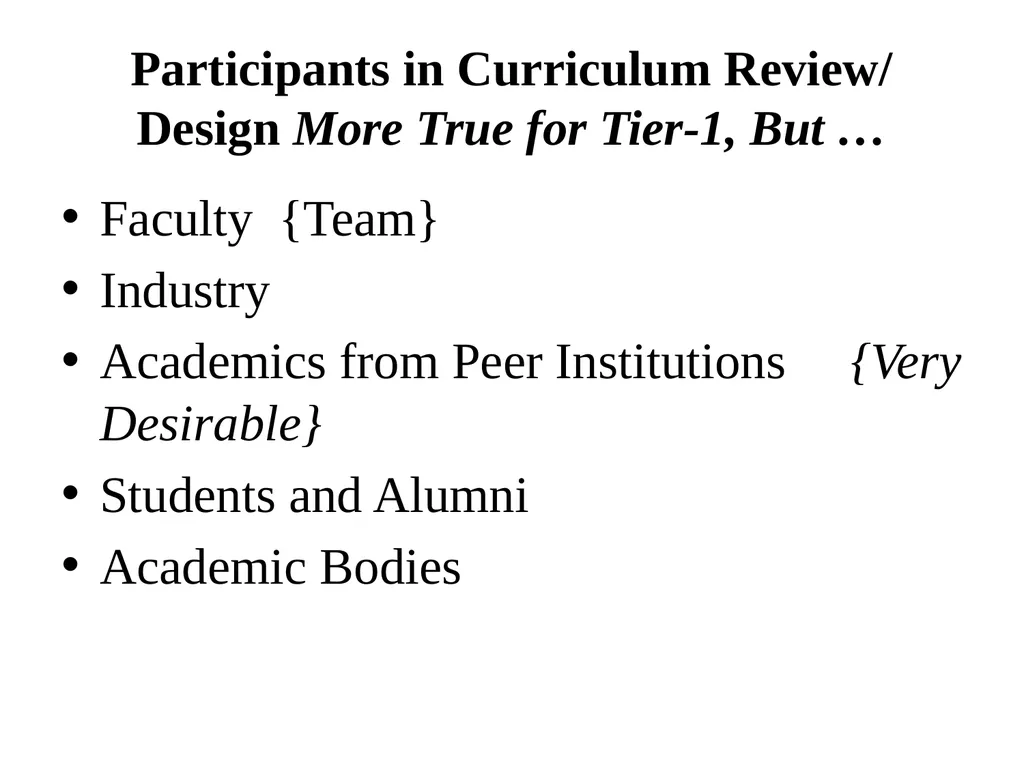
Participants in Curriculum Review/ Design More True for Tier-1, But … Faculty {Team}
Industry
Academics from Peer Institutions {Very Desirable}
Students and Alumni
Academic Bodies<br>
Industry
Academics from Peer Institutions {Very Desirable}
Students and Alumni
Academic Bodies<br>
09
The Curriculum Committee
Needs to Keep in view also
The PEOs & Resources<br>
Needs to Keep in view also
The PEOs & Resources<br>
10
For Tier-1, the entire responsibility rests with the Institutions<br>
11
Structure of Curriculum of a
Typical Engineering Program<br>
12
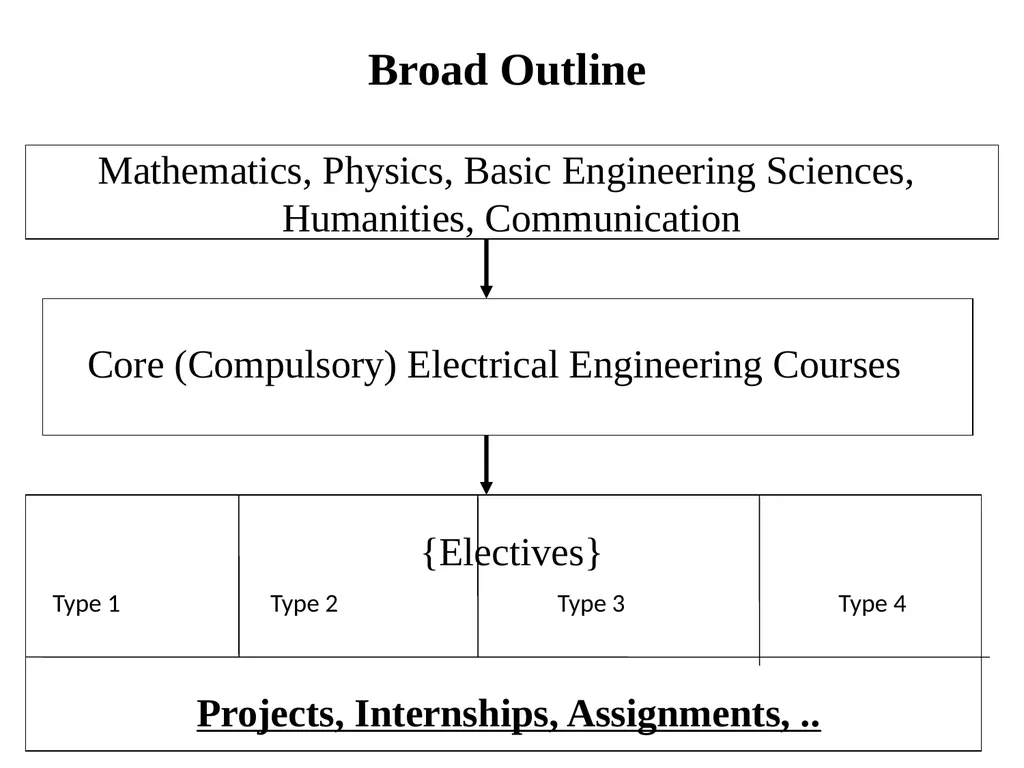
Mathematics, Physics, Basic Engineering Sciences,
Humanities, Communication Core (Compulsory) Electrical Engineering Courses {Electives}
Type 1 Type 2 Type 3 Type 4 Broad Outline Projects, Internships, Assignments, ..<br>
Humanities, Communication Core (Compulsory) Electrical Engineering Courses {Electives}
Type 1 Type 2 Type 3 Type 4 Broad Outline Projects, Internships, Assignments, ..<br>
13
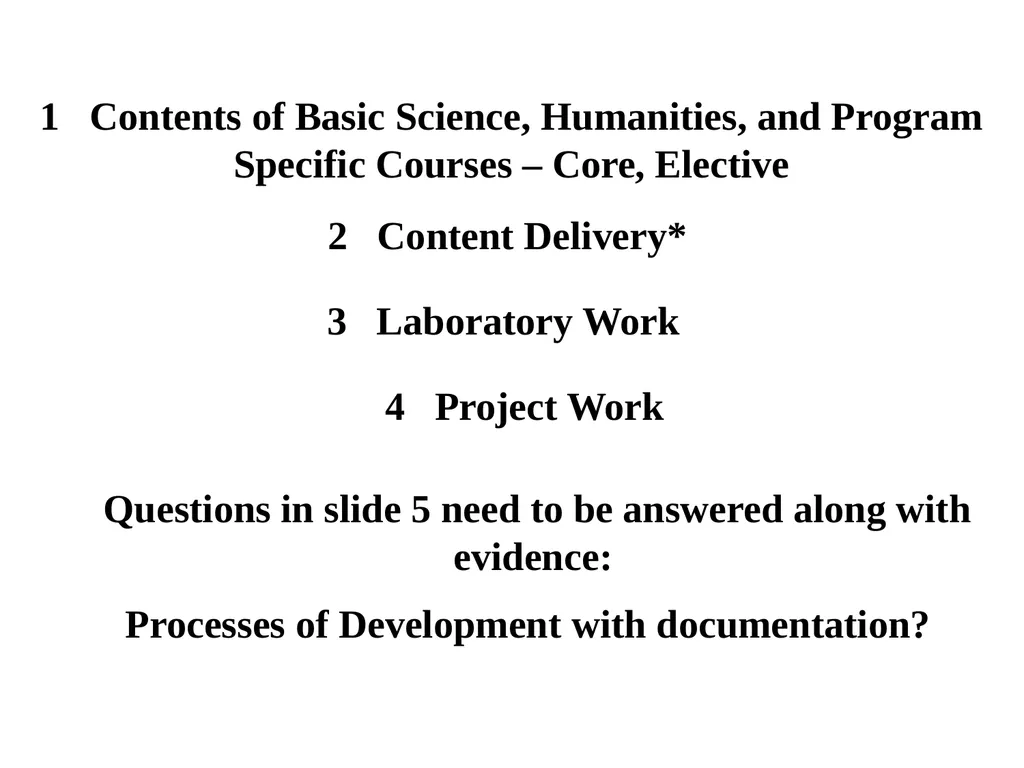
1 Contents of Basic Science, Humanities, and Program Specific Courses – Core, Elective 2 Content Delivery* 3 Laboratory Work 4 Project Work Questions in slide 5 need to be answered along with evidence:
Processes of Development with documentation?<br>
Processes of Development with documentation?<br>
14
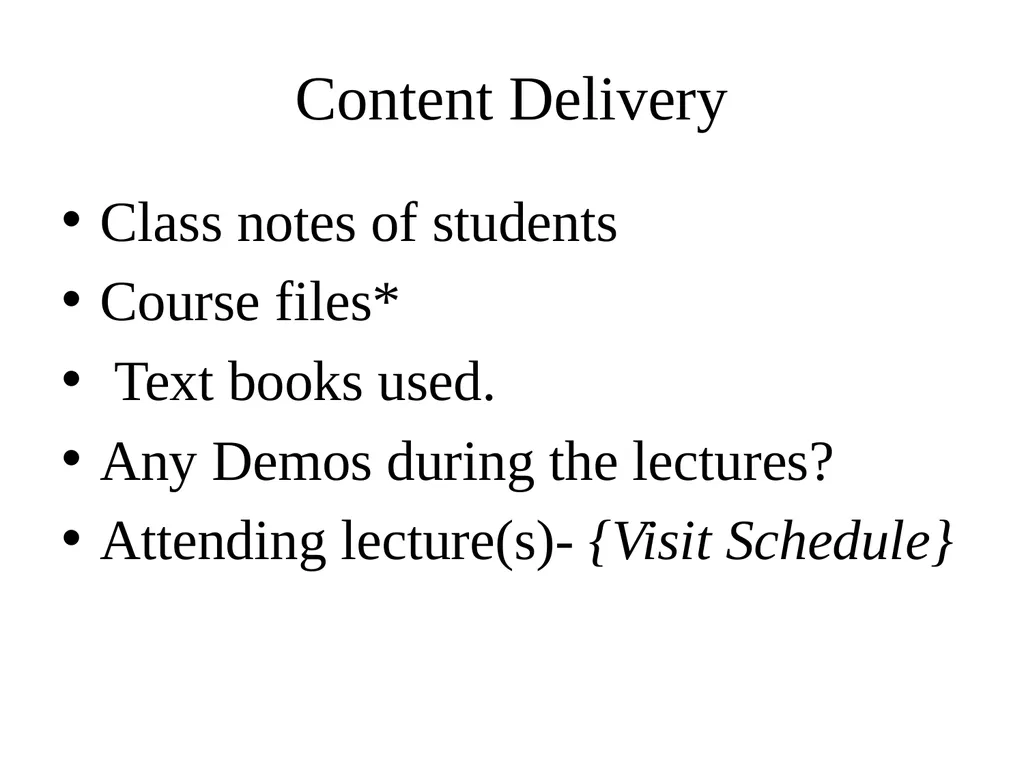
Content Delivery Class notes of students
Course files*
Text books used.
Any Demos during the lectures?
Attending lecture(s)- {Visit Schedule}<br>
Course files*
Text books used.
Any Demos during the lectures?
Attending lecture(s)- {Visit Schedule}<br>
15
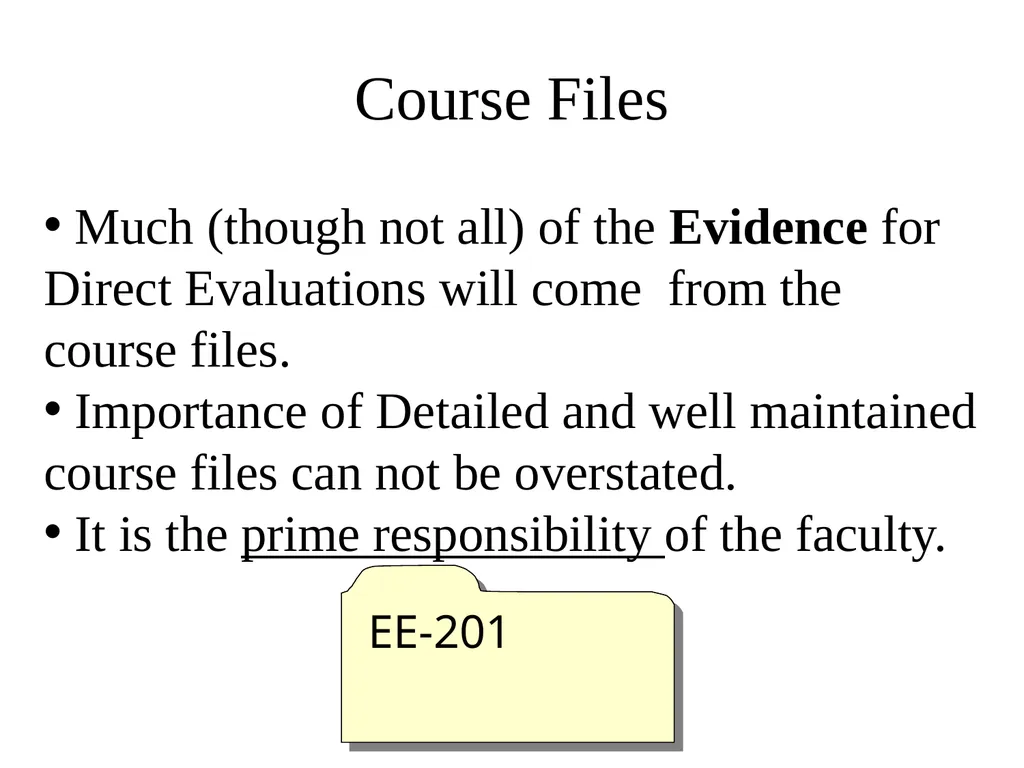
Course Files Much (though not all) of the Evidence for Direct Evaluations will come from the course files.
Importance of Detailed and well maintained course files can not be overstated.
It is the prime responsibility of the faculty. EE-201<br>
Importance of Detailed and well maintained course files can not be overstated.
It is the prime responsibility of the faculty. EE-201<br>
16
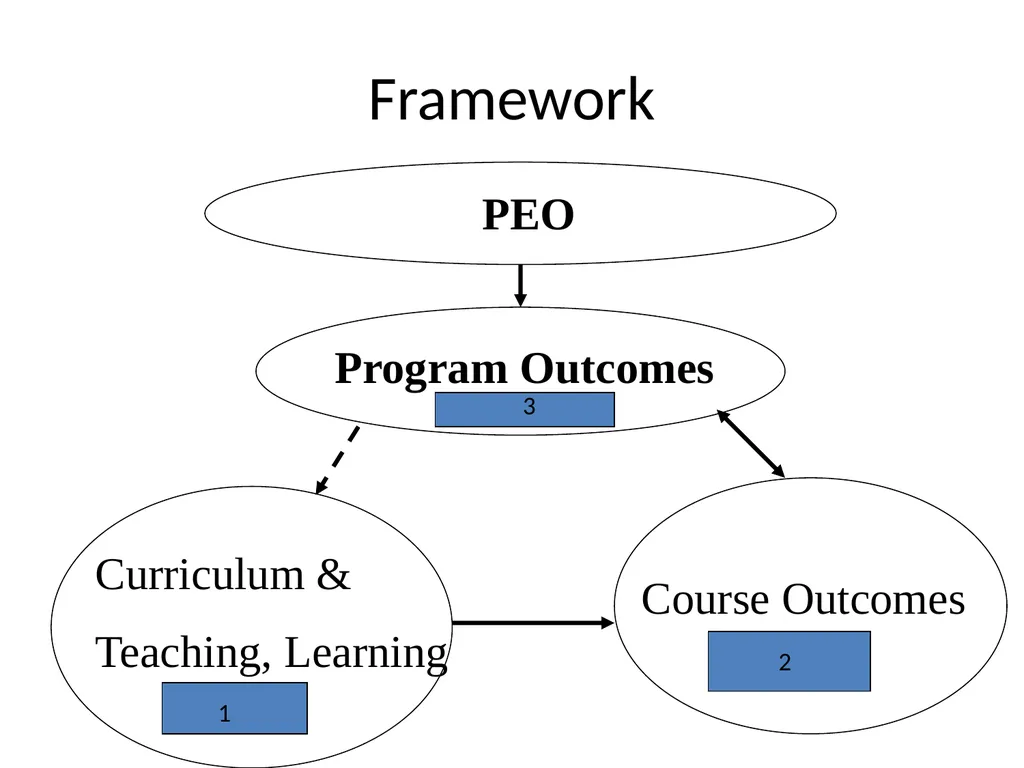
Framework PEO Program Outcomes Curriculum &
Teaching, Learning Course Outcomes 1 2 3<br>
Teaching, Learning Course Outcomes 1 2 3<br>
17
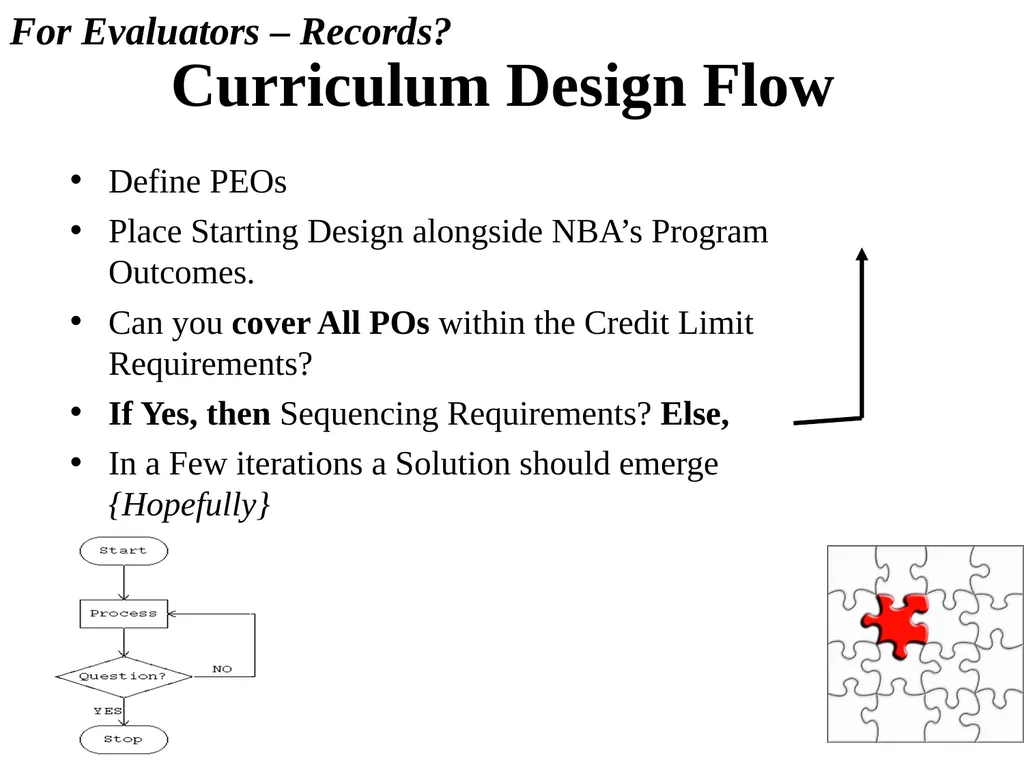
Curriculum Design Flow Define PEOs
Place Starting Design alongside NBA’s Program Outcomes.
Can you cover All POs within the Credit Limit Requirements?
If Yes, then Sequencing Requirements? Else,
In a Few iterations a Solution should emerge {Hopefully} For Evaluators – Records?<br>
Place Starting Design alongside NBA’s Program Outcomes.
Can you cover All POs within the Credit Limit Requirements?
If Yes, then Sequencing Requirements? Else,
In a Few iterations a Solution should emerge {Hopefully} For Evaluators – Records?<br>
18
Sample Syllabus Course: Electrical Circuits and Network Theory.
Offered in either 2nd or 3rd semester to students of Electrical Sciences. Credits: (Typical) 3-1-0. Course is Compulsory.
Course Objective: To prepare a student to take courses normally offered in subsequent semesters, like: Electronic Circuits, Signals and Systems, Advanced Electronics, etc.
Syllabus: The circuit concept as an approximation to a physical system {modeling, Application of laws of physics (PO 1)}. Kirchoff’s Laws, voltage and current sources, Network equations, use of source transformations, Loop and Nodal analysis, Matrix representation of circuit equations and their solutions {Apply knowledge of mathematics (PO1)} Continued…<br>
Offered in either 2nd or 3rd semester to students of Electrical Sciences. Credits: (Typical) 3-1-0. Course is Compulsory.
Course Objective: To prepare a student to take courses normally offered in subsequent semesters, like: Electronic Circuits, Signals and Systems, Advanced Electronics, etc.
Syllabus: The circuit concept as an approximation to a physical system {modeling, Application of laws of physics (PO 1)}. Kirchoff’s Laws, voltage and current sources, Network equations, use of source transformations, Loop and Nodal analysis, Matrix representation of circuit equations and their solutions {Apply knowledge of mathematics (PO1)} Continued…<br>
19
Transient response, solution of differential equations with constant coefficients, initial and final conditions, time constant, its physical significance, and use in solving engineering problems {PO 2 particularly, switching circuits}. Use of Laplace transform in circuit analysis {again PO 1}
Two-port networks, two-port parameters {necessary for all the electronics systems that would follow}, sinusoidal steady state analysis and frequency response
Use of computers for solving large problems {PO 5}
Text books: 1.Van Valkenburg, Network Analysis, 3rd Edition, PHI. {For an 8 credit advanced course}
2. V Del Toro, Electrical Engineering Fundamentals, 2nd Edition
{For a 6 credit standard course}
Course Outcomes: PO 1, PO 2, PO 5
Reference: The Mathematics of Circuit Analysis, E.A. Guillemin, Oxford & IBH<br>
Two-port networks, two-port parameters {necessary for all the electronics systems that would follow}, sinusoidal steady state analysis and frequency response
Use of computers for solving large problems {PO 5}
Text books: 1.Van Valkenburg, Network Analysis, 3rd Edition, PHI. {For an 8 credit advanced course}
2. V Del Toro, Electrical Engineering Fundamentals, 2nd Edition
{For a 6 credit standard course}
Course Outcomes: PO 1, PO 2, PO 5
Reference: The Mathematics of Circuit Analysis, E.A. Guillemin, Oxford & IBH<br>
20
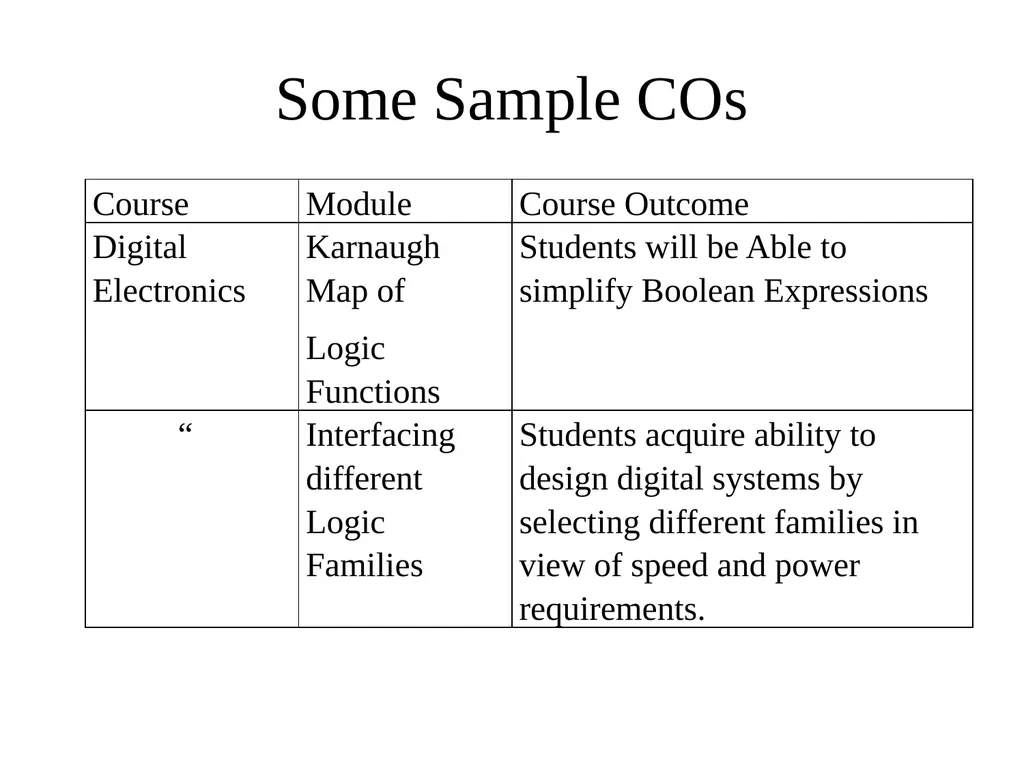
Some Sample COs<br>
21
It is a Good Practice to embed Course Outcomes (CO) in the Syllabus<br>
22
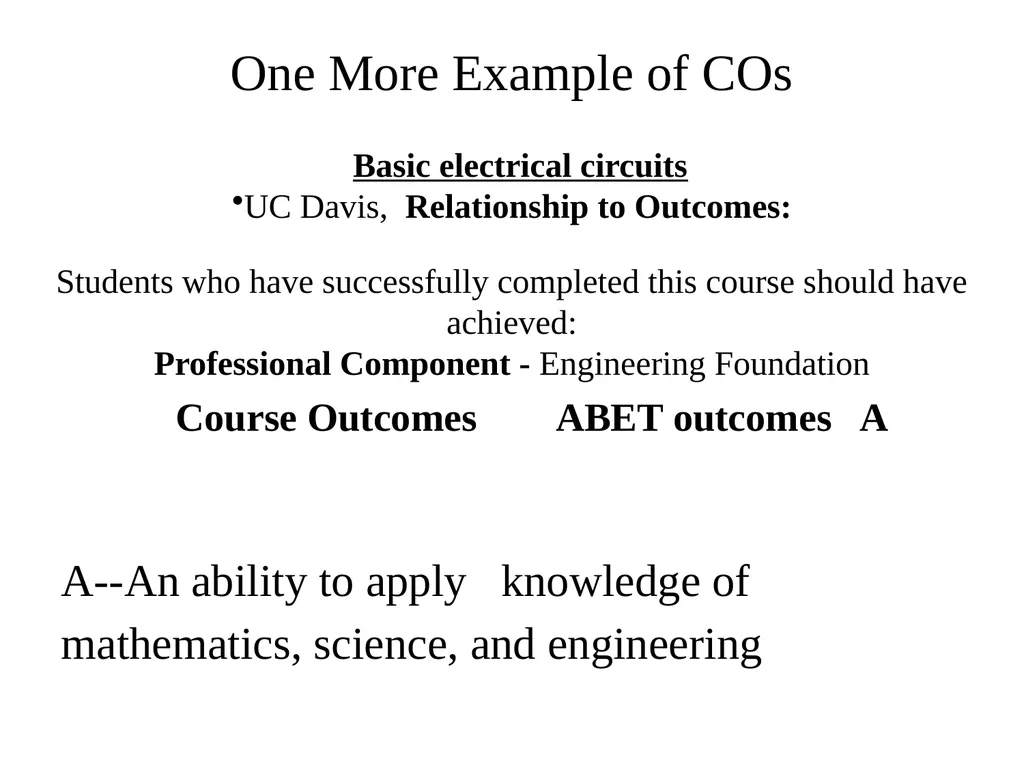
Basic electrical circuits
UC Davis, Relationship to Outcomes:
Students who have successfully completed this course should have achieved:
Professional Component - Engineering Foundation A--An ability to apply knowledge of mathematics, science, and engineering One More Example of COs<br>
UC Davis, Relationship to Outcomes:
Students who have successfully completed this course should have achieved:
Professional Component - Engineering Foundation A--An ability to apply knowledge of mathematics, science, and engineering One More Example of COs<br>
23
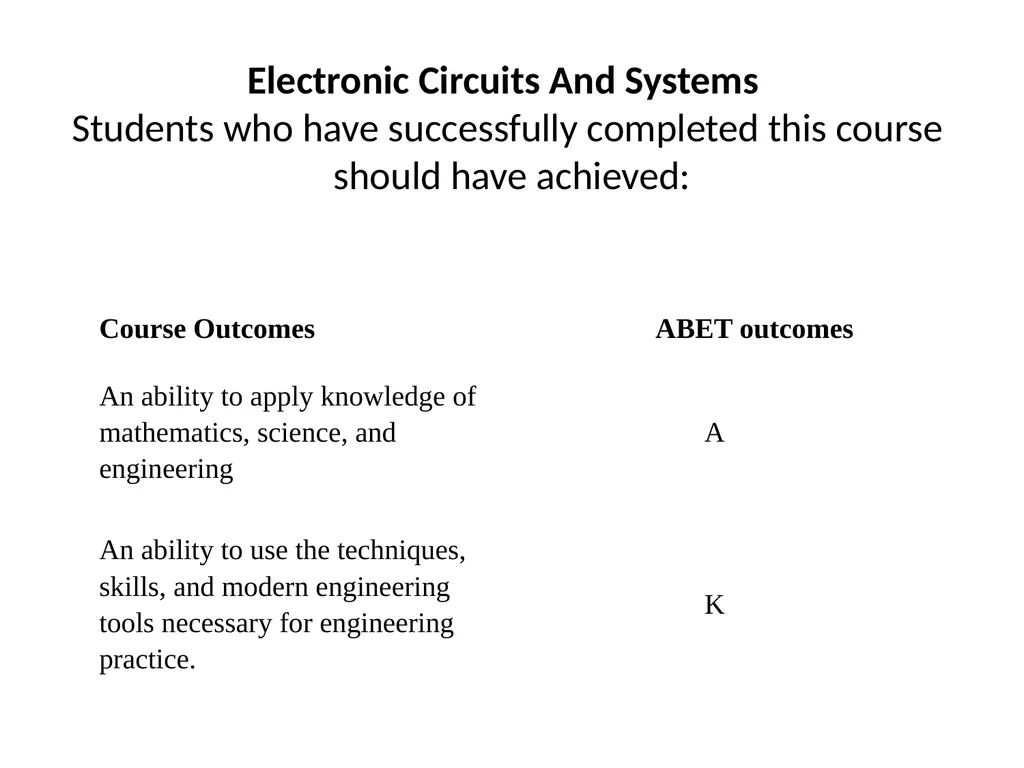
Electronic Circuits And Systems
Students who have successfully completed this course
should have achieved:<br>
Students who have successfully completed this course
should have achieved:<br>
24
One more Example
Next Three Slides
University of Florida
Department of Electrical and Computer Engineering
From the
Course : Foundations of Digital Signal Processing
Semester – Fall 2018<br>
Next Three Slides
University of Florida
Department of Electrical and Computer Engineering
From the
Course : Foundations of Digital Signal Processing
Semester – Fall 2018<br>
25
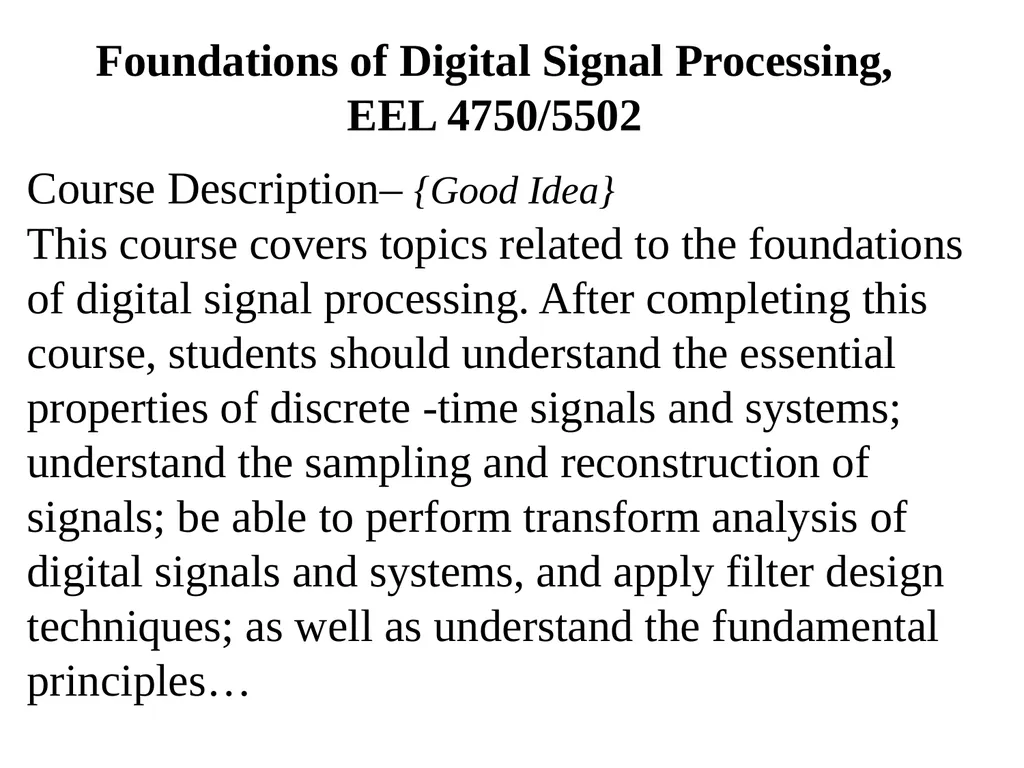
Foundations of Digital Signal Processing, EEL 4750/5502 Course Description– {Good Idea}
This course covers topics related to the foundations of digital signal processing. After completing this course, students should understand the essential properties of discrete -time signals and systems; understand the sampling and reconstruction of signals; be able to perform transform analysis of digital signals and systems, and apply filter design techniques; as well as understand the fundamental principles…<br>
This course covers topics related to the foundations of digital signal processing. After completing this course, students should understand the essential properties of discrete -time signals and systems; understand the sampling and reconstruction of signals; be able to perform transform analysis of digital signals and systems, and apply filter design techniques; as well as understand the fundamental principles…<br>
26
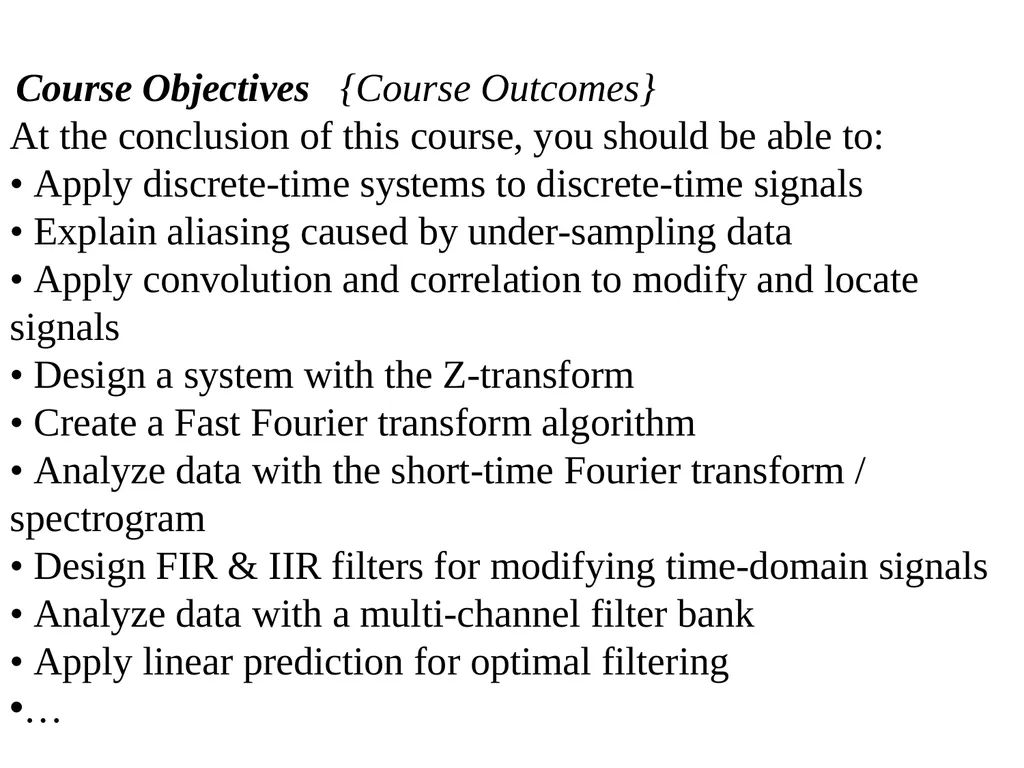
Course Objectives {Course Outcomes}
At the conclusion of this course, you should be able to:
• Apply discrete-time systems to discrete-time signals
• Explain aliasing caused by under-sampling data
• Apply convolution and correlation to modify and locate signals
• Design a system with the Z-transform
• Create a Fast Fourier transform algorithm
• Analyze data with the short-time Fourier transform / spectrogram
• Design FIR & IIR filters for modifying time-domain signals
• Analyze data with a multi-channel filter bank
• Apply linear prediction for optimal filtering
…<br>
At the conclusion of this course, you should be able to:
• Apply discrete-time systems to discrete-time signals
• Explain aliasing caused by under-sampling data
• Apply convolution and correlation to modify and locate signals
• Design a system with the Z-transform
• Create a Fast Fourier transform algorithm
• Analyze data with the short-time Fourier transform / spectrogram
• Design FIR & IIR filters for modifying time-domain signals
• Analyze data with a multi-channel filter bank
• Apply linear prediction for optimal filtering
…<br>
27
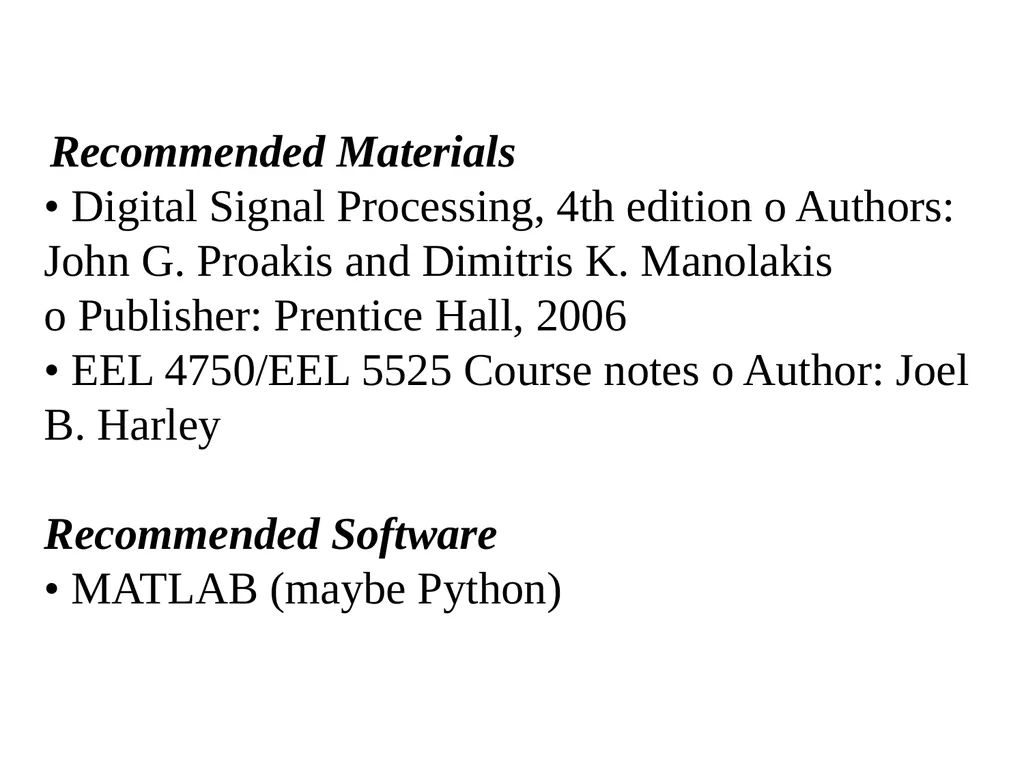
Recommended Materials
• Digital Signal Processing, 4th edition o Authors: John G. Proakis and Dimitris K. Manolakis
o Publisher: Prentice Hall, 2006
• EEL 4750/EEL 5525 Course notes o Author: Joel B. Harley
Recommended Software
• MATLAB (maybe Python)<br>
• Digital Signal Processing, 4th edition o Authors: John G. Proakis and Dimitris K. Manolakis
o Publisher: Prentice Hall, 2006
• EEL 4750/EEL 5525 Course notes o Author: Joel B. Harley
Recommended Software
• MATLAB (maybe Python)<br>
28
Typical Documents
Needed by Evaluators Curriculum Development Process Documents- {Committee constitution, Participants, Agendas and Minutes of meetings, etc}*
Courses of Study Bulletin- {Syllabi, Text books, Reference material, Credit structure, etc.}<br>
Courses of Study Bulletin- {Syllabi, Text books, Reference material, Credit structure, etc.}<br>
29
Have we answered all the questions that we had raised at the beginning?<br>
30
In Curriculum, SAR Seeks Answers to: Process for developing the curriculum exists and has been followed?
The curriculum is well balanced?
Level of syllabi is at the degree level?
It allows the NBA Program Outcomes to be attained (critical)<br>
The curriculum is well balanced?
Level of syllabi is at the degree level?
It allows the NBA Program Outcomes to be attained (critical)<br>
31
Q1. Process for developing the curriculum exists and has been followed? Yes / No?<br>
32
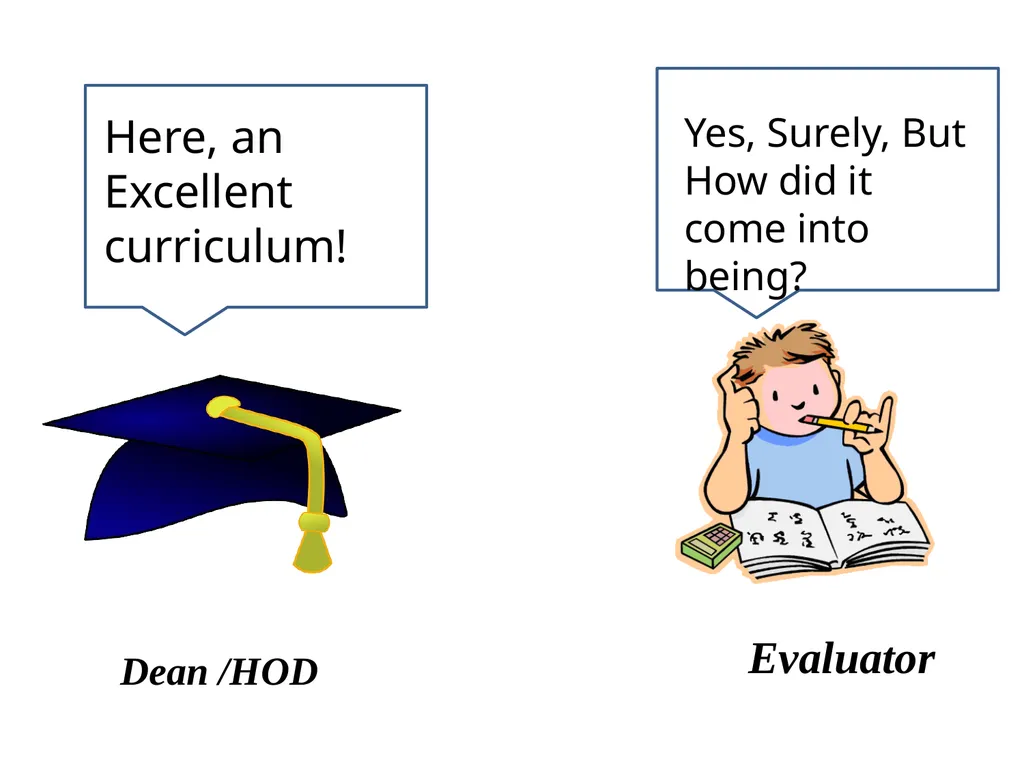
Here, an Excellent curriculum! Yes, Surely, But How did it come into being? Evaluator Dean /HOD<br>
33
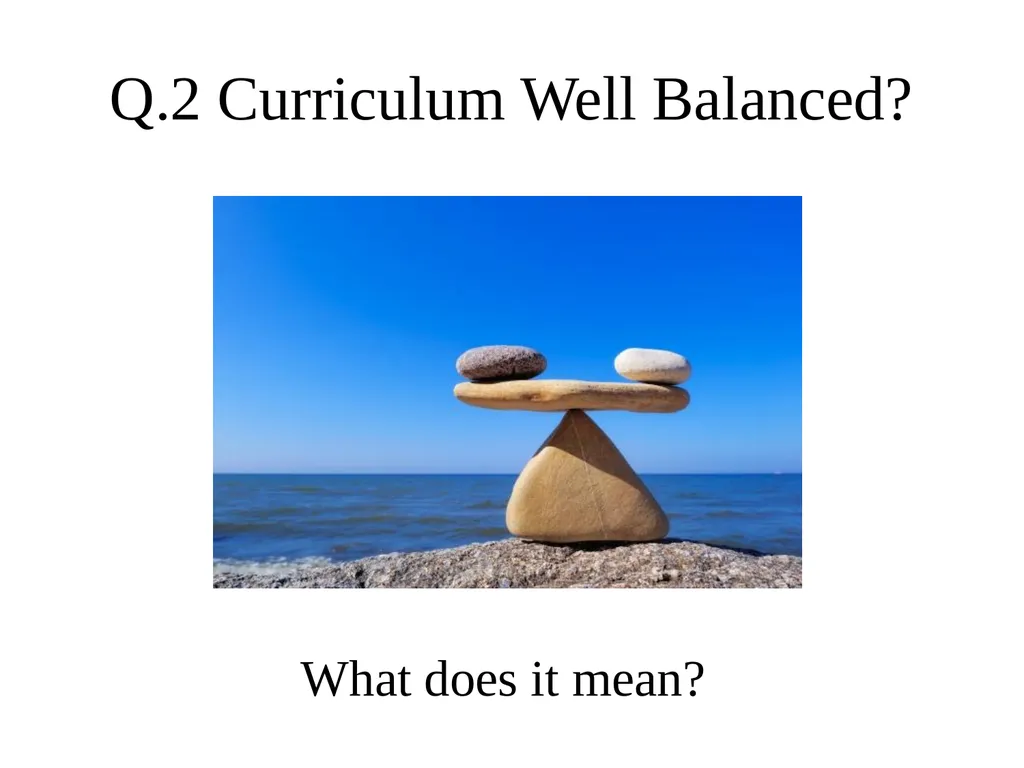
Q.2 Curriculum Well Balanced? What does it mean?<br>
34
“General Institute Requirements,” the rigorous foundation in natural science, mathematics, technology, humanities, arts, and social sciences that forms the core curriculum of an MIT undergraduate education.
The Task Force affirms the many ways in which this common curriculum has successfully prepared MIT’s graduates for a lifetime of learning and leadership Task Force on the Undergraduate Educational Commons
Massachusetts Institute of Technology, October 2006<br>
The Task Force affirms the many ways in which this common curriculum has successfully prepared MIT’s graduates for a lifetime of learning and leadership Task Force on the Undergraduate Educational Commons
Massachusetts Institute of Technology, October 2006<br>
35
ABET’s Take on Balance The curriculum must support attainment of the student outcomes and must include:
(a) one academic year of a combination of college-level mathematics and basic sciences (some with experimental experience).
(b) one and one-half academic years of engineering topics, of engineering sciences and engineering and utilizing modern engineering tools.<br>
(a) one academic year of a combination of college-level mathematics and basic sciences (some with experimental experience).
(b) one and one-half academic years of engineering topics, of engineering sciences and engineering and utilizing modern engineering tools.<br>
36
(c) a broad education component that includes humanities and social sciences, complements the technical content of the curriculum, and is consistent with the PEOs.
Students must be prepared to enter the professional practice of engineering through a curriculum culminating in a major design experience based on the knowledge and skills acquired in earlier course work<br>
Students must be prepared to enter the professional practice of engineering through a curriculum culminating in a major design experience based on the knowledge and skills acquired in earlier course work<br>
37
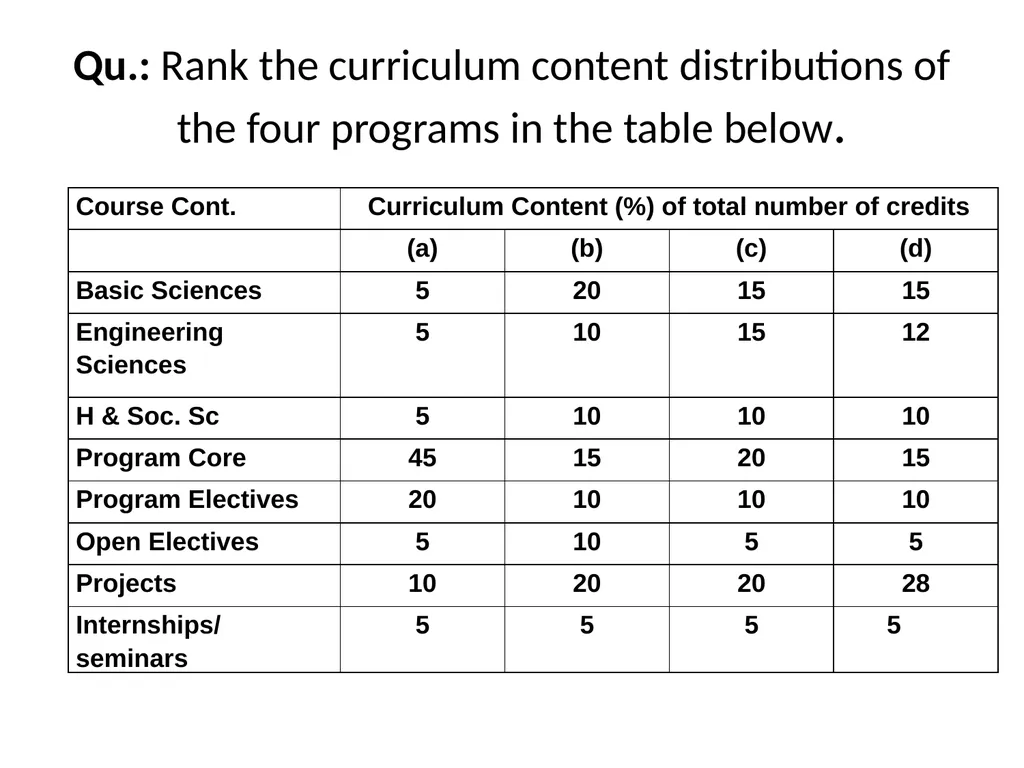
Qu.: Rank the curriculum content distributions of the four programs in the table below.<br>
38
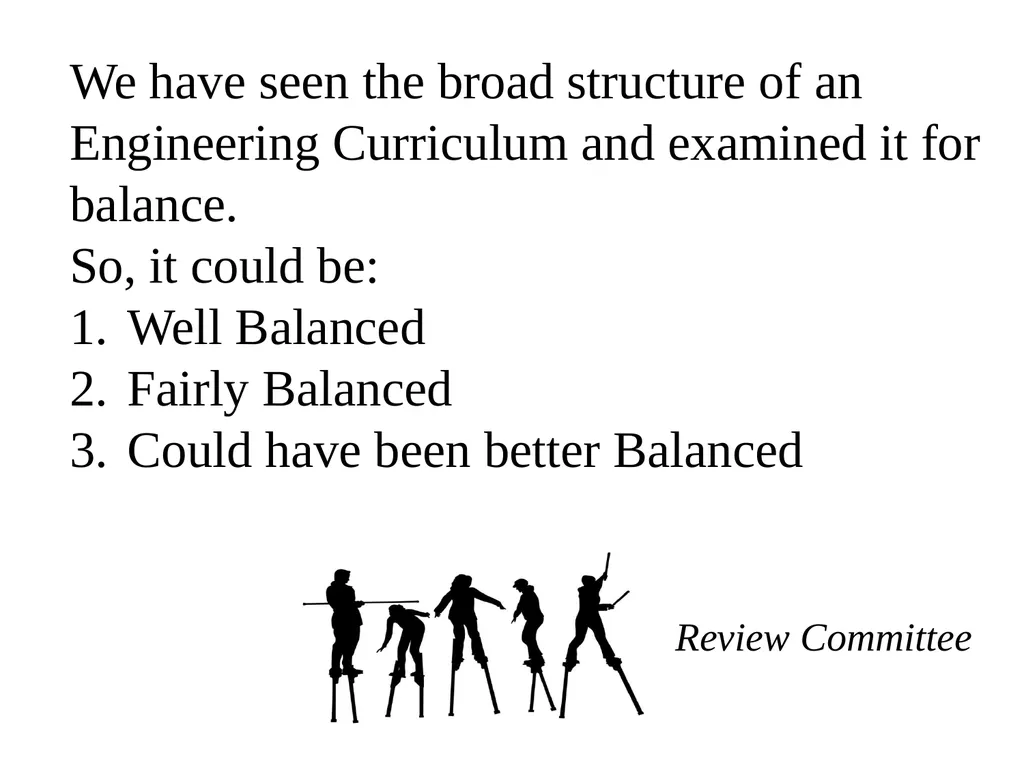
We have seen the broad structure of an Engineering Curriculum and examined it for balance.
So, it could be:
Well Balanced
Fairly Balanced
Could have been better Balanced Review Committee<br>
So, it could be:
Well Balanced
Fairly Balanced
Could have been better Balanced Review Committee<br>
39
Q 3. Level of syllabi is at the degree level? This is a judgment call that
Experts have to take<br>
Experts have to take<br>
40
Q4. Does it ( the Curriculum)allow the NBA Program Outcomes to be attained (critical)
How? Was Answered in Part- 1<br>
41
If All the Four Questions
can be Answered in the
Affirmative
The Job is Done!<br>
can be Answered in the
Affirmative
The Job is Done!<br>
42
End Part 2<br>
43
Thank You!<br>
44
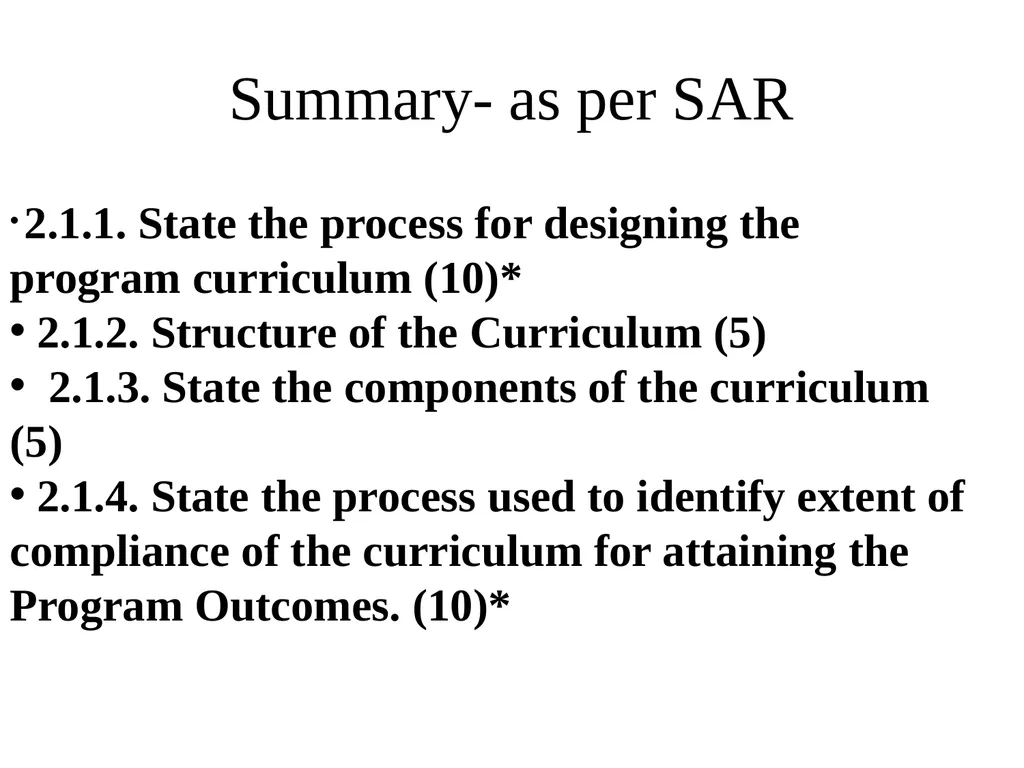
Summary- as per SAR 2.1.1. State the process for designing the program curriculum (10)*
2.1.2. Structure of the Curriculum (5)
2.1.3. State the components of the curriculum (5)
2.1.4. State the process used to identify extent of compliance of the curriculum for attaining the Program Outcomes. (10)*<br>
2.1.2. Structure of the Curriculum (5)
2.1.3. State the components of the curriculum (5)
2.1.4. State the process used to identify extent of compliance of the curriculum for attaining the Program Outcomes. (10)*<br>
45
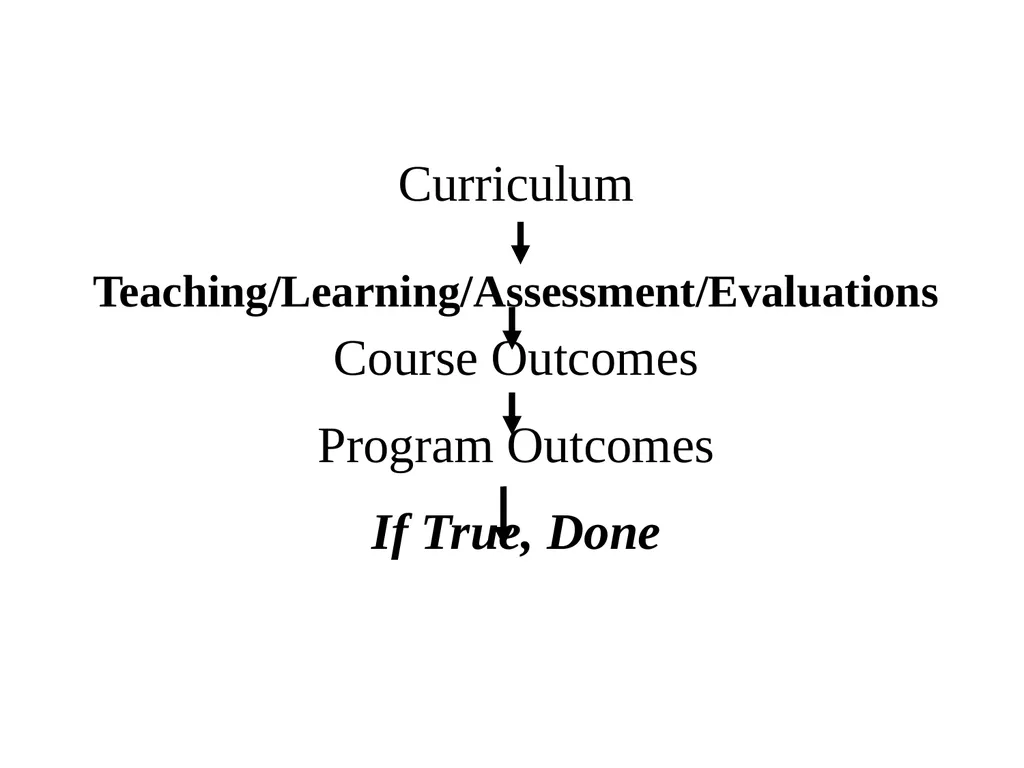
Curriculum
Course Outcomes
Program Outcomes
If True, Done Teaching/Learning/Assessment/Evaluations<br>
Course Outcomes
Program Outcomes
If True, Done Teaching/Learning/Assessment/Evaluations<br>
46
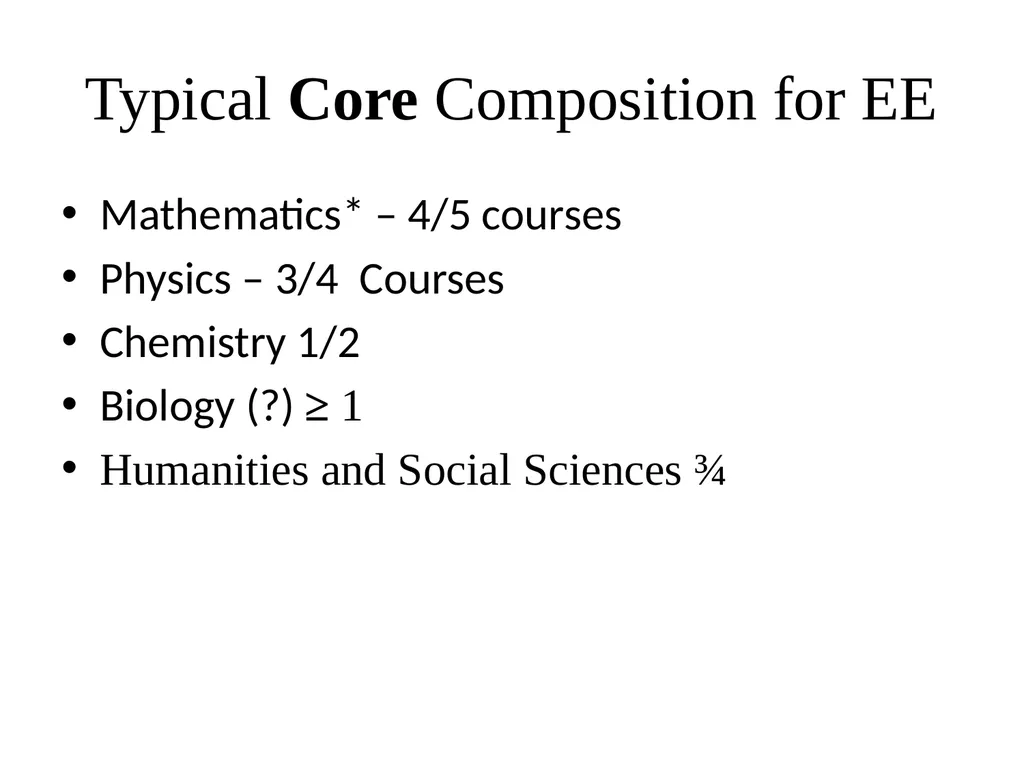
Typical Core Composition for EE Mathematics* – 4/5 courses
Physics – 3/4 Courses
Chemistry 1/2
Biology (?) ≥ 1
Humanities and Social Sciences ¾<br>
Physics – 3/4 Courses
Chemistry 1/2
Biology (?) ≥ 1
Humanities and Social Sciences ¾<br>
47
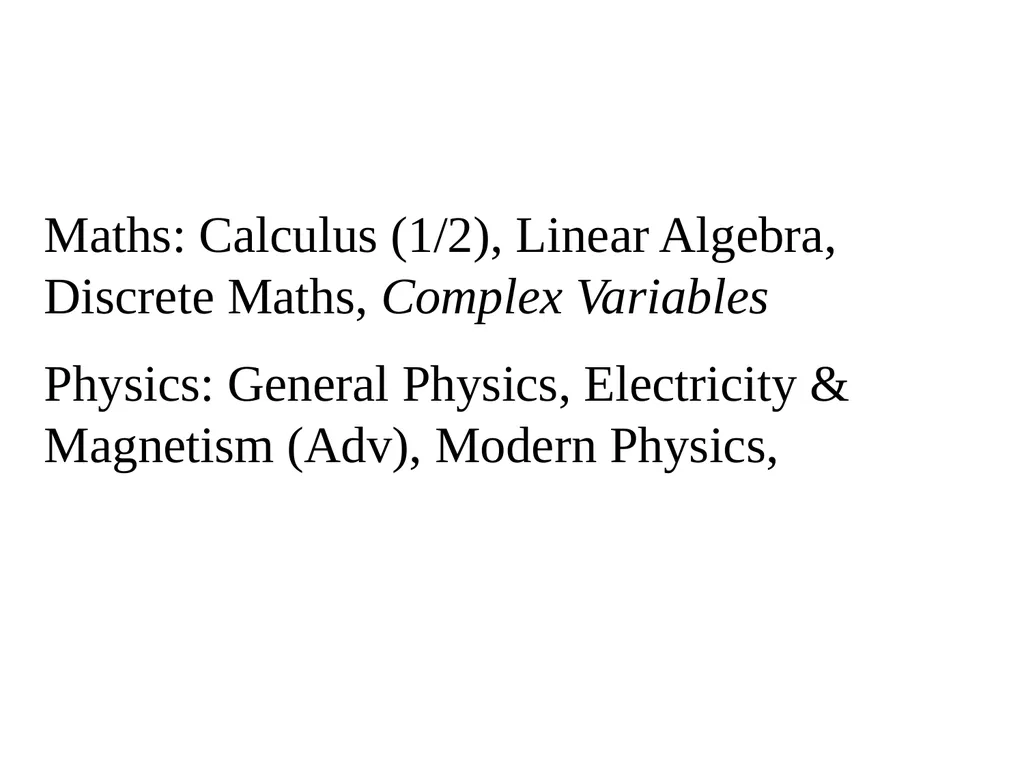
Maths: Calculus (1/2), Linear Algebra, Discrete Maths, Complex Variables
Physics: General Physics, Electricity & Magnetism (Adv), Modern Physics,<br>
Physics: General Physics, Electricity & Magnetism (Adv), Modern Physics,<br>
48
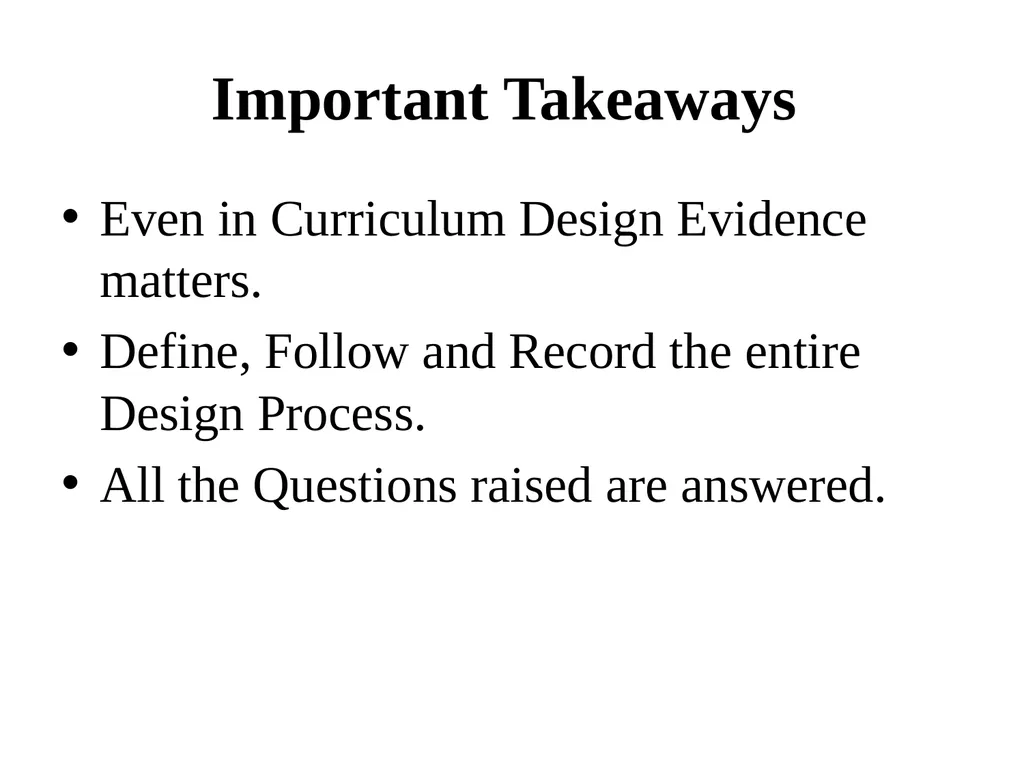
Important Takeaways Even in Curriculum Design Evidence matters.
Define, Follow and Record the entire Design Process.
All the Questions raised are answered.<br>
Define, Follow and Record the entire Design Process.
All the Questions raised are answered.<br>
49
Curiosity & "curiosity killed the cat" "but satisfaction brought it back".<br>
50
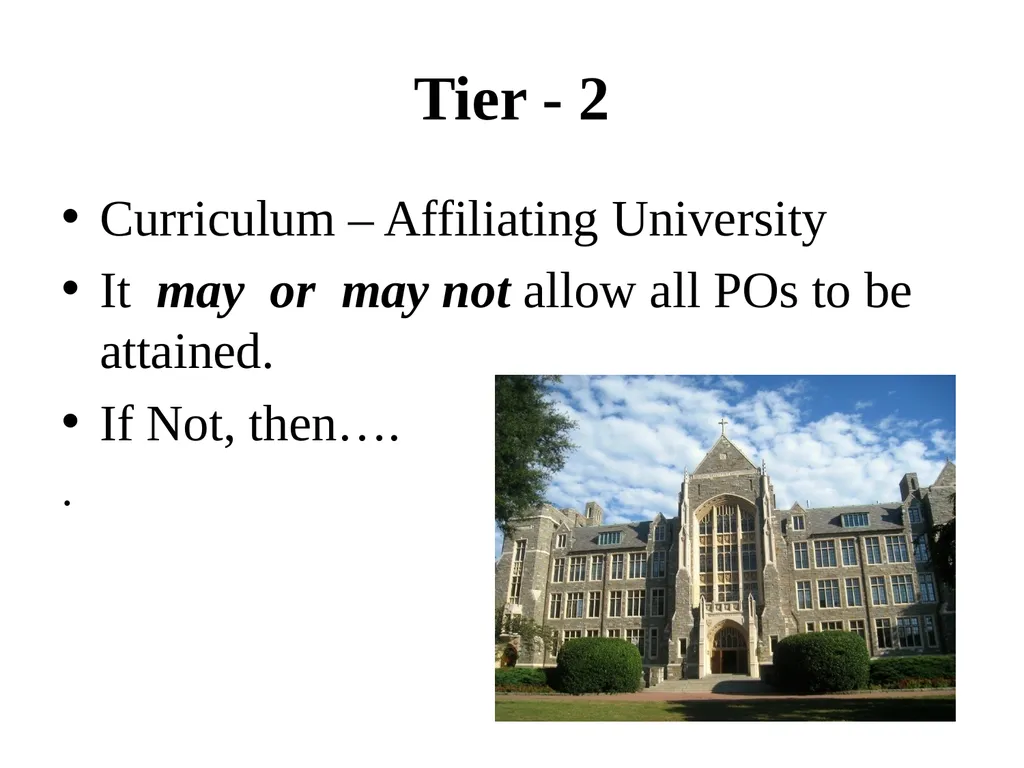
Tier - 2 Curriculum – Affiliating University
It may or may not allow all POs to be attained.
If Not, then….
.<br>
It may or may not allow all POs to be attained.
If Not, then….
.<br>
51
Curriculum Design Process for Tier – 2: Determine which POs are attainable by the University Curriculum..
Leads to gaps (if any) to be identified.
List All the Gaps.
Design additions to the curriculum to bridge gaps – and Document all these processes.
{May be, It’s a good idea to keep the University informed}<br>
Leads to gaps (if any) to be identified.
List All the Gaps.
Design additions to the curriculum to bridge gaps – and Document all these processes.
{May be, It’s a good idea to keep the University informed}<br>