
Curriculum Integration to promote student outcomes
GB
Published · 12 slides · 0 views

1 / 1

Description
Curriculum Integration to promote student outcomes Rachel Blackshire Grand Canyon University EAD 520 Dr. Schlabra March 2, 2022 Planning Units Versus Individual Lessons Planning Units Promotes collaboration among teachers across content
Related Topics
Share
Embed code
Download this presentation From Below
"Curriculum Integration to promote student outcomes" is the property of its rightful owner. Permission is granted to download and print the materials on this website for personal, non-commercial use only, and to display it on your personal computer provided you do not modify the materials and that you retain all copyright notices contained in the materials. By downloading content from our website, you accept the terms of this agreement.
Presentation Transcript
01
Curriculum Integration to promote student outcomes Rachel Blackshire
Grand Canyon University
EAD 520 Dr. Schlabra
March 2, 2022<br>
Grand Canyon University
EAD 520 Dr. Schlabra
March 2, 2022<br>
02
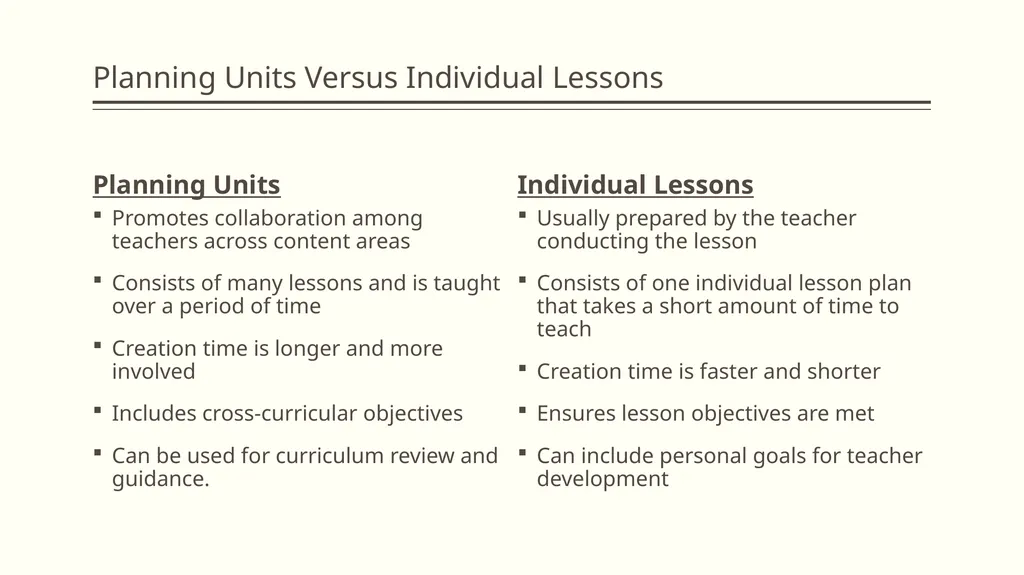
Planning Units Versus Individual Lessons Planning Units Promotes collaboration among teachers across content areas
Consists of many lessons and is taught over a period of time
Creation time is longer and more involved
Includes cross-curricular objectives
Can be used for curriculum review and guidance. Individual Lessons Usually prepared by the teacher conducting the lesson
Consists of one individual lesson plan that takes a short amount of time to teach
Creation time is faster and shorter
Ensures lesson objectives are met
Can include personal goals for teacher development<br>
Consists of many lessons and is taught over a period of time
Creation time is longer and more involved
Includes cross-curricular objectives
Can be used for curriculum review and guidance. Individual Lessons Usually prepared by the teacher conducting the lesson
Consists of one individual lesson plan that takes a short amount of time to teach
Creation time is faster and shorter
Ensures lesson objectives are met
Can include personal goals for teacher development<br>
03
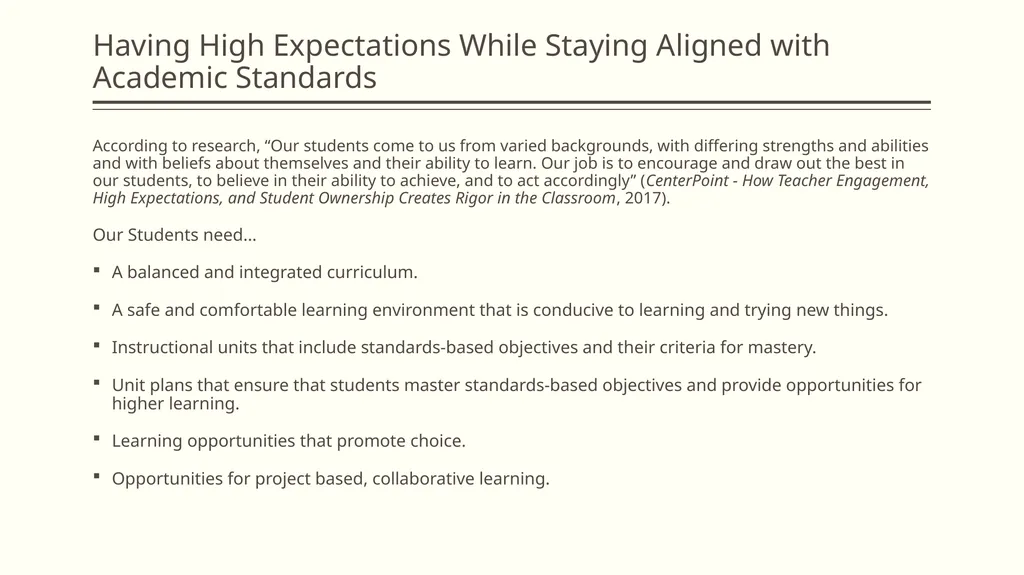
Having High Expectations While Staying Aligned with Academic Standards According to research, “Our students come to us from varied backgrounds, with differing strengths and abilities and with beliefs about themselves and their ability to learn. Our job is to encourage and draw out the best in our students, to believe in their ability to achieve, and to act accordingly” (CenterPoint - How Teacher Engagement, High Expectations, and Student Ownership Creates Rigor in the Classroom, 2017).
Our Students need…
A balanced and integrated curriculum.
A safe and comfortable learning environment that is conducive to learning and trying new things.
Instructional units that include standards-based objectives and their criteria for mastery.
Unit plans that ensure that students master standards-based objectives and provide opportunities for higher learning.
Learning opportunities that promote choice.
Opportunities for project based, collaborative learning.<br>
Our Students need…
A balanced and integrated curriculum.
A safe and comfortable learning environment that is conducive to learning and trying new things.
Instructional units that include standards-based objectives and their criteria for mastery.
Unit plans that ensure that students master standards-based objectives and provide opportunities for higher learning.
Learning opportunities that promote choice.
Opportunities for project based, collaborative learning.<br>
04
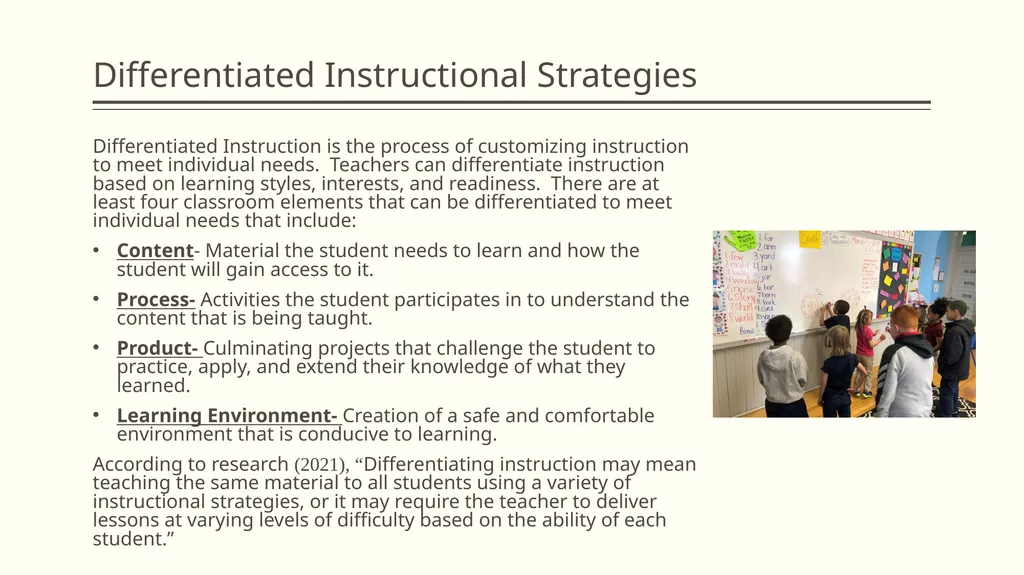
Differentiated Instructional Strategies Differentiated Instruction is the process of customizing instruction to meet individual needs. Teachers can differentiate instruction based on learning styles, interests, and readiness. There are at least four classroom elements that can be differentiated to meet individual needs that include:
Content- Material the student needs to learn and how the student will gain access to it.
Process- Activities the student participates in to understand the content that is being taught.
Product- Culminating projects that challenge the student to practice, apply, and extend their knowledge of what they learned.
Learning Environment- Creation of a safe and comfortable environment that is conducive to learning.
According to research (2021), “Differentiating instruction may mean teaching the same material to all students using a variety of instructional strategies, or it may require the teacher to deliver lessons at varying levels of difficulty based on the ability of each student.”<br>
Content- Material the student needs to learn and how the student will gain access to it.
Process- Activities the student participates in to understand the content that is being taught.
Product- Culminating projects that challenge the student to practice, apply, and extend their knowledge of what they learned.
Learning Environment- Creation of a safe and comfortable environment that is conducive to learning.
According to research (2021), “Differentiating instruction may mean teaching the same material to all students using a variety of instructional strategies, or it may require the teacher to deliver lessons at varying levels of difficulty based on the ability of each student.”<br>
05
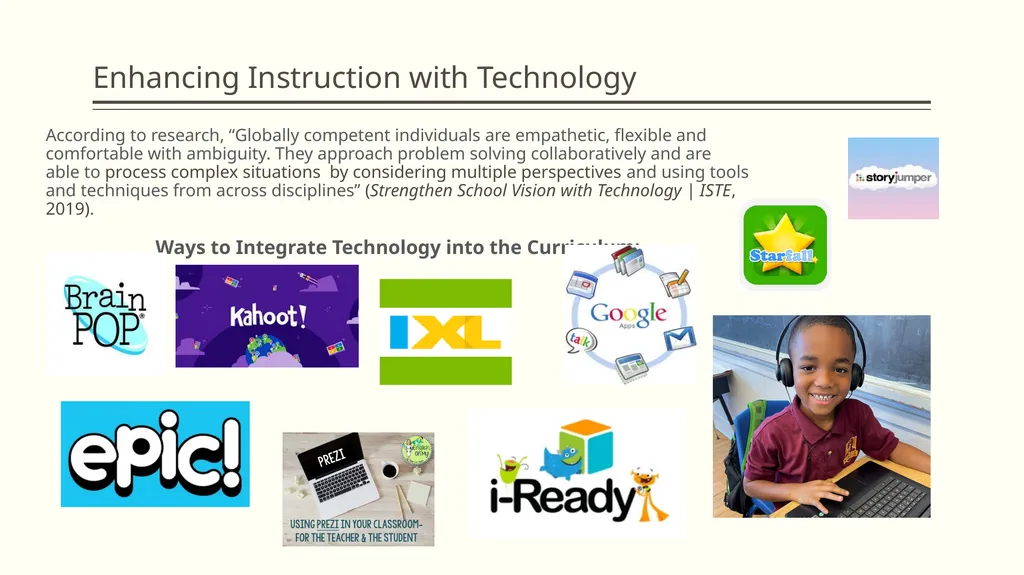
Enhancing Instruction with Technology According to research, “Globally competent individuals are empathetic, flexible and comfortable with ambiguity. They approach problem solving collaboratively and are able to process complex situations by considering multiple perspectives and using tools and techniques from across disciplines” (Strengthen School Vision with Technology | ISTE, 2019).
Ways to Integrate Technology into the Curriculum:<br>
Ways to Integrate Technology into the Curriculum:<br>
06
Implementing a Non-Culturally Biased Curriculum Research shows that “Culturally responsive teaching is an approach that “empowers students intellectually, socially, emotionally, and politically by using cultural referents to impart knowledge, skills, and attitudes” (Ladson-Billings, 2014)” (Gulati, 2021).
Creating a Non-Culturally Biased Classroom
Implement an “inclusive” curriculum that is respectful of differences.
Show interest in the ethic backgrounds of students.
Seek opportunities to be a facilitator of learning instead of an instructor of learning.
Be respectful and sensitive to language concerns.
Maintain high expectations for student performance.<br>
Creating a Non-Culturally Biased Classroom
Implement an “inclusive” curriculum that is respectful of differences.
Show interest in the ethic backgrounds of students.
Seek opportunities to be a facilitator of learning instead of an instructor of learning.
Be respectful and sensitive to language concerns.
Maintain high expectations for student performance.<br>
07
Integrating the Vision and Mission Mission
Our school is committed to providing a safe, nurturing environment where our students develop positive self-esteem, leadership skills, multi-cultural awareness, community involvement, and a love for life-long learning while striving to achieve academic excellence.
Vision
Our vision is to develop students who are curious and creative learners who succeed through a rigorous academic program and high academic goals. We will ensure that they become critical thinkers who possess technological competence. Our students will embrace diversity, learn to act responsibly, and contribute to our community through service and good stewardship of our resources. Our educators will ensure that all students can meet or exceed rigorous academic standards. They will be compassionate and empathetic but not enablers or have low expectations. Teachers, staff, and administrators will all work together to form a rich professional learning community. Through the examination of our instructional practices and data, we will adjust our teaching and operational systems in order to continuously improve. Our Families and Community are integral to the success of our students and schools, and they will be treated as active, engaged and welcomed partners.<br>
Our school is committed to providing a safe, nurturing environment where our students develop positive self-esteem, leadership skills, multi-cultural awareness, community involvement, and a love for life-long learning while striving to achieve academic excellence.
Vision
Our vision is to develop students who are curious and creative learners who succeed through a rigorous academic program and high academic goals. We will ensure that they become critical thinkers who possess technological competence. Our students will embrace diversity, learn to act responsibly, and contribute to our community through service and good stewardship of our resources. Our educators will ensure that all students can meet or exceed rigorous academic standards. They will be compassionate and empathetic but not enablers or have low expectations. Teachers, staff, and administrators will all work together to form a rich professional learning community. Through the examination of our instructional practices and data, we will adjust our teaching and operational systems in order to continuously improve. Our Families and Community are integral to the success of our students and schools, and they will be treated as active, engaged and welcomed partners.<br>
08
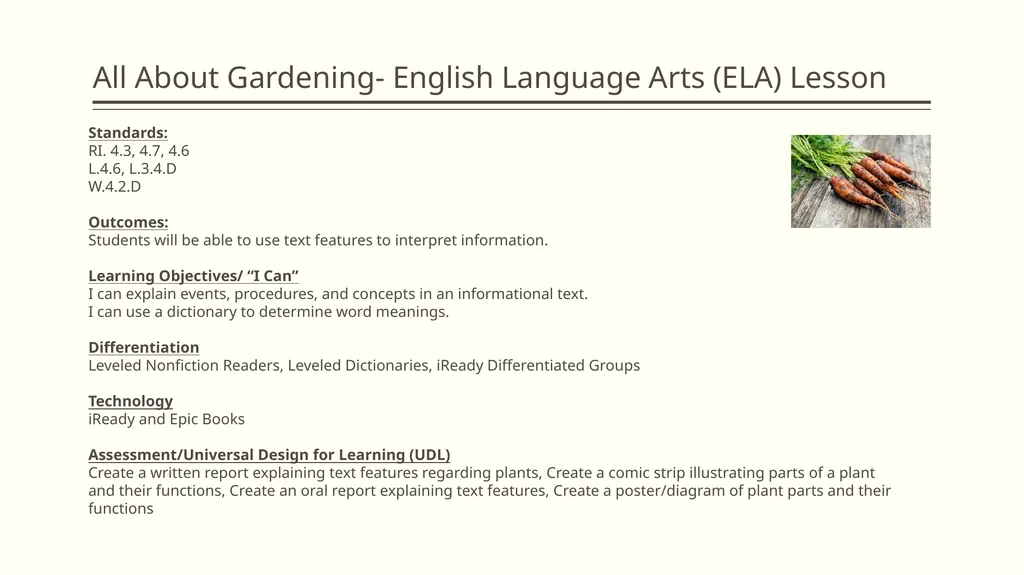
All About Gardening- English Language Arts (ELA) Lesson Standards:
RI. 4.3, 4.7, 4.6
L.4.6, L.3.4.D
W.4.2.D
Outcomes:
Students will be able to use text features to interpret information.
Learning Objectives/ “I Can”
I can explain events, procedures, and concepts in an informational text.
I can use a dictionary to determine word meanings.
Differentiation
Leveled Nonfiction Readers, Leveled Dictionaries, iReady Differentiated Groups
Technology
iReady and Epic Books
Assessment/Universal Design for Learning (UDL)
Create a written report explaining text features regarding plants, Create a comic strip illustrating parts of a plant and their functions, Create an oral report explaining text features, Create a poster/diagram of plant parts and their functions<br>
RI. 4.3, 4.7, 4.6
L.4.6, L.3.4.D
W.4.2.D
Outcomes:
Students will be able to use text features to interpret information.
Learning Objectives/ “I Can”
I can explain events, procedures, and concepts in an informational text.
I can use a dictionary to determine word meanings.
Differentiation
Leveled Nonfiction Readers, Leveled Dictionaries, iReady Differentiated Groups
Technology
iReady and Epic Books
Assessment/Universal Design for Learning (UDL)
Create a written report explaining text features regarding plants, Create a comic strip illustrating parts of a plant and their functions, Create an oral report explaining text features, Create a poster/diagram of plant parts and their functions<br>
09
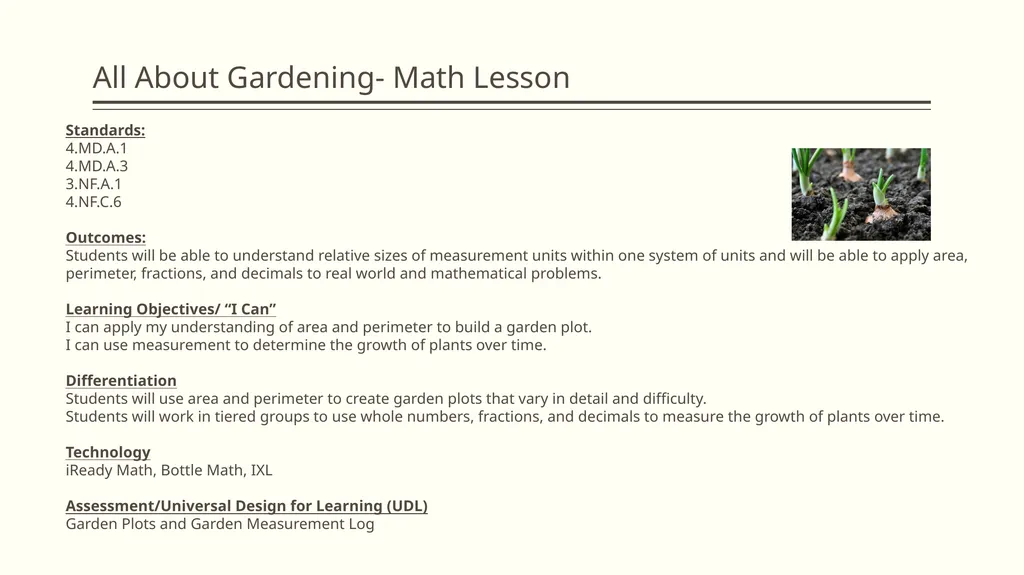
All About Gardening- Math Lesson Standards:
4.MD.A.1
4.MD.A.3
3.NF.A.1
4.NF.C.6
Outcomes:
Students will be able to understand relative sizes of measurement units within one system of units and will be able to apply area, perimeter, fractions, and decimals to real world and mathematical problems.
Learning Objectives/ “I Can”
I can apply my understanding of area and perimeter to build a garden plot.
I can use measurement to determine the growth of plants over time.
Differentiation
Students will use area and perimeter to create garden plots that vary in detail and difficulty.
Students will work in tiered groups to use whole numbers, fractions, and decimals to measure the growth of plants over time.
Technology
iReady Math, Bottle Math, IXL
Assessment/Universal Design for Learning (UDL)
Garden Plots and Garden Measurement Log<br>
4.MD.A.1
4.MD.A.3
3.NF.A.1
4.NF.C.6
Outcomes:
Students will be able to understand relative sizes of measurement units within one system of units and will be able to apply area, perimeter, fractions, and decimals to real world and mathematical problems.
Learning Objectives/ “I Can”
I can apply my understanding of area and perimeter to build a garden plot.
I can use measurement to determine the growth of plants over time.
Differentiation
Students will use area and perimeter to create garden plots that vary in detail and difficulty.
Students will work in tiered groups to use whole numbers, fractions, and decimals to measure the growth of plants over time.
Technology
iReady Math, Bottle Math, IXL
Assessment/Universal Design for Learning (UDL)
Garden Plots and Garden Measurement Log<br>
10
All About Gardening- Science/Technology Lesson Standards:
3-ESS2-1
3-ESS2-2
4-LS1-1
Outcomes:
Students will be able to represent data in tables to describe weather patterns and climates in different regions and explain the internal and external structures of plants.
Learning Objectives/ “I Can”
I can identify weather patterns and climates and explain how they impact the growth of plants.
Differentiation
Varying graphical displays/tables to represent observations
Leveled Readers
Technology
Brainpop, IXL, Science Fusion
Assessment/Universal Design for Learning (UDL)
Graphical Displays, Science Fusion Assessment<br>
3-ESS2-1
3-ESS2-2
4-LS1-1
Outcomes:
Students will be able to represent data in tables to describe weather patterns and climates in different regions and explain the internal and external structures of plants.
Learning Objectives/ “I Can”
I can identify weather patterns and climates and explain how they impact the growth of plants.
Differentiation
Varying graphical displays/tables to represent observations
Leveled Readers
Technology
Brainpop, IXL, Science Fusion
Assessment/Universal Design for Learning (UDL)
Graphical Displays, Science Fusion Assessment<br>
11
All About Gardening- Social Studies Lesson Standards:
4.T4
Outcomes:
Students will be able to develop questions, conduct research, and analyze how people have adapted to the environment of the Northeast.
Learning Objectives/ “I Can”
I can analyze how people of the Northeast adapted to the environment.
Differentiation
Expand past the Northeast
Leveled Readers
Technology
Brainpop, IXL
Assessment/Universal Design for Learning (UDL)
Posters, Oral and Written Reports, Video Presentations<br>
4.T4
Outcomes:
Students will be able to develop questions, conduct research, and analyze how people have adapted to the environment of the Northeast.
Learning Objectives/ “I Can”
I can analyze how people of the Northeast adapted to the environment.
Differentiation
Expand past the Northeast
Leveled Readers
Technology
Brainpop, IXL
Assessment/Universal Design for Learning (UDL)
Posters, Oral and Written Reports, Video Presentations<br>
12
References CenterPoint - How Teacher Engagement, High Expectations, and Student Ownership Creates Rigor in the Classroom. (2017). CenterPoint Education Solutions. https://centerpointeducation.org/article/how-teacher-engagement-high-expectations-and- student- ownership-creates-rigor-in-the-classroom
El-Amin, A. (2020, December 10). Critical consciousness: A key to student achievement. Kappanonline.Org. https://kappanonline.org/critical-consciousness-key-student achievement/
Gulati, M. S. A. S. (2021, March 25). Five Essential Strategies to Embrace Culturally Responsive Teaching. Faculty Focus | Higher Ed Teaching & Learning. https://www.facultyfocus.com/articles/equality-inclusion-and-diversity/five-essential-strategies-to- embrace-culturally-responsive-teaching/
H. (2021, April 30). Differentiated Instruction: Examples & Classroom Strategies | Resilient Educator. ResilientEducator.Com. https://resilienteducator.com/classroom-resources/examples-of- differentiated-instruction/
Strengthen school vision with technology | ISTE. (2019). ISTE.Org. https://www.iste.org/explore/Education-leadership/Strengthen-school-vision-with-technology<br>
El-Amin, A. (2020, December 10). Critical consciousness: A key to student achievement. Kappanonline.Org. https://kappanonline.org/critical-consciousness-key-student achievement/
Gulati, M. S. A. S. (2021, March 25). Five Essential Strategies to Embrace Culturally Responsive Teaching. Faculty Focus | Higher Ed Teaching & Learning. https://www.facultyfocus.com/articles/equality-inclusion-and-diversity/five-essential-strategies-to- embrace-culturally-responsive-teaching/
H. (2021, April 30). Differentiated Instruction: Examples & Classroom Strategies | Resilient Educator. ResilientEducator.Com. https://resilienteducator.com/classroom-resources/examples-of- differentiated-instruction/
Strengthen school vision with technology | ISTE. (2019). ISTE.Org. https://www.iste.org/explore/Education-leadership/Strengthen-school-vision-with-technology<br>