04
Missy Baker has cystic fibrosis CFTR
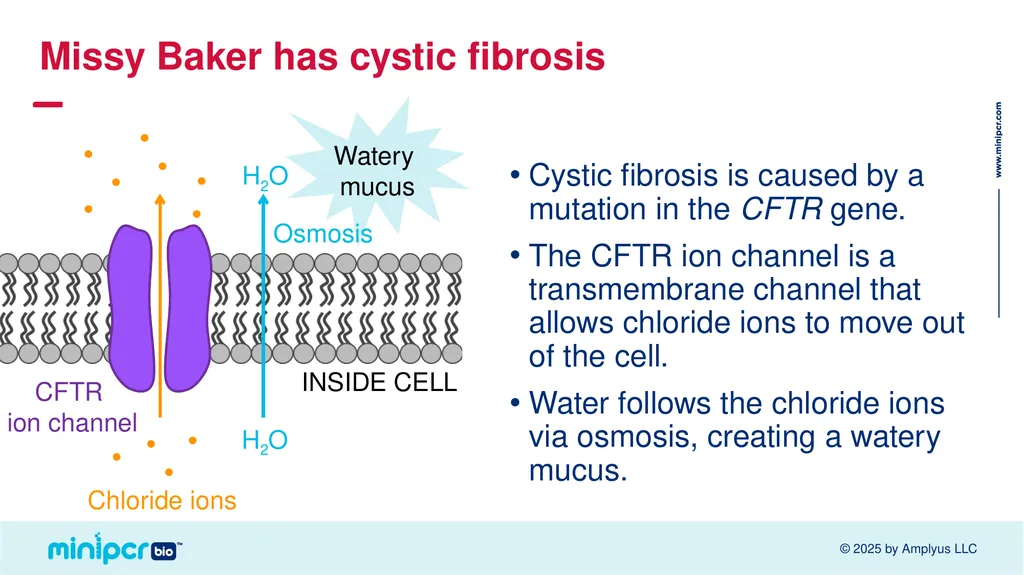
ion channel INSIDE CELL When an individual has cystic fibrosis, their CFTR ion channel is dysfunctional.
Cystic fibrosis leads to thick sticky mucus that will clog passageways in the body, most notably in the lungs.<br>
05
Missy Baker has cystic fibrosis CFTR
ion channel INSIDE CELL<br>
06
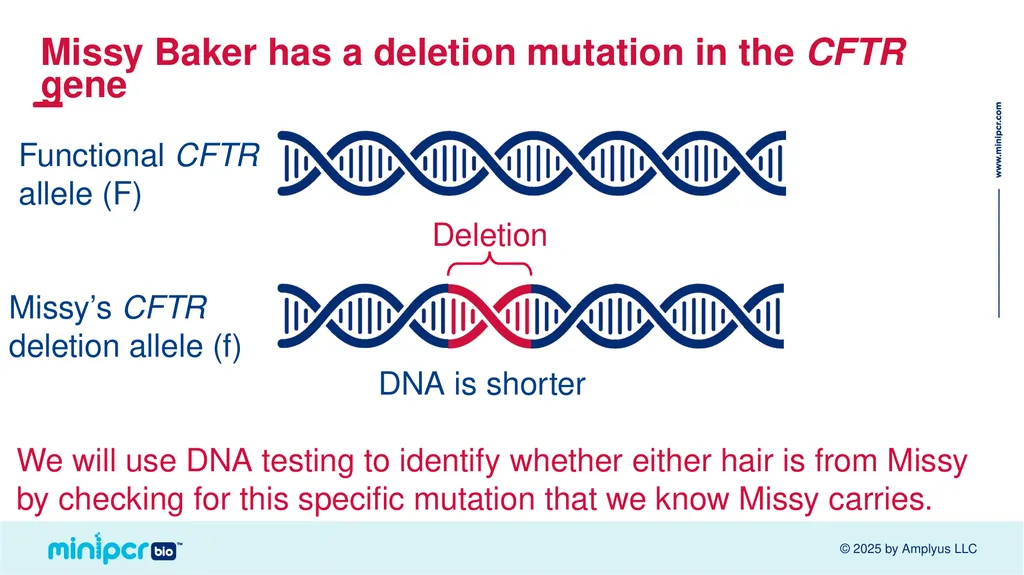
Missy Baker has a deletion mutation in the CFTR gene Functional CFTR
allele (F) Missy’s CFTR
deletion allele (f) DNA is shorter We will use DNA testing to identify whether either hair is from Missy by checking for this specific mutation that we know Missy carries.<br>
08
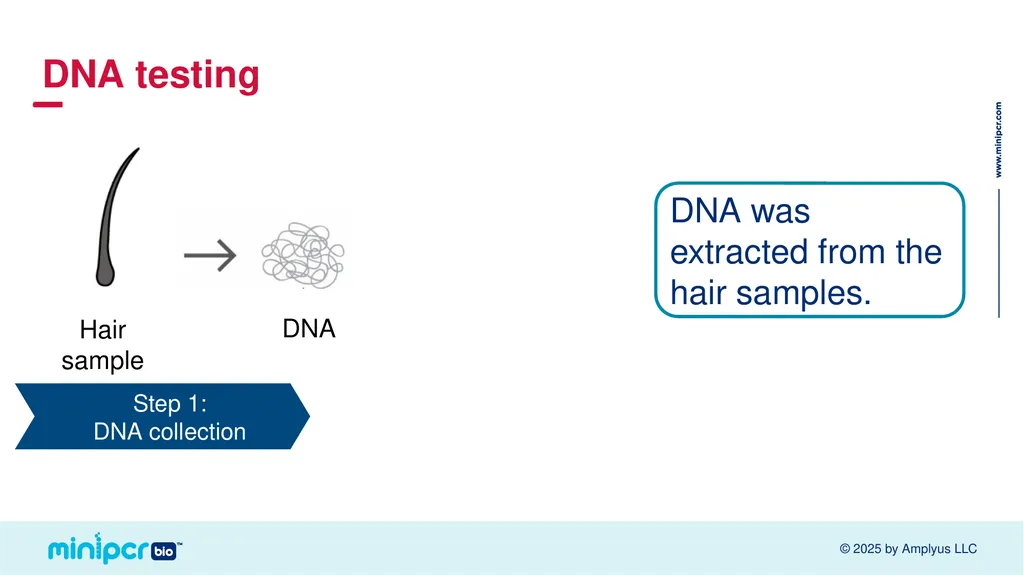
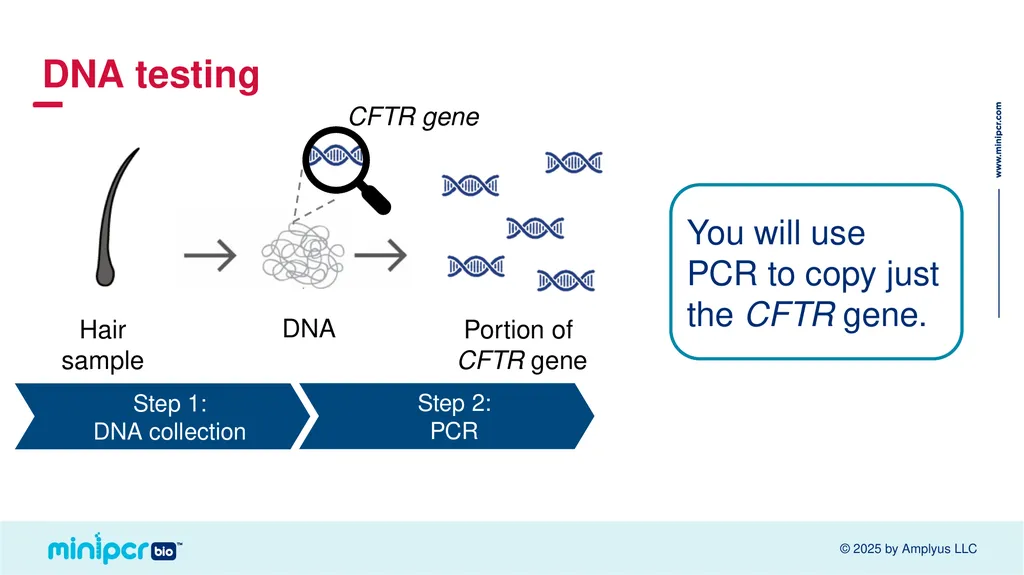
DNA testing Hair
sample You will use PCR to copy just the CFTR gene. Step 2:
PCR Step 1:
DNA collection<br>
09
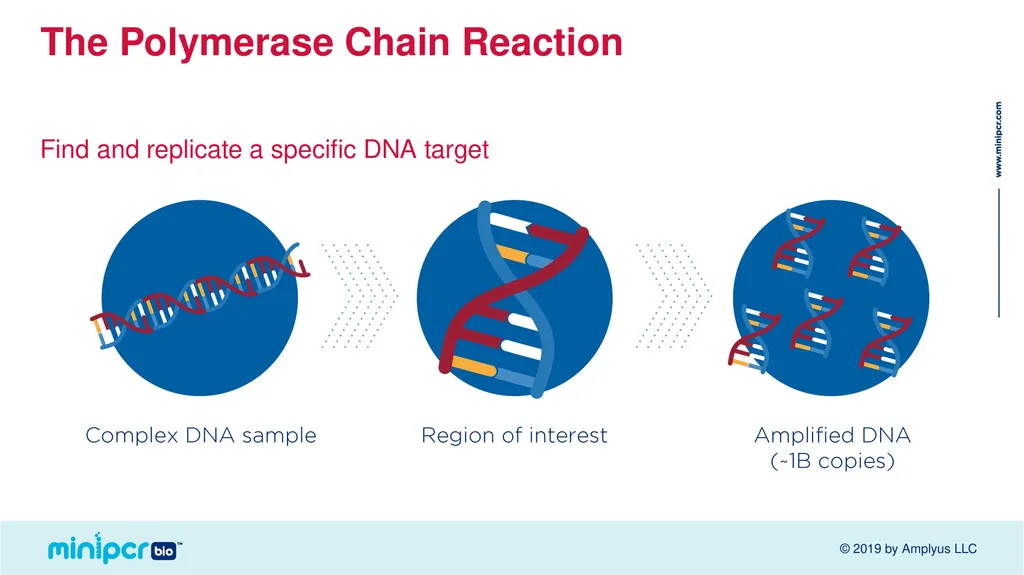
The Polymerase Chain Reaction Find and replicate a specific DNA target © 2019 by Amplyus LLC<br>
10
Your goal is to determine if the hair in either suspects’ car belongs to Missy.
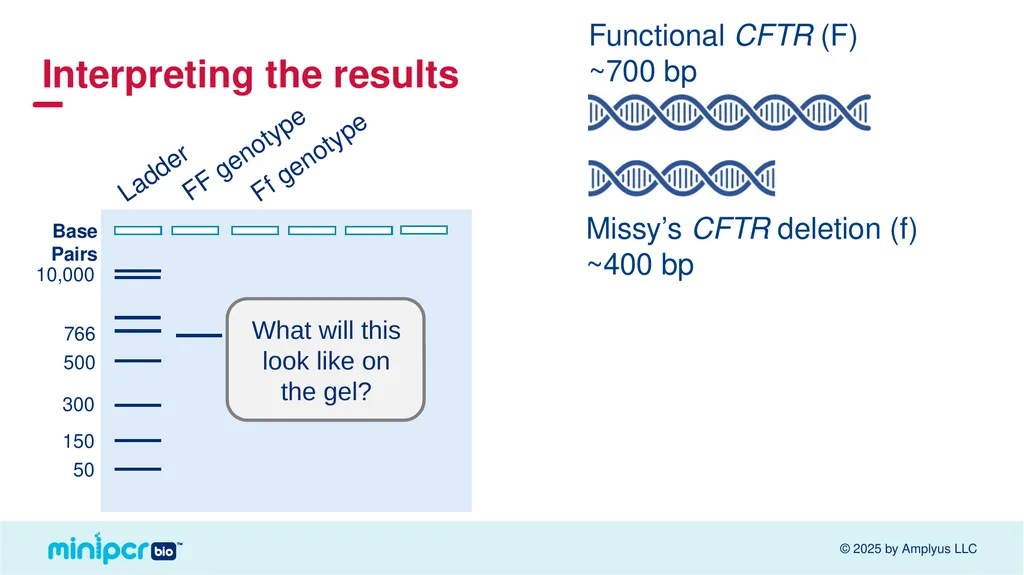
The PCR is designed to copy a section of the CFTR gene that spans the deletion mutation that we know Missy carries. CFTR: the target gene Functional CFTR (F)
~700 bp Missy’s CFTR deletion (f)
~400 bp<br>
11
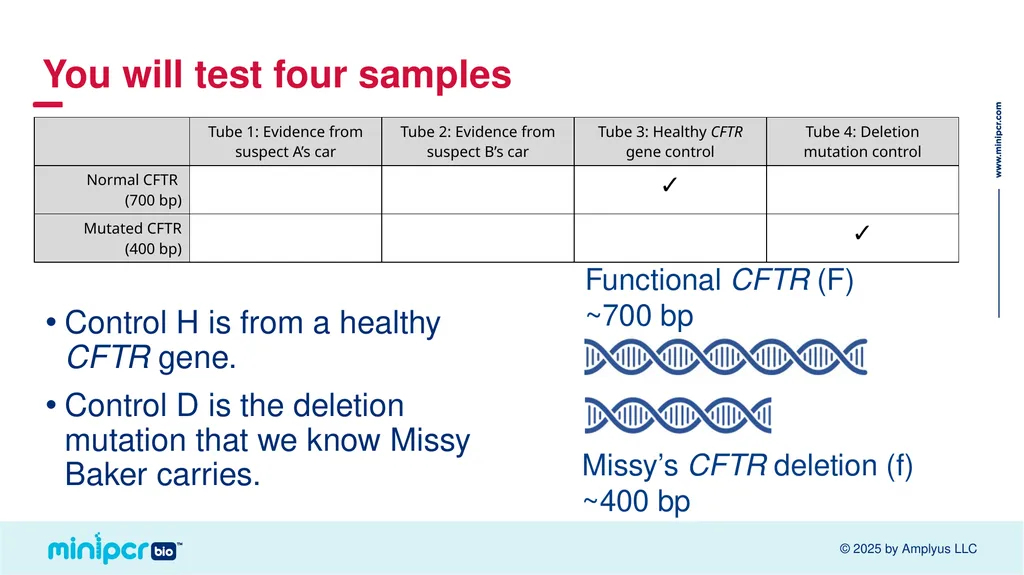
You will test four samples Control H is from a healthy CFTR gene.
Control D is the deletion mutation that we know Missy Baker carries.<br>
12
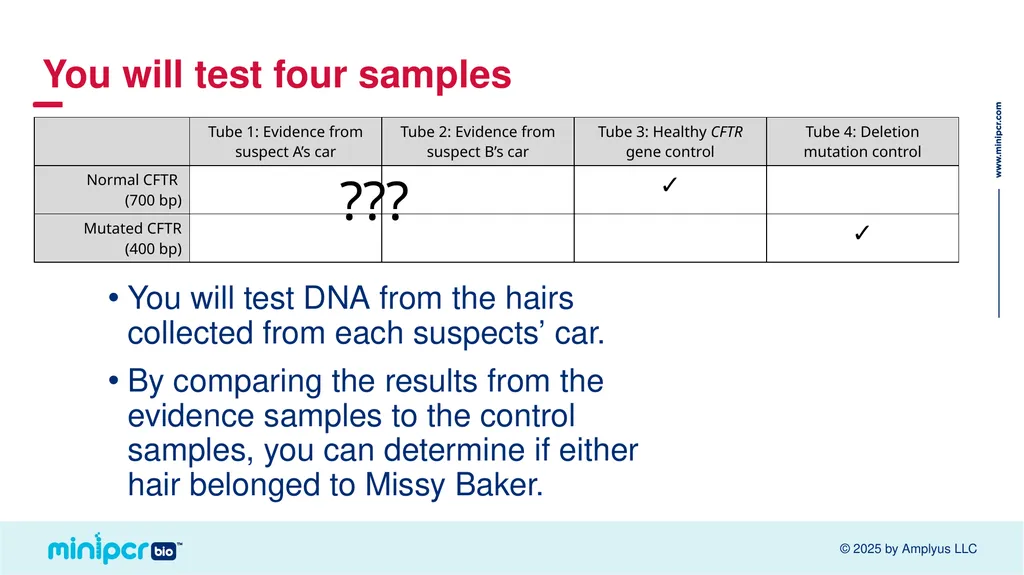
You will test four samples ??? You will test DNA from the hairs collected from each suspects’ car.
By comparing the results from the evidence samples to the control samples, you can determine if either hair belonged to Missy Baker.<br>
13
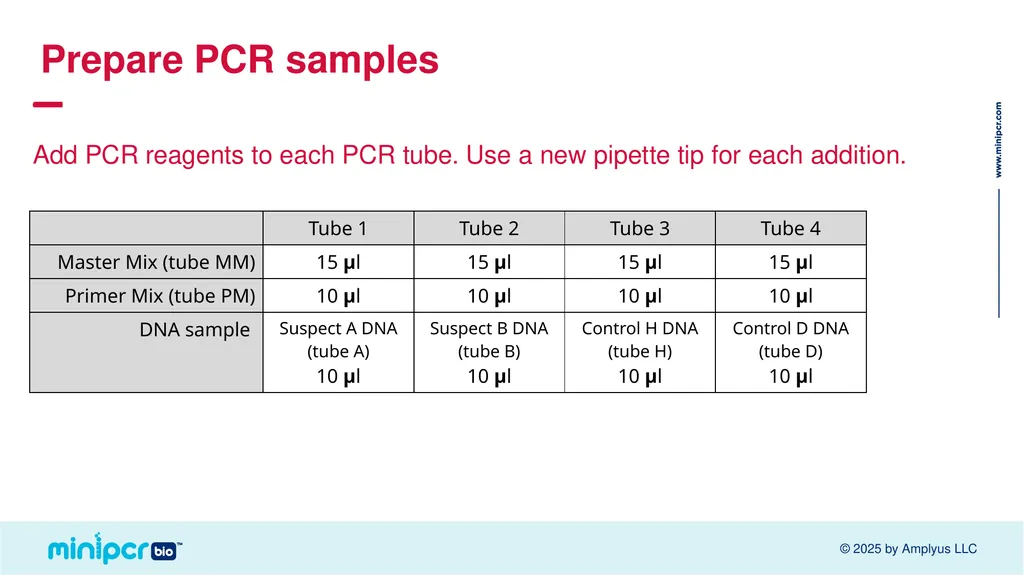
Prepare PCR samples Add PCR reagents to each PCR tube. Use a new pipette tip for each addition.<br>
14
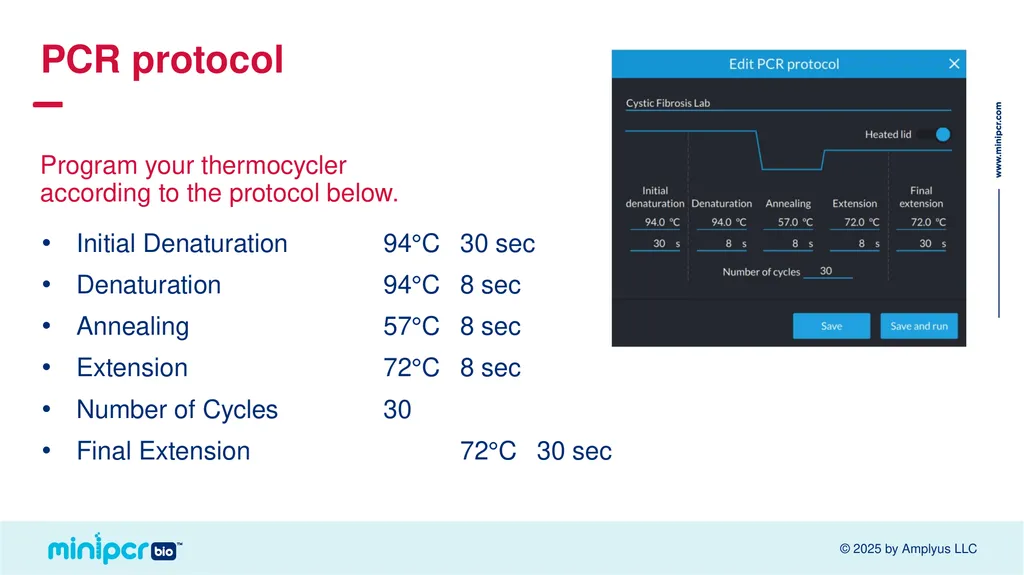
PCR protocol Initial Denaturation 94°C 30 sec
Denaturation 94°C 8 sec
Annealing 57°C 8 sec
Extension 72°C 8 sec
Number of Cycles 30
Final Extension 72°C 30 sec Program your thermocycler according to the protocol below.<br>
15
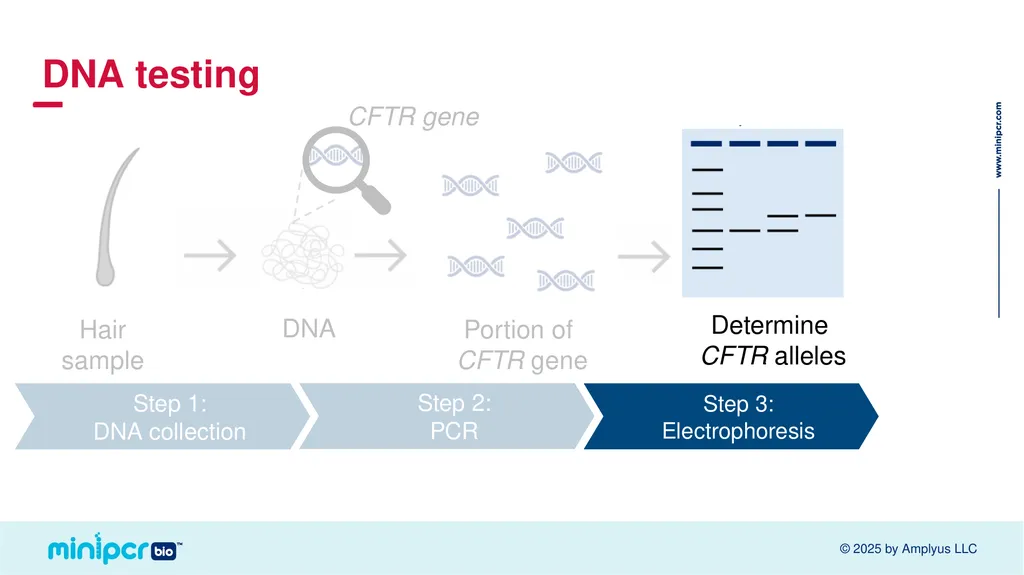
DNA testing Step 1:
DNA collection Hair
sample<br>
16
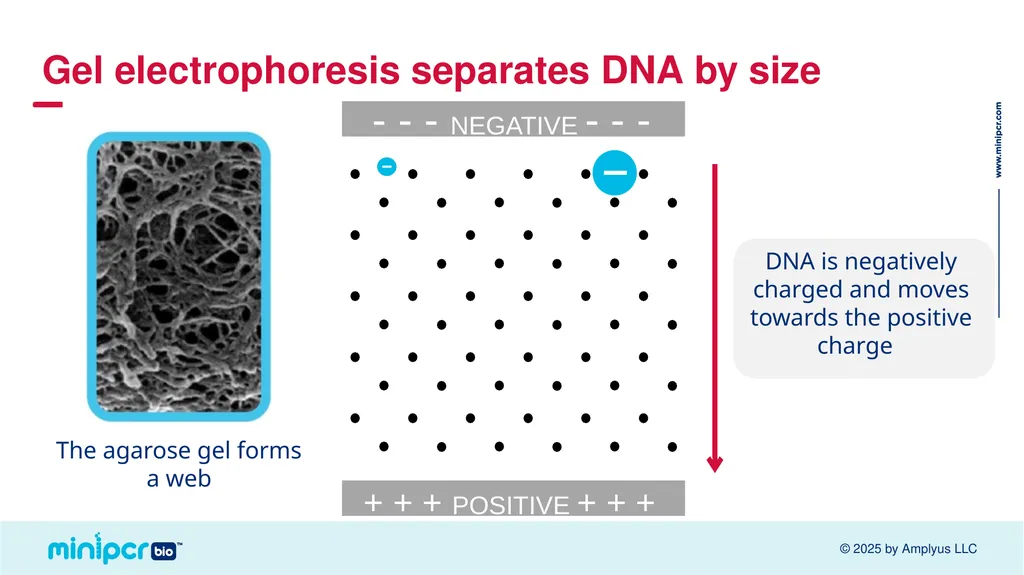
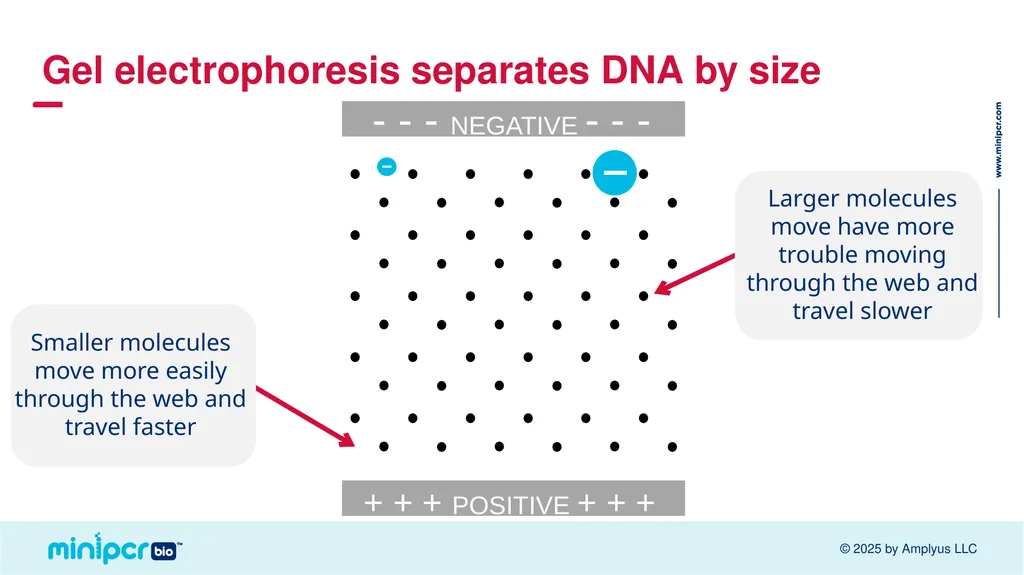
Gel electrophoresis separates DNA by size + + + POSITIVE + + + - - - NEGATIVE - - -<br>
17
Gel electrophoresis separates DNA by size<br>
18
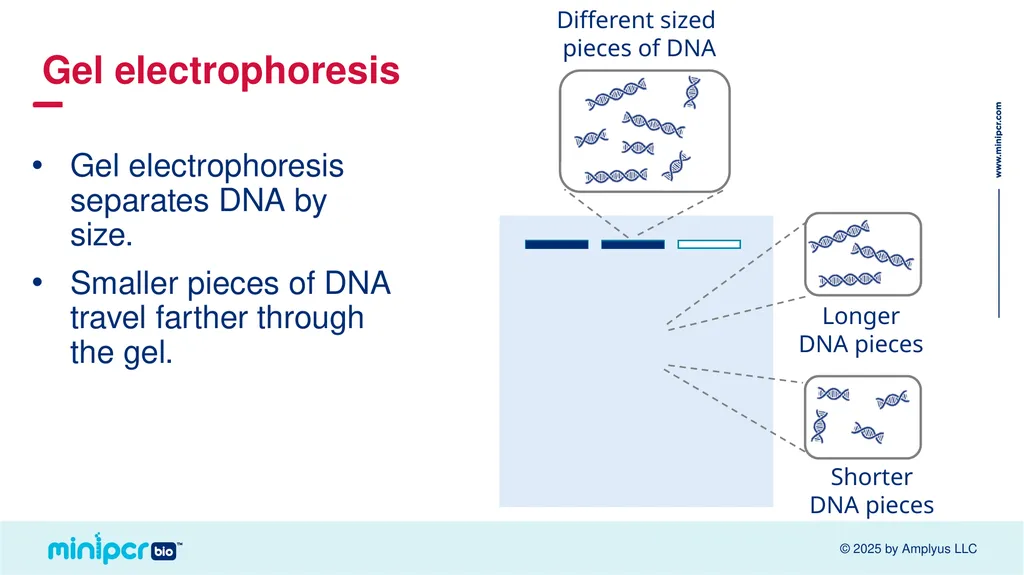
Gel electrophoresis Gel electrophoresis separates DNA by size.
Smaller pieces of DNA travel farther through the gel.<br>
19
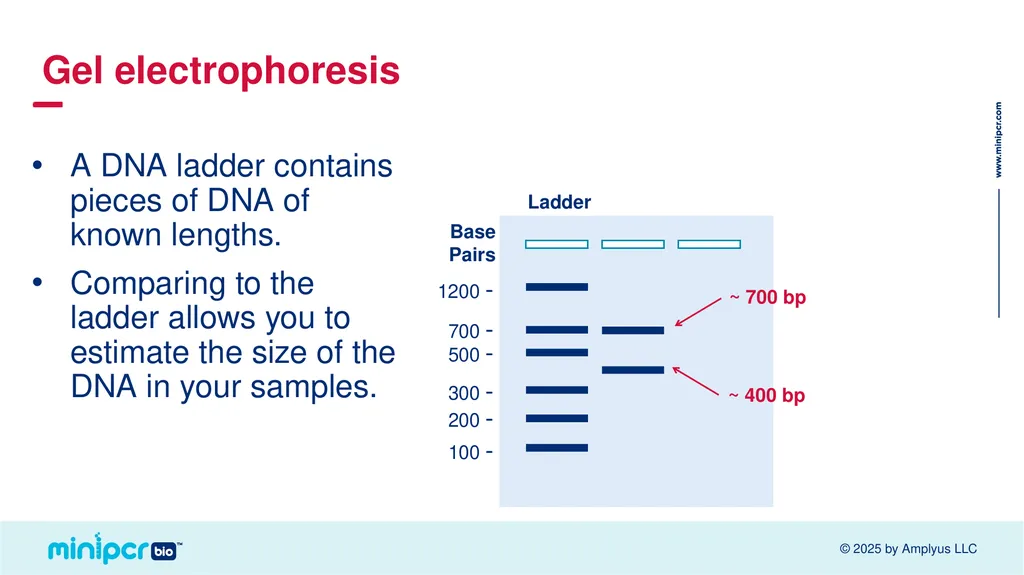
Gel electrophoresis A DNA ladder contains pieces of DNA of known lengths.
Comparing to the ladder allows you to estimate the size of the DNA in your samples. ~ 700 bp ~ 400 bp Ladder<br>
20
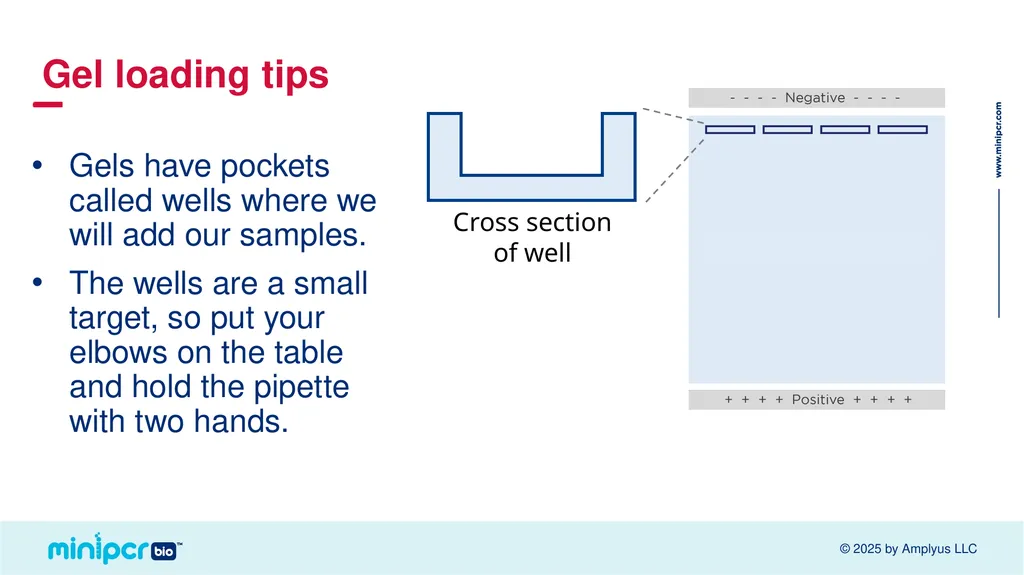
Gels have pockets called wells where we will add our samples.
The wells are a small target, so put your elbows on the table and hold the pipette with two hands. Gel loading tips<br>
21
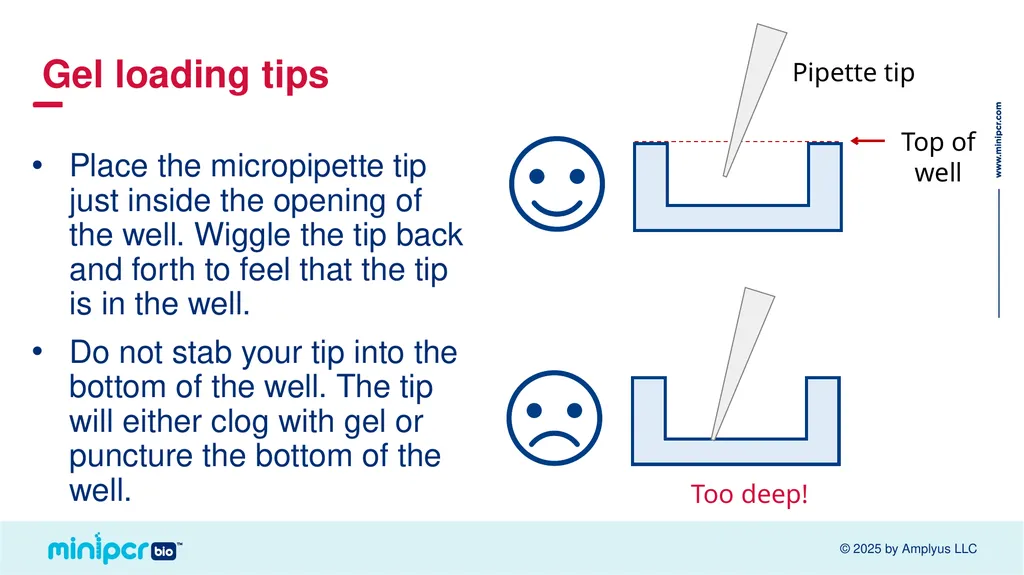
Place the micropipette tip just inside the opening of the well. Wiggle the tip back and forth to feel that the tip is in the well.
Do not stab your tip into the bottom of the well. The tip will either clog with gel or puncture the bottom of the well. Gel loading tips<br>
22
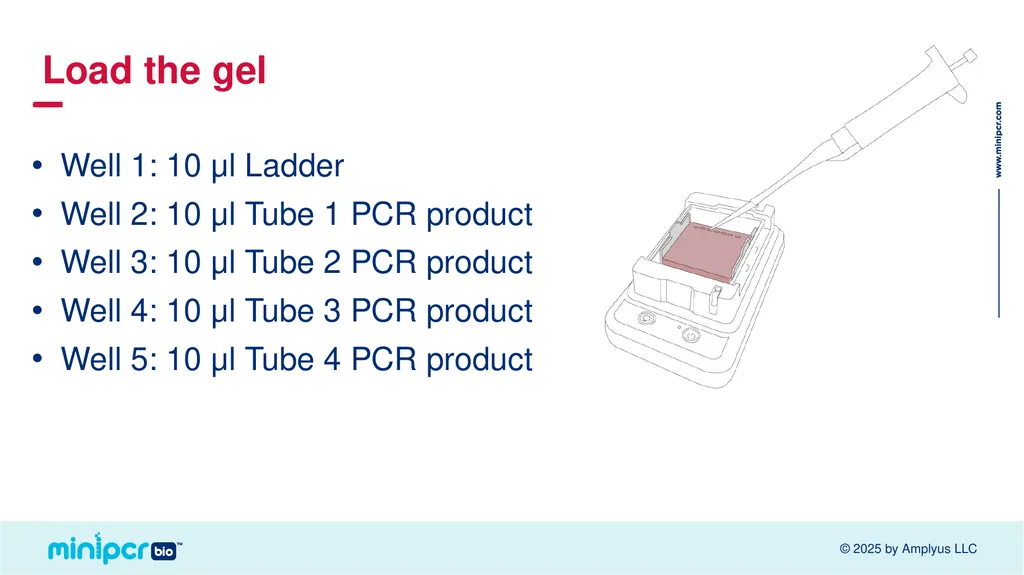
Well 1: 10 μl Ladder
Well 2: 10 μl Tube 1 PCR product
Well 3: 10 μl Tube 2 PCR product
Well 4: 10 μl Tube 3 PCR product
Well 5: 10 μl Tube 4 PCR product Load the gel<br>
23
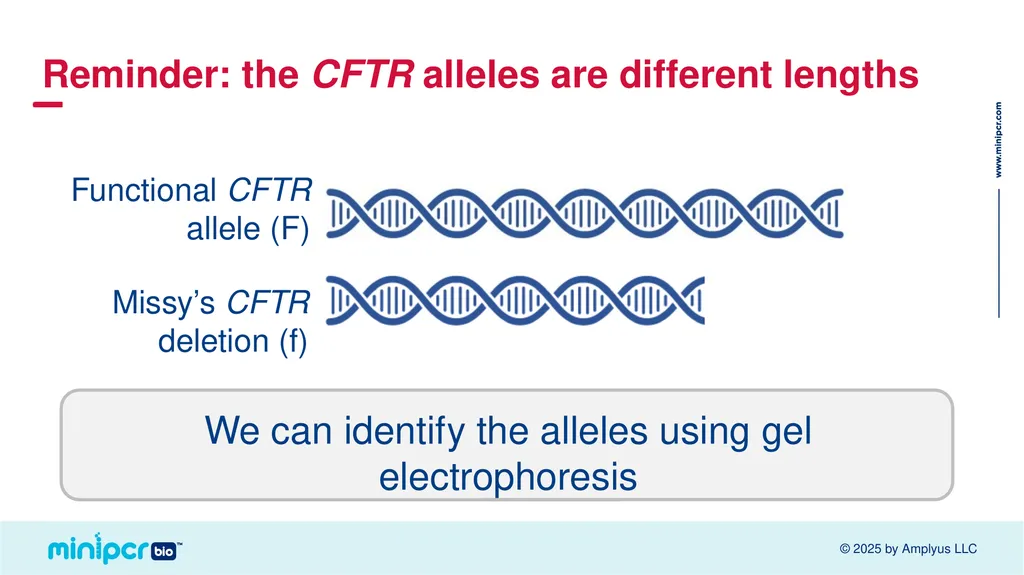
Reminder: the CFTR alleles are different lengths Missy’s CFTR deletion (f) Functional CFTR allele (F)<br>
24
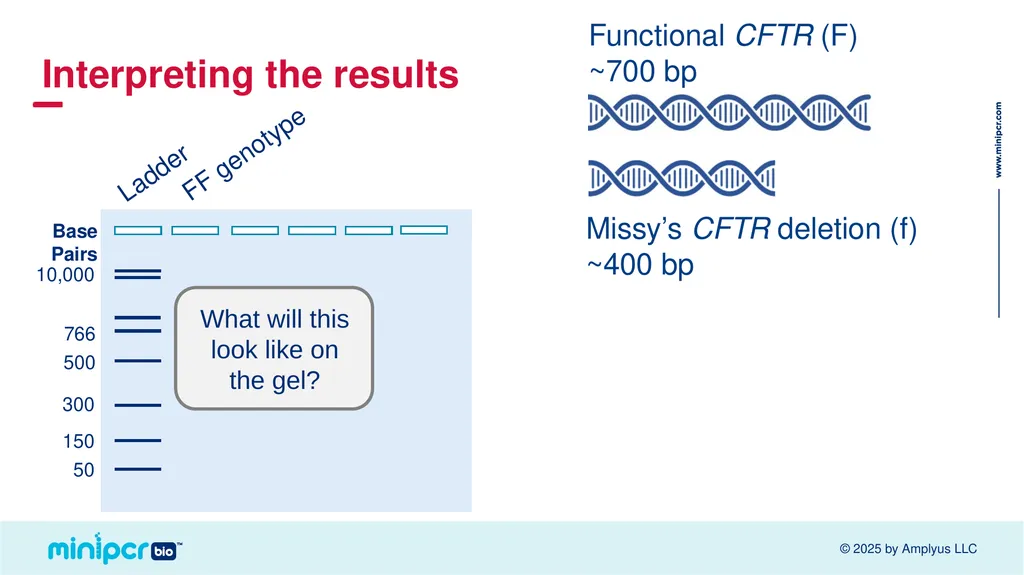
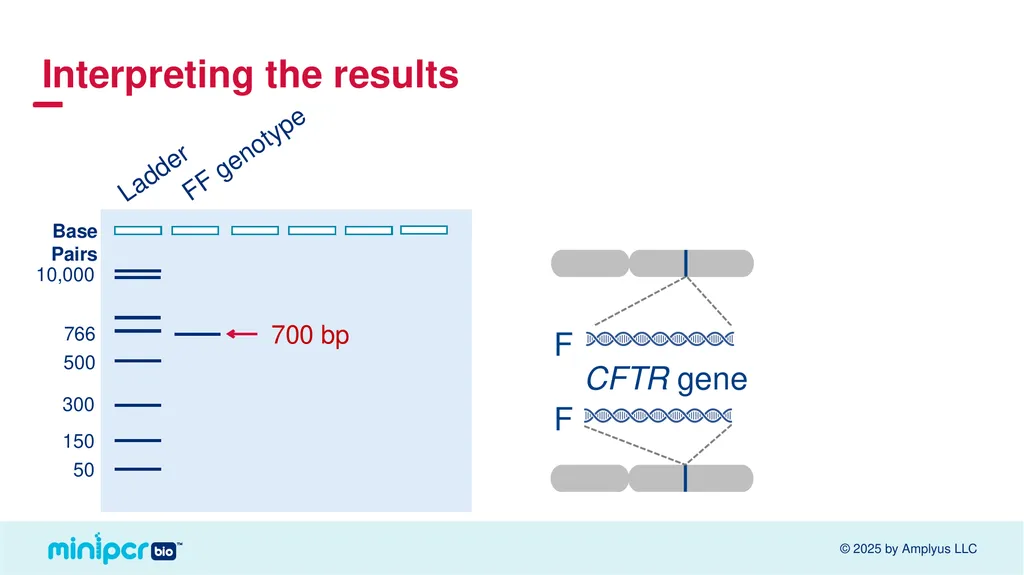
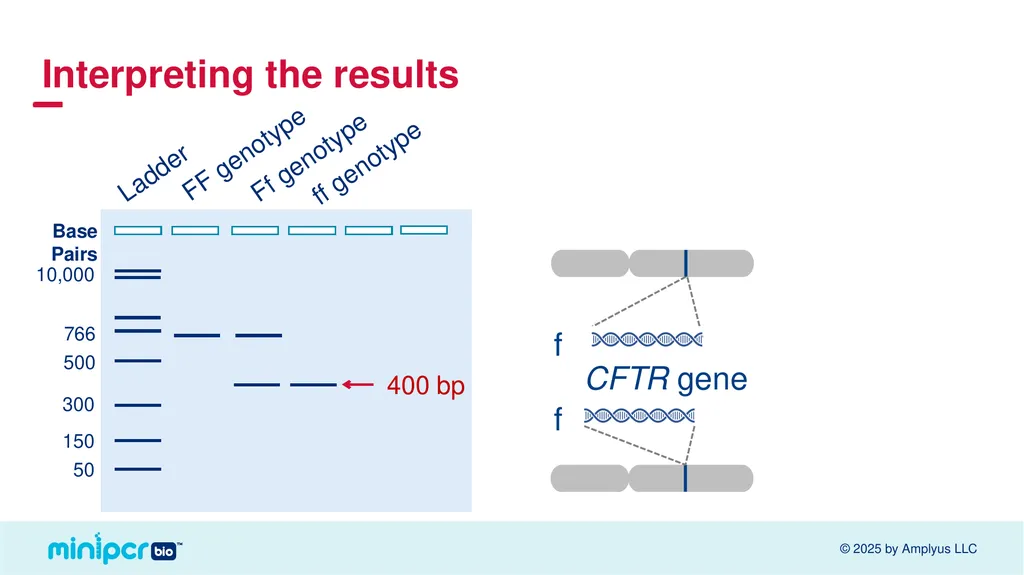
Interpreting the results Ladder Base
Pairs 766 10,000 FF genotype 500 300 150 50<br>
25
Interpreting the results Ladder FF genotype Base
Pairs 766 10,000 500 300 150 50<br>
26
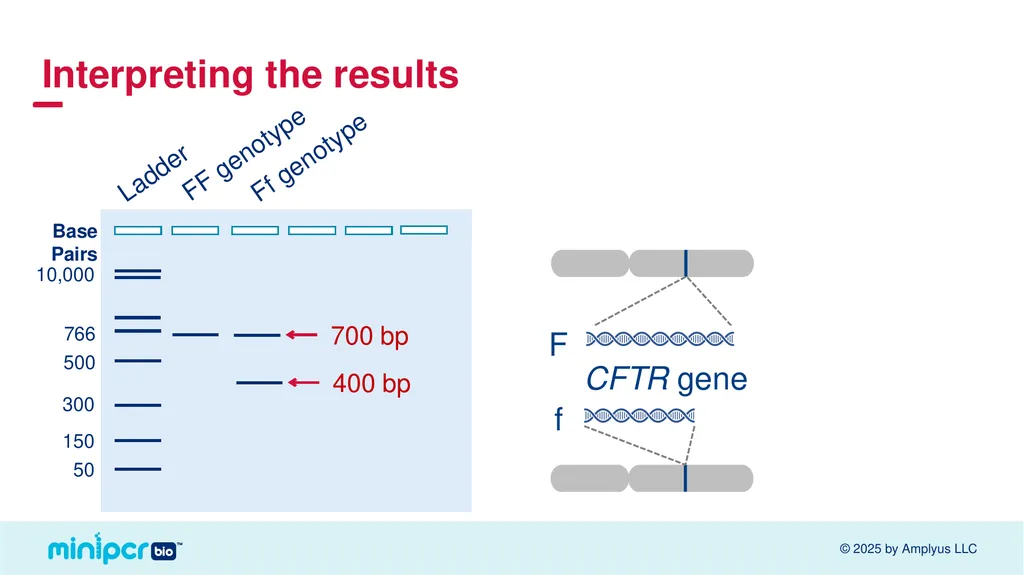
Interpreting the results Ladder FF genotype Ff genotype Base
Pairs 766 10,000 500 300 150 50<br>
27
Interpreting the results Ladder FF genotype Ff genotype Base
Pairs 766 10,000 500 300 150 50<br>
28
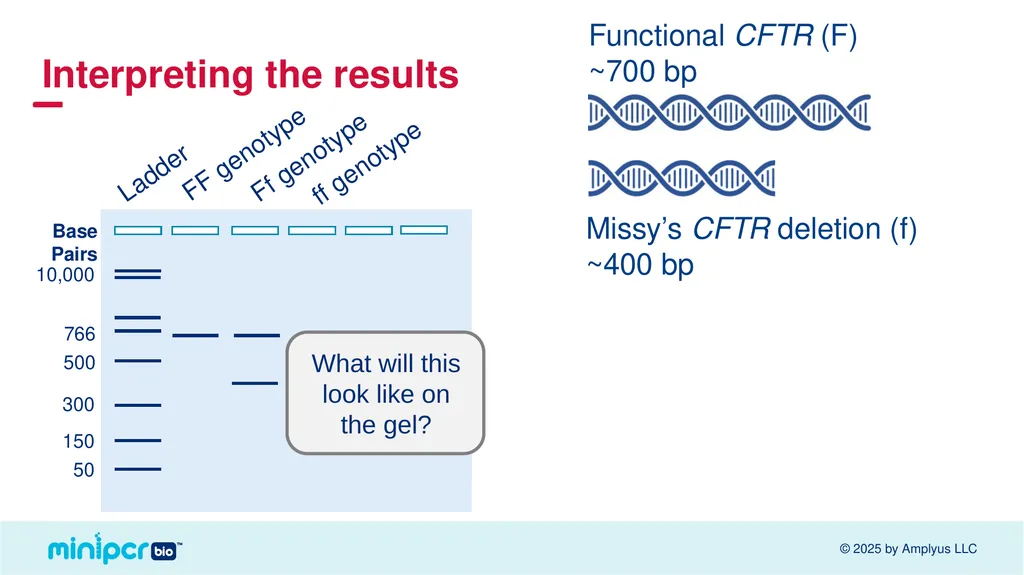
Interpreting the results Ladder FF genotype Ff genotype ff genotype Base
Pairs 766 10,000 500 300 150 50<br>
29
Interpreting the results Ladder FF genotype Ff genotype ff genotype Base
Pairs 766 10,000 500 300 150 50<br>
30
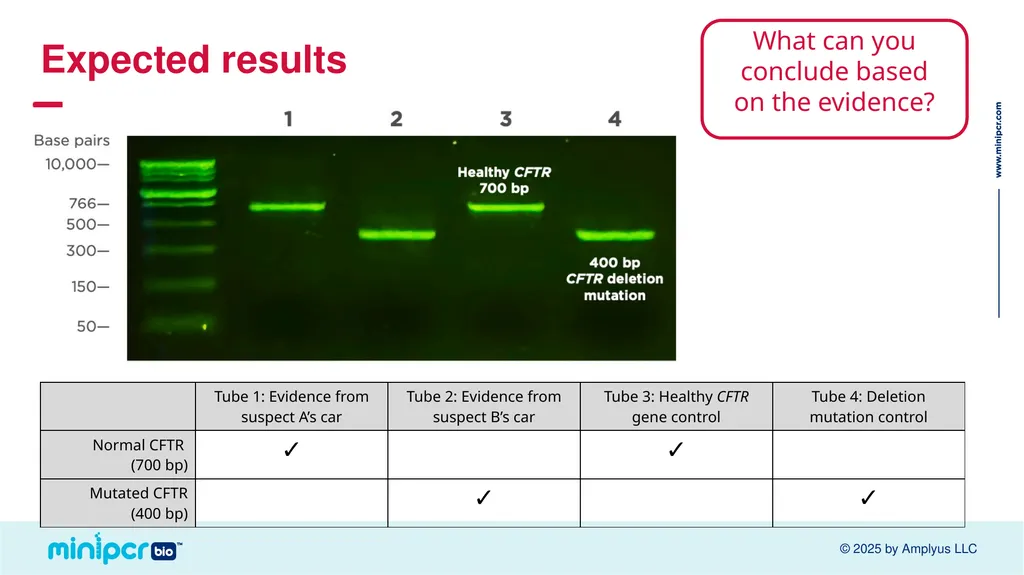
Expected results What can you conclude based on the evidence?<br>
31
Extension: CFTR and cystic fibrosis<br>
32
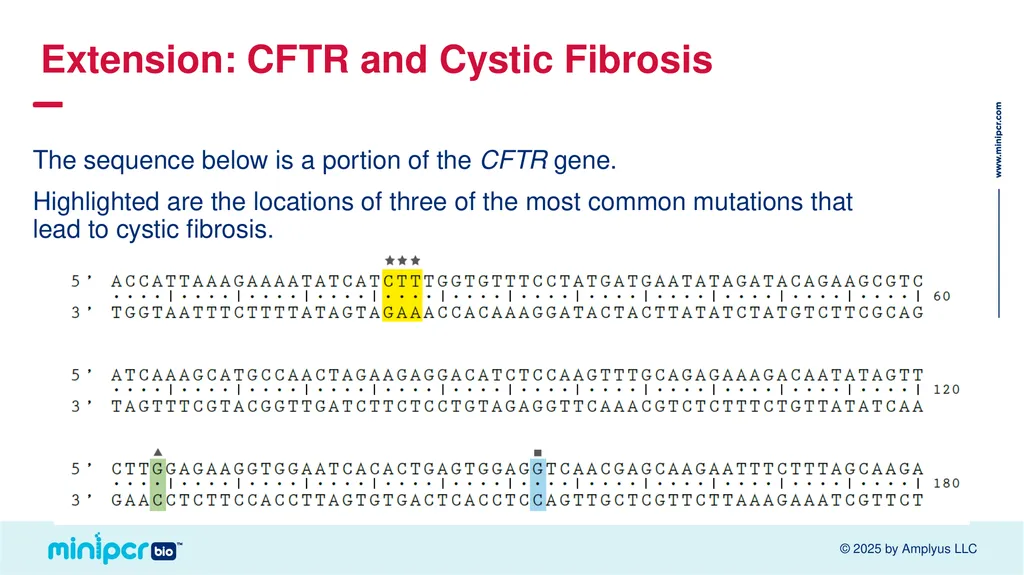
The sequence below is a portion of the CFTR gene.
Highlighted are the locations of three of the most common mutations that lead to cystic fibrosis. Extension: CFTR and Cystic Fibrosis<br>
33
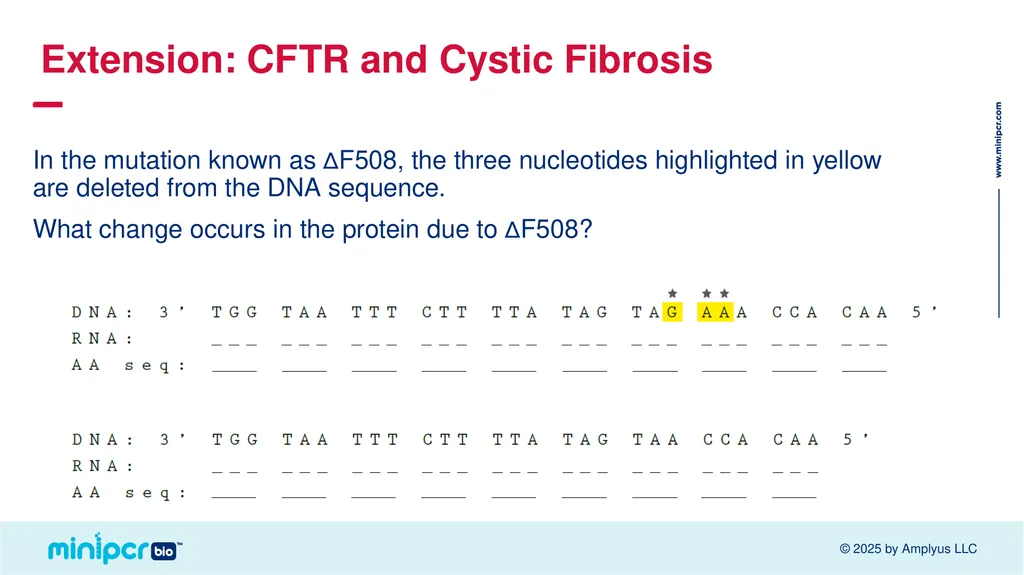
In the mutation known as ∆F508, the three nucleotides highlighted in yellow are deleted from the DNA sequence.
What change occurs in the protein due to ∆F508? Extension: CFTR and Cystic Fibrosis<br>
34
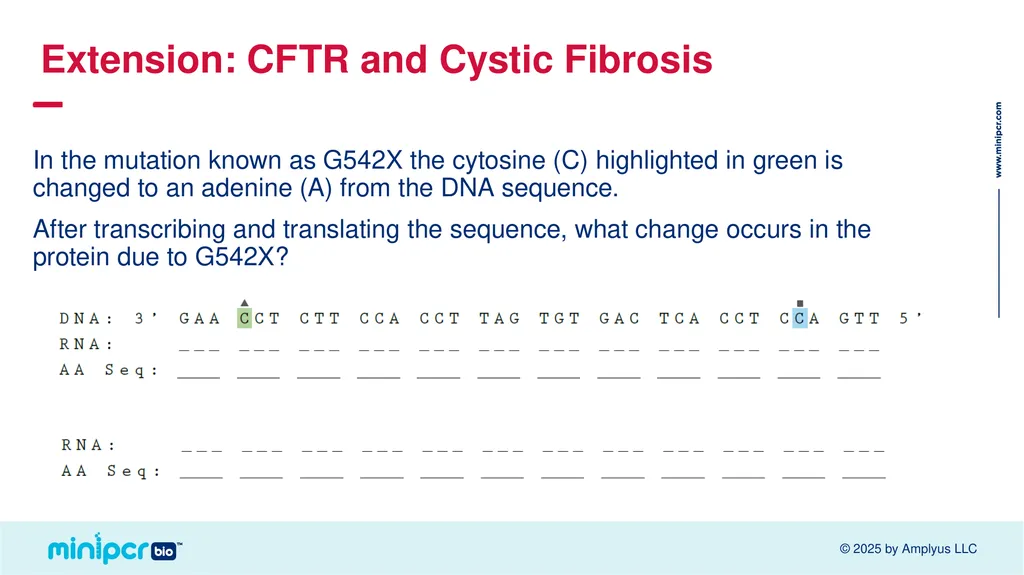
In the mutation known as G542X the cytosine (C) highlighted in green is changed to an adenine (A) from the DNA sequence.
After transcribing and translating the sequence, what change occurs in the protein due to G542X? Extension: CFTR and Cystic Fibrosis<br>
35
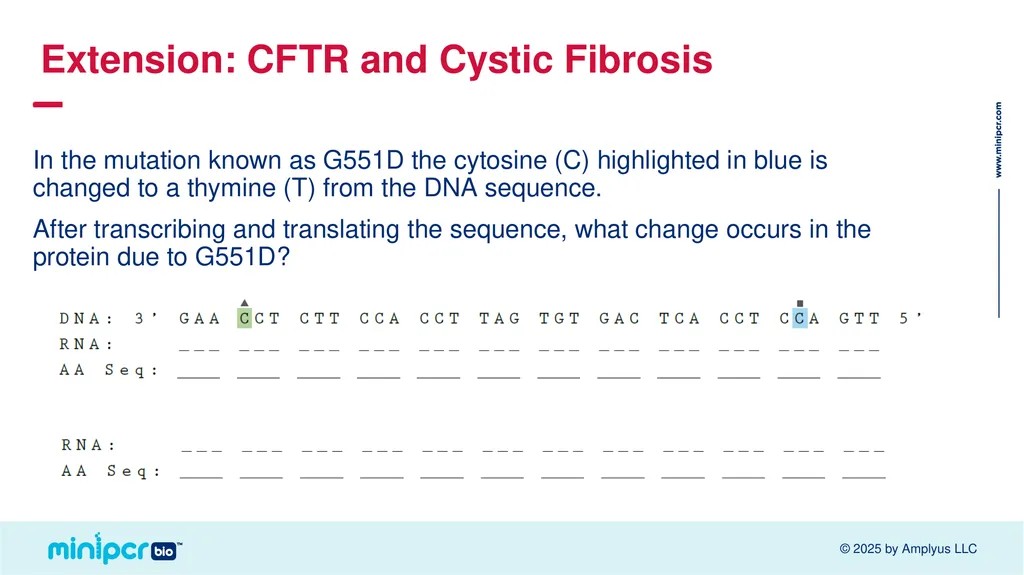
In the mutation known as G551D the cytosine (C) highlighted in blue is changed to a thymine (T) from the DNA sequence.
After transcribing and translating the sequence, what change occurs in the protein due to G551D? Extension: CFTR and Cystic Fibrosis<br>
36
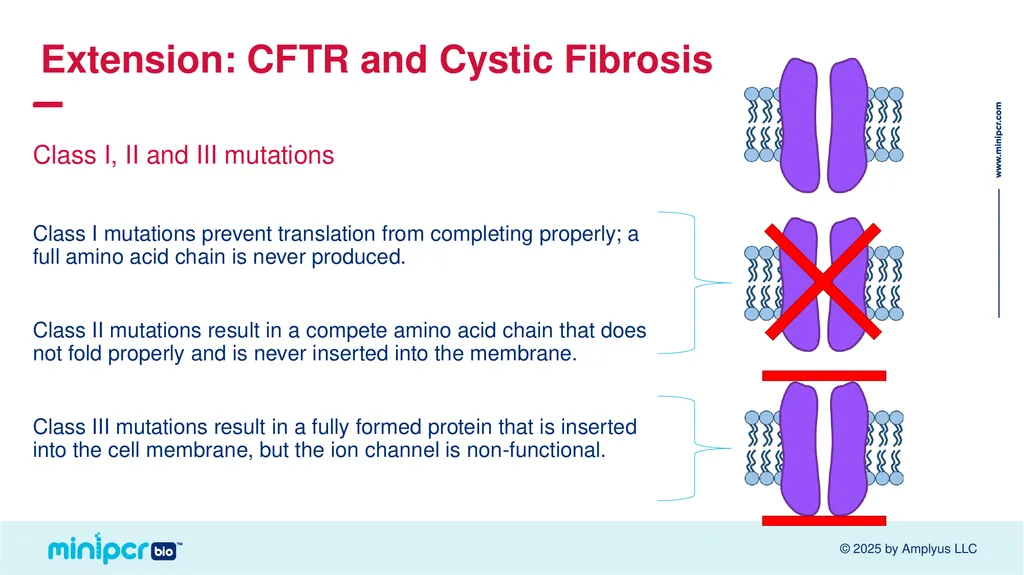
Extension: CFTR and Cystic Fibrosis Class I, II and III mutations Class I mutations prevent translation from completing properly; a full amino acid chain is never produced.
Class II mutations result in a compete amino acid chain that does not fold properly and is never inserted into the membrane.
Class III mutations result in a fully formed protein that is inserted into the cell membrane, but the ion channel is non-functional.<br>
37
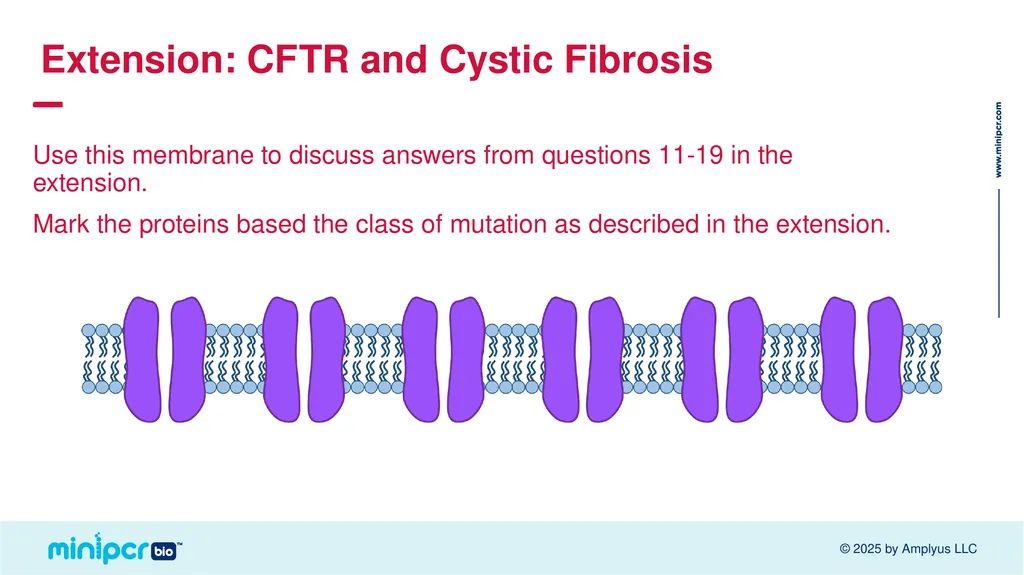
Extension: CFTR and Cystic Fibrosis Use this membrane to discuss answers from questions 11-19 in the extension.
Mark the proteins based the class of mutation as described in the extension.<br>