
Daily Opener When was the Cold War? How can a
DP
Published · 105 slides · 0 views

1 / 1













Description
Daily Opener When was the Cold War? How can a war be cold? DO Describe Stalin. Objectives The student: Is able to create a timeline of early Cold War events. Is able to define and explain early Cold War events. Is able to synthesize primary
Related Topics
Share
Embed code
Download this presentation From Below
"Daily Opener When was the Cold War? How can a" is the property of its rightful owner. Permission is granted to download and print the materials on this website for personal, non-commercial use only, and to display it on your personal computer provided you do not modify the materials and that you retain all copyright notices contained in the materials. By downloading content from our website, you accept the terms of this agreement.
Presentation Transcript
01
Daily Opener When was the Cold War? How can a war be cold?<br>
02
DO Describe Stalin.<br>
03
Objectives The student:
Is able to create a timeline of early Cold War events.
Is able to define and explain early Cold War events.
Is able to synthesize primary source information to draw conclusions about Cold War events.<br>
Is able to create a timeline of early Cold War events.
Is able to define and explain early Cold War events.
Is able to synthesize primary source information to draw conclusions about Cold War events.<br>
04
Agenda Daily Opener
Daily News Clip
Timeline Review
Flashcards – Quizlet
Cold War Notes and Questions
Video Clip ?
Quizlet –Games & Test
Analyze Primary Sources
Writing Assignment<br>
Daily News Clip
Timeline Review
Flashcards – Quizlet
Cold War Notes and Questions
Video Clip ?
Quizlet –Games & Test
Analyze Primary Sources
Writing Assignment<br>
05
CNN Student News Clip Answer Questions on Handout.<br>
06
The Cold War 1945-1991<br>
07
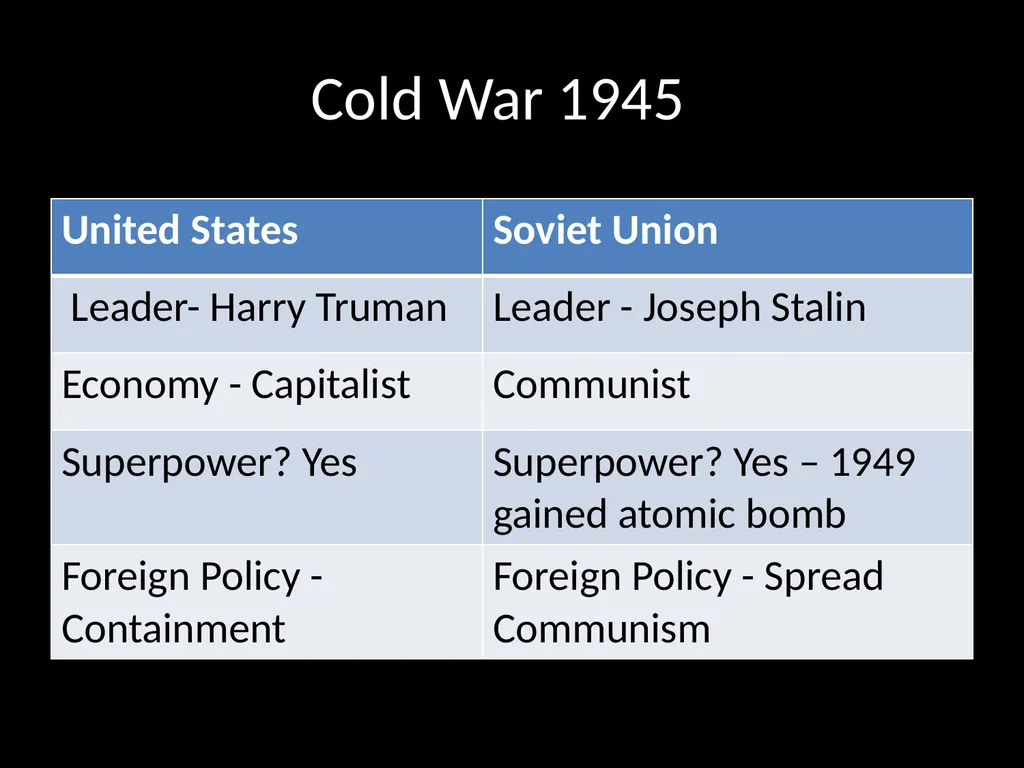
Cold War 1945<br>
08
Cram for Test!<br>
09
What is the United Nations? Daily Opener<br>
10
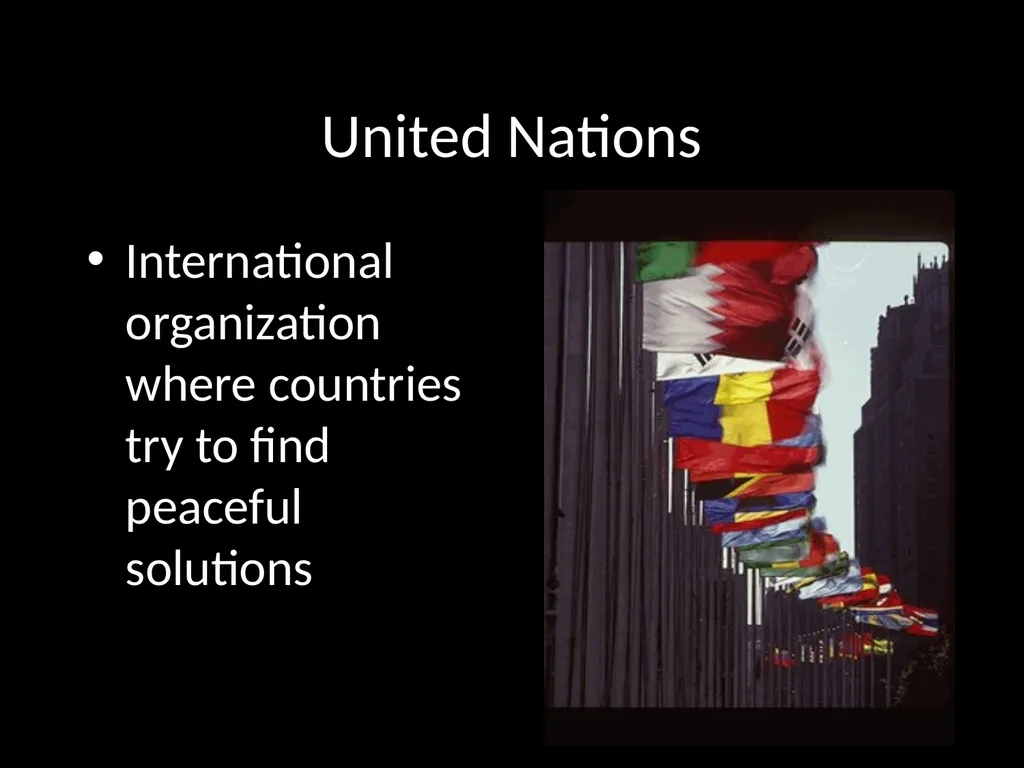
United Nations International organization where countries try to find peaceful solutions<br>
11
United States Capitalism
Free market economy<br>
Free market economy<br>
12
Soviet Union Communism
Collective ownership<br>
Collective ownership<br>
13
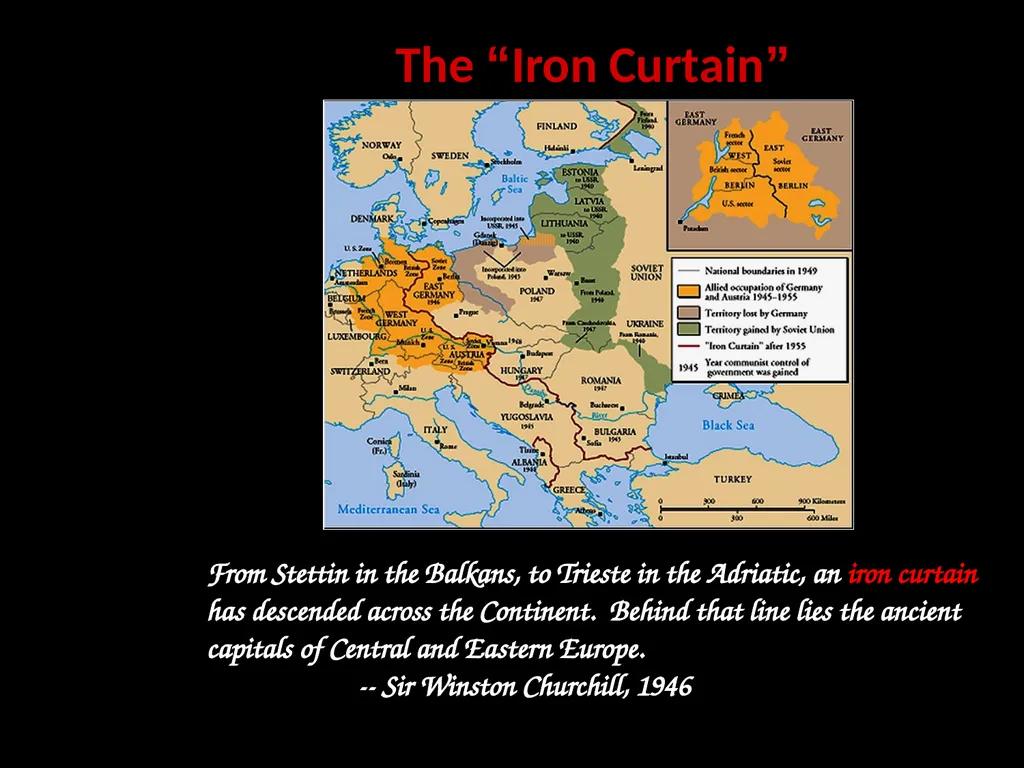
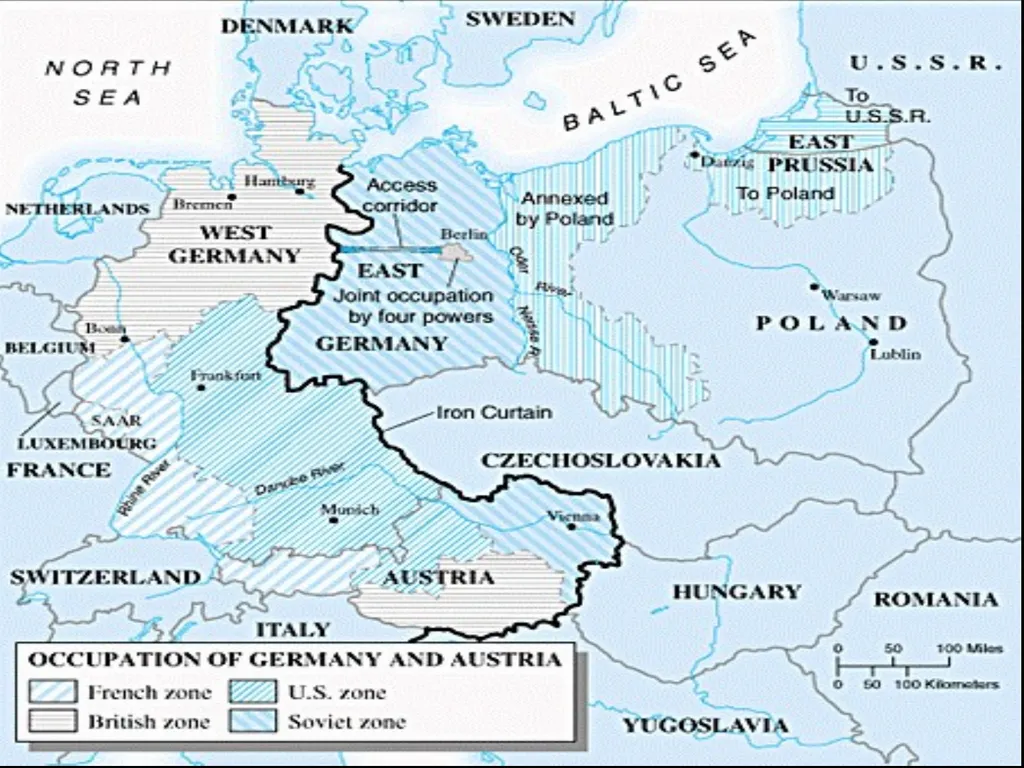
The “Iron Curtain” From Stettin in the Balkans, to Trieste in the Adriatic, an iron curtain has descended across the Continent. Behind that line lies the ancient capitals of Central and Eastern Europe.
-- Sir Winston Churchill, 1946<br>
14
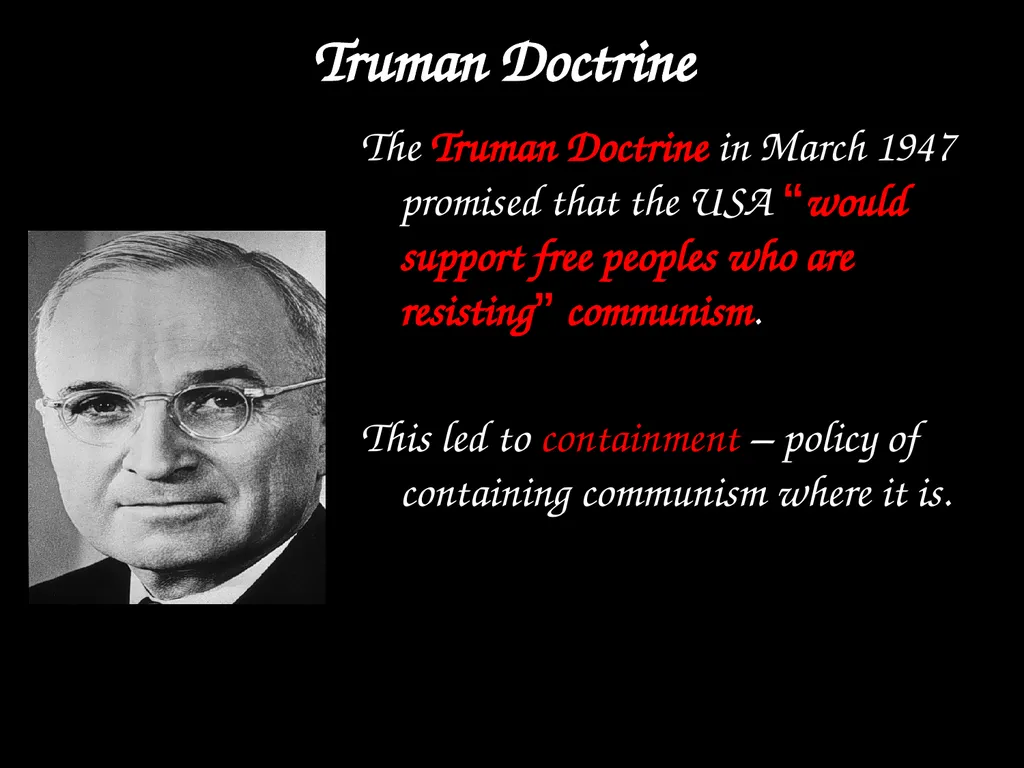
Truman Doctrine The Truman Doctrine in March 1947 promised that the USA “would support free peoples who are resisting” communism.
This led to containment – policy of containing communism where it is.<br>
This led to containment – policy of containing communism where it is.<br>
15
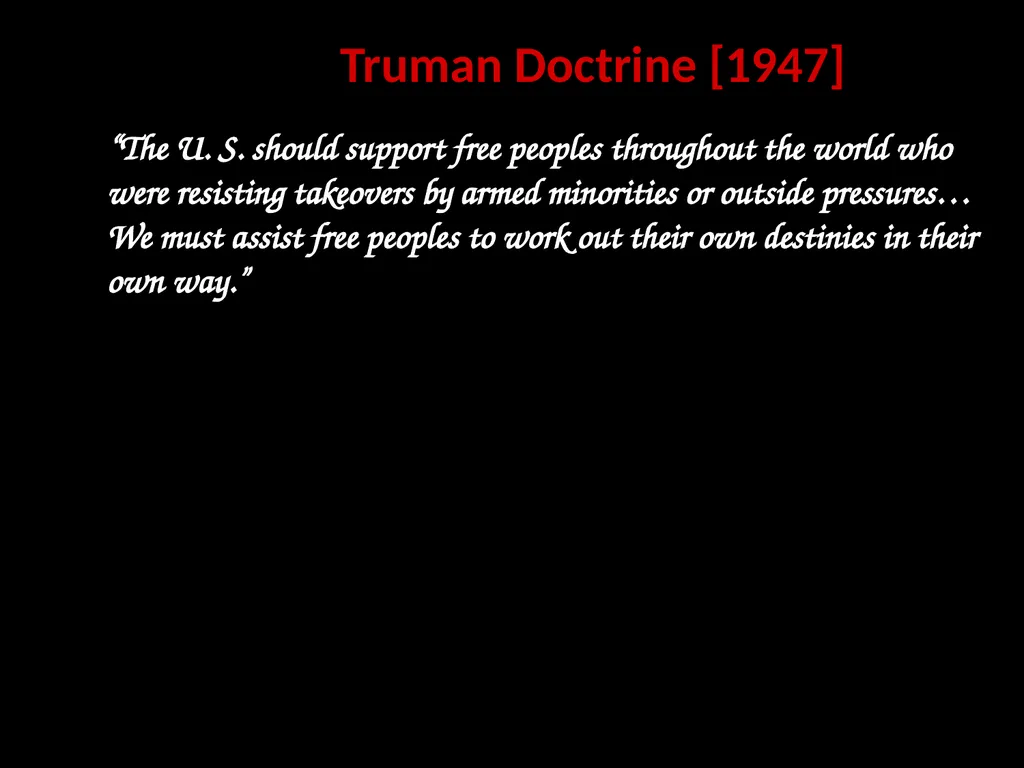
Truman Doctrine [1947] “The U. S. should support free peoples throughout the world who were resisting takeovers by armed minorities or outside pressures…We must assist free peoples to work out their own destinies in their own way.”<br>
16
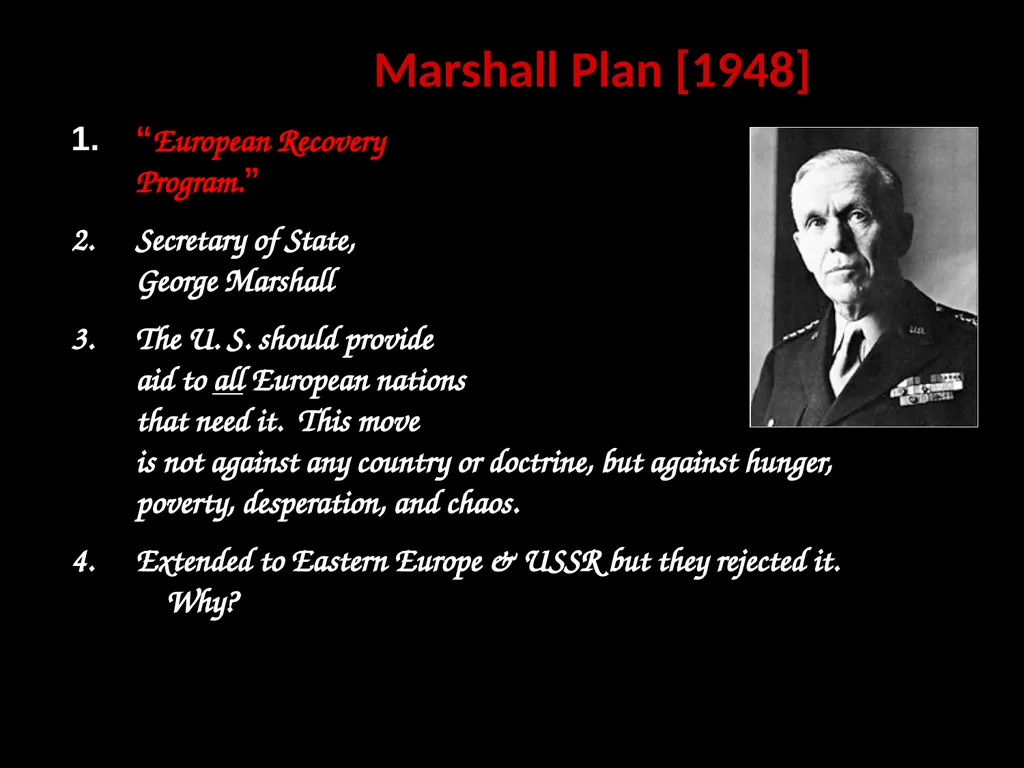
Marshall Plan [1948] “European Recovery
Program.”
Secretary of State, George Marshall
The U. S. should provide aid to all European nations that need it. This move is not against any country or doctrine, but against hunger, poverty, desperation, and chaos.
Extended to Eastern Europe & USSR but they rejected it. Why?<br>
Secretary of State, George Marshall
The U. S. should provide aid to all European nations that need it. This move is not against any country or doctrine, but against hunger, poverty, desperation, and chaos.
Extended to Eastern Europe & USSR but they rejected it. Why?<br>
17
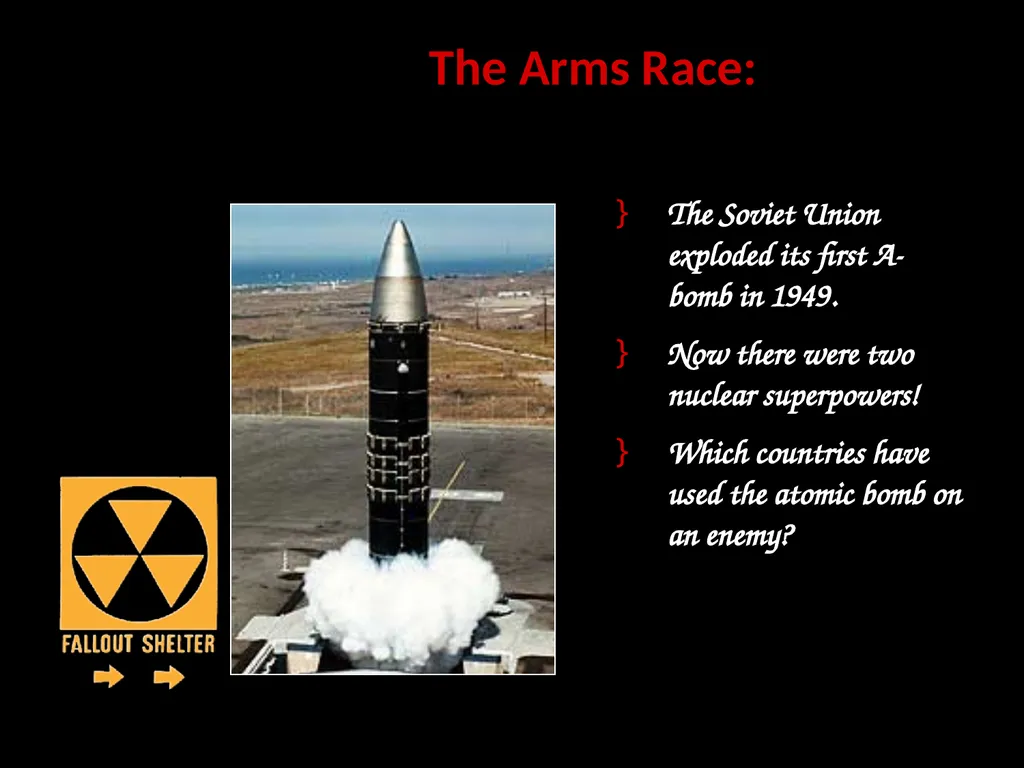
The Arms Race: The Soviet Union exploded its first A-bomb in 1949.
Now there were two nuclear superpowers!
Which countries have used the atomic bomb on an enemy?<br>
Now there were two nuclear superpowers!
Which countries have used the atomic bomb on an enemy?<br>
18
US.73 Describe the competition between the two “superpowers” of the United States and the Soviet Union in the areas of arms development, economic dominance, and ideology, including the role and location of NATO, SEATO, and the Warsaw Pact. (C, E, H, P)<br>
19
North Atlantic Treaty Organization (1949) United States
Belgium
Britain
Canada
Denmark
France
Iceland
Italy Luxemburg
Netherlands
Norway
Portugal
1952: Greece & Turkey
1955: West Germany
1983: Spain<br>
Belgium
Britain
Canada
Denmark
France
Iceland
Italy Luxemburg
Netherlands
Norway
Portugal
1952: Greece & Turkey
1955: West Germany
1983: Spain<br>
20
https://www.youtube.com/watch?v=JGc3v56_ZZY<br>
21
What will the Soviet Union do in response to the creation of NATO?<br>
22
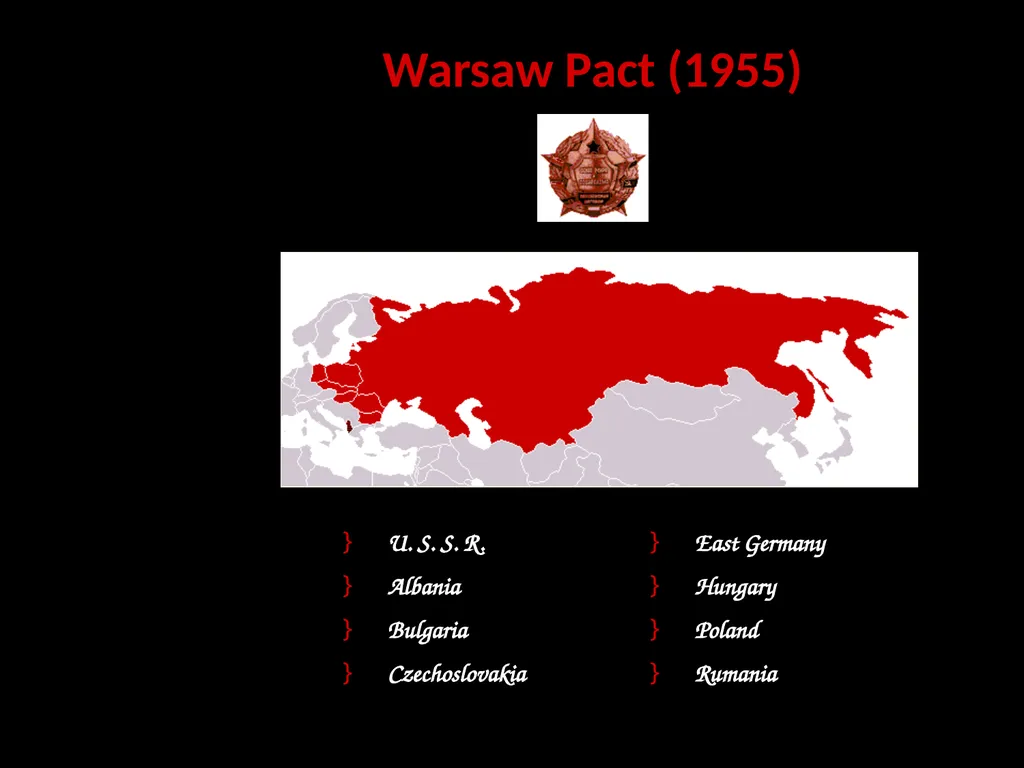
Warsaw Pact (1955) U. S. S. R.
Albania
Bulgaria
Czechoslovakia East Germany
Hungary
Poland
Rumania<br>
Albania
Bulgaria
Czechoslovakia East Germany
Hungary
Poland
Rumania<br>
23
https://www.youtube.com/watch?v=X1El1GVQVdc<br>
24
NATO & WARSAW TODAY http://www.nato.int/cps/en/natolive/nato_countries.htm
http://www.nytimes.com/1991/02/26/world/warsaw-pact-agrees-to-dissolve-its-military-alliance-by-march-31.html<br>
http://www.nytimes.com/1991/02/26/world/warsaw-pact-agrees-to-dissolve-its-military-alliance-by-march-31.html<br>
25
SEATO The Southeast Asia Treaty Organization (SEATO) was an international organization for collective defense in Southeast Asia created by the Southeast Asia Collective Defense Treaty, or Manila Pact, signed in September 1954 in Manila, Philippines.<br>
26
Compare and Contrast NATO with the Warsaw Pact.
How were they alike? Different?
Can you think of a solution to these two groups rivalry? Was this rivalry a good or bad thing for a world with atomic weapons?<br>
How were they alike? Different?
Can you think of a solution to these two groups rivalry? Was this rivalry a good or bad thing for a world with atomic weapons?<br>
27
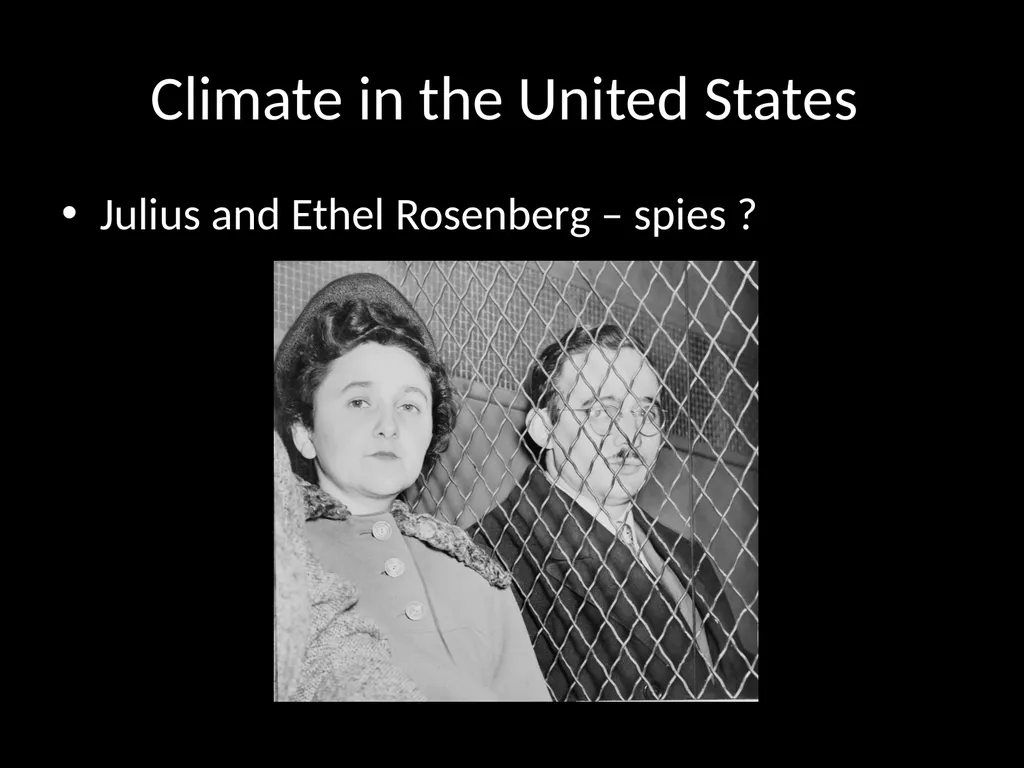
Climate in the United States Julius and Ethel Rosenberg – spies ?<br>
28
1953 Julius and Ethel Had two sons
Were members of the American Communist Party
Accused of espionage (spying) and sentenced to death
Executed by electric chair<br>
Were members of the American Communist Party
Accused of espionage (spying) and sentenced to death
Executed by electric chair<br>
29
http://www.history.com/topics/cold-war/cold-war-history/videos/speeches-execution-of-julius-and-ethel-rosenberg<br>
30
You need: Paper
US History textbook
Pen/pencil
binder<br>
US History textbook
Pen/pencil
binder<br>
31
Red Scare https://www.youtube.com/watch?v=A4LpLqHNOTk<br>
32
Group 4 - Describe NATO.
Justify the creation of NATO. What did the Soviet Union join instead? Describe it. How you think the Soviets viewed NATO (threat, friend, neutral?)
What could have been a solution to the Cold War era of tension?
Group 2 What was the Truman Doctrine?
What was the Marshall Plan?
Explain US foreign policy during this time and their main goal.
Group 3
Describe the atomic bomb and the first time it was used.
Was the United States justified in using the atomic bomb? Why or Why not? Cite evidence if possible.
Group 1 - Who were the Rosenbergs and what did they do?
What happened to them? Was the US justified in executing two human beings for espionage? (What does espionage mean?)
What conclusion(s) can you draw about emotions in the US after learning about the Rosenbergs?<br>
Justify the creation of NATO. What did the Soviet Union join instead? Describe it. How you think the Soviets viewed NATO (threat, friend, neutral?)
What could have been a solution to the Cold War era of tension?
Group 2 What was the Truman Doctrine?
What was the Marshall Plan?
Explain US foreign policy during this time and their main goal.
Group 3
Describe the atomic bomb and the first time it was used.
Was the United States justified in using the atomic bomb? Why or Why not? Cite evidence if possible.
Group 1 - Who were the Rosenbergs and what did they do?
What happened to them? Was the US justified in executing two human beings for espionage? (What does espionage mean?)
What conclusion(s) can you draw about emotions in the US after learning about the Rosenbergs?<br>
33
Group 2 What was the Truman Doctrine?
What was the Marshall Plan?
Explain US foreign policy during this time and their main goal.<br>
What was the Marshall Plan?
Explain US foreign policy during this time and their main goal.<br>
34
Daily Opener What was the main goal of the US during the Cold War?<br>
35
Quiz Describe NATO.
When was the Cold War?
What could have been a solution to the Cold War era of tension?
What was the Truman Doctrine?
What was the Marshall Plan?
Explain US foreign policy during this time and their main goal.
Describe the atomic bomb and the first time it was used.
Was the United States justified in using the atomic bomb? Why or Why not? Cite evidence if possible.
Who were the Rosenbergs and what did they do?
Use one word to describe the climate of the US during the Cold War.<br>
When was the Cold War?
What could have been a solution to the Cold War era of tension?
What was the Truman Doctrine?
What was the Marshall Plan?
Explain US foreign policy during this time and their main goal.
Describe the atomic bomb and the first time it was used.
Was the United States justified in using the atomic bomb? Why or Why not? Cite evidence if possible.
Who were the Rosenbergs and what did they do?
Use one word to describe the climate of the US during the Cold War.<br>
36
Group 3 Describe the atomic bomb and the first time it was used.
Was the United States justified in using the atomic bomb? Why or Why not? Cite evidence if possible.
Think about the mention of sanctions against Iran for their nuclear program. Create a solution to the problem of nuclear weapons today.<br>
Was the United States justified in using the atomic bomb? Why or Why not? Cite evidence if possible.
Think about the mention of sanctions against Iran for their nuclear program. Create a solution to the problem of nuclear weapons today.<br>
37
Group 1 Who were the Rosenbergs and what did they do?
What happened to them? Was the US justified in executing two human beings for espionage? (What does espionage mean?)
What conclusion(s) can you draw about emotions in the US after learning about the Rosenbergs?<br>
What happened to them? Was the US justified in executing two human beings for espionage? (What does espionage mean?)
What conclusion(s) can you draw about emotions in the US after learning about the Rosenbergs?<br>
38
Daily Agenda Daily Opener DO
Timeline Activity
Video Clip: Cold War
Notes
Video Clip: Cold War
Reading Activity
Question
Quiz? What does espionage mean?<br>
Timeline Activity
Video Clip: Cold War
Notes
Video Clip: Cold War
Reading Activity
Question
Quiz? What does espionage mean?<br>
39
After Reading: Timeline Create a Timeline of Cold War Presidents.
Include all Presidents from 1945-91.
Include the years they served and their major contributions (preferably dealing with the Cold War).<br>
Include all Presidents from 1945-91.
Include the years they served and their major contributions (preferably dealing with the Cold War).<br>
40
Iron Curtain and a Divided Germany https://www.youtube.com/watch?v=5zBfIJ4ABIQ<br>
41
Dividing
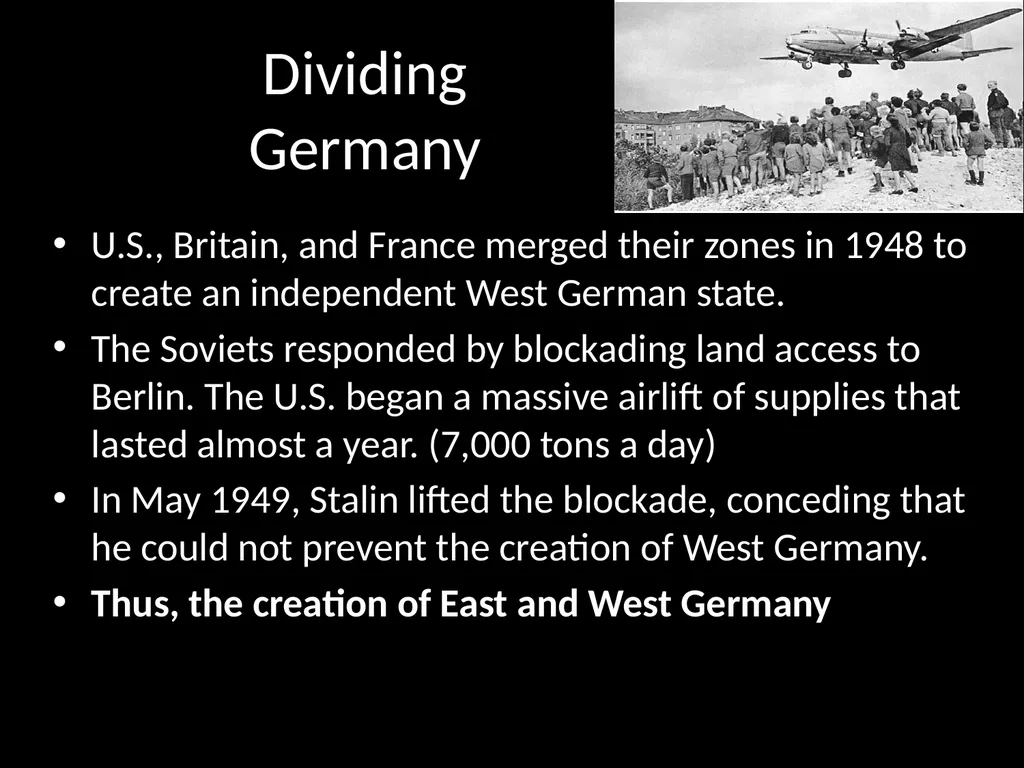
Germany U.S., Britain, and France merged their zones in 1948 to create an independent West German state.
The Soviets responded by blockading land access to Berlin. The U.S. began a massive airlift of supplies that lasted almost a year. (7,000 tons a day)
In May 1949, Stalin lifted the blockade, conceding that he could not prevent the creation of West Germany.
Thus, the creation of East and West Germany<br>
The Soviets responded by blockading land access to Berlin. The U.S. began a massive airlift of supplies that lasted almost a year. (7,000 tons a day)
In May 1949, Stalin lifted the blockade, conceding that he could not prevent the creation of West Germany.
Thus, the creation of East and West Germany<br>
42
Military Industrial Complex B/c of Cold War, US defense industry prospered greatly after WWII.
The government spent large amounts of money to hire private corporations to develop new weapons.
Why?
Threats about communism
Arms race<br>
The government spent large amounts of money to hire private corporations to develop new weapons.
Why?
Threats about communism
Arms race<br>
43
President Eisenhower warned the American people of the military industrial complex. (Government plus weapons industry)<br>
44
Space Race Soviets vs. US
Who could advance the fastest in space travel technology ?
Soviets launched first satellite in 1957
1969 Neil Armstrong – first man on moon<br>
Who could advance the fastest in space travel technology ?
Soviets launched first satellite in 1957
1969 Neil Armstrong – first man on moon<br>
45
Space Race Video Clips<br>
46
Korea Both US and Soviets played role in liberating Korea from Japan during World War II
After Japan’s surrender, the Korean peninsula was divided along the 38th parallel
North Korea – communist
South Korea – capitalist<br>
After Japan’s surrender, the Korean peninsula was divided along the 38th parallel
North Korea – communist
South Korea – capitalist<br>
47
North Korean forces crossed the 38th parallel invading South Korea
The UN sent aid to South Korea with General Douglas MacArthur leading the troops
He pushed them back until China sent troops to help North Korea
War or international police action?
1953 signed a truce and both sides were pretty much where they had started<br>
The UN sent aid to South Korea with General Douglas MacArthur leading the troops
He pushed them back until China sent troops to help North Korea
War or international police action?
1953 signed a truce and both sides were pretty much where they had started<br>
48
Daily Opener Describe the Korean War.<br>
49
Pick 1 Cold War topic
Research – Take Notes on topic<br>
Research – Take Notes on topic<br>
50
Cold War Presidents<br>
51
Quiz 1. List the names of the Cold War Presidents in order.
2. When was the Cold War? Why did we have it?<br>
2. When was the Cold War? Why did we have it?<br>
52
H-Bomb After the Soviets developed their atomic bomb, the two superpowers embarked on an arms race.
https://www.youtube.com/watch?v=AdQGHIFFGyw
Race for the H-bomb
Even more destructive thermonuclear weapon
67xs the power of the bomb dropped on Hiroshima<br>
https://www.youtube.com/watch?v=AdQGHIFFGyw
Race for the H-bomb
Even more destructive thermonuclear weapon
67xs the power of the bomb dropped on Hiroshima<br>
53
1952- US exploded the first H-bomb
1953 – Soviets exploded theirs
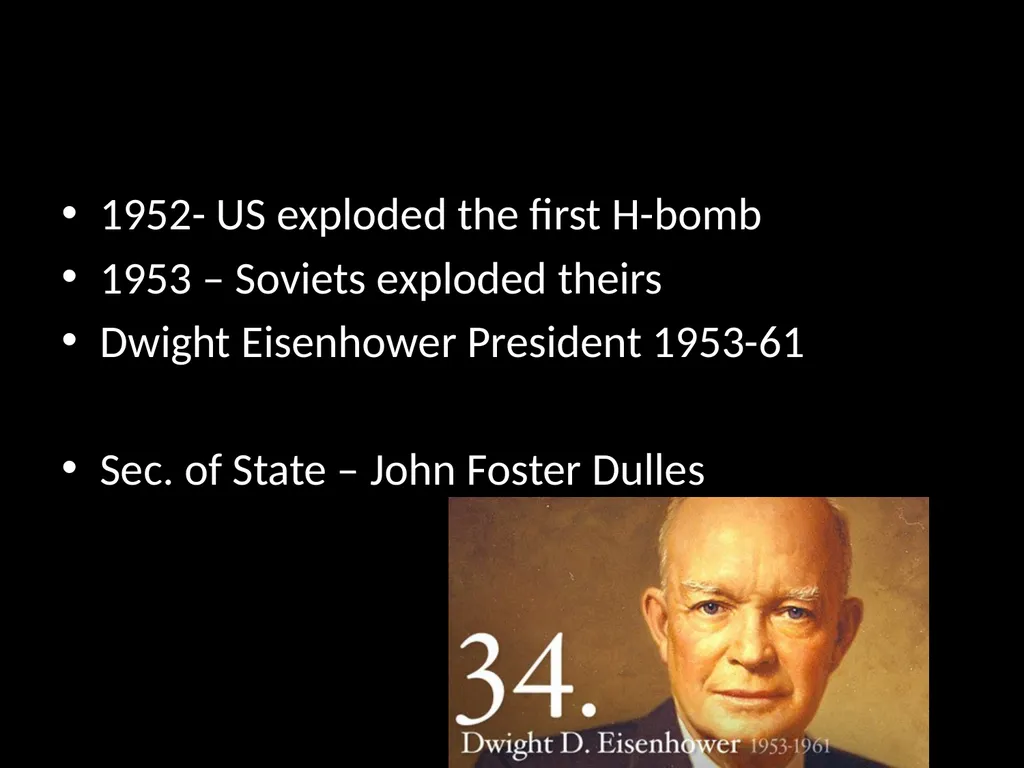
Dwight Eisenhower President 1953-61
Sec. of State – John Foster Dulles<br>
1953 – Soviets exploded theirs
Dwight Eisenhower President 1953-61
Sec. of State – John Foster Dulles<br>
54
John Dulles Staunchly anti-communist
Promised that the US could prevent the spread of communism by promising to use all of its force, including nuclear weapons, against an aggressor
The willingness, under Eisenhower, to go to all out war became known as brinkmanship<br>
Promised that the US could prevent the spread of communism by promising to use all of its force, including nuclear weapons, against an aggressor
The willingness, under Eisenhower, to go to all out war became known as brinkmanship<br>
55
Daily Opener Describe the Decay Theory.<br>
56
DO Describe the reason for the Korean War.<br>
57
The US trimmed its army and navy and built up its air force
The Soviets followed suit
Why?<br>
The Soviets followed suit
Why?<br>
58
CIA Eisenhower began to rely more on the recently created CIA (1947)
First major international issue – Iran
Mohammed Mossadegh nationalized Iran’s oil fields
Placed formerly Britain owned oil fields back into Iranian hands<br>
First major international issue – Iran
Mohammed Mossadegh nationalized Iran’s oil fields
Placed formerly Britain owned oil fields back into Iranian hands<br>
59
As Britain boycotted buying the oil, the Iranian economy faltered.
Fearing that Iran would turn to the Soviets for help, the US gave several million dollars to anti-Mossadegh supporters
The Shah returned to power and gave their oil field back to the West<br>
Fearing that Iran would turn to the Soviets for help, the US gave several million dollars to anti-Mossadegh supporters
The Shah returned to power and gave their oil field back to the West<br>
60
Cold War Attitudes at Home Very concerned about the cold war and communism
Lived with constant threat of nuclear war – fear
During the Great Depression, many Americans had supported some socialist policies
Once the Cold War began, the government investigated, arrested, and harassed many people due to their alleged connections to the Communist Party. This period became known as the Red Scare.<br>
Lived with constant threat of nuclear war – fear
During the Great Depression, many Americans had supported some socialist policies
Once the Cold War began, the government investigated, arrested, and harassed many people due to their alleged connections to the Communist Party. This period became known as the Red Scare.<br>
61
Joseph McCarthy Wisconsin Senator
Claimed communists had inflitrated high levels of government
Gained popularity at first until people realized he was lying
The irrational fear that ‘communists are everywhere’ ultimately subsided<br>
Claimed communists had inflitrated high levels of government
Gained popularity at first until people realized he was lying
The irrational fear that ‘communists are everywhere’ ultimately subsided<br>
62
Cuba During the 1950s, a young revolutionary named Fidel Castro rose to fame as the leader of the Cuban Revolution.
The Revolution overthrew the Cuban government in 1959 and made Castro the communist leader of the country
Castro executed more than 700 of his opponents and jailed even more.
His government also seized control of much of the land and property in the country.<br>
The Revolution overthrew the Cuban government in 1959 and made Castro the communist leader of the country
Castro executed more than 700 of his opponents and jailed even more.
His government also seized control of much of the land and property in the country.<br>
63
Discovering that Castro had ties to communism and had taken some US lands, President Eisenhower refused to support the new dictator and broke off diplomatic relations.<br>
64
The Bay of Pigs With US support lacking, Castro allied himself with the Soviets.
Eisenhower then authorized the CIA to begin training anti-Castro Cuban exiles for an invasion of Cuba. When JFK succeeded Eisenhower as president in 1961, he approved the operation and authorized the CIA to continue.<br>
Eisenhower then authorized the CIA to begin training anti-Castro Cuban exiles for an invasion of Cuba. When JFK succeeded Eisenhower as president in 1961, he approved the operation and authorized the CIA to continue.<br>
65
The Bay of Pigs The invasion landed at the Bay of Pigs on April 17, 1961 as planned.
The invasion failed and turned into a big embarrassment for the Kennedy administration.
It left many around the world wondering if the young president was up to the task of defending democracy.<br>
The invasion failed and turned into a big embarrassment for the Kennedy administration.
It left many around the world wondering if the young president was up to the task of defending democracy.<br>
66
http://www.history.com/topics/cold-war/cuban-missile-crisis/videos/bay-of-pigs-cias-perfect-failure<br>
67
Quiz – Opinion Questions Do you think the Bay of Pigs would have failed if Eisenhower was the President? Why or Why not?
Do you think military experience should be a requirement for our country’s President? Why or Why Not?
Create at least 4 requirements for President that would help guarantee a good leader.<br>
Do you think military experience should be a requirement for our country’s President? Why or Why Not?
Create at least 4 requirements for President that would help guarantee a good leader.<br>
68
Daily Opener Which President coined the term domino theory?<br>
69
Daily Opener What was John Foster Dulle’s foreign policy plan? Explain it.<br>
70
Daily Opener What happened during the Chinese Revolution of 1949? (Which leader took control of the country and what was the new type of government?)<br>
71
9.9 Recognize the altered American approach to foreign policy (i.e., Bay of Pigs, Brinkmanship, Cuban Missile Crisis, peaceful coexistence).<br>
72
After the Bay of Pigs Although the Bay of Pigs was a failure, the attempted invasion concerned Castro.
He feared a future invasion by US forces.
So, Castro forged a stronger alliance with the Soviets and allowed them to place nuclear missiles in Cuba.
?<br>
He feared a future invasion by US forces.
So, Castro forged a stronger alliance with the Soviets and allowed them to place nuclear missiles in Cuba.
?<br>
73
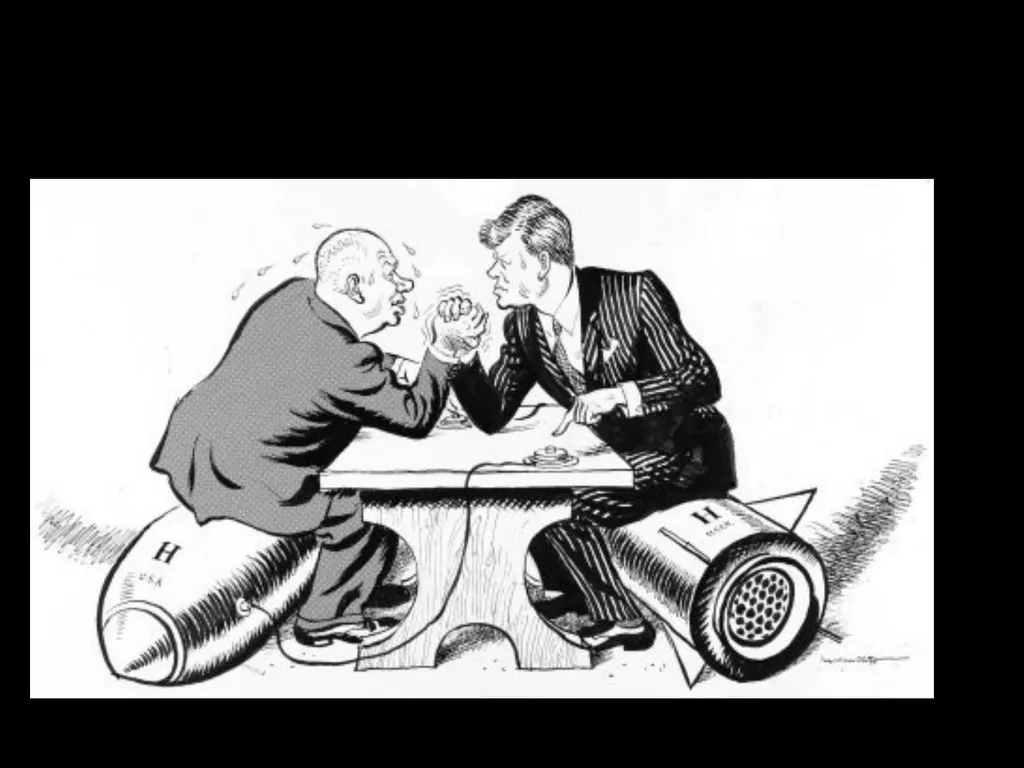
Brink of Nuclear War Cuba is just 90 miles from Florida.
In October of 1962, spy planes spotted these missiles.
JFK responded by authorizing a naval blockade of the island.
For thirteen days, the world watched as the Cuban Missile Crisis brought the two superpowers to the brink of nuclear war.<br>
In October of 1962, spy planes spotted these missiles.
JFK responded by authorizing a naval blockade of the island.
For thirteen days, the world watched as the Cuban Missile Crisis brought the two superpowers to the brink of nuclear war.<br>
74
The US strategy of refusing to back down to the Soviets – even to the point of war – became known as brinkmanship.
Finally after heated arguments in the UN and much negotiating, Soviet Leader Nikita Khrushchev, agreed to withdraw the missiles in exchange for a US pledge not to invade Cuba and to secretly remove their missiles from Turkey.<br>
Finally after heated arguments in the UN and much negotiating, Soviet Leader Nikita Khrushchev, agreed to withdraw the missiles in exchange for a US pledge not to invade Cuba and to secretly remove their missiles from Turkey.<br>
75
Khrushchev and JFK increased communications between their countries.
Having seen how close the two nations had come to a nuclear war, Kennedy began
moving the US in the direction of
peaceful coexistence (maintaining
peace despite the difference
between communism and capitalism)<br>
Having seen how close the two nations had come to a nuclear war, Kennedy began
moving the US in the direction of
peaceful coexistence (maintaining
peace despite the difference
between communism and capitalism)<br>
76
http://www.history.com/topics/cold-war/cuban-missile-crisis/videos/cuban-missile-crisis?m=528e394da93ae&s=undefined&f=1&free=false<br>
77
Jelly Doughnut http://www.history.com/topics/cold-war/cuban-missile-crisis/videos/ask-history-kennedy-and-the-jelly-doughnut?m=528e394da93ae&s=undefined&f=1&free=false
http://www.history.com/topics/cold-war/cuban-missile-crisis/videos/kennedy-responds-to-berlin-wall?m=528e394da93ae&s=undefined&f=1&free=false<br>
http://www.history.com/topics/cold-war/cuban-missile-crisis/videos/kennedy-responds-to-berlin-wall?m=528e394da93ae&s=undefined&f=1&free=false<br>
78
Daily Opener “You have a row of dominoes set up. You knock over the first one, and what will happen to the last one is a certainty that it will go over quickly.” Which President said this?<br>
79
Daily Opener Write a brief description and the years for the following time periods:
Civil War
Gilded Age
American Imperialism
Progressive Era
World War I<br>
Civil War
Gilded Age
American Imperialism
Progressive Era
World War I<br>
80
Ch. 16 Quiz 1.<br>
81
2.<br>
82
When was the Cold War?
Who was it between?
Explain the term Iron Curtain.
What was the Berlin Airlift?
List three communist countries during this period.
Describe the Bay of Pigs in one word.
What was significant about the Cuban Missile Crisis?
Who coined the term domino theory and implemented the Interstate Highway Act?
Which President was in charge during the Bay of Pigs and Cuban Missile Crisis?
Who was the Soviet leader during the Cuban Missile Crisis?<br>
Who was it between?
Explain the term Iron Curtain.
What was the Berlin Airlift?
List three communist countries during this period.
Describe the Bay of Pigs in one word.
What was significant about the Cuban Missile Crisis?
Who coined the term domino theory and implemented the Interstate Highway Act?
Which President was in charge during the Bay of Pigs and Cuban Missile Crisis?
Who was the Soviet leader during the Cuban Missile Crisis?<br>
83
At the present moment in world history nearly every nation must choose between alternative ways of life. The choice is too often not a free one. . . .
The second way of life is based upon the will of a minority forcibly imposed upon the majority. It relies upon terror and oppression, a controlled press and radio, fixed elections, and the suppression of personal freedoms.
—President Harry S. Truman, speech to Congress (1947)
6. Based on the excerpt, which country was President Truman criticizing?
A. South Korea
*B. the Soviet Union
C. West Germany
D. the United Kingdom<br>
The second way of life is based upon the will of a minority forcibly imposed upon the majority. It relies upon terror and oppression, a controlled press and radio, fixed elections, and the suppression of personal freedoms.
—President Harry S. Truman, speech to Congress (1947)
6. Based on the excerpt, which country was President Truman criticizing?
A. South Korea
*B. the Soviet Union
C. West Germany
D. the United Kingdom<br>
84
Daily Opener What do you think about the term glass ceiling?
Reminders:
Study Guides are due in ten minutes – effort grade
Review Game to follow (going over the study guide)
Test on Wednesday<br>
Reminders:
Study Guides are due in ten minutes – effort grade
Review Game to follow (going over the study guide)
Test on Wednesday<br>
85
Bonus What does espionage mean?<br>
86
Cold War Presidents 1945-91 Harry Truman - 1945-53
Dwight Eisenhower – 1953-61
John F. Kennedy – 1961-63
Lyndon Baines Johnson – 1963-69
Richard Nixon – 1969-74
Gerald Ford – 1974-77
Jimmy Carter – 1977-81
Ronald Reagan – 1981-89
George Bush – 1989-93<br>
Dwight Eisenhower – 1953-61
John F. Kennedy – 1961-63
Lyndon Baines Johnson – 1963-69
Richard Nixon – 1969-74
Gerald Ford – 1974-77
Jimmy Carter – 1977-81
Ronald Reagan – 1981-89
George Bush – 1989-93<br>
87
Crash course – Cold War #39
https://www.youtube.com/watch?v=y9HjvHZfCUI
Famous Daisy Attack - https://www.youtube.com/watch?v=dDTBnsqxZ3k
Pass out cloze notes<br>
https://www.youtube.com/watch?v=y9HjvHZfCUI
Famous Daisy Attack - https://www.youtube.com/watch?v=dDTBnsqxZ3k
Pass out cloze notes<br>
88
Khan Academy – Vietnam War https://www.khanacademy.org/humanities/history/euro-hist/cold-war/v/vietnam-war<br>
89
Agenda & Daily Opener Daily Opener
Finish going over the Vietnam War cloze notes.
Turn in homework: L19 Reading Handout.
Study Guide Handout
Go over Review Handout: Cold War - Test next week
EOC Study Folder and EOC Score- Go over test What are the years for the Vietnam War?<br>
Finish going over the Vietnam War cloze notes.
Turn in homework: L19 Reading Handout.
Study Guide Handout
Go over Review Handout: Cold War - Test next week
EOC Study Folder and EOC Score- Go over test What are the years for the Vietnam War?<br>
90
Find a partner. Get ready to study for a quiz. Open a blue textbook to a map.
Find the following countries that were
DOMINATED OR THREATENED BY COMMUNISM DURING THE COLD WAR
Germany Korea Vietnam Cuba
- (US intervened in at some point)
Czechoslovakia Poland Hungary Romania
Bulgaria Soviet Union China Quiz each other in preparation for the real quiz.<br>
Find the following countries that were
DOMINATED OR THREATENED BY COMMUNISM DURING THE COLD WAR
Germany Korea Vietnam Cuba
- (US intervened in at some point)
Czechoslovakia Poland Hungary Romania
Bulgaria Soviet Union China Quiz each other in preparation for the real quiz.<br>
91
Vietnam During the 1800s, France established a colony in a small Southeast Asian country called Vietnam.
Following WWII, fighting erupted as Vietnamese nationalists wanted independence from France.
This greatly concerned President Eisenhower, who viewed the nationalists as Communists.
Various world leaders met in 1954to discuss a peaceful solution.<br>
Following WWII, fighting erupted as Vietnamese nationalists wanted independence from France.
This greatly concerned President Eisenhower, who viewed the nationalists as Communists.
Various world leaders met in 1954to discuss a peaceful solution.<br>
92
They agreed to divided Vietnam into two nations. North Vietnam became a communist backed government led by Ho Chi Minh.
South Vietnam became a US supported government eventually led by Ngo Dinh Diem.
War broke out between North and South Vietnam.
Diem dealt with opposition by imprisoning people. US money aided Diem and helped create a corrupt political set up.<br>
South Vietnam became a US supported government eventually led by Ngo Dinh Diem.
War broke out between North and South Vietnam.
Diem dealt with opposition by imprisoning people. US money aided Diem and helped create a corrupt political set up.<br>
93
Diem also alienated the mostly Buddhist population by trying to push his Catholic beliefs on them.
A pro-North Vietnamese rebel force known as the Vietcong grew in numbers and strength within South Vietnam. Eventually Diem was overthrown and executed by members of his own military.
The South Vietnamese leaders that followed, however, had little more success in uniting the country.<br>
A pro-North Vietnamese rebel force known as the Vietcong grew in numbers and strength within South Vietnam. Eventually Diem was overthrown and executed by members of his own military.
The South Vietnamese leaders that followed, however, had little more success in uniting the country.<br>
94
LBJ’s approach to Vietnam In the early 60s, both Eisenhower and JFK feared the spread of communism and sent military advisors to South Vietnam.
JFK was assassinated on November 22, 1963 leaving Lyndon Baines Johnson the new President with a tough decision to make: What should the US do in Vietnam?
1964 LBJ defeats Barry Goldwater by making Goldwater appear to be ready to start a nuclear war.<br>
JFK was assassinated on November 22, 1963 leaving Lyndon Baines Johnson the new President with a tough decision to make: What should the US do in Vietnam?
1964 LBJ defeats Barry Goldwater by making Goldwater appear to be ready to start a nuclear war.<br>
95
In 1964, North Vietnamese attacked US ships in the Gulf of Tonkin.
LBJ got Congress to pass the Gulf of Tonkin Resolution. This Resolution gave the President the authority to “take all necessary measures to repel any armed attack against the forces of the United States.”
It gave Johnson the power to take military action in Vietnam without having to get approval from Congress.<br>
LBJ got Congress to pass the Gulf of Tonkin Resolution. This Resolution gave the President the authority to “take all necessary measures to repel any armed attack against the forces of the United States.”
It gave Johnson the power to take military action in Vietnam without having to get approval from Congress.<br>
96
Johnson decided to take military action to cut off the Vietcong’s supplies from North Vietnam.
The President ordered intense bombing of North Vietnam.
The US dropped thousands of tons of explosives that destroyed bridges, supply lines, and villages, killing many civilians in the process.
Between 1965 and 1968, the US military presence increased dramatically in Vietnam.<br>
The President ordered intense bombing of North Vietnam.
The US dropped thousands of tons of explosives that destroyed bridges, supply lines, and villages, killing many civilians in the process.
Between 1965 and 1968, the US military presence increased dramatically in Vietnam.<br>
97
Tet Offensive January 1968, the North Vietnamese and Vietcong launched a major coordinated attack against the US and South Vietnamese forces.
Produced heavy fighting
The US forces eventually pushed them back
BUT the Vietcong had won a psychological battle against the US
Americans wondered if the US was handling the war correclty<br>
Produced heavy fighting
The US forces eventually pushed them back
BUT the Vietcong had won a psychological battle against the US
Americans wondered if the US was handling the war correclty<br>
98
My Lai Massacre March 1968
US troops rounded up and executed between 175-400 civilians in M Lai.
American people were horrified.<br>
US troops rounded up and executed between 175-400 civilians in M Lai.
American people were horrified.<br>
99
Nixon and the end of involvement in Vietnam Nixon became president in January 1969.
Nixon wanted to end the Vietnam War for the US but he didn’t want South Vietnam to fall to the communists Northern forces.
He bombed bordering countries like Laos and Cambodia.<br>
Nixon wanted to end the Vietnam War for the US but he didn’t want South Vietnam to fall to the communists Northern forces.
He bombed bordering countries like Laos and Cambodia.<br>
100
http://www.history.com/topics/cold-war/cuban-missile-crisis/videos/vietnam?m=528e394da93ae&s=undefined&f=1&free=false<br>
101
Cold War: Study Guide Each person needs to complete one for a grade today.
May work in groups if prefer
May use books and notes for answers<br>
May work in groups if prefer
May use books and notes for answers<br>
102
Alger Hiss an American government official who was accused of being a Soviet spy in 1948 and convicted of perjury in connection with this charge in 1950.
Before he was tried and convicted, he was involved in the establishment of the United Nations both as a U.S. State Department official and as a U.N. official.<br>
Before he was tried and convicted, he was involved in the establishment of the United Nations both as a U.S. State Department official and as a U.N. official.<br>