
Dairy Cattle Nutrition – The Basics Dr. L. E.
AM
Published · 49 slides · 0 views

1 / 1





Description
Dairy Cattle Nutrition The Basics Dr. L. E. Chase Department of Animal Science Cornell University Todays Dairy Cow The dairy cow is a marvel as a biological manufacturing plant The average New York dairy cow produced 20,071 lbs. of
Related Topics
Share
Embed code
Download this presentation From Below
"Dairy Cattle Nutrition – The Basics Dr. L. E." is the property of its rightful owner. Permission is granted to download and print the materials on this website for personal, non-commercial use only, and to display it on your personal computer provided you do not modify the materials and that you retain all copyright notices contained in the materials. By downloading content from our website, you accept the terms of this agreement.
Presentation Transcript
01
Dairy Cattle Nutrition – The Basics Dr. L. E. Chase
Department of Animal Science
Cornell University<br>
Department of Animal Science
Cornell University<br>
02
Today’s Dairy Cow The dairy cow is a marvel as a biological manufacturing plant
The “average” New York dairy cow produced 20,071 lbs. of milk per lactation in 2009
The “average” New York dairy cow produced 10,885 lbs. of milk per lactation in 1970
This is an 84% increase!<br>
The “average” New York dairy cow produced 20,071 lbs. of milk per lactation in 2009
The “average” New York dairy cow produced 10,885 lbs. of milk per lactation in 1970
This is an 84% increase!<br>
03
Today’s Dairy Cow - 2 We have a number of herds in NY with herd average milk production > 30,000 lbs/cow
What is the biological limit to milk production?
How can an individual cow in a herd produce > 200 lbs of milk per day when housed in a group fed a ration balanced for 85 lbs. of milk?<br>
What is the biological limit to milk production?
How can an individual cow in a herd produce > 200 lbs of milk per day when housed in a group fed a ration balanced for 85 lbs. of milk?<br>
04
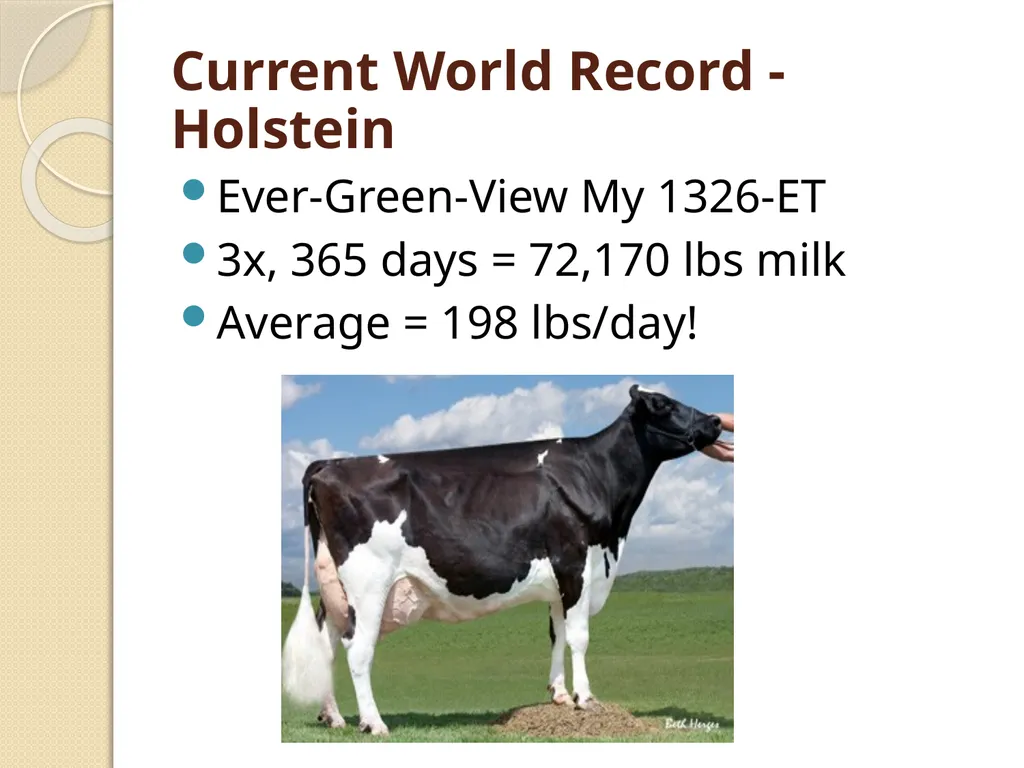
Current World Record - Holstein Ever-Green-View My 1326-ET
3x, 365 days = 72,170 lbs milk
Average = 198 lbs/day!<br>
3x, 365 days = 72,170 lbs milk
Average = 198 lbs/day!<br>
05
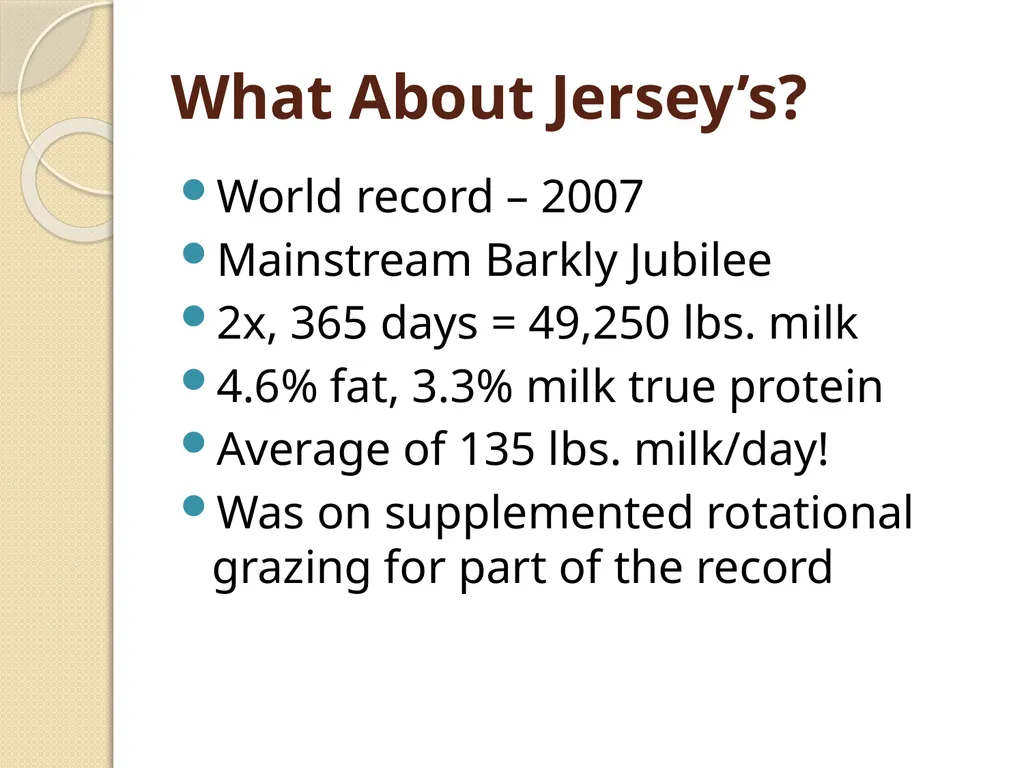
What About Jersey’s? World record – 2007
Mainstream Barkly Jubilee
2x, 365 days = 49,250 lbs. milk
4.6% fat, 3.3% milk true protein
Average of 135 lbs. milk/day!
Was on supplemented rotational grazing for part of the record<br>
Mainstream Barkly Jubilee
2x, 365 days = 49,250 lbs. milk
4.6% fat, 3.3% milk true protein
Average of 135 lbs. milk/day!
Was on supplemented rotational grazing for part of the record<br>
06
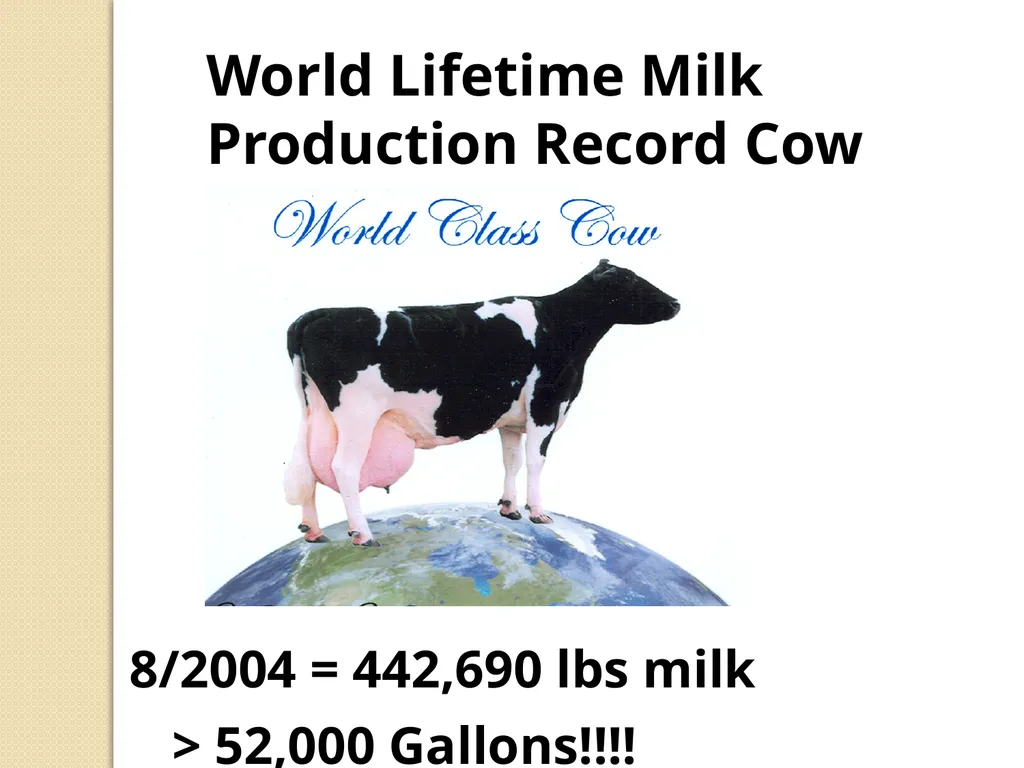
World Lifetime Milk Production Record Cow 8/2004 = 442,690 lbs milk > 52,000 Gallons!!!!<br>
07
Milk - - 100 lbs (13 lbs of dry matter) - 4.9 lbs. of lactose (sugar) - 3.6 lbs of milk fat - 3.1 lbs. of milk true protein
Manure - - 190 lbs of total manure - 60 – 70 lbs of urine - 120 -130 lbs fecal material What Does a Cow Producing 100 lbs. of Milk Excrete/Day?<br>
Manure - - 190 lbs of total manure - 60 – 70 lbs of urine - 120 -130 lbs fecal material What Does a Cow Producing 100 lbs. of Milk Excrete/Day?<br>
08
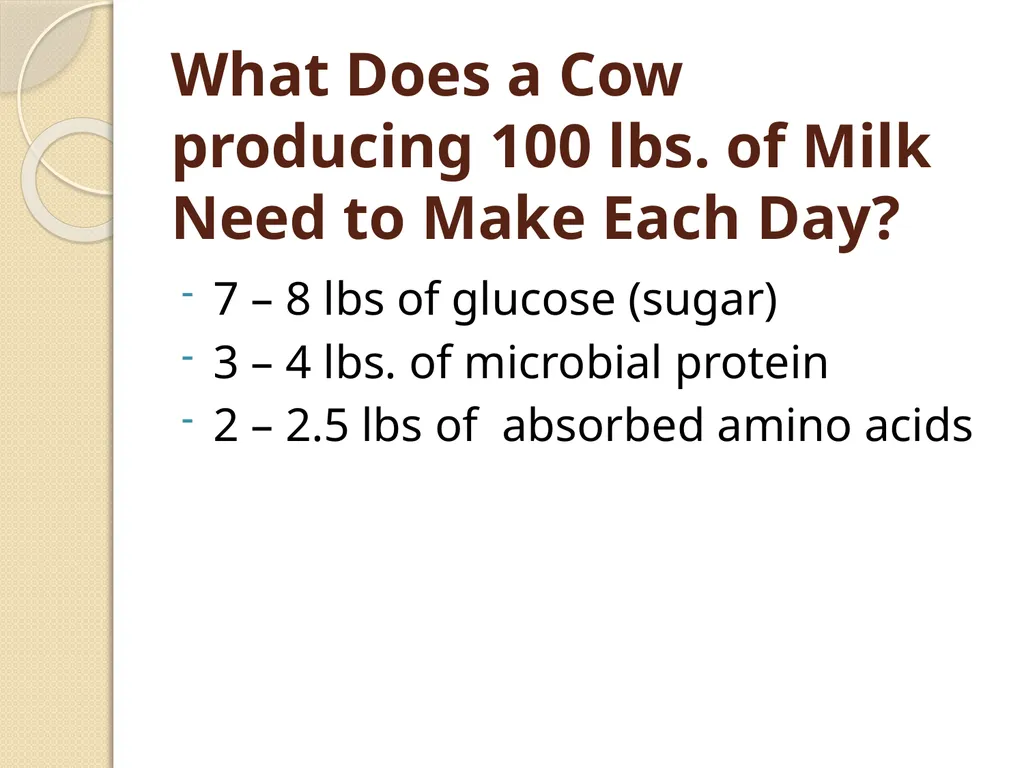
What Does a Cow producing 100 lbs. of Milk Need to Make Each Day? 7 – 8 lbs of glucose (sugar)
3 – 4 lbs. of microbial protein
2 – 2.5 lbs of absorbed amino acids<br>
3 – 4 lbs. of microbial protein
2 – 2.5 lbs of absorbed amino acids<br>
09
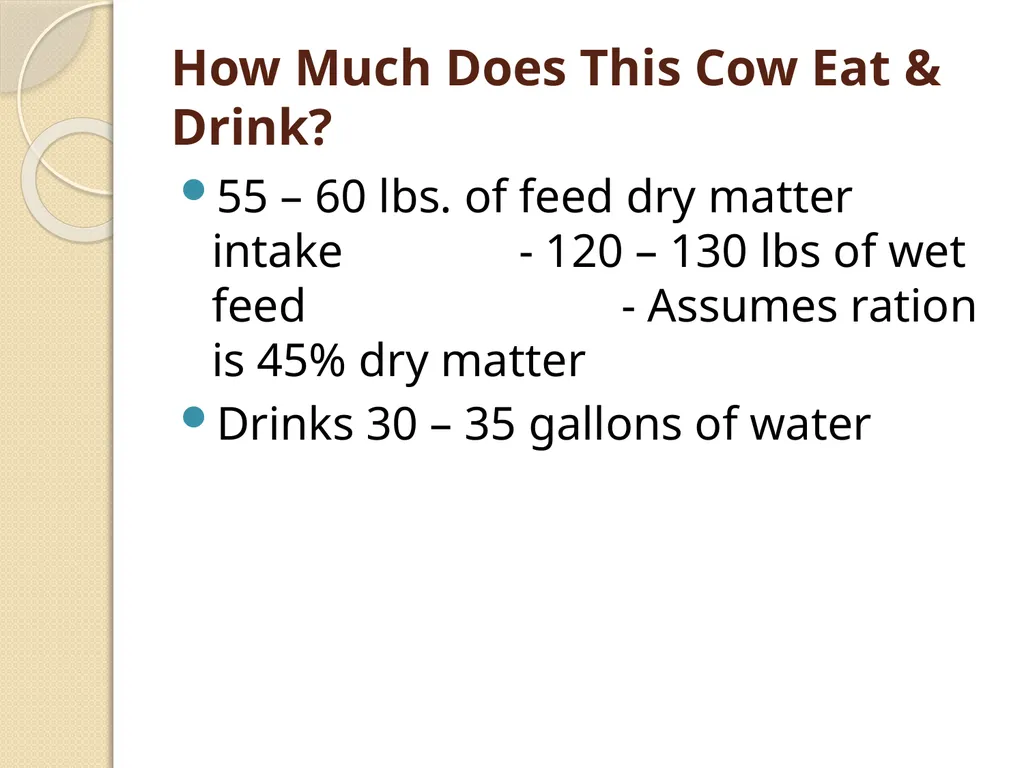
How Much Does This Cow Eat & Drink? 55 – 60 lbs. of feed dry matter intake - 120 – 130 lbs of wet feed - Assumes ration is 45% dry matter
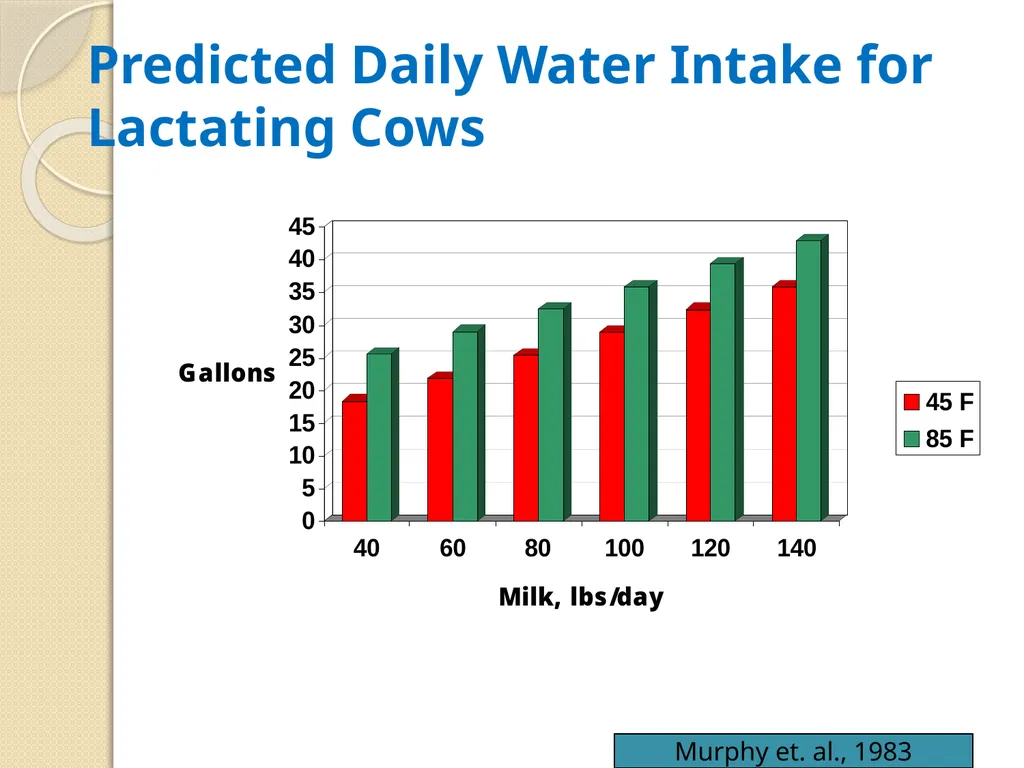
Drinks 30 – 35 gallons of water<br>
Drinks 30 – 35 gallons of water<br>
10
Why is DMI Important? Must be a package size that the cow can be expected to consume
Related directly to potential milk production, feed cost and PROFIT
Essential if rations are formulated on a nutrient density basis
Can’t do problem solving without DMI<br>
Related directly to potential milk production, feed cost and PROFIT
Essential if rations are formulated on a nutrient density basis
Can’t do problem solving without DMI<br>
11
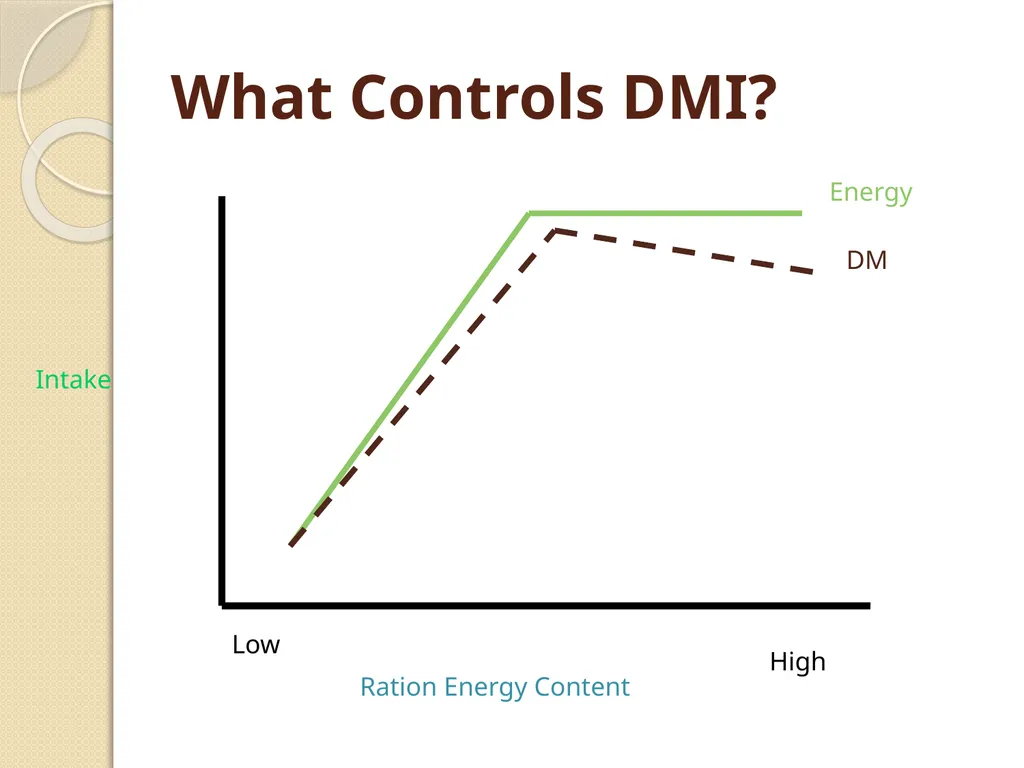
What Controls DMI? Ration Energy Content Low High Intake Energy DM<br>
12
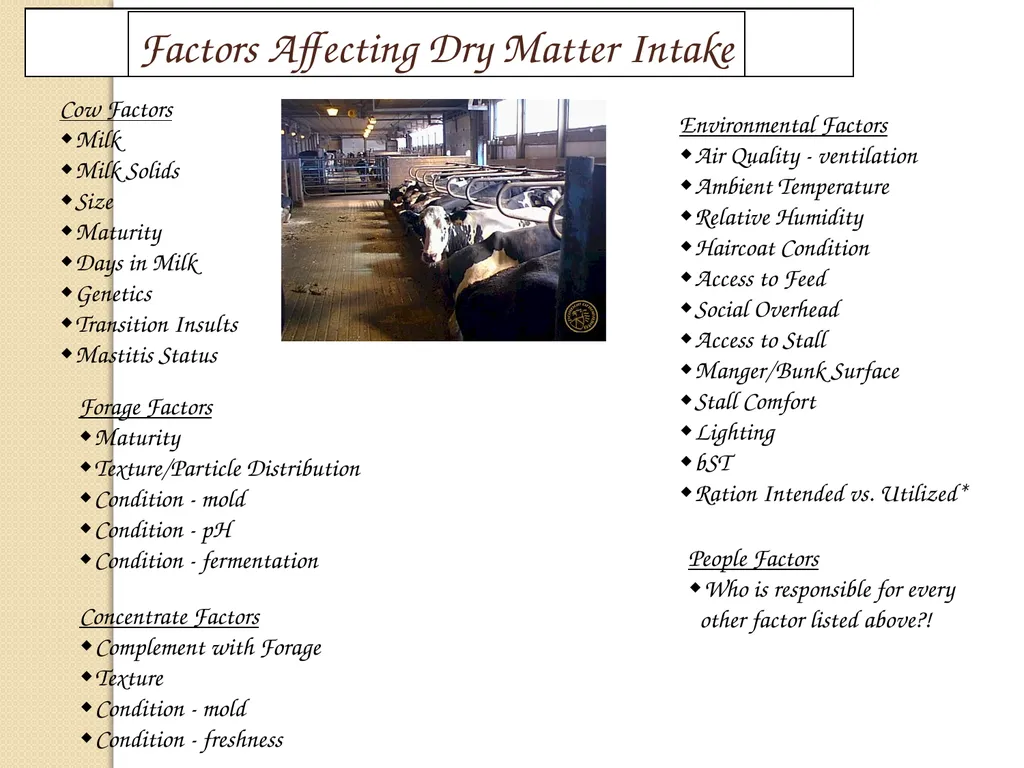
Cow Factors
Milk
Milk Solids
Size
Maturity
Days in Milk
Genetics
Transition Insults
Mastitis Status Forage Factors
Maturity
Texture/Particle Distribution
Condition - mold
Condition - pH
Condition - fermentation Environmental Factors
Air Quality - ventilation
Ambient Temperature
Relative Humidity
Haircoat Condition
Access to Feed
Social Overhead
Access to Stall
Manger/Bunk Surface
Stall Comfort
Lighting
bST
Ration Intended vs. Utilized* Concentrate Factors
Complement with Forage
Texture
Condition - mold
Condition - freshness People Factors
Who is responsible for every
other factor listed above?!<br>
Milk
Milk Solids
Size
Maturity
Days in Milk
Genetics
Transition Insults
Mastitis Status Forage Factors
Maturity
Texture/Particle Distribution
Condition - mold
Condition - pH
Condition - fermentation Environmental Factors
Air Quality - ventilation
Ambient Temperature
Relative Humidity
Haircoat Condition
Access to Feed
Social Overhead
Access to Stall
Manger/Bunk Surface
Stall Comfort
Lighting
bST
Ration Intended vs. Utilized* Concentrate Factors
Complement with Forage
Texture
Condition - mold
Condition - freshness People Factors
Who is responsible for every
other factor listed above?!<br>
13
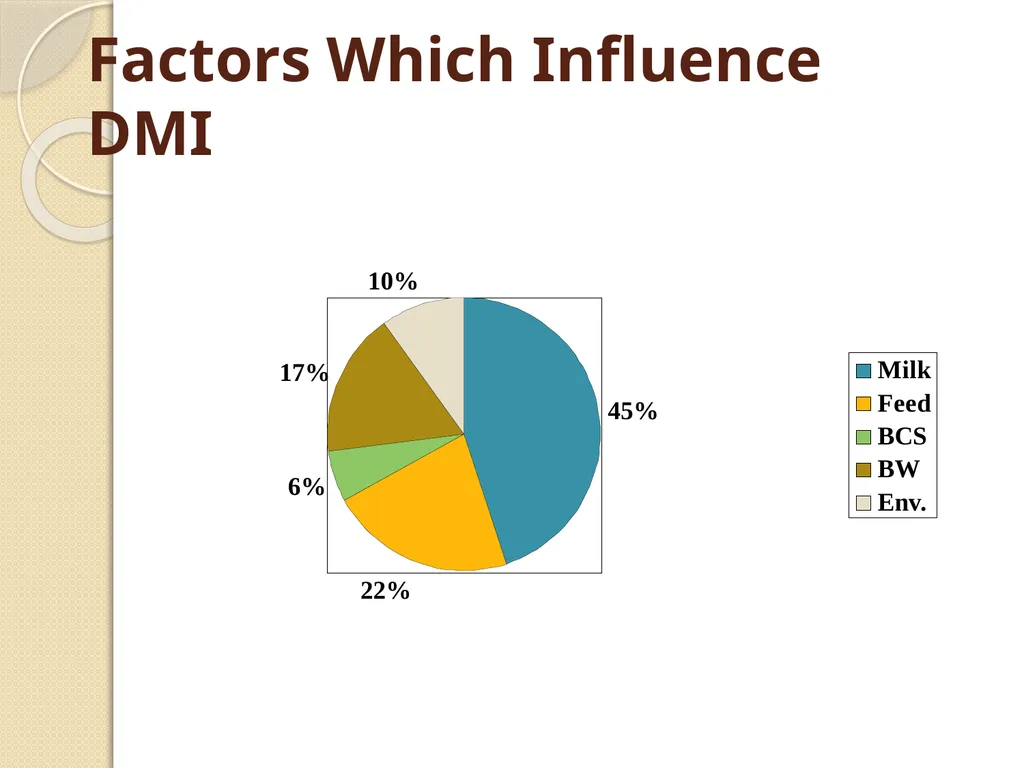
Factors Which Influence DMI<br>
14
High Producing Dairy Herds Do they attain high levels of milk production by increasing ration nutrient density or do they have higher levels of DMI?<br>
15
Monitoring DMI Use scales that work + moisture tester
Know what is fed, refused, consumed
How many cows are in the group?
Graph intake & milk production
Calculate “actual” versus “predicted” grain disappearance rate<br>
Know what is fed, refused, consumed
How many cows are in the group?
Graph intake & milk production
Calculate “actual” versus “predicted” grain disappearance rate<br>
16
What Nutrients Does A Cow Need? Water
Protein
Carbohydrates
Lipids/fats
Minerals
Vitamins
Energy???<br>
Protein
Carbohydrates
Lipids/fats
Minerals
Vitamins
Energy???<br>
17
Water Nutrient required in the largest quantity per day
Milk is about 87% water
The cow’s body is about 56 to 81% water (784 to 1134 lbs. for a 1400 lb. cow)<br>
Milk is about 87% water
The cow’s body is about 56 to 81% water (784 to 1134 lbs. for a 1400 lb. cow)<br>
18
Predicted Daily Water Intake for Lactating Cows Murphy et. al., 1983<br>
19
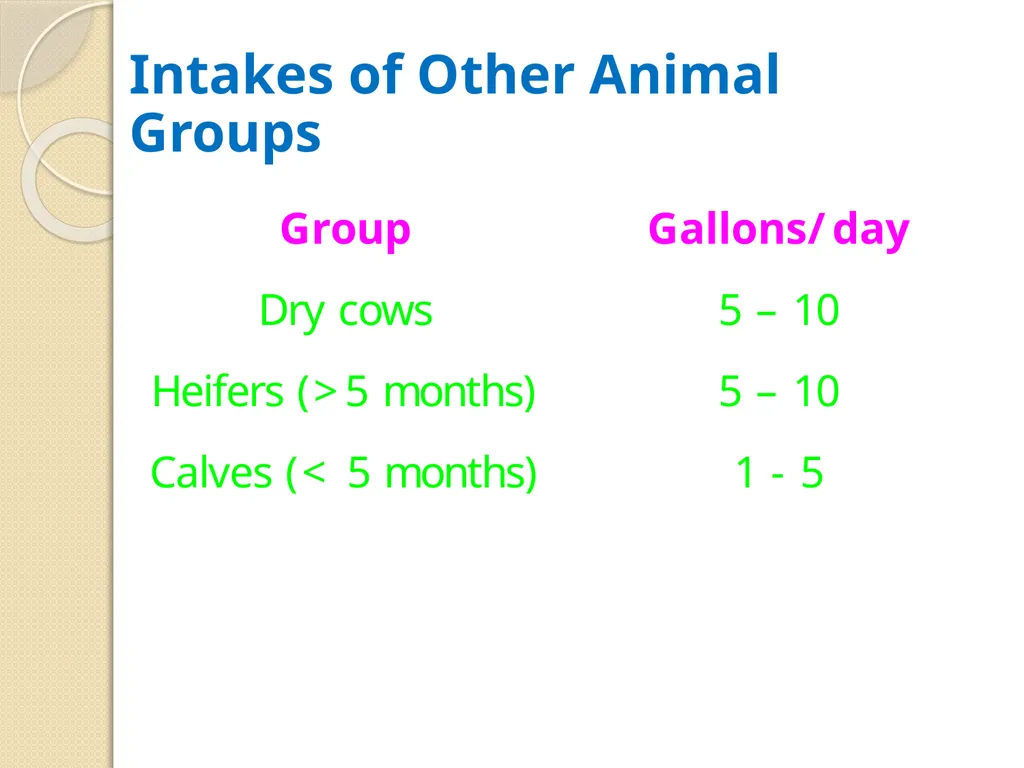
Intakes of Other Animal Groups<br>
20
Is This Clean Water?<br>
21
Would You Drink this Water?<br>
22
Would You Drink this Water?<br>
23
Nutrient Definition:
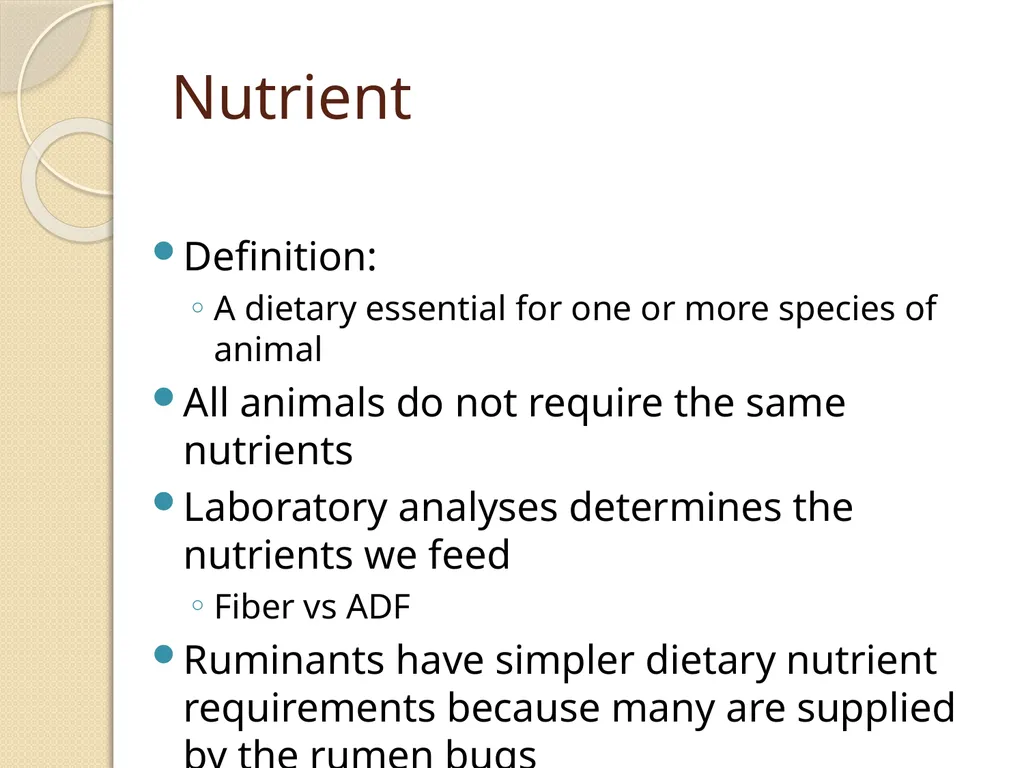
A dietary essential for one or more species of animal
All animals do not require the same nutrients
Laboratory analyses determines the nutrients we feed
Fiber vs ADF
Ruminants have simpler dietary nutrient requirements because many are supplied by the rumen bugs<br>
A dietary essential for one or more species of animal
All animals do not require the same nutrients
Laboratory analyses determines the nutrients we feed
Fiber vs ADF
Ruminants have simpler dietary nutrient requirements because many are supplied by the rumen bugs<br>
24
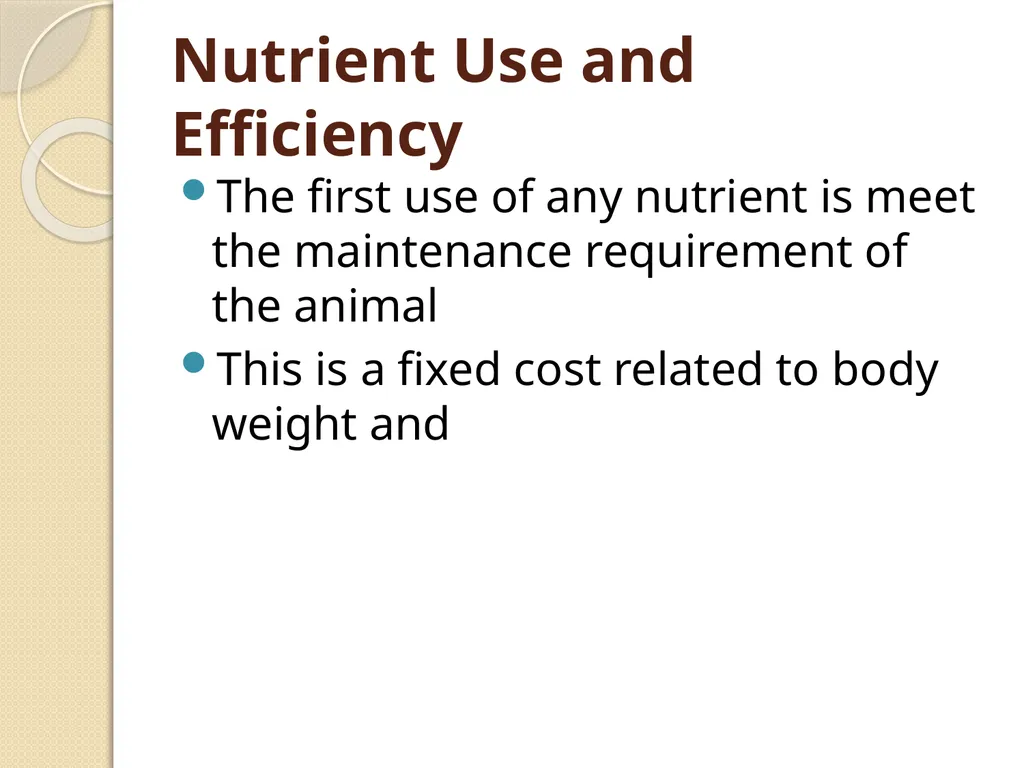
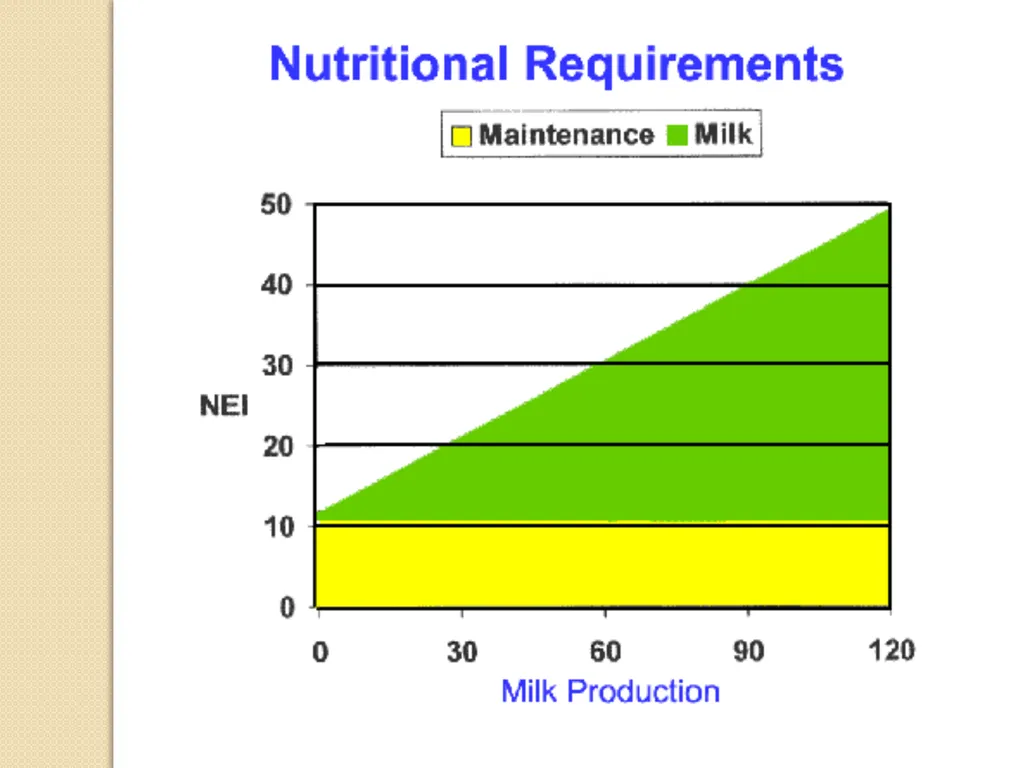
Nutrient Use and Efficiency The first use of any nutrient is meet the maintenance requirement of the animal
This is a fixed cost related to body weight and<br>
This is a fixed cost related to body weight and<br>
25
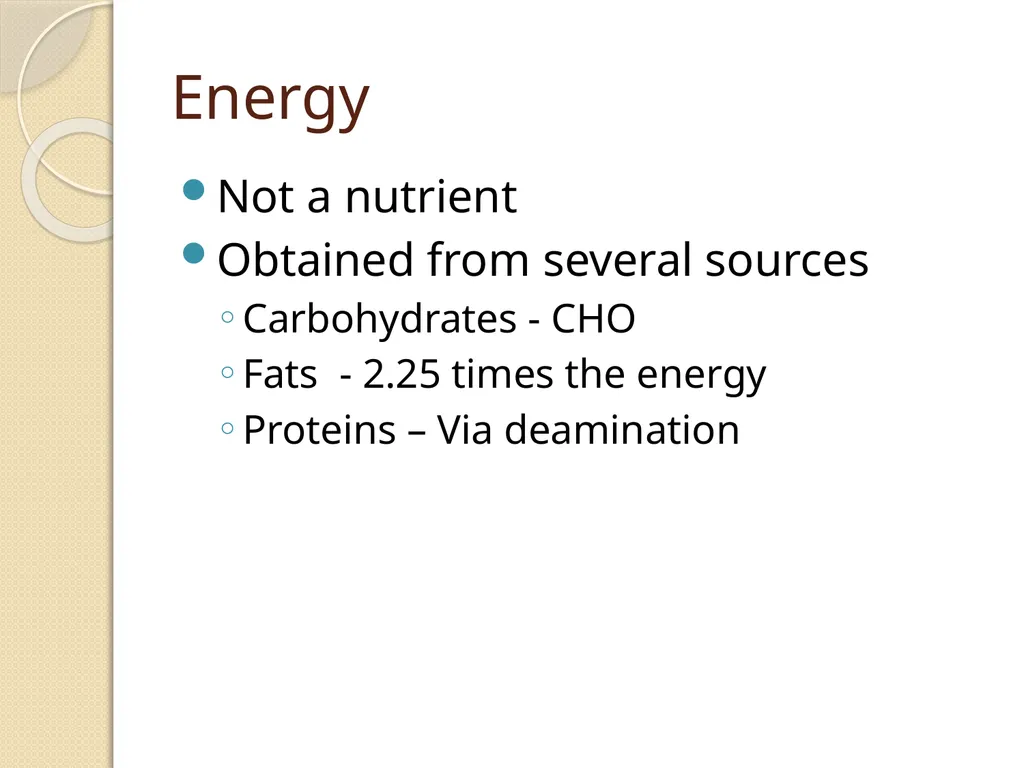
Energy Not a nutrient
Obtained from several sources
Carbohydrates - CHO
Fats - 2.25 times the energy
Proteins – Via deamination<br>
Obtained from several sources
Carbohydrates - CHO
Fats - 2.25 times the energy
Proteins – Via deamination<br>
26
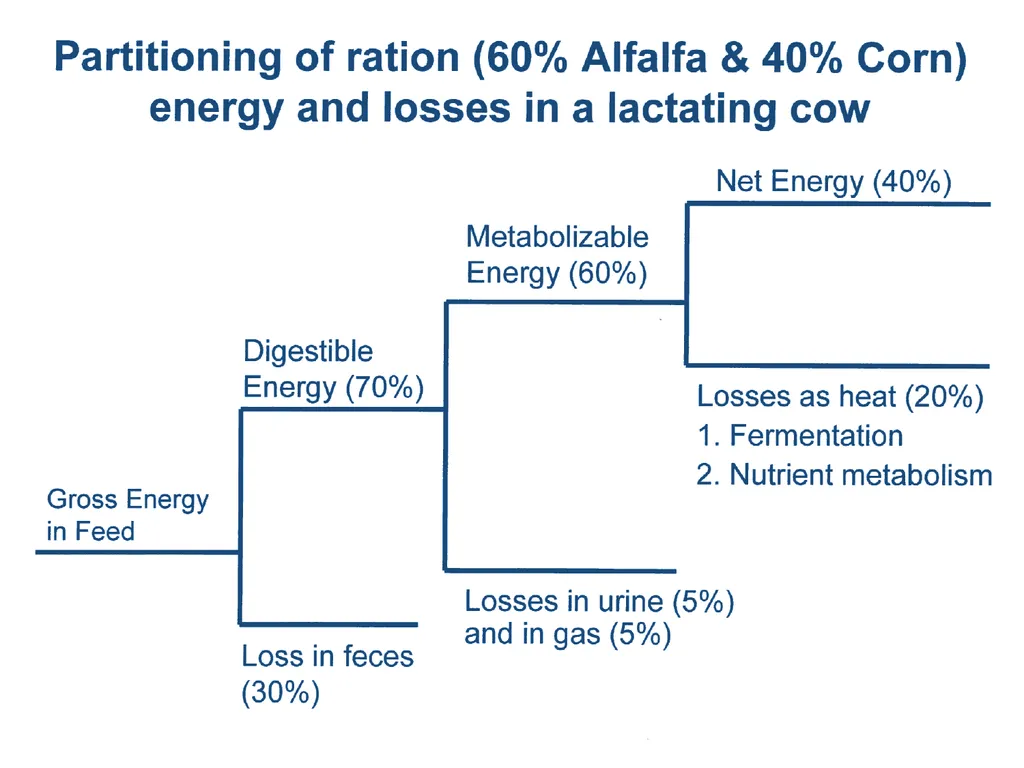
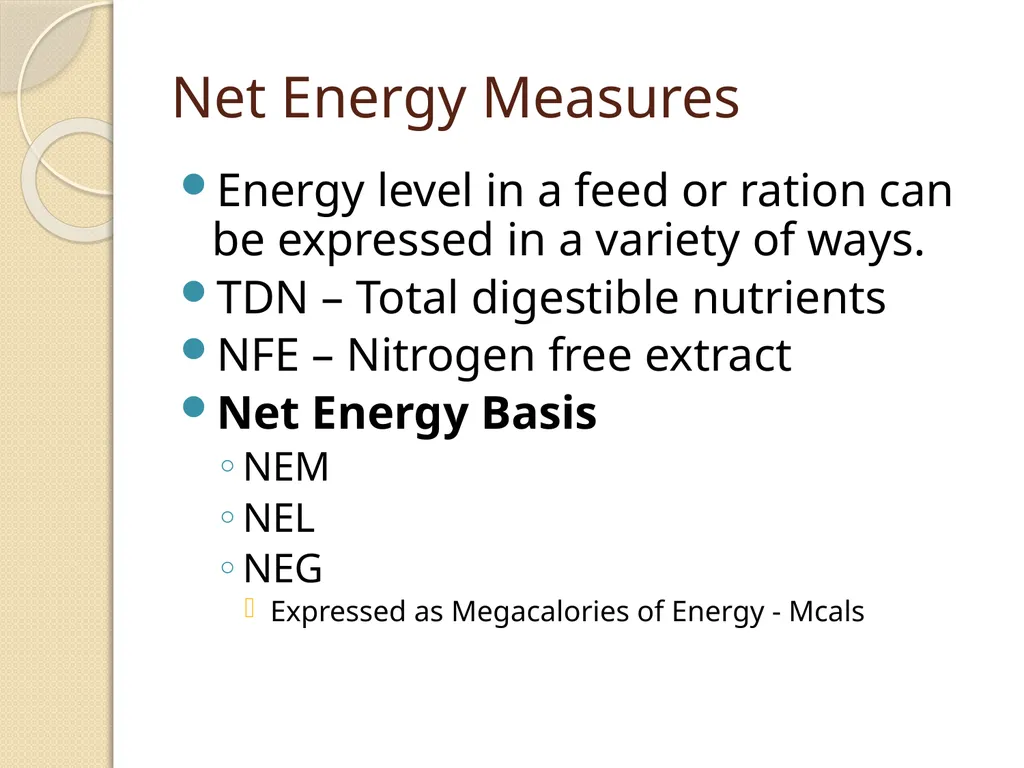
Net Energy Measures Energy level in a feed or ration can be expressed in a variety of ways.
TDN – Total digestible nutrients
NFE – Nitrogen free extract
Net Energy Basis
NEM
NEL
NEG
Expressed as Megacalories of Energy - Mcals<br>
TDN – Total digestible nutrients
NFE – Nitrogen free extract
Net Energy Basis
NEM
NEL
NEG
Expressed as Megacalories of Energy - Mcals<br>
27
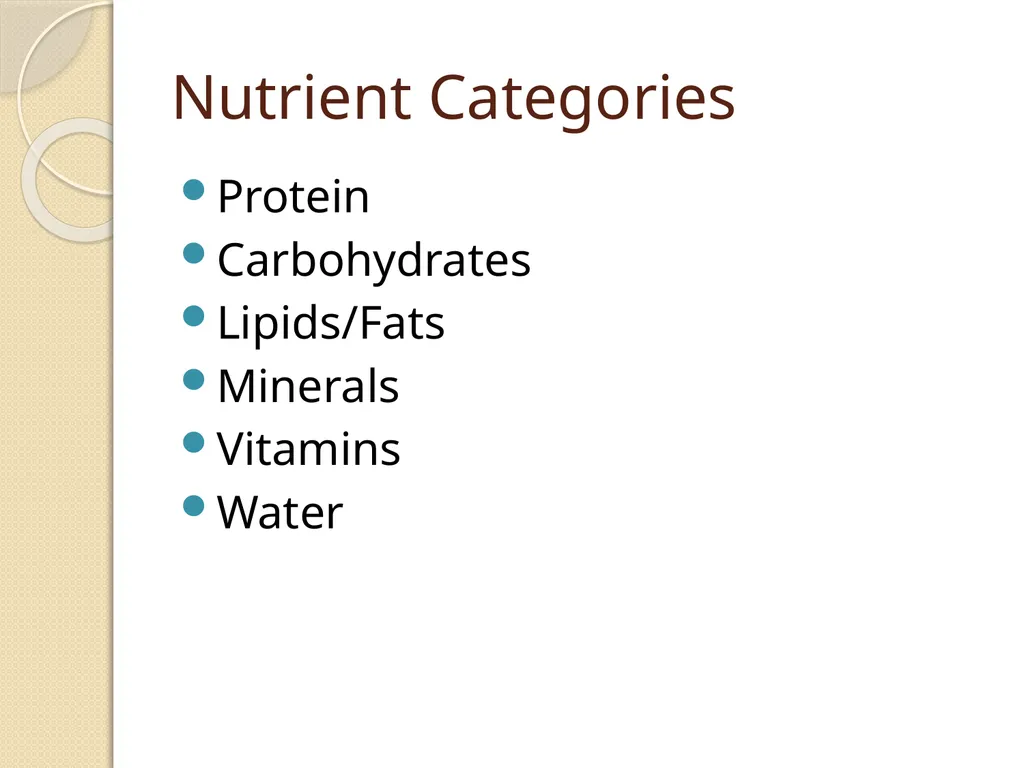
Nutrient Categories Protein
Carbohydrates
Lipids/Fats
Minerals
Vitamins
Water<br>
Carbohydrates
Lipids/Fats
Minerals
Vitamins
Water<br>
28
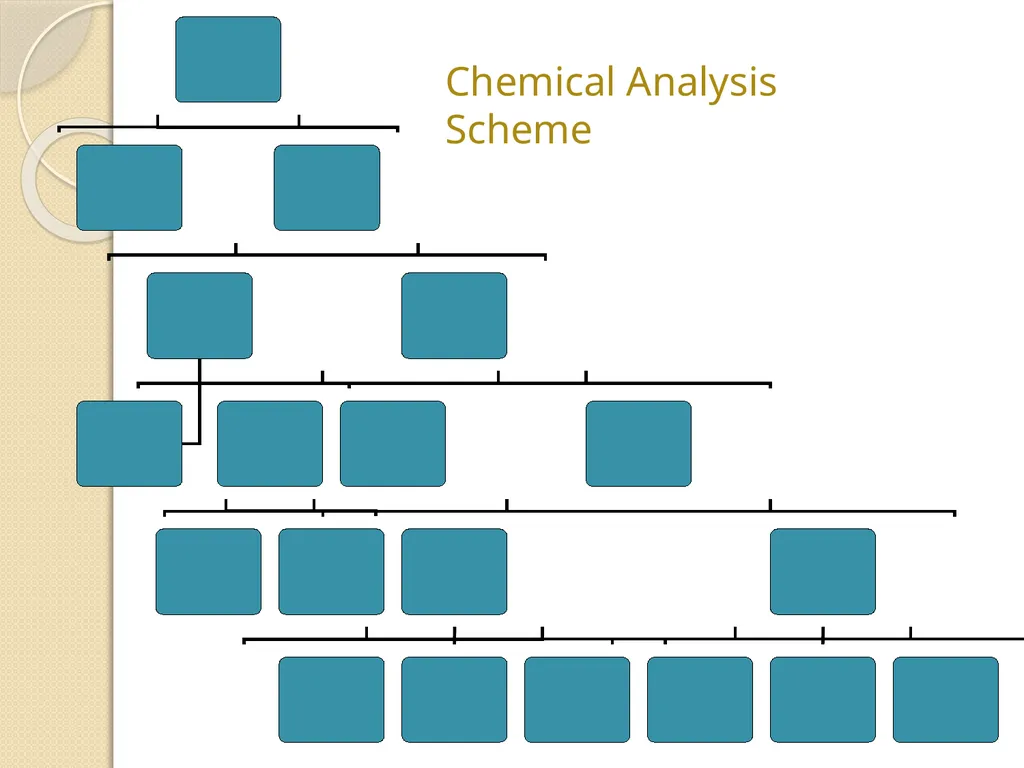
Chemical Analysis Scheme<br>
29
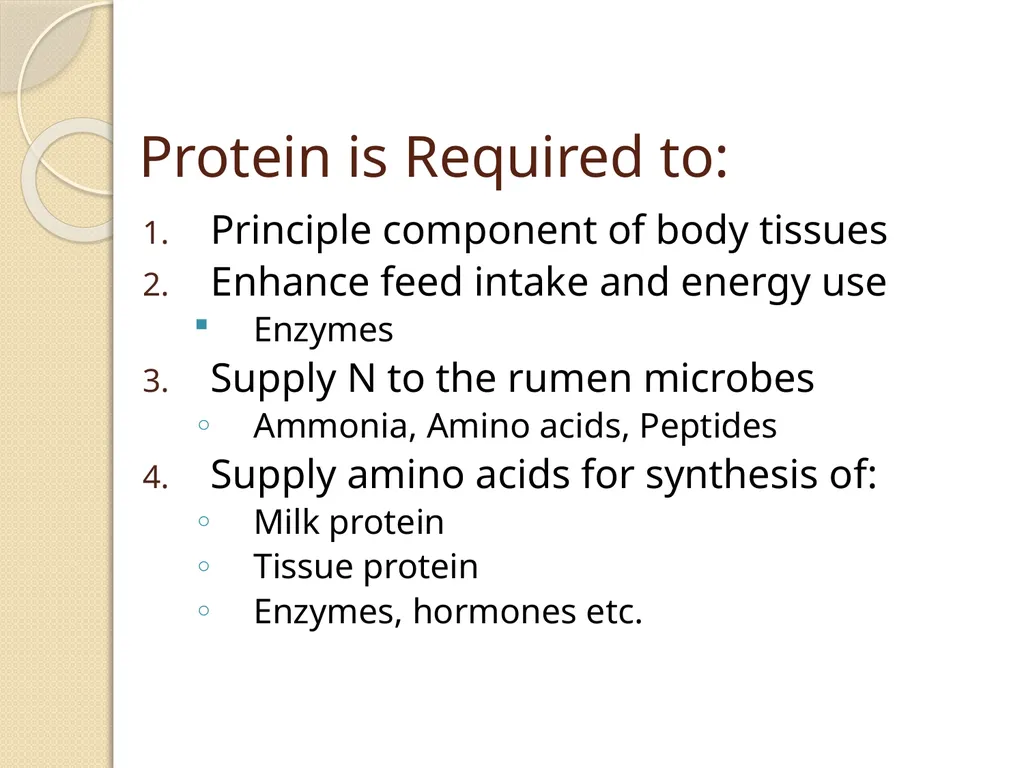
Protein is Required to: Principle component of body tissues
Enhance feed intake and energy use
Enzymes
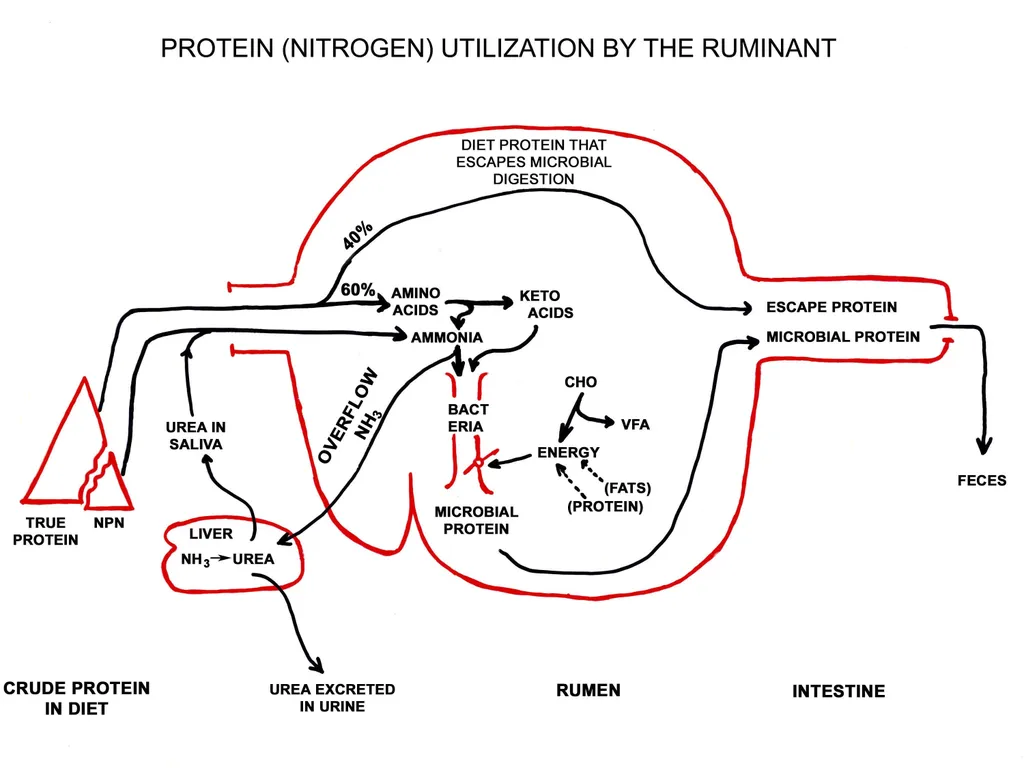
Supply N to the rumen microbes
Ammonia, Amino acids, Peptides
Supply amino acids for synthesis of:
Milk protein
Tissue protein
Enzymes, hormones etc.<br>
Enhance feed intake and energy use
Enzymes
Supply N to the rumen microbes
Ammonia, Amino acids, Peptides
Supply amino acids for synthesis of:
Milk protein
Tissue protein
Enzymes, hormones etc.<br>
30
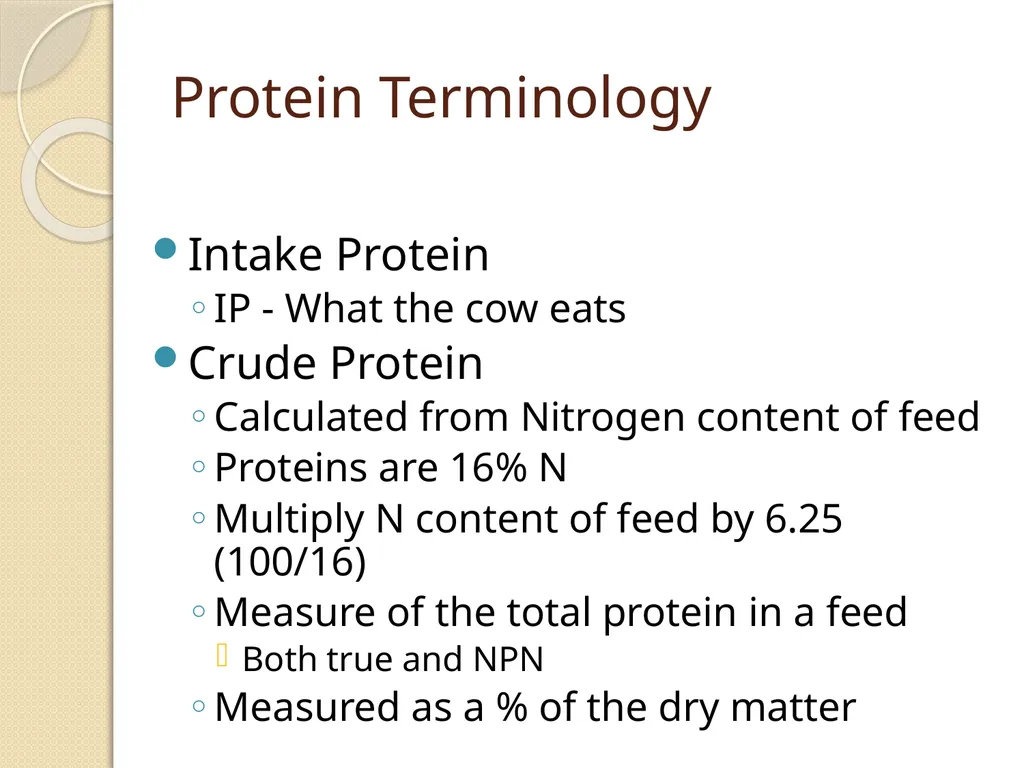
Protein Terminology Intake Protein
IP - What the cow eats
Crude Protein
Calculated from Nitrogen content of feed
Proteins are 16% N
Multiply N content of feed by 6.25 (100/16)
Measure of the total protein in a feed
Both true and NPN
Measured as a % of the dry matter<br>
IP - What the cow eats
Crude Protein
Calculated from Nitrogen content of feed
Proteins are 16% N
Multiply N content of feed by 6.25 (100/16)
Measure of the total protein in a feed
Both true and NPN
Measured as a % of the dry matter<br>
31
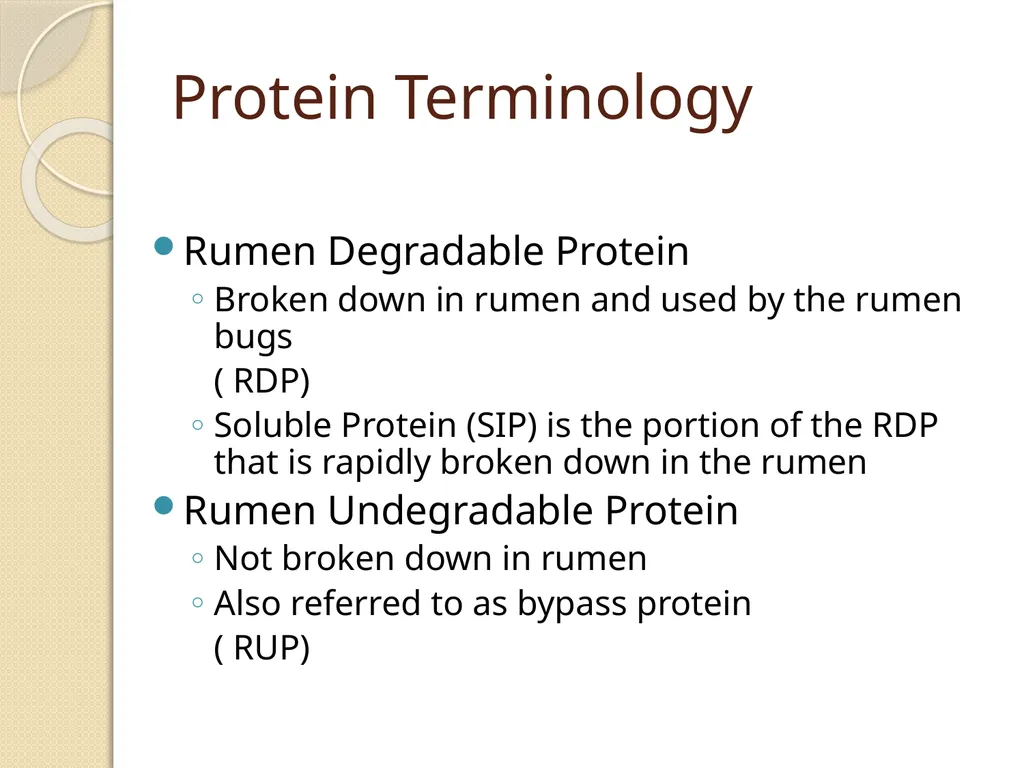
Protein Terminology Rumen Degradable Protein
Broken down in rumen and used by the rumen bugs
( RDP)
Soluble Protein (SIP) is the portion of the RDP that is rapidly broken down in the rumen
Rumen Undegradable Protein
Not broken down in rumen
Also referred to as bypass protein
( RUP)<br>
Broken down in rumen and used by the rumen bugs
( RDP)
Soluble Protein (SIP) is the portion of the RDP that is rapidly broken down in the rumen
Rumen Undegradable Protein
Not broken down in rumen
Also referred to as bypass protein
( RUP)<br>
32
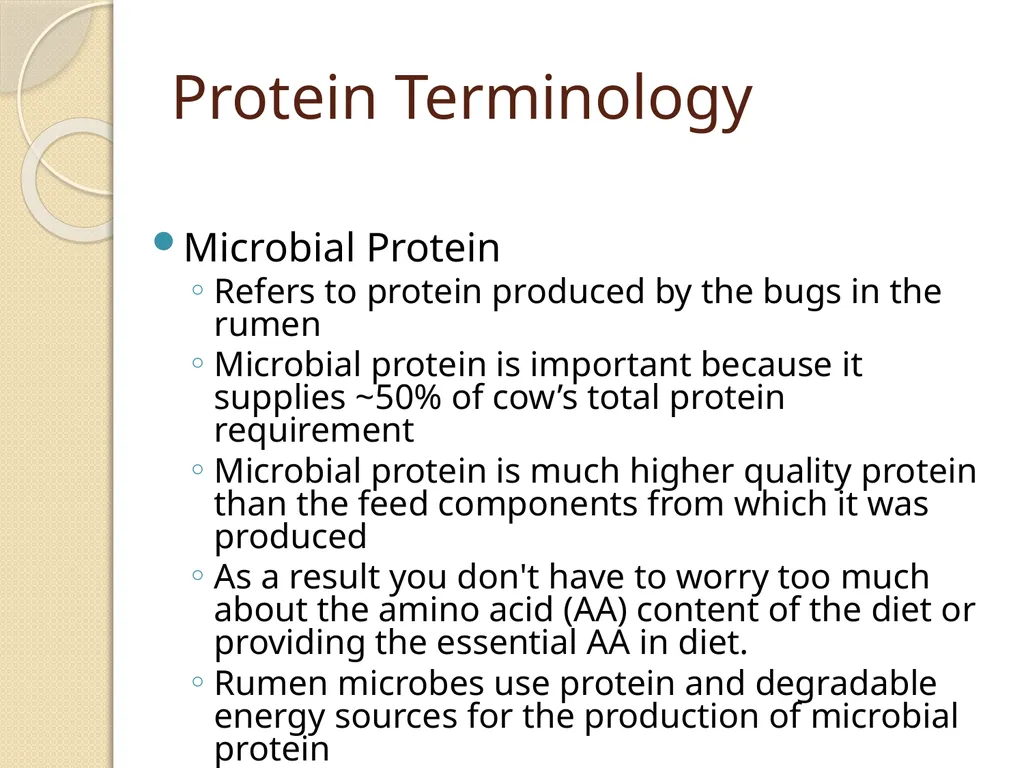
Protein Terminology Microbial Protein
Refers to protein produced by the bugs in the rumen
Microbial protein is important because it supplies ~50% of cow’s total protein requirement
Microbial protein is much higher quality protein than the feed components from which it was produced
As a result you don't have to worry too much about the amino acid (AA) content of the diet or providing the essential AA in diet.
Rumen microbes use protein and degradable energy sources for the production of microbial protein<br>
Refers to protein produced by the bugs in the rumen
Microbial protein is important because it supplies ~50% of cow’s total protein requirement
Microbial protein is much higher quality protein than the feed components from which it was produced
As a result you don't have to worry too much about the amino acid (AA) content of the diet or providing the essential AA in diet.
Rumen microbes use protein and degradable energy sources for the production of microbial protein<br>
33
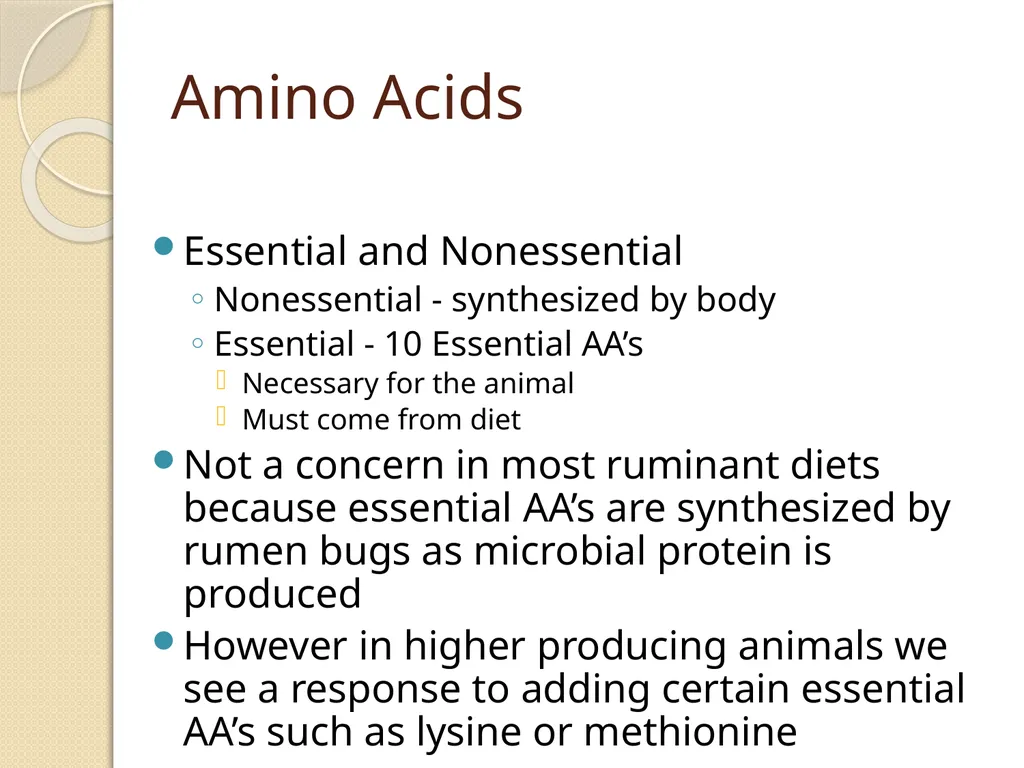
Amino Acids Essential and Nonessential
Nonessential - synthesized by body
Essential - 10 Essential AA’s
Necessary for the animal
Must come from diet
Not a concern in most ruminant diets because essential AA’s are synthesized by rumen bugs as microbial protein is produced
However in higher producing animals we see a response to adding certain essential AA’s such as lysine or methionine<br>
Nonessential - synthesized by body
Essential - 10 Essential AA’s
Necessary for the animal
Must come from diet
Not a concern in most ruminant diets because essential AA’s are synthesized by rumen bugs as microbial protein is produced
However in higher producing animals we see a response to adding certain essential AA’s such as lysine or methionine<br>
34
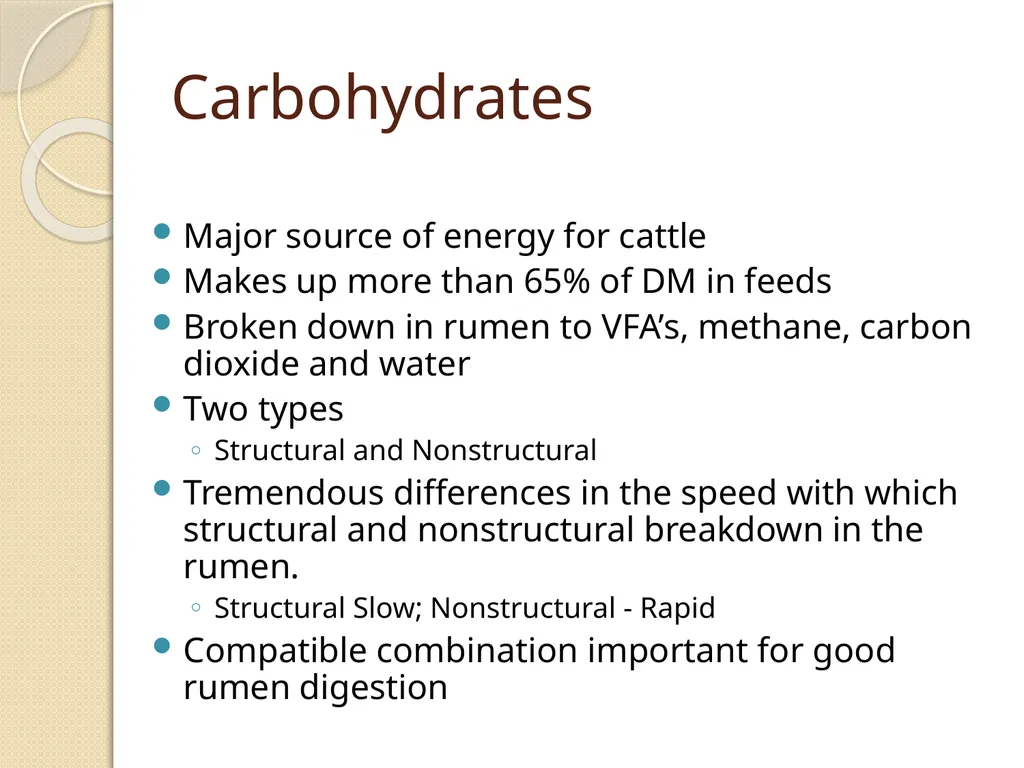
Carbohydrates Major source of energy for cattle
Makes up more than 65% of DM in feeds
Broken down in rumen to VFA’s, methane, carbon dioxide and water
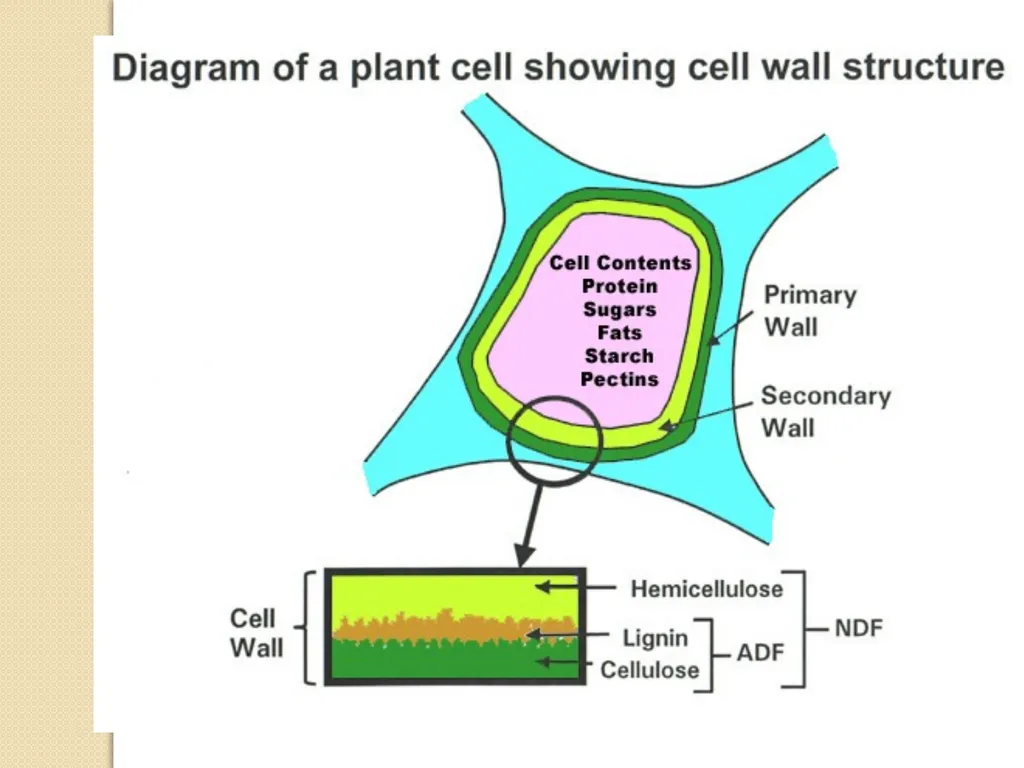
Two types
Structural and Nonstructural
Tremendous differences in the speed with which structural and nonstructural breakdown in the rumen.
Structural Slow; Nonstructural - Rapid
Compatible combination important for good rumen digestion<br>
Makes up more than 65% of DM in feeds
Broken down in rumen to VFA’s, methane, carbon dioxide and water
Two types
Structural and Nonstructural
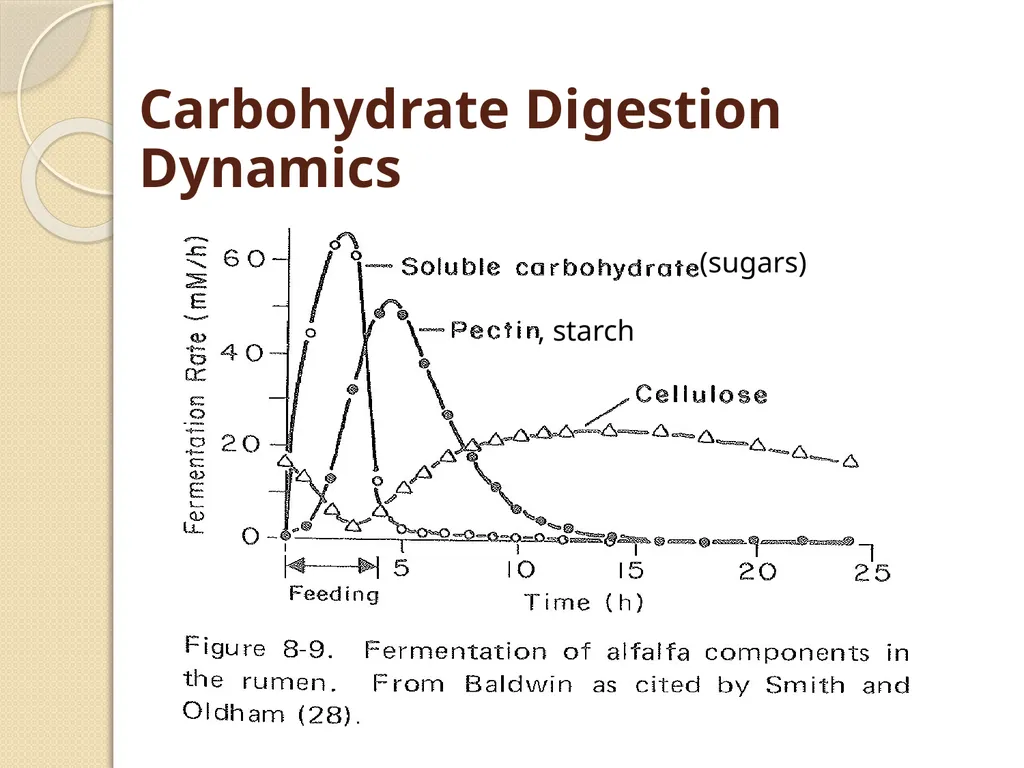
Tremendous differences in the speed with which structural and nonstructural breakdown in the rumen.
Structural Slow; Nonstructural - Rapid
Compatible combination important for good rumen digestion<br>
35
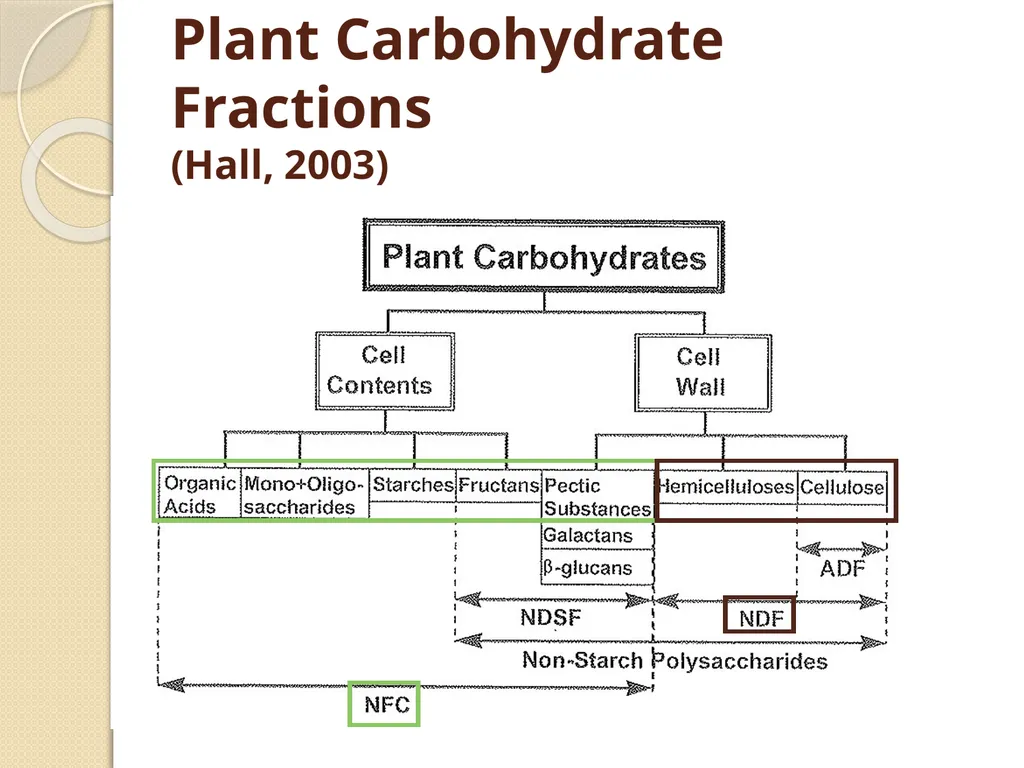
Plant Carbohydrate Fractions
(Hall, 2003)<br>
36
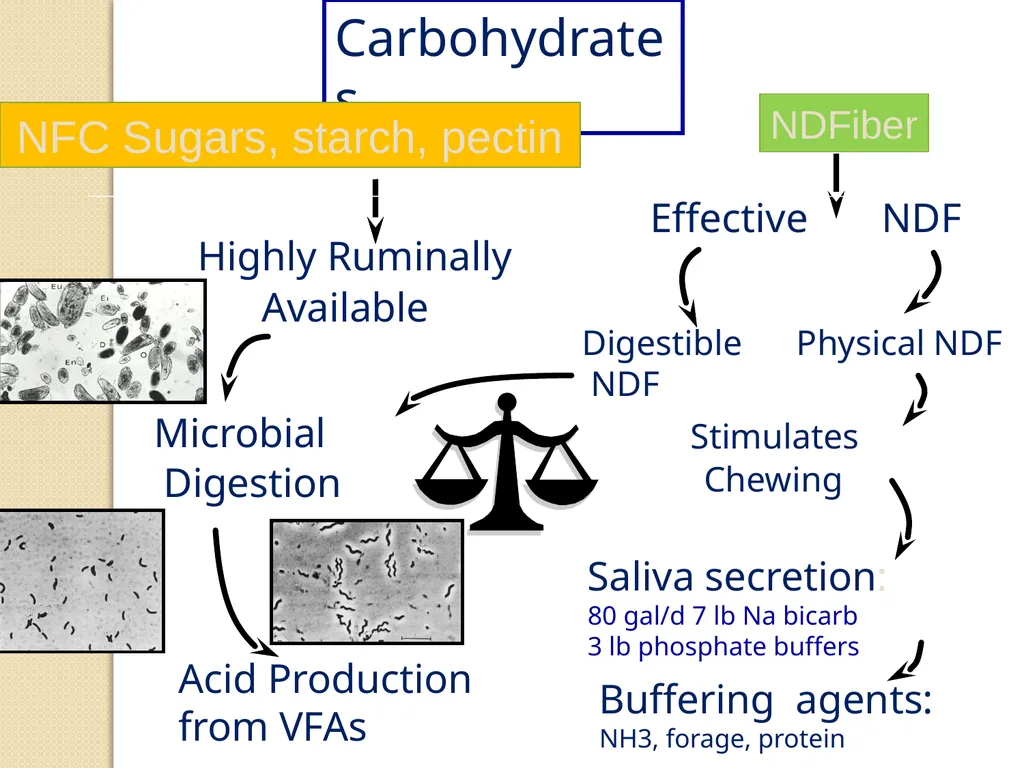
Carbohydrates NFC Sugars, starch, pectin Highly Ruminally Available Effective NDF Physical NDF Digestible
NDF Microbial Digestion Stimulates Chewing Saliva secretion:
80 gal/d 7 lb Na bicarb
3 lb phosphate buffers Buffering agents:
NH3, forage, protein Acid Production
from VFAs NDFiber<br>
NDF Microbial Digestion Stimulates Chewing Saliva secretion:
80 gal/d 7 lb Na bicarb
3 lb phosphate buffers Buffering agents:
NH3, forage, protein Acid Production
from VFAs NDFiber<br>
37
Carbohydrate Digestion Dynamics , starch (sugars)<br>
38
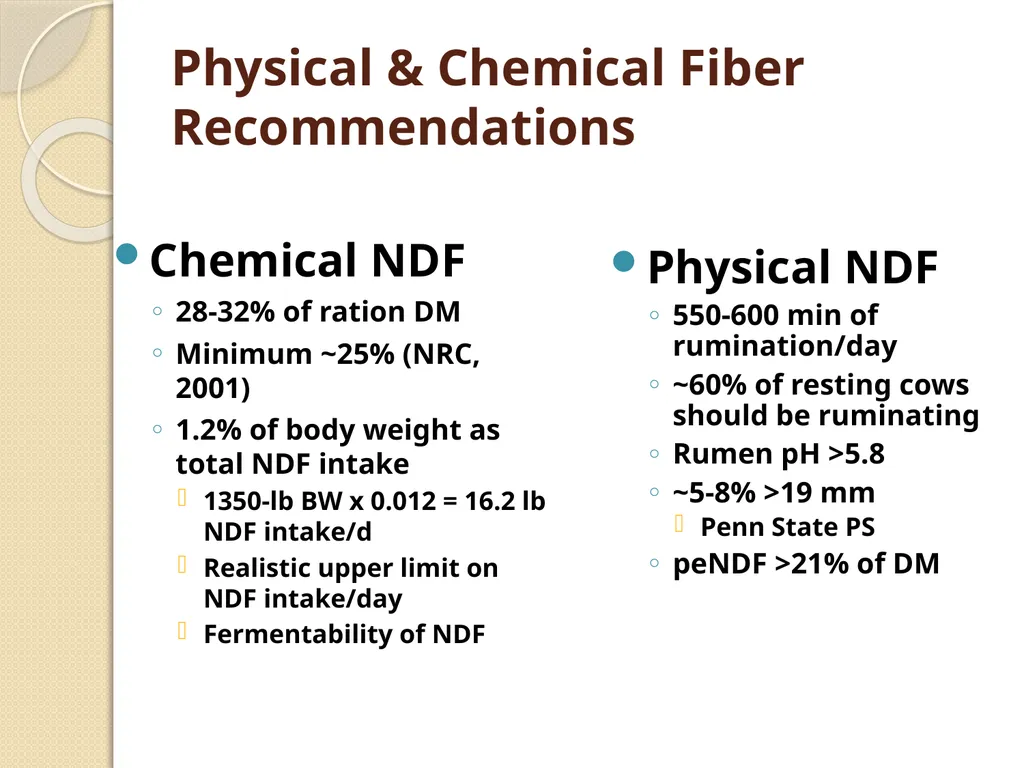
Physical & Chemical Fiber Recommendations Chemical NDF
28-32% of ration DM
Minimum ~25% (NRC, 2001)
1.2% of body weight as total NDF intake
1350-lb BW x 0.012 = 16.2 lb NDF intake/d
Realistic upper limit on NDF intake/day
Fermentability of NDF Physical NDF
550-600 min of rumination/day
~60% of resting cows should be ruminating
Rumen pH >5.8
~5-8% >19 mm
Penn State PS
peNDF >21% of DM<br>
28-32% of ration DM
Minimum ~25% (NRC, 2001)
1.2% of body weight as total NDF intake
1350-lb BW x 0.012 = 16.2 lb NDF intake/d
Realistic upper limit on NDF intake/day
Fermentability of NDF Physical NDF
550-600 min of rumination/day
~60% of resting cows should be ruminating
Rumen pH >5.8
~5-8% >19 mm
Penn State PS
peNDF >21% of DM<br>
39
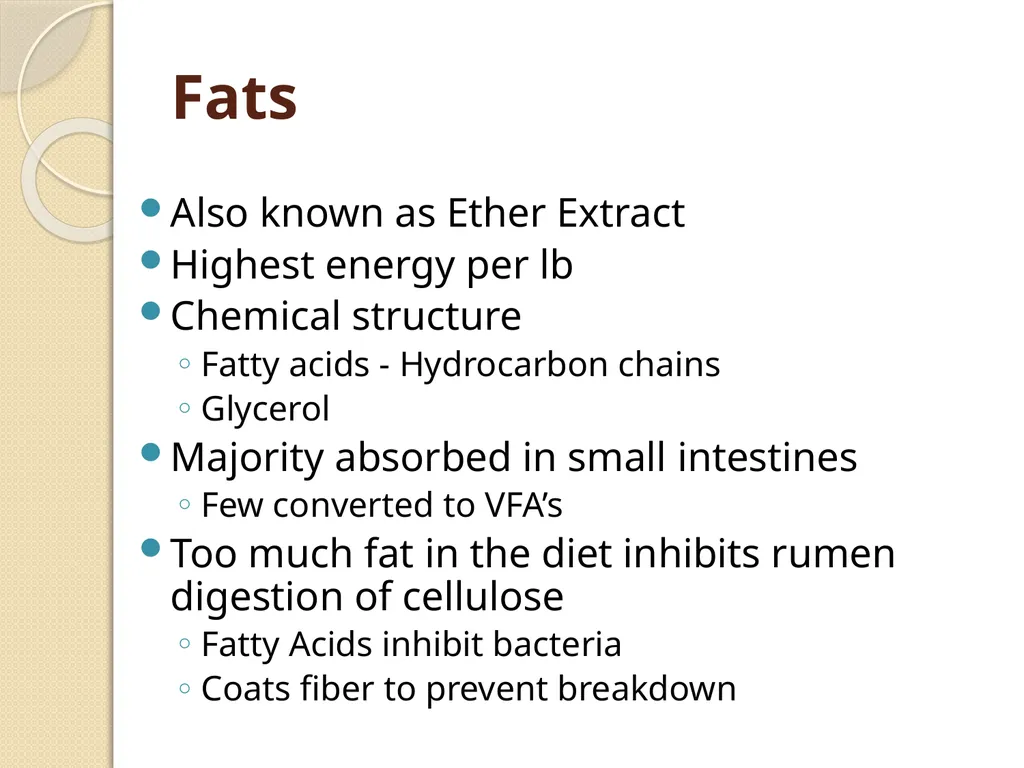
Fats Also known as Ether Extract
Highest energy per lb
Chemical structure
Fatty acids - Hydrocarbon chains
Glycerol
Majority absorbed in small intestines
Few converted to VFA’s
Too much fat in the diet inhibits rumen digestion of cellulose
Fatty Acids inhibit bacteria
Coats fiber to prevent breakdown<br>
Highest energy per lb
Chemical structure
Fatty acids - Hydrocarbon chains
Glycerol
Majority absorbed in small intestines
Few converted to VFA’s
Too much fat in the diet inhibits rumen digestion of cellulose
Fatty Acids inhibit bacteria
Coats fiber to prevent breakdown<br>
40
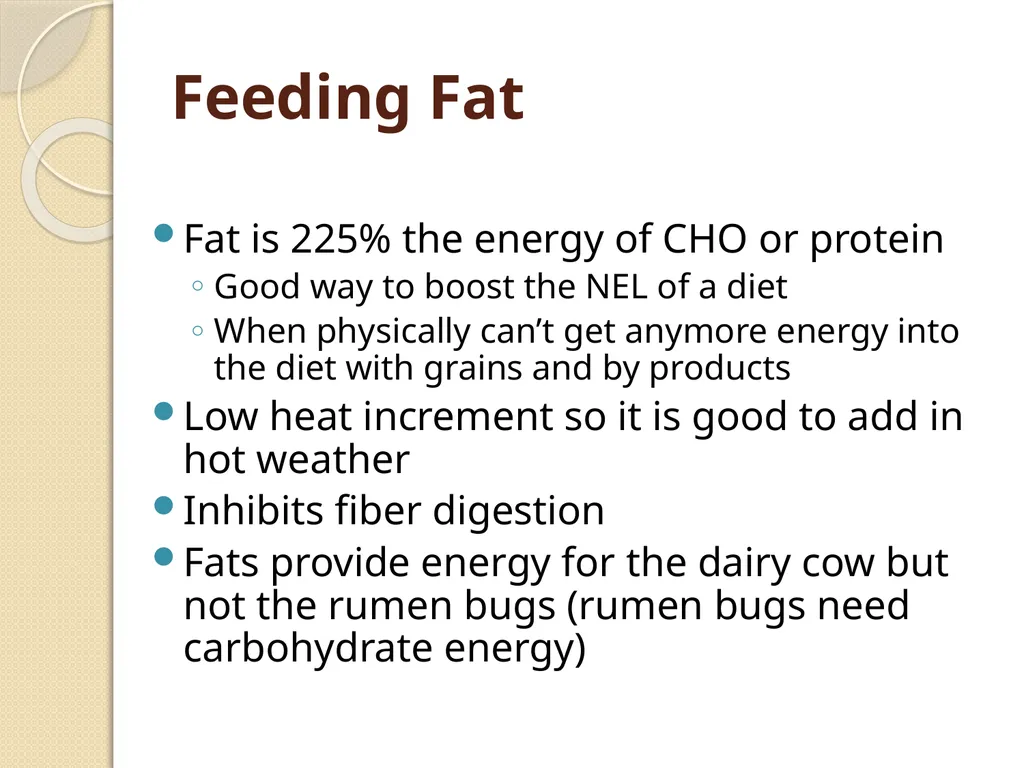
Feeding Fat Fat is 225% the energy of CHO or protein
Good way to boost the NEL of a diet
When physically can’t get anymore energy into the diet with grains and by products
Low heat increment so it is good to add in hot weather
Inhibits fiber digestion
Fats provide energy for the dairy cow but not the rumen bugs (rumen bugs need carbohydrate energy)<br>
Good way to boost the NEL of a diet
When physically can’t get anymore energy into the diet with grains and by products
Low heat increment so it is good to add in hot weather
Inhibits fiber digestion
Fats provide energy for the dairy cow but not the rumen bugs (rumen bugs need carbohydrate energy)<br>
41
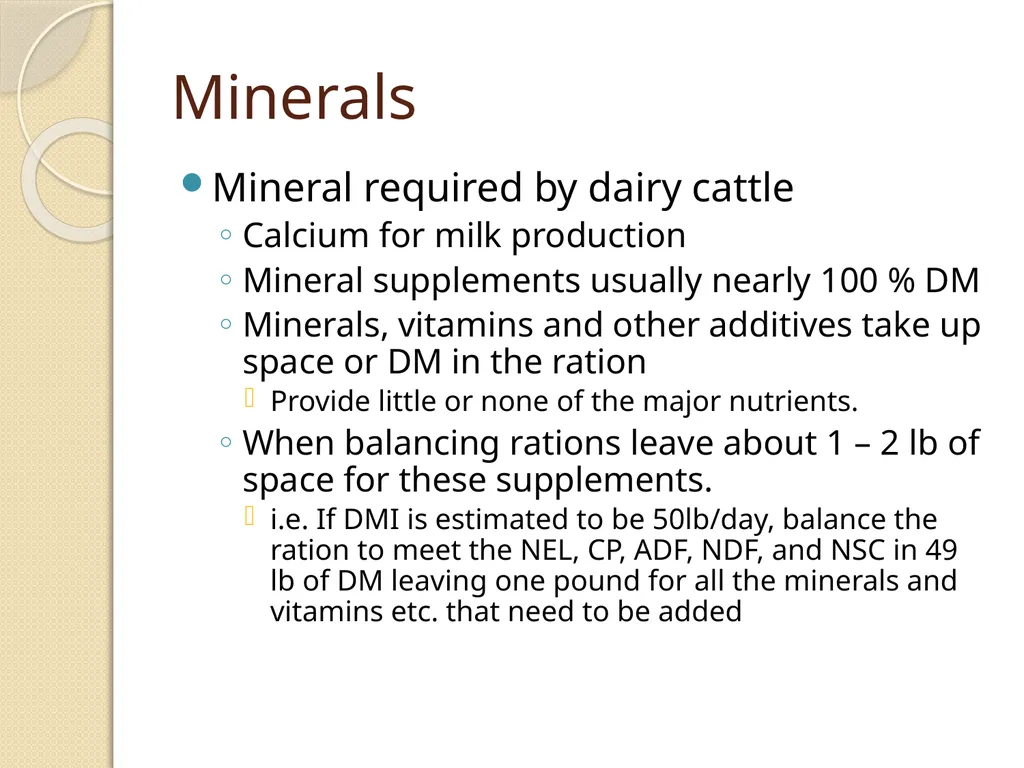
Minerals Mineral required by dairy cattle
Calcium for milk production
Mineral supplements usually nearly 100 % DM
Minerals, vitamins and other additives take up space or DM in the ration
Provide little or none of the major nutrients.
When balancing rations leave about 1 – 2 lb of space for these supplements.
i.e. If DMI is estimated to be 50lb/day, balance the ration to meet the NEL, CP, ADF, NDF, and NSC in 49 lb of DM leaving one pound for all the minerals and vitamins etc. that need to be added<br>
Calcium for milk production
Mineral supplements usually nearly 100 % DM
Minerals, vitamins and other additives take up space or DM in the ration
Provide little or none of the major nutrients.
When balancing rations leave about 1 – 2 lb of space for these supplements.
i.e. If DMI is estimated to be 50lb/day, balance the ration to meet the NEL, CP, ADF, NDF, and NSC in 49 lb of DM leaving one pound for all the minerals and vitamins etc. that need to be added<br>
42
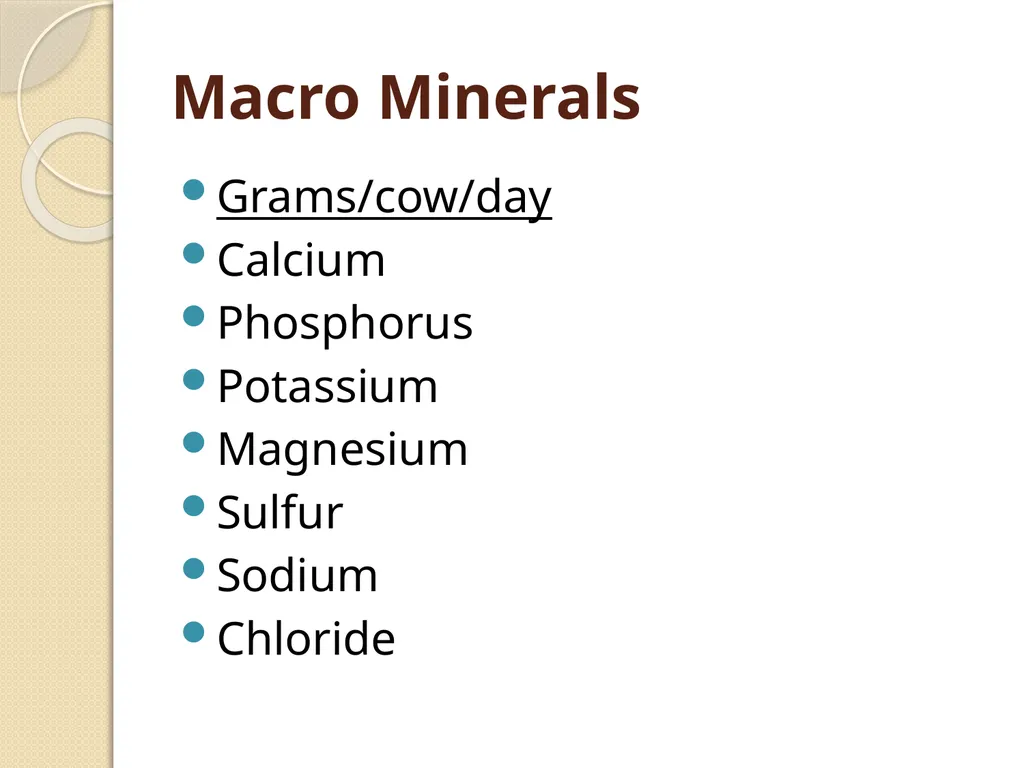
Macro Minerals Grams/cow/day
Calcium
Phosphorus
Potassium
Magnesium
Sulfur
Sodium
Chloride<br>
Calcium
Phosphorus
Potassium
Magnesium
Sulfur
Sodium
Chloride<br>
43
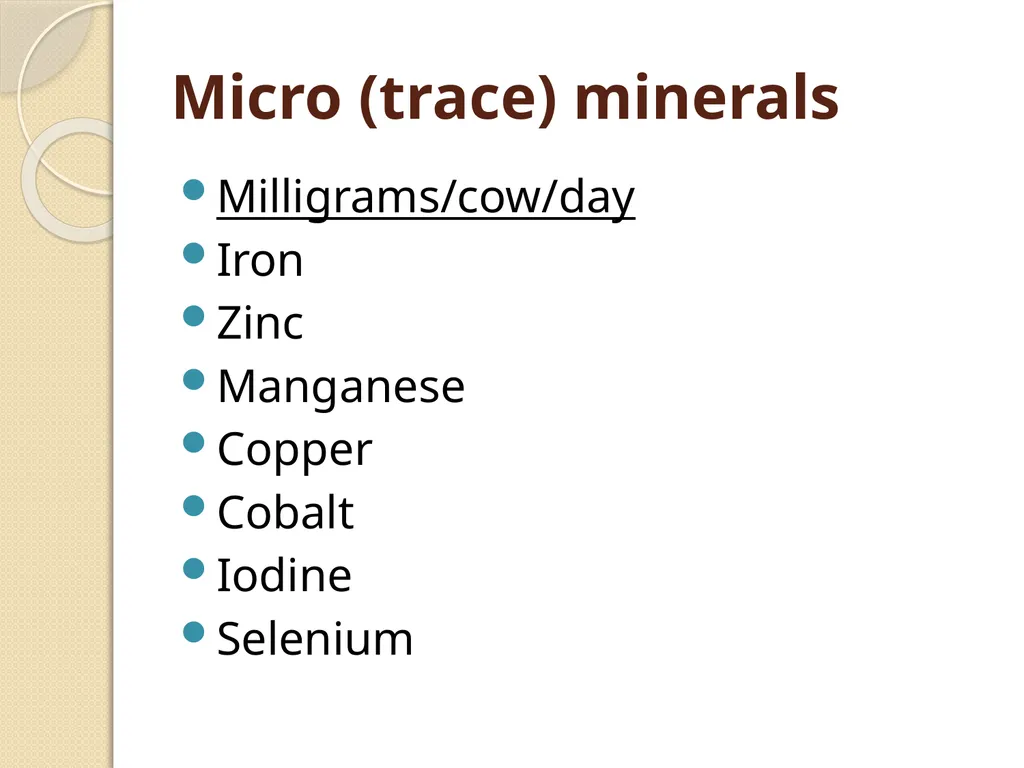
Micro (trace) minerals Milligrams/cow/day
Iron
Zinc
Manganese
Copper
Cobalt
Iodine
Selenium<br>
Iron
Zinc
Manganese
Copper
Cobalt
Iodine
Selenium<br>
44
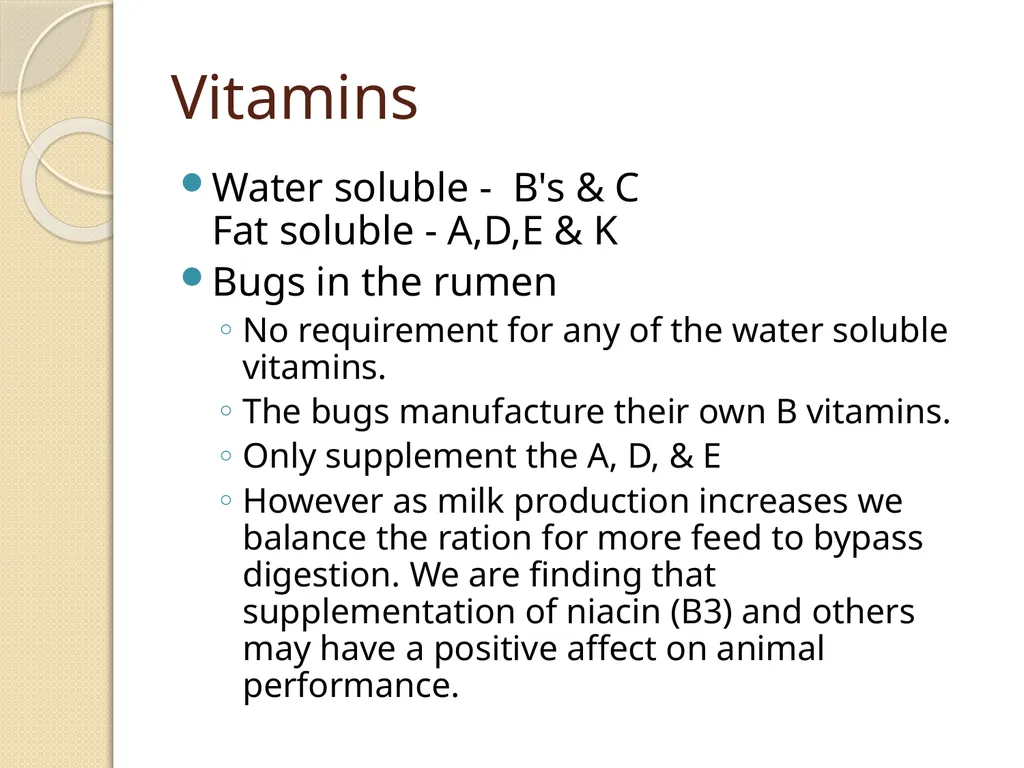
Vitamins Water soluble - B's & C
Fat soluble - A,D,E & K
Bugs in the rumen
No requirement for any of the water soluble vitamins.
The bugs manufacture their own B vitamins.
Only supplement the A, D, & E
However as milk production increases we balance the ration for more feed to bypass digestion. We are finding that supplementation of niacin (B3) and others may have a positive affect on animal performance.<br>
Bugs in the rumen
No requirement for any of the water soluble vitamins.
The bugs manufacture their own B vitamins.
Only supplement the A, D, & E
However as milk production increases we balance the ration for more feed to bypass digestion. We are finding that supplementation of niacin (B3) and others may have a positive affect on animal performance.<br>
45
Summary<br>