
Data Privacy Day: Perceptions study Consumers &



Description: Data Privacy Day: Perceptions study Consumers HRRecruiters Prepared for: Trustworthy Computing Group, Microsoft Prepared by: Cross-Tab Marketing Services January 2010 Executive Summary 3 Key Findings 4 Appendix Detailed Findings :
Related Topics
Download Presentation
"Data Privacy Day: Perceptions study Consumers &" is the property of its rightful owner. Permission is granted to download and print the materials on this website for personal, non-commercial use only, and to display it on your personal computer provided you do not modify the materials and that you retain all copyright notices contained in the materials. By downloading content from our website, you accept the terms of this agreement.
Presentation Transcript
slide1. Data Privacy Day: Perceptions study Consumers & HR/Recruiters Prepared for: Trustworthy Computing Group, Microsoft
Prepared by: Cross-Tab Marketing Services January 2010<br>
slide2. Executive Summary 3
Key Findings 4
Appendix
Detailed Findings : Consumer Segment 20
Detailed Findings : HR/Recruiter Segment 61 Table of Contents<br>
slide3. As we look at the findings of the study, three main points emerge:
The impact of online reputation on professional life
Nationality plays key role in determining whether online content will harm reputations
Companies have formal policies for checking online reputational data, but male recruiters are more likely to check - except in France
Recruiters typically conduct deeper searches than most consumers are aware of, and feel justified in doing so
Not all online content is true – but candidates may be rejected nonetheless
Recruiters say they tell candidates if online content factored into their rejection, but consumers do not seem to be hearing it
Good online reputations matter to recruiters
The impact of online reputation on personal life
Online reputations matter when trying to meet people socially, but the extent to which it matters is closely tied to age
Survey respondents are concerned about having their online reputations abused to steal their identities, target them for scams, or become a victim of defamation, harassment or bullying
The impact to online reputations by content created via mobile devices is an area of concern for consumers
What people do to manage their online reputation
Consumers take steps to keep a divide between personal and professional identities.
Most respondents use measures to protect and manage their online reputation.
Consumers apply both proactive and reactive methods of reputation management.
Respondents are divided about their ability to manage their online reputation and on ownership of issues. Executive Summary<br>
slide4. Key Findings<br>
slide5. As job seekers worldwide struggle to find employment, understanding how information posted online
can affect their chances for employment are critical.
Only a little over one third of the consumers surveyed actually think that their online reputation might impact their chances of getting a job or admission into a college in the future whereas most of the HR/Recruiters surveyed admit that they review online reputational information while evaluating a candidate The impact of online reputation on professional life Q6. Do you review online reputational information about candidates when
evaluating them for a potential job / college admission? Q18. How concerned are you that your online reputation may Impact
your ability to get a job/be admitted into college in the future? Consumers HR/Recruiters<br>
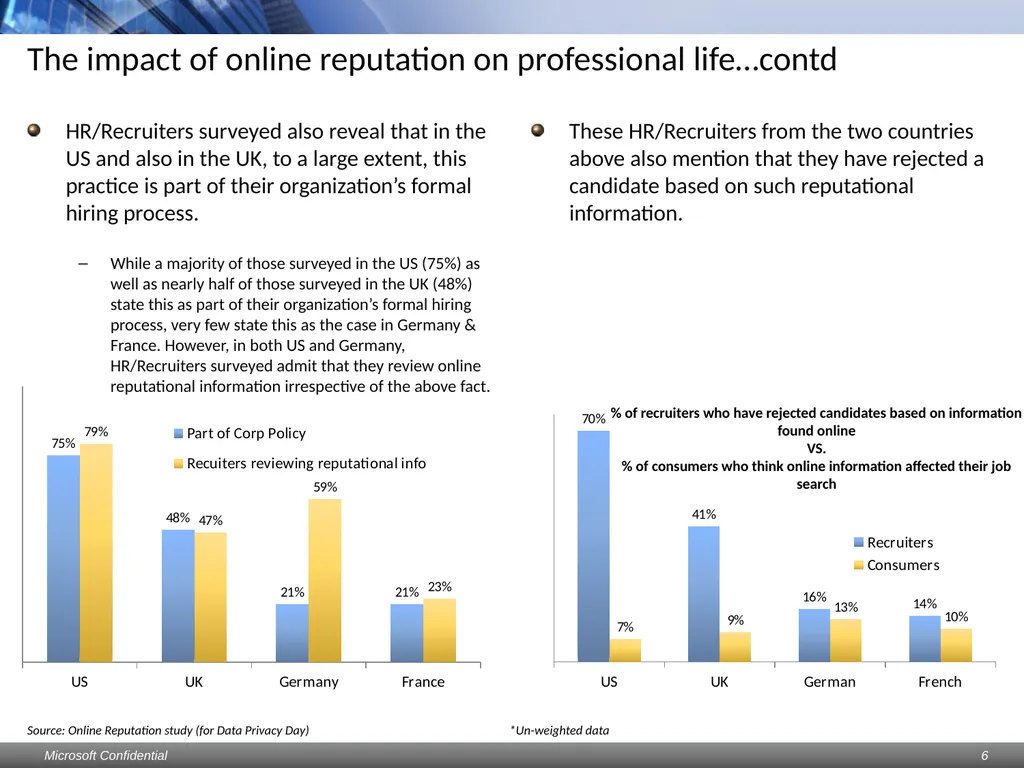
slide6. The impact of online reputation on professional life…contd HR/Recruiters surveyed also reveal that in the US and also in the UK, to a large extent, this practice is part of their organization’s formal hiring process.
While a majority of those surveyed in the US (75%) as well as nearly half of those surveyed in the UK (48%) state this as part of their organization’s formal hiring process, very few state this as the case in Germany & France. However, in both US and Germany, HR/Recruiters surveyed admit that they review online reputational information irrespective of the above fact. These HR/Recruiters from the two countries above also mention that they have rejected a candidate based on such reputational information. % of recruiters who have rejected candidates based on information found online VS. % of consumers who think online information affected their job search Source: Online Reputation study (for Data Privacy Day) *Un-weighted data<br>
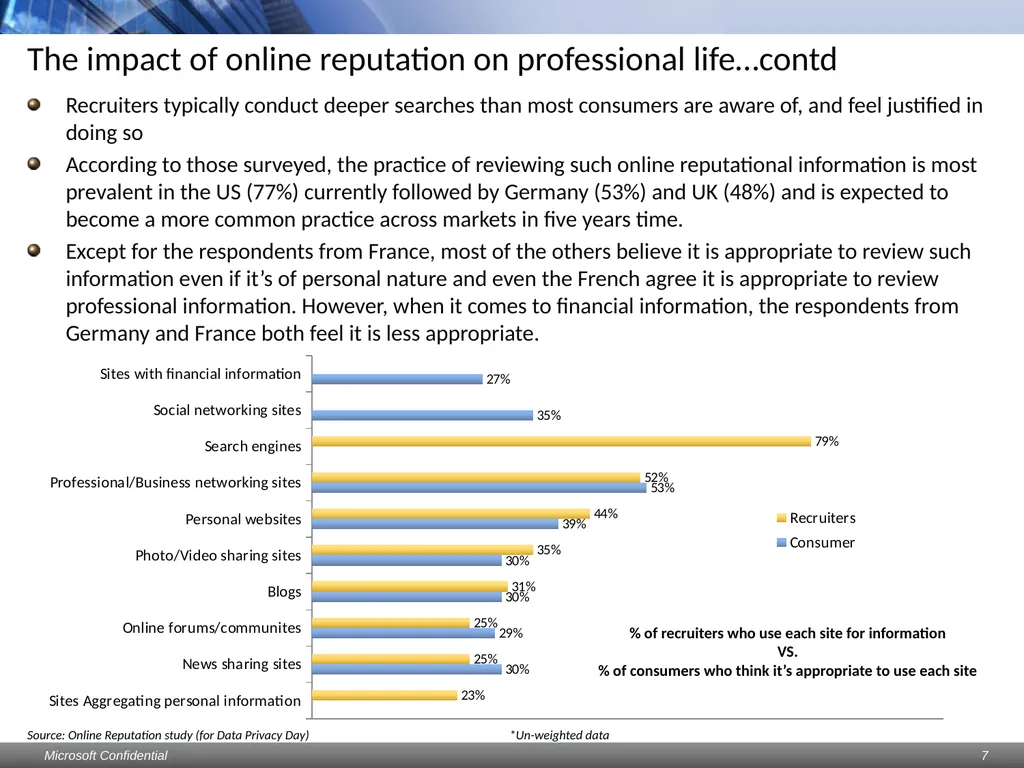
slide7. Recruiters typically conduct deeper searches than most consumers are aware of, and feel justified in doing so
According to those surveyed, the practice of reviewing such online reputational information is most prevalent in the US (77%) currently followed by Germany (53%) and UK (48%) and is expected to become a more common practice across markets in five years time.
Except for the respondents from France, most of the others believe it is appropriate to review such information even if it’s of personal nature and even the French agree it is appropriate to review professional information. However, when it comes to financial information, the respondents from Germany and France both feel it is less appropriate. The impact of online reputation on professional life…contd % of recruiters who use each site for information VS. % of consumers who think it’s appropriate to use each site Source: Online Reputation study (for Data Privacy Day) *Un-weighted data<br>
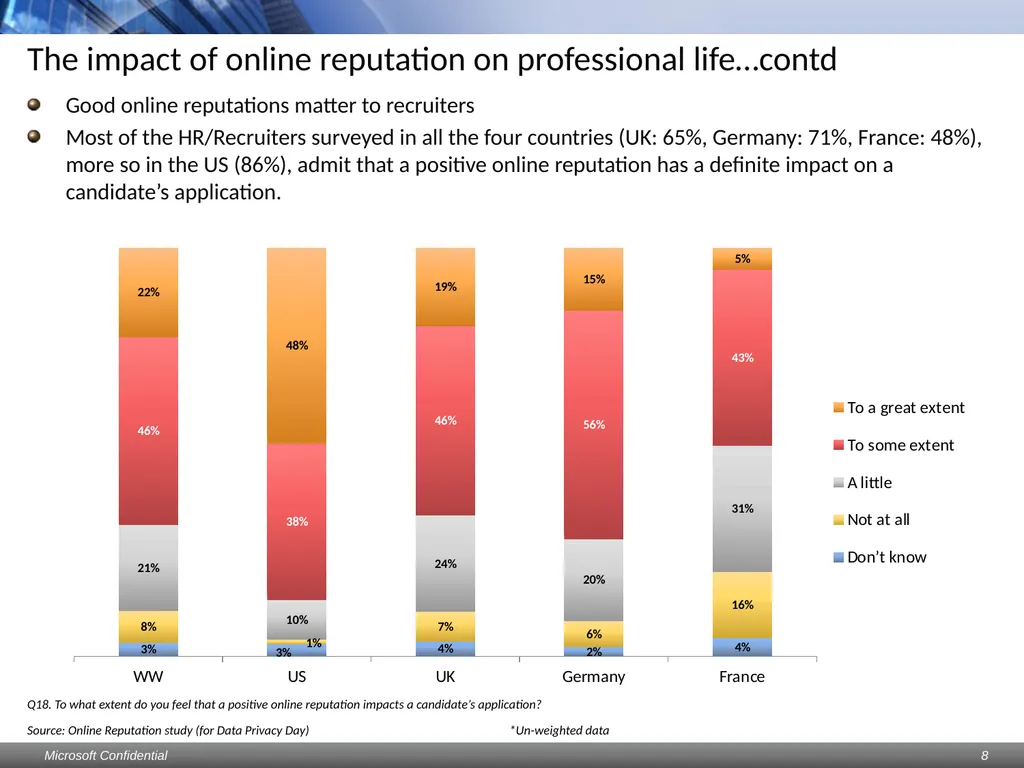
slide8. Good online reputations matter to recruiters
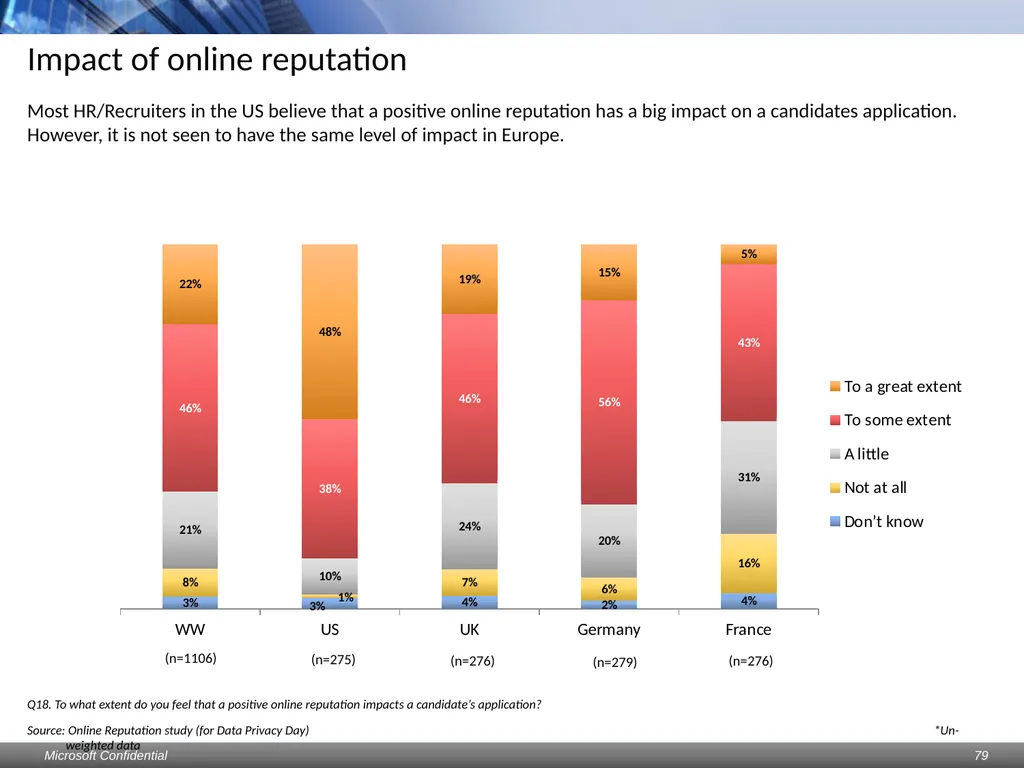
Most of the HR/Recruiters surveyed in all the four countries (UK: 65%, Germany: 71%, France: 48%), more so in the US (86%), admit that a positive online reputation has a definite impact on a candidate’s application. The impact of online reputation on professional life…contd Q18. To what extent do you feel that a positive online reputation impacts a candidate’s application? Source: Online Reputation study (for Data Privacy Day) *Un-weighted data<br>
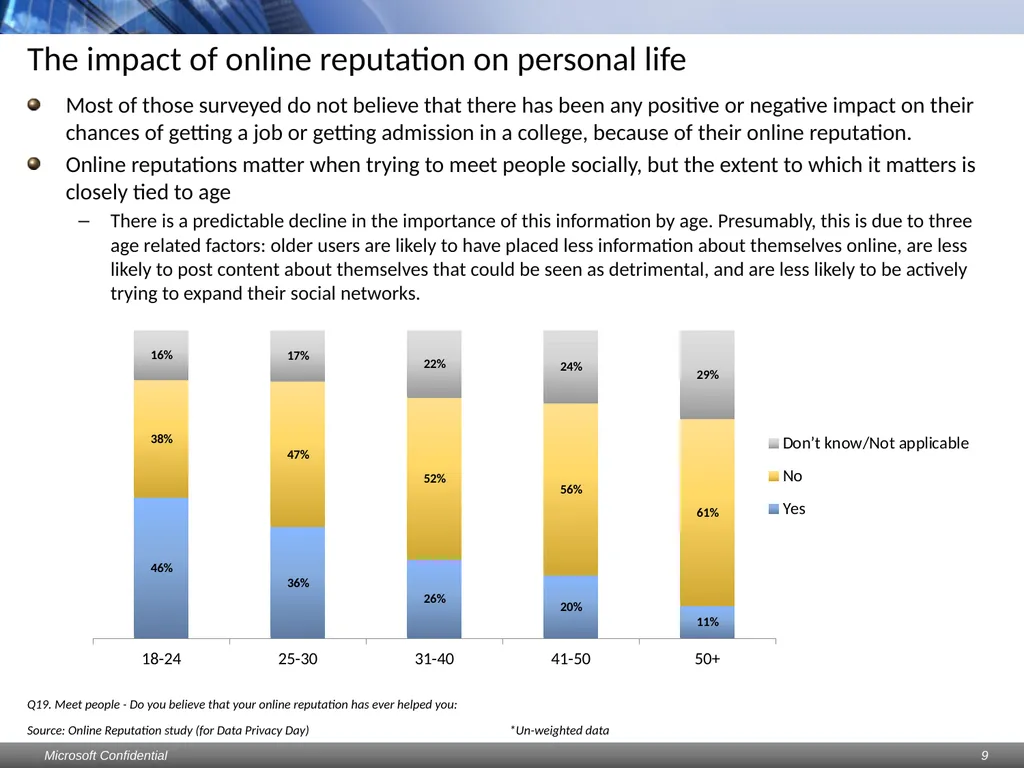
slide9. Most of those surveyed do not believe that there has been any positive or negative impact on their chances of getting a job or getting admission in a college, because of their online reputation.
Online reputations matter when trying to meet people socially, but the extent to which it matters is closely tied to age
There is a predictable decline in the importance of this information by age. Presumably, this is due to three age related factors: older users are likely to have placed less information about themselves online, are less likely to post content about themselves that could be seen as detrimental, and are less likely to be actively trying to expand their social networks. The impact of online reputation on personal life Q19. Meet people - Do you believe that your online reputation has ever helped you: Source: Online Reputation study (for Data Privacy Day) *Un-weighted data<br>
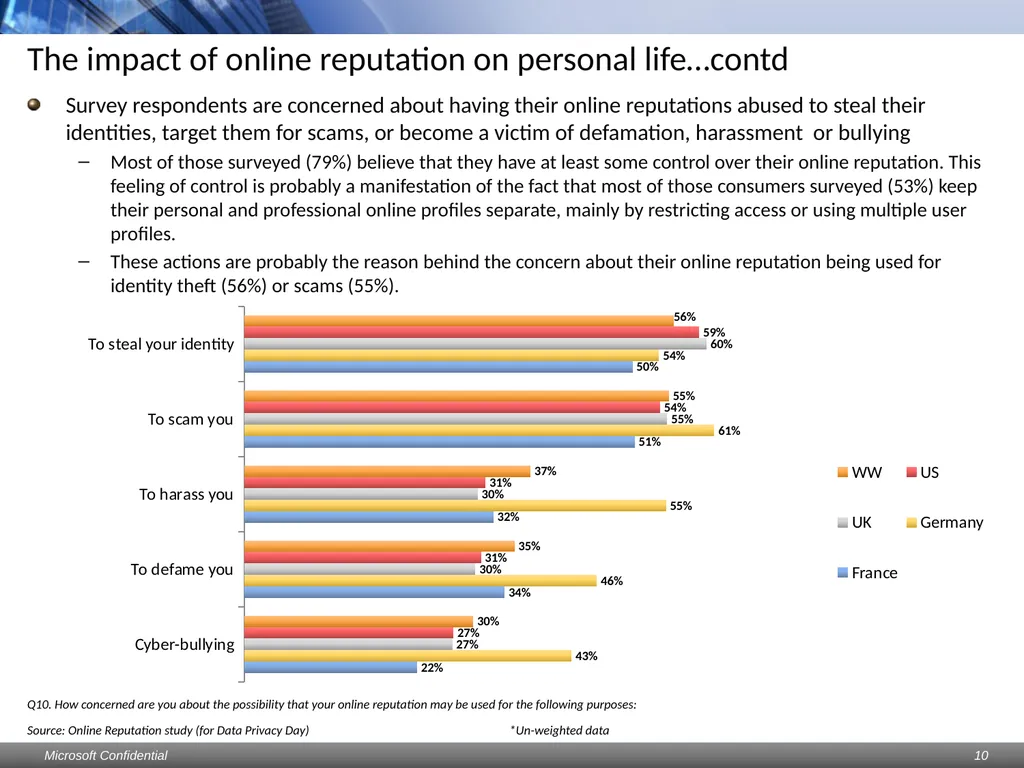
slide10. Survey respondents are concerned about having their online reputations abused to steal their identities, target them for scams, or become a victim of defamation, harassment or bullying
Most of those surveyed (79%) believe that they have at least some control over their online reputation. This feeling of control is probably a manifestation of the fact that most of those consumers surveyed (53%) keep their personal and professional online profiles separate, mainly by restricting access or using multiple user profiles.
These actions are probably the reason behind the concern about their online reputation being used for identity theft (56%) or scams (55%). The impact of online reputation on personal life…contd Q10. How concerned are you about the possibility that your online reputation may be used for the following purposes: Source: Online Reputation study (for Data Privacy Day) *Un-weighted data<br>
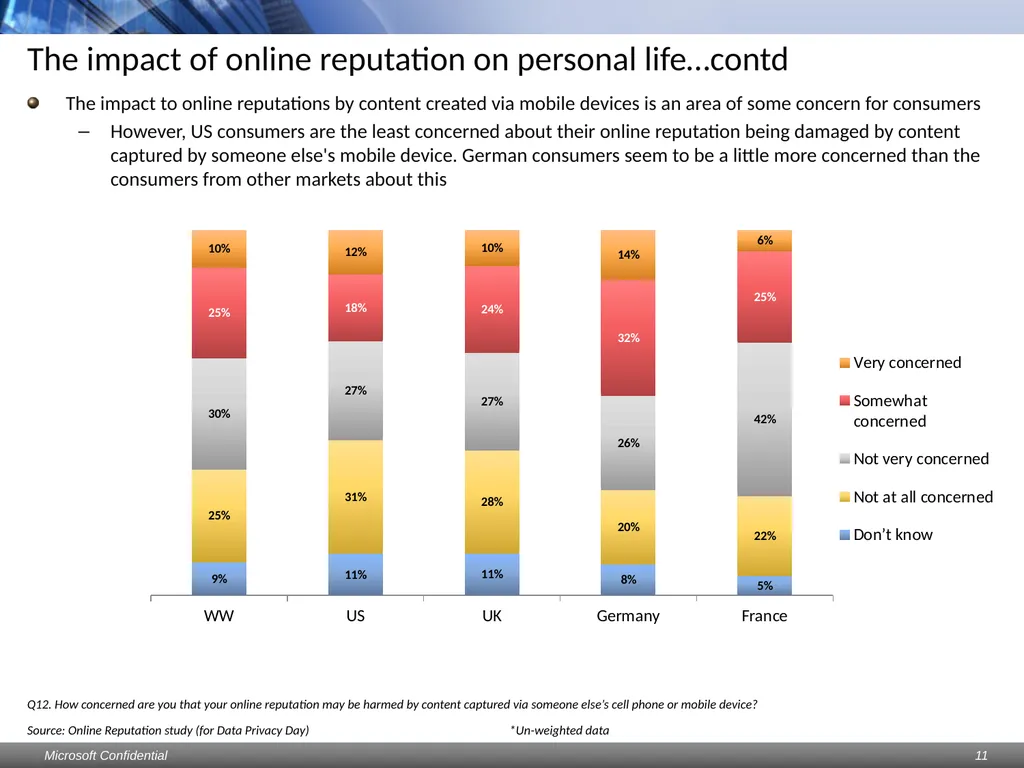
slide11. The impact to online reputations by content created via mobile devices is an area of some concern for consumers
However, US consumers are the least concerned about their online reputation being damaged by content captured by someone else's mobile device. German consumers seem to be a little more concerned than the consumers from other markets about this The impact of online reputation on personal life…contd Q12. How concerned are you that your online reputation may be harmed by content captured via someone else’s cell phone or mobile device? Source: Online Reputation study (for Data Privacy Day) *Un-weighted data<br>
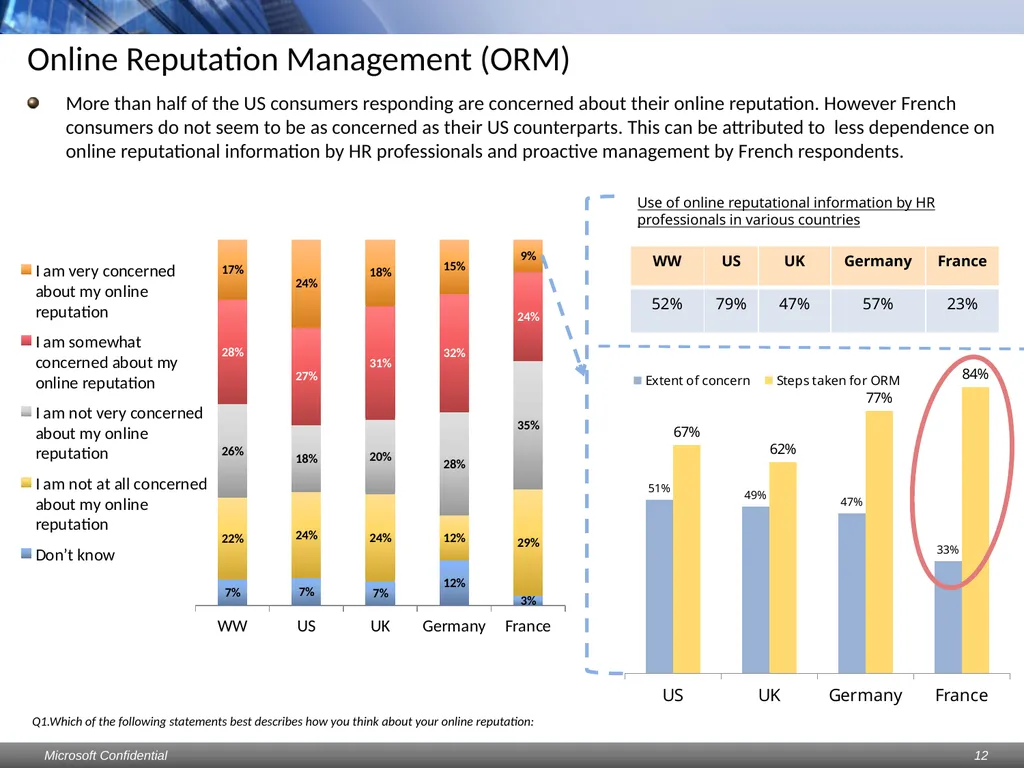
slide12. Online Reputation Management (ORM) More than half of the US consumers responding are concerned about their online reputation. However French consumers do not seem to be as concerned as their US counterparts. This can be attributed to less dependence on online reputational information by HR professionals and proactive management by French respondents. Use of online reputational information by HR professionals in various countries Q1.Which of the following statements best describes how you think about your online reputation:<br>
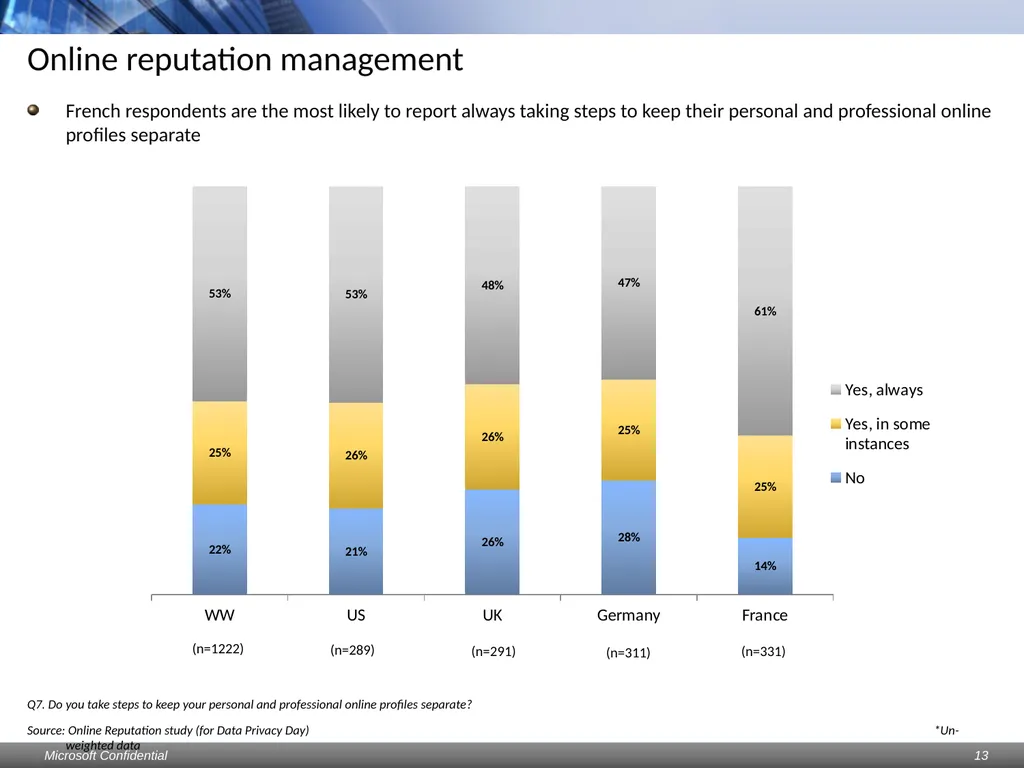
slide13. Source: Online Reputation study (for Data Privacy Day) *Un-weighted data Online reputation management French respondents are the most likely to report always taking steps to keep their personal and professional online profiles separate Q7. Do you take steps to keep your personal and professional online profiles separate? (n=1222) (n=289) (n=291) (n=311) (n=331)<br>
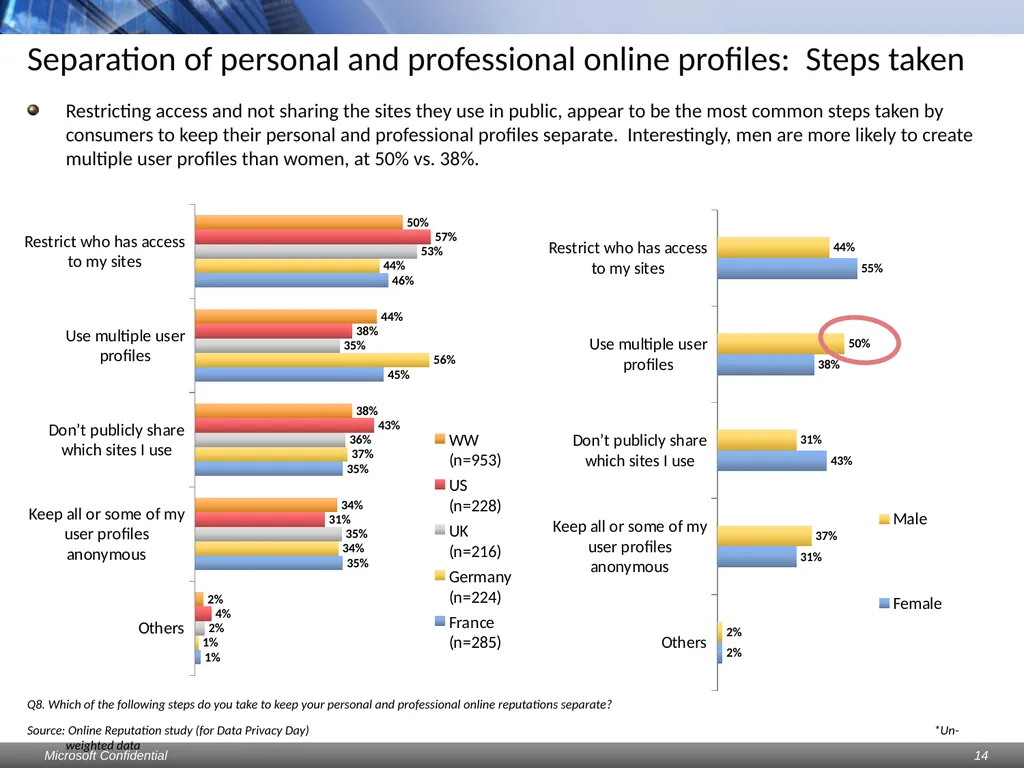
slide14. Source: Online Reputation study (for Data Privacy Day) *Un-weighted data Separation of personal and professional online profiles: Steps taken Restricting access and not sharing the sites they use in public, appear to be the most common steps taken by consumers to keep their personal and professional profiles separate. Interestingly, men are more likely to create multiple user profiles than women, at 50% vs. 38%. Q8. Which of the following steps do you take to keep your personal and professional online reputations separate?<br>
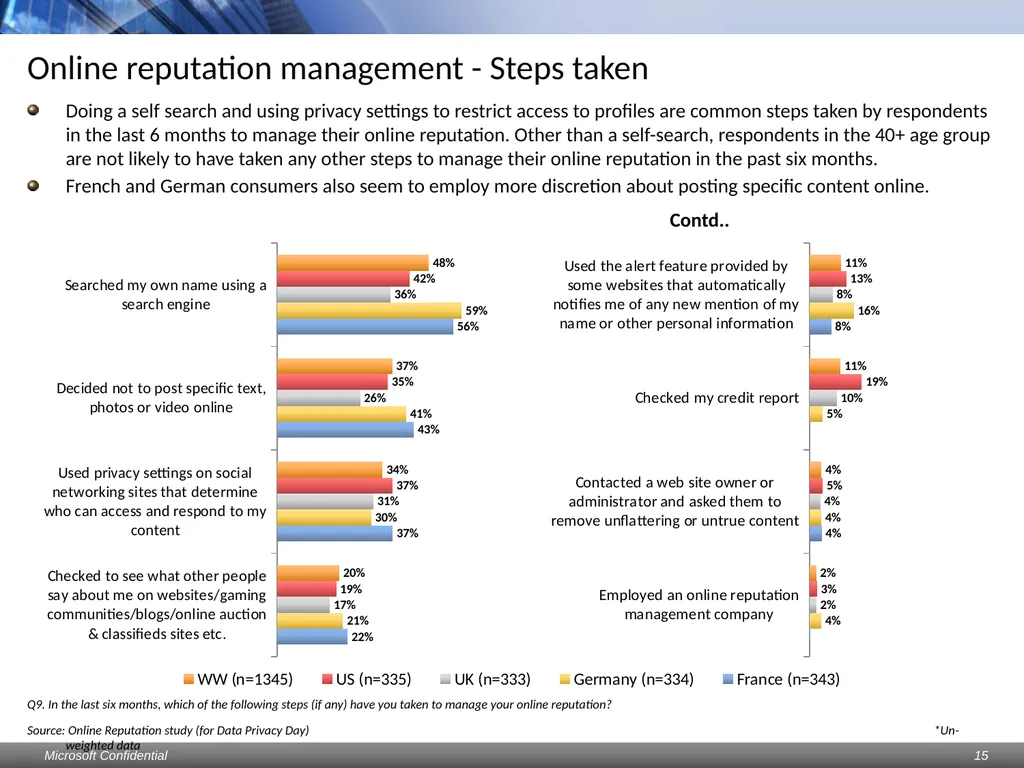
slide15. Source: Online Reputation study (for Data Privacy Day) *Un-weighted data Online reputation management - Steps taken Q9. In the last six months, which of the following steps (if any) have you taken to manage your online reputation? Doing a self search and using privacy settings to restrict access to profiles are common steps taken by respondents in the last 6 months to manage their online reputation. Other than a self-search, respondents in the 40+ age group are not likely to have taken any other steps to manage their online reputation in the past six months.
French and German consumers also seem to employ more discretion about posting specific content online. Contd..<br>
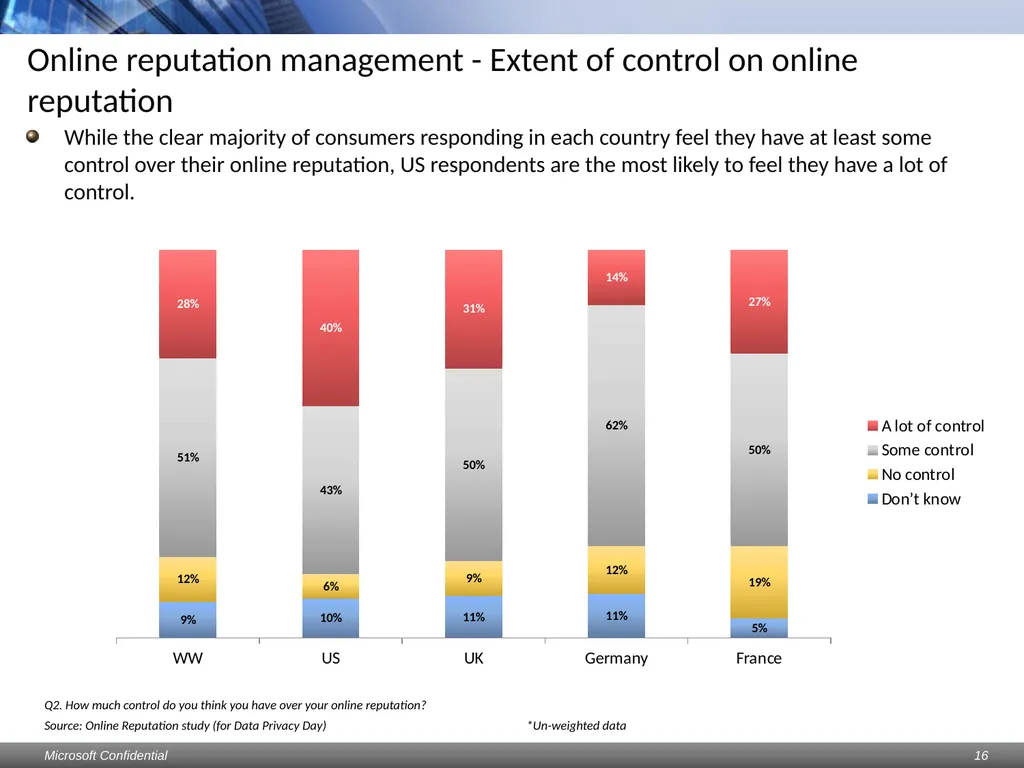
slide16. While the clear majority of consumers responding in each country feel they have at least some control over their online reputation, US respondents are the most likely to feel they have a lot of control. Online reputation management - Extent of control on online reputation Source: Online Reputation study (for Data Privacy Day) *Un-weighted data Q2. How much control do you think you have over your online reputation?<br>
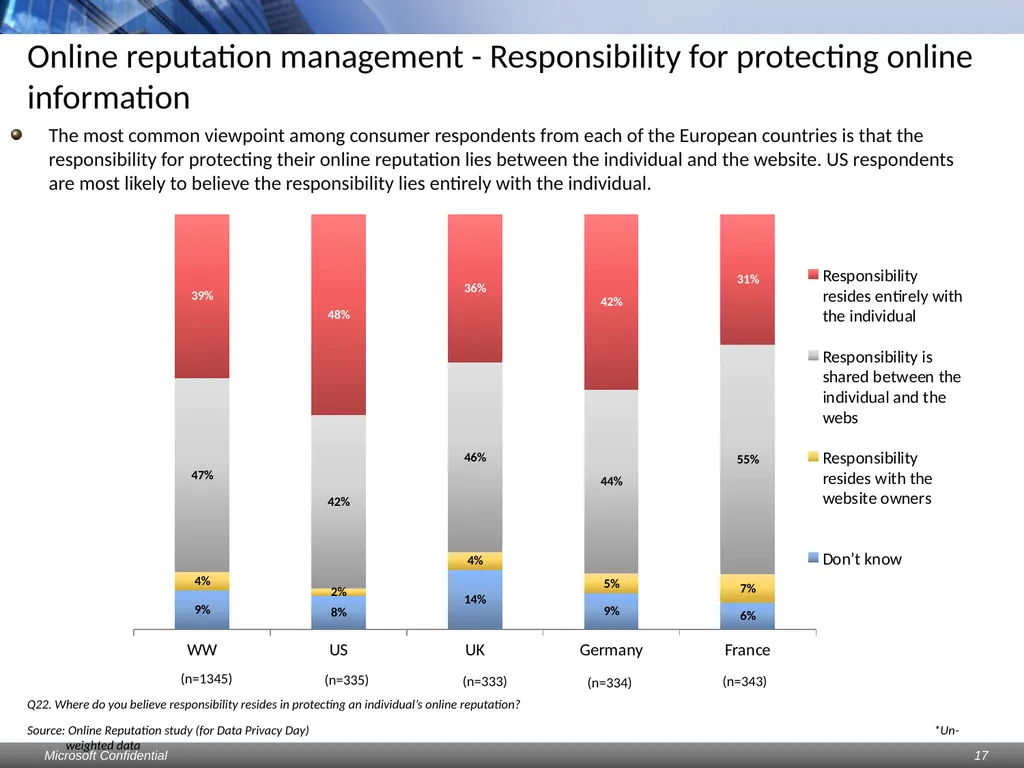
slide17. Source: Online Reputation study (for Data Privacy Day) *Un-weighted data Q22. Where do you believe responsibility resides in protecting an individual’s online reputation? Online reputation management - Responsibility for protecting online information (n=1345) (n=335) (n=333) (n=334) (n=343) The most common viewpoint among consumer respondents from each of the European countries is that the responsibility for protecting their online reputation lies between the individual and the website. US respondents are most likely to believe the responsibility lies entirely with the individual.<br>
slide18. Thank You Gary Nearn
Client Services Director
v-ganear@microsoft.com Ashok Varma
Sr. Research Manager
ashok@cross-tab.com<br>
slide19. Appendix<br>
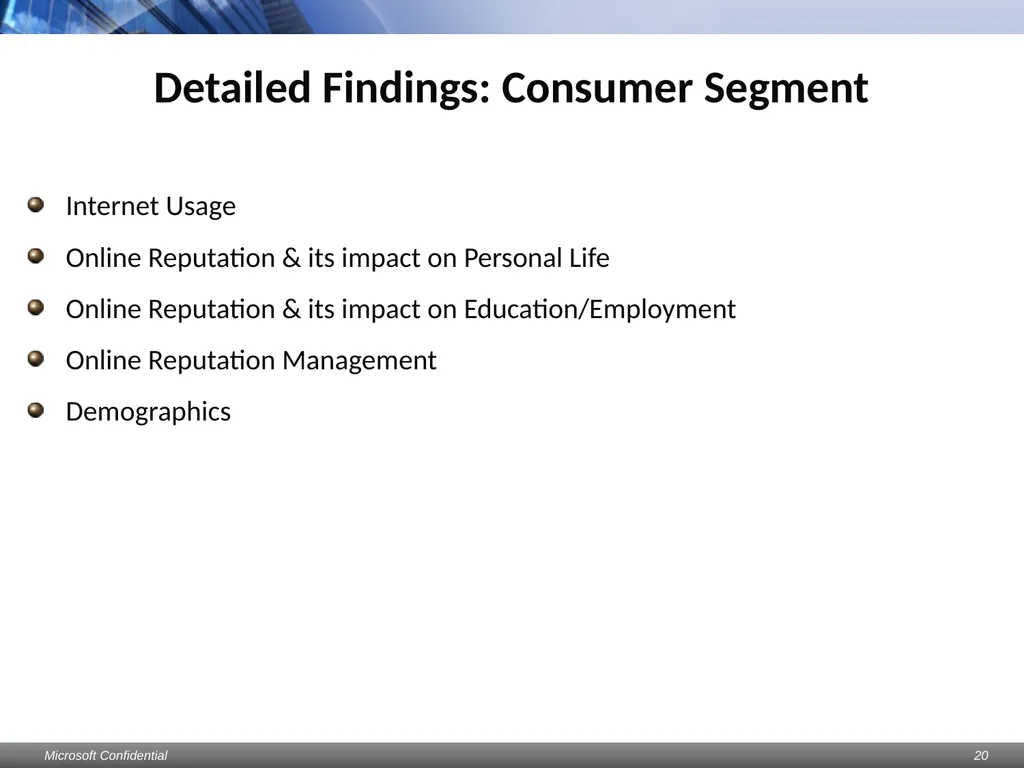
slide20. Internet Usage
Online Reputation & its impact on Personal Life
Online Reputation & its impact on Education/Employment
Online Reputation Management
Demographics Detailed Findings: Consumer Segment<br>
slide21. Internet Usage<br>
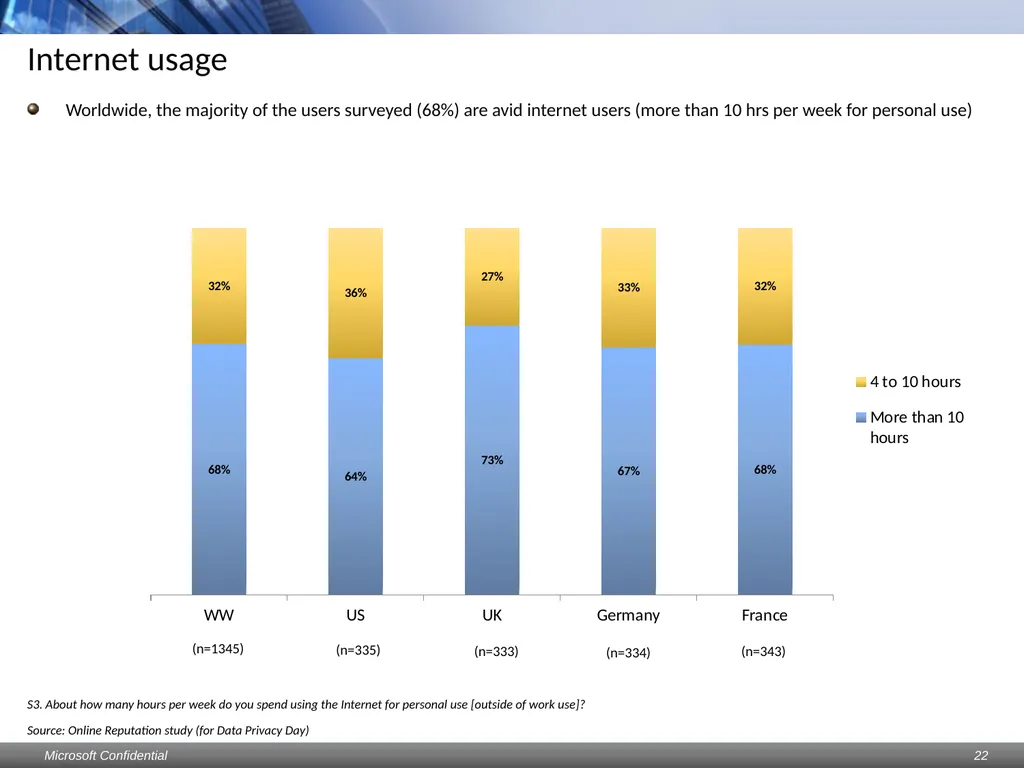
slide22. Source: Online Reputation study (for Data Privacy Day) Internet usage Worldwide, the majority of the users surveyed (68%) are avid internet users (more than 10 hrs per week for personal use) S3. About how many hours per week do you spend using the Internet for personal use [outside of work use]? (n=1345) (n=335) (n=333) (n=334) (n=343)<br>
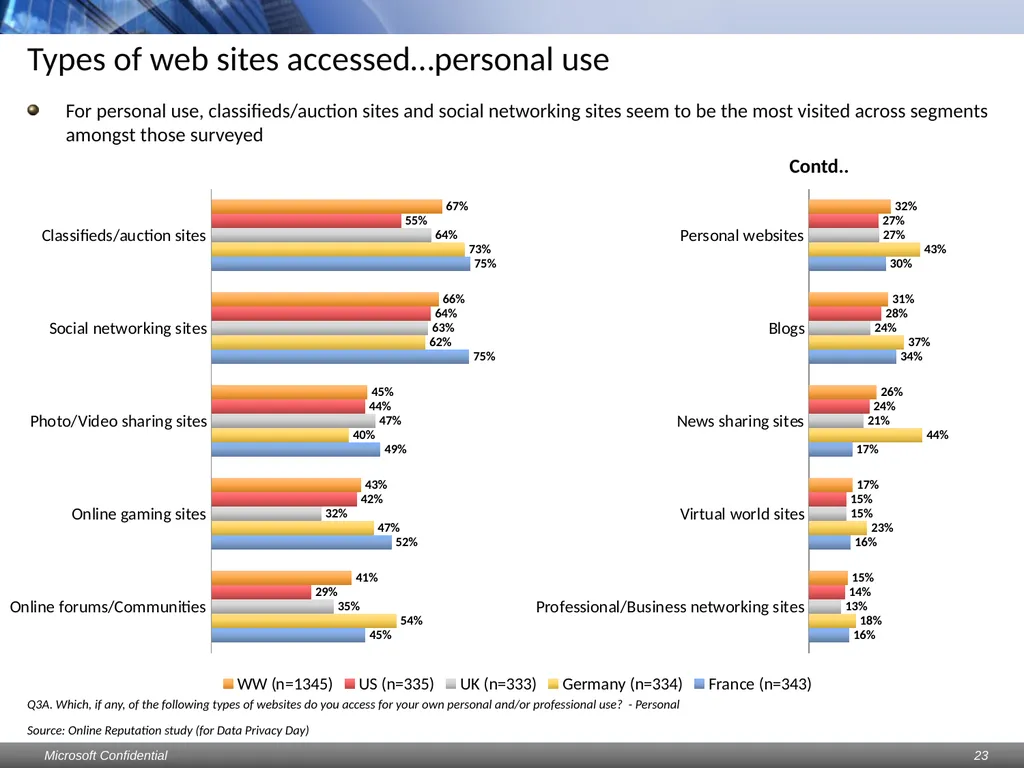
slide23. Source: Online Reputation study (for Data Privacy Day) Types of web sites accessed…personal use For personal use, classifieds/auction sites and social networking sites seem to be the most visited across segments amongst those surveyed Q3A. Which, if any, of the following types of websites do you access for your own personal and/or professional use? - Personal Contd..<br>
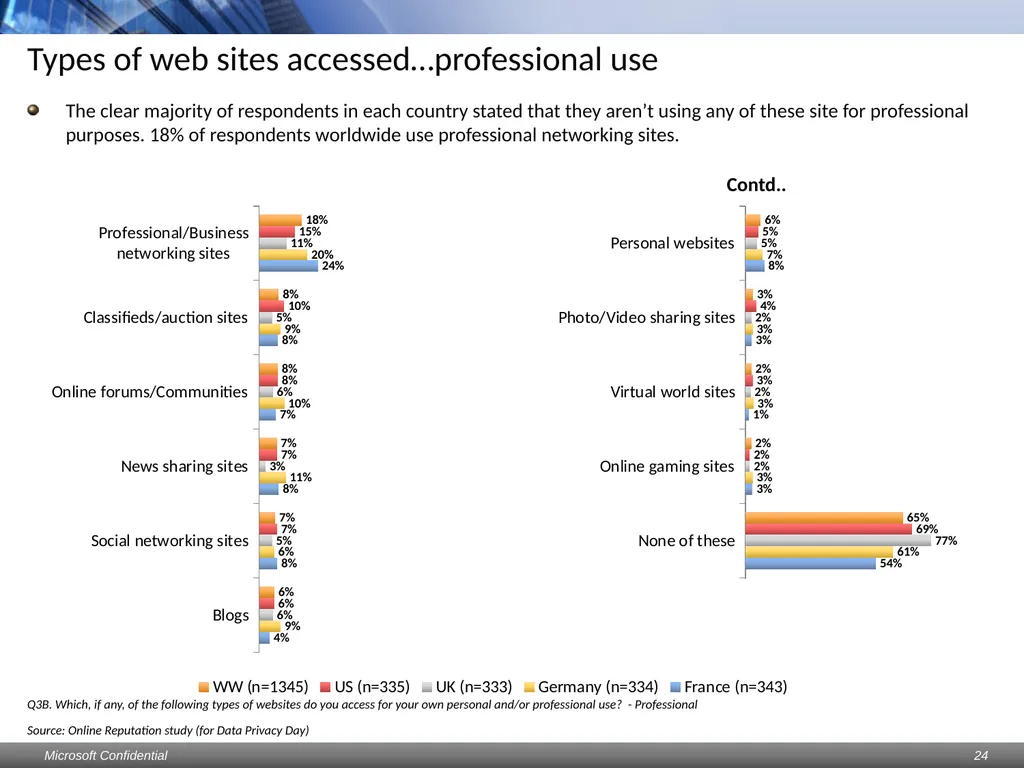
slide24. Source: Online Reputation study (for Data Privacy Day) Types of web sites accessed…professional use Q3B. Which, if any, of the following types of websites do you access for your own personal and/or professional use? - Professional Contd.. The clear majority of respondents in each country stated that they aren’t using any of these site for professional purposes. 18% of respondents worldwide use professional networking sites.<br>
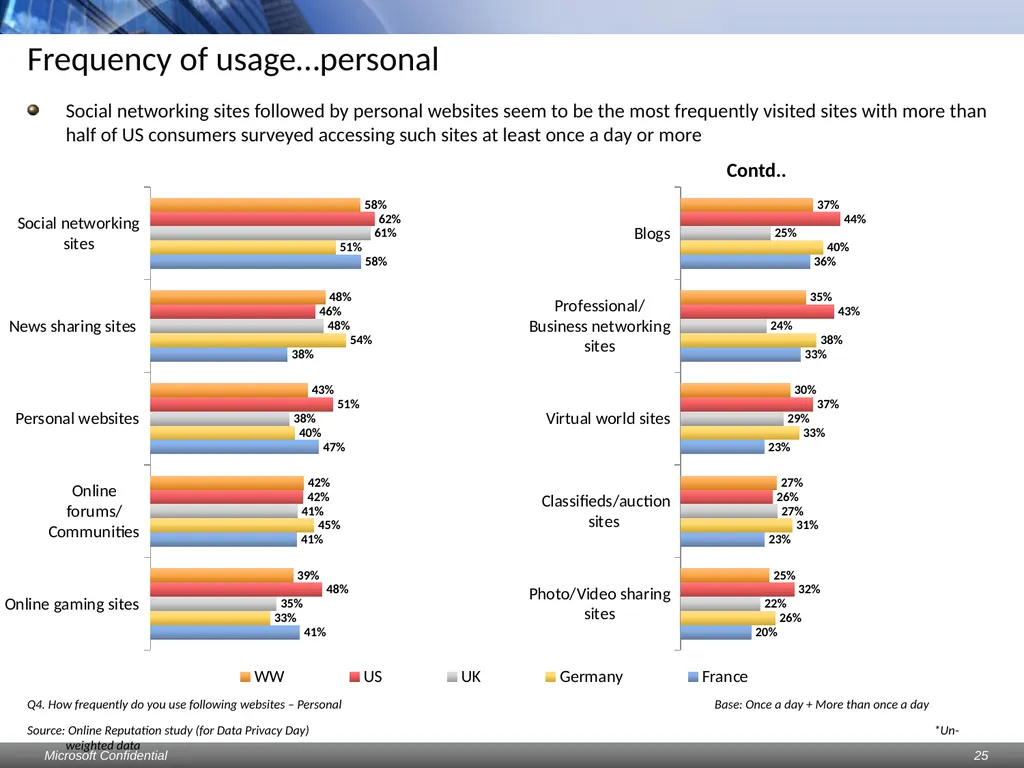
slide25. Source: Online Reputation study (for Data Privacy Day) *Un-weighted data Frequency of usage…personal Social networking sites followed by personal websites seem to be the most frequently visited sites with more than half of US consumers surveyed accessing such sites at least once a day or more Q4. How frequently do you use following websites – Personal Base: Once a day + More than once a day Contd..<br>
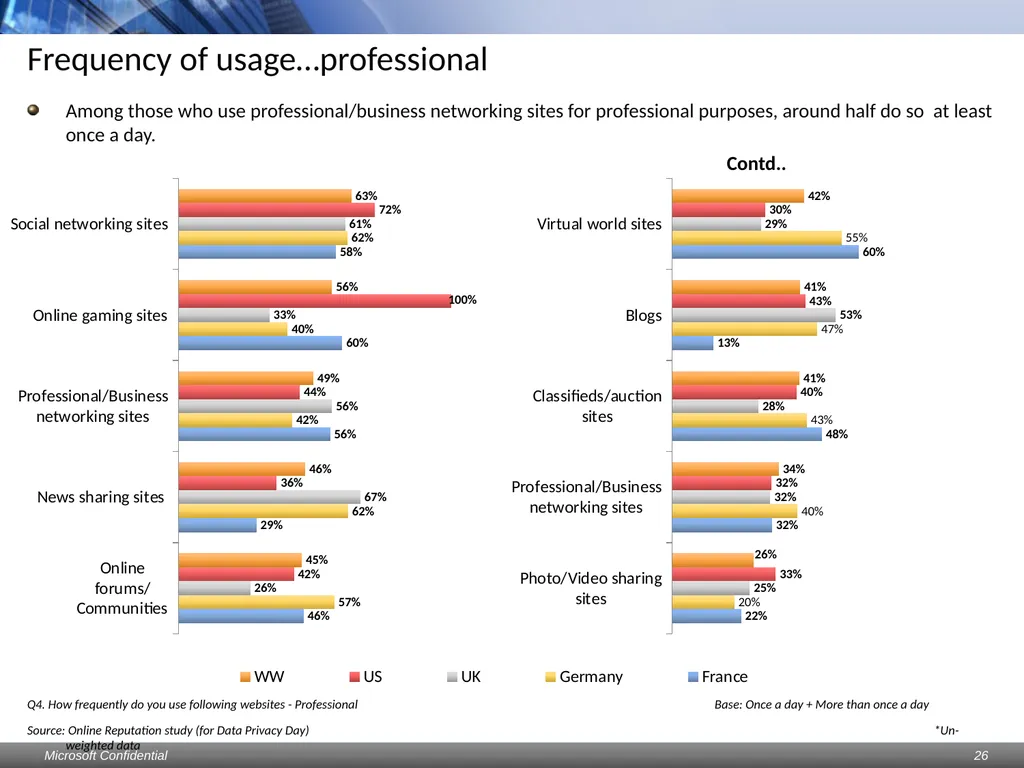
slide26. Source: Online Reputation study (for Data Privacy Day) *Un-weighted data Frequency of usage…professional Contd.. Q4. How frequently do you use following websites - Professional Base: Once a day + More than once a day Among those who use professional/business networking sites for professional purposes, around half do so at least once a day.<br>
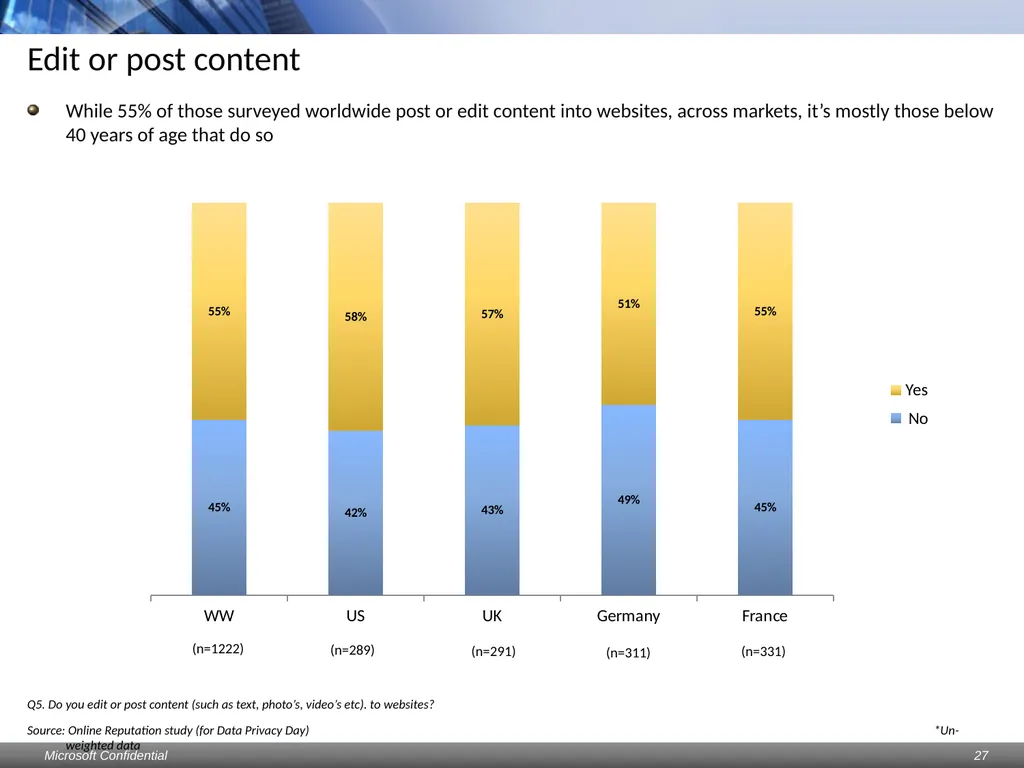
slide27. Source: Online Reputation study (for Data Privacy Day) *Un-weighted data Edit or post content While 55% of those surveyed worldwide post or edit content into websites, across markets, it’s mostly those below 40 years of age that do so Q5. Do you edit or post content (such as text, photo’s, video’s etc). to websites? (n=1222) (n=289) (n=291) (n=311) (n=331)<br>
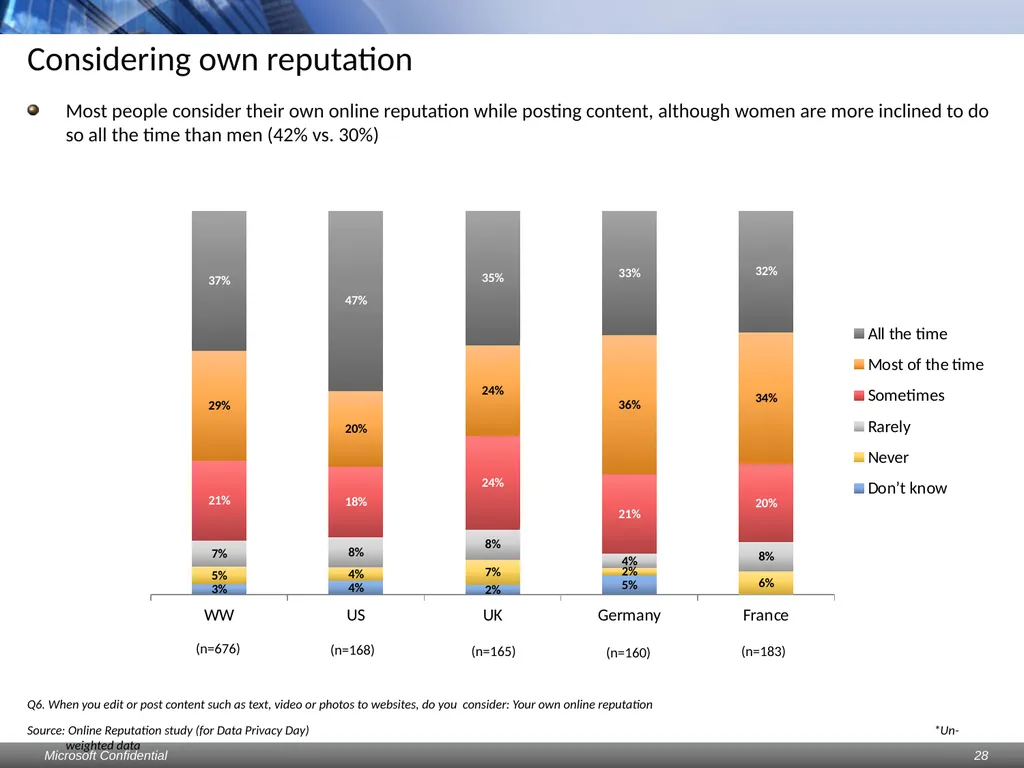
slide28. Source: Online Reputation study (for Data Privacy Day) *Un-weighted data Considering own reputation Most people consider their own online reputation while posting content, although women are more inclined to do so all the time than men (42% vs. 30%) Q6. When you edit or post content such as text, video or photos to websites, do you consider: Your own online reputation (n=676) (n=168) (n=165) (n=160) (n=183)<br>
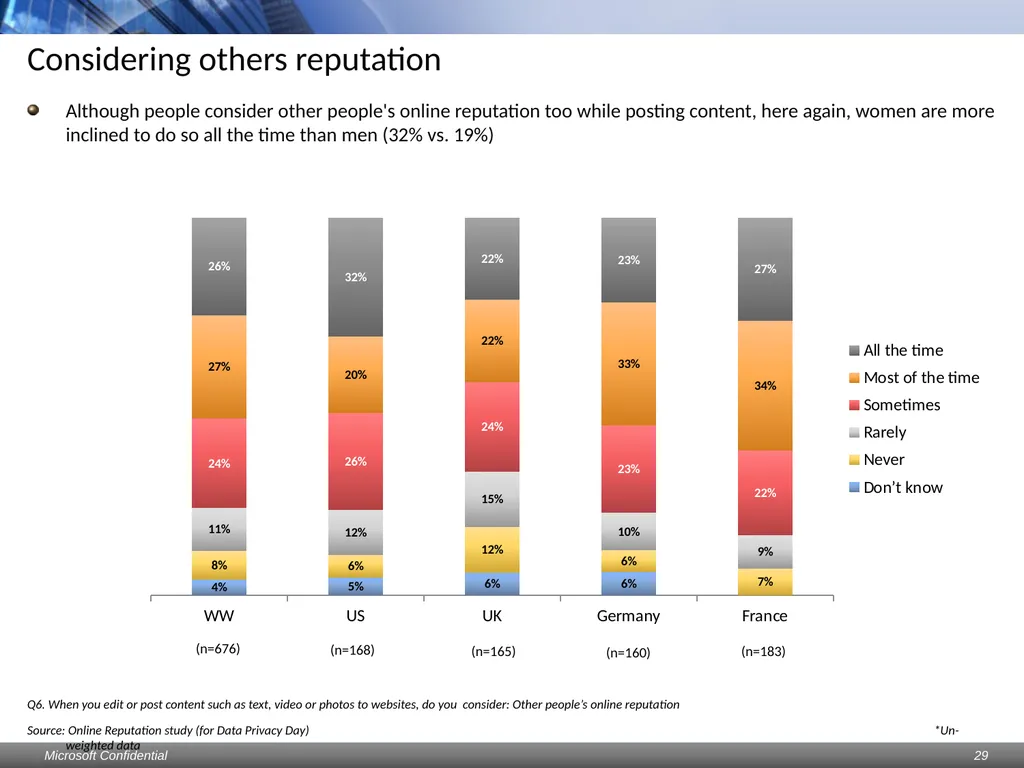
slide29. Source: Online Reputation study (for Data Privacy Day) *Un-weighted data Considering others reputation Although people consider other people's online reputation too while posting content, here again, women are more inclined to do so all the time than men (32% vs. 19%) (n=676) (n=168) (n=165) (n=160) (n=183) Q6. When you edit or post content such as text, video or photos to websites, do you consider: Other people’s online reputation<br>
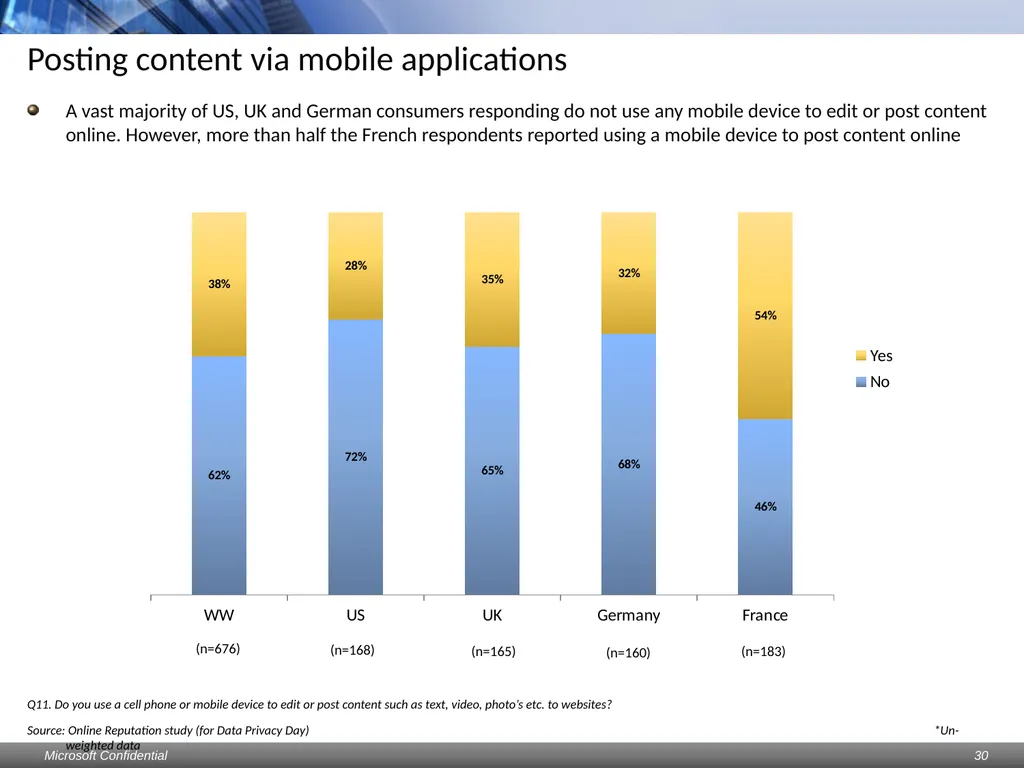
slide30. Source: Online Reputation study (for Data Privacy Day) *Un-weighted data Posting content via mobile applications A vast majority of US, UK and German consumers responding do not use any mobile device to edit or post content online. However, more than half the French respondents reported using a mobile device to post content online Q11. Do you use a cell phone or mobile device to edit or post content such as text, video, photo’s etc. to websites? (n=676) (n=168) (n=165) (n=160) (n=183)<br>
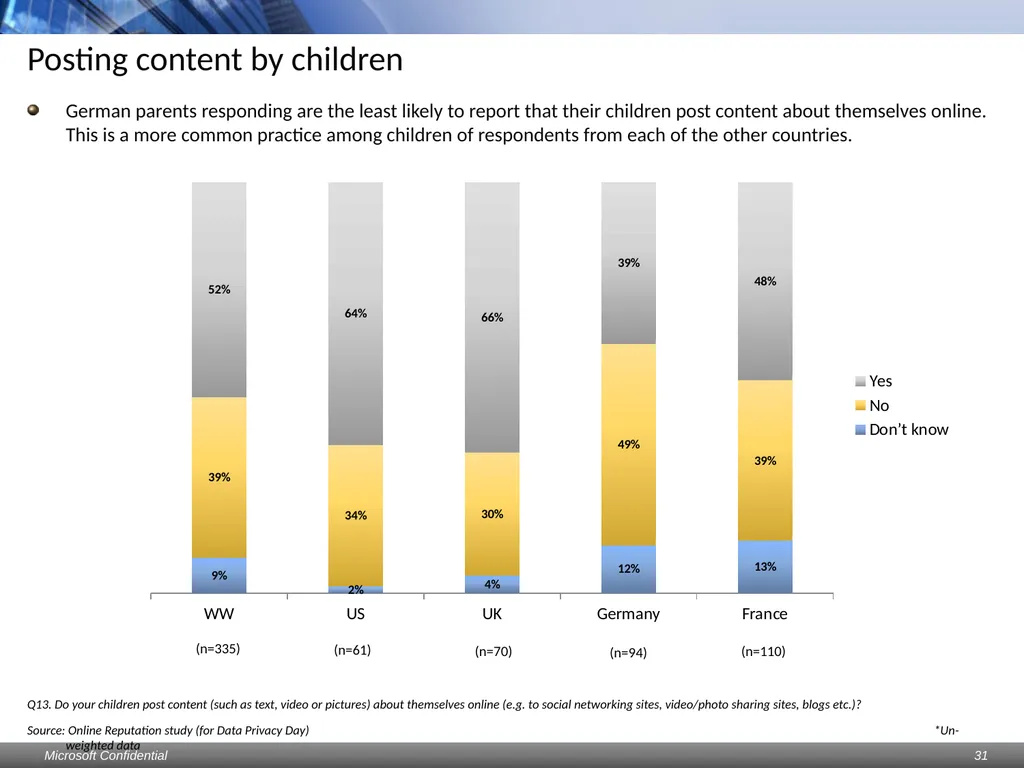
slide31. Source: Online Reputation study (for Data Privacy Day) *Un-weighted data Posting content by children Q13. Do your children post content (such as text, video or pictures) about themselves online (e.g. to social networking sites, video/photo sharing sites, blogs etc.)? (n=335) (n=61) (n=70) (n=94) (n=110) German parents responding are the least likely to report that their children post content about themselves online. This is a more common practice among children of respondents from each of the other countries.<br>
slide32. Online Reputation and its impact on Personal Life<br>
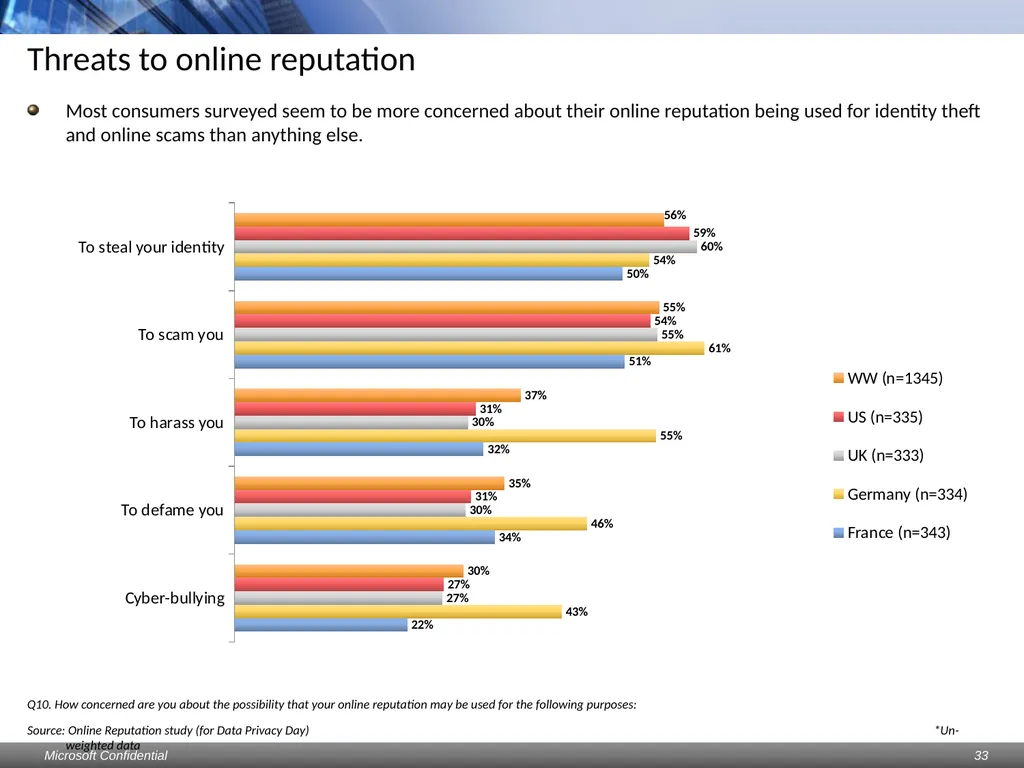
slide33. Source: Online Reputation study (for Data Privacy Day) *Un-weighted data Threats to online reputation Most consumers surveyed seem to be more concerned about their online reputation being used for identity theft and online scams than anything else. Q10. How concerned are you about the possibility that your online reputation may be used for the following purposes:<br>
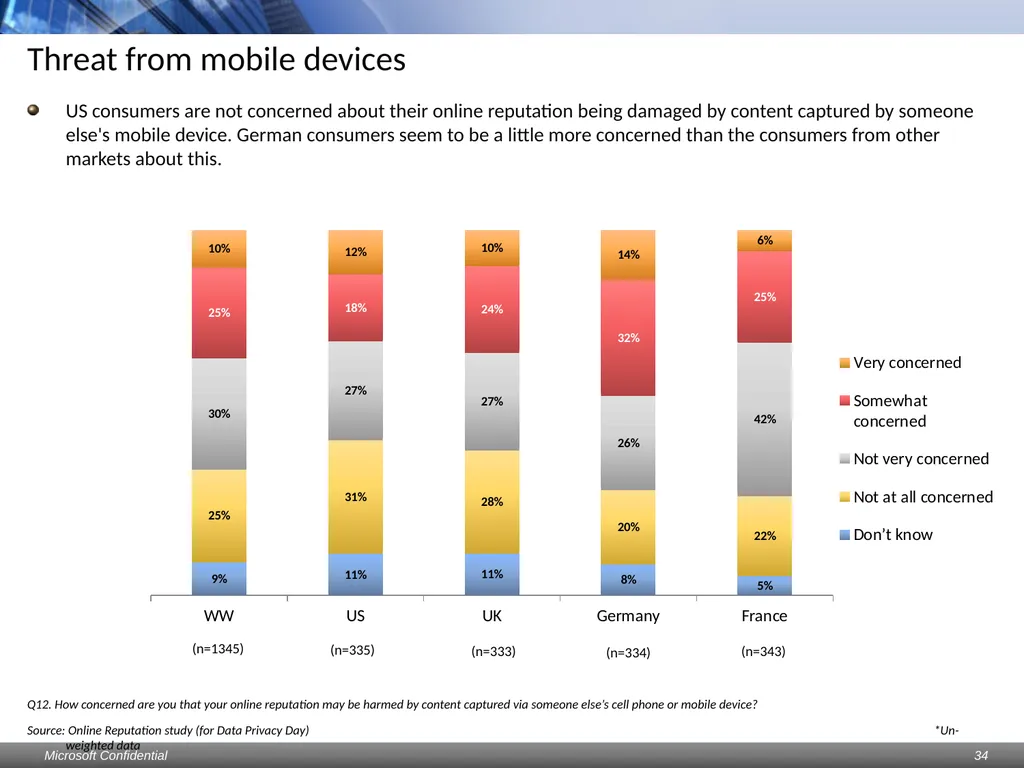
slide34. Source: Online Reputation study (for Data Privacy Day) *Un-weighted data Threat from mobile devices US consumers are not concerned about their online reputation being damaged by content captured by someone else's mobile device. German consumers seem to be a little more concerned than the consumers from other markets about this. Q12. How concerned are you that your online reputation may be harmed by content captured via someone else’s cell phone or mobile device? (n=1345) (n=335) (n=333) (n=334) (n=343)<br>
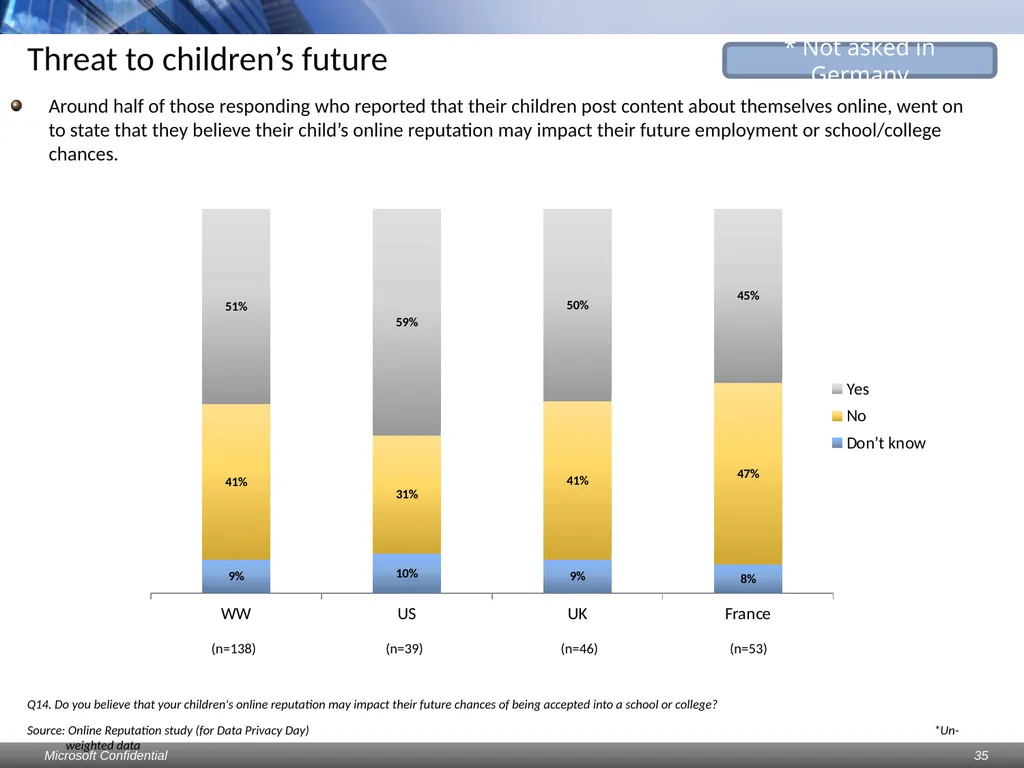
slide35. Source: Online Reputation study (for Data Privacy Day) *Un-weighted data Threat to children’s future Q14. Do you believe that your children's online reputation may impact their future chances of being accepted into a school or college? (n=138) (n=39) (n=46) (n=53) * Not asked in Germany Around half of those responding who reported that their children post content about themselves online, went on to state that they believe their child’s online reputation may impact their future employment or school/college chances.<br>
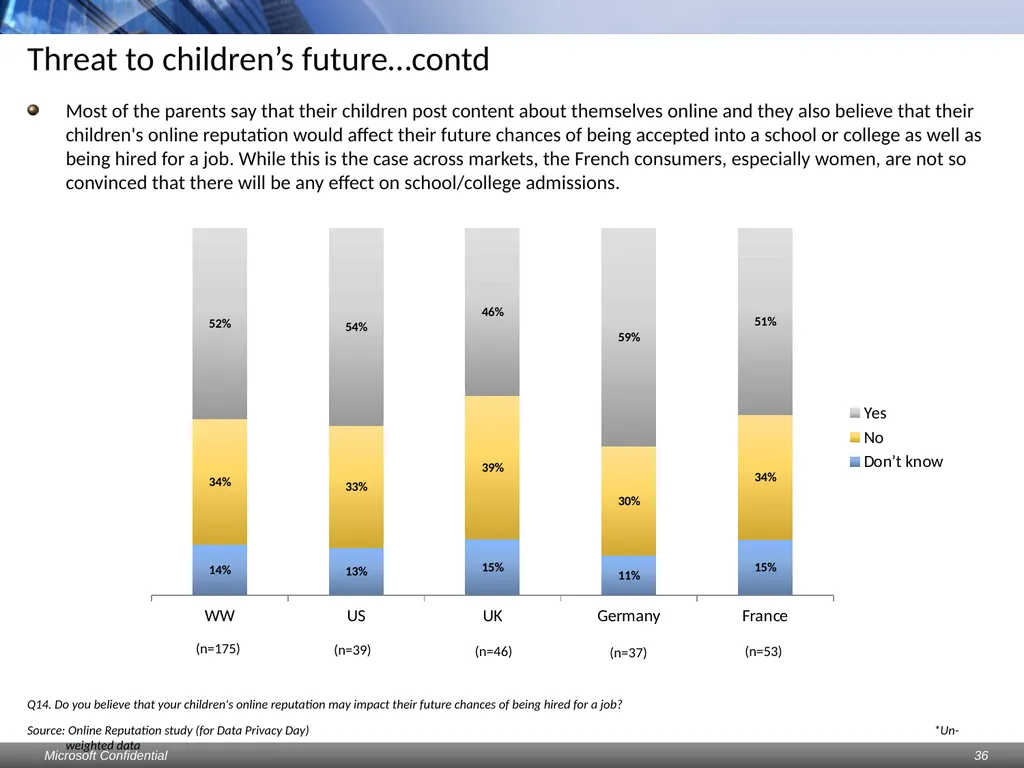
slide36. Source: Online Reputation study (for Data Privacy Day) *Un-weighted data Threat to children’s future…contd Most of the parents say that their children post content about themselves online and they also believe that their children's online reputation would affect their future chances of being accepted into a school or college as well as being hired for a job. While this is the case across markets, the French consumers, especially women, are not so convinced that there will be any effect on school/college admissions. (n=175) (n=39) (n=46) (n=37) (n=53) Q14. Do you believe that your children's online reputation may impact their future chances of being hired for a job?<br>
slide37. Online Reputation and its impact on Education/Employment Opportunities<br>
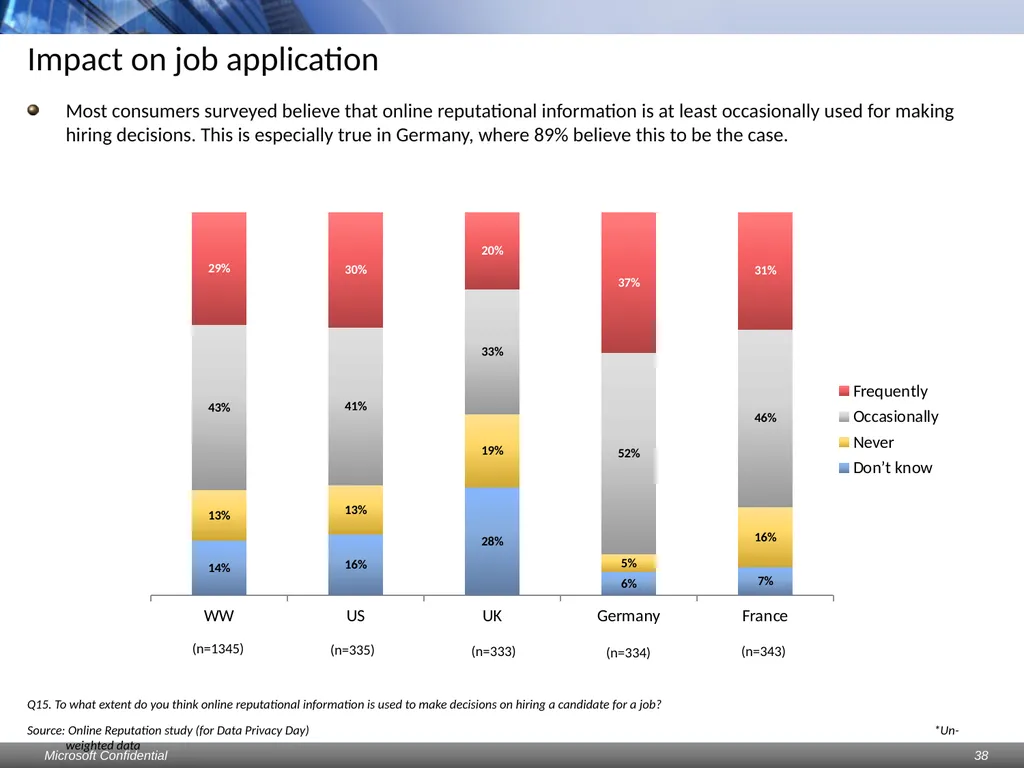
slide38. Source: Online Reputation study (for Data Privacy Day) *Un-weighted data Impact on job application Most consumers surveyed believe that online reputational information is at least occasionally used for making hiring decisions. This is especially true in Germany, where 89% believe this to be the case. (n=1345) (n=335) (n=333) (n=334) (n=343) Q15. To what extent do you think online reputational information is used to make decisions on hiring a candidate for a job?<br>
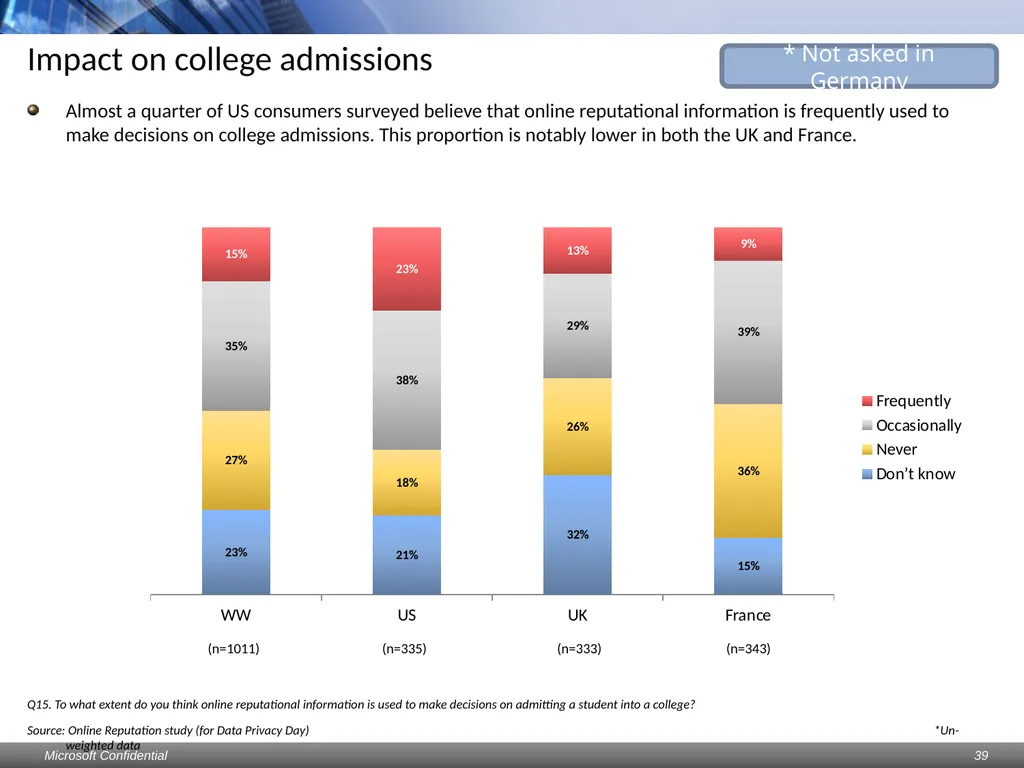
slide39. Source: Online Reputation study (for Data Privacy Day) *Un-weighted data Impact on college admissions Almost a quarter of US consumers surveyed believe that online reputational information is frequently used to make decisions on college admissions. This proportion is notably lower in both the UK and France. (n=1011) (n=335) (n=333) (n=343) Q15. To what extent do you think online reputational information is used to make decisions on admitting a student into a college? * Not asked in Germany<br>
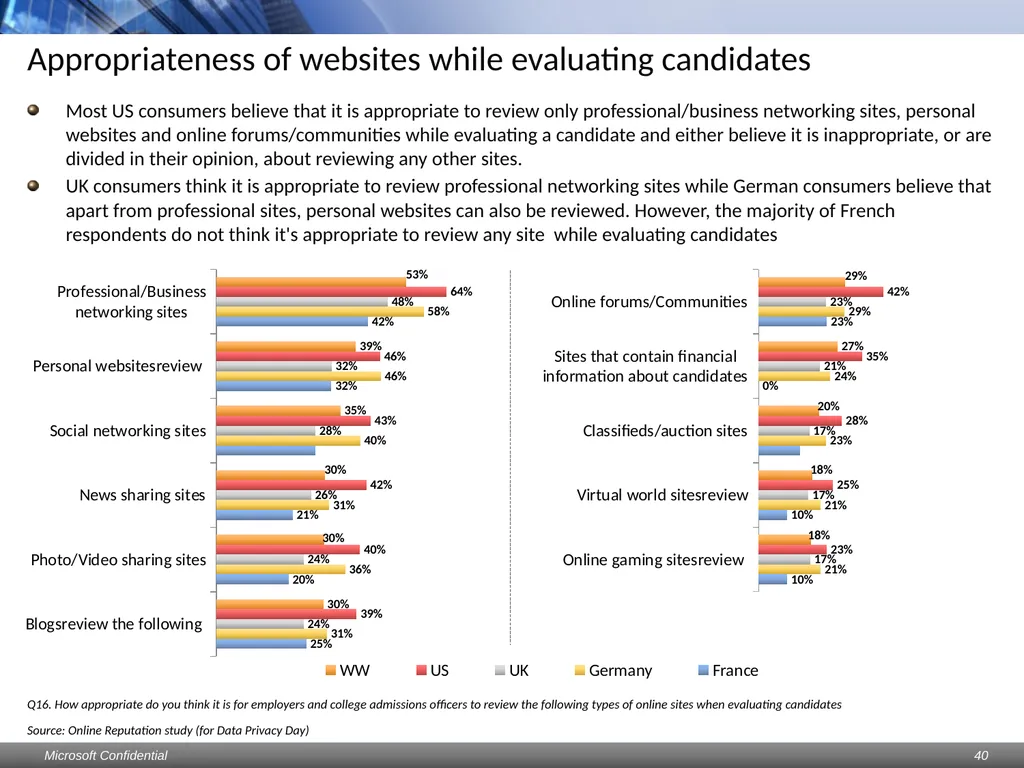
slide40. Source: Online Reputation study (for Data Privacy Day) Appropriateness of websites while evaluating candidates Most US consumers believe that it is appropriate to review only professional/business networking sites, personal websites and online forums/communities while evaluating a candidate and either believe it is inappropriate, or are divided in their opinion, about reviewing any other sites.
UK consumers think it is appropriate to review professional networking sites while German consumers believe that apart from professional sites, personal websites can also be reviewed. However, the majority of French respondents do not think it's appropriate to review any site while evaluating candidates Q16. How appropriate do you think it is for employers and college admissions officers to review the following types of online sites when evaluating candidates<br>
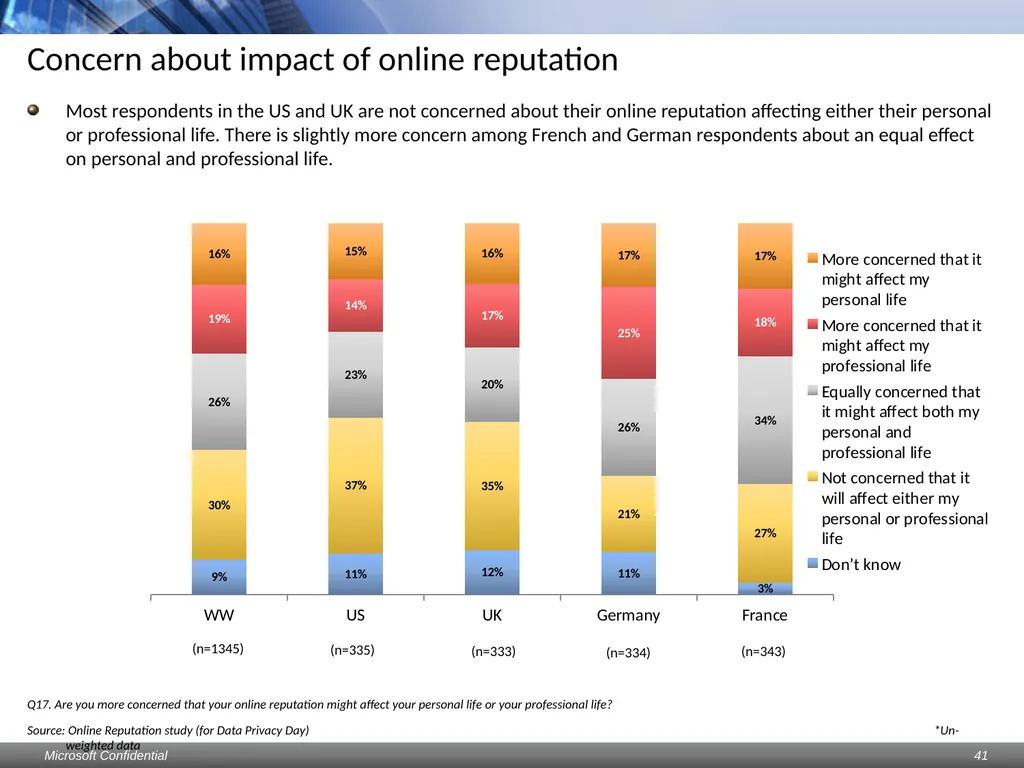
slide41. Source: Online Reputation study (for Data Privacy Day) *Un-weighted data Concern about impact of online reputation Most respondents in the US and UK are not concerned about their online reputation affecting either their personal or professional life. There is slightly more concern among French and German respondents about an equal effect on personal and professional life. (n=1345) (n=335) (n=333) (n=334) (n=343) Q17. Are you more concerned that your online reputation might affect your personal life or your professional life?<br>
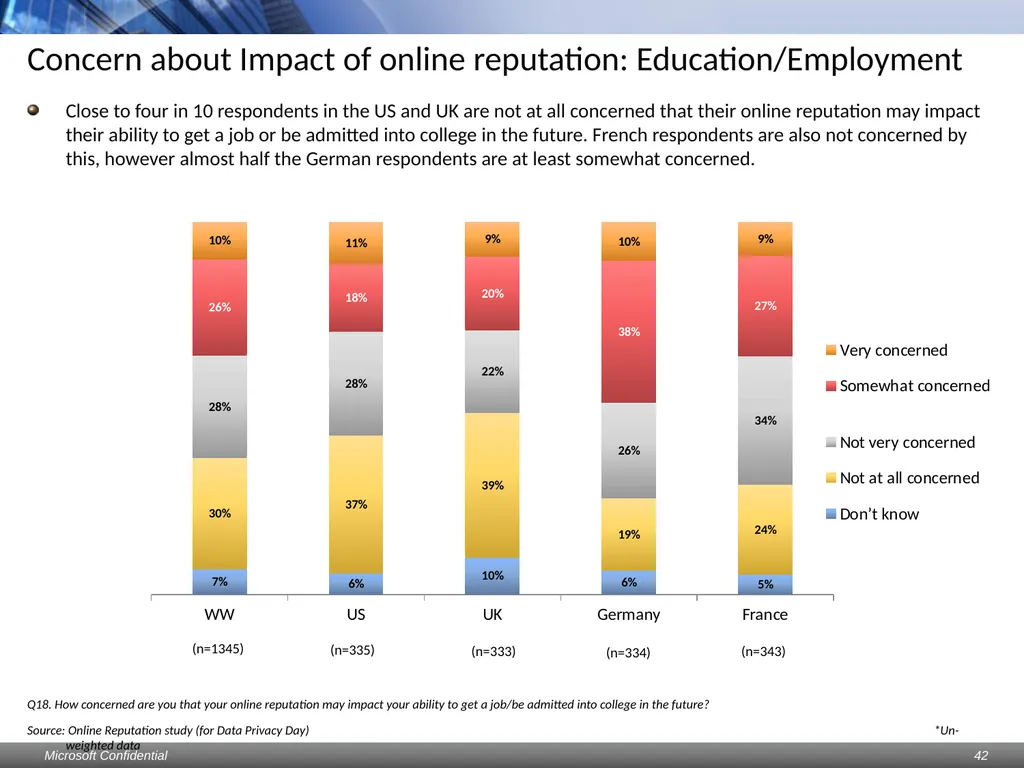
slide42. Source: Online Reputation study (for Data Privacy Day) *Un-weighted data Concern about Impact of online reputation: Education/Employment Close to four in 10 respondents in the US and UK are not at all concerned that their online reputation may impact their ability to get a job or be admitted into college in the future. French respondents are also not concerned by this, however almost half the German respondents are at least somewhat concerned. (n=1345) (n=335) (n=333) (n=334) (n=343) Q18. How concerned are you that your online reputation may impact your ability to get a job/be admitted into college in the future?<br>
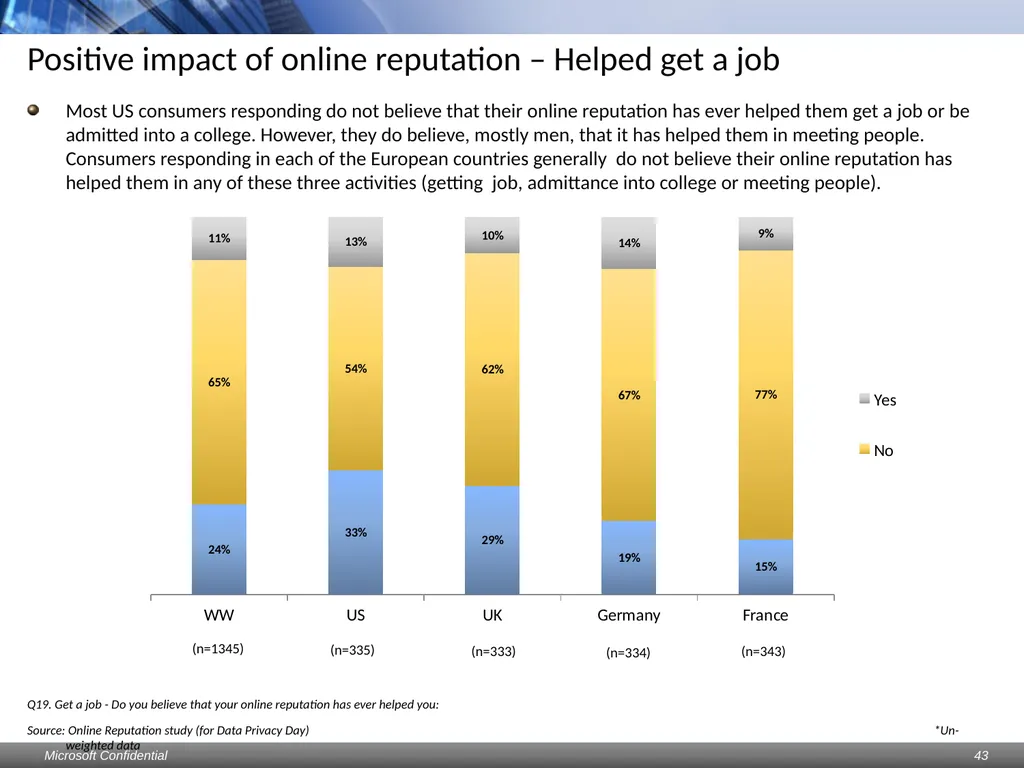
slide43. Source: Online Reputation study (for Data Privacy Day) *Un-weighted data Q19. Get a job - Do you believe that your online reputation has ever helped you: Positive impact of online reputation – Helped get a job Most US consumers responding do not believe that their online reputation has ever helped them get a job or be admitted into a college. However, they do believe, mostly men, that it has helped them in meeting people. Consumers responding in each of the European countries generally do not believe their online reputation has helped them in any of these three activities (getting job, admittance into college or meeting people). (n=1345) (n=335) (n=333) (n=334) (n=343)<br>
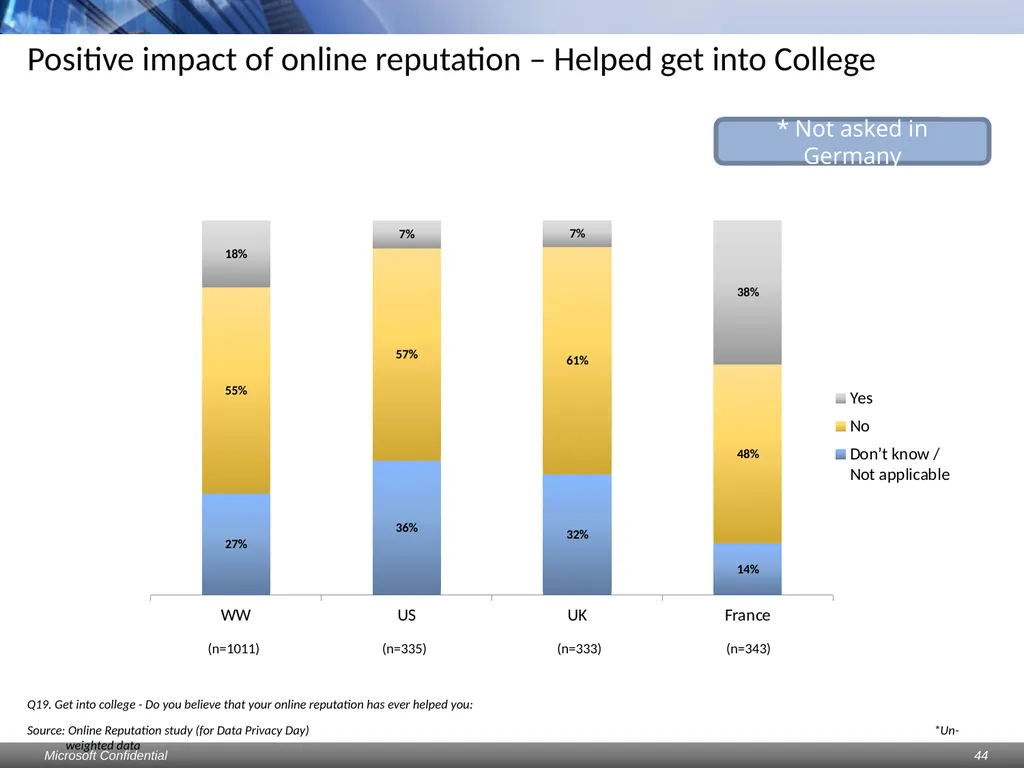
slide44. Source: Online Reputation study (for Data Privacy Day) *Un-weighted data Q19. Get into college - Do you believe that your online reputation has ever helped you: Positive impact of online reputation – Helped get into College (n=1011) (n=335) (n=333) (n=343) * Not asked in Germany<br>
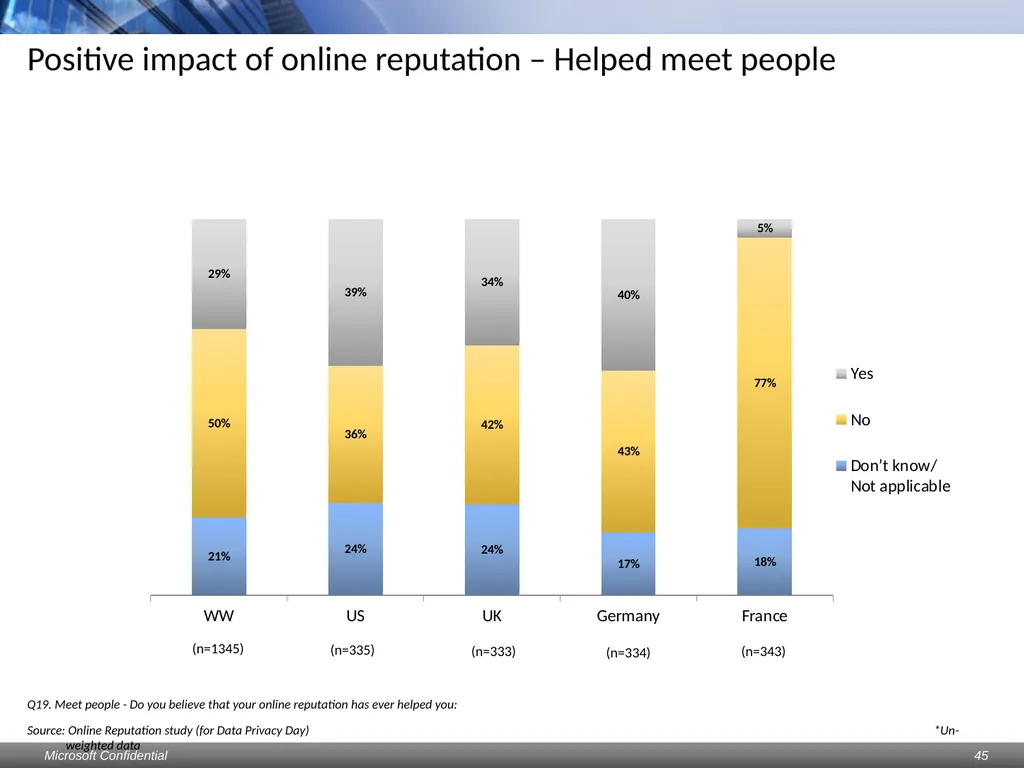
slide45. Source: Online Reputation study (for Data Privacy Day) *Un-weighted data Q19. Meet people - Do you believe that your online reputation has ever helped you: Positive impact of online reputation – Helped meet people (n=1345) (n=335) (n=333) (n=334) (n=343)<br>
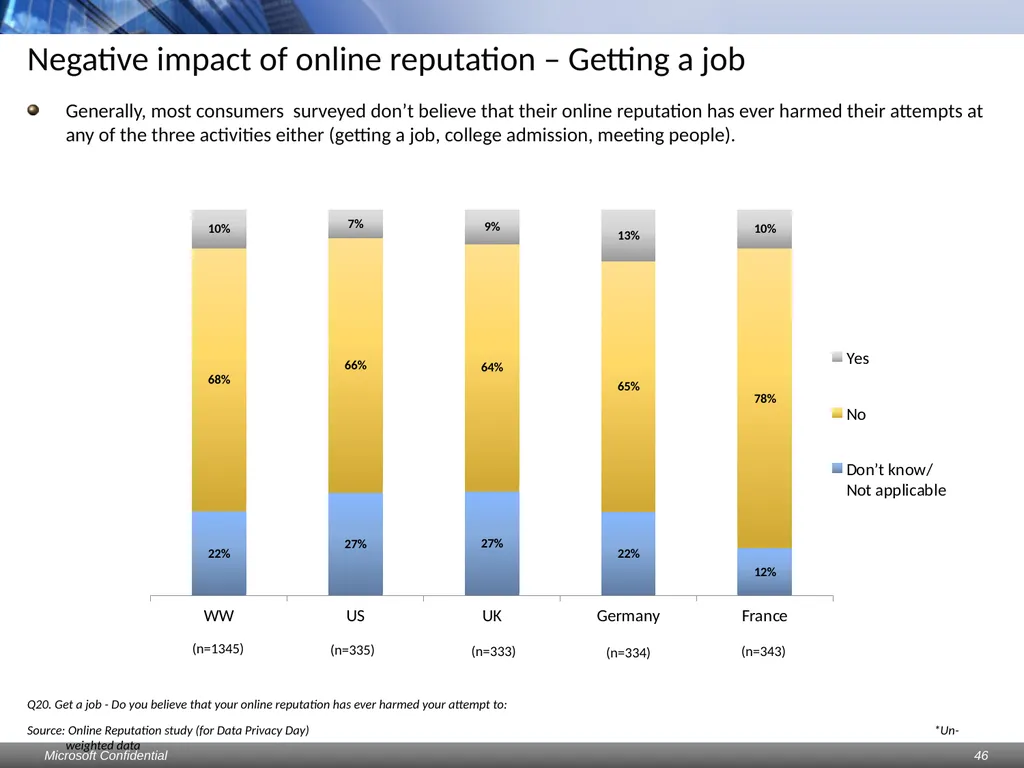
slide46. Source: Online Reputation study (for Data Privacy Day) *Un-weighted data Q20. Get a job - Do you believe that your online reputation has ever harmed your attempt to: Negative impact of online reputation – Getting a job Generally, most consumers surveyed don’t believe that their online reputation has ever harmed their attempts at any of the three activities either (getting a job, college admission, meeting people). (n=1345) (n=335) (n=333) (n=334) (n=343)<br>
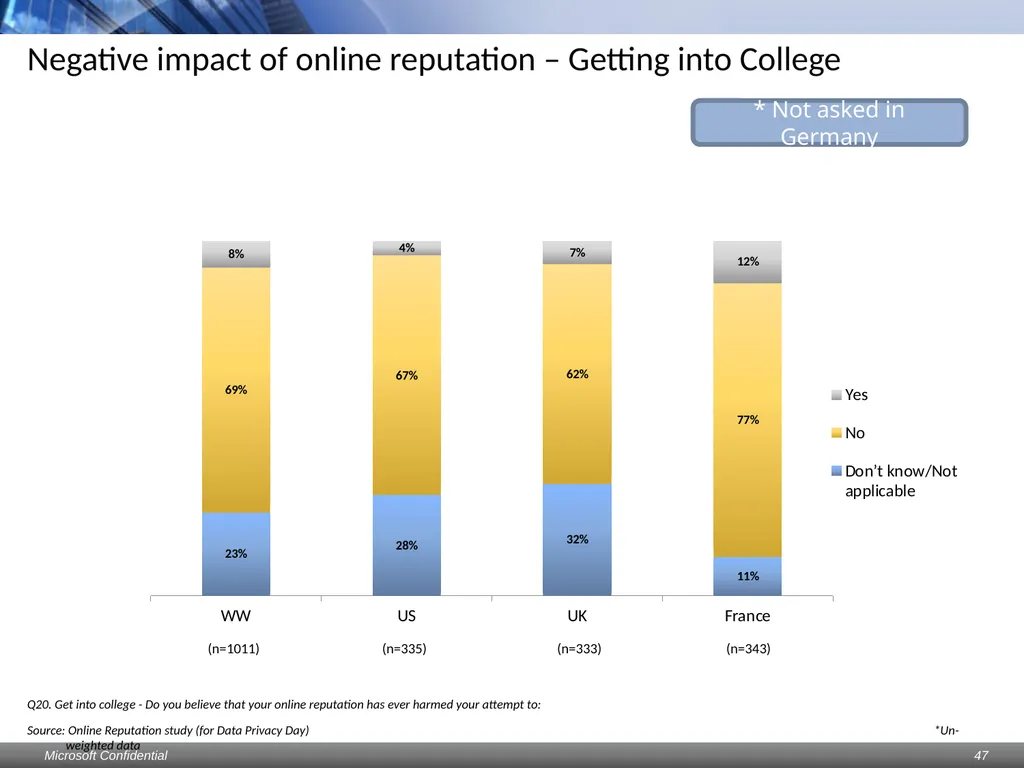
slide47. Source: Online Reputation study (for Data Privacy Day) *Un-weighted data Q20. Get into college - Do you believe that your online reputation has ever harmed your attempt to: Negative impact of online reputation – Getting into College (n=1011) (n=335) (n=333) (n=343) * Not asked in Germany<br>
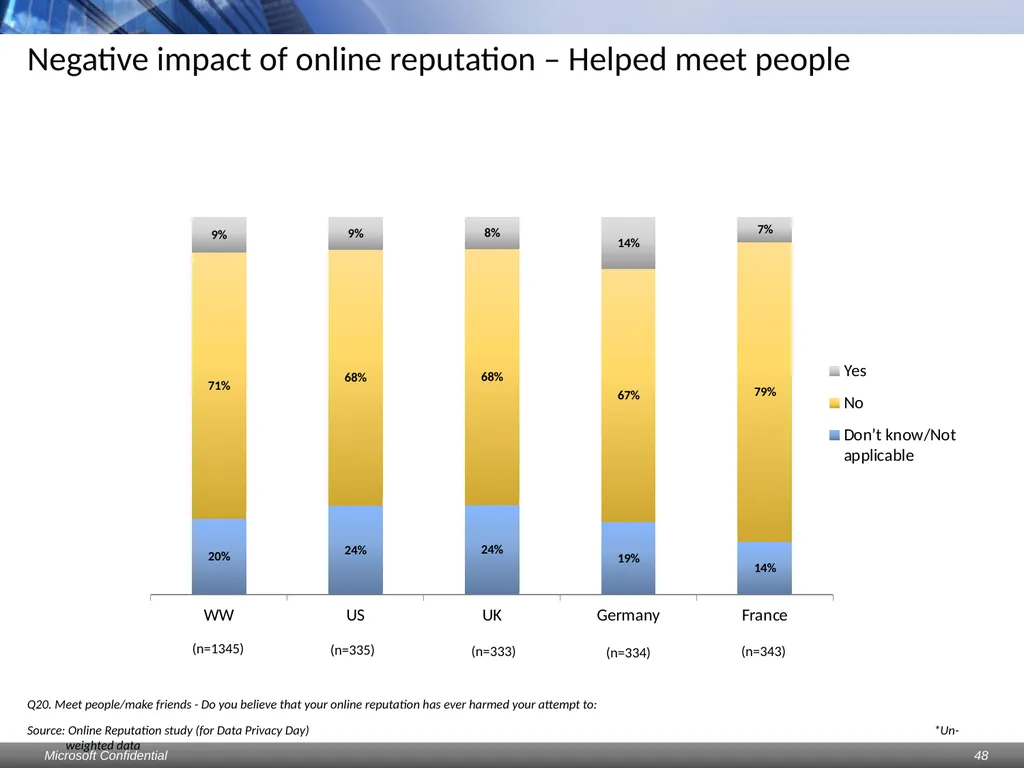
slide48. Source: Online Reputation study (for Data Privacy Day) *Un-weighted data Q20. Meet people/make friends - Do you believe that your online reputation has ever harmed your attempt to: Negative impact of online reputation – Helped meet people (n=1345) (n=335) (n=333) (n=334) (n=343)<br>
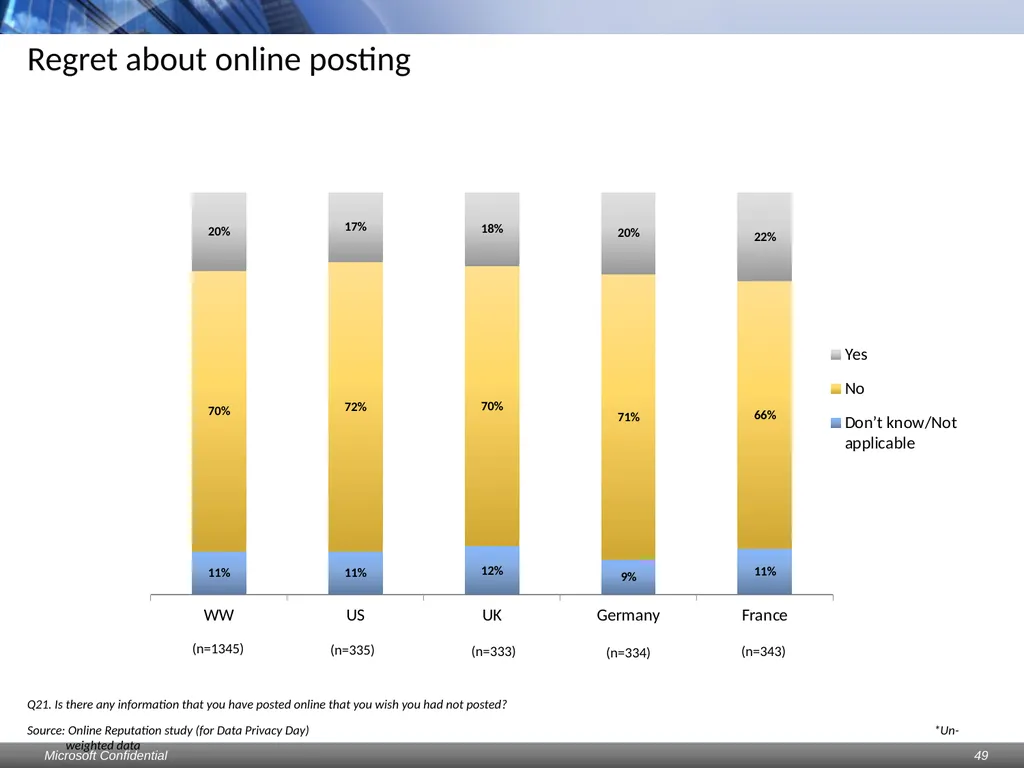
slide49. Source: Online Reputation study (for Data Privacy Day) *Un-weighted data Q21. Is there any information that you have posted online that you wish you had not posted? Regret about online posting (n=1345) (n=335) (n=333) (n=334) (n=343)<br>
slide50. Online Reputation Management<br>
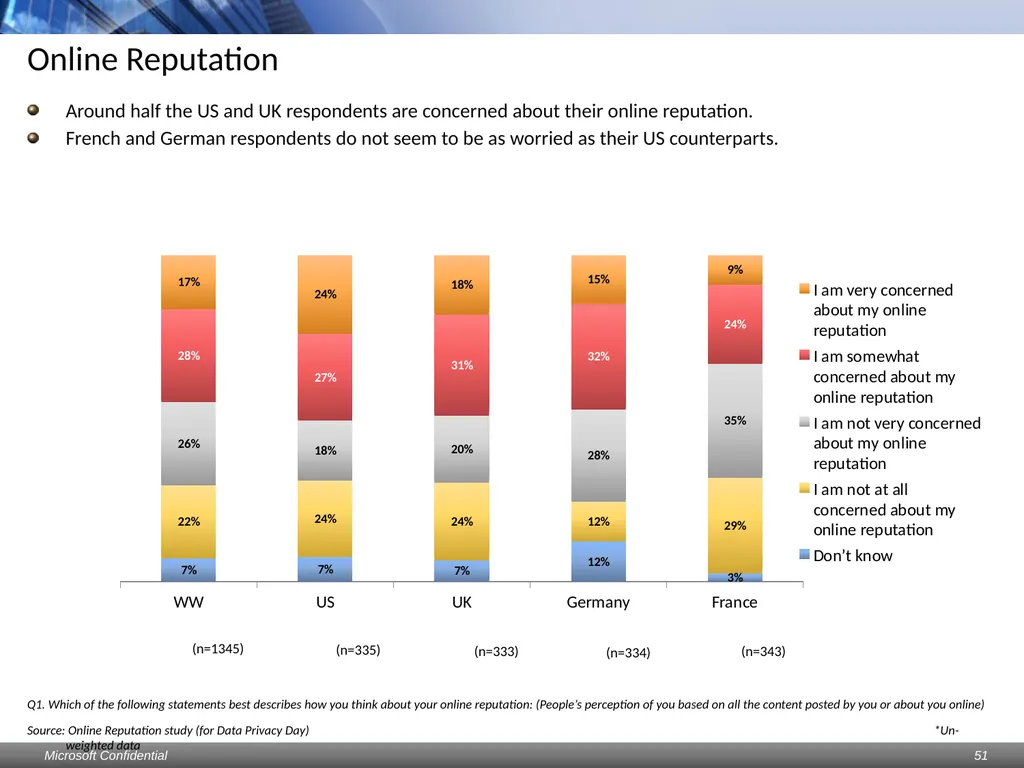
slide51. Source: Online Reputation study (for Data Privacy Day) *Un-weighted data Online Reputation Q1. Which of the following statements best describes how you think about your online reputation: (People’s perception of you based on all the content posted by you or about you online) (n=1345) (n=335) (n=333) (n=334) (n=343) Around half the US and UK respondents are concerned about their online reputation.
French and German respondents do not seem to be as worried as their US counterparts.<br>
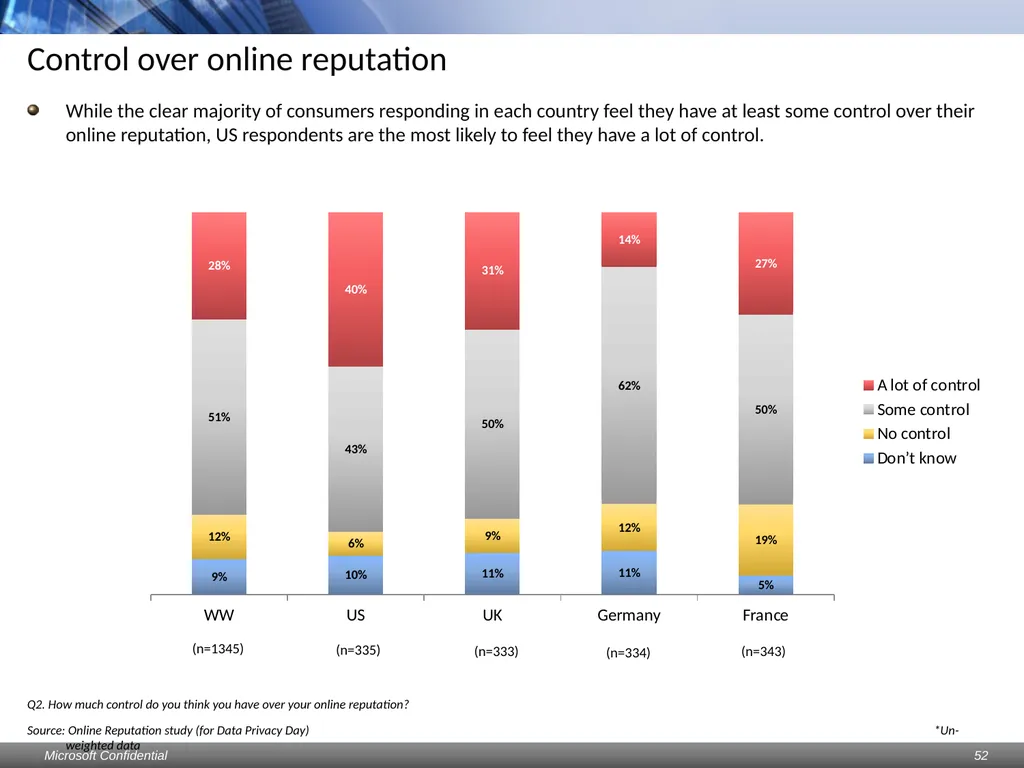
slide52. Source: Online Reputation study (for Data Privacy Day) *Un-weighted data Control over online reputation While the clear majority of consumers responding in each country feel they have at least some control over their online reputation, US respondents are the most likely to feel they have a lot of control. (n=1345) (n=335) (n=333) (n=334) (n=343) Q2. How much control do you think you have over your online reputation?<br>
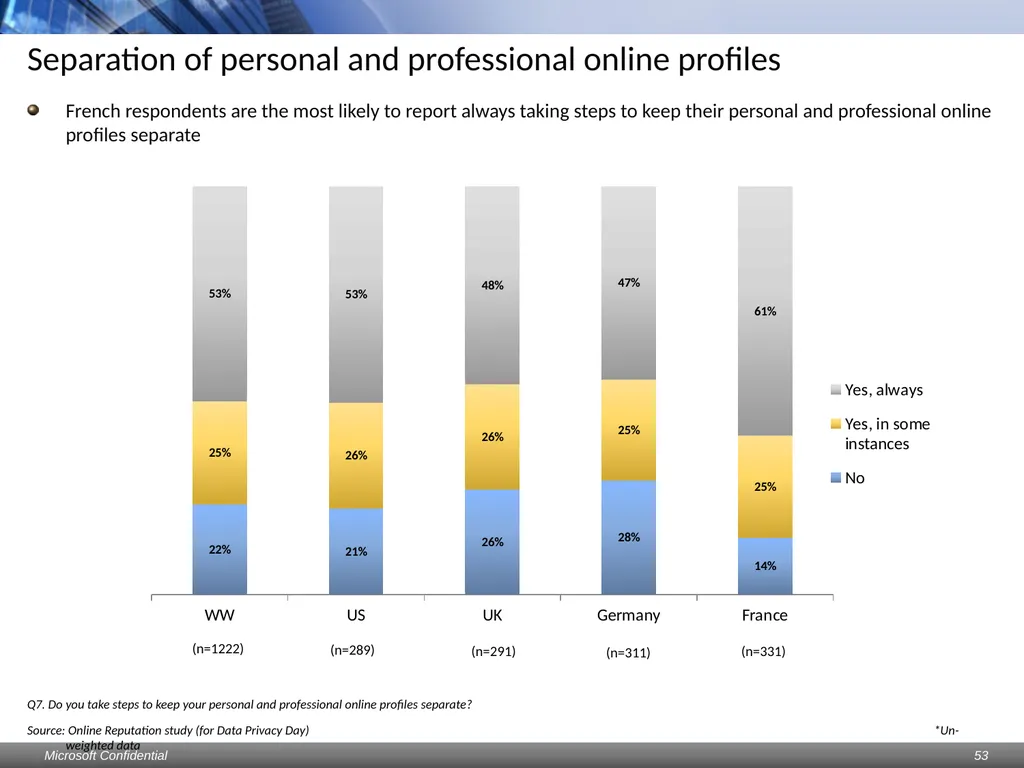
slide53. Source: Online Reputation study (for Data Privacy Day) *Un-weighted data Separation of personal and professional online profiles French respondents are the most likely to report always taking steps to keep their personal and professional online profiles separate Q7. Do you take steps to keep your personal and professional online profiles separate? (n=1222) (n=289) (n=291) (n=311) (n=331)<br>
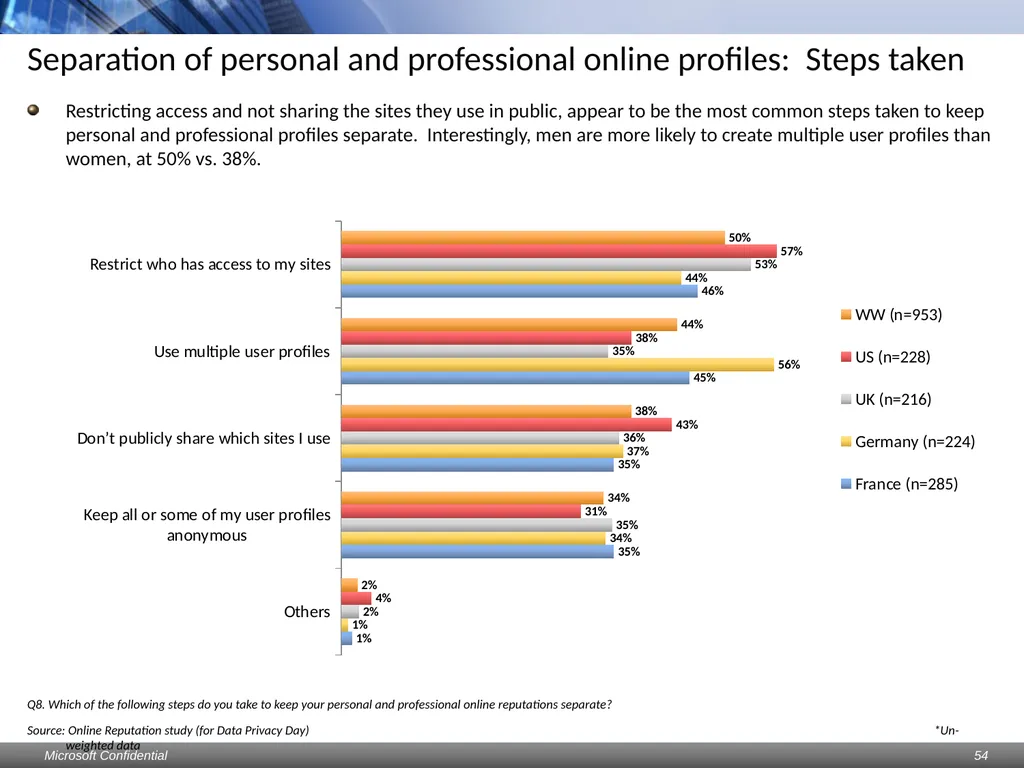
slide54. Source: Online Reputation study (for Data Privacy Day) *Un-weighted data Separation of personal and professional online profiles: Steps taken Restricting access and not sharing the sites they use in public, appear to be the most common steps taken to keep personal and professional profiles separate. Interestingly, men are more likely to create multiple user profiles than women, at 50% vs. 38%. Q8. Which of the following steps do you take to keep your personal and professional online reputations separate?<br>
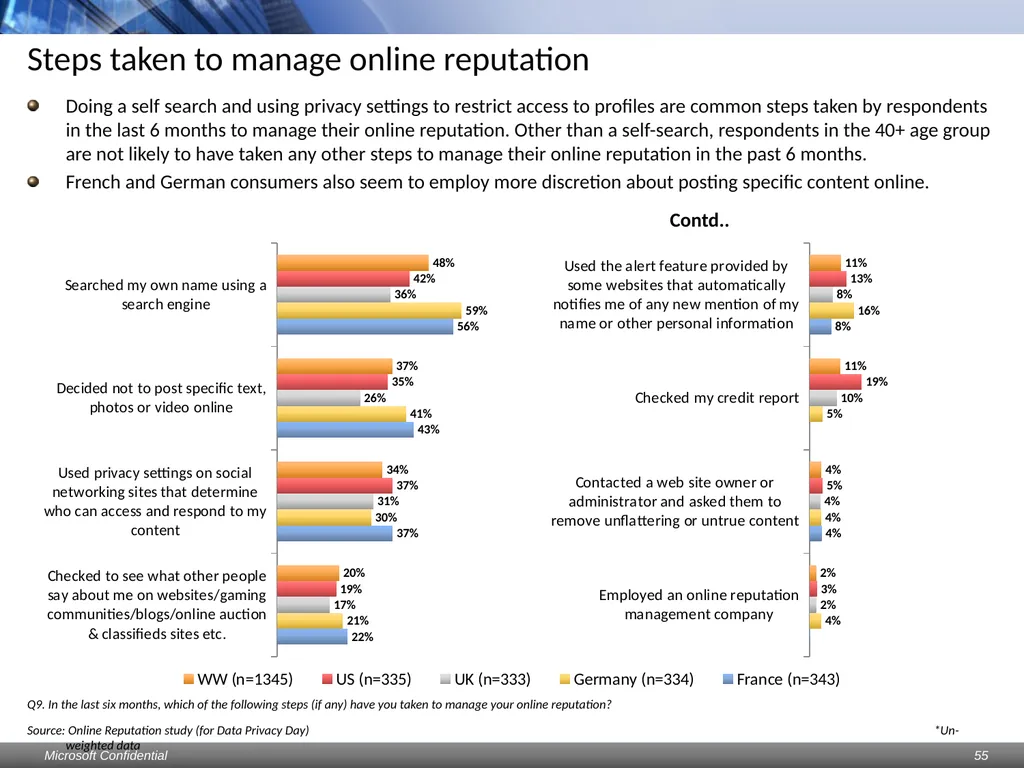
slide55. Source: Online Reputation study (for Data Privacy Day) *Un-weighted data Steps taken to manage online reputation Q9. In the last six months, which of the following steps (if any) have you taken to manage your online reputation? Doing a self search and using privacy settings to restrict access to profiles are common steps taken by respondents in the last 6 months to manage their online reputation. Other than a self-search, respondents in the 40+ age group are not likely to have taken any other steps to manage their online reputation in the past 6 months.
French and German consumers also seem to employ more discretion about posting specific content online. Contd..<br>
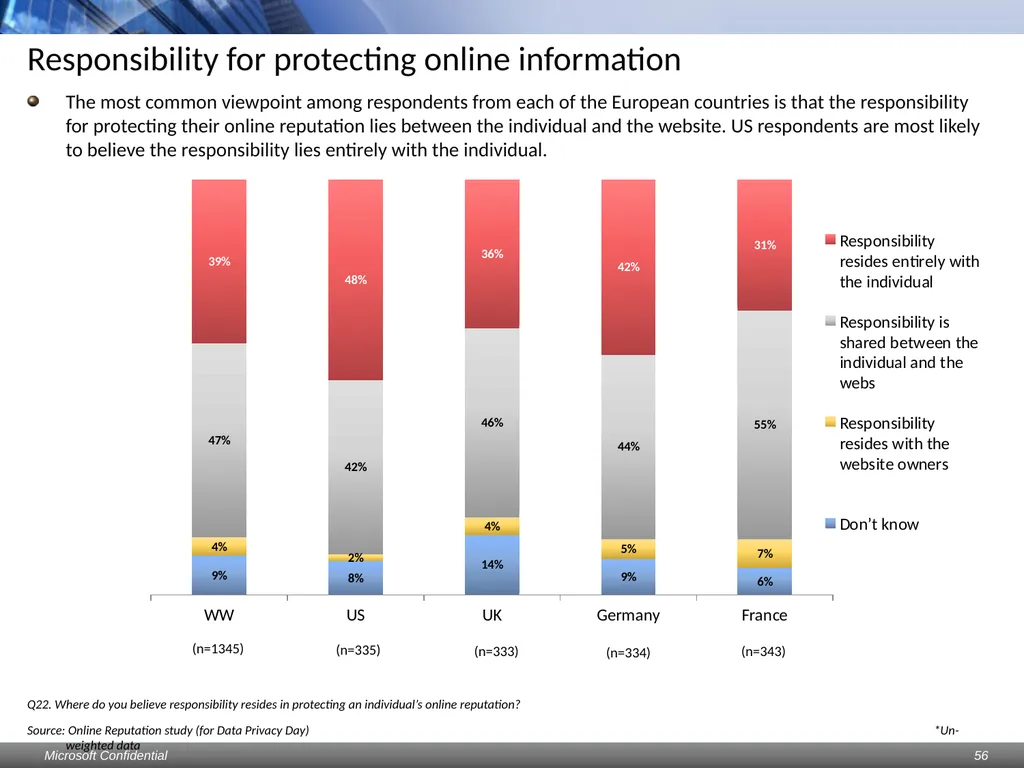
slide56. Source: Online Reputation study (for Data Privacy Day) *Un-weighted data Q22. Where do you believe responsibility resides in protecting an individual’s online reputation? Responsibility for protecting online information (n=1345) (n=335) (n=333) (n=334) (n=343) The most common viewpoint among respondents from each of the European countries is that the responsibility for protecting their online reputation lies between the individual and the website. US respondents are most likely to believe the responsibility lies entirely with the individual.<br>
slide57. Demographics<br>
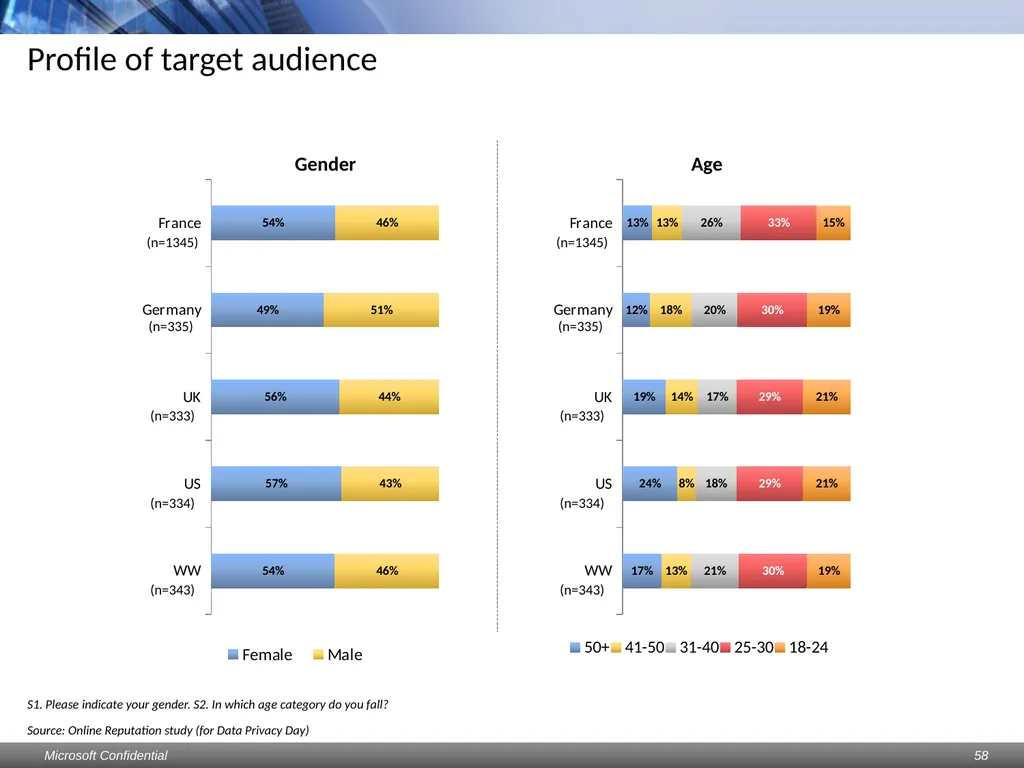
slide58. Source: Online Reputation study (for Data Privacy Day) S1. Please indicate your gender. S2. In which age category do you fall? Profile of target audience (n=1345) (n=335) (n=333) (n=334) (n=343) (n=1345) (n=335) (n=333) (n=334) (n=343) Gender Age<br>
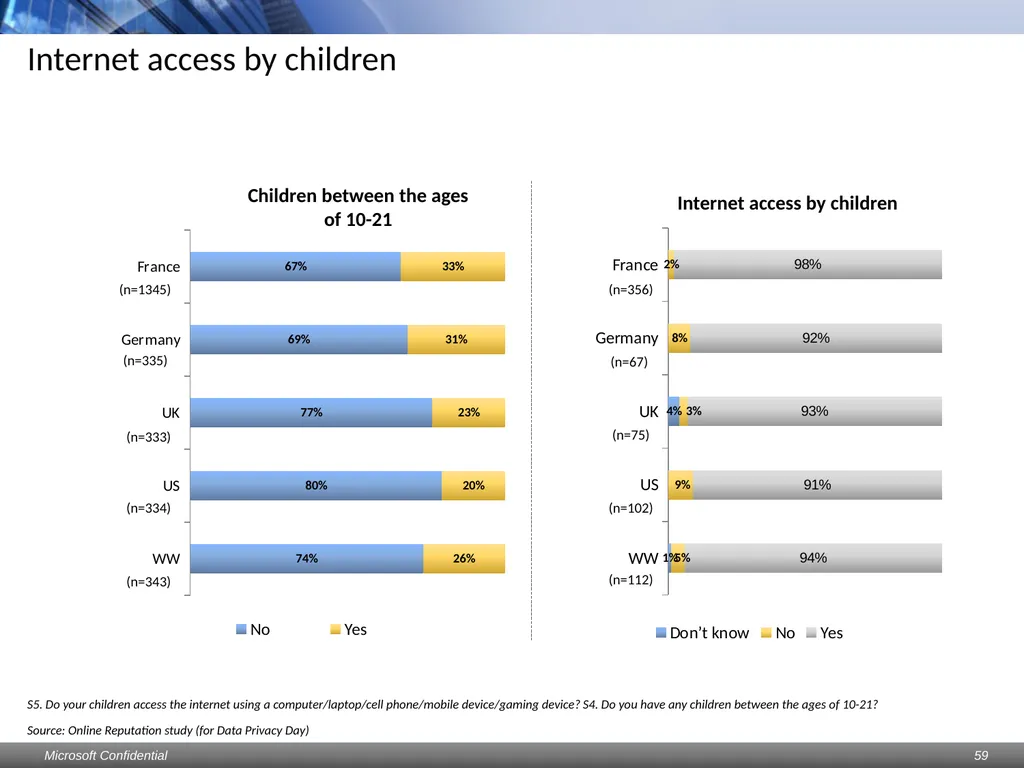
slide59. Source: Online Reputation study (for Data Privacy Day) Internet access by children (n=356) (n=67) (n=75) (n=102) (n=112) Internet access by children (n=1345) (n=335) (n=333) (n=334) (n=343) Children between the ages
of 10-21 S5. Do your children access the internet using a computer/laptop/cell phone/mobile device/gaming device? S4. Do you have any children between the ages of 10-21?<br>
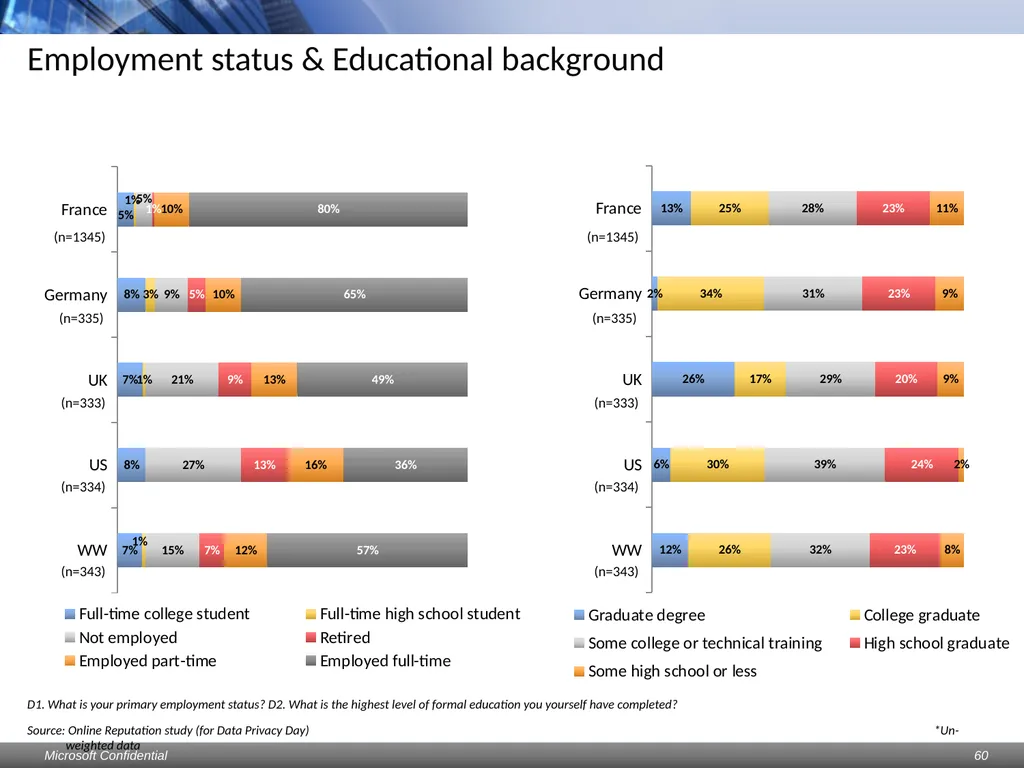
slide60. Source: Online Reputation study (for Data Privacy Day) *Un-weighted data D1. What is your primary employment status? D2. What is the highest level of formal education you yourself have completed? Employment status & Educational background (n=1345) (n=335) (n=333) (n=334) (n=343) (n=1345) (n=335) (n=333) (n=334) (n=343)<br>
slide61. Internet usage
Impact on employment opportunities
Online reputation management
Demographics Detailed Findings: HR/Recruiter Segment<br>
slide62. Internet Usage<br>
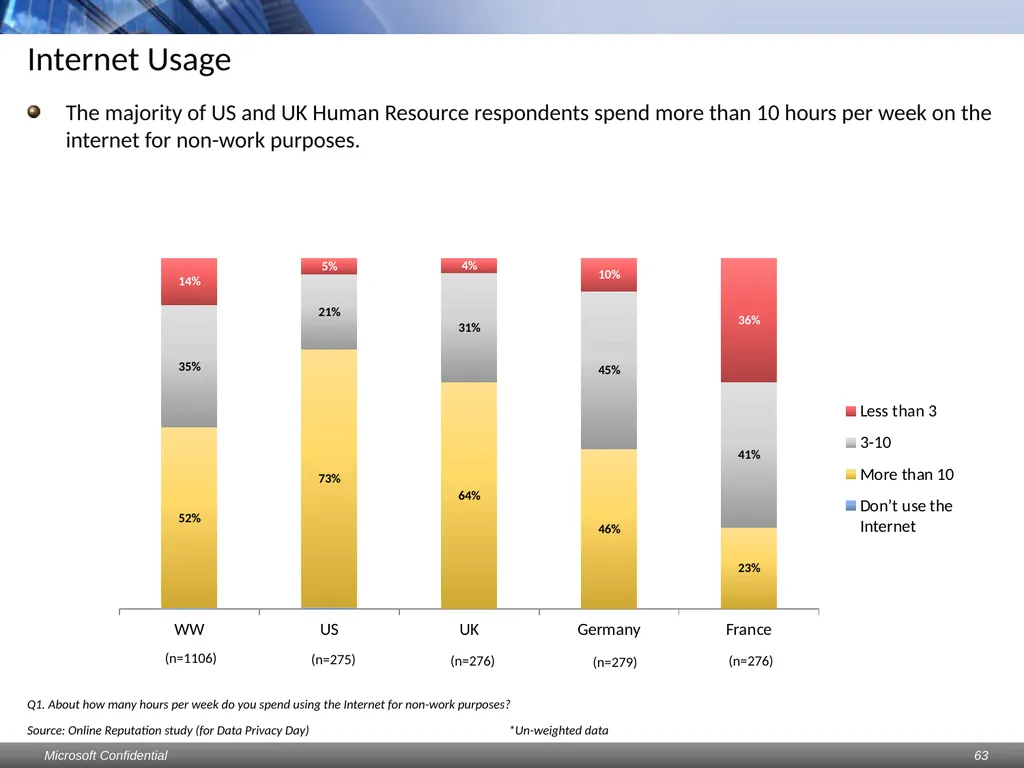
slide63. Internet Usage Source: Online Reputation study (for Data Privacy Day) *Un-weighted data The majority of US and UK Human Resource respondents spend more than 10 hours per week on the internet for non-work purposes. Q1. About how many hours per week do you spend using the Internet for non-work purposes? (n=1106) (n=275) (n=276) (n=279) (n=276)<br>
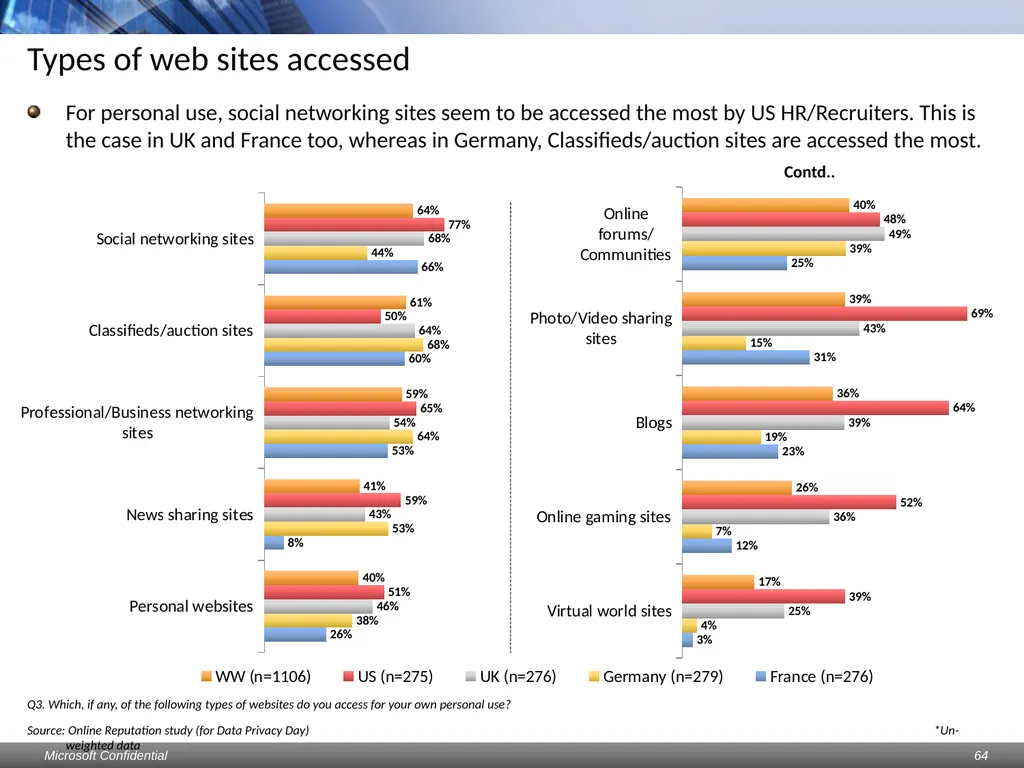
slide64. Source: Online Reputation study (for Data Privacy Day) *Un-weighted data Types of web sites accessed For personal use, social networking sites seem to be accessed the most by US HR/Recruiters. This is the case in UK and France too, whereas in Germany, Classifieds/auction sites are accessed the most. Q3. Which, if any, of the following types of websites do you access for your own personal use? Contd..<br>
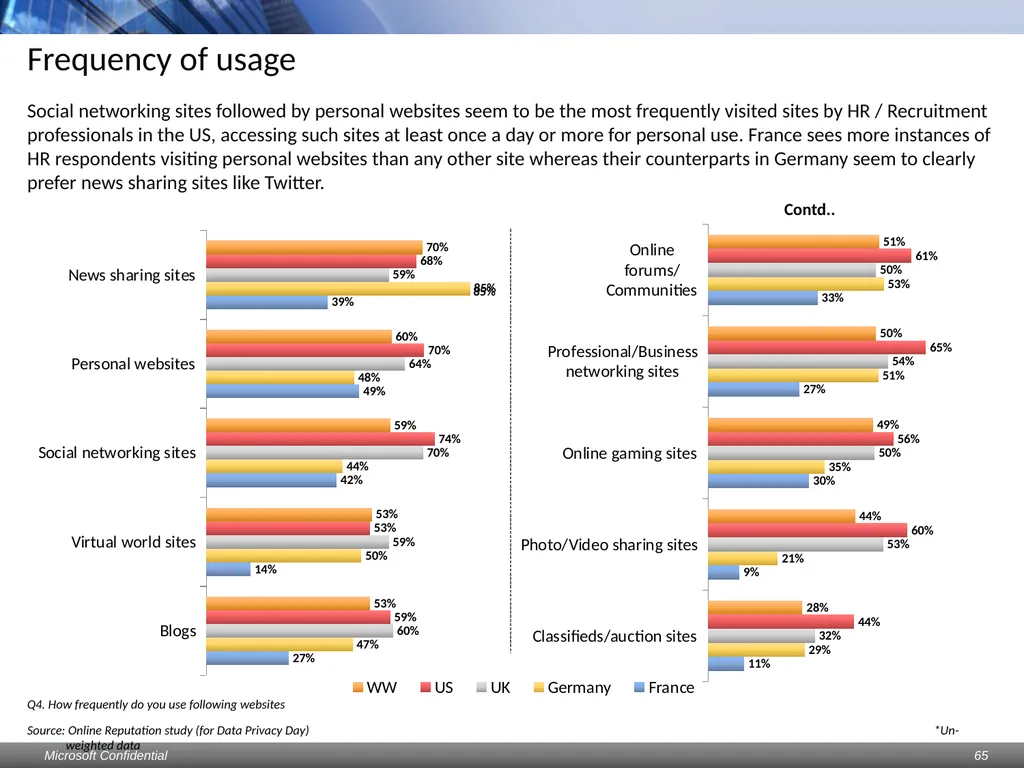
slide65. Source: Online Reputation study (for Data Privacy Day) *Un-weighted data Frequency of usage Social networking sites followed by personal websites seem to be the most frequently visited sites by HR / Recruitment professionals in the US, accessing such sites at least once a day or more for personal use. France sees more instances of HR respondents visiting personal websites than any other site whereas their counterparts in Germany seem to clearly prefer news sharing sites like Twitter. Q4. How frequently do you use following websites 85% Contd..<br>
slide66. Impact on Employment Opportunities<br>
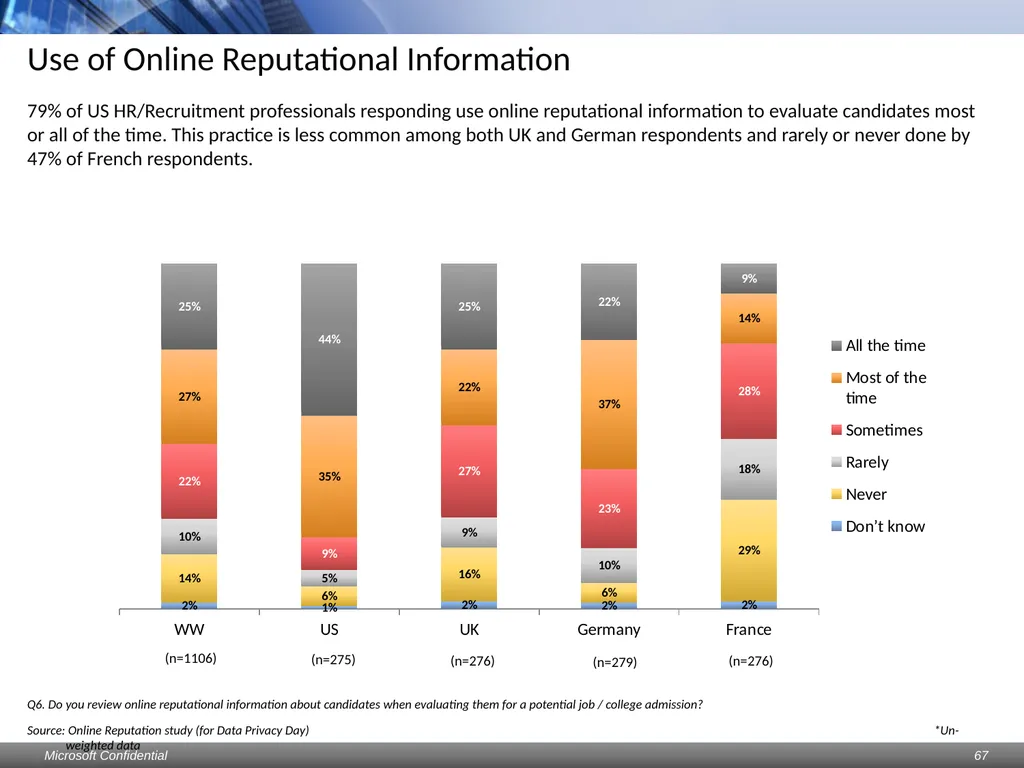
slide67. Source: Online Reputation study (for Data Privacy Day) *Un-weighted data Use of Online Reputational Information 79% of US HR/Recruitment professionals responding use online reputational information to evaluate candidates most or all of the time. This practice is less common among both UK and German respondents and rarely or never done by 47% of French respondents. Q6. Do you review online reputational information about candidates when evaluating them for a potential job / college admission? (n=1106) (n=275) (n=276) (n=279) (n=276)<br>
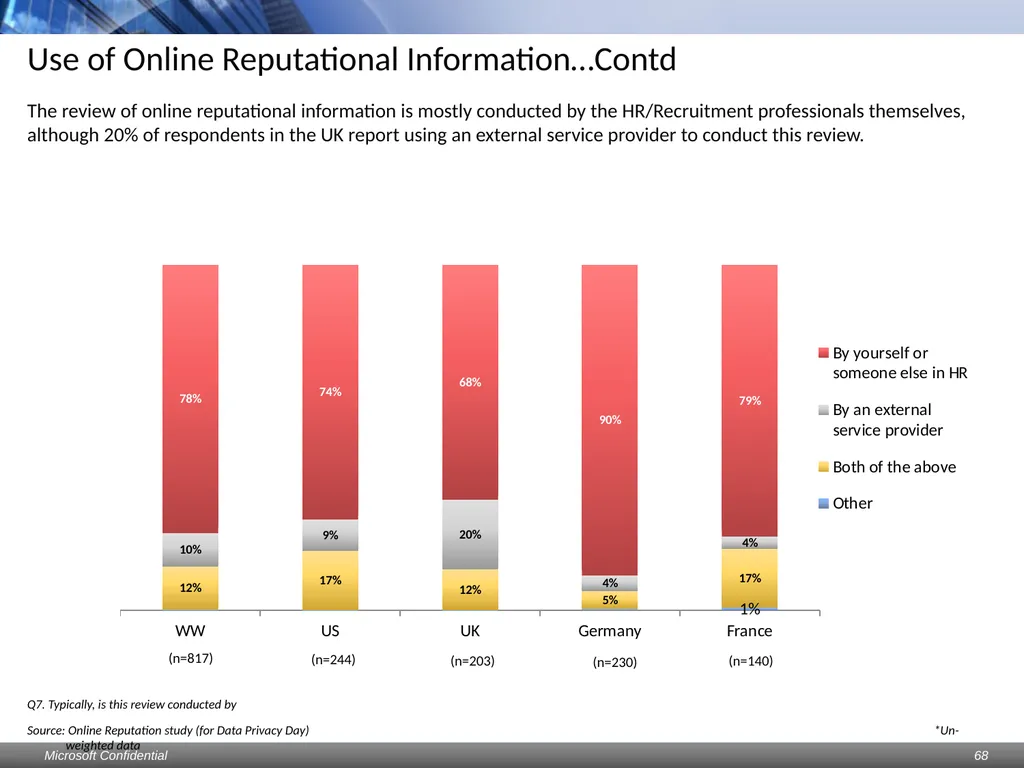
slide68. Source: Online Reputation study (for Data Privacy Day) *Un-weighted data Use of Online Reputational Information…Contd The review of online reputational information is mostly conducted by the HR/Recruitment professionals themselves, although 20% of respondents in the UK report using an external service provider to conduct this review. Q7. Typically, is this review conducted by (n=817) (n=244) (n=203) (n=230) (n=140)<br>
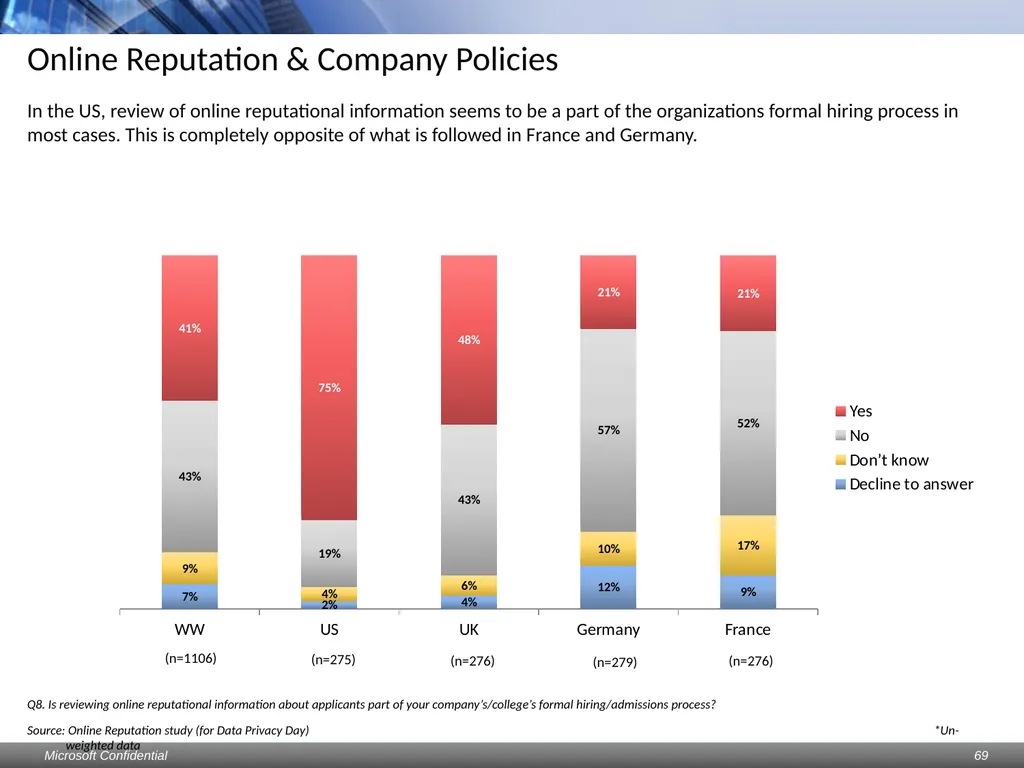
slide69. Source: Online Reputation study (for Data Privacy Day) *Un-weighted data Online Reputation & Company Policies In the US, review of online reputational information seems to be a part of the organizations formal hiring process in most cases. This is completely opposite of what is followed in France and Germany. Q8. Is reviewing online reputational information about applicants part of your company’s/college’s formal hiring/admissions process? (n=1106) (n=275) (n=276) (n=279) (n=276)<br>
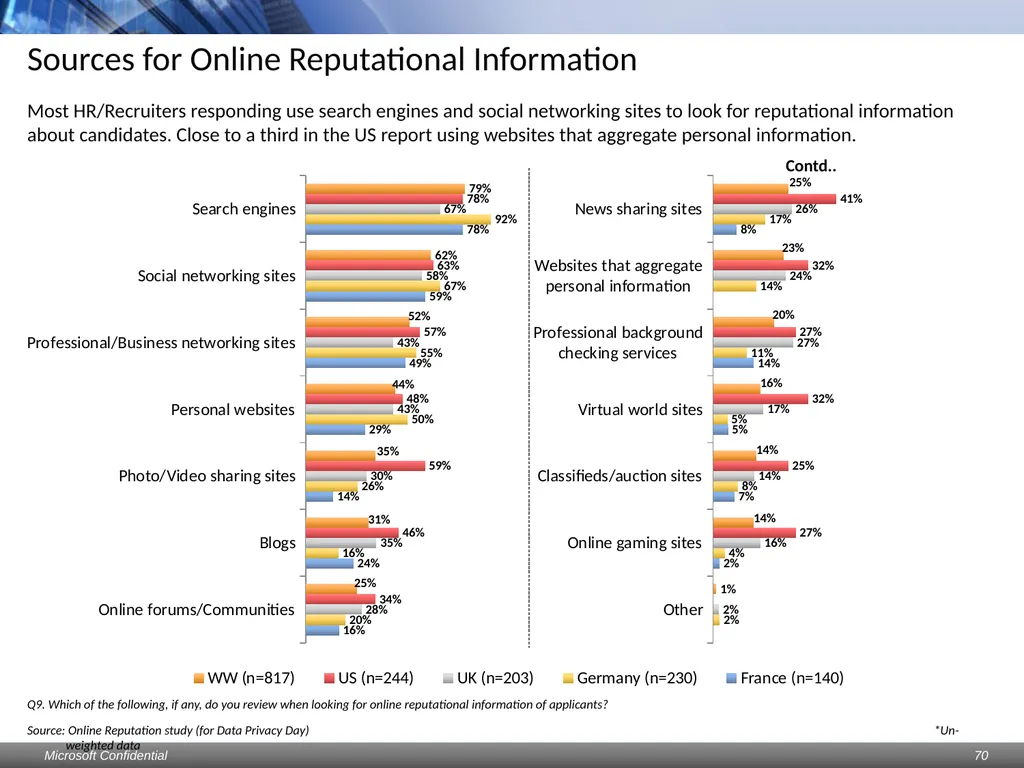
slide70. Source: Online Reputation study (for Data Privacy Day) *Un-weighted data Sources for Online Reputational Information Most HR/Recruiters responding use search engines and social networking sites to look for reputational information about candidates. Close to a third in the US report using websites that aggregate personal information. Q9. Which of the following, if any, do you review when looking for online reputational information of applicants? Contd..<br>
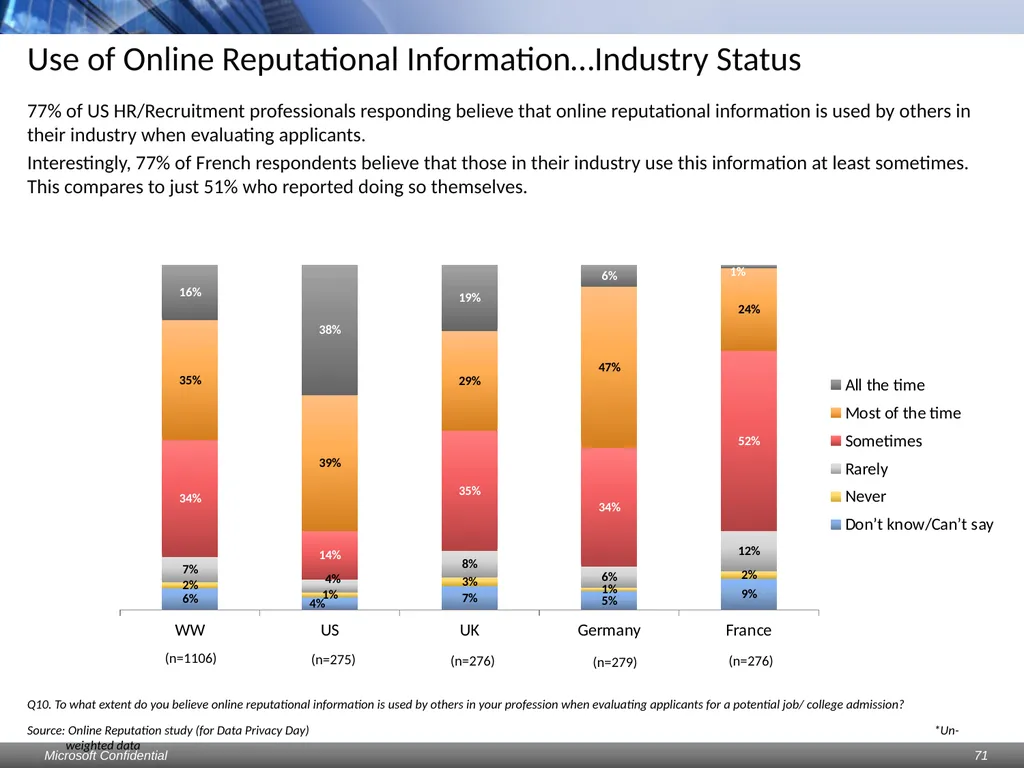
slide71. Source: Online Reputation study (for Data Privacy Day) *Un-weighted data Use of Online Reputational Information…Industry Status 77% of US HR/Recruitment professionals responding believe that online reputational information is used by others in their industry when evaluating applicants.
Interestingly, 77% of French respondents believe that those in their industry use this information at least sometimes. This compares to just 51% who reported doing so themselves. Q10. To what extent do you believe online reputational information is used by others in your profession when evaluating applicants for a potential job/ college admission? (n=1106) (n=275) (n=276) (n=279) (n=276)<br>
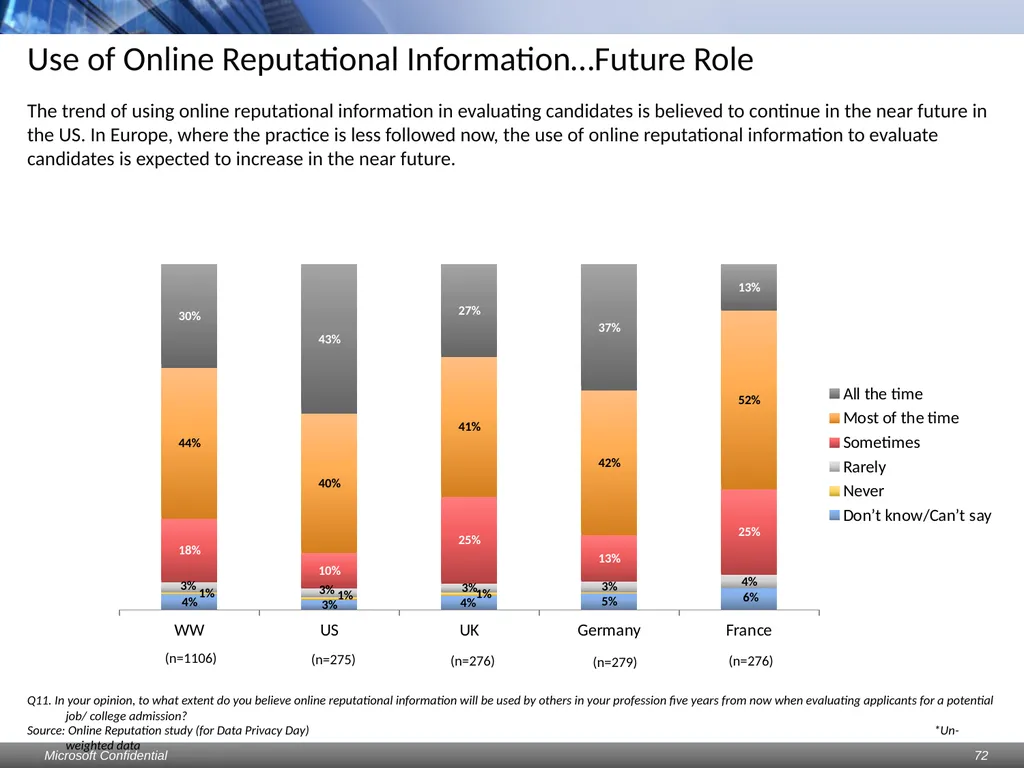
slide72. Source: Online Reputation study (for Data Privacy Day) *Un-weighted data Use of Online Reputational Information…Future Role The trend of using online reputational information in evaluating candidates is believed to continue in the near future in the US. In Europe, where the practice is less followed now, the use of online reputational information to evaluate candidates is expected to increase in the near future. Q11. In your opinion, to what extent do you believe online reputational information will be used by others in your profession five years from now when evaluating applicants for a potential job/ college admission? (n=1106) (n=275) (n=276) (n=279) (n=276)<br>
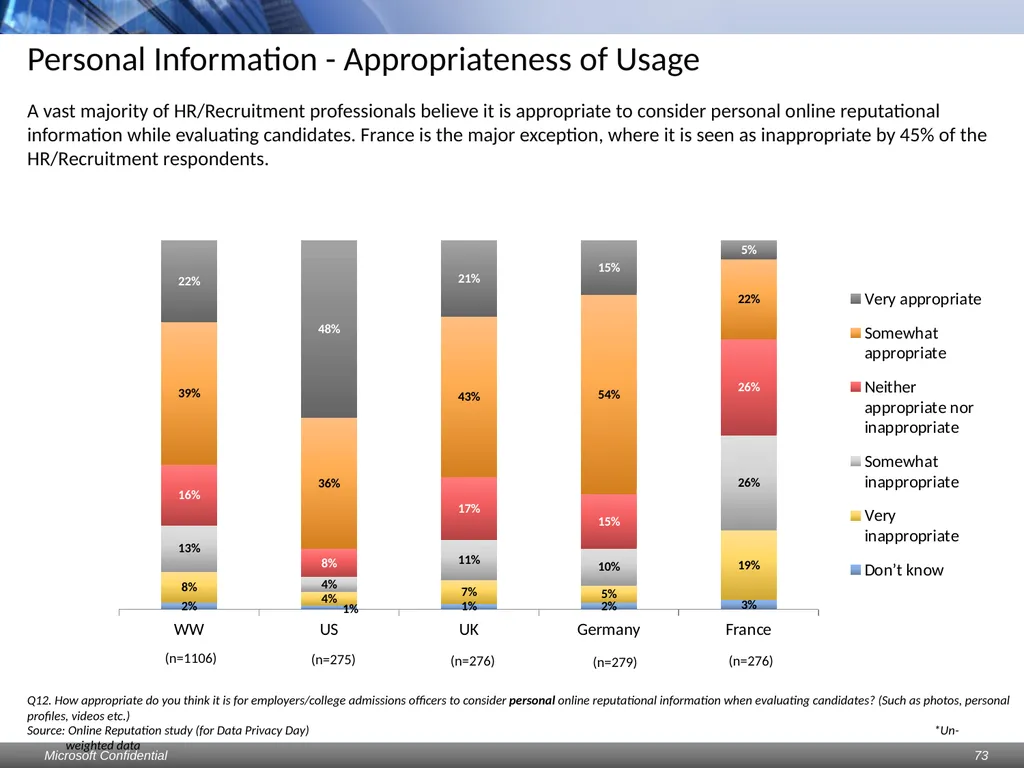
slide73. Source: Online Reputation study (for Data Privacy Day) *Un-weighted data Personal Information - Appropriateness of Usage A vast majority of HR/Recruitment professionals believe it is appropriate to consider personal online reputational information while evaluating candidates. France is the major exception, where it is seen as inappropriate by 45% of the HR/Recruitment respondents. Q12. How appropriate do you think it is for employers/college admissions officers to consider personal online reputational information when evaluating candidates? (Such as photos, personal profiles, videos etc.) (n=1106) (n=275) (n=276) (n=279) (n=276)<br>
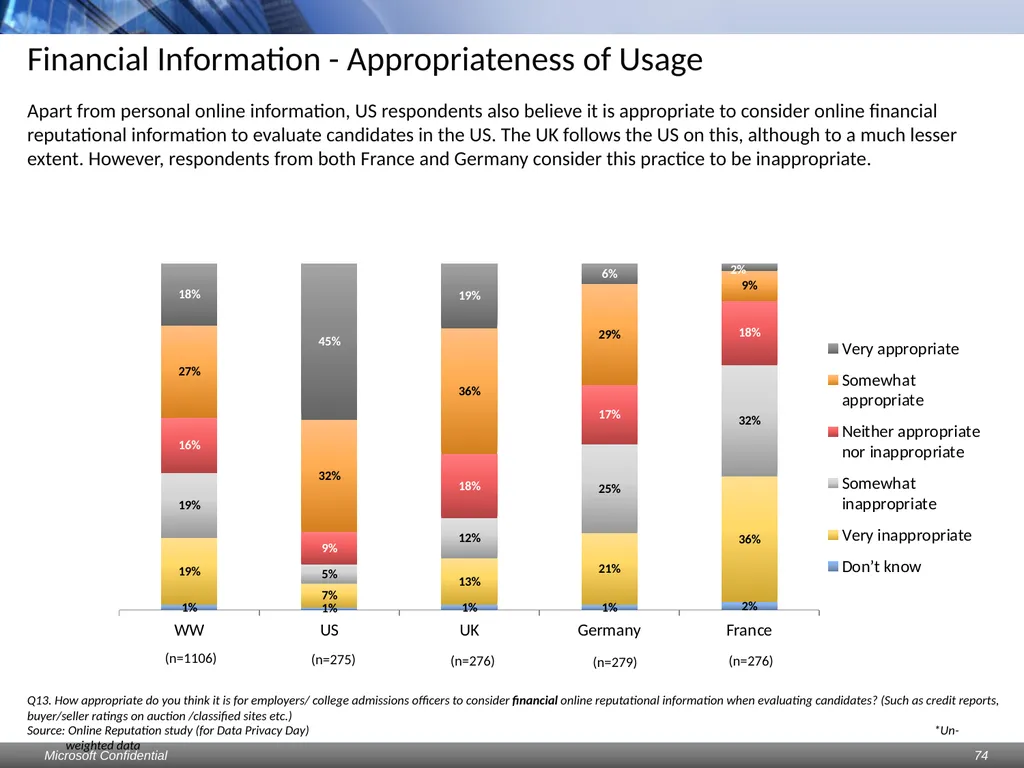
slide74. Source: Online Reputation study (for Data Privacy Day) *Un-weighted data Financial Information - Appropriateness of Usage Apart from personal online information, US respondents also believe it is appropriate to consider online financial reputational information to evaluate candidates in the US. The UK follows the US on this, although to a much lesser extent. However, respondents from both France and Germany consider this practice to be inappropriate. Q13. How appropriate do you think it is for employers/ college admissions officers to consider financial online reputational information when evaluating candidates? (Such as credit reports, buyer/seller ratings on auction /classified sites etc.) (n=1106) (n=275) (n=276) (n=279) (n=276)<br>
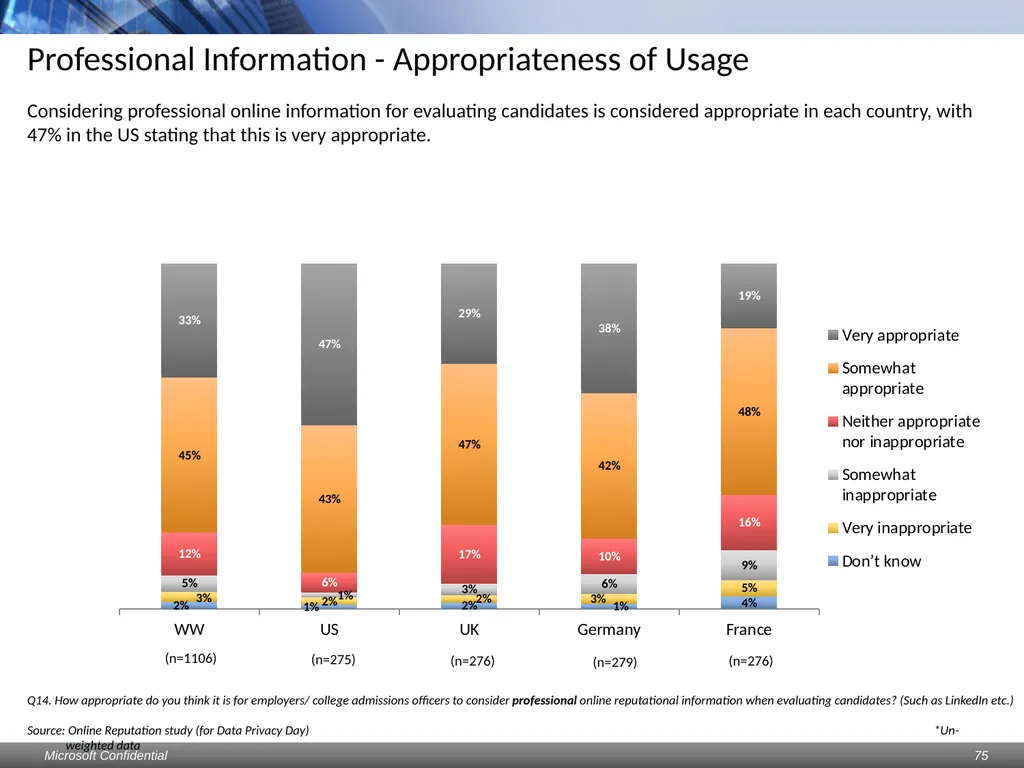
slide75. Source: Online Reputation study (for Data Privacy Day) *Un-weighted data Professional Information - Appropriateness of Usage Considering professional online information for evaluating candidates is considered appropriate in each country, with 47% in the US stating that this is very appropriate. Q14. How appropriate do you think it is for employers/ college admissions officers to consider professional online reputational information when evaluating candidates? (Such as LinkedIn etc.) (n=1106) (n=275) (n=276) (n=279) (n=276)<br>
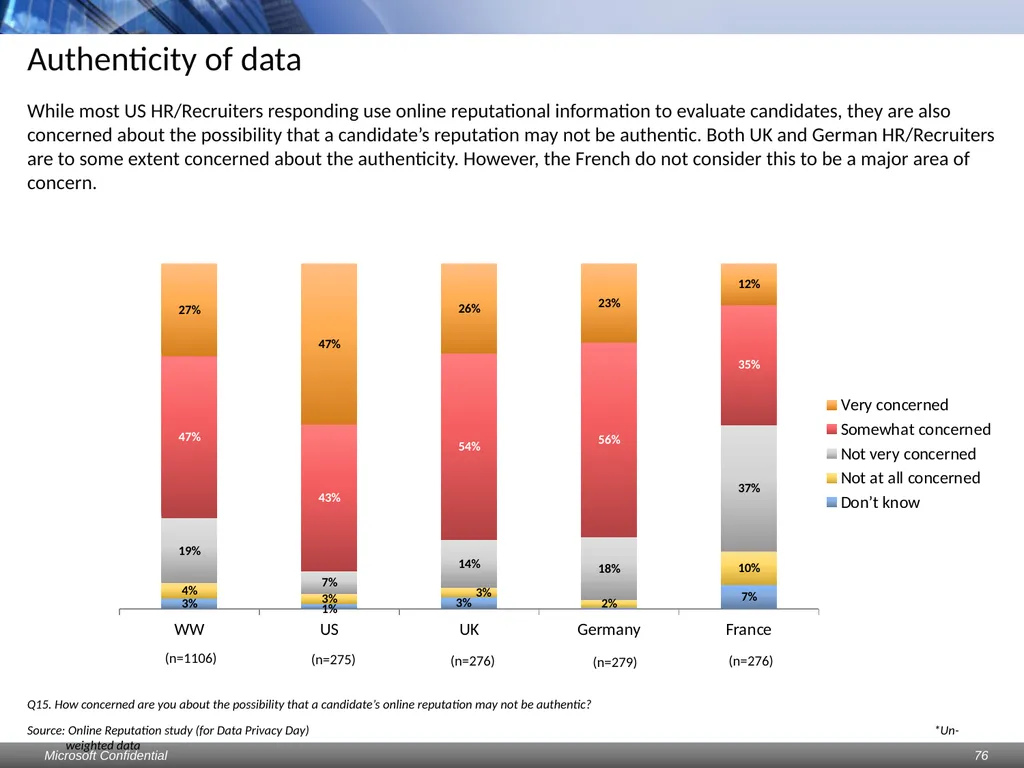
slide76. Source: Online Reputation study (for Data Privacy Day) *Un-weighted data Authenticity of data While most US HR/Recruiters responding use online reputational information to evaluate candidates, they are also concerned about the possibility that a candidate’s reputation may not be authentic. Both UK and German HR/Recruiters are to some extent concerned about the authenticity. However, the French do not consider this to be a major area of concern. Q15. How concerned are you about the possibility that a candidate’s online reputation may not be authentic? (n=1106) (n=275) (n=276) (n=279) (n=276)<br>
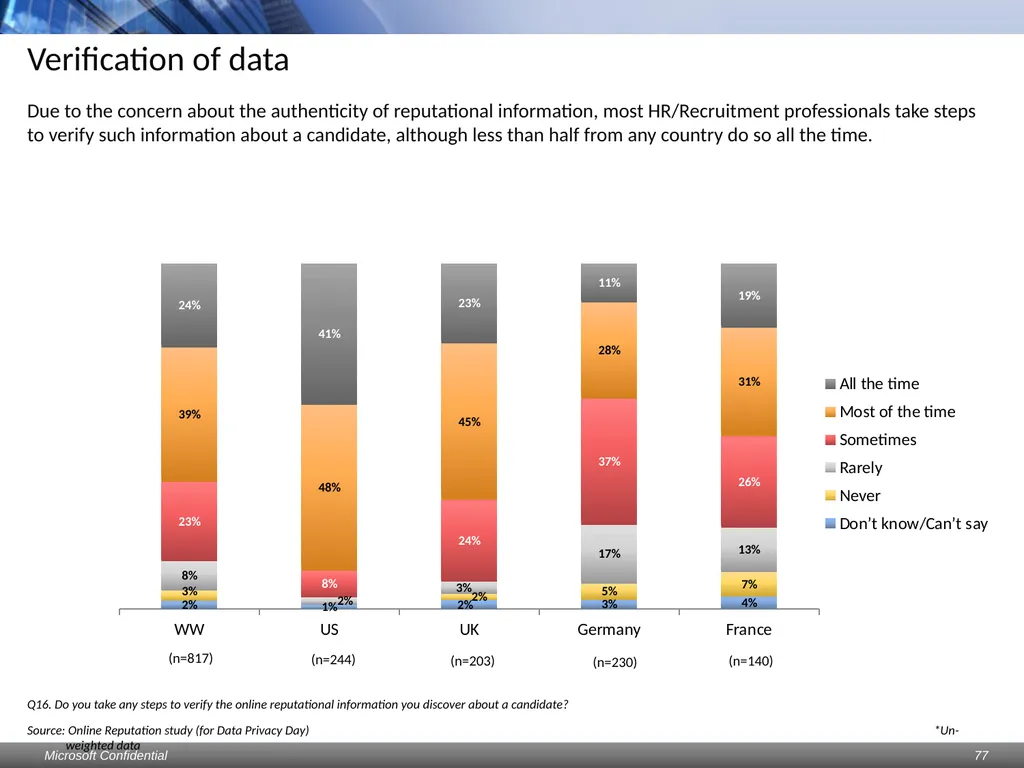
slide77. Source: Online Reputation study (for Data Privacy Day) *Un-weighted data Verification of data Due to the concern about the authenticity of reputational information, most HR/Recruitment professionals take steps to verify such information about a candidate, although less than half from any country do so all the time. Q16. Do you take any steps to verify the online reputational information you discover about a candidate? (n=817) (n=244) (n=203) (n=230) (n=140)<br>
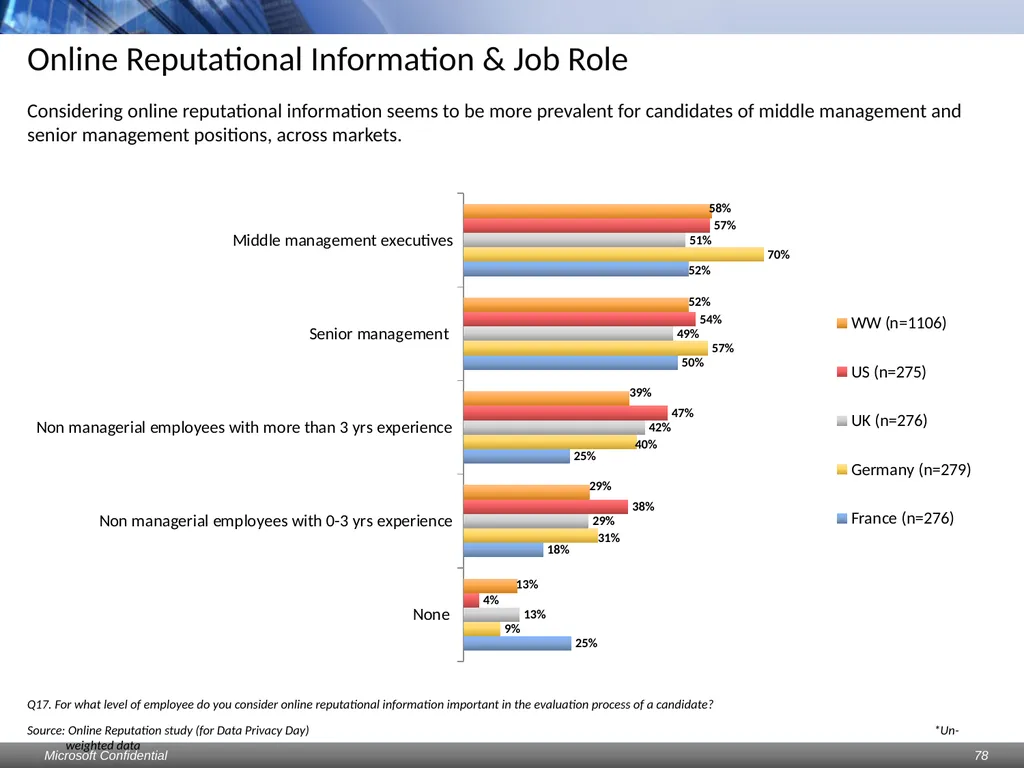
slide78. Source: Online Reputation study (for Data Privacy Day) *Un-weighted data Online Reputational Information & Job Role Considering online reputational information seems to be more prevalent for candidates of middle management and senior management positions, across markets. Q17. For what level of employee do you consider online reputational information important in the evaluation process of a candidate?<br>
slide79. Source: Online Reputation study (for Data Privacy Day) *Un-weighted data Impact of online reputation Most HR/Recruiters in the US believe that a positive online reputation has a big impact on a candidates application. However, it is not seen to have the same level of impact in Europe. Q18. To what extent do you feel that a positive online reputation impacts a candidate’s application? (n=1106) (n=275) (n=276) (n=279) (n=276)<br>
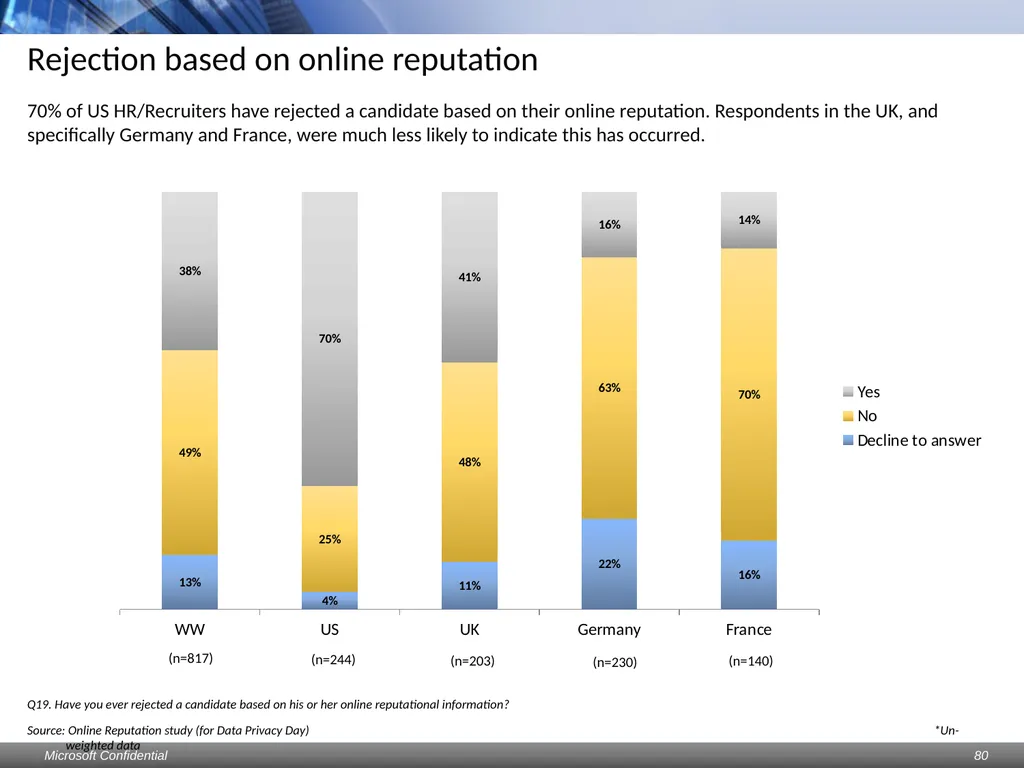
slide80. Source: Online Reputation study (for Data Privacy Day) *Un-weighted data Rejection based on online reputation 70% of US HR/Recruiters have rejected a candidate based on their online reputation. Respondents in the UK, and specifically Germany and France, were much less likely to indicate this has occurred. Q19. Have you ever rejected a candidate based on his or her online reputational information? (n=817) (n=244) (n=203) (n=230) (n=140)<br>
slide81. In most cases in the US, UK and France, candidates were informed that one of the reasons for the rejection of their application was due to their online reputational information. Interestingly, 58% of German respondents did not let the candidate know this was one of the reasons they were rejected. Source: Online Reputation study (for Data Privacy Day) *Un-weighted data Candidate made aware that rejection was based on online reputation Q20. Did you notify the candidate that this was (one of) the reason(s) he or she was rejected? (n=310) (n=172) (n=83) (n=36) (n=19*) *Small Sample Size<br>
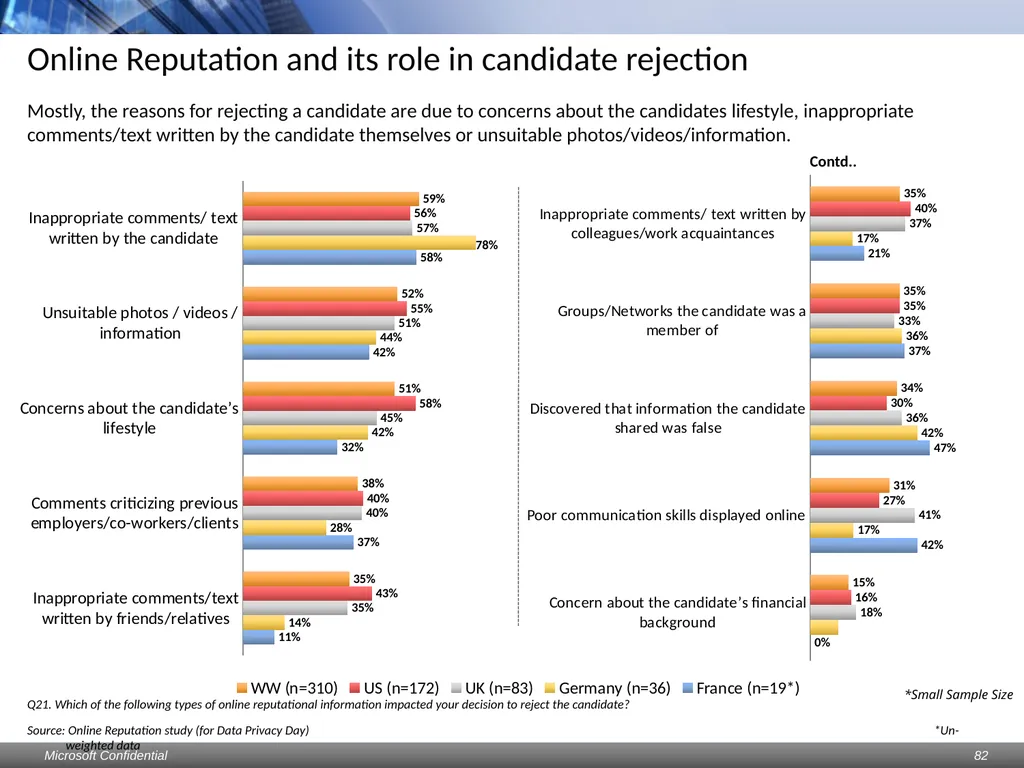
slide82. Mostly, the reasons for rejecting a candidate are due to concerns about the candidates lifestyle, inappropriate comments/text written by the candidate themselves or unsuitable photos/videos/information. Source: Online Reputation study (for Data Privacy Day) *Un-weighted data Online Reputation and its role in candidate rejection Q21. Which of the following types of online reputational information impacted your decision to reject the candidate? Contd.. *Small Sample Size<br>
slide83. Online Reputation Management<br>
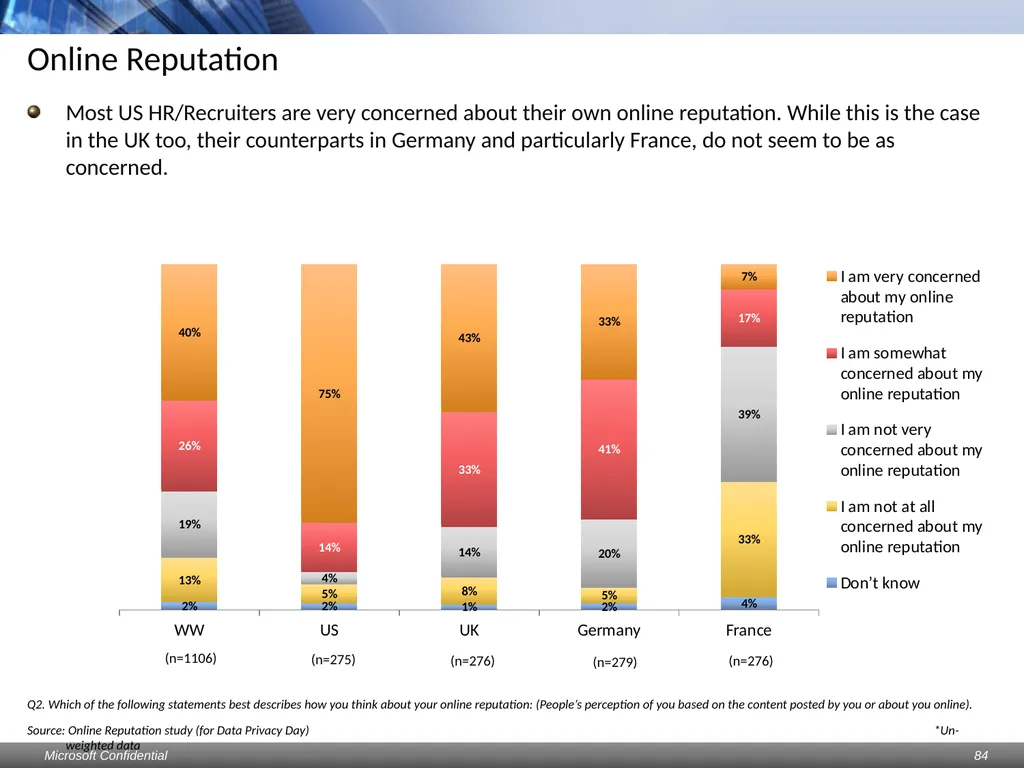
slide84. Online Reputation Source: Online Reputation study (for Data Privacy Day) *Un-weighted data Most US HR/Recruiters are very concerned about their own online reputation. While this is the case in the UK too, their counterparts in Germany and particularly France, do not seem to be as concerned. Q2. Which of the following statements best describes how you think about your online reputation: (People’s perception of you based on the content posted by you or about you online). (n=1106) (n=275) (n=276) (n=279) (n=276)<br>
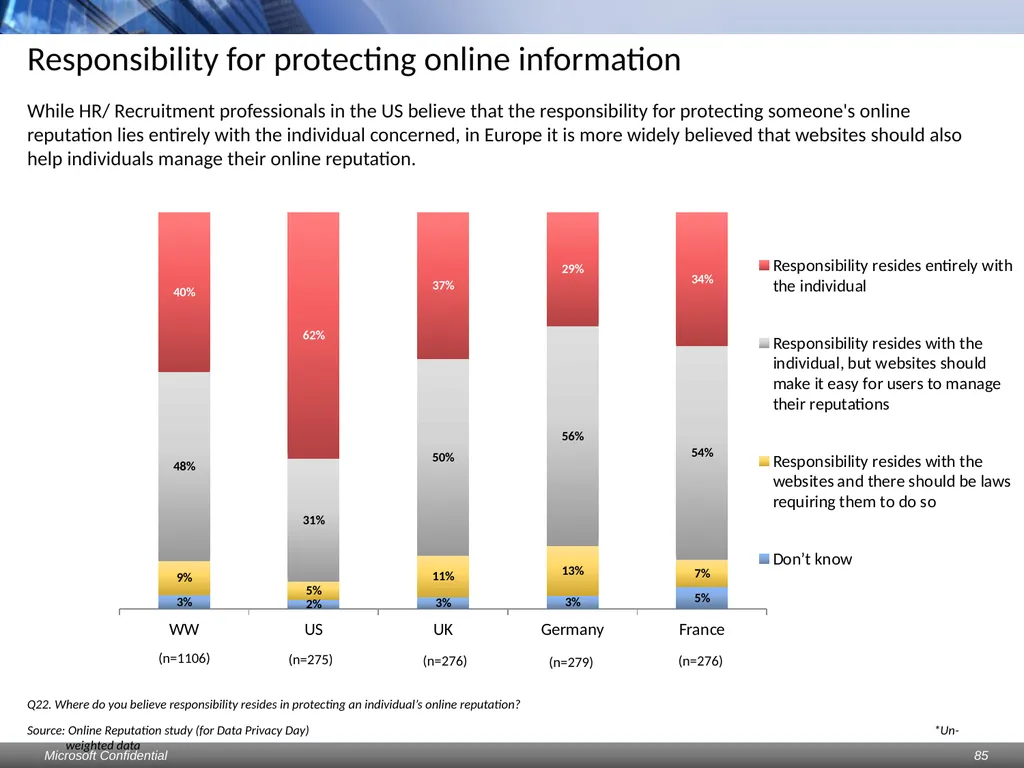
slide85. Source: Online Reputation study (for Data Privacy Day) *Un-weighted data Responsibility for protecting online information While HR/ Recruitment professionals in the US believe that the responsibility for protecting someone's online reputation lies entirely with the individual concerned, in Europe it is more widely believed that websites should also help individuals manage their online reputation. Q22. Where do you believe responsibility resides in protecting an individual’s online reputation? (n=1106) (n=275) (n=276) (n=279) (n=276)<br>
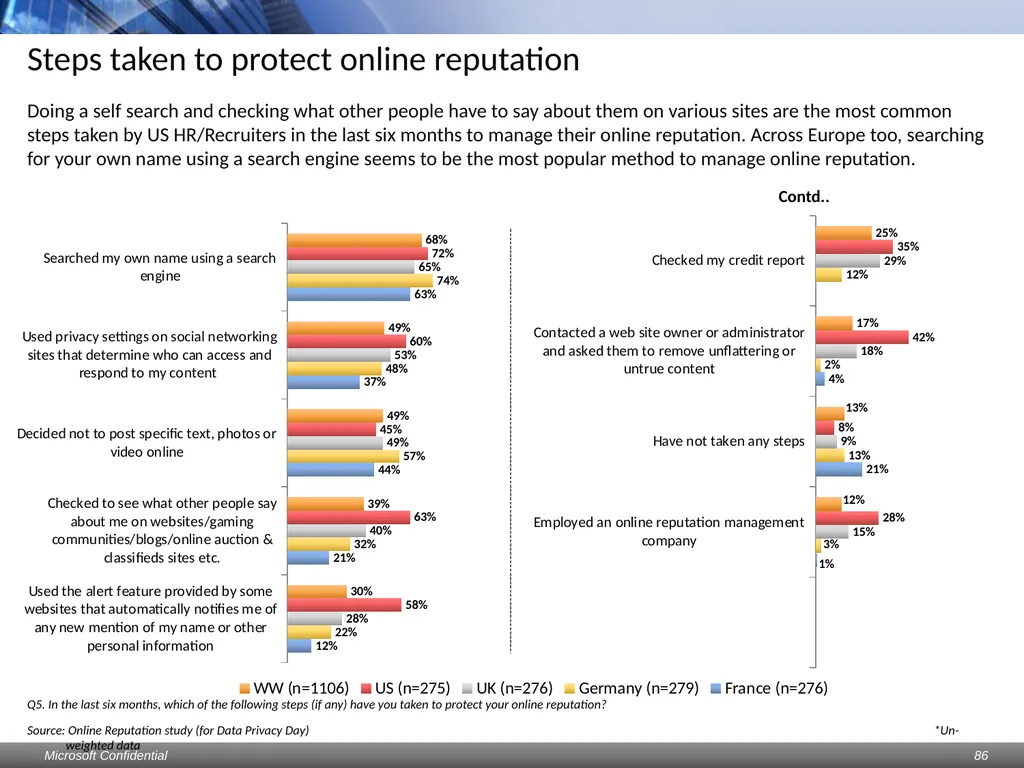
slide86. Source: Online Reputation study (for Data Privacy Day) *Un-weighted data Steps taken to protect online reputation Doing a self search and checking what other people have to say about them on various sites are the most common steps taken by US HR/Recruiters in the last six months to manage their online reputation. Across Europe too, searching for your own name using a search engine seems to be the most popular method to manage online reputation. Q5. In the last six months, which of the following steps (if any) have you taken to protect your online reputation? Contd..<br>
slide87. Demographics<br>
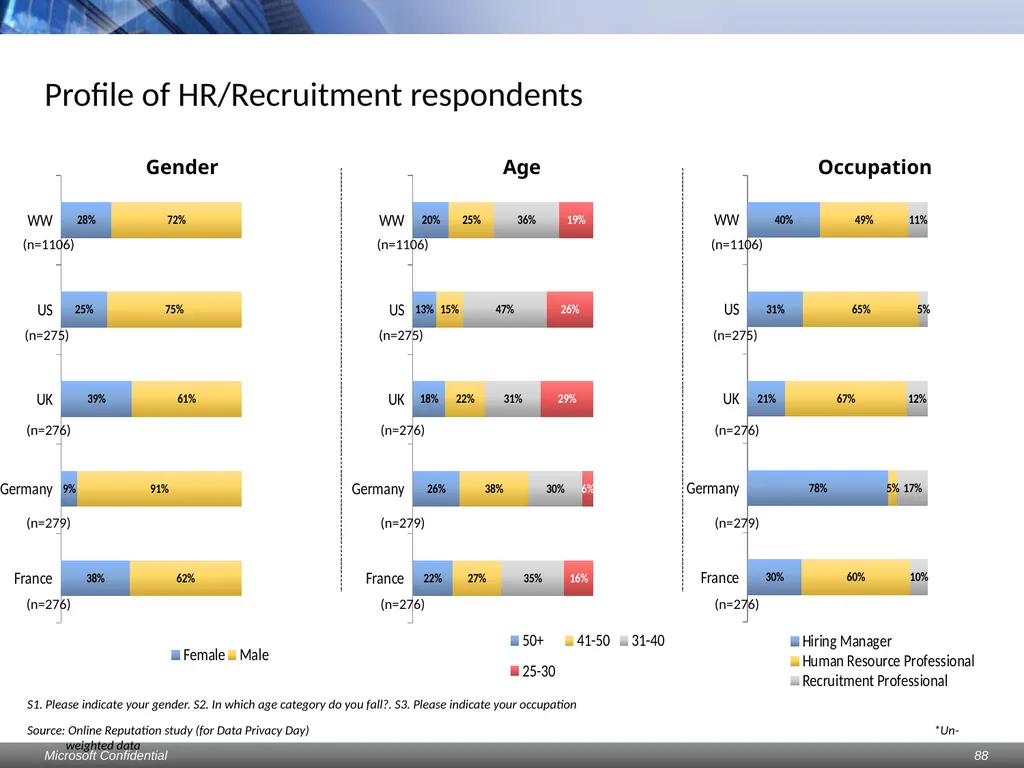
slide88. Profile of HR/Recruitment respondents Gender Age Occupation Source: Online Reputation study (for Data Privacy Day) *Un-weighted data S1. Please indicate your gender. S2. In which age category do you fall?. S3. Please indicate your occupation (n=1106) (n=275) (n=276) (n=279) (n=276) (n=1106) (n=275) (n=276) (n=279) (n=276) (n=1106) (n=275) (n=276) (n=279) (n=276)<br>
Prepared by: Cross-Tab Marketing Services January 2010<br>
slide2. Executive Summary 3
Key Findings 4
Appendix
Detailed Findings : Consumer Segment 20
Detailed Findings : HR/Recruiter Segment 61 Table of Contents<br>
slide3. As we look at the findings of the study, three main points emerge:
The impact of online reputation on professional life
Nationality plays key role in determining whether online content will harm reputations
Companies have formal policies for checking online reputational data, but male recruiters are more likely to check - except in France
Recruiters typically conduct deeper searches than most consumers are aware of, and feel justified in doing so
Not all online content is true – but candidates may be rejected nonetheless
Recruiters say they tell candidates if online content factored into their rejection, but consumers do not seem to be hearing it
Good online reputations matter to recruiters
The impact of online reputation on personal life
Online reputations matter when trying to meet people socially, but the extent to which it matters is closely tied to age
Survey respondents are concerned about having their online reputations abused to steal their identities, target them for scams, or become a victim of defamation, harassment or bullying
The impact to online reputations by content created via mobile devices is an area of concern for consumers
What people do to manage their online reputation
Consumers take steps to keep a divide between personal and professional identities.
Most respondents use measures to protect and manage their online reputation.
Consumers apply both proactive and reactive methods of reputation management.
Respondents are divided about their ability to manage their online reputation and on ownership of issues. Executive Summary<br>
slide4. Key Findings<br>
slide5. As job seekers worldwide struggle to find employment, understanding how information posted online
can affect their chances for employment are critical.
Only a little over one third of the consumers surveyed actually think that their online reputation might impact their chances of getting a job or admission into a college in the future whereas most of the HR/Recruiters surveyed admit that they review online reputational information while evaluating a candidate The impact of online reputation on professional life Q6. Do you review online reputational information about candidates when
evaluating them for a potential job / college admission? Q18. How concerned are you that your online reputation may Impact
your ability to get a job/be admitted into college in the future? Consumers HR/Recruiters<br>
slide6. The impact of online reputation on professional life…contd HR/Recruiters surveyed also reveal that in the US and also in the UK, to a large extent, this practice is part of their organization’s formal hiring process.
While a majority of those surveyed in the US (75%) as well as nearly half of those surveyed in the UK (48%) state this as part of their organization’s formal hiring process, very few state this as the case in Germany & France. However, in both US and Germany, HR/Recruiters surveyed admit that they review online reputational information irrespective of the above fact. These HR/Recruiters from the two countries above also mention that they have rejected a candidate based on such reputational information. % of recruiters who have rejected candidates based on information found online VS. % of consumers who think online information affected their job search Source: Online Reputation study (for Data Privacy Day) *Un-weighted data<br>
slide7. Recruiters typically conduct deeper searches than most consumers are aware of, and feel justified in doing so
According to those surveyed, the practice of reviewing such online reputational information is most prevalent in the US (77%) currently followed by Germany (53%) and UK (48%) and is expected to become a more common practice across markets in five years time.
Except for the respondents from France, most of the others believe it is appropriate to review such information even if it’s of personal nature and even the French agree it is appropriate to review professional information. However, when it comes to financial information, the respondents from Germany and France both feel it is less appropriate. The impact of online reputation on professional life…contd % of recruiters who use each site for information VS. % of consumers who think it’s appropriate to use each site Source: Online Reputation study (for Data Privacy Day) *Un-weighted data<br>
slide8. Good online reputations matter to recruiters
Most of the HR/Recruiters surveyed in all the four countries (UK: 65%, Germany: 71%, France: 48%), more so in the US (86%), admit that a positive online reputation has a definite impact on a candidate’s application. The impact of online reputation on professional life…contd Q18. To what extent do you feel that a positive online reputation impacts a candidate’s application? Source: Online Reputation study (for Data Privacy Day) *Un-weighted data<br>
slide9. Most of those surveyed do not believe that there has been any positive or negative impact on their chances of getting a job or getting admission in a college, because of their online reputation.
Online reputations matter when trying to meet people socially, but the extent to which it matters is closely tied to age
There is a predictable decline in the importance of this information by age. Presumably, this is due to three age related factors: older users are likely to have placed less information about themselves online, are less likely to post content about themselves that could be seen as detrimental, and are less likely to be actively trying to expand their social networks. The impact of online reputation on personal life Q19. Meet people - Do you believe that your online reputation has ever helped you: Source: Online Reputation study (for Data Privacy Day) *Un-weighted data<br>
slide10. Survey respondents are concerned about having their online reputations abused to steal their identities, target them for scams, or become a victim of defamation, harassment or bullying
Most of those surveyed (79%) believe that they have at least some control over their online reputation. This feeling of control is probably a manifestation of the fact that most of those consumers surveyed (53%) keep their personal and professional online profiles separate, mainly by restricting access or using multiple user profiles.
These actions are probably the reason behind the concern about their online reputation being used for identity theft (56%) or scams (55%). The impact of online reputation on personal life…contd Q10. How concerned are you about the possibility that your online reputation may be used for the following purposes: Source: Online Reputation study (for Data Privacy Day) *Un-weighted data<br>
slide11. The impact to online reputations by content created via mobile devices is an area of some concern for consumers
However, US consumers are the least concerned about their online reputation being damaged by content captured by someone else's mobile device. German consumers seem to be a little more concerned than the consumers from other markets about this The impact of online reputation on personal life…contd Q12. How concerned are you that your online reputation may be harmed by content captured via someone else’s cell phone or mobile device? Source: Online Reputation study (for Data Privacy Day) *Un-weighted data<br>
slide12. Online Reputation Management (ORM) More than half of the US consumers responding are concerned about their online reputation. However French consumers do not seem to be as concerned as their US counterparts. This can be attributed to less dependence on online reputational information by HR professionals and proactive management by French respondents. Use of online reputational information by HR professionals in various countries Q1.Which of the following statements best describes how you think about your online reputation:<br>
slide13. Source: Online Reputation study (for Data Privacy Day) *Un-weighted data Online reputation management French respondents are the most likely to report always taking steps to keep their personal and professional online profiles separate Q7. Do you take steps to keep your personal and professional online profiles separate? (n=1222) (n=289) (n=291) (n=311) (n=331)<br>
slide14. Source: Online Reputation study (for Data Privacy Day) *Un-weighted data Separation of personal and professional online profiles: Steps taken Restricting access and not sharing the sites they use in public, appear to be the most common steps taken by consumers to keep their personal and professional profiles separate. Interestingly, men are more likely to create multiple user profiles than women, at 50% vs. 38%. Q8. Which of the following steps do you take to keep your personal and professional online reputations separate?<br>
slide15. Source: Online Reputation study (for Data Privacy Day) *Un-weighted data Online reputation management - Steps taken Q9. In the last six months, which of the following steps (if any) have you taken to manage your online reputation? Doing a self search and using privacy settings to restrict access to profiles are common steps taken by respondents in the last 6 months to manage their online reputation. Other than a self-search, respondents in the 40+ age group are not likely to have taken any other steps to manage their online reputation in the past six months.
French and German consumers also seem to employ more discretion about posting specific content online. Contd..<br>
slide16. While the clear majority of consumers responding in each country feel they have at least some control over their online reputation, US respondents are the most likely to feel they have a lot of control. Online reputation management - Extent of control on online reputation Source: Online Reputation study (for Data Privacy Day) *Un-weighted data Q2. How much control do you think you have over your online reputation?<br>
slide17. Source: Online Reputation study (for Data Privacy Day) *Un-weighted data Q22. Where do you believe responsibility resides in protecting an individual’s online reputation? Online reputation management - Responsibility for protecting online information (n=1345) (n=335) (n=333) (n=334) (n=343) The most common viewpoint among consumer respondents from each of the European countries is that the responsibility for protecting their online reputation lies between the individual and the website. US respondents are most likely to believe the responsibility lies entirely with the individual.<br>
slide18. Thank You Gary Nearn
Client Services Director
v-ganear@microsoft.com Ashok Varma
Sr. Research Manager
ashok@cross-tab.com<br>
slide19. Appendix<br>
slide20. Internet Usage
Online Reputation & its impact on Personal Life
Online Reputation & its impact on Education/Employment
Online Reputation Management
Demographics Detailed Findings: Consumer Segment<br>
slide21. Internet Usage<br>
slide22. Source: Online Reputation study (for Data Privacy Day) Internet usage Worldwide, the majority of the users surveyed (68%) are avid internet users (more than 10 hrs per week for personal use) S3. About how many hours per week do you spend using the Internet for personal use [outside of work use]? (n=1345) (n=335) (n=333) (n=334) (n=343)<br>
slide23. Source: Online Reputation study (for Data Privacy Day) Types of web sites accessed…personal use For personal use, classifieds/auction sites and social networking sites seem to be the most visited across segments amongst those surveyed Q3A. Which, if any, of the following types of websites do you access for your own personal and/or professional use? - Personal Contd..<br>
slide24. Source: Online Reputation study (for Data Privacy Day) Types of web sites accessed…professional use Q3B. Which, if any, of the following types of websites do you access for your own personal and/or professional use? - Professional Contd.. The clear majority of respondents in each country stated that they aren’t using any of these site for professional purposes. 18% of respondents worldwide use professional networking sites.<br>
slide25. Source: Online Reputation study (for Data Privacy Day) *Un-weighted data Frequency of usage…personal Social networking sites followed by personal websites seem to be the most frequently visited sites with more than half of US consumers surveyed accessing such sites at least once a day or more Q4. How frequently do you use following websites – Personal Base: Once a day + More than once a day Contd..<br>
slide26. Source: Online Reputation study (for Data Privacy Day) *Un-weighted data Frequency of usage…professional Contd.. Q4. How frequently do you use following websites - Professional Base: Once a day + More than once a day Among those who use professional/business networking sites for professional purposes, around half do so at least once a day.<br>
slide27. Source: Online Reputation study (for Data Privacy Day) *Un-weighted data Edit or post content While 55% of those surveyed worldwide post or edit content into websites, across markets, it’s mostly those below 40 years of age that do so Q5. Do you edit or post content (such as text, photo’s, video’s etc). to websites? (n=1222) (n=289) (n=291) (n=311) (n=331)<br>
slide28. Source: Online Reputation study (for Data Privacy Day) *Un-weighted data Considering own reputation Most people consider their own online reputation while posting content, although women are more inclined to do so all the time than men (42% vs. 30%) Q6. When you edit or post content such as text, video or photos to websites, do you consider: Your own online reputation (n=676) (n=168) (n=165) (n=160) (n=183)<br>
slide29. Source: Online Reputation study (for Data Privacy Day) *Un-weighted data Considering others reputation Although people consider other people's online reputation too while posting content, here again, women are more inclined to do so all the time than men (32% vs. 19%) (n=676) (n=168) (n=165) (n=160) (n=183) Q6. When you edit or post content such as text, video or photos to websites, do you consider: Other people’s online reputation<br>
slide30. Source: Online Reputation study (for Data Privacy Day) *Un-weighted data Posting content via mobile applications A vast majority of US, UK and German consumers responding do not use any mobile device to edit or post content online. However, more than half the French respondents reported using a mobile device to post content online Q11. Do you use a cell phone or mobile device to edit or post content such as text, video, photo’s etc. to websites? (n=676) (n=168) (n=165) (n=160) (n=183)<br>
slide31. Source: Online Reputation study (for Data Privacy Day) *Un-weighted data Posting content by children Q13. Do your children post content (such as text, video or pictures) about themselves online (e.g. to social networking sites, video/photo sharing sites, blogs etc.)? (n=335) (n=61) (n=70) (n=94) (n=110) German parents responding are the least likely to report that their children post content about themselves online. This is a more common practice among children of respondents from each of the other countries.<br>
slide32. Online Reputation and its impact on Personal Life<br>
slide33. Source: Online Reputation study (for Data Privacy Day) *Un-weighted data Threats to online reputation Most consumers surveyed seem to be more concerned about their online reputation being used for identity theft and online scams than anything else. Q10. How concerned are you about the possibility that your online reputation may be used for the following purposes:<br>
slide34. Source: Online Reputation study (for Data Privacy Day) *Un-weighted data Threat from mobile devices US consumers are not concerned about their online reputation being damaged by content captured by someone else's mobile device. German consumers seem to be a little more concerned than the consumers from other markets about this. Q12. How concerned are you that your online reputation may be harmed by content captured via someone else’s cell phone or mobile device? (n=1345) (n=335) (n=333) (n=334) (n=343)<br>
slide35. Source: Online Reputation study (for Data Privacy Day) *Un-weighted data Threat to children’s future Q14. Do you believe that your children's online reputation may impact their future chances of being accepted into a school or college? (n=138) (n=39) (n=46) (n=53) * Not asked in Germany Around half of those responding who reported that their children post content about themselves online, went on to state that they believe their child’s online reputation may impact their future employment or school/college chances.<br>
slide36. Source: Online Reputation study (for Data Privacy Day) *Un-weighted data Threat to children’s future…contd Most of the parents say that their children post content about themselves online and they also believe that their children's online reputation would affect their future chances of being accepted into a school or college as well as being hired for a job. While this is the case across markets, the French consumers, especially women, are not so convinced that there will be any effect on school/college admissions. (n=175) (n=39) (n=46) (n=37) (n=53) Q14. Do you believe that your children's online reputation may impact their future chances of being hired for a job?<br>
slide37. Online Reputation and its impact on Education/Employment Opportunities<br>
slide38. Source: Online Reputation study (for Data Privacy Day) *Un-weighted data Impact on job application Most consumers surveyed believe that online reputational information is at least occasionally used for making hiring decisions. This is especially true in Germany, where 89% believe this to be the case. (n=1345) (n=335) (n=333) (n=334) (n=343) Q15. To what extent do you think online reputational information is used to make decisions on hiring a candidate for a job?<br>
slide39. Source: Online Reputation study (for Data Privacy Day) *Un-weighted data Impact on college admissions Almost a quarter of US consumers surveyed believe that online reputational information is frequently used to make decisions on college admissions. This proportion is notably lower in both the UK and France. (n=1011) (n=335) (n=333) (n=343) Q15. To what extent do you think online reputational information is used to make decisions on admitting a student into a college? * Not asked in Germany<br>
slide40. Source: Online Reputation study (for Data Privacy Day) Appropriateness of websites while evaluating candidates Most US consumers believe that it is appropriate to review only professional/business networking sites, personal websites and online forums/communities while evaluating a candidate and either believe it is inappropriate, or are divided in their opinion, about reviewing any other sites.
UK consumers think it is appropriate to review professional networking sites while German consumers believe that apart from professional sites, personal websites can also be reviewed. However, the majority of French respondents do not think it's appropriate to review any site while evaluating candidates Q16. How appropriate do you think it is for employers and college admissions officers to review the following types of online sites when evaluating candidates<br>
slide41. Source: Online Reputation study (for Data Privacy Day) *Un-weighted data Concern about impact of online reputation Most respondents in the US and UK are not concerned about their online reputation affecting either their personal or professional life. There is slightly more concern among French and German respondents about an equal effect on personal and professional life. (n=1345) (n=335) (n=333) (n=334) (n=343) Q17. Are you more concerned that your online reputation might affect your personal life or your professional life?<br>
slide42. Source: Online Reputation study (for Data Privacy Day) *Un-weighted data Concern about Impact of online reputation: Education/Employment Close to four in 10 respondents in the US and UK are not at all concerned that their online reputation may impact their ability to get a job or be admitted into college in the future. French respondents are also not concerned by this, however almost half the German respondents are at least somewhat concerned. (n=1345) (n=335) (n=333) (n=334) (n=343) Q18. How concerned are you that your online reputation may impact your ability to get a job/be admitted into college in the future?<br>
slide43. Source: Online Reputation study (for Data Privacy Day) *Un-weighted data Q19. Get a job - Do you believe that your online reputation has ever helped you: Positive impact of online reputation – Helped get a job Most US consumers responding do not believe that their online reputation has ever helped them get a job or be admitted into a college. However, they do believe, mostly men, that it has helped them in meeting people. Consumers responding in each of the European countries generally do not believe their online reputation has helped them in any of these three activities (getting job, admittance into college or meeting people). (n=1345) (n=335) (n=333) (n=334) (n=343)<br>
slide44. Source: Online Reputation study (for Data Privacy Day) *Un-weighted data Q19. Get into college - Do you believe that your online reputation has ever helped you: Positive impact of online reputation – Helped get into College (n=1011) (n=335) (n=333) (n=343) * Not asked in Germany<br>
slide45. Source: Online Reputation study (for Data Privacy Day) *Un-weighted data Q19. Meet people - Do you believe that your online reputation has ever helped you: Positive impact of online reputation – Helped meet people (n=1345) (n=335) (n=333) (n=334) (n=343)<br>
slide46. Source: Online Reputation study (for Data Privacy Day) *Un-weighted data Q20. Get a job - Do you believe that your online reputation has ever harmed your attempt to: Negative impact of online reputation – Getting a job Generally, most consumers surveyed don’t believe that their online reputation has ever harmed their attempts at any of the three activities either (getting a job, college admission, meeting people). (n=1345) (n=335) (n=333) (n=334) (n=343)<br>
slide47. Source: Online Reputation study (for Data Privacy Day) *Un-weighted data Q20. Get into college - Do you believe that your online reputation has ever harmed your attempt to: Negative impact of online reputation – Getting into College (n=1011) (n=335) (n=333) (n=343) * Not asked in Germany<br>
slide48. Source: Online Reputation study (for Data Privacy Day) *Un-weighted data Q20. Meet people/make friends - Do you believe that your online reputation has ever harmed your attempt to: Negative impact of online reputation – Helped meet people (n=1345) (n=335) (n=333) (n=334) (n=343)<br>
slide49. Source: Online Reputation study (for Data Privacy Day) *Un-weighted data Q21. Is there any information that you have posted online that you wish you had not posted? Regret about online posting (n=1345) (n=335) (n=333) (n=334) (n=343)<br>
slide50. Online Reputation Management<br>
slide51. Source: Online Reputation study (for Data Privacy Day) *Un-weighted data Online Reputation Q1. Which of the following statements best describes how you think about your online reputation: (People’s perception of you based on all the content posted by you or about you online) (n=1345) (n=335) (n=333) (n=334) (n=343) Around half the US and UK respondents are concerned about their online reputation.
French and German respondents do not seem to be as worried as their US counterparts.<br>
slide52. Source: Online Reputation study (for Data Privacy Day) *Un-weighted data Control over online reputation While the clear majority of consumers responding in each country feel they have at least some control over their online reputation, US respondents are the most likely to feel they have a lot of control. (n=1345) (n=335) (n=333) (n=334) (n=343) Q2. How much control do you think you have over your online reputation?<br>
slide53. Source: Online Reputation study (for Data Privacy Day) *Un-weighted data Separation of personal and professional online profiles French respondents are the most likely to report always taking steps to keep their personal and professional online profiles separate Q7. Do you take steps to keep your personal and professional online profiles separate? (n=1222) (n=289) (n=291) (n=311) (n=331)<br>
slide54. Source: Online Reputation study (for Data Privacy Day) *Un-weighted data Separation of personal and professional online profiles: Steps taken Restricting access and not sharing the sites they use in public, appear to be the most common steps taken to keep personal and professional profiles separate. Interestingly, men are more likely to create multiple user profiles than women, at 50% vs. 38%. Q8. Which of the following steps do you take to keep your personal and professional online reputations separate?<br>
slide55. Source: Online Reputation study (for Data Privacy Day) *Un-weighted data Steps taken to manage online reputation Q9. In the last six months, which of the following steps (if any) have you taken to manage your online reputation? Doing a self search and using privacy settings to restrict access to profiles are common steps taken by respondents in the last 6 months to manage their online reputation. Other than a self-search, respondents in the 40+ age group are not likely to have taken any other steps to manage their online reputation in the past 6 months.
French and German consumers also seem to employ more discretion about posting specific content online. Contd..<br>
slide56. Source: Online Reputation study (for Data Privacy Day) *Un-weighted data Q22. Where do you believe responsibility resides in protecting an individual’s online reputation? Responsibility for protecting online information (n=1345) (n=335) (n=333) (n=334) (n=343) The most common viewpoint among respondents from each of the European countries is that the responsibility for protecting their online reputation lies between the individual and the website. US respondents are most likely to believe the responsibility lies entirely with the individual.<br>
slide57. Demographics<br>
slide58. Source: Online Reputation study (for Data Privacy Day) S1. Please indicate your gender. S2. In which age category do you fall? Profile of target audience (n=1345) (n=335) (n=333) (n=334) (n=343) (n=1345) (n=335) (n=333) (n=334) (n=343) Gender Age<br>
slide59. Source: Online Reputation study (for Data Privacy Day) Internet access by children (n=356) (n=67) (n=75) (n=102) (n=112) Internet access by children (n=1345) (n=335) (n=333) (n=334) (n=343) Children between the ages
of 10-21 S5. Do your children access the internet using a computer/laptop/cell phone/mobile device/gaming device? S4. Do you have any children between the ages of 10-21?<br>
slide60. Source: Online Reputation study (for Data Privacy Day) *Un-weighted data D1. What is your primary employment status? D2. What is the highest level of formal education you yourself have completed? Employment status & Educational background (n=1345) (n=335) (n=333) (n=334) (n=343) (n=1345) (n=335) (n=333) (n=334) (n=343)<br>
slide61. Internet usage
Impact on employment opportunities
Online reputation management
Demographics Detailed Findings: HR/Recruiter Segment<br>
slide62. Internet Usage<br>
slide63. Internet Usage Source: Online Reputation study (for Data Privacy Day) *Un-weighted data The majority of US and UK Human Resource respondents spend more than 10 hours per week on the internet for non-work purposes. Q1. About how many hours per week do you spend using the Internet for non-work purposes? (n=1106) (n=275) (n=276) (n=279) (n=276)<br>
slide64. Source: Online Reputation study (for Data Privacy Day) *Un-weighted data Types of web sites accessed For personal use, social networking sites seem to be accessed the most by US HR/Recruiters. This is the case in UK and France too, whereas in Germany, Classifieds/auction sites are accessed the most. Q3. Which, if any, of the following types of websites do you access for your own personal use? Contd..<br>
slide65. Source: Online Reputation study (for Data Privacy Day) *Un-weighted data Frequency of usage Social networking sites followed by personal websites seem to be the most frequently visited sites by HR / Recruitment professionals in the US, accessing such sites at least once a day or more for personal use. France sees more instances of HR respondents visiting personal websites than any other site whereas their counterparts in Germany seem to clearly prefer news sharing sites like Twitter. Q4. How frequently do you use following websites 85% Contd..<br>
slide66. Impact on Employment Opportunities<br>
slide67. Source: Online Reputation study (for Data Privacy Day) *Un-weighted data Use of Online Reputational Information 79% of US HR/Recruitment professionals responding use online reputational information to evaluate candidates most or all of the time. This practice is less common among both UK and German respondents and rarely or never done by 47% of French respondents. Q6. Do you review online reputational information about candidates when evaluating them for a potential job / college admission? (n=1106) (n=275) (n=276) (n=279) (n=276)<br>
slide68. Source: Online Reputation study (for Data Privacy Day) *Un-weighted data Use of Online Reputational Information…Contd The review of online reputational information is mostly conducted by the HR/Recruitment professionals themselves, although 20% of respondents in the UK report using an external service provider to conduct this review. Q7. Typically, is this review conducted by (n=817) (n=244) (n=203) (n=230) (n=140)<br>
slide69. Source: Online Reputation study (for Data Privacy Day) *Un-weighted data Online Reputation & Company Policies In the US, review of online reputational information seems to be a part of the organizations formal hiring process in most cases. This is completely opposite of what is followed in France and Germany. Q8. Is reviewing online reputational information about applicants part of your company’s/college’s formal hiring/admissions process? (n=1106) (n=275) (n=276) (n=279) (n=276)<br>
slide70. Source: Online Reputation study (for Data Privacy Day) *Un-weighted data Sources for Online Reputational Information Most HR/Recruiters responding use search engines and social networking sites to look for reputational information about candidates. Close to a third in the US report using websites that aggregate personal information. Q9. Which of the following, if any, do you review when looking for online reputational information of applicants? Contd..<br>
slide71. Source: Online Reputation study (for Data Privacy Day) *Un-weighted data Use of Online Reputational Information…Industry Status 77% of US HR/Recruitment professionals responding believe that online reputational information is used by others in their industry when evaluating applicants.
Interestingly, 77% of French respondents believe that those in their industry use this information at least sometimes. This compares to just 51% who reported doing so themselves. Q10. To what extent do you believe online reputational information is used by others in your profession when evaluating applicants for a potential job/ college admission? (n=1106) (n=275) (n=276) (n=279) (n=276)<br>
slide72. Source: Online Reputation study (for Data Privacy Day) *Un-weighted data Use of Online Reputational Information…Future Role The trend of using online reputational information in evaluating candidates is believed to continue in the near future in the US. In Europe, where the practice is less followed now, the use of online reputational information to evaluate candidates is expected to increase in the near future. Q11. In your opinion, to what extent do you believe online reputational information will be used by others in your profession five years from now when evaluating applicants for a potential job/ college admission? (n=1106) (n=275) (n=276) (n=279) (n=276)<br>
slide73. Source: Online Reputation study (for Data Privacy Day) *Un-weighted data Personal Information - Appropriateness of Usage A vast majority of HR/Recruitment professionals believe it is appropriate to consider personal online reputational information while evaluating candidates. France is the major exception, where it is seen as inappropriate by 45% of the HR/Recruitment respondents. Q12. How appropriate do you think it is for employers/college admissions officers to consider personal online reputational information when evaluating candidates? (Such as photos, personal profiles, videos etc.) (n=1106) (n=275) (n=276) (n=279) (n=276)<br>
slide74. Source: Online Reputation study (for Data Privacy Day) *Un-weighted data Financial Information - Appropriateness of Usage Apart from personal online information, US respondents also believe it is appropriate to consider online financial reputational information to evaluate candidates in the US. The UK follows the US on this, although to a much lesser extent. However, respondents from both France and Germany consider this practice to be inappropriate. Q13. How appropriate do you think it is for employers/ college admissions officers to consider financial online reputational information when evaluating candidates? (Such as credit reports, buyer/seller ratings on auction /classified sites etc.) (n=1106) (n=275) (n=276) (n=279) (n=276)<br>
slide75. Source: Online Reputation study (for Data Privacy Day) *Un-weighted data Professional Information - Appropriateness of Usage Considering professional online information for evaluating candidates is considered appropriate in each country, with 47% in the US stating that this is very appropriate. Q14. How appropriate do you think it is for employers/ college admissions officers to consider professional online reputational information when evaluating candidates? (Such as LinkedIn etc.) (n=1106) (n=275) (n=276) (n=279) (n=276)<br>
slide76. Source: Online Reputation study (for Data Privacy Day) *Un-weighted data Authenticity of data While most US HR/Recruiters responding use online reputational information to evaluate candidates, they are also concerned about the possibility that a candidate’s reputation may not be authentic. Both UK and German HR/Recruiters are to some extent concerned about the authenticity. However, the French do not consider this to be a major area of concern. Q15. How concerned are you about the possibility that a candidate’s online reputation may not be authentic? (n=1106) (n=275) (n=276) (n=279) (n=276)<br>
slide77. Source: Online Reputation study (for Data Privacy Day) *Un-weighted data Verification of data Due to the concern about the authenticity of reputational information, most HR/Recruitment professionals take steps to verify such information about a candidate, although less than half from any country do so all the time. Q16. Do you take any steps to verify the online reputational information you discover about a candidate? (n=817) (n=244) (n=203) (n=230) (n=140)<br>
slide78. Source: Online Reputation study (for Data Privacy Day) *Un-weighted data Online Reputational Information & Job Role Considering online reputational information seems to be more prevalent for candidates of middle management and senior management positions, across markets. Q17. For what level of employee do you consider online reputational information important in the evaluation process of a candidate?<br>
slide79. Source: Online Reputation study (for Data Privacy Day) *Un-weighted data Impact of online reputation Most HR/Recruiters in the US believe that a positive online reputation has a big impact on a candidates application. However, it is not seen to have the same level of impact in Europe. Q18. To what extent do you feel that a positive online reputation impacts a candidate’s application? (n=1106) (n=275) (n=276) (n=279) (n=276)<br>
slide80. Source: Online Reputation study (for Data Privacy Day) *Un-weighted data Rejection based on online reputation 70% of US HR/Recruiters have rejected a candidate based on their online reputation. Respondents in the UK, and specifically Germany and France, were much less likely to indicate this has occurred. Q19. Have you ever rejected a candidate based on his or her online reputational information? (n=817) (n=244) (n=203) (n=230) (n=140)<br>
slide81. In most cases in the US, UK and France, candidates were informed that one of the reasons for the rejection of their application was due to their online reputational information. Interestingly, 58% of German respondents did not let the candidate know this was one of the reasons they were rejected. Source: Online Reputation study (for Data Privacy Day) *Un-weighted data Candidate made aware that rejection was based on online reputation Q20. Did you notify the candidate that this was (one of) the reason(s) he or she was rejected? (n=310) (n=172) (n=83) (n=36) (n=19*) *Small Sample Size<br>
slide82. Mostly, the reasons for rejecting a candidate are due to concerns about the candidates lifestyle, inappropriate comments/text written by the candidate themselves or unsuitable photos/videos/information. Source: Online Reputation study (for Data Privacy Day) *Un-weighted data Online Reputation and its role in candidate rejection Q21. Which of the following types of online reputational information impacted your decision to reject the candidate? Contd.. *Small Sample Size<br>
slide83. Online Reputation Management<br>
slide84. Online Reputation Source: Online Reputation study (for Data Privacy Day) *Un-weighted data Most US HR/Recruiters are very concerned about their own online reputation. While this is the case in the UK too, their counterparts in Germany and particularly France, do not seem to be as concerned. Q2. Which of the following statements best describes how you think about your online reputation: (People’s perception of you based on the content posted by you or about you online). (n=1106) (n=275) (n=276) (n=279) (n=276)<br>
slide85. Source: Online Reputation study (for Data Privacy Day) *Un-weighted data Responsibility for protecting online information While HR/ Recruitment professionals in the US believe that the responsibility for protecting someone's online reputation lies entirely with the individual concerned, in Europe it is more widely believed that websites should also help individuals manage their online reputation. Q22. Where do you believe responsibility resides in protecting an individual’s online reputation? (n=1106) (n=275) (n=276) (n=279) (n=276)<br>
slide86. Source: Online Reputation study (for Data Privacy Day) *Un-weighted data Steps taken to protect online reputation Doing a self search and checking what other people have to say about them on various sites are the most common steps taken by US HR/Recruiters in the last six months to manage their online reputation. Across Europe too, searching for your own name using a search engine seems to be the most popular method to manage online reputation. Q5. In the last six months, which of the following steps (if any) have you taken to protect your online reputation? Contd..<br>
slide87. Demographics<br>
slide88. Profile of HR/Recruitment respondents Gender Age Occupation Source: Online Reputation study (for Data Privacy Day) *Un-weighted data S1. Please indicate your gender. S2. In which age category do you fall?. S3. Please indicate your occupation (n=1106) (n=275) (n=276) (n=279) (n=276) (n=1106) (n=275) (n=276) (n=279) (n=276) (n=1106) (n=275) (n=276) (n=279) (n=276)<br>