
Debasis Samanta Computer Science & Engineering
DJ
Published · 34 slides · 0 views

1 / 1



Description
Debasis Samanta Computer Science Engineering Indian Institute of Technology Kharagpur Spring-2017 Programming and Data Structures Lecture 07 Memory Allocation Techniques Lecture 07: DSamanta CS 11001 : Programming and Data Structures
Related Topics
Share
Embed code
Download this presentation From Below
"Debasis Samanta Computer Science & Engineering" is the property of its rightful owner. Permission is granted to download and print the materials on this website for personal, non-commercial use only, and to display it on your personal computer provided you do not modify the materials and that you retain all copyright notices contained in the materials. By downloading content from our website, you accept the terms of this agreement.
Presentation Transcript
01
Debasis Samanta
Computer Science & Engineering
Indian Institute of Technology Kharagpur
Spring-2017 Programming and Data Structures<br>
Computer Science & Engineering
Indian Institute of Technology Kharagpur
Spring-2017 Programming and Data Structures<br>
02
Lecture #07
Memory Allocation Techniques Lecture #07: © DSamanta CS 11001 : Programming and Data Structures 2<br>
Memory Allocation Techniques Lecture #07: © DSamanta CS 11001 : Programming and Data Structures 2<br>
03
Static Memory Allocation
Dynamic Memory Allocation
Functions in C for Memory Allocation Today’s discussion… CS 11001 : Programming and Data Structures 3 Lecture #07: © DSamanta<br>
Dynamic Memory Allocation
Functions in C for Memory Allocation Today’s discussion… CS 11001 : Programming and Data Structures 3 Lecture #07: © DSamanta<br>
04
Memory Allocation CS 11001 : Programming and Data Structures 4 Lecture #07: © DSamanta<br>
05
Why Memory Allocation? C language allows constants and variables to be processed
All such variables should be maintained in primary memory at the time of execution.
This needs that memory should be allocated to all variables.
There are two ways to allocate memory for data in C
Static allocation
At the time of writing your program, you specify the memory requirement
Dynamic allocation
Allocate memory during run time as and when require CS 11001 : Programming and Data Structures 5 Lecture #07: © DSamanta<br>
All such variables should be maintained in primary memory at the time of execution.
This needs that memory should be allocated to all variables.
There are two ways to allocate memory for data in C
Static allocation
At the time of writing your program, you specify the memory requirement
Dynamic allocation
Allocate memory during run time as and when require CS 11001 : Programming and Data Structures 5 Lecture #07: © DSamanta<br>
06
Static Memory Allocation CS 11001 : Programming and Data Structures 6 Lecture #07: © DSamanta<br>
07
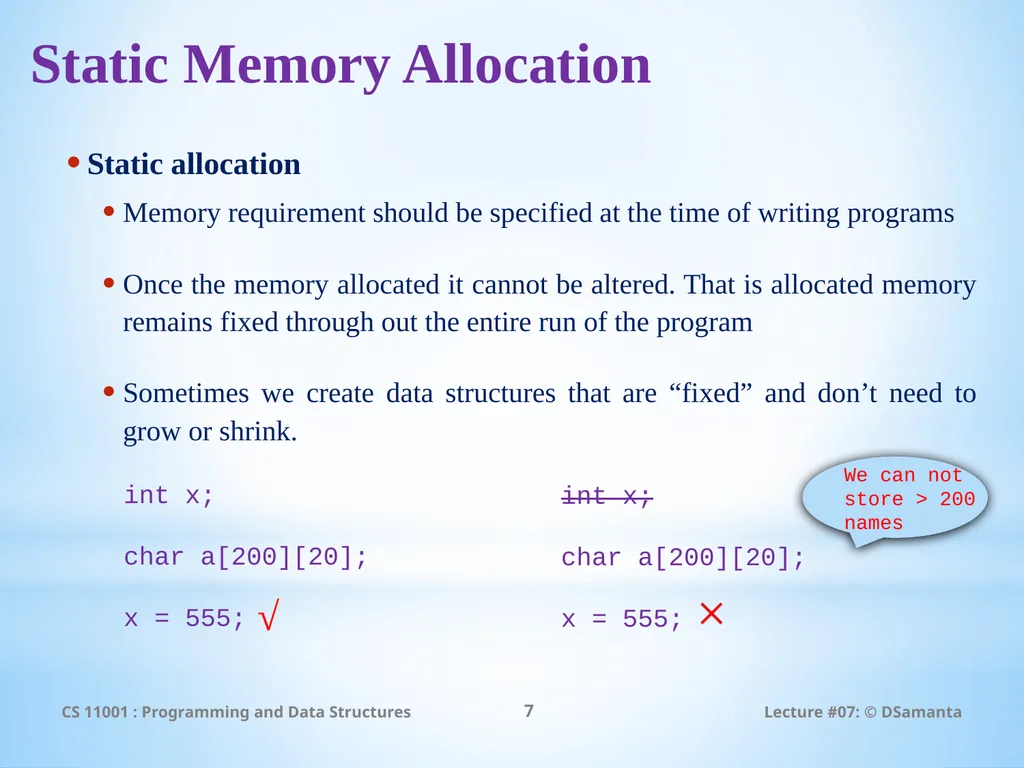
Static Memory Allocation Static allocation
Memory requirement should be specified at the time of writing programs
Once the memory allocated it cannot be altered. That is allocated memory remains fixed through out the entire run of the program
Sometimes we create data structures that are “fixed” and don’t need to grow or shrink. CS 11001 : Programming and Data Structures 7 Lecture #07: © DSamanta int x;
char a[200][20];
x = 555; int x;
char a[200][20];
x = 555; √ We can not
store > 200
names<br>
Memory requirement should be specified at the time of writing programs
Once the memory allocated it cannot be altered. That is allocated memory remains fixed through out the entire run of the program
Sometimes we create data structures that are “fixed” and don’t need to grow or shrink. CS 11001 : Programming and Data Structures 7 Lecture #07: © DSamanta int x;
char a[200][20];
x = 555; int x;
char a[200][20];
x = 555; √ We can not
store > 200
names<br>
08
Static Allocation: Pros and Cons Done at compile time.
Global variables: variables declared “ahead of time,” such as fixed arrays.
Lifetime
Entire runtime of program.
Advantage
Efficient execution time.
Disadvantage
If we declare more static data space than we need, we waste space.
If we declare less static space than we need, we are out of luck. CS 11001 : Programming and Data Structures 8 Lecture #07: © DSamanta<br>
Global variables: variables declared “ahead of time,” such as fixed arrays.
Lifetime
Entire runtime of program.
Advantage
Efficient execution time.
Disadvantage
If we declare more static data space than we need, we waste space.
If we declare less static space than we need, we are out of luck. CS 11001 : Programming and Data Structures 8 Lecture #07: © DSamanta<br>
09
Dynamic Memory Allocation CS 11001 : Programming and Data Structures 9 Lecture #07: © DSamanta<br>
10
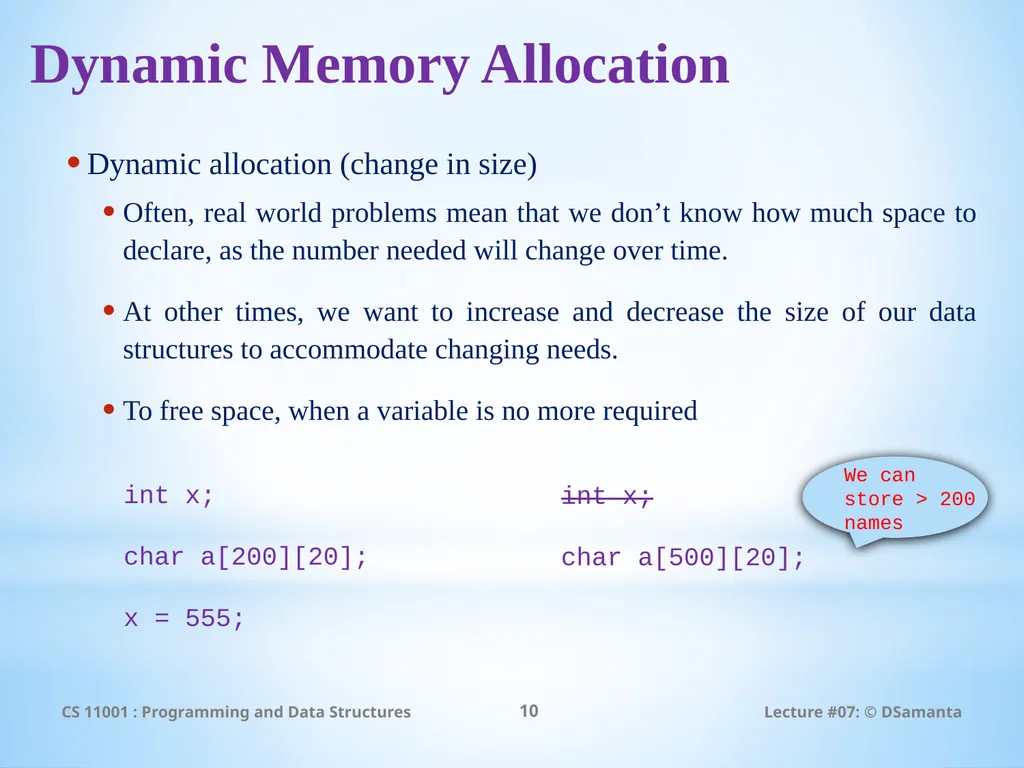
Dynamic Memory Allocation Dynamic allocation (change in size)
Often, real world problems mean that we don’t know how much space to declare, as the number needed will change over time.
At other times, we want to increase and decrease the size of our data structures to accommodate changing needs.
To free space, when a variable is no more required CS 11001 : Programming and Data Structures 10 Lecture #07: © DSamanta int x;
char a[200][20];
x = 555; int x;
char a[500][20]; We can
store > 200
names<br>
Often, real world problems mean that we don’t know how much space to declare, as the number needed will change over time.
At other times, we want to increase and decrease the size of our data structures to accommodate changing needs.
To free space, when a variable is no more required CS 11001 : Programming and Data Structures 10 Lecture #07: © DSamanta int x;
char a[200][20];
x = 555; int x;
char a[500][20]; We can
store > 200
names<br>
11
Dynamic Allocation: Pros and Cons Done at run time.
Data structures can grow and shrink to fit changing data requirements.
We can allocate (create) additional storage whenever we need them.
We can de-allocate (free/delete) dynamic space whenever we are done with them.
Advantage:
We can always have exactly the amount of space required - no more, no less. CS 11001 : Programming and Data Structures 11 Lecture #07: © DSamanta<br>
Data structures can grow and shrink to fit changing data requirements.
We can allocate (create) additional storage whenever we need them.
We can de-allocate (free/delete) dynamic space whenever we are done with them.
Advantage:
We can always have exactly the amount of space required - no more, no less. CS 11001 : Programming and Data Structures 11 Lecture #07: © DSamanta<br>
12
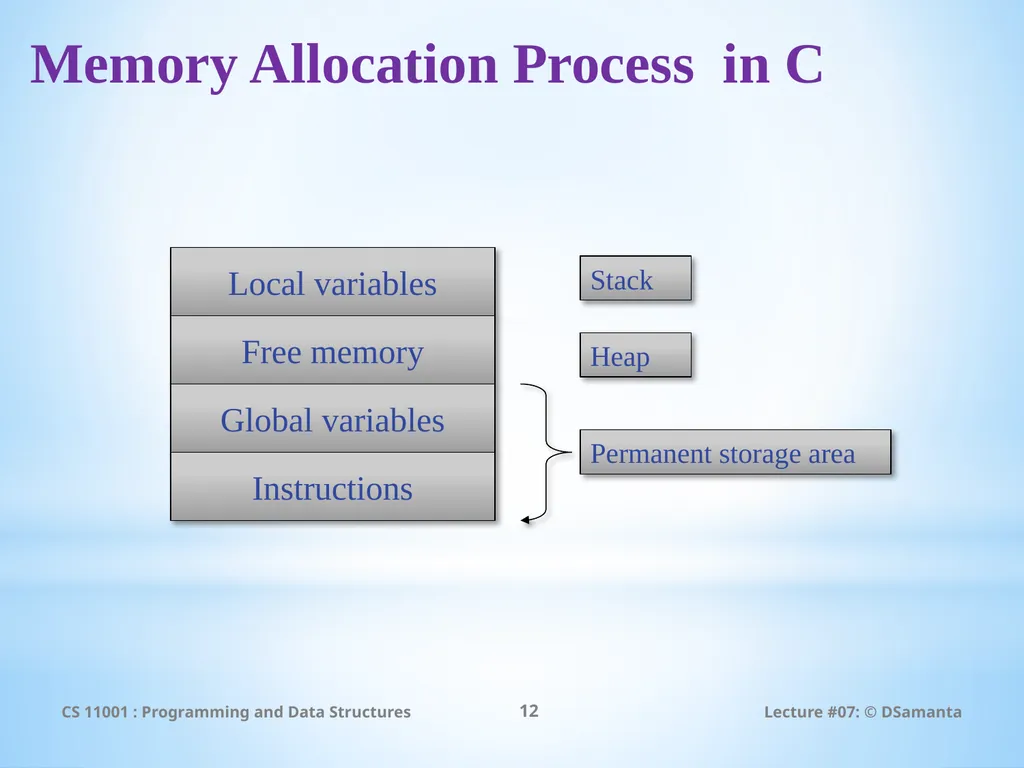
Memory Allocation Process in C CS 11001 : Programming and Data Structures 12 Lecture #07: © DSamanta Local variables Free memory Global variables Instructions Permanent storage area Stack Heap<br>
13
Memory Allocation Process in C The program instructions and the global variables are stored in a region known as permanent storage area.
The local variables are stored in another area called stack.
The memory space available for dynamic allocation during execution of the program is called heap.
This region is initially kept free.
The size of the heap keeps changing as a program runs. CS 11001 : Programming and Data Structures 13 Lecture #07: © DSamanta<br>
The local variables are stored in another area called stack.
The memory space available for dynamic allocation during execution of the program is called heap.
This region is initially kept free.
The size of the heap keeps changing as a program runs. CS 11001 : Programming and Data Structures 13 Lecture #07: © DSamanta<br>
14
Dynamic Memory Allocation Many a time, we face situations where data is dynamic in nature.
Amount of data cannot be predicted beforehand.
Number of data item keeps changing during program execution.
Such situations can be handled more easily and effectively using dynamic memory management techniques.
C language requires the number of elements in an array to be specified at compile time.
Often leads to wastage or memory space or program failure.
Dynamic Memory Allocation
Memory space required can be specified at the time of execution.
C supports allocating and freeing memory dynamically using library routines. CS 11001 : Programming and Data Structures 14 Lecture #07: © DSamanta<br>
Amount of data cannot be predicted beforehand.
Number of data item keeps changing during program execution.
Such situations can be handled more easily and effectively using dynamic memory management techniques.
C language requires the number of elements in an array to be specified at compile time.
Often leads to wastage or memory space or program failure.
Dynamic Memory Allocation
Memory space required can be specified at the time of execution.
C supports allocating and freeing memory dynamically using library routines. CS 11001 : Programming and Data Structures 14 Lecture #07: © DSamanta<br>
15
Memory Allocation Functions malloc()
Allocates requested number of bytes and returns a pointer to the first byte of the allocated space.
calloc()
Allocates space for an array of elements, initializes them to zero and then returns a pointer to the memory.
free()
Frees previously allocated space.
realloc()
Modifies the size of previously allocated space. CS 11001 : Programming and Data Structures 15 Lecture #07: © DSamanta<br>
Allocates requested number of bytes and returns a pointer to the first byte of the allocated space.
calloc()
Allocates space for an array of elements, initializes them to zero and then returns a pointer to the memory.
free()
Frees previously allocated space.
realloc()
Modifies the size of previously allocated space. CS 11001 : Programming and Data Structures 15 Lecture #07: © DSamanta<br>
16
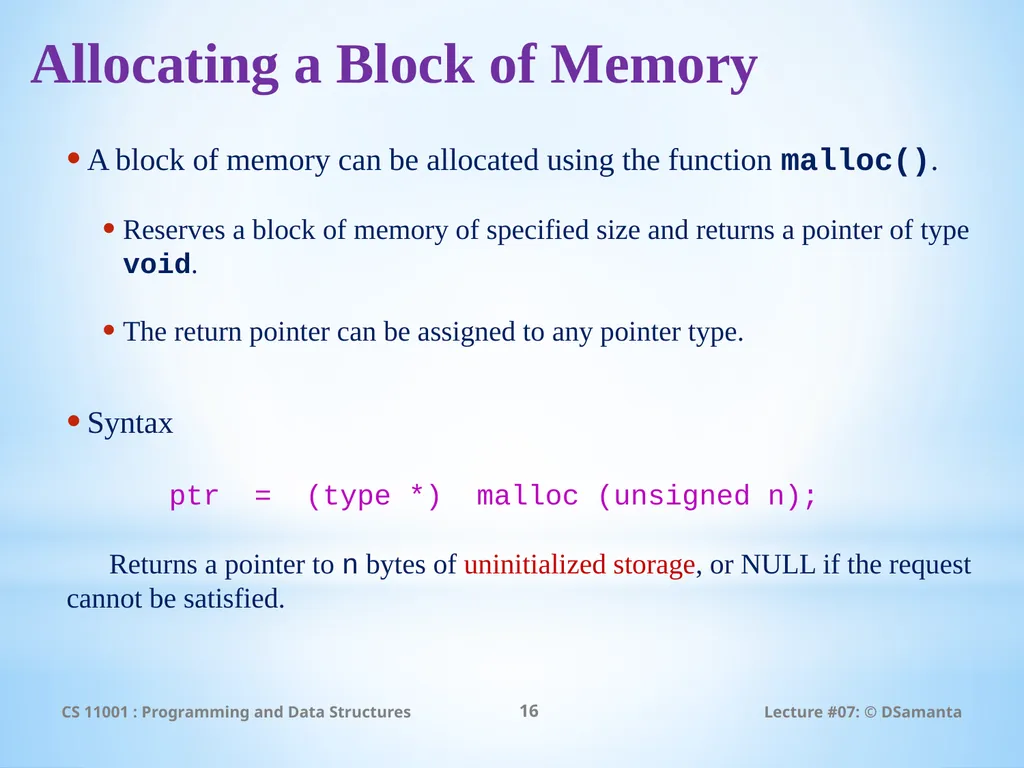
Allocating a Block of Memory A block of memory can be allocated using the function malloc().
Reserves a block of memory of specified size and returns a pointer of type void.
The return pointer can be assigned to any pointer type.
Syntax
ptr = (type *) malloc (unsigned n);
Returns a pointer to n bytes of uninitialized storage, or NULL if the request cannot be satisfied. CS 11001 : Programming and Data Structures 16 Lecture #07: © DSamanta<br>
Reserves a block of memory of specified size and returns a pointer of type void.
The return pointer can be assigned to any pointer type.
Syntax
ptr = (type *) malloc (unsigned n);
Returns a pointer to n bytes of uninitialized storage, or NULL if the request cannot be satisfied. CS 11001 : Programming and Data Structures 16 Lecture #07: © DSamanta<br>
17
Allocating a Block of Memory Examples
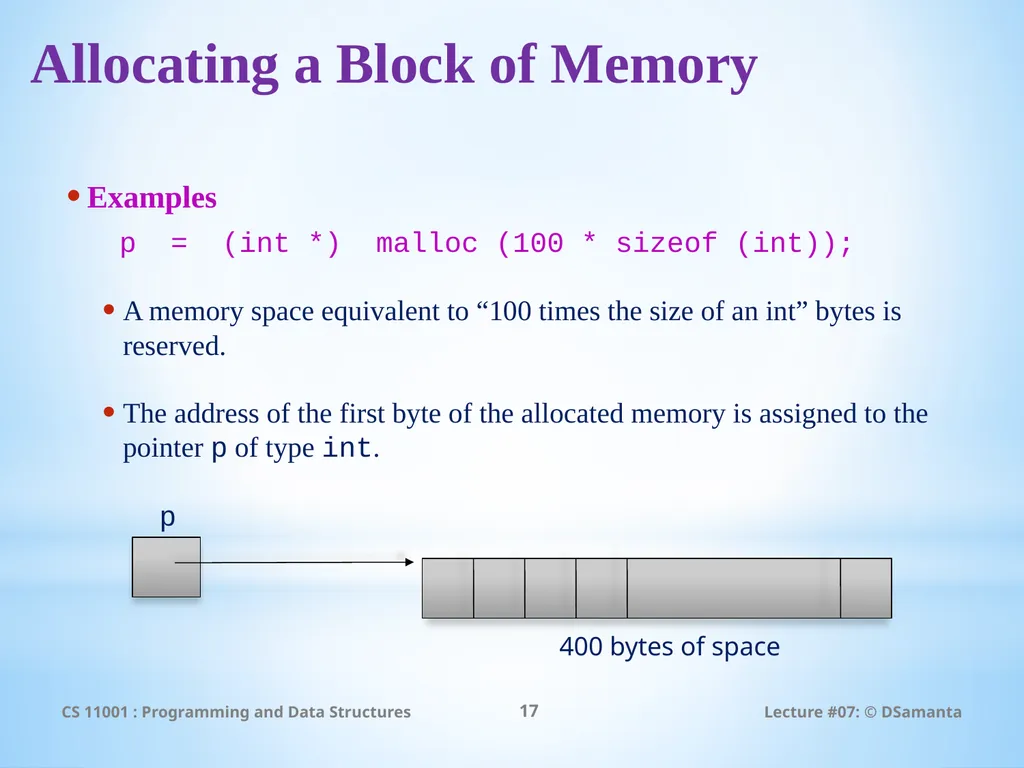
p = (int *) malloc (100 * sizeof (int));
A memory space equivalent to “100 times the size of an int” bytes is reserved.
The address of the first byte of the allocated memory is assigned to the pointer p of type int. CS 11001 : Programming and Data Structures 17 Lecture #07: © DSamanta p 400 bytes of space<br>
p = (int *) malloc (100 * sizeof (int));
A memory space equivalent to “100 times the size of an int” bytes is reserved.
The address of the first byte of the allocated memory is assigned to the pointer p of type int. CS 11001 : Programming and Data Structures 17 Lecture #07: © DSamanta p 400 bytes of space<br>
18
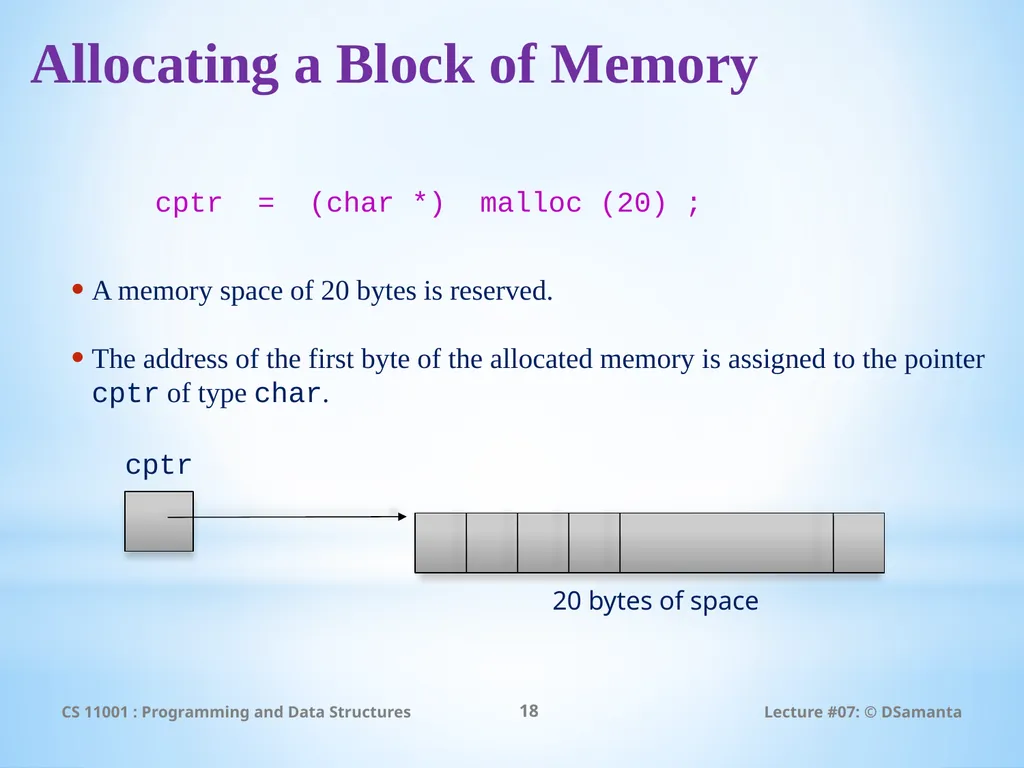
Allocating a Block of Memory cptr = (char *) malloc (20) ;
A memory space of 20 bytes is reserved.
The address of the first byte of the allocated memory is assigned to the pointer cptr of type char. CS 11001 : Programming and Data Structures 18 Lecture #07: © DSamanta cptr 20 bytes of space<br>
A memory space of 20 bytes is reserved.
The address of the first byte of the allocated memory is assigned to the pointer cptr of type char. CS 11001 : Programming and Data Structures 18 Lecture #07: © DSamanta cptr 20 bytes of space<br>
19
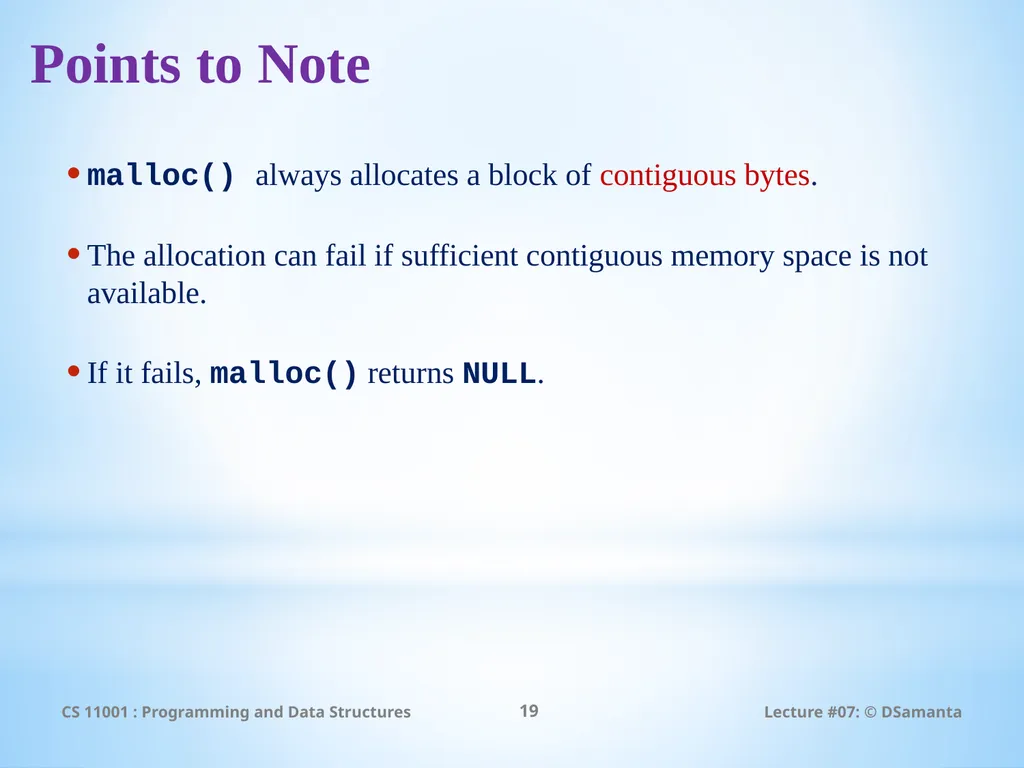
Points to Note malloc() always allocates a block of contiguous bytes.
The allocation can fail if sufficient contiguous memory space is not available.
If it fails, malloc() returns NULL. CS 11001 : Programming and Data Structures 19 Lecture #07: © DSamanta<br>
The allocation can fail if sufficient contiguous memory space is not available.
If it fails, malloc() returns NULL. CS 11001 : Programming and Data Structures 19 Lecture #07: © DSamanta<br>
20
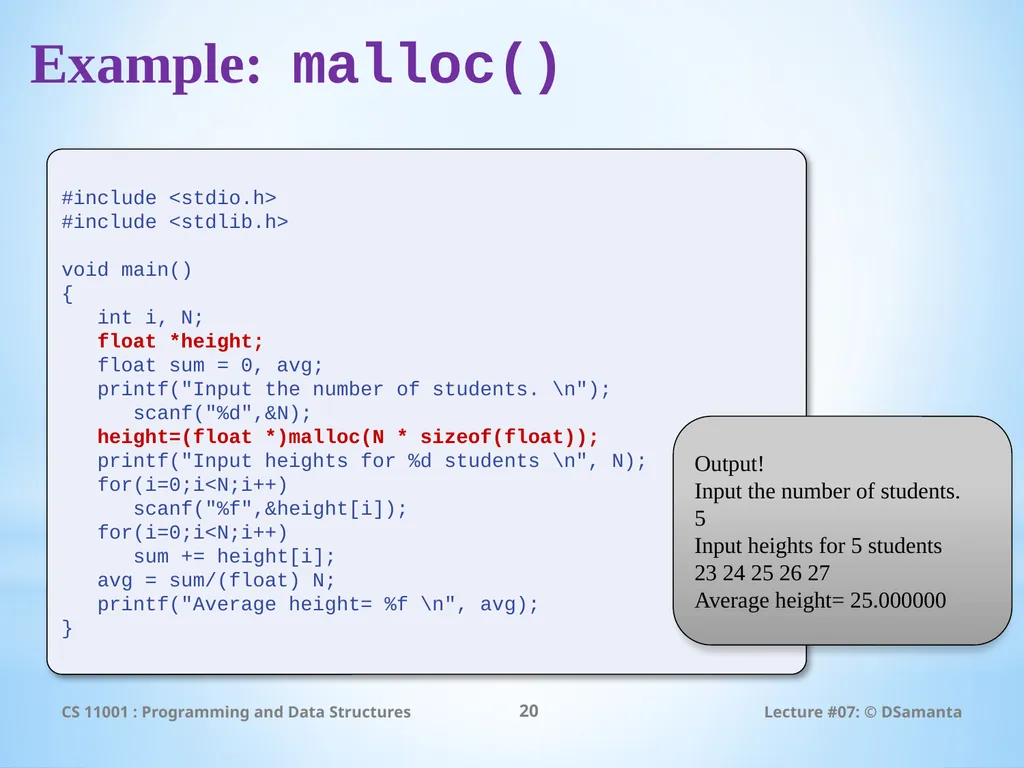
Example: malloc() CS 11001 : Programming and Data Structures 20 Lecture #07: © DSamanta #include <stdio.h>
#include <stdlib.h>
void main()
{
int i, N;
float *height;
float sum = 0, avg;
printf("Input the number of students. \n");
scanf("%d",&N);
height=(float *)malloc(N * sizeof(float));
printf("Input heights for %d students \n", N);
for(i=0;i<N;i++)
scanf("%f",&height[i]);
for(i=0;i<N;i++)
sum += height[i];
avg = sum/(float) N;
printf("Average height= %f \n", avg);
} Output!
Input the number of students.
5
Input heights for 5 students
23 24 25 26 27
Average height= 25.000000<br>
#include <stdlib.h>
void main()
{
int i, N;
float *height;
float sum = 0, avg;
printf("Input the number of students. \n");
scanf("%d",&N);
height=(float *)malloc(N * sizeof(float));
printf("Input heights for %d students \n", N);
for(i=0;i<N;i++)
scanf("%f",&height[i]);
for(i=0;i<N;i++)
sum += height[i];
avg = sum/(float) N;
printf("Average height= %f \n", avg);
} Output!
Input the number of students.
5
Input heights for 5 students
23 24 25 26 27
Average height= 25.000000<br>
21
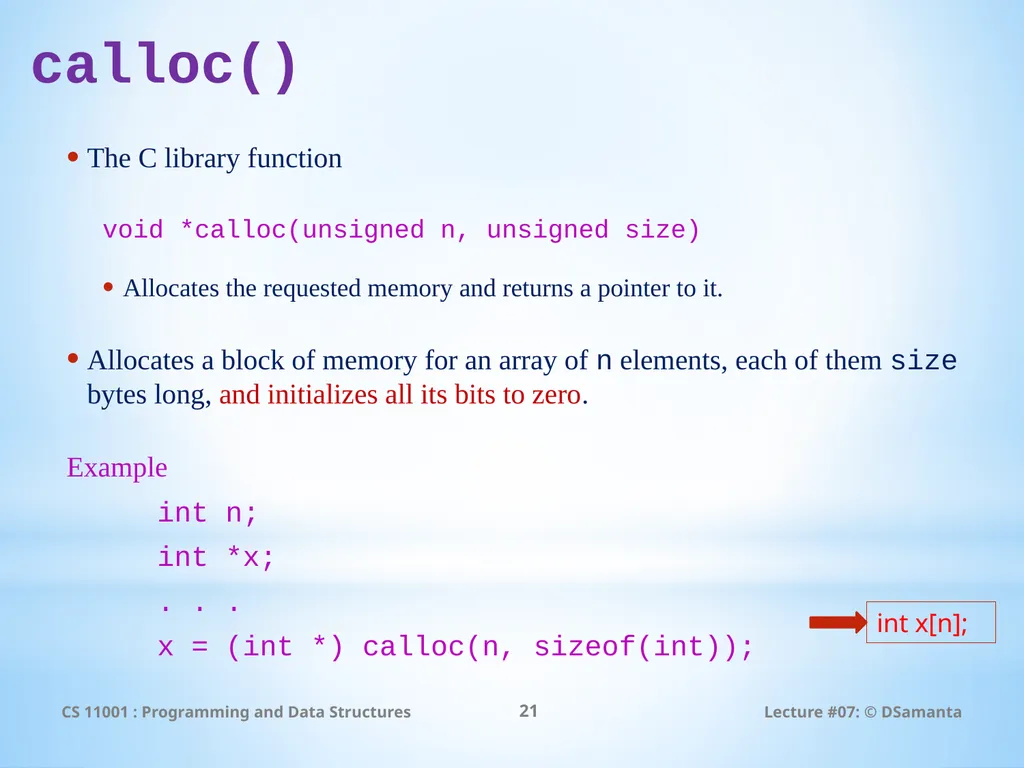
calloc() The C library function
void *calloc(unsigned n, unsigned size)
Allocates the requested memory and returns a pointer to it.
Allocates a block of memory for an array of n elements, each of them size bytes long, and initializes all its bits to zero.
Example
int n;
int *x;
. . .
x = (int *) calloc(n, sizeof(int)); CS 11001 : Programming and Data Structures 21 Lecture #07: © DSamanta int x[n];<br>
void *calloc(unsigned n, unsigned size)
Allocates the requested memory and returns a pointer to it.
Allocates a block of memory for an array of n elements, each of them size bytes long, and initializes all its bits to zero.
Example
int n;
int *x;
. . .
x = (int *) calloc(n, sizeof(int)); CS 11001 : Programming and Data Structures 21 Lecture #07: © DSamanta int x[n];<br>
22
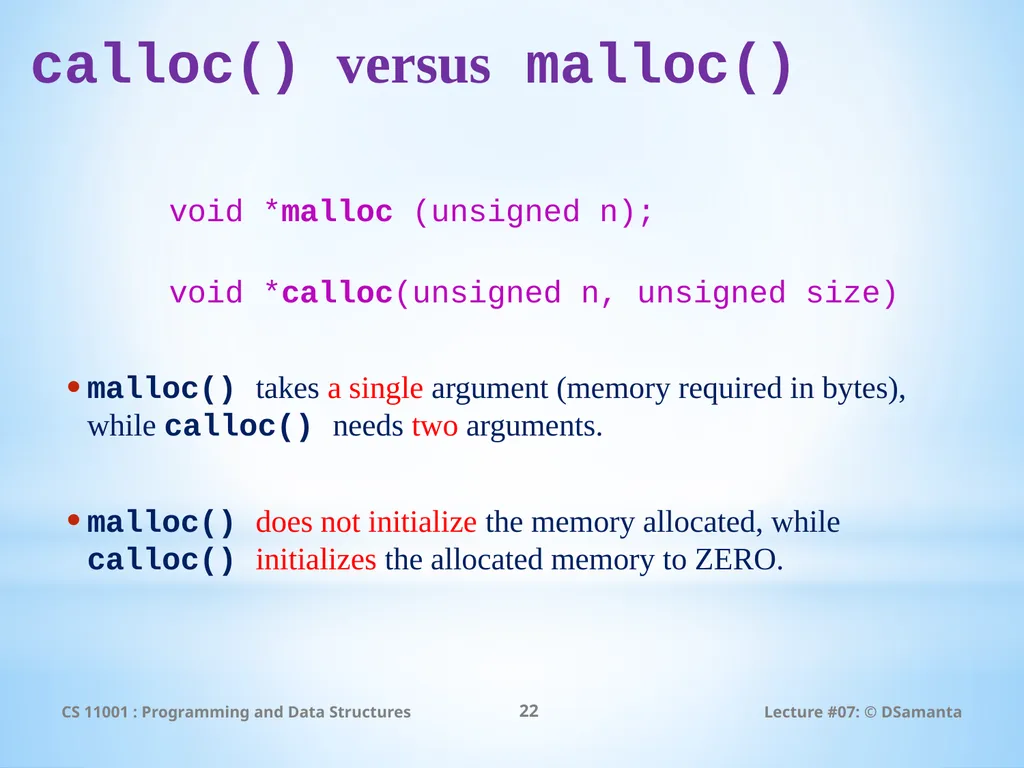
calloc() versus malloc() void *malloc (unsigned n);
void *calloc(unsigned n, unsigned size)
malloc() takes a single argument (memory required in bytes), while calloc() needs two arguments.
malloc() does not initialize the memory allocated, while calloc() initializes the allocated memory to ZERO. CS 11001 : Programming and Data Structures 22 Lecture #07: © DSamanta<br>
void *calloc(unsigned n, unsigned size)
malloc() takes a single argument (memory required in bytes), while calloc() needs two arguments.
malloc() does not initialize the memory allocated, while calloc() initializes the allocated memory to ZERO. CS 11001 : Programming and Data Structures 22 Lecture #07: © DSamanta<br>
23
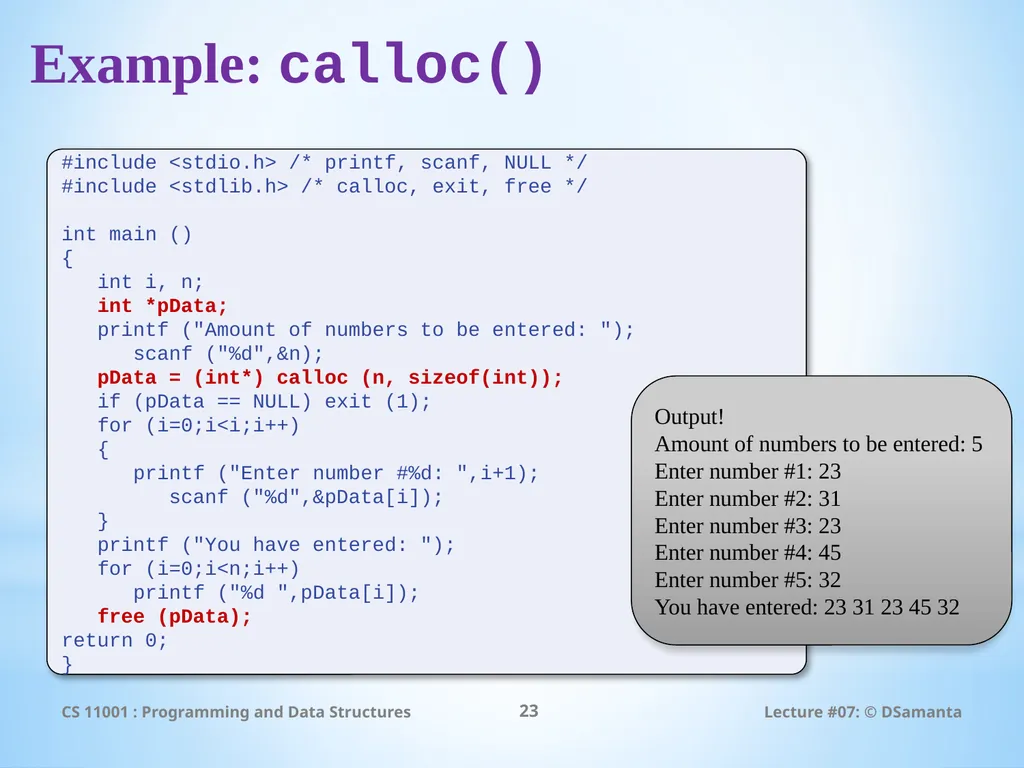
Example: calloc() CS 11001 : Programming and Data Structures 23 Lecture #07: © DSamanta #include <stdio.h> /* printf, scanf, NULL */
#include <stdlib.h> /* calloc, exit, free */
int main ()
{
int i, n;
int *pData;
printf ("Amount of numbers to be entered: ");
scanf ("%d",&n);
pData = (int*) calloc (n, sizeof(int));
if (pData == NULL) exit (1);
for (i=0;i<i;i++)
{
printf ("Enter number #%d: ",i+1);
scanf ("%d",&pData[i]);
}
printf ("You have entered: ");
for (i=0;i<n;i++)
printf ("%d ",pData[i]);
free (pData);
return 0;
} Output!
Amount of numbers to be entered: 5
Enter number #1: 23
Enter number #2: 31
Enter number #3: 23
Enter number #4: 45
Enter number #5: 32
You have entered: 23 31 23 45 32<br>
#include <stdlib.h> /* calloc, exit, free */
int main ()
{
int i, n;
int *pData;
printf ("Amount of numbers to be entered: ");
scanf ("%d",&n);
pData = (int*) calloc (n, sizeof(int));
if (pData == NULL) exit (1);
for (i=0;i<i;i++)
{
printf ("Enter number #%d: ",i+1);
scanf ("%d",&pData[i]);
}
printf ("You have entered: ");
for (i=0;i<n;i++)
printf ("%d ",pData[i]);
free (pData);
return 0;
} Output!
Amount of numbers to be entered: 5
Enter number #1: 23
Enter number #2: 31
Enter number #3: 23
Enter number #4: 45
Enter number #5: 32
You have entered: 23 31 23 45 32<br>
24
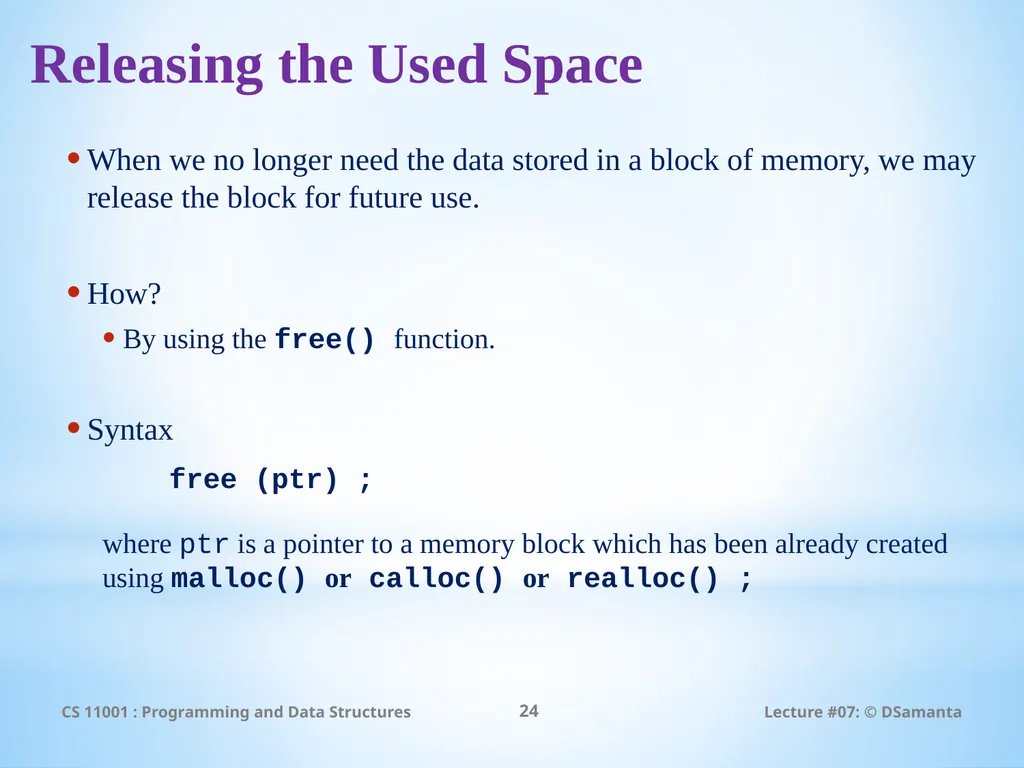
Releasing the Used Space When we no longer need the data stored in a block of memory, we may release the block for future use.
How?
By using the free() function.
Syntax
free (ptr) ;
where ptr is a pointer to a memory block which has been already created using malloc() or calloc() or realloc() ; CS 11001 : Programming and Data Structures 24 Lecture #07: © DSamanta<br>
How?
By using the free() function.
Syntax
free (ptr) ;
where ptr is a pointer to a memory block which has been already created using malloc() or calloc() or realloc() ; CS 11001 : Programming and Data Structures 24 Lecture #07: © DSamanta<br>
25
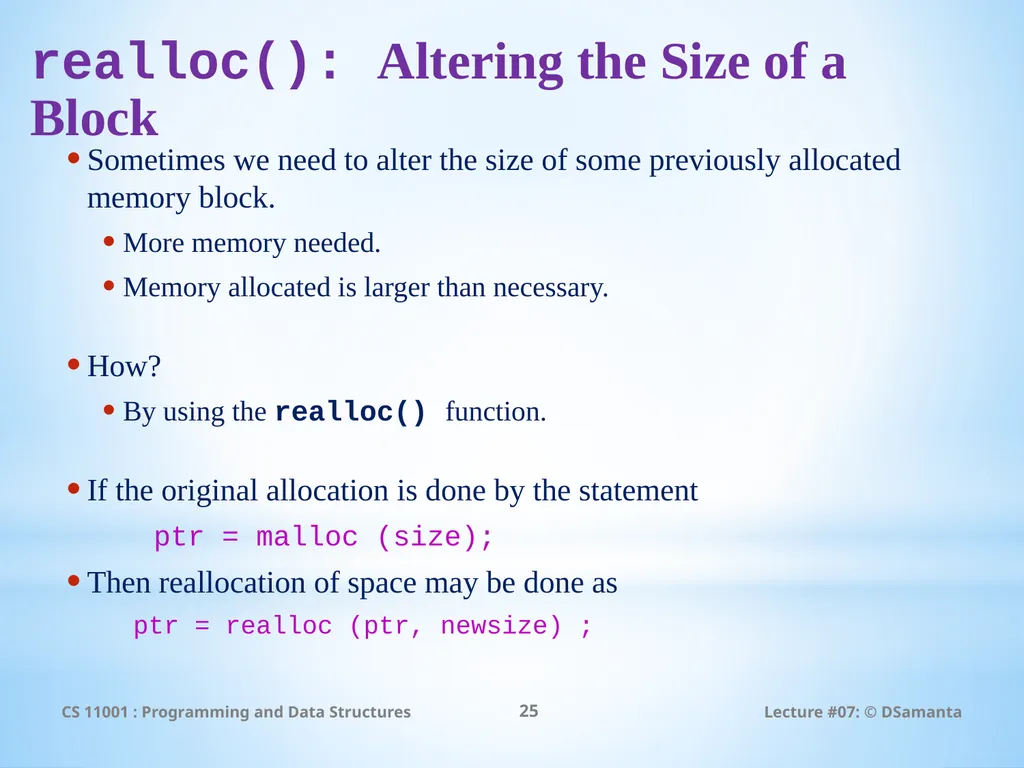
realloc(): Altering the Size of a Block Sometimes we need to alter the size of some previously allocated memory block.
More memory needed.
Memory allocated is larger than necessary.
How?
By using the realloc() function.
If the original allocation is done by the statement
ptr = malloc (size);
Then reallocation of space may be done as
ptr = realloc (ptr, newsize) ; CS 11001 : Programming and Data Structures 25 Lecture #07: © DSamanta<br>
More memory needed.
Memory allocated is larger than necessary.
How?
By using the realloc() function.
If the original allocation is done by the statement
ptr = malloc (size);
Then reallocation of space may be done as
ptr = realloc (ptr, newsize) ; CS 11001 : Programming and Data Structures 25 Lecture #07: © DSamanta<br>
26
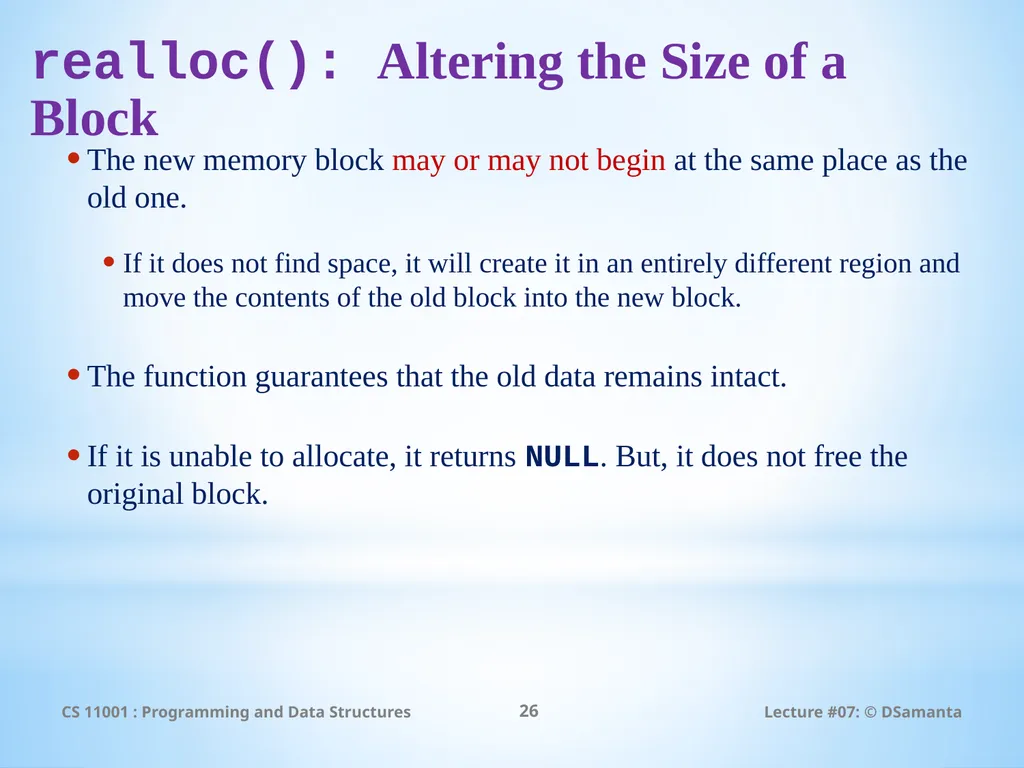
realloc(): Altering the Size of a Block The new memory block may or may not begin at the same place as the old one.
If it does not find space, it will create it in an entirely different region and move the contents of the old block into the new block.
The function guarantees that the old data remains intact.
If it is unable to allocate, it returns NULL. But, it does not free the original block. CS 11001 : Programming and Data Structures 26 Lecture #07: © DSamanta<br>
If it does not find space, it will create it in an entirely different region and move the contents of the old block into the new block.
The function guarantees that the old data remains intact.
If it is unable to allocate, it returns NULL. But, it does not free the original block. CS 11001 : Programming and Data Structures 26 Lecture #07: © DSamanta<br>
27
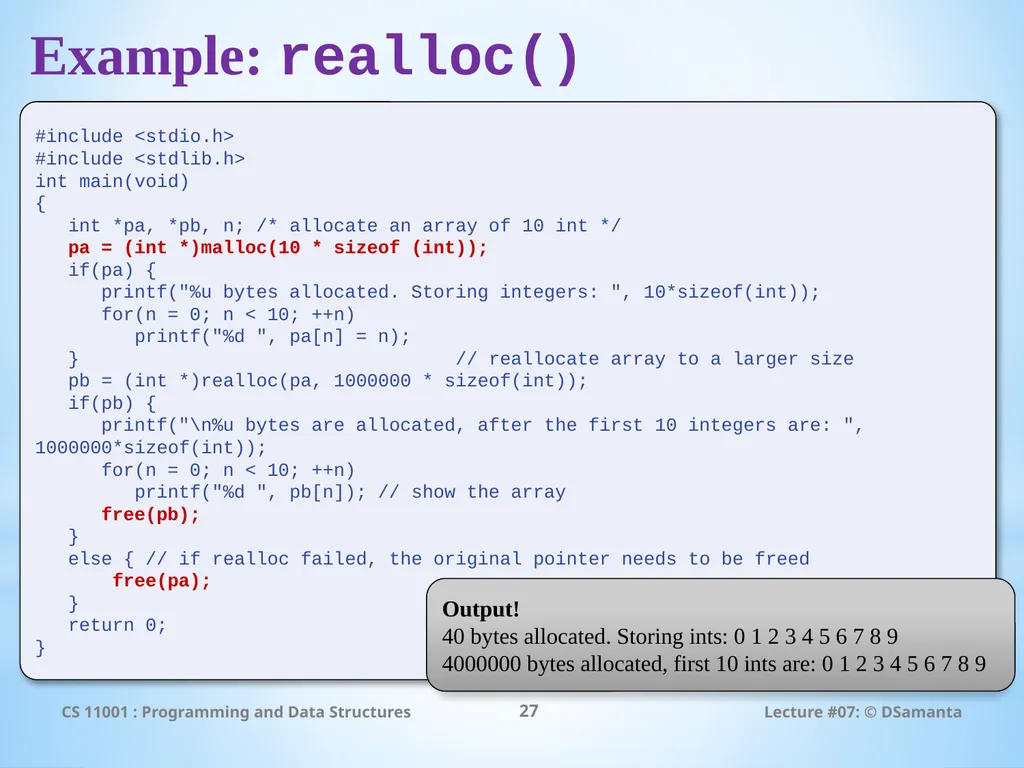
Example: realloc() CS 11001 : Programming and Data Structures 27 Lecture #07: © DSamanta #include <stdio.h>
#include <stdlib.h>
int main(void)
{
int *pa, *pb, n; /* allocate an array of 10 int */
pa = (int *)malloc(10 * sizeof (int));
if(pa) {
printf("%u bytes allocated. Storing integers: ", 10*sizeof(int));
for(n = 0; n < 10; ++n)
printf("%d ", pa[n] = n);
} // reallocate array to a larger size
pb = (int *)realloc(pa, 1000000 * sizeof(int));
if(pb) {
printf("\n%u bytes are allocated, after the first 10 integers are: ", 1000000*sizeof(int));
for(n = 0; n < 10; ++n)
printf("%d ", pb[n]); // show the array
free(pb);
}
else { // if realloc failed, the original pointer needs to be freed
free(pa);
}
return 0;
} Output!
40 bytes allocated. Storing ints: 0 1 2 3 4 5 6 7 8 9
4000000 bytes allocated, first 10 ints are: 0 1 2 3 4 5 6 7 8 9<br>
#include <stdlib.h>
int main(void)
{
int *pa, *pb, n; /* allocate an array of 10 int */
pa = (int *)malloc(10 * sizeof (int));
if(pa) {
printf("%u bytes allocated. Storing integers: ", 10*sizeof(int));
for(n = 0; n < 10; ++n)
printf("%d ", pa[n] = n);
} // reallocate array to a larger size
pb = (int *)realloc(pa, 1000000 * sizeof(int));
if(pb) {
printf("\n%u bytes are allocated, after the first 10 integers are: ", 1000000*sizeof(int));
for(n = 0; n < 10; ++n)
printf("%d ", pb[n]); // show the array
free(pb);
}
else { // if realloc failed, the original pointer needs to be freed
free(pa);
}
return 0;
} Output!
40 bytes allocated. Storing ints: 0 1 2 3 4 5 6 7 8 9
4000000 bytes allocated, first 10 ints are: 0 1 2 3 4 5 6 7 8 9<br>
28
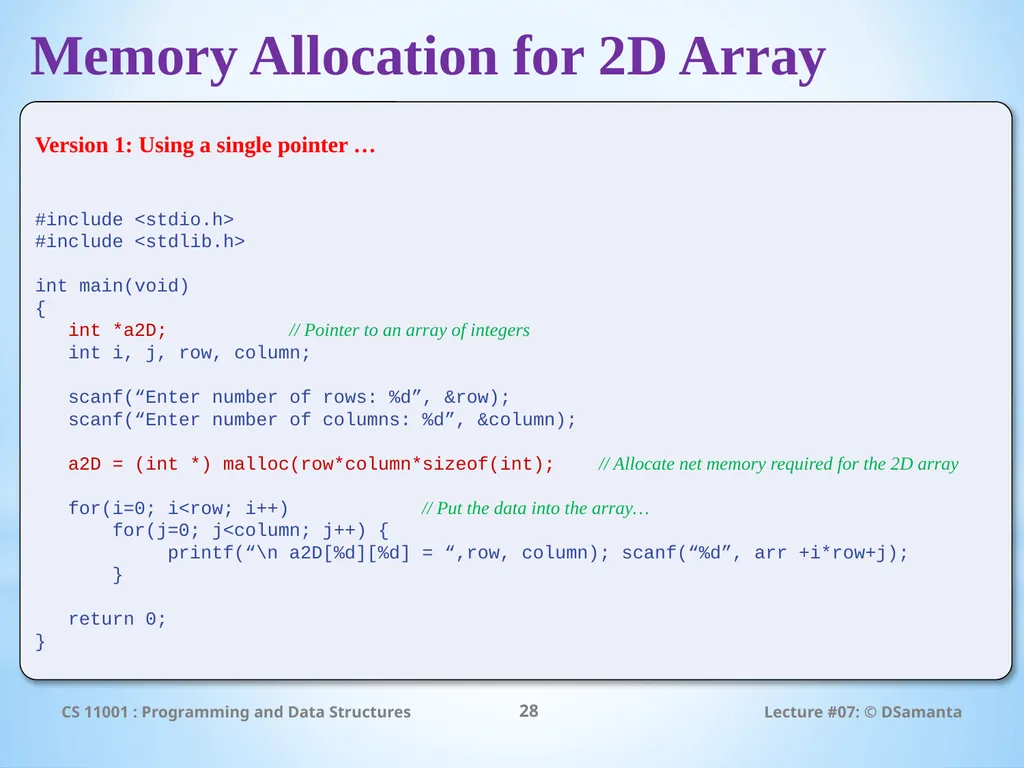
Memory Allocation for 2D Array CS 11001 : Programming and Data Structures 28 Lecture #07: © DSamanta Version 1: Using a single pointer …
#include <stdio.h>
#include <stdlib.h>
int main(void)
{
int *a2D; // Pointer to an array of integers
int i, j, row, column;
scanf(“Enter number of rows: %d”, &row);
scanf(“Enter number of columns: %d”, &column);
a2D = (int *) malloc(row*column*sizeof(int); // Allocate net memory required for the 2D array
for(i=0; i<row; i++) // Put the data into the array…
for(j=0; j<column; j++) {
printf(“\n a2D[%d][%d] = “,row, column); scanf(“%d”, arr +i*row+j);
}
return 0;
}<br>
#include <stdio.h>
#include <stdlib.h>
int main(void)
{
int *a2D; // Pointer to an array of integers
int i, j, row, column;
scanf(“Enter number of rows: %d”, &row);
scanf(“Enter number of columns: %d”, &column);
a2D = (int *) malloc(row*column*sizeof(int); // Allocate net memory required for the 2D array
for(i=0; i<row; i++) // Put the data into the array…
for(j=0; j<column; j++) {
printf(“\n a2D[%d][%d] = “,row, column); scanf(“%d”, arr +i*row+j);
}
return 0;
}<br>
29
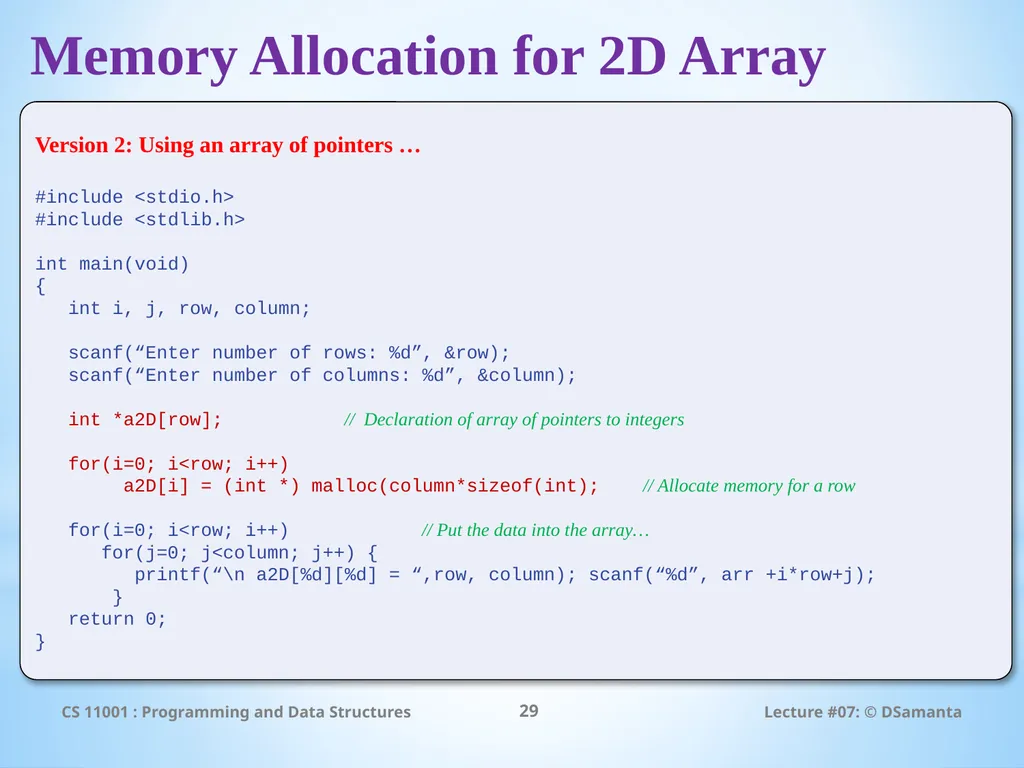
Memory Allocation for 2D Array CS 11001 : Programming and Data Structures 29 Lecture #07: © DSamanta Version 2: Using an array of pointers …
#include <stdio.h>
#include <stdlib.h>
int main(void)
{
int i, j, row, column;
scanf(“Enter number of rows: %d”, &row);
scanf(“Enter number of columns: %d”, &column);
int *a2D[row]; // Declaration of array of pointers to integers
for(i=0; i<row; i++)
a2D[i] = (int *) malloc(column*sizeof(int); // Allocate memory for a row
for(i=0; i<row; i++) // Put the data into the array…
for(j=0; j<column; j++) {
printf(“\n a2D[%d][%d] = “,row, column); scanf(“%d”, arr +i*row+j);
}
return 0;
}<br>
#include <stdio.h>
#include <stdlib.h>
int main(void)
{
int i, j, row, column;
scanf(“Enter number of rows: %d”, &row);
scanf(“Enter number of columns: %d”, &column);
int *a2D[row]; // Declaration of array of pointers to integers
for(i=0; i<row; i++)
a2D[i] = (int *) malloc(column*sizeof(int); // Allocate memory for a row
for(i=0; i<row; i++) // Put the data into the array…
for(j=0; j<column; j++) {
printf(“\n a2D[%d][%d] = “,row, column); scanf(“%d”, arr +i*row+j);
}
return 0;
}<br>
30
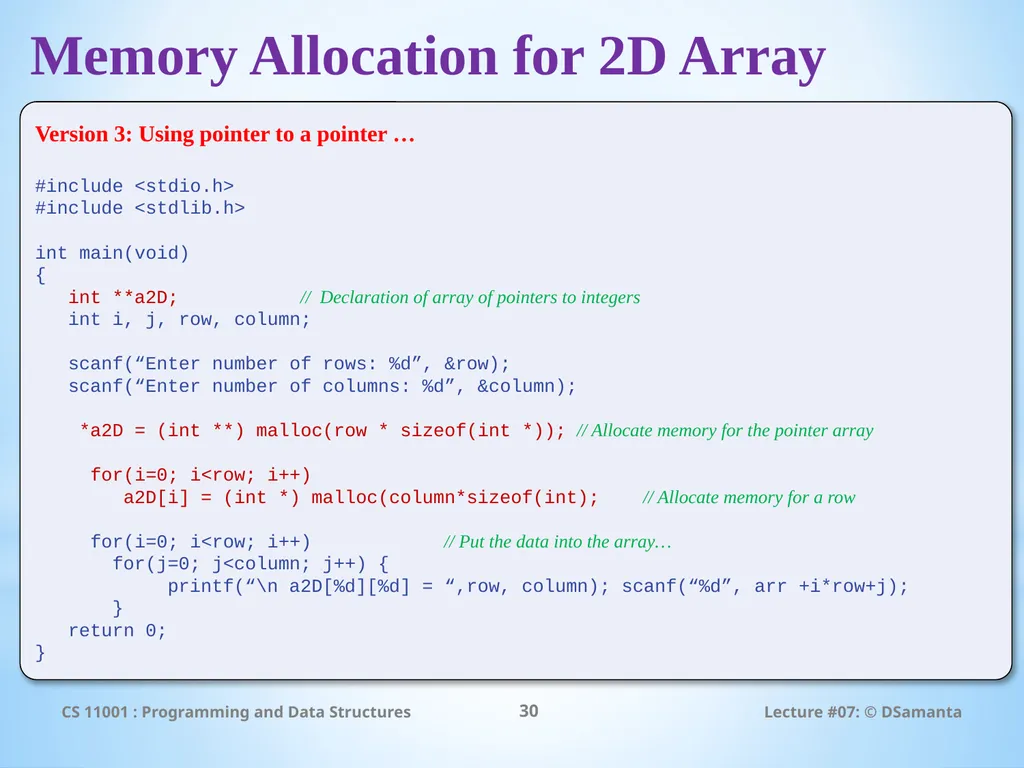
Memory Allocation for 2D Array CS 11001 : Programming and Data Structures 30 Lecture #07: © DSamanta Version 3: Using pointer to a pointer …
#include <stdio.h>
#include <stdlib.h>
int main(void)
{
int **a2D; // Declaration of array of pointers to integers
int i, j, row, column;
scanf(“Enter number of rows: %d”, &row);
scanf(“Enter number of columns: %d”, &column);
*a2D = (int **) malloc(row * sizeof(int *)); // Allocate memory for the pointer array
for(i=0; i<row; i++)
a2D[i] = (int *) malloc(column*sizeof(int); // Allocate memory for a row
for(i=0; i<row; i++) // Put the data into the array…
for(j=0; j<column; j++) {
printf(“\n a2D[%d][%d] = “,row, column); scanf(“%d”, arr +i*row+j);
}
return 0;
}<br>
#include <stdio.h>
#include <stdlib.h>
int main(void)
{
int **a2D; // Declaration of array of pointers to integers
int i, j, row, column;
scanf(“Enter number of rows: %d”, &row);
scanf(“Enter number of columns: %d”, &column);
*a2D = (int **) malloc(row * sizeof(int *)); // Allocate memory for the pointer array
for(i=0; i<row; i++)
a2D[i] = (int *) malloc(column*sizeof(int); // Allocate memory for a row
for(i=0; i<row; i++) // Put the data into the array…
for(j=0; j<column; j++) {
printf(“\n a2D[%d][%d] = “,row, column); scanf(“%d”, arr +i*row+j);
}
return 0;
}<br>
31
Any question? You may post your question(s) at the “Discussion Forum” maintained in the course Web page. CS 11001 : Programming and Data Structures 31 Lecture #07: © DSamanta<br>
32
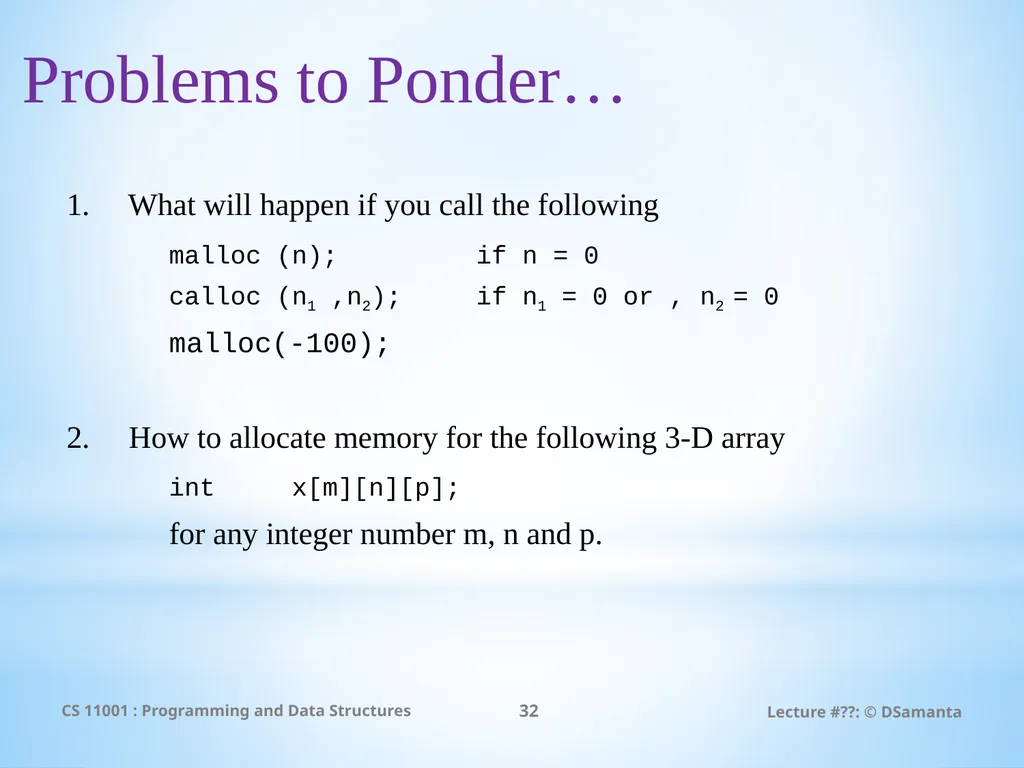
Problems to Ponder… CS 11001 : Programming and Data Structures 32 Lecture #??: © DSamanta 1. What will happen if you call the following
malloc (n); if n = 0
calloc (n1 ,n2); if n1 = 0 or , n2 = 0
malloc(-100);
2. How to allocate memory for the following 3-D array
int x[m][n][p];
for any integer number m, n and p.<br>
malloc (n); if n = 0
calloc (n1 ,n2); if n1 = 0 or , n2 = 0
malloc(-100);
2. How to allocate memory for the following 3-D array
int x[m][n][p];
for any integer number m, n and p.<br>
33
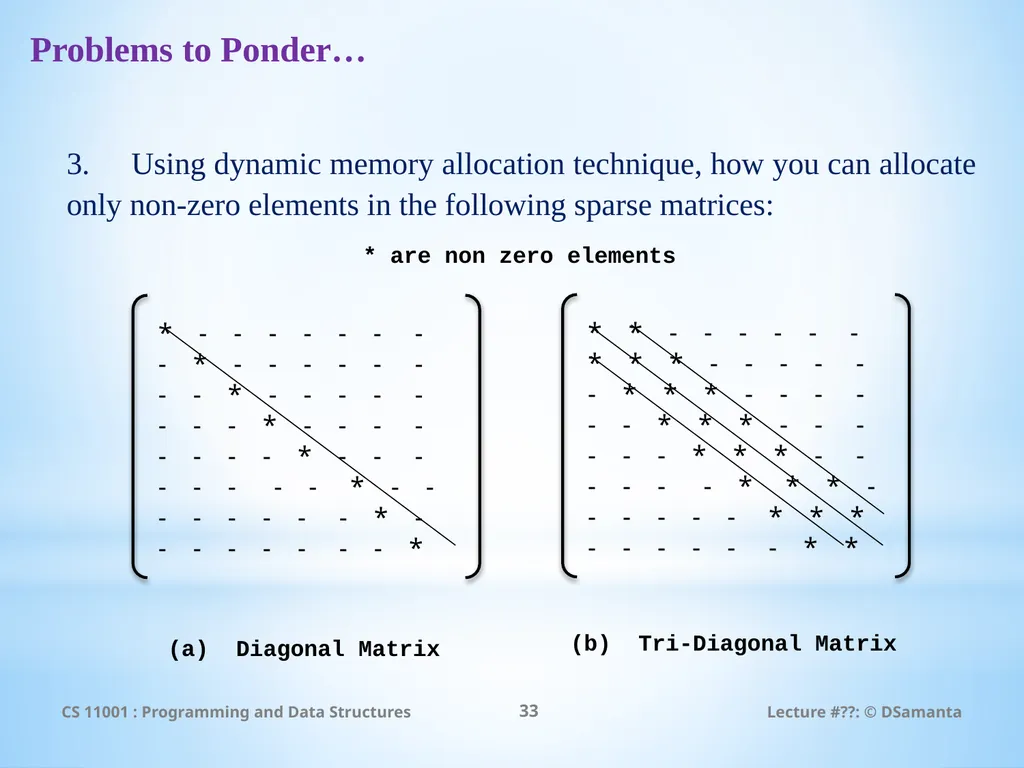
Problems to Ponder… 3. Using dynamic memory allocation technique, how you can allocate only non-zero elements in the following sparse matrices: CS 11001 : Programming and Data Structures 33 Lecture #??: © DSamanta (a) Diagonal Matrix (b) Tri-Diagonal Matrix * are non zero elements<br>
34
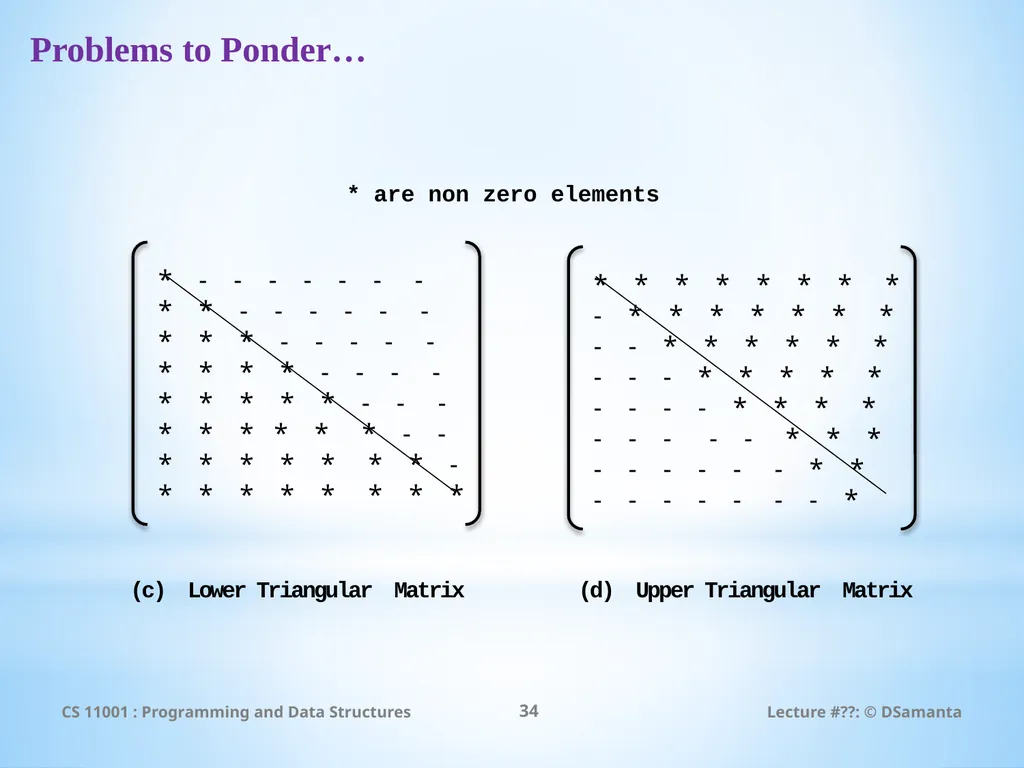
Problems to Ponder… CS 11001 : Programming and Data Structures 34 Lecture #??: © DSamanta (c) Lower Triangular Matrix (d) Upper Triangular Matrix * are non zero elements<br>