
Denotative meaning and translation issues
CS
Published · 40 slides · 0 views
1 / 1





Description
Denotative meaning and translation issues Presented by: Maryam Wissam and Ayat Amer Denotative meaning 2 Translation is concerned with meaning. But, as has already become very clear, the term meaning is elastic and indeterminate,
Related Topics
Share
Embed code
Download this presentation From Below
"Denotative meaning and translation issues" is the property of its rightful owner. Permission is granted to download and print the materials on this website for personal, non-commercial use only, and to display it on your personal computer provided you do not modify the materials and that you retain all copyright notices contained in the materials. By downloading content from our website, you accept the terms of this agreement.
Presentation Transcript
01
Denotative meaning and
translation issues Presented by:
Maryam Wissam and Ayat Amer<br>
Maryam Wissam and Ayat Amer<br>
02
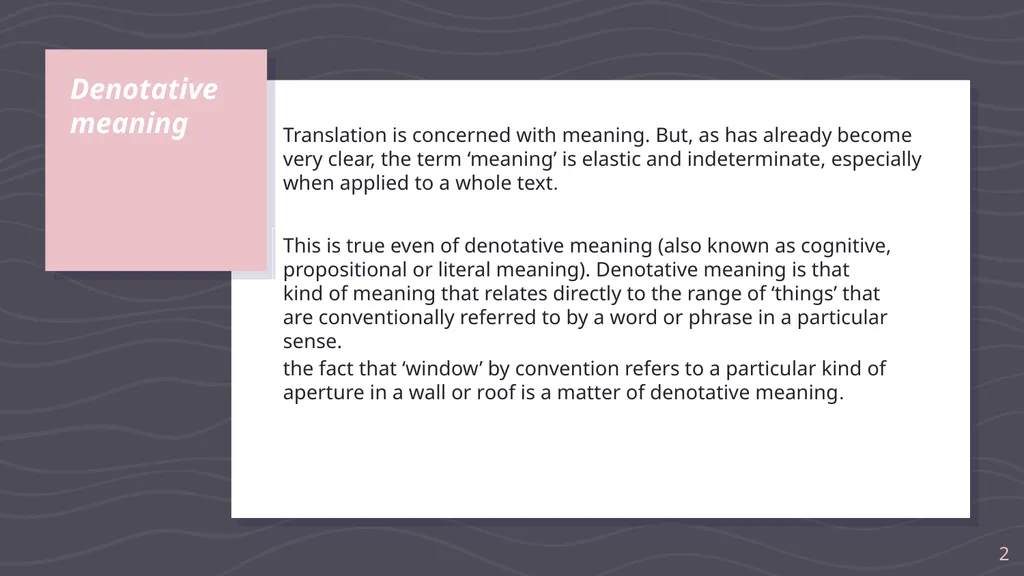
Denotative meaning 2 Translation is concerned with meaning. But, as has already become very clear, the term ‘meaning’ is elastic and indeterminate, especially when applied to a whole text. This is true even of denotative meaning (also known as cognitive, propositional or literal meaning). Denotative meaning is that kind of meaning that relates directly to the range of ‘things’ that are conventionally referred to by a word or phrase in a particular sense. the fact that ‘window’ by convention refers to a particular kind of aperture in a wall or roof is a matter of denotative meaning.<br>
03
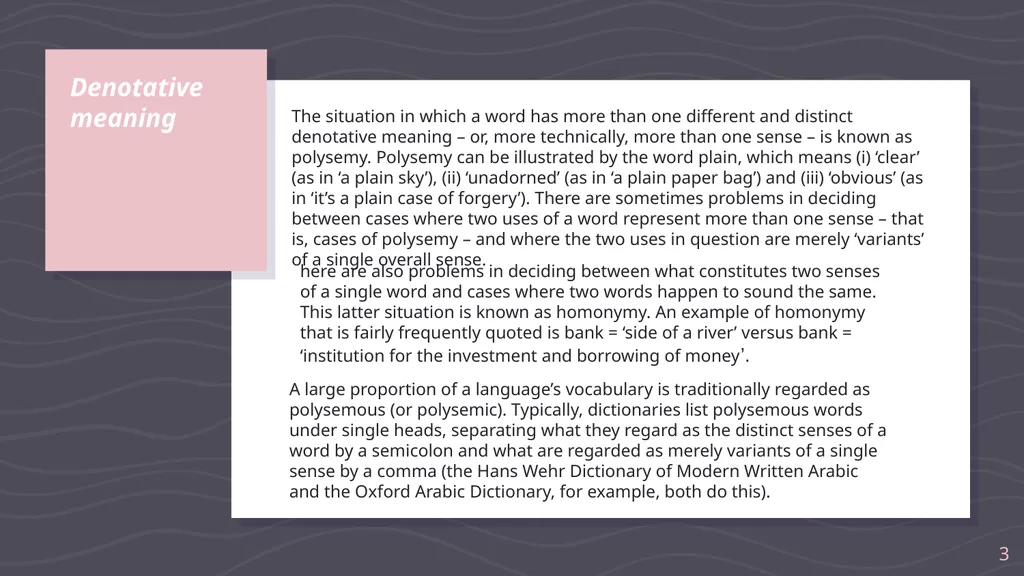
Denotative meaning 3 The situation in which a word has more than one different and distinct denotative meaning – or, more technically, more than one sense – is known as polysemy. Polysemy can be illustrated by the word plain, which means (i) ‘clear’ (as in ‘a plain sky’), (ii) ‘unadorned’ (as in ‘a plain paper bag’) and (iii) ‘obvious’ (as in ‘it’s a plain case of forgery’). There are sometimes problems in deciding between cases where two uses of a word represent more than one sense – that is, cases of polysemy – and where the two uses in question are merely ‘variants’ of a single overall sense. here are also problems in deciding between what constitutes two senses of a single word and cases where two words happen to sound the same. This latter situation is known as homonymy. An example of homonymy that is fairly frequently quoted is bank = ‘side of a river’ versus bank = ‘institution for the investment and borrowing of money’. A large proportion of a language’s vocabulary is traditionally regarded as polysemous (or polysemic). Typically, dictionaries list polysemous words under single heads, separating what they regard as the distinct senses of a word by a semicolon and what are regarded as merely variants of a single sense by a comma (the Hans Wehr Dictionary of Modern Written Arabic and the Oxford Arabic Dictionary, for example, both do this).<br>
04
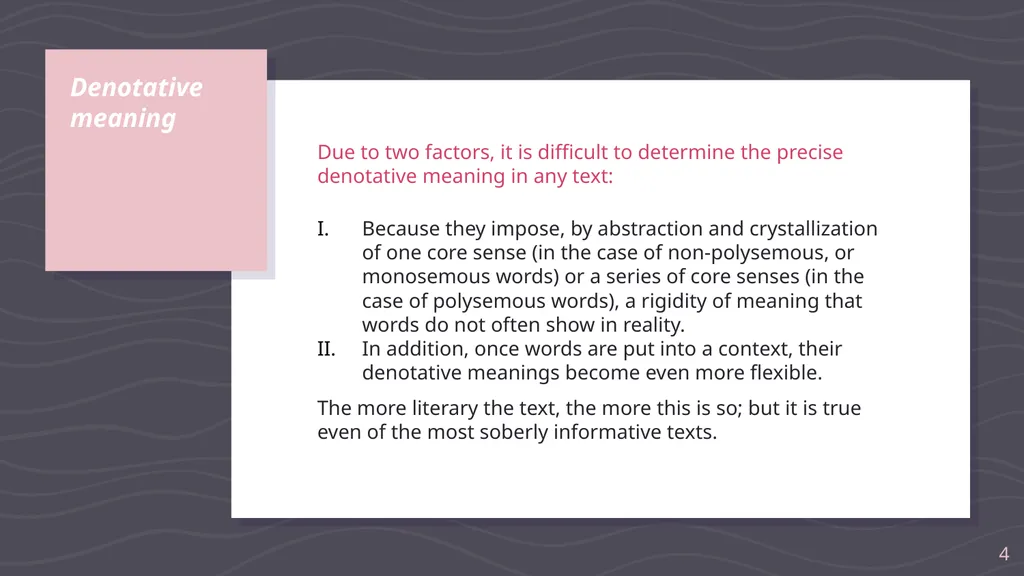
Denotative meaning 4 Due to two factors, it is difficult to determine the precise denotative meaning in any text: Because they impose, by abstraction and crystallization of one core sense (in the case of non-polysemous, or monosemous words) or a series of core senses (in the case of polysemous words), a rigidity of meaning that words do not often show in reality.
In addition, once words are put into a context, their denotative meanings become even more flexible. The more literary the text, the more this is so; but it is true even of the most soberly informative texts.<br>
In addition, once words are put into a context, their denotative meanings become even more flexible. The more literary the text, the more this is so; but it is true even of the most soberly informative texts.<br>
05
1 5 Synonymy<br>
06
Synonymy Denotative meaning is a matter of categories into which a language divides the totality of communicable experience. So, for example, the denotative meaning of the word ‘pencil’ (in the relevant sense) consists of the fact that all over the world one may find similar objects that are included in the category of ‘pencil’ – and of course all sorts of other objects that are excluded from it.
To define a denotative meaning is to specify a ‘range’ covered by a word or phrase (in the relevant sense) in such a way that one knows what items are included in that range or category and what items are excluded. It is helpful to visualize denotative meanings as rectangles, because rectangles can represent intersections between categories.
In exploring correspondence between denotative meanings, it is these intersections that are most significant, because they provide a kind of measure of semantic equivalence. So, for instance, the expressions ‘my mother’s father’ and ‘my maternal grandfather’ may be represented as two separate rectangles. The two ranges of denotative meaning, however, coincide perfectly: that is, in every specific instance of use, ‘my mother’s father’ and ‘my maternal grandfather’ include and exclude exactly the same referents. This can be visualized as sliding the two rectangles on top of each other and finding that they are the same size and cover each other exactly.<br>
07
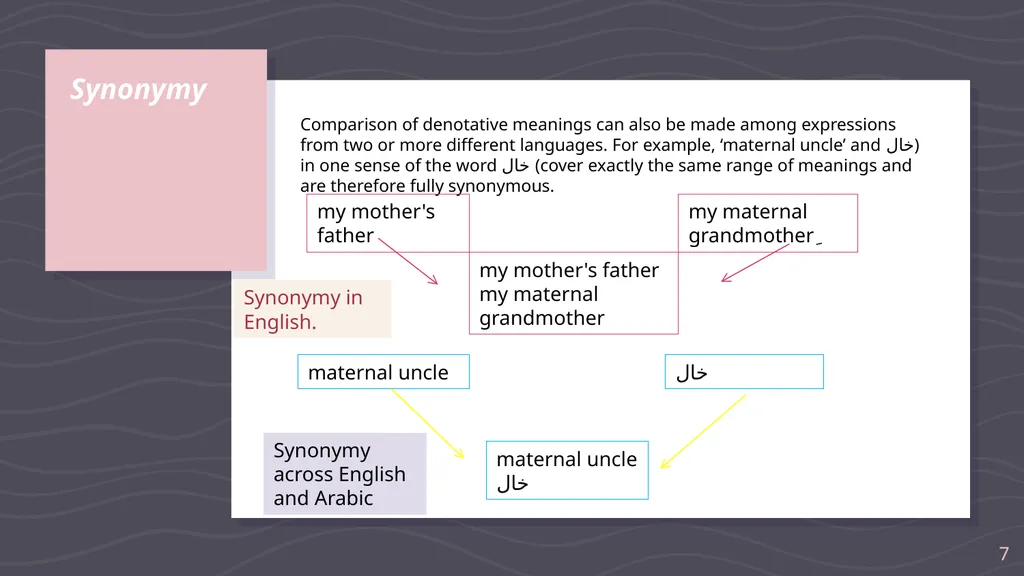
Synonymy 7 Comparison of denotative meanings can also be made among expressions from two or more different languages. For example, ‘maternal uncle’ and خال) in one sense of the word خال (cover exactly the same range of meanings and are therefore fully synonymous. my mother's father my maternal grandmotherِ my mother's father my maternal grandmother Synonymy in English. خال maternal uncle maternal uncle
خال Synonymy across English and Arabic<br>
خال Synonymy across English and Arabic<br>
08
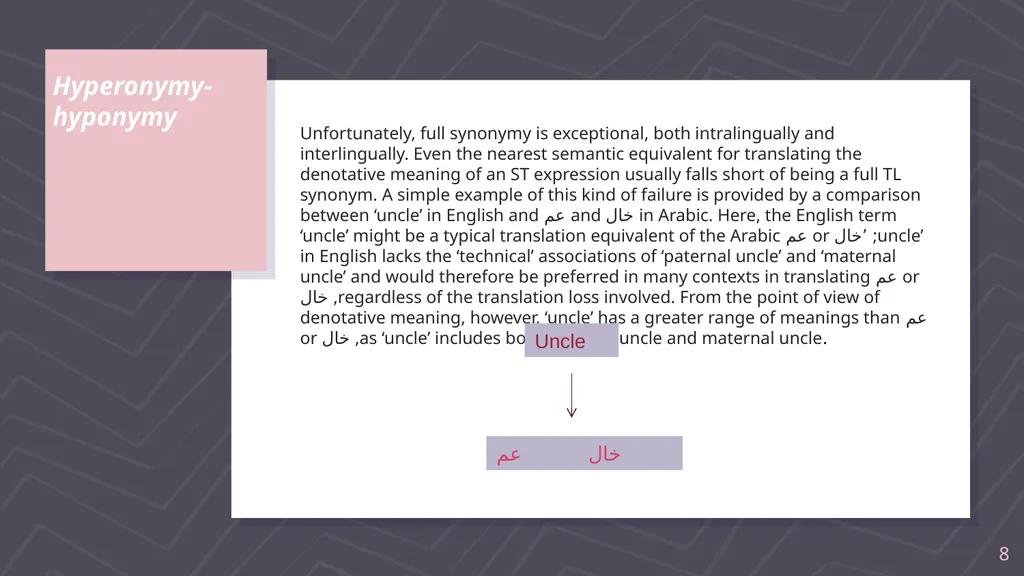
8 Hyperonymy-hyponymy Unfortunately, full synonymy is exceptional, both intralingually and interlingually. Even the nearest semantic equivalent for translating the denotative meaning of an ST expression usually falls short of being a full TL synonym. A simple example of this kind of failure is provided by a comparison between ‘uncle’ in English and عم and خال in Arabic. Here, the English term ‘uncle’ might be a typical translation equivalent of the Arabic عم or خال’ ;uncle’ in English lacks the ‘technical’ associations of ‘paternal uncle’ and ‘maternal uncle’ and would therefore be preferred in many contexts in translating عم or خال ,regardless of the translation loss involved. From the point of view of denotative meaning, however, ‘uncle’ has a greater range of meanings than عم or خال ,as ‘uncle’ includes both paternal uncle and maternal uncle. Uncle خال عم<br>
09
9 The relationship between ‘uncle’ and عم and between ‘uncle’ and خال is known as hyperonymy-hyponymy. An expression with a wider, less specific range of denotative meaning is a hyperonym (or superordinate) of one with a narrower and more specific meaning. Conversely, an expression with a narrower, more specific range of denotative meaning is a hyponym of one with a wider meaning. Thus عم and خال are both hyponyms of ‘uncle’. Hyperonymy-hyponymy is so widespread in all languages that one can say that the entire fabric of linguistic reference is built on such relationships. The same external reality can be described and rephrased in an indefinite number of ways, depending on how precise or vague one wants to be – compare ‘I bought a Hans Wehr’ with these increasingly general rephrasings : ‘I bought an Arabic dictionary’, ‘I bought a dictionary’, ‘I bought a book’, ‘I bought something’. Each of these rephrasings is a hyperonym of the ones before it. By its very nature, translation is concerned with rephrasing in such a way as to lose as little as possible of the integrity of an ST message. All other things being equal, this includes its degree of precision or vagueness. Therefore, the fact that both a hyperonym and a hyponym can serve for conveying a given message is of great importance to translation practice. It means that when there is no full TL synonym for a given ST expression (e.g. ‘uncle’), the translator must look for an appropriate TL hyperonym or hyponym. In fact, translators do this automatically. This is obvious from the translation of pronouns between Arabic and English. English has one second-person pronoun ‘you’, which serves to address one, two or more people or animals. English ‘you’ also makes no distinction between the sex of the person or animal being addressed Arabic has five second-person pronouns: أنتم ,أنتما ,أنت , ِ أنت َ and أنتن َّ , involving distinctions between singular, dual and plural, as well as masculine and feminine.<br>
10
Particularizing translation and generalizing translation<br>
11
Particularizing translation and generalizing translation Translating by a hyponym implies that the TT expression has a narrower and more specific denotative meaning than the ST expression. TT خال is more specific than ST ‘uncle’, adding particulars not present in the ST expression. We shall call this ‘particularizing translation’, or particularization for short. Another example of particularizing translation is the translation صندوق ,which could be used for either a ‘box’ or a ‘bin’.
In the case of a street sweeper putting his rubbish into a صندوق ,the more plausible translation would be ‘bin’, while in the case of someone packing their books up to move them, the more plausible translation would be ‘box’.
Translating by a hyperonym implies that the TT expression has a wider and less specific denotative meaning than the ST expression. In translating from Arabic to English, TT ‘uncle’ is more general than ST عم) or خال ,(omitting particulars given by the ST. We shall call this ‘generalizing translation’, or generalization for short. Translating جلابیة as ‘garment’ or مزمار as ‘pipe’ are other examples of generalization. 11<br>
12
Particularizing In their semantic near-equivalence, particularization and generalization both entail a degree of translation loss: detail is either added to, or omitted from, the ST text. However, in the absence of plausible synonyms, translating by a hyponym or hyperonym is standard practice and entirely unremarkable. Only when a TL hyponym or hyperonym is unnecessary, contextually inappropriate or misleading can a TT be criticized in this respect.
Particularizing translation is acceptable if the TL offers no suitable alternative and if the added detail does not clash with the overall context of the ST or the TT. Thus, بلد in Arabic means ‘country, town, city, place, community, village’ (Wehr). There is no single word in English that covers all of these possibilities; therefore, in a particular context, the translator is likely to have to choose the one that he or she feels is most appropriate. Other situations in which particularization is acceptable include the follow: 12<br>
Particularizing translation is acceptable if the TL offers no suitable alternative and if the added detail does not clash with the overall context of the ST or the TT. Thus, بلد in Arabic means ‘country, town, city, place, community, village’ (Wehr). There is no single word in English that covers all of these possibilities; therefore, in a particular context, the translator is likely to have to choose the one that he or she feels is most appropriate. Other situations in which particularization is acceptable include the follow: 12<br>
13
13 where the context implies something that is typically referred to in more specific terms in the TL than in the SL; thus, an إنذار issued by a military commander is likely to be an ‘ultimatum’ rather than simply a ‘warning’; a بیان in a similar context is likely to be a ‘proclamation’ or a ‘communique’ rather than a ‘statement’; غارات in the context of NATO raids on Kosovo is likely to be ‘strikes’ or ‘air strikes’ rather than ‘attacks’.
where the TL typically makes use of a specific collocation that happens to involve a hyponym of the TL form; for example, ثمین كنز is likely to be translated as ‘priceless treasure’ rather than as ‘valuable treasure’, as ‘priceless treasure’ is the more common collocation in English. Particularizing translation may also be used for other reasons. For example, كنیسة قدیمة might be translated as ‘ancient church’ in a particular context where this was appropriate to avoid the ambiguity of ‘old church’, as this latter could be interpreted to mean ‘former church’ instead of the intended ‘old [= not new] church’. That is to say, ‘old’ in English is polysemous between the two senses of ‘not new’ and ‘former’, and in this context, it would not necessarily be clear to the reader which of the two senses was intended. Particularizing translation is not acceptable if the TL does in fact offer a suitable alternative to the additional detail or if the added detail clashes with the overall context of ST or TT.<br>
where the TL typically makes use of a specific collocation that happens to involve a hyponym of the TL form; for example, ثمین كنز is likely to be translated as ‘priceless treasure’ rather than as ‘valuable treasure’, as ‘priceless treasure’ is the more common collocation in English. Particularizing translation may also be used for other reasons. For example, كنیسة قدیمة might be translated as ‘ancient church’ in a particular context where this was appropriate to avoid the ambiguity of ‘old church’, as this latter could be interpreted to mean ‘former church’ instead of the intended ‘old [= not new] church’. That is to say, ‘old’ in English is polysemous between the two senses of ‘not new’ and ‘former’, and in this context, it would not necessarily be clear to the reader which of the two senses was intended. Particularizing translation is not acceptable if the TL does in fact offer a suitable alternative to the additional detail or if the added detail clashes with the overall context of ST or TT.<br>
14
Generalizing Generalization is acceptable if the TL offers no suitable alternative and the omitted detail is either unimportant in the ST or is implied in the TT context. For instance, Arabic محزن ُrefers only to something, such as a film or story, that makes one feel sad. In this it contrasts with حزین ,which may refer to a person (or even to some non-human entity, such as an animal), who is sad (i.e. who feels sad), or it may refer to something, such as a story or film, that makes one feel sad. In English, the word ‘sad’ covers both possibilities: ‘a sad person’, ‘a sad story’. Typically, there is unlikely to be any confusion in translating محزن as ‘sad’, and this is likely to be the most natural-sounding translation in most cases. As the examples ‘a sad person’ and ‘a sad story’ suggest, normally the context makes immediately plain in English whether what is intended is a ‘feeling sad’ or a ‘making sad’ interpretation. 14<br>
15
Other situations in which generalization is acceptable include where the context implies something that is typically referred to in more specific terms in the SL than in the TL. For instance, it is common to refer to a room as ضیق in Arabic to mean not just that it is small but that it is rather too small. In many contexts in English, however, a suitable translation of ضیقة حجرة would be the generalizing ‘small room’, a particularizing translation, such as ‘cramped room’, being reserved for contexts in which it was important to stress that the room was too small. Similarly, عصفور in Arabic is regularly used to refer to any small bird. In translating the phrase صغیر عصفور ,it is likely to be sufficient to say ‘small bird’, although properly speaking what is being meant is a specific small member of the class of small birds (i.e. a bird that is small even among small birds).
where the TL typically makes use of a specific collocation that involves a hyperonym of the SL form. For instance, الأولى للوھلة denotatively means ‘for the first moment’. However, in English, the normal phrase is ‘for the first time’. Similarly, رث means ‘old and worn out’ clothes. However, in many contexts, رثة ملابس would be happily translatable by the standard collocation ‘old clothes’ 15<br>
where the TL typically makes use of a specific collocation that involves a hyperonym of the SL form. For instance, الأولى للوھلة denotatively means ‘for the first moment’. However, in English, the normal phrase is ‘for the first time’. Similarly, رث means ‘old and worn out’ clothes. However, in many contexts, رثة ملابس would be happily translatable by the standard collocation ‘old clothes’ 15<br>
16
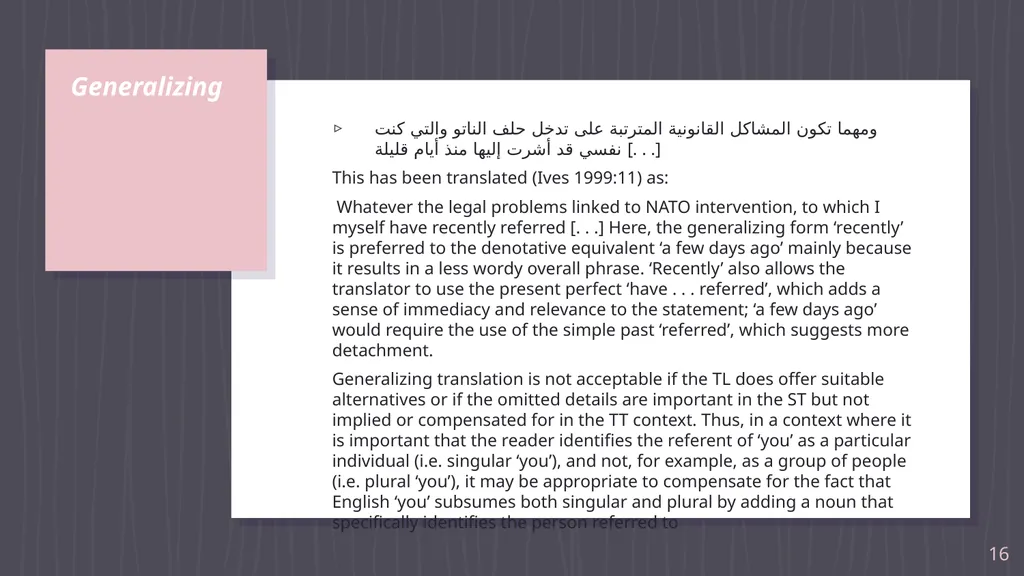
Generalizing ومھما تكون المشاكل القانونیة المترتبة على تدخل حلف الناتو والتي كنت نفسي قد أشرت إلیھا منذ أیام قلیلة [. . .]
This has been translated (Ives 1999:11) as:
Whatever the legal problems linked to NATO intervention, to which I myself have recently referred [. . .] Here, the generalizing form ‘recently’ is preferred to the denotative equivalent ‘a few days ago’ mainly because it results in a less wordy overall phrase. ‘Recently’ also allows the translator to use the present perfect ‘have . . . referred’, which adds a sense of immediacy and relevance to the statement; ‘a few days ago’ would require the use of the simple past ‘referred’, which suggests more detachment.
Generalizing translation is not acceptable if the TL does offer suitable alternatives or if the omitted details are important in the ST but not implied or compensated for in the TT context. Thus, in a context where it is important that the reader identifies the referent of ‘you’ as a particular individual (i.e. singular ‘you’), and not, for example, as a group of people (i.e. plural ‘you’), it may be appropriate to compensate for the fact that English ‘you’ subsumes both singular and plural by adding a noun that specifically identifies the person referred to 16<br>
17
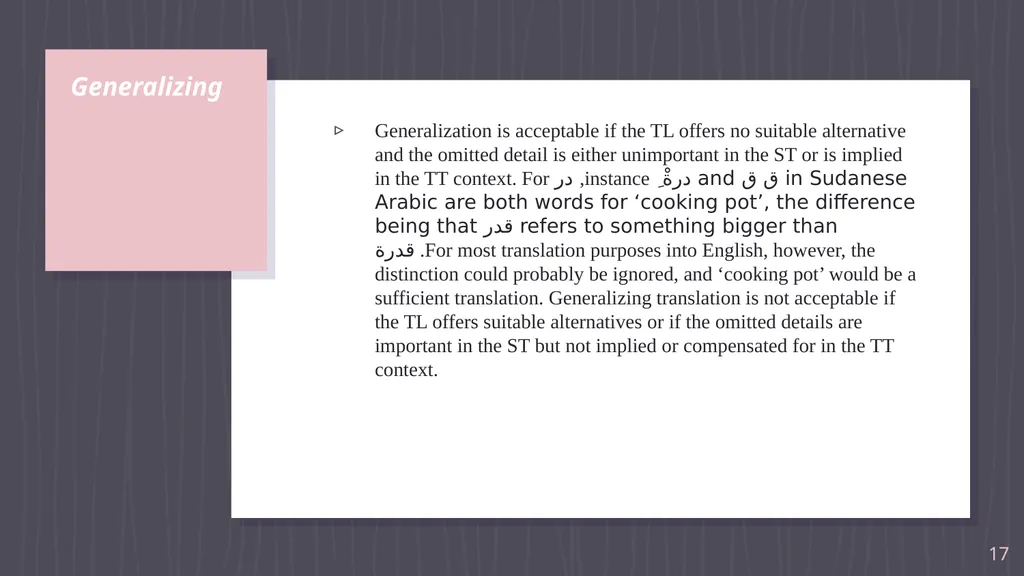
Generalizing Generalization is acceptable if the TL offers no suitable alternative and the omitted detail is either unimportant in the ST or is implied in the TT context. For در ,instance ِ ْدرة and ق ق in Sudanese Arabic are both words for ‘cooking pot’, the difference being that قدر refers to something bigger than قدرة .For most translation purposes into English, however, the distinction could probably be ignored, and ‘cooking pot’ would be a sufficient translation. Generalizing translation is not acceptable if the TL offers suitable alternatives or if the omitted details are important in the ST but not implied or compensated for in the TT context. 17<br>
18
18 Semantic overlap and overlapping translation<br>
19
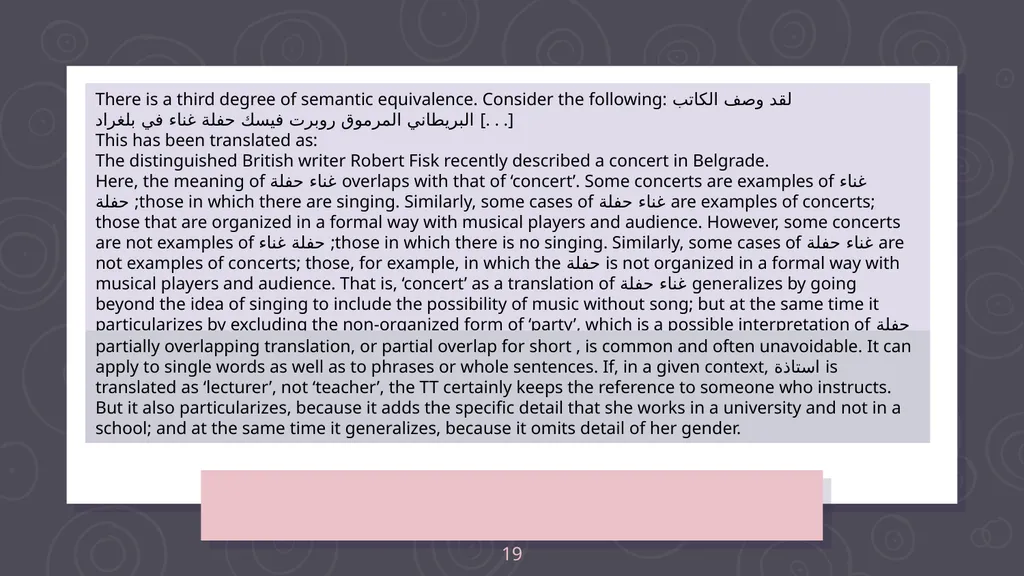
19 There is a third degree of semantic equivalence. Consider the following: لقد وصف الكاتب
البریطاني المرموق روبرت فیسك حفلة غناء في بلغراد [. . .]
This has been translated as:
The distinguished British writer Robert Fisk recently described a concert in Belgrade.
Here, the meaning of غناء حفلة overlaps with that of ‘concert’. Some concerts are examples of غناء حفلة ;those in which there are singing. Similarly, some cases of غناء حفلة are examples of concerts; those that are organized in a formal way with musical players and audience. However, some concerts are not examples of حفلة غناء ;those in which there is no singing. Similarly, some cases of غناء حفلة are not examples of concerts; those, for example, in which the حفلة is not organized in a formal way with musical players and audience. That is, ‘concert’ as a translation of غناء حفلة generalizes by going beyond the idea of singing to include the possibility of music without song; but at the same time it particularizes by excluding the non-organized form of ‘party’, which is a possible interpretation of حفلة partially overlapping translation, or partial overlap for short , is common and often unavoidable. It can apply to single words as well as to phrases or whole sentences. If, in a given context, استاذة is translated as ‘lecturer’, not ‘teacher’, the TT certainly keeps the reference to someone who instructs. But it also particularizes, because it adds the specific detail that she works in a university and not in a school; and at the same time it generalizes, because it omits detail of her gender.<br>
20
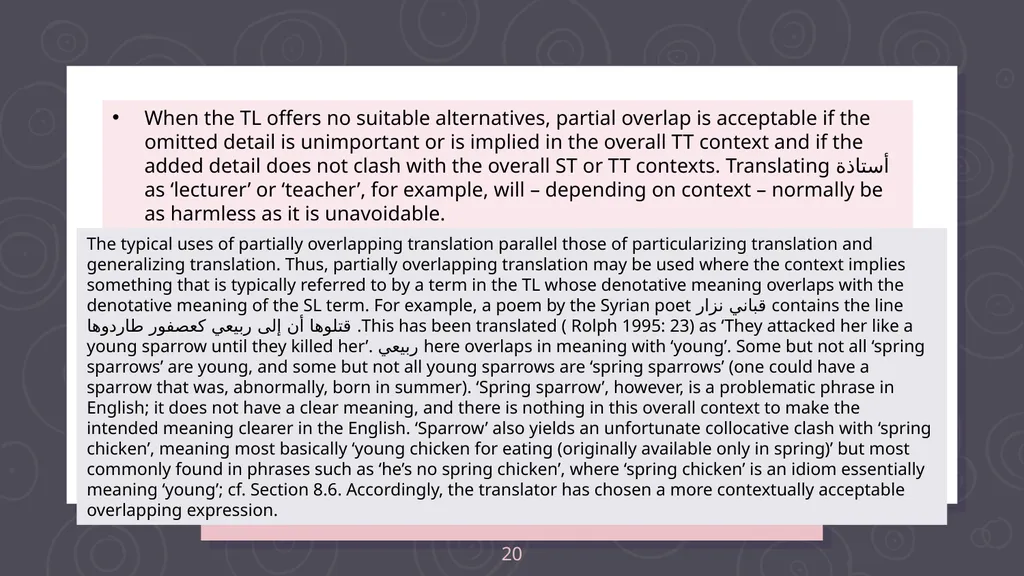
20 When the TL offers no suitable alternatives, partial overlap is acceptable if the omitted detail is unimportant or is implied in the overall TT context and if the added detail does not clash with the overall ST or TT contexts. Translating أستاذة as ‘lecturer’ or ‘teacher’, for example, will – depending on context – normally be as harmless as it is unavoidable. The typical uses of partially overlapping translation parallel those of particularizing translation and generalizing translation. Thus, partially overlapping translation may be used where the context implies something that is typically referred to by a term in the TL whose denotative meaning overlaps with the denotative meaning of the SL term. For example, a poem by the Syrian poet قباني نزار contains the line قتلوھا أن إلى ربیعي كعصفور طاردوھا .This has been translated ( Rolph 1995: 23) as ‘They attacked her like a young sparrow until they killed her’. ربیعي here overlaps in meaning with ‘young’. Some but not all ‘spring sparrows’ are young, and some but not all young sparrows are ‘spring sparrows’ (one could have a sparrow that was, abnormally, born in summer). ‘Spring sparrow’, however, is a problematic phrase in English; it does not have a clear meaning, and there is nothing in this overall context to make the intended meaning clearer in the English. ‘Sparrow’ also yields an unfortunate collocative clash with ‘spring chicken’, meaning most basically ‘young chicken for eating (originally available only in spring)’ but most commonly found in phrases such as ‘he’s no spring chicken’, where ‘spring chicken’ is an idiom essentially meaning ‘young’; cf. Section 8.6. Accordingly, the translator has chosen a more contextually acceptable overlapping expression.<br>
21
Near-synonymy and translation 21<br>
22
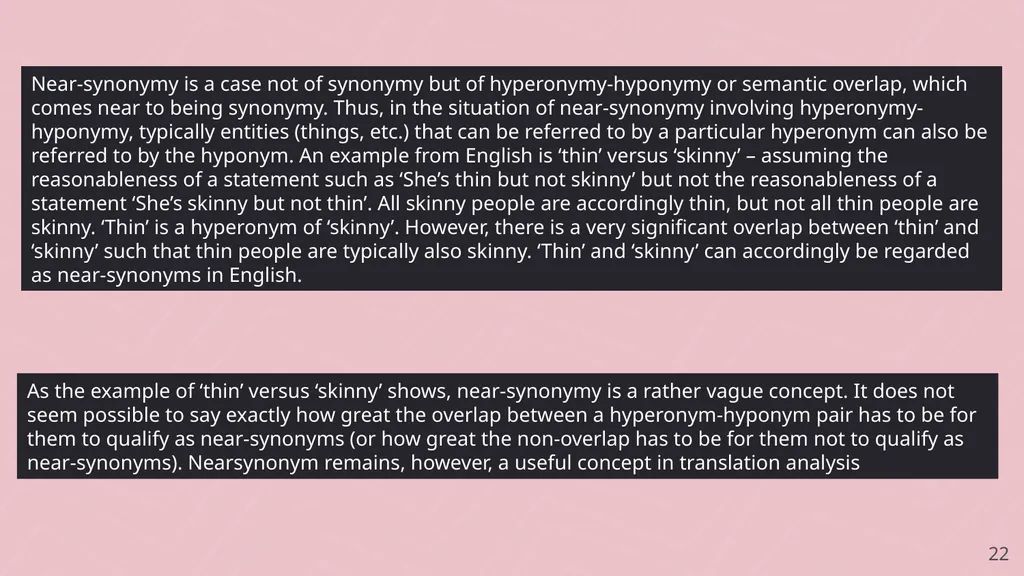
22 Near-synonymy is a case not of synonymy but of hyperonymy-hyponymy or semantic overlap, which comes near to being synonymy. Thus, in the situation of near-synonymy involving hyperonymy-hyponymy, typically entities (things, etc.) that can be referred to by a particular hyperonym can also be referred to by the hyponym. An example from English is ‘thin’ versus ‘skinny’ – assuming the reasonableness of a statement such as ‘She’s thin but not skinny’ but not the reasonableness of a statement ‘She’s skinny but not thin’. All skinny people are accordingly thin, but not all thin people are skinny. ‘Thin’ is a hyperonym of ‘skinny’. However, there is a very significant overlap between ‘thin’ and ‘skinny’ such that thin people are typically also skinny. ‘Thin’ and ‘skinny’ can accordingly be regarded as near-synonyms in English. As the example of ‘thin’ versus ‘skinny’ shows, near-synonymy is a rather vague concept. It does not seem possible to say exactly how great the overlap between a hyperonym-hyponym pair has to be for them to qualify as near-synonyms (or how great the non-overlap has to be for them not to qualify as near-synonyms). Nearsynonym remains, however, a useful concept in translation analysis<br>
23
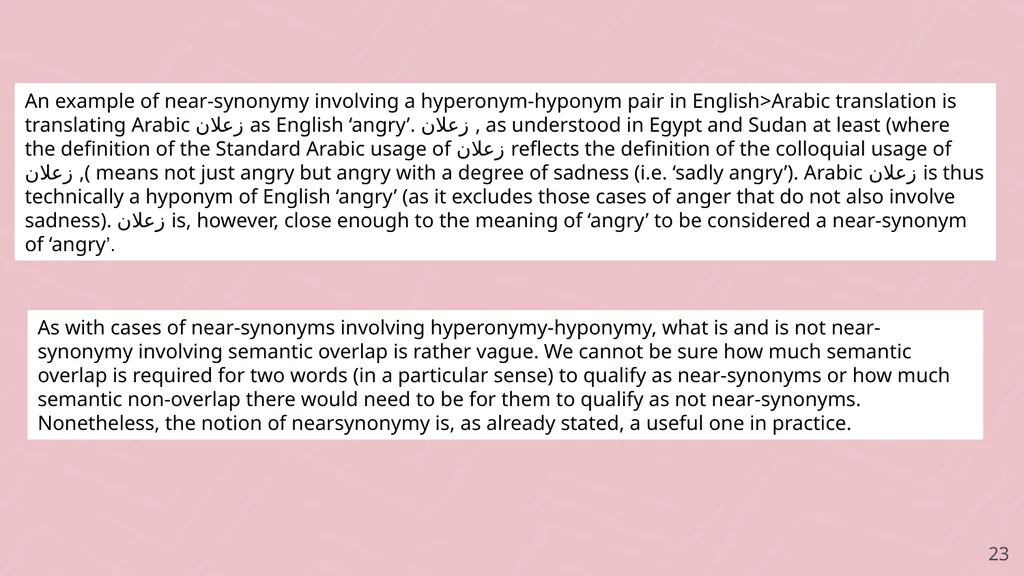
23 An example of near-synonymy involving a hyperonym-hyponym pair in English>Arabic translation is translating Arabic زعلان as English ‘angry’. زعلان , as understood in Egypt and Sudan at least (where the definition of the Standard Arabic usage of زعلان reflects the definition of the colloquial usage of زعلان ,( means not just angry but angry with a degree of sadness (i.e. ‘sadly angry’). Arabic زعلان is thus technically a hyponym of English ‘angry’ (as it excludes those cases of anger that do not also involve sadness). زعلان is, however, close enough to the meaning of ‘angry’ to be considered a near-synonym of ‘angry’. As with cases of near-synonyms involving hyperonymy-hyponymy, what is and is not near-synonymy involving semantic overlap is rather vague. We cannot be sure how much semantic overlap is required for two words (in a particular sense) to qualify as near-synonyms or how much semantic non-overlap there would need to be for them to qualify as not near-synonyms. Nonetheless, the notion of nearsynonymy is, as already stated, a useful one in practice.<br>
24
Semantic repetition in Arabic<br>
25
25 Semantic repetition is repetition of meaning. Most basically, this involves the use of two (or more) synonyms or near-synonyms. But it can also be extended to include hyperonym-hyponym pairs and words and phrases standing in an ‘associative’ relationship.<br>
26
Synonym and near-synonym repetition<br>
27
Synonym and near-synonym repetition Arabic frequently makes use of repetition of synonyms or near-synonyms in a way that is not normally found in English. This kind of repetition is sometimes referred to as semantic repetition
Two types of (near) synonym repetition :
where the two words or phrases used have closely related but distinguishable meanings – that is, they are near-synonyms; an example of this is والتحلیل الاستقصاء’ investigation and analysis’
where the words or phrases used are fully synonymous or, at least in the context in which they are being used, there is no clear difference in meaning; an example of this is the doublet متواصلة مستمرة in the phrase متواصلة مستمرة بصورة ,literally, ‘in a continuing continuous manner.
(Near-)synonym repetition may involve any of the major parts of speech: nouns, as in والتحلیل الاستقصاء ;adjectives, as in متواصلة مستمرة ;verbs, for instance, یدھشه ویذھله surprise and baffle’ in the phrase ویذھله یدھشه منظرھا كان) literally, ‘her look surprised and baffled him’); and adverbs, for instance, مكتئبة واجمة’ silently and dispiritedly’ in the phrase ابصر المرأة نفسها تمشي واجمة مكتئبة (saw he the same woman walking silently and dispiritly. 27<br>
28
Techniques to translate (near) synonym repetition The first of these is to merge the two Arabic words into one English word. This is particularly likely to be an appropriate strategy where there is no clear difference in meaning between the two Arabic words .
So وقاسیة صارمة تدابیر may be translated as ‘severe measures’ – (near-)synonym repetition of صارمة A second fairly common technique, and one that is used where the two words in the (near-)synonym repetition have clearly different meanings, is to employ at least partial grammatical transposition.
So the phrase والأخلاقیات القیم تحلل might be translated as ‘the collapse of all moral values’. Here, the noun doublet of the Arabic has been replaced by an adjective–noun phrase in English. One final technique for translating (near)synonym repetition into English is to maintain the same form of repetition. An example of this is والبربري الھمجي السلوك , translatable as ‘this savage and barbaric behaviour’ 28<br>
29
Synonym and near-synonym repetition (Near-)synonym repetition may be syndetic (i.e. it may involve the use of a connective, typically (وor – in the case of adjectives in particular, but also occasionally in the case of nouns and verbs – it may be asyndetic (i.e. it may occur without the use of a connective).
An example of syndetic (near-)synonym repetition is والبربري الھمجي in the phrase والبربري الھمجي السلوك’ savage and barbaric behaviour’. An example of asyndetic (near-)synonym repetition is انیقات جمیلات in the phrase انیقات جمیلات فتیات ,literally, ‘pretty, elegant girls’ . 29<br>
An example of syndetic (near-)synonym repetition is والبربري الھمجي in the phrase والبربري الھمجي السلوك’ savage and barbaric behaviour’. An example of asyndetic (near-)synonym repetition is انیقات جمیلات in the phrase انیقات جمیلات فتیات ,literally, ‘pretty, elegant girls’ . 29<br>
30
30 The first technique that takes into account the potentially emphatic aspect of (near-)synonym repetition is what we shall call semantic distancing. This involves relaying both elements of the Arabic doublet by different words in English but choosing English words whose meanings are more obviously distinct than those of their Arabic counterparts. For example, in ویذھله یدھشه منظرھا وكان , the two words یدھش and یذھل are quite close in meaning .The phrase has been translated ( St John 1999: 5), however, as ‘Her appearance had both astonished and alarmed him’; the semantic difference between ‘astonish’ and ‘alarm’ is greater than that between أدھش and أذھل .This semantic distancing ensures that the English translation does not involve what would otherwise be the stylistic oddity in English of having two words with virtually the same meaning conjoined with each other.<br>
31
31 Here, the repetition in English carries the same emphatic – and more specifically emotive – force as it does in Arabic. The convention that operates otherwise in English that words having much the same meaning are not conjoined is overridden. Something similar happens with respect to formulaic language, especially where this is of a religious or legal nature. The following is from an oath made by members of the Muslim Brotherhood to their first leader حسن البنا ان من حقك علینا الطاعة والثقة الكاملة والطمأنینة الشاملة وعلى ھذا بایعنا وعاھدنا
This might be translated as: [. . .] ‘You have the right to our unquestioning obedience, complete trust and total confidence. This is the oath which we have taken and the pledge which we have made’.
Here, the (near-)synonym repetition of بایعنا and عاھدنا is retained in the English and even expanded as ‘the oath we have taken’, ‘the pledge we have made’<br>
32
Hyperonym-hyponym repetition<br>
33
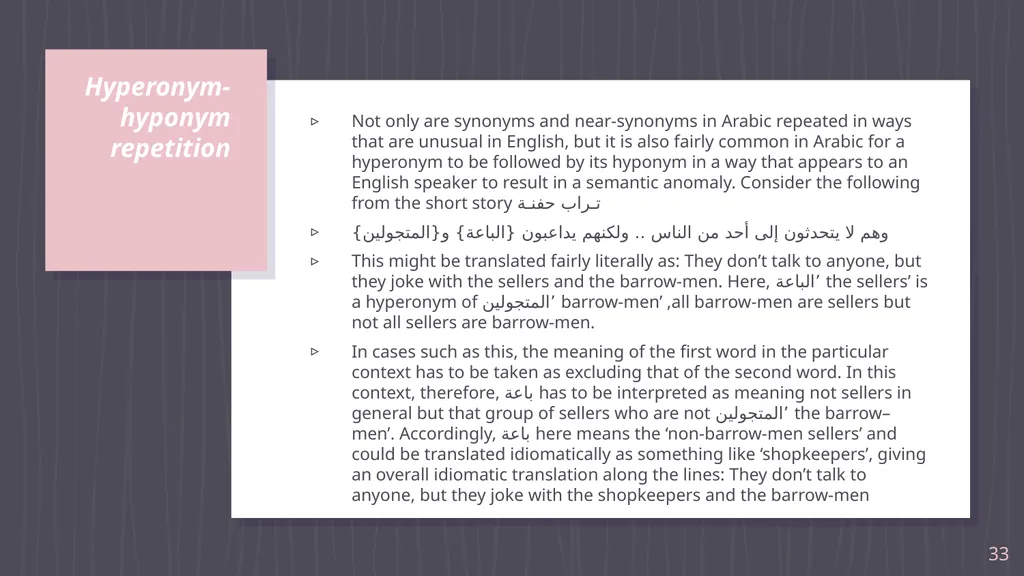
Hyperonym-hyponym repetition Not only are synonyms and near-synonyms in Arabic repeated in ways that are unusual in English, but it is also fairly common in Arabic for a hyperonym to be followed by its hyponym in a way that appears to an English speaker to result in a semantic anomaly. Consider the following from the short story تـراب حفنـة
وھم لا یتحدثون إلى أحد من الناس .. ولكنھم یداعبون {الباعة} و{المتجولین}
This might be translated fairly literally as: They don’t talk to anyone, but they joke with the sellers and the barrow-men. Here, الباعة’ the sellers’ is a hyperonym of المتجولین’ barrow-men’ ,all barrow-men are sellers but not all sellers are barrow-men.
In cases such as this, the meaning of the first word in the particular context has to be taken as excluding that of the second word. In this context, therefore, باعة has to be interpreted as meaning not sellers in general but that group of sellers who are not المتجولین’ the barrow–men’. Accordingly, باعة here means the ‘non-barrow-men sellers’ and could be translated idiomatically as something like ‘shopkeepers’, giving an overall idiomatic translation along the lines: They don’t talk to anyone, but they joke with the shopkeepers and the barrow-men 33<br>
34
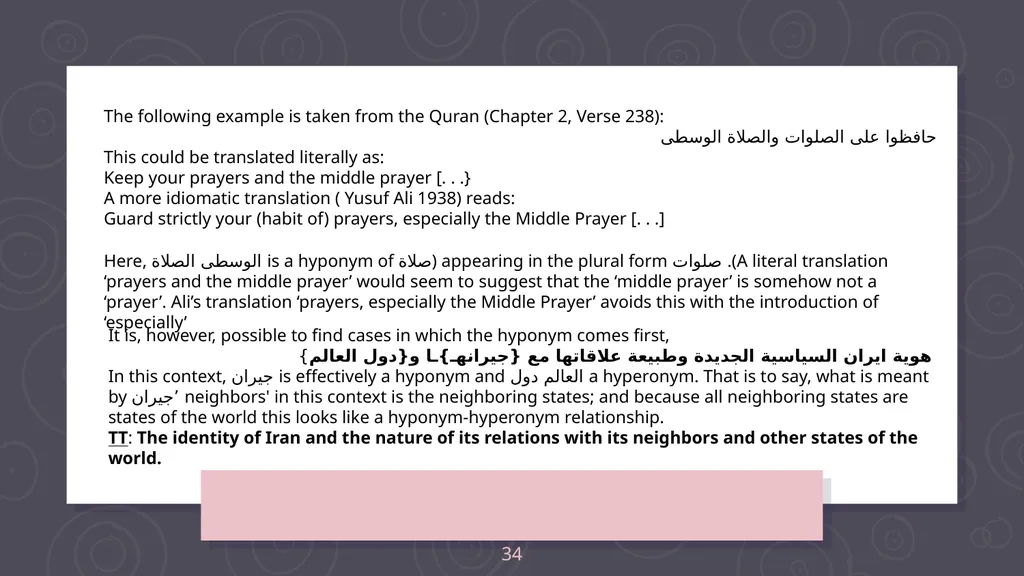
34 The following example is taken from the Quran (Chapter 2, Verse 238):
حافظوا على الصلوات والصلاة الوسطى
This could be translated literally as:
Keep your prayers and the middle prayer [. . .}
A more idiomatic translation ( Yusuf Ali 1938) reads:
Guard strictly your (habit of) prayers, especially the Middle Prayer [. . .] Here, الوسطى الصلاة is a hyponym of صلاة) appearing in the plural form صلوات .(A literal translation ‘prayers and the middle prayer’ would seem to suggest that the ‘middle prayer’ is somehow not a ‘prayer’. Ali’s translation ‘prayers, especially the Middle Prayer’ avoids this with the introduction of ‘especially’ It is, however, possible to find cases in which the hyponym comes first,
ھویة ایران السیاسیة الجدیدة وطبیعة علاقاتھا مع {جیرانھـ}ـا و{دول العالم}
In this context, جیران is effectively a hyponym and العالم دول a hyperonym. That is to say, what is meant by جیران’ neighbors' in this context is the neighboring states; and because all neighboring states are states of the world this looks like a hyponym-hyperonym relationship.
TT: The identity of Iran and the nature of its relations with its neighbors and other states of the world.<br>
35
Associative repetition<br>
36
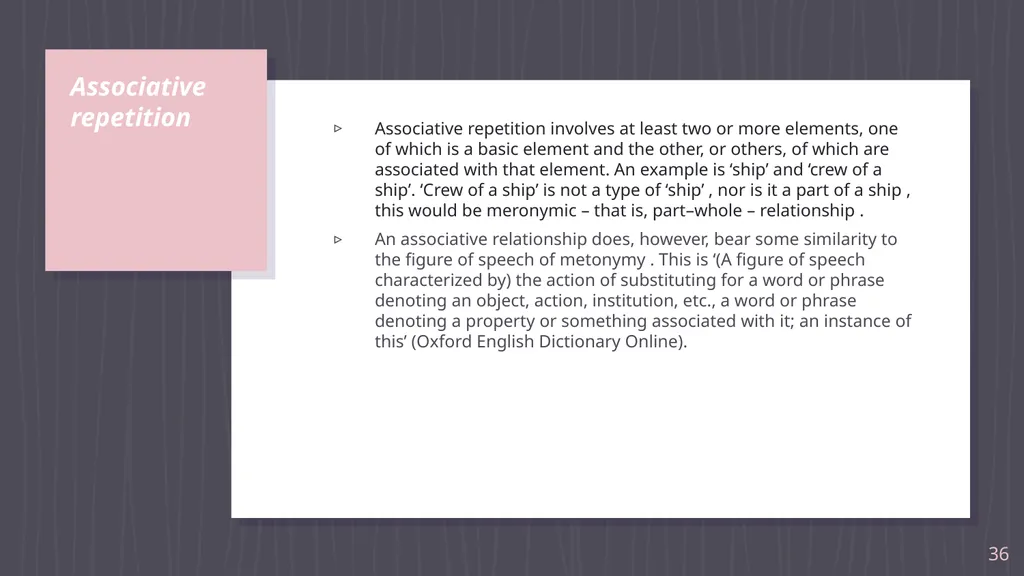
Associative repetition Associative repetition involves at least two or more elements, one of which is a basic element and the other, or others, of which are associated with that element. An example is ‘ship’ and ‘crew of a ship’. ‘Crew of a ship’ is not a type of ‘ship’ , nor is it a part of a ship , this would be meronymic – that is, part–whole – relationship .
An associative relationship does, however, bear some similarity to the figure of speech of metonymy . This is ‘(A figure of speech characterized by) the action of substituting for a word or phrase denoting an object, action, institution, etc., a word or phrase denoting a property or something associated with it; an instance of this’ (Oxford English Dictionary Online). 36<br>
An associative relationship does, however, bear some similarity to the figure of speech of metonymy . This is ‘(A figure of speech characterized by) the action of substituting for a word or phrase denoting an object, action, institution, etc., a word or phrase denoting a property or something associated with it; an instance of this’ (Oxford English Dictionary Online). 36<br>
37
List restructuring<br>
38
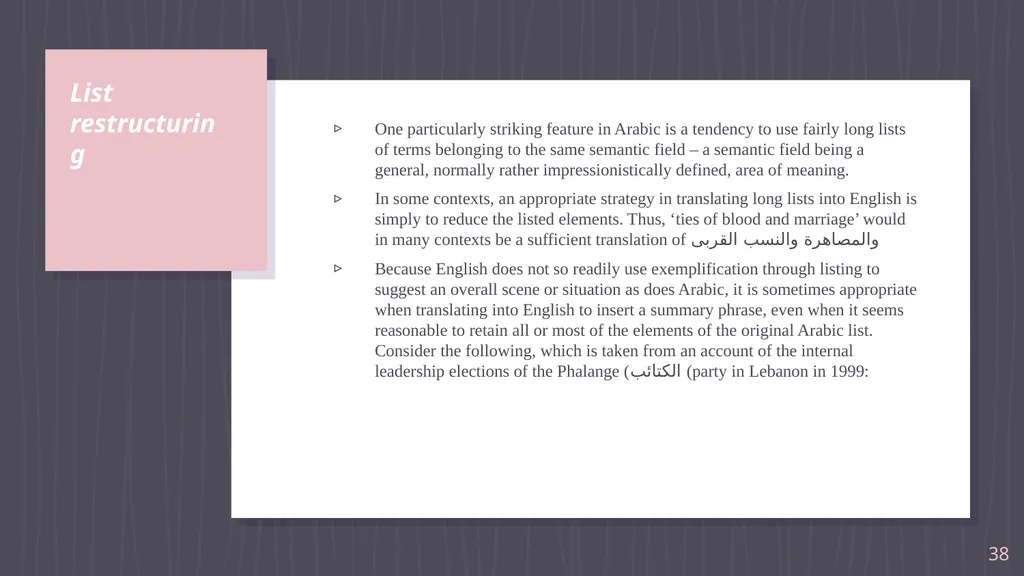
List restructuring One particularly striking feature in Arabic is a tendency to use fairly long lists of terms belonging to the same semantic field – a semantic field being a general, normally rather impressionistically defined, area of meaning.
In some contexts, an appropriate strategy in translating long lists into English is simply to reduce the listed elements. Thus, ‘ties of blood and marriage’ would in many contexts be a sufficient translation of والمصاھرة والنسب القربى
Because English does not so readily use exemplification through listing to suggest an overall scene or situation as does Arabic, it is sometimes appropriate when translating into English to insert a summary phrase, even when it seems reasonable to retain all or most of the elements of the original Arabic list. Consider the following, which is taken from an account of the internal leadership elections of the Phalange (الكتائب (party in Lebanon in 1999: 38<br>
39
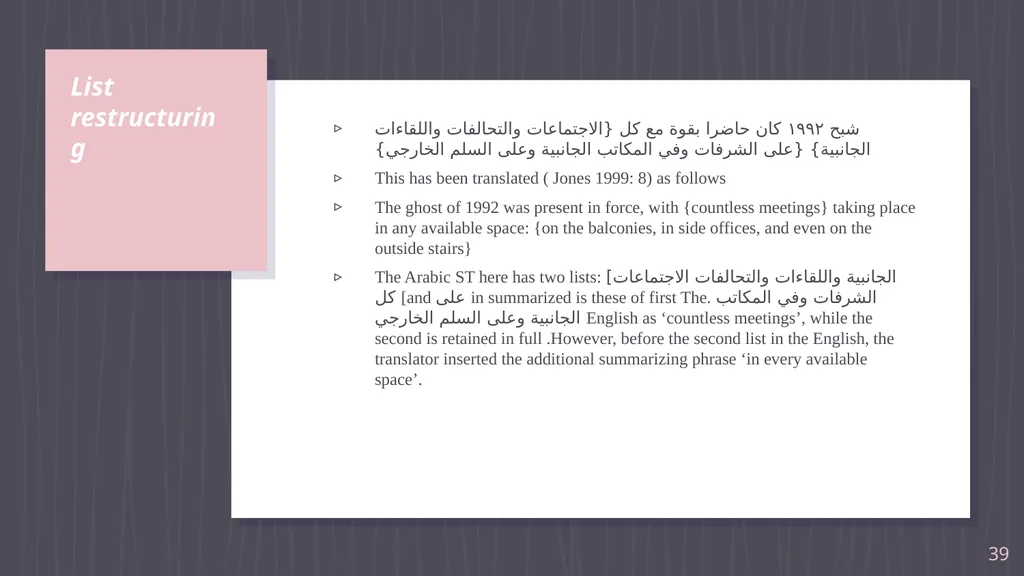
List restructuring شبح ۱۹۹۲ كان حاضرا بقوة مع كل {الاجتماعات والتحالفات واللقاءات الجانبیة} {على الشرفات وفي المكاتب الجانبیة وعلى السلم الخارجي}
This has been translated ( Jones 1999: 8) as follows
The ghost of 1992 was present in force, with {countless meetings} taking place in any available space: {on the balconies, in side offices, and even on the outside stairs}
The Arabic ST here has two lists: الجانبیة واللقاءات والتحالفات الاجتماعات] كل [and على in summarized is these of first The. الشرفات وفي المكاتب الجانبیة وعلى السلم الخارجي English as ‘countless meetings’, while the second is retained in full .However, before the second list in the English, the translator inserted the additional summarizing phrase ‘in every available space’. 39<br>
40
Thank you<br>