
DEPENDENCY Why we add dependents Who can be
PM
Published · 35 slides · 0 views

1 / 1







Description
DEPENDENCY Why we add dependents Who can be claimed as a dependent Dependency in compensation and pension claims The service officers role in establishing dependents How to add dependents Evidence that may be needed to prove dependency
Related Topics
Share
Embed code
Download this presentation From Below
"DEPENDENCY Why we add dependents Who can be" is the property of its rightful owner. Permission is granted to download and print the materials on this website for personal, non-commercial use only, and to display it on your personal computer provided you do not modify the materials and that you retain all copyright notices contained in the materials. By downloading content from our website, you accept the terms of this agreement.
Presentation Transcript
01
DEPENDENCY<br>
02
Why we add dependents
Who can be claimed as a dependent
Dependency in compensation and pension claims
The service officer’s role in establishing dependents
How to add dependents
Evidence that may be needed to prove dependency
Effective Dates
Loss of a Dependent
Apportionments
Periodic Reviews
Derived v. Independent benefits for Dependents 2 TOPICS OF DISCUSSION<br>
Who can be claimed as a dependent
Dependency in compensation and pension claims
The service officer’s role in establishing dependents
How to add dependents
Evidence that may be needed to prove dependency
Effective Dates
Loss of a Dependent
Apportionments
Periodic Reviews
Derived v. Independent benefits for Dependents 2 TOPICS OF DISCUSSION<br>
03
Veterans can receive extra compensation or pension based on the number and type of dependents.
Establishing dependency can assist in future claims, as the dependent will not have to re-prove their relationship to the veteran, and processing of an educational or survivors claim can proceed more quickly.
When being added to an award of compensation or pension, the dependents themselves have no independent entitlement to the benefit, it is added to the veteran’s award 3 WHY WE ADD DEPENDENTS<br>
Establishing dependency can assist in future claims, as the dependent will not have to re-prove their relationship to the veteran, and processing of an educational or survivors claim can proceed more quickly.
When being added to an award of compensation or pension, the dependents themselves have no independent entitlement to the benefit, it is added to the veteran’s award 3 WHY WE ADD DEPENDENTS<br>
04
Spouse: Person married to the veteran through a recognized legal or religious ceremony. Common law marriages are recognized if they were valid under the law at the time of the marriage.
38 CFR 3.1(j) defines marriage as a marriage valid under the law of the place where the parties resided at the time of marriage, or the law of the place where the parties resided when the right to benefits accrued.
If a legal marriage cannot be established, then the spouse cannot be recognized as a dependent for a living veteran. However, for survivor benefits there is a process to “deem the marriage valid” in certain cases. 4 WHO CAN BE A DEPENDENT?<br>
38 CFR 3.1(j) defines marriage as a marriage valid under the law of the place where the parties resided at the time of marriage, or the law of the place where the parties resided when the right to benefits accrued.
If a legal marriage cannot be established, then the spouse cannot be recognized as a dependent for a living veteran. However, for survivor benefits there is a process to “deem the marriage valid” in certain cases. 4 WHO CAN BE A DEPENDENT?<br>
05
Child: 38 CFR 3.57 defines a “child” of the veteran as an unmarried person under the age of 18 who is a legitimate child, a child legally adopted before the age of 18 years, an unmarried stepchild who acquired that status before the age of 18 years and who is a member of the veteran's household or was a member of the veteran's household at the time of the veteran's death, or an unmarried illegitimate child. 5 WHO CAN BE A DEPENDENT?<br>
06
School Age Child: a child of a veteran who is between the ages of 18-22, unmarried and attending school full time. Verification of school attendance must be sent to VA using the VA Form 21-674 “Request For Approval Of School Attendance”.
*Note that if a veteran is rated 100% P&T, the child may be eligible for Dependents Education Assistance (DEA) benefits (discussed later). Only DEA or dependent benefits may be received, not both, so be sure the veteran is aware of any DEA application, or the veteran may end up owing a debt to VA. 6 WHO CAN BE A DEPENDENT?<br>
*Note that if a veteran is rated 100% P&T, the child may be eligible for Dependents Education Assistance (DEA) benefits (discussed later). Only DEA or dependent benefits may be received, not both, so be sure the veteran is aware of any DEA application, or the veteran may end up owing a debt to VA. 6 WHO CAN BE A DEPENDENT?<br>
07
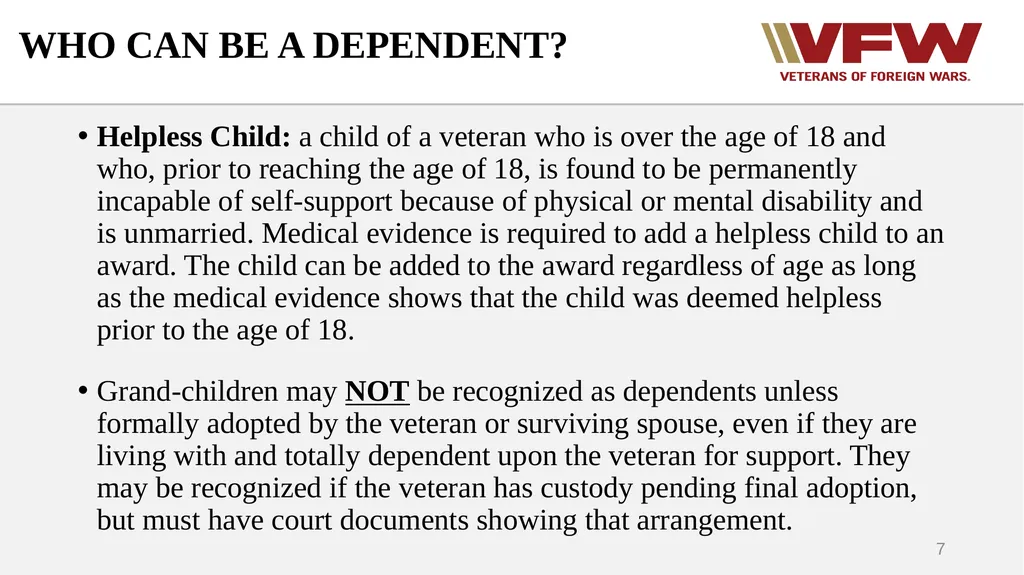
Helpless Child: a child of a veteran who is over the age of 18 and who, prior to reaching the age of 18, is found to be permanently incapable of self-support because of physical or mental disability and is unmarried. Medical evidence is required to add a helpless child to an award. The child can be added to the award regardless of age as long as the medical evidence shows that the child was deemed helpless prior to the age of 18.
Grand-children may NOT be recognized as dependents unless formally adopted by the veteran or surviving spouse, even if they are living with and totally dependent upon the veteran for support. They may be recognized if the veteran has custody pending final adoption, but must have court documents showing that arrangement. 7 WHO CAN BE A DEPENDENT?<br>
Grand-children may NOT be recognized as dependents unless formally adopted by the veteran or surviving spouse, even if they are living with and totally dependent upon the veteran for support. They may be recognized if the veteran has custody pending final adoption, but must have court documents showing that arrangement. 7 WHO CAN BE A DEPENDENT?<br>
08
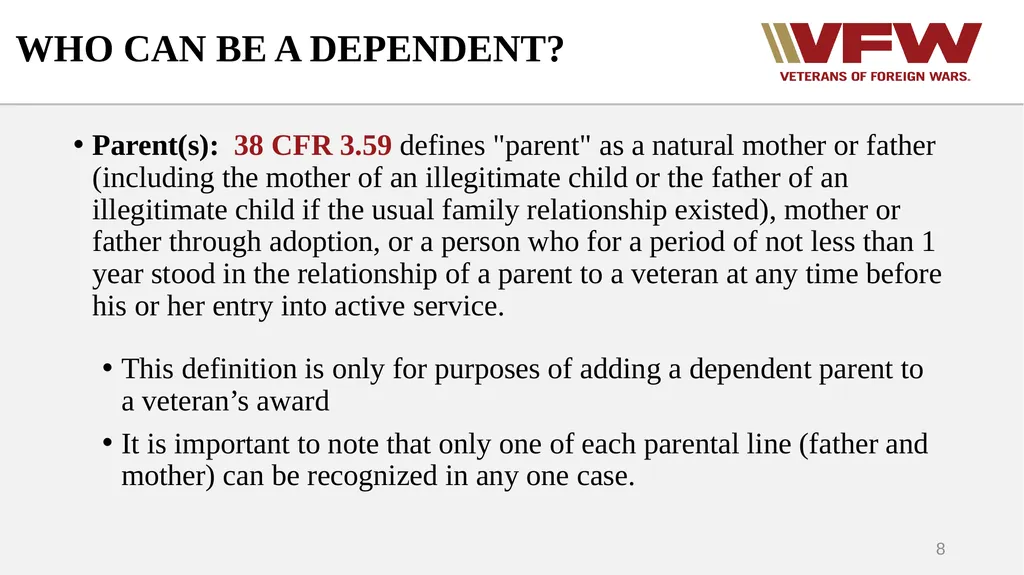
Parent(s): 38 CFR 3.59 defines "parent" as a natural mother or father (including the mother of an illegitimate child or the father of an illegitimate child if the usual family relationship existed), mother or father through adoption, or a person who for a period of not less than 1 year stood in the relationship of a parent to a veteran at any time before his or her entry into active service.
This definition is only for purposes of adding a dependent parent to a veteran’s award
It is important to note that only one of each parental line (father and mother) can be recognized in any one case. 8 WHO CAN BE A DEPENDENT?<br>
This definition is only for purposes of adding a dependent parent to a veteran’s award
It is important to note that only one of each parental line (father and mother) can be recognized in any one case. 8 WHO CAN BE A DEPENDENT?<br>
09
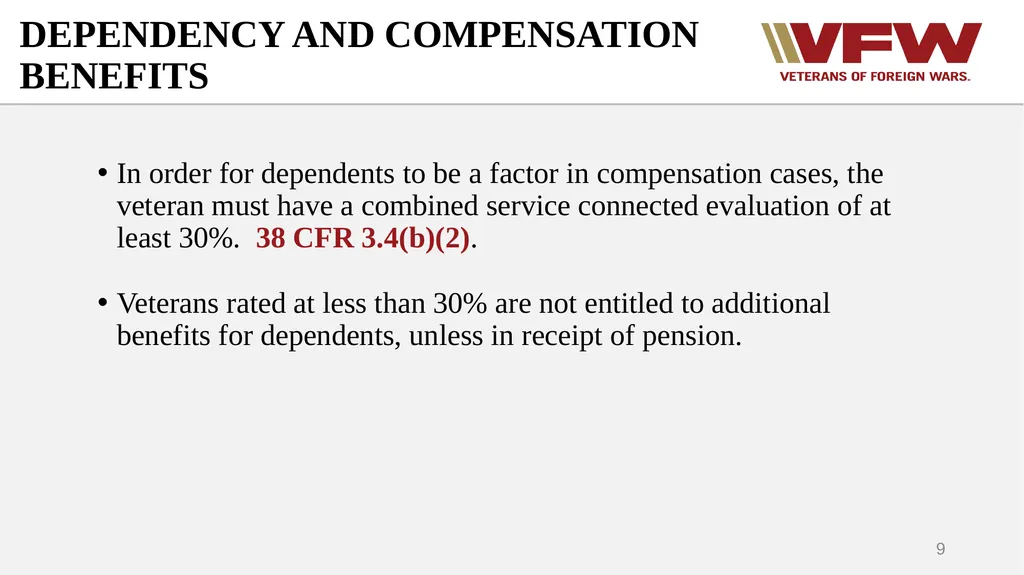
In order for dependents to be a factor in compensation cases, the veteran must have a combined service connected evaluation of at least 30%. 38 CFR 3.4(b)(2).
Veterans rated at less than 30% are not entitled to additional benefits for dependents, unless in receipt of pension. 9 DEPENDENCY AND COMPENSATION BENEFITS<br>
Veterans rated at less than 30% are not entitled to additional benefits for dependents, unless in receipt of pension. 9 DEPENDENCY AND COMPENSATION BENEFITS<br>
10
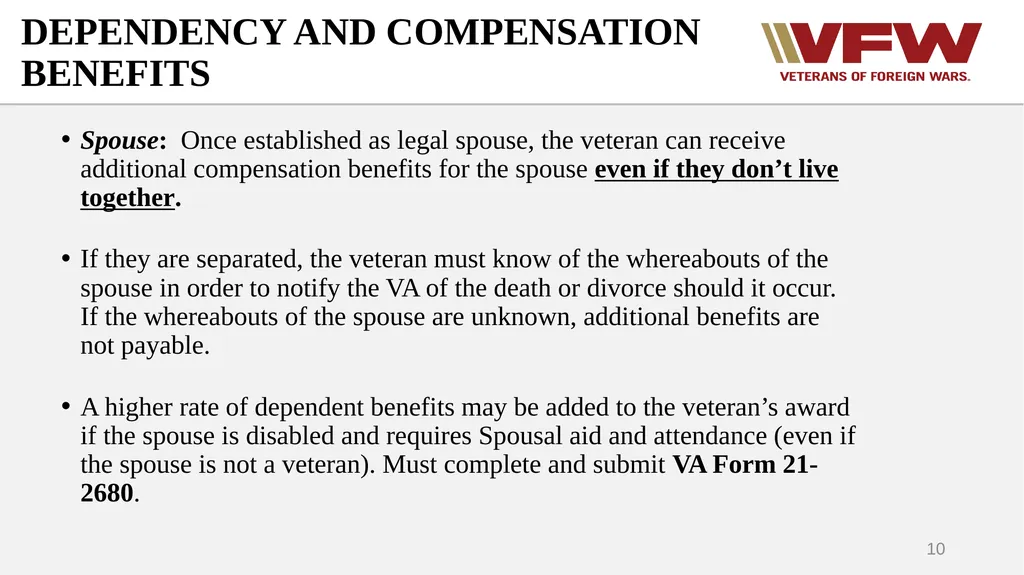
Spouse: Once established as legal spouse, the veteran can receive additional compensation benefits for the spouse even if they don’t live together.
If they are separated, the veteran must know of the whereabouts of the spouse in order to notify the VA of the death or divorce should it occur. If the whereabouts of the spouse are unknown, additional benefits are not payable.
A higher rate of dependent benefits may be added to the veteran’s award if the spouse is disabled and requires Spousal aid and attendance (even if the spouse is not a veteran). Must complete and submit VA Form 21-2680. 10 DEPENDENCY AND COMPENSATION BENEFITS<br>
If they are separated, the veteran must know of the whereabouts of the spouse in order to notify the VA of the death or divorce should it occur. If the whereabouts of the spouse are unknown, additional benefits are not payable.
A higher rate of dependent benefits may be added to the veteran’s award if the spouse is disabled and requires Spousal aid and attendance (even if the spouse is not a veteran). Must complete and submit VA Form 21-2680. 10 DEPENDENCY AND COMPENSATION BENEFITS<br>
11
Child: Once established as the child of the veteran, additional compensation benefits are payable whether or not the child resides with the veteran. Child custody is irrelevant, but as in the case of the spouse, the veteran must know of the whereabouts of the child in order to report changes of status to VA.
Parent(s): Once the relationship has been established, the parent(s) must then be found to be “dependent” upon the veteran for support. In this context, dependency can be established either by the income of the parent(s) or by contributions towards their support by the veteran. 11 DEPENDENCY AND COMPENSATION BENEFITS<br>
Parent(s): Once the relationship has been established, the parent(s) must then be found to be “dependent” upon the veteran for support. In this context, dependency can be established either by the income of the parent(s) or by contributions towards their support by the veteran. 11 DEPENDENCY AND COMPENSATION BENEFITS<br>
12
As with compensation cases, keep in mind that the dependents in pension cases have no independent entitlement to pension benefits.
Spouse: If the veteran is to receive additional pension benefits for a spouse, they must live together. If they do not, then the veteran must be contributing to the spouse’s support.
Spousal income is included in countable income for benefit calculation unless it is found that the spousal income is not available to the veteran because of separation. 12 DEPENDENCY AND PENSION BENEFITS<br>
Spouse: If the veteran is to receive additional pension benefits for a spouse, they must live together. If they do not, then the veteran must be contributing to the spouse’s support.
Spousal income is included in countable income for benefit calculation unless it is found that the spousal income is not available to the veteran because of separation. 12 DEPENDENCY AND PENSION BENEFITS<br>
13
Child: Similar to the spouse; the child must live with the veteran or, if not, the veteran must be contributing to the child’s support.
The child’s income is included in countable income for benefit calculation unless the child is not in the veteran’s household and the child’s income is found to be unavailable to the veteran.
Parent(s): There is no provision for additional pension benefits for parents. However, if the veteran is paying for the parent(s)’s medical expenses, they can be used to reduce countable income in the same fashion as if they were the veteran’s. 13 DEPENDENCY AND PENSION BENEFITS<br>
The child’s income is included in countable income for benefit calculation unless the child is not in the veteran’s household and the child’s income is found to be unavailable to the veteran.
Parent(s): There is no provision for additional pension benefits for parents. However, if the veteran is paying for the parent(s)’s medical expenses, they can be used to reduce countable income in the same fashion as if they were the veteran’s. 13 DEPENDENCY AND PENSION BENEFITS<br>
14
On original claims, if the dependents are listed on the application, they will be included from the effective date of the award, if eligible.
If the veteran’s compensation increases to an evaluation that includes additional benefits for dependents, the veteran has one year from the rating decision to furnish dependent information to have the dependents added from the date of the increase.
Otherwise, the dependents will be added from the date the evidence is received.
38 CFR 3.401(b) 14 DEPENDENCY EFFECTIVE DATES<br>
If the veteran’s compensation increases to an evaluation that includes additional benefits for dependents, the veteran has one year from the rating decision to furnish dependent information to have the dependents added from the date of the increase.
Otherwise, the dependents will be added from the date the evidence is received.
38 CFR 3.401(b) 14 DEPENDENCY EFFECTIVE DATES<br>
15
If the veteran has a new dependent, such as the birth of a child or marriage, he/she has one year from the date of the event to notify the VA and the benefit will be adjusted from the date of the event.
If the evidence is received more than one year after the event, the benefit will be adjusted from the date of the receipt of evidence.
38 CFR 3.401 15 DEPENDENCY EFFECTIVE DATES<br>
If the evidence is received more than one year after the event, the benefit will be adjusted from the date of the receipt of evidence.
38 CFR 3.401 15 DEPENDENCY EFFECTIVE DATES<br>
16
Generally speaking, if a reduction in benefits is required due to the loss of a dependent, they will be removed at the end of the month in which the event occurs.
For example, if the veteran’s divorce becomes final in June, the spouse will be removed from the award effective July 1.
Note that if the veteran was being paid for a spouse and stepchildren as a result of the marriage, the stepchildren will be removed as dependents when the spouse is removed, unless the stepchild remains in the veteran’s custody and household. 16 LOSS OF A DEPENDENT<br>
For example, if the veteran’s divorce becomes final in June, the spouse will be removed from the award effective July 1.
Note that if the veteran was being paid for a spouse and stepchildren as a result of the marriage, the stepchildren will be removed as dependents when the spouse is removed, unless the stepchild remains in the veteran’s custody and household. 16 LOSS OF A DEPENDENT<br>
17
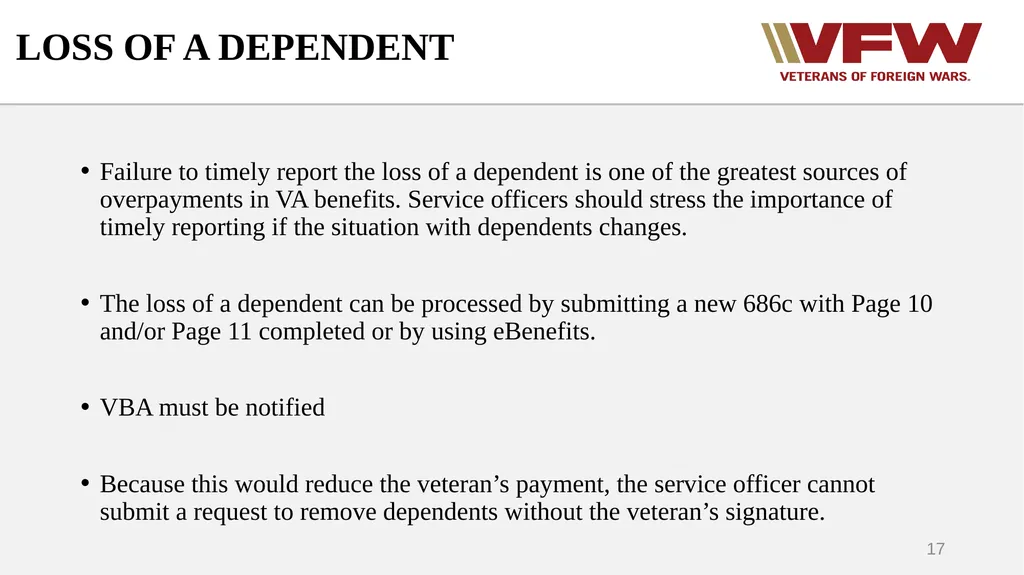
Failure to timely report the loss of a dependent is one of the greatest sources of overpayments in VA benefits. Service officers should stress the importance of timely reporting if the situation with dependents changes.
The loss of a dependent can be processed by submitting a new 686c with Page 10 and/or Page 11 completed or by using eBenefits.
VBA must be notified
Because this would reduce the veteran’s payment, the service officer cannot submit a request to remove dependents without the veteran’s signature. 17 LOSS OF A DEPENDENT<br>
The loss of a dependent can be processed by submitting a new 686c with Page 10 and/or Page 11 completed or by using eBenefits.
VBA must be notified
Because this would reduce the veteran’s payment, the service officer cannot submit a request to remove dependents without the veteran’s signature. 17 LOSS OF A DEPENDENT<br>
18
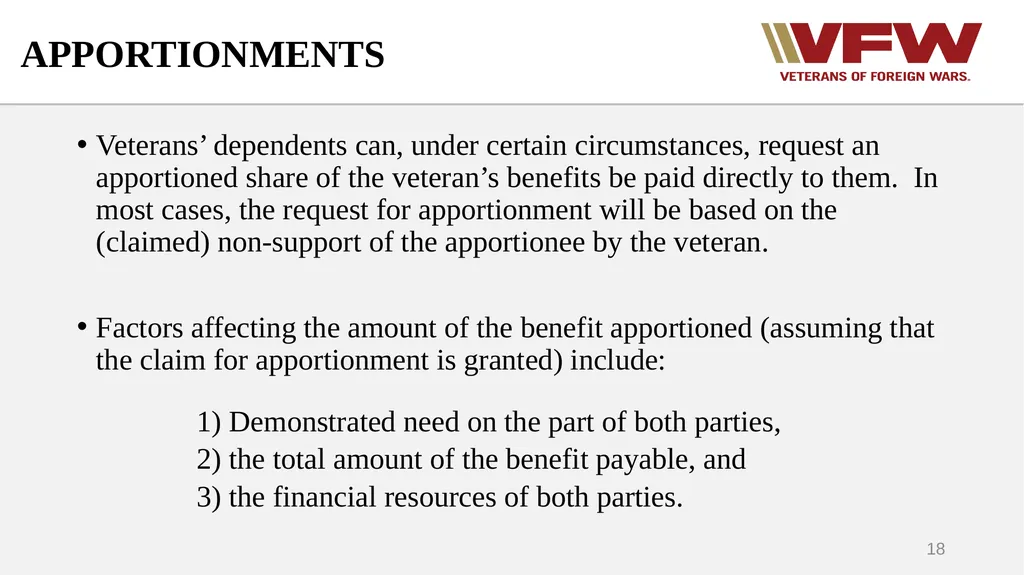
Veterans’ dependents can, under certain circumstances, request an apportioned share of the veteran’s benefits be paid directly to them. In most cases, the request for apportionment will be based on the (claimed) non-support of the apportionee by the veteran.
Factors affecting the amount of the benefit apportioned (assuming that the claim for apportionment is granted) include:
1) Demonstrated need on the part of both parties,
2) the total amount of the benefit payable, and
3) the financial resources of both parties. 18 APPORTIONMENTS<br>
Factors affecting the amount of the benefit apportioned (assuming that the claim for apportionment is granted) include:
1) Demonstrated need on the part of both parties,
2) the total amount of the benefit payable, and
3) the financial resources of both parties. 18 APPORTIONMENTS<br>
19
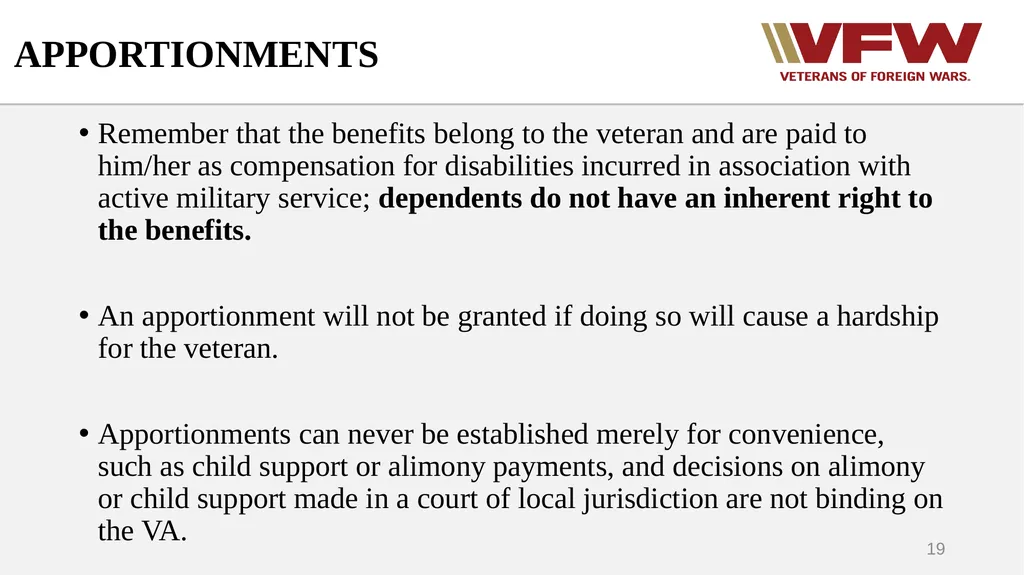
Remember that the benefits belong to the veteran and are paid to him/her as compensation for disabilities incurred in association with active military service; dependents do not have an inherent right to the benefits.
An apportionment will not be granted if doing so will cause a hardship for the veteran.
Apportionments can never be established merely for convenience, such as child support or alimony payments, and decisions on alimony or child support made in a court of local jurisdiction are not binding on the VA. 19 APPORTIONMENTS<br>
An apportionment will not be granted if doing so will cause a hardship for the veteran.
Apportionments can never be established merely for convenience, such as child support or alimony payments, and decisions on alimony or child support made in a court of local jurisdiction are not binding on the VA. 19 APPORTIONMENTS<br>
20
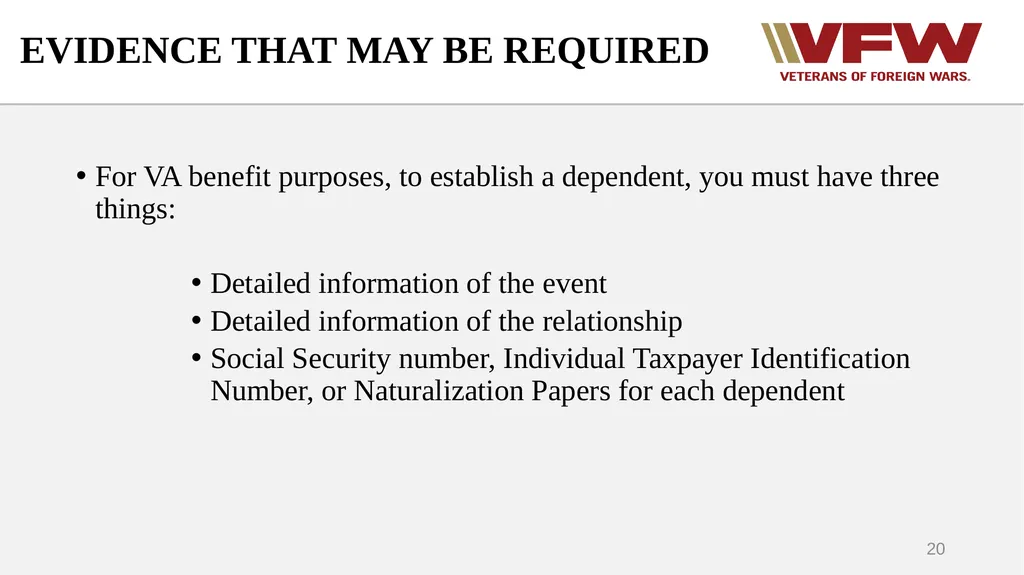
For VA benefit purposes, to establish a dependent, you must have three things:
Detailed information of the event
Detailed information of the relationship
Social Security number, Individual Taxpayer Identification Number, or Naturalization Papers for each dependent 20 EVIDENCE THAT MAY BE REQUIRED<br>
Detailed information of the event
Detailed information of the relationship
Social Security number, Individual Taxpayer Identification Number, or Naturalization Papers for each dependent 20 EVIDENCE THAT MAY BE REQUIRED<br>
21
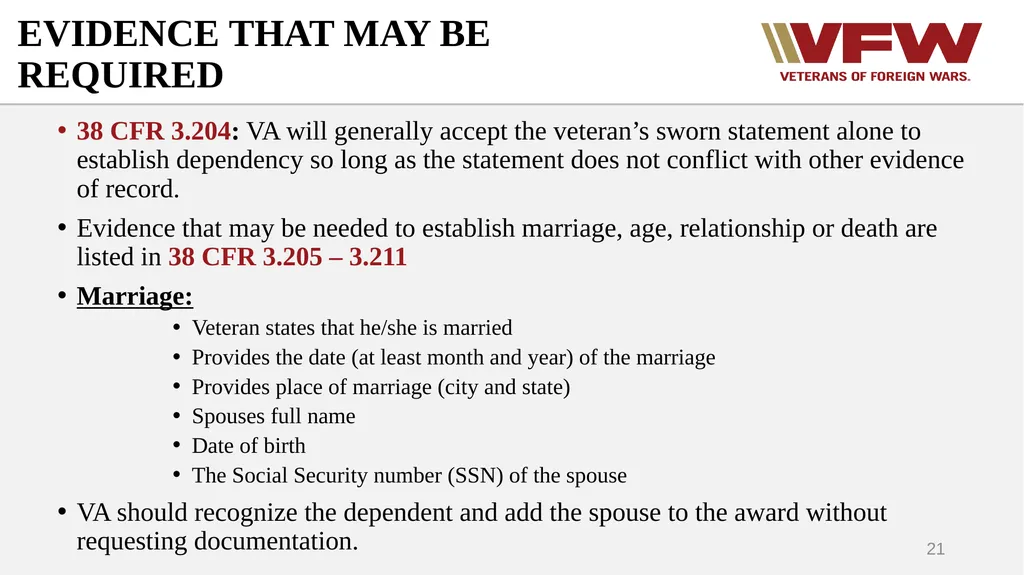
38 CFR 3.204: VA will generally accept the veteran’s sworn statement alone to establish dependency so long as the statement does not conflict with other evidence of record.
Evidence that may be needed to establish marriage, age, relationship or death are listed in 38 CFR 3.205 – 3.211
Marriage:
Veteran states that he/she is married
Provides the date (at least month and year) of the marriage
Provides place of marriage (city and state)
Spouses full name
Date of birth
The Social Security number (SSN) of the spouse
VA should recognize the dependent and add the spouse to the award without requesting documentation. 21 EVIDENCE THAT MAY BE REQUIRED<br>
Evidence that may be needed to establish marriage, age, relationship or death are listed in 38 CFR 3.205 – 3.211
Marriage:
Veteran states that he/she is married
Provides the date (at least month and year) of the marriage
Provides place of marriage (city and state)
Spouses full name
Date of birth
The Social Security number (SSN) of the spouse
VA should recognize the dependent and add the spouse to the award without requesting documentation. 21 EVIDENCE THAT MAY BE REQUIRED<br>
22
Child: If the veteran states that he/she has a child, provides the date and place of birth, the child’s full name and child’s SSN, VA should recognize the child and add the child to the award without requesting additional documentation or evidence.
Situations involving step-children or adopted children routinely require the submission of birth certificates or adoption papers before VA will recognize the dependent.
Parent: In order to recognize a parent as a dependent, VA requires a copy of the veteran’s birth certificate or adoption paperwork that clearly shows the names of both parents. 22 EVIDENCE THAT MAY BE REQUIRED<br>
Situations involving step-children or adopted children routinely require the submission of birth certificates or adoption papers before VA will recognize the dependent.
Parent: In order to recognize a parent as a dependent, VA requires a copy of the veteran’s birth certificate or adoption paperwork that clearly shows the names of both parents. 22 EVIDENCE THAT MAY BE REQUIRED<br>
23
Spouse:
In cases other than a standard legal or religious marriage, VA may require documentation and sometimes additional evidence before the dependent can be recognized. (naturalization papers, sworn statements, tax records etc.)
In simple cases of divorce, the veteran’s statement that provides the date (at least month and year) and place (city and state) of the divorce will be accepted as proof of the event. 23 EVIDENCE THAT MAY BE REQUIRED<br>
In cases other than a standard legal or religious marriage, VA may require documentation and sometimes additional evidence before the dependent can be recognized. (naturalization papers, sworn statements, tax records etc.)
In simple cases of divorce, the veteran’s statement that provides the date (at least month and year) and place (city and state) of the divorce will be accepted as proof of the event. 23 EVIDENCE THAT MAY BE REQUIRED<br>
24
In complex cases of multiple marriages/divorces on the part of the veteran and/or current spouse, copies of divorce decrees or orders of annulment may be required by VA before dependency can be established.
In death cases, VA can “deem” the marriage of a surviving spouse valid following development if the marriage to the veteran can be shown and the surviving spouse was unaware of any prior marriages of the late veteran. 24 EVIDENCE THAT MAY BE REQUIRED<br>
In death cases, VA can “deem” the marriage of a surviving spouse valid following development if the marriage to the veteran can be shown and the surviving spouse was unaware of any prior marriages of the late veteran. 24 EVIDENCE THAT MAY BE REQUIRED<br>
25
Keep in mind that VA reserves the right to request documentation of dependency if VA finds conflicting evidence, unclear statements, or any other situation where it feels that documentation is warranted.
Inconsistency in reporting dependents causes red flags to go up.
If the veteran is claiming “Sally” as his spouse, and the claims file shows he is married to “Jane”, you can be assured that demands for documentation will follow
VA needs to know that the prior marriage was dissolved BEFORE the current marriage began.
If the veteran can’t give you complete dates/places/SSNs, ask for documentation; you can be assured that VA will need them. 25 EVIDENCE THAT MAY BE REQUIRED<br>
Inconsistency in reporting dependents causes red flags to go up.
If the veteran is claiming “Sally” as his spouse, and the claims file shows he is married to “Jane”, you can be assured that demands for documentation will follow
VA needs to know that the prior marriage was dissolved BEFORE the current marriage began.
If the veteran can’t give you complete dates/places/SSNs, ask for documentation; you can be assured that VA will need them. 25 EVIDENCE THAT MAY BE REQUIRED<br>
26
Dependency is an issue in nearly every VA claim and should be a routine part of your interview with the claimant.
Even if you are certain the veteran will not receive the required 30% rating needed to receive additional benefits, you should still submit dependency paperwork at the time of filing if possible. 26 THE SERVICE OFFICER’S ROLE IN DEPENDENCY CLAIMS<br>
Even if you are certain the veteran will not receive the required 30% rating needed to receive additional benefits, you should still submit dependency paperwork at the time of filing if possible. 26 THE SERVICE OFFICER’S ROLE IN DEPENDENCY CLAIMS<br>
27
Dependents can be added to a claim in the following ways:
Complete the VA Form 21-686c “Application to Add and/or Remove Dependents” and turn it into the VARO/submit through Direct Upload or fax to centralized mail
Have the veteran apply through eBenefits
Use the Stakeholder Enterprise Portal (SEP) 27 HOW TO ADD DEPENDENTS TO A CLAIM<br>
Complete the VA Form 21-686c “Application to Add and/or Remove Dependents” and turn it into the VARO/submit through Direct Upload or fax to centralized mail
Have the veteran apply through eBenefits
Use the Stakeholder Enterprise Portal (SEP) 27 HOW TO ADD DEPENDENTS TO A CLAIM<br>
28
When filling out the 686c be sure to pay attention to what information the form is asking for and follow the instructions completely. Though it looks intimidating, if you follow the instructions you will be ok.
For instance – Block 12A asks if your spouse is a veteran, if yes complete 12B & 12C.
What do you do if the answer is no?
All marriages of the veteran and spouse must be included in order to receive dependent benefits.
What can you do if the veteran doesn’t know this information? 28 COMPLETING THE 686c<br>
For instance – Block 12A asks if your spouse is a veteran, if yes complete 12B & 12C.
What do you do if the answer is no?
All marriages of the veteran and spouse must be included in order to receive dependent benefits.
What can you do if the veteran doesn’t know this information? 28 COMPLETING THE 686c<br>
29
Block 13A asks if you live with your spouse, if the veteran is a geographical bachelor, select yes.
If the veteran has more marriages than spaces on the form you can put the additional marriages on a 21-4138 Statement in Support of Claim but be sure to write that this is a continuation of the 686c
If the veteran has more children than space available use the addendum form (Page 12 of the 686c) 29 COMPLETING THE 686c<br>
If the veteran has more marriages than spaces on the form you can put the additional marriages on a 21-4138 Statement in Support of Claim but be sure to write that this is a continuation of the 686c
If the veteran has more children than space available use the addendum form (Page 12 of the 686c) 29 COMPLETING THE 686c<br>
30
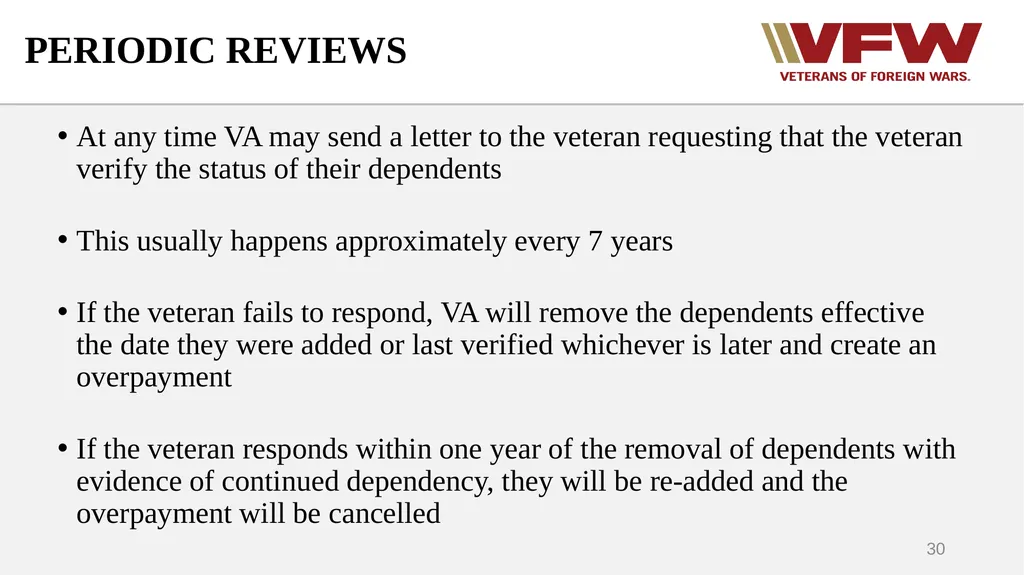
At any time VA may send a letter to the veteran requesting that the veteran verify the status of their dependents
This usually happens approximately every 7 years
If the veteran fails to respond, VA will remove the dependents effective the date they were added or last verified whichever is later and create an overpayment
If the veteran responds within one year of the removal of dependents with evidence of continued dependency, they will be re-added and the overpayment will be cancelled 30 PERIODIC REVIEWS<br>
This usually happens approximately every 7 years
If the veteran fails to respond, VA will remove the dependents effective the date they were added or last verified whichever is later and create an overpayment
If the veteran responds within one year of the removal of dependents with evidence of continued dependency, they will be re-added and the overpayment will be cancelled 30 PERIODIC REVIEWS<br>
31
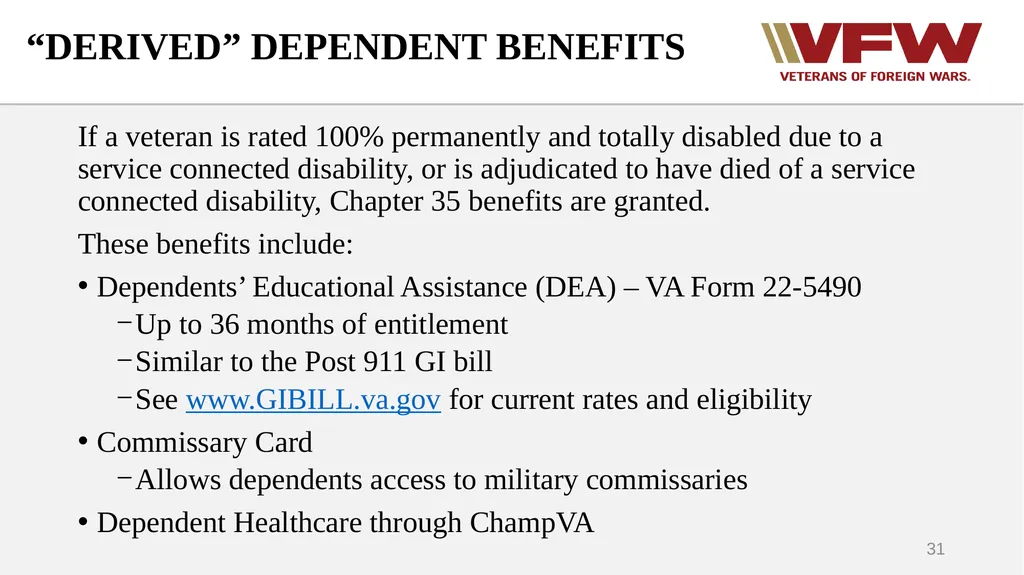
If a veteran is rated 100% permanently and totally disabled due to a service connected disability, or is adjudicated to have died of a service connected disability, Chapter 35 benefits are granted.
These benefits include:
Dependents’ Educational Assistance (DEA) – VA Form 22-5490
Up to 36 months of entitlement
Similar to the Post 911 GI bill
See www.GIBILL.va.gov for current rates and eligibility
Commissary Card
Allows dependents access to military commissaries
Dependent Healthcare through ChampVA 31 “DERIVED” DEPENDENT BENEFITS<br>
These benefits include:
Dependents’ Educational Assistance (DEA) – VA Form 22-5490
Up to 36 months of entitlement
Similar to the Post 911 GI bill
See www.GIBILL.va.gov for current rates and eligibility
Commissary Card
Allows dependents access to military commissaries
Dependent Healthcare through ChampVA 31 “DERIVED” DEPENDENT BENEFITS<br>
32
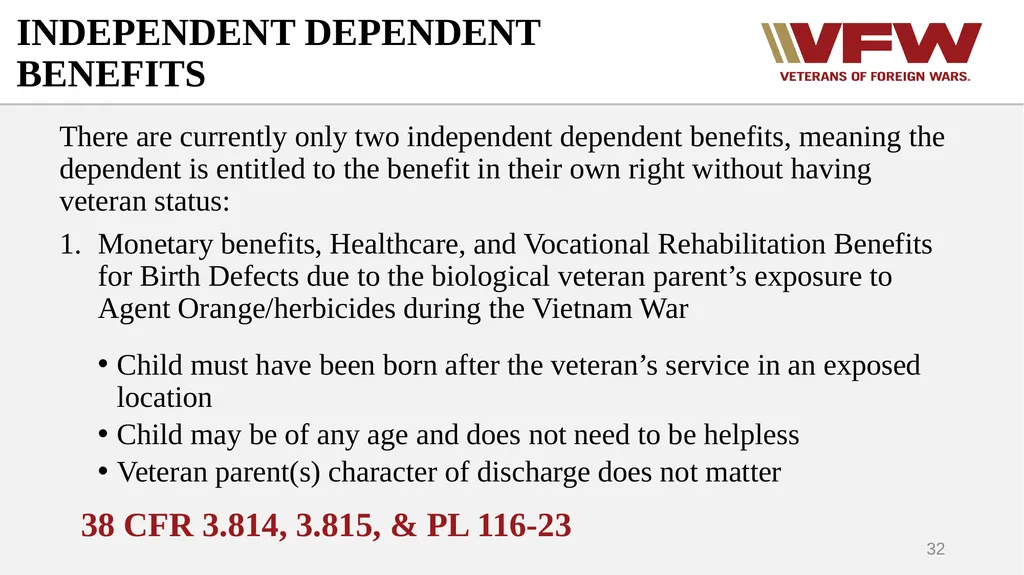
There are currently only two independent dependent benefits, meaning the dependent is entitled to the benefit in their own right without having veteran status:
Monetary benefits, Healthcare, and Vocational Rehabilitation Benefits for Birth Defects due to the biological veteran parent’s exposure to Agent Orange/herbicides during the Vietnam War
Child must have been born after the veteran’s service in an exposed location
Child may be of any age and does not need to be helpless
Veteran parent(s) character of discharge does not matter
38 CFR 3.814, 3.815, & PL 116-23 32 INDEPENDENT DEPENDENT BENEFITS<br>
Monetary benefits, Healthcare, and Vocational Rehabilitation Benefits for Birth Defects due to the biological veteran parent’s exposure to Agent Orange/herbicides during the Vietnam War
Child must have been born after the veteran’s service in an exposed location
Child may be of any age and does not need to be helpless
Veteran parent(s) character of discharge does not matter
38 CFR 3.814, 3.815, & PL 116-23 32 INDEPENDENT DEPENDENT BENEFITS<br>
33
Reimbursement of healthcare costs for 15 medical conditions related to exposure to contaminated water at Camp LeJeune, for family members who lived in the Camp LeJeune area with the veteran for 30 days or more between August 1953 and December 1987
Does not have to be a current dependent, just a dependent at time of exposure (can be ex-spouse, adult child)
VA does not provide health care, just reimbursement for expenses paid by dependent
More information: https://www.va.gov/disability/eligibility/hazardous-materials-exposure/camp-lejeune-water-contamination/
38 CFR 17.410 33 INDEPENDENT DEPENDENT BENEFITS<br>
Does not have to be a current dependent, just a dependent at time of exposure (can be ex-spouse, adult child)
VA does not provide health care, just reimbursement for expenses paid by dependent
More information: https://www.va.gov/disability/eligibility/hazardous-materials-exposure/camp-lejeune-water-contamination/
38 CFR 17.410 33 INDEPENDENT DEPENDENT BENEFITS<br>
34
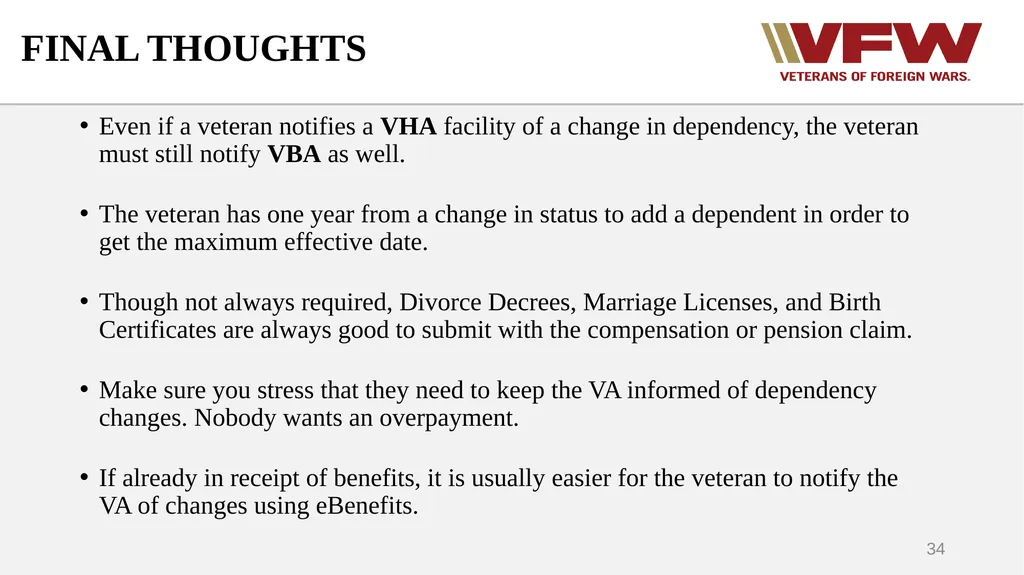
Even if a veteran notifies a VHA facility of a change in dependency, the veteran must still notify VBA as well.
The veteran has one year from a change in status to add a dependent in order to get the maximum effective date.
Though not always required, Divorce Decrees, Marriage Licenses, and Birth Certificates are always good to submit with the compensation or pension claim.
Make sure you stress that they need to keep the VA informed of dependency changes. Nobody wants an overpayment.
If already in receipt of benefits, it is usually easier for the veteran to notify the VA of changes using eBenefits. 34 FINAL THOUGHTS<br>
The veteran has one year from a change in status to add a dependent in order to get the maximum effective date.
Though not always required, Divorce Decrees, Marriage Licenses, and Birth Certificates are always good to submit with the compensation or pension claim.
Make sure you stress that they need to keep the VA informed of dependency changes. Nobody wants an overpayment.
If already in receipt of benefits, it is usually easier for the veteran to notify the VA of changes using eBenefits. 34 FINAL THOUGHTS<br>
35
If you have any questions regarding this topic, please email them to the DSO Helpdesk at DSOHelpdesk@vfw.org.
When sending a question, please title your email as: Virtual Basic Training Question<br>
When sending a question, please title your email as: Virtual Basic Training Question<br>