
Describing works and expressions Module 6 Prepared
DP
Published · 163 slides · 0 views

1 / 1


Description
Describing works and expressions Module 6 Prepared by the PCC Standing Committee on Training RDA NACO Program Training Workshop Task Group Pertinent instructions RDA Chapters 5 and 6 Other RDA chapters when constructing access points that
Related Topics
Share
Embed code
Download this presentation From Below
"Describing works and expressions Module 6 Prepared" is the property of its rightful owner. Permission is granted to download and print the materials on this website for personal, non-commercial use only, and to display it on your personal computer provided you do not modify the materials and that you retain all copyright notices contained in the materials. By downloading content from our website, you accept the terms of this agreement.
Presentation Transcript
01
Describing works and expressions
Module 6 Prepared by
the PCC Standing Committee on Training
RDA NACO Program Training Workshop Task Group<br>
the PCC Standing Committee on Training
RDA NACO Program Training Workshop Task Group<br>
02
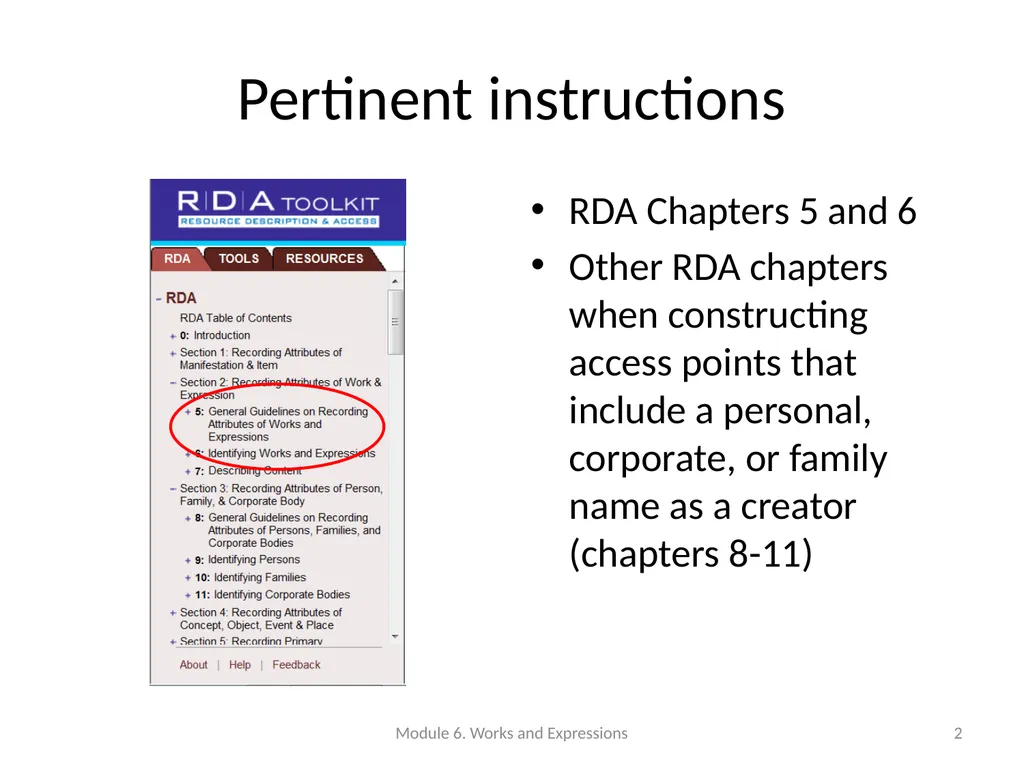
Pertinent instructions RDA Chapters 5 and 6
Other RDA chapters when constructing access points that include a personal, corporate, or family name as a creator (chapters 8-11) Module 6. Works and Expressions 2<br>
Other RDA chapters when constructing access points that include a personal, corporate, or family name as a creator (chapters 8-11) Module 6. Works and Expressions 2<br>
03
Scope The purpose of this module is to learn how to describe works and expressions
This workshop does not cover
Music
Legal works
Series Module 6. Works and Expressions 3<br>
This workshop does not cover
Music
Legal works
Series Module 6. Works and Expressions 3<br>
04
Definitions (RDA 5.1.2) The term work refers to a distinct intellectual or artistic creation (i.e., the intellectual or artistic content).
The term expression refers to the intellectual or artistic realization of a work in the form of alpha-numeric, musical or choreographic notation, sound, image, object, movement, etc., or any combination of such forms. Module 6. Works and Expressions 4<br>
The term expression refers to the intellectual or artistic realization of a work in the form of alpha-numeric, musical or choreographic notation, sound, image, object, movement, etc., or any combination of such forms. Module 6. Works and Expressions 4<br>
05
Definitions (RDA 5.1.2) The terms work and expression should be read, where applicable, to include not only an individual entity, but also aggregates and components of such entities (i.e., the term work should be read to include aggregate works and components of works as well as individual works, etc.)
So throughout this presentation “work” and “expression” can refer to collections and parts, as well as individual works or expressions Module 6. Works and Expressions 5<br>
So throughout this presentation “work” and “expression” can refer to collections and parts, as well as individual works or expressions Module 6. Works and Expressions 5<br>
06
Work and Expressions Module 6. Works and Expressions 6<br>
07
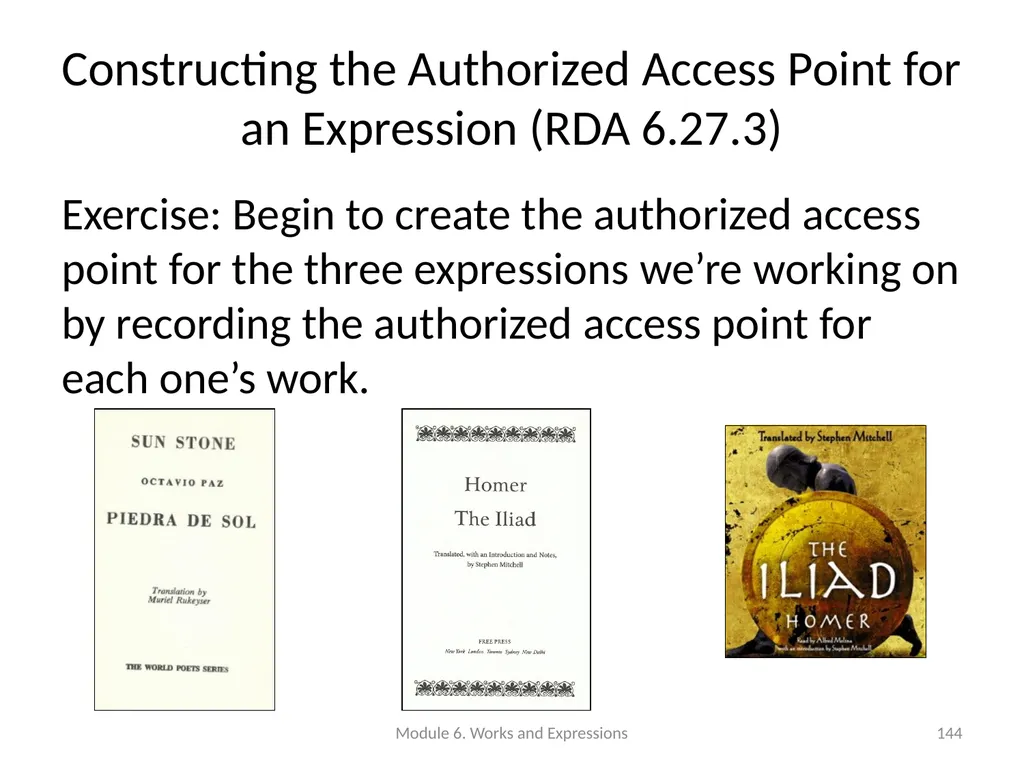
Works and Expressions Work: Piedra de sol Person: Muriel Rukeyser Person: Octavio Paz Expression: English Expression: Spanish realized through translated by created by Module 6. Works and Expressions 7<br>
08
When do you have to create an authority record? PCC Practice—create as needed for cataloging
BIBCO—create to support access points Module 6. Works and Expressions 8<br>
BIBCO—create to support access points Module 6. Works and Expressions 8<br>
09
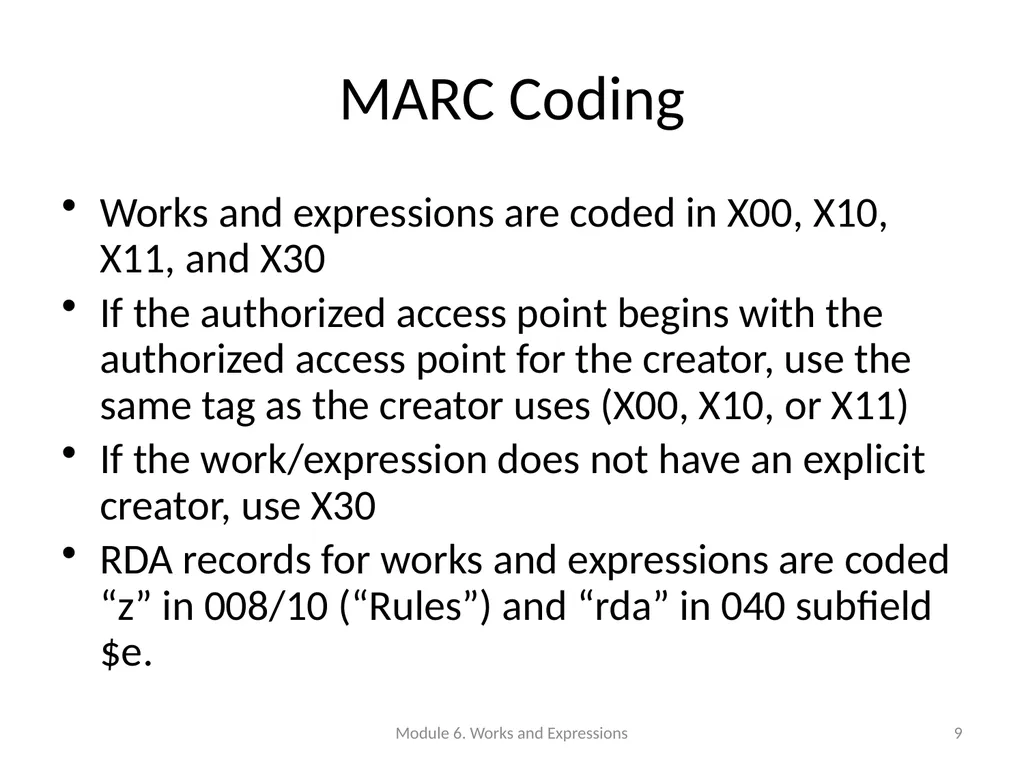
MARC Coding Works and expressions are coded in X00, X10, X11, and X30
If the authorized access point begins with the authorized access point for the creator, use the same tag as the creator uses (X00, X10, or X11)
If the work/expression does not have an explicit creator, use X30
RDA records for works and expressions are coded “z” in 008/10 (“Rules”) and “rda” in 040 subfield $e. Module 6. Works and Expressions 9<br>
If the authorized access point begins with the authorized access point for the creator, use the same tag as the creator uses (X00, X10, or X11)
If the work/expression does not have an explicit creator, use X30
RDA records for works and expressions are coded “z” in 008/10 (“Rules”) and “rda” in 040 subfield $e. Module 6. Works and Expressions 9<br>
10
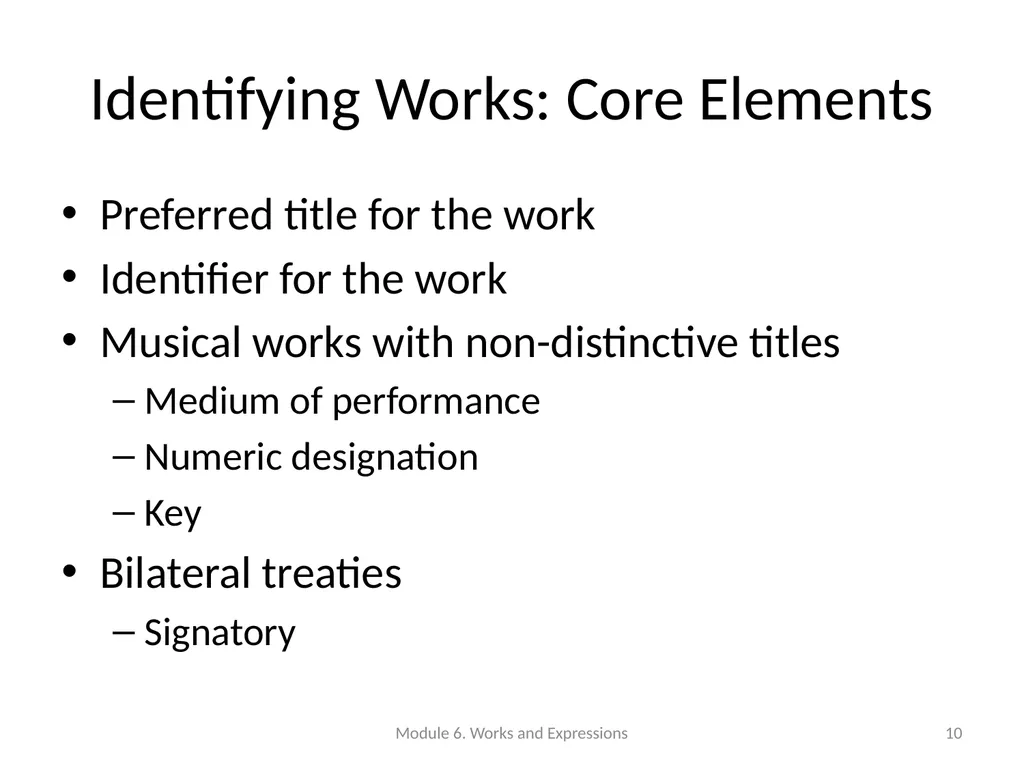
Identifying Works: Core Elements Preferred title for the work
Identifier for the work
Musical works with non-distinctive titles
Medium of performance
Numeric designation
Key
Bilateral treaties
Signatory Module 6. Works and Expressions 10<br>
Identifier for the work
Musical works with non-distinctive titles
Medium of performance
Numeric designation
Key
Bilateral treaties
Signatory Module 6. Works and Expressions 10<br>
11
Identifying Works:
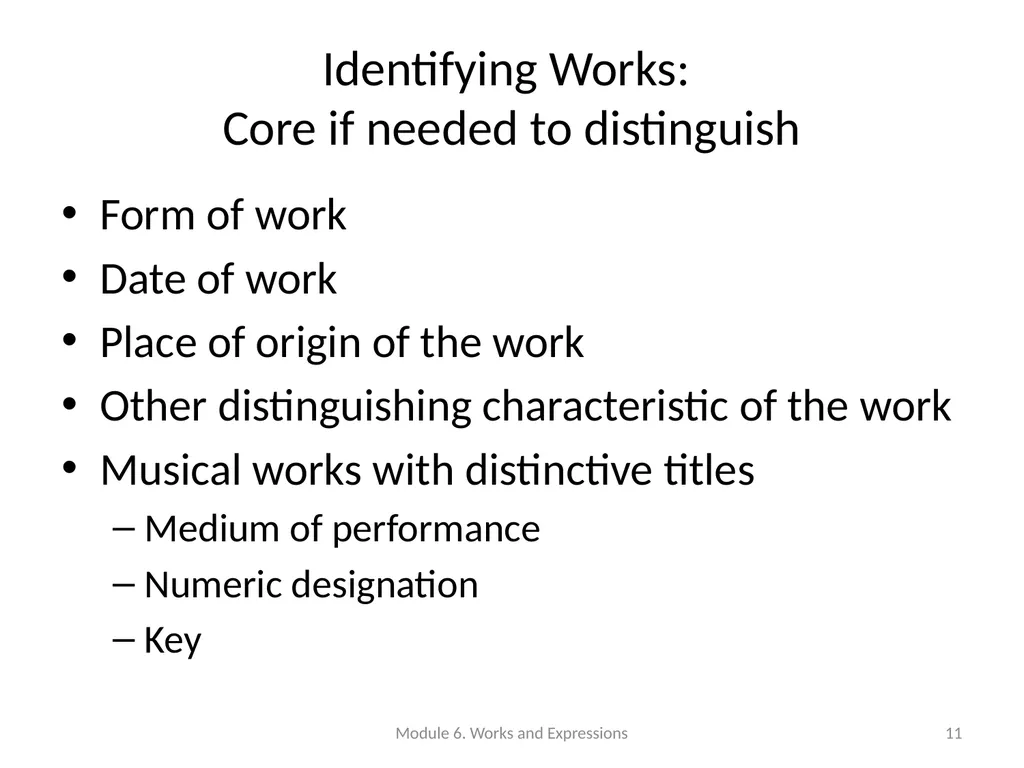
Core if needed to distinguish Form of work
Date of work
Place of origin of the work
Other distinguishing characteristic of the work
Musical works with distinctive titles
Medium of performance
Numeric designation
Key Module 6. Works and Expressions 11<br>
Date of work
Place of origin of the work
Other distinguishing characteristic of the work
Musical works with distinctive titles
Medium of performance
Numeric designation
Key Module 6. Works and Expressions 11<br>
12
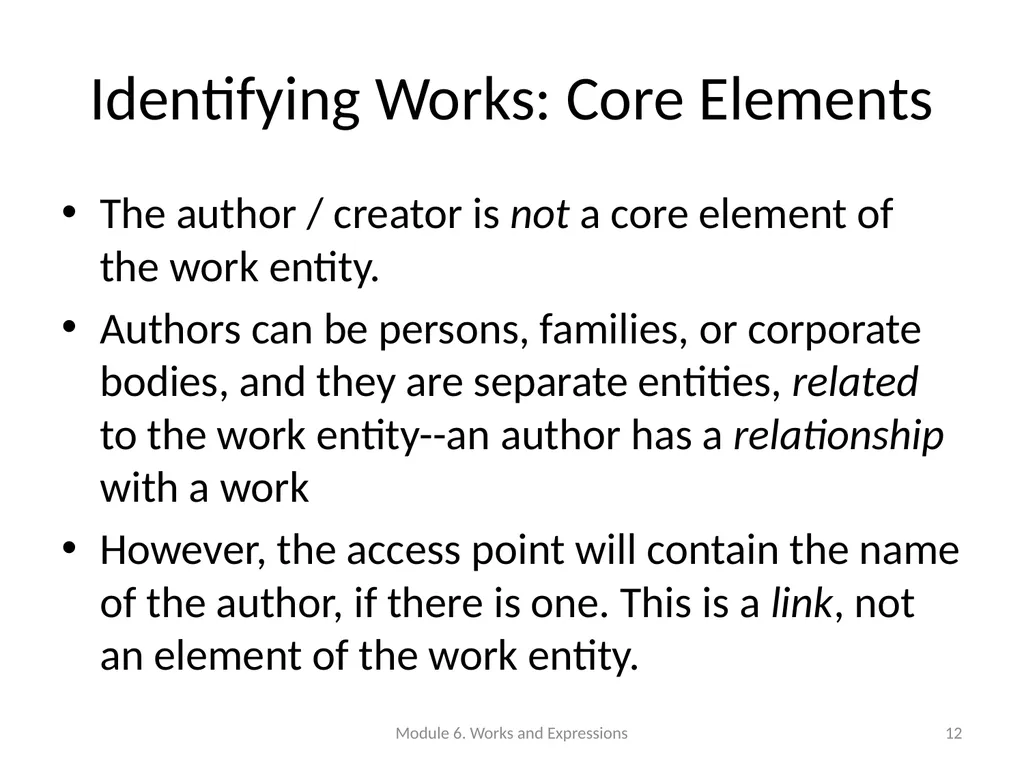
Identifying Works: Core Elements The author / creator is not a core element of the work entity.
Authors can be persons, families, or corporate bodies, and they are separate entities, related to the work entity--an author has a relationship with a work
However, the access point will contain the name of the author, if there is one. This is a link, not an element of the work entity. Module 6. Works and Expressions 12<br>
Authors can be persons, families, or corporate bodies, and they are separate entities, related to the work entity--an author has a relationship with a work
However, the access point will contain the name of the author, if there is one. This is a link, not an element of the work entity. Module 6. Works and Expressions 12<br>
13
Identifying Expressions:
Core Elements (RDA 5.3) Core in all cases
Identifier for the expression
Content type
Language of expression
Horizontal scale (maps)
Vertical scale (maps)
Core if needed to distinguish
Date of expression
Other distinguishing characteristic Module 6. Works and Expressions 13<br>
Identifier for the expression
Content type
Language of expression
Horizontal scale (maps)
Vertical scale (maps)
Core if needed to distinguish
Date of expression
Other distinguishing characteristic Module 6. Works and Expressions 13<br>
14
Source Consulted (RDA 5.8) Record in 670 field, or 3XX subfield $u/$v
Always include one 670 for the resource being cataloged
Others included if needed to justify information in the description
Suggested format:
670 Title proper, date: $b location within source (data found) Module 6. Works and Expressions 14<br>
Always include one 670 for the resource being cataloged
Others included if needed to justify information in the description
Suggested format:
670 Title proper, date: $b location within source (data found) Module 6. Works and Expressions 14<br>
15
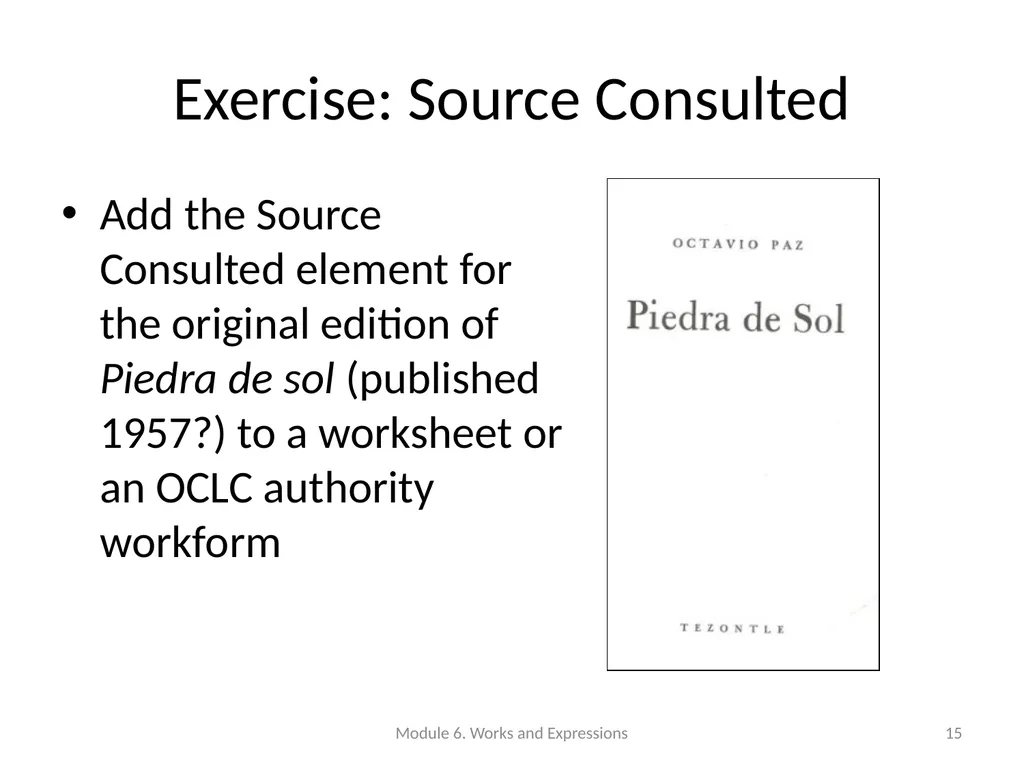
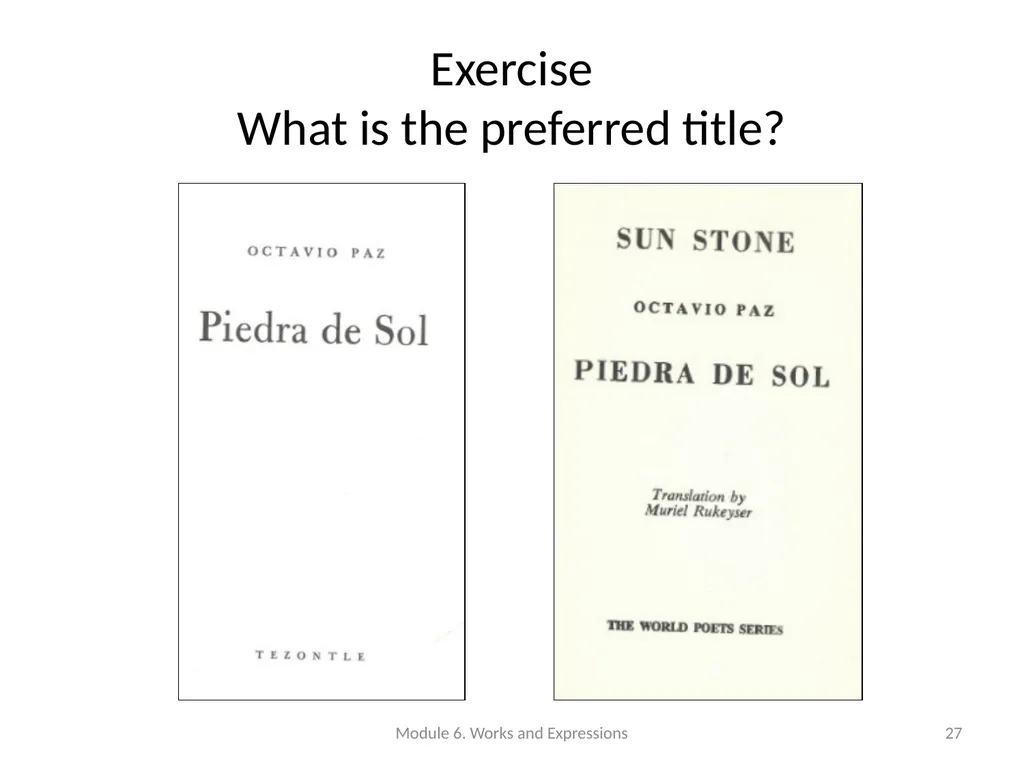
Exercise: Source Consulted Add the Source Consulted element for the original edition of Piedra de sol (published 1957?) to a worksheet or an OCLC authority workform Module 6. Works and Expressions 15<br>
16
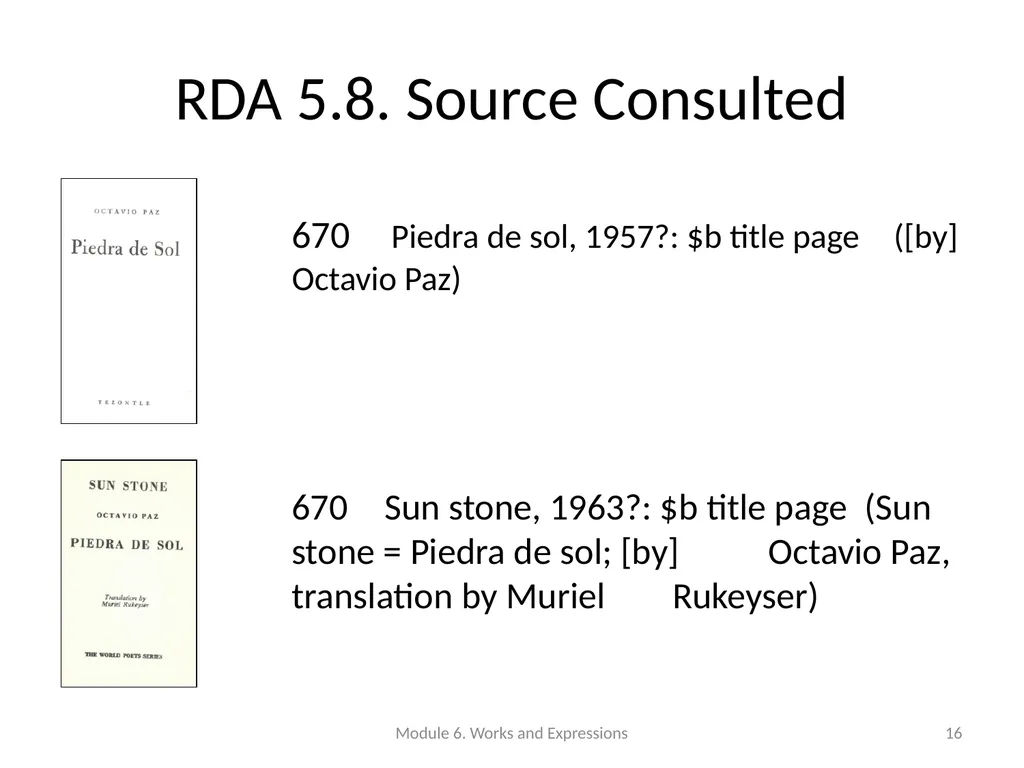
RDA 5.8. Source Consulted 670 Piedra de sol, 1957?: $b title page ([by] Octavio Paz) 670 Sun stone, 1963?: $b title page (Sun stone = Piedra de sol; [by] Octavio Paz, translation by Muriel Rukeyser) Module 6. Works and Expressions 16<br>
17
Attributes of Works Module 6. Works and Expressions 17<br>
18
Titles (RDA 6.2.1) Information about titles of a work can be taken from any source (RDA 6.2.1.2)
Sources of information for the preferred title are found in RDA 6.2.2.2.
Creating the authorized access point is a further step (RDA 6.27) Module 6. Works and Expressions 18<br>
Sources of information for the preferred title are found in RDA 6.2.2.2.
Creating the authorized access point is a further step (RDA 6.27) Module 6. Works and Expressions 18<br>
19
Transcription and Capitalization Follow RDA 1.7. General guidelines on transcription (not the alternatives)
RDA 6.2.1.4. Capitalization. Follow Appendix A.3 and A.4.
RDA 6.2.1.6. Diacritical marks: record them as they appear; add them if it is certain that they are integral to the title but were omitted in the source
RDA 6.2.1.7. Omit initial articles (NACO follows the alternative)
RDA 6.2.1.9. Abbreviations. Record only abbreviations that are found in the source.
RDA 5.4. Language and script. NACO policy = Romanize vernacular scripts. Module 6. Works and Expressions 19<br>
RDA 6.2.1.4. Capitalization. Follow Appendix A.3 and A.4.
RDA 6.2.1.6. Diacritical marks: record them as they appear; add them if it is certain that they are integral to the title but were omitted in the source
RDA 6.2.1.7. Omit initial articles (NACO follows the alternative)
RDA 6.2.1.9. Abbreviations. Record only abbreviations that are found in the source.
RDA 5.4. Language and script. NACO policy = Romanize vernacular scripts. Module 6. Works and Expressions 19<br>
20
Transcription and Capitalization LC-PCC PS 6.2.2.8:
Do not routinely omit introductory phrases (e.g. “Here beginneth …”). Decide whether or not to omit, based on evidence for the most common form of the title
Correct inaccuracies in titles proper of series
Pre-modern forms of letters (i/j, u/v)
I/J vowel = i (ITER = iter; ILIAS = Ilias)
I/J consonant = j (IVS = jus; IVLIVS = Julius; MAJOR = major)
U/V vowel = u (VRSA = ursa)
U/V consonant = v (UOX = vox)
UU/VV = w (VVINDELIA = Windelia) Module 6. Works and Expressions 20<br>
Do not routinely omit introductory phrases (e.g. “Here beginneth …”). Decide whether or not to omit, based on evidence for the most common form of the title
Correct inaccuracies in titles proper of series
Pre-modern forms of letters (i/j, u/v)
I/J vowel = i (ITER = iter; ILIAS = Ilias)
I/J consonant = j (IVS = jus; IVLIVS = Julius; MAJOR = major)
U/V vowel = u (VRSA = ursa)
U/V consonant = v (UOX = vox)
UU/VV = w (VVINDELIA = Windelia) Module 6. Works and Expressions 20<br>
21
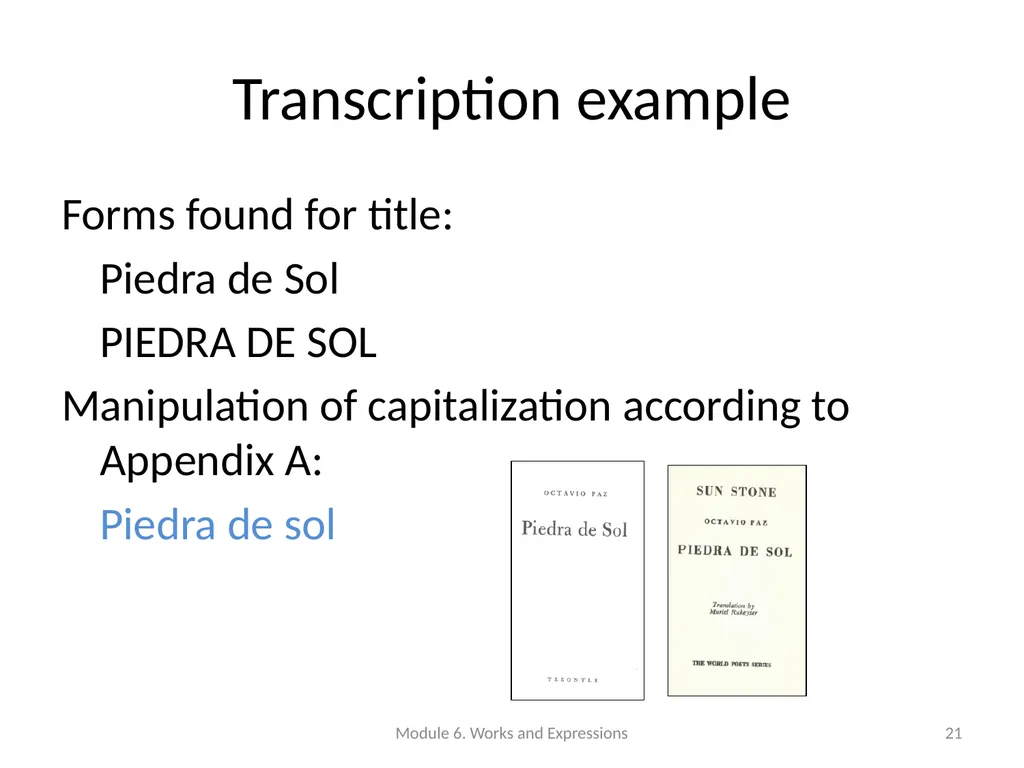
Transcription example Forms found for title:
Piedra de Sol
PIEDRA DE SOL
Manipulation of capitalization according to Appendix A:
Piedra de sol Module 6. Works and Expressions 21<br>
Piedra de Sol
PIEDRA DE SOL
Manipulation of capitalization according to Appendix A:
Piedra de sol Module 6. Works and Expressions 21<br>
22
Choosing the preferred title RDA 6.2.2.4-6.2.2.7
Two instructions:
Works created after 1500 and works created before 1501
Based on date of creation, not of publication Module 6. Works and Expressions 22<br>
Two instructions:
Works created after 1500 and works created before 1501
Based on date of creation, not of publication Module 6. Works and Expressions 22<br>
23
Choosing the preferred title—works created after 1500 Conditions (RDA 6.2.2.4):
Choose the most commonly known title in the original language (but not necessarily the original title)
The title can be found in resources embodying the work OR in reference sources. Module 6. Works and Expressions 23<br>
Choose the most commonly known title in the original language (but not necessarily the original title)
The title can be found in resources embodying the work OR in reference sources. Module 6. Works and Expressions 23<br>
24
Module 6. Works and Expressions 24<br>
25
Choosing the preferred title—works created after 1500 If no title is identified as being best-known or in case of doubt, choose the title proper of original edition
An alternative title is not included in the preferred title Module 6. Works and Expressions 25<br>
An alternative title is not included in the preferred title Module 6. Works and Expressions 25<br>
26
Choosing the preferred title—works created after 1500 If a work is simultaneously published in different languages: choose the title proper of the first publication received by agency
LC/PCC PS: If more than one language expression is issued in a compilation and the original cannot be determined, use the first title proper
Individual works of art: LC/PCC PS: use English-language reference source Module 6. Works and Expressions 26<br>
LC/PCC PS: If more than one language expression is issued in a compilation and the original cannot be determined, use the first title proper
Individual works of art: LC/PCC PS: use English-language reference source Module 6. Works and Expressions 26<br>
27
Exercise
What is the preferred title? Module 6. Works and Expressions 27<br>
28
Choosing the preferred title—work created before 1501 RDA 6.2.2.5. Choose the title
In the original language
By which the work is identified (i.e. commonly known)
As found in reference sources
If reference sources are inadequate, use forms found in (in this order)
Modern editions
Early editions
Manuscript copies
Special rules for Greek and anonymous works Module 6. Works and Expressions 28<br>
In the original language
By which the work is identified (i.e. commonly known)
As found in reference sources
If reference sources are inadequate, use forms found in (in this order)
Modern editions
Early editions
Manuscript copies
Special rules for Greek and anonymous works Module 6. Works and Expressions 28<br>
29
Choosing the preferred title—before 1501 Exceptions (RDA 6.2.2.5)
Classical Greek, Byzantine Greek (pre-1453). Choose, in this order:
A well-established title in language of cataloging agency (English for NACO)
The Latin title of the work
The Greek title of the work
Anonymous works, neither in Greek nor in the preferred script of the cataloging agency
A well-established title in language of cataloging agency (English for NACO)
If there is none, use the transliterated form of the original title Module 6. Works and Expressions 29<br>
Classical Greek, Byzantine Greek (pre-1453). Choose, in this order:
A well-established title in language of cataloging agency (English for NACO)
The Latin title of the work
The Greek title of the work
Anonymous works, neither in Greek nor in the preferred script of the cataloging agency
A well-established title in language of cataloging agency (English for NACO)
If there is none, use the transliterated form of the original title Module 6. Works and Expressions 29<br>
30
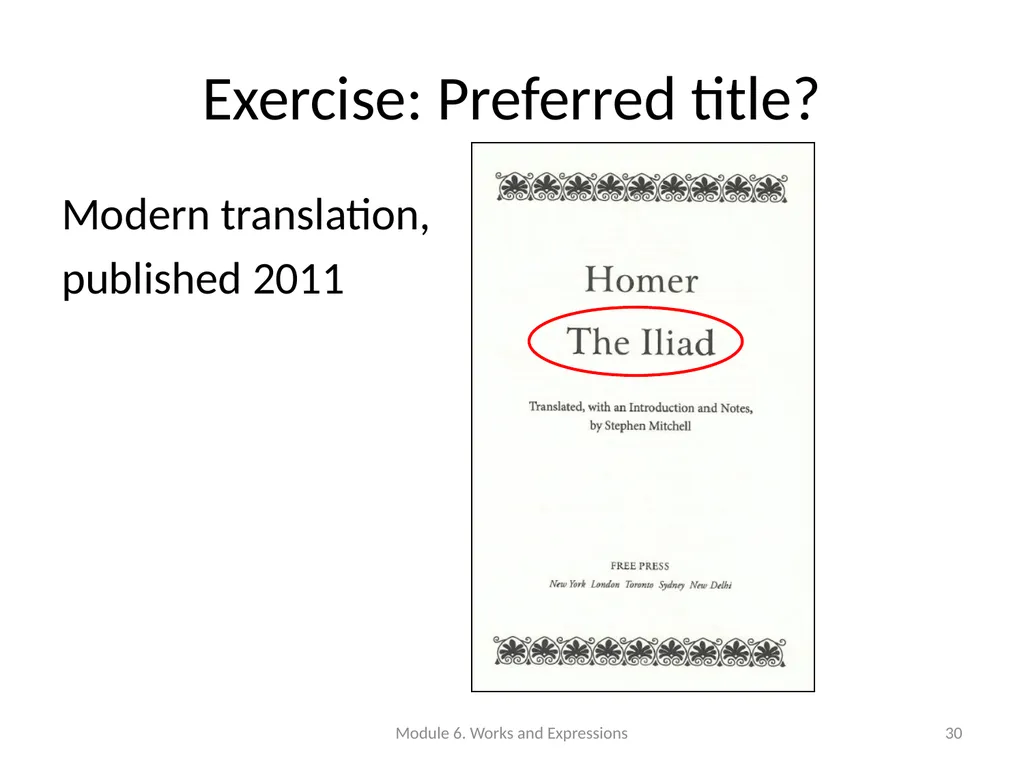
Exercise: Preferred title? Modern translation,
published 2011 Module 6. Works and Expressions 30<br>
published 2011 Module 6. Works and Expressions 30<br>
31
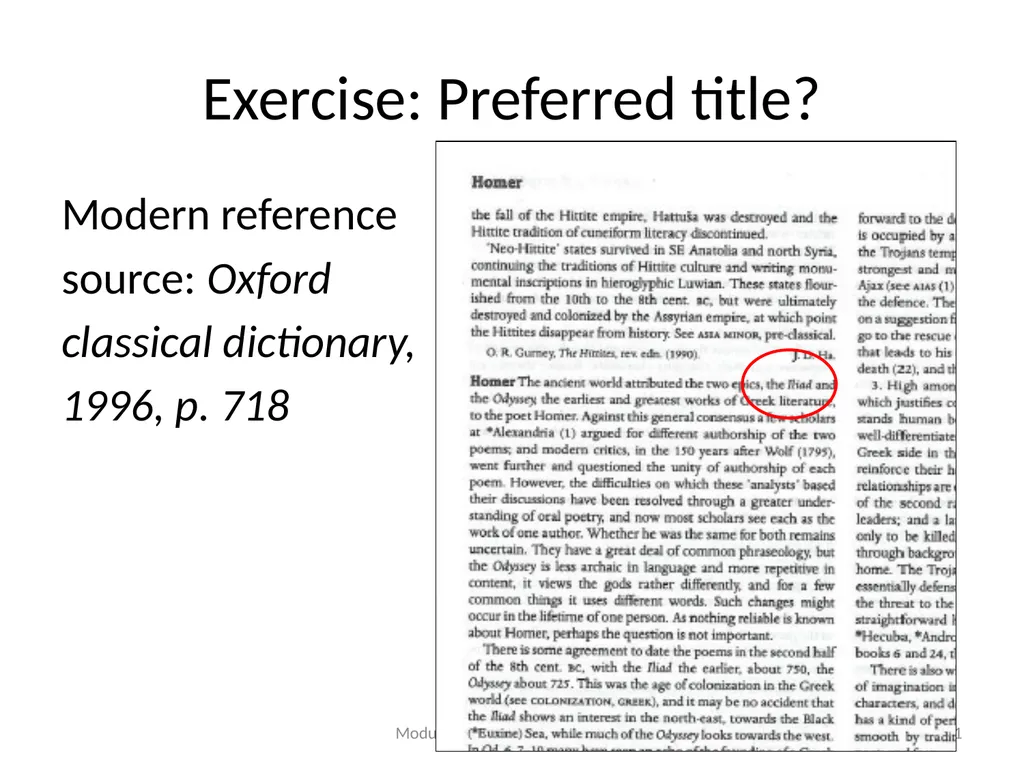
Exercise: Preferred title? Modern reference
source: Oxford
classical dictionary,
1996, p. 718 Module 6. Works and Expressions 31<br>
source: Oxford
classical dictionary,
1996, p. 718 Module 6. Works and Expressions 31<br>
32
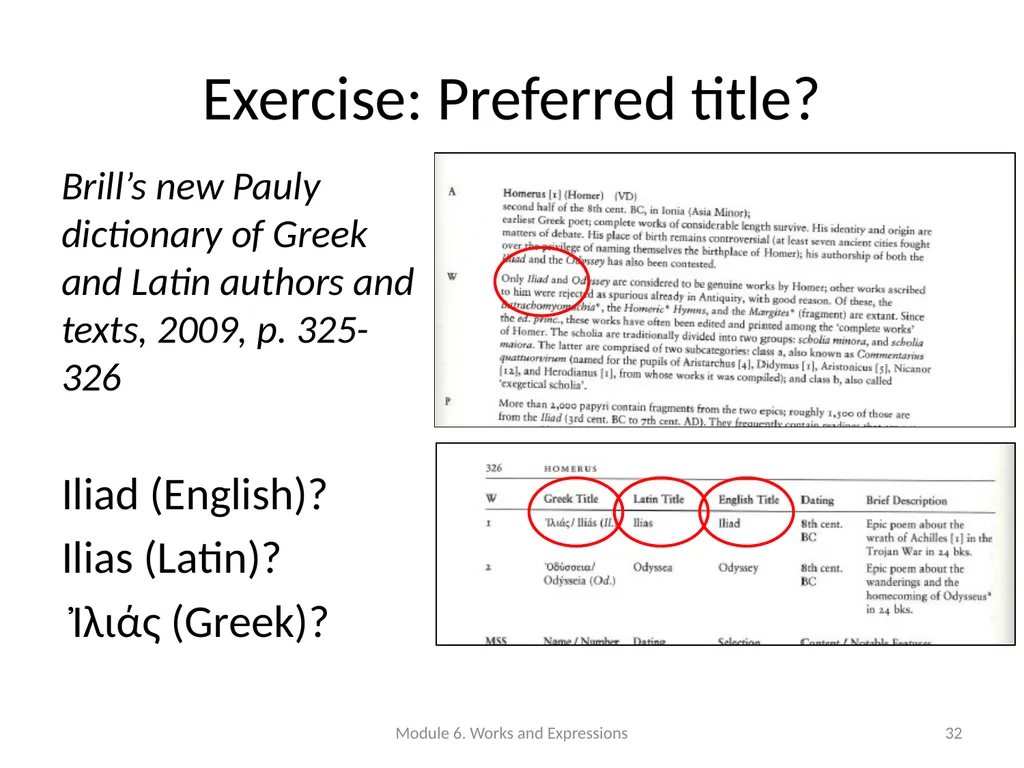
Exercise: Preferred title? Brill’s new Pauly dictionary of Greek and Latin authors and texts, 2009, p. 325-326
Iliad (English)?
Ilias (Latin)?
Ἰλιάς (Greek)? Module 6. Works and Expressions 32<br>
Iliad (English)?
Ilias (Latin)?
Ἰλιάς (Greek)? Module 6. Works and Expressions 32<br>
33
Cycles & stories with many versions Cycles (RDA 6.2.2.6)
Choose the “generally-accepted” title
Lacking that, use the title of the first-received resource
Title vs. descriptive phrase
Story with many versions
Choose the title in English found in reference sources Module 6. Works and Expressions 33<br>
Choose the “generally-accepted” title
Lacking that, use the title of the first-received resource
Title vs. descriptive phrase
Story with many versions
Choose the title in English found in reference sources Module 6. Works and Expressions 33<br>
34
Manuscripts/Manuscript Groups RDA 6.2.2.7: instructions for treating the manuscript as an object (vs. the work contained in it)
Use the title or name by which the manuscript is commonly identified
Book of Kells
If none, devise a title:
[Authorized access point for the repository]. Manuscript. [Repository’s designation for the manuscript]
British Library. Manuscript. Arundel 384
Apply general instructions (RDA 6.2.2.4-6.2.2.6) to describe the work contained in the manuscript Module 6. Works and Expressions 34<br>
Use the title or name by which the manuscript is commonly identified
Book of Kells
If none, devise a title:
[Authorized access point for the repository]. Manuscript. [Repository’s designation for the manuscript]
British Library. Manuscript. Arundel 384
Apply general instructions (RDA 6.2.2.4-6.2.2.6) to describe the work contained in the manuscript Module 6. Works and Expressions 34<br>
35
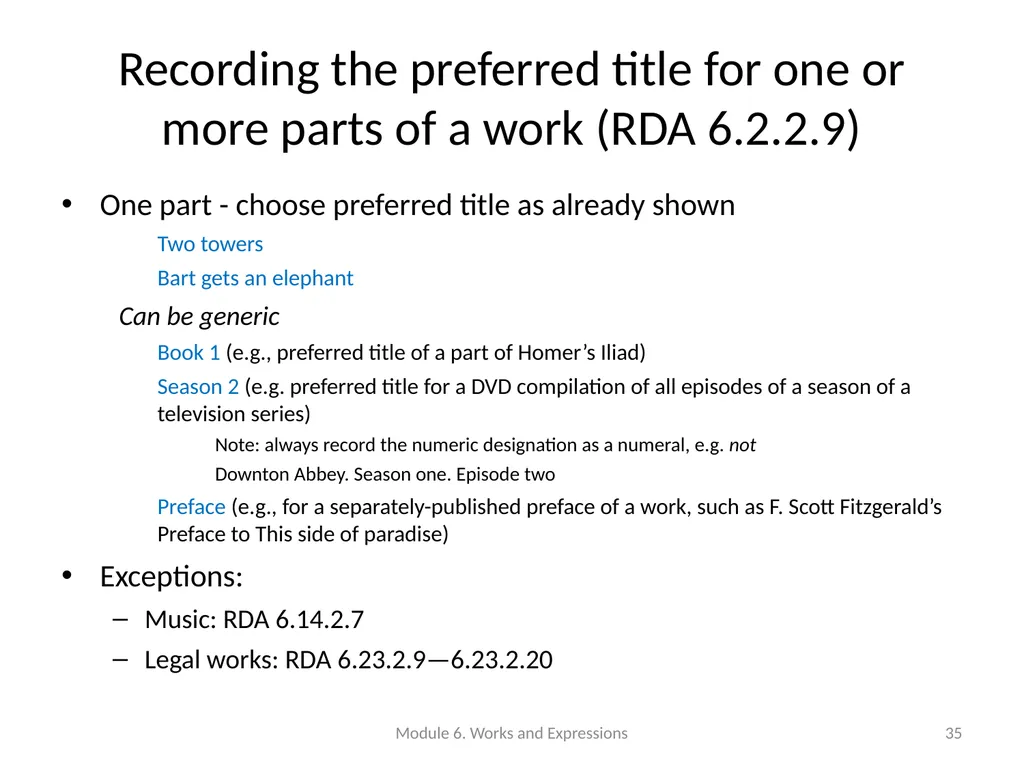
Recording the preferred title for one or more parts of a work (RDA 6.2.2.9) One part - choose preferred title as already shown
Two towers
Bart gets an elephant
Can be generic
Book 1 (e.g., preferred title of a part of Homer’s Iliad)
Season 2 (e.g. preferred title for a DVD compilation of all episodes of a season of a television series)
Note: always record the numeric designation as a numeral, e.g. not
Downton Abbey. Season one. Episode two
Preface (e.g., for a separately-published preface of a work, such as F. Scott Fitzgerald’s Preface to This side of paradise)
Exceptions:
Music: RDA 6.14.2.7
Legal works: RDA 6.23.2.9—6.23.2.20 Module 6. Works and Expressions 35<br>
Two towers
Bart gets an elephant
Can be generic
Book 1 (e.g., preferred title of a part of Homer’s Iliad)
Season 2 (e.g. preferred title for a DVD compilation of all episodes of a season of a television series)
Note: always record the numeric designation as a numeral, e.g. not
Downton Abbey. Season one. Episode two
Preface (e.g., for a separately-published preface of a work, such as F. Scott Fitzgerald’s Preface to This side of paradise)
Exceptions:
Music: RDA 6.14.2.7
Legal works: RDA 6.23.2.9—6.23.2.20 Module 6. Works and Expressions 35<br>
36
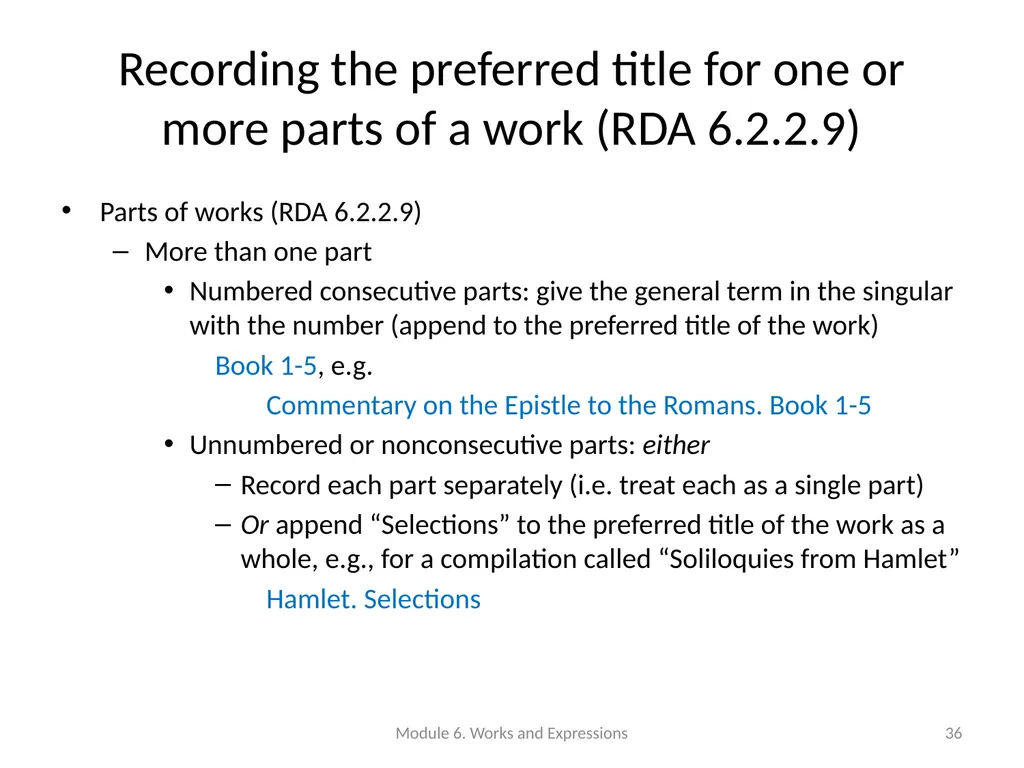
Recording the preferred title for one or more parts of a work (RDA 6.2.2.9) Parts of works (RDA 6.2.2.9)
More than one part
Numbered consecutive parts: give the general term in the singular with the number (append to the preferred title of the work)
Book 1-5, e.g.
Commentary on the Epistle to the Romans. Book 1-5
Unnumbered or nonconsecutive parts: either
Record each part separately (i.e. treat each as a single part)
Or append “Selections” to the preferred title of the work as a whole, e.g., for a compilation called “Soliloquies from Hamlet”
Hamlet. Selections Module 6. Works and Expressions 36<br>
More than one part
Numbered consecutive parts: give the general term in the singular with the number (append to the preferred title of the work)
Book 1-5, e.g.
Commentary on the Epistle to the Romans. Book 1-5
Unnumbered or nonconsecutive parts: either
Record each part separately (i.e. treat each as a single part)
Or append “Selections” to the preferred title of the work as a whole, e.g., for a compilation called “Soliloquies from Hamlet”
Hamlet. Selections Module 6. Works and Expressions 36<br>
37
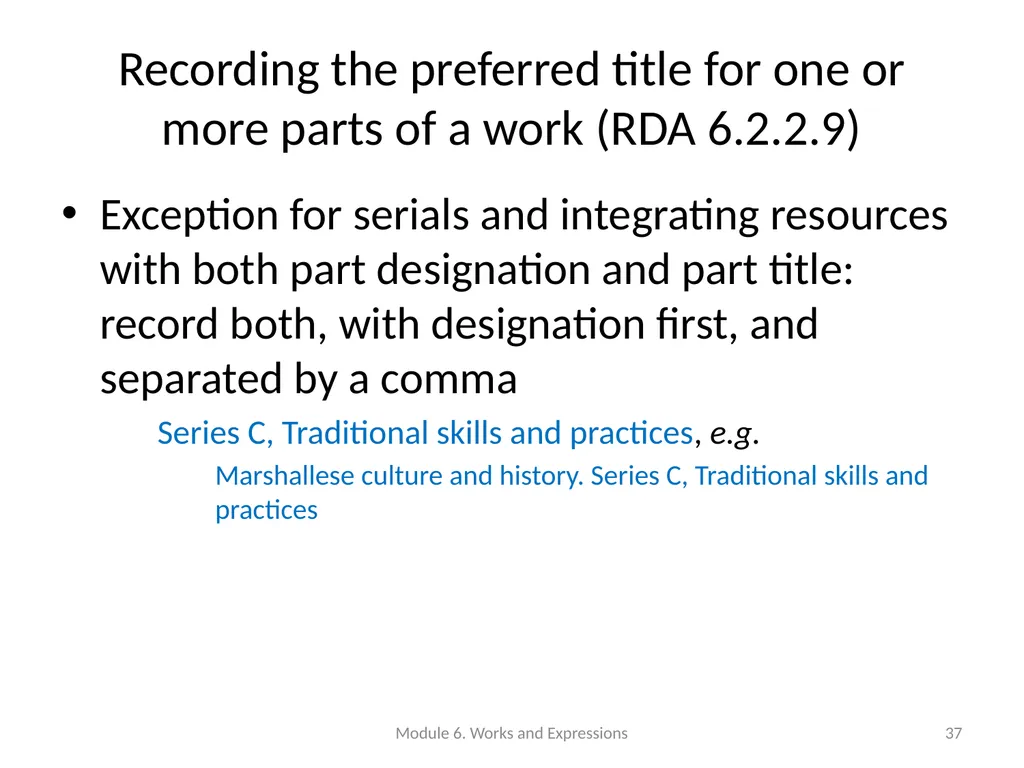
Recording the preferred title for one or more parts of a work (RDA 6.2.2.9) Exception for serials and integrating resources with both part designation and part title: record both, with designation first, and separated by a comma
Series C, Traditional skills and practices, e.g.
Marshallese culture and history. Series C, Traditional skills and practices Module 6. Works and Expressions 37<br>
Series C, Traditional skills and practices, e.g.
Marshallese culture and history. Series C, Traditional skills and practices Module 6. Works and Expressions 37<br>
38
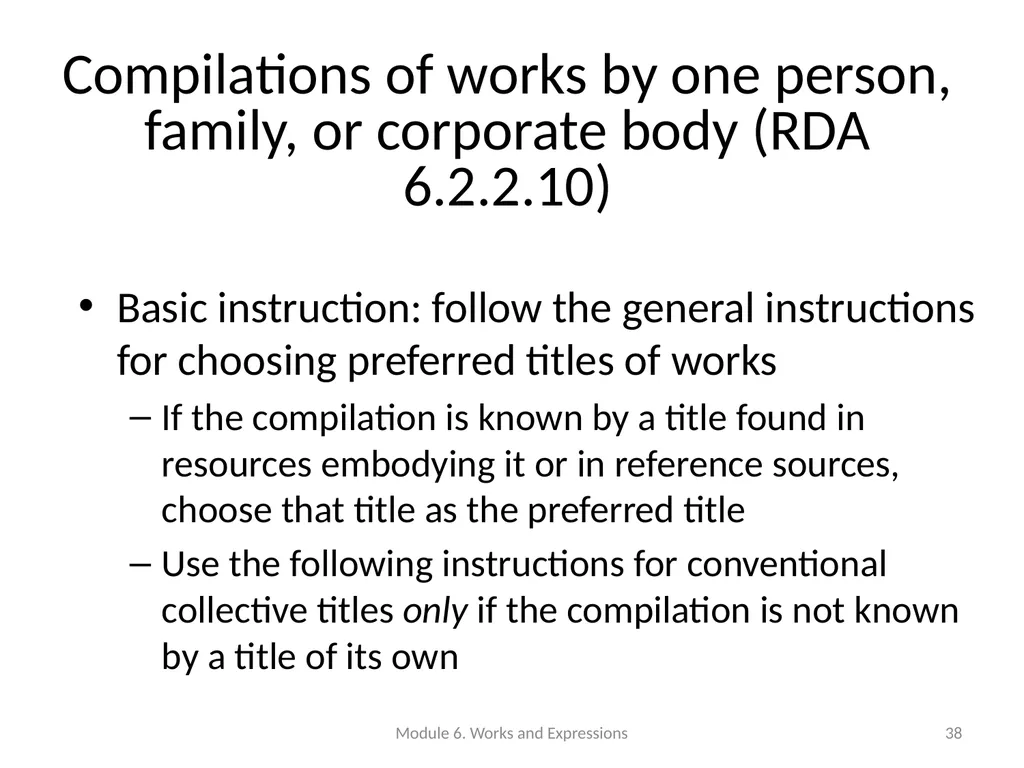
Compilations of works by one person, family, or corporate body (RDA 6.2.2.10) Basic instruction: follow the general instructions for choosing preferred titles of works
If the compilation is known by a title found in resources embodying it or in reference sources, choose that title as the preferred title
Use the following instructions for conventional collective titles only if the compilation is not known by a title of its own Module 6. Works and Expressions 38<br>
If the compilation is known by a title found in resources embodying it or in reference sources, choose that title as the preferred title
Use the following instructions for conventional collective titles only if the compilation is not known by a title of its own Module 6. Works and Expressions 38<br>
39
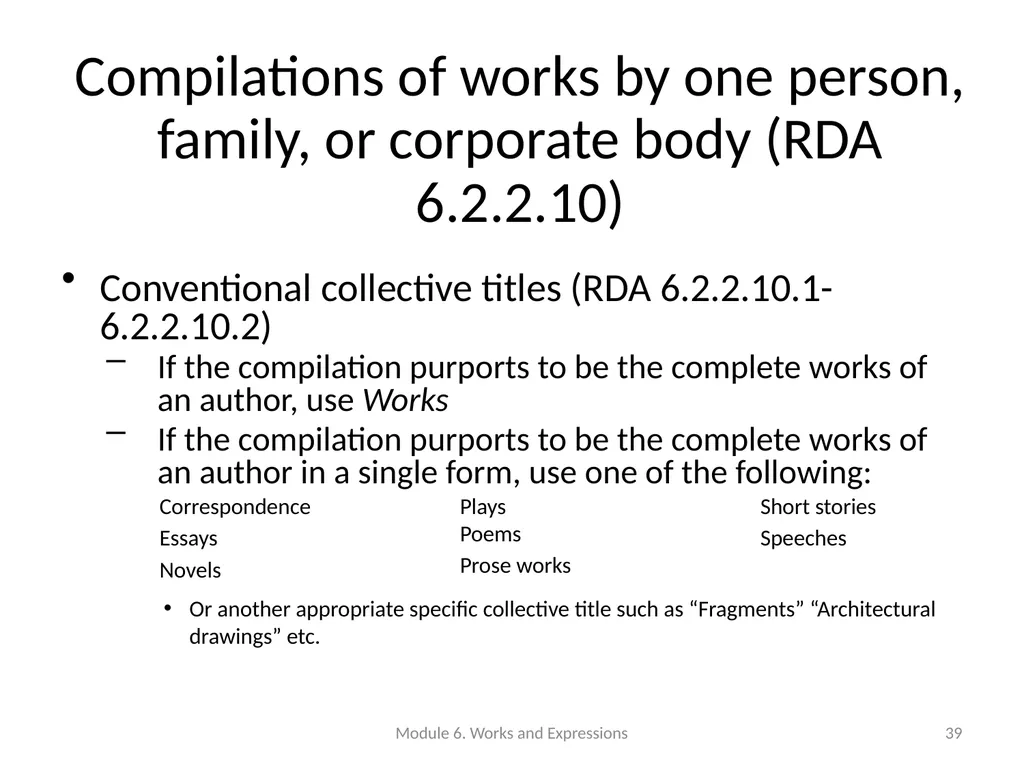
Compilations of works by one person, family, or corporate body (RDA 6.2.2.10) Conventional collective titles (RDA 6.2.2.10.1-6.2.2.10.2)
If the compilation purports to be the complete works of an author, use Works
If the compilation purports to be the complete works of an author in a single form, use one of the following: Correspondence
Essays
Novels
Plays Poems
Prose works
Short stories
Speeches Or another appropriate specific collective title such as “Fragments” “Architectural drawings” etc. Module 6. Works and Expressions 39<br>
If the compilation purports to be the complete works of an author, use Works
If the compilation purports to be the complete works of an author in a single form, use one of the following: Correspondence
Essays
Novels
Plays Poems
Prose works
Short stories
Speeches Or another appropriate specific collective title such as “Fragments” “Architectural drawings” etc. Module 6. Works and Expressions 39<br>
40
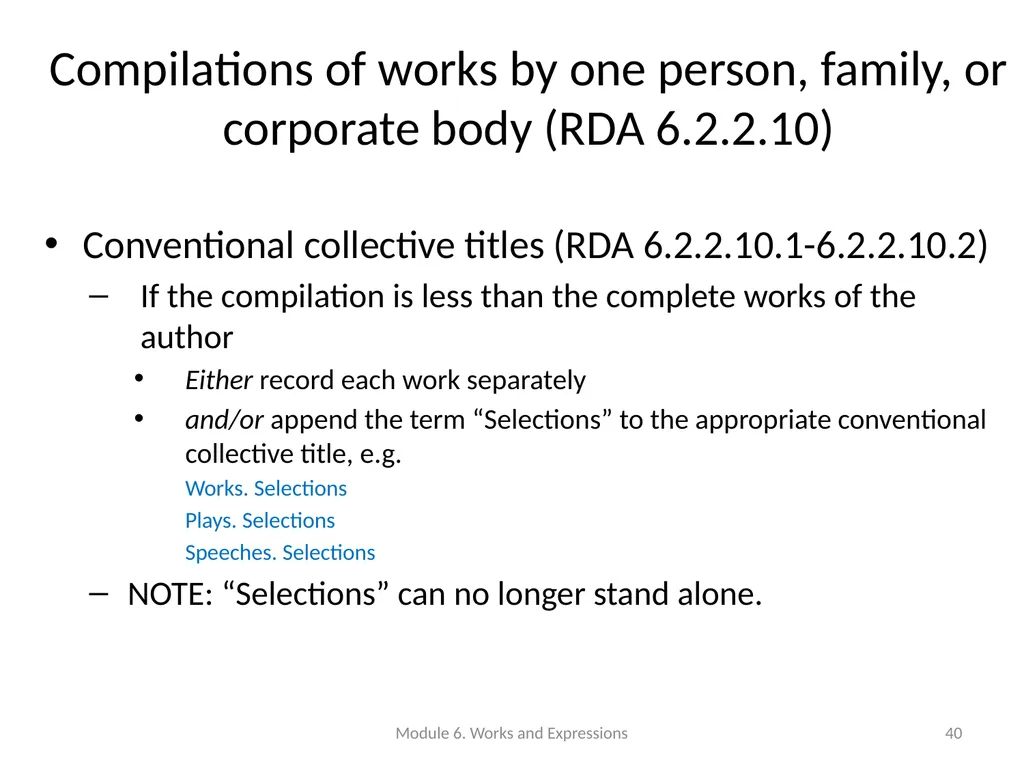
Compilations of works by one person, family, or corporate body (RDA 6.2.2.10) Conventional collective titles (RDA 6.2.2.10.1-6.2.2.10.2)
If the compilation is less than the complete works of the author
Either record each work separately
and/or append the term “Selections” to the appropriate conventional collective title, e.g.
Works. Selections
Plays. Selections
Speeches. Selections
NOTE: “Selections” can no longer stand alone. Module 6. Works and Expressions 40<br>
If the compilation is less than the complete works of the author
Either record each work separately
and/or append the term “Selections” to the appropriate conventional collective title, e.g.
Works. Selections
Plays. Selections
Speeches. Selections
NOTE: “Selections” can no longer stand alone. Module 6. Works and Expressions 40<br>
41
Special Rules for Religious Works Additional instructions to those found earlier in Chapter 6
RDA 6.23:
Title of a Religious Work Module 6. Works and Expressions 41<br>
RDA 6.23:
Title of a Religious Work Module 6. Works and Expressions 41<br>
42
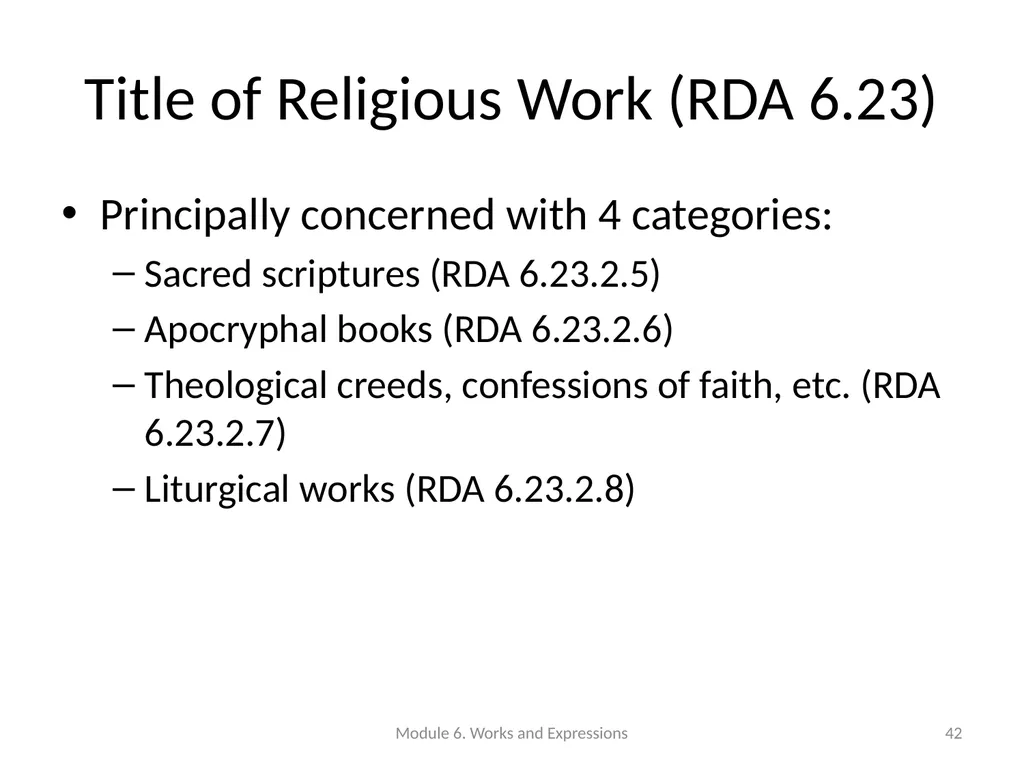
Title of Religious Work (RDA 6.23) Principally concerned with 4 categories:
Sacred scriptures (RDA 6.23.2.5)
Apocryphal books (RDA 6.23.2.6)
Theological creeds, confessions of faith, etc. (RDA 6.23.2.7)
Liturgical works (RDA 6.23.2.8) Module 6. Works and Expressions 42<br>
Sacred scriptures (RDA 6.23.2.5)
Apocryphal books (RDA 6.23.2.6)
Theological creeds, confessions of faith, etc. (RDA 6.23.2.7)
Liturgical works (RDA 6.23.2.8) Module 6. Works and Expressions 42<br>
43
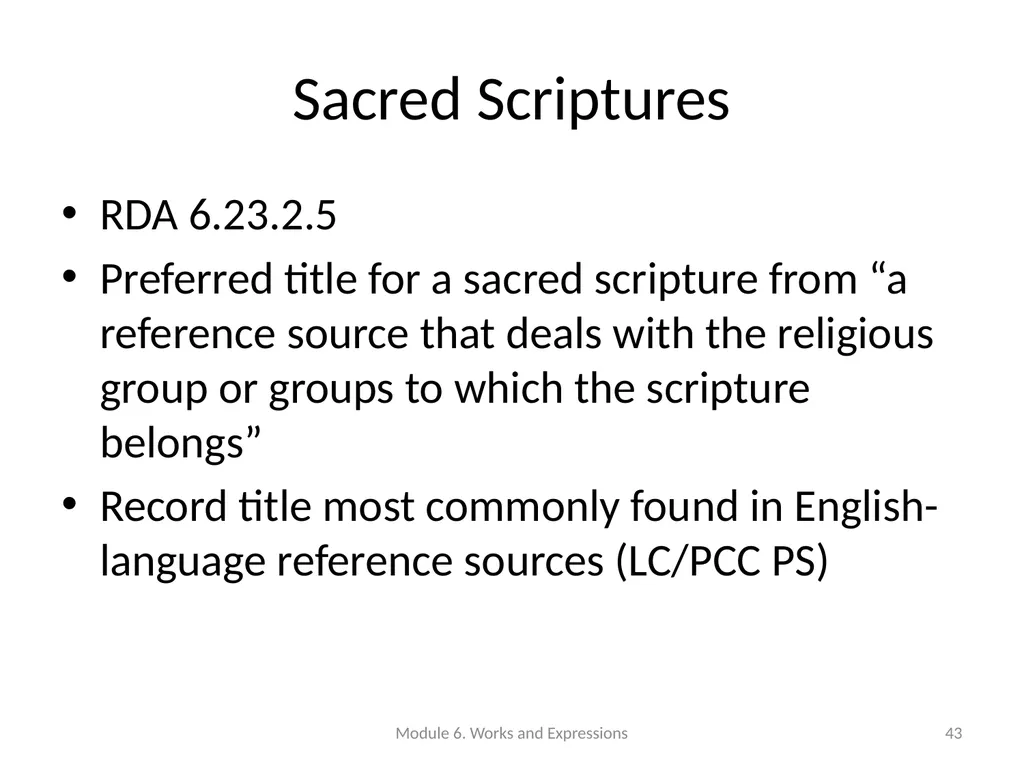
Sacred Scriptures RDA 6.23.2.5
Preferred title for a sacred scripture from “a reference source that deals with the religious group or groups to which the scripture belongs”
Record title most commonly found in English-language reference sources (LC/PCC PS) Module 6. Works and Expressions 43<br>
Preferred title for a sacred scripture from “a reference source that deals with the religious group or groups to which the scripture belongs”
Record title most commonly found in English-language reference sources (LC/PCC PS) Module 6. Works and Expressions 43<br>
44
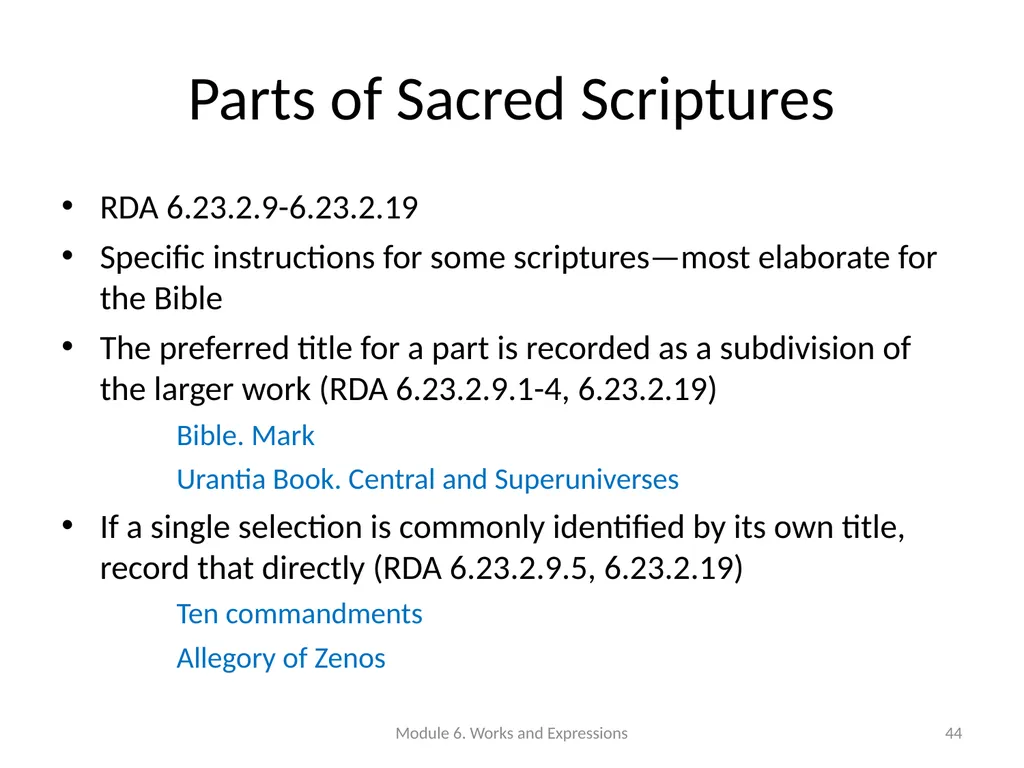
Parts of Sacred Scriptures RDA 6.23.2.9-6.23.2.19
Specific instructions for some scriptures—most elaborate for the Bible
The preferred title for a part is recorded as a subdivision of the larger work (RDA 6.23.2.9.1-4, 6.23.2.19)
Bible. Mark
Urantia Book. Central and Superuniverses
If a single selection is commonly identified by its own title, record that directly (RDA 6.23.2.9.5, 6.23.2.19)
Ten commandments
Allegory of Zenos Module 6. Works and Expressions 44<br>
Specific instructions for some scriptures—most elaborate for the Bible
The preferred title for a part is recorded as a subdivision of the larger work (RDA 6.23.2.9.1-4, 6.23.2.19)
Bible. Mark
Urantia Book. Central and Superuniverses
If a single selection is commonly identified by its own title, record that directly (RDA 6.23.2.9.5, 6.23.2.19)
Ten commandments
Allegory of Zenos Module 6. Works and Expressions 44<br>
45
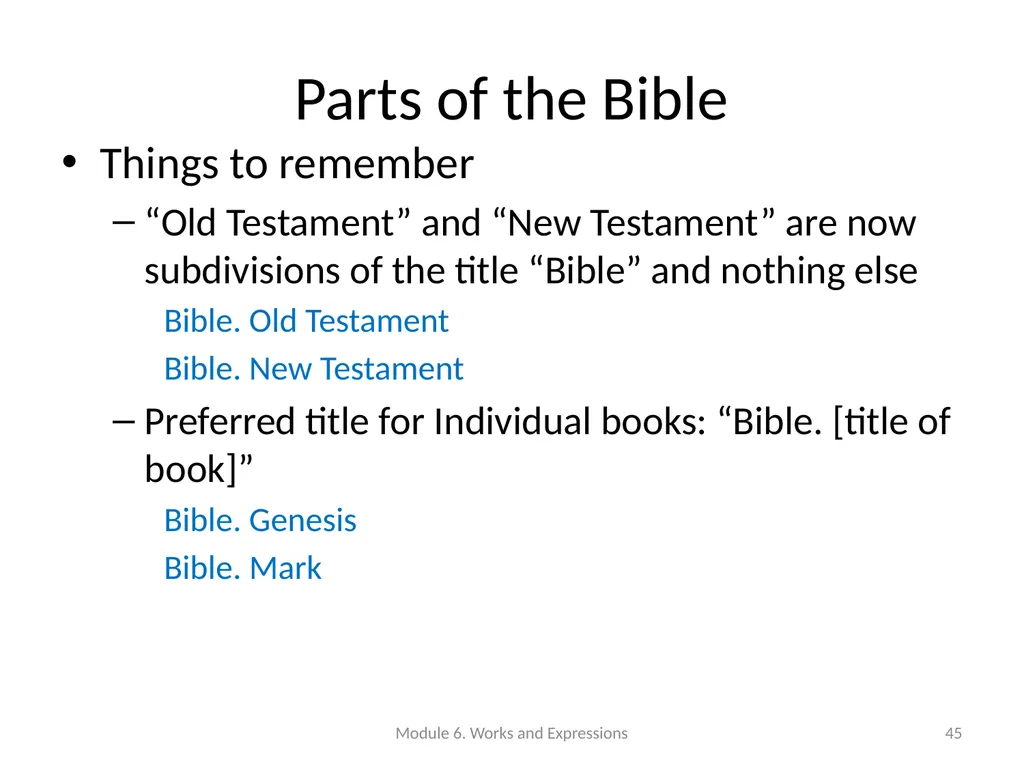
Parts of the Bible Things to remember
“Old Testament” and “New Testament” are now subdivisions of the title “Bible” and nothing else
Bible. Old Testament
Bible. New Testament
Preferred title for Individual books: “Bible. [title of book]”
Bible. Genesis
Bible. Mark Module 6. Works and Expressions 45<br>
“Old Testament” and “New Testament” are now subdivisions of the title “Bible” and nothing else
Bible. Old Testament
Bible. New Testament
Preferred title for Individual books: “Bible. [title of book]”
Bible. Genesis
Bible. Mark Module 6. Works and Expressions 45<br>
46
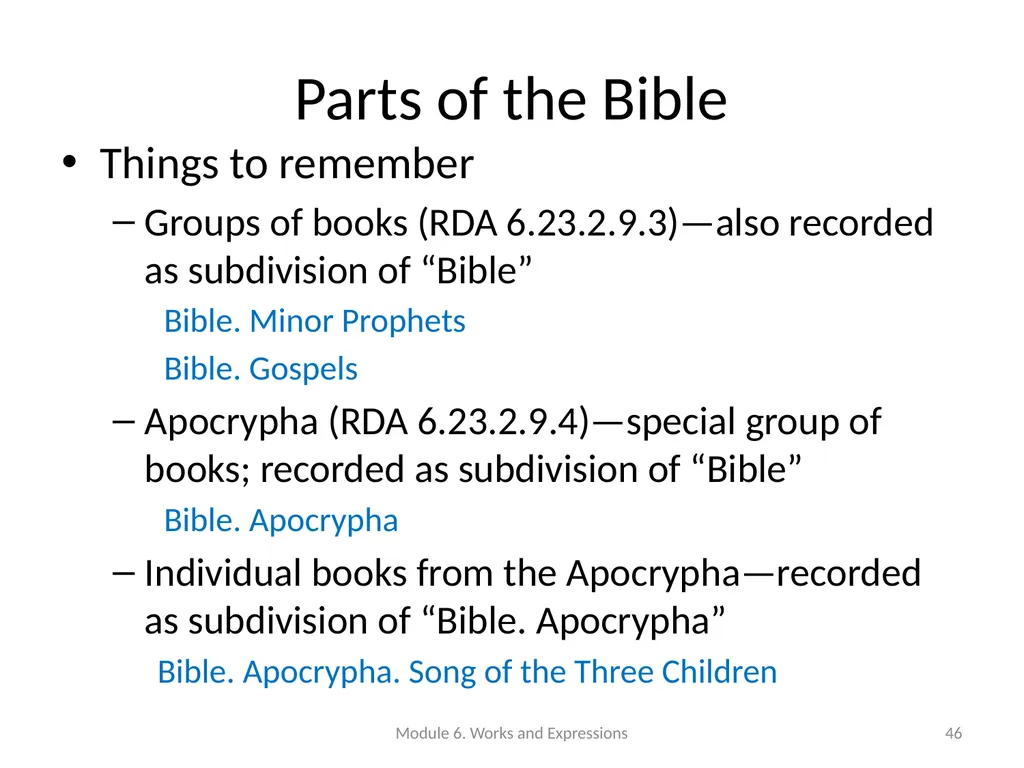
Parts of the Bible Things to remember
Groups of books (RDA 6.23.2.9.3)—also recorded as subdivision of “Bible”
Bible. Minor Prophets
Bible. Gospels
Apocrypha (RDA 6.23.2.9.4)—special group of books; recorded as subdivision of “Bible”
Bible. Apocrypha
Individual books from the Apocrypha—recorded as subdivision of “Bible. Apocrypha”
Bible. Apocrypha. Song of the Three Children Module 6. Works and Expressions 46<br>
Groups of books (RDA 6.23.2.9.3)—also recorded as subdivision of “Bible”
Bible. Minor Prophets
Bible. Gospels
Apocrypha (RDA 6.23.2.9.4)—special group of books; recorded as subdivision of “Bible”
Bible. Apocrypha
Individual books from the Apocrypha—recorded as subdivision of “Bible. Apocrypha”
Bible. Apocrypha. Song of the Three Children Module 6. Works and Expressions 46<br>
47
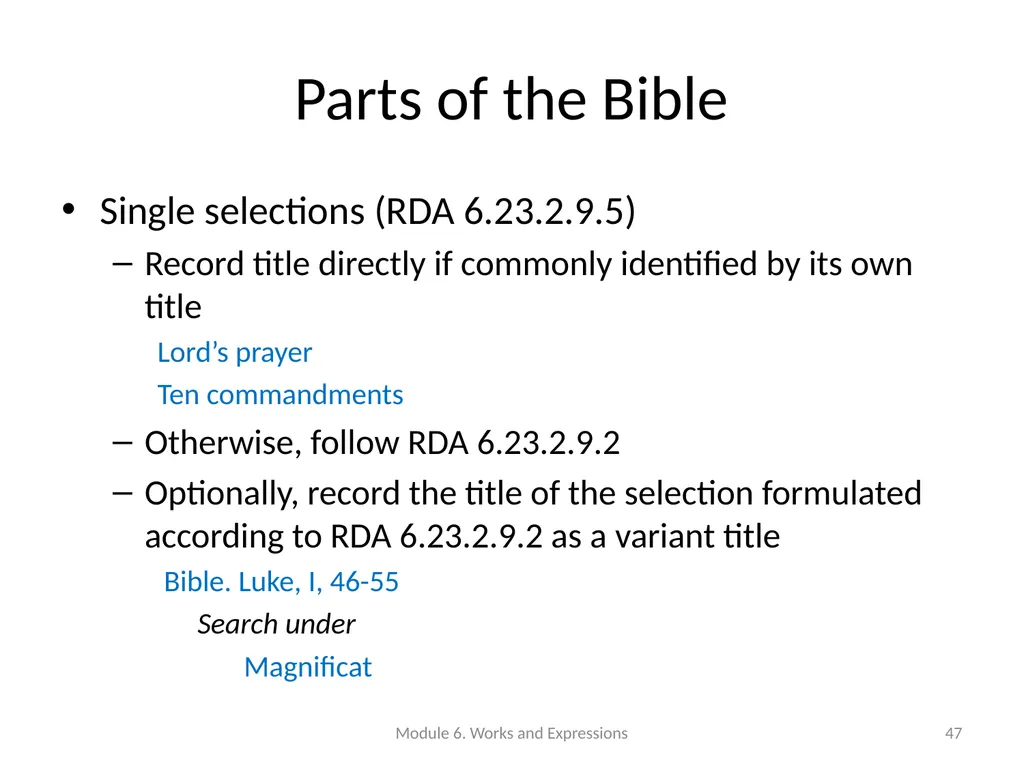
Parts of the Bible Single selections (RDA 6.23.2.9.5)
Record title directly if commonly identified by its own title
Lord’s prayer
Ten commandments
Otherwise, follow RDA 6.23.2.9.2
Optionally, record the title of the selection formulated according to RDA 6.23.2.9.2 as a variant title
Bible. Luke, I, 46-55
Search under
Magnificat Module 6. Works and Expressions 47<br>
Record title directly if commonly identified by its own title
Lord’s prayer
Ten commandments
Otherwise, follow RDA 6.23.2.9.2
Optionally, record the title of the selection formulated according to RDA 6.23.2.9.2 as a variant title
Bible. Luke, I, 46-55
Search under
Magnificat Module 6. Works and Expressions 47<br>
48
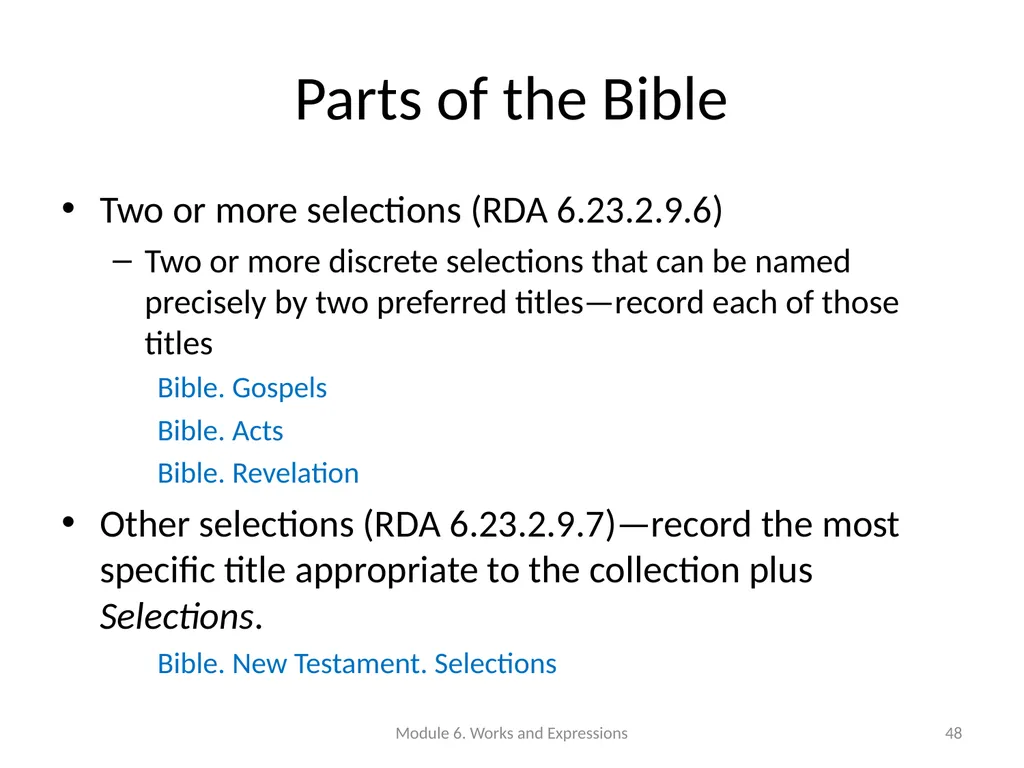
Parts of the Bible Two or more selections (RDA 6.23.2.9.6)
Two or more discrete selections that can be named precisely by two preferred titles—record each of those titles
Bible. Gospels
Bible. Acts
Bible. Revelation
Other selections (RDA 6.23.2.9.7)—record the most specific title appropriate to the collection plus Selections.
Bible. New Testament. Selections Module 6. Works and Expressions 48<br>
Two or more discrete selections that can be named precisely by two preferred titles—record each of those titles
Bible. Gospels
Bible. Acts
Bible. Revelation
Other selections (RDA 6.23.2.9.7)—record the most specific title appropriate to the collection plus Selections.
Bible. New Testament. Selections Module 6. Works and Expressions 48<br>
49
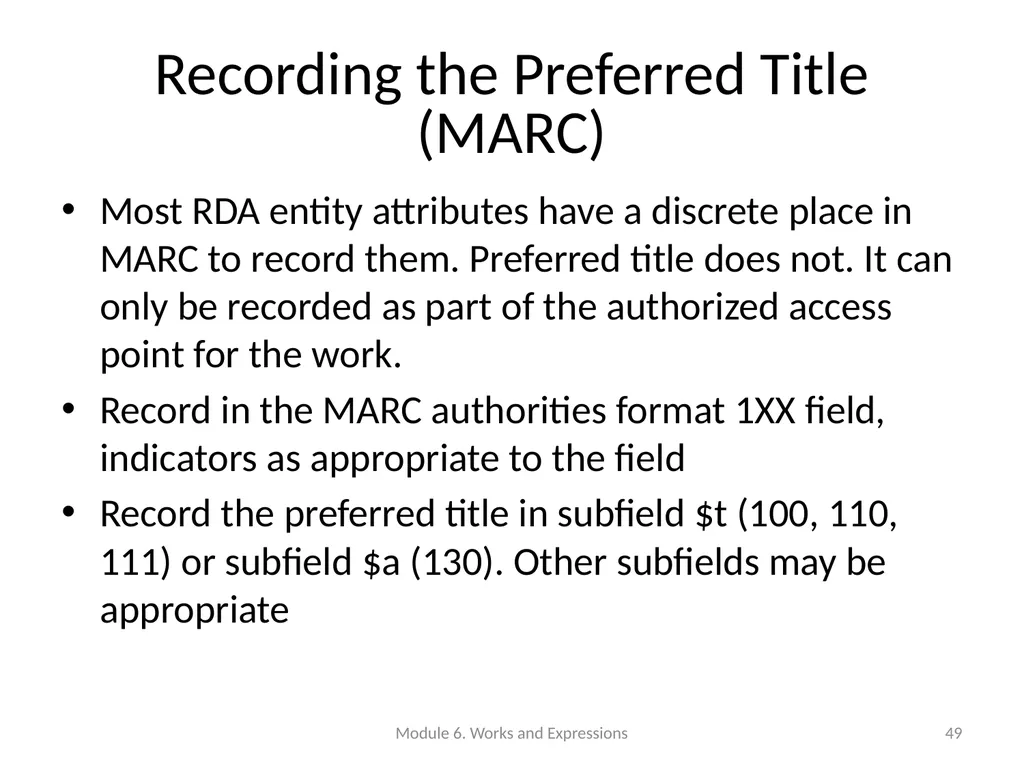
Recording the Preferred Title (MARC) Most RDA entity attributes have a discrete place in MARC to record them. Preferred title does not. It can only be recorded as part of the authorized access point for the work.
Record in the MARC authorities format 1XX field, indicators as appropriate to the field
Record the preferred title in subfield $t (100, 110, 111) or subfield $a (130). Other subfields may be appropriate Module 6. Works and Expressions 49<br>
Record in the MARC authorities format 1XX field, indicators as appropriate to the field
Record the preferred title in subfield $t (100, 110, 111) or subfield $a (130). Other subfields may be appropriate Module 6. Works and Expressions 49<br>
50
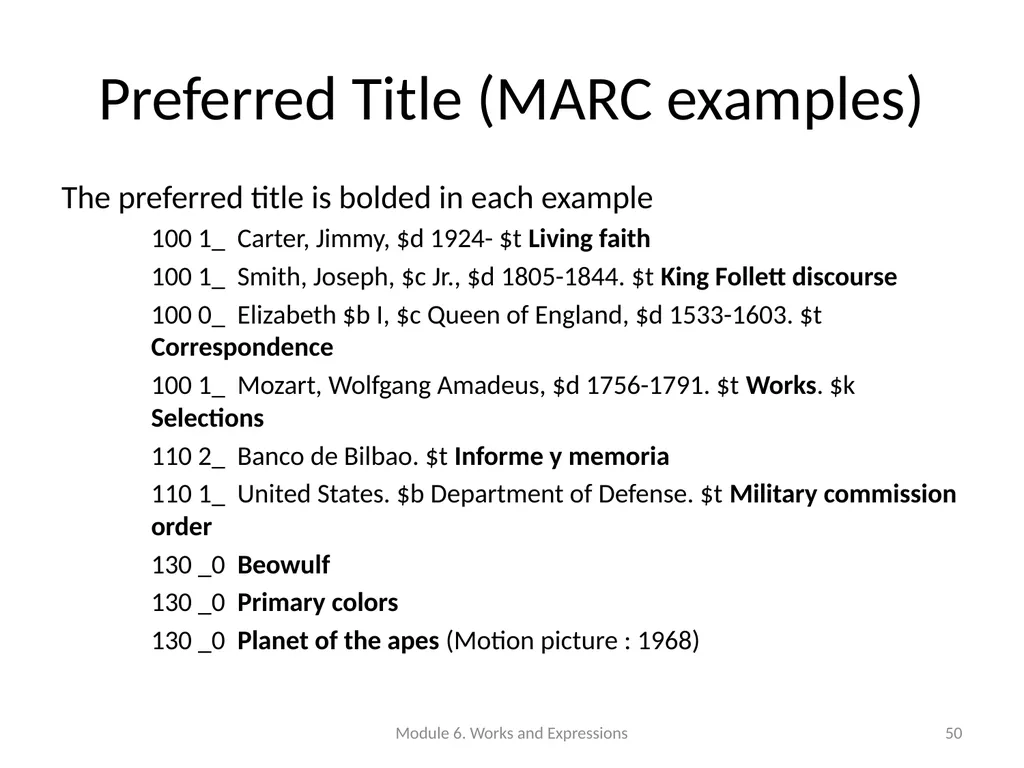
Preferred Title (MARC examples) The preferred title is bolded in each example
100 1_ Carter, Jimmy, $d 1924- $t Living faith
100 1_ Smith, Joseph, $c Jr., $d 1805-1844. $t King Follett discourse
100 0_ Elizabeth $b I, $c Queen of England, $d 1533-1603. $t Correspondence
100 1_ Mozart, Wolfgang Amadeus, $d 1756-1791. $t Works. $k Selections
110 2_ Banco de Bilbao. $t Informe y memoria
110 1_ United States. $b Department of Defense. $t Military commission order
130 _0 Beowulf
130 _0 Primary colors
130 _0 Planet of the apes (Motion picture : 1968) Module 6. Works and Expressions 50<br>
100 1_ Carter, Jimmy, $d 1924- $t Living faith
100 1_ Smith, Joseph, $c Jr., $d 1805-1844. $t King Follett discourse
100 0_ Elizabeth $b I, $c Queen of England, $d 1533-1603. $t Correspondence
100 1_ Mozart, Wolfgang Amadeus, $d 1756-1791. $t Works. $k Selections
110 2_ Banco de Bilbao. $t Informe y memoria
110 1_ United States. $b Department of Defense. $t Military commission order
130 _0 Beowulf
130 _0 Primary colors
130 _0 Planet of the apes (Motion picture : 1968) Module 6. Works and Expressions 50<br>
51
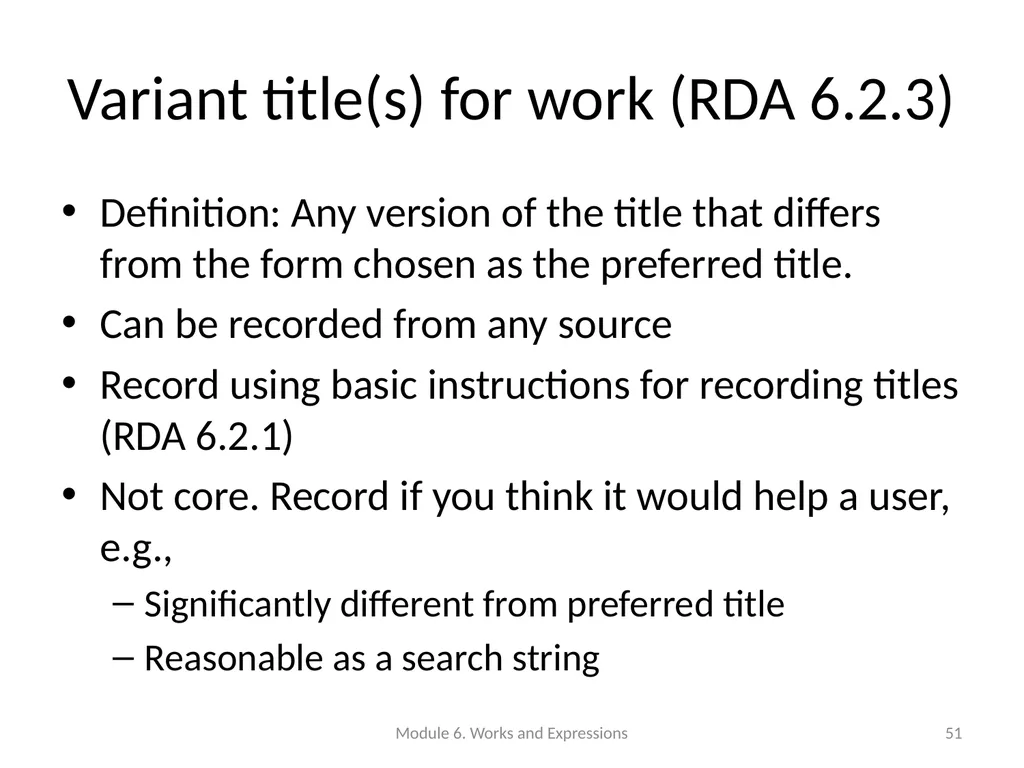
Variant title(s) for work (RDA 6.2.3) Definition: Any version of the title that differs from the form chosen as the preferred title.
Can be recorded from any source
Record using basic instructions for recording titles (RDA 6.2.1)
Not core. Record if you think it would help a user, e.g.,
Significantly different from preferred title
Reasonable as a search string Module 6. Works and Expressions 51<br>
Can be recorded from any source
Record using basic instructions for recording titles (RDA 6.2.1)
Not core. Record if you think it would help a user, e.g.,
Significantly different from preferred title
Reasonable as a search string Module 6. Works and Expressions 51<br>
52
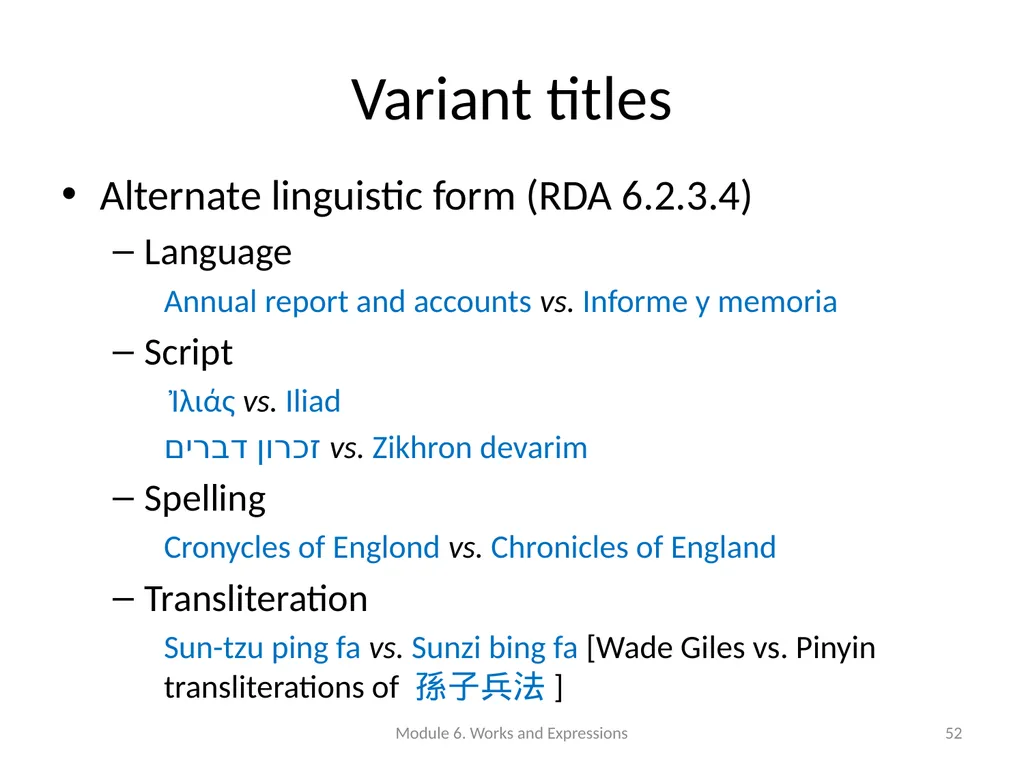
Variant titles Alternate linguistic form (RDA 6.2.3.4)
Language
Annual report and accounts vs. Informe y memoria
Script
Ἰλιάς vs. Iliad
זכרון דברים vs. Zikhron devarim
Spelling
Cronycles of Englond vs. Chronicles of England
Transliteration
Sun-tzu ping fa vs. Sunzi bing fa [Wade Giles vs. Pinyin transliterations of 孫子兵法] Module 6. Works and Expressions 52<br>
Language
Annual report and accounts vs. Informe y memoria
Script
Ἰλιάς vs. Iliad
זכרון דברים vs. Zikhron devarim
Spelling
Cronycles of Englond vs. Chronicles of England
Transliteration
Sun-tzu ping fa vs. Sunzi bing fa [Wade Giles vs. Pinyin transliterations of 孫子兵法] Module 6. Works and Expressions 52<br>
53
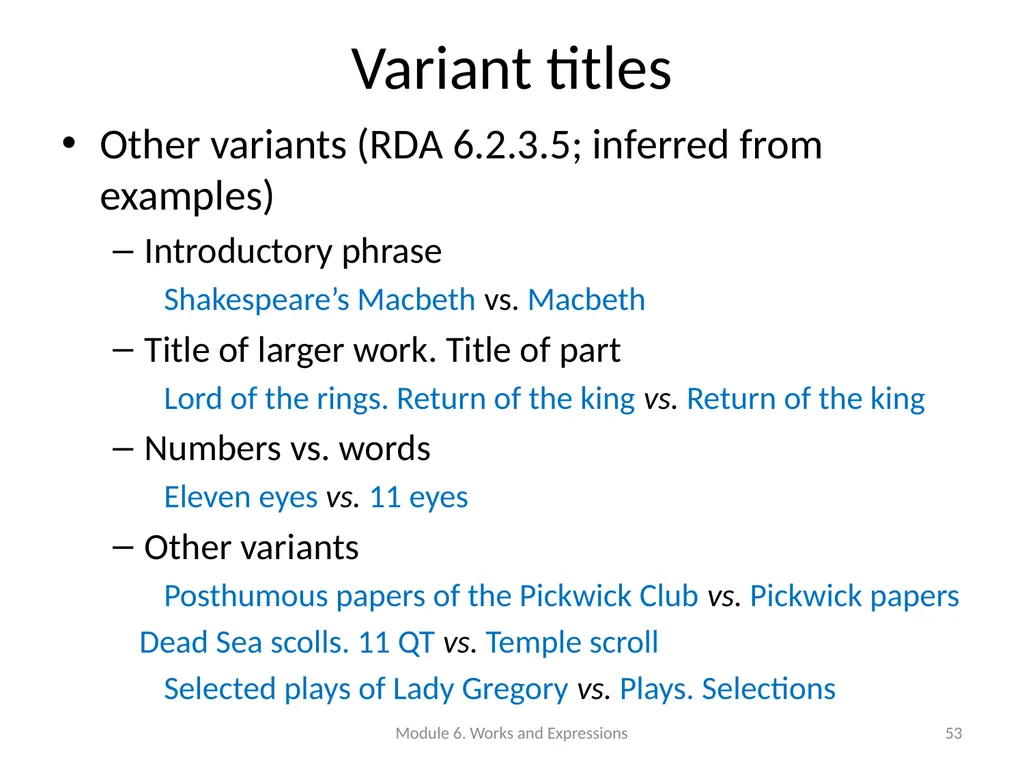
Variant titles Other variants (RDA 6.2.3.5; inferred from examples)
Introductory phrase
Shakespeare’s Macbeth vs. Macbeth
Title of larger work. Title of part
Lord of the rings. Return of the king vs. Return of the king
Numbers vs. words
Eleven eyes vs. 11 eyes
Other variants
Posthumous papers of the Pickwick Club vs. Pickwick papers
Dead Sea scolls. 11 QT vs. Temple scroll
Selected plays of Lady Gregory vs. Plays. Selections Module 6. Works and Expressions 53<br>
Introductory phrase
Shakespeare’s Macbeth vs. Macbeth
Title of larger work. Title of part
Lord of the rings. Return of the king vs. Return of the king
Numbers vs. words
Eleven eyes vs. 11 eyes
Other variants
Posthumous papers of the Pickwick Club vs. Pickwick papers
Dead Sea scolls. 11 QT vs. Temple scroll
Selected plays of Lady Gregory vs. Plays. Selections Module 6. Works and Expressions 53<br>
54
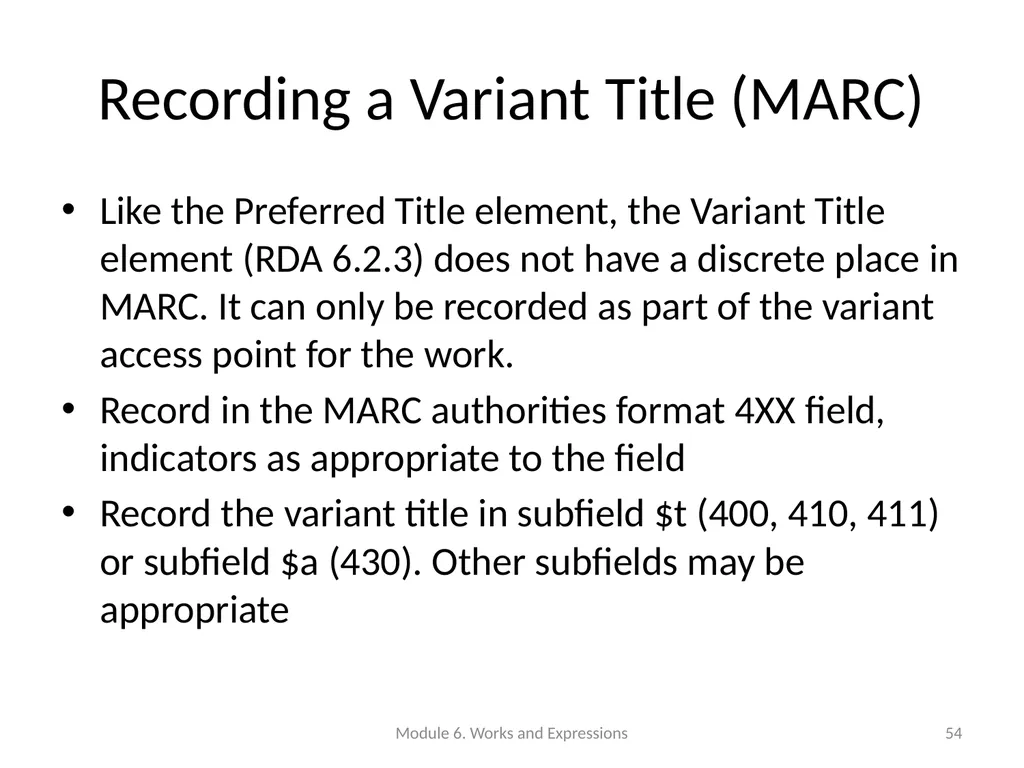
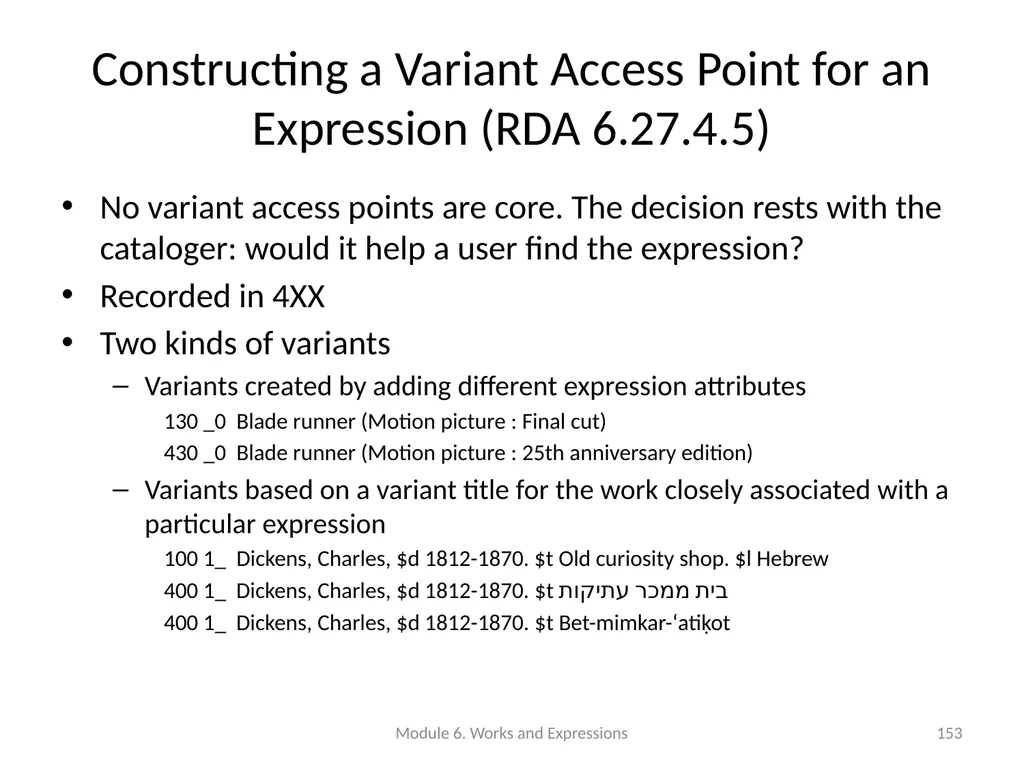
Recording a Variant Title (MARC) Like the Preferred Title element, the Variant Title element (RDA 6.2.3) does not have a discrete place in MARC. It can only be recorded as part of the variant access point for the work.
Record in the MARC authorities format 4XX field, indicators as appropriate to the field
Record the variant title in subfield $t (400, 410, 411) or subfield $a (430). Other subfields may be appropriate Module 6. Works and Expressions 54<br>
Record in the MARC authorities format 4XX field, indicators as appropriate to the field
Record the variant title in subfield $t (400, 410, 411) or subfield $a (430). Other subfields may be appropriate Module 6. Works and Expressions 54<br>
55
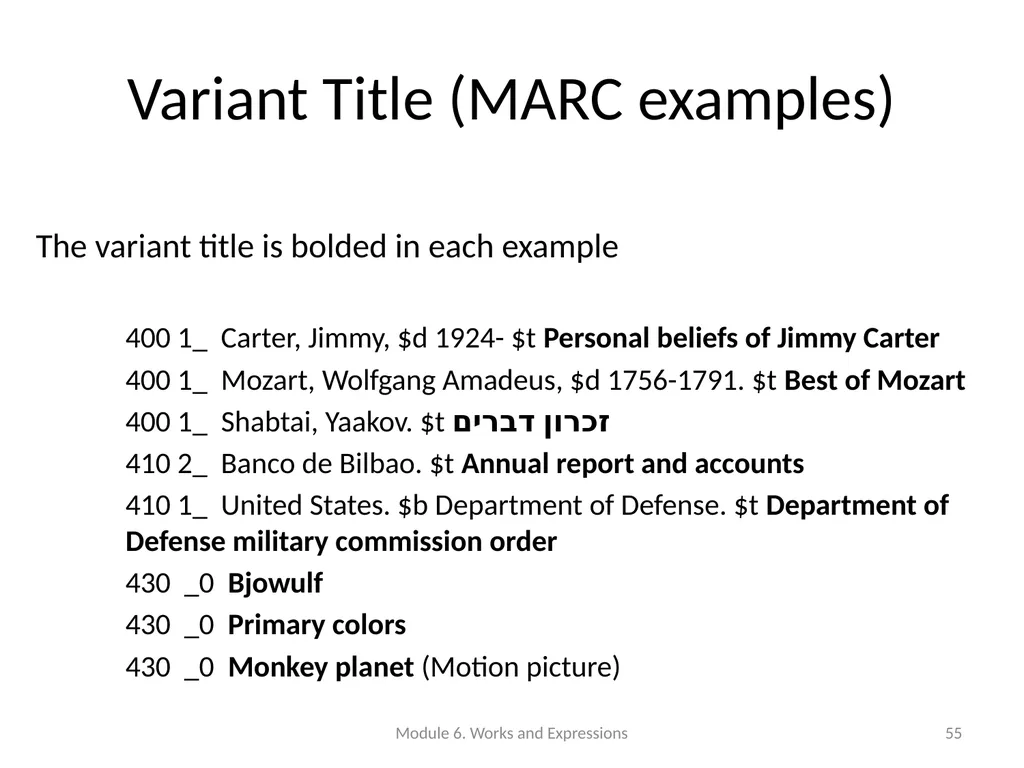
Variant Title (MARC examples) The variant title is bolded in each example
400 1_ Carter, Jimmy, $d 1924- $t Personal beliefs of Jimmy Carter
400 1_ Mozart, Wolfgang Amadeus, $d 1756-1791. $t Best of Mozart
400 1_ Shabtai, Yaakov. $t זכרון דברים
410 2_ Banco de Bilbao. $t Annual report and accounts
410 1_ United States. $b Department of Defense. $t Department of Defense military commission order
430 _0 Bjowulf
430 _0 Primary colors
430 _0 Monkey planet (Motion picture) Module 6. Works and Expressions 55<br>
400 1_ Carter, Jimmy, $d 1924- $t Personal beliefs of Jimmy Carter
400 1_ Mozart, Wolfgang Amadeus, $d 1756-1791. $t Best of Mozart
400 1_ Shabtai, Yaakov. $t זכרון דברים
410 2_ Banco de Bilbao. $t Annual report and accounts
410 1_ United States. $b Department of Defense. $t Department of Defense military commission order
430 _0 Bjowulf
430 _0 Primary colors
430 _0 Monkey planet (Motion picture) Module 6. Works and Expressions 55<br>
56
Other Identifying Attributes of Works There are many attributes of works aside from title
All may be recorded as separate elements
Some may also appear as part of the authorized access point
LC/PCC PS limitations apply to some Module 6. Works and Expressions 56<br>
All may be recorded as separate elements
Some may also appear as part of the authorized access point
LC/PCC PS limitations apply to some Module 6. Works and Expressions 56<br>
57
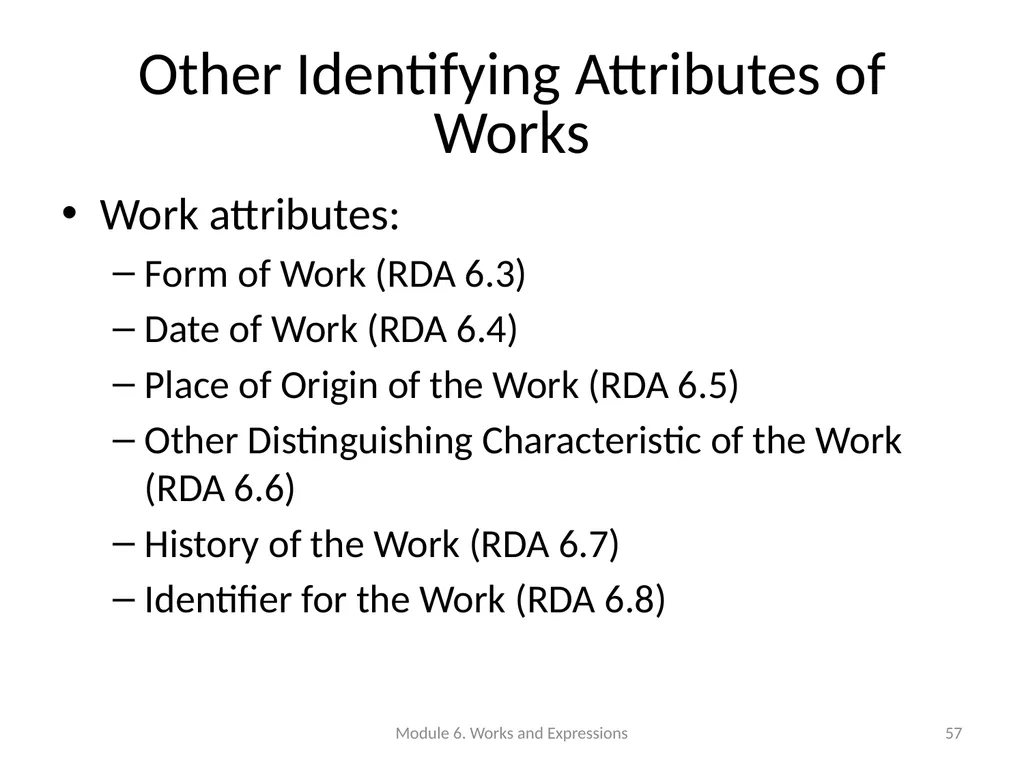
Other Identifying Attributes of Works Work attributes:
Form of Work (RDA 6.3)
Date of Work (RDA 6.4)
Place of Origin of the Work (RDA 6.5)
Other Distinguishing Characteristic of the Work (RDA 6.6)
History of the Work (RDA 6.7)
Identifier for the Work (RDA 6.8) Module 6. Works and Expressions 57<br>
Form of Work (RDA 6.3)
Date of Work (RDA 6.4)
Place of Origin of the Work (RDA 6.5)
Other Distinguishing Characteristic of the Work (RDA 6.6)
History of the Work (RDA 6.7)
Identifier for the Work (RDA 6.8) Module 6. Works and Expressions 57<br>
58
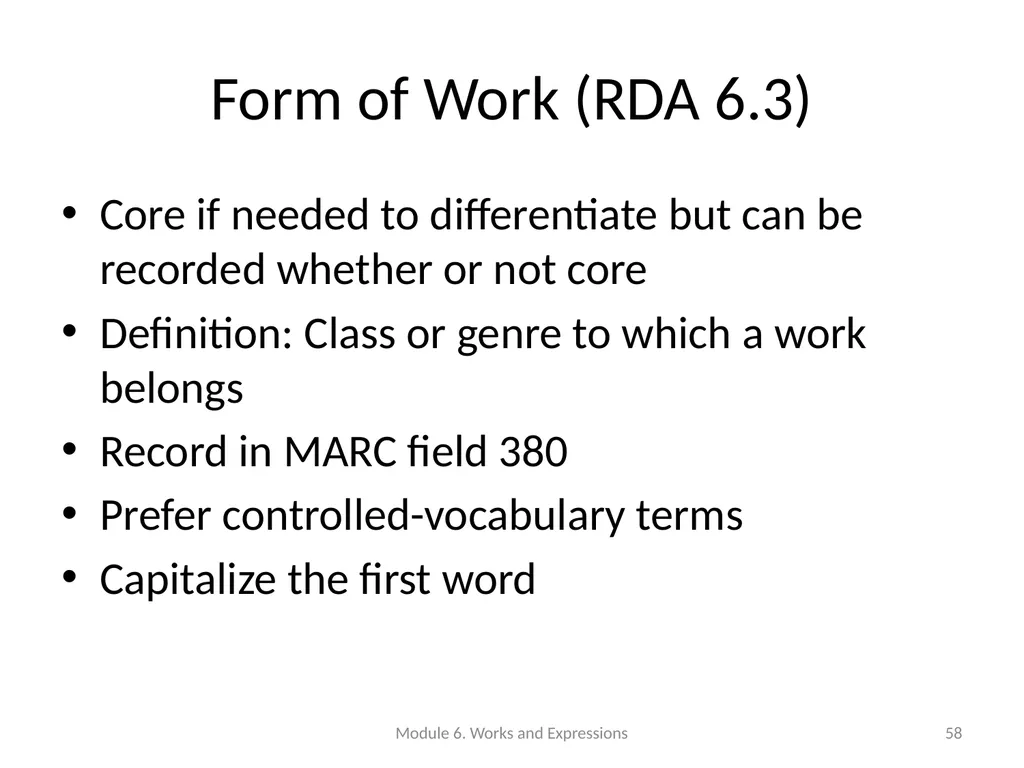
Form of Work (RDA 6.3) Core if needed to differentiate but can be recorded whether or not core
Definition: Class or genre to which a work belongs
Record in MARC field 380
Prefer controlled-vocabulary terms
Capitalize the first word Module 6. Works and Expressions 58<br>
Definition: Class or genre to which a work belongs
Record in MARC field 380
Prefer controlled-vocabulary terms
Capitalize the first word Module 6. Works and Expressions 58<br>
59
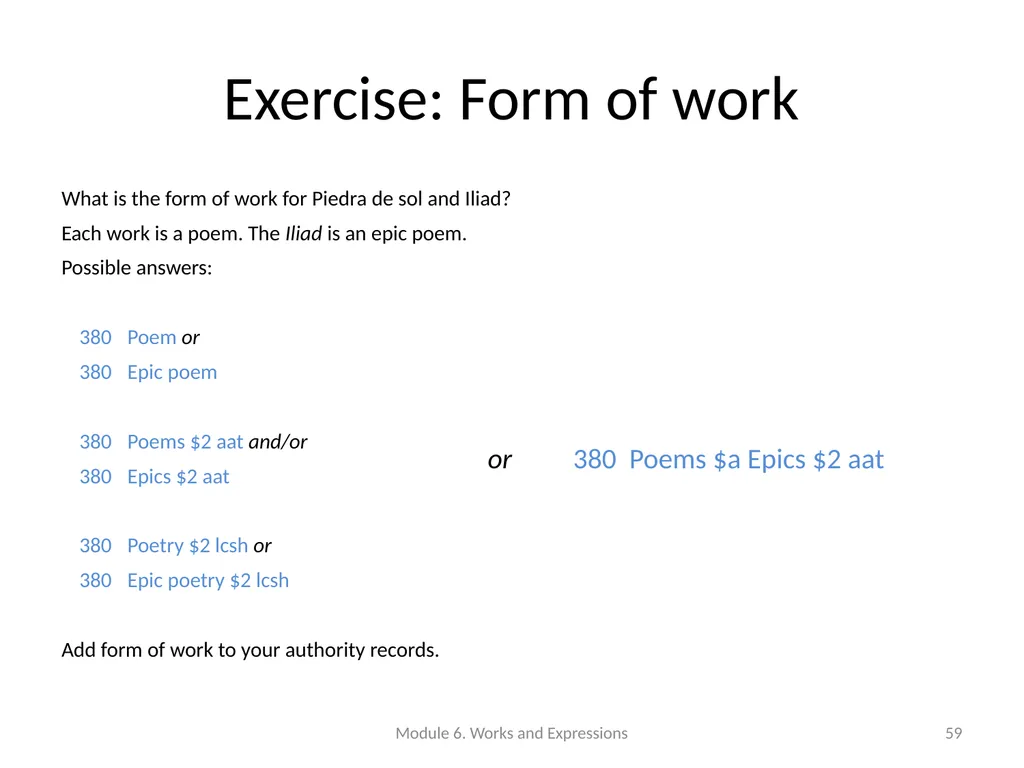
Exercise: Form of work What is the form of work for Piedra de sol and Iliad?
Each work is a poem. The Iliad is an epic poem.
Possible answers:
380 Poem or
380 Epic poem
380 Poems $2 aat and/or
380 Epics $2 aat
380 Poetry $2 lcsh or
380 Epic poetry $2 lcsh
Add form of work to your authority records. Module 6. Works and Expressions 59 or 380 Poems $a Epics $2 aat<br>
Each work is a poem. The Iliad is an epic poem.
Possible answers:
380 Poem or
380 Epic poem
380 Poems $2 aat and/or
380 Epics $2 aat
380 Poetry $2 lcsh or
380 Epic poetry $2 lcsh
Add form of work to your authority records. Module 6. Works and Expressions 59 or 380 Poems $a Epics $2 aat<br>
60
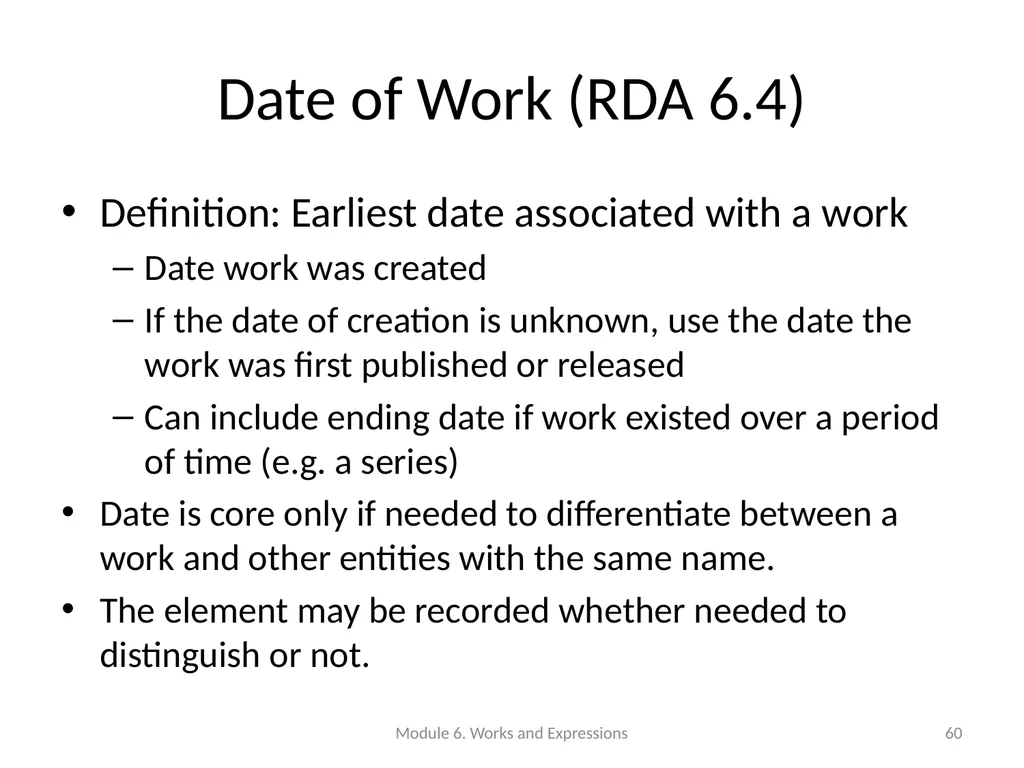
Date of Work (RDA 6.4) Definition: Earliest date associated with a work
Date work was created
If the date of creation is unknown, use the date the work was first published or released
Can include ending date if work existed over a period of time (e.g. a series)
Date is core only if needed to differentiate between a work and other entities with the same name.
The element may be recorded whether needed to distinguish or not. Module 6. Works and Expressions 60<br>
Date work was created
If the date of creation is unknown, use the date the work was first published or released
Can include ending date if work existed over a period of time (e.g. a series)
Date is core only if needed to differentiate between a work and other entities with the same name.
The element may be recorded whether needed to distinguish or not. Module 6. Works and Expressions 60<br>
61
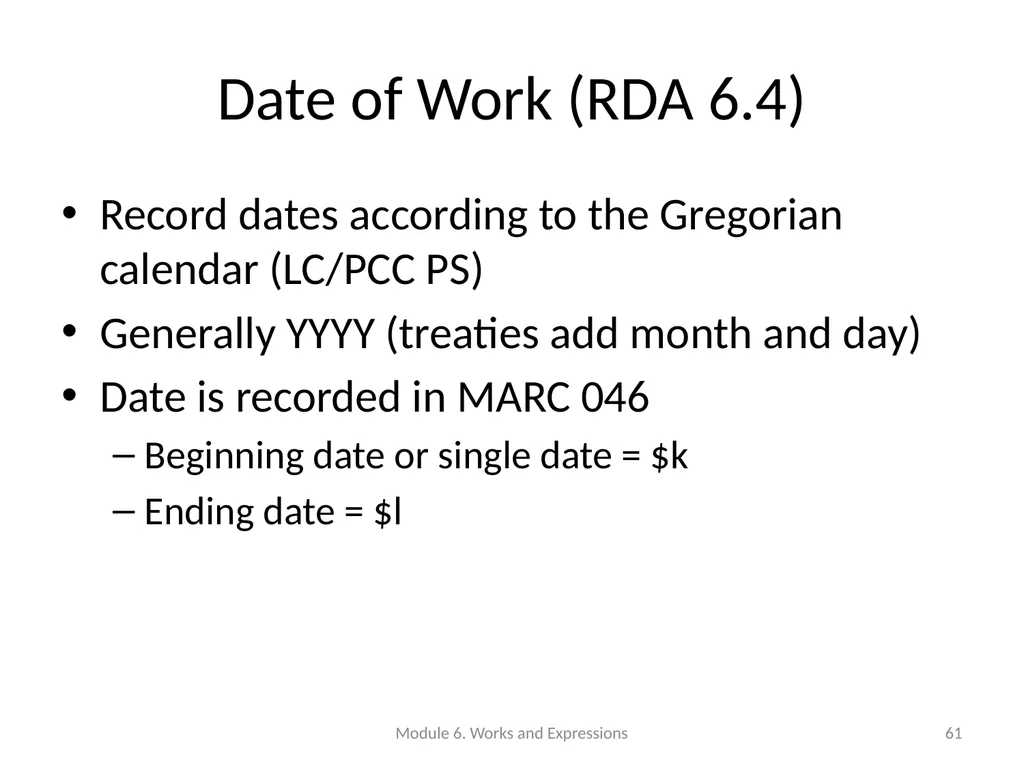
Date of Work (RDA 6.4) Record dates according to the Gregorian calendar (LC/PCC PS)
Generally YYYY (treaties add month and day)
Date is recorded in MARC 046
Beginning date or single date = $k
Ending date = $l Module 6. Works and Expressions 61<br>
Generally YYYY (treaties add month and day)
Date is recorded in MARC 046
Beginning date or single date = $k
Ending date = $l Module 6. Works and Expressions 61<br>
62
Exercise
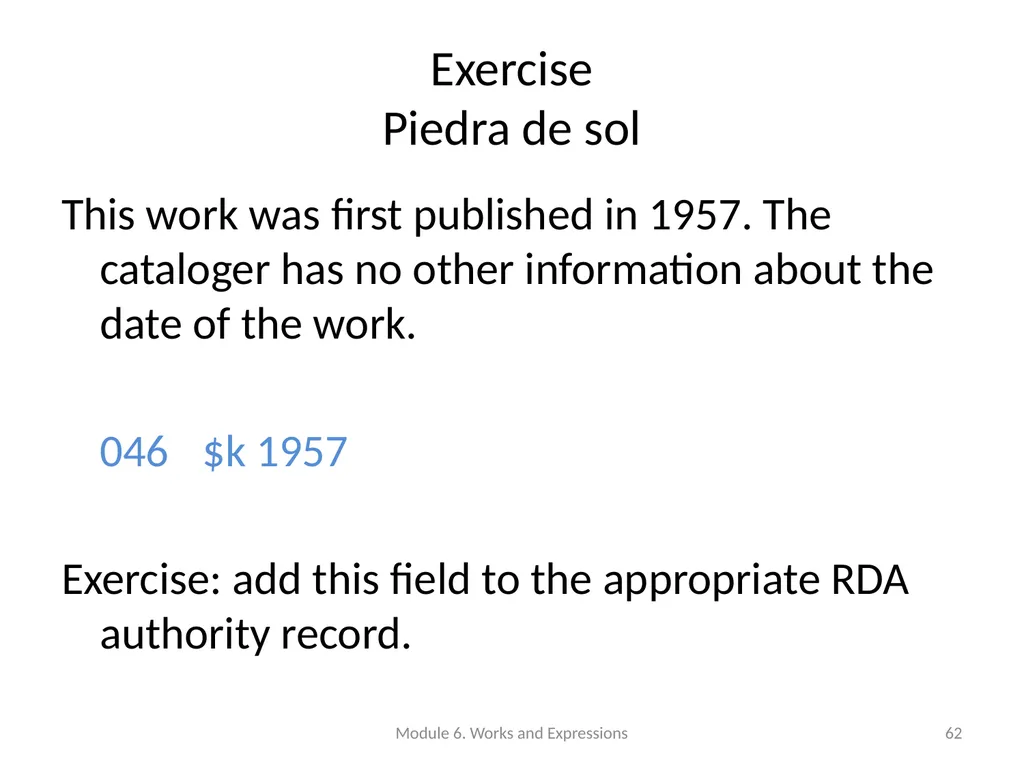
Piedra de sol This work was first published in 1957. The cataloger has no other information about the date of the work.
046 $k 1957
Exercise: add this field to the appropriate RDA authority record. Module 6. Works and Expressions 62<br>
046 $k 1957
Exercise: add this field to the appropriate RDA authority record. Module 6. Works and Expressions 62<br>
63
Exercise
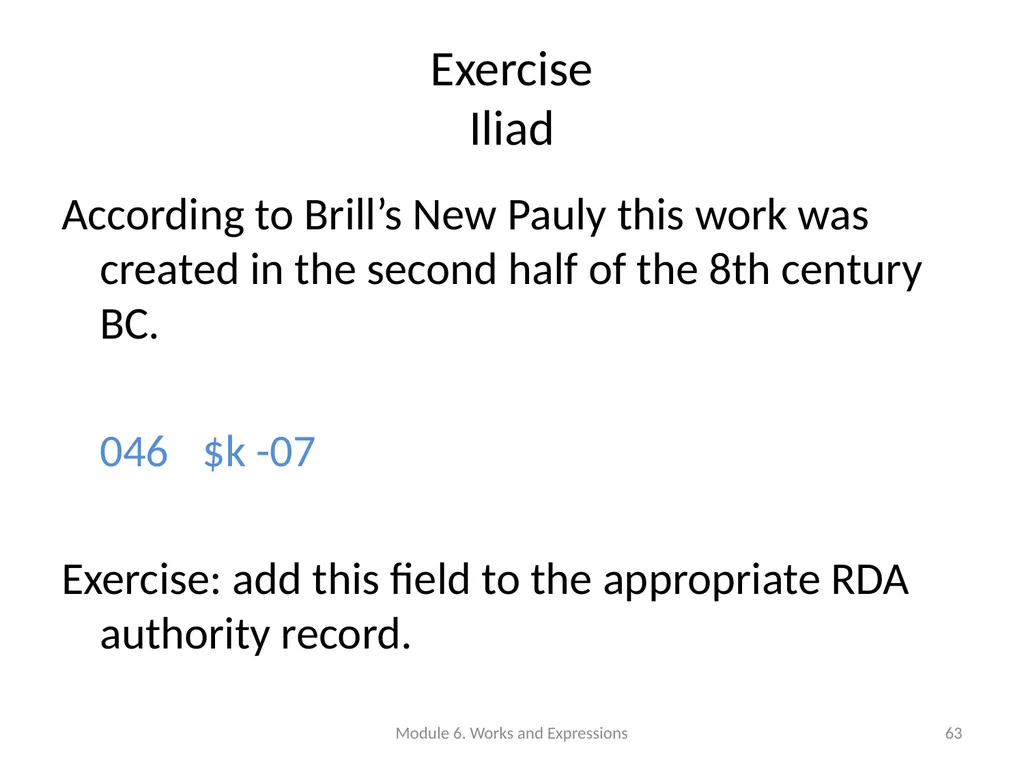
Iliad According to Brill’s New Pauly this work was created in the second half of the 8th century BC.
046 $k -07
Exercise: add this field to the appropriate RDA authority record. Module 6. Works and Expressions 63<br>
046 $k -07
Exercise: add this field to the appropriate RDA authority record. Module 6. Works and Expressions 63<br>
64
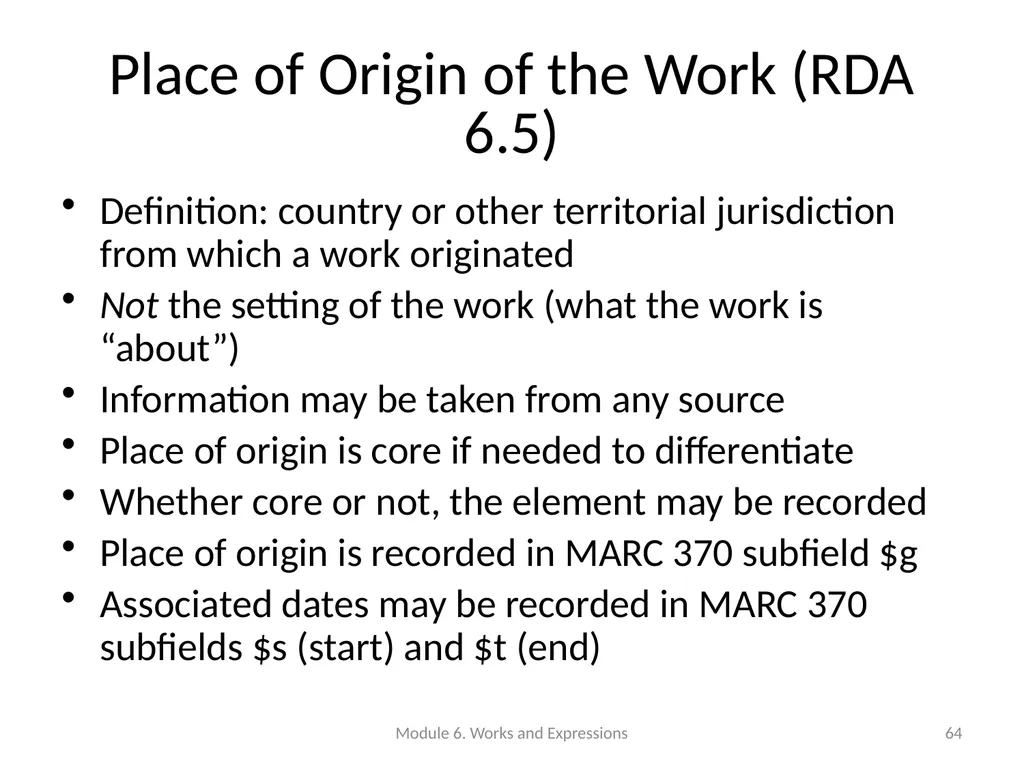
Place of Origin of the Work (RDA 6.5) Definition: country or other territorial jurisdiction from which a work originated
Not the setting of the work (what the work is “about”)
Information may be taken from any source
Place of origin is core if needed to differentiate
Whether core or not, the element may be recorded
Place of origin is recorded in MARC 370 subfield $g
Associated dates may be recorded in MARC 370 subfields $s (start) and $t (end) Module 6. Works and Expressions 64<br>
Not the setting of the work (what the work is “about”)
Information may be taken from any source
Place of origin is core if needed to differentiate
Whether core or not, the element may be recorded
Place of origin is recorded in MARC 370 subfield $g
Associated dates may be recorded in MARC 370 subfields $s (start) and $t (end) Module 6. Works and Expressions 64<br>
65
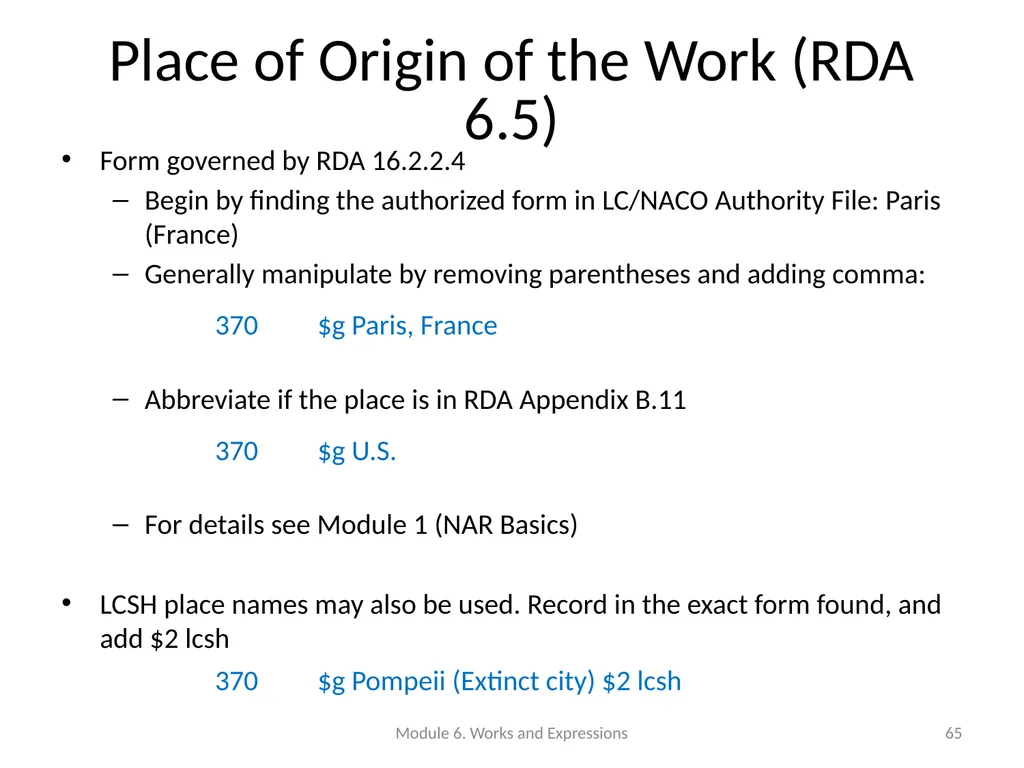
Place of Origin of the Work (RDA 6.5) Form governed by RDA 16.2.2.4
Begin by finding the authorized form in LC/NACO Authority File: Paris (France)
Generally manipulate by removing parentheses and adding comma:
370 $g Paris, France
Abbreviate if the place is in RDA Appendix B.11
370 $g U.S.
For details see Module 1 (NAR Basics)
LCSH place names may also be used. Record in the exact form found, and add $2 lcsh
370 $g Pompeii (Extinct city) $2 lcsh Module 6. Works and Expressions 65<br>
Begin by finding the authorized form in LC/NACO Authority File: Paris (France)
Generally manipulate by removing parentheses and adding comma:
370 $g Paris, France
Abbreviate if the place is in RDA Appendix B.11
370 $g U.S.
For details see Module 1 (NAR Basics)
LCSH place names may also be used. Record in the exact form found, and add $2 lcsh
370 $g Pompeii (Extinct city) $2 lcsh Module 6. Works and Expressions 65<br>
66
Exercise
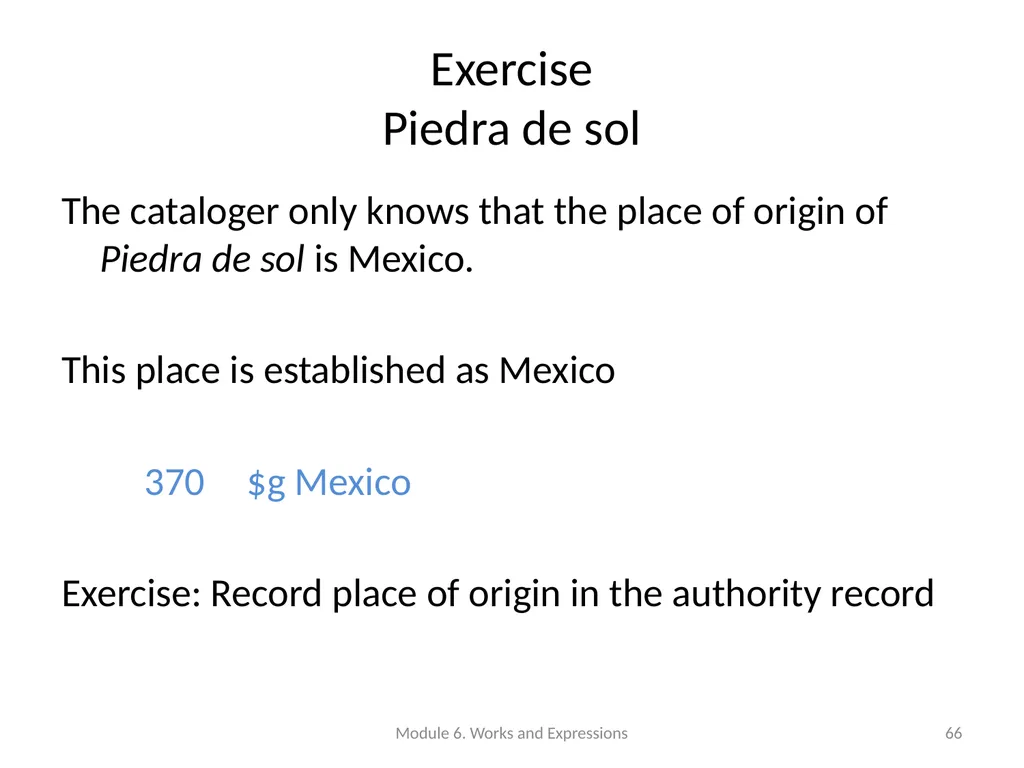
Piedra de sol The cataloger only knows that the place of origin of Piedra de sol is Mexico.
This place is established as Mexico
370 $g Mexico
Exercise: Record place of origin in the authority record Module 6. Works and Expressions 66<br>
This place is established as Mexico
370 $g Mexico
Exercise: Record place of origin in the authority record Module 6. Works and Expressions 66<br>
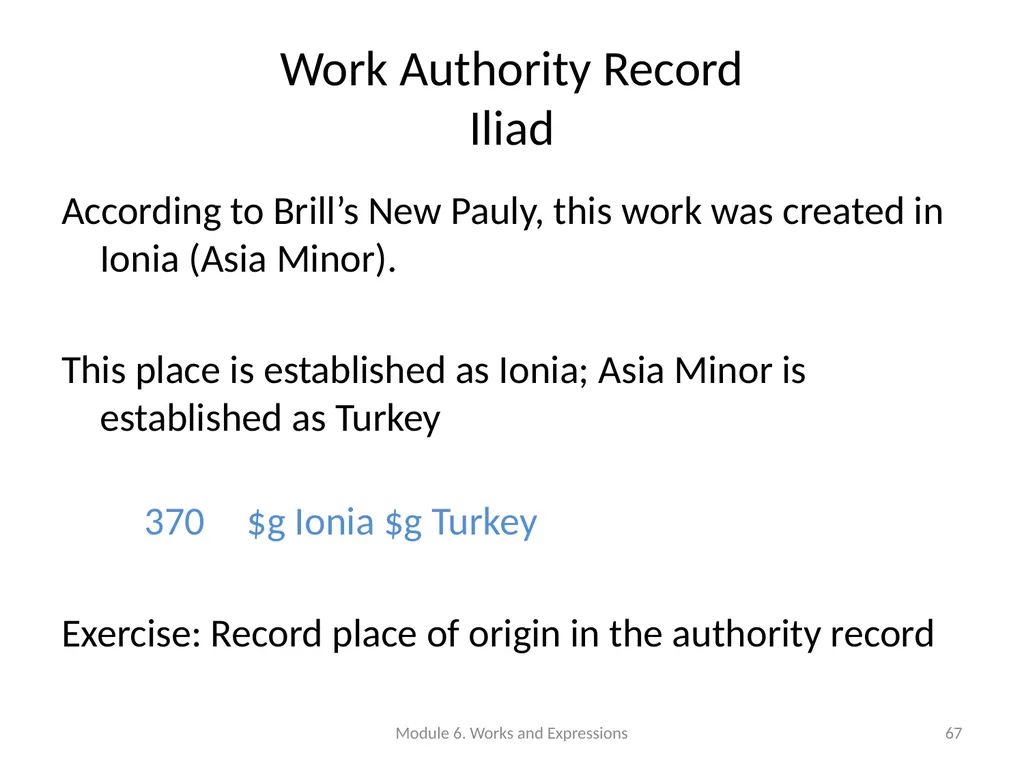
67
Work Authority Record
Iliad According to Brill’s New Pauly, this work was created in Ionia (Asia Minor).
This place is established as Ionia; Asia Minor is established as Turkey
370 $g Ionia $g Turkey
Exercise: Record place of origin in the authority record Module 6. Works and Expressions 67<br>
This place is established as Ionia; Asia Minor is established as Turkey
370 $g Ionia $g Turkey
Exercise: Record place of origin in the authority record Module 6. Works and Expressions 67<br>
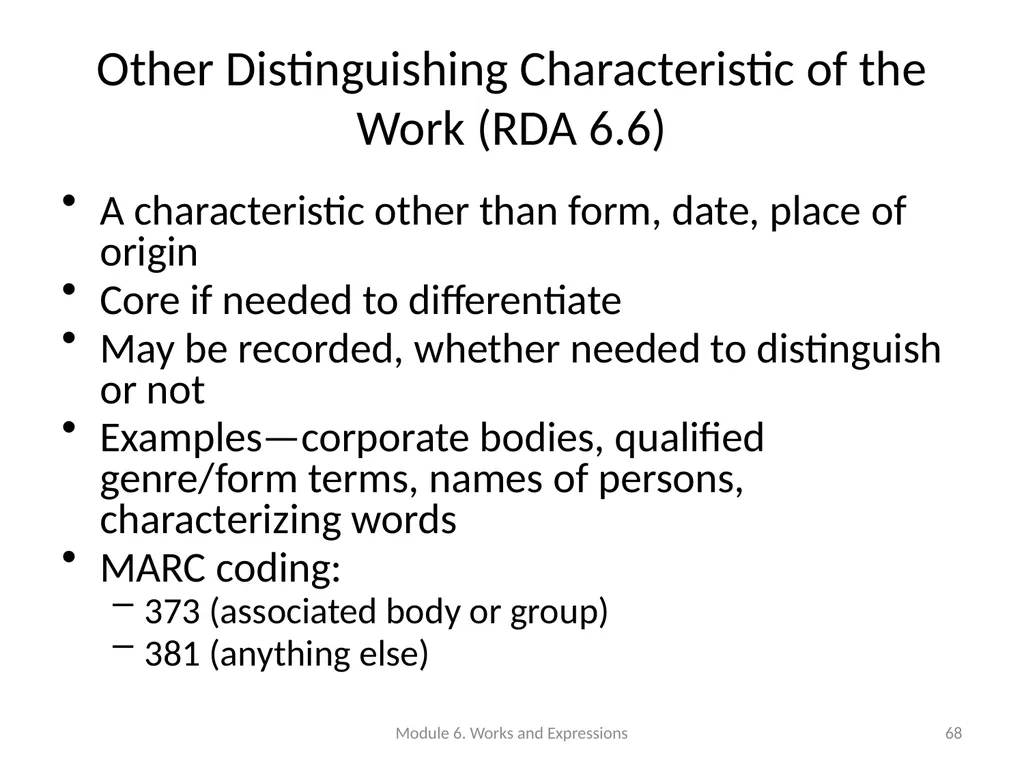
68
Other Distinguishing Characteristic of the Work (RDA 6.6) A characteristic other than form, date, place of origin
Core if needed to differentiate
May be recorded, whether needed to distinguish or not
Examples—corporate bodies, qualified genre/form terms, names of persons, characterizing words
MARC coding:
373 (associated body or group)
381 (anything else) Module 6. Works and Expressions 68<br>
Core if needed to differentiate
May be recorded, whether needed to distinguish or not
Examples—corporate bodies, qualified genre/form terms, names of persons, characterizing words
MARC coding:
373 (associated body or group)
381 (anything else) Module 6. Works and Expressions 68<br>
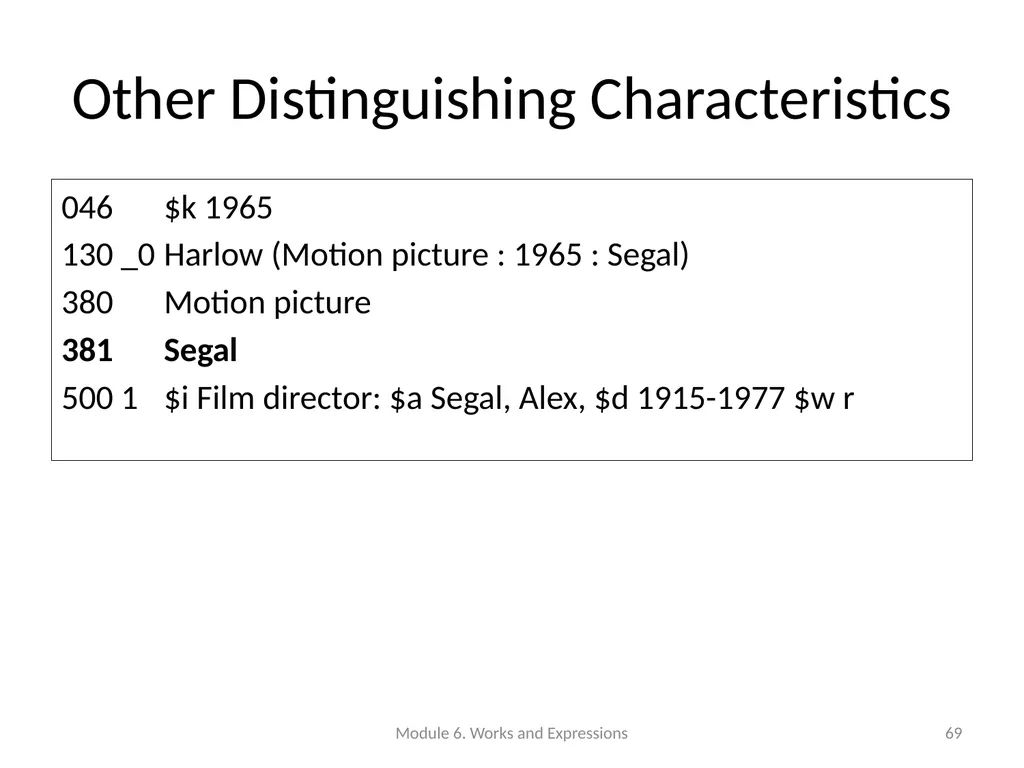
69
Other Distinguishing Characteristics 046 $k 1965
130 _0 Harlow (Motion picture : 1965 : Segal)
380 Motion picture
381 Segal
500 1 $i Film director: $a Segal, Alex, $d 1915-1977 $w r Module 6. Works and Expressions 69<br>
130 _0 Harlow (Motion picture : 1965 : Segal)
380 Motion picture
381 Segal
500 1 $i Film director: $a Segal, Alex, $d 1915-1977 $w r Module 6. Works and Expressions 69<br>
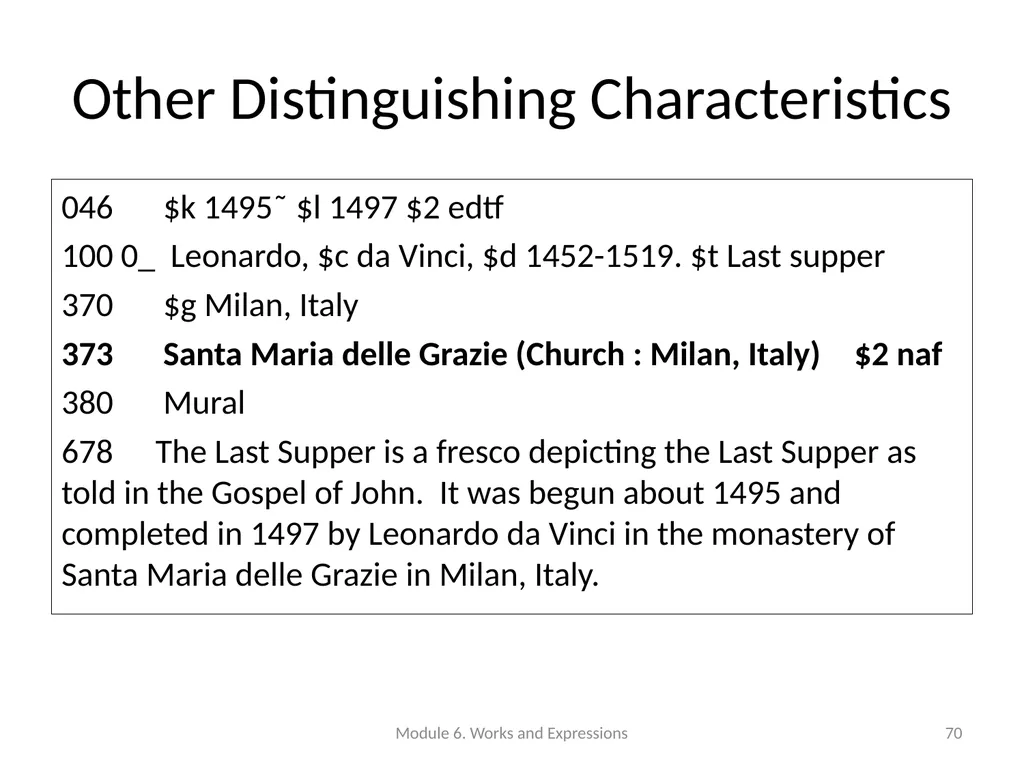
70
Other Distinguishing Characteristics 046 $k 1495˜ $l 1497 $2 edtf
100 0_ Leonardo, $c da Vinci, $d 1452-1519. $t Last supper
370 $g Milan, Italy
373 Santa Maria delle Grazie (Church : Milan, Italy) $2 naf
380 Mural
678 The Last Supper is a fresco depicting the Last Supper as told in the Gospel of John. It was begun about 1495 and completed in 1497 by Leonardo da Vinci in the monastery of Santa Maria delle Grazie in Milan, Italy. Module 6. Works and Expressions 70<br>
100 0_ Leonardo, $c da Vinci, $d 1452-1519. $t Last supper
370 $g Milan, Italy
373 Santa Maria delle Grazie (Church : Milan, Italy) $2 naf
380 Mural
678 The Last Supper is a fresco depicting the Last Supper as told in the Gospel of John. It was begun about 1495 and completed in 1497 by Leonardo da Vinci in the monastery of Santa Maria delle Grazie in Milan, Italy. Module 6. Works and Expressions 70<br>
71
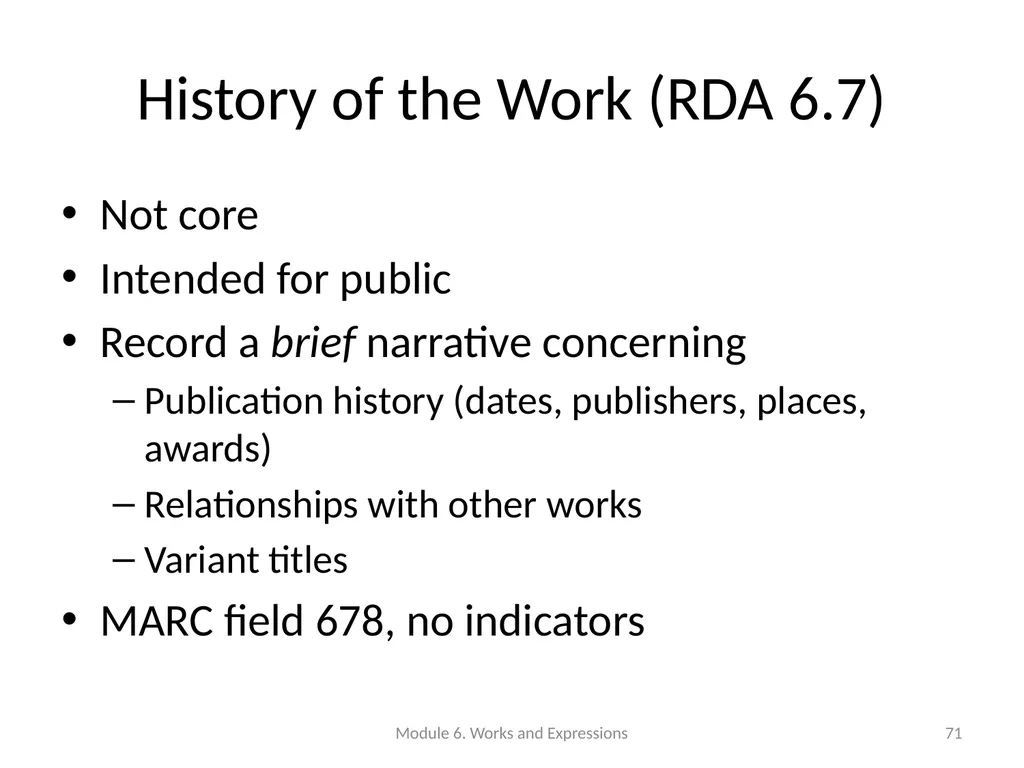
History of the Work (RDA 6.7) Not core
Intended for public
Record a brief narrative concerning
Publication history (dates, publishers, places, awards)
Relationships with other works
Variant titles
MARC field 678, no indicators Module 6. Works and Expressions 71<br>
Intended for public
Record a brief narrative concerning
Publication history (dates, publishers, places, awards)
Relationships with other works
Variant titles
MARC field 678, no indicators Module 6. Works and Expressions 71<br>
72
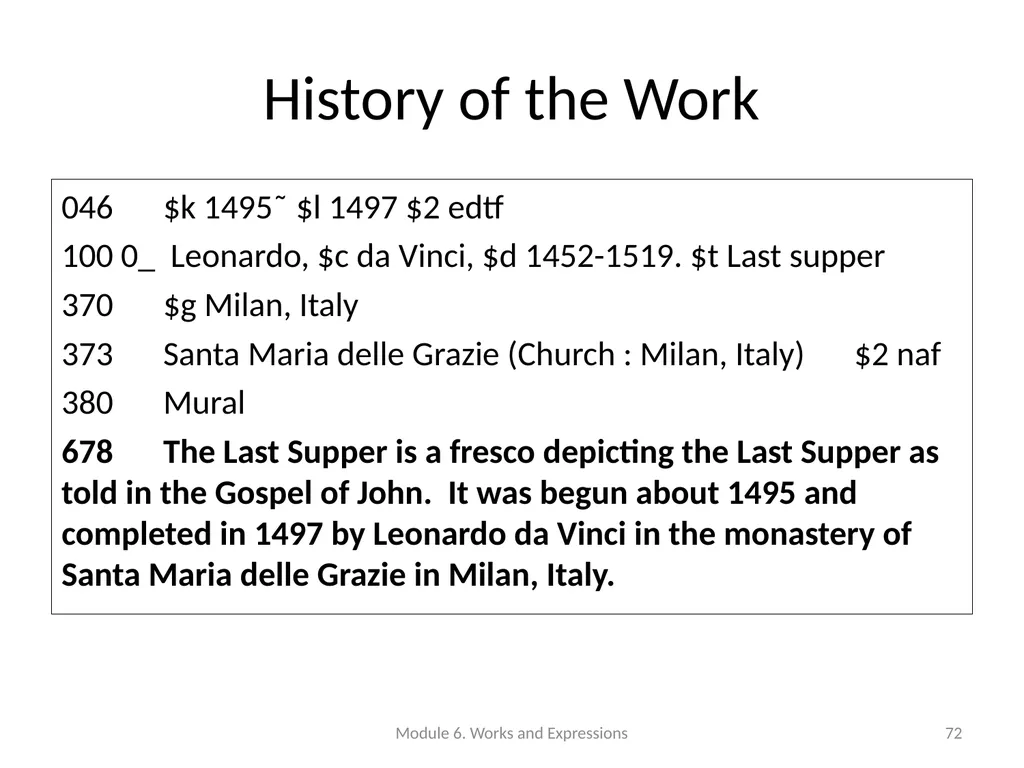
History of the Work 046 $k 1495˜ $l 1497 $2 edtf
100 0_ Leonardo, $c da Vinci, $d 1452-1519. $t Last supper
370 $g Milan, Italy
373 Santa Maria delle Grazie (Church : Milan, Italy) $2 naf
380 Mural
678 The Last Supper is a fresco depicting the Last Supper as told in the Gospel of John. It was begun about 1495 and completed in 1497 by Leonardo da Vinci in the monastery of Santa Maria delle Grazie in Milan, Italy. Module 6. Works and Expressions 72<br>
100 0_ Leonardo, $c da Vinci, $d 1452-1519. $t Last supper
370 $g Milan, Italy
373 Santa Maria delle Grazie (Church : Milan, Italy) $2 naf
380 Mural
678 The Last Supper is a fresco depicting the Last Supper as told in the Gospel of John. It was begun about 1495 and completed in 1497 by Leonardo da Vinci in the monastery of Santa Maria delle Grazie in Milan, Italy. Module 6. Works and Expressions 72<br>
73
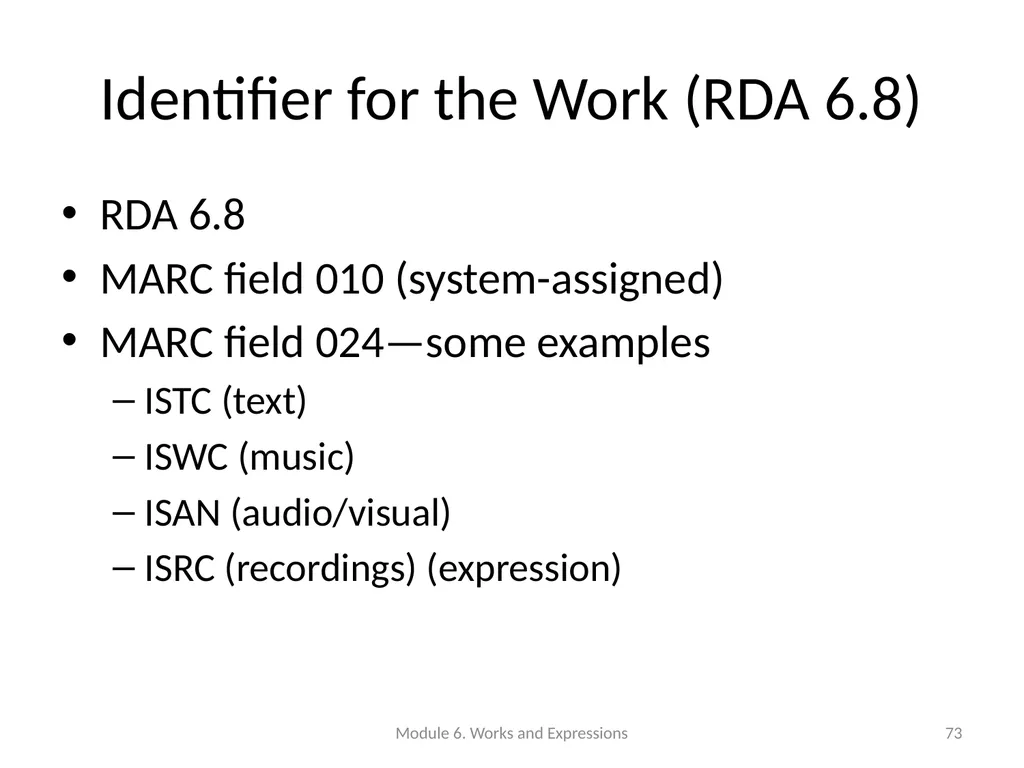
Identifier for the Work (RDA 6.8) RDA 6.8
MARC field 010 (system-assigned)
MARC field 024—some examples
ISTC (text)
ISWC (music)
ISAN (audio/visual)
ISRC (recordings) (expression) Module 6. Works and Expressions 73<br>
MARC field 010 (system-assigned)
MARC field 024—some examples
ISTC (text)
ISWC (music)
ISAN (audio/visual)
ISRC (recordings) (expression) Module 6. Works and Expressions 73<br>
74
Attributes of Expressions Module 6. Works and Expressions 74<br>
75
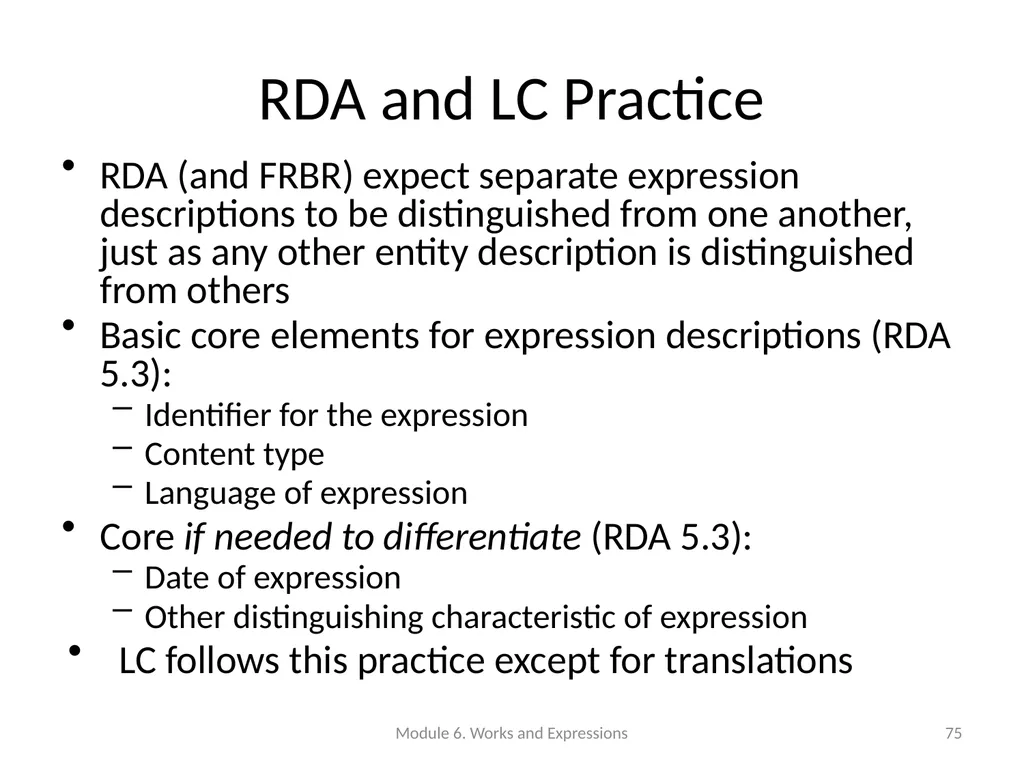
RDA and LC Practice RDA (and FRBR) expect separate expression descriptions to be distinguished from one another, just as any other entity description is distinguished from others
Basic core elements for expression descriptions (RDA 5.3):
Identifier for the expression
Content type
Language of expression
Core if needed to differentiate (RDA 5.3):
Date of expression
Other distinguishing characteristic of expression
LC follows this practice except for translations Module 6. Works and Expressions 75<br>
Basic core elements for expression descriptions (RDA 5.3):
Identifier for the expression
Content type
Language of expression
Core if needed to differentiate (RDA 5.3):
Date of expression
Other distinguishing characteristic of expression
LC follows this practice except for translations Module 6. Works and Expressions 75<br>
76
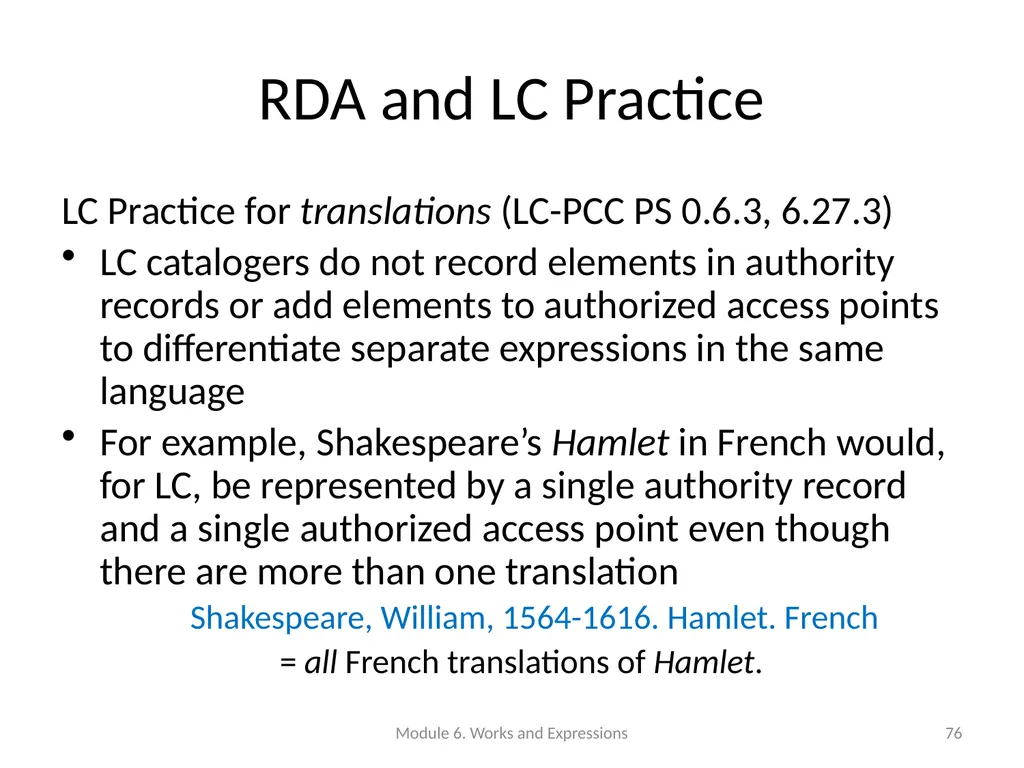
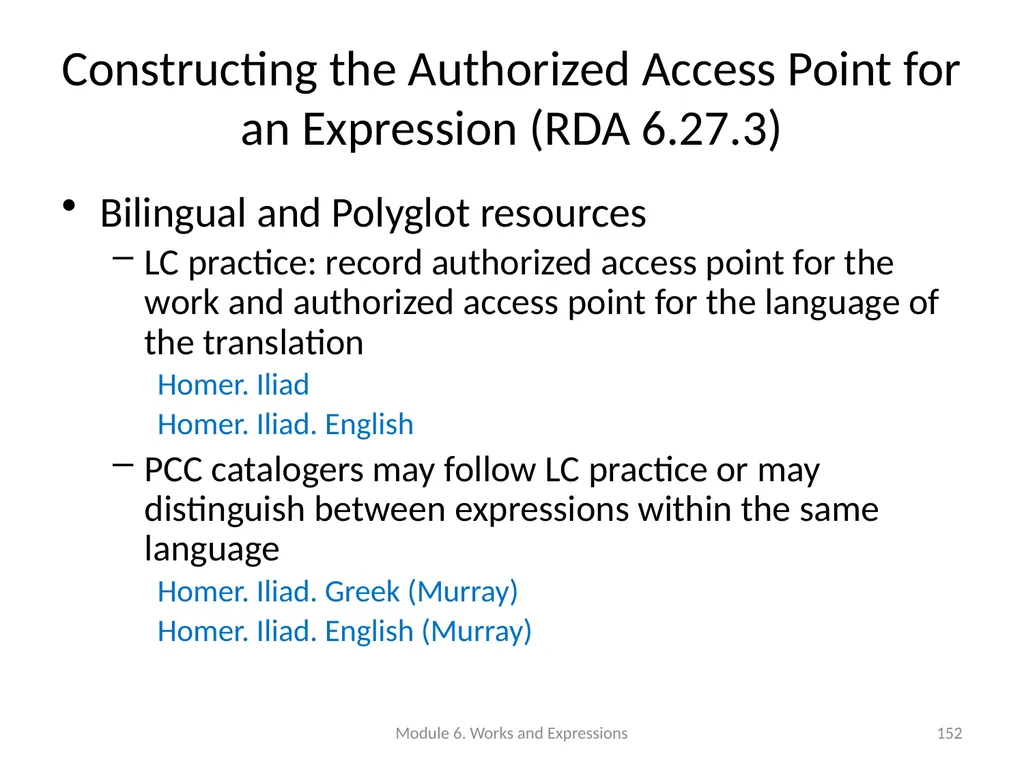
RDA and LC Practice LC Practice for translations (LC-PCC PS 0.6.3, 6.27.3)
LC catalogers do not record elements in authority records or add elements to authorized access points to differentiate separate expressions in the same language
For example, Shakespeare’s Hamlet in French would, for LC, be represented by a single authority record and a single authorized access point even though there are more than one translation
Shakespeare, William, 1564-1616. Hamlet. French
= all French translations of Hamlet. Module 6. Works and Expressions 76<br>
LC catalogers do not record elements in authority records or add elements to authorized access points to differentiate separate expressions in the same language
For example, Shakespeare’s Hamlet in French would, for LC, be represented by a single authority record and a single authorized access point even though there are more than one translation
Shakespeare, William, 1564-1616. Hamlet. French
= all French translations of Hamlet. Module 6. Works and Expressions 76<br>
77
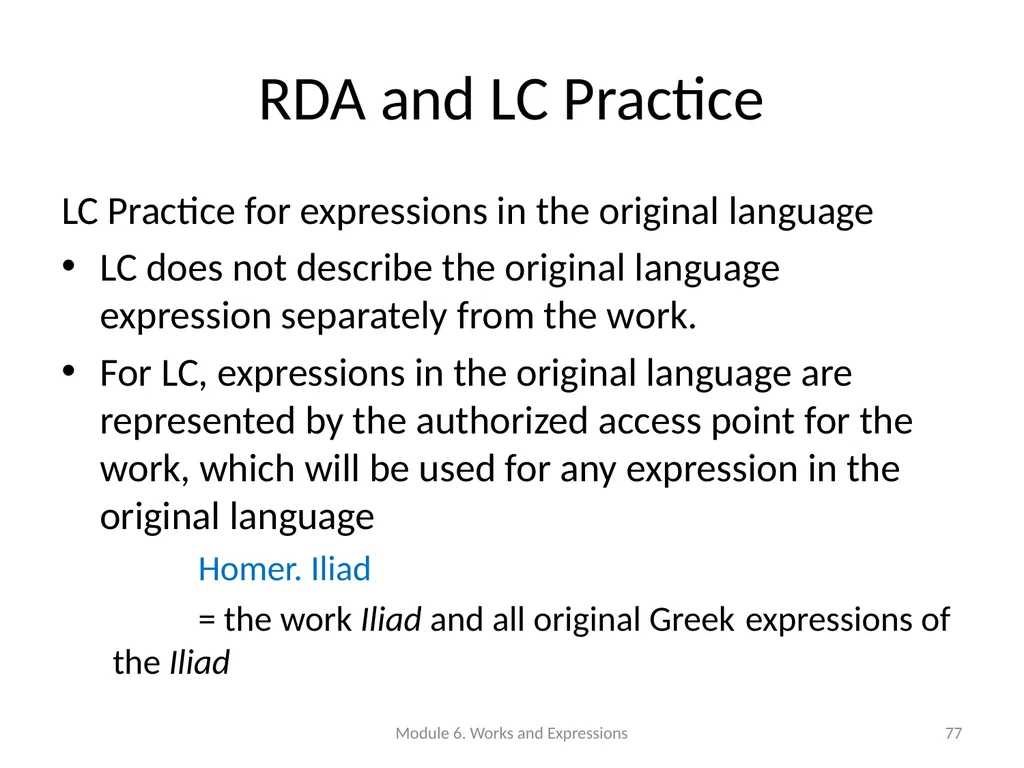
RDA and LC Practice LC Practice for expressions in the original language
LC does not describe the original language expression separately from the work.
For LC, expressions in the original language are represented by the authorized access point for the work, which will be used for any expression in the original language
Homer. Iliad
= the work Iliad and all original Greek expressions of the Iliad Module 6. Works and Expressions 77<br>
LC does not describe the original language expression separately from the work.
For LC, expressions in the original language are represented by the authorized access point for the work, which will be used for any expression in the original language
Homer. Iliad
= the work Iliad and all original Greek expressions of the Iliad Module 6. Works and Expressions 77<br>
78
RDA and LC Practice Exception to LC practice: If there is a name authority record with an authorized access point for an expression that includes an additional characteristic LC would not have added, LC catalogers will use that established authorized access point for that specific expression. Module 6. Works and Expressions 78<br>
79
RDA and LC Practice PCC Catalogers may follow this LC practice, or may apply RDA and describe distinct expressions in separate authority records and assign them distinct authorized access points depending on the needs of their users. Module 6. Works and Expressions 79<br>
80
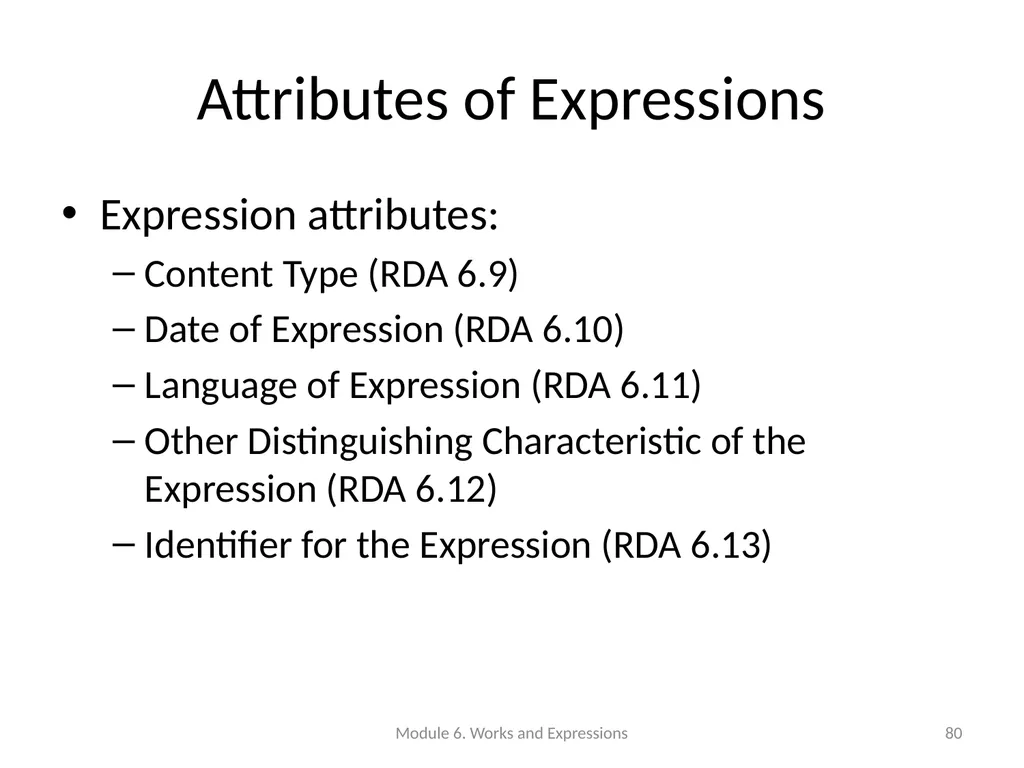
Attributes of Expressions Expression attributes:
Content Type (RDA 6.9)
Date of Expression (RDA 6.10)
Language of Expression (RDA 6.11)
Other Distinguishing Characteristic of the Expression (RDA 6.12)
Identifier for the Expression (RDA 6.13) Module 6. Works and Expressions 80<br>
Content Type (RDA 6.9)
Date of Expression (RDA 6.10)
Language of Expression (RDA 6.11)
Other Distinguishing Characteristic of the Expression (RDA 6.12)
Identifier for the Expression (RDA 6.13) Module 6. Works and Expressions 80<br>
81
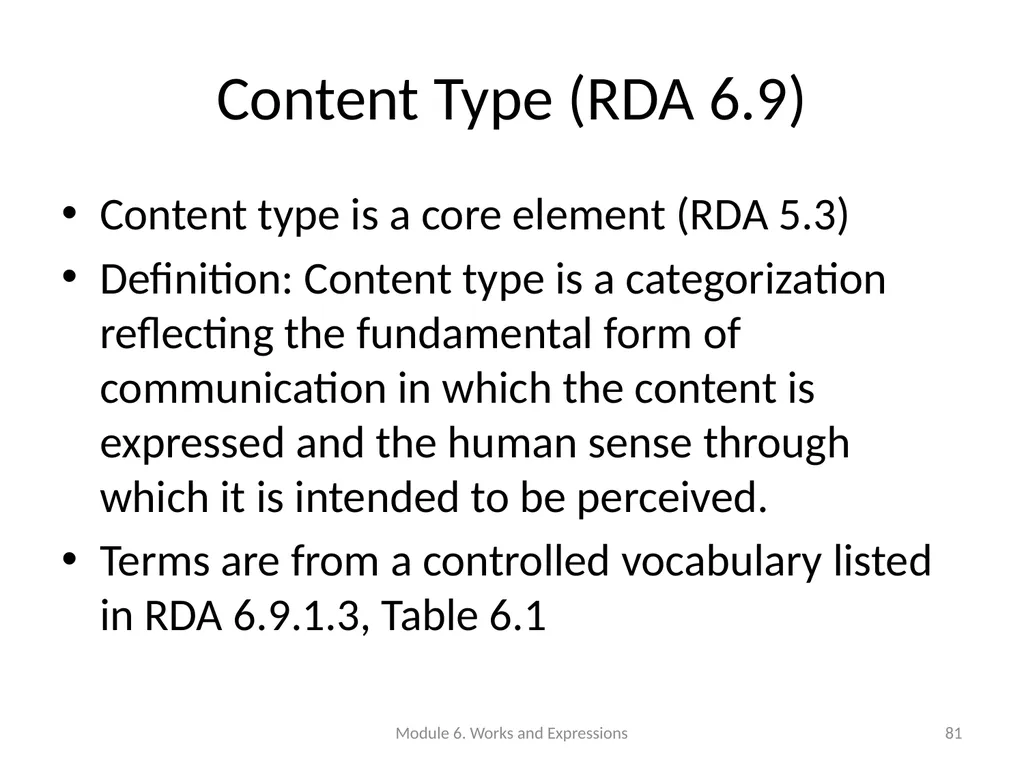
Content Type (RDA 6.9) Content type is a core element (RDA 5.3)
Definition: Content type is a categorization reflecting the fundamental form of communication in which the content is expressed and the human sense through which it is intended to be perceived.
Terms are from a controlled vocabulary listed in RDA 6.9.1.3, Table 6.1 Module 6. Works and Expressions 81<br>
Definition: Content type is a categorization reflecting the fundamental form of communication in which the content is expressed and the human sense through which it is intended to be perceived.
Terms are from a controlled vocabulary listed in RDA 6.9.1.3, Table 6.1 Module 6. Works and Expressions 81<br>
82
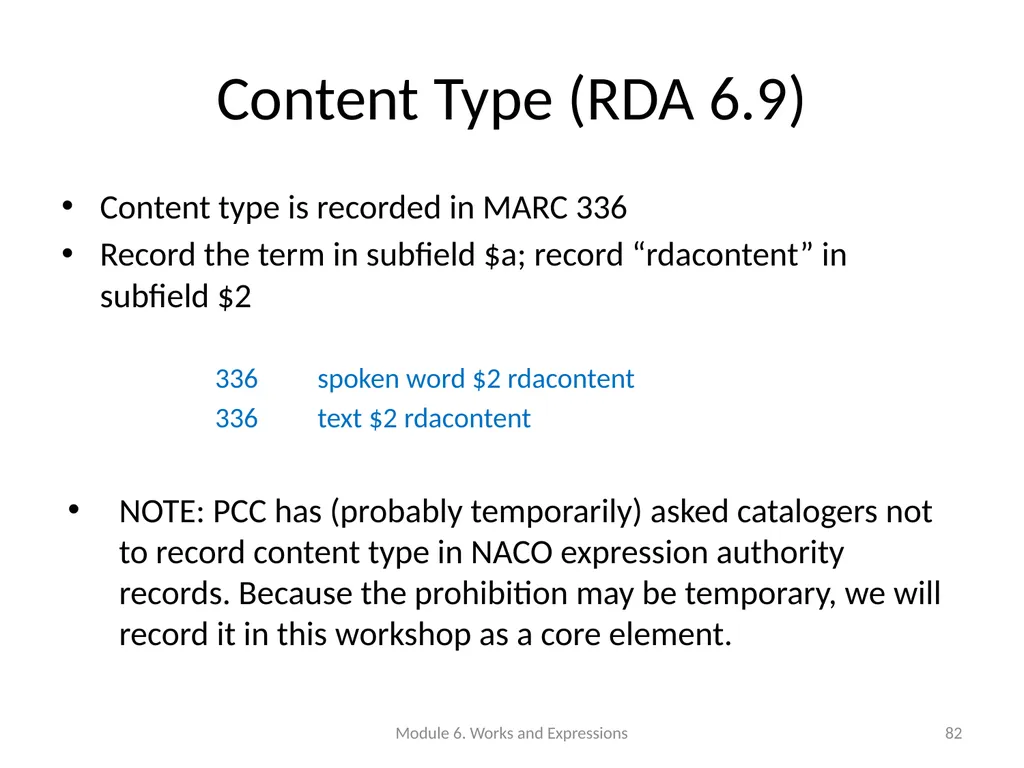
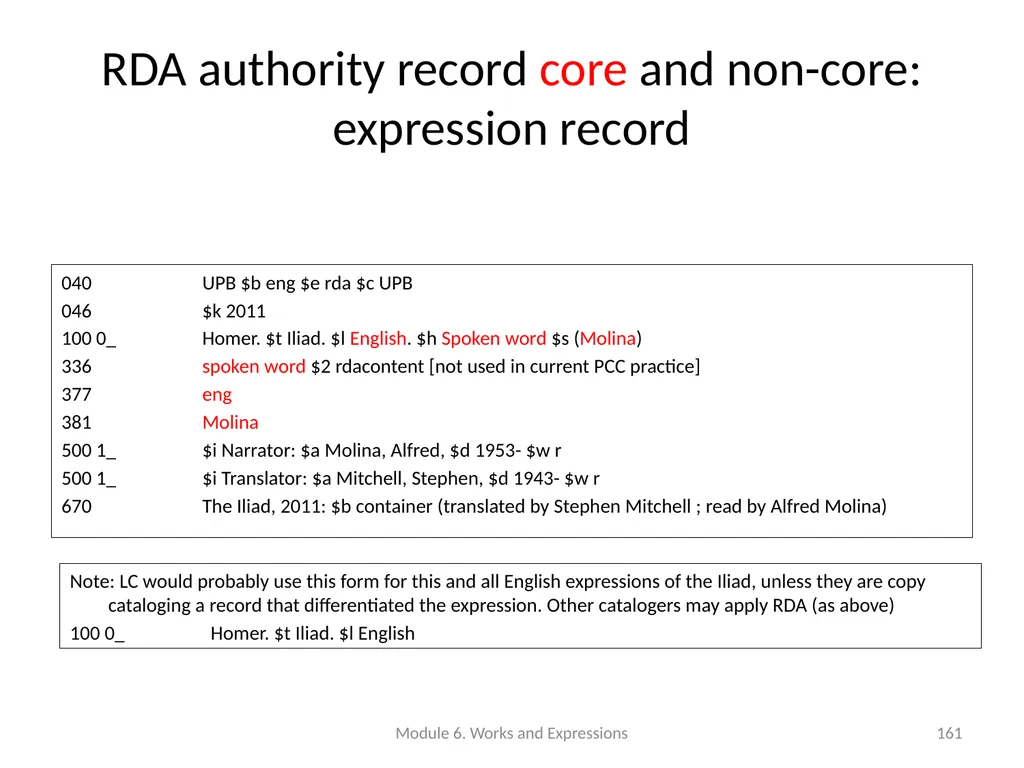
Content Type (RDA 6.9) Content type is recorded in MARC 336
Record the term in subfield $a; record “rdacontent” in subfield $2
336 spoken word $2 rdacontent
336 text $2 rdacontent
NOTE: PCC has (probably temporarily) asked catalogers not to record content type in NACO expression authority records. Because the prohibition may be temporary, we will record it in this workshop as a core element. Module 6. Works and Expressions 82<br>
Record the term in subfield $a; record “rdacontent” in subfield $2
336 spoken word $2 rdacontent
336 text $2 rdacontent
NOTE: PCC has (probably temporarily) asked catalogers not to record content type in NACO expression authority records. Because the prohibition may be temporary, we will record it in this workshop as a core element. Module 6. Works and Expressions 82<br>
83
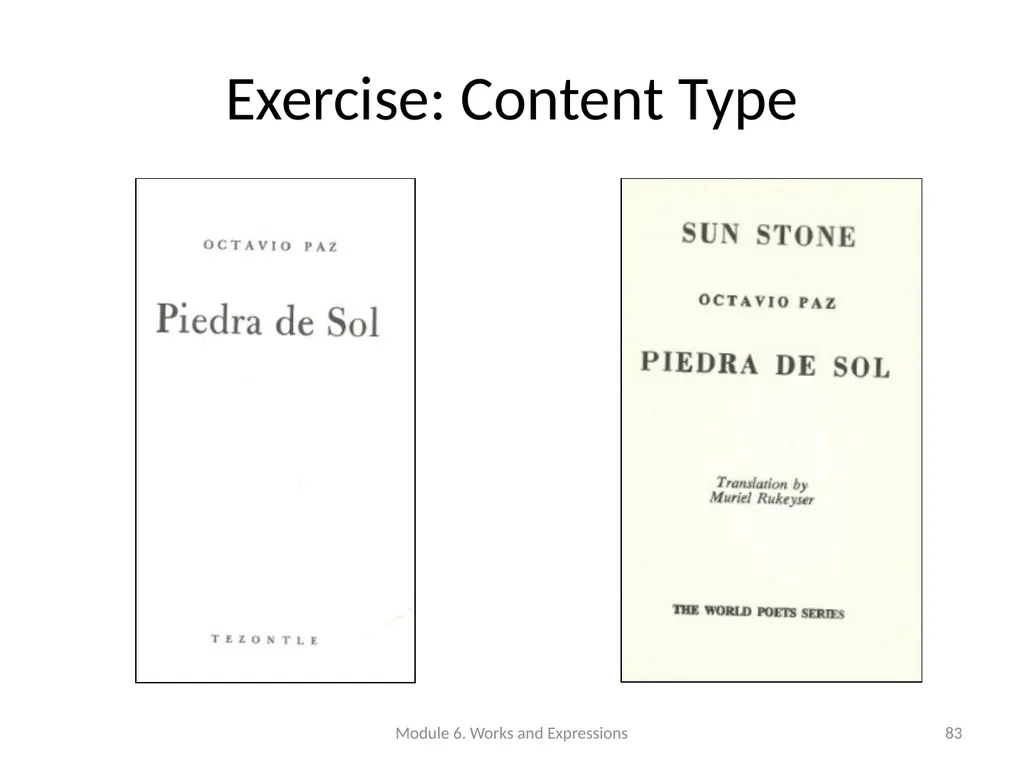
Exercise: Content Type Module 6. Works and Expressions 83<br>
84
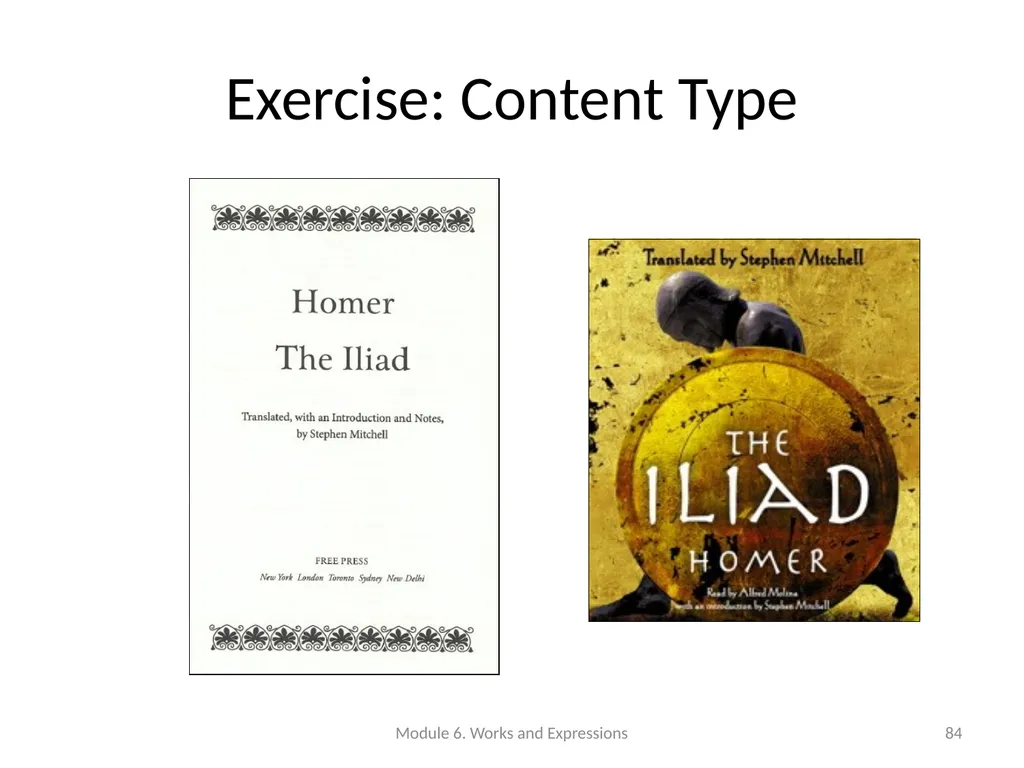
Exercise: Content Type Module 6. Works and Expressions 84<br>
85
Date of Expression (RDA 6.10) Definition: “earliest date associated with an expression;” if that date is unknown, record the date of the earliest manifestation
Not core unless needed to distinguish between expressions; but may be recorded as an element whether or not core
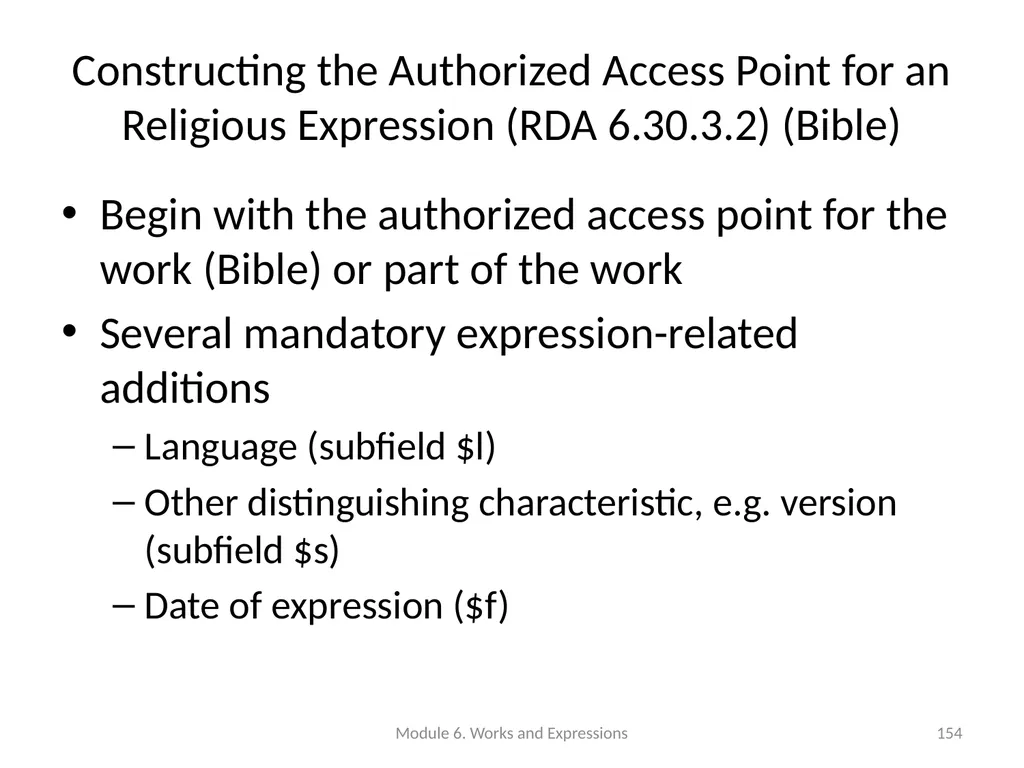
Special instructions for religious works (RDA 6.24) and for the Bible in particular (RDA 6.30.3.2)
Use the 046 field
Beginning or single date created: 046 $k
Ending date created: 046 $l Module 6. Works and Expressions 85<br>
Not core unless needed to distinguish between expressions; but may be recorded as an element whether or not core
Special instructions for religious works (RDA 6.24) and for the Bible in particular (RDA 6.30.3.2)
Use the 046 field
Beginning or single date created: 046 $k
Ending date created: 046 $l Module 6. Works and Expressions 85<br>
86
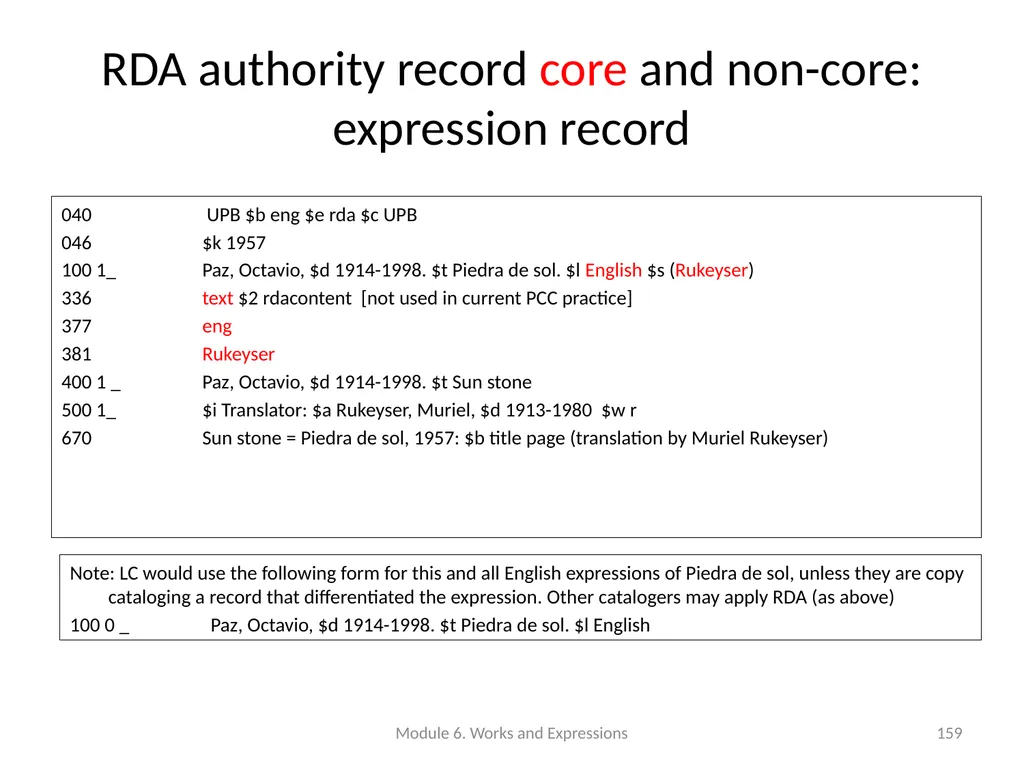
Exercise: Date of Expression The Rukeyser translation of Piedra de sol was first published in 1963.
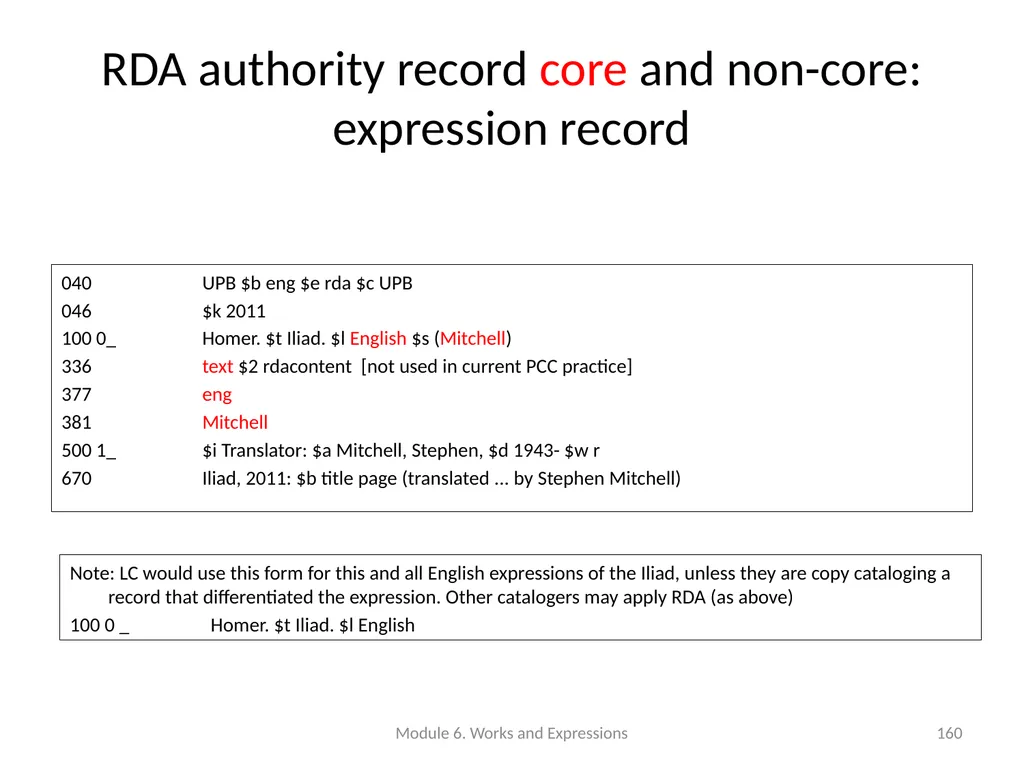
The Mitchell translation of the Iliad was first published in 2011.
The Alfred Molina performance of the Mitchell translation of the Iliad was first published in 2011.
Exercise: Record the date of expression element in the authority record Module 6. Works and Expressions 86<br>
The Mitchell translation of the Iliad was first published in 2011.
The Alfred Molina performance of the Mitchell translation of the Iliad was first published in 2011.
Exercise: Record the date of expression element in the authority record Module 6. Works and Expressions 86<br>
87
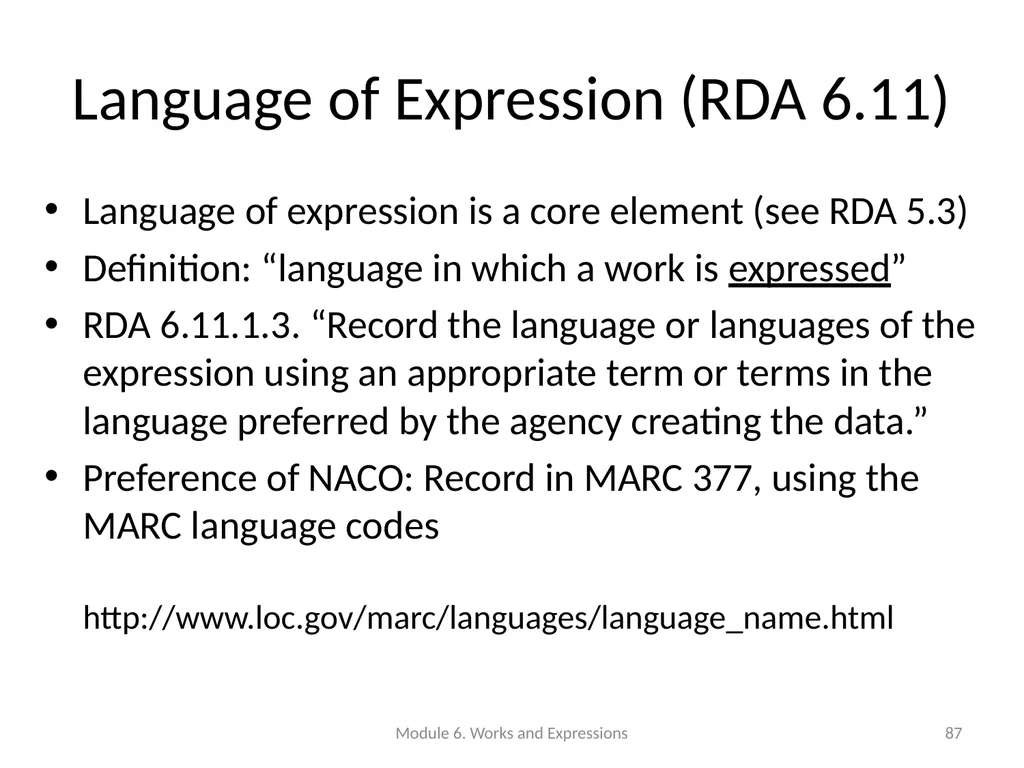
Language of Expression (RDA 6.11) Language of expression is a core element (see RDA 5.3)
Definition: “language in which a work is expressed”
RDA 6.11.1.3. “Record the language or languages of the expression using an appropriate term or terms in the language preferred by the agency creating the data.”
Preference of NACO: Record in MARC 377, using the MARC language codes http://www.loc.gov/marc/languages/language_name.html Module 6. Works and Expressions 87<br>
Definition: “language in which a work is expressed”
RDA 6.11.1.3. “Record the language or languages of the expression using an appropriate term or terms in the language preferred by the agency creating the data.”
Preference of NACO: Record in MARC 377, using the MARC language codes http://www.loc.gov/marc/languages/language_name.html Module 6. Works and Expressions 87<br>
88
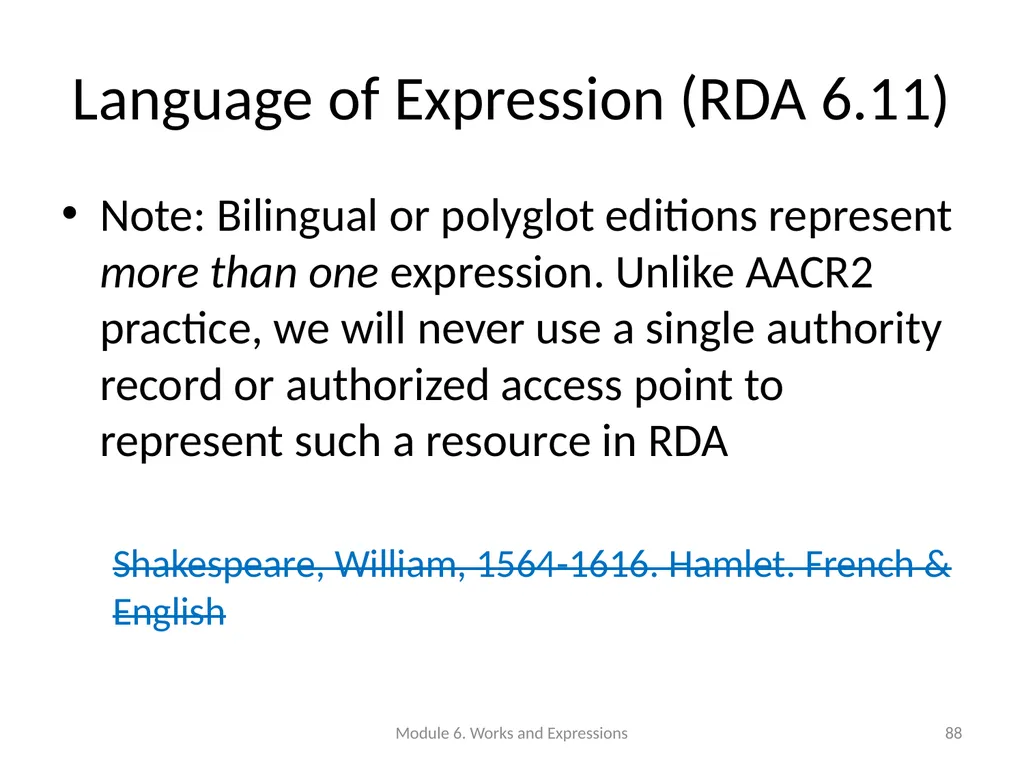
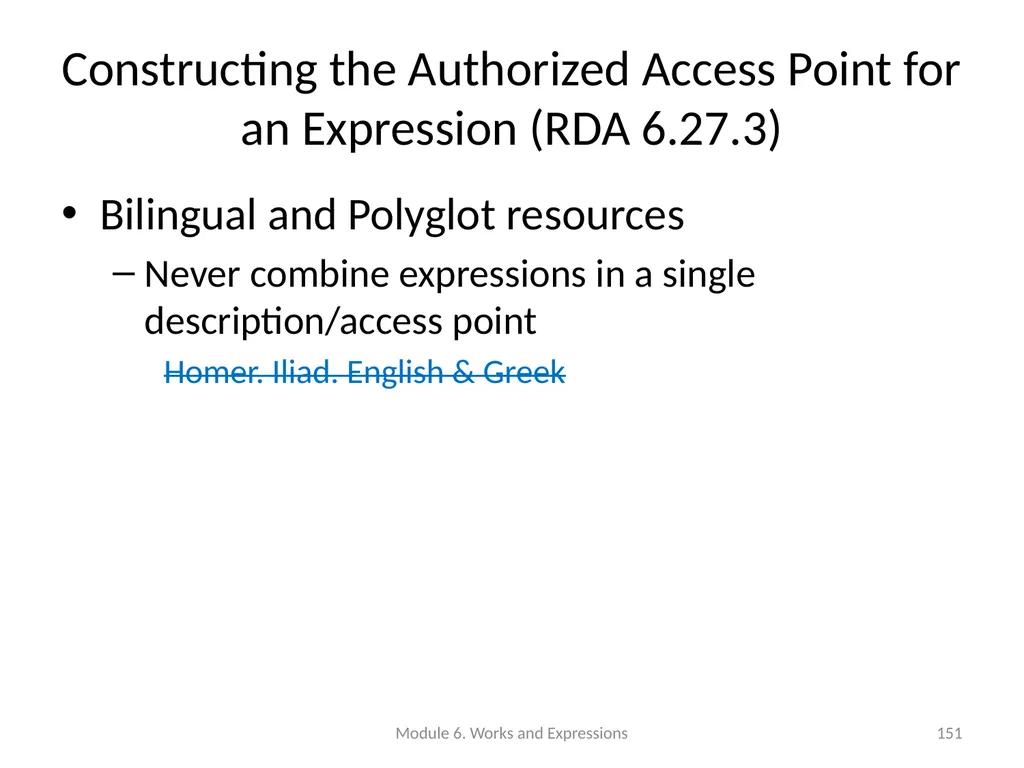
Language of Expression (RDA 6.11) Note: Bilingual or polyglot editions represent more than one expression. Unlike AACR2 practice, we will never use a single authority record or authorized access point to represent such a resource in RDA
Shakespeare, William, 1564-1616. Hamlet. French & English Module 6. Works and Expressions 88<br>
Shakespeare, William, 1564-1616. Hamlet. French & English Module 6. Works and Expressions 88<br>
89
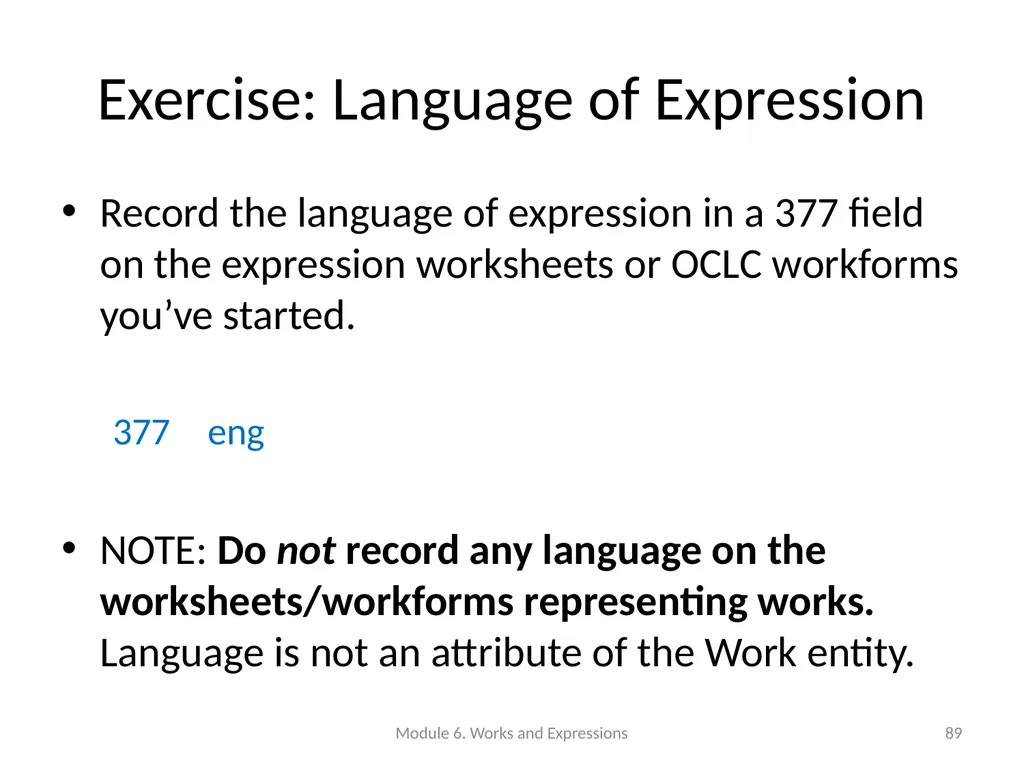
Exercise: Language of Expression Record the language of expression in a 377 field on the expression worksheets or OCLC workforms you’ve started.
377 eng
NOTE: Do not record any language on the worksheets/workforms representing works. Language is not an attribute of the Work entity. Module 6. Works and Expressions 89<br>
377 eng
NOTE: Do not record any language on the worksheets/workforms representing works. Language is not an attribute of the Work entity. Module 6. Works and Expressions 89<br>
90
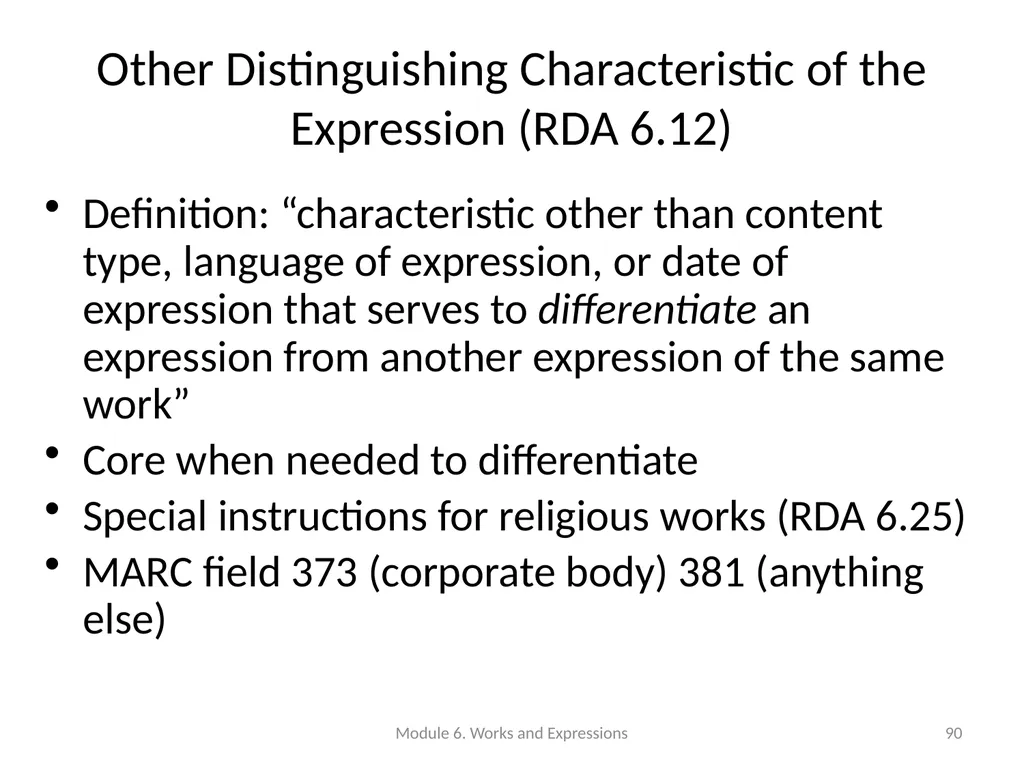
Other Distinguishing Characteristic of the Expression (RDA 6.12) Definition: “characteristic other than content type, language of expression, or date of expression that serves to differentiate an expression from another expression of the same work”
Core when needed to differentiate
Special instructions for religious works (RDA 6.25)
MARC field 373 (corporate body) 381 (anything else) Module 6. Works and Expressions 90<br>
Core when needed to differentiate
Special instructions for religious works (RDA 6.25)
MARC field 373 (corporate body) 381 (anything else) Module 6. Works and Expressions 90<br>
91
Other Distinguishing Characteristic of the Expression (RDA 6.12) Use whatever distinguishes the expressions best.
the surname of an editor or translator
the name of a version
the name of a publisher closely associated with the expression
etc. ...
If it makes more sense, the language, the date of the expression, or content type can be used to distinguish instead (RDA 6.9-6.11) Module 6. Works and Expressions 91<br>
the surname of an editor or translator
the name of a version
the name of a publisher closely associated with the expression
etc. ...
If it makes more sense, the language, the date of the expression, or content type can be used to distinguish instead (RDA 6.9-6.11) Module 6. Works and Expressions 91<br>
92
Exercise: Other Distinguishing Characteristic of the Expression There is more than one English expression of Piedra de sol and the Iliad.
There is more than one spoken word expression of the Iliad. Module 6. Works and Expressions 92<br>
There is more than one spoken word expression of the Iliad. Module 6. Works and Expressions 92<br>
93
Exercise: Other Distinguishing Characteristic of the Expression What might you use to distinguish these expressions?
Record your choice in 381
Possible answers
Rukeyser
Mitchell
381 Molina or
381 Mitchell $a Molina Module 6. Works and Expressions 93<br>
Record your choice in 381
Possible answers
Rukeyser
Mitchell
381 Molina or
381 Mitchell $a Molina Module 6. Works and Expressions 93<br>
94
Special Rules for Expressions of Religious Works Additional instructions to those found earlier in Chapter 6
RDA 6.24
Date of Expression of a Religious Work
RDA 6.25
Other Distinguishing Characteristic of the Expression of a Religious Work Module 6. Works and Expressions 94<br>
RDA 6.24
Date of Expression of a Religious Work
RDA 6.25
Other Distinguishing Characteristic of the Expression of a Religious Work Module 6. Works and Expressions 94<br>
95
Date of Expression of a Religious Work (RDA 6.24) Definition: the earliest date associated with an expression of a religious work
If that date is unknown, the date of the earliest manifestation may be substituted
Bible: Record the year of publication
Use 046 (as described above) Module 6. Works and Expressions 95<br>
If that date is unknown, the date of the earliest manifestation may be substituted
Bible: Record the year of publication
Use 046 (as described above) Module 6. Works and Expressions 95<br>
96
Other Distinguishing Characteristic of the Expression of a Religious Work (RDA 6.25) RDA 6.25.1.4 gives some expression attributes unique to sacred scripture. If appropriate, record
A brief form of the name of the version
Authorized
Vulgate
If the version is known by the name of the translator, record it
Lamsa
Smith-Goodspeed
Gordon and others
See RDA 6.25.1.4 for details and other possibilities
Record in 381 Module 6. Works and Expressions 96<br>
A brief form of the name of the version
Authorized
Vulgate
If the version is known by the name of the translator, record it
Lamsa
Smith-Goodspeed
Gordon and others
See RDA 6.25.1.4 for details and other possibilities
Record in 381 Module 6. Works and Expressions 96<br>
97
Authorized Access Points<br>
98
Creating the authorized access point Follow RDA 6.27 except:
Some musical works (RDA 6.28)
Legal works (RDA 6.29)
Religious works (RDA 6.30)
Series—a different workshop
Subject usage—most authorized access points can be used as subjects in LCSH Module 6. Works and Expressions 98<br>
Some musical works (RDA 6.28)
Legal works (RDA 6.29)
Religious works (RDA 6.30)
Series—a different workshop
Subject usage—most authorized access points can be used as subjects in LCSH Module 6. Works and Expressions 98<br>
99
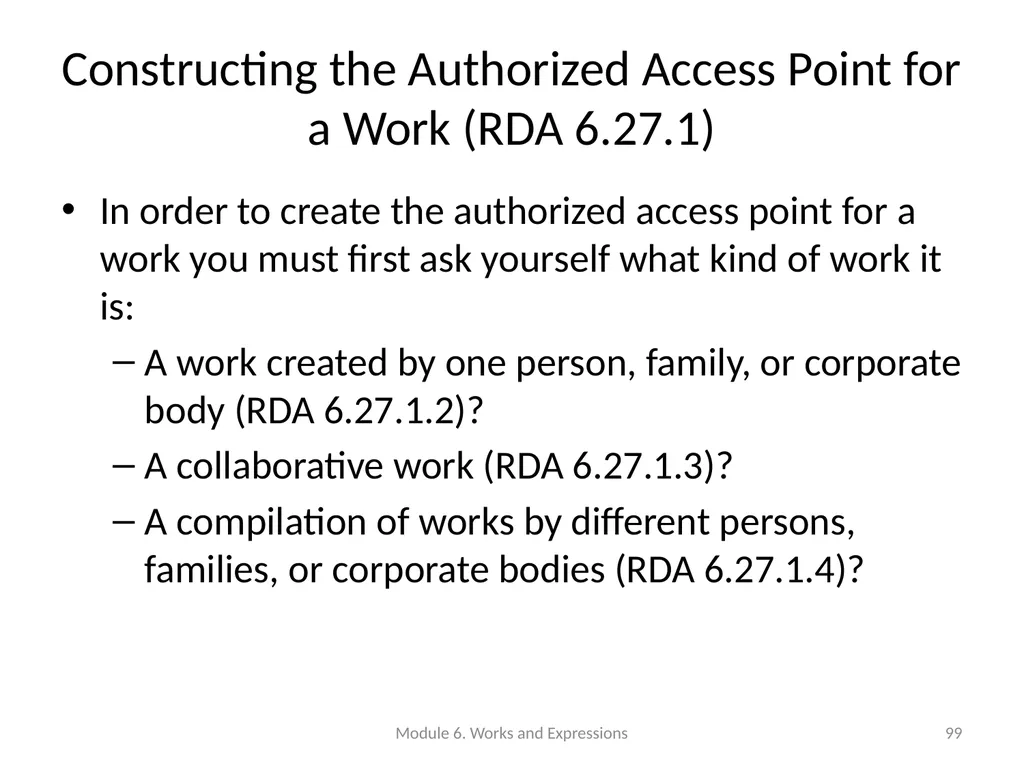
Constructing the Authorized Access Point for a Work (RDA 6.27.1) In order to create the authorized access point for a work you must first ask yourself what kind of work it is:
A work created by one person, family, or corporate body (RDA 6.27.1.2)?
A collaborative work (RDA 6.27.1.3)?
A compilation of works by different persons, families, or corporate bodies (RDA 6.27.1.4)? Module 6. Works and Expressions 99<br>
A work created by one person, family, or corporate body (RDA 6.27.1.2)?
A collaborative work (RDA 6.27.1.3)?
A compilation of works by different persons, families, or corporate bodies (RDA 6.27.1.4)? Module 6. Works and Expressions 99<br>
100
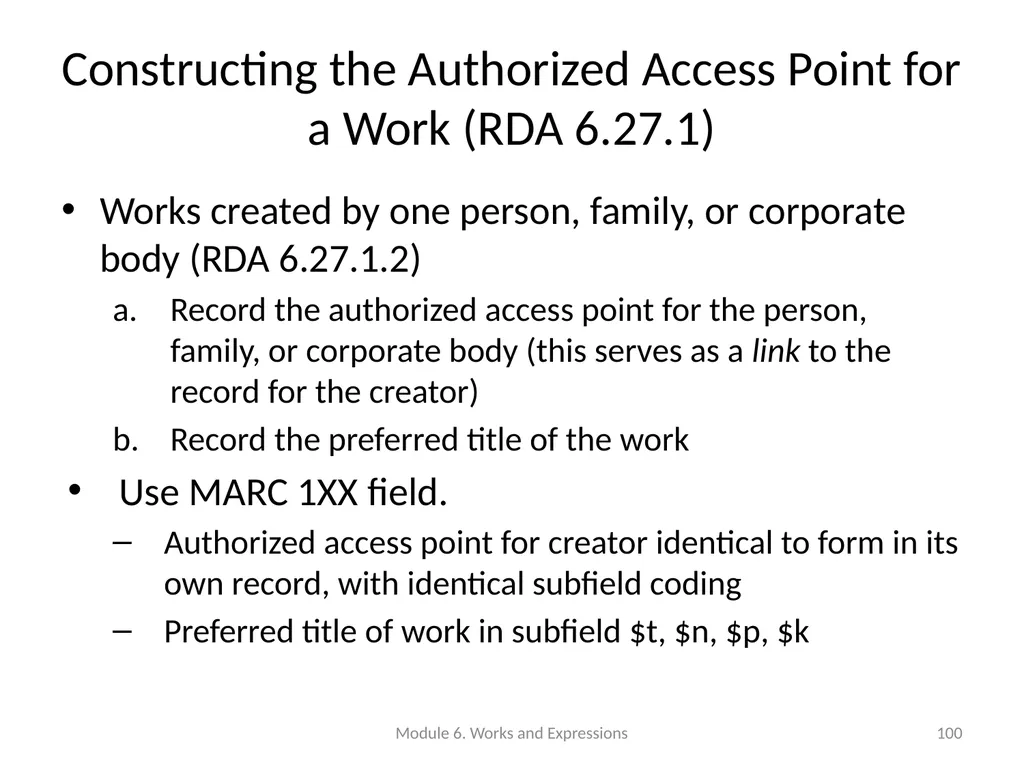
Constructing the Authorized Access Point for a Work (RDA 6.27.1) Works created by one person, family, or corporate body (RDA 6.27.1.2)
Record the authorized access point for the person, family, or corporate body (this serves as a link to the record for the creator)
Record the preferred title of the work
Use MARC 1XX field.
Authorized access point for creator identical to form in its own record, with identical subfield coding
Preferred title of work in subfield $t, $n, $p, $k Module 6. Works and Expressions 100<br>
Record the authorized access point for the person, family, or corporate body (this serves as a link to the record for the creator)
Record the preferred title of the work
Use MARC 1XX field.
Authorized access point for creator identical to form in its own record, with identical subfield coding
Preferred title of work in subfield $t, $n, $p, $k Module 6. Works and Expressions 100<br>
101
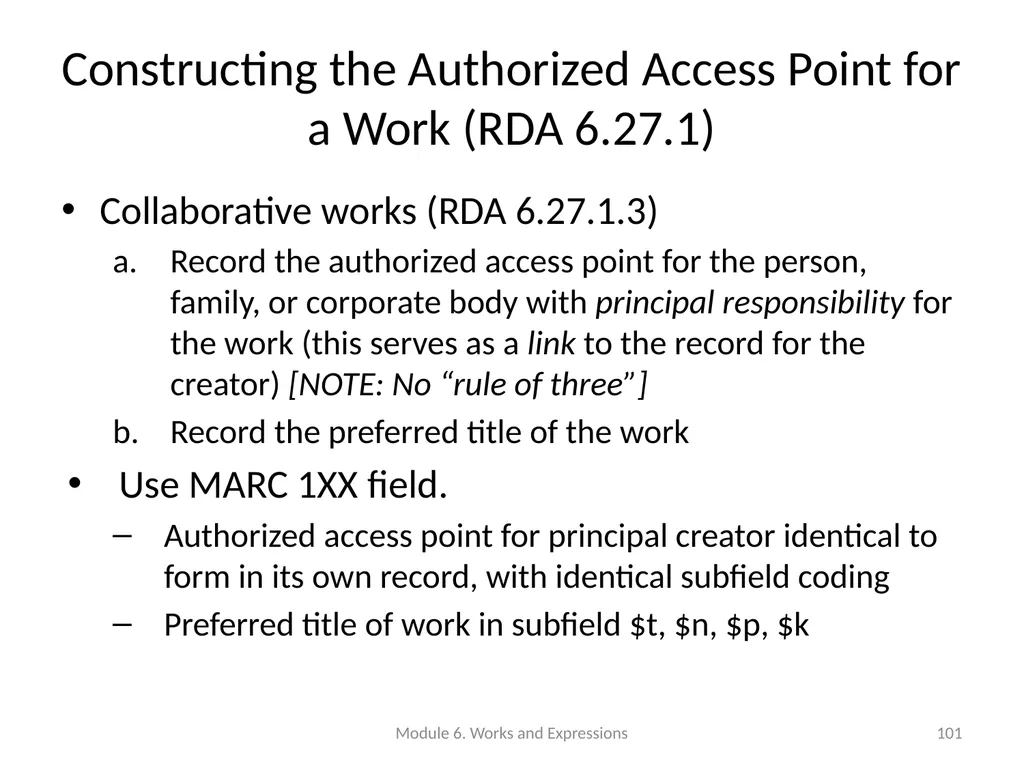
Constructing the Authorized Access Point for a Work (RDA 6.27.1) Collaborative works (RDA 6.27.1.3)
Record the authorized access point for the person, family, or corporate body with principal responsibility for the work (this serves as a link to the record for the creator) [NOTE: No “rule of three”]
Record the preferred title of the work
Use MARC 1XX field.
Authorized access point for principal creator identical to form in its own record, with identical subfield coding
Preferred title of work in subfield $t, $n, $p, $k Module 6. Works and Expressions 101<br>
Record the authorized access point for the person, family, or corporate body with principal responsibility for the work (this serves as a link to the record for the creator) [NOTE: No “rule of three”]
Record the preferred title of the work
Use MARC 1XX field.
Authorized access point for principal creator identical to form in its own record, with identical subfield coding
Preferred title of work in subfield $t, $n, $p, $k Module 6. Works and Expressions 101<br>
102
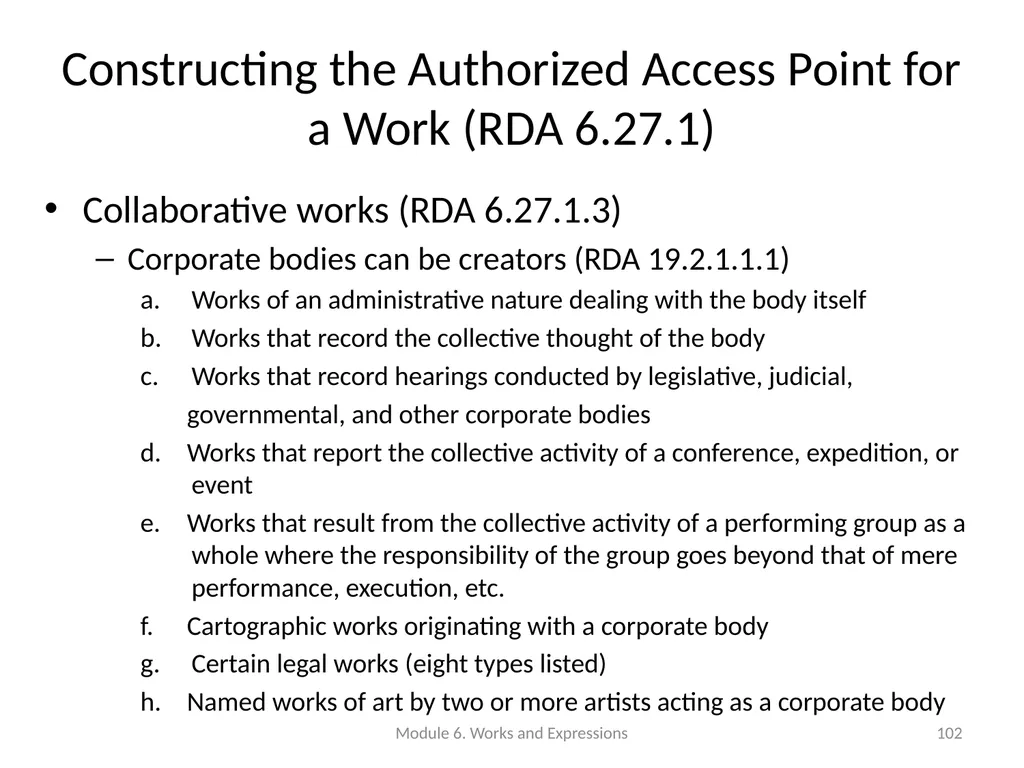
Constructing the Authorized Access Point for a Work (RDA 6.27.1) Collaborative works (RDA 6.27.1.3)
Corporate bodies can be creators (RDA 19.2.1.1.1)
Works of an administrative nature dealing with the body itself
Works that record the collective thought of the body
Works that record hearings conducted by legislative, judicial,
governmental, and other corporate bodies
d. Works that report the collective activity of a conference, expedition, or event
e. Works that result from the collective activity of a performing group as a whole where the responsibility of the group goes beyond that of mere performance, execution, etc.
f. Cartographic works originating with a corporate body
Certain legal works (eight types listed)
h. Named works of art by two or more artists acting as a corporate body Module 6. Works and Expressions 102<br>
Corporate bodies can be creators (RDA 19.2.1.1.1)
Works of an administrative nature dealing with the body itself
Works that record the collective thought of the body
Works that record hearings conducted by legislative, judicial,
governmental, and other corporate bodies
d. Works that report the collective activity of a conference, expedition, or event
e. Works that result from the collective activity of a performing group as a whole where the responsibility of the group goes beyond that of mere performance, execution, etc.
f. Cartographic works originating with a corporate body
Certain legal works (eight types listed)
h. Named works of art by two or more artists acting as a corporate body Module 6. Works and Expressions 102<br>
103
Constructing the Authorized Access Point for a Work (RDA 6.27.1) Collaborative works exception (RDA 6.27.1.3)
Moving image works
The access point is created by recording the preferred title alone (does not begin with access point for a creator)
NOTE: this applies to most motion pictures, which are usually collaborative works. If a motion picture is the work of a single person, family, or corporate body, its access point is created according to RDA 6.27.1.2 (authorized access point for creator + preferred title of the work) Module 6. Works and Expressions 103<br>
Moving image works
The access point is created by recording the preferred title alone (does not begin with access point for a creator)
NOTE: this applies to most motion pictures, which are usually collaborative works. If a motion picture is the work of a single person, family, or corporate body, its access point is created according to RDA 6.27.1.2 (authorized access point for creator + preferred title of the work) Module 6. Works and Expressions 103<br>
104
Constructing the Authorized Access Point for a Work (RDA 6.27.1) Compilations of works by different persons, families, or corporate bodies (RDA 6.27.1.4)
The access point is created by recording the preferred title alone (does not begin with access point for a creator)
The preferred title is the collective title for the compilation (an aggregate work)
If there is no collective title, separate access points are constructed for the individual works in the compilation Module 6. Works and Expressions 104<br>
The access point is created by recording the preferred title alone (does not begin with access point for a creator)
The preferred title is the collective title for the compilation (an aggregate work)
If there is no collective title, separate access points are constructed for the individual works in the compilation Module 6. Works and Expressions 104<br>
105
Constructing the Authorized Access Point for a Work (RDA 6.27.1) Works of unknown or uncertain attribution (RDA 6.27.1.8)
The access point is created by recording the preferred title alone (does not begin with access point for a creator)
If reference sources indicate that there is a probable creator, however,
Record the authorized access point for the person, family, or corporate body (this serves as a link to the record for the creator)
Record the preferred title of the work Module 6. Works and Expressions 105<br>
The access point is created by recording the preferred title alone (does not begin with access point for a creator)
If reference sources indicate that there is a probable creator, however,
Record the authorized access point for the person, family, or corporate body (this serves as a link to the record for the creator)
Record the preferred title of the work Module 6. Works and Expressions 105<br>
106
Constructing the Authorized Access Point for Part of a Work Generally formed in the same way as for the work as a whole
One part (RDA 6.27.2.2)
Authorized access point for person/body/family responsible for part (if any)
Preferred title for part
Proust, Marcel, 1871–1922. Du côté de chez Swann Module 6. Works and Expressions 106<br>
One part (RDA 6.27.2.2)
Authorized access point for person/body/family responsible for part (if any)
Preferred title for part
Proust, Marcel, 1871–1922. Du côté de chez Swann Module 6. Works and Expressions 106<br>
107
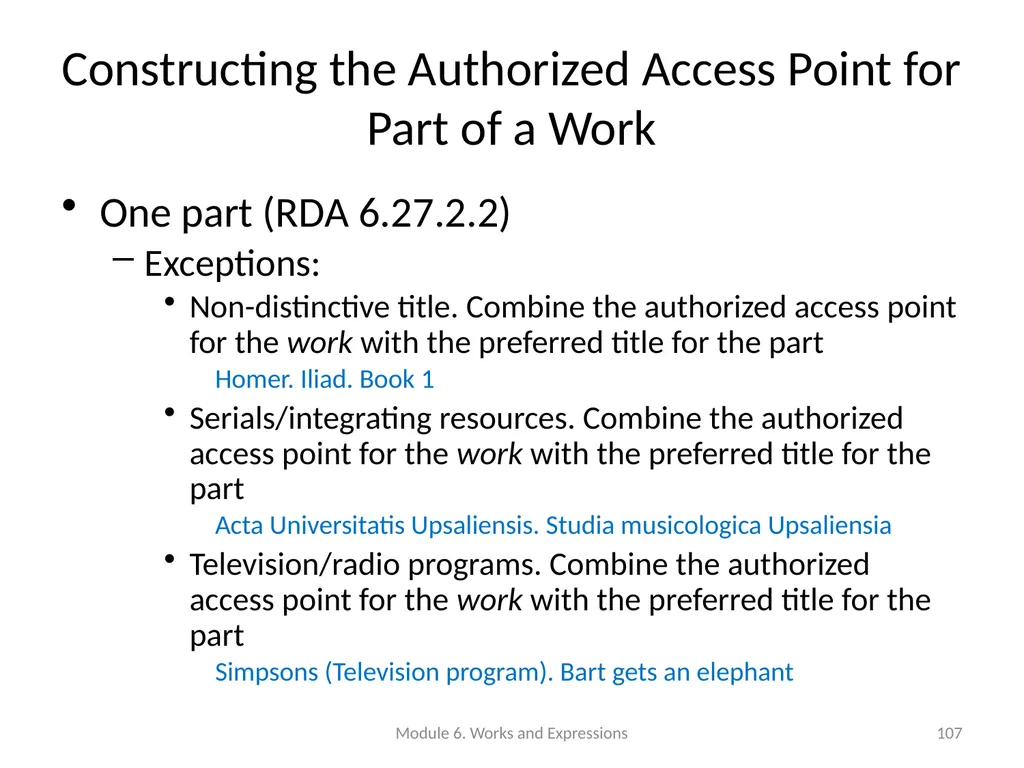
Constructing the Authorized Access Point for Part of a Work One part (RDA 6.27.2.2)
Exceptions:
Non-distinctive title. Combine the authorized access point for the work with the preferred title for the part
Homer. Iliad. Book 1
Serials/integrating resources. Combine the authorized access point for the work with the preferred title for the part
Acta Universitatis Upsaliensis. Studia musicologica Upsaliensia
Television/radio programs. Combine the authorized access point for the work with the preferred title for the part
Simpsons (Television program). Bart gets an elephant Module 6. Works and Expressions 107<br>
Exceptions:
Non-distinctive title. Combine the authorized access point for the work with the preferred title for the part
Homer. Iliad. Book 1
Serials/integrating resources. Combine the authorized access point for the work with the preferred title for the part
Acta Universitatis Upsaliensis. Studia musicologica Upsaliensia
Television/radio programs. Combine the authorized access point for the work with the preferred title for the part
Simpsons (Television program). Bart gets an elephant Module 6. Works and Expressions 107<br>
108
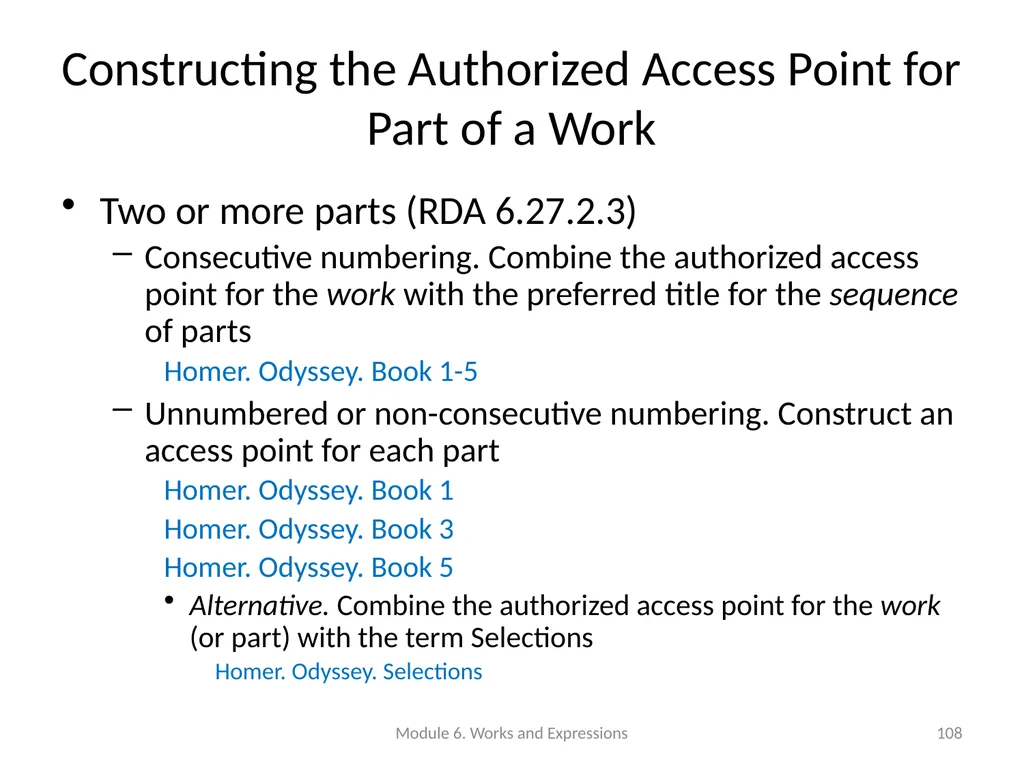
Constructing the Authorized Access Point for Part of a Work Two or more parts (RDA 6.27.2.3)
Consecutive numbering. Combine the authorized access point for the work with the preferred title for the sequence of parts
Homer. Odyssey. Book 1-5
Unnumbered or non-consecutive numbering. Construct an access point for each part
Homer. Odyssey. Book 1
Homer. Odyssey. Book 3
Homer. Odyssey. Book 5
Alternative. Combine the authorized access point for the work (or part) with the term Selections
Homer. Odyssey. Selections Module 6. Works and Expressions 108<br>
Consecutive numbering. Combine the authorized access point for the work with the preferred title for the sequence of parts
Homer. Odyssey. Book 1-5
Unnumbered or non-consecutive numbering. Construct an access point for each part
Homer. Odyssey. Book 1
Homer. Odyssey. Book 3
Homer. Odyssey. Book 5
Alternative. Combine the authorized access point for the work (or part) with the term Selections
Homer. Odyssey. Selections Module 6. Works and Expressions 108<br>
109
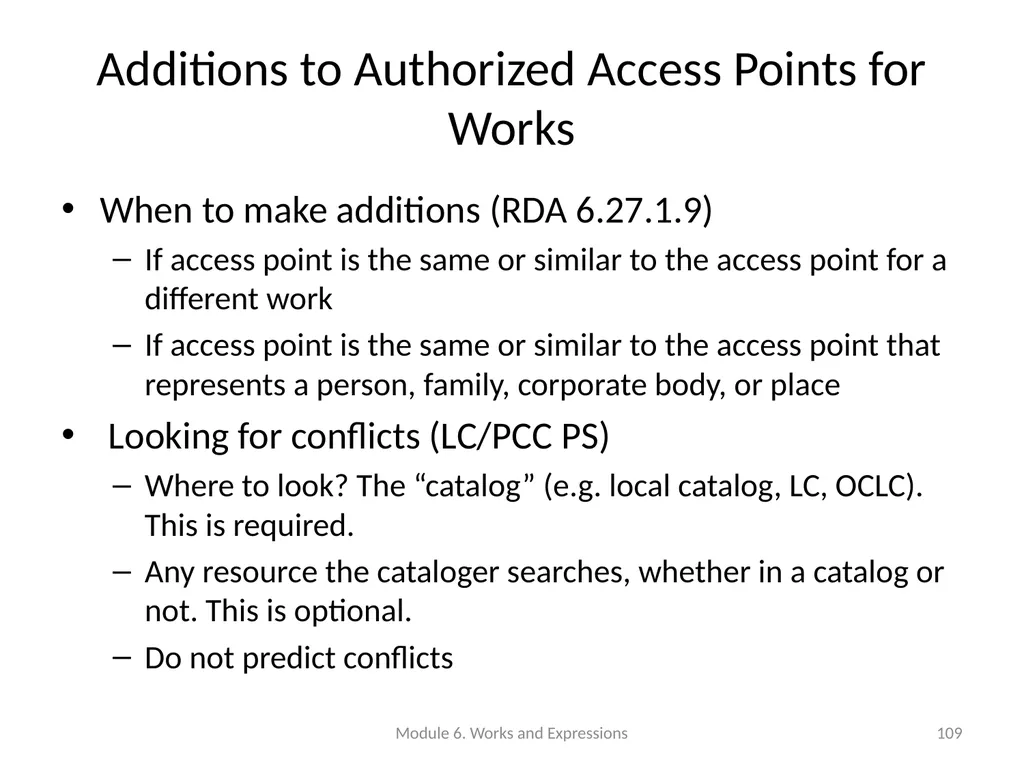
Additions to Authorized Access Points for Works When to make additions (RDA 6.27.1.9)
If access point is the same or similar to the access point for a different work
If access point is the same or similar to the access point that represents a person, family, corporate body, or place
Looking for conflicts (LC/PCC PS)
Where to look? The “catalog” (e.g. local catalog, LC, OCLC). This is required.
Any resource the cataloger searches, whether in a catalog or not. This is optional.
Do not predict conflicts Module 6. Works and Expressions 109<br>
If access point is the same or similar to the access point for a different work
If access point is the same or similar to the access point that represents a person, family, corporate body, or place
Looking for conflicts (LC/PCC PS)
Where to look? The “catalog” (e.g. local catalog, LC, OCLC). This is required.
Any resource the cataloger searches, whether in a catalog or not. This is optional.
Do not predict conflicts Module 6. Works and Expressions 109<br>
110
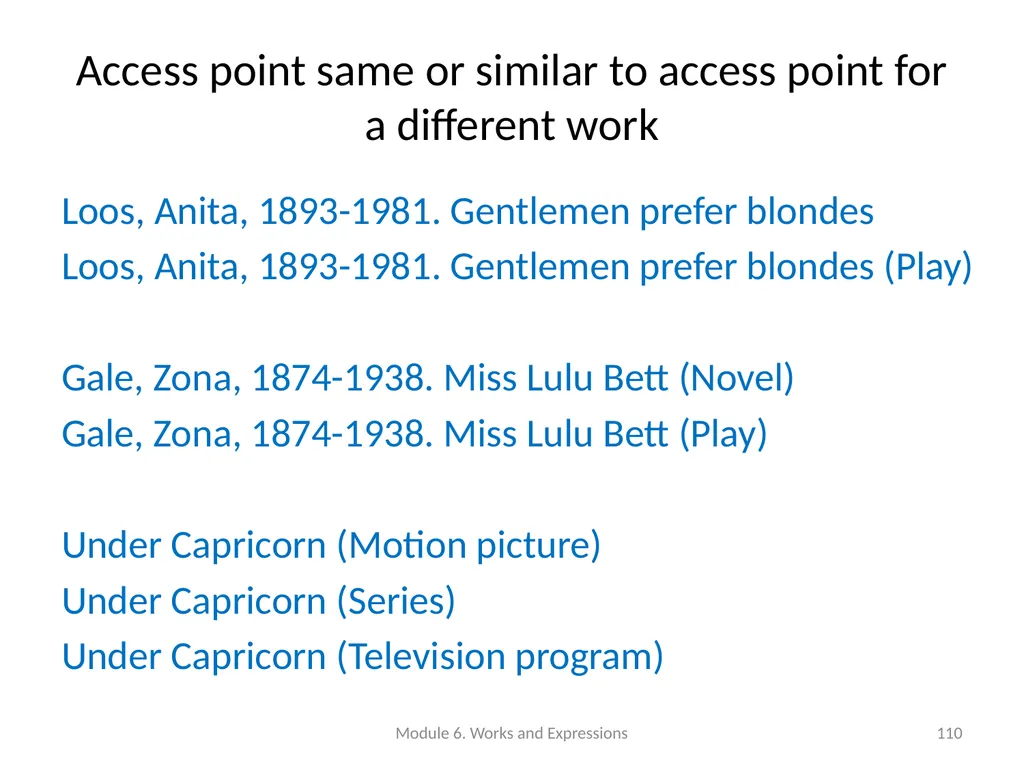
Access point same or similar to access point for a different work Loos, Anita, 1893-1981. Gentlemen prefer blondes
Loos, Anita, 1893-1981. Gentlemen prefer blondes (Play)
Gale, Zona, 1874-1938. Miss Lulu Bett (Novel)
Gale, Zona, 1874-1938. Miss Lulu Bett (Play)
Under Capricorn (Motion picture)
Under Capricorn (Series)
Under Capricorn (Television program) Module 6. Works and Expressions 110<br>
Loos, Anita, 1893-1981. Gentlemen prefer blondes (Play)
Gale, Zona, 1874-1938. Miss Lulu Bett (Novel)
Gale, Zona, 1874-1938. Miss Lulu Bett (Play)
Under Capricorn (Motion picture)
Under Capricorn (Series)
Under Capricorn (Television program) Module 6. Works and Expressions 110<br>
111
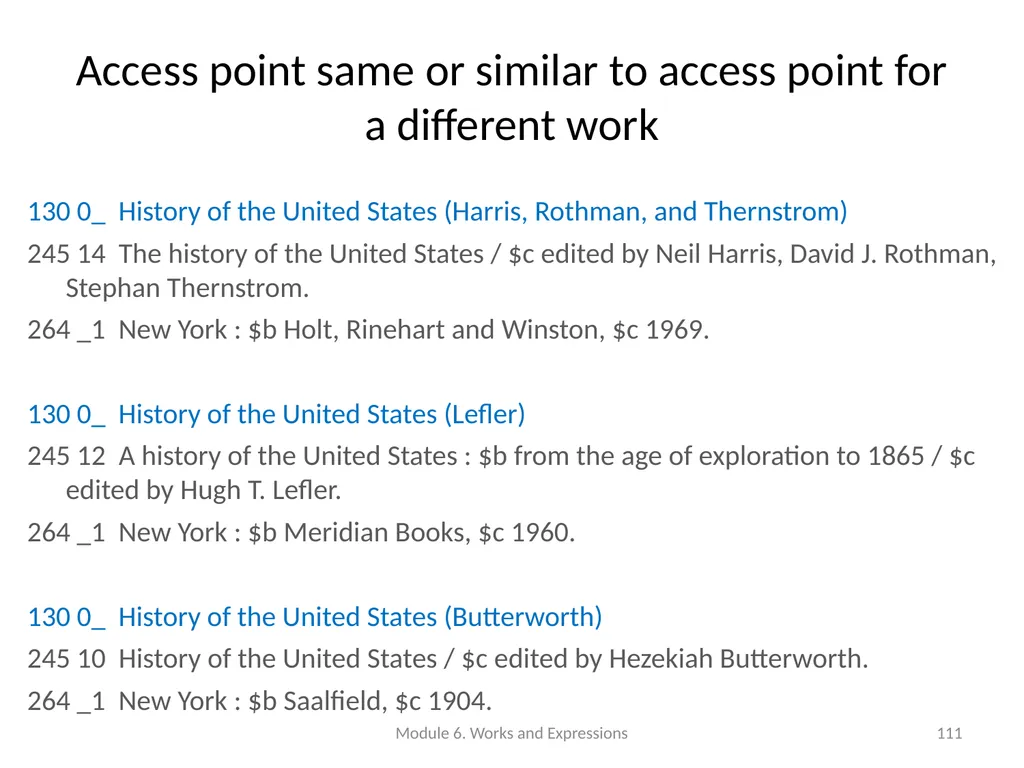
Access point same or similar to access point for a different work 130 0_ History of the United States (Harris, Rothman, and Thernstrom)
245 14 The history of the United States / $c edited by Neil Harris, David J. Rothman, Stephan Thernstrom.
264 _1 New York : $b Holt, Rinehart and Winston, $c 1969.
130 0_ History of the United States (Lefler)
245 12 A history of the United States : $b from the age of exploration to 1865 / $c edited by Hugh T. Lefler.
264 _1 New York : $b Meridian Books, $c 1960.
130 0_ History of the United States (Butterworth)
245 10 History of the United States / $c edited by Hezekiah Butterworth.
264 _1 New York : $b Saalfield, $c 1904. Module 6. Works and Expressions 111<br>
245 14 The history of the United States / $c edited by Neil Harris, David J. Rothman, Stephan Thernstrom.
264 _1 New York : $b Holt, Rinehart and Winston, $c 1969.
130 0_ History of the United States (Lefler)
245 12 A history of the United States : $b from the age of exploration to 1865 / $c edited by Hugh T. Lefler.
264 _1 New York : $b Meridian Books, $c 1960.
130 0_ History of the United States (Butterworth)
245 10 History of the United States / $c edited by Hezekiah Butterworth.
264 _1 New York : $b Saalfield, $c 1904. Module 6. Works and Expressions 111<br>
112
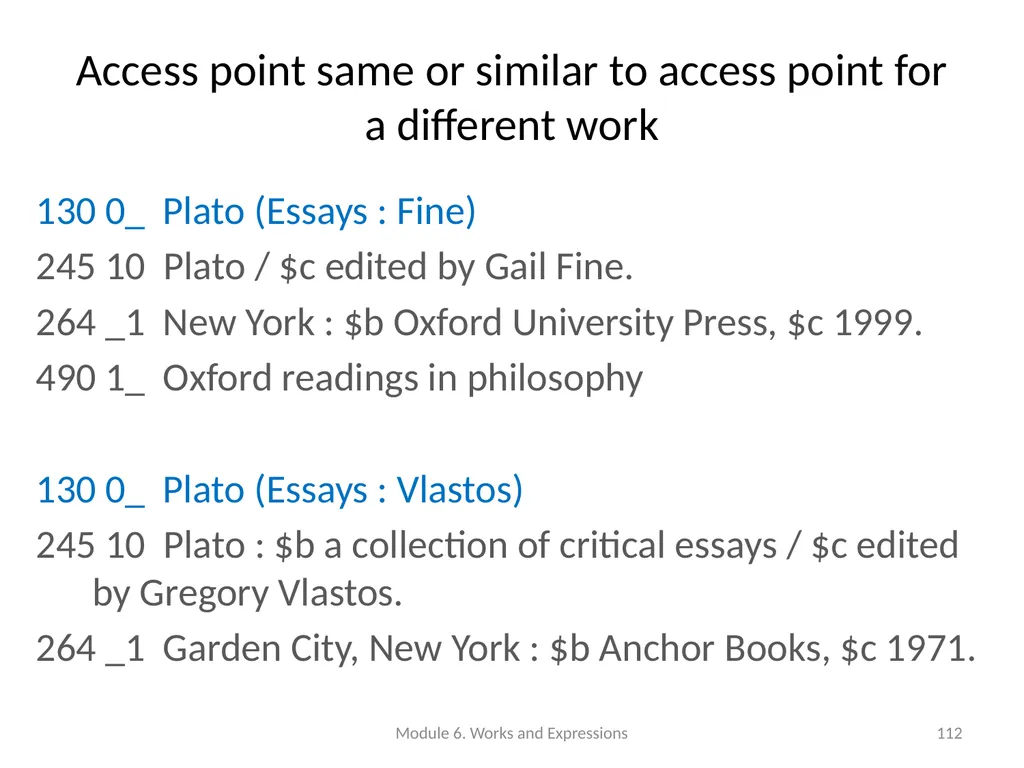
Access point same or similar to access point for a different work 130 0_ Plato (Essays : Fine)
245 10 Plato / $c edited by Gail Fine.
264 _1 New York : $b Oxford University Press, $c 1999.
490 1_ Oxford readings in philosophy
130 0_ Plato (Essays : Vlastos)
245 10 Plato : $b a collection of critical essays / $c edited by Gregory Vlastos.
264 _1 Garden City, New York : $b Anchor Books, $c 1971. Module 6. Works and Expressions 112<br>
245 10 Plato / $c edited by Gail Fine.
264 _1 New York : $b Oxford University Press, $c 1999.
490 1_ Oxford readings in philosophy
130 0_ Plato (Essays : Vlastos)
245 10 Plato : $b a collection of critical essays / $c edited by Gregory Vlastos.
264 _1 Garden City, New York : $b Anchor Books, $c 1971. Module 6. Works and Expressions 112<br>
113
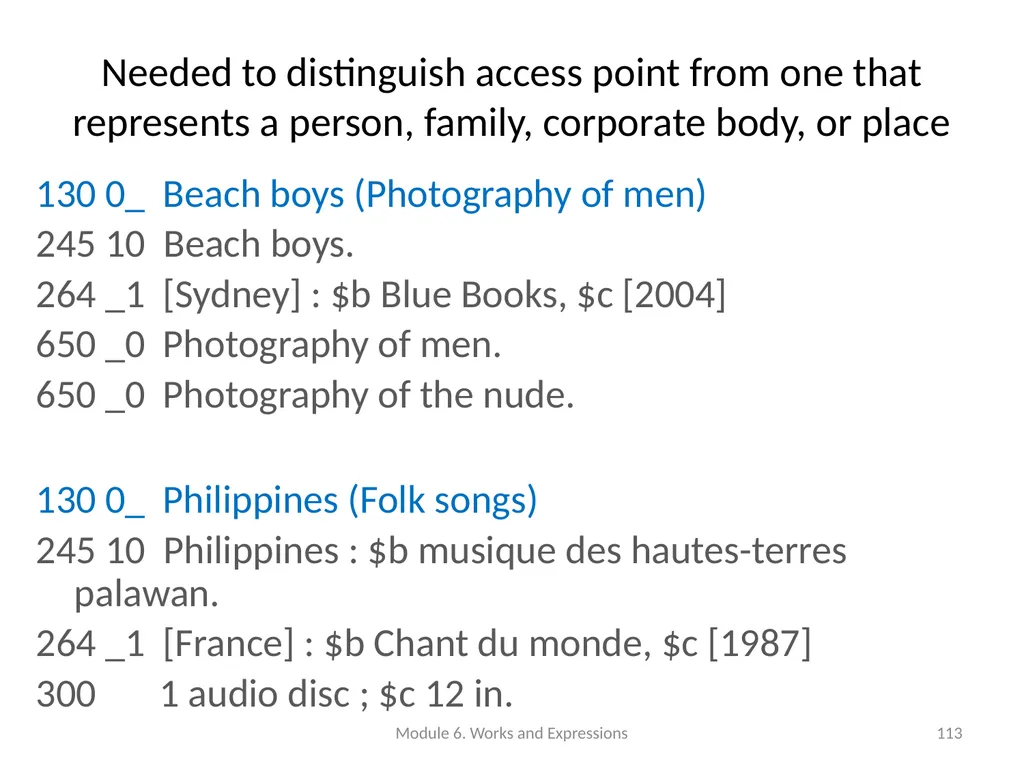
Needed to distinguish access point from one that represents a person, family, corporate body, or place 130 0_ Beach boys (Photography of men)
245 10 Beach boys.
264 _1 [Sydney] : $b Blue Books, $c [2004]
650 _0 Photography of men.
650 _0 Photography of the nude.
130 0_ Philippines (Folk songs)
245 10 Philippines : $b musique des hautes-terres palawan.
264 _1 [France] : $b Chant du monde, $c [1987]
300 1 audio disc ; $c 12 in. Module 6. Works and Expressions 113<br>
245 10 Beach boys.
264 _1 [Sydney] : $b Blue Books, $c [2004]
650 _0 Photography of men.
650 _0 Photography of the nude.
130 0_ Philippines (Folk songs)
245 10 Philippines : $b musique des hautes-terres palawan.
264 _1 [France] : $b Chant du monde, $c [1987]
300 1 audio disc ; $c 12 in. Module 6. Works and Expressions 113<br>
114
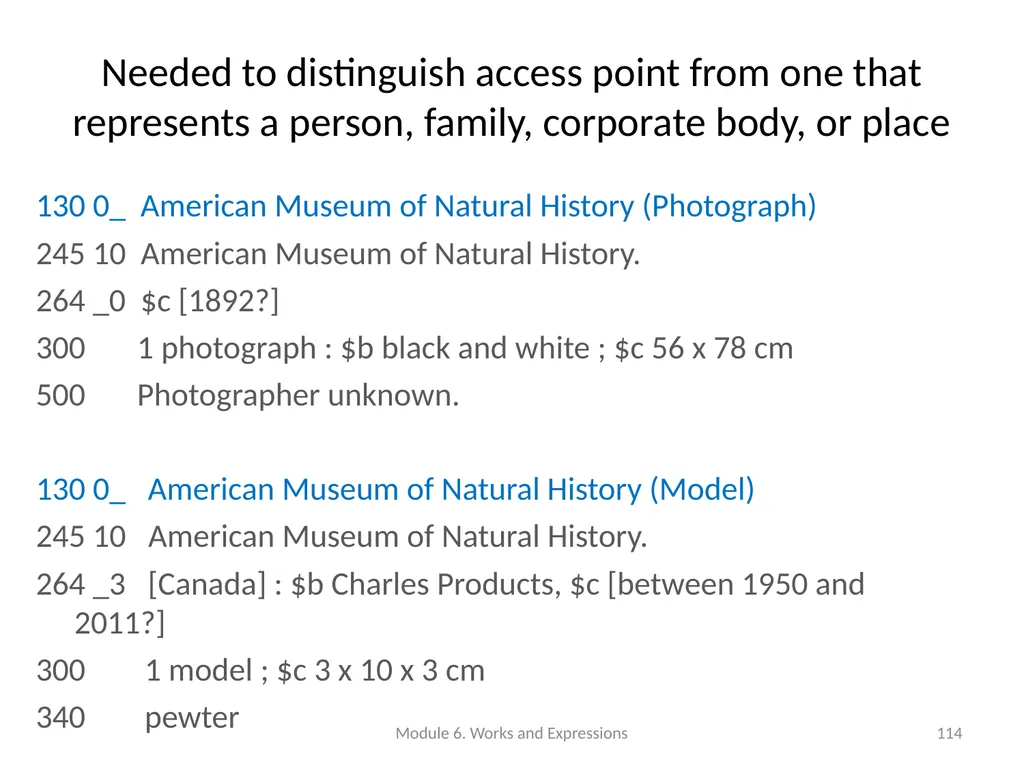
Needed to distinguish access point from one that represents a person, family, corporate body, or place 130 0_ American Museum of Natural History (Photograph)
245 10 American Museum of Natural History.
264 _0 $c [1892?]
300 1 photograph : $b black and white ; $c 56 x 78 cm
500 Photographer unknown.
130 0_ American Museum of Natural History (Model)
245 10 American Museum of Natural History.
264 _3 [Canada] : $b Charles Products, $c [between 1950 and 2011?]
300 1 model ; $c 3 x 10 x 3 cm
340 pewter Module 6. Works and Expressions 114<br>
245 10 American Museum of Natural History.
264 _0 $c [1892?]
300 1 photograph : $b black and white ; $c 56 x 78 cm
500 Photographer unknown.
130 0_ American Museum of Natural History (Model)
245 10 American Museum of Natural History.
264 _3 [Canada] : $b Charles Products, $c [between 1950 and 2011?]
300 1 model ; $c 3 x 10 x 3 cm
340 pewter Module 6. Works and Expressions 114<br>
115
Additions to Authorized Access Points for Works Other considerations (LC/PCC PS)
Resolve conflicts by adding qualifier to the new authorized access point, not the old one (with some exceptions)
Use an authorized access point to represent a resource when it is referred to in other authorized access point, or related to another resource by a note
For reproductions, use the authorized access point of the original (because it’s the same work/expression) Module 6. Works and Expressions 115<br>
Resolve conflicts by adding qualifier to the new authorized access point, not the old one (with some exceptions)
Use an authorized access point to represent a resource when it is referred to in other authorized access point, or related to another resource by a note
For reproductions, use the authorized access point of the original (because it’s the same work/expression) Module 6. Works and Expressions 115<br>
116
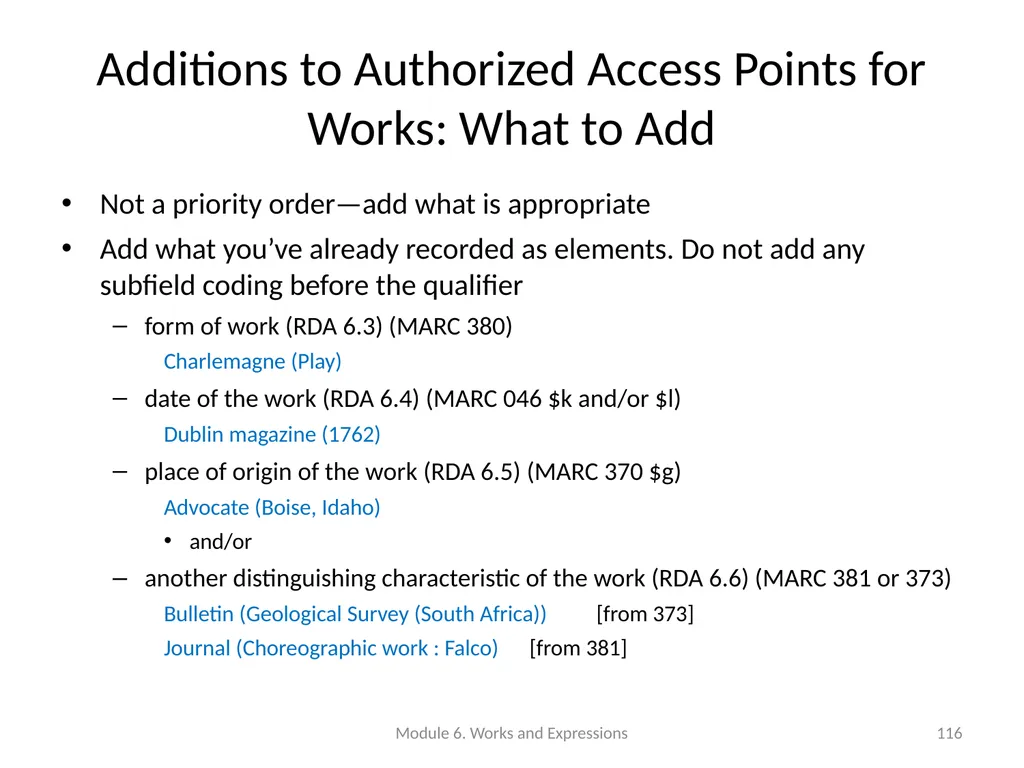
Additions to Authorized Access Points for Works: What to Add Not a priority order—add what is appropriate
Add what you’ve already recorded as elements. Do not add any subfield coding before the qualifier
form of work (RDA 6.3) (MARC 380)
Charlemagne (Play)
date of the work (RDA 6.4) (MARC 046 $k and/or $l)
Dublin magazine (1762)
place of origin of the work (RDA 6.5) (MARC 370 $g)
Advocate (Boise, Idaho)
and/or
another distinguishing characteristic of the work (RDA 6.6) (MARC 381 or 373)
Bulletin (Geological Survey (South Africa)) [from 373]
Journal (Choreographic work : Falco) [from 381] Module 6. Works and Expressions 116<br>
Add what you’ve already recorded as elements. Do not add any subfield coding before the qualifier
form of work (RDA 6.3) (MARC 380)
Charlemagne (Play)
date of the work (RDA 6.4) (MARC 046 $k and/or $l)
Dublin magazine (1762)
place of origin of the work (RDA 6.5) (MARC 370 $g)
Advocate (Boise, Idaho)
and/or
another distinguishing characteristic of the work (RDA 6.6) (MARC 381 or 373)
Bulletin (Geological Survey (South Africa)) [from 373]
Journal (Choreographic work : Falco) [from 381] Module 6. Works and Expressions 116<br>
117
Additions to Authorized Access Points for Works 100 1_ Keyes, Daniel. $t Flowers for Algernon
100 1_ Keyes, Daniel. $t Flowers for Algernon (Short story)
100 1_ Card, Orson Scott. $t Ender’s game
100 1_ Card, Orson Scott. $t Ender’s game (Graphic novel) Module 6. Works and Expressions 117<br>
100 1_ Keyes, Daniel. $t Flowers for Algernon (Short story)
100 1_ Card, Orson Scott. $t Ender’s game
100 1_ Card, Orson Scott. $t Ender’s game (Graphic novel) Module 6. Works and Expressions 117<br>
118
Additions to Authorized Access Points for Works: Conventional Collective Titles Reminder: the term work is read, in RDA, to include aggregates (collections) and components (parts) of works as well as individual works (RDA 5.1.2)
Therefore the provisions for additions to authorized access points for works (RDA 6.27.1.9) apply to aggregates and components as well as individual works
Because the preferred title of such collections is often a conventional collective title, there will frequently be conflict Module 6. Works and Expressions 118<br>
Therefore the provisions for additions to authorized access points for works (RDA 6.27.1.9) apply to aggregates and components as well as individual works
Because the preferred title of such collections is often a conventional collective title, there will frequently be conflict Module 6. Works and Expressions 118<br>
119
Additions to Authorized Access Points for Works: Conventional Collective Titles Different collections or selections of parts are different aggregate works Module 6. Works and Expressions 119<br>
120
Additions to Authorized Access Points for Works: Conventional Collective Titles Each of these short story collections is a different aggregate work: they contain different stories, in different arrangements Module 6. Works and Expressions 120<br>
121
Additions to Authorized Access Points for Works: Conventional Collective Titles The conventional collective title for collections such as these is “Short stories” (RDA 6.2.2.10.2)
Because none of these collections contains all Dickens’ short stories we add “Selections” (RDA 6.2.2.10.2)
The preferred title is: Short stories. Selections Module 6. Works and Expressions 121<br>
Because none of these collections contains all Dickens’ short stories we add “Selections” (RDA 6.2.2.10.2)
The preferred title is: Short stories. Selections Module 6. Works and Expressions 121<br>
122
Additions to Authorized Access Points for Works: Conventional Collective Titles The preferred title is: Short stories. Selections
Remember, these are three separate works
The access point for each begins
Dickens, Charles, 1812-1870. Short stories. Selections
RDA 6.27.1.9 says to add something to the access point for a work that is the same or similar to that of another work Module 6. Works and Expressions 122<br>
Remember, these are three separate works
The access point for each begins
Dickens, Charles, 1812-1870. Short stories. Selections
RDA 6.27.1.9 says to add something to the access point for a work that is the same or similar to that of another work Module 6. Works and Expressions 122<br>
123
Additions to Authorized Access Points for Works: Conventional Collective Titles We could use form, date, place of origin, or something else to distinguish
Possibilities: Other distinguishing characteristic (title of the collection)
Dickens, Charles, 1812-1870. Short stories. Selections (Selected short stories)
Dickens, Charles, 1812-1870. Short stories. Selections (Supernatural short stories of Charles Dickens)
Dickens, Charles, 1812-1870. Short stories. Selections (Christmas stories) Module 6. Works and Expressions 123<br>
Possibilities: Other distinguishing characteristic (title of the collection)
Dickens, Charles, 1812-1870. Short stories. Selections (Selected short stories)
Dickens, Charles, 1812-1870. Short stories. Selections (Supernatural short stories of Charles Dickens)
Dickens, Charles, 1812-1870. Short stories. Selections (Christmas stories) Module 6. Works and Expressions 123<br>
124
Additions to Authorized Access Points for Works: Conventional Collective Titles We could use form, date, place of origin, or something else to distinguish
Possibilities: Other distinguishing characteristic (compiler of the collection)
Dickens, Charles, 1812-1870. Short stories. Selections (Thomas)
Dickens, Charles, 1812-1870. Short stories. Selections (Hayes)
Dickens, Charles, 1812-1870. Short stories. Selections (University Society) Module 6. Works and Expressions 124<br>
Possibilities: Other distinguishing characteristic (compiler of the collection)
Dickens, Charles, 1812-1870. Short stories. Selections (Thomas)
Dickens, Charles, 1812-1870. Short stories. Selections (Hayes)
Dickens, Charles, 1812-1870. Short stories. Selections (University Society) Module 6. Works and Expressions 124<br>
125
Additions to Authorized Access Points for Works: Conventional Collective Titles We could use form, date, place of origin, or something else to distinguish
Possibilities: Date of the work
Dickens, Charles, 1812-1870. Short stories. Selections. 1976
Dickens, Charles, 1812-1870. Short stories. Selections. 2010
Dickens, Charles, 1812-1870. Short stories. Selections. 1908 Module 6. Works and Expressions 125<br>
Possibilities: Date of the work
Dickens, Charles, 1812-1870. Short stories. Selections. 1976
Dickens, Charles, 1812-1870. Short stories. Selections. 2010
Dickens, Charles, 1812-1870. Short stories. Selections. 1908 Module 6. Works and Expressions 125<br>
126
Additions to Authorized Access Points for Works: Conventional Collective Titles The AACR2 headings for such collections may not be appropriate for use in RDA because they usually represented more than one work
If authorized access points are needed in RDA, they should be established on separate records Module 6. Works and Expressions 126<br>
If authorized access points are needed in RDA, they should be established on separate records Module 6. Works and Expressions 126<br>
127
Additions to Authorized Access Points for Works: Conventional Collective Titles This AACR2 heading cannot be used as an RDA authorized access point because it represents different aggregate works Module 6. Works and Expressions 127<br>
128
Additions to Authorized Access Points for Works: Conventional Collective Titles “Works”
Conventional collective title for a compilation that purports to be the complete works of a person, family, or corporate body
Different compilations are treated as different aggregate works
If a creator’s works have been compiled more than once, the access point usually needs an addition under RDA 6.27.1.9 to distinguish between the aggregate works Module 6. Works and Expressions 128<br>
Conventional collective title for a compilation that purports to be the complete works of a person, family, or corporate body
Different compilations are treated as different aggregate works
If a creator’s works have been compiled more than once, the access point usually needs an addition under RDA 6.27.1.9 to distinguish between the aggregate works Module 6. Works and Expressions 128<br>
129
Additions to Authorized Access Points for Works: Conventional Collective Titles “Works”
The pre-RDA NACO practice was always to add the date of publication to the conventional collective title “Works”
This is not required under RDA
Addition only necessary if the preferred title “Works” would conflict (i.e. if the creator’s works have been compiled more than once)
Addition should be what makes most sense to distinguish, not necessarily the date of publication Module 6. Works and Expressions 129<br>
The pre-RDA NACO practice was always to add the date of publication to the conventional collective title “Works”
This is not required under RDA
Addition only necessary if the preferred title “Works” would conflict (i.e. if the creator’s works have been compiled more than once)
Addition should be what makes most sense to distinguish, not necessarily the date of publication Module 6. Works and Expressions 129<br>
130
Additions to Authorized Access Points for Works: Conventional Collective Titles Three different aggregate works Module 6. Works and Expressions 130<br>
131
Additions to Authorized Access Points for Works: Conventional Collective Titles All three will have the same preferred title: Works
How can they be differentiated?
Form of work?
Date of work?
Place of origin of work?
Other characteristic? Module 6. Works and Expressions 131<br>
How can they be differentiated?
Form of work?
Date of work?
Place of origin of work?
Other characteristic? Module 6. Works and Expressions 131<br>
132
Additions to Authorized Access Points for Works: Conventional Collective Titles Possible RDA authorized access points
Paine, Thomas, 1737-1809. Works (Blanchard)
Paine, Thomas, 1737-1809. Works (Belford, Clarke & Co.)
Paine, Thomas, 1737-1809. Works. 1880
Paine, Thomas, 1737-1809. Works (Complete works of Thomas Paine containing all the political and theological writings)
Paine, Thomas, 1737-1809. Works (Chicago, Ill.) Module 6. Works and Expressions 132<br>
Paine, Thomas, 1737-1809. Works (Blanchard)
Paine, Thomas, 1737-1809. Works (Belford, Clarke & Co.)
Paine, Thomas, 1737-1809. Works. 1880
Paine, Thomas, 1737-1809. Works (Complete works of Thomas Paine containing all the political and theological writings)
Paine, Thomas, 1737-1809. Works (Chicago, Ill.) Module 6. Works and Expressions 132<br>
133
Additions to Authorized Access Points for Works: Conventional Collective Titles Possible RDA authorized access points
Paine, Thomas, 1737-1809. Works (D.M. Bennett)
Paine, Thomas, 1737-1809. Works. 1878
Paine, Thomas, 1737-1809. Works (New York, N.Y.)
Paine, Thomas, 1737-1809. Works (The great works of Thomas Paine, complete) Module 6. Works and Expressions 133<br>
Paine, Thomas, 1737-1809. Works (D.M. Bennett)
Paine, Thomas, 1737-1809. Works. 1878
Paine, Thomas, 1737-1809. Works (New York, N.Y.)
Paine, Thomas, 1737-1809. Works (The great works of Thomas Paine, complete) Module 6. Works and Expressions 133<br>
134
Additions to Authorized Access Points for Works: Conventional Collective Titles Possible RDA authorized access points
Paine, Thomas, 1737-1809. Works (Carey)
Paine, Thomas, 1737-1809. Works (Philadelphia, Pa.)
Paine, Thomas, 1737-1809. Works. 1797
Paine, Thomas, 1737-1809. Works (The works of Thomas Paine, Secretary for Foreign Affairs) Module 6. Works and Expressions 134<br>
Paine, Thomas, 1737-1809. Works (Carey)
Paine, Thomas, 1737-1809. Works (Philadelphia, Pa.)
Paine, Thomas, 1737-1809. Works. 1797
Paine, Thomas, 1737-1809. Works (The works of Thomas Paine, Secretary for Foreign Affairs) Module 6. Works and Expressions 134<br>
135
Additions to Authorized Access Points for Works: Conventional Collective Titles Problem: Because NACO conventions were different previous to RDA, more than one AACR2 heading may be found for the same aggregate work. These should be consolidated for use in RDA.
Shakespeare, William, 1564-1616. Works. 1974
Shakespeare, William, 1564-1616. Works. 1997
These were used for two different manifestations of the aggregate work called The Riverside Shakespeare, published in different years. Only one authorized access point is appropriate in RDA. Module 6. Works and Expressions 135<br>
Shakespeare, William, 1564-1616. Works. 1974
Shakespeare, William, 1564-1616. Works. 1997
These were used for two different manifestations of the aggregate work called The Riverside Shakespeare, published in different years. Only one authorized access point is appropriate in RDA. Module 6. Works and Expressions 135<br>
136
Additions to Authorized Access Points for Works: Conventional Collective Titles Possible RDA authorized access points:
Shakespeare, William, 1564-1616. Works. 1974
[differentiate by date the aggregate work was first published]
Shakespeare, William, 1564-1616. Works (The Riverside Shakespeare)
[differentiate by title by which the aggregate work is known]
Shakespeare, William, 1564-1616. Works (Evans)
[differentiate by the chief editor/compiler, G. Blakemore Evans] Module 6. Works and Expressions 136<br>
Shakespeare, William, 1564-1616. Works. 1974
[differentiate by date the aggregate work was first published]
Shakespeare, William, 1564-1616. Works (The Riverside Shakespeare)
[differentiate by title by which the aggregate work is known]
Shakespeare, William, 1564-1616. Works (Evans)
[differentiate by the chief editor/compiler, G. Blakemore Evans] Module 6. Works and Expressions 136<br>
137
Additions to Authorized Access Points for Works: Conventional Collective Titles Additional problem: Because NACO conventions were different previous to RDA, one AACR2 heading may be found that represents different aggregate works. These should be split for use in RDA.
Shakespeare, William, 1564-1616. Works. 1997
In addition to The Riverside Shakespeare, this heading was used for at least three other compilations, all published in 1997. These need to be differentiated because they are separate aggregate works. Module 6. Works and Expressions 137<br>
Shakespeare, William, 1564-1616. Works. 1997
In addition to The Riverside Shakespeare, this heading was used for at least three other compilations, all published in 1997. These need to be differentiated because they are separate aggregate works. Module 6. Works and Expressions 137<br>
138
Additions to Authorized Access Points for Works: Conventional Collective Titles Module 6. Works and Expressions 138<br>
139
Additions to Authorized Access Points for Works: Conventional Collective Titles Possible RDA authorized access points for one of these:
Shakespeare, William, 1564-1616. Works (The Norton Shakespeare)
[differentiate by title by which the aggregate work is known]
Shakespeare, William, 1564-1616. Works (Greenblatt)
[differentiate by the chief editor/compiler, Stephen Greenblatt]
Shakespeare, William, 1564-1616. Works. 1997
[differentiate by date the aggregate work was first published—unless this access point has already been used by one of the others. This is probably the least useful since it does not differentiate from others published the same year] Module 6. Works and Expressions 139<br>
Shakespeare, William, 1564-1616. Works (The Norton Shakespeare)
[differentiate by title by which the aggregate work is known]
Shakespeare, William, 1564-1616. Works (Greenblatt)
[differentiate by the chief editor/compiler, Stephen Greenblatt]
Shakespeare, William, 1564-1616. Works. 1997
[differentiate by date the aggregate work was first published—unless this access point has already been used by one of the others. This is probably the least useful since it does not differentiate from others published the same year] Module 6. Works and Expressions 139<br>
140
Authorized Access Point for a Work (MARC) 100 1_ Carter, Jimmy, $d 1924- $t Living faith
100 1_ Smith, Joseph, $c Jr., $d 1805-1844. $t King Follett discourse
110 2_ Banco de Bilbao. $t Informe y memoria
130 _0 Beowulf
130 _0 Primary colors
130 _0 Planet of the apes (Motion picture : 1968)
130 _0 Encyclopaedia Britannica
130 _0 Bible. $p Genesis
130 _0 Bible. $p New Testament
130 _0 NuTCRACKER (Computer file) Module 6. Works and Expressions 140<br>
100 1_ Smith, Joseph, $c Jr., $d 1805-1844. $t King Follett discourse
110 2_ Banco de Bilbao. $t Informe y memoria
130 _0 Beowulf
130 _0 Primary colors
130 _0 Planet of the apes (Motion picture : 1968)
130 _0 Encyclopaedia Britannica
130 _0 Bible. $p Genesis
130 _0 Bible. $p New Testament
130 _0 NuTCRACKER (Computer file) Module 6. Works and Expressions 140<br>
141
Variant Access Points for a Work
(RDA 6.27.4) Variant access points are not core. Include them if in your judgment they would help the user find or identify the work.
Begin with a variant title (RDA 6.2.3)
Record in appropriate 4XX fields
Construct the variant access point by combining the authorized access point for the creator with the variant title or by giving the variant title alone
Make further additions to the access point if you consider them to be important for identification in the same way such additions would have been added to a preferred title. These additions are not required. Module 6. Works and Expressions 141<br>
Begin with a variant title (RDA 6.2.3)
Record in appropriate 4XX fields
Construct the variant access point by combining the authorized access point for the creator with the variant title or by giving the variant title alone
Make further additions to the access point if you consider them to be important for identification in the same way such additions would have been added to a preferred title. These additions are not required. Module 6. Works and Expressions 141<br>
142
Exercises Complete worksheet or OCLC workform descriptions of the works Iliad and Piedra de sol
Create authority records for works that workshop participants have brought Module 6. Works and Expressions 142<br>
Create authority records for works that workshop participants have brought Module 6. Works and Expressions 142<br>
143
Constructing the Authorized Access Point for an Expression (RDA 6.27.3) The authorized access point for an expression always begins with the authorized access point for the work. Record it in 1XX exactly as it was recorded in the description of the work. Module 6. Works and Expressions 143<br>
144
Constructing the Authorized Access Point for an Expression (RDA 6.27.3) Exercise: Begin to create the authorized access point for the three expressions we’re working on by recording the authorized access point for each one’s work. Module 6. Works and Expressions 144<br>
145
Constructing the Authorized Access Point for an Expression (RDA 6.27.3) RDA 6.27.3 says to add at least one other element
Other elements beyond the first may be added as needed to distinguish the expression from others. These may already have been recorded in the record as elements
Content type (RDA 6.9)
Date (RDA 6.10)
Language (RDA 6.11)
Other distinguishing characteristic (RDA 6.12)
Cataloger’s judgment about which element(s) to add. What best distinguishes between the expressions? Module 6. Works and Expressions 145<br>
Other elements beyond the first may be added as needed to distinguish the expression from others. These may already have been recorded in the record as elements
Content type (RDA 6.9)
Date (RDA 6.10)
Language (RDA 6.11)
Other distinguishing characteristic (RDA 6.12)
Cataloger’s judgment about which element(s) to add. What best distinguishes between the expressions? Module 6. Works and Expressions 145<br>
146
Constructing the Authorized Access Point for an Expression (RDA 6.27.3) Translations
Always begin by adding the language in subfield $l
Reminder: LC practice stops there, even though there may be more than one expression in the language
There are two English-language expressions of Piedra de sol
There are scores of English-language expressions of The Iliad
If your library chooses to differentiate between these expressions, add another element following the language element.
Content type – precede by period and subfield $h [note: not currently validating in OCLC]
Date of expression – precede by period and subfield $f
Other distinguishing characteristic – enclose in parentheses and precede by subfield $s
Other possible combinations and orders Module 6. Works and Expressions 146<br>
Always begin by adding the language in subfield $l
Reminder: LC practice stops there, even though there may be more than one expression in the language
There are two English-language expressions of Piedra de sol
There are scores of English-language expressions of The Iliad
If your library chooses to differentiate between these expressions, add another element following the language element.
Content type – precede by period and subfield $h [note: not currently validating in OCLC]
Date of expression – precede by period and subfield $f
Other distinguishing characteristic – enclose in parentheses and precede by subfield $s
Other possible combinations and orders Module 6. Works and Expressions 146<br>
147
Constructing the Authorized Access Point for an Expression (RDA 6.27.3) For this exercise, assume our library does distinguish between expressions in the same language
Let’s start by adding language to the access points for each expression to see if that’s enough to distinguish them from other expressions of the work.
Is it? If not, we can add something more.
Possible answers (expression additions in red):
100 1_ Paz, Octavio, $d 1914-1998. $t Piedra de sol. $l English $s (Rukeyser)
100 0_ Homer. $t Iliad. $l English $s (Mitchell)
100 0_ Homer. $t Iliad. $l English. $h Spoken word $s (Molina) Module 6. Works and Expressions 147<br>
Let’s start by adding language to the access points for each expression to see if that’s enough to distinguish them from other expressions of the work.
Is it? If not, we can add something more.
Possible answers (expression additions in red):
100 1_ Paz, Octavio, $d 1914-1998. $t Piedra de sol. $l English $s (Rukeyser)
100 0_ Homer. $t Iliad. $l English $s (Mitchell)
100 0_ Homer. $t Iliad. $l English. $h Spoken word $s (Molina) Module 6. Works and Expressions 147<br>
148
Constructing the Authorized Access Point for an Expression (RDA 6.27.3) Original language editions
Reminder: LC practice is to use the authorized access point for the work to represent any expression in the work’s original language
PCC catalogers may follow this practice, but in some cases may find it necessary to distinguish between expressions in the original language
RDA 6.27.3 says to begin with the authorized access point for the work and then add one or more elements
Content type (RDA 6.9)
Date (RDA 6.10)
Language (RDA 6.11)
Other distinguishing characteristic (RDA 6.12)
Best practices have not yet developed (stay tuned!) Module 6. Works and Expressions 148<br>
Reminder: LC practice is to use the authorized access point for the work to represent any expression in the work’s original language
PCC catalogers may follow this practice, but in some cases may find it necessary to distinguish between expressions in the original language
RDA 6.27.3 says to begin with the authorized access point for the work and then add one or more elements
Content type (RDA 6.9)
Date (RDA 6.10)
Language (RDA 6.11)
Other distinguishing characteristic (RDA 6.12)
Best practices have not yet developed (stay tuned!) Module 6. Works and Expressions 148<br>
149
Constructing the Authorized Access Point for an Expression (RDA 6.27.3) In some fields it is important to distinguish between editions in the original language. Premodern literatures are such fields.
Some possibilities:
Begin with language, add further elements as needed
100 0_ Homer. $t Iliad. $l Greek $s (Murray)
500 1_ $i Editor: $a Murray, A. T. $q (Augustus Taber), $d 1866-1940 $w r
Begin with some other element
100 1_ Langland, William, $d 1330?-1400? $t Piers Plowman $s (Z-text) Module 6. Works and Expressions 149<br>
Some possibilities:
Begin with language, add further elements as needed
100 0_ Homer. $t Iliad. $l Greek $s (Murray)
500 1_ $i Editor: $a Murray, A. T. $q (Augustus Taber), $d 1866-1940 $w r
Begin with some other element
100 1_ Langland, William, $d 1330?-1400? $t Piers Plowman $s (Z-text) Module 6. Works and Expressions 149<br>
150
Constructing the Authorized Access Point for an Expression (RDA 6.27.3) This can happen in modern language editions as well. James Joyce’s Ulysses appeared in many versions, and it may be important to your library to bring this out
Some possibilities:
Begin with language, add further elements as needed
100 1_ Joyce, James, $d 1882-1941. $t Ulysses. $l English $s (Critical and synoptic edition)
500 1_ $i Editor: $a Gabler, Hans Walter, $d 1938- $w r
500 1_ $i Editor: $a Steppe, Wolfhard $w r
500 1_ $i Editor: $a Melchior, Claus $w r
Begin with some other element
100 0_ Joyce, James, $d 1882-1941. $t Ulysses $s (Critical and synoptic edition)
500 1_ $i Editor: $a Gabler, Hans Walter, $d 1938- $w r
500 1_ $i Editor: $a Steppe, Wolfhard $w r
500 1_ $i Editor: $a Melchior, Claus $w r Module 6. Works and Expressions 150<br>
Some possibilities:
Begin with language, add further elements as needed
100 1_ Joyce, James, $d 1882-1941. $t Ulysses. $l English $s (Critical and synoptic edition)
500 1_ $i Editor: $a Gabler, Hans Walter, $d 1938- $w r
500 1_ $i Editor: $a Steppe, Wolfhard $w r
500 1_ $i Editor: $a Melchior, Claus $w r
Begin with some other element
100 0_ Joyce, James, $d 1882-1941. $t Ulysses $s (Critical and synoptic edition)
500 1_ $i Editor: $a Gabler, Hans Walter, $d 1938- $w r
500 1_ $i Editor: $a Steppe, Wolfhard $w r
500 1_ $i Editor: $a Melchior, Claus $w r Module 6. Works and Expressions 150<br>
151
Constructing the Authorized Access Point for an Expression (RDA 6.27.3) Bilingual and Polyglot resources
Never combine expressions in a single description/access point
Homer. Iliad. English & Greek Module 6. Works and Expressions 151<br>
Never combine expressions in a single description/access point
Homer. Iliad. English & Greek Module 6. Works and Expressions 151<br>
152
Constructing the Authorized Access Point for an Expression (RDA 6.27.3) Bilingual and Polyglot resources
LC practice: record authorized access point for the work and authorized access point for the language of the translation
Homer. Iliad
Homer. Iliad. English
PCC catalogers may follow LC practice or may distinguish between expressions within the same language
Homer. Iliad. Greek (Murray)
Homer. Iliad. English (Murray) Module 6. Works and Expressions 152<br>
LC practice: record authorized access point for the work and authorized access point for the language of the translation
Homer. Iliad
Homer. Iliad. English
PCC catalogers may follow LC practice or may distinguish between expressions within the same language
Homer. Iliad. Greek (Murray)
Homer. Iliad. English (Murray) Module 6. Works and Expressions 152<br>
153
Constructing a Variant Access Point for an Expression (RDA 6.27.4.5) No variant access points are core. The decision rests with the cataloger: would it help a user find the expression?
Recorded in 4XX
Two kinds of variants
Variants created by adding different expression attributes
130 _0 Blade runner (Motion picture : Final cut)
430 _0 Blade runner (Motion picture : 25th anniversary edition)
Variants based on a variant title for the work closely associated with a particular expression
100 1_ Dickens, Charles, $d 1812-1870. $t Old curiosity shop. $l Hebrew
400 1_ Dickens, Charles, $d 1812-1870. $t בית ממכר עתיקות
400 1_ Dickens, Charles, $d 1812-1870. $t Bet-mimkar-ʻatiḳot Module 6. Works and Expressions 153<br>
Recorded in 4XX
Two kinds of variants
Variants created by adding different expression attributes
130 _0 Blade runner (Motion picture : Final cut)
430 _0 Blade runner (Motion picture : 25th anniversary edition)
Variants based on a variant title for the work closely associated with a particular expression
100 1_ Dickens, Charles, $d 1812-1870. $t Old curiosity shop. $l Hebrew
400 1_ Dickens, Charles, $d 1812-1870. $t בית ממכר עתיקות
400 1_ Dickens, Charles, $d 1812-1870. $t Bet-mimkar-ʻatiḳot Module 6. Works and Expressions 153<br>
154
Constructing the Authorized Access Point for an Religious Expression (RDA 6.30.3.2) (Bible) Begin with the authorized access point for the work (Bible) or part of the work
Several mandatory expression-related additions
Language (subfield $l)
Other distinguishing characteristic, e.g. version (subfield $s)
Date of expression ($f) Module 6. Works and Expressions 154<br>
Several mandatory expression-related additions
Language (subfield $l)
Other distinguishing characteristic, e.g. version (subfield $s)
Date of expression ($f) Module 6. Works and Expressions 154<br>
155
Constructing the Authorized Access Point for an Religious Expression (RDA 6.30.3.2) (Bible) Examples
130 _0 Bible. $p Amos. $l English. $s Andersen-Freedman. $f 1989
130 _0 Bible. $p Old Testament. $l English. $s NETS. $f 2007
130 _0 Bible. $p Acts. $l Arawak. $s Shultz. $f 1850 Module 6. Works and Expressions 155<br>
130 _0 Bible. $p Amos. $l English. $s Andersen-Freedman. $f 1989
130 _0 Bible. $p Old Testament. $l English. $s NETS. $f 2007
130 _0 Bible. $p Acts. $l Arawak. $s Shultz. $f 1850 Module 6. Works and Expressions 155<br>
156
Related Works (RDA 25) Related works are recorded in 5XX fields, and may include a relationship indicator in subfield $i (from RDA Appendix J), with $w r.
130 _0 Doctor Zhivago (Motion picture : 2002)
500 1_ $i Motion picture adaptation of (work): $a Pasternak, Boris Leonidovich, $d 1890-1960. $t Doktor Zhivago $w r
130 _0 3 men and a baby (Motion picture)
530 _0 $i Remake of (work): $a Trois hommes et un couffin (Motion picture) $w r Module 6. Works and Expressions 156<br>
130 _0 Doctor Zhivago (Motion picture : 2002)
500 1_ $i Motion picture adaptation of (work): $a Pasternak, Boris Leonidovich, $d 1890-1960. $t Doktor Zhivago $w r
130 _0 3 men and a baby (Motion picture)
530 _0 $i Remake of (work): $a Trois hommes et un couffin (Motion picture) $w r Module 6. Works and Expressions 156<br>
157
Related Expressions (RDA 25) Related expressions are recorded in 5XX fields, and may include a relationship indicator in subfield $i (from RDA Appendix J), with $w r.
100 1_ Jackson, Joe, $d 1955- $t Thief at the end of the world. $l Portuguese
500 1_ $i Translation of: $a Jackson, Joe, $d 1955- $t Thief at the end of the world $w r Module 6. Works and Expressions 157<br>
100 1_ Jackson, Joe, $d 1955- $t Thief at the end of the world. $l Portuguese
500 1_ $i Translation of: $a Jackson, Joe, $d 1955- $t Thief at the end of the world $w r Module 6. Works and Expressions 157<br>
158
Related Persons, Families, or Corporate Bodies (RDA 30-32) Related persons, families, or corporate bodies are recorded in 500 or 510 fields, and may include a relationship indicator in subfield $i (from RDA Appendix I), with $w r.
100 1_ Tolstoy, Leo, $c graf, $d 1828-1910. $t Voĭna i mir. $l English $s (Pevear and Volokhonsky)
400 1_ Tolstoy, Leo, $c graf, $d 1828-1910. $t War and peace
500 1_ $i Translator: $a Pevear, Richard, $d 1943- $w r
500 1_ $i Translator: $a Volokhonsky, Larissa $w r Module 6. Works and Expressions 158<br>
100 1_ Tolstoy, Leo, $c graf, $d 1828-1910. $t Voĭna i mir. $l English $s (Pevear and Volokhonsky)
400 1_ Tolstoy, Leo, $c graf, $d 1828-1910. $t War and peace
500 1_ $i Translator: $a Pevear, Richard, $d 1943- $w r
500 1_ $i Translator: $a Volokhonsky, Larissa $w r Module 6. Works and Expressions 158<br>
159
RDA authority record core and non-core: expression record 040 UPB $b eng $e rda $c UPB
046 $k 1957
100 1_ Paz, Octavio, $d 1914-1998. $t Piedra de sol. $l English $s (Rukeyser)
336 text $2 rdacontent [not used in current PCC practice]
377 eng
381 Rukeyser
400 1 _ Paz, Octavio, $d 1914-1998. $t Sun stone
500 1_ $i Translator: $a Rukeyser, Muriel, $d 1913-1980 $w r
670 Sun stone = Piedra de sol, 1957: $b title page (translation by Muriel Rukeyser) Note: LC would use the following form for this and all English expressions of Piedra de sol, unless they are copy cataloging a record that differentiated the expression. Other catalogers may apply RDA (as above)
100 0 _ Paz, Octavio, $d 1914-1998. $t Piedra de sol. $l English Module 6. Works and Expressions 159<br>
046 $k 1957
100 1_ Paz, Octavio, $d 1914-1998. $t Piedra de sol. $l English $s (Rukeyser)
336 text $2 rdacontent [not used in current PCC practice]
377 eng
381 Rukeyser
400 1 _ Paz, Octavio, $d 1914-1998. $t Sun stone
500 1_ $i Translator: $a Rukeyser, Muriel, $d 1913-1980 $w r
670 Sun stone = Piedra de sol, 1957: $b title page (translation by Muriel Rukeyser) Note: LC would use the following form for this and all English expressions of Piedra de sol, unless they are copy cataloging a record that differentiated the expression. Other catalogers may apply RDA (as above)
100 0 _ Paz, Octavio, $d 1914-1998. $t Piedra de sol. $l English Module 6. Works and Expressions 159<br>
160
RDA authority record core and non-core: expression record 040 UPB $b eng $e rda $c UPB
046 $k 2011
100 0_ Homer. $t Iliad. $l English $s (Mitchell)
336 text $2 rdacontent [not used in current PCC practice]
377 eng
381 Mitchell
500 1_ $i Translator: $a Mitchell, Stephen, $d 1943- $w r
670 Iliad, 2011: $b title page (translated ... by Stephen Mitchell) Note: LC would use this form for this and all English expressions of the Iliad, unless they are copy cataloging a record that differentiated the expression. Other catalogers may apply RDA (as above)
100 0 _ Homer. $t Iliad. $l English Module 6. Works and Expressions 160<br>
046 $k 2011
100 0_ Homer. $t Iliad. $l English $s (Mitchell)
336 text $2 rdacontent [not used in current PCC practice]
377 eng
381 Mitchell
500 1_ $i Translator: $a Mitchell, Stephen, $d 1943- $w r
670 Iliad, 2011: $b title page (translated ... by Stephen Mitchell) Note: LC would use this form for this and all English expressions of the Iliad, unless they are copy cataloging a record that differentiated the expression. Other catalogers may apply RDA (as above)
100 0 _ Homer. $t Iliad. $l English Module 6. Works and Expressions 160<br>
161
RDA authority record core and non-core: expression record 040 UPB $b eng $e rda $c UPB
046 $k 2011
100 0_ Homer. $t Iliad. $l English. $h Spoken word $s (Molina)
336 spoken word $2 rdacontent [not used in current PCC practice]
377 eng
381 Molina
500 1_ $i Narrator: $a Molina, Alfred, $d 1953- $w r
500 1_ $i Translator: $a Mitchell, Stephen, $d 1943- $w r
670 The Iliad, 2011: $b container (translated by Stephen Mitchell ; read by Alfred Molina) Note: LC would probably use this form for this and all English expressions of the Iliad, unless they are copy cataloging a record that differentiated the expression. Other catalogers may apply RDA (as above)
100 0_ Homer. $t Iliad. $l English Module 6. Works and Expressions 161<br>
046 $k 2011
100 0_ Homer. $t Iliad. $l English. $h Spoken word $s (Molina)
336 spoken word $2 rdacontent [not used in current PCC practice]
377 eng
381 Molina
500 1_ $i Narrator: $a Molina, Alfred, $d 1953- $w r
500 1_ $i Translator: $a Mitchell, Stephen, $d 1943- $w r
670 The Iliad, 2011: $b container (translated by Stephen Mitchell ; read by Alfred Molina) Note: LC would probably use this form for this and all English expressions of the Iliad, unless they are copy cataloging a record that differentiated the expression. Other catalogers may apply RDA (as above)
100 0_ Homer. $t Iliad. $l English Module 6. Works and Expressions 161<br>
162
Exercises Update or add authority records for expressions workshop participants have brought Module 6. Works and Expressions 162<br>
163
Questions? Module 6
Describing works and expressions Module 6. Works and Expressions 163<br>