Description: This set of PowerPoint slides provides information on the variations in the human form and the differences between normal and abnormal anatomy. The topics covered by this resource include: Anatomical variation Patient
"Description: This set of PowerPoint slides" is the property of its rightful owner. Permission is granted to
download and print the materials on this website for personal, non-commercial use only, and to display it
on your personal computer provided you do not modify the materials and that you retain all copyright
notices contained in the materials. By downloading content from our website, you accept the terms of this
agreement.
Presentation Transcript
01
Description:
This set of PowerPoint slides provides information on the variations in the human form and the differences between “normal” and “abnormal” anatomy. The topics covered by this resource include:
Anatomical variation
Patient humanization Bioethics in Anatomy Education Resources:
Human Variation Creator(s): Thomas Champney
Contact details: tchampney@med.miami.edu Further reading:
Winant AJ, Cho J, Alyafei TS, Lee EY. Pediatric Thoracic Anatomic Variants: What Radiologists Need to Know. Radiol Clin North Am 55:677-691, 2017.
Rood JE, Stuart T, Ghazanfar S, et al. Toward a Common Coordinate Framework for the Human Body. Cell 179:1455-1467, 2019.<br>
02
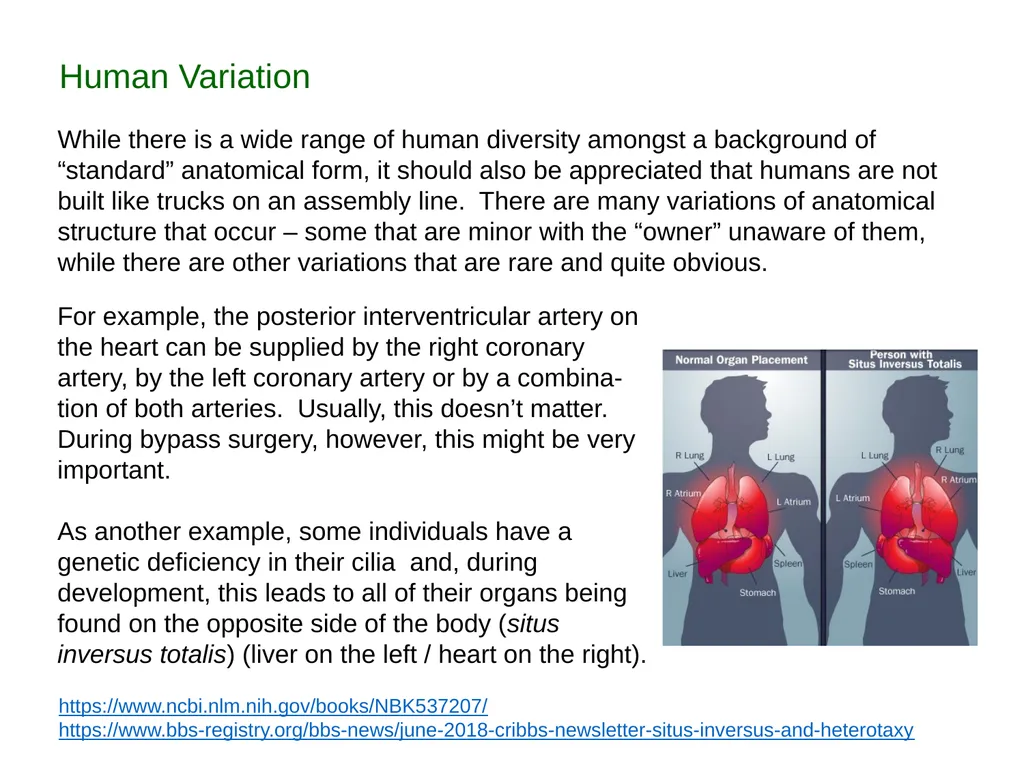
While there is a wide range of human diversity amongst a background of “standard” anatomical form, it should also be appreciated that humans are not built like trucks on an assembly line. There are many variations of anatomical structure that occur – some that are minor with the “owner” unaware of them, while there are other variations that are rare and quite obvious. Human Variation https://www.ncbi.nlm.nih.gov/books/NBK537207/
https://www.bbs-registry.org/bbs-news/june-2018-cribbs-newsletter-situs-inversus-and-heterotaxy For example, the posterior interventricular artery on the heart can be supplied by the right coronary artery, by the left coronary artery or by a combina-tion of both arteries. Usually, this doesn’t matter. During bypass surgery, however, this might be very important.
As another example, some individuals have a genetic deficiency in their cilia and, during development, this leads to all of their organs being found on the opposite side of the body (situs inversus totalis) (liver on the left / heart on the right).<br>
03
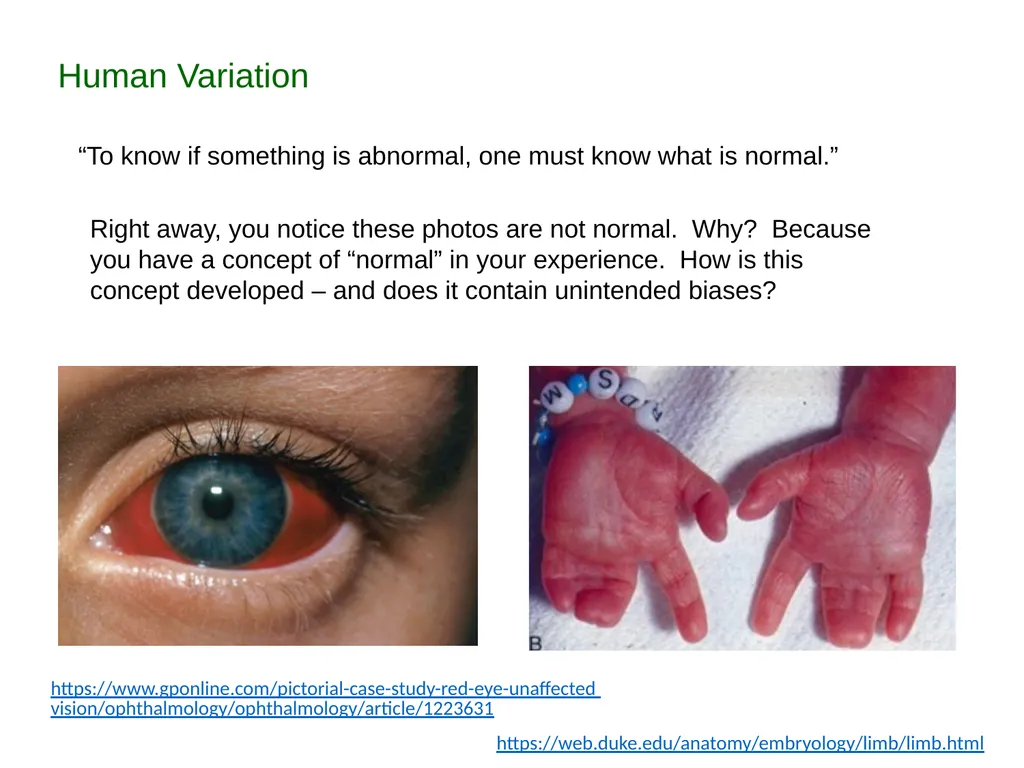
Human Variation “To know if something is abnormal, one must know what is normal.” Right away, you notice these photos are not normal. Why? Because you have a concept of “normal” in your experience. How is this concept developed – and does it contain unintended biases? https://web.duke.edu/anatomy/embryology/limb/limb.html https://www.gponline.com/pictorial-case-study-red-eye-unaffected vision/ophthalmology/ophthalmology/article/1223631<br>
04
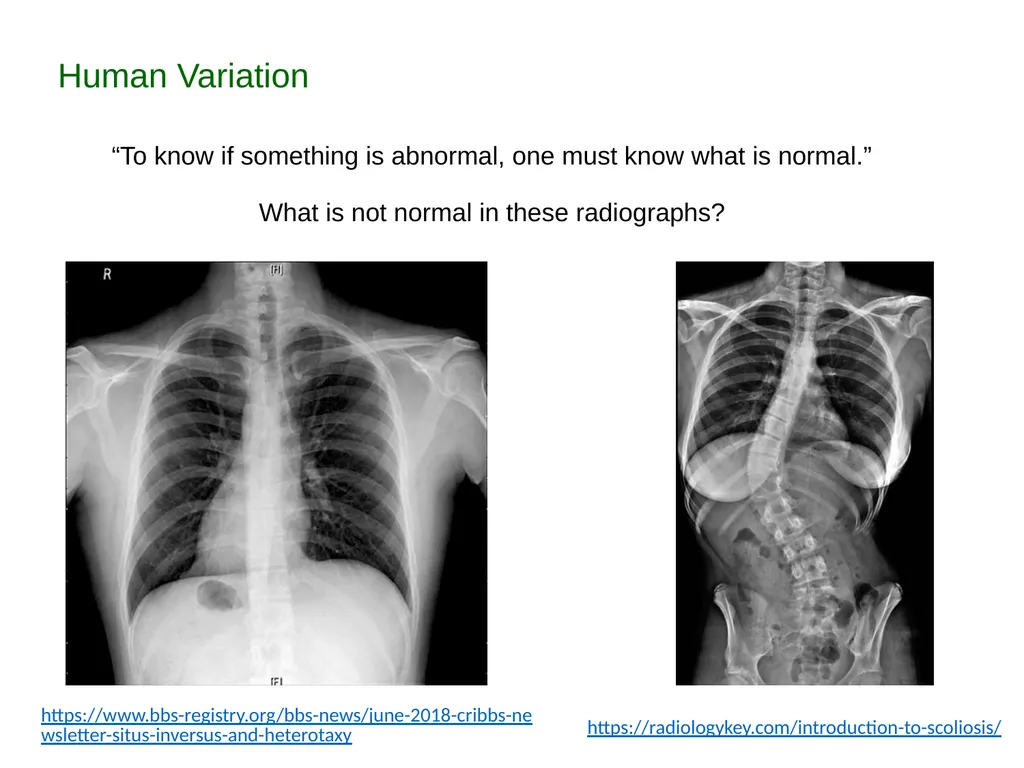
“To know if something is abnormal, one must know what is normal.” Human Variation What is not normal in these radiographs? https://radiologykey.com/introduction-to-scoliosis/ https://www.bbs-registry.org/bbs-news/june-2018-cribbs-newsletter-situs-inversus-and-heterotaxy<br>
05
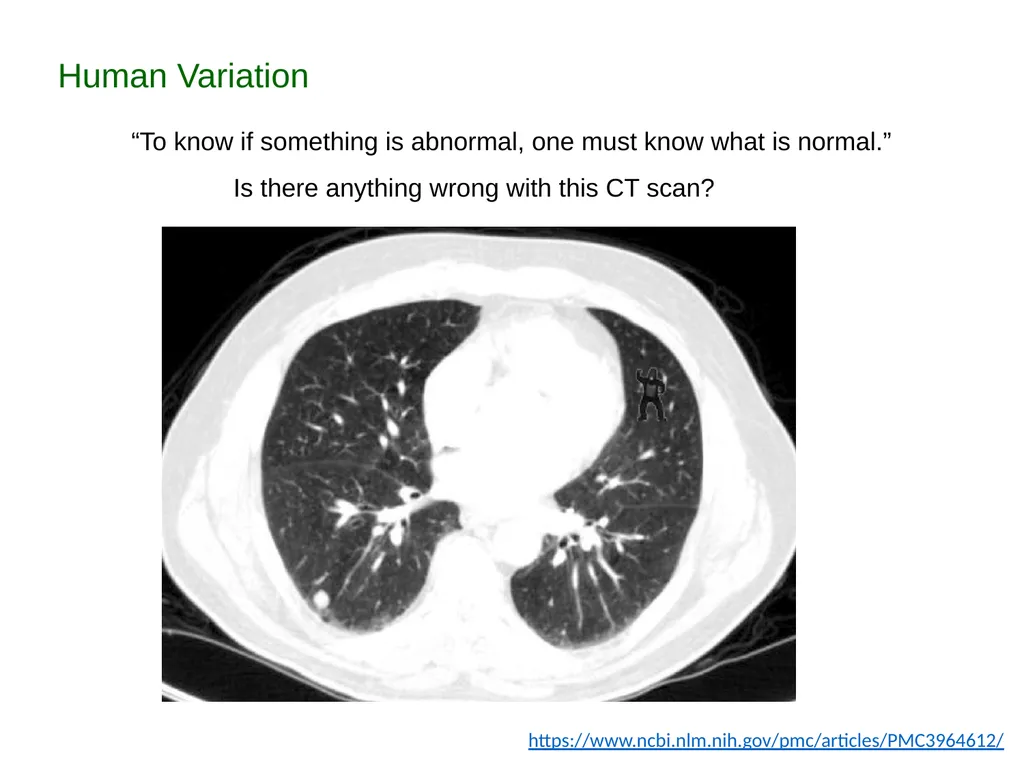
“To know if something is abnormal, one must know what is normal.” Human Variation Is there anything wrong with this CT scan? https://www.ncbi.nlm.nih.gov/pmc/articles/PMC3964612/<br>
06
As a health care professional, it is important to be aware of the variation in the human form. While you should know the “common form” of human anatomy, you should continually appreciate the wide variety in this “common form”. Your patients will represent this broad swath of humanity. Human Variation https://www.boredpanda.com/athlete-body-types-comparison-howard-schatz/<br>