Description: This set of slides explores the ethical concerns raised with the use of unclaimed or unidentified human bodies in anatomy education. The topics covered by this resource include: Informed consent Ethics of Human Tissue Use
"Description: This set of slides explores the" is the property of its rightful owner. Permission is granted to
download and print the materials on this website for personal, non-commercial use only, and to display it
on your personal computer provided you do not modify the materials and that you retain all copyright
notices contained in the materials. By downloading content from our website, you accept the terms of this
agreement.
Presentation Transcript
01
Description:
This set of slides explores the ethical concerns raised with the use of unclaimed or unidentified human bodies in anatomy education. The topics covered by this resource include:
Informed consent
Ethics of Human Tissue Use Further reading:
Caplan I, DeCamp M. Of discomfort and disagreement: unclaimed bodies in anatomy laboratories at United States medical schools. Anat Sci Educ. 12:360-369, 2019.
Kahn PA, Champney TH, Hildebrandt S. The incompatibility of the use of unclaimed bodies with ethical anatomical education in the United States. Anat Sci Educ, 10:200-201, 2017. Bioethics in Anatomy Education Resources:
Use of Unclaimed or Unidentified Human Bodies Creator(s): Thomas Champney
Contact details: tchampney@med.miami.edu<br>
02
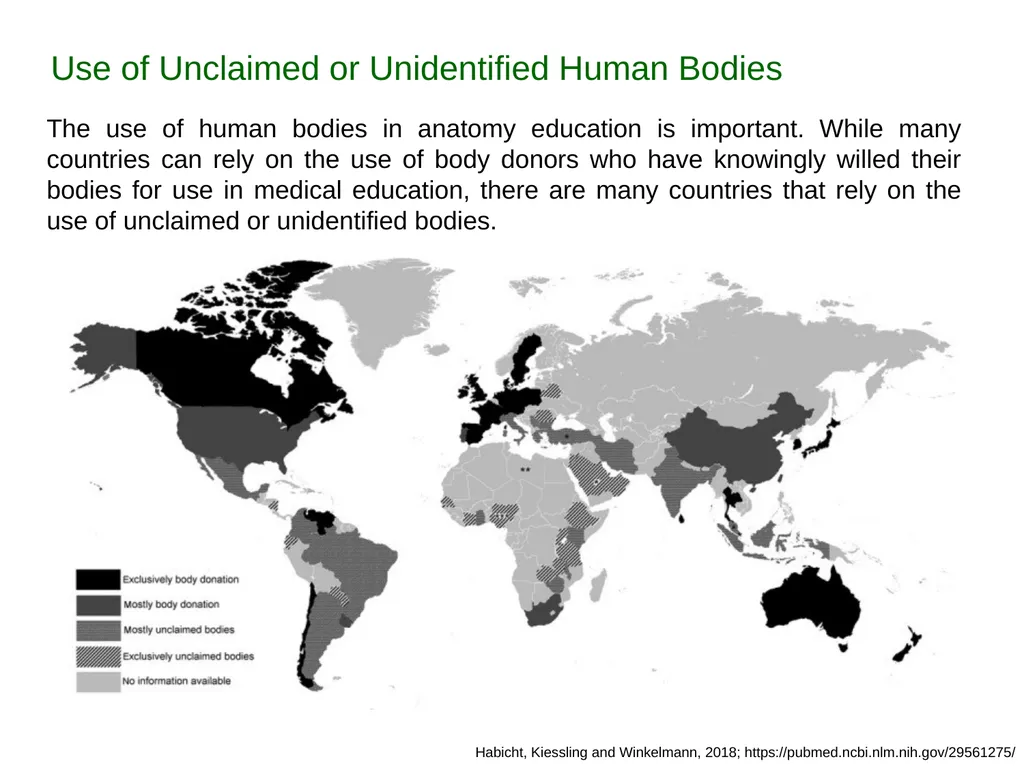
Use of Unclaimed or Unidentified Human Bodies The use of human bodies in anatomy education is important. While many countries can rely on the use of body donors who have knowingly willed their bodies for use in medical education, there are many countries that rely on the use of unclaimed or unidentified bodies. Habicht, Kiessling and Winkelmann, 2018; https://pubmed.ncbi.nlm.nih.gov/29561275/<br>
03
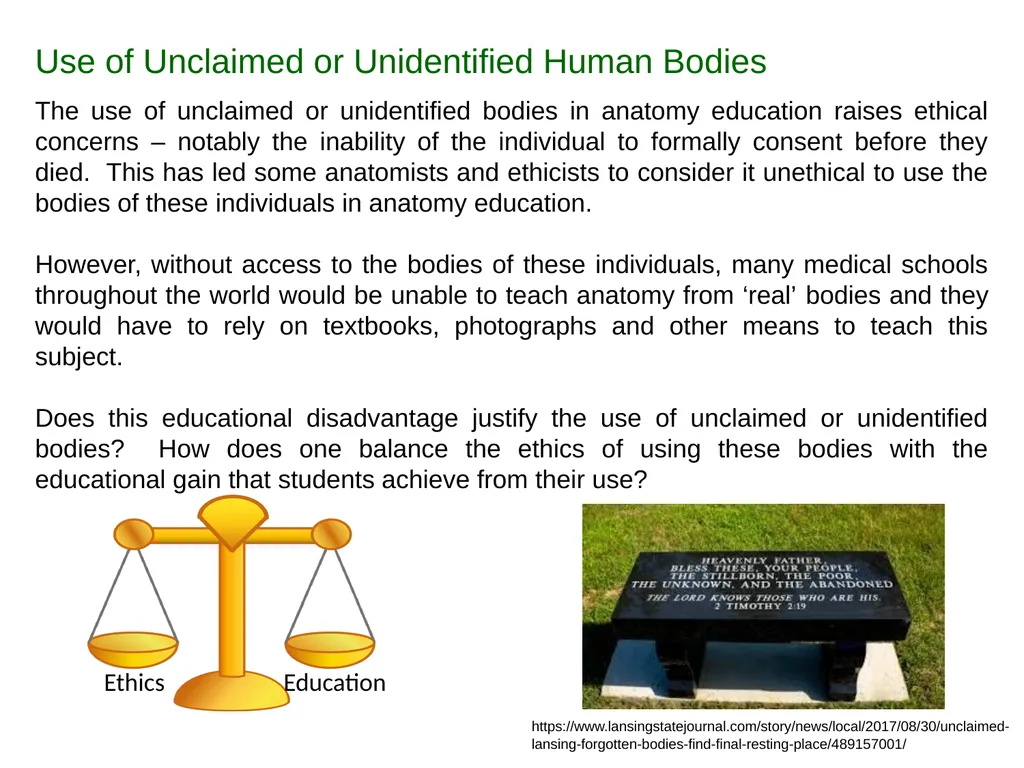
Use of Unclaimed or Unidentified Human Bodies The use of unclaimed or unidentified bodies in anatomy education raises ethical concerns – notably the inability of the individual to formally consent before they died. This has led some anatomists and ethicists to consider it unethical to use the bodies of these individuals in anatomy education.
However, without access to the bodies of these individuals, many medical schools throughout the world would be unable to teach anatomy from ‘real’ bodies and they would have to rely on textbooks, photographs and other means to teach this subject.
Does this educational disadvantage justify the use of unclaimed or unidentified bodies? How does one balance the ethics of using these bodies with the educational gain that students achieve from their use? https://www.lansingstatejournal.com/story/news/local/2017/08/30/unclaimed-lansing-forgotten-bodies-find-final-resting-place/489157001/<br>
04
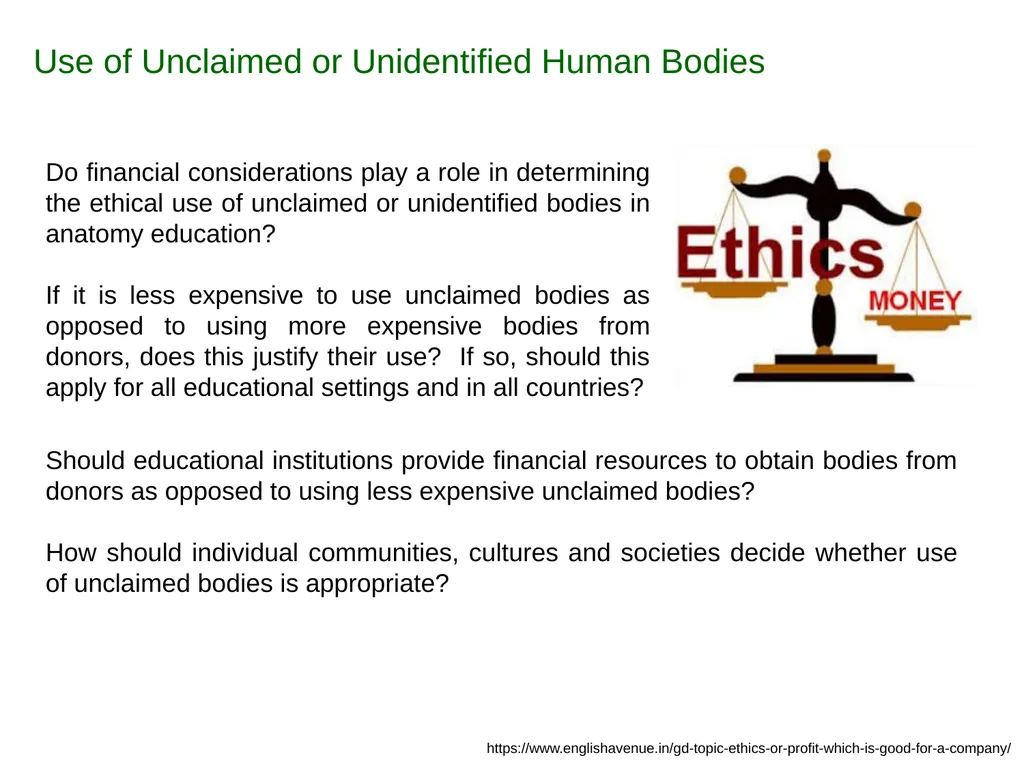
Use of Unclaimed or Unidentified Human Bodies Do financial considerations play a role in determining the ethical use of unclaimed or unidentified bodies in anatomy education?
If it is less expensive to use unclaimed bodies as opposed to using more expensive bodies from donors, does this justify their use? If so, should this apply for all educational settings and in all countries? https://www.englishavenue.in/gd-topic-ethics-or-profit-which-is-good-for-a-company/ Should educational institutions provide financial resources to obtain bodies from donors as opposed to using less expensive unclaimed bodies?
How should individual communities, cultures and societies decide whether use of unclaimed bodies is appropriate?<br>