
Designing Informing systems: What Research Tells
TD
Published · 49 slides · 0 views

1 / 1


Description
Designing Informing systems: What Research Tells Us Alan R. Hevner University of South Florida ahevnerusf.edu 1 Outline Designing Informing Systems Design Science Research (DSR) Concepts, Models, and Guidelines Three Cycles of Design
Related Topics
Share
Embed code
Download this presentation From Below
"Designing Informing systems: What Research Tells" is the property of its rightful owner. Permission is granted to download and print the materials on this website for personal, non-commercial use only, and to display it on your personal computer provided you do not modify the materials and that you retain all copyright notices contained in the materials. By downloading content from our website, you accept the terms of this agreement.
Presentation Transcript
01
Designing Informing systems: What Research Tells Us Alan R. Hevner
University of South Florida
ahevner@usf.edu 1<br>
University of South Florida
ahevner@usf.edu 1<br>
02
Outline Designing Informing Systems
Design Science Research (DSR)
Concepts, Models, and Guidelines
Three Cycles of Design Activities
Positioning and Presenting DSR
The Knowledge Contribution Matrix
A Fitness/Utility Model of DSR
Discussion and Questions 2<br>
Design Science Research (DSR)
Concepts, Models, and Guidelines
Three Cycles of Design Activities
Positioning and Presenting DSR
The Knowledge Contribution Matrix
A Fitness/Utility Model of DSR
Discussion and Questions 2<br>
03
Informing Systems Design Science is a creative research paradigm that informs multiple audiences:
Researchers: Design principles and mid-range design theories
Practitioners: Artifact (product and process) instantiations
Managers: Work and application system controls
Government: Economic and social welfare 3<br>
Researchers: Design principles and mid-range design theories
Practitioners: Artifact (product and process) instantiations
Managers: Work and application system controls
Government: Economic and social welfare 3<br>
04
Design Science Research Sciences of the Artificial, 3rd Ed. – Simon 1996
A Problem Solving Paradigm
The Creation of Innovative Artifacts to Solve Real Problems
Design in Other Fields – Long Histories
Engineering, Architecture, Art
Role of Creativity in Design
DSR in Information Systems
A. Hevner, S. March, J. Park, and S. Ram, “Design Science Research in Information Systems,” Management Information Systems Quarterly, Vol. 28, No. 1, March 2004, pp. 75-105.
S. Gregor and D. Jones, “The Anatomy of a Design Theory,” Journal of the Association of Information Systems, (8:5), 2007, pp. 312-335. 4<br>
A Problem Solving Paradigm
The Creation of Innovative Artifacts to Solve Real Problems
Design in Other Fields – Long Histories
Engineering, Architecture, Art
Role of Creativity in Design
DSR in Information Systems
A. Hevner, S. March, J. Park, and S. Ram, “Design Science Research in Information Systems,” Management Information Systems Quarterly, Vol. 28, No. 1, March 2004, pp. 75-105.
S. Gregor and D. Jones, “The Anatomy of a Design Theory,” Journal of the Association of Information Systems, (8:5), 2007, pp. 312-335. 4<br>
05
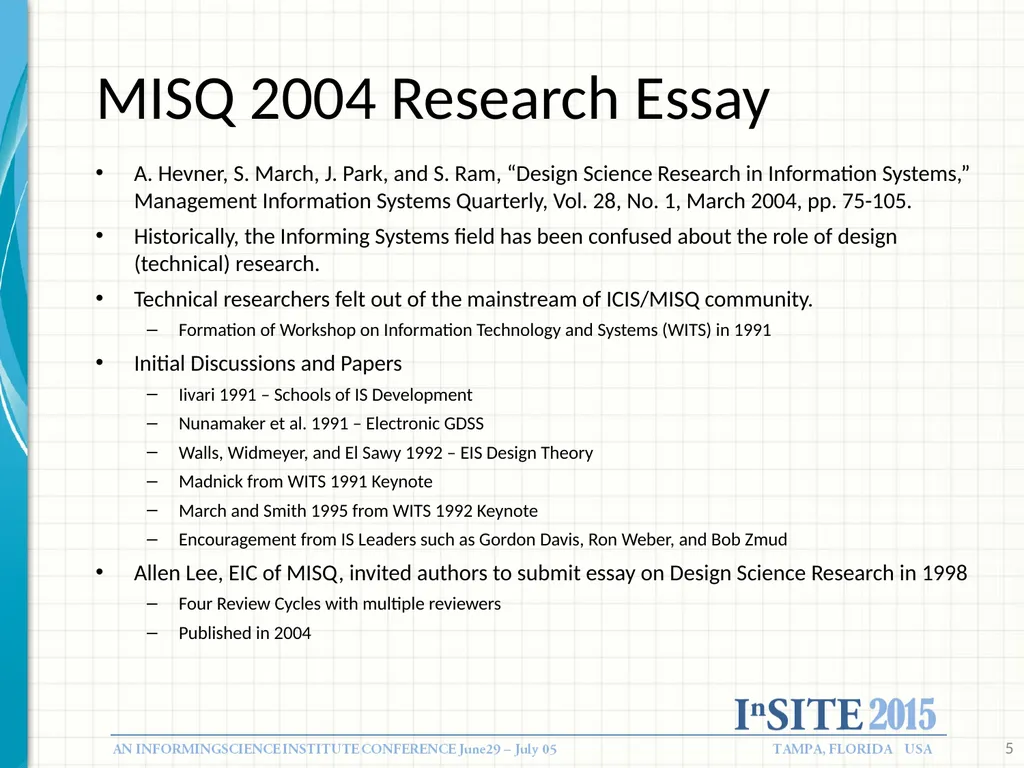
MISQ 2004 Research Essay A. Hevner, S. March, J. Park, and S. Ram, “Design Science Research in Information Systems,” Management Information Systems Quarterly, Vol. 28, No. 1, March 2004, pp. 75-105.
Historically, the Informing Systems field has been confused about the role of design (technical) research.
Technical researchers felt out of the mainstream of ICIS/MISQ community.
Formation of Workshop on Information Technology and Systems (WITS) in 1991
Initial Discussions and Papers
Iivari 1991 – Schools of IS Development
Nunamaker et al. 1991 – Electronic GDSS
Walls, Widmeyer, and El Sawy 1992 – EIS Design Theory
Madnick from WITS 1991 Keynote
March and Smith 1995 from WITS 1992 Keynote
Encouragement from IS Leaders such as Gordon Davis, Ron Weber, and Bob Zmud
Allen Lee, EIC of MISQ, invited authors to submit essay on Design Science Research in 1998
Four Review Cycles with multiple reviewers
Published in 2004 5<br>
Historically, the Informing Systems field has been confused about the role of design (technical) research.
Technical researchers felt out of the mainstream of ICIS/MISQ community.
Formation of Workshop on Information Technology and Systems (WITS) in 1991
Initial Discussions and Papers
Iivari 1991 – Schools of IS Development
Nunamaker et al. 1991 – Electronic GDSS
Walls, Widmeyer, and El Sawy 1992 – EIS Design Theory
Madnick from WITS 1991 Keynote
March and Smith 1995 from WITS 1992 Keynote
Encouragement from IS Leaders such as Gordon Davis, Ron Weber, and Bob Zmud
Allen Lee, EIC of MISQ, invited authors to submit essay on Design Science Research in 1998
Four Review Cycles with multiple reviewers
Published in 2004 5<br>
06
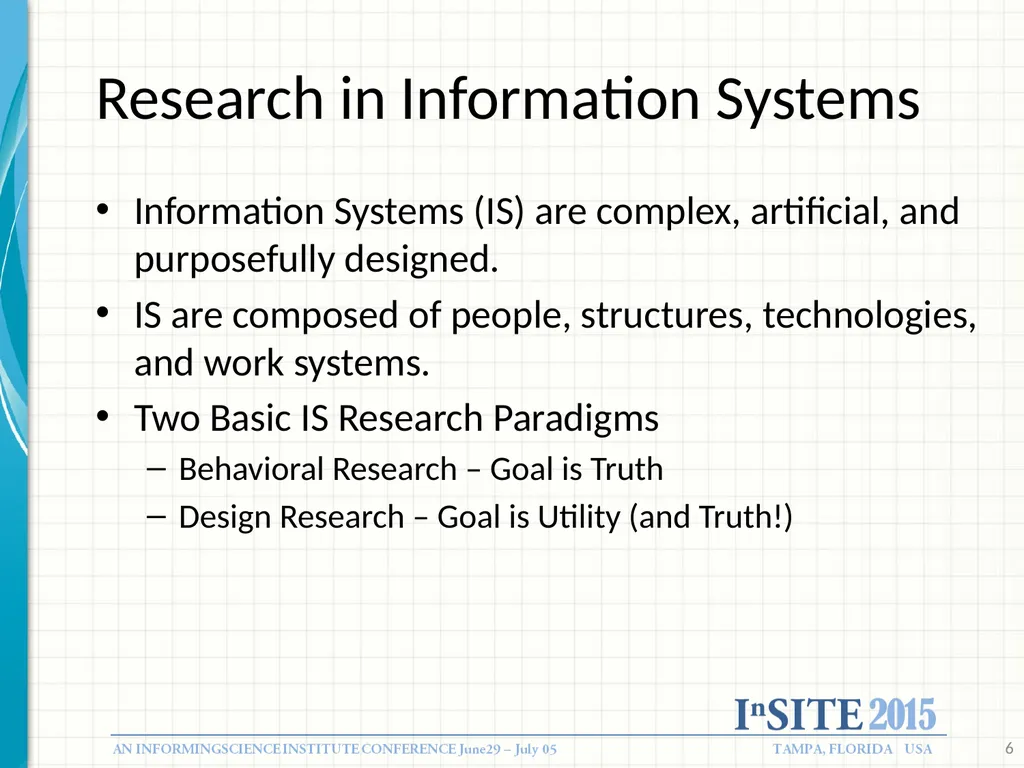
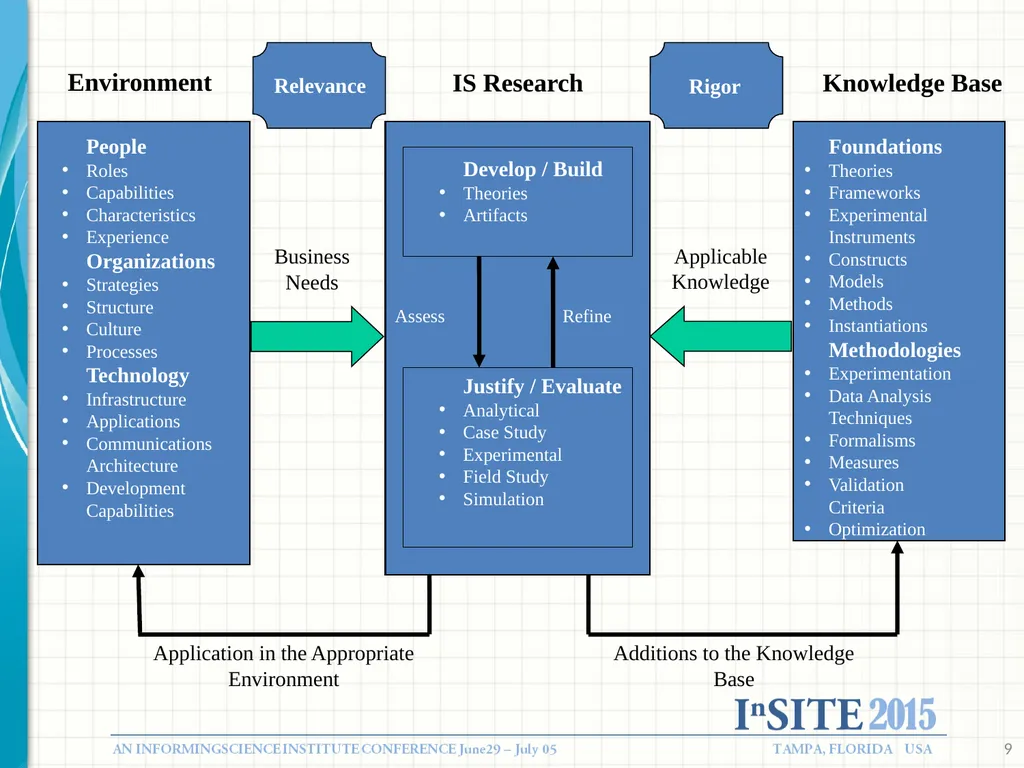
Research in Information Systems Information Systems (IS) are complex, artificial, and purposefully designed.
IS are composed of people, structures, technologies, and work systems.
Two Basic IS Research Paradigms
Behavioral Research – Goal is Truth
Design Research – Goal is Utility (and Truth!) 6<br>
IS are composed of people, structures, technologies, and work systems.
Two Basic IS Research Paradigms
Behavioral Research – Goal is Truth
Design Research – Goal is Utility (and Truth!) 6<br>
07
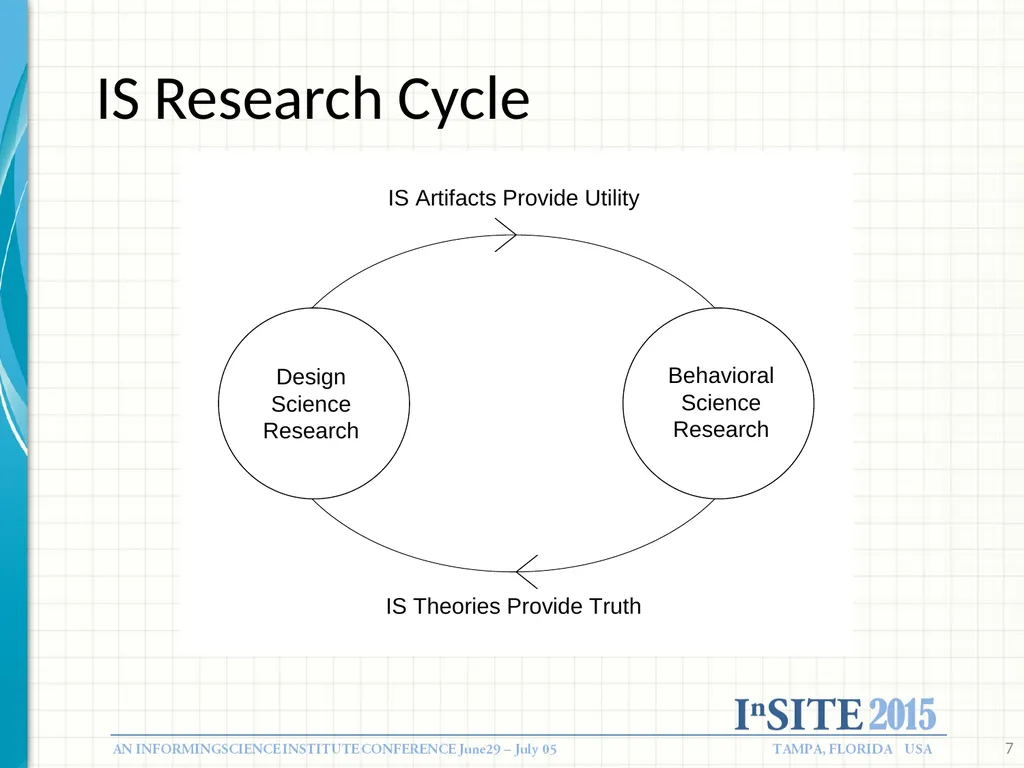
IS Research Cycle 7<br>
08
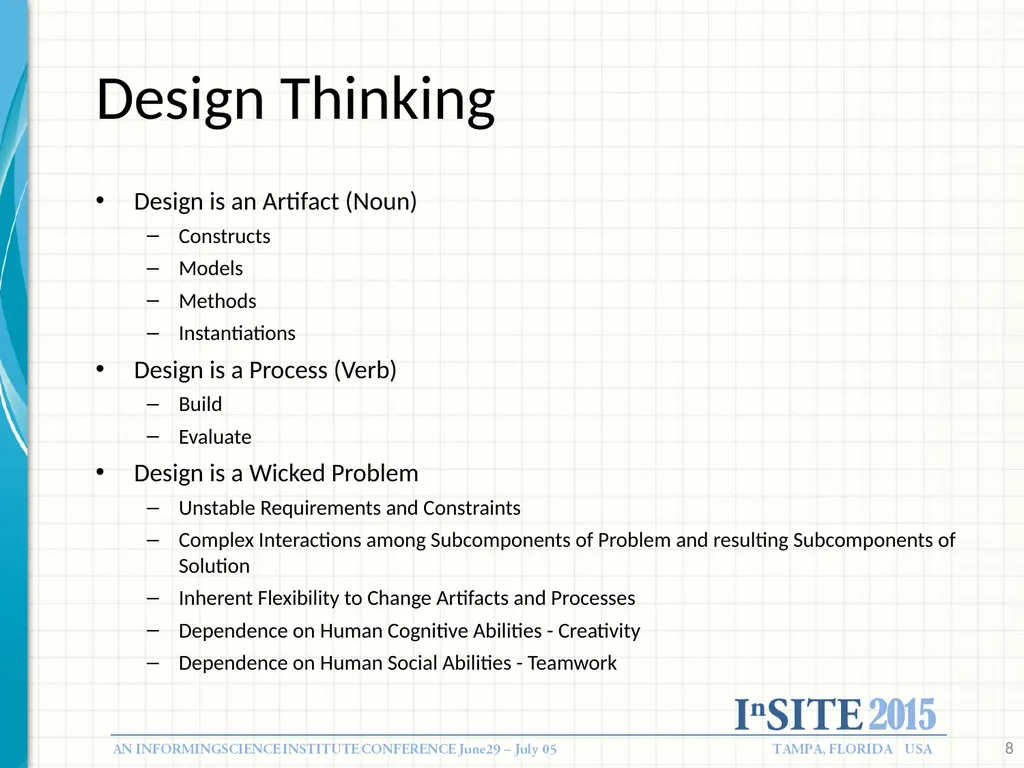
Design Thinking Design is an Artifact (Noun)
Constructs
Models
Methods
Instantiations
Design is a Process (Verb)
Build
Evaluate
Design is a Wicked Problem
Unstable Requirements and Constraints
Complex Interactions among Subcomponents of Problem and resulting Subcomponents of Solution
Inherent Flexibility to Change Artifacts and Processes
Dependence on Human Cognitive Abilities - Creativity
Dependence on Human Social Abilities - Teamwork 8<br>
Constructs
Models
Methods
Instantiations
Design is a Process (Verb)
Build
Evaluate
Design is a Wicked Problem
Unstable Requirements and Constraints
Complex Interactions among Subcomponents of Problem and resulting Subcomponents of Solution
Inherent Flexibility to Change Artifacts and Processes
Dependence on Human Cognitive Abilities - Creativity
Dependence on Human Social Abilities - Teamwork 8<br>
09
9<br>
10
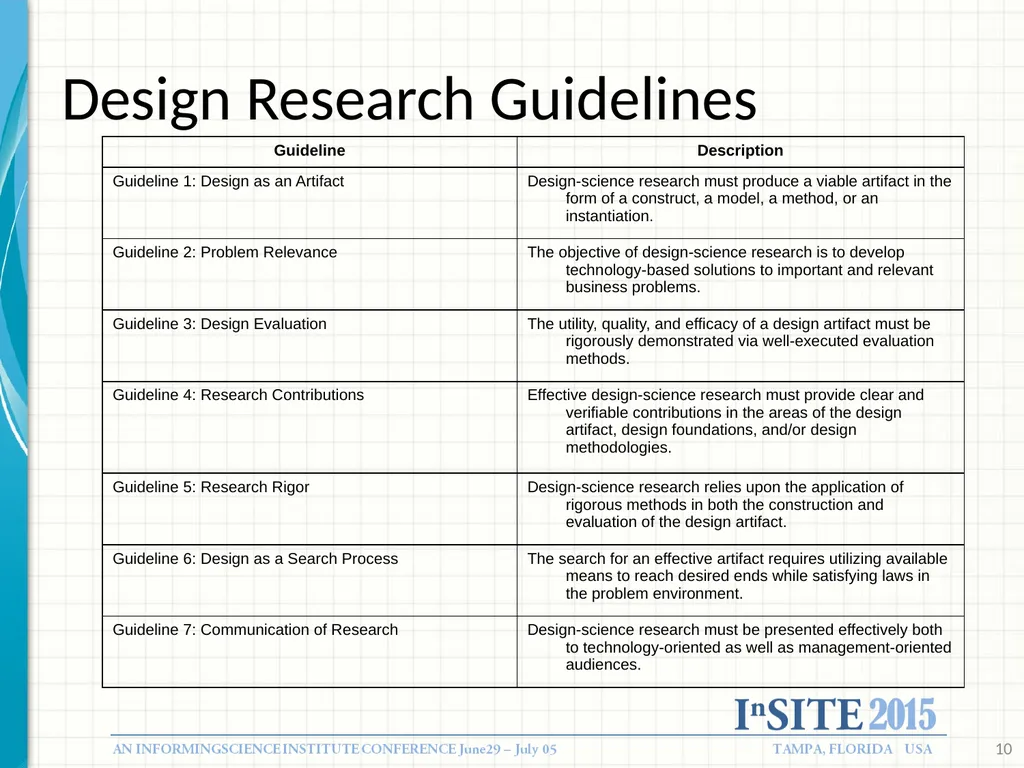
Design Research Guidelines 10<br>
11
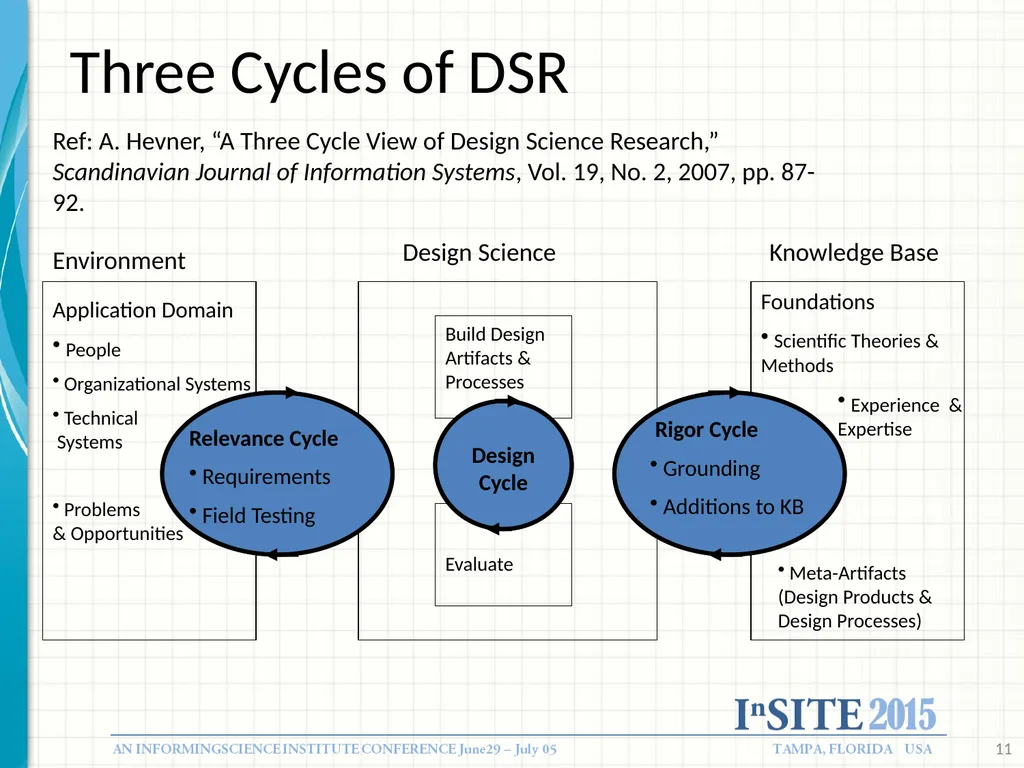
Three Cycles of DSR 11 Environment Knowledge Base Design Science Build Design Artifacts & Processes Evaluate Design Cycle Application Domain
People
Organizational Systems
Technical Systems
Problems & Opportunities Relevance Cycle
Requirements
Field Testing Rigor Cycle
Grounding
Additions to KB Foundations
Scientific Theories & Methods Experience & Expertise Meta-Artifacts (Design Products & Design Processes) Ref: A. Hevner, “A Three Cycle View of Design Science Research,” Scandinavian Journal of Information Systems, Vol. 19, No. 2, 2007, pp. 87-92.<br>
People
Organizational Systems
Technical Systems
Problems & Opportunities Relevance Cycle
Requirements
Field Testing Rigor Cycle
Grounding
Additions to KB Foundations
Scientific Theories & Methods Experience & Expertise Meta-Artifacts (Design Products & Design Processes) Ref: A. Hevner, “A Three Cycle View of Design Science Research,” Scandinavian Journal of Information Systems, Vol. 19, No. 2, 2007, pp. 87-92.<br>
12
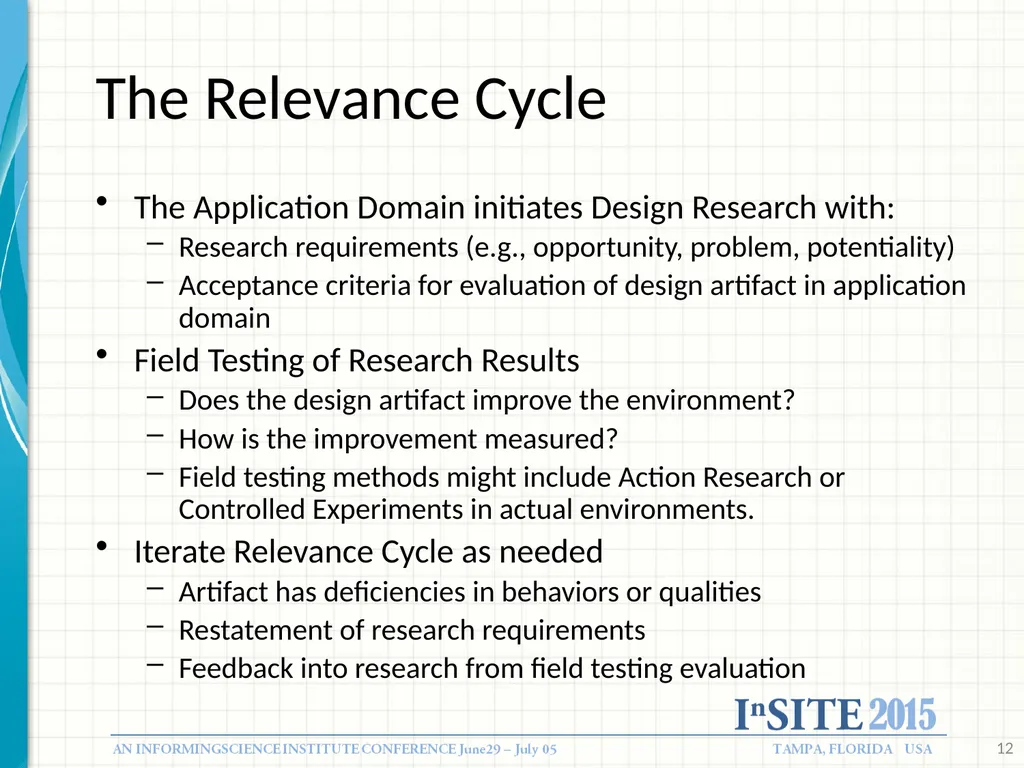
The Relevance Cycle The Application Domain initiates Design Research with:
Research requirements (e.g., opportunity, problem, potentiality)
Acceptance criteria for evaluation of design artifact in application domain
Field Testing of Research Results
Does the design artifact improve the environment?
How is the improvement measured?
Field testing methods might include Action Research or Controlled Experiments in actual environments.
Iterate Relevance Cycle as needed
Artifact has deficiencies in behaviors or qualities
Restatement of research requirements
Feedback into research from field testing evaluation 12<br>
Research requirements (e.g., opportunity, problem, potentiality)
Acceptance criteria for evaluation of design artifact in application domain
Field Testing of Research Results
Does the design artifact improve the environment?
How is the improvement measured?
Field testing methods might include Action Research or Controlled Experiments in actual environments.
Iterate Relevance Cycle as needed
Artifact has deficiencies in behaviors or qualities
Restatement of research requirements
Feedback into research from field testing evaluation 12<br>
13
The Rigor Cycle Design Research Knowledge Base
Design Theories
Engineering Methods
Experiences and Expertise
Existing Design Artifacts and Processes
Research Rigor is predicated on the researcher’s skilled selection and application of appropriate theories and methods for constructing and evaluating the artifact.
Additions to the Knowledge Base:
Extensions to theories and methods
New experiences and expertise
New artifacts and design processes 13<br>
Design Theories
Engineering Methods
Experiences and Expertise
Existing Design Artifacts and Processes
Research Rigor is predicated on the researcher’s skilled selection and application of appropriate theories and methods for constructing and evaluating the artifact.
Additions to the Knowledge Base:
Extensions to theories and methods
New experiences and expertise
New artifacts and design processes 13<br>
14
Design Cycle Rapid iteration of Build and Evaluate activities
The hard work of design research (1% inspiration and 99% perspiration - Edison)
Build – Create and Refine artifact design as both product (noun) and process (verb)
Evaluation – Rigorous, scientific study of artifact in laboratory or controlled environment
Continue Design Cycle until:
Artifact ready for field test in Application Environment
New knowledge appropriate for inclusion in Knowledge Base 14<br>
The hard work of design research (1% inspiration and 99% perspiration - Edison)
Build – Create and Refine artifact design as both product (noun) and process (verb)
Evaluation – Rigorous, scientific study of artifact in laboratory or controlled environment
Continue Design Cycle until:
Artifact ready for field test in Application Environment
New knowledge appropriate for inclusion in Knowledge Base 14<br>
15
Positioning and Presenting DSR S. Gregor and A. Hevner, “Positioning and Presenting Design Science Research for Maximum Impact,” June 2013, MISQ.
DSR is stymied by lack of clear understanding of how knowledge is consumed, produced, and communicated
Goals of essay:
appreciate the levels of artifact abstractions that may be DSR contributions to include design theory
identify appropriate ways of consuming and producing knowledge when preparing journal articles or other scholarly works
understand and position the knowledge contributions of research projects
structure a DSR article so that a significant contribution to the knowledge base is highlighted. 15<br>
DSR is stymied by lack of clear understanding of how knowledge is consumed, produced, and communicated
Goals of essay:
appreciate the levels of artifact abstractions that may be DSR contributions to include design theory
identify appropriate ways of consuming and producing knowledge when preparing journal articles or other scholarly works
understand and position the knowledge contributions of research projects
structure a DSR article so that a significant contribution to the knowledge base is highlighted. 15<br>
16
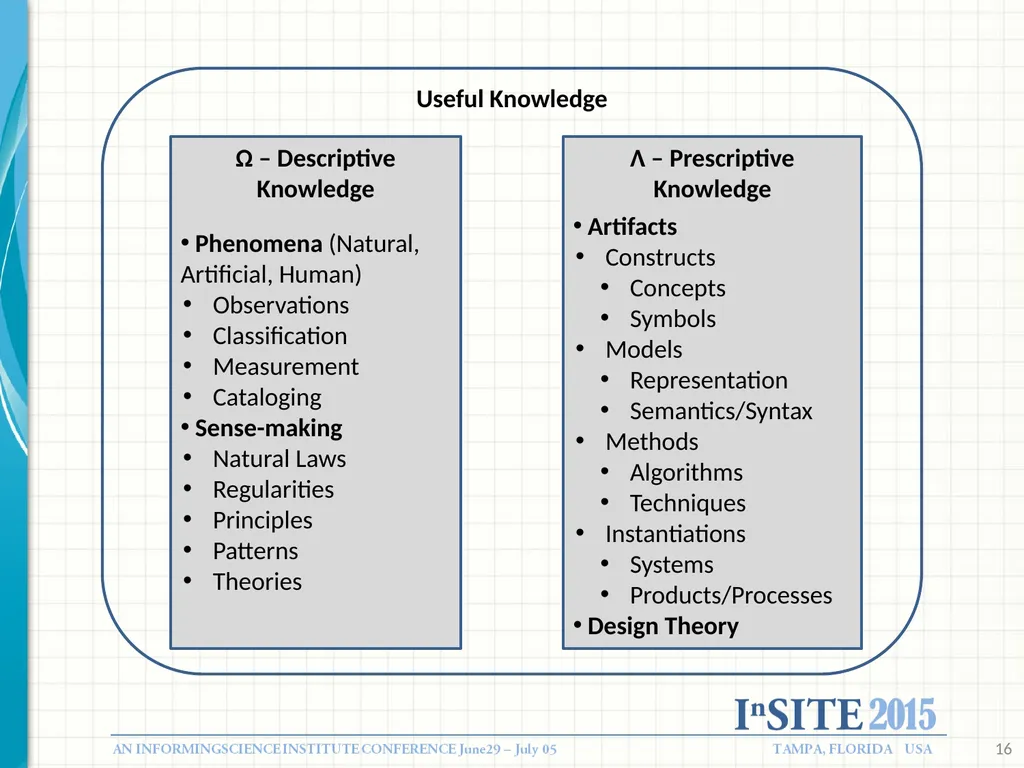
Useful Knowledge Ω – Descriptive Knowledge Λ – Prescriptive Knowledge Phenomena (Natural, Artificial, Human)
Observations
Classification
Measurement
Cataloging
Sense-making
Natural Laws
Regularities
Principles
Patterns
Theories Artifacts
Constructs
Concepts
Symbols
Models
Representation
Semantics/Syntax
Methods
Algorithms
Techniques
Instantiations
Systems
Products/Processes
Design Theory 16<br>
Observations
Classification
Measurement
Cataloging
Sense-making
Natural Laws
Regularities
Principles
Patterns
Theories Artifacts
Constructs
Concepts
Symbols
Models
Representation
Semantics/Syntax
Methods
Algorithms
Techniques
Instantiations
Systems
Products/Processes
Design Theory 16<br>
17
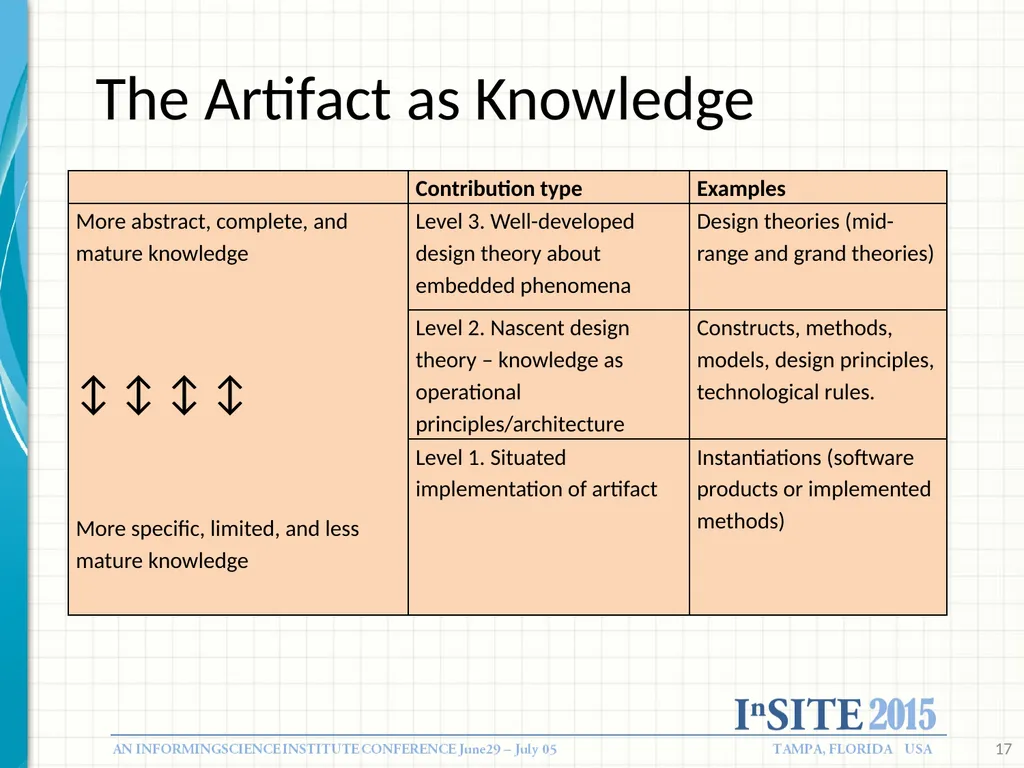
The Artifact as Knowledge 17<br>
18
Design Theory as Knowledge Theory – set of statements of relationships among constructs that aims to describe, explain, enhance understanding, and, in some cases, allow predictions about the future (Gregor 2006)
Design Theory (Gregor and Jones 2007) – prescriptions for design and action
Behaviors of individual artifacts (Level 1) lead to empirical generalizations or technical rules
Extending the boundaries of abstract design artifacts (Level 2) grows nascent design theory
Middle-range design theory (Level 3) – understanding expands to partial theory (Goal of theory in applied fields – Merton 1968)
Grand design theory – transitions to descriptive theory 18<br>
Design Theory (Gregor and Jones 2007) – prescriptions for design and action
Behaviors of individual artifacts (Level 1) lead to empirical generalizations or technical rules
Extending the boundaries of abstract design artifacts (Level 2) grows nascent design theory
Middle-range design theory (Level 3) – understanding expands to partial theory (Goal of theory in applied fields – Merton 1968)
Grand design theory – transitions to descriptive theory 18<br>
19
Ω Knowledge Λ Knowledge Application Environment - Research Opportunities and Problems
- Research Questions Human Capabilities Cognitive
Creativity
Reasoning
Analysis
Synthesis
Social
Teamwork
Collective Intelligence Knowledge Sources Constructs Models Methods Instantiations Informing Ω Knowledge The DSR Process 19 Contribution to Ω Knowledge Design Theory<br>
- Research Questions Human Capabilities Cognitive
Creativity
Reasoning
Analysis
Synthesis
Social
Teamwork
Collective Intelligence Knowledge Sources Constructs Models Methods Instantiations Informing Ω Knowledge The DSR Process 19 Contribution to Ω Knowledge Design Theory<br>
20
Design Cycle 1 Design Cycle 2 Design Cycle n … … … … 20 Knowledge Growth in DSR Cycles<br>
21
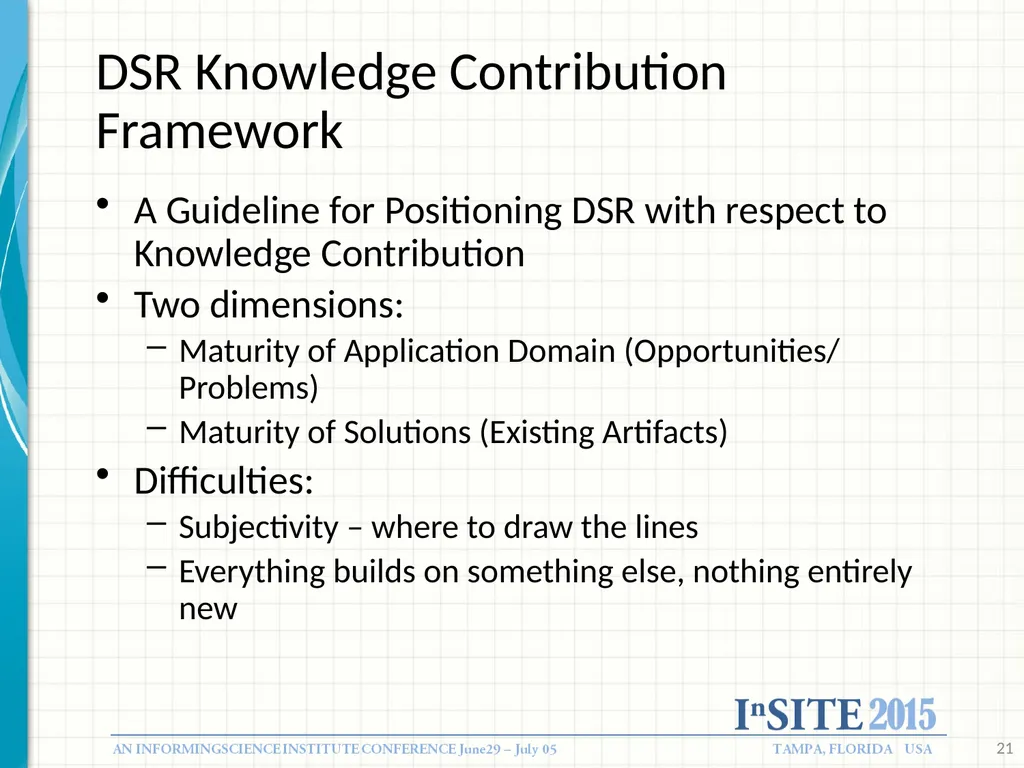
DSR Knowledge Contribution Framework A Guideline for Positioning DSR with respect to Knowledge Contribution
Two dimensions:
Maturity of Application Domain (Opportunities/ Problems)
Maturity of Solutions (Existing Artifacts)
Difficulties:
Subjectivity – where to draw the lines
Everything builds on something else, nothing entirely new 21<br>
Two dimensions:
Maturity of Application Domain (Opportunities/ Problems)
Maturity of Solutions (Existing Artifacts)
Difficulties:
Subjectivity – where to draw the lines
Everything builds on something else, nothing entirely new 21<br>
22
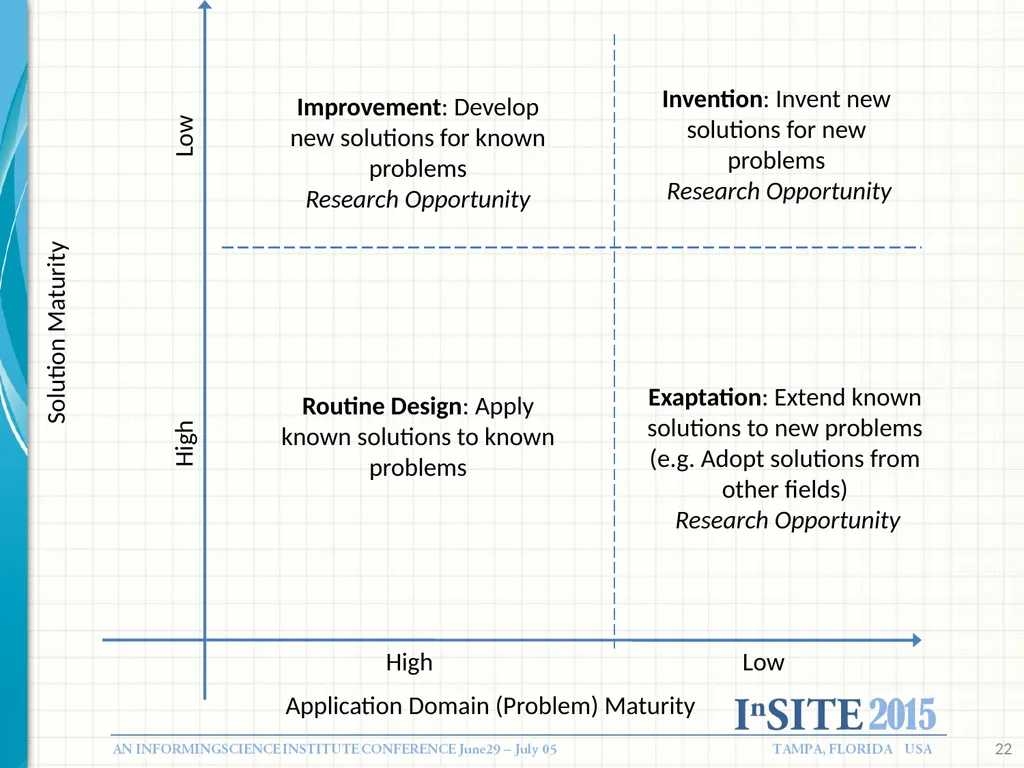
Solution Maturity Application Domain (Problem) Maturity High Low High Low Routine Design: Apply known solutions to known problems Exaptation: Extend known solutions to new problems (e.g. Adopt solutions from other fields)
Research Opportunity Improvement: Develop new solutions for known problems
Research Opportunity Invention: Invent new solutions for new problems
Research Opportunity 22<br>
23
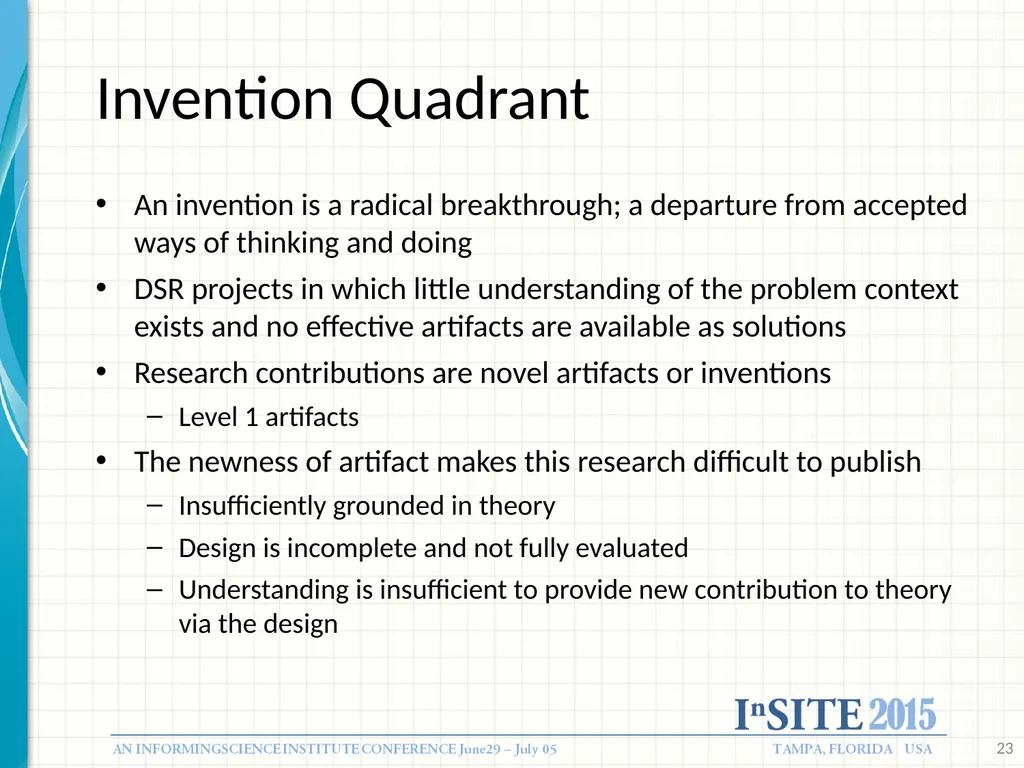
Invention Quadrant An invention is a radical breakthrough; a departure from accepted ways of thinking and doing
DSR projects in which little understanding of the problem context exists and no effective artifacts are available as solutions
Research contributions are novel artifacts or inventions
Level 1 artifacts
The newness of artifact makes this research difficult to publish
Insufficiently grounded in theory
Design is incomplete and not fully evaluated
Understanding is insufficient to provide new contribution to theory via the design 23<br>
DSR projects in which little understanding of the problem context exists and no effective artifacts are available as solutions
Research contributions are novel artifacts or inventions
Level 1 artifacts
The newness of artifact makes this research difficult to publish
Insufficiently grounded in theory
Design is incomplete and not fully evaluated
Understanding is insufficient to provide new contribution to theory via the design 23<br>
24
Invention Exemplars Agrawal, R., Imielinski, T. and Swami, A. (1993). “Mining Association Rules between Sets of Items in Large Databases”, Proceedings of the 1993 ACM SIGMOD Conference, Washington DC, May.
Aim: produce an algorithm that generates all significant association rules between items in the database
Practical importance: Allows organizations to find interesting relationships (e.g. shopping patterns)
Theoretical significance (newness): Shows (Sect 5) that no other work has done same thing
Description of new method: Shows requirements (Sect 1), new concepts (association rule, support, confidence), Formal Model (pseudocode) (Sects 2-3)
Proof: Experiments (Sect 4)
Scott-Morton (1967) – Decision Support Systems 24<br>
Aim: produce an algorithm that generates all significant association rules between items in the database
Practical importance: Allows organizations to find interesting relationships (e.g. shopping patterns)
Theoretical significance (newness): Shows (Sect 5) that no other work has done same thing
Description of new method: Shows requirements (Sect 1), new concepts (association rule, support, confidence), Formal Model (pseudocode) (Sects 2-3)
Proof: Experiments (Sect 4)
Scott-Morton (1967) – Decision Support Systems 24<br>
25
Improvement Quadrant An improvement is a better artifact solution in the form of more efficient and effective products, processes, services, technologies, or ideas
DSR projects in which the problem context is mature but there is a great need for more effective artifacts as solutions
Improvement DSR is judged by:
Clearly grounding, representing, and communicating the new artifact design
Convincing evaluation providing evidence of improvements over current solutions
All levels of artifact knowledge contribution can be made 25<br>
DSR projects in which the problem context is mature but there is a great need for more effective artifacts as solutions
Improvement DSR is judged by:
Clearly grounding, representing, and communicating the new artifact design
Convincing evaluation providing evidence of improvements over current solutions
All levels of artifact knowledge contribution can be made 25<br>
26
Improvement Exemplars Many DSR projects in IS are in the Improvement Quadrant, for example:
Better data mining algorithms for knowledge discovery (extending the initial ideas invented by Agrawal et al. (1993)); for example, (Fayyad et al. 1996; Zhang et al. 2004; Witten et al. 2011)
Improved recommendation systems for use in e-commerce; for example (Herlocker et al. 2004; Adomavicius and Tuzhilin 2005)
Better technologies and use strategies for saving energy in IT applications; for example (Donnellan et al. 2011; Watson and Boudreau 2011)
Improved routing algorithms for business supply chains; for example (van der Aalst and Hee 2004; Liu et al. 2005) 26<br>
Better data mining algorithms for knowledge discovery (extending the initial ideas invented by Agrawal et al. (1993)); for example, (Fayyad et al. 1996; Zhang et al. 2004; Witten et al. 2011)
Improved recommendation systems for use in e-commerce; for example (Herlocker et al. 2004; Adomavicius and Tuzhilin 2005)
Better technologies and use strategies for saving energy in IT applications; for example (Donnellan et al. 2011; Watson and Boudreau 2011)
Improved routing algorithms for business supply chains; for example (van der Aalst and Hee 2004; Liu et al. 2005) 26<br>
27
Exaptation Quadrant An exaptation is the expropriation of an artifact in one field to solve problems in another field
DSR projects in which the problem context is not well understood but there exist mature artifacts in other fields that can be exapted as effective solutions
Exaptation DSR is judged by:
Clearly grounding, representing, and communicating the exapted artifact design
Convincing evaluation providing evidence of how well the new artifact solves the given problem
All levels of artifact knowledge contribution can be made 27<br>
DSR projects in which the problem context is not well understood but there exist mature artifacts in other fields that can be exapted as effective solutions
Exaptation DSR is judged by:
Clearly grounding, representing, and communicating the exapted artifact design
Convincing evaluation providing evidence of how well the new artifact solves the given problem
All levels of artifact knowledge contribution can be made 27<br>
28
Exaptation Exemplars Exaptation DSR is employed when new technologies provide opportunities to solve new and/or different IS problems; for example:
Codd’s exaptation of relational mathematics to the problem of database systems design leading to relational database concepts, models, methods, and instantiations (Codd, 1970; Codd, 1982)
Berners-Lee original concept of the World Wide Web was one of simply sharing research documents in a hypertext form among multiple computers. In short time, however, many individuals saw the potential of this rapidly expanding interconnection environment to exapt applications from old platforms to the WWW platforms. These new Internet applications were very different from previous versions adding many new artifacts to Λ knowledge
Research by Berndt et al. (2003) on the CATCH data warehouse for health care information. Well-known methods of data warehouse development (e.g. Inmon, 1992) were exapted to new and interesting areas of health care systems and decision-making applications 28<br>
Codd’s exaptation of relational mathematics to the problem of database systems design leading to relational database concepts, models, methods, and instantiations (Codd, 1970; Codd, 1982)
Berners-Lee original concept of the World Wide Web was one of simply sharing research documents in a hypertext form among multiple computers. In short time, however, many individuals saw the potential of this rapidly expanding interconnection environment to exapt applications from old platforms to the WWW platforms. These new Internet applications were very different from previous versions adding many new artifacts to Λ knowledge
Research by Berndt et al. (2003) on the CATCH data warehouse for health care information. Well-known methods of data warehouse development (e.g. Inmon, 1992) were exapted to new and interesting areas of health care systems and decision-making applications 28<br>
29
Routine Design Quadrant Professional design or system building to be distinguished from DSR
However, evolving or best practices may be observed and documented in “extractive case study” work (Van Aken)
Study of best practices in routine design may lead to empirical generalization
Example – Davenport’s observation of BPR (Davenport & Short SMR 1990) 29<br>
However, evolving or best practices may be observed and documented in “extractive case study” work (Van Aken)
Study of best practices in routine design may lead to empirical generalization
Example – Davenport’s observation of BPR (Davenport & Short SMR 1990) 29<br>
30
MISQ Papers mapped to Framework 30<br>
31
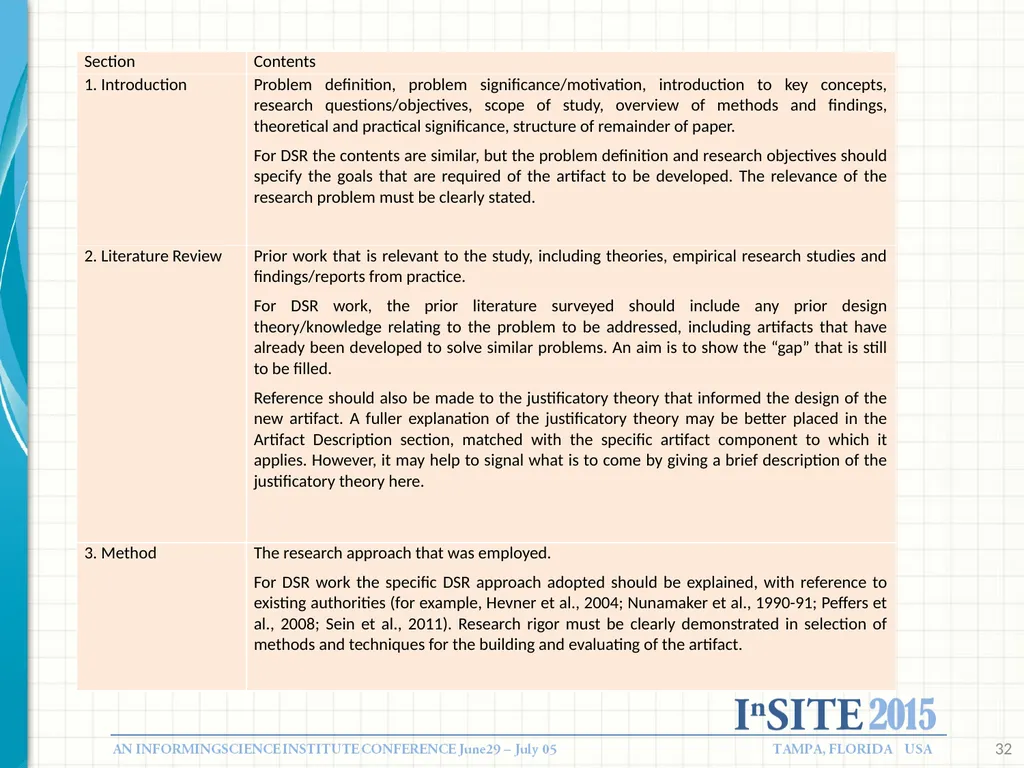
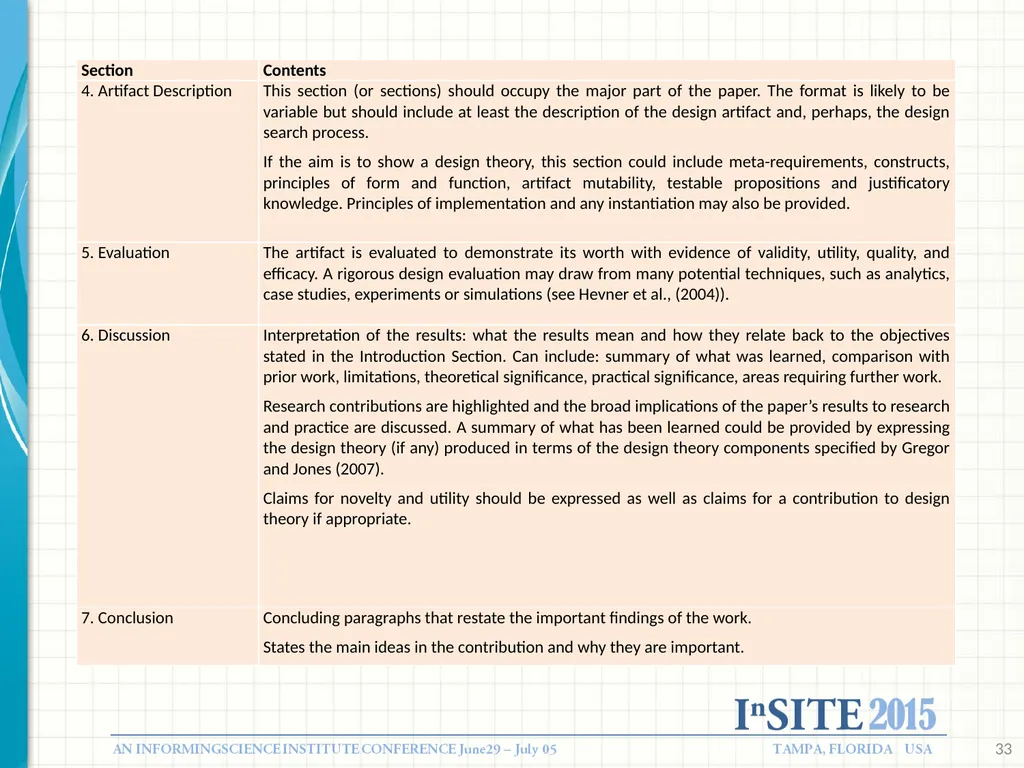
DSR Publication Schema How best to communicate DSR research contributions?
A Publication Schema is proposed that highlights artifact build and evaluation activities
The knowledge contribution is a focus throughout the publication schema 31<br>
A Publication Schema is proposed that highlights artifact build and evaluation activities
The knowledge contribution is a focus throughout the publication schema 31<br>
32
32<br>
33
33<br>
34
DSR Publication Exemplar – McLaren et al. 2011 MISQ 34<br>
35
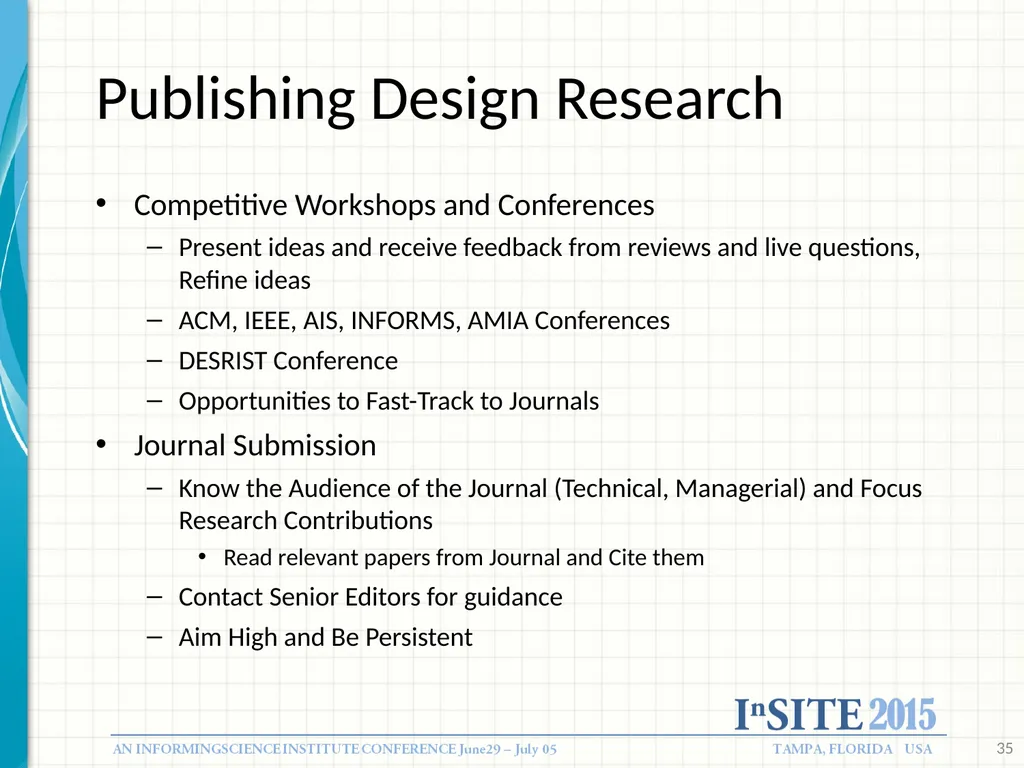
Publishing Design Research Competitive Workshops and Conferences
Present ideas and receive feedback from reviews and live questions, Refine ideas
ACM, IEEE, AIS, INFORMS, AMIA Conferences
DESRIST Conference
Opportunities to Fast-Track to Journals
Journal Submission
Know the Audience of the Journal (Technical, Managerial) and Focus Research Contributions
Read relevant papers from Journal and Cite them
Contact Senior Editors for guidance
Aim High and Be Persistent 35<br>
Present ideas and receive feedback from reviews and live questions, Refine ideas
ACM, IEEE, AIS, INFORMS, AMIA Conferences
DESRIST Conference
Opportunities to Fast-Track to Journals
Journal Submission
Know the Audience of the Journal (Technical, Managerial) and Focus Research Contributions
Read relevant papers from Journal and Cite them
Contact Senior Editors for guidance
Aim High and Be Persistent 35<br>
36
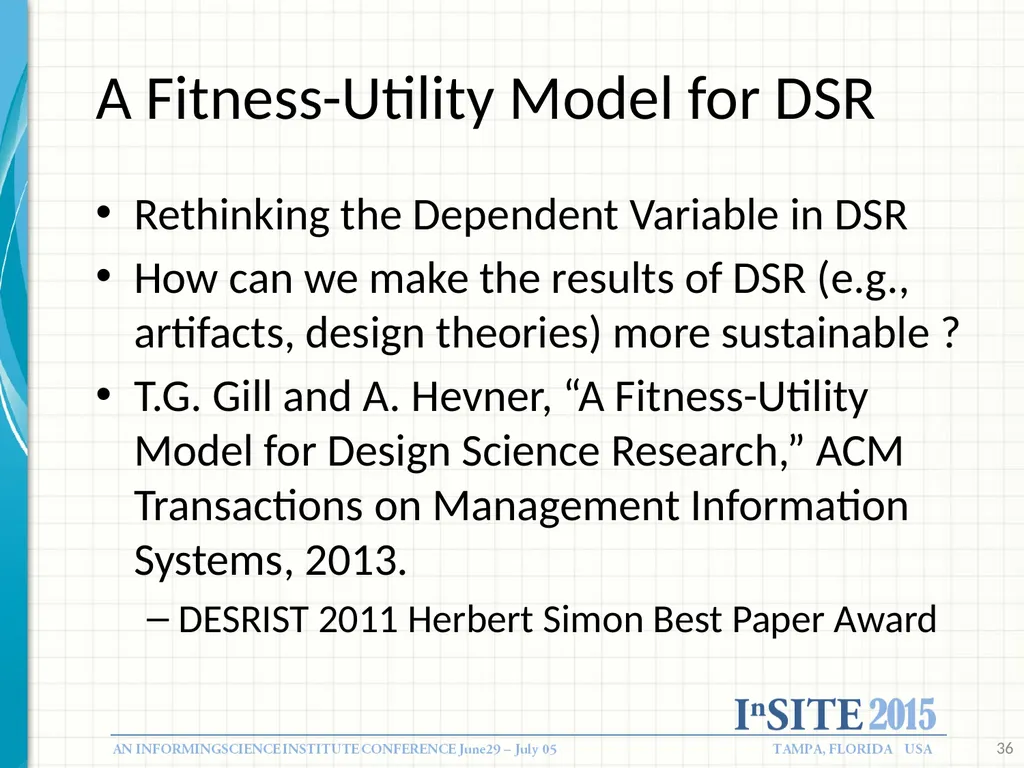
A Fitness-Utility Model for DSR Rethinking the Dependent Variable in DSR
How can we make the results of DSR (e.g., artifacts, design theories) more sustainable ?
T.G. Gill and A. Hevner, “A Fitness-Utility Model for Design Science Research,” ACM Transactions on Management Information Systems, 2013.
DESRIST 2011 Herbert Simon Best Paper Award 36<br>
How can we make the results of DSR (e.g., artifacts, design theories) more sustainable ?
T.G. Gill and A. Hevner, “A Fitness-Utility Model for Design Science Research,” ACM Transactions on Management Information Systems, 2013.
DESRIST 2011 Herbert Simon Best Paper Award 36<br>
37
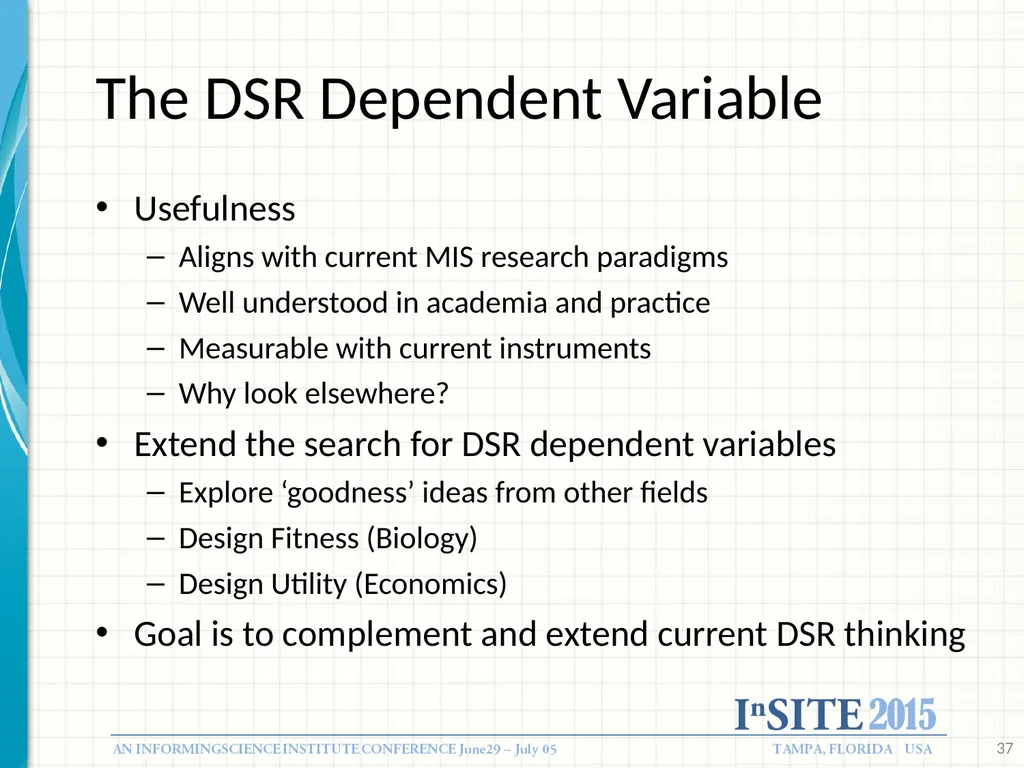
The DSR Dependent Variable Usefulness
Aligns with current MIS research paradigms
Well understood in academia and practice
Measurable with current instruments
Why look elsewhere?
Extend the search for DSR dependent variables
Explore ‘goodness’ ideas from other fields
Design Fitness (Biology)
Design Utility (Economics)
Goal is to complement and extend current DSR thinking 37<br>
Aligns with current MIS research paradigms
Well understood in academia and practice
Measurable with current instruments
Why look elsewhere?
Extend the search for DSR dependent variables
Explore ‘goodness’ ideas from other fields
Design Fitness (Biology)
Design Utility (Economics)
Goal is to complement and extend current DSR thinking 37<br>
38
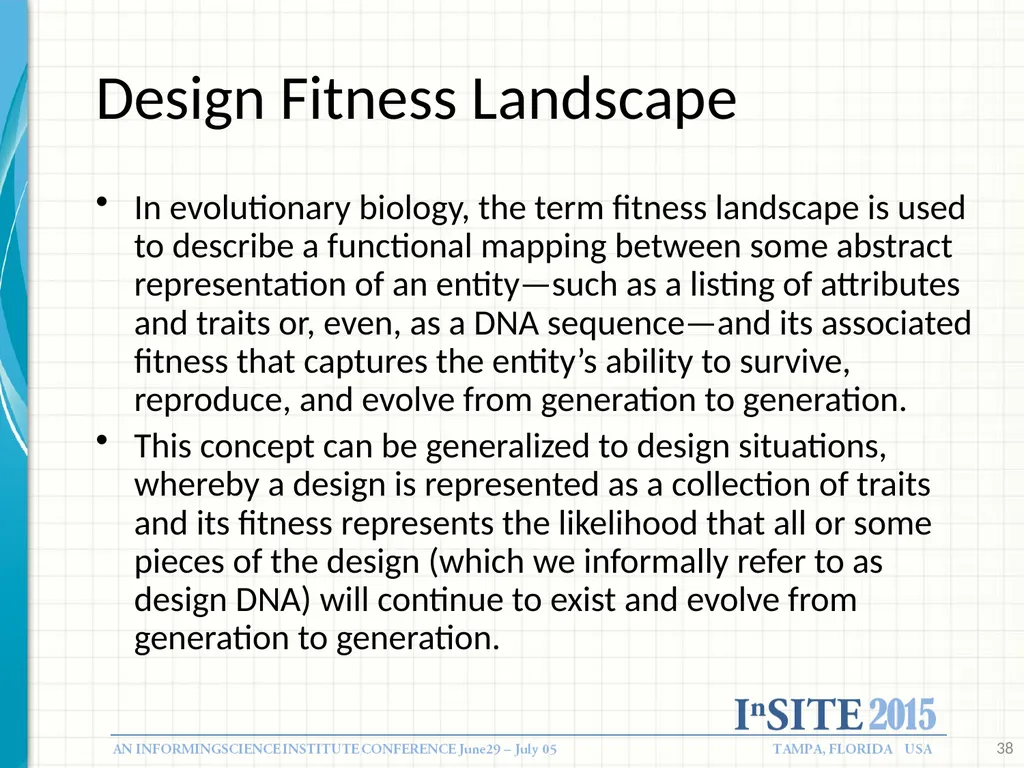
Design Fitness Landscape In evolutionary biology, the term fitness landscape is used to describe a functional mapping between some abstract representation of an entity—such as a listing of attributes and traits or, even, as a DNA sequence—and its associated fitness that captures the entity’s ability to survive, reproduce, and evolve from generation to generation.
This concept can be generalized to design situations, whereby a design is represented as a collection of traits and its fitness represents the likelihood that all or some pieces of the design (which we informally refer to as design DNA) will continue to exist and evolve from generation to generation. 38<br>
This concept can be generalized to design situations, whereby a design is represented as a collection of traits and its fitness represents the likelihood that all or some pieces of the design (which we informally refer to as design DNA) will continue to exist and evolve from generation to generation. 38<br>
39
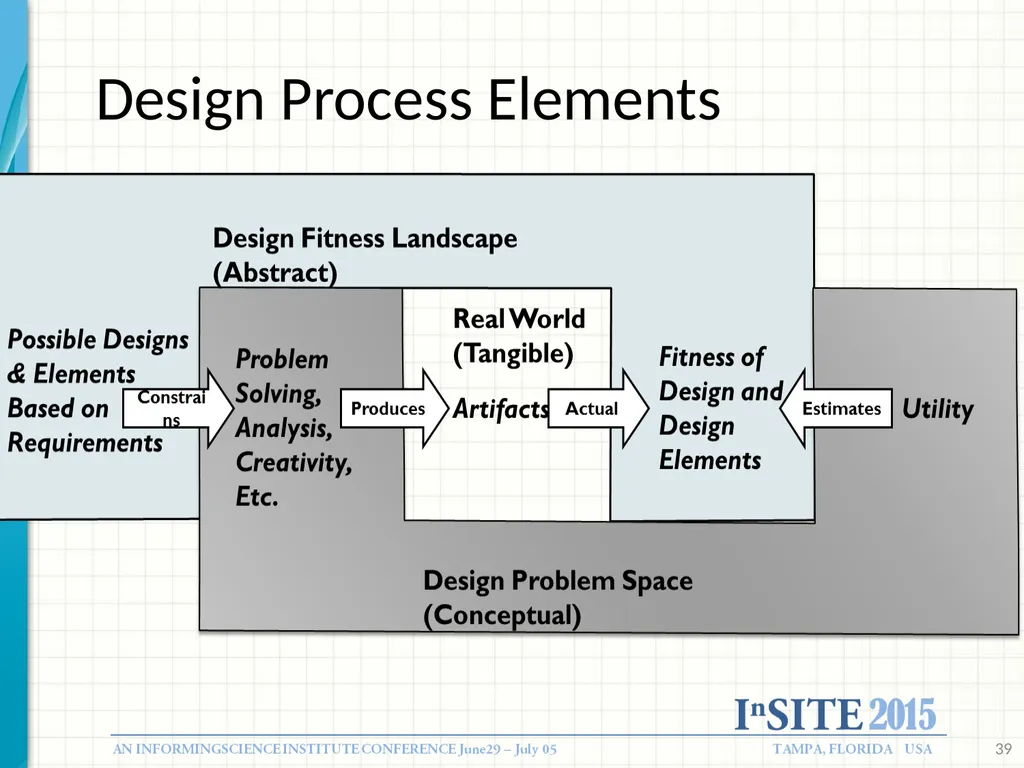
Design Process Elements 39<br>
40
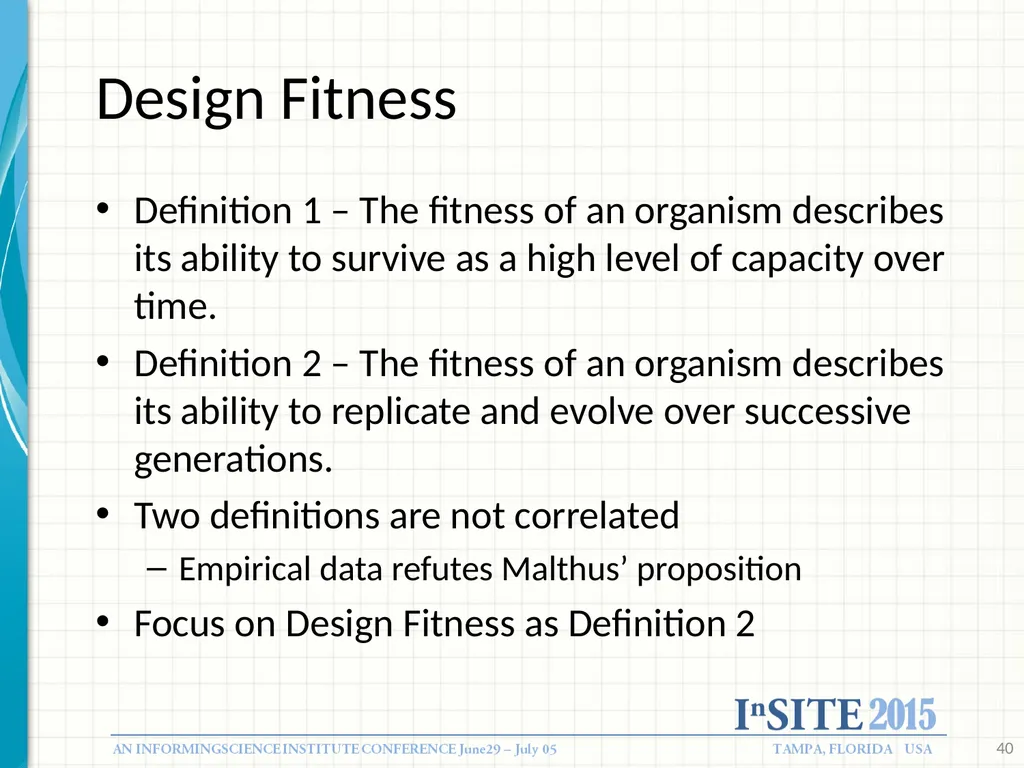
Design Fitness Definition 1 – The fitness of an organism describes its ability to survive as a high level of capacity over time.
Definition 2 – The fitness of an organism describes its ability to replicate and evolve over successive generations.
Two definitions are not correlated
Empirical data refutes Malthus’ proposition
Focus on Design Fitness as Definition 2 40<br>
Definition 2 – The fitness of an organism describes its ability to replicate and evolve over successive generations.
Two definitions are not correlated
Empirical data refutes Malthus’ proposition
Focus on Design Fitness as Definition 2 40<br>
41
Design Utility IS Artifact Utility typically means Usefulness
Efficacy to perform task
Ease of Use, Ease of Learning
Cost-Benefit vis-à-vis other artifacts
Economic Utility involves a complex Utility Function used to rank alternatives in order to Maximize Utility
Utility = u(x1, x2, …, xN)
Utility Characteristics
Income and consumption
Expectations and goals
Social context
Utility Function will vary for different application contexts 41<br>
Efficacy to perform task
Ease of Use, Ease of Learning
Cost-Benefit vis-à-vis other artifacts
Economic Utility involves a complex Utility Function used to rank alternatives in order to Maximize Utility
Utility = u(x1, x2, …, xN)
Utility Characteristics
Income and consumption
Expectations and goals
Social context
Utility Function will vary for different application contexts 41<br>
42
Evolutionary Economics Essentially, the human utility function is tuned to maximize evolutionary fitness on a fitness landscape
Higher fitness humans will crowd out lower fitness humans over time
Since fitness landscapes change over time, Evolutionary Stable Strategies (ESS) encourage traits that promote diversity and adaptation
While Human Evolution is slow, ICT Evolution is rapid, made more so by good DSR
What is a good design utility function to apply to a complex and evolving ICT fitness landscape? 42<br>
Higher fitness humans will crowd out lower fitness humans over time
Since fitness landscapes change over time, Evolutionary Stable Strategies (ESS) encourage traits that promote diversity and adaptation
While Human Evolution is slow, ICT Evolution is rapid, made more so by good DSR
What is a good design utility function to apply to a complex and evolving ICT fitness landscape? 42<br>
43
Fitness-Utility Model applied to DSR A design artifact has an associated fitness that designers estimate via design utility functions
Artifacts perform two roles in the design search process:
They provide evidence that a particular design candidate is feasible, has value, can be effectively represented, and can be built. This serves to help us better estimate the shape of the design fitness landscape
They provide a mechanism for communication between designers and for retaining information that might be imperfectly stored during the design process
Intentionality – Creative guidance that differentiates ICT design/evolution from human evolution
Search on the design space changes the design space by modifying the utility function of design fitness 43<br>
Artifacts perform two roles in the design search process:
They provide evidence that a particular design candidate is feasible, has value, can be effectively represented, and can be built. This serves to help us better estimate the shape of the design fitness landscape
They provide a mechanism for communication between designers and for retaining information that might be imperfectly stored during the design process
Intentionality – Creative guidance that differentiates ICT design/evolution from human evolution
Search on the design space changes the design space by modifying the utility function of design fitness 43<br>
44
Re-Framing DSR with Fitness-Utility The goal of DSR is to impact the design space so as to ensure a continuous flow of high fitness design artifacts. This impact is accomplished in two ways: through the production of artifacts that demonstrate the feasibility of new designs and through improving the utility function that we use to assess the fitness of evaluation artifacts. 44<br>
45
DSR Evaluation with Fitness-Utility As opposed to just Usefulness, the evaluation would be based on a more extensive and detailed utility function that estimates the evolutionary fitness of the artifact
Utility Function Attributes:
Support the design’s ability to evolve incrementally;
Encourage experimentation by users and other designers; and
Are effective memes, meaning that they contain ideas of a form that propagate and replicate. 45<br>
Utility Function Attributes:
Support the design’s ability to evolve incrementally;
Encourage experimentation by users and other designers; and
Are effective memes, meaning that they contain ideas of a form that propagate and replicate. 45<br>
46
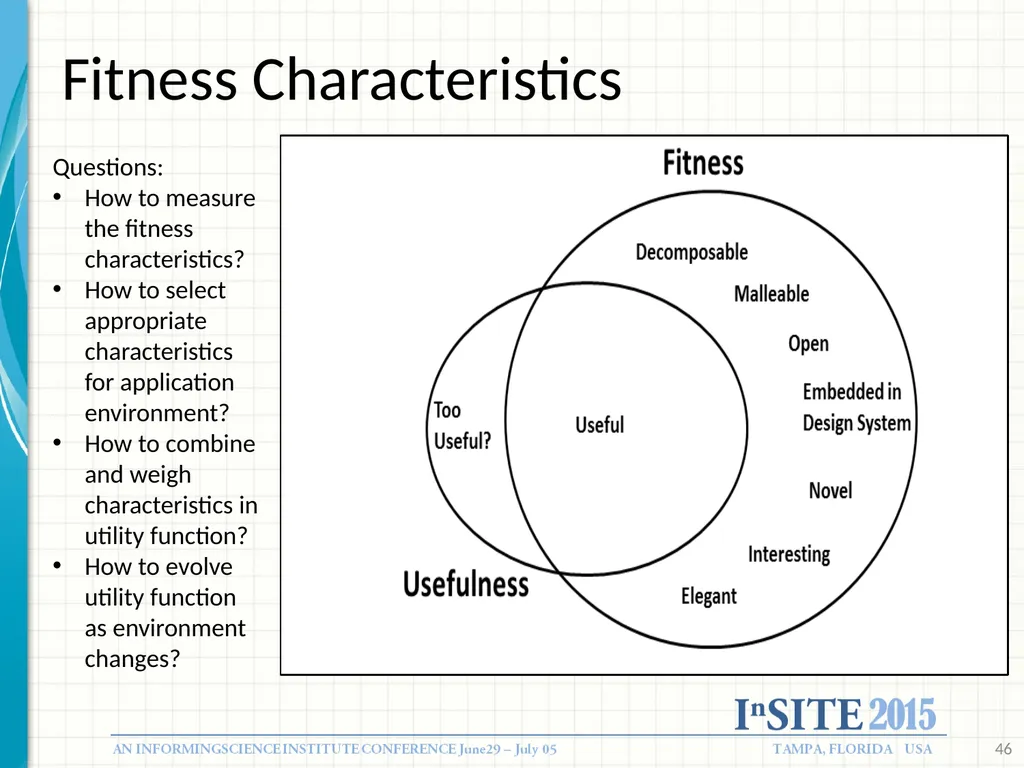
Fitness Characteristics 46 Questions:
How to measure the fitness characteristics?
How to select appropriate characteristics for application environment?
How to combine and weigh characteristics in utility function?
How to evolve utility function as environment changes?<br>
How to measure the fitness characteristics?
How to select appropriate characteristics for application environment?
How to combine and weigh characteristics in utility function?
How to evolve utility function as environment changes?<br>
47
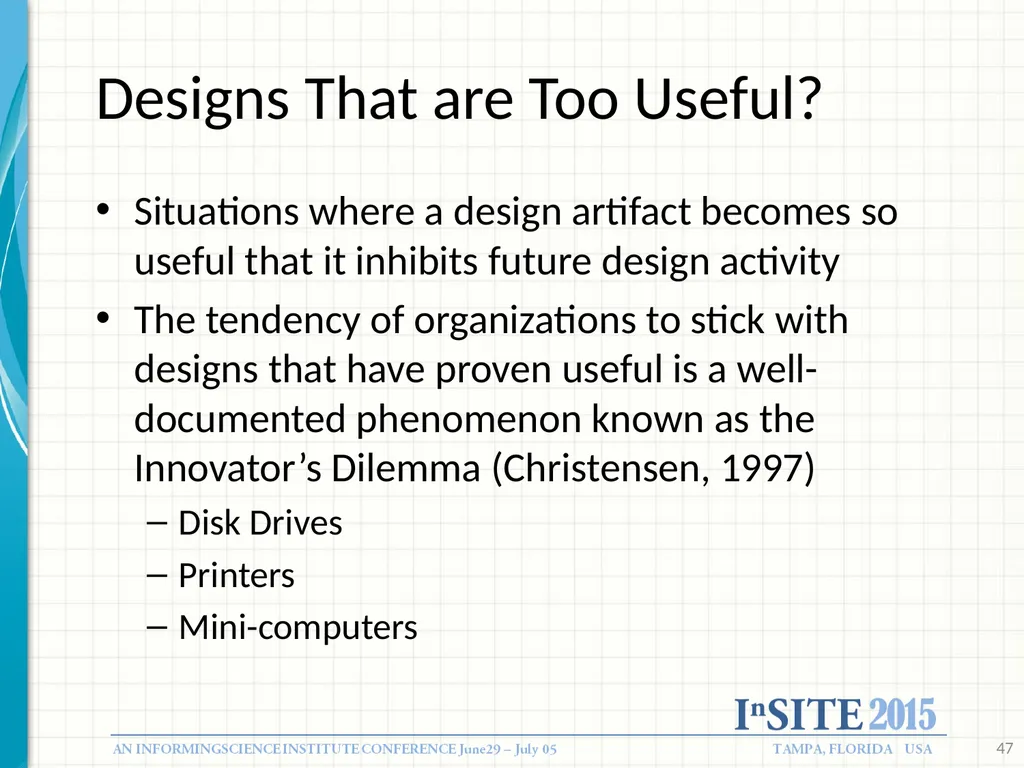
Designs That are Too Useful? Situations where a design artifact becomes so useful that it inhibits future design activity
The tendency of organizations to stick with designs that have proven useful is a well-documented phenomenon known as the Innovator’s Dilemma (Christensen, 1997)
Disk Drives
Printers
Mini-computers 47<br>
The tendency of organizations to stick with designs that have proven useful is a well-documented phenomenon known as the Innovator’s Dilemma (Christensen, 1997)
Disk Drives
Printers
Mini-computers 47<br>
48
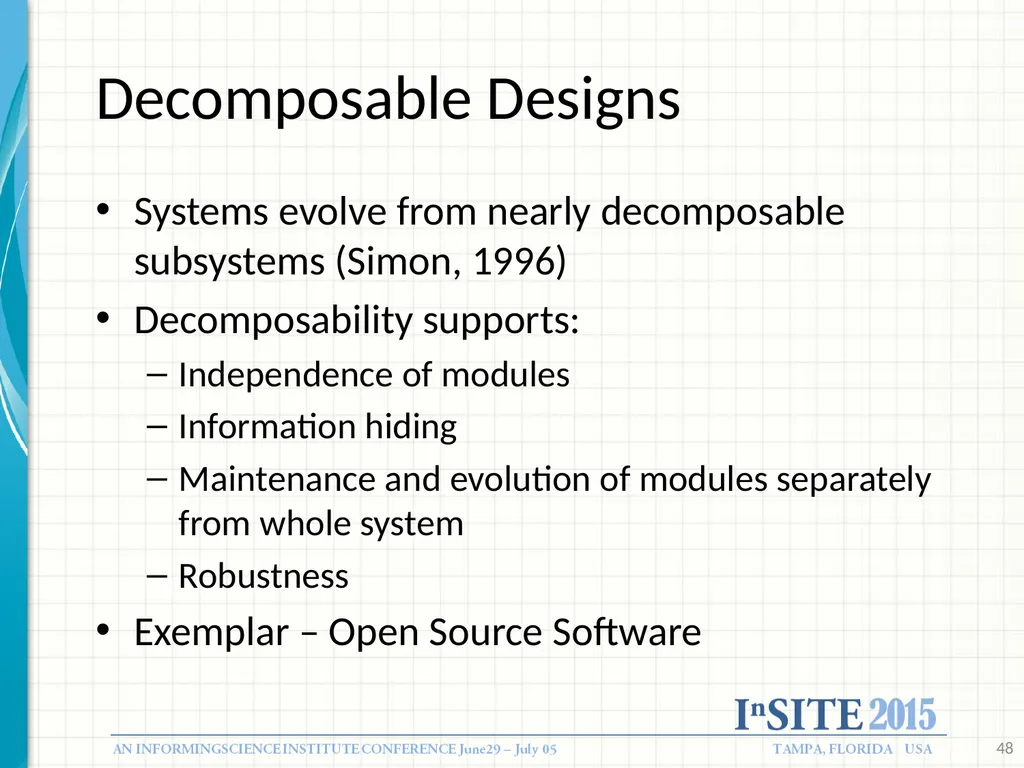
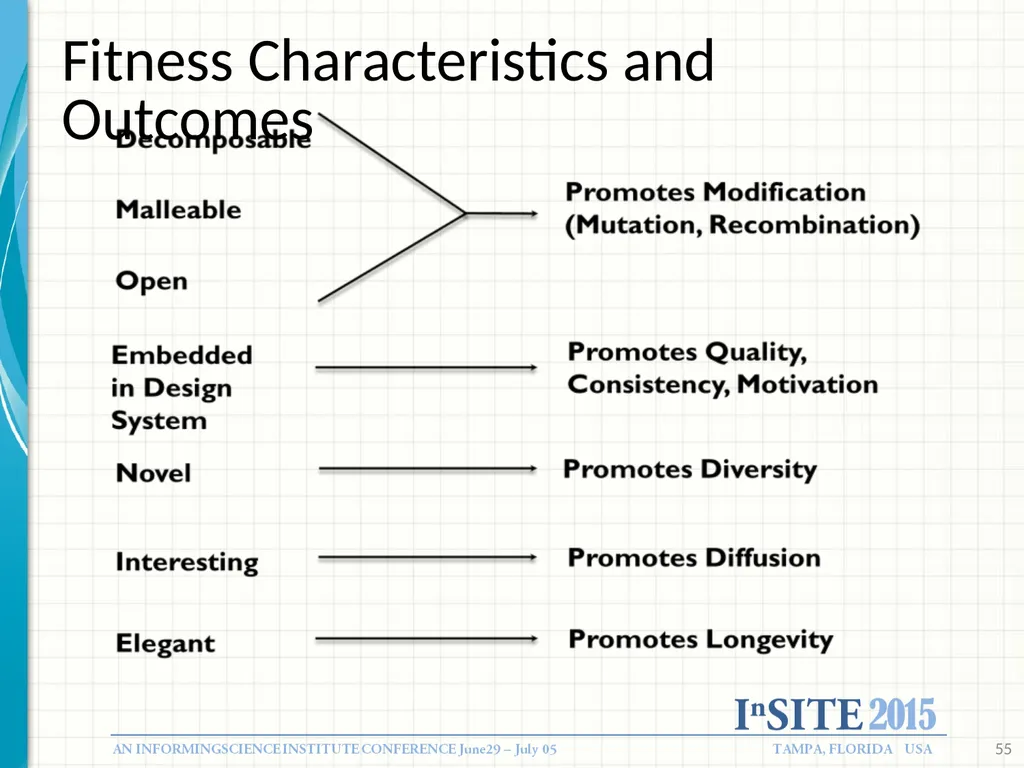
Decomposable Designs Systems evolve from nearly decomposable subsystems (Simon, 1996)
Decomposability supports:
Independence of modules
Information hiding
Maintenance and evolution of modules separately from whole system
Robustness
Exemplar – Open Source Software 48<br>
Decomposability supports:
Independence of modules
Information hiding
Maintenance and evolution of modules separately from whole system
Robustness
Exemplar – Open Source Software 48<br>
49
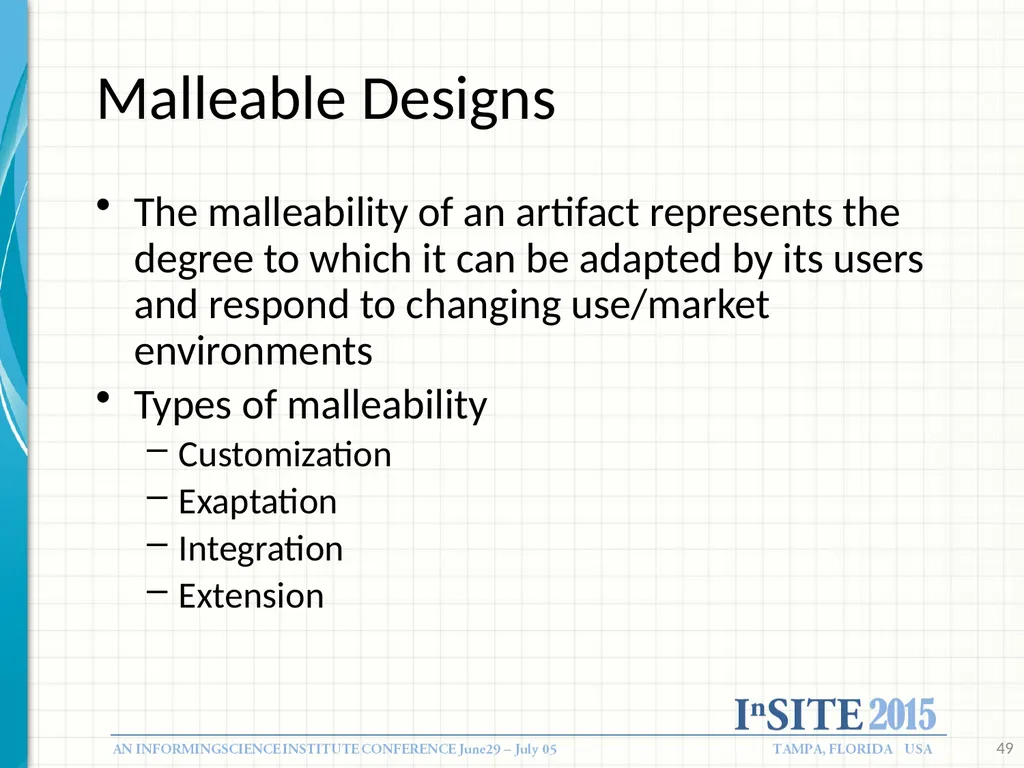
Malleable Designs The malleability of an artifact represents the degree to which it can be adapted by its users and respond to changing use/market environments
Types of malleability
Customization
Exaptation
Integration
Extension 49<br>
Types of malleability
Customization
Exaptation
Integration
Extension 49<br>
50
Open Designs Openness is the degree to which artifacts are open to inspection, modification, and reuse
Open designs—particularly when also imbued with decomposability and malleability—encourage further design evolution by making it easier both to see how an artifact is constructed and to modify existing components of the artifact
Exemplar – UNIX vs. LINUX 50<br>
Open designs—particularly when also imbued with decomposability and malleability—encourage further design evolution by making it easier both to see how an artifact is constructed and to modify existing components of the artifact
Exemplar – UNIX vs. LINUX 50<br>
51
Embedded in a Design System We would expect design artifacts that are the product of a sustainable design system environment to evolve more rapidly than artifacts that are produced in a context where design is an unusual activity
The particular purpose that such systems play is encouraging communication within and throughout the design process
A design system can also manifest itself as a community of users and designers, providing contributors with intrinsic motivation to contribute 51<br>
The particular purpose that such systems play is encouraging communication within and throughout the design process
A design system can also manifest itself as a community of users and designers, providing contributors with intrinsic motivation to contribute 51<br>
52
Design Novelty A design may be considered novel if it originates from an unexplored region of the design fitness landscape
While a particular novel design may be less individually fit than existing counterparts, where the landscape is dynamic the fitness of the population as whole benefits from having a sub-population of designers seeking novelty for its own sake, thereby ensuring design diversity 52<br>
While a particular novel design may be less individually fit than existing counterparts, where the landscape is dynamic the fitness of the population as whole benefits from having a sub-population of designers seeking novelty for its own sake, thereby ensuring design diversity 52<br>
53
Interesting Designs Designs are interesting when
An artifact may demonstrate unexpected emergent behaviors that are worthy of subsequent investigation and the creation of subsequent artifacts
An artifact may be constructed in an unexpected way that intrigues other designers or design researchers
The benefit of an interesting design is its propensity to diffuse—to be an effective meme 53<br>
An artifact may demonstrate unexpected emergent behaviors that are worthy of subsequent investigation and the creation of subsequent artifacts
An artifact may be constructed in an unexpected way that intrigues other designers or design researchers
The benefit of an interesting design is its propensity to diffuse—to be an effective meme 53<br>
54
Design Elegance The Form of an artifact describes aesthetic elements such as appearance that do not necessarily serve a useful purpose, yet nevertheless increase the user’s utility
Like quality, elegance is hard to define in a rigorous manner and yet characteristics that might be associated with it—such as compactness, simplicity, transparency of use, transparency of behavior, clarity of representation—can all lead to designs that invite surprise, delight, imitation, and enhancement 54<br>
Like quality, elegance is hard to define in a rigorous manner and yet characteristics that might be associated with it—such as compactness, simplicity, transparency of use, transparency of behavior, clarity of representation—can all lead to designs that invite surprise, delight, imitation, and enhancement 54<br>
55
Fitness Characteristics and Outcomes 55<br>
56
Pros of Fitness-Utility Model Fitness-Utility Model complements current thinking
Researcher is an active participant in the design system
Alternative bases for evaluating DSR impact
Aligns better with dynamic design environments
Recognizes limitations of intended usefulness
Encourages collaboration between researchers and designers in IS and other fields 56<br>
Researcher is an active participant in the design system
Alternative bases for evaluating DSR impact
Aligns better with dynamic design environments
Recognizes limitations of intended usefulness
Encourages collaboration between researchers and designers in IS and other fields 56<br>
57
Cons of Fitness-Utility Model Existing research standards do not reward design impacts based on new model – longitudinal studies needed to evaluate evolutionary impacts
Research is needed to understand how to evaluate design fitness
Rigor in Fitness-Utility research requires alternative (new?) research methods 57<br>
Research is needed to understand how to evaluate design fitness
Rigor in Fitness-Utility research requires alternative (new?) research methods 57<br>
58
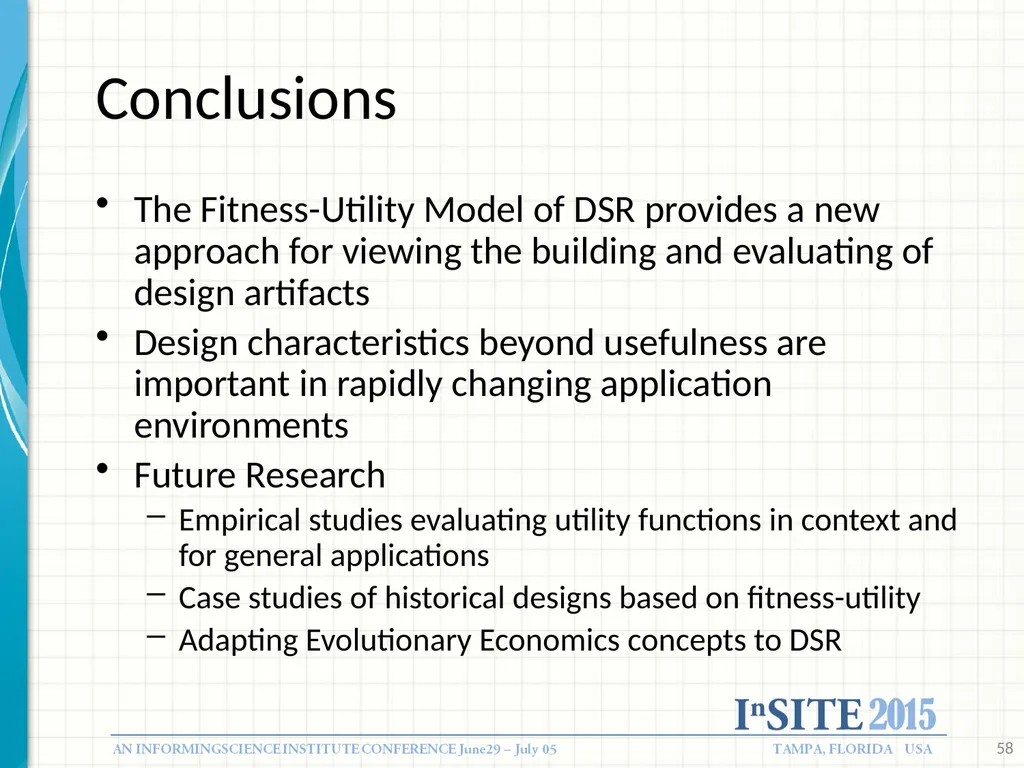
Conclusions The Fitness-Utility Model of DSR provides a new approach for viewing the building and evaluating of design artifacts
Design characteristics beyond usefulness are important in rapidly changing application environments
Future Research
Empirical studies evaluating utility functions in context and for general applications
Case studies of historical designs based on fitness-utility
Adapting Evolutionary Economics concepts to DSR 58<br>
Design characteristics beyond usefulness are important in rapidly changing application environments
Future Research
Empirical studies evaluating utility functions in context and for general applications
Case studies of historical designs based on fitness-utility
Adapting Evolutionary Economics concepts to DSR 58<br>
59
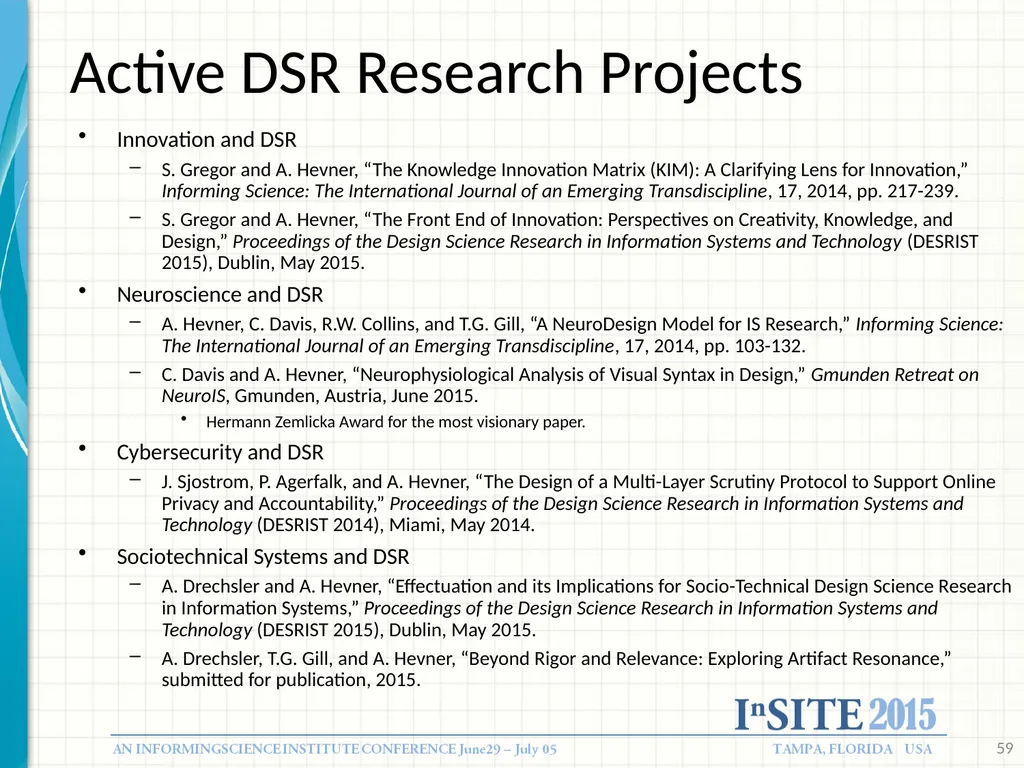
Active DSR Research Projects Innovation and DSR
S. Gregor and A. Hevner, “The Knowledge Innovation Matrix (KIM): A Clarifying Lens for Innovation,” Informing Science: The International Journal of an Emerging Transdiscipline, 17, 2014, pp. 217-239.
S. Gregor and A. Hevner, “The Front End of Innovation: Perspectives on Creativity, Knowledge, and Design,” Proceedings of the Design Science Research in Information Systems and Technology (DESRIST 2015), Dublin, May 2015.
Neuroscience and DSR
A. Hevner, C. Davis, R.W. Collins, and T.G. Gill, “A NeuroDesign Model for IS Research,” Informing Science: The International Journal of an Emerging Transdiscipline, 17, 2014, pp. 103-132.
C. Davis and A. Hevner, “Neurophysiological Analysis of Visual Syntax in Design,” Gmunden Retreat on NeuroIS, Gmunden, Austria, June 2015.
Hermann Zemlicka Award for the most visionary paper.
Cybersecurity and DSR
J. Sjostrom, P. Agerfalk, and A. Hevner, “The Design of a Multi-Layer Scrutiny Protocol to Support Online Privacy and Accountability,” Proceedings of the Design Science Research in Information Systems and Technology (DESRIST 2014), Miami, May 2014.
Sociotechnical Systems and DSR
A. Drechsler and A. Hevner, “Effectuation and its Implications for Socio-Technical Design Science Research in Information Systems,” Proceedings of the Design Science Research in Information Systems and Technology (DESRIST 2015), Dublin, May 2015.
A. Drechsler, T.G. Gill, and A. Hevner, “Beyond Rigor and Relevance: Exploring Artifact Resonance,” submitted for publication, 2015. 59<br>
S. Gregor and A. Hevner, “The Knowledge Innovation Matrix (KIM): A Clarifying Lens for Innovation,” Informing Science: The International Journal of an Emerging Transdiscipline, 17, 2014, pp. 217-239.
S. Gregor and A. Hevner, “The Front End of Innovation: Perspectives on Creativity, Knowledge, and Design,” Proceedings of the Design Science Research in Information Systems and Technology (DESRIST 2015), Dublin, May 2015.
Neuroscience and DSR
A. Hevner, C. Davis, R.W. Collins, and T.G. Gill, “A NeuroDesign Model for IS Research,” Informing Science: The International Journal of an Emerging Transdiscipline, 17, 2014, pp. 103-132.
C. Davis and A. Hevner, “Neurophysiological Analysis of Visual Syntax in Design,” Gmunden Retreat on NeuroIS, Gmunden, Austria, June 2015.
Hermann Zemlicka Award for the most visionary paper.
Cybersecurity and DSR
J. Sjostrom, P. Agerfalk, and A. Hevner, “The Design of a Multi-Layer Scrutiny Protocol to Support Online Privacy and Accountability,” Proceedings of the Design Science Research in Information Systems and Technology (DESRIST 2014), Miami, May 2014.
Sociotechnical Systems and DSR
A. Drechsler and A. Hevner, “Effectuation and its Implications for Socio-Technical Design Science Research in Information Systems,” Proceedings of the Design Science Research in Information Systems and Technology (DESRIST 2015), Dublin, May 2015.
A. Drechsler, T.G. Gill, and A. Hevner, “Beyond Rigor and Relevance: Exploring Artifact Resonance,” submitted for publication, 2015. 59<br>
60
Discussion and Questions 60<br>