Detecting Sexually Provocative Images Debashis Ganguly, Mohammad H. Mofrad, Adriana Kovashka Department of Computer Science, University of Pittsburgh Real Life Challenges Overwhelming amount of visual data on the Internet Parents may want
"Detecting Sexually Provocative Images Debashis" is the property of its rightful owner. Permission is granted to
download and print the materials on this website for personal, non-commercial use only, and to display it
on your personal computer provided you do not modify the materials and that you retain all copyright
notices contained in the materials. By downloading content from our website, you accept the terms of this
agreement.
Presentation Transcript
01
Detecting Sexually Provocative Images Debashis Ganguly,
Mohammad H. Mofrad,
Adriana Kovashka
Department of Computer Science,
University of Pittsburgh<br>
02
Real Life Challenges Overwhelming amount of visual data on the Internet
Parents may want to restrict the visual contents which their children can see.
Lots of manual effort is invested by digital content administrators to classify images in age restricted categories.<br>
03
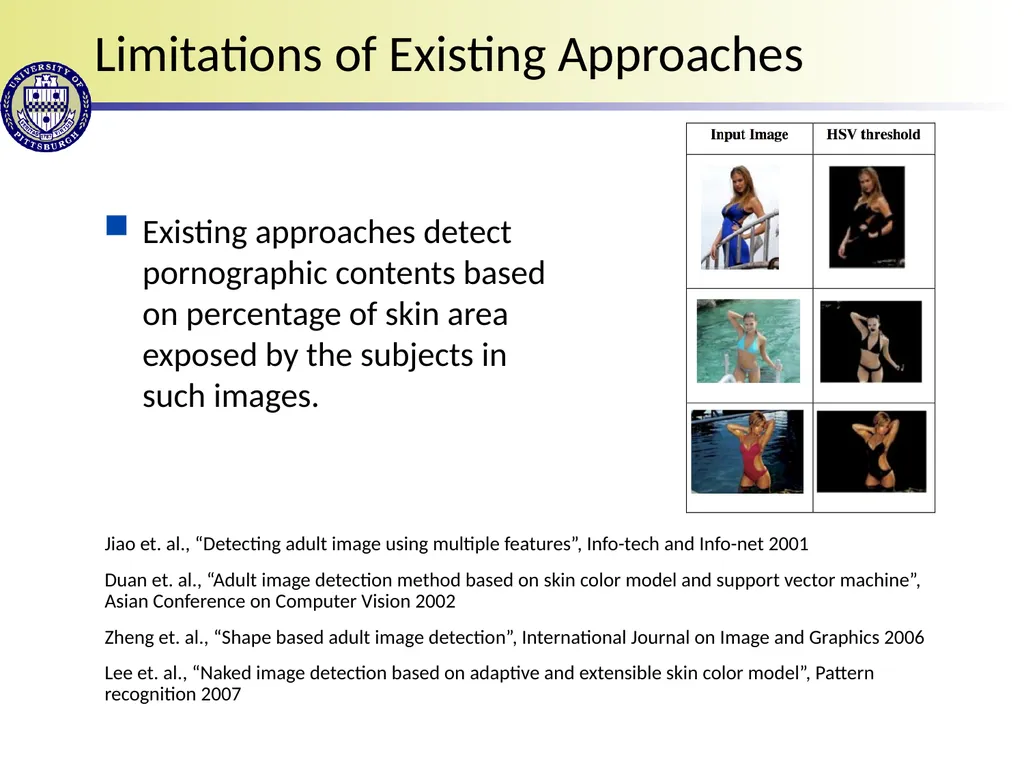
Limitations of Existing Approaches Existing approaches detect pornographic contents based on percentage of skin area exposed by the subjects in such images. Jiao et. al., “Detecting adult image using multiple features”, Info-tech and Info-net 2001
Duan et. al., “Adult image detection method based on skin color model and support vector machine”, Asian Conference on Computer Vision 2002
Zheng et. al., “Shape based adult image detection”, International Journal on Image and Graphics 2006
Lee et. al., “Naked image detection based on adaptive and extensible skin color model”, Pattern recognition 2007<br>
04
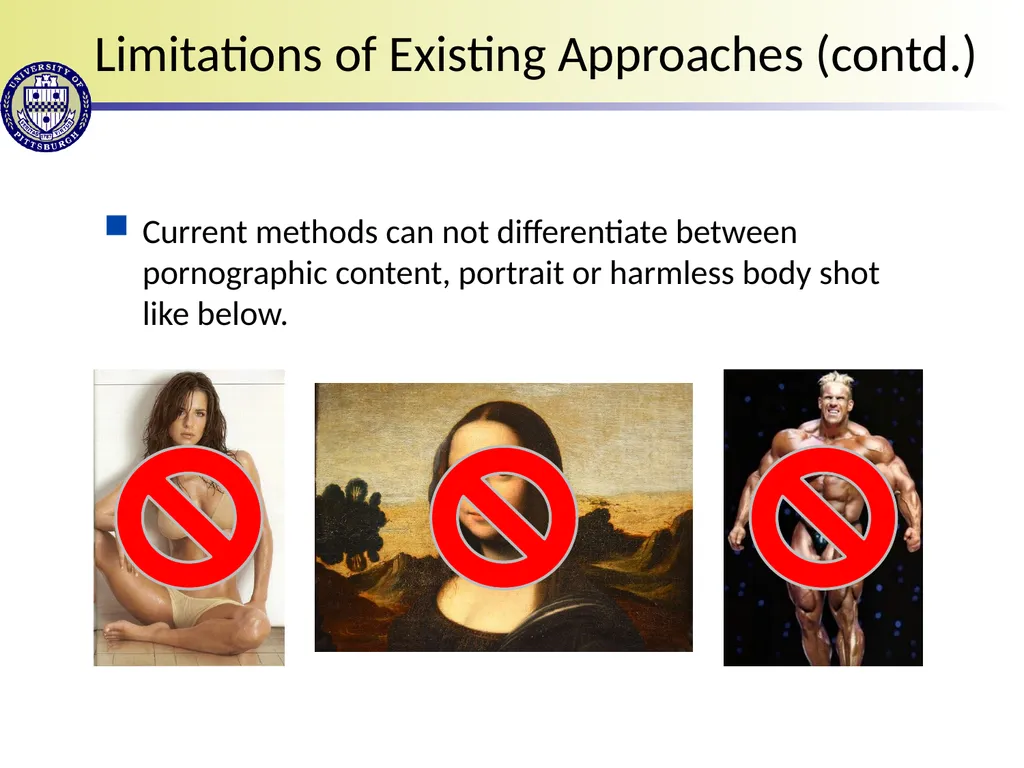
Limitations of Existing Approaches (contd.) Current methods can not differentiate between pornographic content, portrait or harmless body shot like below.<br>
05
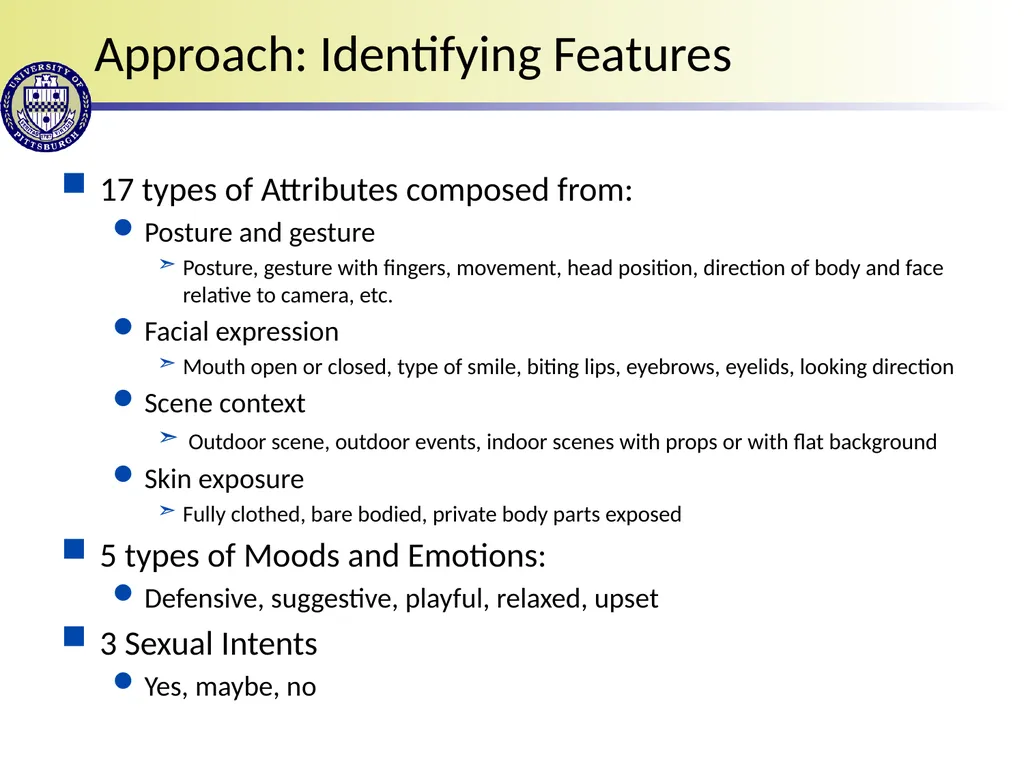
Approach: Identifying Features 17 types of Attributes composed from:
Posture and gesture
Posture, gesture with fingers, movement, head position, direction of body and face relative to camera, etc.
Facial expression
Mouth open or closed, type of smile, biting lips, eyebrows, eyelids, looking direction
Scene context
Outdoor scene, outdoor events, indoor scenes with props or with flat background
Skin exposure
Fully clothed, bare bodied, private body parts exposed
5 types of Moods and Emotions:
Defensive, suggestive, playful, relaxed, upset
3 Sexual Intents
Yes, maybe, no<br>
06
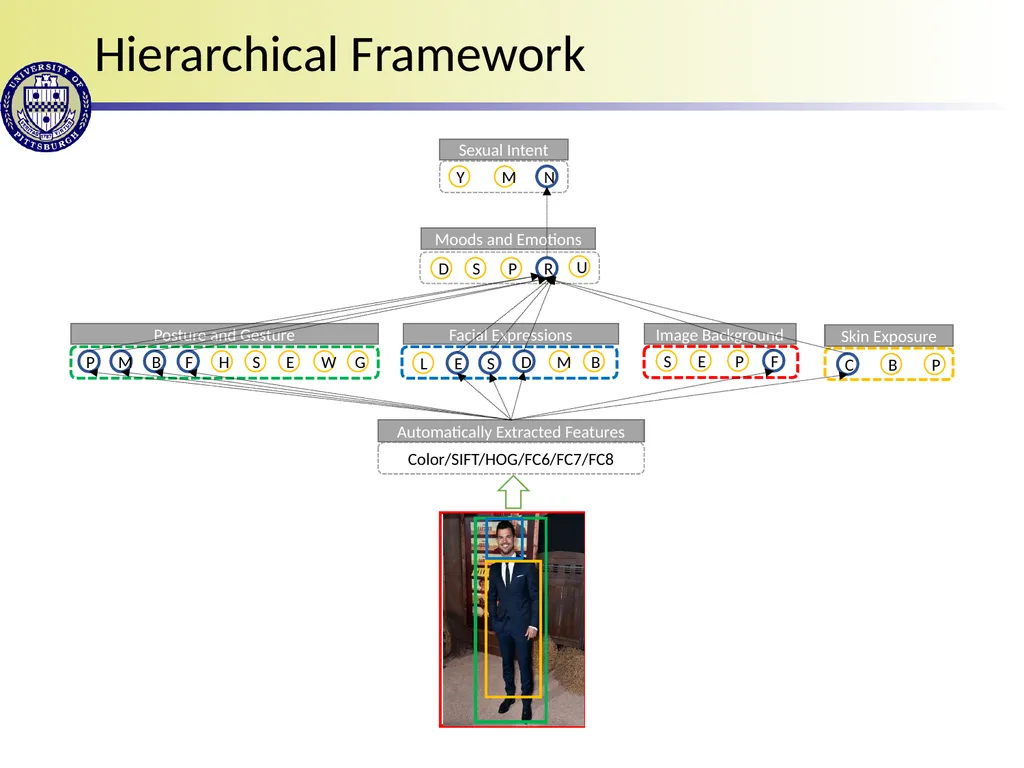
Hierarchical Framework<br>
07
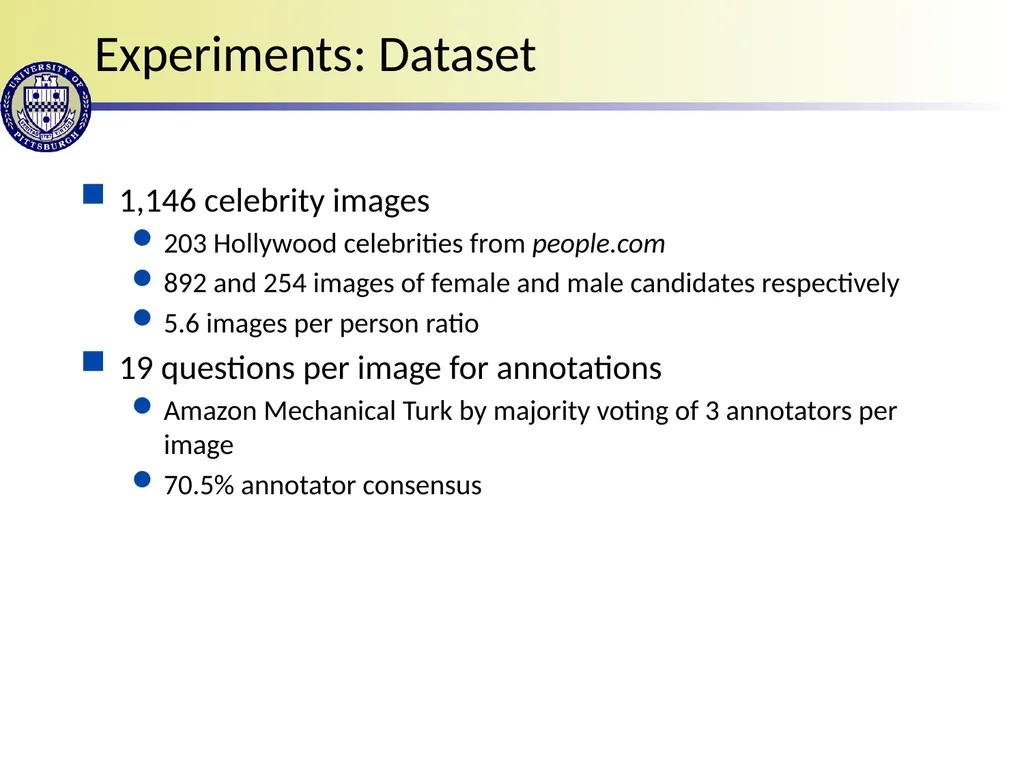
Experiments: Dataset 1,146 celebrity images
203 Hollywood celebrities from people.com
892 and 254 images of female and male candidates respectively
5.6 images per person ratio
19 questions per image for annotations
Amazon Mechanical Turk by majority voting of 3 annotators per image
70.5% annotator consensus<br>
08
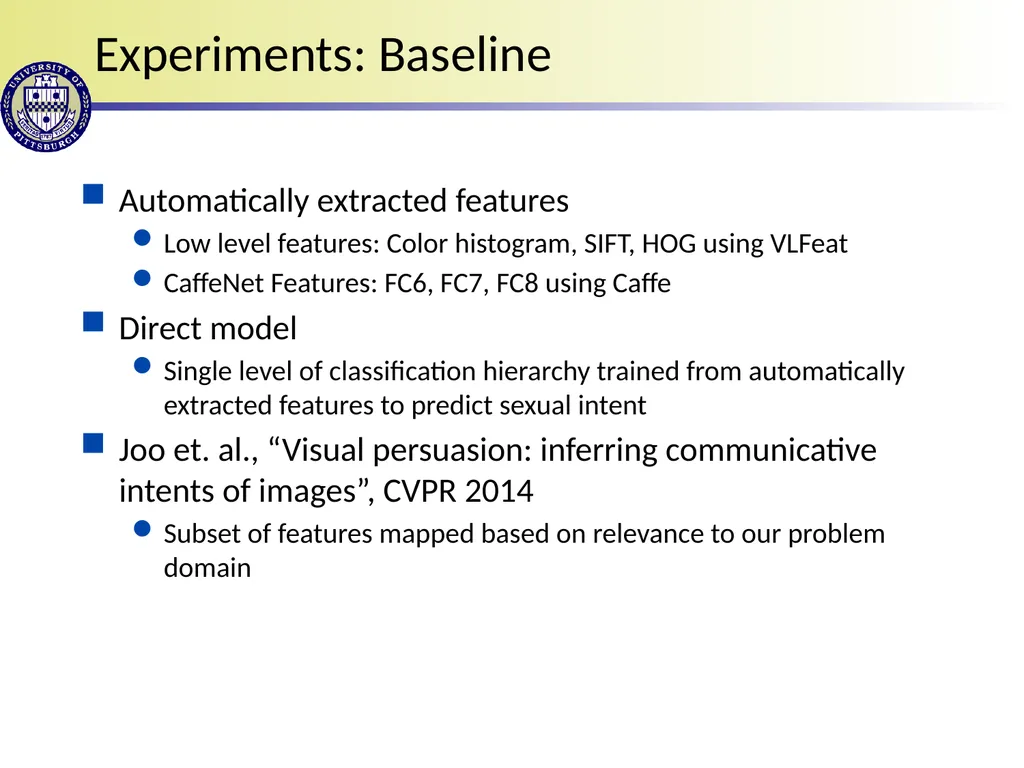
Experiments: Baseline Automatically extracted features
Low level features: Color histogram, SIFT, HOG using VLFeat
CaffeNet Features: FC6, FC7, FC8 using Caffe
Direct model
Single level of classification hierarchy trained from automatically extracted features to predict sexual intent
Joo et. al., “Visual persuasion: inferring communicative intents of images”, CVPR 2014
Subset of features mapped based on relevance to our problem domain<br>
09
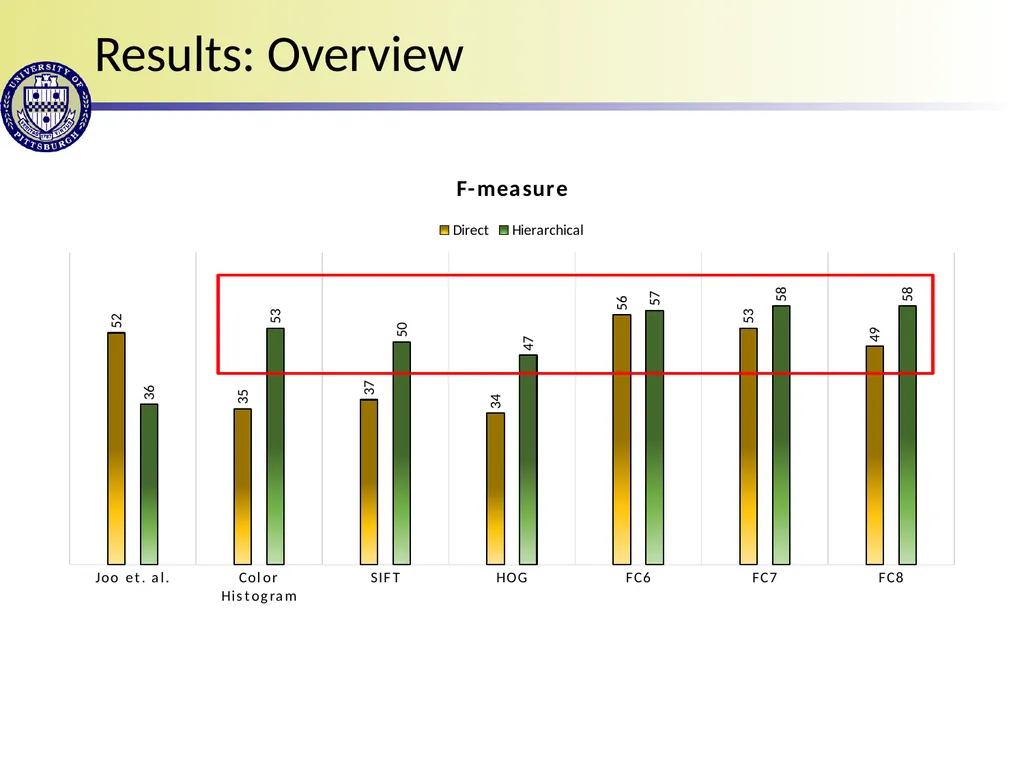
Results: Overview<br>
10
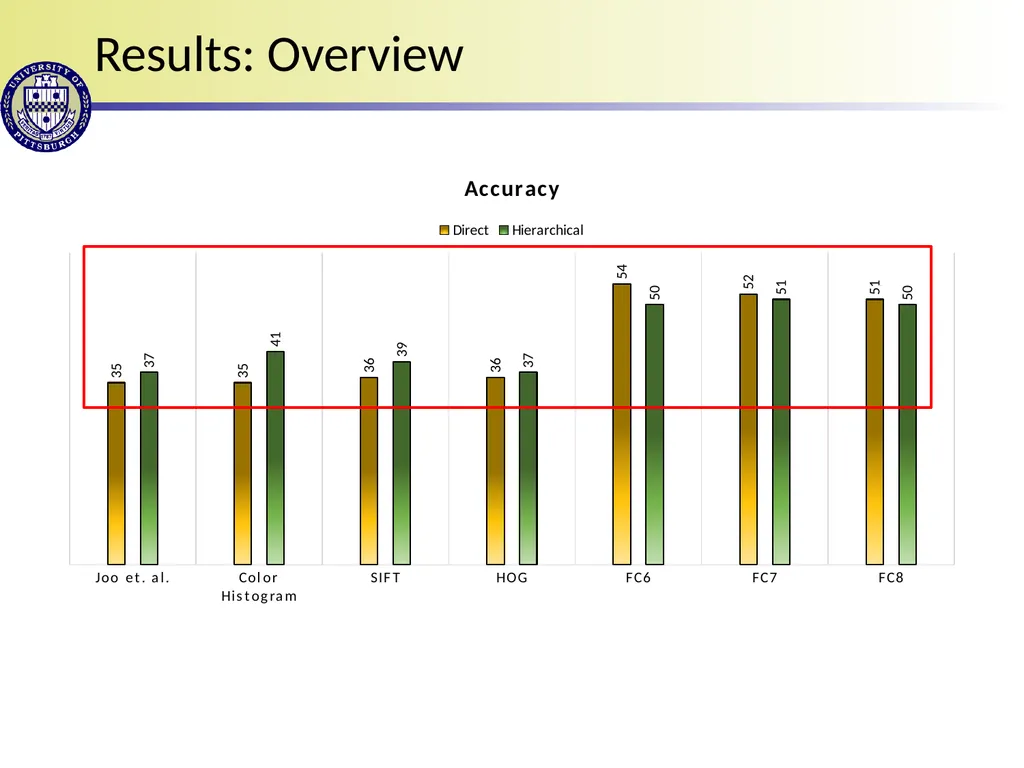
Results: Overview<br>
11
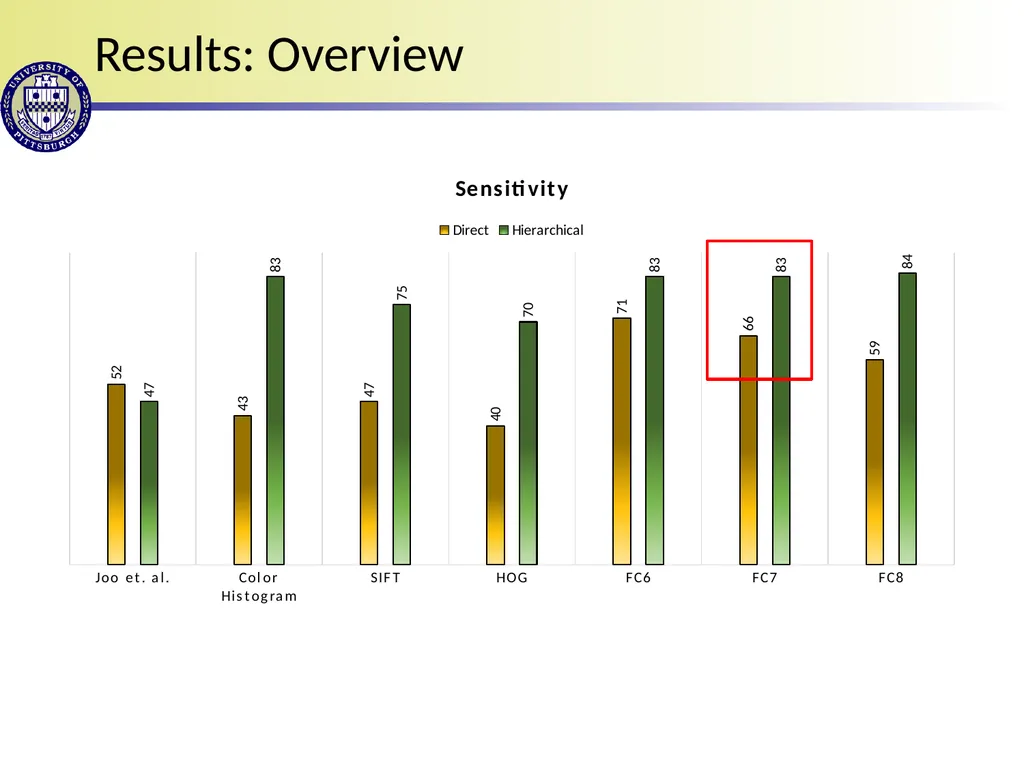
Results: Overview<br>
12
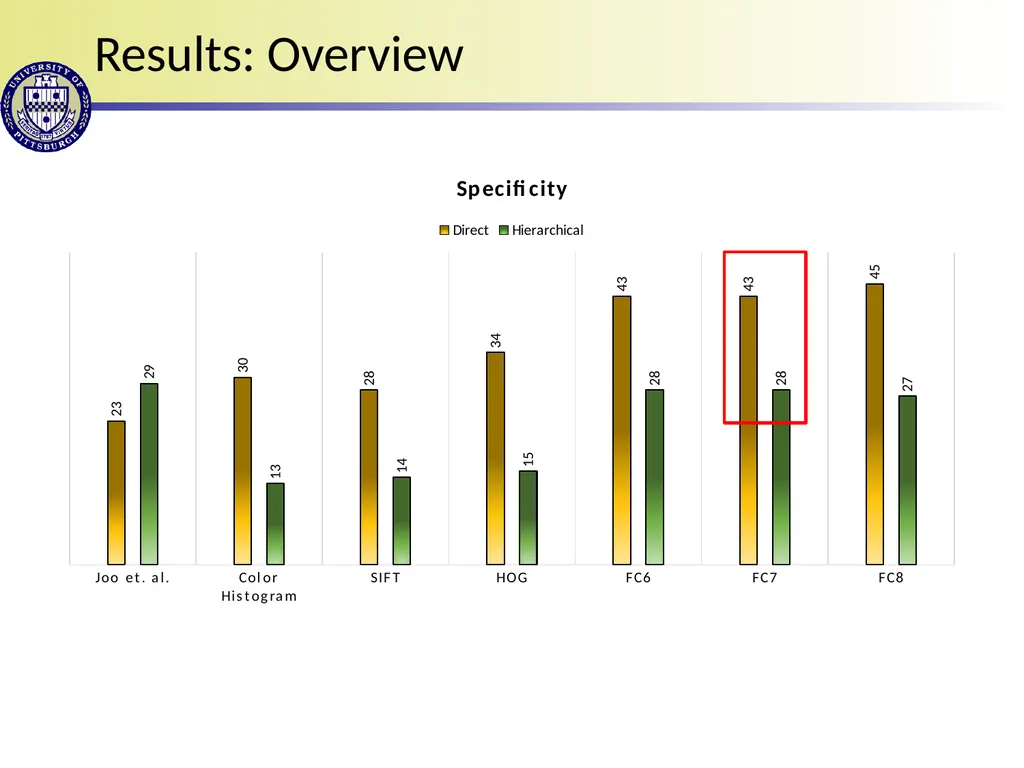
Results: Overview<br>
13
Conclusion Our method enables automated contents classification based on behaviors and intents of the portrayed subjects.
It allows prompt intervention of human experts upon integrating the proposed methodology with mobile apps, social media websites, and media streaming websites.<br>