
Developing intercultural citizenship in the
Description: Developing intercultural citizenship in the digital age Undergraduate students perspectives on Intercultural Communicative Competence in Higher Education. By Jolanta Hudson EAP Lecturer at University of Glasgow, PhD Researcher at Lancaster
Related Topics
Download Presentation
"Developing intercultural citizenship in the" is the property of its rightful owner. Permission is granted to download and print the materials on this website for personal, non-commercial use only, and to display it on your personal computer provided you do not modify the materials and that you retain all copyright notices contained in the materials. By downloading content from our website, you accept the terms of this agreement.
Presentation Transcript
slide1. Developing intercultural citizenship in the digital age Undergraduate students’ perspectives on Intercultural Communicative Competence in Higher Education. By Jolanta Hudson
EAP Lecturer at University of Glasgow, PhD Researcher at Lancaster University BALEAP PIM
Leeds 2022<br>
slide2. Contents Background
Introduction
Literature Review
Theoretical Framework
Participants
Findings
Limitations
References<br>
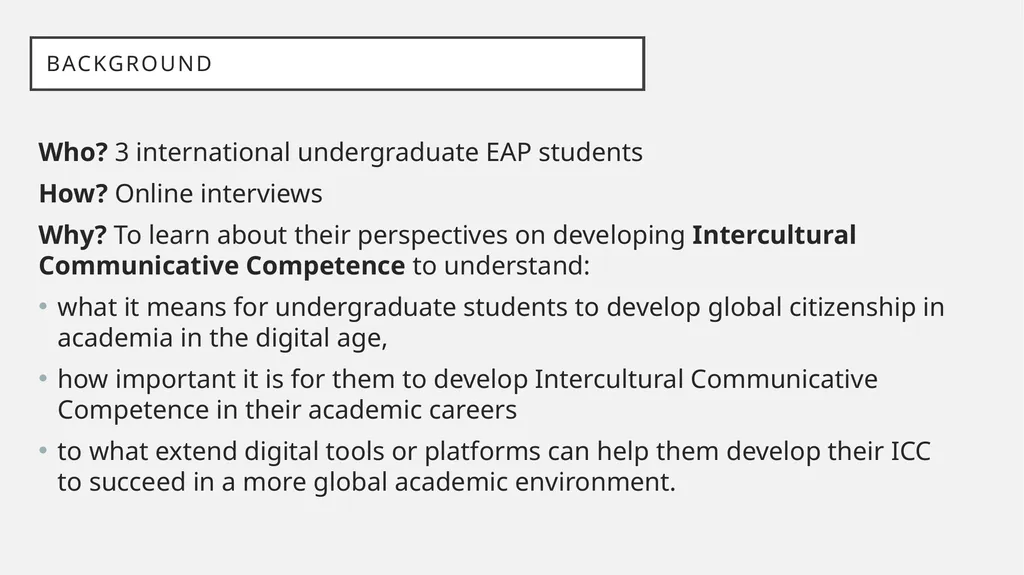
slide3. Background Who? 3 international undergraduate EAP students
How? Online interviews
Why? To learn about their perspectives on developing Intercultural Communicative Competence to understand:
what it means for undergraduate students to develop global citizenship in academia in the digital age,
how important it is for them to develop Intercultural Communicative Competence in their academic careers
to what extend digital tools or platforms can help them develop their ICC to succeed in a more global academic environment.<br>
slide4. Introduction Intercultural citizenship is especially relevant to student mobility in English medium instruction (EMI) programmes in international universities, where students are by definition in intercultural contexts in which intercultural communication and associated linguistic and cultural issues are central. (Baker and Fang, 2019:5)
Intercultural, also known as, global citizenship is typically perceived as the citizenship that is extended beyond national borders that recognises the importance and scale of social relations and communication within local as well as global communities (Byram, 2008).<br>
slide5. Literature Many research studies have discussed the importance of intercultural citizenship in HE, but a few researchers have investigated aspects of developing intercultural competence through the eyes of undergraduate students studying abroad during current times with the increased use of digital tools and platforms.<br>
slide6. The ICC, Byram’s model & EAP The ICC model was developed in relation to the Council of Europe’s project which was to construct the Common European Framework of Reference for Languages (CEFR) (2001) in the late 1990s.
Byram’s (1997) ICC model refers to:
“attitudes, knowledge, skills of interpreting and relating, skills of discovery and interaction, and critical awareness” (Çiftçi, 2016:313)
and it has been of particular importance in the area of language education having influenced language course designs and curriculum development in several countries.<br>
slide7. Language and Culture In Byram’s model:
ICC is described as an important factor in developing effective language skills by Second Language (L2) students through engaging and communicating with other cultures (Byram, 1997; 2000)
Equally focuses on both language and culture (Liu, 2019)
Developing ICC enables L2 speakers to not only communicate effectively with others taking into account their point of view but also helps them to build relationships with them (López-Rocha (2016)
IC is perceived by Byram’s (1997: 71) as “people’s ability to interact in their own language with the people from another country and culture”, ICC according to Byram (ibid.) is “the ability to interact with people from another country and culture in a foreign language”.<br>
slide8. BEING A GLOBAL CITIZEN IN HIGHER EDUCATION Findings indicated strong associations between participants’ academic achievement, satisfaction with life in the new environment and psychological well-being, and aspects of their intercultural competence, contact with non-co-nationals, including hosts, and with their language proficiency (Young et al., 2013: 151)
In an intercultural approach, it is a central objective of language learning to promote the favourable development of the learner’s whole personality and sense of identity in response to the enriching experience of otherness in language and culture. (Corbett, 2010:1)<br>
slide9. DEVELOPING INTERCULTURAL CITIZENSHIP IN THE DIGITAL ERA The limitations of Byram’s model:
significant development of technologies in recent times has changed the way communication and exchange take place which is different from what was affordable in the 90s (Chen, 2012)
the widespread use of the internet (Dooney, 2009) and social media
online text and the use of visuals to share and communicate cultural content has changed the meaning of ICC required to succeed in academia by including computer-mediated communication (CMC) as the alternative to face-to-face interaction (Kramsch, 2011).
Multicultural teamworking is likely to be a considerable transferable skill for graduates, contributing, on the evidence of this study, to their academic success. It is also highly likely to be applicable to people’s future professional lives in a globalising world where international and intercultural contacts are of increasing salience. (Young, et al., 2013:167).<br>
slide10. The Study The Participants:
3 students who were participating in the Erasmus programme were enrolled on Arts and Engineering courses.
All students were attending EAP classes to support their undergraduate studies. 2 participants were males, one was a female student.
Their ages ranged from 23-24.
The participants were EU nationals therefore, they were likely to have a similar educational background. They all had a minimum of CEFR B2 level in English required for enrolling on the programme.<br>
slide11. The results What does it mean for undergraduate students to develop global citizenship in academia in the digital age?
So, I see the language barrier more as a competence…I mean sure if you talk to international people, the culture, beliefs are different (Participant 2)
The most important thing, probably, is that I can actually get into contact with people from completely different cultures, who I wouldn't be able to meet in person. (Participant 3)
…what the approach of another culture is for me personally, sometimes I really can't understand how other people think, or how other people are (Participant 1)<br>
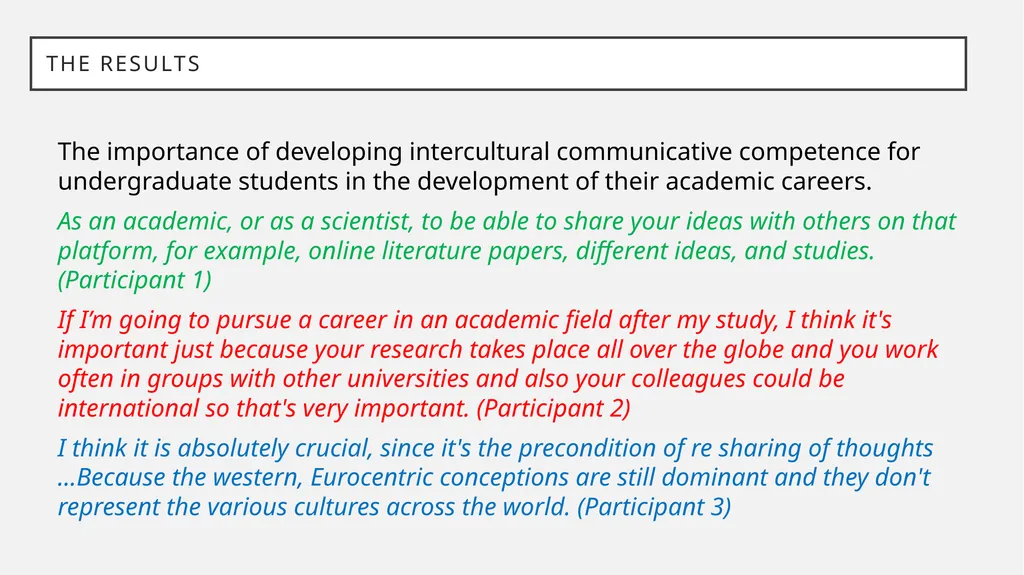
slide12. The results The importance of developing intercultural communicative competence for undergraduate students in the development of their academic careers.
As an academic, or as a scientist, to be able to share your ideas with others on that platform, for example, online literature papers, different ideas, and studies. (Participant 1)
If I’m going to pursue a career in an academic field after my study, I think it's important just because your research takes place all over the globe and you work often in groups with other universities and also your colleagues could be international so that's very important. (Participant 2)
I think it is absolutely crucial, since it's the precondition of re sharing of thoughts …Because the western, Eurocentric conceptions are still dominant and they don't represent the various cultures across the world. (Participant 3)<br>
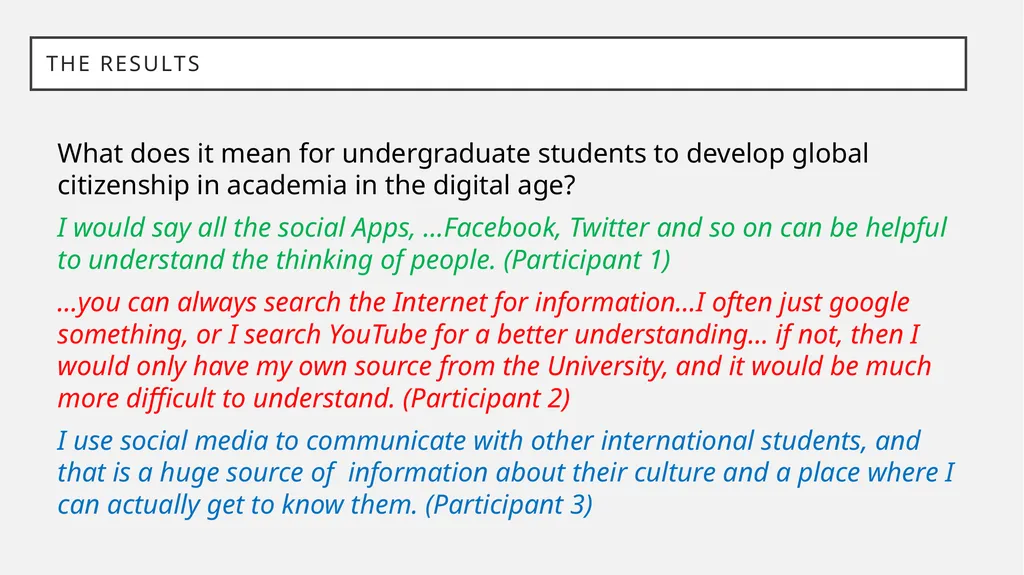
slide13. The results What does it mean for undergraduate students to develop global citizenship in academia in the digital age?
I would say all the social Apps, …Facebook, Twitter and so on can be helpful to understand the thinking of people. (Participant 1)
…you can always search the Internet for information…I often just google something, or I search YouTube for a better understanding… if not, then I would only have my own source from the University, and it would be much more difficult to understand. (Participant 2)
I use social media to communicate with other international students, and that is a huge source of information about their culture and a place where I can actually get to know them. (Participant 3)<br>
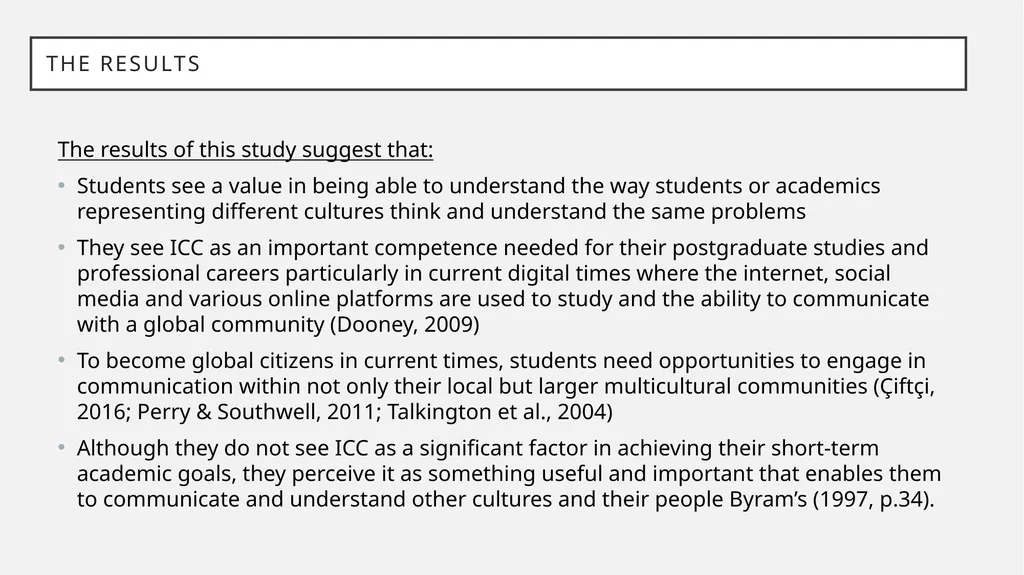
slide14. The results The results of this study suggest that:
Students see a value in being able to understand the way students or academics representing different cultures think and understand the same problems
They see ICC as an important competence needed for their postgraduate studies and professional careers particularly in current digital times where the internet, social media and various online platforms are used to study and the ability to communicate with a global community (Dooney, 2009)
To become global citizens in current times, students need opportunities to engage in communication within not only their local but larger multicultural communities (Çiftçi, 2016; Perry & Southwell, 2011; Talkington et al., 2004)
Although they do not see ICC as a significant factor in achieving their short-term academic goals, they perceive it as something useful and important that enables them to communicate and understand other cultures and their people Byram’s (1997, p.34).<br>
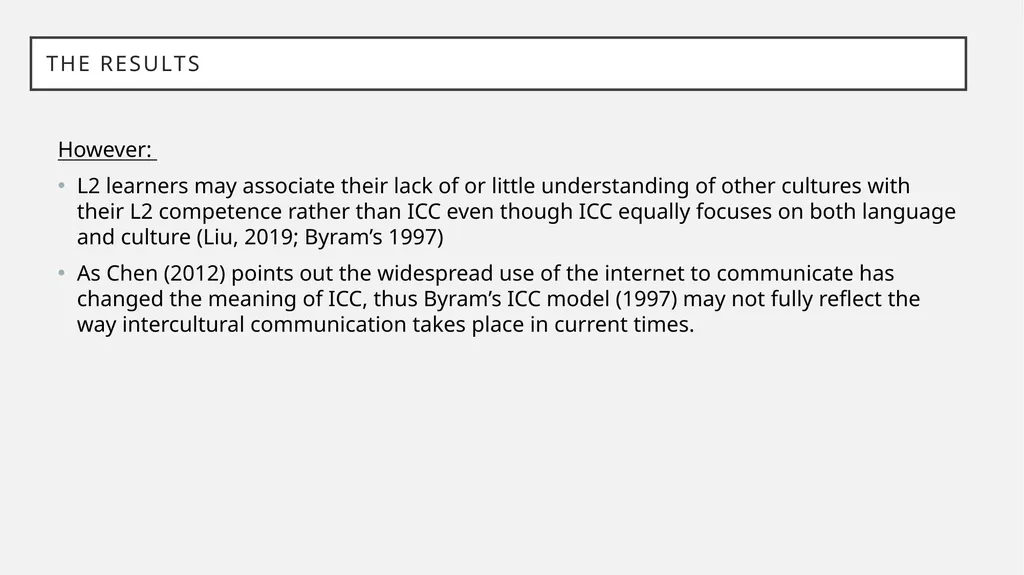
slide15. The results However:
L2 learners may associate their lack of or little understanding of other cultures with their L2 competence rather than ICC even though ICC equally focuses on both language and culture (Liu, 2019; Byram’s 1997)
As Chen (2012) points out the widespread use of the internet to communicate has changed the meaning of ICC, thus Byram’s ICC model (1997) may not fully reflect the way intercultural communication takes place in current times.<br>
slide16. Limitations small sample
lack of diversity among the participants
However:
As this study offers support for the findings of previous researchers and provides new insights into the research, this to some extent increases not only its validity and reliability but also that of other researchers.
Thank you
Jolanta.hudson@glasgow.ac.uk
j.hudson6@lancaster.ac.uk<br>
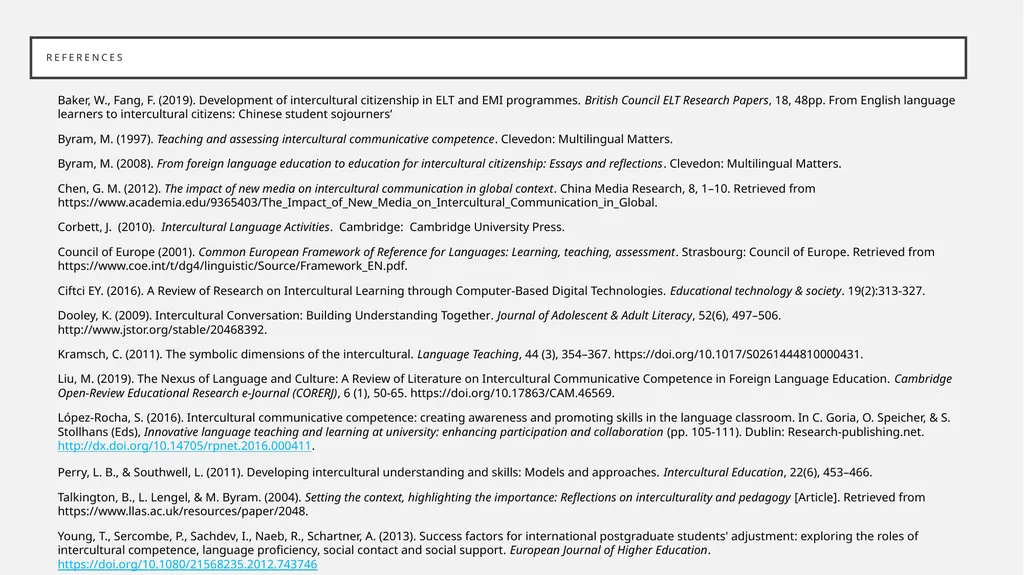
slide17. References Baker, W., Fang, F. (2019). Development of intercultural citizenship in ELT and EMI programmes. British Council ELT Research Papers, 18, 48pp. From English language learners to intercultural citizens: Chinese student sojourners’
Byram, M. (1997). Teaching and assessing intercultural communicative competence. Clevedon: Multilingual Matters.
Byram, M. (2008). From foreign language education to education for intercultural citizenship: Essays and reflections. Clevedon: Multilingual Matters.
Chen, G. M. (2012). The impact of new media on intercultural communication in global context. China Media Research, 8, 1–10. Retrieved from https://www.academia.edu/9365403/The_Impact_of_New_Media_on_Intercultural_Communication_in_Global.
Corbett, J. (2010). Intercultural Language Activities. Cambridge: Cambridge University Press.
Council of Europe (2001). Common European Framework of Reference for Languages: Learning, teaching, assessment. Strasbourg: Council of Europe. Retrieved from https://www.coe.int/t/dg4/linguistic/Source/Framework_EN.pdf.
Ciftci EY. (2016). A Review of Research on Intercultural Learning through Computer-Based Digital Technologies. Educational technology & society. 19(2):313-327.
Dooley, K. (2009). Intercultural Conversation: Building Understanding Together. Journal of Adolescent & Adult Literacy, 52(6), 497–506. http://www.jstor.org/stable/20468392.
Kramsch, C. (2011). The symbolic dimensions of the intercultural. Language Teaching, 44 (3), 354–367. https://doi.org/10.1017/S0261444810000431.
Liu, M. (2019). The Nexus of Language and Culture: A Review of Literature on Intercultural Communicative Competence in Foreign Language Education. Cambridge Open-Review Educational Research e-Journal (CORERJ), 6 (1), 50-65. https://doi.org/10.17863/CAM.46569.
López-Rocha, S. (2016). Intercultural communicative competence: creating awareness and promoting skills in the language classroom. In C. Goria, O. Speicher, & S. Stollhans (Eds), Innovative language teaching and learning at university: enhancing participation and collaboration (pp. 105-111). Dublin: Research-publishing.net. http://dx.doi.org/10.14705/rpnet.2016.000411.
Perry, L. B., & Southwell, L. (2011). Developing intercultural understanding and skills: Models and approaches. Intercultural Education, 22(6), 453–466.
Talkington, B., L. Lengel, & M. Byram. (2004). Setting the context, highlighting the importance: Reflections on interculturality and pedagogy [Article]. Retrieved from https://www.llas.ac.uk/resources/paper/2048.
Young, T., Sercombe, P., Sachdev, I., Naeb, R., Schartner, A. (2013). Success factors for international postgraduate students' adjustment: exploring the roles of intercultural competence, language proficiency, social contact and social support. European Journal of Higher Education. https://doi.org/10.1080/21568235.2012.743746<br>
EAP Lecturer at University of Glasgow, PhD Researcher at Lancaster University BALEAP PIM
Leeds 2022<br>
slide2. Contents Background
Introduction
Literature Review
Theoretical Framework
Participants
Findings
Limitations
References<br>
slide3. Background Who? 3 international undergraduate EAP students
How? Online interviews
Why? To learn about their perspectives on developing Intercultural Communicative Competence to understand:
what it means for undergraduate students to develop global citizenship in academia in the digital age,
how important it is for them to develop Intercultural Communicative Competence in their academic careers
to what extend digital tools or platforms can help them develop their ICC to succeed in a more global academic environment.<br>
slide4. Introduction Intercultural citizenship is especially relevant to student mobility in English medium instruction (EMI) programmes in international universities, where students are by definition in intercultural contexts in which intercultural communication and associated linguistic and cultural issues are central. (Baker and Fang, 2019:5)
Intercultural, also known as, global citizenship is typically perceived as the citizenship that is extended beyond national borders that recognises the importance and scale of social relations and communication within local as well as global communities (Byram, 2008).<br>
slide5. Literature Many research studies have discussed the importance of intercultural citizenship in HE, but a few researchers have investigated aspects of developing intercultural competence through the eyes of undergraduate students studying abroad during current times with the increased use of digital tools and platforms.<br>
slide6. The ICC, Byram’s model & EAP The ICC model was developed in relation to the Council of Europe’s project which was to construct the Common European Framework of Reference for Languages (CEFR) (2001) in the late 1990s.
Byram’s (1997) ICC model refers to:
“attitudes, knowledge, skills of interpreting and relating, skills of discovery and interaction, and critical awareness” (Çiftçi, 2016:313)
and it has been of particular importance in the area of language education having influenced language course designs and curriculum development in several countries.<br>
slide7. Language and Culture In Byram’s model:
ICC is described as an important factor in developing effective language skills by Second Language (L2) students through engaging and communicating with other cultures (Byram, 1997; 2000)
Equally focuses on both language and culture (Liu, 2019)
Developing ICC enables L2 speakers to not only communicate effectively with others taking into account their point of view but also helps them to build relationships with them (López-Rocha (2016)
IC is perceived by Byram’s (1997: 71) as “people’s ability to interact in their own language with the people from another country and culture”, ICC according to Byram (ibid.) is “the ability to interact with people from another country and culture in a foreign language”.<br>
slide8. BEING A GLOBAL CITIZEN IN HIGHER EDUCATION Findings indicated strong associations between participants’ academic achievement, satisfaction with life in the new environment and psychological well-being, and aspects of their intercultural competence, contact with non-co-nationals, including hosts, and with their language proficiency (Young et al., 2013: 151)
In an intercultural approach, it is a central objective of language learning to promote the favourable development of the learner’s whole personality and sense of identity in response to the enriching experience of otherness in language and culture. (Corbett, 2010:1)<br>
slide9. DEVELOPING INTERCULTURAL CITIZENSHIP IN THE DIGITAL ERA The limitations of Byram’s model:
significant development of technologies in recent times has changed the way communication and exchange take place which is different from what was affordable in the 90s (Chen, 2012)
the widespread use of the internet (Dooney, 2009) and social media
online text and the use of visuals to share and communicate cultural content has changed the meaning of ICC required to succeed in academia by including computer-mediated communication (CMC) as the alternative to face-to-face interaction (Kramsch, 2011).
Multicultural teamworking is likely to be a considerable transferable skill for graduates, contributing, on the evidence of this study, to their academic success. It is also highly likely to be applicable to people’s future professional lives in a globalising world where international and intercultural contacts are of increasing salience. (Young, et al., 2013:167).<br>
slide10. The Study The Participants:
3 students who were participating in the Erasmus programme were enrolled on Arts and Engineering courses.
All students were attending EAP classes to support their undergraduate studies. 2 participants were males, one was a female student.
Their ages ranged from 23-24.
The participants were EU nationals therefore, they were likely to have a similar educational background. They all had a minimum of CEFR B2 level in English required for enrolling on the programme.<br>
slide11. The results What does it mean for undergraduate students to develop global citizenship in academia in the digital age?
So, I see the language barrier more as a competence…I mean sure if you talk to international people, the culture, beliefs are different (Participant 2)
The most important thing, probably, is that I can actually get into contact with people from completely different cultures, who I wouldn't be able to meet in person. (Participant 3)
…what the approach of another culture is for me personally, sometimes I really can't understand how other people think, or how other people are (Participant 1)<br>
slide12. The results The importance of developing intercultural communicative competence for undergraduate students in the development of their academic careers.
As an academic, or as a scientist, to be able to share your ideas with others on that platform, for example, online literature papers, different ideas, and studies. (Participant 1)
If I’m going to pursue a career in an academic field after my study, I think it's important just because your research takes place all over the globe and you work often in groups with other universities and also your colleagues could be international so that's very important. (Participant 2)
I think it is absolutely crucial, since it's the precondition of re sharing of thoughts …Because the western, Eurocentric conceptions are still dominant and they don't represent the various cultures across the world. (Participant 3)<br>
slide13. The results What does it mean for undergraduate students to develop global citizenship in academia in the digital age?
I would say all the social Apps, …Facebook, Twitter and so on can be helpful to understand the thinking of people. (Participant 1)
…you can always search the Internet for information…I often just google something, or I search YouTube for a better understanding… if not, then I would only have my own source from the University, and it would be much more difficult to understand. (Participant 2)
I use social media to communicate with other international students, and that is a huge source of information about their culture and a place where I can actually get to know them. (Participant 3)<br>
slide14. The results The results of this study suggest that:
Students see a value in being able to understand the way students or academics representing different cultures think and understand the same problems
They see ICC as an important competence needed for their postgraduate studies and professional careers particularly in current digital times where the internet, social media and various online platforms are used to study and the ability to communicate with a global community (Dooney, 2009)
To become global citizens in current times, students need opportunities to engage in communication within not only their local but larger multicultural communities (Çiftçi, 2016; Perry & Southwell, 2011; Talkington et al., 2004)
Although they do not see ICC as a significant factor in achieving their short-term academic goals, they perceive it as something useful and important that enables them to communicate and understand other cultures and their people Byram’s (1997, p.34).<br>
slide15. The results However:
L2 learners may associate their lack of or little understanding of other cultures with their L2 competence rather than ICC even though ICC equally focuses on both language and culture (Liu, 2019; Byram’s 1997)
As Chen (2012) points out the widespread use of the internet to communicate has changed the meaning of ICC, thus Byram’s ICC model (1997) may not fully reflect the way intercultural communication takes place in current times.<br>
slide16. Limitations small sample
lack of diversity among the participants
However:
As this study offers support for the findings of previous researchers and provides new insights into the research, this to some extent increases not only its validity and reliability but also that of other researchers.
Thank you
Jolanta.hudson@glasgow.ac.uk
j.hudson6@lancaster.ac.uk<br>
slide17. References Baker, W., Fang, F. (2019). Development of intercultural citizenship in ELT and EMI programmes. British Council ELT Research Papers, 18, 48pp. From English language learners to intercultural citizens: Chinese student sojourners’
Byram, M. (1997). Teaching and assessing intercultural communicative competence. Clevedon: Multilingual Matters.
Byram, M. (2008). From foreign language education to education for intercultural citizenship: Essays and reflections. Clevedon: Multilingual Matters.
Chen, G. M. (2012). The impact of new media on intercultural communication in global context. China Media Research, 8, 1–10. Retrieved from https://www.academia.edu/9365403/The_Impact_of_New_Media_on_Intercultural_Communication_in_Global.
Corbett, J. (2010). Intercultural Language Activities. Cambridge: Cambridge University Press.
Council of Europe (2001). Common European Framework of Reference for Languages: Learning, teaching, assessment. Strasbourg: Council of Europe. Retrieved from https://www.coe.int/t/dg4/linguistic/Source/Framework_EN.pdf.
Ciftci EY. (2016). A Review of Research on Intercultural Learning through Computer-Based Digital Technologies. Educational technology & society. 19(2):313-327.
Dooley, K. (2009). Intercultural Conversation: Building Understanding Together. Journal of Adolescent & Adult Literacy, 52(6), 497–506. http://www.jstor.org/stable/20468392.
Kramsch, C. (2011). The symbolic dimensions of the intercultural. Language Teaching, 44 (3), 354–367. https://doi.org/10.1017/S0261444810000431.
Liu, M. (2019). The Nexus of Language and Culture: A Review of Literature on Intercultural Communicative Competence in Foreign Language Education. Cambridge Open-Review Educational Research e-Journal (CORERJ), 6 (1), 50-65. https://doi.org/10.17863/CAM.46569.
López-Rocha, S. (2016). Intercultural communicative competence: creating awareness and promoting skills in the language classroom. In C. Goria, O. Speicher, & S. Stollhans (Eds), Innovative language teaching and learning at university: enhancing participation and collaboration (pp. 105-111). Dublin: Research-publishing.net. http://dx.doi.org/10.14705/rpnet.2016.000411.
Perry, L. B., & Southwell, L. (2011). Developing intercultural understanding and skills: Models and approaches. Intercultural Education, 22(6), 453–466.
Talkington, B., L. Lengel, & M. Byram. (2004). Setting the context, highlighting the importance: Reflections on interculturality and pedagogy [Article]. Retrieved from https://www.llas.ac.uk/resources/paper/2048.
Young, T., Sercombe, P., Sachdev, I., Naeb, R., Schartner, A. (2013). Success factors for international postgraduate students' adjustment: exploring the roles of intercultural competence, language proficiency, social contact and social support. European Journal of Higher Education. https://doi.org/10.1080/21568235.2012.743746<br>