
Developmental Trauma and Attachment Team Aim: To
NS
Published · 26 slides · 0 views
1 / 1


Description
Developmental Trauma and Attachment Team Aim: To offer a different assessment model that includes a systemic perspective and an increased awareness of the Use of Self Case study Please read the case study and make some notes of what you
Related Topics
Share
Embed code
Download this presentation From Below
"Developmental Trauma and Attachment Team Aim: To" is the property of its rightful owner. Permission is granted to download and print the materials on this website for personal, non-commercial use only, and to display it on your personal computer provided you do not modify the materials and that you retain all copyright notices contained in the materials. By downloading content from our website, you accept the terms of this agreement.
Presentation Transcript
01
Developmental Trauma and Attachment Team Aim: To offer a different assessment model that includes a systemic perspective and an increased awareness of the Use of Self<br>
02
Case study Please read the case study and make some notes of what you think the care plan for this child should look like (we will re-visit this later):
School have referred Jack because he is drawing pictures of dead bodies and knives with blood on them. He often fights with other children and told a teacher that he hates his life and wishes he were dead.
Jack aged 9, lives with his mum, step-dad and baby sister Isla. His grandad lives nearby and Jack recently lost his nan. She died in a traffic accident. He never sees his dad. His dad left the family when Jack was five and is reported to have mental health problems, resulting in aggressive, controlling and threatening behaviour. There were a number of MASH referrals during Jack’s early childhood.
Mum and step-dad worry that Jack is like his dad, He can be unpredictably aggressive to his step-dad and little sister, shows no remorse and is very clingy towards his mum. Step-dad is friendly, very talkative and open. He is very keen to access support. He is worried that Isla will be injured during one of Jack’s outbursts. Jack’s mum is very quiet, seems calm and says that everything at home is ok except for Jack’s behaviour.<br>
School have referred Jack because he is drawing pictures of dead bodies and knives with blood on them. He often fights with other children and told a teacher that he hates his life and wishes he were dead.
Jack aged 9, lives with his mum, step-dad and baby sister Isla. His grandad lives nearby and Jack recently lost his nan. She died in a traffic accident. He never sees his dad. His dad left the family when Jack was five and is reported to have mental health problems, resulting in aggressive, controlling and threatening behaviour. There were a number of MASH referrals during Jack’s early childhood.
Mum and step-dad worry that Jack is like his dad, He can be unpredictably aggressive to his step-dad and little sister, shows no remorse and is very clingy towards his mum. Step-dad is friendly, very talkative and open. He is very keen to access support. He is worried that Isla will be injured during one of Jack’s outbursts. Jack’s mum is very quiet, seems calm and says that everything at home is ok except for Jack’s behaviour.<br>
03
Part 1: Systemic Assessment: An intervention starts with an Assessment; this considers all aspects of the child’s life
A DTAT (Developmental trauma and attachment team) Assessment is informed by systemic thinking
We consider the whole family, looking at how communication and interaction takes place, e.g. who talks to whom, who is left out, does behaviour function as communication, e.g. sulking, slamming doors, whining, withdrawing from the family?
We think about which role the family members occupy e.g. ‘the eldest’, ‘the baby’, ‘the good one’, ‘the loud one’ “the clever one” “naughty Boy”.
We consider the life stages that may impact on the family e.g. children starting school, puberty, loss of employment, ageing parent, bereavement, a change of family structure…
We think about attachment experiences; both for the child and for the parents, including birth history and early development. What is the meaning of this baby? How was the pregnancy? Healthy and calm? Planned?<br>
A DTAT (Developmental trauma and attachment team) Assessment is informed by systemic thinking
We consider the whole family, looking at how communication and interaction takes place, e.g. who talks to whom, who is left out, does behaviour function as communication, e.g. sulking, slamming doors, whining, withdrawing from the family?
We think about which role the family members occupy e.g. ‘the eldest’, ‘the baby’, ‘the good one’, ‘the loud one’ “the clever one” “naughty Boy”.
We consider the life stages that may impact on the family e.g. children starting school, puberty, loss of employment, ageing parent, bereavement, a change of family structure…
We think about attachment experiences; both for the child and for the parents, including birth history and early development. What is the meaning of this baby? How was the pregnancy? Healthy and calm? Planned?<br>
04
Assessment continued: We look at the stories/narratives within the family e.g. what position do the women occupy, what about the men, have there been any significant life events, any losses, how does this family deal with issues of trust and asking for help, attitudes to work and money…. Most importantly we consider which strengths are present in the family. How have they coped with past challenges? What helped? What is unique about them?
We also look at what has brought the family to CAMHS; are they hoping for a diagnosis, do they feel that there is something wrong with the child, are they motivated to change; do they feel forced/compelled to attend?
The most productive assessment allows time for you to reflect on your own. How did you feel in their presence? What ideas linger? What are you curious about? This may look like you’re not “working”; but time spent thinking, being aware of how you feel rather than just your thoughts and being “curious” is invaluable. “Curious” means that we accept that we don’t have concrete answers and that there is always more to know….<br>
We also look at what has brought the family to CAMHS; are they hoping for a diagnosis, do they feel that there is something wrong with the child, are they motivated to change; do they feel forced/compelled to attend?
The most productive assessment allows time for you to reflect on your own. How did you feel in their presence? What ideas linger? What are you curious about? This may look like you’re not “working”; but time spent thinking, being aware of how you feel rather than just your thoughts and being “curious” is invaluable. “Curious” means that we accept that we don’t have concrete answers and that there is always more to know….<br>
05
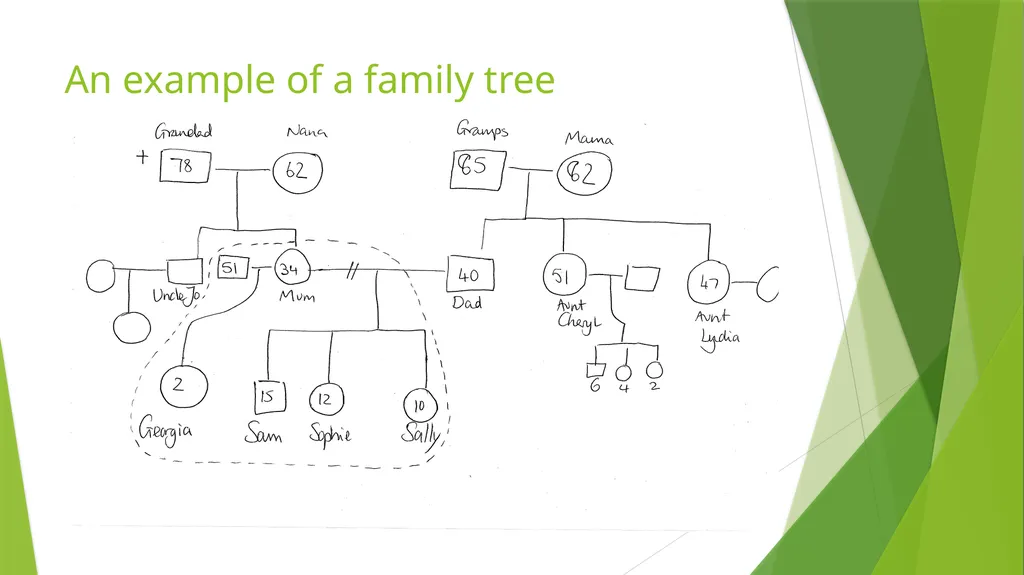
Activity: Can you spend 15-20 minutes drawing your own family tree (see example on the next slide). Notice patterns, strengths, roles and stories that are unique to your family. (Please note how this exercise is impacting on you. If it does not feel safe to do so, please think of another family to focus on throughout this session.)
Please have a look back at the ideas and questions listed in slides 3 & 4 and apply them to your family tree. Draw and write on your tree. (Feel free to make a bit of a mess. You don’t have to hand this in. Its just for you) What have you noticed? What has surprised you? Make a note of this.
The tree is part of your internal working model/ road map for life. How can this road map affect the decisions that you make when faced with a challenge? What helps and what is a challenge?
For example, if you are the eldest, are you expected to look after others and “be strong”? If your family value financial success, do you have to push yourself to earn more even though deep down you would rather pursue a different career path?<br>
Please have a look back at the ideas and questions listed in slides 3 & 4 and apply them to your family tree. Draw and write on your tree. (Feel free to make a bit of a mess. You don’t have to hand this in. Its just for you) What have you noticed? What has surprised you? Make a note of this.
The tree is part of your internal working model/ road map for life. How can this road map affect the decisions that you make when faced with a challenge? What helps and what is a challenge?
For example, if you are the eldest, are you expected to look after others and “be strong”? If your family value financial success, do you have to push yourself to earn more even though deep down you would rather pursue a different career path?<br>
06
An example of a family tree<br>
07
Case study Please have another look below at the case study. Draw their family tree and make a note of any patterns or roles that you think might apply. You don’t have to be certain, you are just wondering, being curious about how things might be for this family (10-15 minutes):
School have referred Jack because he is drawing pictures of dead bodies and knives with blood on them. He often fights with other children and told a teacher that he hates his life.
Jack aged 9, lives with his mum, step-dad and baby sister Isla. His grandad lives nearby and Jack recently lost his nan. She died in a traffic accident. He never sees his dad. His dad left the family when Jack was five and is reported to have a mental health problem, resulting in aggressive, controlling and threatening behavior. There were a number of MASH referrals during Jack’s early childhood.
Mum and step-dad worry that Jack is like his dad, He can be unpredictably aggressive to his step-dad and little sister, shows no remorse and is very clingy towards his mum. Step-dad is friendly, very talkative and open. He is very keen to access support. He is worried that Isla will be injured during one of Jack’s outbursts. Jack’s mum is very quiet, seems calm and says that everything at home is great except for Jack’s behavior.<br>
School have referred Jack because he is drawing pictures of dead bodies and knives with blood on them. He often fights with other children and told a teacher that he hates his life.
Jack aged 9, lives with his mum, step-dad and baby sister Isla. His grandad lives nearby and Jack recently lost his nan. She died in a traffic accident. He never sees his dad. His dad left the family when Jack was five and is reported to have a mental health problem, resulting in aggressive, controlling and threatening behavior. There were a number of MASH referrals during Jack’s early childhood.
Mum and step-dad worry that Jack is like his dad, He can be unpredictably aggressive to his step-dad and little sister, shows no remorse and is very clingy towards his mum. Step-dad is friendly, very talkative and open. He is very keen to access support. He is worried that Isla will be injured during one of Jack’s outbursts. Jack’s mum is very quiet, seems calm and says that everything at home is great except for Jack’s behavior.<br>
08
Part 2: Attachment: Early experiences of how a baby’s and child’s needs are met by the parent will inform their future internal working model/ road map for life. Attachment patterns also shape how the child anticipates and ensures that their needs will be met. Research suggests that attachment patterns continue across the generations, have a huge impact on the behaviour of the child and also the behaviour of the parents.
The Internal working model tells the child/adult what to expect of the world, of others and of themselves. It informs things such as: Is this a safe and caring environment? Are others caring/ friendly/ trustworthy? Am I lovable and deserving of kindness? They adapt their behaviour according to the internal working model and carry it with them into adult life.<br>
The Internal working model tells the child/adult what to expect of the world, of others and of themselves. It informs things such as: Is this a safe and caring environment? Are others caring/ friendly/ trustworthy? Am I lovable and deserving of kindness? They adapt their behaviour according to the internal working model and carry it with them into adult life.<br>
09
In essence attachment style can be divided into two main categories: secure and insecure Secure: A secure child will present as contented, engaged and can concentrate on Safe Exploration of the environment
Insecure: There are 3 Types: 1, Avoidant, 2, Ambivalent or 3, Disorganised.
1, An avoidant child may present as shy, very independent, quiet, says they are “fine”
2, An ambivalent child may present as anxious, focused on remaining in close proximity to the carer, insecure and can ask a lot of questions
3, A disorganised child may present as angry, depressed, not following directions, with a short fuse and difficulty in making friends
Attachment issues fall onto a spectrum, from mild problems to more serious difficulties where a child is unable to establish a healthy attachment with their parent
As adults many of these patterns of behaviour continue to create difficulties<br>
Insecure: There are 3 Types: 1, Avoidant, 2, Ambivalent or 3, Disorganised.
1, An avoidant child may present as shy, very independent, quiet, says they are “fine”
2, An ambivalent child may present as anxious, focused on remaining in close proximity to the carer, insecure and can ask a lot of questions
3, A disorganised child may present as angry, depressed, not following directions, with a short fuse and difficulty in making friends
Attachment issues fall onto a spectrum, from mild problems to more serious difficulties where a child is unable to establish a healthy attachment with their parent
As adults many of these patterns of behaviour continue to create difficulties<br>
10
Attachment Styles Please have a look at the following video which gives a good overview of attachment styles and how they persist throughout our lives:
YouTube: The attachment theory: How childhood affects Life. (7min36 sec long, by Scout)
https://youtu.be/WjOowWxOXCg
This video highlights the way that attachment styles impact on our behaviour, on how we demonstrate or hide our distress, how we get our needs met and how we view others and ourselves.
Think about some of the people that you know. How do they display their distress and get their needs met? Do they admit that they struggle, ask for support and expect to be helped? Do they become overwhelmed by emotion and are very reliant on others? Do they say “ I’m fine” and try to manage on their own? Make a few notes (5-10 minutes)<br>
YouTube: The attachment theory: How childhood affects Life. (7min36 sec long, by Scout)
https://youtu.be/WjOowWxOXCg
This video highlights the way that attachment styles impact on our behaviour, on how we demonstrate or hide our distress, how we get our needs met and how we view others and ourselves.
Think about some of the people that you know. How do they display their distress and get their needs met? Do they admit that they struggle, ask for support and expect to be helped? Do they become overwhelmed by emotion and are very reliant on others? Do they say “ I’m fine” and try to manage on their own? Make a few notes (5-10 minutes)<br>
11
The Case study Have another look at the case study below. What do you notice about the different possible attachment styles and how they are impacting on behavior. Make a few notes (5 minutes).
School have referred Jack because he is drawing pictures of dead bodies, knives with blood on them and told a teacher that he hates his life.
Jack aged 9, lives with his mum, step-dad and baby sister Isla. His grandad lives nearby and Jack recently lost his nan in a traffic accident. He never sees his dad. His dad left the family when Jack was five and is reported to have a mental health problem, resulting in aggressive, threatening behavior. There were a number of MASH referrals during Jack’s early childhood.
Mum and step-dad worry that Jack is like his dad, He can be unpredictably aggressive to his step-dad and little sister, shows no remorse and is very clingy towards his mum. Step-dad is friendly, talkative and open. He is very keen to access support. He is worried that Isla will be injured during one of Jack’s outbursts. Jack’s mum is very quiet and calm and says that everything at home is great except for Jack’s behavior<br>
School have referred Jack because he is drawing pictures of dead bodies, knives with blood on them and told a teacher that he hates his life.
Jack aged 9, lives with his mum, step-dad and baby sister Isla. His grandad lives nearby and Jack recently lost his nan in a traffic accident. He never sees his dad. His dad left the family when Jack was five and is reported to have a mental health problem, resulting in aggressive, threatening behavior. There were a number of MASH referrals during Jack’s early childhood.
Mum and step-dad worry that Jack is like his dad, He can be unpredictably aggressive to his step-dad and little sister, shows no remorse and is very clingy towards his mum. Step-dad is friendly, talkative and open. He is very keen to access support. He is worried that Isla will be injured during one of Jack’s outbursts. Jack’s mum is very quiet and calm and says that everything at home is great except for Jack’s behavior<br>
12
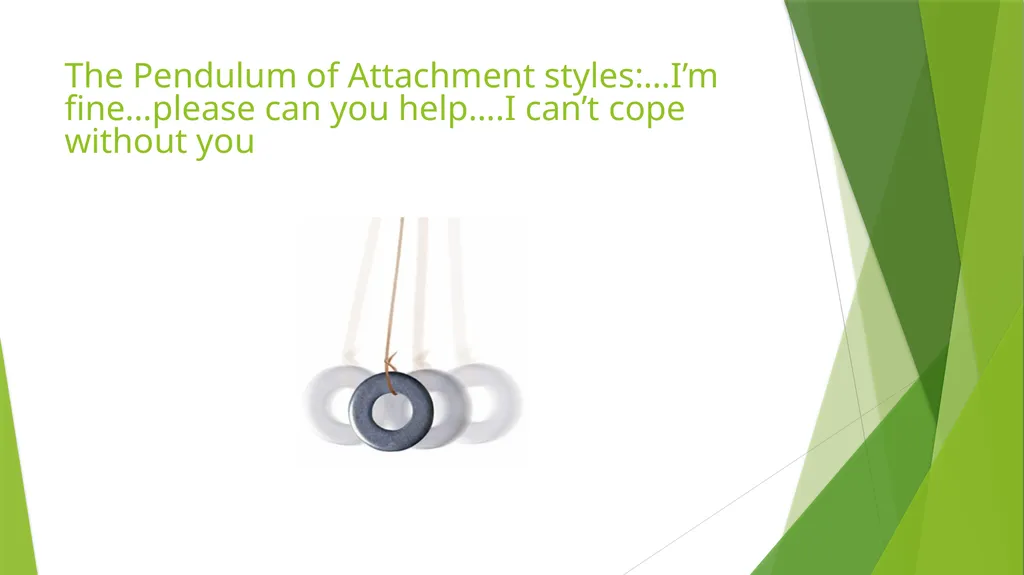
The Pendulum of Attachment styles:…I’m fine…please can you help….I can’t cope without you<br>
13
Attachment difficulties are linked to mental health issues Attachment issues impact on how we deal with problems across the life span. If we do not deal with problems effectively, further problems arise, leading to complications, conflict, loss etc. This impacts on our mental health, ranging from minor impact to major difficulties.
They impact on our ability to make and sustain healthy, caring relationships with our partners, children and friends<br>
They impact on our ability to make and sustain healthy, caring relationships with our partners, children and friends<br>
14
Impact on mental health issues: Physical impact –diet, sleep, self-care, concentration, physical appearance
Social impact – ability to initiate conversation, take turns, show care and concern for another person, play, interact socially, age-appropriate behaviour.
Academically – ability to concentrate, short and long term memory, organisational skills, motivation.
Self esteem – their relationship with themselves, ability to keep themselves safe, to take age-appropriate risks, to respect their own opinions and values, to view themselves as deserving of love, attention and respect.<br>
Social impact – ability to initiate conversation, take turns, show care and concern for another person, play, interact socially, age-appropriate behaviour.
Academically – ability to concentrate, short and long term memory, organisational skills, motivation.
Self esteem – their relationship with themselves, ability to keep themselves safe, to take age-appropriate risks, to respect their own opinions and values, to view themselves as deserving of love, attention and respect.<br>
15
Impact of mental health issues continued: Emotional regulation – to be aware of their own needs, ensure that these needs are met, ability to calm themselves, ask for support, expect and accept kindness and reassurance, understand how to relax, to reflect on their own story, ability to empathise with and understand others, feeling safe because they believe that they live in a predictable and supportive environment.
Possible long term diagnosis, if unaddressed: generalised anxiety disorder (GAD), OCD, phobia, panic attacks, depression, social isolation, self-harm, suicidal ideation, risk-taking behaviour, substance misuse, eating disorder, risk to others, failed or unhealthy relationships…<br>
Possible long term diagnosis, if unaddressed: generalised anxiety disorder (GAD), OCD, phobia, panic attacks, depression, social isolation, self-harm, suicidal ideation, risk-taking behaviour, substance misuse, eating disorder, risk to others, failed or unhealthy relationships…<br>
16
Attachment across the life span impacts on our behaviour We work with people in need. How do people of all ages try to get their needs met?
Do they minimise their needs? “I’m fine” “I just get on with it” “Stiff upper lip”
Do they get overwhelmed by their emotions and ask for support from multiple sources? Do they struggle to manage their emotions as they talk about their difficulties? Are they obviously often upset? Is it very noticeable?
Do they use ineffective methods to have their needs met? Shopping? Cleaning? Sleeping too much? Alcohol? Becoming over-organised/controlling? Self-harm?
Do they expect to have their needs met or expect to be ignored? Do they expect others to manage their emotions? Do they put others first at their own expense?<br>
Do they minimise their needs? “I’m fine” “I just get on with it” “Stiff upper lip”
Do they get overwhelmed by their emotions and ask for support from multiple sources? Do they struggle to manage their emotions as they talk about their difficulties? Are they obviously often upset? Is it very noticeable?
Do they use ineffective methods to have their needs met? Shopping? Cleaning? Sleeping too much? Alcohol? Becoming over-organised/controlling? Self-harm?
Do they expect to have their needs met or expect to be ignored? Do they expect others to manage their emotions? Do they put others first at their own expense?<br>
17
Activity: Behaviour as Communication Can you write down the possible meaning of the following behaviors. A useful question to ask is: if this is their solution, what is the problem?...
e.g. stealing food from a home with plenty of food = my needs won’t be met so I have to take it
Not owning up when you do something wrong
Following the parent around the house
Excessive tidying and organising
Constant talking
Always in their bedroom
Taking drugs
Cutting their skin
Not listening
Controlling aggressive behaviour
Being very good
Acting like a younger child.<br>
e.g. stealing food from a home with plenty of food = my needs won’t be met so I have to take it
Not owning up when you do something wrong
Following the parent around the house
Excessive tidying and organising
Constant talking
Always in their bedroom
Taking drugs
Cutting their skin
Not listening
Controlling aggressive behaviour
Being very good
Acting like a younger child.<br>
18
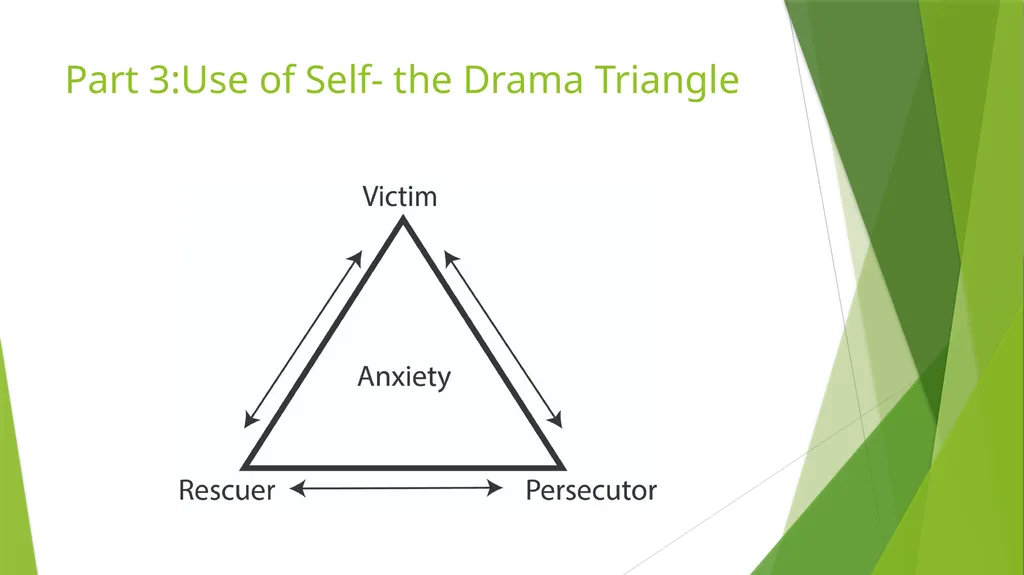
Part 3:Use of Self- the Drama Triangle<br>
19
The drama triangle Exercise Understanding how you respond to working with families in distress is an important part of looking after yourself in the long term
Watch the following video that introduces the drama triangle:
YouTube: The drama triangle (5:33min, Lauren Kress) https://youtu.be/E_XSeUYa0-8
Think about and make some notes on the three roles (10 minutes): victim, rescuer, persecutor. Work out the cost and the benefit of each position. e.g. Why can it be rewarding to feel that you are the rescuer and that someone else is a perpetrator? How do others see the same situation? Does anyone identify with being a perpetrator? What are the downsides to being the victim?
Why do you think people choose these positions? How do these positions affect how we experience other people and how they experience us? Is this the reality? Can we move around the triangle? What are the risks for social workers in this drama triangle, particularly when we are trying to carry out an assessment.
How do these ideas relate to our case study? How does each person in the family view the other?<br>
Watch the following video that introduces the drama triangle:
YouTube: The drama triangle (5:33min, Lauren Kress) https://youtu.be/E_XSeUYa0-8
Think about and make some notes on the three roles (10 minutes): victim, rescuer, persecutor. Work out the cost and the benefit of each position. e.g. Why can it be rewarding to feel that you are the rescuer and that someone else is a perpetrator? How do others see the same situation? Does anyone identify with being a perpetrator? What are the downsides to being the victim?
Why do you think people choose these positions? How do these positions affect how we experience other people and how they experience us? Is this the reality? Can we move around the triangle? What are the risks for social workers in this drama triangle, particularly when we are trying to carry out an assessment.
How do these ideas relate to our case study? How does each person in the family view the other?<br>
20
Use of Self Looking back over this presentation reconsider (10-15 minutes):
what you have learnt about your family narratives and roles?
What have you learned abut your attachment style and your ability to get your needs met?
What have you learned about your position within the drama triangle? What are the benefits for professionals of having a fixed position? Can a fixed positions give us a sense of being certain, of feeling sure, of feeling that we know what is going on….when we are working with risk, uncertainty and distress
Is it ok to be un-certain? To be “curious”? To sit and reflect? How does it feel?<br>
what you have learnt about your family narratives and roles?
What have you learned abut your attachment style and your ability to get your needs met?
What have you learned about your position within the drama triangle? What are the benefits for professionals of having a fixed position? Can a fixed positions give us a sense of being certain, of feeling sure, of feeling that we know what is going on….when we are working with risk, uncertainty and distress
Is it ok to be un-certain? To be “curious”? To sit and reflect? How does it feel?<br>
21
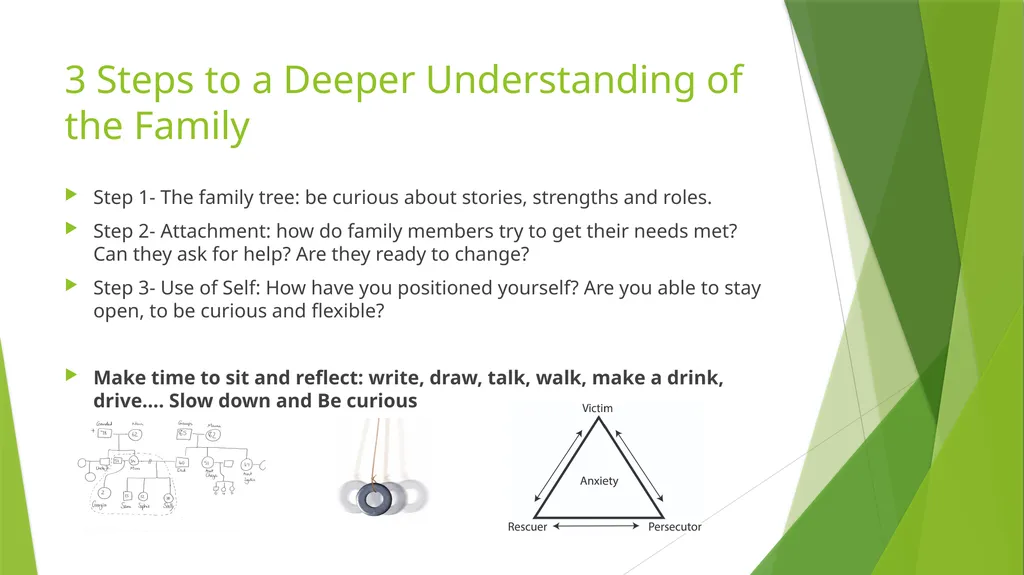
3 Steps to a Deeper Understanding of the Family Step 1- The family tree: be curious about stories, strengths and roles.
Step 2- Attachment: how do family members try to get their needs met? Can they ask for help? Are they ready to change?
Step 3- Use of Self: How have you positioned yourself? Are you able to stay open, to be curious and flexible?
Make time to sit and reflect: write, draw, talk, walk, make a drink, drive…. Slow down and Be curious<br>
Step 2- Attachment: how do family members try to get their needs met? Can they ask for help? Are they ready to change?
Step 3- Use of Self: How have you positioned yourself? Are you able to stay open, to be curious and flexible?
Make time to sit and reflect: write, draw, talk, walk, make a drink, drive…. Slow down and Be curious<br>
22
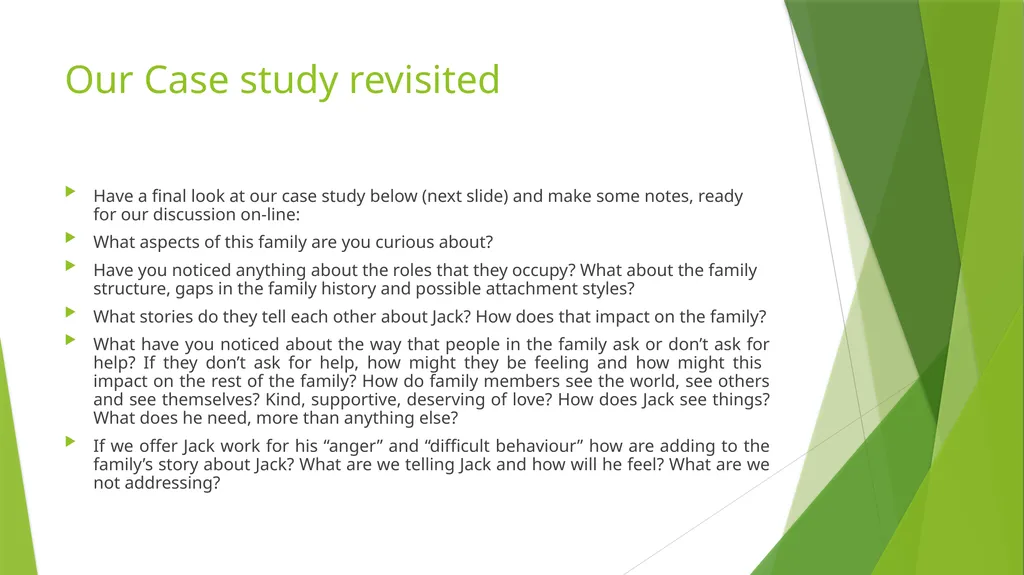
Our Case study revisited Have a final look at our case study below (next slide) and make some notes, ready for our discussion on-line:
What aspects of this family are you curious about?
Have you noticed anything about the roles that they occupy? What about the family structure, gaps in the family history and possible attachment styles?
What stories do they tell each other about Jack? How does that impact on the family?
What have you noticed about the way that people in the family ask or don’t ask for help? If they don’t ask for help, how might they be feeling and how might this impact on the rest of the family? How do family members see the world, see others and see themselves? Kind, supportive, deserving of love? How does Jack see things? What does he need, more than anything else?
If we offer Jack work for his “anger” and “difficult behaviour” how are adding to the family’s story about Jack? What are we telling Jack and how will he feel? What are we not addressing?<br>
What aspects of this family are you curious about?
Have you noticed anything about the roles that they occupy? What about the family structure, gaps in the family history and possible attachment styles?
What stories do they tell each other about Jack? How does that impact on the family?
What have you noticed about the way that people in the family ask or don’t ask for help? If they don’t ask for help, how might they be feeling and how might this impact on the rest of the family? How do family members see the world, see others and see themselves? Kind, supportive, deserving of love? How does Jack see things? What does he need, more than anything else?
If we offer Jack work for his “anger” and “difficult behaviour” how are adding to the family’s story about Jack? What are we telling Jack and how will he feel? What are we not addressing?<br>
23
A Care Plan for Jack revisited School have referred Jack because he is drawing pictures of dead bodies and knives with blood on them. He often fights with other children and told a teacher that he hates his life.
Jack aged 9, lives with his mum, step-dad and baby sister Isla. His grandad lives nearby and Jack recently lost his nan. She died in a traffic accident. He never sees his dad. His dad left the family when Jack was five and is reported to have a mental health problem, resulting in aggressive, controlling and threatening behavior. There were a number of MASH referrals during Jack’s early childhood.
Mum and step-dad worry that Jack is like his dad, He can be unpredictably aggressive to his step-dad and little sister, shows no remorse and is very clingy towards his mum. Step-dad is friendly, very talkative and open. He is very keen to access support. He is worried that Isla will be injured during one of Jack’s outbursts. Jack’s mum is very quiet, seems calm and says that everything at home is great except for Jack’s behavior.<br>
Jack aged 9, lives with his mum, step-dad and baby sister Isla. His grandad lives nearby and Jack recently lost his nan. She died in a traffic accident. He never sees his dad. His dad left the family when Jack was five and is reported to have a mental health problem, resulting in aggressive, controlling and threatening behavior. There were a number of MASH referrals during Jack’s early childhood.
Mum and step-dad worry that Jack is like his dad, He can be unpredictably aggressive to his step-dad and little sister, shows no remorse and is very clingy towards his mum. Step-dad is friendly, very talkative and open. He is very keen to access support. He is worried that Isla will be injured during one of Jack’s outbursts. Jack’s mum is very quiet, seems calm and says that everything at home is great except for Jack’s behavior.<br>
24
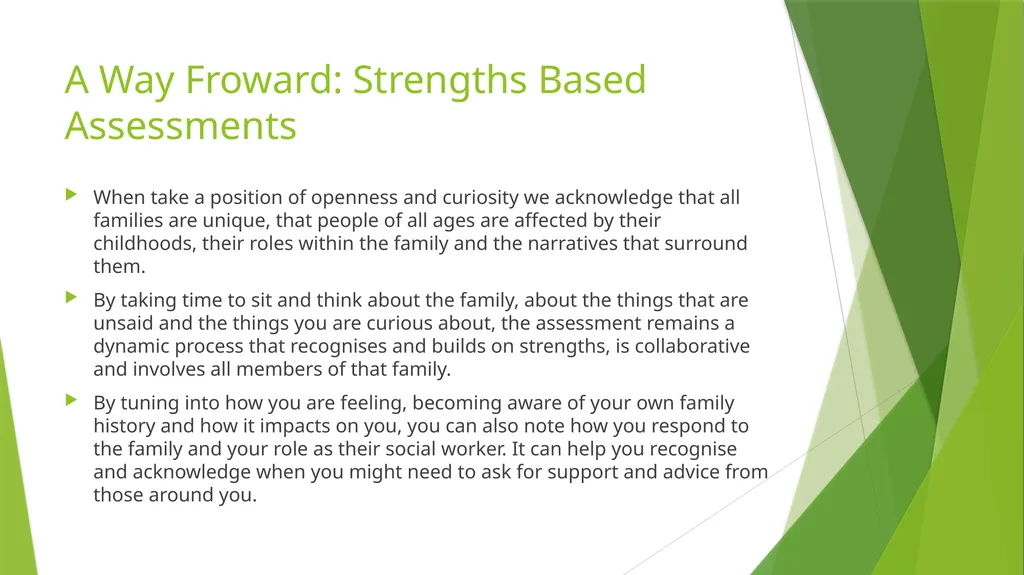
A Way Froward: Strengths Based Assessments When take a position of openness and curiosity we acknowledge that all families are unique, that people of all ages are affected by their childhoods, their roles within the family and the narratives that surround them.
By taking time to sit and think about the family, about the things that are unsaid and the things you are curious about, the assessment remains a dynamic process that recognises and builds on strengths, is collaborative and involves all members of that family.
By tuning into how you are feeling, becoming aware of your own family history and how it impacts on you, you can also note how you respond to the family and your role as their social worker. It can help you recognise and acknowledge when you might need to ask for support and advice from those around you.<br>
By taking time to sit and think about the family, about the things that are unsaid and the things you are curious about, the assessment remains a dynamic process that recognises and builds on strengths, is collaborative and involves all members of that family.
By tuning into how you are feeling, becoming aware of your own family history and how it impacts on you, you can also note how you respond to the family and your role as their social worker. It can help you recognise and acknowledge when you might need to ask for support and advice from those around you.<br>
25
An Overview
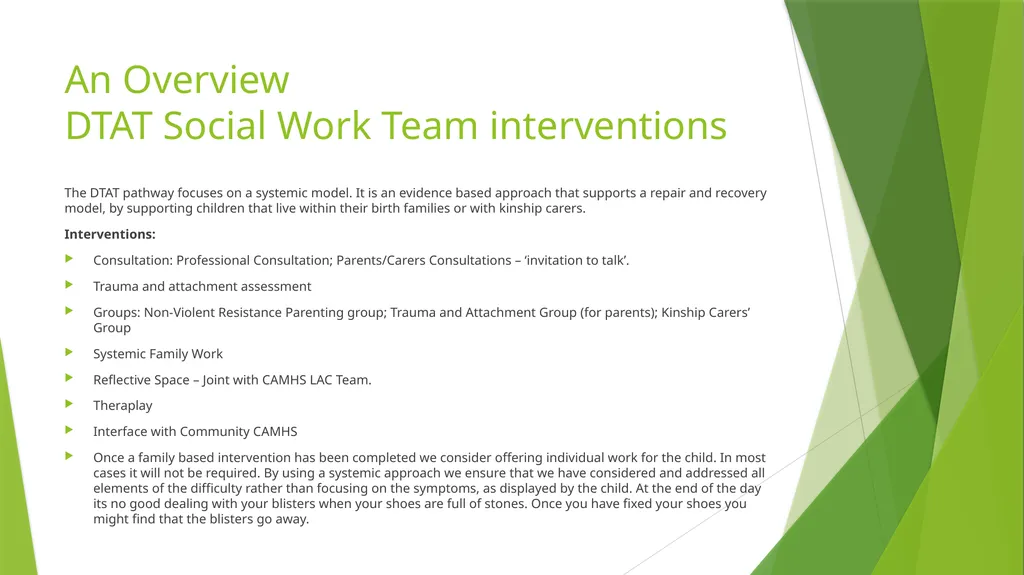
DTAT Social Work Team interventions The DTAT pathway focuses on a systemic model. It is an evidence based approach that supports a repair and recovery model, by supporting children that live within their birth families or with kinship carers.
Interventions:
Consultation: Professional Consultation; Parents/Carers Consultations – ‘invitation to talk’.
Trauma and attachment assessment
Groups: Non-Violent Resistance Parenting group; Trauma and Attachment Group (for parents); Kinship Carers’ Group
Systemic Family Work
Reflective Space – Joint with CAMHS LAC Team.
Theraplay
Interface with Community CAMHS
Once a family based intervention has been completed we consider offering individual work for the child. In most cases it will not be required. By using a systemic approach we ensure that we have considered and addressed all elements of the difficulty rather than focusing on the symptoms, as displayed by the child. At the end of the day its no good dealing with your blisters when your shoes are full of stones. Once you have fixed your shoes you might find that the blisters go away.<br>
Interventions:
Consultation: Professional Consultation; Parents/Carers Consultations – ‘invitation to talk’.
Trauma and attachment assessment
Groups: Non-Violent Resistance Parenting group; Trauma and Attachment Group (for parents); Kinship Carers’ Group
Systemic Family Work
Reflective Space – Joint with CAMHS LAC Team.
Theraplay
Interface with Community CAMHS
Once a family based intervention has been completed we consider offering individual work for the child. In most cases it will not be required. By using a systemic approach we ensure that we have considered and addressed all elements of the difficulty rather than focusing on the symptoms, as displayed by the child. At the end of the day its no good dealing with your blisters when your shoes are full of stones. Once you have fixed your shoes you might find that the blisters go away.<br>
26
Any Questions?....... Please tell us something that you will take away from today?
Any questions?<br>
Any questions?<br>