
Diachronic Works Module 17 1 Distinguish
DJ
Published · 67 slides · 0 views

1 / 1


Description
Diachronic Works Module 17 1 Distinguish diachronic works from static works Understand the importance of determining a works extension plan Recognize the different types of diachronic works Recognize how the concept of WEM lock determines
Related Topics
Share
Embed code
Download this presentation From Below
"Diachronic Works Module 17 1 Distinguish" is the property of its rightful owner. Permission is granted to download and print the materials on this website for personal, non-commercial use only, and to display it on your personal computer provided you do not modify the materials and that you retain all copyright notices contained in the materials. By downloading content from our website, you accept the terms of this agreement.
Presentation Transcript
01
Diachronic Works Module 17 1<br>
02
Distinguish diachronic works from static works
Understand the importance of determining a work’s extension plan
Recognize the different types of diachronic works
Recognize how the concept of WEM lock determines a new work 2<br>
Understand the importance of determining a work’s extension plan
Recognize the different types of diachronic works
Recognize how the concept of WEM lock determines a new work 2<br>
03
Outline What is a diachronic work?
User-driven examples
How diachronic works are different from static works
Extension plans of diachronic works
Concept of extension plans
Special considerations in describing diachronic works
The transformation boundary as an entity boundary
WEM lock 3<br>
User-driven examples
How diachronic works are different from static works
Extension plans of diachronic works
Concept of extension plans
Special considerations in describing diachronic works
The transformation boundary as an entity boundary
WEM lock 3<br>
04
What is a diachronic work? 4<br>
05
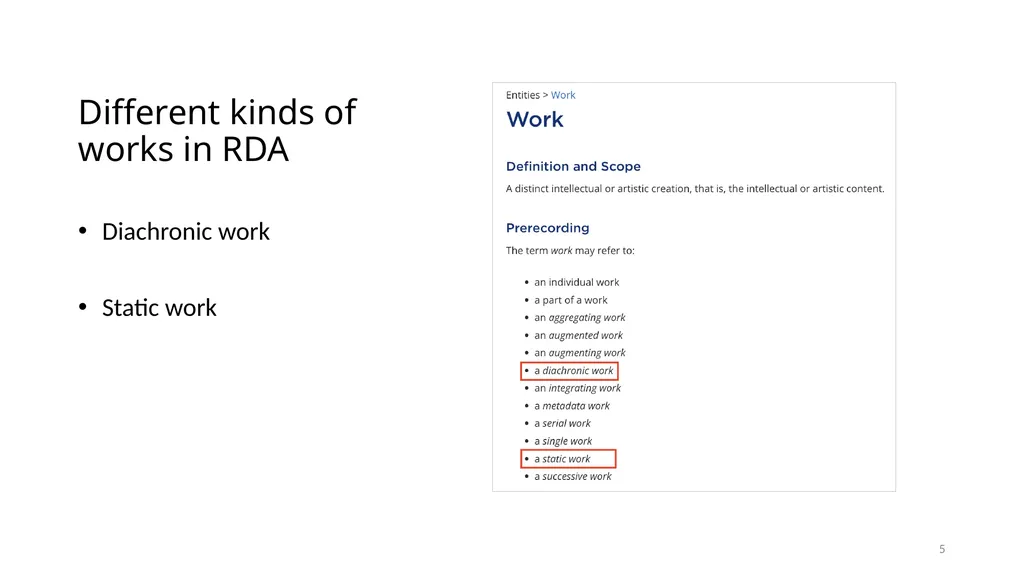
Different kinds of works in RDA Diachronic work
Static work 5<br>
Static work 5<br>
06
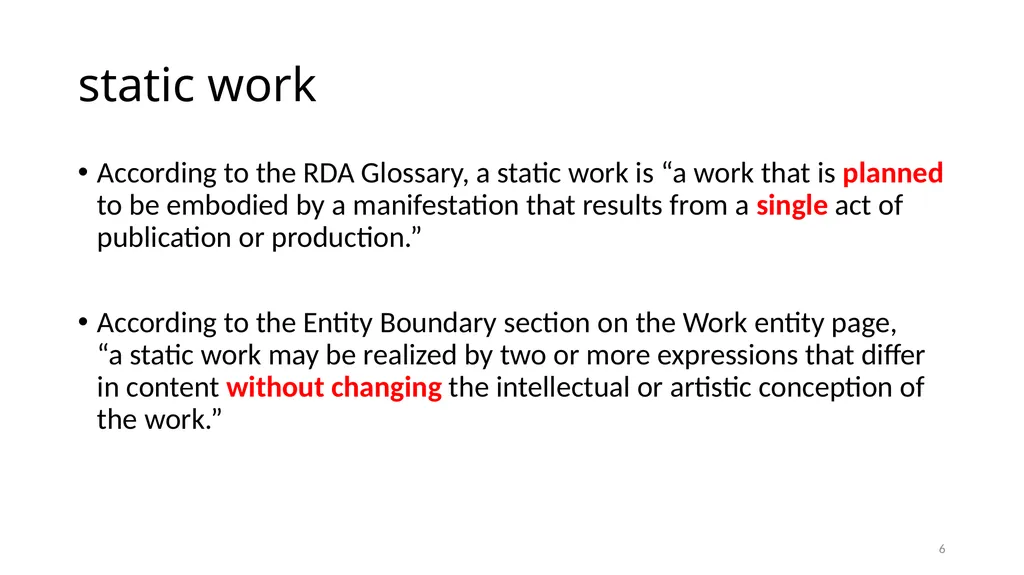
static work According to the RDA Glossary, a static work is “a work that is planned to be embodied by a manifestation that results from a single act of publication or production.”
According to the Entity Boundary section on the Work entity page, “a static work may be realized by two or more expressions that differ in content without changing the intellectual or artistic conception of the work.” 6<br>
According to the Entity Boundary section on the Work entity page, “a static work may be realized by two or more expressions that differ in content without changing the intellectual or artistic conception of the work.” 6<br>
07
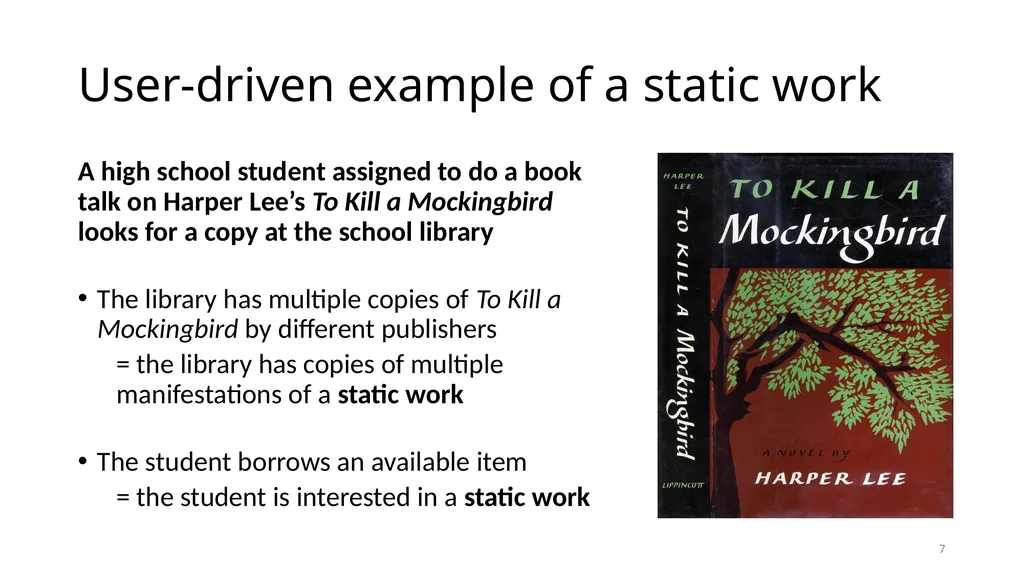
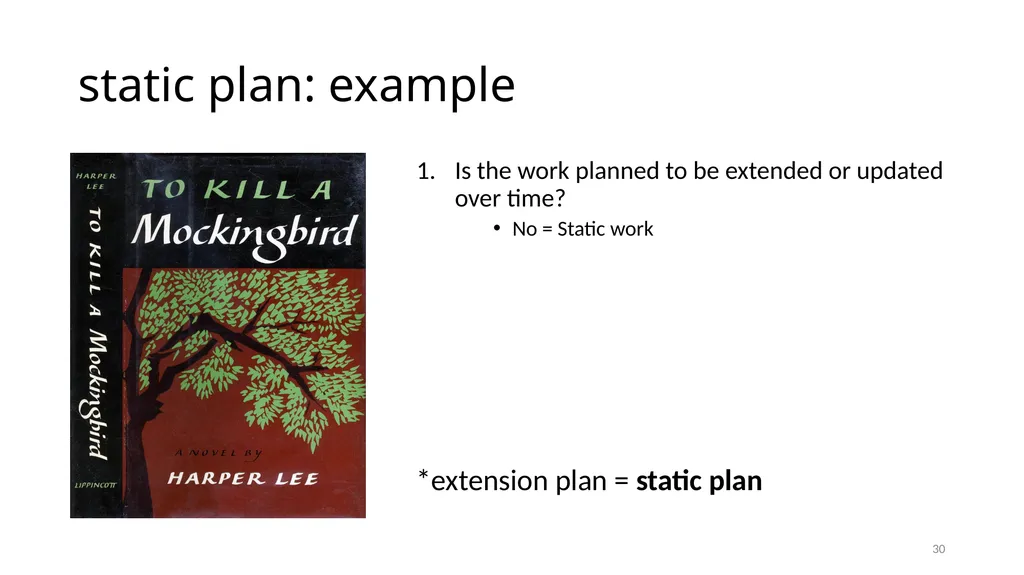
User-driven example of a static work A high school student assigned to do a book talk on Harper Lee’s To Kill a Mockingbird looks for a copy at the school library
The library has multiple copies of To Kill a Mockingbird by different publishers
= the library has copies of multiple manifestations of a static work
The student borrows an available item
= the student is interested in a static work 7<br>
The library has multiple copies of To Kill a Mockingbird by different publishers
= the library has copies of multiple manifestations of a static work
The student borrows an available item
= the student is interested in a static work 7<br>
08
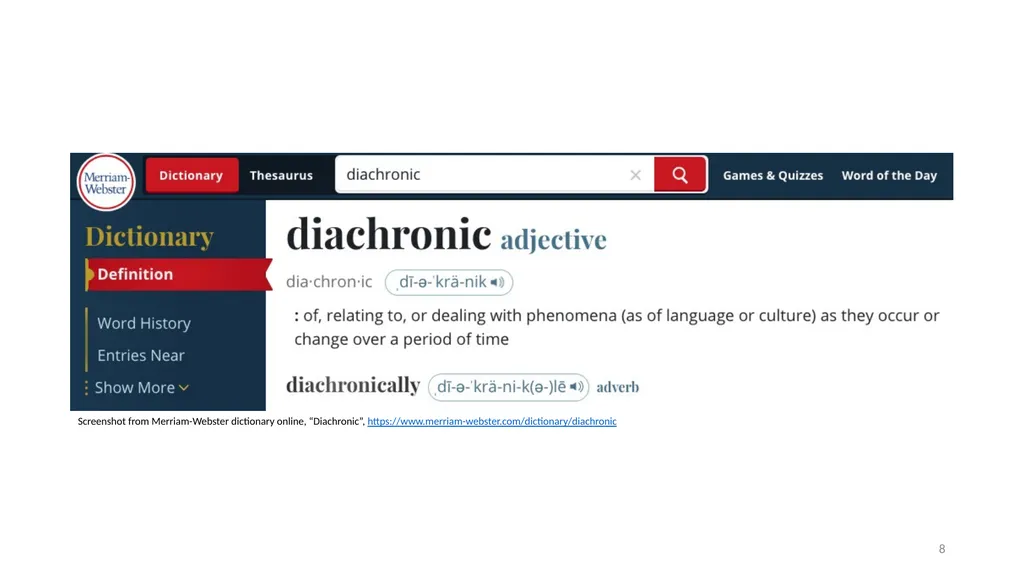
8 Screenshot from Merriam-Webster dictionary online, “Diachronic”, https://www.merriam-webster.com/dictionary/diachronic<br>
09
diachronic work According to the RDA Glossary, a diachronic work is “a work that is planned to be embodied over time.”
Where else can you find information about diachronic works?
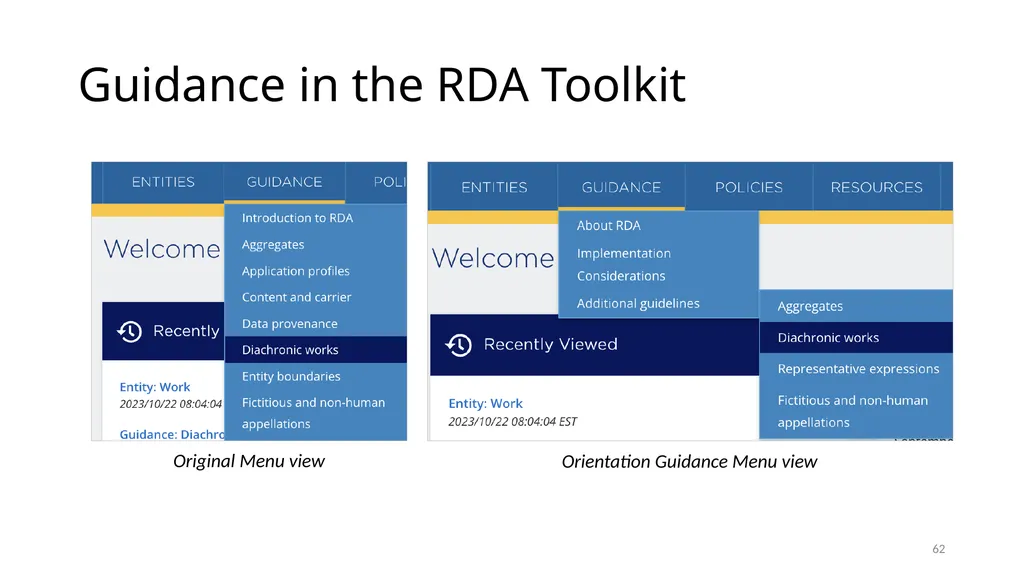
Guidance > Resource description > Describing a work
Guidance > Diachronic works 9<br>
Where else can you find information about diachronic works?
Guidance > Resource description > Describing a work
Guidance > Diachronic works 9<br>
10
diachronic work Guidance > Resource description > Describing a work
A work may be planned to be embodied by a manifestation in a single act of publication or production or in a sequence of two or more such acts carried out at distinct intervals. The plan determines whether the content is fixed as a static work, or is changed over time as a diachronic work.
A diachronic work may be planned to replace the content of a single expression or to accumulate the content by accumulating a sequence of expressions that are embodied at intervals of time. 10<br>
A work may be planned to be embodied by a manifestation in a single act of publication or production or in a sequence of two or more such acts carried out at distinct intervals. The plan determines whether the content is fixed as a static work, or is changed over time as a diachronic work.
A diachronic work may be planned to replace the content of a single expression or to accumulate the content by accumulating a sequence of expressions that are embodied at intervals of time. 10<br>
11
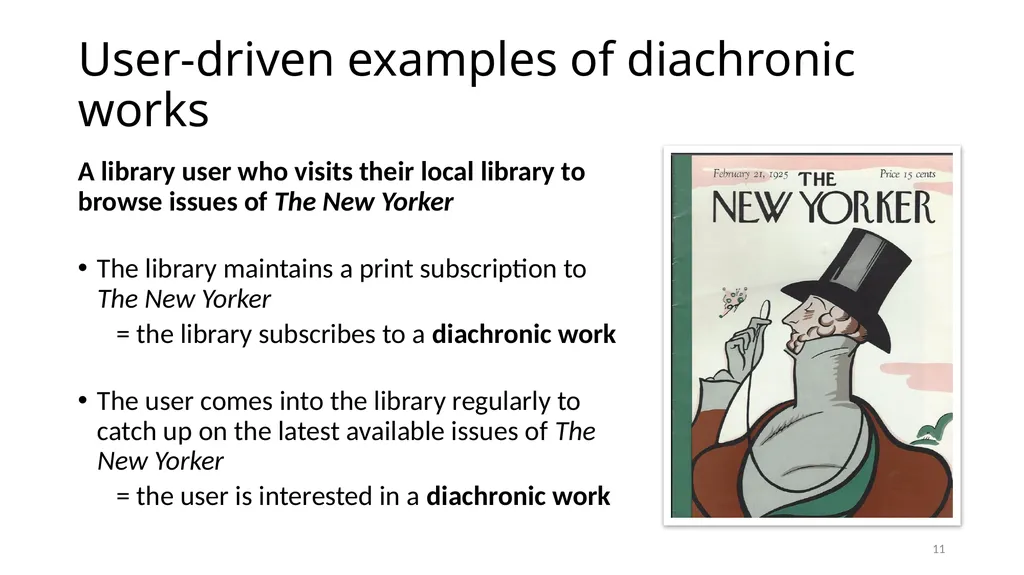
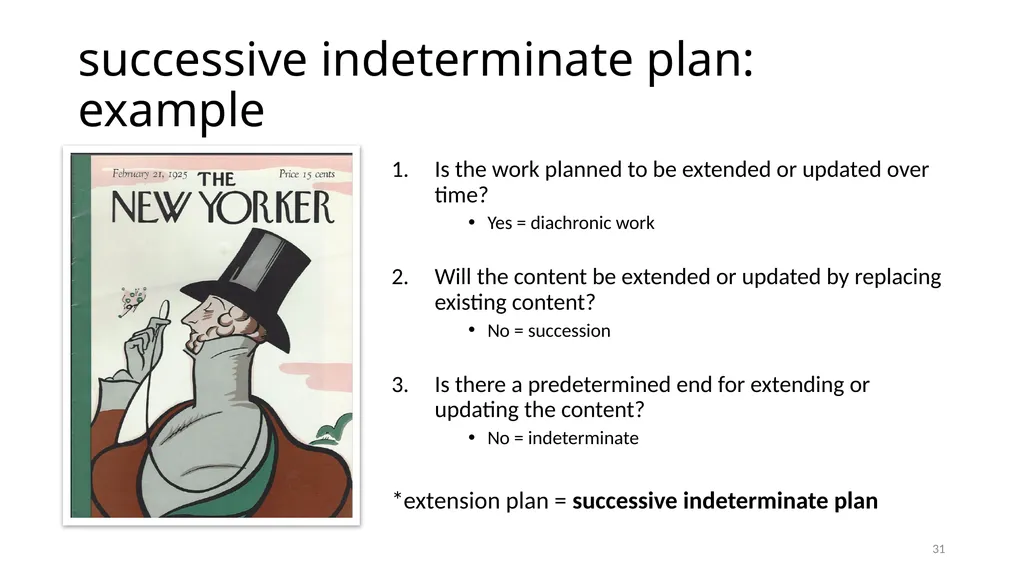
User-driven examples of diachronic works A library user who visits their local library to browse issues of The New Yorker
The library maintains a print subscription to The New Yorker
= the library subscribes to a diachronic work
The user comes into the library regularly to catch up on the latest available issues of The New Yorker
= the user is interested in a diachronic work 11<br>
The library maintains a print subscription to The New Yorker
= the library subscribes to a diachronic work
The user comes into the library regularly to catch up on the latest available issues of The New Yorker
= the user is interested in a diachronic work 11<br>
12
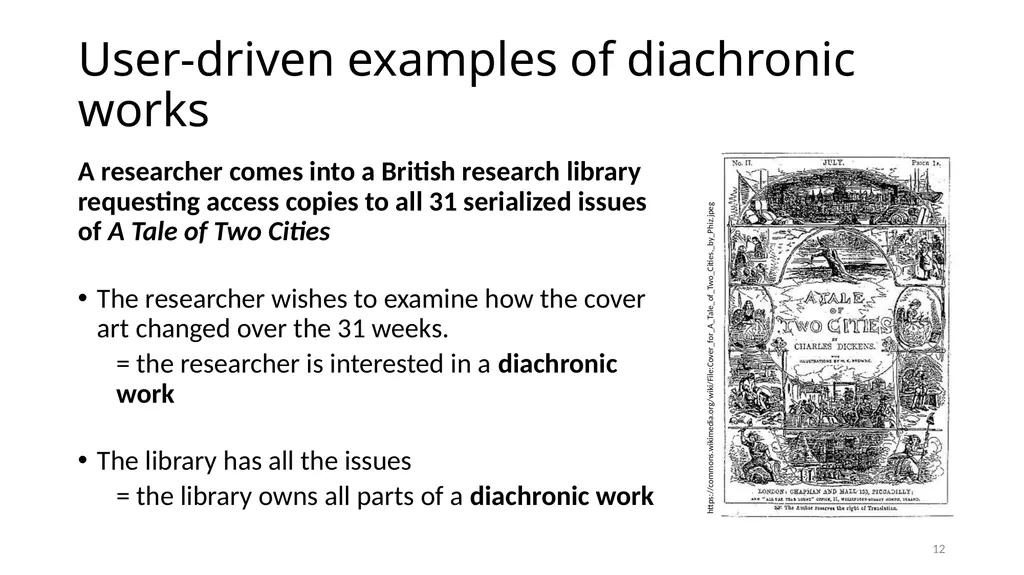
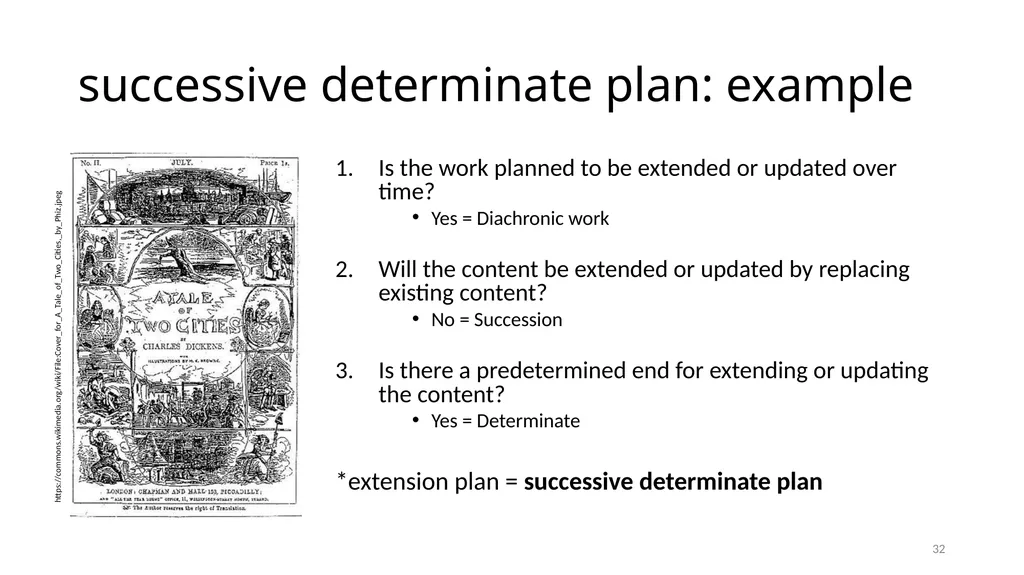
User-driven examples of diachronic works A researcher comes into a British research library requesting access copies to all 31 serialized issues of A Tale of Two Cities
The researcher wishes to examine how the cover art changed over the 31 weeks.
= the researcher is interested in a diachronic work
The library has all the issues
= the library owns all parts of a diachronic work 12 https://commons.wikimedia.org/wiki/File:Cover_for_A_Tale_of_Two_Cities,_by_Phiz.jpeg<br>
The researcher wishes to examine how the cover art changed over the 31 weeks.
= the researcher is interested in a diachronic work
The library has all the issues
= the library owns all parts of a diachronic work 12 https://commons.wikimedia.org/wiki/File:Cover_for_A_Tale_of_Two_Cities,_by_Phiz.jpeg<br>
13
User-driven examples of diachronic works A course instructor needs to provide student access to the official RDA Toolkit for an introductory cataloging course
The course instructor works with the Faculty of Information to obtain a subscription to the Toolkit.
= the school needs to subscribe to a diachronic work 13<br>
The course instructor works with the Faculty of Information to obtain a subscription to the Toolkit.
= the school needs to subscribe to a diachronic work 13<br>
14
User-driven examples of diachronic works A librarian who registered for the 2022 IFLA World Library and Information Congress is interested in seeing the most recent updates
The librarian logs into the 2022 conference website
= the librarian intends to browse a diachronic work 14<br>
The librarian logs into the 2022 conference website
= the librarian intends to browse a diachronic work 14<br>
15
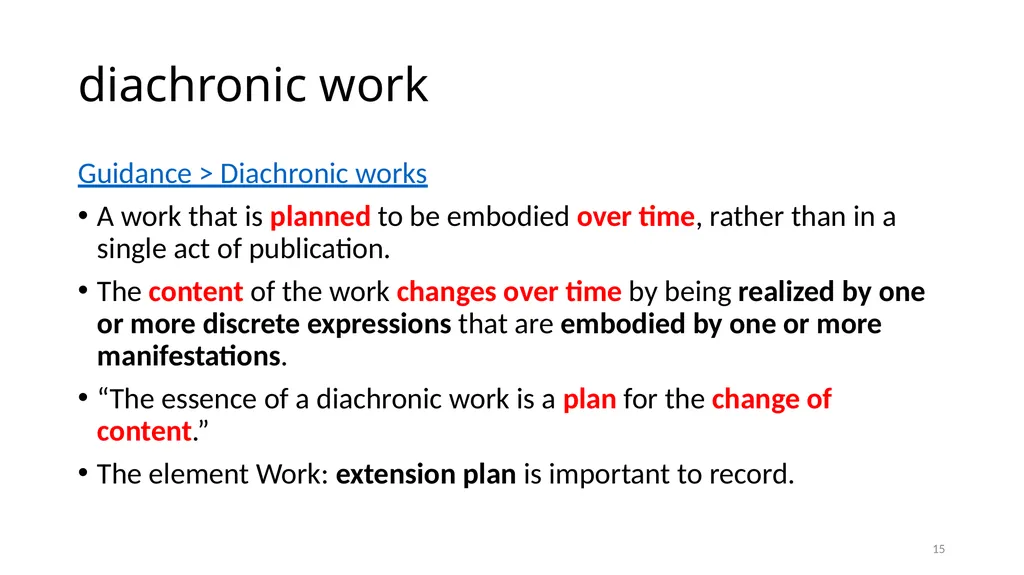
diachronic work Guidance > Diachronic works
A work that is planned to be embodied over time, rather than in a single act of publication.
The content of the work changes over time by being realized by one or more discrete expressions that are embodied by one or more manifestations.
“The essence of a diachronic work is a plan for the change of content.”
The element Work: extension plan is important to record. 15<br>
A work that is planned to be embodied over time, rather than in a single act of publication.
The content of the work changes over time by being realized by one or more discrete expressions that are embodied by one or more manifestations.
“The essence of a diachronic work is a plan for the change of content.”
The element Work: extension plan is important to record. 15<br>
16
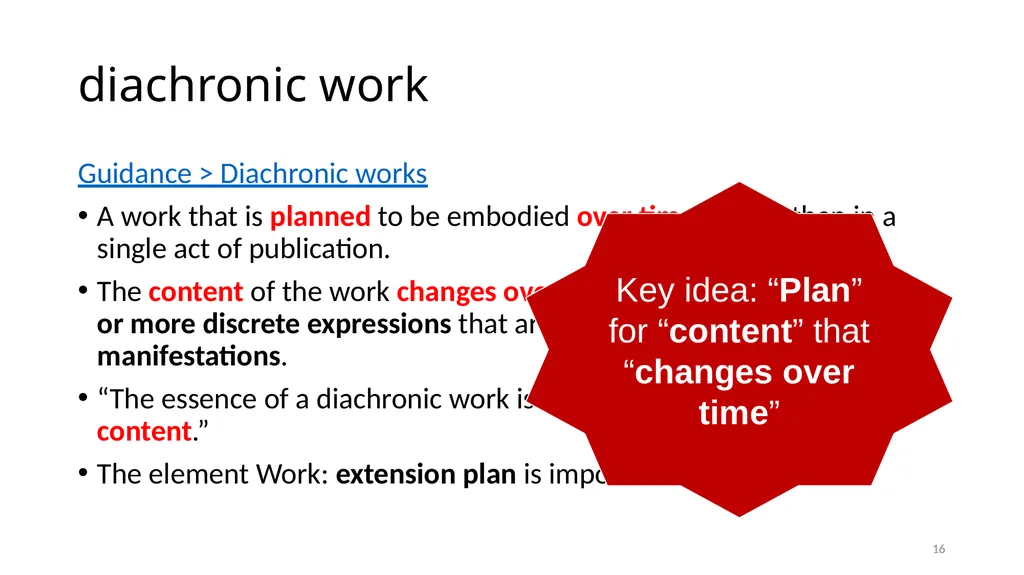
diachronic work Guidance > Diachronic works
A work that is planned to be embodied over time, rather than in a single act of publication.
The content of the work changes over time by being realized by one or more discrete expressions that are embodied by one or more manifestations.
“The essence of a diachronic work is a plan for the change of content.”
The element Work: extension plan is important to record. 16 Key idea: “Plan” for “content” that “changes over time”<br>
A work that is planned to be embodied over time, rather than in a single act of publication.
The content of the work changes over time by being realized by one or more discrete expressions that are embodied by one or more manifestations.
“The essence of a diachronic work is a plan for the change of content.”
The element Work: extension plan is important to record. 16 Key idea: “Plan” for “content” that “changes over time”<br>
17
A diachronic work is not static. 17<br>
18
Extension plans of diachronic works 18<br>
19
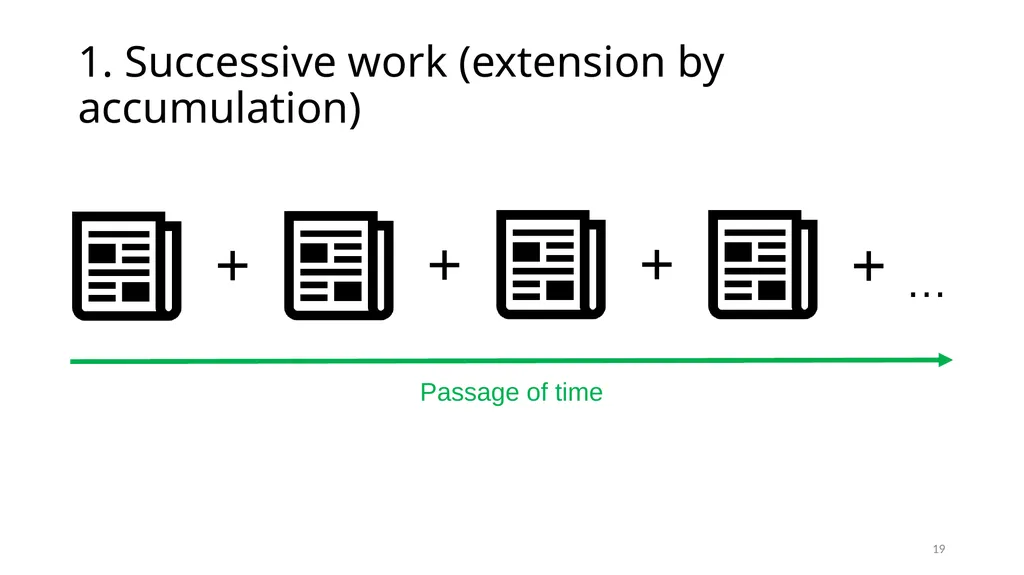
1. Successive work (extension by accumulation) 19 Passage of time<br>
20
1. Successive work (extension by accumulation) Content is accumulated over time through a sequence of issues. Previous issues are retained as new issues are released.
Each issue of the work is considered an expression that is embodied by a single manifestation.
Each expression and manifestation of an issue of the work is also considered to be part of an overall expression and manifestation that realize and embody the successive work as a whole.
Can be determinate or indeterminate. 20<br>
Each issue of the work is considered an expression that is embodied by a single manifestation.
Each expression and manifestation of an issue of the work is also considered to be part of an overall expression and manifestation that realize and embody the successive work as a whole.
Can be determinate or indeterminate. 20<br>
21
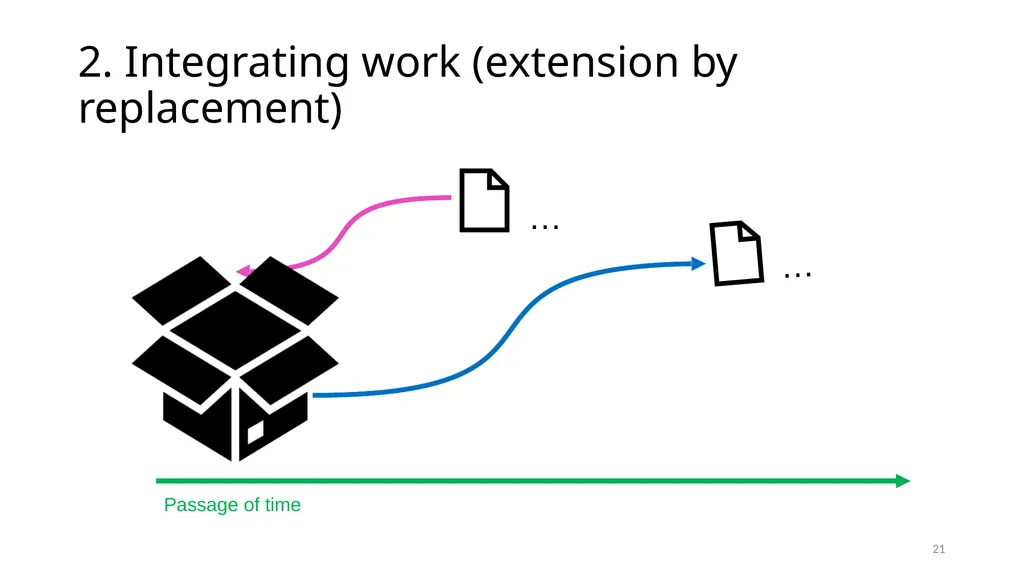
2. Integrating work (extension by replacement) 21 Passage of time … …<br>
22
2. Integrating work (extension by replacement) Content is replaced at intervals
Content from previous iterations is assumed to be inaccessible as it is gradually replaced
Integrating work is realized in a single expression that is embodied by a single manifestation
Can be determinate or indeterminate 22<br>
Content from previous iterations is assumed to be inaccessible as it is gradually replaced
Integrating work is realized in a single expression that is embodied by a single manifestation
Can be determinate or indeterminate 22<br>
23
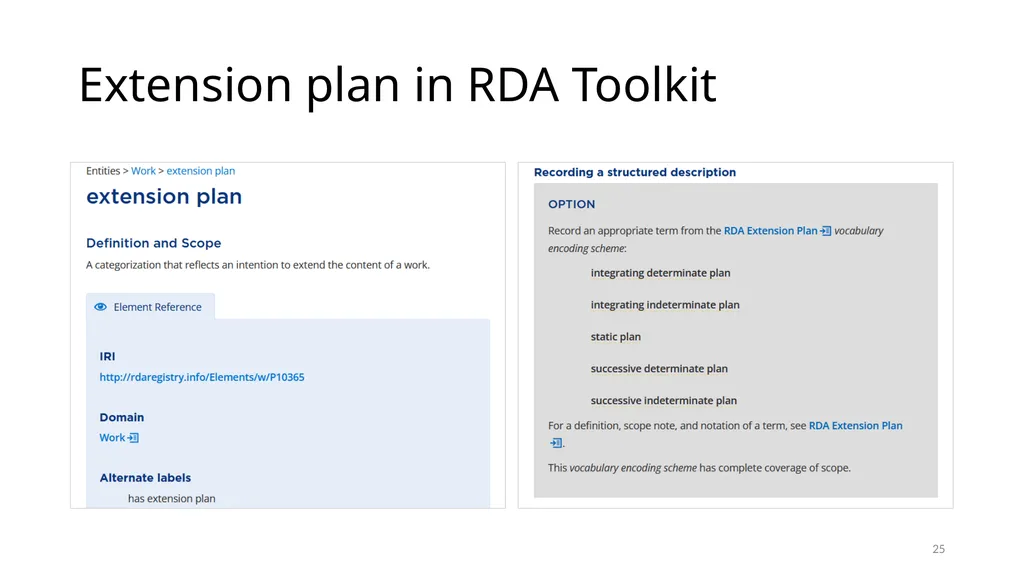
Work: extension plan New attribute element to describe a work
“A categorization that reflects an intention to extend the content of a work.”
The plan for how the content will be updated over time 23<br>
“A categorization that reflects an intention to extend the content of a work.”
The plan for how the content will be updated over time 23<br>
24
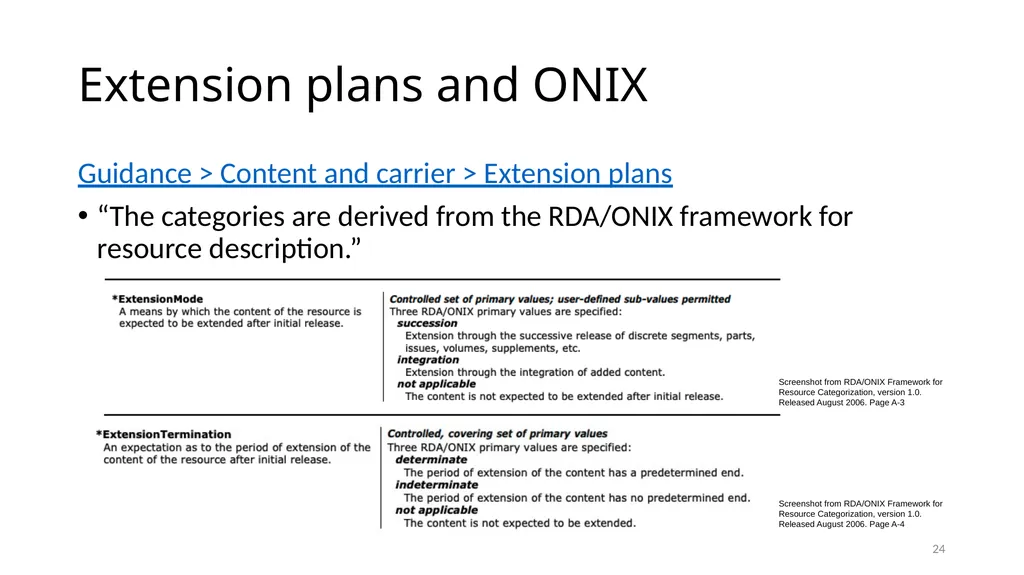
Extension plans and ONIX Guidance > Content and carrier > Extension plans
“The categories are derived from the RDA/ONIX framework for resource description.” 24 Screenshot from RDA/ONIX Framework for Resource Categorization, version 1.0. Released August 2006. Page A-3 Screenshot from RDA/ONIX Framework for Resource Categorization, version 1.0. Released August 2006. Page A-4<br>
“The categories are derived from the RDA/ONIX framework for resource description.” 24 Screenshot from RDA/ONIX Framework for Resource Categorization, version 1.0. Released August 2006. Page A-3 Screenshot from RDA/ONIX Framework for Resource Categorization, version 1.0. Released August 2006. Page A-4<br>
25
Extension plan in RDA Toolkit 25<br>
26
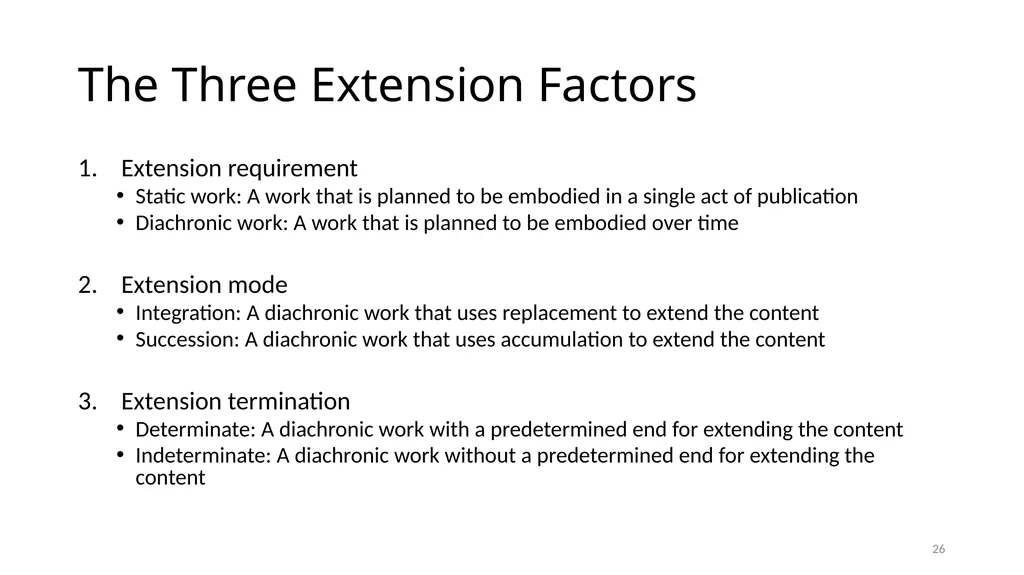
The Three Extension Factors Extension requirement
Static work: A work that is planned to be embodied in a single act of publication
Diachronic work: A work that is planned to be embodied over time
Extension mode
Integration: A diachronic work that uses replacement to extend the content
Succession: A diachronic work that uses accumulation to extend the content
Extension termination
Determinate: A diachronic work with a predetermined end for extending the content
Indeterminate: A diachronic work without a predetermined end for extending the content 26<br>
Static work: A work that is planned to be embodied in a single act of publication
Diachronic work: A work that is planned to be embodied over time
Extension mode
Integration: A diachronic work that uses replacement to extend the content
Succession: A diachronic work that uses accumulation to extend the content
Extension termination
Determinate: A diachronic work with a predetermined end for extending the content
Indeterminate: A diachronic work without a predetermined end for extending the content 26<br>
27
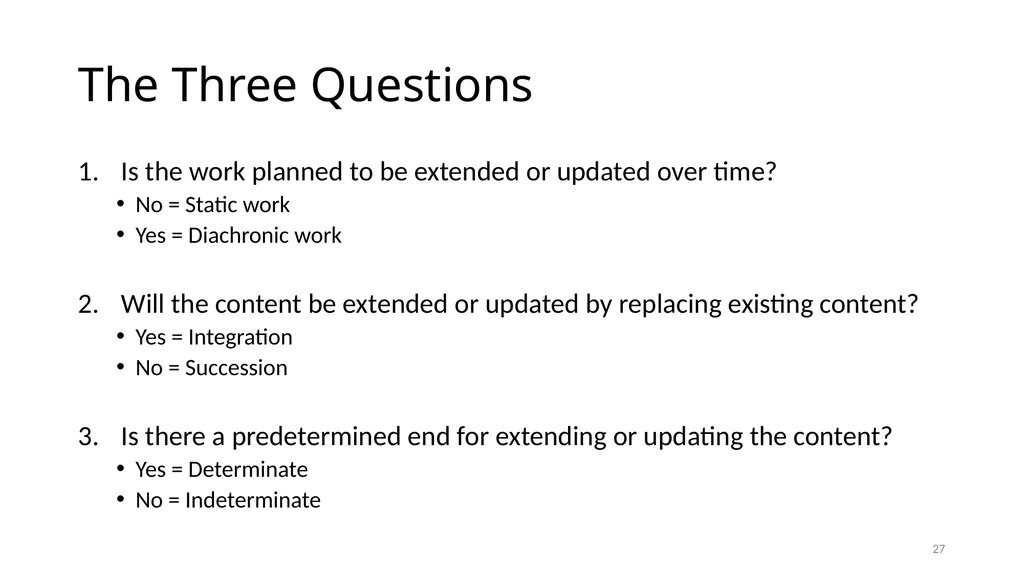
The Three Questions Is the work planned to be extended or updated over time?
No = Static work
Yes = Diachronic work
Will the content be extended or updated by replacing existing content?
Yes = Integration
No = Succession
Is there a predetermined end for extending or updating the content?
Yes = Determinate
No = Indeterminate 27<br>
No = Static work
Yes = Diachronic work
Will the content be extended or updated by replacing existing content?
Yes = Integration
No = Succession
Is there a predetermined end for extending or updating the content?
Yes = Determinate
No = Indeterminate 27<br>
28
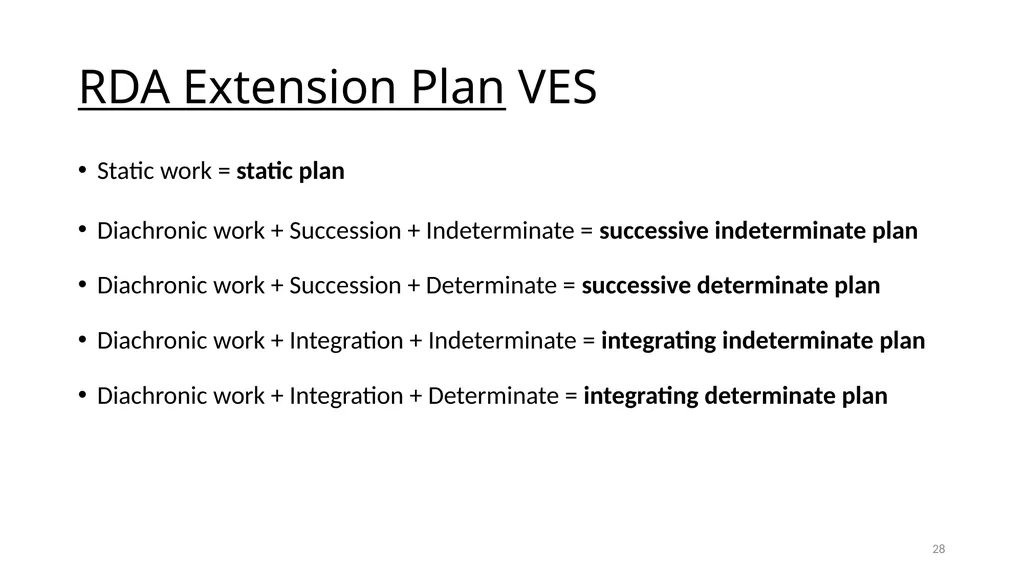
RDA Extension Plan VES Static work = static plan
Diachronic work + Succession + Indeterminate = successive indeterminate plan
Diachronic work + Succession + Determinate = successive determinate plan
Diachronic work + Integration + Indeterminate = integrating indeterminate plan
Diachronic work + Integration + Determinate = integrating determinate plan 28<br>
Diachronic work + Succession + Indeterminate = successive indeterminate plan
Diachronic work + Succession + Determinate = successive determinate plan
Diachronic work + Integration + Indeterminate = integrating indeterminate plan
Diachronic work + Integration + Determinate = integrating determinate plan 28<br>
29
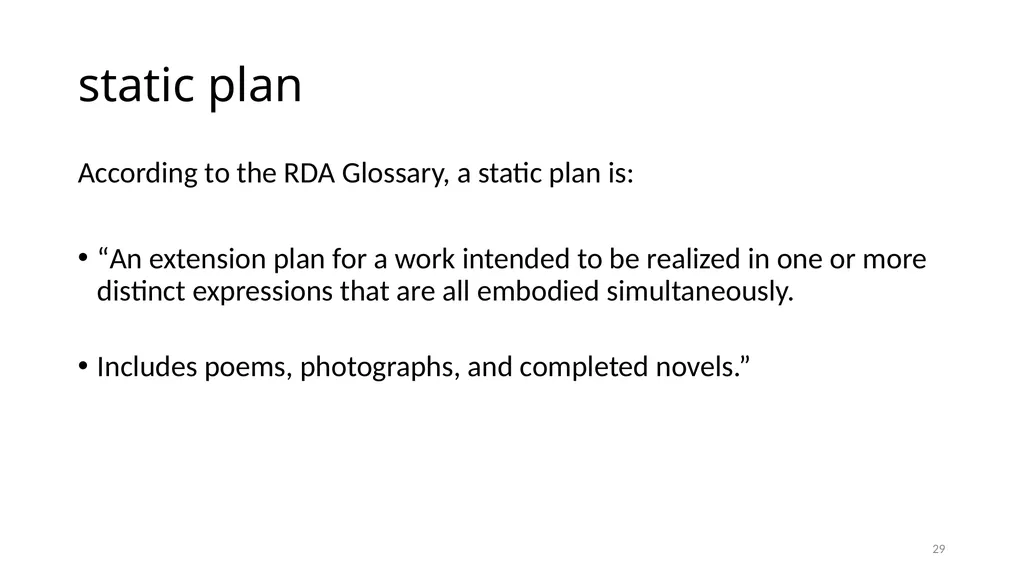
static plan According to the RDA Glossary, a static plan is:
“An extension plan for a work intended to be realized in one or more distinct expressions that are all embodied simultaneously.
Includes poems, photographs, and completed novels.” 29<br>
“An extension plan for a work intended to be realized in one or more distinct expressions that are all embodied simultaneously.
Includes poems, photographs, and completed novels.” 29<br>
30
static plan: example Is the work planned to be extended or updated over time?
No = Static work
*extension plan = static plan 30<br>
No = Static work
*extension plan = static plan 30<br>
31
successive indeterminate plan: example Is the work planned to be extended or updated over time?
Yes = diachronic work
Will the content be extended or updated by replacing existing content?
No = succession
Is there a predetermined end for extending or updating the content?
No = indeterminate
*extension plan = successive indeterminate plan 31<br>
Yes = diachronic work
Will the content be extended or updated by replacing existing content?
No = succession
Is there a predetermined end for extending or updating the content?
No = indeterminate
*extension plan = successive indeterminate plan 31<br>
32
successive determinate plan: example Is the work planned to be extended or updated over time?
Yes = Diachronic work
Will the content be extended or updated by replacing existing content?
No = Succession
Is there a predetermined end for extending or updating the content?
Yes = Determinate
*extension plan = successive determinate plan 32 https://commons.wikimedia.org/wiki/File:Cover_for_A_Tale_of_Two_Cities,_by_Phiz.jpeg<br>
Yes = Diachronic work
Will the content be extended or updated by replacing existing content?
No = Succession
Is there a predetermined end for extending or updating the content?
Yes = Determinate
*extension plan = successive determinate plan 32 https://commons.wikimedia.org/wiki/File:Cover_for_A_Tale_of_Two_Cities,_by_Phiz.jpeg<br>
33
integrating indeterminate plan: example Is the work planned to be extended or updated over time?
Yes = Diachronic work
Will the content be extended or updated by replacing existing content?
Yes = Integrating
Is there a predetermined end for extending or updating the content?
No = Indeterminate
*extension plan = integrating indeterminate plan 33<br>
Yes = Diachronic work
Will the content be extended or updated by replacing existing content?
Yes = Integrating
Is there a predetermined end for extending or updating the content?
No = Indeterminate
*extension plan = integrating indeterminate plan 33<br>
34
integrating determinate plan: example Is the work planned to be extended or updated over time?
Yes = Diachronic work
Will the content be extended or updated by replacing existing content?
Yes = Integrating
Is there a predetermined end for extending or updating the content?
Yes = Determinate
*extension plan = integrating determinate plan 34<br>
Yes = Diachronic work
Will the content be extended or updated by replacing existing content?
Yes = Integrating
Is there a predetermined end for extending or updating the content?
Yes = Determinate
*extension plan = integrating determinate plan 34<br>
35
Considerations in describing diachronic works 35<br>
36
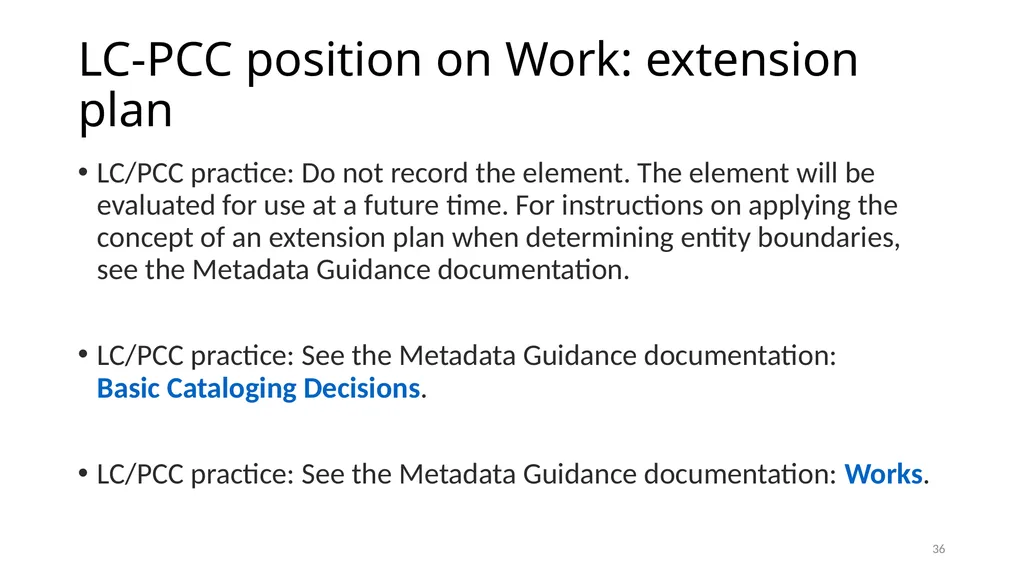
LC-PCC position on Work: extension plan LC/PCC practice: Do not record the element. The element will be evaluated for use at a future time. For instructions on applying the concept of an extension plan when determining entity boundaries, see the Metadata Guidance documentation.
LC/PCC practice: See the Metadata Guidance documentation: Basic Cataloging Decisions.
LC/PCC practice: See the Metadata Guidance documentation: Works. 36<br>
LC/PCC practice: See the Metadata Guidance documentation: Basic Cataloging Decisions.
LC/PCC practice: See the Metadata Guidance documentation: Works. 36<br>
37
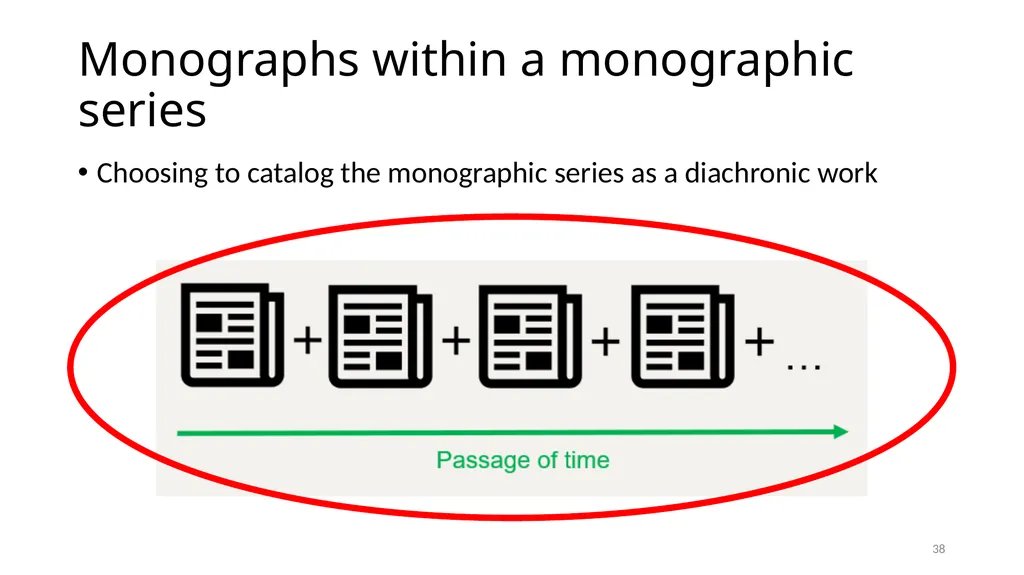
Monographic series You may choose to catalog the monographic series as a diachronic work.
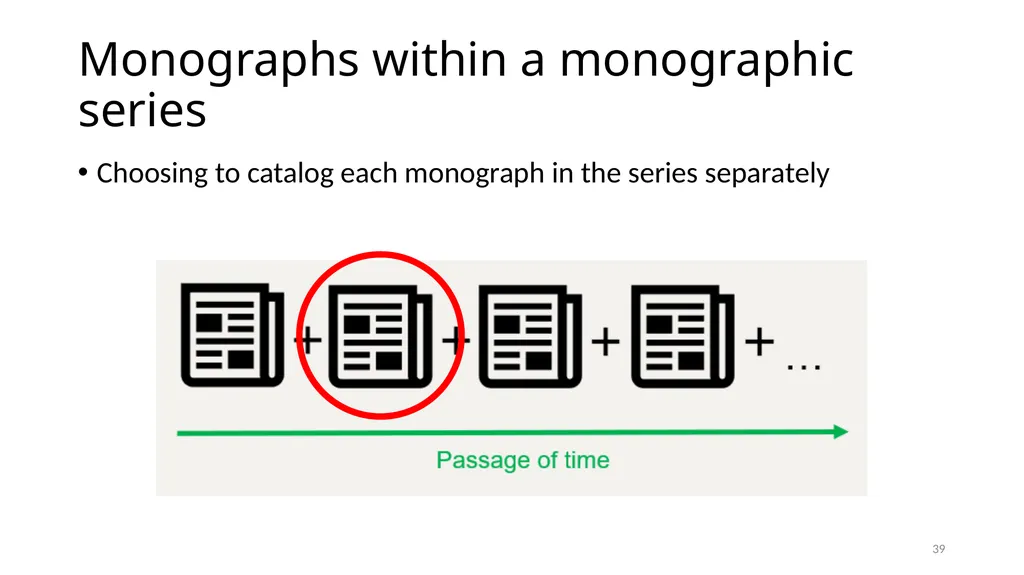
You may choose to catalog each monograph in the series separately.
What is the one-time work?
How do you indicate the relationship to the diachronic work that is the monographic series?
The monographs within the monographic series may or may not be numbered. 37<br>
You may choose to catalog each monograph in the series separately.
What is the one-time work?
How do you indicate the relationship to the diachronic work that is the monographic series?
The monographs within the monographic series may or may not be numbered. 37<br>
38
Monographs within a monographic series Choosing to catalog the monographic series as a diachronic work 38<br>
39
Monographs within a monographic series Choosing to catalog each monograph in the series separately 39<br>
40
Annuals with special themed issues Situation:
You have an annual that releases new volumes each year.
Each annual volume has a special theme and its own title.
Cataloging treatment:
You catalog the annual as a whole, rather than each volume separately.
Do you bring attention to the individual volumes? If so, what are possible approaches? 40<br>
You have an annual that releases new volumes each year.
Each annual volume has a special theme and its own title.
Cataloging treatment:
You catalog the annual as a whole, rather than each volume separately.
Do you bring attention to the individual volumes? If so, what are possible approaches? 40<br>
41
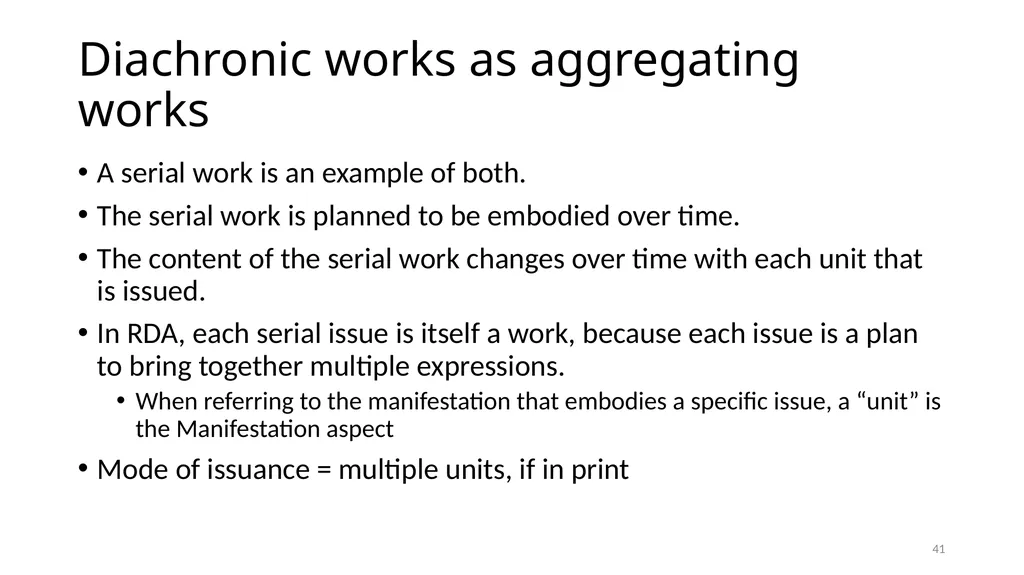
Diachronic works as aggregating works A serial work is an example of both.
The serial work is planned to be embodied over time.
The content of the serial work changes over time with each unit that is issued.
In RDA, each serial issue is itself a work, because each issue is a plan to bring together multiple expressions.
When referring to the manifestation that embodies a specific issue, a “unit” is the Manifestation aspect
Mode of issuance = multiple units, if in print 41<br>
The serial work is planned to be embodied over time.
The content of the serial work changes over time with each unit that is issued.
In RDA, each serial issue is itself a work, because each issue is a plan to bring together multiple expressions.
When referring to the manifestation that embodies a specific issue, a “unit” is the Manifestation aspect
Mode of issuance = multiple units, if in print 41<br>
42
WEM Lock 42<br>
43
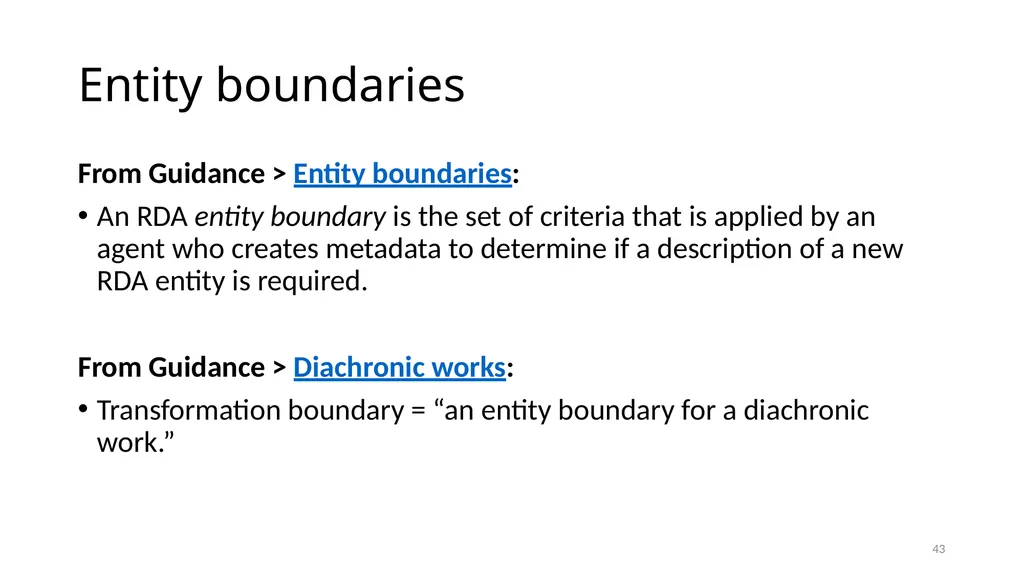
Entity boundaries From Guidance > Entity boundaries:
An RDA entity boundary is the set of criteria that is applied by an agent who creates metadata to determine if a description of a new RDA entity is required.
From Guidance > Diachronic works:
Transformation boundary = “an entity boundary for a diachronic work.” 43<br>
An RDA entity boundary is the set of criteria that is applied by an agent who creates metadata to determine if a description of a new RDA entity is required.
From Guidance > Diachronic works:
Transformation boundary = “an entity boundary for a diachronic work.” 43<br>
44
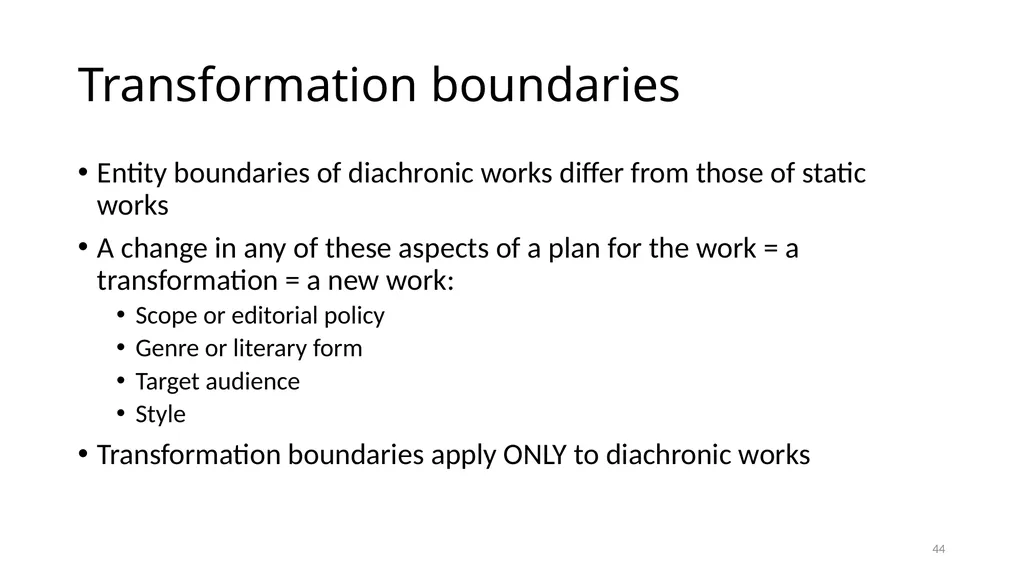
Transformation boundaries Entity boundaries of diachronic works differ from those of static works
A change in any of these aspects of a plan for the work = a transformation = a new work:
Scope or editorial policy
Genre or literary form
Target audience
Style
Transformation boundaries apply ONLY to diachronic works 44<br>
A change in any of these aspects of a plan for the work = a transformation = a new work:
Scope or editorial policy
Genre or literary form
Target audience
Style
Transformation boundaries apply ONLY to diachronic works 44<br>
45
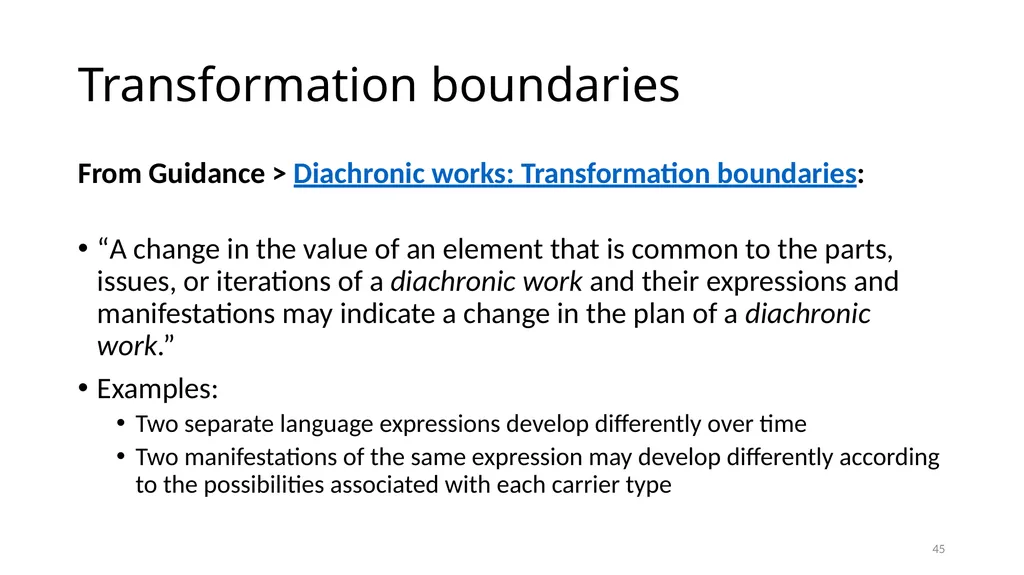
Transformation boundaries From Guidance > Diachronic works: Transformation boundaries:
“A change in the value of an element that is common to the parts, issues, or iterations of a diachronic work and their expressions and manifestations may indicate a change in the plan of a diachronic work.”
Examples:
Two separate language expressions develop differently over time
Two manifestations of the same expression may develop differently according to the possibilities associated with each carrier type 45<br>
“A change in the value of an element that is common to the parts, issues, or iterations of a diachronic work and their expressions and manifestations may indicate a change in the plan of a diachronic work.”
Examples:
Two separate language expressions develop differently over time
Two manifestations of the same expression may develop differently according to the possibilities associated with each carrier type 45<br>
46
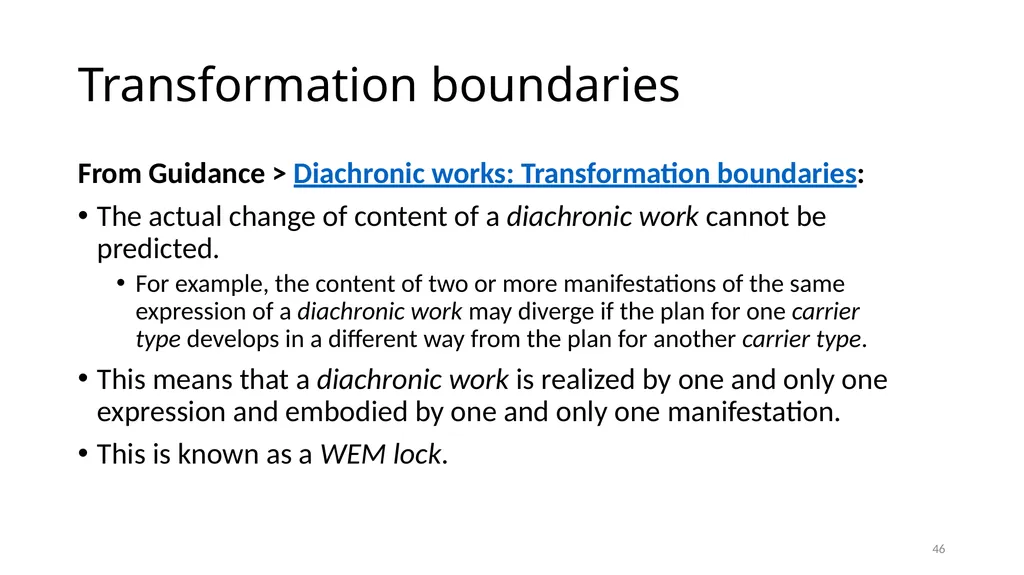
Transformation boundaries From Guidance > Diachronic works: Transformation boundaries:
The actual change of content of a diachronic work cannot be predicted.
For example, the content of two or more manifestations of the same expression of a diachronic work may diverge if the plan for one carrier type develops in a different way from the plan for another carrier type.
This means that a diachronic work is realized by one and only one expression and embodied by one and only one manifestation.
This is known as a WEM lock. 46<br>
The actual change of content of a diachronic work cannot be predicted.
For example, the content of two or more manifestations of the same expression of a diachronic work may diverge if the plan for one carrier type develops in a different way from the plan for another carrier type.
This means that a diachronic work is realized by one and only one expression and embodied by one and only one manifestation.
This is known as a WEM lock. 46<br>
47
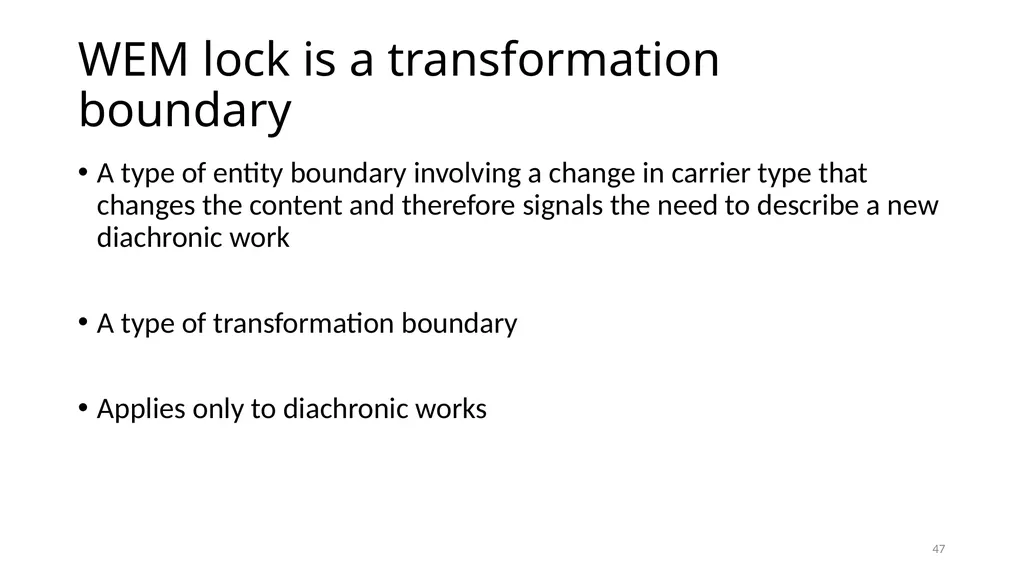
WEM lock is a transformation boundary A type of entity boundary involving a change in carrier type that changes the content and therefore signals the need to describe a new diachronic work
A type of transformation boundary
Applies only to diachronic works 47<br>
A type of transformation boundary
Applies only to diachronic works 47<br>
48
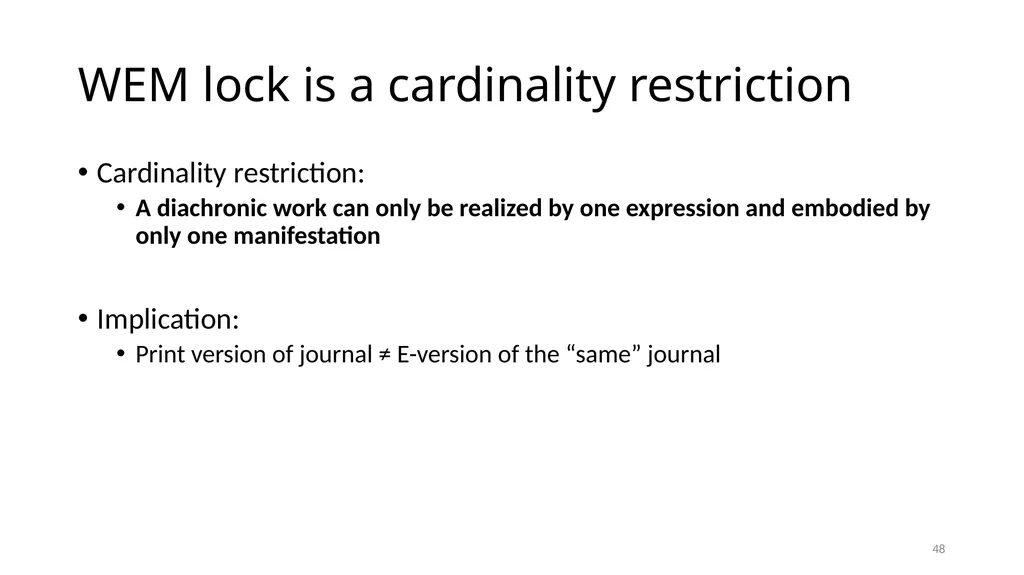
WEM lock is a cardinality restriction Cardinality restriction:
A diachronic work can only be realized by one expression and embodied by only one manifestation
Implication:
Print version of journal ≠ E-version of the “same” journal 48<br>
A diachronic work can only be realized by one expression and embodied by only one manifestation
Implication:
Print version of journal ≠ E-version of the “same” journal 48<br>
49
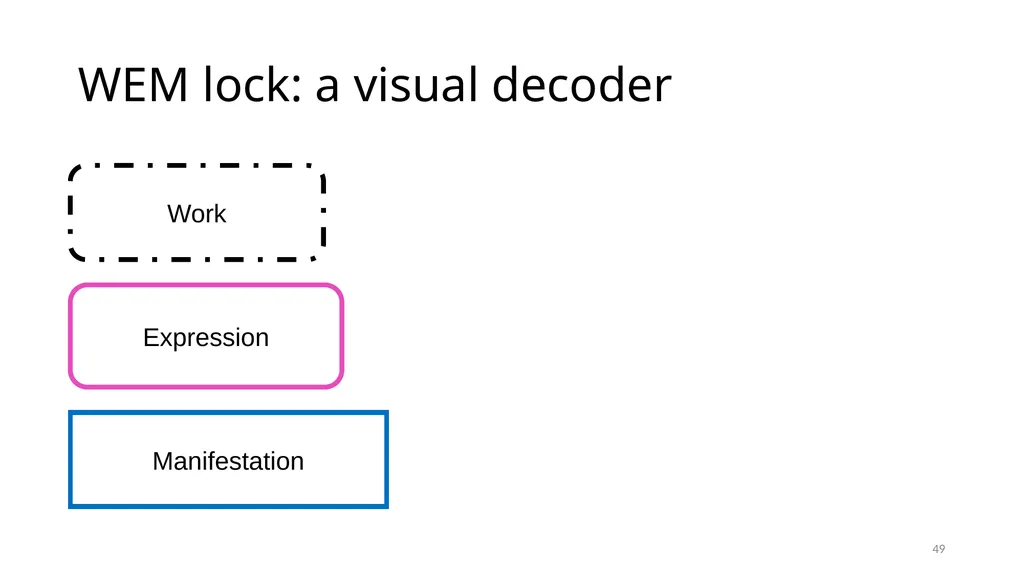
WEM lock: a visual decoder 49 Work Expression Manifestation<br>
50
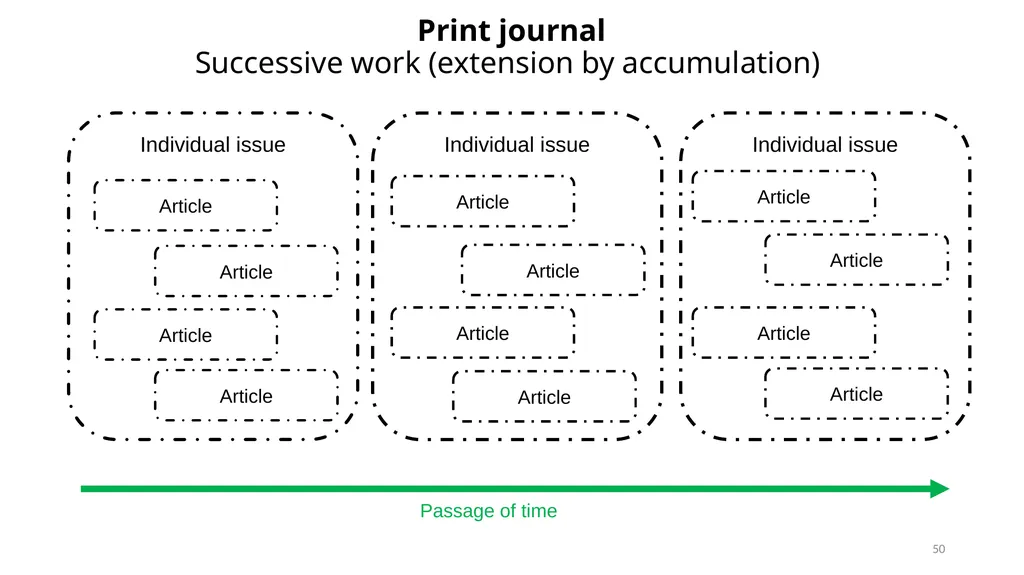
Print journal
Successive work (extension by accumulation) 50 Individual issue Article Article Article Article<br>
51
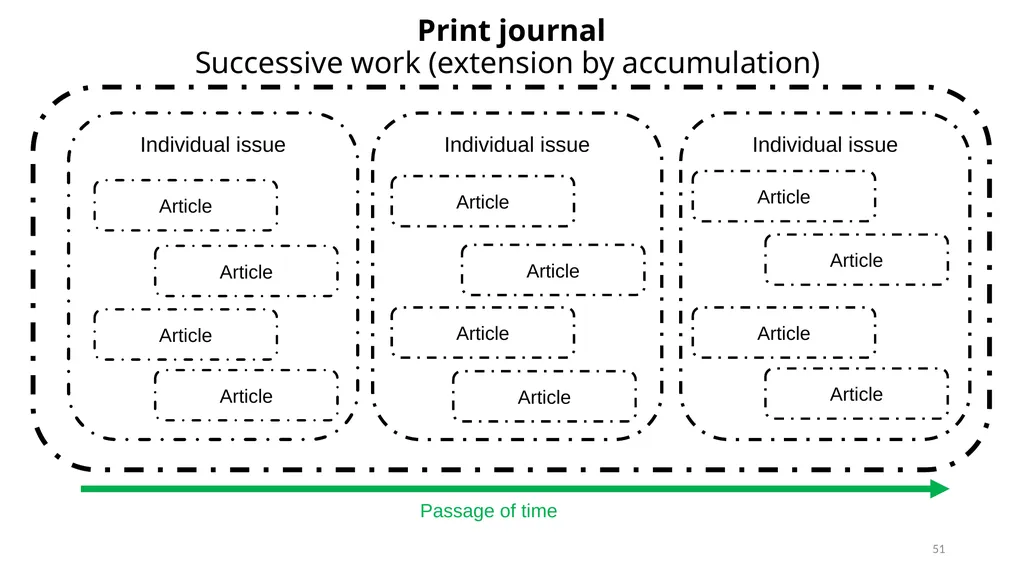
Print journal
Successive work (extension by accumulation) 51 Individual issue Article Article Article Article Individual issue Article Article Article Article Individual issue Article Article Article Article<br>
52
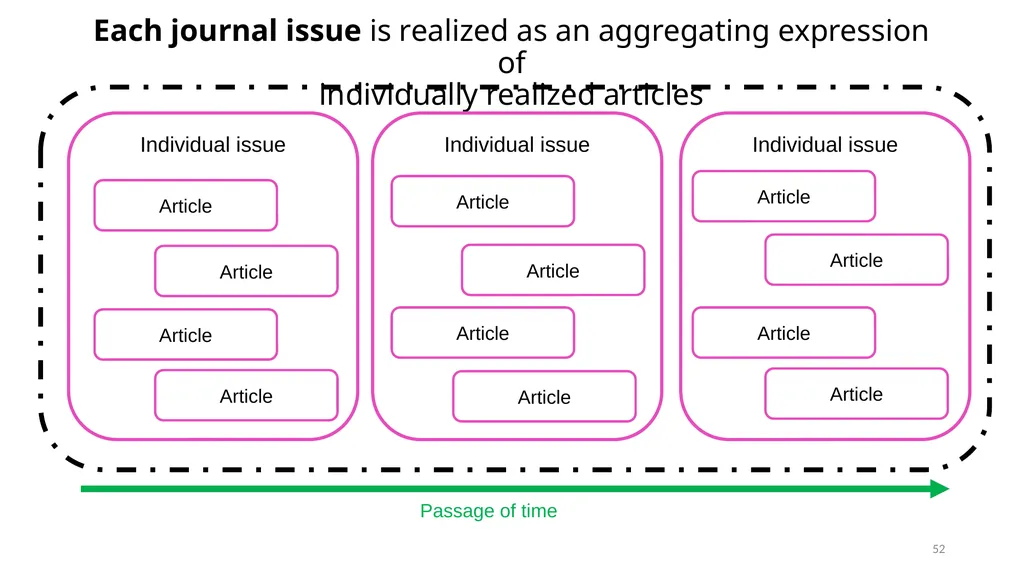
Each journal issue is realized as an aggregating expression of
individually realized articles 52 Individual issue Article Article Article Article Individual issue Article Article Article Article Individual issue Article Article Article Article<br>
53
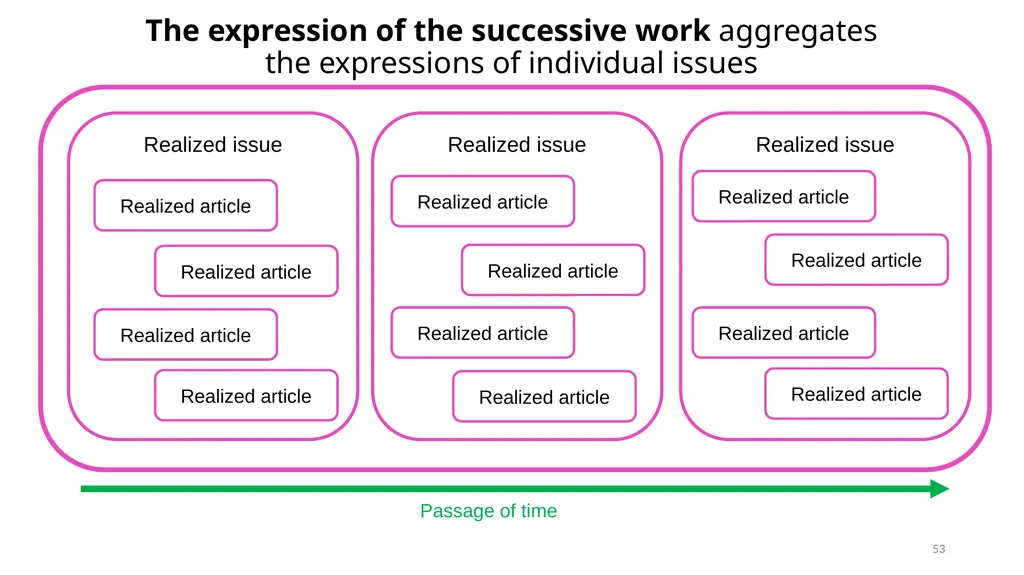
The expression of the successive work aggregates
the expressions of individual issues 53 Realized issue Realized article Realized article Realized article Realized article Realized issue Realized article Realized article Realized article Realized article Realized issue Realized article Realized article Realized article Realized article<br>
54
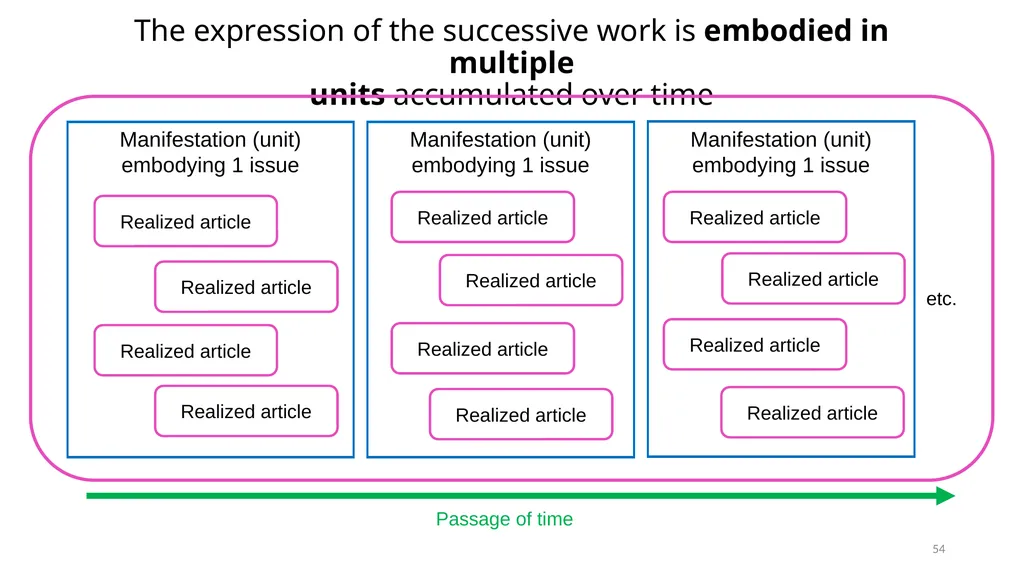
The expression of the successive work is embodied in multiple
units accumulated over time 54 Manifestation (unit) embodying 1 issue Manifestation (unit) embodying 1 issue Manifestation (unit) embodying 1 issue etc. Realized article Realized article Realized article Realized article Realized article Realized article Realized article Realized article Realized article Realized article Realized article Realized article<br>
55
The manifestation of the successive work has n number of
units accumulated over time 55 Manifestation (unit) embodying 1 issue Manifestation (unit) embodying 1 issue Manifestation (unit) embodying 1 issue etc. Realized article Realized article Realized article Realized article Realized article Realized article Realized article Realized article Realized article Realized article Realized article Realized article<br>
56
The manifestation of the successive work has n number of
units accumulated over time 56 Manifestation “Issue #2” Manifestation of “Issue #1” Manifestation of “Issue #3” etc. Article 2.1 Article 2.2 Article 2.3 Article 2.4 Article 1.1 Article 1.2 Article 1.3 Article 1.4 Article 3.1 Article 3.2 Article 3.3 Article 3.4<br>
57
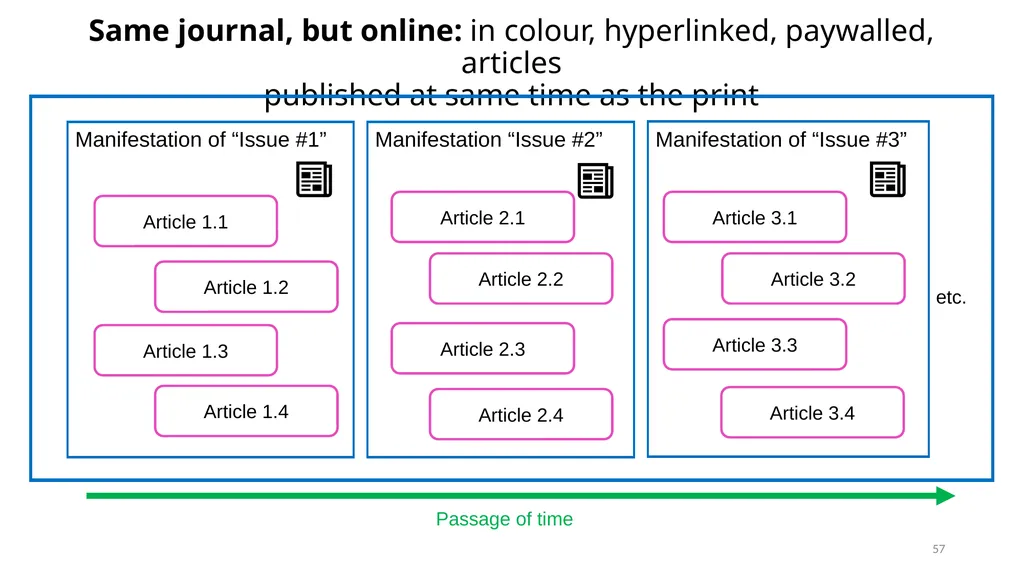
Same journal, but online: in colour, hyperlinked, paywalled, articles
published at same time as the print 57 Manifestation “Issue #2” Manifestation of “Issue #1” Manifestation of “Issue #3” etc. Article 2.1 Article 2.2 Article 2.3 Article 2.4 Article 1.1 Article 1.2 Article 1.3 Article 1.4 Article 3.1 Article 3.2 Article 3.3 Article 3.4<br>
58
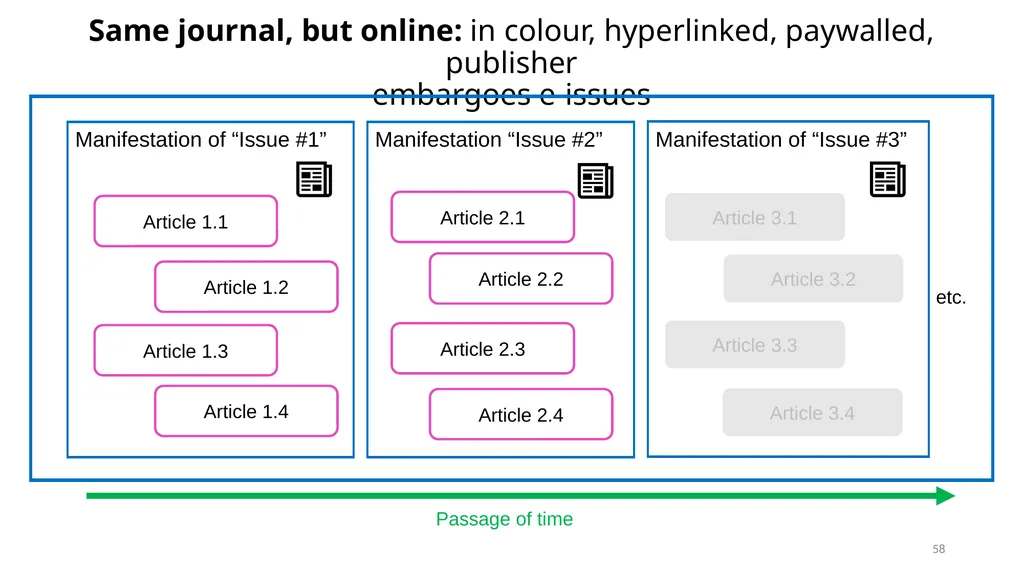
Same journal, but online: in colour, hyperlinked, paywalled, publisher
embargoes e-issues 58 Manifestation “Issue #2” Manifestation of “Issue #1” Manifestation of “Issue #3” etc. Article 2.1 Article 2.2 Article 2.3 Article 2.4 Article 1.1 Article 1.2 Article 1.3 Article 1.4 Article 3.1 Article 3.2 Article 3.3 Article 3.4<br>
59
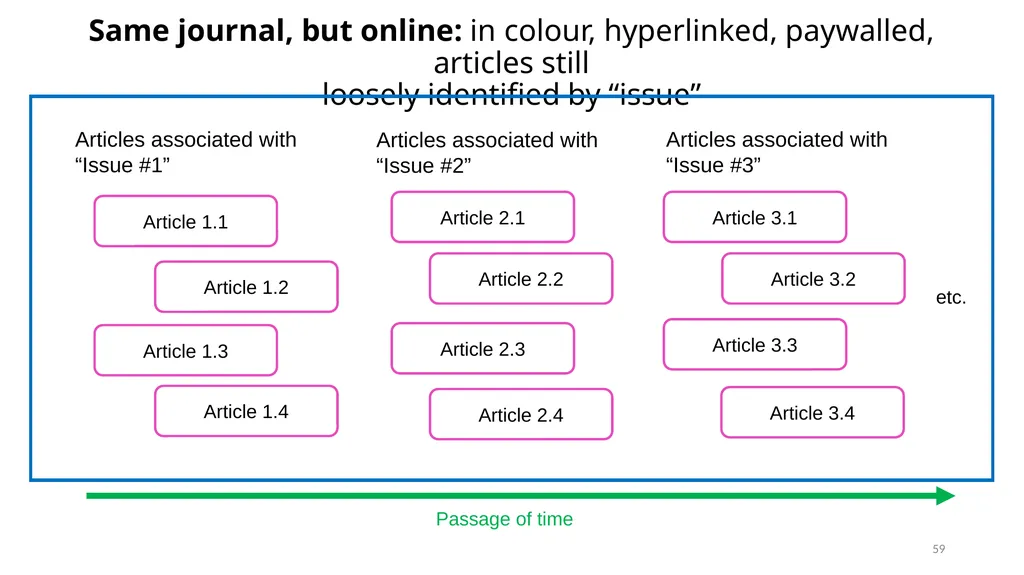
Same journal, but online: in colour, hyperlinked, paywalled, articles still
loosely identified by “issue” 59 Articles associated with “Issue #2” Articles associated with “Issue #1” Articles associated with “Issue #3” etc. Article 2.1 Article 2.2 Article 2.3 Article 2.4 Article 1.1 Article 1.2 Article 1.3 Article 1.4 Article 3.1 Article 3.2 Article 3.3 Article 3.4<br>
60
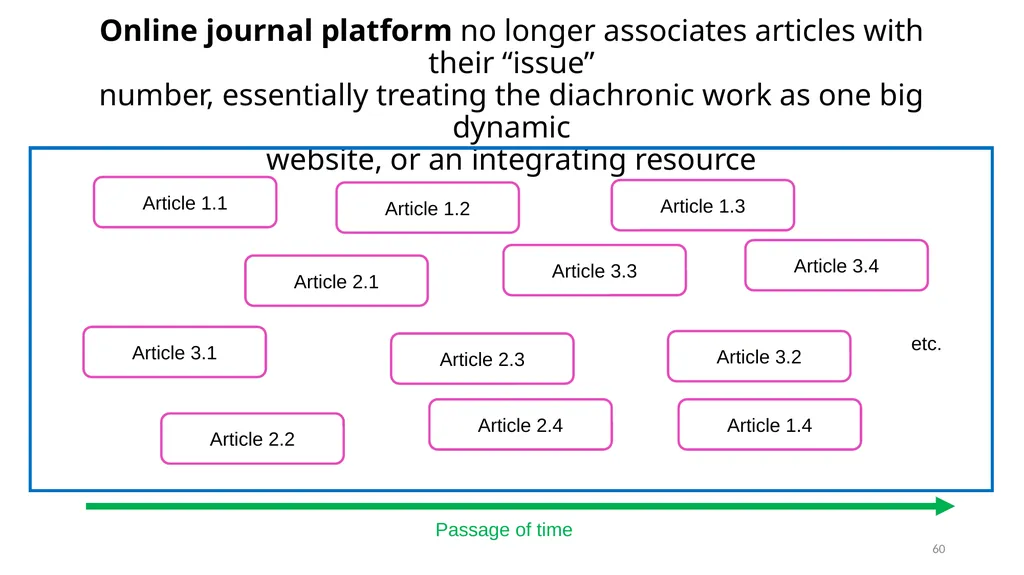
Online journal platform no longer associates articles with their “issue”
number, essentially treating the diachronic work as one big dynamic
website, or an integrating resource 60 etc. Article 2.1 Article 2.2 Article 2.3 Article 2.4 Article 1.1 Article 1.2 Article 1.3 Article 1.4 Article 3.1 Article 3.2 Article 3.3 Article 3.4<br>
61
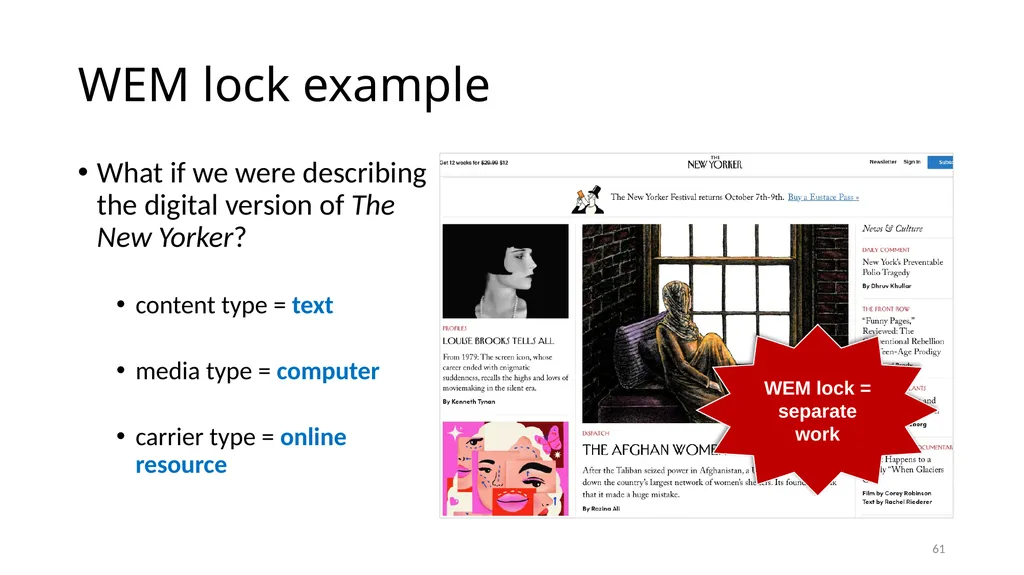
WEM lock example What if we were describing the digital version of The New Yorker?
content type = text
media type = computer
carrier type = online resource 61 WEM lock = separate work<br>
content type = text
media type = computer
carrier type = online resource 61 WEM lock = separate work<br>
62
Guidance in the RDA Toolkit 62 Original Menu view Orientation Guidance Menu view<br>
63
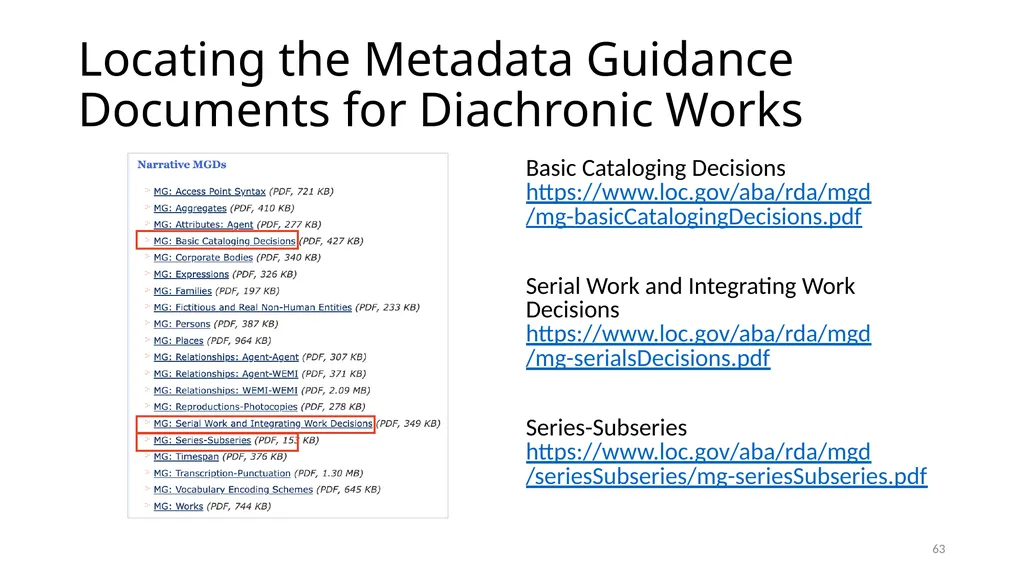
Locating the Metadata Guidance Documents for Diachronic Works Basic Cataloging Decisions
https://www.loc.gov/aba/rda/mgd
/mg-basicCatalogingDecisions.pdf
Serial Work and Integrating Work Decisions https://www.loc.gov/aba/rda/mgd /mg-serialsDecisions.pdf
Series-Subseries https://www.loc.gov/aba/rda/mgd /seriesSubseries/mg-seriesSubseries.pdf 63<br>
Serial Work and Integrating Work Decisions https://www.loc.gov/aba/rda/mgd /mg-serialsDecisions.pdf
Series-Subseries https://www.loc.gov/aba/rda/mgd /seriesSubseries/mg-seriesSubseries.pdf 63<br>
64
A static work is planned to be embodied from a single act of publication or production, whereas a diachronic work is planned to be embodied over time.
The content of a diachronic work is planned to change over time by replacing content of a single expression (i.e., an integrating work) or accumulating content of multiple distinct expressions (i.e., a successive work). 64<br>
The content of a diachronic work is planned to change over time by replacing content of a single expression (i.e., an integrating work) or accumulating content of multiple distinct expressions (i.e., a successive work). 64<br>
65
The new RDA element Work: extension plan is a categorization that reflects an intention to extend the content of a work.
When determining the appropriate term from the RDA Extension Plan vocabulary encoding scheme, consider:
Is the work planned to be extended or updated over time?
How will the content be extended or updated over time?
Is there a predetermined end to extending or updating the content? 65<br>
When determining the appropriate term from the RDA Extension Plan vocabulary encoding scheme, consider:
Is the work planned to be extended or updated over time?
How will the content be extended or updated over time?
Is there a predetermined end to extending or updating the content? 65<br>
66
A diachronic work is realized by only one expression and embodied by only one manifestation. This is known as a WEM lock.
The WEM lock means that a print version of a journal and an e-version of the "same" journal are actually different works, expressions, and manifestations because the plan to change the content of the two manifestations over time may vary. 66<br>
The WEM lock means that a print version of a journal and an e-version of the "same" journal are actually different works, expressions, and manifestations because the plan to change the content of the two manifestations over time may vary. 66<br>
67
Acknowledgements The content of this module, particularly the visual models, draws on Elisa Sze’s course material on diachronic works for the ALA eLearning course “A Practical Approach to Cataloging with the New RDA” held in August 2022. 67<br>