
Digital Learning Infrastructure and IT

Description: Digital Learning Infrastructure and IT Modernization Pilot Webinar TABLE OF CONTENT I. Purpose II. Submission of Applications III. Absolute Priority Selection Criteria General Comments VI. Instructions VII. Grants.gov VIII. Questions
Related Topics
Download Presentation
"Digital Learning Infrastructure and IT" is the property of its rightful owner. Permission is granted to download and print the materials on this website for personal, non-commercial use only, and to display it on your personal computer provided you do not modify the materials and that you retain all copyright notices contained in the materials. By downloading content from our website, you accept the terms of this agreement.
Presentation Transcript
slide1. Digital Learning Infrastructure and IT Modernization Pilot Webinar<br>
slide2. TABLE OF CONTENT I. Purpose
II. Submission of Applications
III. Absolute Priority
Selection Criteria
General Comments
VI. Instructions
VII. Grants.gov
VIII. Questions<br>
slide3. PURPOSE The Digital Learning Infrastructure and IT Modernization Pilot provides grants to HBCUs, TCUs, and other eligible minority-serving institutions (MSIs) to support IT modernization, and to enable them to provide support and technical assistance to expand their digital learning infrastructure.<br>
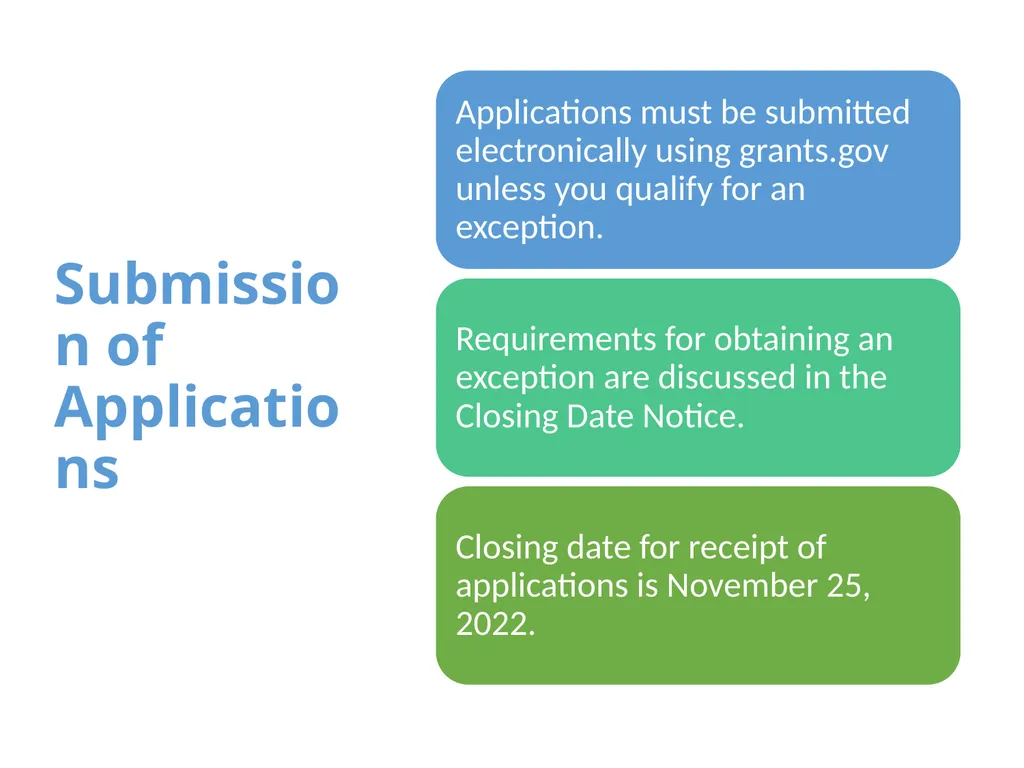
slide4. Submission of Applications<br>
slide5. ABSOLUTE PRIORITY Projects to Develop or Improve the Institution’s Digital Learning Infrastructure. Through the following areas –
(a) Leadership: Describe how the institution will equitably and efficiently sustain progress toward digital learning and institutional governance, resources, and collaboration with external partners will support and drive change to improve the learning environment for students, faculty, and staff.<br>
slide6. ABOSLUTE PRIORITY Projects to Develop or Improve the Institution’s Digital Learning Infrastructure. Through the following areas –
(b) Human Capacity: Describe the institution’s plan to address the professional development needs of leadership, faculty, and staff, which will allow for active learning opportunities enabled through technology for students as they work toward a certificate or degree.<br>
slide7. ABSOLUTE PRIORITY Projects to Develop or Improve the Institution’s Digital Learning Infrastructure. Through the following areas –
(c) Approach to networks and infrastructure: Describe how the institution will strategically maximize resources to provide equitable access to and adoption of devices and broadband and ensure adequate infrastructure for digital learning, including reliable, high-speed access. Applicants must describe how their projects will ensure greater equity and accessibility to learning opportunities for all students by providing support to ensure that the technology supports active teaching and learning practices.<br>
slide8. ABSOLUTE PRIORITY Projects to Develop or Improve the Institution’s Digital Learning Infrastructure. Through the following areas –
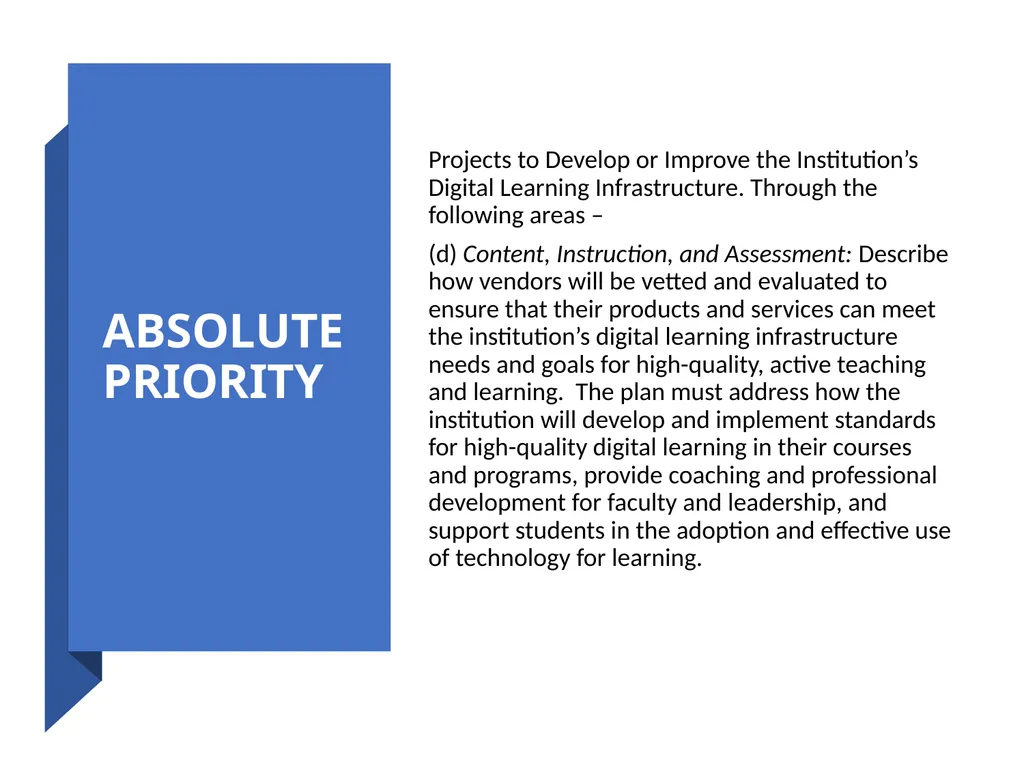
(d) Content, Instruction, and Assessment: Describe how vendors will be vetted and evaluated to ensure that their products and services can meet the institution’s digital learning infrastructure needs and goals for high-quality, active teaching and learning. The plan must address how the institution will develop and implement standards for high-quality digital learning in their courses and programs, provide coaching and professional development for faculty and leadership, and support students in the adoption and effective use of technology for learning.<br>
slide9. ABSOLUTE PRIORITY Projects to Develop or Improve the Institution’s Digital Learning Infrastructure. Through the following areas –
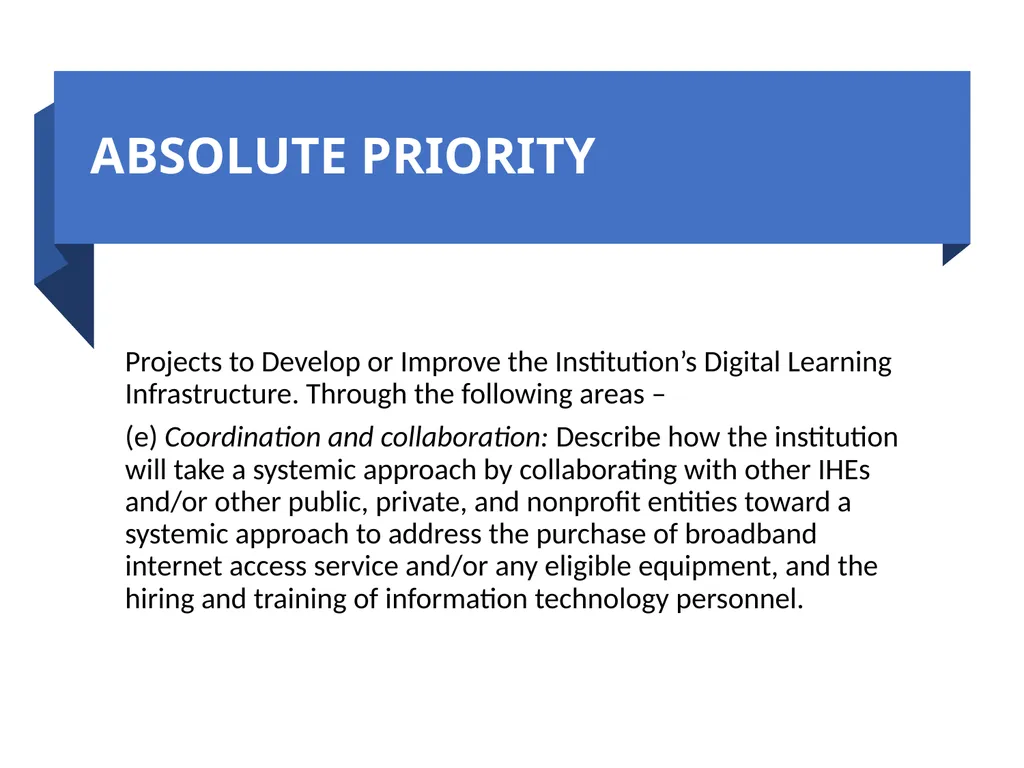
(e) Coordination and collaboration: Describe how the institution will take a systemic approach by collaborating with other IHEs and/or other public, private, and nonprofit entities toward a systemic approach to address the purchase of broadband internet access service and/or any eligible equipment, and the hiring and training of information technology personnel.<br>
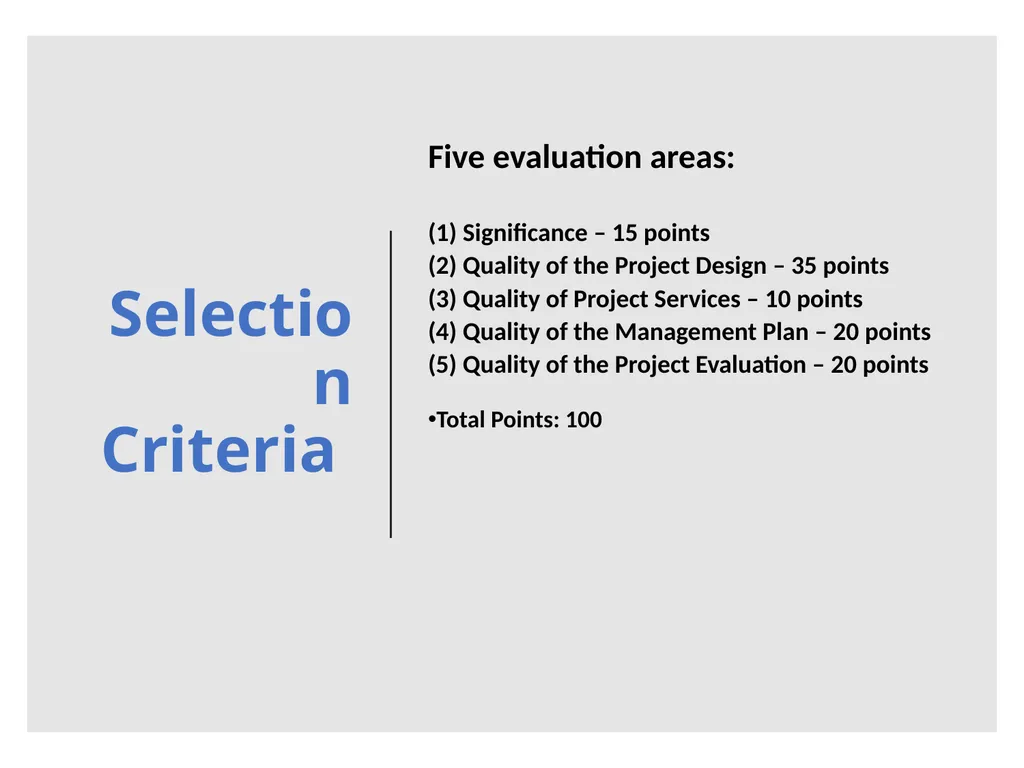
slide10. Selection Criteria Five evaluation areas:
(1) Significance – 15 points
(2) Quality of the Project Design – 35 points
(3) Quality of Project Services – 10 points
(4) Quality of the Management Plan – 20 points
(5) Quality of the Project Evaluation – 20 points Total Points: 100<br>
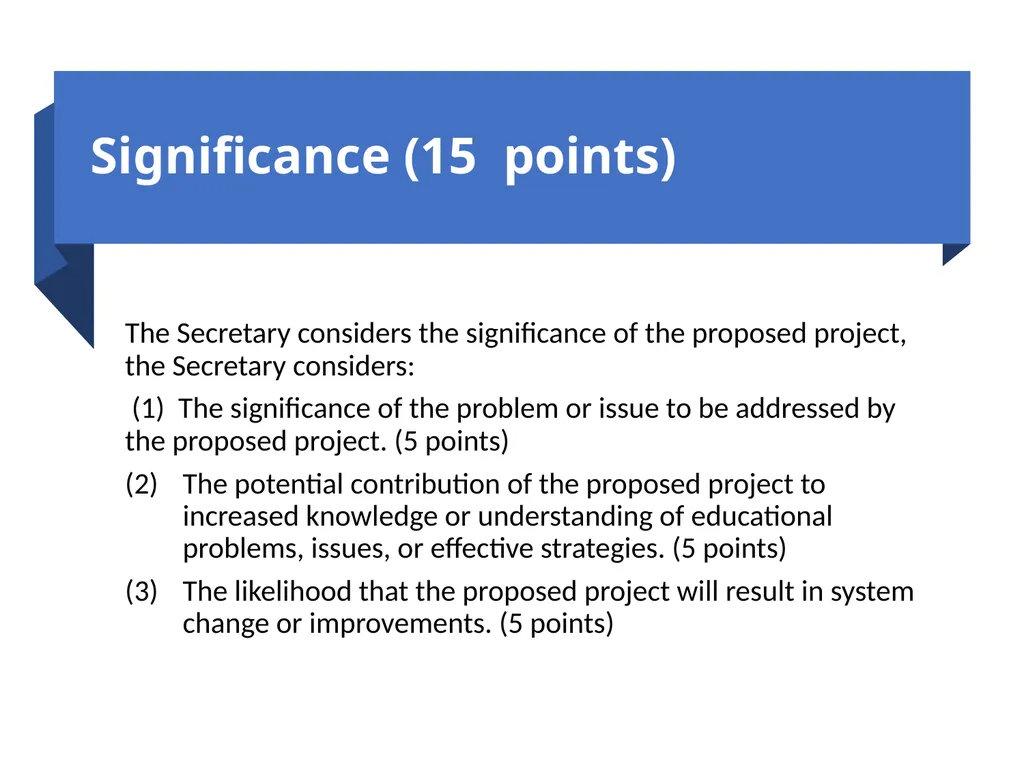
slide11. Significance (15 points) The Secretary considers the significance of the proposed project, the Secretary considers:
(1) The significance of the problem or issue to be addressed by the proposed project. (5 points)
The potential contribution of the proposed project to increased knowledge or understanding of educational problems, issues, or effective strategies. (5 points)
The likelihood that the proposed project will result in system change or improvements. (5 points)<br>
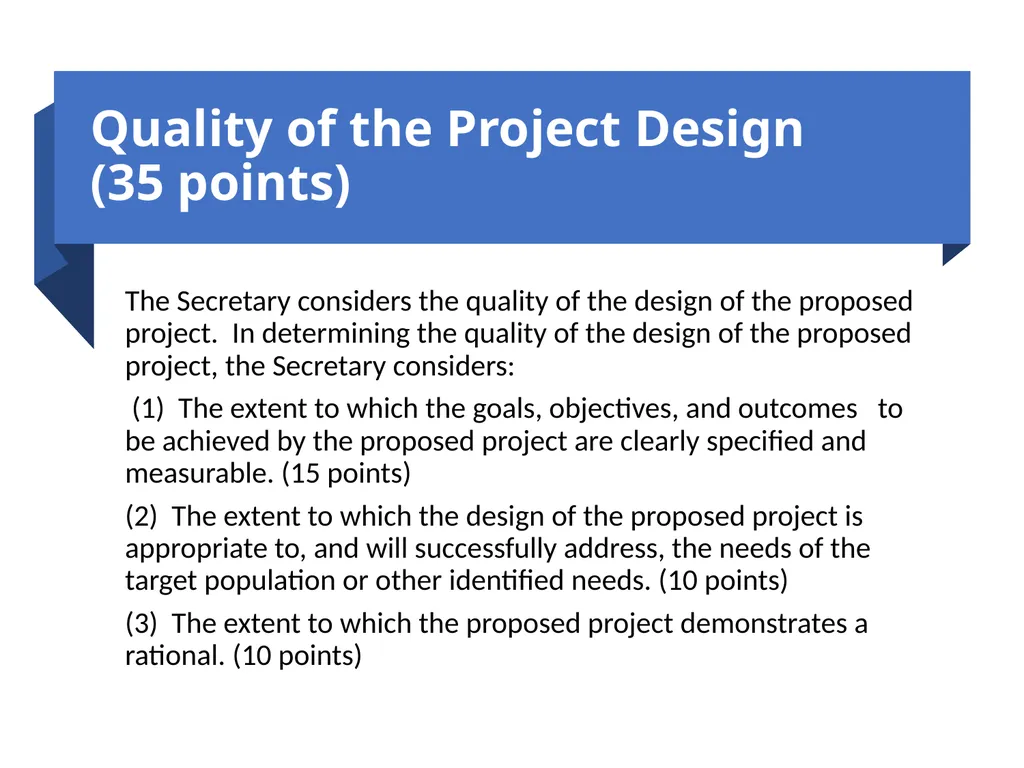
slide12. Quality of the Project Design (35 points) The Secretary considers the quality of the design of the proposed project. In determining the quality of the design of the proposed project, the Secretary considers:
(1) The extent to which the goals, objectives, and outcomes to be achieved by the proposed project are clearly specified and measurable. (15 points)
(2) The extent to which the design of the proposed project is appropriate to, and will successfully address, the needs of the target population or other identified needs. (10 points)
(3) The extent to which the proposed project demonstrates a rational. (10 points)<br>
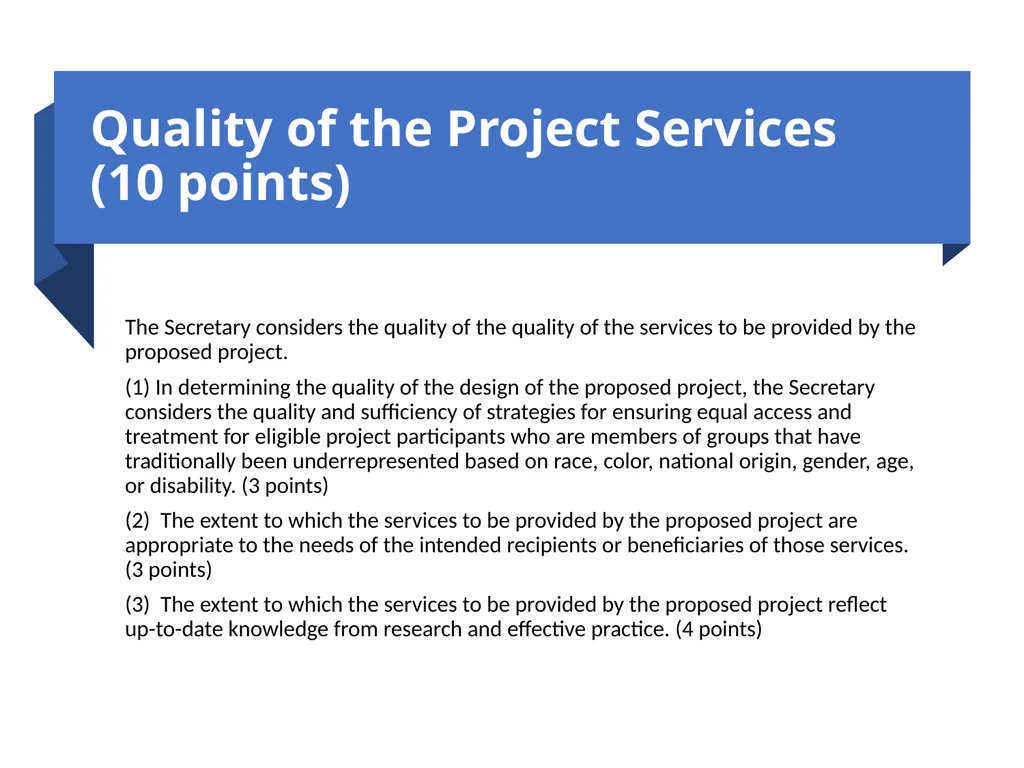
slide13. Quality of the Project Services (10 points) The Secretary considers the quality of the quality of the services to be provided by the proposed project.
(1) In determining the quality of the design of the proposed project, the Secretary considers the quality and sufficiency of strategies for ensuring equal access and treatment for eligible project participants who are members of groups that have traditionally been underrepresented based on race, color, national origin, gender, age, or disability. (3 points)
(2) The extent to which the services to be provided by the proposed project are appropriate to the needs of the intended recipients or beneficiaries of those services. (3 points)
(3) The extent to which the services to be provided by the proposed project reflect up-to-date knowledge from research and effective practice. (4 points)<br>
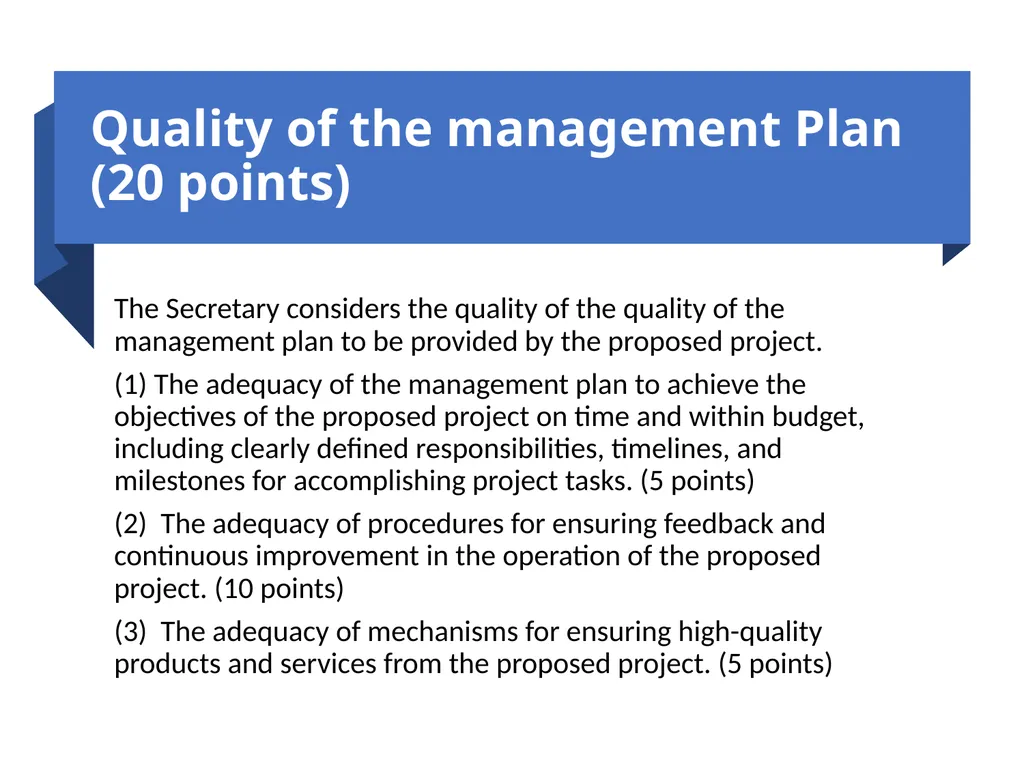
slide14. Quality of the management Plan (20 points) The Secretary considers the quality of the quality of the management plan to be provided by the proposed project.
(1) The adequacy of the management plan to achieve the objectives of the proposed project on time and within budget, including clearly defined responsibilities, timelines, and milestones for accomplishing project tasks. (5 points)
(2) The adequacy of procedures for ensuring feedback and continuous improvement in the operation of the proposed project. (10 points)
(3) The adequacy of mechanisms for ensuring high-quality products and services from the proposed project. (5 points)<br>
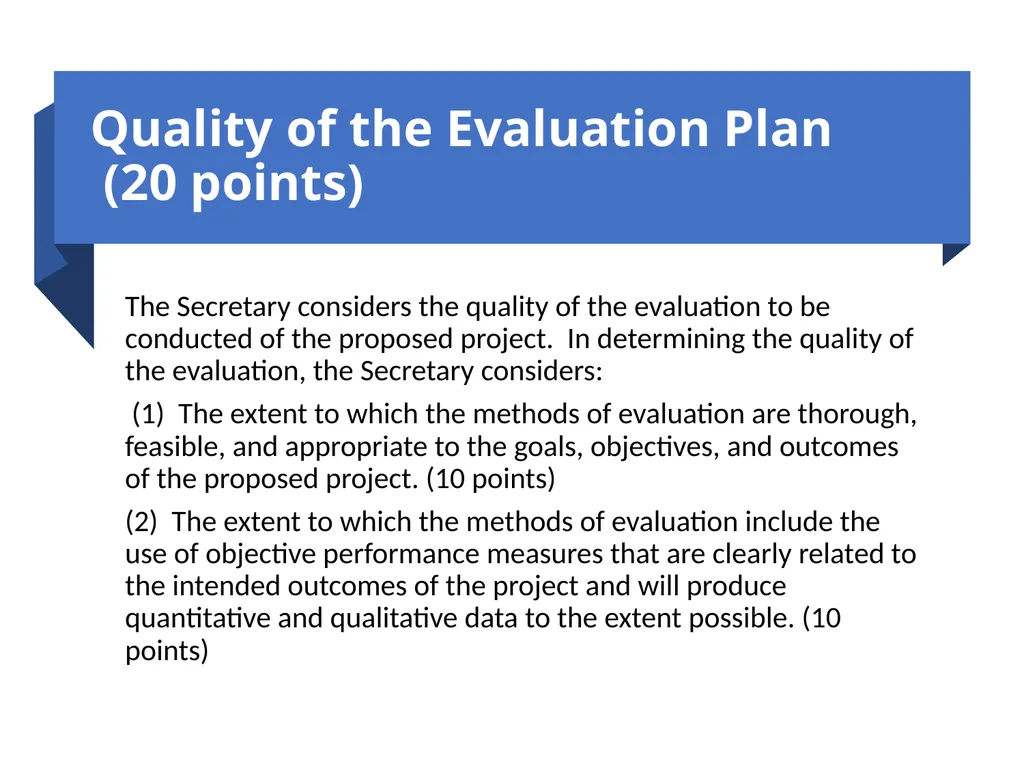
slide15. Quality of the Evaluation Plan (20 points) The Secretary considers the quality of the evaluation to be conducted of the proposed project. In determining the quality of the evaluation, the Secretary considers:
(1) The extent to which the methods of evaluation are thorough, feasible, and appropriate to the goals, objectives, and outcomes of the proposed project. (10 points)
(2) The extent to which the methods of evaluation include the use of objective performance measures that are clearly related to the intended outcomes of the project and will produce quantitative and qualitative data to the extent possible. (10 points)<br>
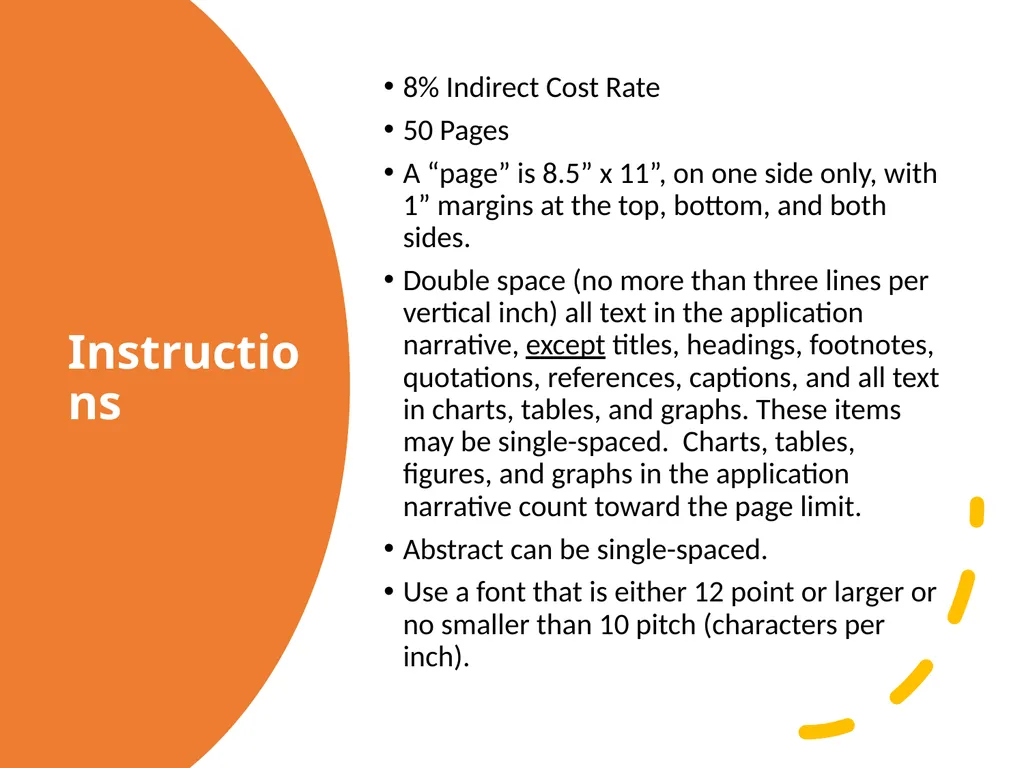
slide16. Instructions 8% Indirect Cost Rate
50 Pages
A “page” is 8.5” x 11”, on one side only, with 1” margins at the top, bottom, and both sides.
Double space (no more than three lines per vertical inch) all text in the application narrative, except titles, headings, footnotes, quotations, references, captions, and all text in charts, tables, and graphs. These items may be single-spaced. Charts, tables, figures, and graphs in the application narrative count toward the page limit.
Abstract can be single-spaced.
Use a font that is either 12 point or larger or no smaller than 10 pitch (characters per inch).<br>
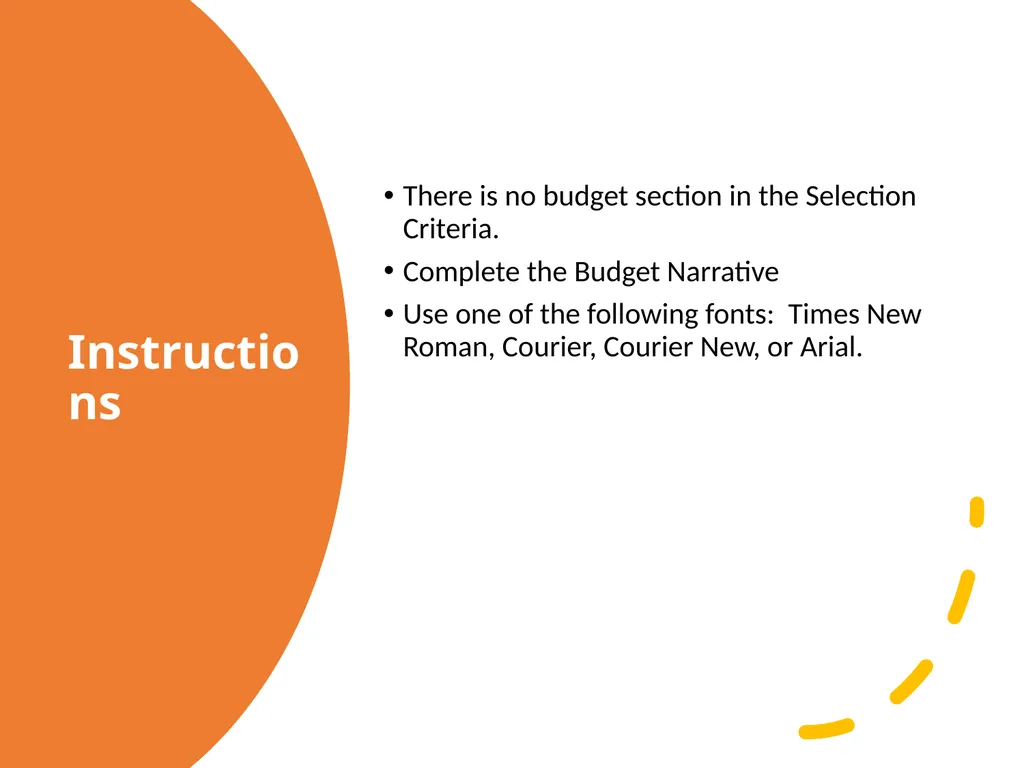
slide17. Instructions There is no budget section in the Selection Criteria.
Complete the Budget Narrative
Use one of the following fonts: Times New Roman, Courier, Courier New, or Arial.<br>
slide18. Follow Instructions It is essential that you follow all instructions completely!
Read all instructions a number of times.
You are being evaluated solely by what you write in your application, not the great idea that you have.<br>
slide19. What’s Included in the Page Count? Only the Application/Project Narrative is included in the page count. If you include any attachments or appendices, these will be counted as part of the Application/Project Narrative.<br>
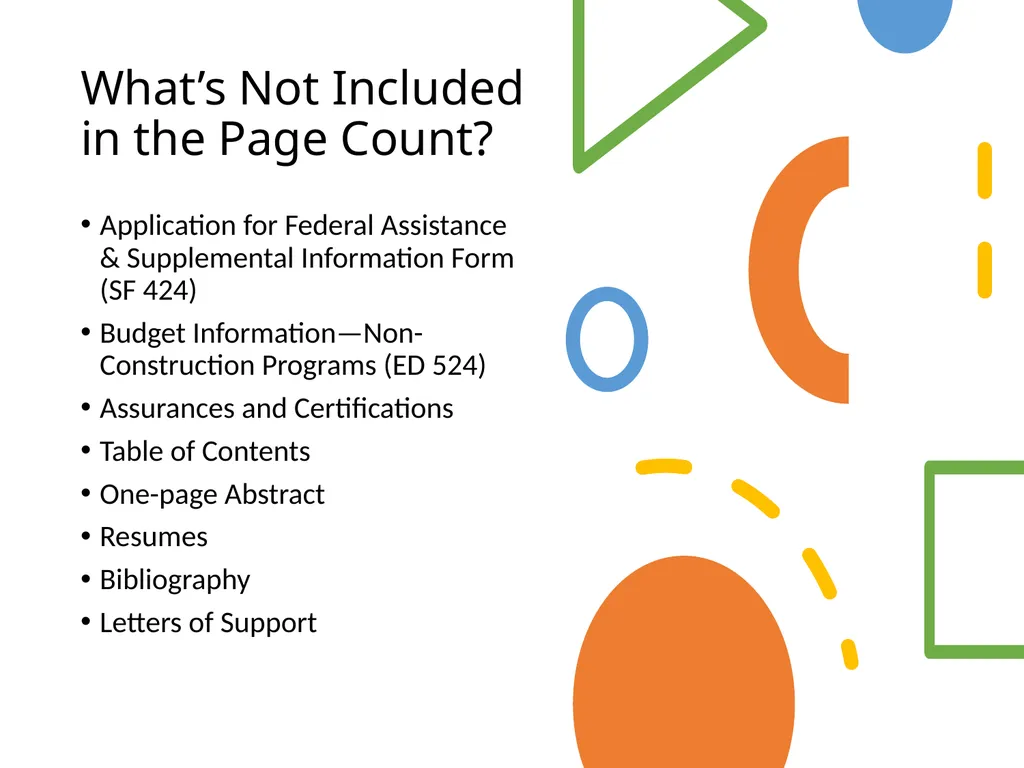
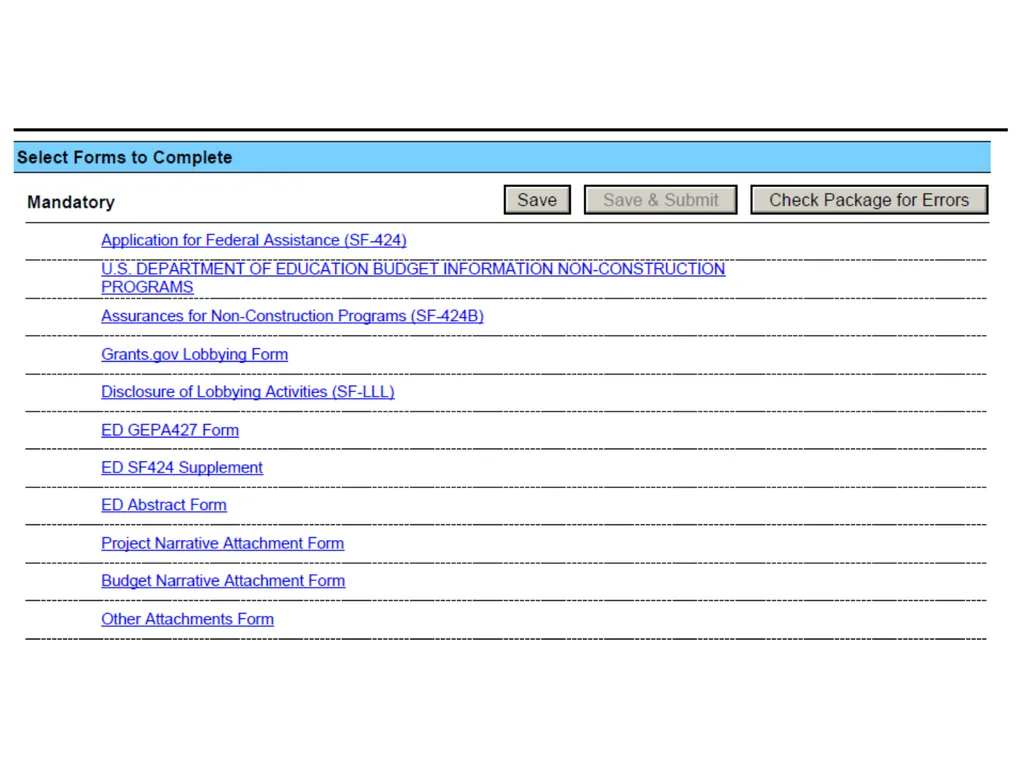
slide20. What’s Not Included in the Page Count? Application for Federal Assistance & Supplemental Information Form (SF 424)
Budget Information—Non-Construction Programs (ED 524)
Assurances and Certifications
Table of Contents
One-page Abstract
Resumes
Bibliography
Letters of Support<br>
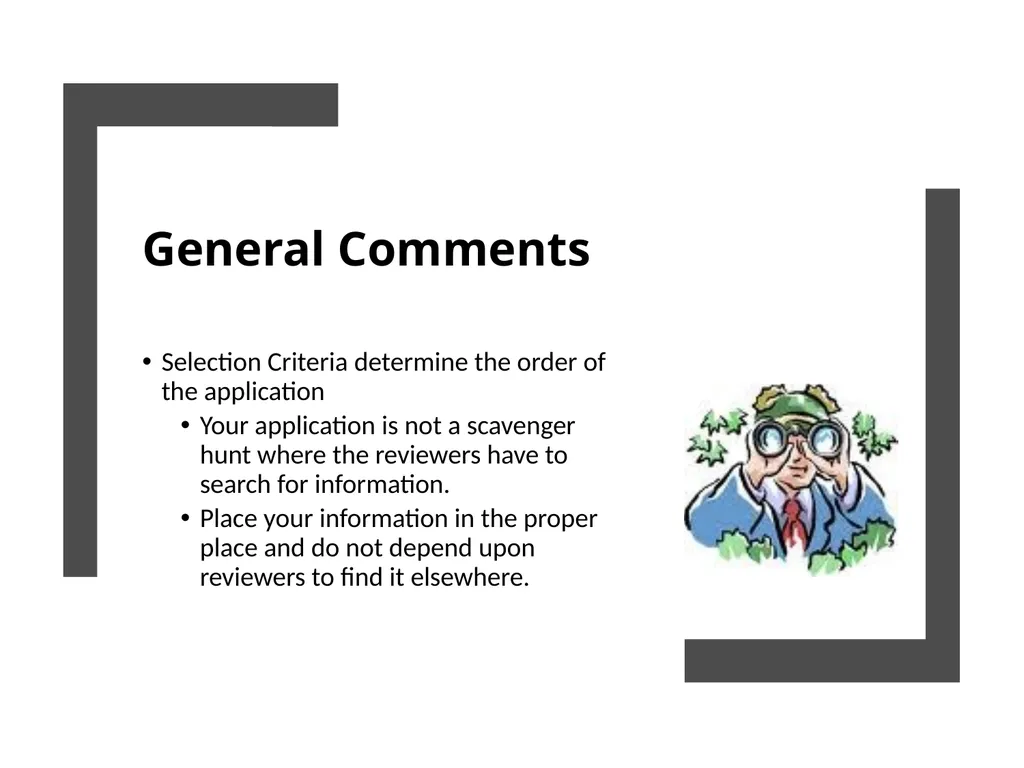
slide21. General Comments Selection Criteria determine the order of the application
Your application is not a scavenger hunt where the reviewers have to search for information.
Place your information in the proper place and do not depend upon reviewers to find it elsewhere.<br>
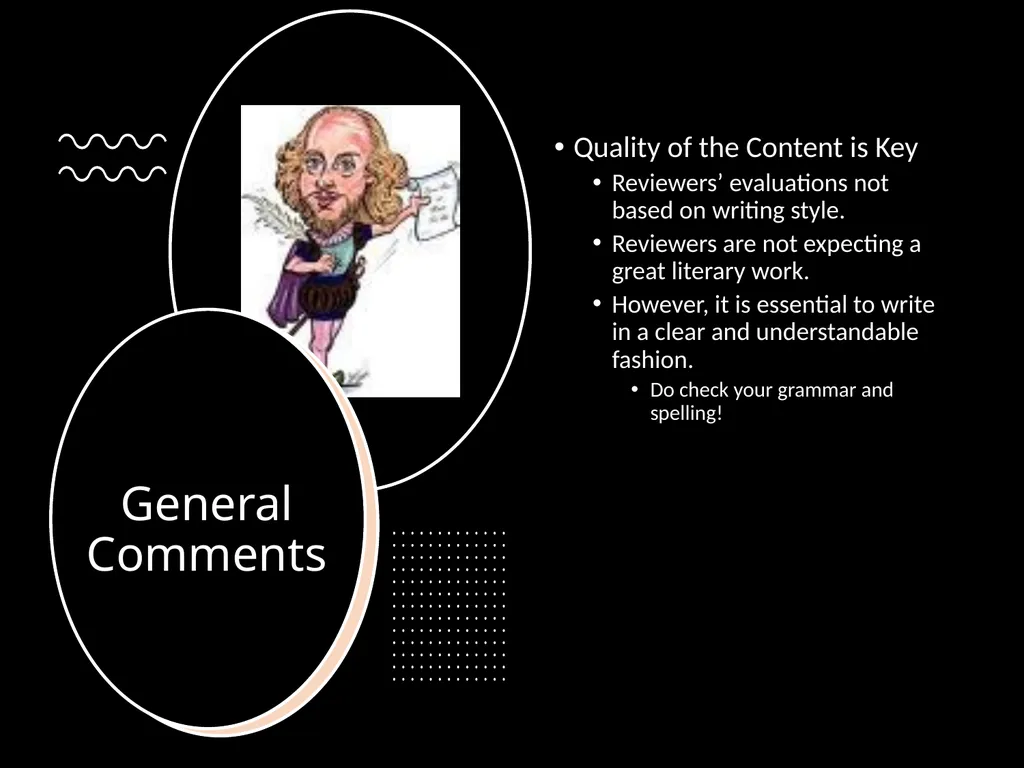
slide22. General Comments Quality of the Content is Key
Reviewers’ evaluations not based on writing style.
Reviewers are not expecting a great literary work.
However, it is essential to write in a clear and understandable fashion.
Do check your grammar and spelling!<br>
slide23. General Comments (cont.) Read and follow the guidelines.
Address everything that is called for.
Leave out extraneous material.
Write clearly, not cryptically .
Beware of jargon and buzz words.<br>
slide24. General Comments (cont.) Use facts and statistics to prove your case.
Be sure the facts and figures you use in one section of your application are consistent with those used elsewhere.<br>
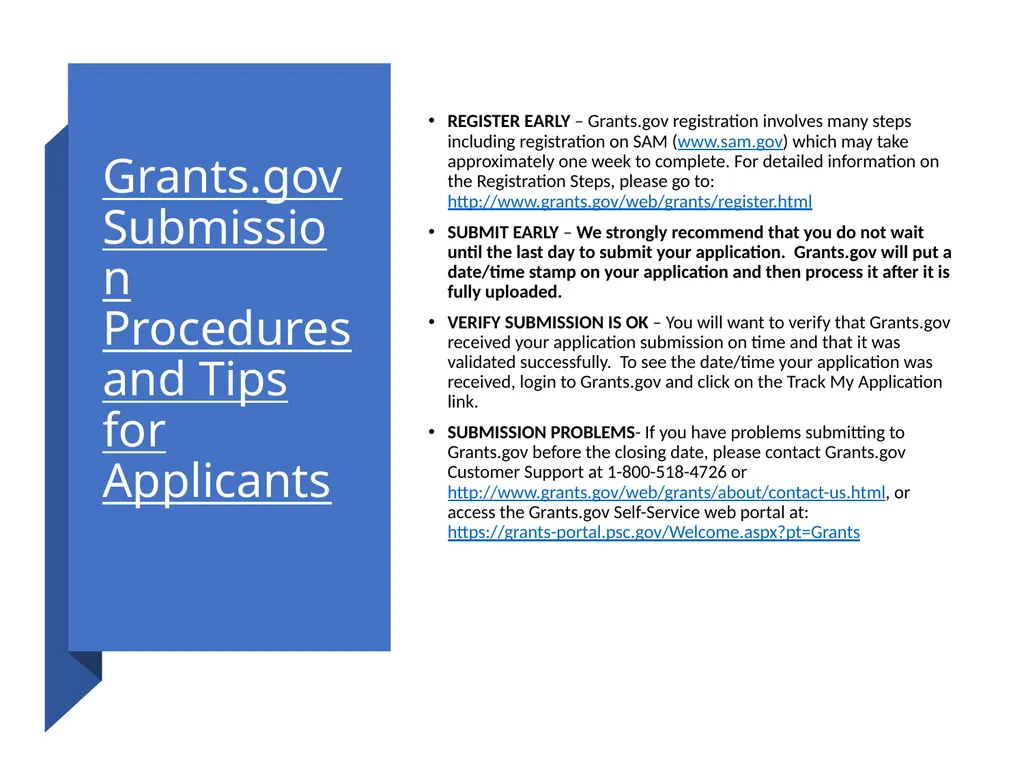
slide25. Grants.gov Submission Procedures and Tips for Applicants REGISTER EARLY – Grants.gov registration involves many steps including registration on SAM (www.sam.gov) which may take approximately one week to complete. For detailed information on the Registration Steps, please go to: http://www.grants.gov/web/grants/register.html
SUBMIT EARLY – We strongly recommend that you do not wait until the last day to submit your application. Grants.gov will put a date/time stamp on your application and then process it after it is fully uploaded.
VERIFY SUBMISSION IS OK – You will want to verify that Grants.gov received your application submission on time and that it was validated successfully. To see the date/time your application was received, login to Grants.gov and click on the Track My Application link.
SUBMISSION PROBLEMS- If you have problems submitting to Grants.gov before the closing date, please contact Grants.gov Customer Support at 1-800-518-4726 or http://www.grants.gov/web/grants/about/contact-us.html, or access the Grants.gov Self-Service web portal at: https://grants-portal.psc.gov/Welcome.aspx?pt=Grants<br>
slide27. Questions?
Contact Information:
Pearson.Owens@ed.gov
202-453-7997<br>
slide2. TABLE OF CONTENT I. Purpose
II. Submission of Applications
III. Absolute Priority
Selection Criteria
General Comments
VI. Instructions
VII. Grants.gov
VIII. Questions<br>
slide3. PURPOSE The Digital Learning Infrastructure and IT Modernization Pilot provides grants to HBCUs, TCUs, and other eligible minority-serving institutions (MSIs) to support IT modernization, and to enable them to provide support and technical assistance to expand their digital learning infrastructure.<br>
slide4. Submission of Applications<br>
slide5. ABSOLUTE PRIORITY Projects to Develop or Improve the Institution’s Digital Learning Infrastructure. Through the following areas –
(a) Leadership: Describe how the institution will equitably and efficiently sustain progress toward digital learning and institutional governance, resources, and collaboration with external partners will support and drive change to improve the learning environment for students, faculty, and staff.<br>
slide6. ABOSLUTE PRIORITY Projects to Develop or Improve the Institution’s Digital Learning Infrastructure. Through the following areas –
(b) Human Capacity: Describe the institution’s plan to address the professional development needs of leadership, faculty, and staff, which will allow for active learning opportunities enabled through technology for students as they work toward a certificate or degree.<br>
slide7. ABSOLUTE PRIORITY Projects to Develop or Improve the Institution’s Digital Learning Infrastructure. Through the following areas –
(c) Approach to networks and infrastructure: Describe how the institution will strategically maximize resources to provide equitable access to and adoption of devices and broadband and ensure adequate infrastructure for digital learning, including reliable, high-speed access. Applicants must describe how their projects will ensure greater equity and accessibility to learning opportunities for all students by providing support to ensure that the technology supports active teaching and learning practices.<br>
slide8. ABSOLUTE PRIORITY Projects to Develop or Improve the Institution’s Digital Learning Infrastructure. Through the following areas –
(d) Content, Instruction, and Assessment: Describe how vendors will be vetted and evaluated to ensure that their products and services can meet the institution’s digital learning infrastructure needs and goals for high-quality, active teaching and learning. The plan must address how the institution will develop and implement standards for high-quality digital learning in their courses and programs, provide coaching and professional development for faculty and leadership, and support students in the adoption and effective use of technology for learning.<br>
slide9. ABSOLUTE PRIORITY Projects to Develop or Improve the Institution’s Digital Learning Infrastructure. Through the following areas –
(e) Coordination and collaboration: Describe how the institution will take a systemic approach by collaborating with other IHEs and/or other public, private, and nonprofit entities toward a systemic approach to address the purchase of broadband internet access service and/or any eligible equipment, and the hiring and training of information technology personnel.<br>
slide10. Selection Criteria Five evaluation areas:
(1) Significance – 15 points
(2) Quality of the Project Design – 35 points
(3) Quality of Project Services – 10 points
(4) Quality of the Management Plan – 20 points
(5) Quality of the Project Evaluation – 20 points Total Points: 100<br>
slide11. Significance (15 points) The Secretary considers the significance of the proposed project, the Secretary considers:
(1) The significance of the problem or issue to be addressed by the proposed project. (5 points)
The potential contribution of the proposed project to increased knowledge or understanding of educational problems, issues, or effective strategies. (5 points)
The likelihood that the proposed project will result in system change or improvements. (5 points)<br>
slide12. Quality of the Project Design (35 points) The Secretary considers the quality of the design of the proposed project. In determining the quality of the design of the proposed project, the Secretary considers:
(1) The extent to which the goals, objectives, and outcomes to be achieved by the proposed project are clearly specified and measurable. (15 points)
(2) The extent to which the design of the proposed project is appropriate to, and will successfully address, the needs of the target population or other identified needs. (10 points)
(3) The extent to which the proposed project demonstrates a rational. (10 points)<br>
slide13. Quality of the Project Services (10 points) The Secretary considers the quality of the quality of the services to be provided by the proposed project.
(1) In determining the quality of the design of the proposed project, the Secretary considers the quality and sufficiency of strategies for ensuring equal access and treatment for eligible project participants who are members of groups that have traditionally been underrepresented based on race, color, national origin, gender, age, or disability. (3 points)
(2) The extent to which the services to be provided by the proposed project are appropriate to the needs of the intended recipients or beneficiaries of those services. (3 points)
(3) The extent to which the services to be provided by the proposed project reflect up-to-date knowledge from research and effective practice. (4 points)<br>
slide14. Quality of the management Plan (20 points) The Secretary considers the quality of the quality of the management plan to be provided by the proposed project.
(1) The adequacy of the management plan to achieve the objectives of the proposed project on time and within budget, including clearly defined responsibilities, timelines, and milestones for accomplishing project tasks. (5 points)
(2) The adequacy of procedures for ensuring feedback and continuous improvement in the operation of the proposed project. (10 points)
(3) The adequacy of mechanisms for ensuring high-quality products and services from the proposed project. (5 points)<br>
slide15. Quality of the Evaluation Plan (20 points) The Secretary considers the quality of the evaluation to be conducted of the proposed project. In determining the quality of the evaluation, the Secretary considers:
(1) The extent to which the methods of evaluation are thorough, feasible, and appropriate to the goals, objectives, and outcomes of the proposed project. (10 points)
(2) The extent to which the methods of evaluation include the use of objective performance measures that are clearly related to the intended outcomes of the project and will produce quantitative and qualitative data to the extent possible. (10 points)<br>
slide16. Instructions 8% Indirect Cost Rate
50 Pages
A “page” is 8.5” x 11”, on one side only, with 1” margins at the top, bottom, and both sides.
Double space (no more than three lines per vertical inch) all text in the application narrative, except titles, headings, footnotes, quotations, references, captions, and all text in charts, tables, and graphs. These items may be single-spaced. Charts, tables, figures, and graphs in the application narrative count toward the page limit.
Abstract can be single-spaced.
Use a font that is either 12 point or larger or no smaller than 10 pitch (characters per inch).<br>
slide17. Instructions There is no budget section in the Selection Criteria.
Complete the Budget Narrative
Use one of the following fonts: Times New Roman, Courier, Courier New, or Arial.<br>
slide18. Follow Instructions It is essential that you follow all instructions completely!
Read all instructions a number of times.
You are being evaluated solely by what you write in your application, not the great idea that you have.<br>
slide19. What’s Included in the Page Count? Only the Application/Project Narrative is included in the page count. If you include any attachments or appendices, these will be counted as part of the Application/Project Narrative.<br>
slide20. What’s Not Included in the Page Count? Application for Federal Assistance & Supplemental Information Form (SF 424)
Budget Information—Non-Construction Programs (ED 524)
Assurances and Certifications
Table of Contents
One-page Abstract
Resumes
Bibliography
Letters of Support<br>
slide21. General Comments Selection Criteria determine the order of the application
Your application is not a scavenger hunt where the reviewers have to search for information.
Place your information in the proper place and do not depend upon reviewers to find it elsewhere.<br>
slide22. General Comments Quality of the Content is Key
Reviewers’ evaluations not based on writing style.
Reviewers are not expecting a great literary work.
However, it is essential to write in a clear and understandable fashion.
Do check your grammar and spelling!<br>
slide23. General Comments (cont.) Read and follow the guidelines.
Address everything that is called for.
Leave out extraneous material.
Write clearly, not cryptically .
Beware of jargon and buzz words.<br>
slide24. General Comments (cont.) Use facts and statistics to prove your case.
Be sure the facts and figures you use in one section of your application are consistent with those used elsewhere.<br>
slide25. Grants.gov Submission Procedures and Tips for Applicants REGISTER EARLY – Grants.gov registration involves many steps including registration on SAM (www.sam.gov) which may take approximately one week to complete. For detailed information on the Registration Steps, please go to: http://www.grants.gov/web/grants/register.html
SUBMIT EARLY – We strongly recommend that you do not wait until the last day to submit your application. Grants.gov will put a date/time stamp on your application and then process it after it is fully uploaded.
VERIFY SUBMISSION IS OK – You will want to verify that Grants.gov received your application submission on time and that it was validated successfully. To see the date/time your application was received, login to Grants.gov and click on the Track My Application link.
SUBMISSION PROBLEMS- If you have problems submitting to Grants.gov before the closing date, please contact Grants.gov Customer Support at 1-800-518-4726 or http://www.grants.gov/web/grants/about/contact-us.html, or access the Grants.gov Self-Service web portal at: https://grants-portal.psc.gov/Welcome.aspx?pt=Grants<br>
slide27. Questions?
Contact Information:
Pearson.Owens@ed.gov
202-453-7997<br>