Digital Twins in Large Scale Scientific Instruments: Improving Particle Accelerator Performance and Operation Weijian (Lucy) Lin Collider Accelerator Department, BNL New York Scientific Data Summit 2024 September 17, 2024 Motivation 2
"Digital Twins in Large Scale Scientific" is the property of its rightful owner. Permission is granted to
download and print the materials on this website for personal, non-commercial use only, and to display it
on your personal computer provided you do not modify the materials and that you retain all copyright
notices contained in the materials. By downloading content from our website, you accept the terms of this
agreement.
Presentation Transcript
01
Digital Twins in Large Scale Scientific Instruments: Improving Particle Accelerator Performance and Operation Weijian (Lucy) Lin
Collider Accelerator Department, BNL
New York Scientific Data Summit 2024
September 17, 2024<br>
02
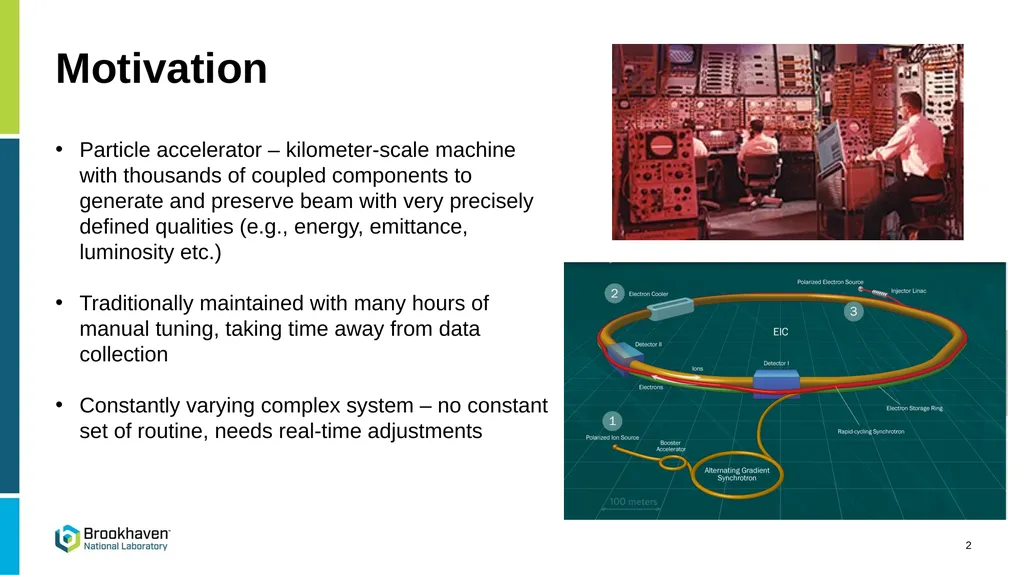
Motivation 2 Particle accelerator – kilometer-scale machine with thousands of coupled components to generate and preserve beam with very precisely defined qualities (e.g., energy, emittance, luminosity etc.)
Traditionally maintained with many hours of manual tuning, taking time away from data collection
Constantly varying complex system – no constant set of routine, needs real-time adjustments<br>
03
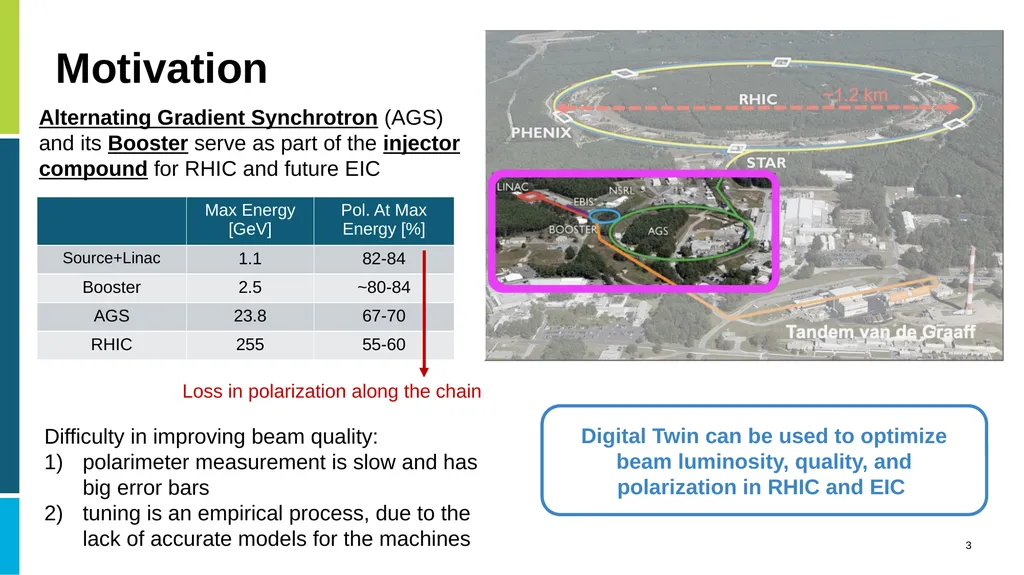
3 Alternating Gradient Synchrotron (AGS) and its Booster serve as part of the injector compound for RHIC and future EIC Motivation Loss in polarization along the chain Difficulty in improving beam quality:
polarimeter measurement is slow and has big error bars
tuning is an empirical process, due to the lack of accurate models for the machines Digital Twin can be used to optimize beam luminosity, quality, and polarization in RHIC and EIC<br>
04
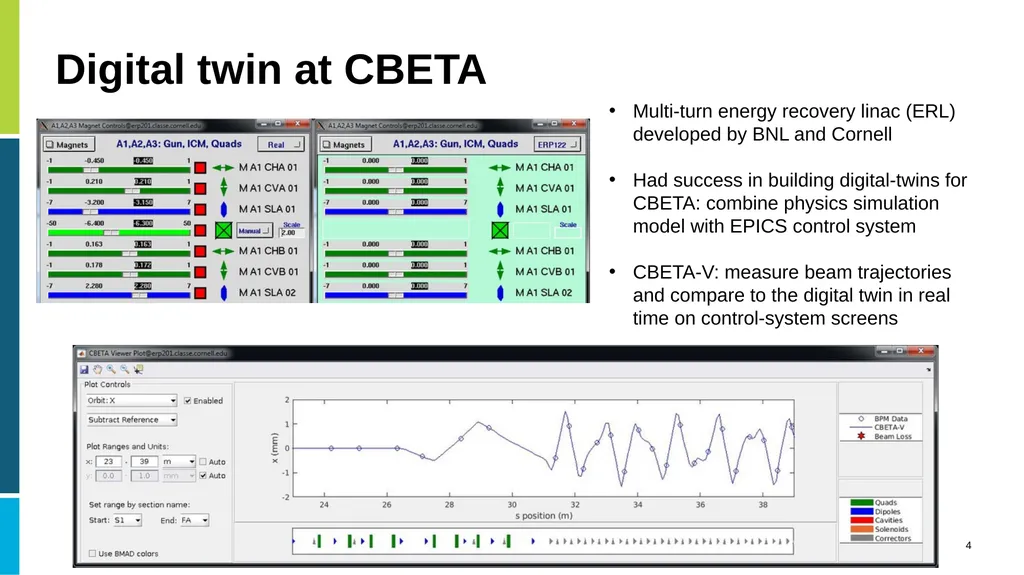
Digital twin at CBETA 4 Multi-turn energy recovery linac (ERL) developed by BNL and Cornell
Had success in building digital-twins for CBETA: combine physics simulation model with EPICS control system
CBETA-V: measure beam trajectories and compare to the digital twin in real time on control-system screens<br>
05
5 Improve Accelerator Operations with DT<br>
06
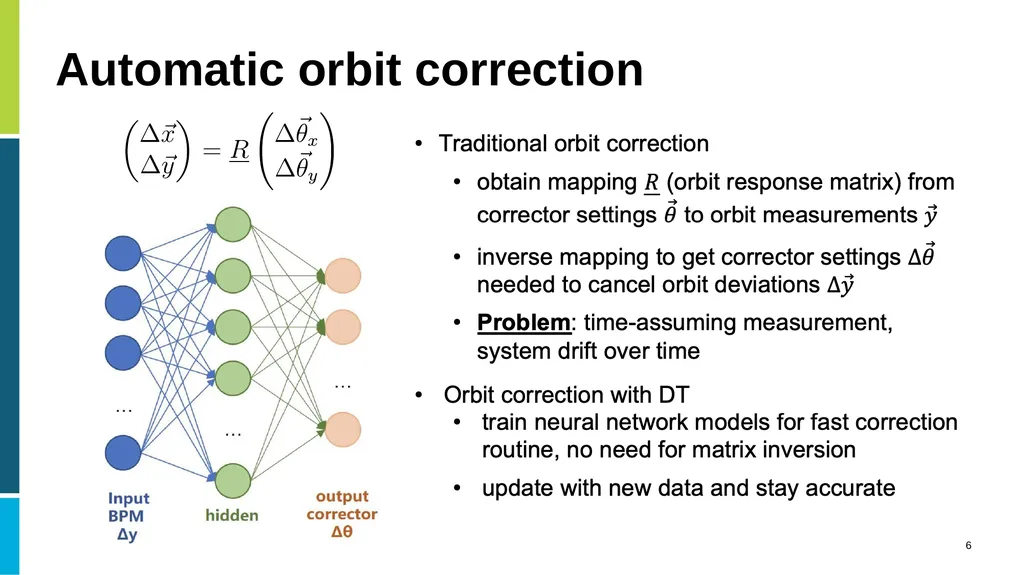
Automatic orbit correction 6<br>
07
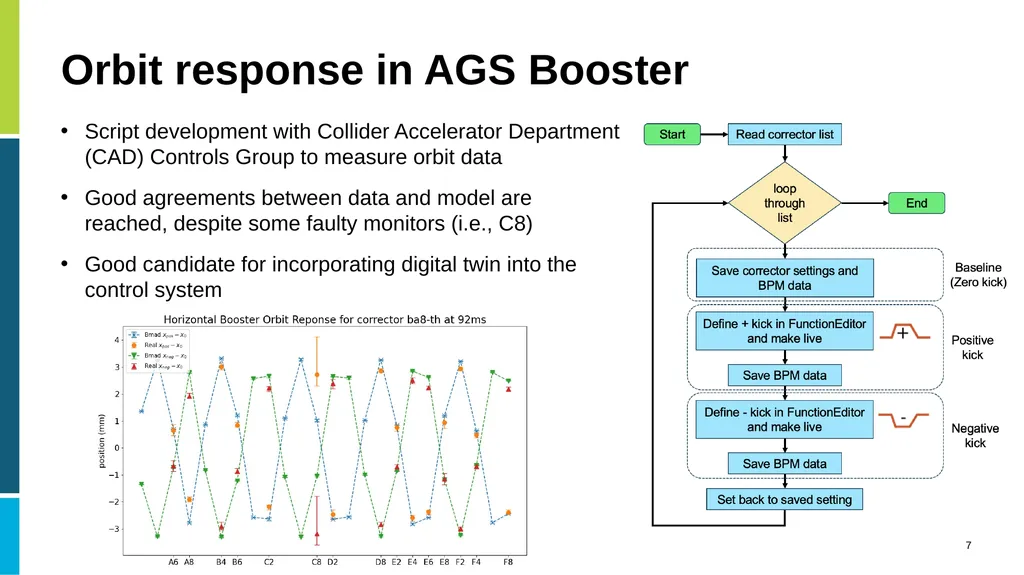
Orbit response in AGS Booster 7 Script development with Collider Accelerator Department (CAD) Controls Group to measure orbit data
Good agreements between data and model are reached, despite some faulty monitors (i.e., C8)
Good candidate for incorporating digital twin into the control system<br>
08
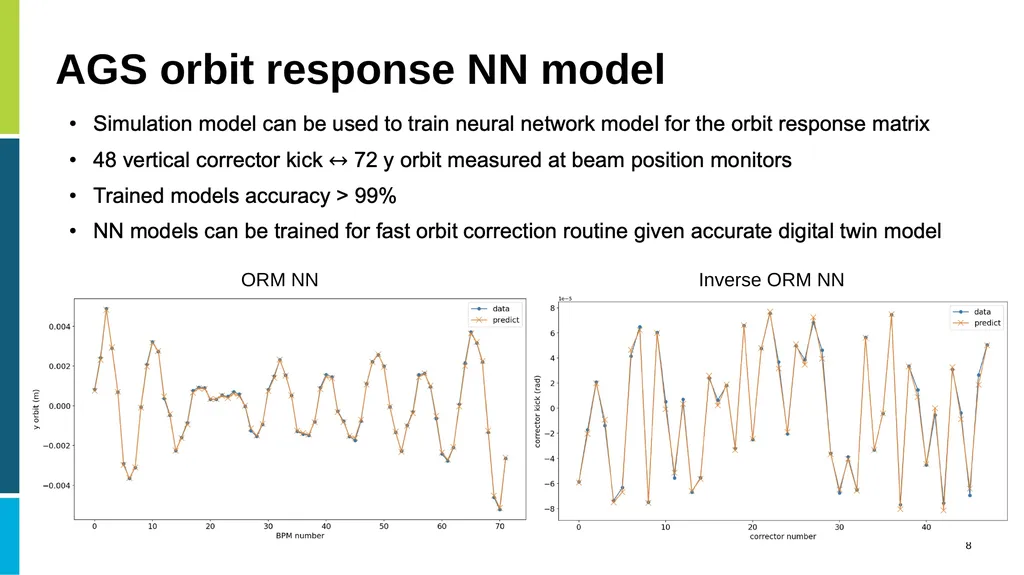
AGS orbit response NN model 8 ORM NN Inverse ORM NN<br>
09
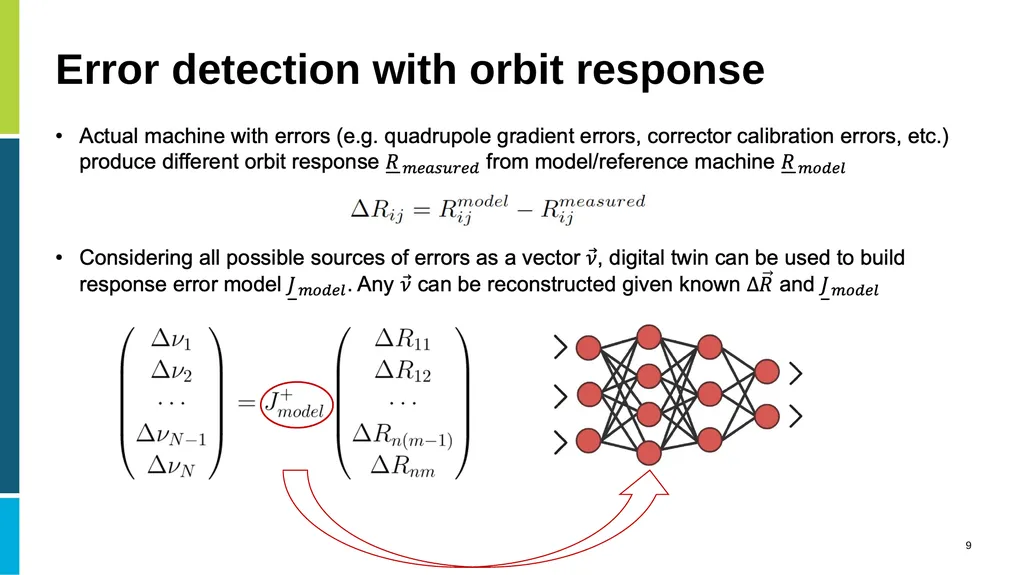
Error detection with orbit response 9<br>
10
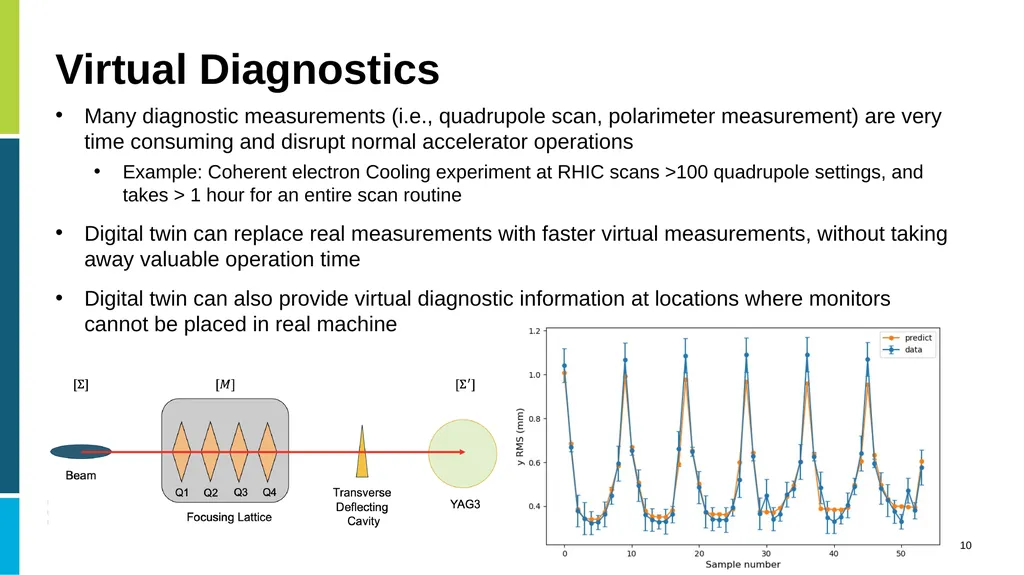
Virtual Diagnostics 10 Many diagnostic measurements (i.e., quadrupole scan, polarimeter measurement) are very time consuming and disrupt normal accelerator operations
Example: Coherent electron Cooling experiment at RHIC scans >100 quadrupole settings, and takes > 1 hour for an entire scan routine
Digital twin can replace real measurements with faster virtual measurements, without taking away valuable operation time
Digital twin can also provide virtual diagnostic information at locations where monitors cannot be placed in real machine<br>
11
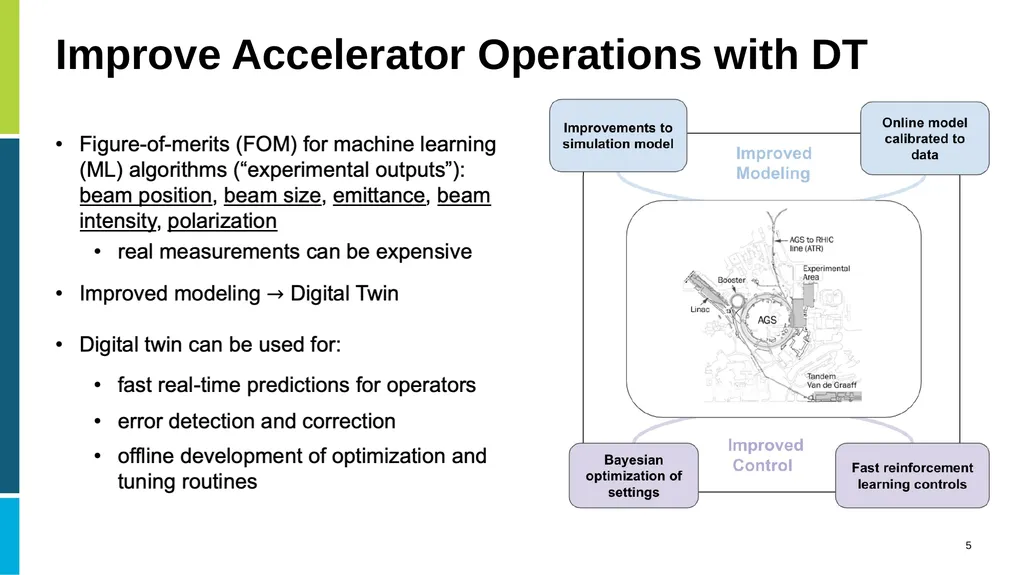
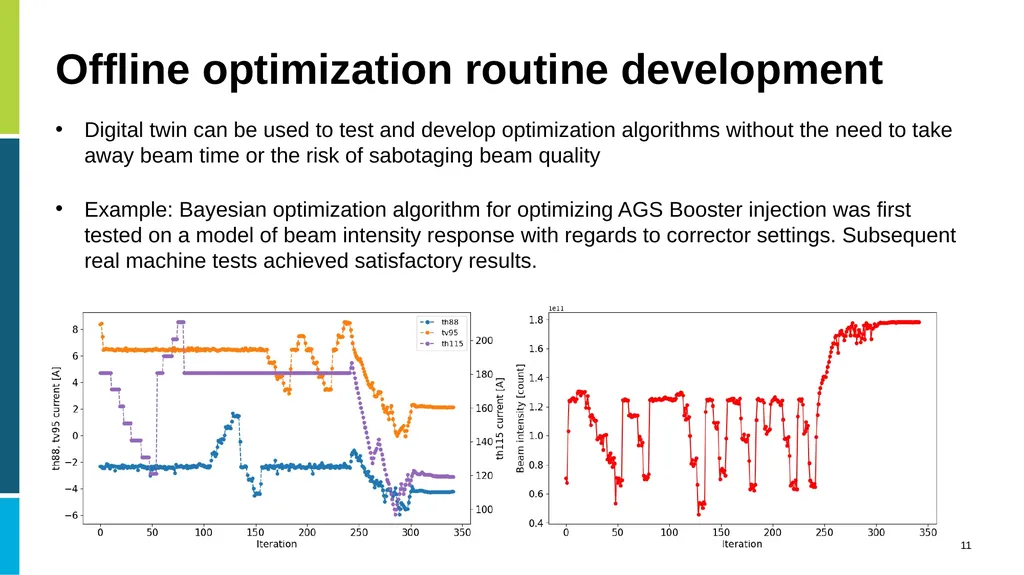
Offline optimization routine development 11 Digital twin can be used to test and develop optimization algorithms without the need to take away beam time or the risk of sabotaging beam quality
Example: Bayesian optimization algorithm for optimizing AGS Booster injection was first tested on a model of beam intensity response with regards to corrector settings. Subsequent real machine tests achieved satisfactory results.<br>
12
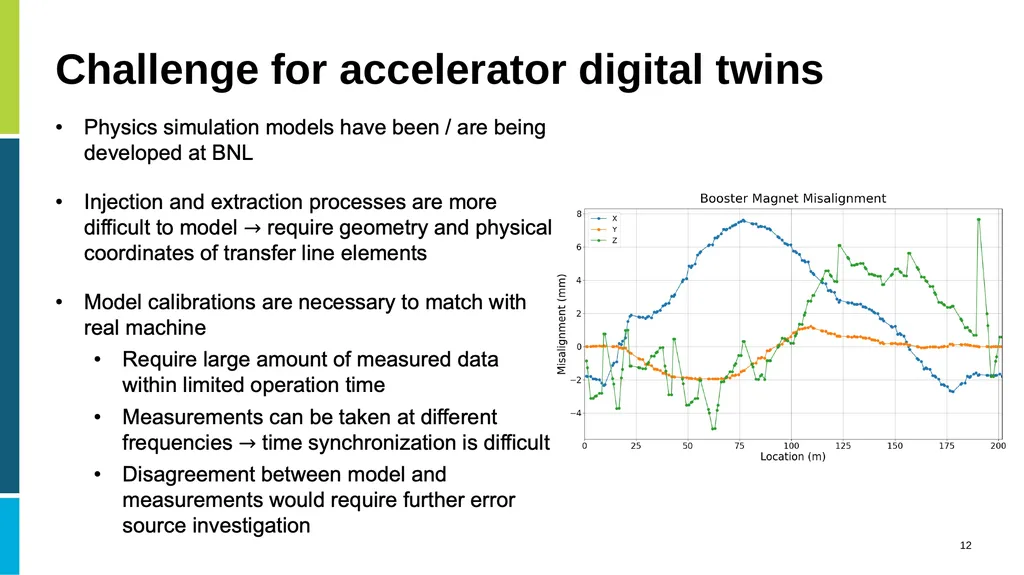
Challenge for accelerator digital twins 12<br>
13
Summary 13 Particle accelerators are large scale machines with very complicated tuning and maintenance needs
Majority of particle accelerators still rely on empirical tuning by human operators
Digital twins can be hugely beneficial for improving accelerator performance and operations by providing:
Foundation to develop tuning and correction routines which can involve other machine learning techniques (e.g., neural network, Bayesian optimization etc.)
Fast real-time virtual diagnostics for operators to make quick and efficient adjustments
Building digital twins for particle accelerators requires more carefully planned beam studies and script development<br>