Diplomatic Etiquette First session Diplomatic Terminologies Presented by : Yadav Khanal Resource Person Institute of Foreign Affairs Meaning of Diplomatic terminologies As with other profession, diplomacy also is replete with specific
"Diplomatic Etiquette First session Diplomatic" is the property of its rightful owner. Permission is granted to
download and print the materials on this website for personal, non-commercial use only, and to display it
on your personal computer provided you do not modify the materials and that you retain all copyright
notices contained in the materials. By downloading content from our website, you accept the terms of this
agreement.
Presentation Transcript
01
Diplomatic Etiquette First session Diplomatic Terminologies
Presented by :
Yadav Khanal
Resource Person
Institute of Foreign Affairs<br>
02
Meaning of Diplomatic terminologies As with other profession, diplomacy also is replete with specific terminologies and jargons.
Such diplomatic terminologies and diplomatic jargons have been in use more commonly in diplomacy for long time.
Also new terminologies and jargons have evolved and been evolving in line with the expansion of diplomatic functions as well as actors.
Knowledge of such terminologies is essential for diplomats as well as for those who engage in diplomatic functions regularly or occasionally.<br>
03
Why do we need knowledge of diplomatic terminology ? Being Govt. official we all need to be aware of these terms
Common language for diplomats/officials
Codification in international laws and conventions
Communication with desired effect
Comprehension of new and emerging knowledge and initiatives in diplomacy and international relations.
Courtesies and politeness
Sparing ourselves from any diplomatic embarrassment<br>
04
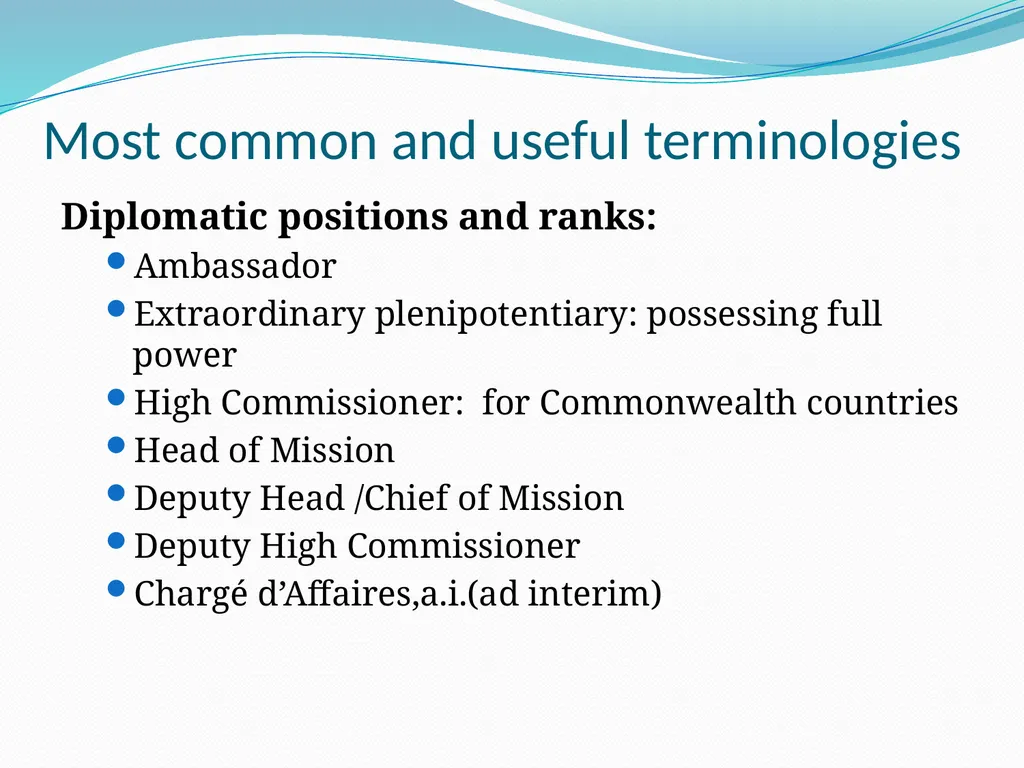
Most common and useful terminologies Diplomatic positions and ranks:
Ambassador
Extraordinary plenipotentiary: possessing full power
High Commissioner: for Commonwealth countries
Head of Mission
Deputy Head /Chief of Mission
Deputy High Commissioner
Chargé d’Affaires,a.i.(ad interim)<br>
05
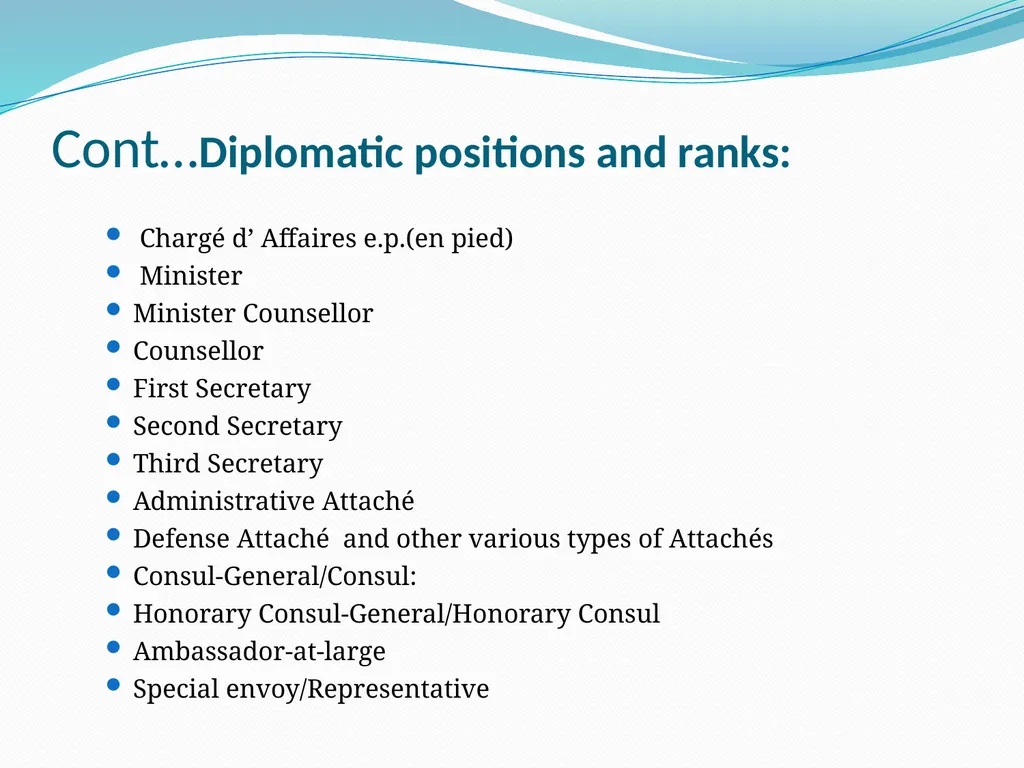
Cont…Diplomatic positions and ranks: Chargé d’ Affaires e.p.(en pied)
Minister
Minister Counsellor
Counsellor
First Secretary
Second Secretary
Third Secretary
Administrative Attaché
Defense Attaché and other various types of Attachés
Consul-General/Consul:
Honorary Consul-General/Honorary Consul
Ambassador-at-large
Special envoy/Representative<br>
06
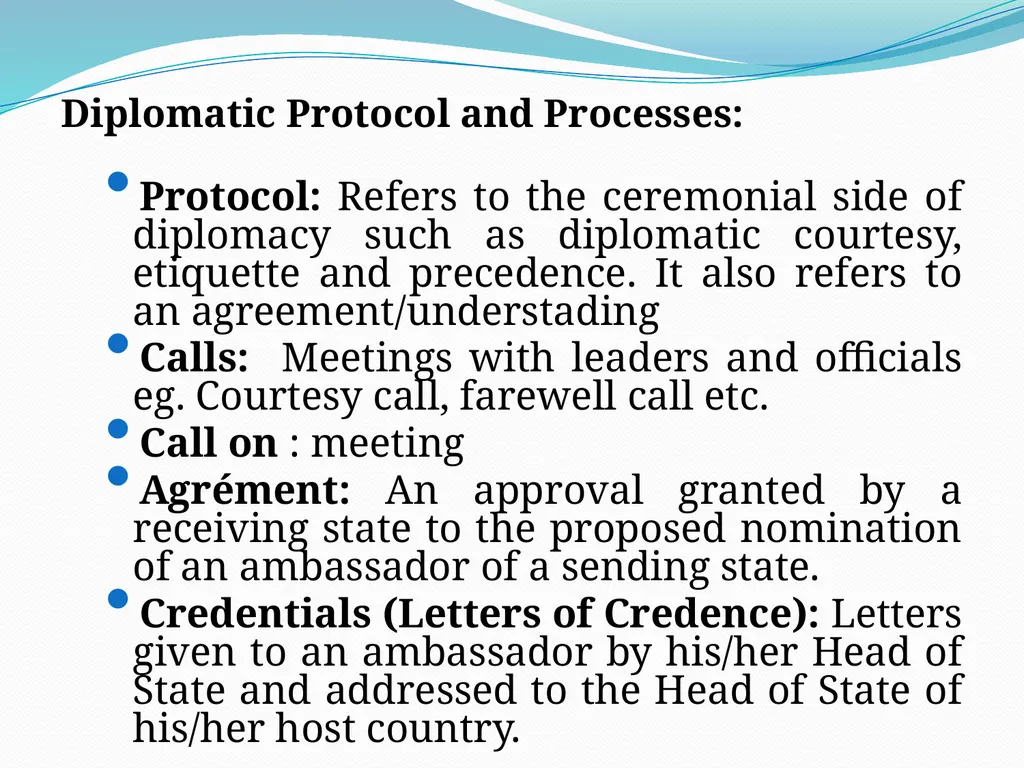
Diplomatic Protocol and Processes:
Protocol: Refers to the ceremonial side of diplomacy such as diplomatic courtesy, etiquette and precedence. It also refers to an agreement/understading
Calls: Meetings with leaders and officials eg. Courtesy call, farewell call etc.
Call on : meeting
Agrément: An approval granted by a receiving state to the proposed nomination of an ambassador of a sending state.
Credentials (Letters of Credence): Letters given to an ambassador by his/her Head of State and addressed to the Head of State of his/her host country.<br>
07
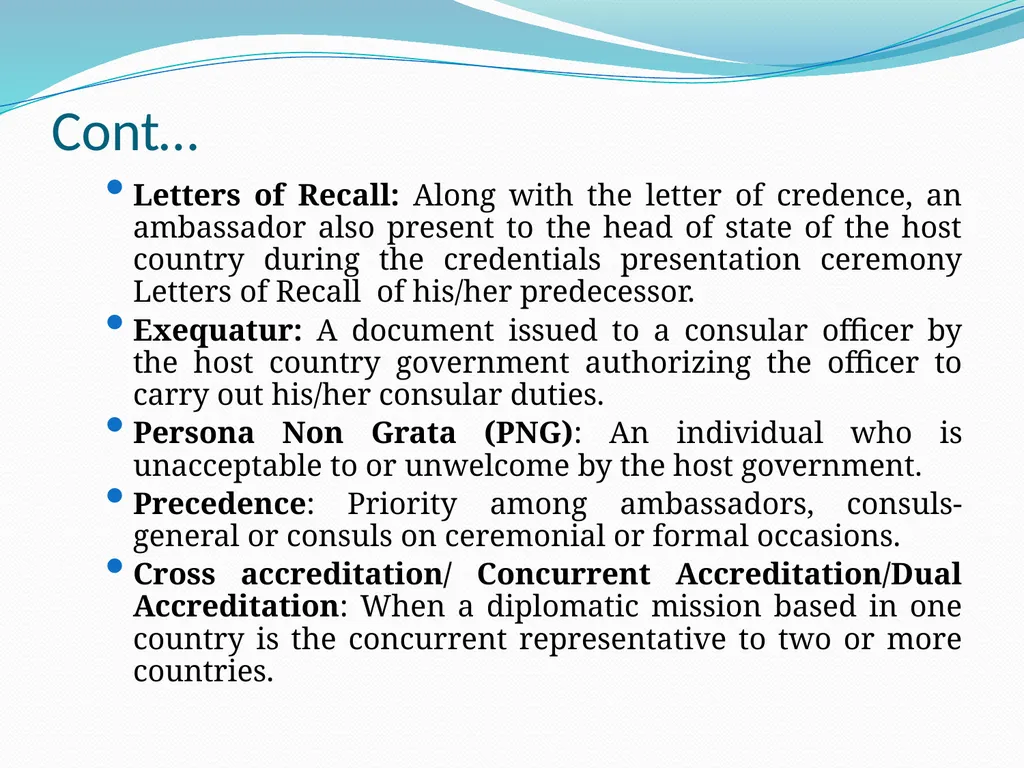
Cont… Letters of Recall: Along with the letter of credence, an ambassador also present to the head of state of the host country during the credentials presentation ceremony Letters of Recall of his/her predecessor.
Exequatur: A document issued to a consular officer by the host country government authorizing the officer to carry out his/her consular duties.
Persona Non Grata (PNG): An individual who is unacceptable to or unwelcome by the host government.
Precedence: Priority among ambassadors, consuls-general or consuls on ceremonial or formal occasions.
Cross accreditation/ Concurrent Accreditation/Dual Accreditation: When a diplomatic mission based in one country is the concurrent representative to two or more countries.<br>
08
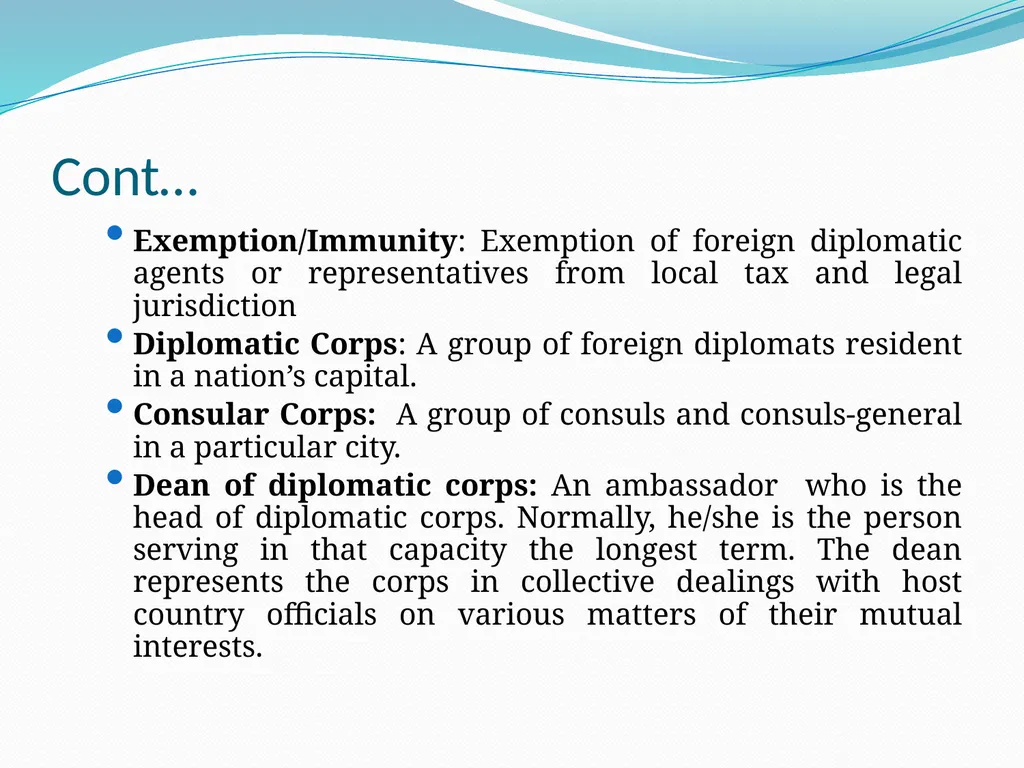
Cont… Exemption/Immunity: Exemption of foreign diplomatic agents or representatives from local tax and legal jurisdiction
Diplomatic Corps: A group of foreign diplomats resident in a nation’s capital.
Consular Corps: A group of consuls and consuls-general in a particular city.
Dean of diplomatic corps: An ambassador who is the head of diplomatic corps. Normally, he/she is the person serving in that capacity the longest term. The dean represents the corps in collective dealings with host country officials on various matters of their mutual interests.<br>
09
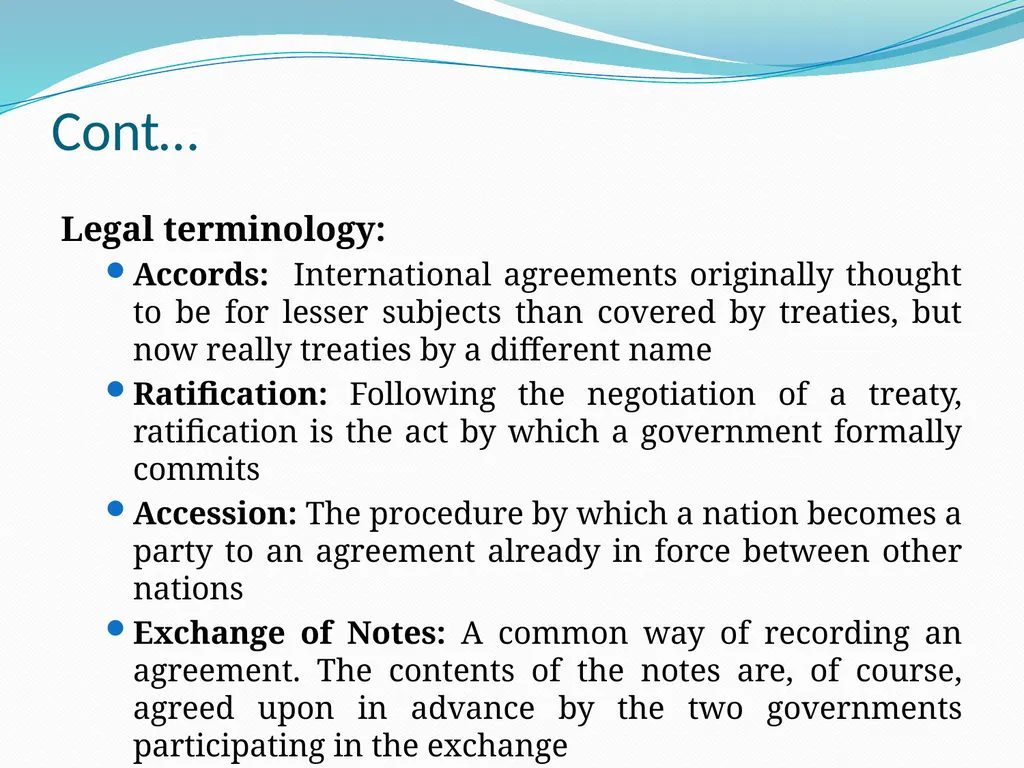
Cont… Legal terminology:
Accords: International agreements originally thought to be for lesser subjects than covered by treaties, but now really treaties by a different name
Ratification: Following the negotiation of a treaty, ratification is the act by which a government formally commits
Accession: The procedure by which a nation becomes a party to an agreement already in force between other nations
Exchange of Notes: A common way of recording an agreement. The contents of the notes are, of course, agreed upon in advance by the two governments participating in the exchange<br>
10
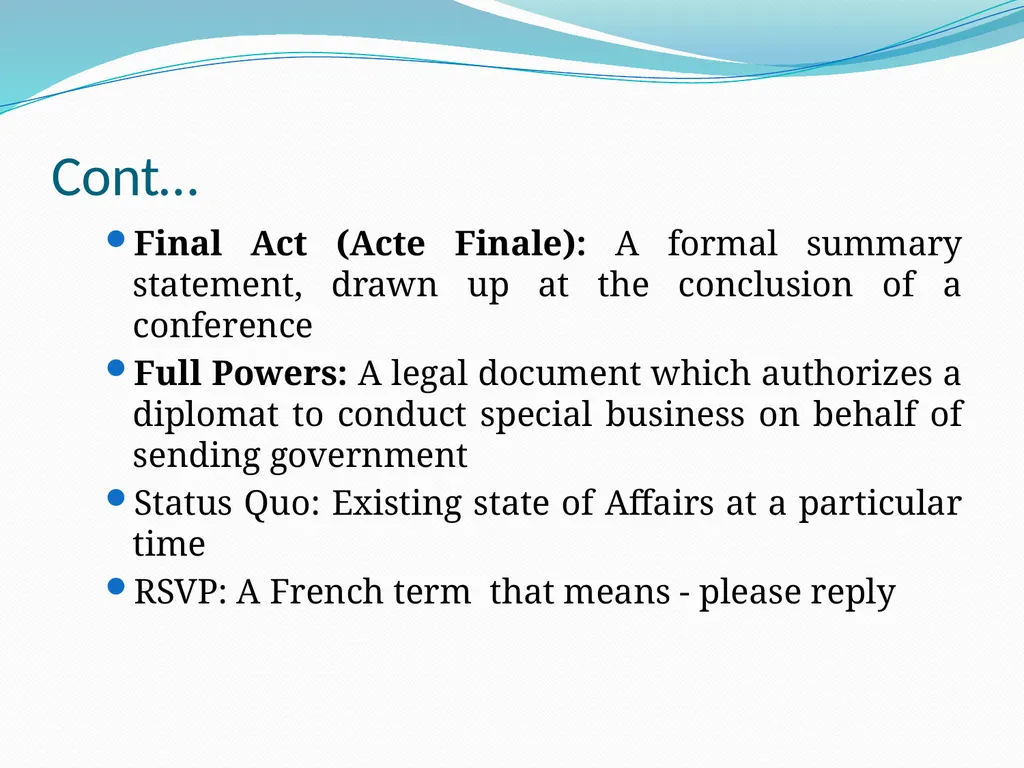
Cont… Final Act (Acte Finale): A formal summary statement, drawn up at the conclusion of a conference
Full Powers: A legal document which authorizes a diplomat to conduct special business on behalf of sending government
Status Quo: Existing state of Affairs at a particular time
RSVP: A French term that means - please reply<br>
11
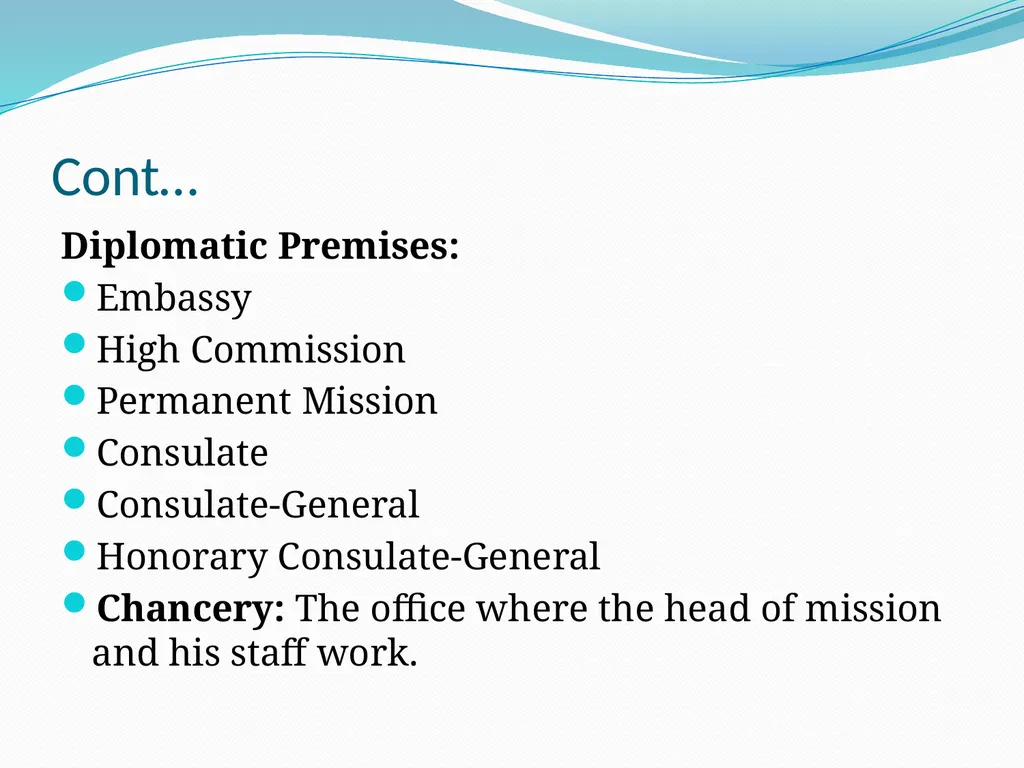
Cont… Diplomatic Premises:
Embassy
High Commission
Permanent Mission
Consulate
Consulate-General
Honorary Consulate-General
Chancery: The office where the head of mission and his staff work.<br>
12
Diplomatic Communication Effectiveness of diplomacy lies in effective communication
Diplomatic communication is done between and among governments
Third person note or Note verbal: Written formal Communication (begins with “…… presents its complements to…..and has the honor to request that…..” and ends with “… avails itself of this opportunity to renew to …… the assurances of its highest consideration”)
First Person note : addressed to individual (begins with.. On behalf of the government of …… I have the honor… and ends with ….pls accept your Excellency the assurances of my highest consideration
Symbolic communication
Levels of Diplomatic communication; Head of State/Government, Foreign Minister, Officials, Diplomats etc.
Purposes of diplomatic communication: exchange views, clarify own positions, probe intentions, make agreement, attempt to convince other governments, diplomatic bargaining, diplomatic lobby, make propaganda etc<br>
13
Cont… Types of Diplomatic communication:
Diplomatic bag/pouch: Bag in which mail is sent to and from diplomatic/consular missions and the Ministry of Foreign Affairs .
Communiqué/Joint Communiqué: A summary of statement issued following important bilateral or multilateral meetings. Joint Communiqué is often signed by both the parties.
Aide Memoire: A written summary of the key points made by a diplomat in an official conversation. Literally, a document left with the other party to the conversation, either at the time of the conversation or subsequently, as an aid to memory.<br>
14
Cont… Demarché: A formal approach or intervention by a diplomat, making representations to another government. Normally indicates formally raising an issue with host country government, usually involving a specific request for some action or decision in connection with the issue
Rapporteur: The official of a committee or subcommittee whose job is to prepare a summary report of its discussions and
Negotiation (Secrecy is the soul of negotiation)
Dean: Head of Diplomatic Core<br>
15
Cont… Diplomatic relations:
Recognition: Commonly used in connection with the recognition by one state of the existence of another state
Rapprochement: The establishment of improved relations between two countries
Détente: An easing of tension between states
Recall of Ambassador:<br>
16
Diplomacy Various forms of diplomacy:
(Derived from the term Diploma. )
Diplomacy is thinking twice before saying nothing
Diplomacy is the patriotic art of lying
Diplomacy is the art of knowing what not to say
Diplomacy is the first line of defense
Diplomacy is the art of negotiation and generally known as a skill for the management of relation between states. These arts are known in different terms and practices:<br>
17
Diplomacy : contd. Bilateral diplomacy
Multilateral diplomacy
New diplomacy
Old diplomacy
Summit diplomacy
Regional diplomacy
Sport diplomacy
Economic diplomacy
Trade diplomacy<br>