
Disability Competency Training in Medical

Description: Disability Competency Training in Medical Education Danbi Lee, PhD, OTD, OTRL Department of rehabilitation medicine disability studies program University Of Washington Acknowledgement University of Washington Center for Health Workforce
Related Topics
Download Presentation
"Disability Competency Training in Medical" is the property of its rightful owner. Permission is granted to download and print the materials on this website for personal, non-commercial use only, and to display it on your personal computer provided you do not modify the materials and that you retain all copyright notices contained in the materials. By downloading content from our website, you accept the terms of this agreement.
Presentation Transcript
slide1. Disability Competency Training
in Medical Education Danbi Lee, PhD, OTD, OTR/L
Department of rehabilitation medicine & disability studies program
University Of Washington<br>
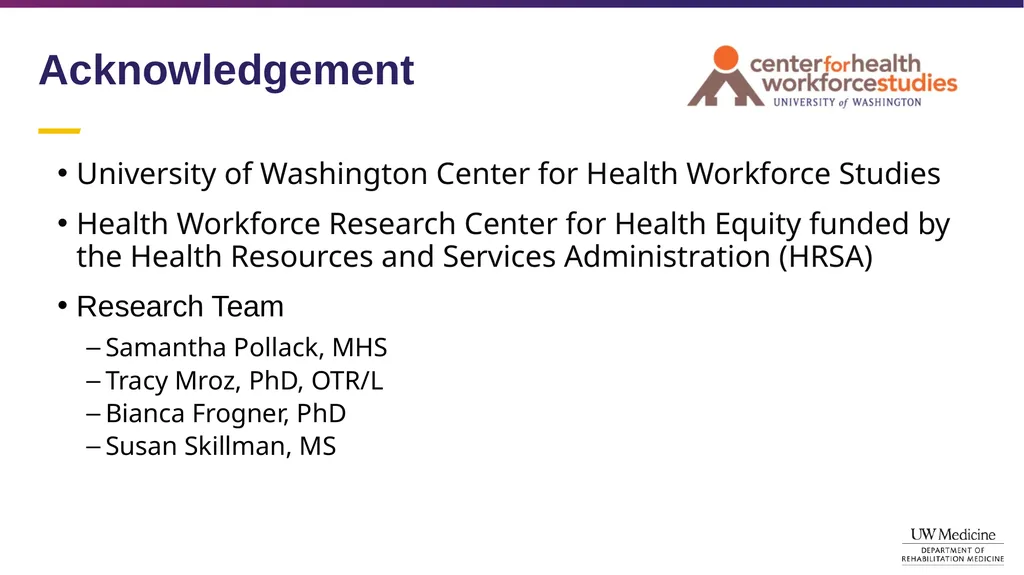
slide2. Acknowledgement University of Washington Center for Health Workforce Studies
Health Workforce Research Center for Health Equity funded by the Health Resources and Services Administration (HRSA)
Research Team
Samantha Pollack, MHS
Tracy Mroz, PhD, OTR/L
Bianca Frogner, PhD
Susan Skillman, MS<br>
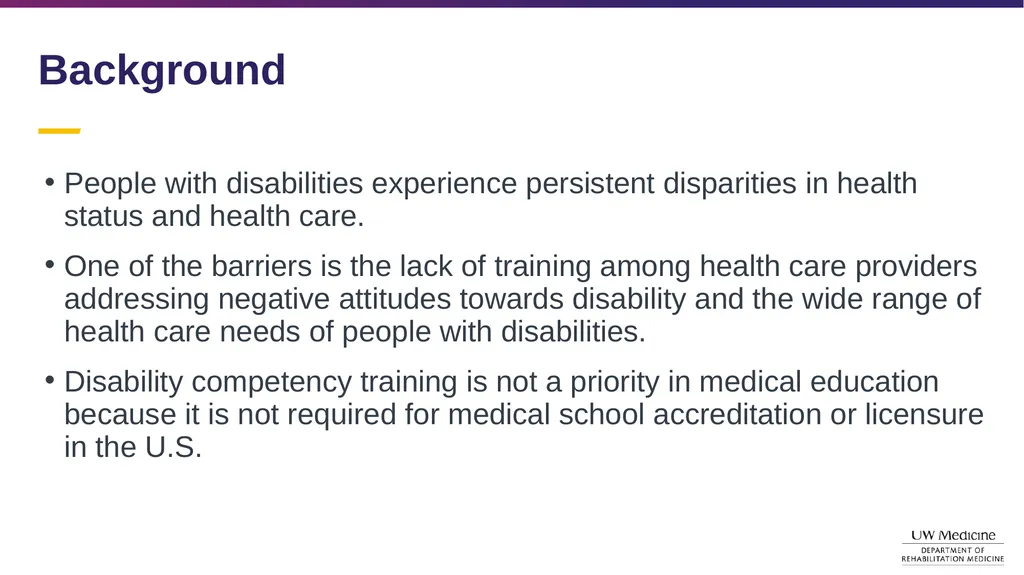
slide3. Background People with disabilities experience persistent disparities in health status and health care.
One of the barriers is the lack of training among health care providers addressing negative attitudes towards disability and the wide range of health care needs of people with disabilities.
Disability competency training is not a priority in medical education because it is not required for medical school accreditation or licensure in the U.S.<br>
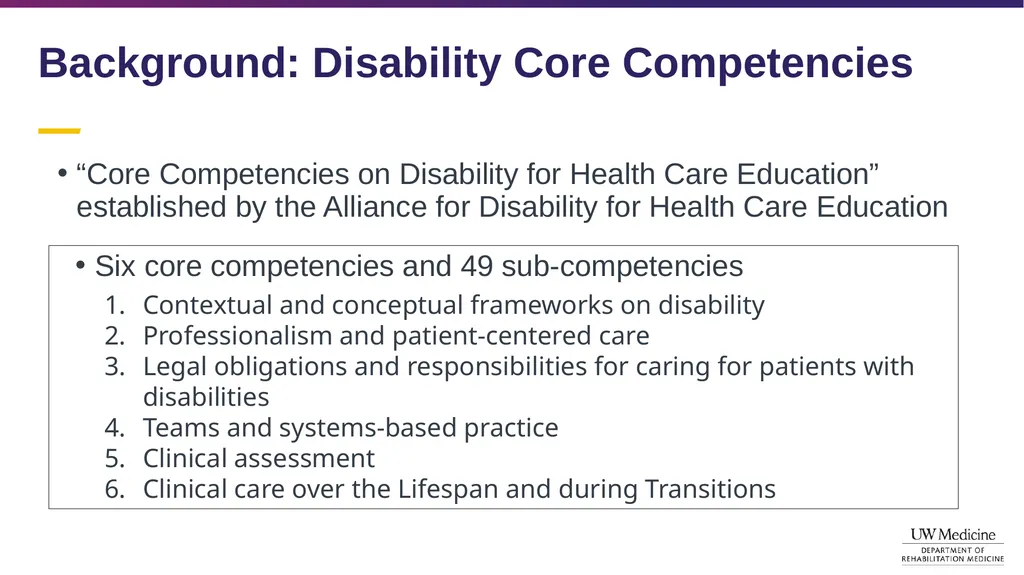
slide4. Background: Disability Core Competencies “Core Competencies on Disability for Health Care Education” established by the Alliance for Disability for Health Care Education Six core competencies and 49 sub-competencies
Contextual and conceptual frameworks on disability
Professionalism and patient-centered care
Legal obligations and responsibilities for caring for patients with disabilities
Teams and systems-based practice
Clinical assessment
Clinical care over the Lifespan and during Transitions<br>
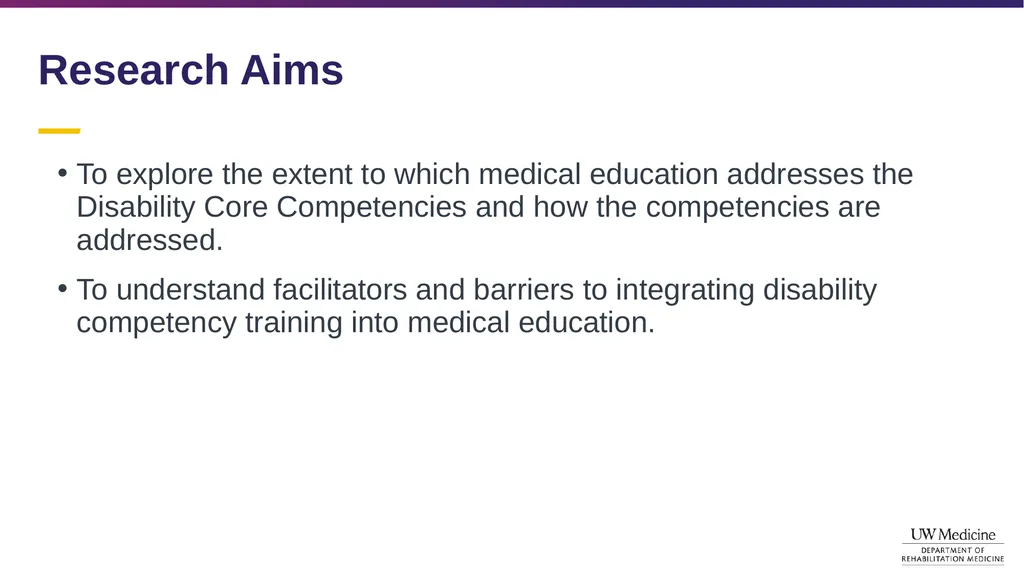
slide5. Research Aims To explore the extent to which medical education addresses the Disability Core Competencies and how the competencies are addressed.
To understand facilitators and barriers to integrating disability competency training into medical education.<br>
slide6. Online survey
23 questions on Disability Core Competencies addressed in curriculum, specific learning activities, and facilitators and barriers to integration of disability competency training.
Distributed to all allopathic and osteopathic medical schools in the U.S. (n=196) between February – June 2020
Qualitative interviews
30-minute semi-structured individual interviews
Convenience (volunteers) and purposeful sampling Methods: Data Collection Explanatory mixed methods design<br>
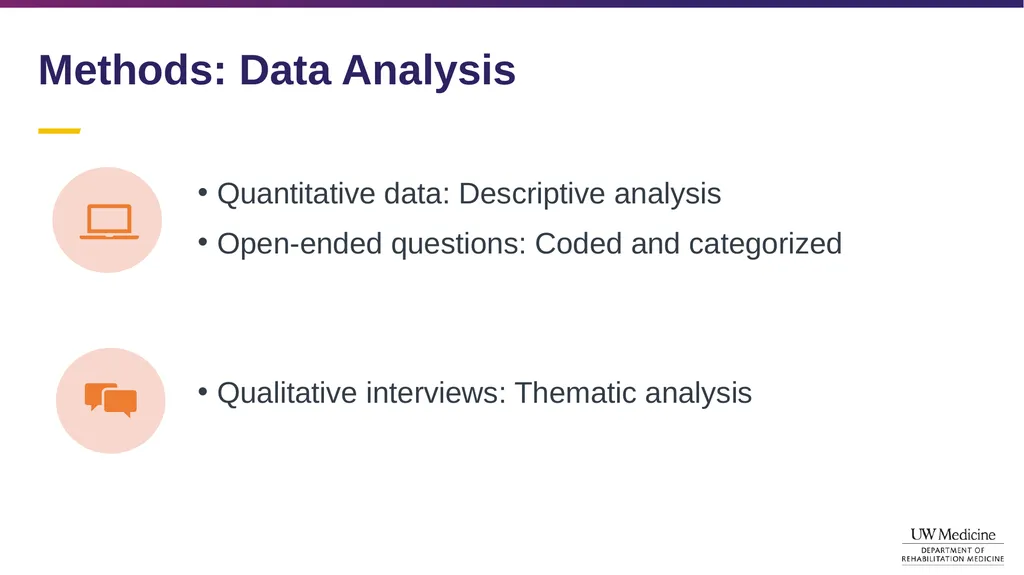
slide7. Methods: Data Analysis Quantitative data: Descriptive analysis
Open-ended questions: Coded and categorized
Qualitative interviews: Thematic analysis<br>
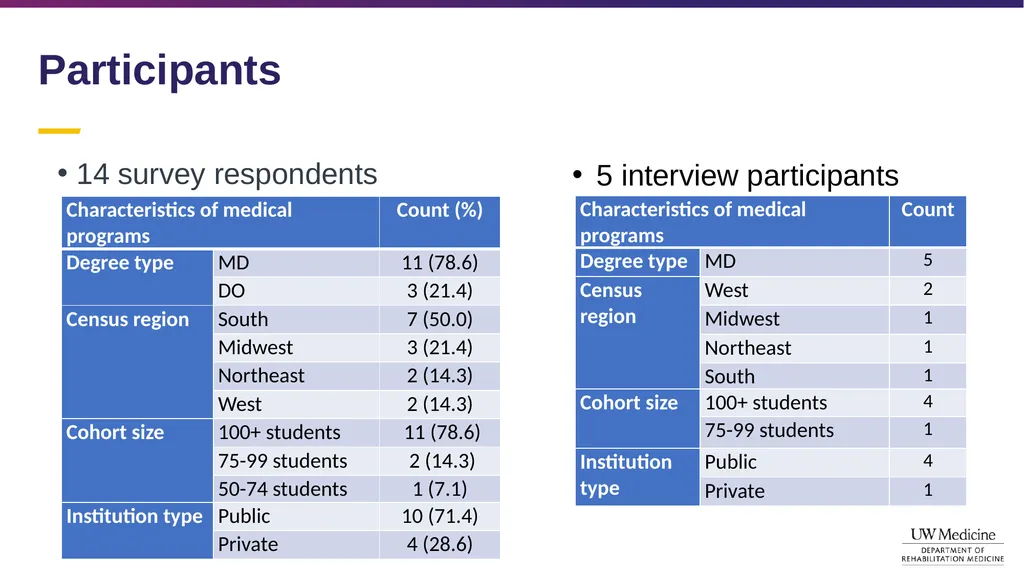
slide8. Participants 14 survey respondents 5 interview participants<br>
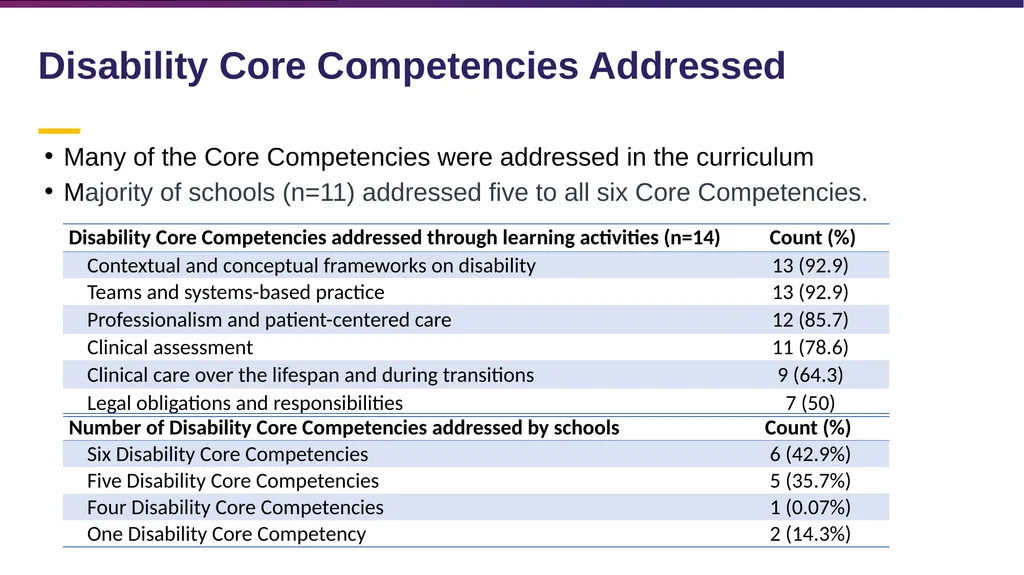
slide9. Disability Core Competencies Addressed Many of the Core Competencies were addressed in the curriculum
Majority of schools (n=11) addressed five to all six Core Competencies.<br>
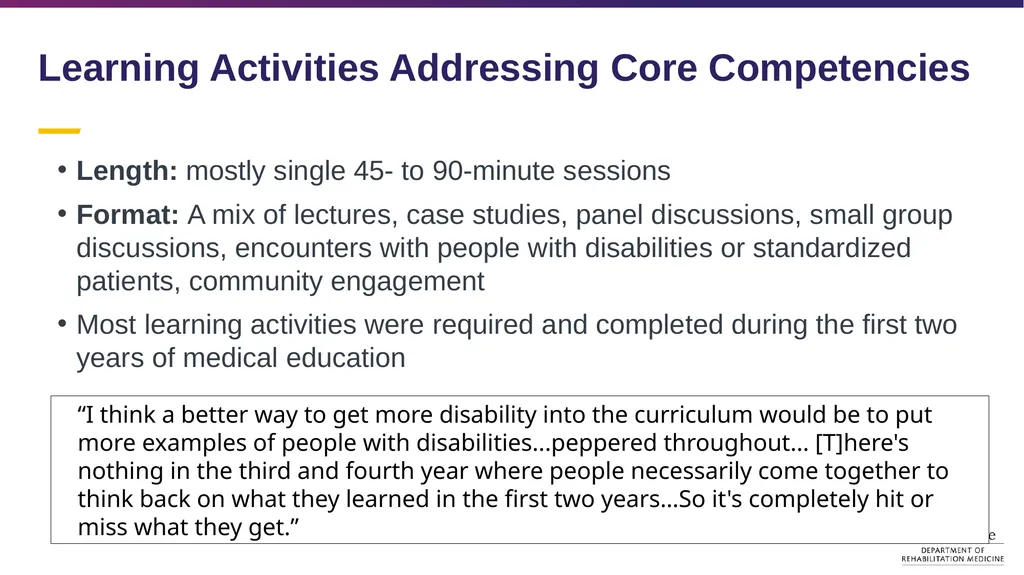
slide10. Learning Activities Addressing Core Competencies Length: mostly single 45- to 90-minute sessions
Format: A mix of lectures, case studies, panel discussions, small group discussions, encounters with people with disabilities or standardized patients, community engagement
Most learning activities were required and completed during the first two years of medical education “I think a better way to get more disability into the curriculum would be to put more examples of people with disabilities...peppered throughout... [T]here's nothing in the third and fourth year where people necessarily come together to think back on what they learned in the first two years…So it's completely hit or miss what they get.”<br>
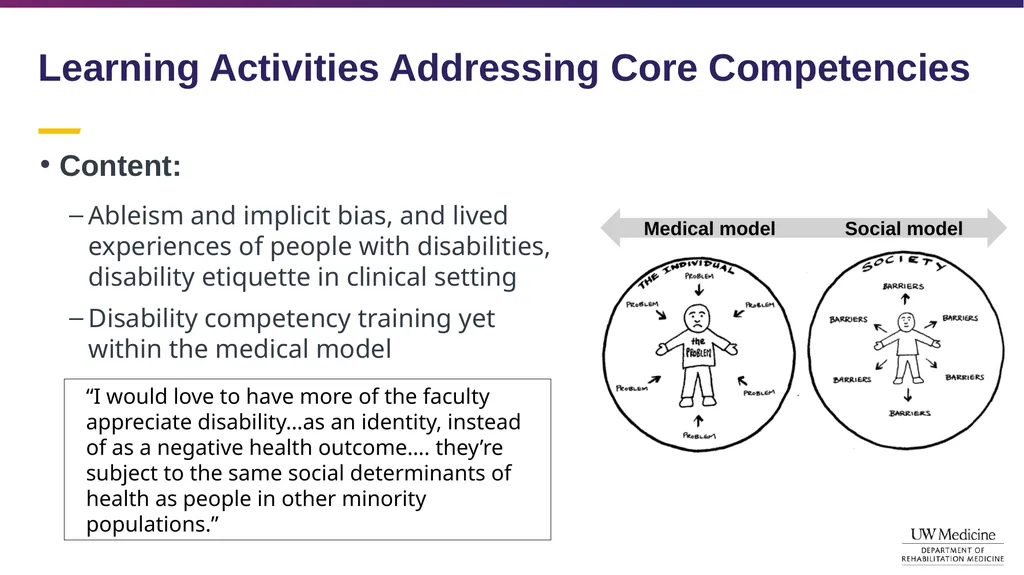
slide11. Learning Activities Addressing Core Competencies Content:
Ableism and implicit bias, and lived experiences of people with disabilities, disability etiquette in clinical setting
Disability competency training yet within the medical model Medical model Social model “I would love to have more of the faculty appreciate disability…as an identity, instead of as a negative health outcome…. they’re subject to the same social determinants of health as people in other minority populations.”<br>
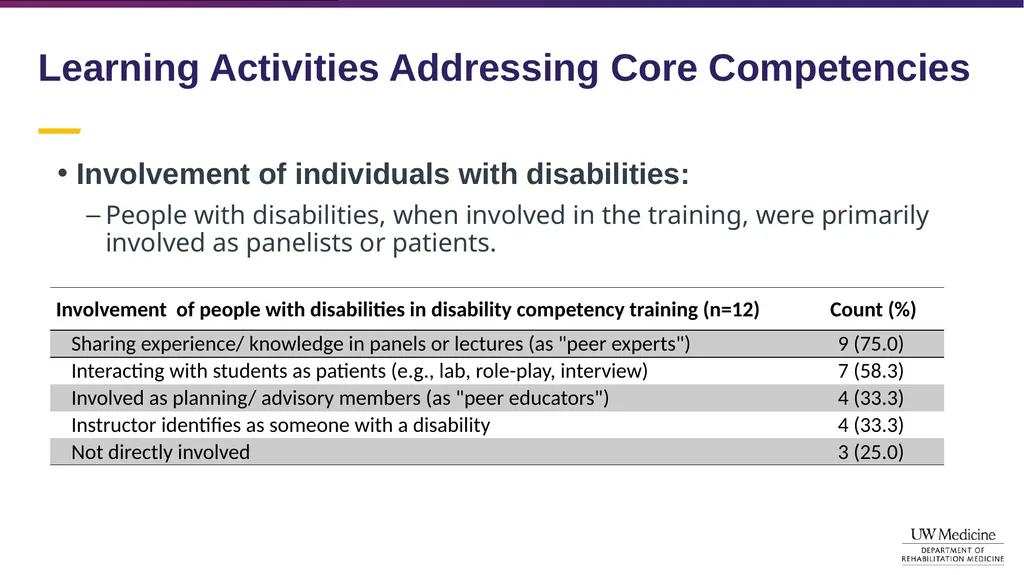
slide12. Learning Activities Addressing Core Competencies Involvement of individuals with disabilities:
People with disabilities, when involved in the training, were primarily involved as panelists or patients.<br>
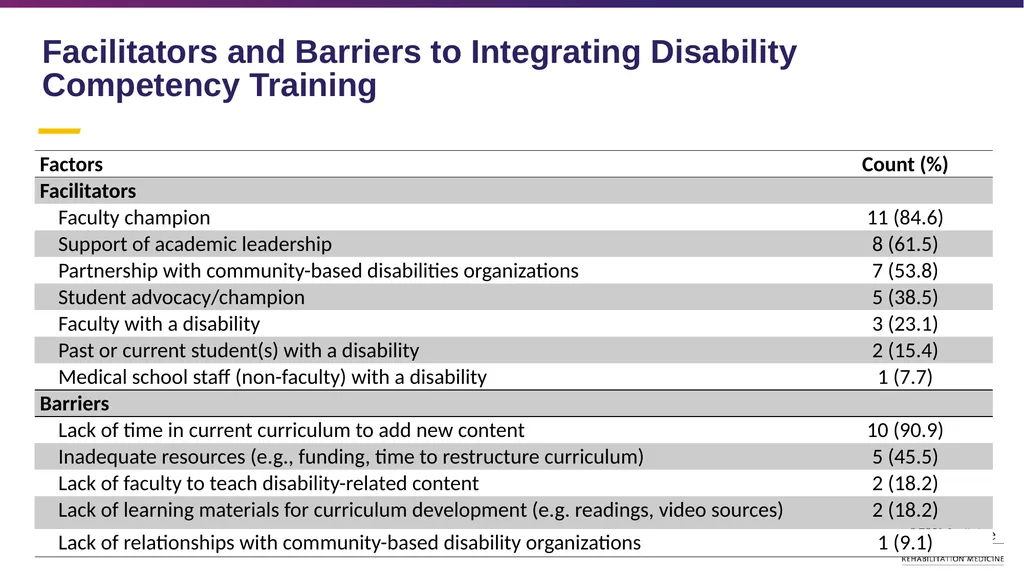
slide13. Facilitators and Barriers to Integrating Disability Competency Training<br>
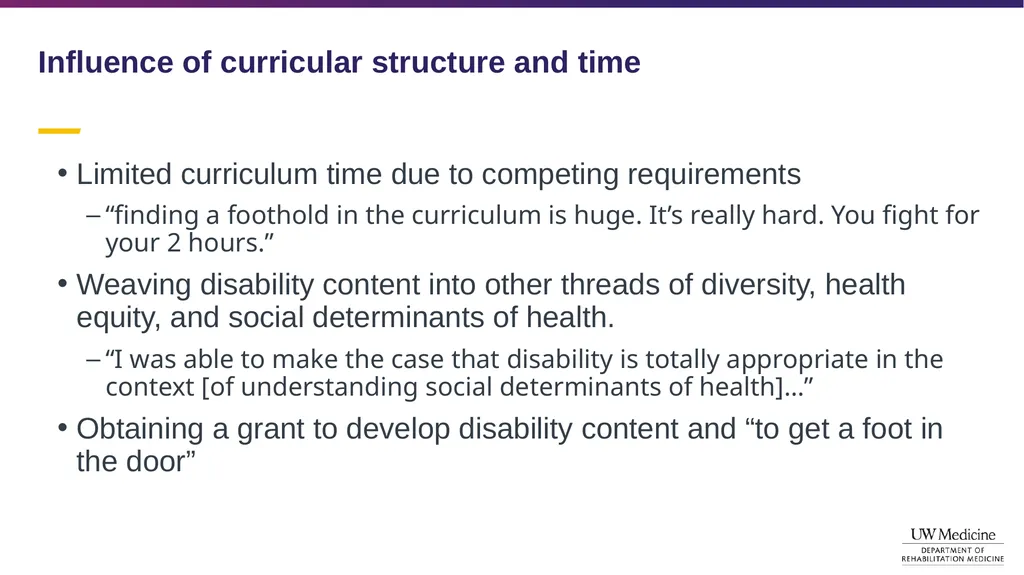
slide14. Influence of curricular structure and time Limited curriculum time due to competing requirements
“finding a foothold in the curriculum is huge. It’s really hard. You fight for your 2 hours.”
Weaving disability content into other threads of diversity, health equity, and social determinants of health.
“I was able to make the case that disability is totally appropriate in the context [of understanding social determinants of health]…”
Obtaining a grant to develop disability content and “to get a foot in the door”<br>
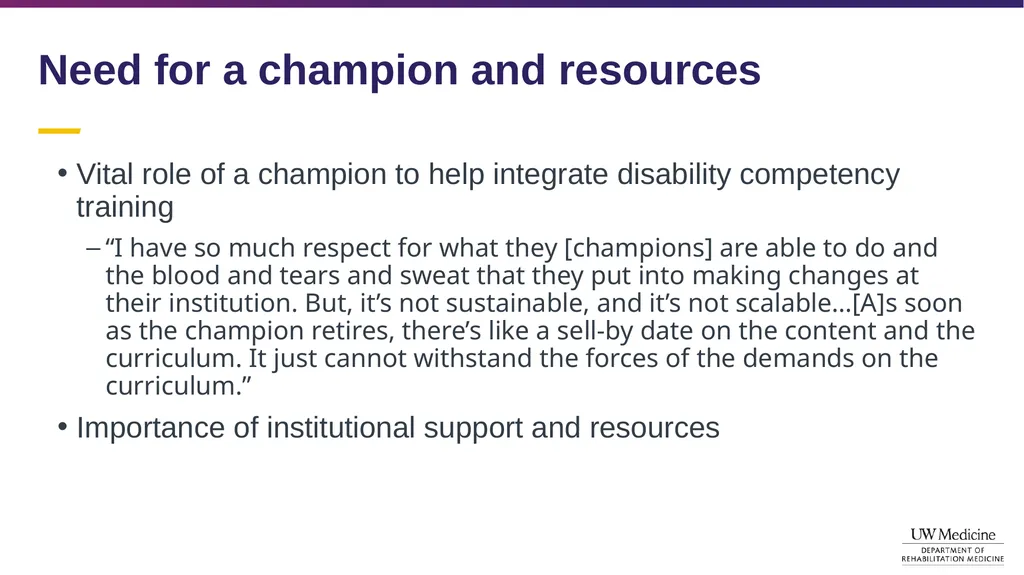
slide15. Need for a champion and resources Vital role of a champion to help integrate disability competency training
“I have so much respect for what they [champions] are able to do and the blood and tears and sweat that they put into making changes at their institution. But, it’s not sustainable, and it’s not scalable…[A]s soon as the champion retires, there’s like a sell-by date on the content and the curriculum. It just cannot withstand the forces of the demands on the curriculum.”
Importance of institutional support and resources<br>
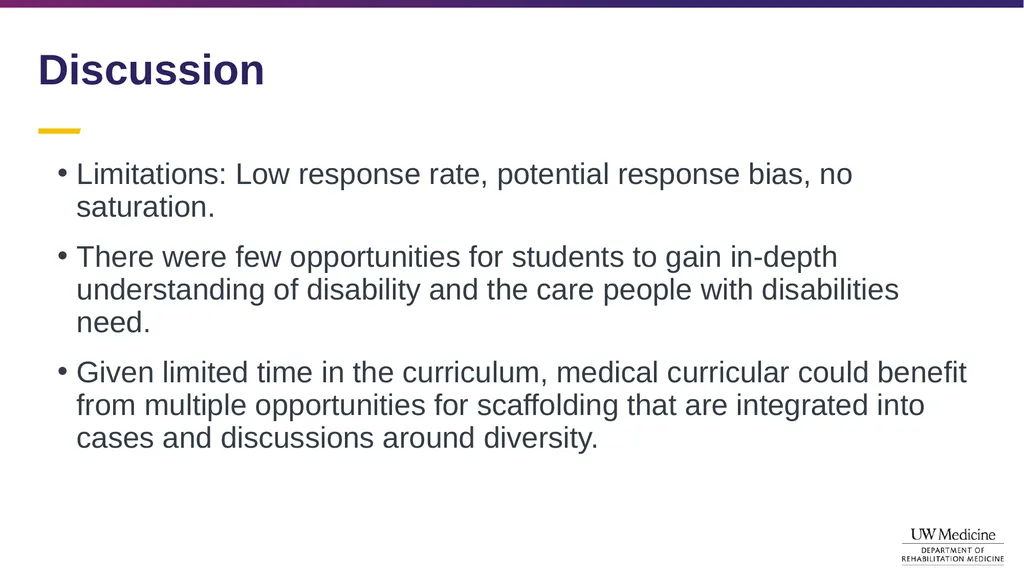
slide16. Discussion Limitations: Low response rate, potential response bias, no saturation.
There were few opportunities for students to gain in-depth understanding of disability and the care people with disabilities need.
Given limited time in the curriculum, medical curricular could benefit from multiple opportunities for scaffolding that are integrated into cases and discussions around diversity.<br>
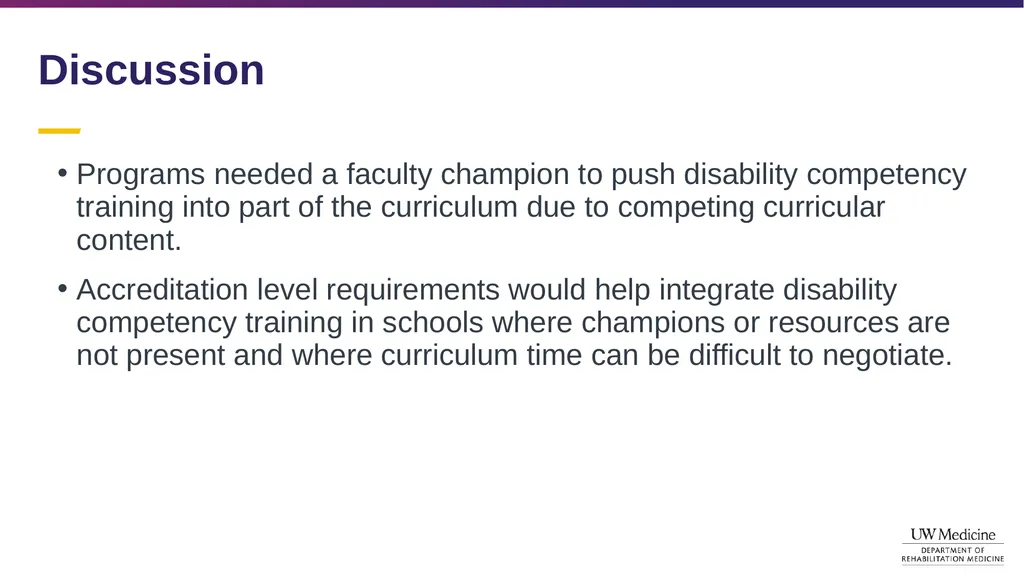
slide17. Discussion Programs needed a faculty champion to push disability competency training into part of the curriculum due to competing curricular content.
Accreditation level requirements would help integrate disability competency training in schools where champions or resources are not present and where curriculum time can be difficult to negotiate.<br>
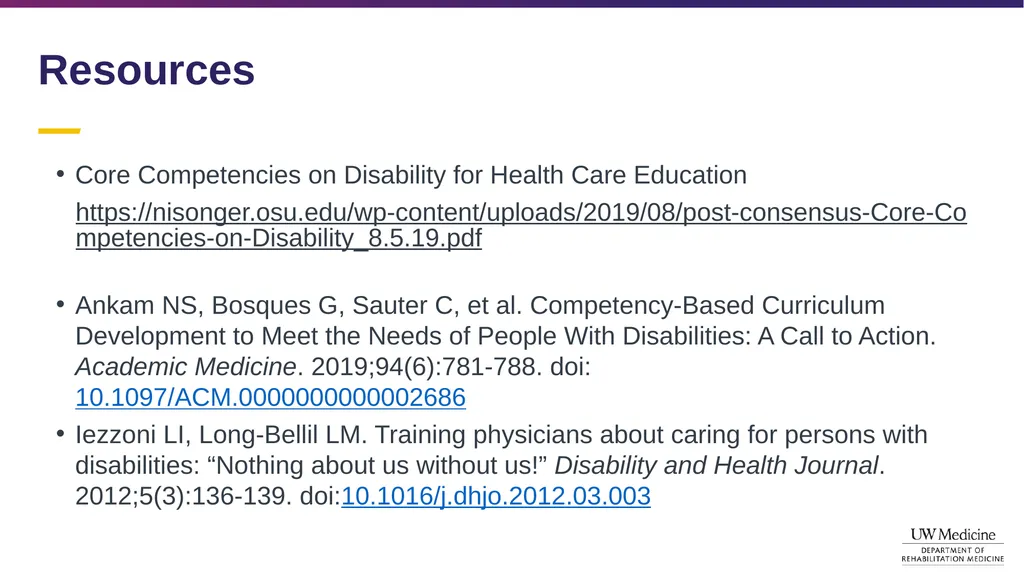
slide18. Resources Core Competencies on Disability for Health Care Education
https://nisonger.osu.edu/wp-content/uploads/2019/08/post-consensus-Core-Competencies-on-Disability_8.5.19.pdf
Ankam NS, Bosques G, Sauter C, et al. Competency-Based Curriculum Development to Meet the Needs of People With Disabilities: A Call to Action. Academic Medicine. 2019;94(6):781-788. doi:10.1097/ACM.0000000000002686
Iezzoni LI, Long-Bellil LM. Training physicians about caring for persons with disabilities: “Nothing about us without us!” Disability and Health Journal. 2012;5(3):136-139. doi:10.1016/j.dhjo.2012.03.003<br>
Department of rehabilitation medicine & disability studies program
University Of Washington<br>
slide2. Acknowledgement University of Washington Center for Health Workforce Studies
Health Workforce Research Center for Health Equity funded by the Health Resources and Services Administration (HRSA)
Research Team
Samantha Pollack, MHS
Tracy Mroz, PhD, OTR/L
Bianca Frogner, PhD
Susan Skillman, MS<br>
slide3. Background People with disabilities experience persistent disparities in health status and health care.
One of the barriers is the lack of training among health care providers addressing negative attitudes towards disability and the wide range of health care needs of people with disabilities.
Disability competency training is not a priority in medical education because it is not required for medical school accreditation or licensure in the U.S.<br>
slide4. Background: Disability Core Competencies “Core Competencies on Disability for Health Care Education” established by the Alliance for Disability for Health Care Education Six core competencies and 49 sub-competencies
Contextual and conceptual frameworks on disability
Professionalism and patient-centered care
Legal obligations and responsibilities for caring for patients with disabilities
Teams and systems-based practice
Clinical assessment
Clinical care over the Lifespan and during Transitions<br>
slide5. Research Aims To explore the extent to which medical education addresses the Disability Core Competencies and how the competencies are addressed.
To understand facilitators and barriers to integrating disability competency training into medical education.<br>
slide6. Online survey
23 questions on Disability Core Competencies addressed in curriculum, specific learning activities, and facilitators and barriers to integration of disability competency training.
Distributed to all allopathic and osteopathic medical schools in the U.S. (n=196) between February – June 2020
Qualitative interviews
30-minute semi-structured individual interviews
Convenience (volunteers) and purposeful sampling Methods: Data Collection Explanatory mixed methods design<br>
slide7. Methods: Data Analysis Quantitative data: Descriptive analysis
Open-ended questions: Coded and categorized
Qualitative interviews: Thematic analysis<br>
slide8. Participants 14 survey respondents 5 interview participants<br>
slide9. Disability Core Competencies Addressed Many of the Core Competencies were addressed in the curriculum
Majority of schools (n=11) addressed five to all six Core Competencies.<br>
slide10. Learning Activities Addressing Core Competencies Length: mostly single 45- to 90-minute sessions
Format: A mix of lectures, case studies, panel discussions, small group discussions, encounters with people with disabilities or standardized patients, community engagement
Most learning activities were required and completed during the first two years of medical education “I think a better way to get more disability into the curriculum would be to put more examples of people with disabilities...peppered throughout... [T]here's nothing in the third and fourth year where people necessarily come together to think back on what they learned in the first two years…So it's completely hit or miss what they get.”<br>
slide11. Learning Activities Addressing Core Competencies Content:
Ableism and implicit bias, and lived experiences of people with disabilities, disability etiquette in clinical setting
Disability competency training yet within the medical model Medical model Social model “I would love to have more of the faculty appreciate disability…as an identity, instead of as a negative health outcome…. they’re subject to the same social determinants of health as people in other minority populations.”<br>
slide12. Learning Activities Addressing Core Competencies Involvement of individuals with disabilities:
People with disabilities, when involved in the training, were primarily involved as panelists or patients.<br>
slide13. Facilitators and Barriers to Integrating Disability Competency Training<br>
slide14. Influence of curricular structure and time Limited curriculum time due to competing requirements
“finding a foothold in the curriculum is huge. It’s really hard. You fight for your 2 hours.”
Weaving disability content into other threads of diversity, health equity, and social determinants of health.
“I was able to make the case that disability is totally appropriate in the context [of understanding social determinants of health]…”
Obtaining a grant to develop disability content and “to get a foot in the door”<br>
slide15. Need for a champion and resources Vital role of a champion to help integrate disability competency training
“I have so much respect for what they [champions] are able to do and the blood and tears and sweat that they put into making changes at their institution. But, it’s not sustainable, and it’s not scalable…[A]s soon as the champion retires, there’s like a sell-by date on the content and the curriculum. It just cannot withstand the forces of the demands on the curriculum.”
Importance of institutional support and resources<br>
slide16. Discussion Limitations: Low response rate, potential response bias, no saturation.
There were few opportunities for students to gain in-depth understanding of disability and the care people with disabilities need.
Given limited time in the curriculum, medical curricular could benefit from multiple opportunities for scaffolding that are integrated into cases and discussions around diversity.<br>
slide17. Discussion Programs needed a faculty champion to push disability competency training into part of the curriculum due to competing curricular content.
Accreditation level requirements would help integrate disability competency training in schools where champions or resources are not present and where curriculum time can be difficult to negotiate.<br>
slide18. Resources Core Competencies on Disability for Health Care Education
https://nisonger.osu.edu/wp-content/uploads/2019/08/post-consensus-Core-Competencies-on-Disability_8.5.19.pdf
Ankam NS, Bosques G, Sauter C, et al. Competency-Based Curriculum Development to Meet the Needs of People With Disabilities: A Call to Action. Academic Medicine. 2019;94(6):781-788. doi:10.1097/ACM.0000000000002686
Iezzoni LI, Long-Bellil LM. Training physicians about caring for persons with disabilities: “Nothing about us without us!” Disability and Health Journal. 2012;5(3):136-139. doi:10.1016/j.dhjo.2012.03.003<br>