04
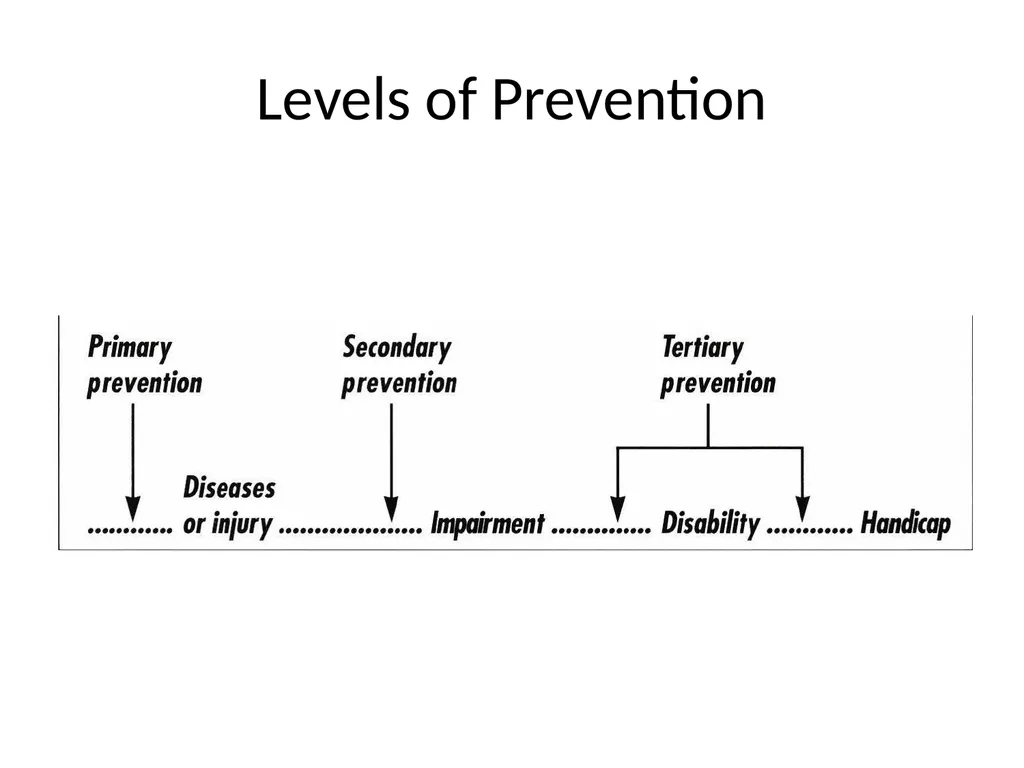
Levels of prevention There are three levels of prevention:
Primary
Secondary
Tertiary<br>
05
Levels of Prevention<br>
06
Primary Prevention Primary prevention reduces the incidence of disabilities by preventing risk factors which cause impairment. If primary prevention efforts succeed, they completely eliminate any possibility of disability that will occur. Primary prevention is aimed at the general population rather than at an identified "high risk" group.<br>
07
strategies Preventive efforts can involve medical, educational, or social strategies, or any combination of these. For example, a program intended to reduce the risk of disabilities for the infants of pregnant teenagers who smoke, drink, or use drugs might combine medical treatment, health education, peer counselling, and group pressure to achieve its goal.<br>
08
Process of primary prevention This process means helping clients to access and participate in preventative strategies which may include, but are not limited to:
Identifying and implementing ways to prevent injury and illness at home and in the community.
Providing education about protective equipment, such as helmets, seatbelts, and earplugs.
Ensuring access to medical care and proper nutrition.
Promoting healthy behaviors, such as routine and preventative medical care, prenatal care, exercise, healthy eating, consuming alcohol responsibly, and smoking cessation.
Educating family members, employers, and community members about the needs of people with disabilities.<br>
09
measures The measures promoted for the prevention of diseases which cause disabilities include:
immunization, Particularly against poliomyelitis, measles, rubella and tuberculosis;
prenatal care to ensure the healthy development and delivery of babies;
appropriate nutrition, especially iron, iodine and vitamin A, for mothers and children; and
sanitary measures to prevent eye diseases, such as infections and trachoma.<br>
10
measures Injuries may result from intentional or unintentional acts and injury prevention has several aspects. One is education regarding measures which can be taken to prevent acts that cause injuries. A second is protection, which uses environmental or technical devices such as seat belts, helmets and air bags to prevent injuries. A third aspect is the promotion of safety as part of general health promotion policies, and this is being developed under WHO leadership.<br>
11
Secondary Prevention Secondary prevention targets an existing risk factor and removes or reduces it. When secondary prevention is successful, the disability will not occur.
However, since the risk factor did exist and some damage may have been done before secondary prevention began, the impairment may be reduced rather than prevented.<br>
12
Aims Efforts in the category of secondary prevention are aimed at an identified group of people who either show symptoms of a disabling condition or are considered to be "high risk" for the development of such a condition.<br>
13
Measures Secondary prevention detects illness or injury early to lessen the impact of disability. Examples of secondary prevention strategies include, but are not limited to:
Routine health screenings, such as eye exams for cataracts, and mammograms for breast cancer.
Nutrition programs to help prevent further cardiac issues.
Fall risk evaluation.<br>
14
Tertiary Prevention Tertiary prevention is implemented when a pathological condition exists.
It "promotes adjustment to irremediable conditions and minimizes further complications or loss of function" (Scott & Carran, 1987, page 801).
When tertiary prevention is successful progression along the continuum from pathology to disability is slowed, halted, or even reversed.
Tertiary prevention is focused on a limited population who have a specific condition.<br>
15
Aims Tertiary prevention attempts to limit or undo the impact of an injury or illness, which is causing disability. The goal of tertiary prevention is to prevent limitations and promote improvement toward independence. Examples of tertiary prevention strategies include, but are not limited to:
A rehabilitation program after an accident
A cardiac rehabilitation program
A disease management program
A self-help group<br>
16
Treatment When impairments occur, they can be treated in order to prevent or to reduce disabilities, such as difficulty in seeing, hearing or walking.
Eyeglasses can greatly reduce, or even eliminate, difficulty in seeing; a hearing aid can reduce difficulty in hearing; and leg braces can reduce difficulty in walking<br>
17
Measures When disabilities occur, measures aimed specifically at the limited function which a disabled person experiences can also be taken to reduce or to limit the progression of the disability.
These are the measures commonly referred to as rehabilitation. Because they focus on the activities which people can or cannot do, they require their active participation.
The rehabilitation process may require a person to learn how to dress or feed; a new system for communication; a new method for moving around, perhaps using a wheelchair; or new methods for organizing and carrying out daily activities.<br>
18
Conti.. Addressing the functional limitations of disabled people may also reduce the handicaps confronting them in their interactions with society.
For example, if a person with paralysed legs can learn to walk with braces and crutches, he or she will have a far greater chance of being accepted by other people at school or at work.
However, only treating disabilities is not sufficient to reduce handicaps. Societal attitudes must also change so that people with disabilities have increased opportunities to participate in the same educational, work and social activities as other people in their communities.<br>
19
Integrated Approach WHO promotes an integrated approach to preventing disabilities by including all promotive, preventive, curative and rehabilitative care in primary health care. Integrated health services can strengthen disability prevention by keeping health care personnel at district and subdistrict level well informed about all aspects of disability prevention, including rehabilitation.<br>
20
Conti.. In addition, the health sector can actively participate in intersectoral efforts to provide living conditions, which reduces the risk of diseases and injuries, address the needs of people with impairments and disabilities through community based rehabilitation, and ensure their full integration in society.<br>
21
Refrences Dr Ann Goerdt, Disability prevention and rehabilitation, World Health , 48th Year, No. 5, September-october 1995.
Scott, K.G. & Curran, D.T. (1987). The epidemiology and prevention of mental retardation. American Psychologist, 42, pp. 801-804.
Florence Lalonde, Prevention of Disabilities,SSTA Research Centre Report #94-07a.
Laura Camus, https://study.com/academy/lesson/disability-prevention-management-strategies-for-counselors.html.<br>