
Disciplinary Case Studies Second Schedule (Others








Description: Disciplinary Case Studies Second Schedule (Others affected) 2 The two Schedules to the Chartered Accountants Act First Schedule (of a nature internally affecting) 3 Chapter V Provisions relating to Misconduct Proceedings for Misconduct -
Related Topics
Download Presentation
"Disciplinary Case Studies Second Schedule (Others" is the property of its rightful owner. Permission is granted to download and print the materials on this website for personal, non-commercial use only, and to display it on your personal computer provided you do not modify the materials and that you retain all copyright notices contained in the materials. By downloading content from our website, you accept the terms of this agreement.
Presentation Transcript
slide1. Disciplinary Case Studies<br>
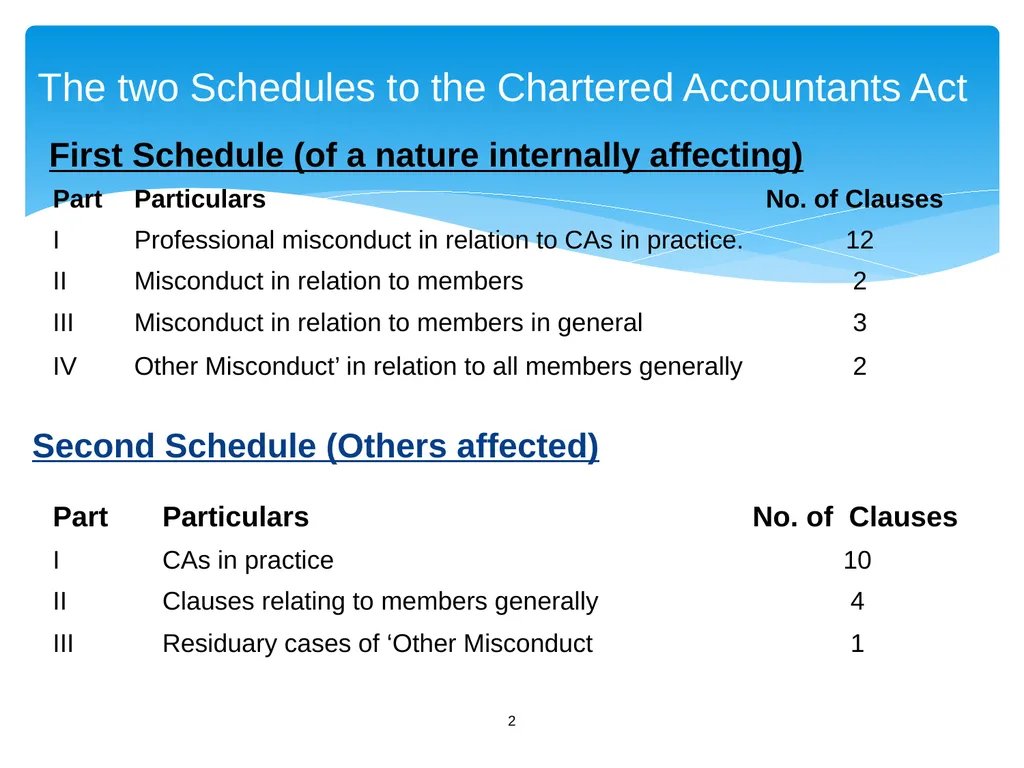
slide2. Second Schedule (Others affected) 2 The two Schedules to the Chartered Accountants Act First Schedule (of a nature internally affecting)<br>
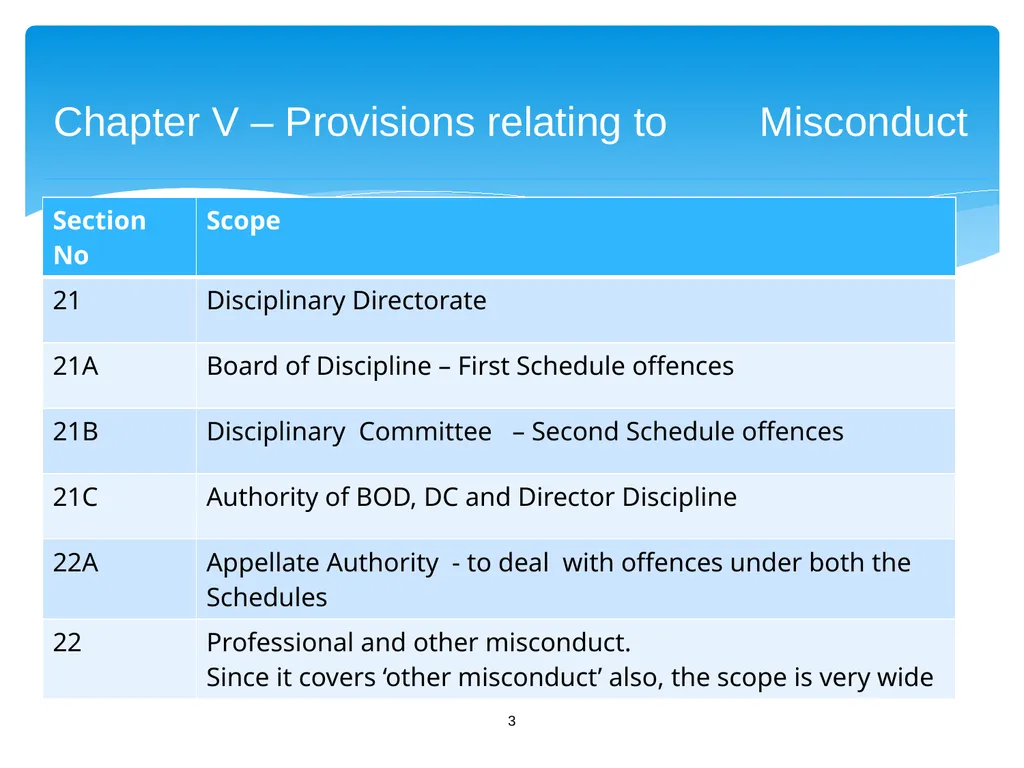
slide3. 3 Chapter V – Provisions relating to Misconduct<br>
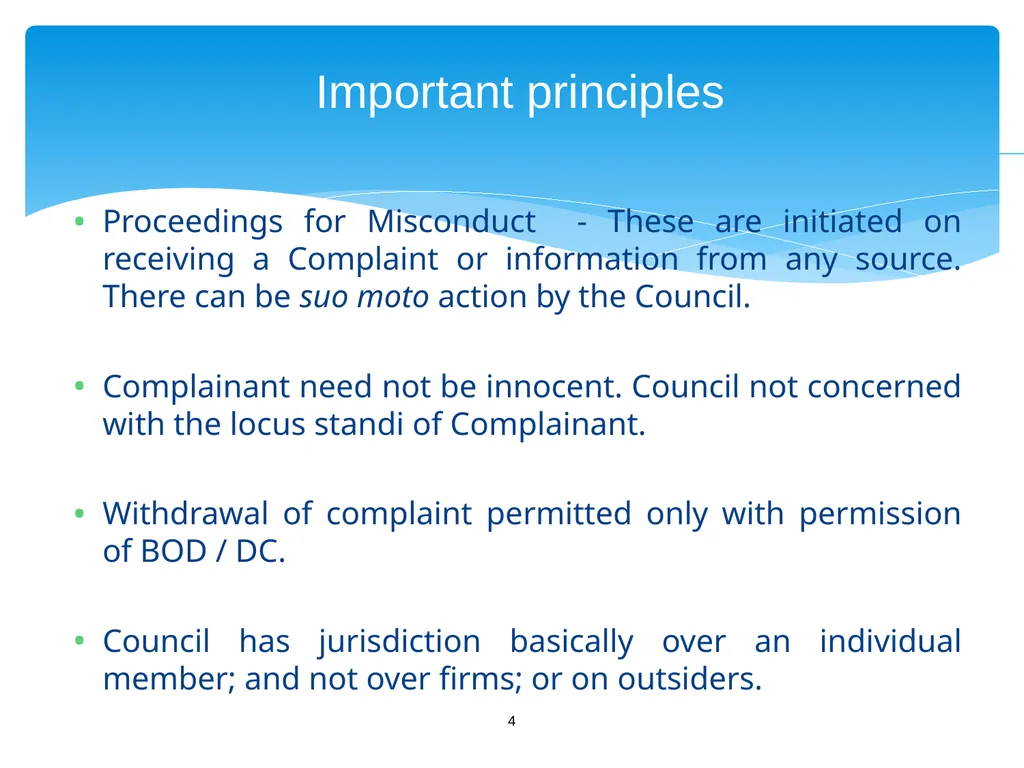
slide4. Proceedings for Misconduct - These are initiated on receiving a Complaint or information from any source. There can be suo moto action by the Council.
Complainant need not be innocent. Council not concerned with the locus standi of Complainant.
Withdrawal of complaint permitted only with permission of BOD / DC.
Council has jurisdiction basically over an individual member; and not over firms; or on outsiders. 4 Important principles<br>
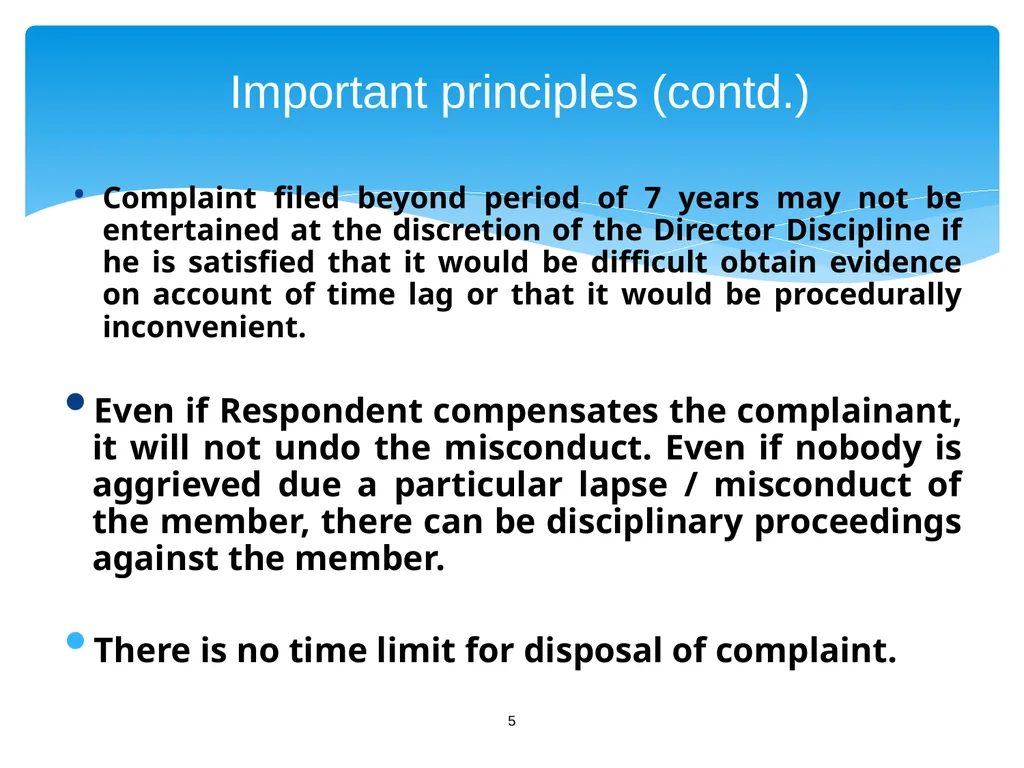
slide5. Complaint filed beyond period of 7 years may not be entertained at the discretion of the Director Discipline if he is satisfied that it would be difficult obtain evidence on account of time lag or that it would be procedurally inconvenient.
Even if Respondent compensates the complainant, it will not undo the misconduct. Even if nobody is aggrieved due a particular lapse / misconduct of the member, there can be disciplinary proceedings against the member.
There is no time limit for disposal of complaint. 5 Important principles (contd.)<br>
slide6. Punishment may be any one or more of the following –
For First Schedule (by Board of Discipline)
Reprimand
Suspension upto 3 months
Fine upto rupees one lakh.
For Second Schedule (by Disciplinary Committee)
Reprimand
Suspension for any period or permanently
Fine upto rupees five lakhs. 6 Punishment<br>
slide7. Some selected Case Laws / issues<br>
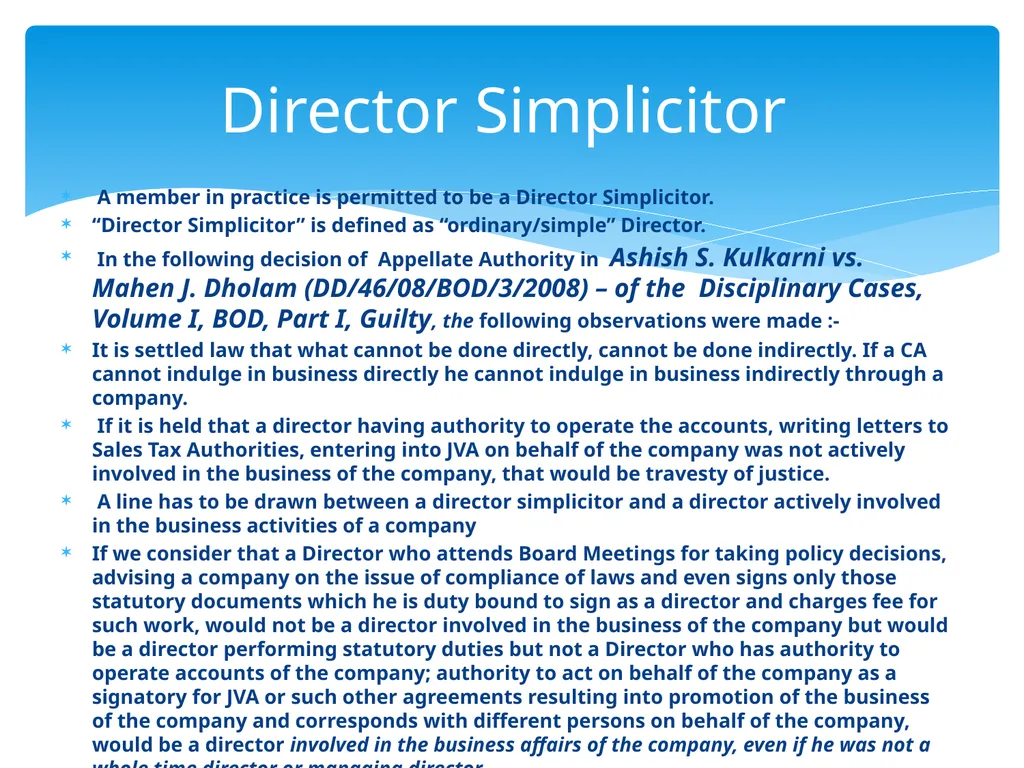
slide8. A member in practice is permitted to be a Director Simplicitor.
“Director Simplicitor” is defined as “ordinary/simple” Director.
In the following decision of Appellate Authority in Ashish S. Kulkarni vs. Mahen J. Dholam (DD/46/08/BOD/3/2008) – of the Disciplinary Cases, Volume I, BOD, Part I, Guilty, the following observations were made :-
It is settled law that what cannot be done directly, cannot be done indirectly. If a CA cannot indulge in business directly he cannot indulge in business indirectly through a company.
If it is held that a director having authority to operate the accounts, writing letters to Sales Tax Authorities, entering into JVA on behalf of the company was not actively involved in the business of the company, that would be travesty of justice.
A line has to be drawn between a director simplicitor and a director actively involved in the business activities of a company
If we consider that a Director who attends Board Meetings for taking policy decisions, advising a company on the issue of compliance of laws and even signs only those statutory documents which he is duty bound to sign as a director and charges fee for such work, would not be a director involved in the business of the company but would be a director performing statutory duties but not a Director who has authority to operate accounts of the company; authority to act on behalf of the company as a signatory for JVA or such other agreements resulting into promotion of the business of the company and corresponds with different persons on behalf of the company, would be a director involved in the business affairs of the company, even if he was not a whole time director or managing director. Director Simplicitor<br>
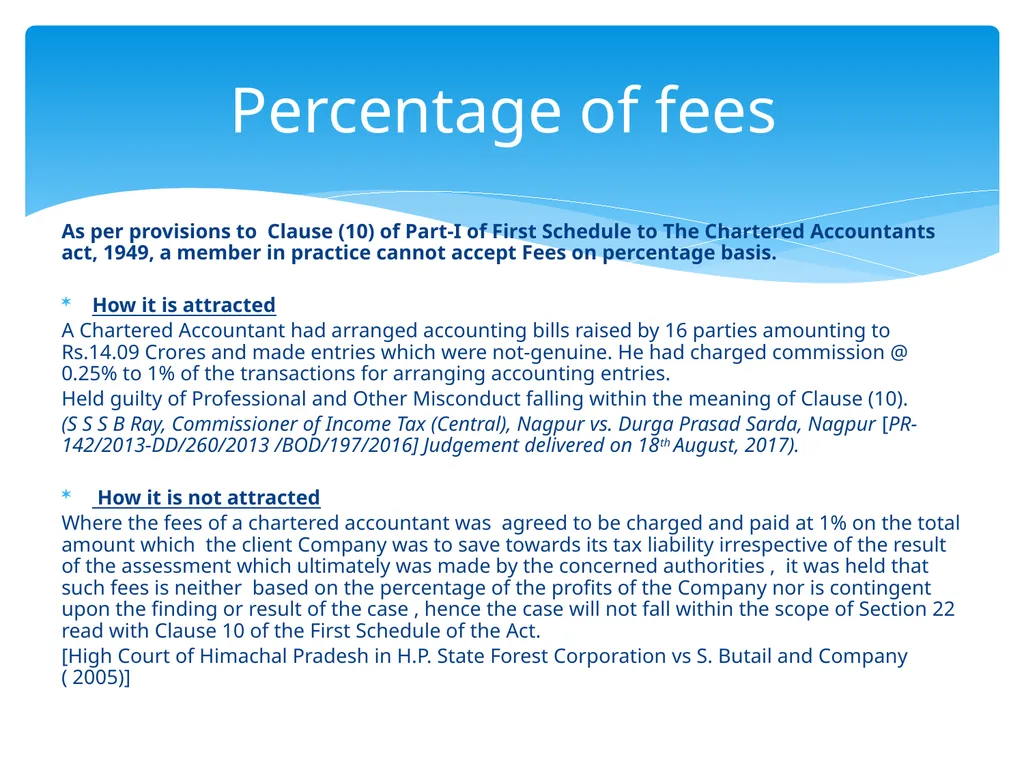
slide9. As per provisions to Clause (10) of Part-I of First Schedule to The Chartered Accountants act, 1949, a member in practice cannot accept Fees on percentage basis.
How it is attracted
A Chartered Accountant had arranged accounting bills raised by 16 parties amounting to Rs.14.09 Crores and made entries which were not-genuine. He had charged commission @ 0.25% to 1% of the transactions for arranging accounting entries.
Held guilty of Professional and Other Misconduct falling within the meaning of Clause (10).
(S S S B Ray, Commissioner of Income Tax (Central), Nagpur vs. Durga Prasad Sarda, Nagpur [PR-142/2013-DD/260/2013 /BOD/197/2016] Judgement delivered on 18th August, 2017).
How it is not attracted
Where the fees of a chartered accountant was agreed to be charged and paid at 1% on the total amount which the client Company was to save towards its tax liability irrespective of the result of the assessment which ultimately was made by the concerned authorities , it was held that such fees is neither based on the percentage of the profits of the Company nor is contingent upon the finding or result of the case , hence the case will not fall within the scope of Section 22 read with Clause 10 of the First Schedule of the Act.
[High Court of Himachal Pradesh in H.P. State Forest Corporation vs S. Butail and Company ( 2005)] Percentage of fees<br>
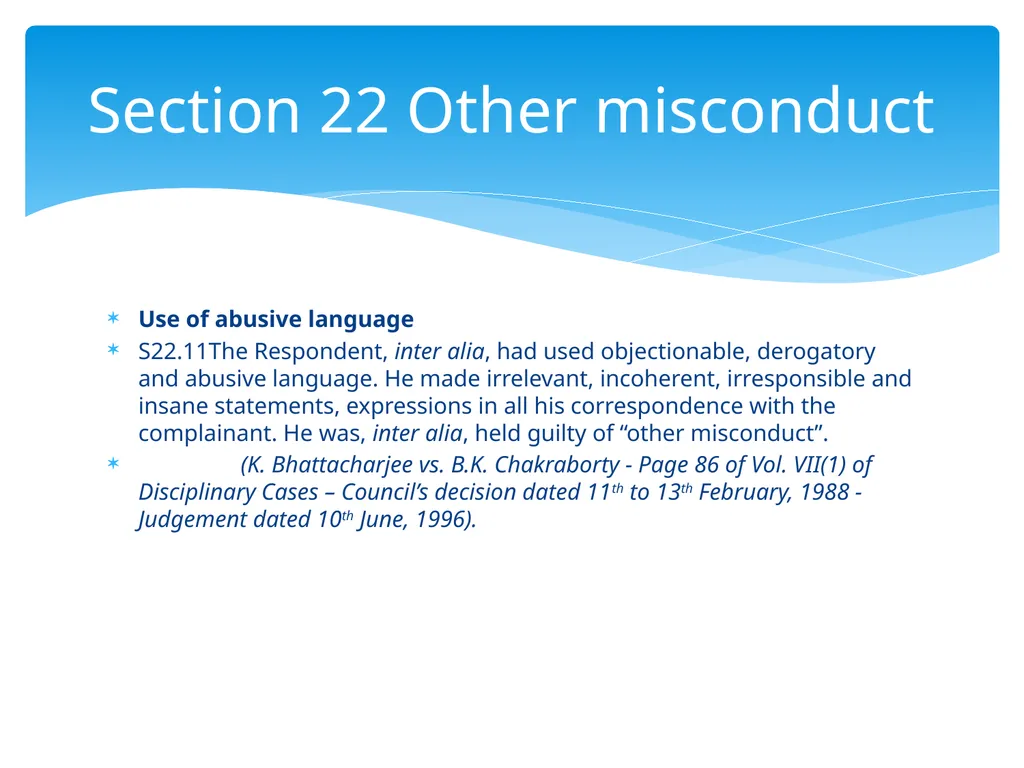
slide10. Use of abusive language
S22.11The Respondent, inter alia, had used objectionable, derogatory and abusive language. He made irrelevant, incoherent, irresponsible and insane statements, expressions in all his correspondence with the complainant. He was, inter alia, held guilty of “other misconduct”.
(K. Bhattacharjee vs. B.K. Chakraborty - Page 86 of Vol. VII(1) of Disciplinary Cases – Council’s decision dated 11th to 13th February, 1988 - Judgement dated 10th June, 1996). Section 22 Other misconduct<br>
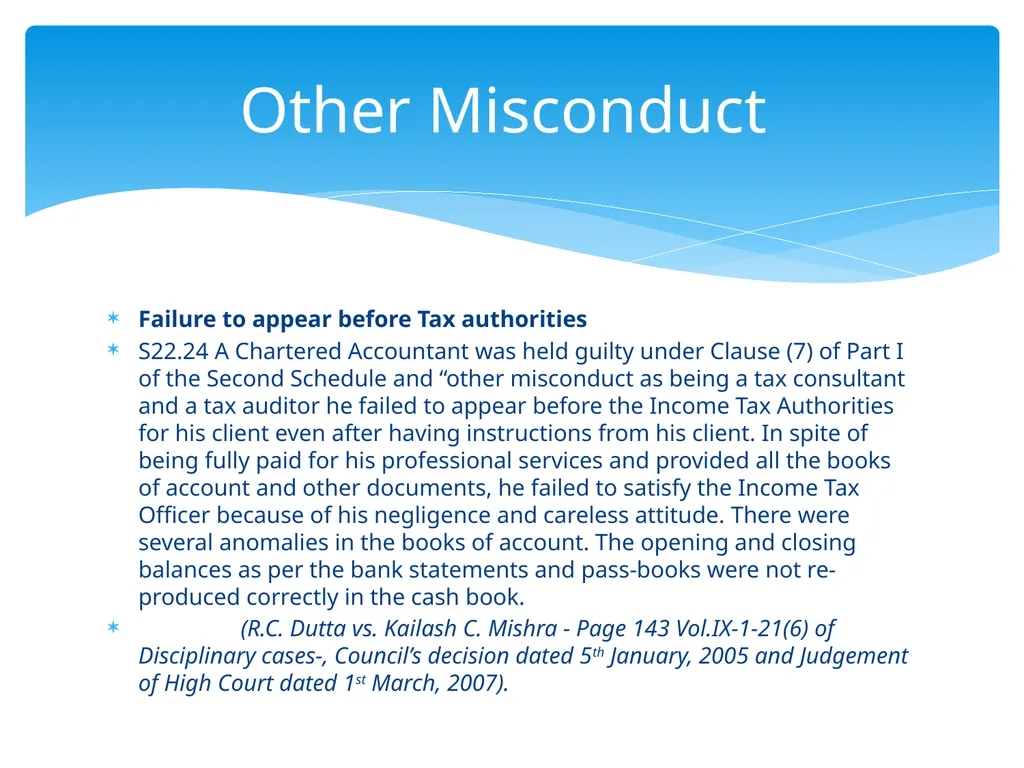
slide11. Failure to appear before Tax authorities
S22.24 A Chartered Accountant was held guilty under Clause (7) of Part I of the Second Schedule and “other misconduct as being a tax consultant and a tax auditor he failed to appear before the Income Tax Authorities for his client even after having instructions from his client. In spite of being fully paid for his professional services and provided all the books of account and other documents, he failed to satisfy the Income Tax Officer because of his negligence and careless attitude. There were several anomalies in the books of account. The opening and closing balances as per the bank statements and pass-books were not re-produced correctly in the cash book.
(R.C. Dutta vs. Kailash C. Mishra - Page 143 Vol.IX-1-21(6) of Disciplinary cases-, Council’s decision dated 5th January, 2005 and Judgement of High Court dated 1st March, 2007). Other Misconduct<br>
slide12. I.I(11).256 Where a Chartered Accountant had floated various companies/firms and availed huge limits from various Banks in the name of the said Companies/firms. The limits were availed fraudulently by him against factory, land & building, machineries and other fixed assets in his name and others were already mortgaged with a Bank. Furthermore, besides holding full time COP he was also the proprietor of Private Limited Company for which he did not inform the Institute.
Held guilty of ‘Other Misconduct’ falling under Clause (2) of Part IV of First Schedule to the Chartered Accountants Act, 1949, and ‘Professional Misconduct’ falling under Clause (11) of Part I of First Schedule to the Chartered Accountants Act, 1949.
(Deputy General Manager, Canara Bank vs. Prasanta Kumar Roy Burman Re : Page 47 of Vol I Part I of Disciplinary Cases, Judgement delivered on 3rd February, 2011). Other misconduct<br>
slide13. I.IV (2).290 Where a Chartered Accountant allegedly propagating his services subsequent to demonetization, an objective of Government of eradicating black money, through mass SMS alongwith his mobile number offering his services towards conversion of cash with minimum tax liability.
Held guilty of Professional Misconduct falling within the meaning of Clause (6) & (7) of Part I and “Other Misconduct” falling within the meaning of Clause (2) of Part IV of First Schedule read with section 22 of the Chartered Accountants Act, 1949.
(Kailash Shankarlal Mantry in Re: [PPR/392/2016/DD/ 135/INF/2016/BOD/240/17] Judgement delivered on 30th May, 2017). Demonetization<br>
slide14. I.IV (2).303 Where the Respondent as a General Manager Commercial of a private limited Company had purchased raw materials at exorbitant prices, taken unauthorised loans at usurious interest rates, manipulated the MIS(Management Information System) Report, pressurised fellow employees to prepare bogus invoices and misguided the statutory auditor of the Company. The Respondent as a member of the Institute certainly owed a duty to the Statutory Auditors of the Company and to the shareholders and creditors at large to present a true and fair view of the financial statements and he should not have been a party to any attempt on falsification of accounts whether at the instance of the Complainant or otherwise.
Held, guilty of Other Misconduct falling within the meaning of Clause (2) of Part IV of the First Schedule to the Chartered Accountants Act, 1949.
(Cyrus Maneck Bahadurji, Chairman, M/s. Tytan Organics Pvt. Ltd., Mumbai vs. Mustafa Abdulla Surka Re: [PR-157/09-DD/185/09/ DC /148/11] Judgement delivered on 7th November, 2017). Employee<br>
slide15. II.I (1).310 Where a Chartered Accountant discloses to the Registrar of Companies (ROC) information acquired during the course of his professional engagement without the consent of the Client and without there being any requirement in Law to disclose the same. The Court rejected the contention of the respondent that the voluntary disclosure made by him to the ROC was in public interest and that the same was done with a view to bring home the circumstances under which he was wrongfully removed from the auditorship. The Court observed that:
“From the facts on record it is evident that the respondent was aggrieved by the action of the company in removing him from the auditorship and there were disputes regarding non-payment of his professional fees and in these circumstances the letter was written more out of vengeance rather than public interest. If the public interest was the paramount consideration, then the respondent would have made a report disclosing all such information to the shareholders/creditors. The fact that no such report was made and the fact that after his removal from the auditorship on 14.12.1982, the respondent chose to write a letter on 28.12.1982 to the ROC without there being such obligation, clearly shows that the plea of public interest raised is only a ruse and not a bonafide action on the part of the respondent. It cannot also be stated that the letter was written with a view to protect his own interest. No action was contemplated by the ROC against the respondent and hence there was no question of addressing a letter to protect his own interest. Therefore, addressing a letter to the ROC was neither in public interest nor with a view to protect his own interest.”
Held that the respondent had committed gross professional misconduct under Clause 1 of Part I of the Second Schedule of the Chartered Accountants Act, 1949.
(Director, M/s Shree Industrial Rubber Works Pvt. Ltd. vs. S.R. Khanna - Page 437 of Vol. VIII–1–21(6) of Disciplinary Cases- Judgement dated 5th August, 2004). Confidentiality<br>
slide16. Non-application of mind while totally relying on staff
II.I (7).388 A certificate issued by a Chartered Accountant to a proprietor of a firm in respect of the turnover of betelnuts to enable the firm, which was not dealing in betel nuts, to obtain import licence without checking the books and documents himself, but relying on his articled clerk for its correctness.
Held he was guilty of gross negligence.
(Sunderlal Fatehpuria in Re:- Page 591 of Vol.III of the Disciplinary Cases and page 224 of January, 1959 issue of the Institute’s Journal - Judgement delivered on 14th November, 1958). Negligence<br>
slide17. Registered post without Acknowledgement
I.I (8).89 A Chartered Accountant had sent a communication to the previous auditor under certificate of posting without obtaining any acknowledgement thereof. The Council held the member guilty in terms of this Clause.
On an appeal made by the member, the High Court observed that the expression “in communication with” when read in the light of the instructions contained in the booklet “Code of Conduct” could not be interpreted in any other manner but to mean that there should be positive evidence of the fact that the communication addressed to the outgoing auditor had reached his hands. Certificate of Posting of a letter could not in the circumstances be taken as positive evidence of its delivery to the addressee.
(M.L. Agarwal vs. J.S. Bhati - Page 65 of Vol. V of the Disciplinary Cases and pages 305-307 of November, 1975 issue of the Institute’s Journal - Judgement delivered on 29th August, 1975). Positive evidence of delivery<br>
slide18. Authoring Book on Black Money
S22.16 The Respondent authored a book titled ‘Tax Planning for Secret Income (Black Money)’. On going through the preface as well as the contents of the book it was seen that the author had explained in detail the various methods of creation of black money followed by different sections of society and the methods, legal as well as illegal, generally adopted to convert the same into white. Since it appeared that the title of the book, its preface, its contents and in totality the book was likely to create an impression in the eyes of common man that Chartered Accountants are experts in helping in the creation of black money and its conversion into white money though there is no direct reference as such to the Chartered Accountants; this might tend to lower the image of the profession in the public eyes.
Held that the Respondent was guilty of “other misconduct”.
The Hon’ble Gujarat High Court in its judgement dated 14th February, 2003 observed that:
“… Having regard to the old age of the Respondent, ailments that he is suffering from, repentance that he has shown in the Court and the time lag that has elapsed, as also his statement that he has never published any such writing after the publication of the said book, in our opinion, interest of justice will be met if the Respondent is removed forthwith from the membership of the Institute for a period of five years. We accordingly, while upholding the Respondent guilty of misconduct, direct that the Respondent be removed forthwith from the membership of the Institute for a period of five years. The reference stands disposed of accordingly with no order as to costs.
At this stage, the learned counsel for the Respondent submits that the operation of this order may be stayed to enable the Respondent to approach the higher forum. In our opinion, in the facts and circumstances of the case, it will be improper for us to stay the operation of this order when the removal of the Respondent was due long back, having regard to the serious nature of the misconduct committed by him.”
The Respondent filed a review petition and special Leave Petition against the above judgement of the Gujarat High Court, in the Supreme Court. The Supreme Court, by its judgement dated 6 August 2003, dismissed the review petition. The text of the order is given below:
"We have gone through the review petition and the connected papers. We do not find any good reason to review our order. It lacks merits. The review petition is therefore dismissed."
(P.C. Parekh in Re: –Page 63 Vol. VIII-1-21(6) of Disciplinary Cases – Judgement of the Gujarat High Court dated 14th February 2003 and judgement of Supreme Court dated 6th August, 2003 and published in the February, 2004 issue of Institute’s Journal at pages 869 to 890). Section 22 Act<br>
slide19. Failure of disclosure of iregularities in audit even though disclosed to Company
II.I (5).327 Where a Chartered Accountant had not disclosed the fact that a large amount of loan had been given out of the funds of an Employees Provident Fund to the Employer Company in contravention of the Rules of the Provident Fund and had failed to report on the default in clearing the cheques received in re-payment of the loan. Held by the High Court that he was not guilty of any non- disclosure to the individual subscribers of the Provident Fund because he owed no duty to disclose to them and he was well within his rights to have disclosed the irregularities to the Trustees themselves and to the Company which had appointed him.
Held by the Supreme Court on appeal that it was no defence for the Chartered Accountant to say that he had disclosed the irregularities to the Company as it was his duty to have made a disclosure thereof to the beneficiaries of the Provident Fund in the statement of accounts signed by him as the legal position of the Auditor in the present case was similar to that of the auditor appointed under the Companies Act. He was therefore guilty of professional misconduct under Clause (5).
(Kishori Lal Dutta vs. P.K. Mukherjee - Page 646 of Vol. IV of the Disciplinary Cases and page 573 of April, 1968 issue of the Institute’s Journal -Judgement delivered on 26th February, 1968). Failure of disclosure<br>
slide20. I.I (8).146 Where a Chartered Accountant was appointed as a Statutory Auditor of a housing society where the Committee members beside doctoring and fabricating records, committed innumerable illegalities and irregularities in accounts of the Society to manipulate the huge funds and was also hand in glove with the Committee. Beside this he accepted the appointment of the auditor without any communication with the previous Government Certified Auditor.
Held guilty of professional misconduct falling under Clause (8) of Part I of First Schedule to the Chartered Accountants Act, 1949.
(Gautam R. Patelvs.Bharat Kumar Haridas Mehta Re: Page 80 of Vol.II Part I of Disciplinary Cases, Judgement delivered on 4th October 2013). Communication<br>
slide21. I.I.(6).47 A member had an advertisement published in a newspaper regarding inauguration of his professional office. It was held that having regard to:
(i) the nature of the advertisement
(ii) the function organised on that occasion
(iii) the persons invited
(iv) the medium used
(v) the names of various concerns which had conveyed their good wishes
(vi) the advertisement having been released by the Respondent himself, and he had solicited professional work by advertisement, he was found guilty in terms of this clause.
(Shashindra S. Ostwal in Re: - Page 81 of Vol. VI(2) of Disciplinary Cases - Decided on 11th, 12th and 13th February, 1988). Advertisement<br>
slide22. II.I (10).526 The Respondent was entrusted with the work of incorporation of a Company for which he was given a sum of Rs. 13,000/- and he was also entrusted the work of filing the returns for registration of the charges in Form 8. On enquiry from the Registrar of Companies, it was learnt that the particular name of the Company was not borne on the Register of Companies and Form 8 was not traceable in the Registrars office.
He was held guilty for failure to keep the clients monies in a separate banking account and to utilise the same for the purpose for which the same was intended.
(Deepak Pahwa vs. A.K. Gupta – Page 331 of in Vol. VII(1) of Disciplinary Cases – Council’s decision dated 6th December, 1995 - Judgement dated 4th September, 2000). Separate Account<br>
slide23. Thank you 23<br>
slide2. Second Schedule (Others affected) 2 The two Schedules to the Chartered Accountants Act First Schedule (of a nature internally affecting)<br>
slide3. 3 Chapter V – Provisions relating to Misconduct<br>
slide4. Proceedings for Misconduct - These are initiated on receiving a Complaint or information from any source. There can be suo moto action by the Council.
Complainant need not be innocent. Council not concerned with the locus standi of Complainant.
Withdrawal of complaint permitted only with permission of BOD / DC.
Council has jurisdiction basically over an individual member; and not over firms; or on outsiders. 4 Important principles<br>
slide5. Complaint filed beyond period of 7 years may not be entertained at the discretion of the Director Discipline if he is satisfied that it would be difficult obtain evidence on account of time lag or that it would be procedurally inconvenient.
Even if Respondent compensates the complainant, it will not undo the misconduct. Even if nobody is aggrieved due a particular lapse / misconduct of the member, there can be disciplinary proceedings against the member.
There is no time limit for disposal of complaint. 5 Important principles (contd.)<br>
slide6. Punishment may be any one or more of the following –
For First Schedule (by Board of Discipline)
Reprimand
Suspension upto 3 months
Fine upto rupees one lakh.
For Second Schedule (by Disciplinary Committee)
Reprimand
Suspension for any period or permanently
Fine upto rupees five lakhs. 6 Punishment<br>
slide7. Some selected Case Laws / issues<br>
slide8. A member in practice is permitted to be a Director Simplicitor.
“Director Simplicitor” is defined as “ordinary/simple” Director.
In the following decision of Appellate Authority in Ashish S. Kulkarni vs. Mahen J. Dholam (DD/46/08/BOD/3/2008) – of the Disciplinary Cases, Volume I, BOD, Part I, Guilty, the following observations were made :-
It is settled law that what cannot be done directly, cannot be done indirectly. If a CA cannot indulge in business directly he cannot indulge in business indirectly through a company.
If it is held that a director having authority to operate the accounts, writing letters to Sales Tax Authorities, entering into JVA on behalf of the company was not actively involved in the business of the company, that would be travesty of justice.
A line has to be drawn between a director simplicitor and a director actively involved in the business activities of a company
If we consider that a Director who attends Board Meetings for taking policy decisions, advising a company on the issue of compliance of laws and even signs only those statutory documents which he is duty bound to sign as a director and charges fee for such work, would not be a director involved in the business of the company but would be a director performing statutory duties but not a Director who has authority to operate accounts of the company; authority to act on behalf of the company as a signatory for JVA or such other agreements resulting into promotion of the business of the company and corresponds with different persons on behalf of the company, would be a director involved in the business affairs of the company, even if he was not a whole time director or managing director. Director Simplicitor<br>
slide9. As per provisions to Clause (10) of Part-I of First Schedule to The Chartered Accountants act, 1949, a member in practice cannot accept Fees on percentage basis.
How it is attracted
A Chartered Accountant had arranged accounting bills raised by 16 parties amounting to Rs.14.09 Crores and made entries which were not-genuine. He had charged commission @ 0.25% to 1% of the transactions for arranging accounting entries.
Held guilty of Professional and Other Misconduct falling within the meaning of Clause (10).
(S S S B Ray, Commissioner of Income Tax (Central), Nagpur vs. Durga Prasad Sarda, Nagpur [PR-142/2013-DD/260/2013 /BOD/197/2016] Judgement delivered on 18th August, 2017).
How it is not attracted
Where the fees of a chartered accountant was agreed to be charged and paid at 1% on the total amount which the client Company was to save towards its tax liability irrespective of the result of the assessment which ultimately was made by the concerned authorities , it was held that such fees is neither based on the percentage of the profits of the Company nor is contingent upon the finding or result of the case , hence the case will not fall within the scope of Section 22 read with Clause 10 of the First Schedule of the Act.
[High Court of Himachal Pradesh in H.P. State Forest Corporation vs S. Butail and Company ( 2005)] Percentage of fees<br>
slide10. Use of abusive language
S22.11The Respondent, inter alia, had used objectionable, derogatory and abusive language. He made irrelevant, incoherent, irresponsible and insane statements, expressions in all his correspondence with the complainant. He was, inter alia, held guilty of “other misconduct”.
(K. Bhattacharjee vs. B.K. Chakraborty - Page 86 of Vol. VII(1) of Disciplinary Cases – Council’s decision dated 11th to 13th February, 1988 - Judgement dated 10th June, 1996). Section 22 Other misconduct<br>
slide11. Failure to appear before Tax authorities
S22.24 A Chartered Accountant was held guilty under Clause (7) of Part I of the Second Schedule and “other misconduct as being a tax consultant and a tax auditor he failed to appear before the Income Tax Authorities for his client even after having instructions from his client. In spite of being fully paid for his professional services and provided all the books of account and other documents, he failed to satisfy the Income Tax Officer because of his negligence and careless attitude. There were several anomalies in the books of account. The opening and closing balances as per the bank statements and pass-books were not re-produced correctly in the cash book.
(R.C. Dutta vs. Kailash C. Mishra - Page 143 Vol.IX-1-21(6) of Disciplinary cases-, Council’s decision dated 5th January, 2005 and Judgement of High Court dated 1st March, 2007). Other Misconduct<br>
slide12. I.I(11).256 Where a Chartered Accountant had floated various companies/firms and availed huge limits from various Banks in the name of the said Companies/firms. The limits were availed fraudulently by him against factory, land & building, machineries and other fixed assets in his name and others were already mortgaged with a Bank. Furthermore, besides holding full time COP he was also the proprietor of Private Limited Company for which he did not inform the Institute.
Held guilty of ‘Other Misconduct’ falling under Clause (2) of Part IV of First Schedule to the Chartered Accountants Act, 1949, and ‘Professional Misconduct’ falling under Clause (11) of Part I of First Schedule to the Chartered Accountants Act, 1949.
(Deputy General Manager, Canara Bank vs. Prasanta Kumar Roy Burman Re : Page 47 of Vol I Part I of Disciplinary Cases, Judgement delivered on 3rd February, 2011). Other misconduct<br>
slide13. I.IV (2).290 Where a Chartered Accountant allegedly propagating his services subsequent to demonetization, an objective of Government of eradicating black money, through mass SMS alongwith his mobile number offering his services towards conversion of cash with minimum tax liability.
Held guilty of Professional Misconduct falling within the meaning of Clause (6) & (7) of Part I and “Other Misconduct” falling within the meaning of Clause (2) of Part IV of First Schedule read with section 22 of the Chartered Accountants Act, 1949.
(Kailash Shankarlal Mantry in Re: [PPR/392/2016/DD/ 135/INF/2016/BOD/240/17] Judgement delivered on 30th May, 2017). Demonetization<br>
slide14. I.IV (2).303 Where the Respondent as a General Manager Commercial of a private limited Company had purchased raw materials at exorbitant prices, taken unauthorised loans at usurious interest rates, manipulated the MIS(Management Information System) Report, pressurised fellow employees to prepare bogus invoices and misguided the statutory auditor of the Company. The Respondent as a member of the Institute certainly owed a duty to the Statutory Auditors of the Company and to the shareholders and creditors at large to present a true and fair view of the financial statements and he should not have been a party to any attempt on falsification of accounts whether at the instance of the Complainant or otherwise.
Held, guilty of Other Misconduct falling within the meaning of Clause (2) of Part IV of the First Schedule to the Chartered Accountants Act, 1949.
(Cyrus Maneck Bahadurji, Chairman, M/s. Tytan Organics Pvt. Ltd., Mumbai vs. Mustafa Abdulla Surka Re: [PR-157/09-DD/185/09/ DC /148/11] Judgement delivered on 7th November, 2017). Employee<br>
slide15. II.I (1).310 Where a Chartered Accountant discloses to the Registrar of Companies (ROC) information acquired during the course of his professional engagement without the consent of the Client and without there being any requirement in Law to disclose the same. The Court rejected the contention of the respondent that the voluntary disclosure made by him to the ROC was in public interest and that the same was done with a view to bring home the circumstances under which he was wrongfully removed from the auditorship. The Court observed that:
“From the facts on record it is evident that the respondent was aggrieved by the action of the company in removing him from the auditorship and there were disputes regarding non-payment of his professional fees and in these circumstances the letter was written more out of vengeance rather than public interest. If the public interest was the paramount consideration, then the respondent would have made a report disclosing all such information to the shareholders/creditors. The fact that no such report was made and the fact that after his removal from the auditorship on 14.12.1982, the respondent chose to write a letter on 28.12.1982 to the ROC without there being such obligation, clearly shows that the plea of public interest raised is only a ruse and not a bonafide action on the part of the respondent. It cannot also be stated that the letter was written with a view to protect his own interest. No action was contemplated by the ROC against the respondent and hence there was no question of addressing a letter to protect his own interest. Therefore, addressing a letter to the ROC was neither in public interest nor with a view to protect his own interest.”
Held that the respondent had committed gross professional misconduct under Clause 1 of Part I of the Second Schedule of the Chartered Accountants Act, 1949.
(Director, M/s Shree Industrial Rubber Works Pvt. Ltd. vs. S.R. Khanna - Page 437 of Vol. VIII–1–21(6) of Disciplinary Cases- Judgement dated 5th August, 2004). Confidentiality<br>
slide16. Non-application of mind while totally relying on staff
II.I (7).388 A certificate issued by a Chartered Accountant to a proprietor of a firm in respect of the turnover of betelnuts to enable the firm, which was not dealing in betel nuts, to obtain import licence without checking the books and documents himself, but relying on his articled clerk for its correctness.
Held he was guilty of gross negligence.
(Sunderlal Fatehpuria in Re:- Page 591 of Vol.III of the Disciplinary Cases and page 224 of January, 1959 issue of the Institute’s Journal - Judgement delivered on 14th November, 1958). Negligence<br>
slide17. Registered post without Acknowledgement
I.I (8).89 A Chartered Accountant had sent a communication to the previous auditor under certificate of posting without obtaining any acknowledgement thereof. The Council held the member guilty in terms of this Clause.
On an appeal made by the member, the High Court observed that the expression “in communication with” when read in the light of the instructions contained in the booklet “Code of Conduct” could not be interpreted in any other manner but to mean that there should be positive evidence of the fact that the communication addressed to the outgoing auditor had reached his hands. Certificate of Posting of a letter could not in the circumstances be taken as positive evidence of its delivery to the addressee.
(M.L. Agarwal vs. J.S. Bhati - Page 65 of Vol. V of the Disciplinary Cases and pages 305-307 of November, 1975 issue of the Institute’s Journal - Judgement delivered on 29th August, 1975). Positive evidence of delivery<br>
slide18. Authoring Book on Black Money
S22.16 The Respondent authored a book titled ‘Tax Planning for Secret Income (Black Money)’. On going through the preface as well as the contents of the book it was seen that the author had explained in detail the various methods of creation of black money followed by different sections of society and the methods, legal as well as illegal, generally adopted to convert the same into white. Since it appeared that the title of the book, its preface, its contents and in totality the book was likely to create an impression in the eyes of common man that Chartered Accountants are experts in helping in the creation of black money and its conversion into white money though there is no direct reference as such to the Chartered Accountants; this might tend to lower the image of the profession in the public eyes.
Held that the Respondent was guilty of “other misconduct”.
The Hon’ble Gujarat High Court in its judgement dated 14th February, 2003 observed that:
“… Having regard to the old age of the Respondent, ailments that he is suffering from, repentance that he has shown in the Court and the time lag that has elapsed, as also his statement that he has never published any such writing after the publication of the said book, in our opinion, interest of justice will be met if the Respondent is removed forthwith from the membership of the Institute for a period of five years. We accordingly, while upholding the Respondent guilty of misconduct, direct that the Respondent be removed forthwith from the membership of the Institute for a period of five years. The reference stands disposed of accordingly with no order as to costs.
At this stage, the learned counsel for the Respondent submits that the operation of this order may be stayed to enable the Respondent to approach the higher forum. In our opinion, in the facts and circumstances of the case, it will be improper for us to stay the operation of this order when the removal of the Respondent was due long back, having regard to the serious nature of the misconduct committed by him.”
The Respondent filed a review petition and special Leave Petition against the above judgement of the Gujarat High Court, in the Supreme Court. The Supreme Court, by its judgement dated 6 August 2003, dismissed the review petition. The text of the order is given below:
"We have gone through the review petition and the connected papers. We do not find any good reason to review our order. It lacks merits. The review petition is therefore dismissed."
(P.C. Parekh in Re: –Page 63 Vol. VIII-1-21(6) of Disciplinary Cases – Judgement of the Gujarat High Court dated 14th February 2003 and judgement of Supreme Court dated 6th August, 2003 and published in the February, 2004 issue of Institute’s Journal at pages 869 to 890). Section 22 Act<br>
slide19. Failure of disclosure of iregularities in audit even though disclosed to Company
II.I (5).327 Where a Chartered Accountant had not disclosed the fact that a large amount of loan had been given out of the funds of an Employees Provident Fund to the Employer Company in contravention of the Rules of the Provident Fund and had failed to report on the default in clearing the cheques received in re-payment of the loan. Held by the High Court that he was not guilty of any non- disclosure to the individual subscribers of the Provident Fund because he owed no duty to disclose to them and he was well within his rights to have disclosed the irregularities to the Trustees themselves and to the Company which had appointed him.
Held by the Supreme Court on appeal that it was no defence for the Chartered Accountant to say that he had disclosed the irregularities to the Company as it was his duty to have made a disclosure thereof to the beneficiaries of the Provident Fund in the statement of accounts signed by him as the legal position of the Auditor in the present case was similar to that of the auditor appointed under the Companies Act. He was therefore guilty of professional misconduct under Clause (5).
(Kishori Lal Dutta vs. P.K. Mukherjee - Page 646 of Vol. IV of the Disciplinary Cases and page 573 of April, 1968 issue of the Institute’s Journal -Judgement delivered on 26th February, 1968). Failure of disclosure<br>
slide20. I.I (8).146 Where a Chartered Accountant was appointed as a Statutory Auditor of a housing society where the Committee members beside doctoring and fabricating records, committed innumerable illegalities and irregularities in accounts of the Society to manipulate the huge funds and was also hand in glove with the Committee. Beside this he accepted the appointment of the auditor without any communication with the previous Government Certified Auditor.
Held guilty of professional misconduct falling under Clause (8) of Part I of First Schedule to the Chartered Accountants Act, 1949.
(Gautam R. Patelvs.Bharat Kumar Haridas Mehta Re: Page 80 of Vol.II Part I of Disciplinary Cases, Judgement delivered on 4th October 2013). Communication<br>
slide21. I.I.(6).47 A member had an advertisement published in a newspaper regarding inauguration of his professional office. It was held that having regard to:
(i) the nature of the advertisement
(ii) the function organised on that occasion
(iii) the persons invited
(iv) the medium used
(v) the names of various concerns which had conveyed their good wishes
(vi) the advertisement having been released by the Respondent himself, and he had solicited professional work by advertisement, he was found guilty in terms of this clause.
(Shashindra S. Ostwal in Re: - Page 81 of Vol. VI(2) of Disciplinary Cases - Decided on 11th, 12th and 13th February, 1988). Advertisement<br>
slide22. II.I (10).526 The Respondent was entrusted with the work of incorporation of a Company for which he was given a sum of Rs. 13,000/- and he was also entrusted the work of filing the returns for registration of the charges in Form 8. On enquiry from the Registrar of Companies, it was learnt that the particular name of the Company was not borne on the Register of Companies and Form 8 was not traceable in the Registrars office.
He was held guilty for failure to keep the clients monies in a separate banking account and to utilise the same for the purpose for which the same was intended.
(Deepak Pahwa vs. A.K. Gupta – Page 331 of in Vol. VII(1) of Disciplinary Cases – Council’s decision dated 6th December, 1995 - Judgement dated 4th September, 2000). Separate Account<br>
slide23. Thank you 23<br>