
Discover UH Revenue 2 Why Do We Create Journal



Description: Discover UH Revenue 2 Why Do We Create Journal Entries? Journal entries are created to record the Universitys business transactions. These transactions are posted to the general ledger. The general ledger records all account activity for
Related Topics
Download Presentation
"Discover UH Revenue 2 Why Do We Create Journal" is the property of its rightful owner. Permission is granted to download and print the materials on this website for personal, non-commercial use only, and to display it on your personal computer provided you do not modify the materials and that you retain all copyright notices contained in the materials. By downloading content from our website, you accept the terms of this agreement.
Presentation Transcript
slide1. Discover UH
Revenue<br>
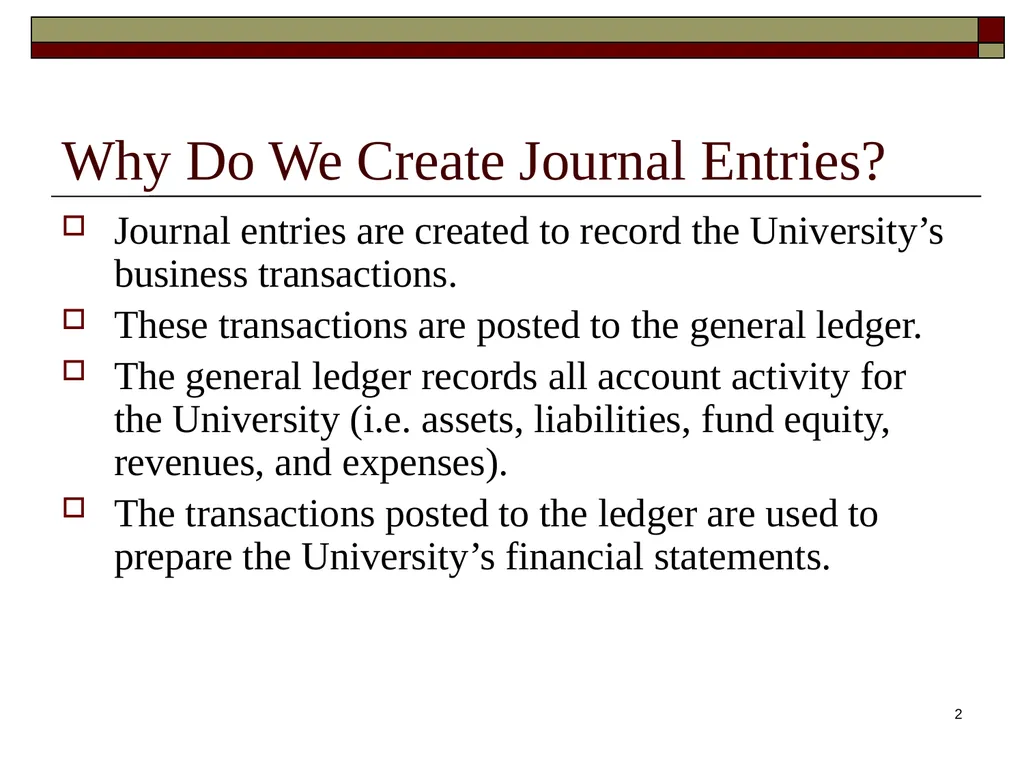
slide2. 2 Why Do We Create Journal Entries? Journal entries are created to record the University’s business transactions.
These transactions are posted to the general ledger.
The general ledger records all account activity for the University (i.e. assets, liabilities, fund equity, revenues, and expenses).
The transactions posted to the ledger are used to prepare the University’s financial statements.<br>
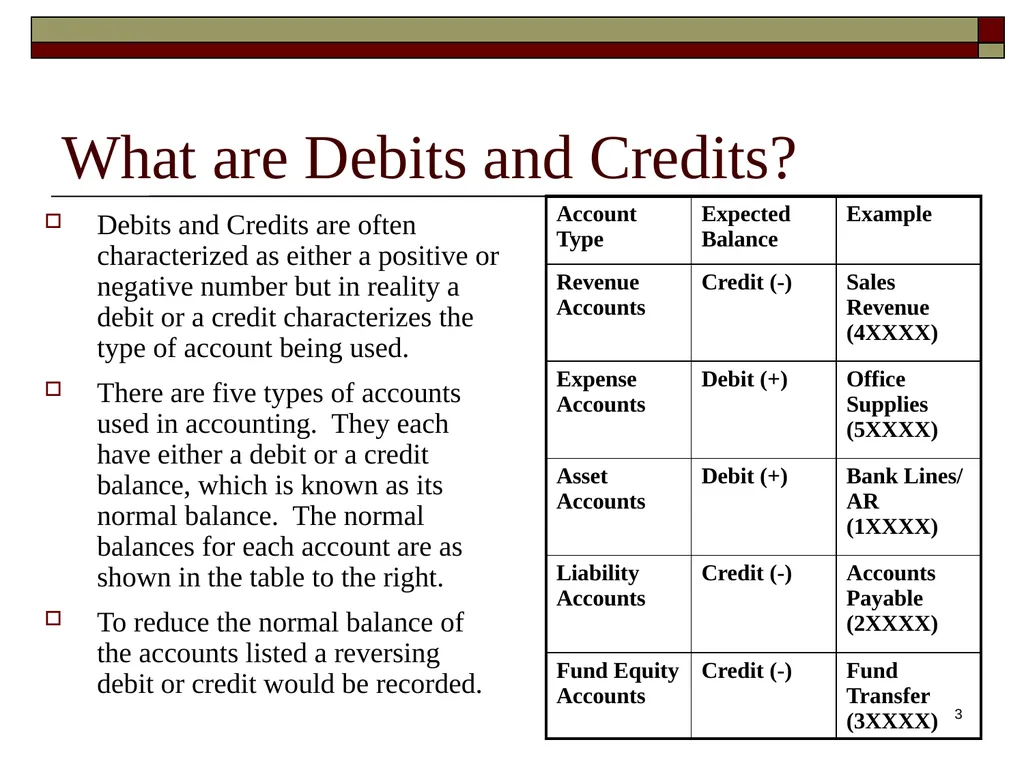
slide3. 3 What are Debits and Credits? Debits and Credits are often characterized as either a positive or negative number but in reality a debit or a credit characterizes the type of account being used.
There are five types of accounts used in accounting. They each have either a debit or a credit balance, which is known as its normal balance. The normal balances for each account are as shown in the table to the right.
To reduce the normal balance of the accounts listed a reversing debit or credit would be recorded.<br>
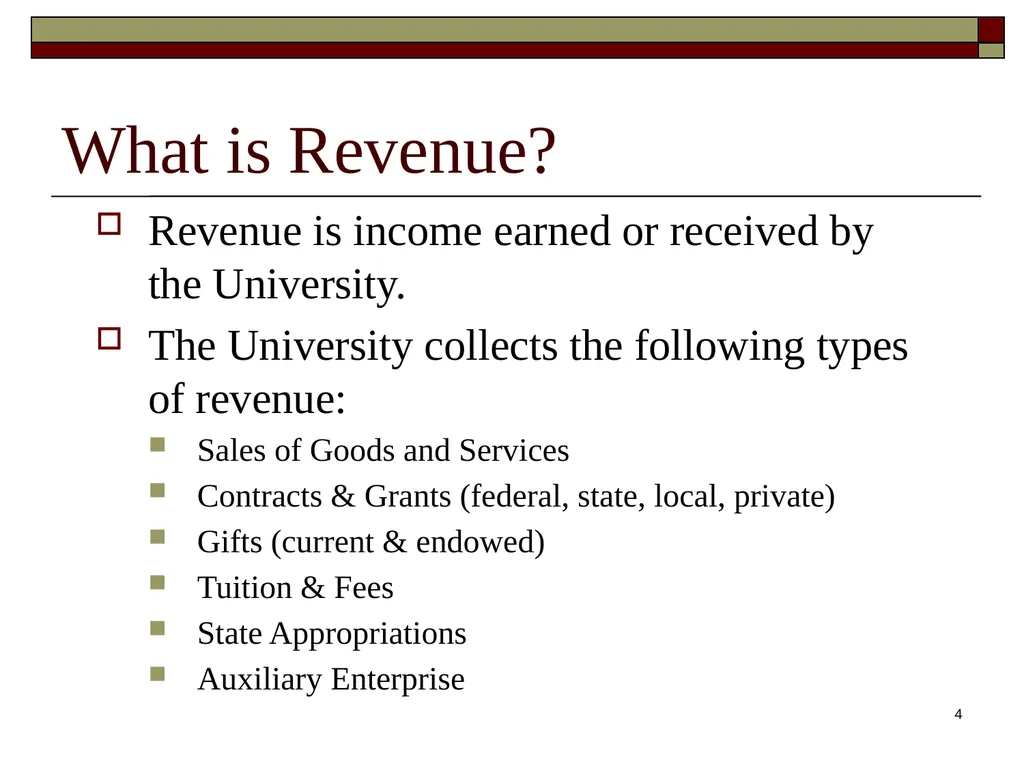
slide4. 4 What is Revenue? Revenue is income earned or received by the University.
The University collects the following types of revenue:
Sales of Goods and Services
Contracts & Grants (federal, state, local, private)
Gifts (current & endowed)
Tuition & Fees
State Appropriations
Auxiliary Enterprise<br>
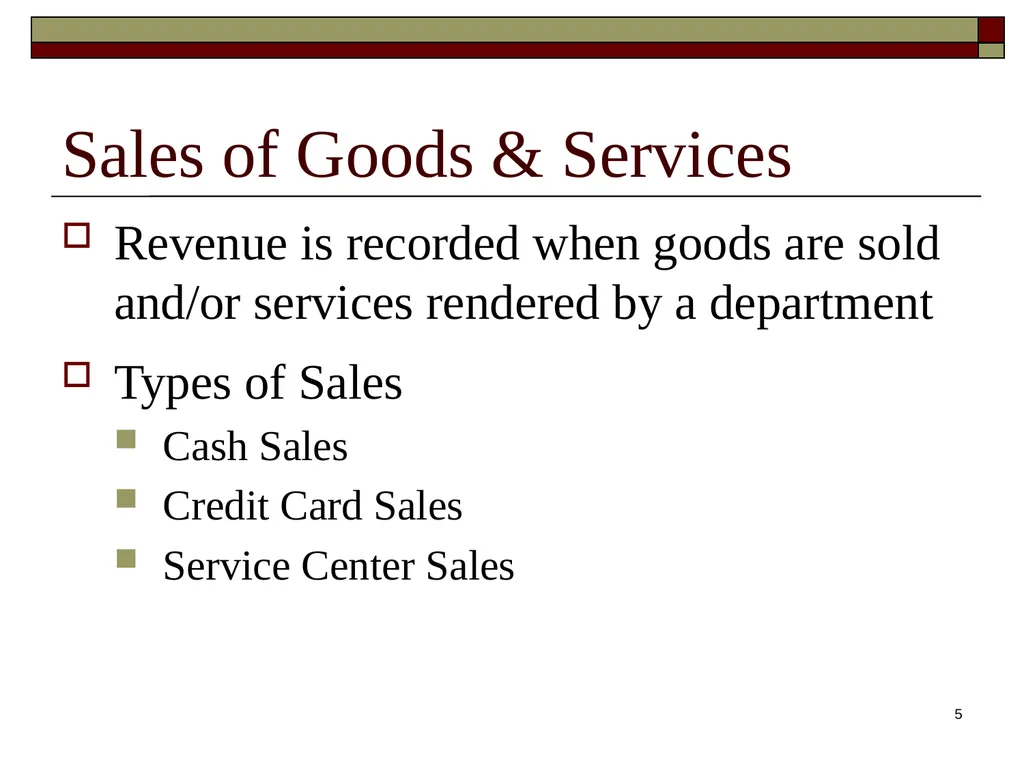
slide5. 5 Sales of Goods & Services Revenue is recorded when goods are sold and/or services rendered by a department
Types of Sales
Cash Sales
Credit Card Sales
Service Center Sales<br>
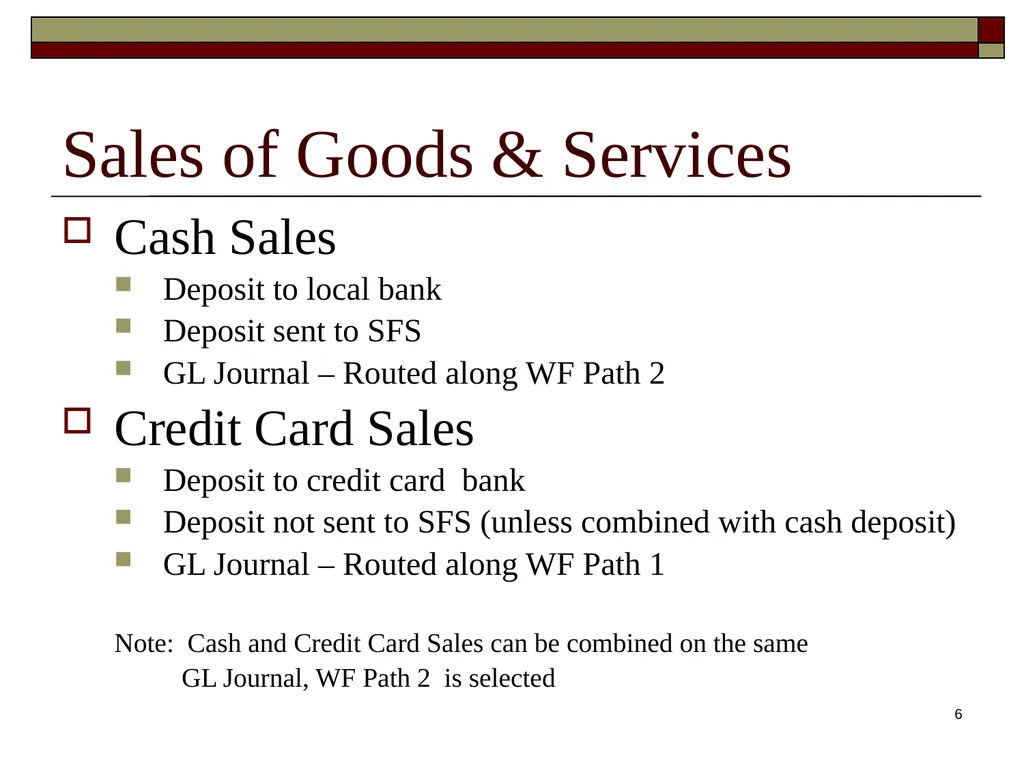
slide6. 6 Sales of Goods & Services Cash Sales
Deposit to local bank
Deposit sent to SFS
GL Journal – Routed along WF Path 2
Credit Card Sales
Deposit to credit card bank
Deposit not sent to SFS (unless combined with cash deposit)
GL Journal – Routed along WF Path 1
Note: Cash and Credit Card Sales can be combined on the same
GL Journal, WF Path 2 is selected<br>
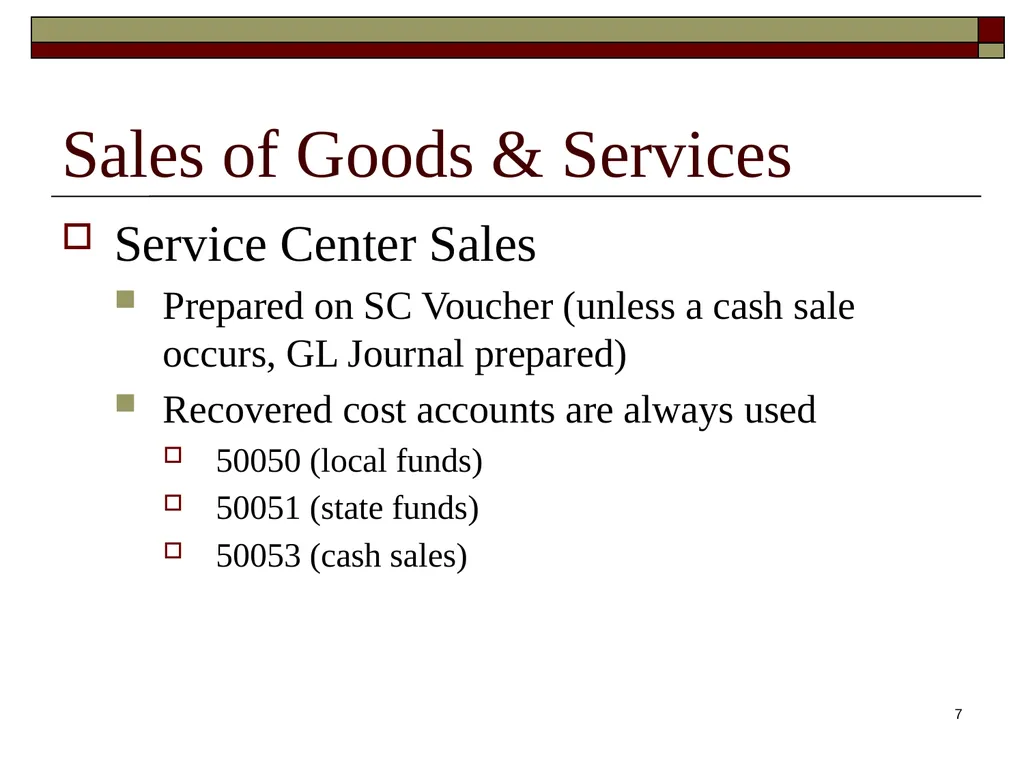
slide7. 7 Sales of Goods & Services Service Center Sales
Prepared on SC Voucher (unless a cash sale occurs, GL Journal prepared)
Recovered cost accounts are always used
50050 (local funds)
50051 (state funds)
50053 (cash sales)<br>
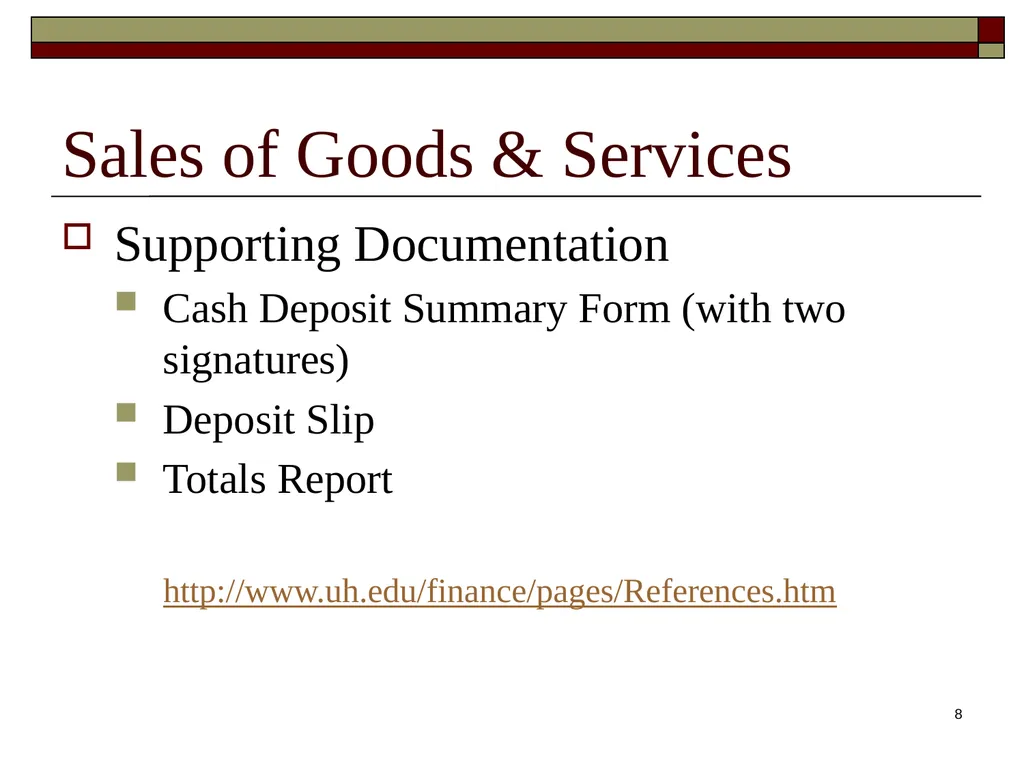
slide8. 8 Sales of Goods & Services Supporting Documentation
Cash Deposit Summary Form (with two signatures)
Deposit Slip
Totals Report
http://www.uh.edu/finance/pages/References.htm<br>
slide9. 9 Contract & Grant Revenue Revenue Estimate Budget is the total amount of funds to be received from the sponsoring agency.
The revenue budget should be equal to your expense budget in order to create the appropriate REV actual entry.<br>
slide10. 10 Contract & Grant Revenue Revenue recorded to cover expenses of sponsored or research projects
As expenditures are posted to Ledger 5 cost centers, a weekly revenue recognition process is run to generate a REV (source code) GL Journal entry that records an accounts receivable and revenue
When the payments are received via check or ACH, a manual GL journal is prepared to record the cash receipt and reduce the project accounts receivable.<br>
slide11. 11 Contract & Grant Revenue Once the total amount of the award has been expensed and payments received, revenue and expenditures totals should balance, leaving a zero fund equity and receivable balance.<br>
slide12. 12 Contract & Grant Revenue If the revenue budget is less than the expenditure budget once the actual expense post over the revenue budget, it will cause a deficit fund equity balance.
To clear the deficit fund equity balance, a budget revision needs to be processed by OCG to increase the revenue budget or prepare a manual journal to address the deficit.<br>
slide13. 13 General Accounting Contacts Sales of Goods and Service Revenue
Gretta McClain - ext 3•8729
email: gmcclain@uh.edu
Contract and Grant Revenue
Andrea Tebo – ext 3•8722
email: atebo@uh.edu
Training: www.uh.edu/finance/pages/Training.htm<br>
slide14. 14 Gift Revenue Gift revenue may be monetary or non monetary.
Monetary revenue is money given to the University.
Non monetary revenue is goods and/or services given to University without an exchange of cash to the University. (Ex: property, royalties, gifts-in-kind,etc)<br>
slide15. Gift Revenue Gift Revenue is recorded when money is given to the University or when the University receives goods and/or services from an external entity.
Two general categories of gift revenue
Current operations (non-endowed)
Endowment 15<br>
slide16. 16 Gift Revenue - Current Operations Current gift revenue is recorded to ledger 4 cost centers.
When current gifts are given to the University, the beneficiary department prepares a Gift Transmittal Form.
Journal entries are prepared to record the gift to the General Ledger.<br>
slide17. 17 Gift Revenue - Endowment Endowment revenue is also gift revenue, but endowment contributions are recorded to ledger 6 cost centers.
When money is contributed to an endowment, the donor designates which endowment will receive their contribution.
The University has numerous endowments which provide benefits to specific departments.
Contributions that are received during the fiscal year are invested in the endowment pool.<br>
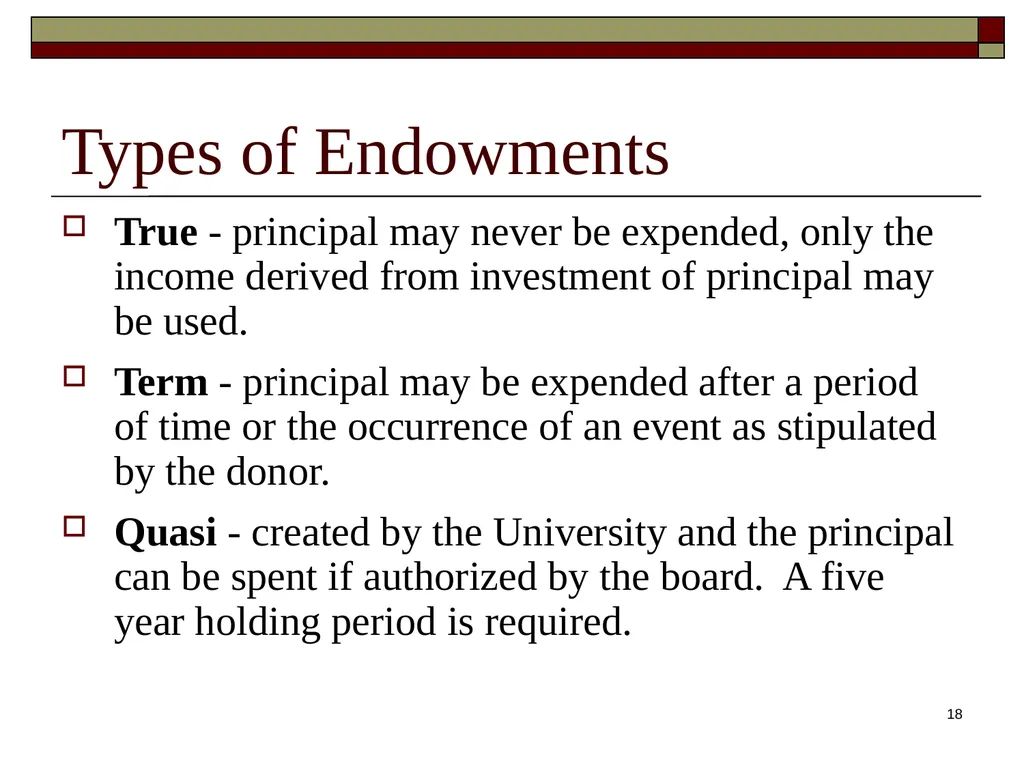
slide18. 18 Types of Endowments True - principal may never be expended, only the income derived from investment of principal may be used.
Term - principal may be expended after a period of time or the occurrence of an event as stipulated by the donor.
Quasi - created by the University and the principal can be spent if authorized by the board. A five year holding period is required.<br>
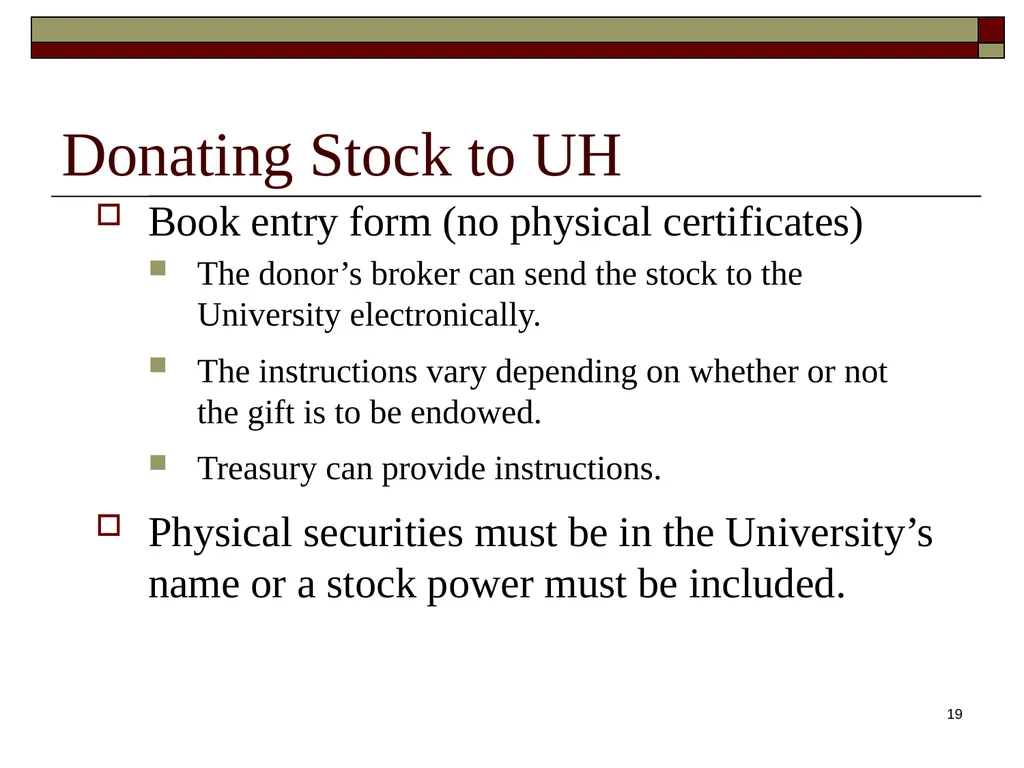
slide19. 19 Donating Stock to UH Book entry form (no physical certificates)
The donor’s broker can send the stock to the University electronically.
The instructions vary depending on whether or not the gift is to be endowed.
Treasury can provide instructions.
Physical securities must be in the University’s name or a stock power must be included.<br>
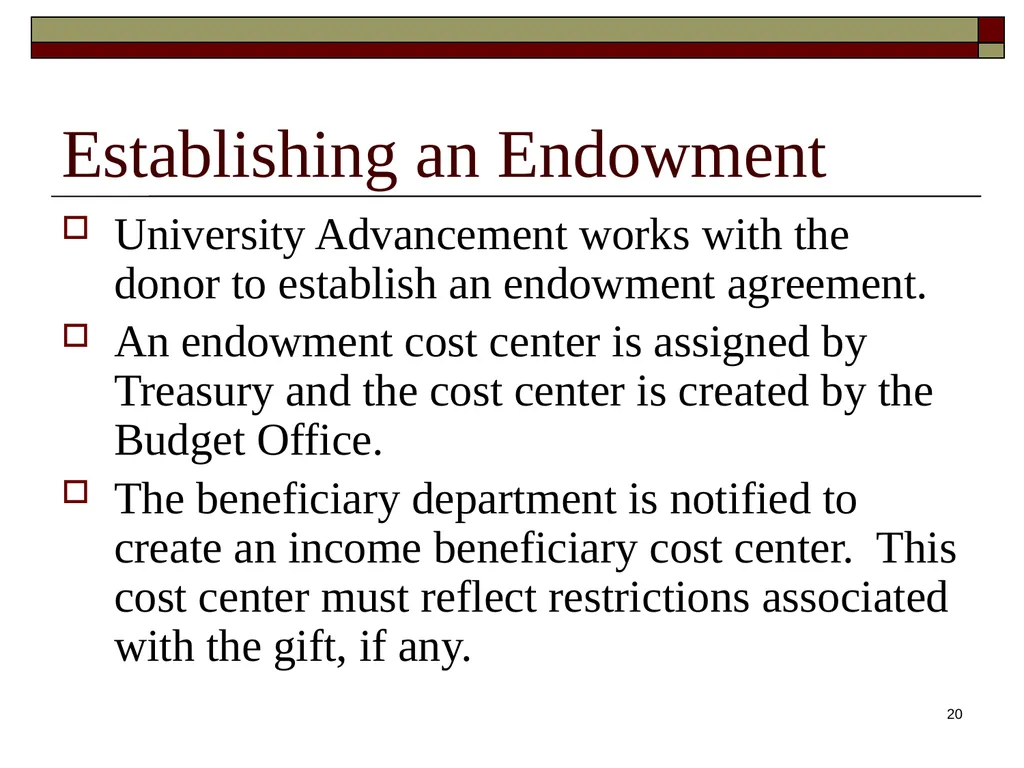
slide20. 20 Establishing an Endowment University Advancement works with the donor to establish an endowment agreement.
An endowment cost center is assigned by Treasury and the cost center is created by the Budget Office.
The beneficiary department is notified to create an income beneficiary cost center. This cost center must reflect restrictions associated with the gift, if any.<br>
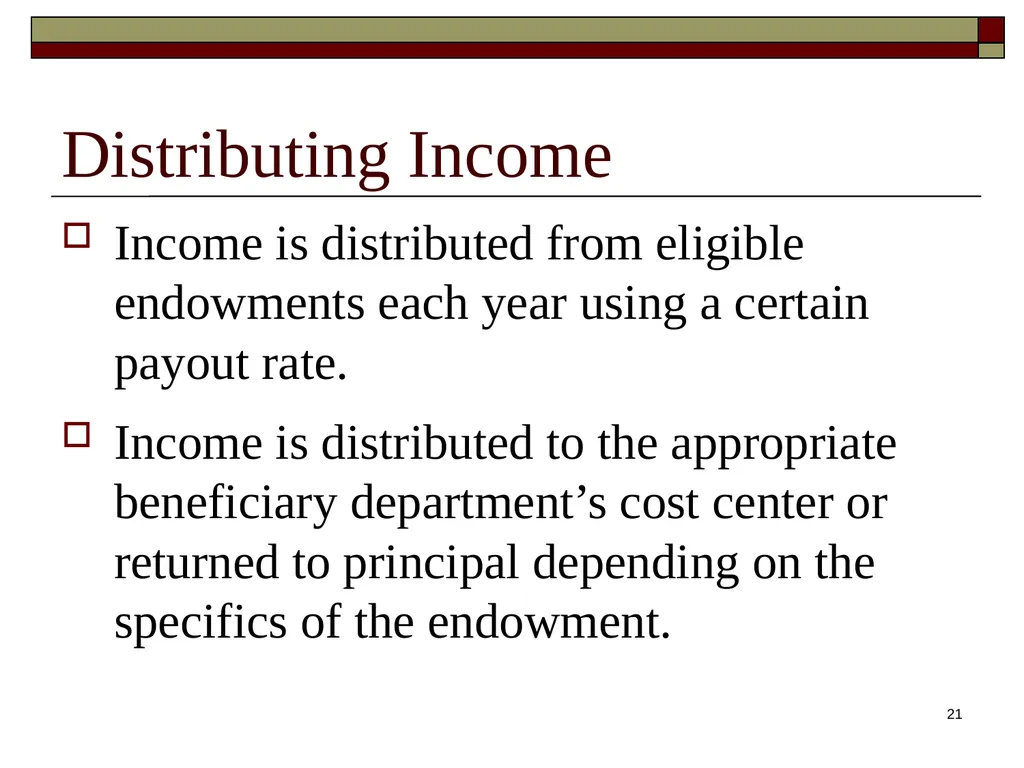
slide21. 21 Distributing Income Income is distributed from eligible endowments each year using a certain payout rate.
Income is distributed to the appropriate beneficiary department’s cost center or returned to principal depending on the specifics of the endowment.<br>
slide22. 22 Distributing Income Income may be spent for purposes approved by the donor
Scholarships
Fellowships
Professorships
Program Support
Other restricted purpose
Unrestricted purpose<br>
slide23. 23 Distributing Income Who is responsible for distributing endowment income?
The Treasurer’s Office is responsible for calculating the annual income distribution and works with accounting to post the entries to the general ledger.<br>
slide24. 24 Distributing Income How is the endowment income calculated?
The distribution is based on a percentage of the average market value of the endowment at the end of the previous three years. The Board of Regents determines the payout rate, which is currently 4%.<br>
slide25. Distributing Income What is an under water endowment?
Any endowment whose current market value is less than sum of all donations made to that endowment over its existence. 25<br>
slide26. Distributing Income What is the impact of under water endowments?
Any endowment that is under water will have its distributions suspended. This gives the endowment time to rebuild its value through market appreciation. 26<br>
slide27. 27 Distributing Income When does the income distribution occur?
Revenue and a receivable is posted to the income beneficiary cost center in period 998 after the accounting for all current year gifts.
The receivable is cleared when we move the cash from the endowment.<br>
slide28. 28 Distributing Income Who is responsible for the spending of endowment income?
The department to whom the beneficiary income account belongs is responsible for making sure the income is spent in accordance with the terms of the endowment agreement.
Note: Spending is tested annually by Internal Auditing and the external auditing firm for compliance with donor restrictions.<br>
slide29. 29 Distributing Income Can distributed income be reinvested in the endowment?
Yes, if permitted by the endowment agreement.
The return of income to principal must be approved by the Vice Chancellor/Vice President for Administration and Finance.
The form should be sent to Treasury.<br>
slide30. 30 Correcting Gift Entries A gift was incorrectly deposited to a restricted cost center instead of an endowment or vice versa. Can this be corrected?
Yes, send a transfer request form to University Advancement explaining the circumstances along with donor details.<br>
slide31. 31 L4 Funds and Endowments Can I transfer funds from fund 4 to an endowment?
Only if the restrictions on the ledger 4 account allow it. Documentation is required before funds can be moved. Documentation has to show that the donors knew the gifts donated were to be endowed.<br>
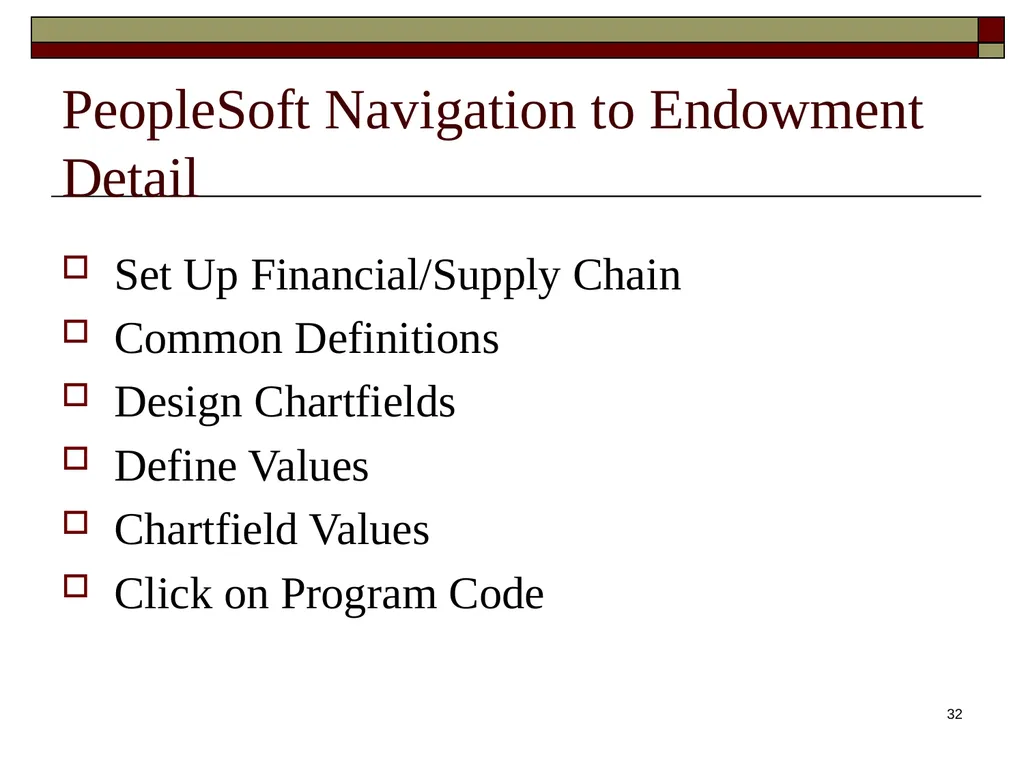
slide32. 32 PeopleSoft Navigation to Endowment Detail Set Up Financial/Supply Chain
Common Definitions
Design Chartfields
Define Values
Chartfield Values
Click on Program Code<br>
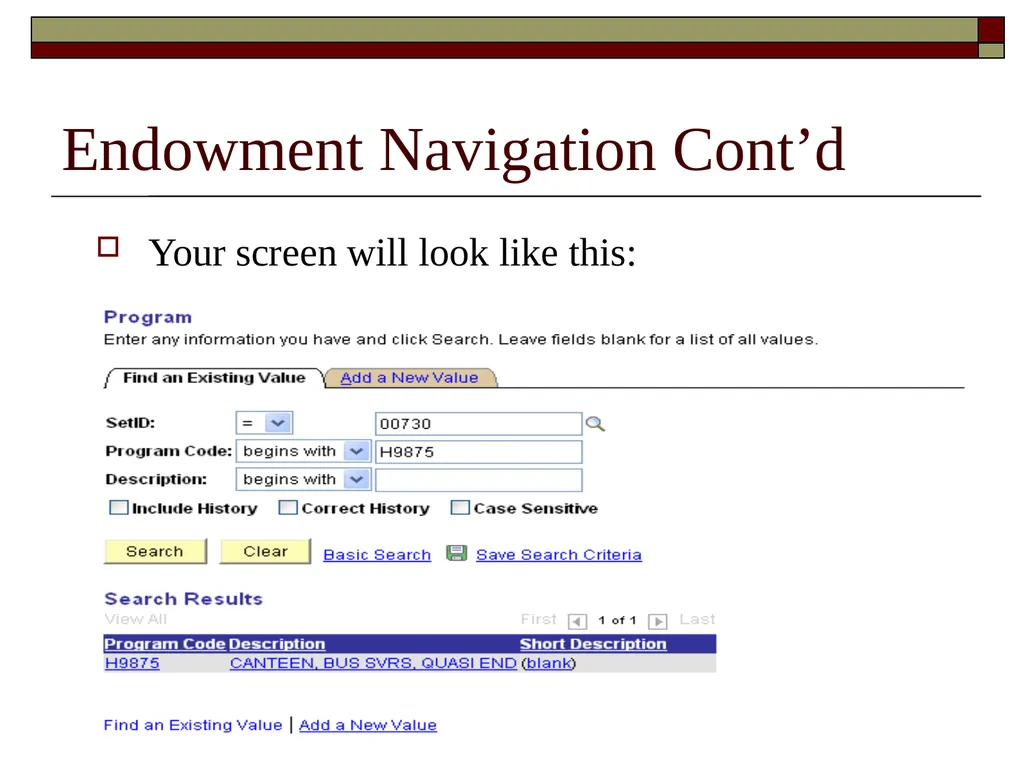
slide33. 33 Endowment Navigation Cont’d Your screen will look like this:<br>
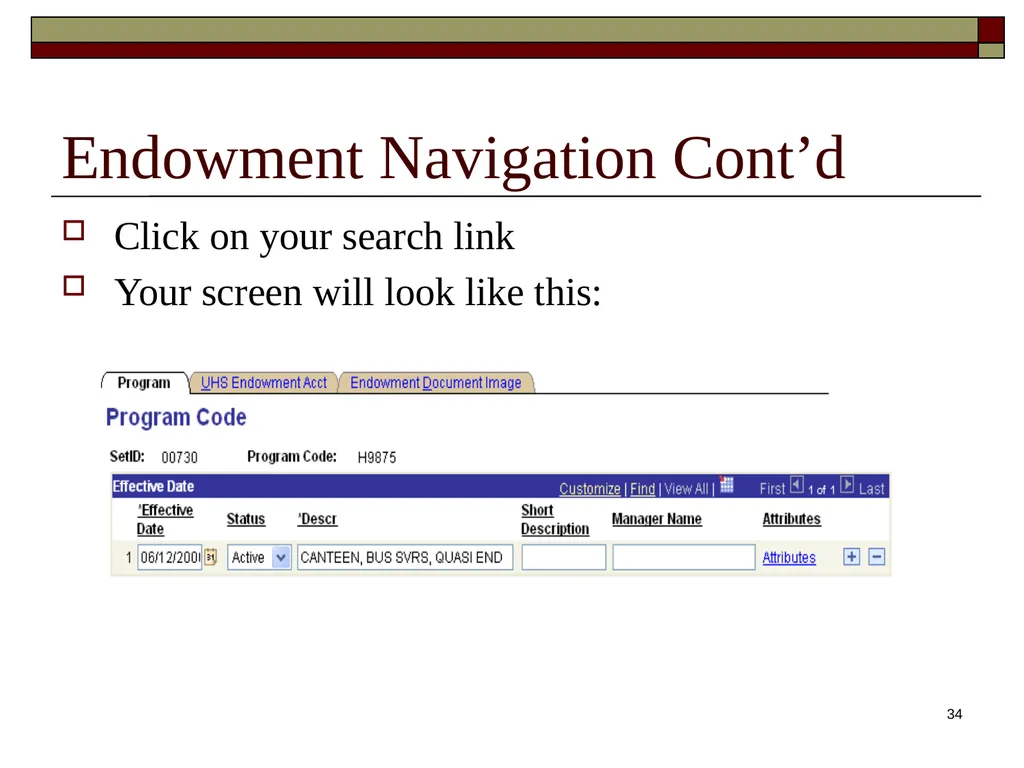
slide34. 34 Endowment Navigation Cont’d Click on your search link
Your screen will look like this:<br>
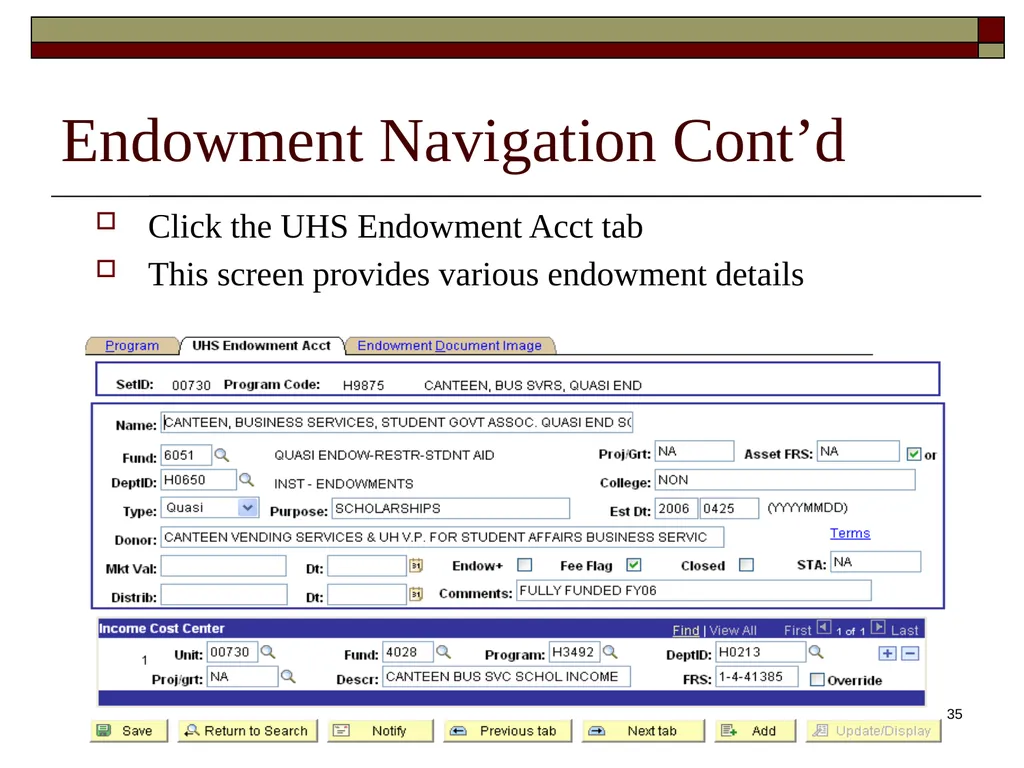
slide35. 35 Click the UHS Endowment Acct tab
This screen provides various endowment details Endowment Navigation Cont’d<br>
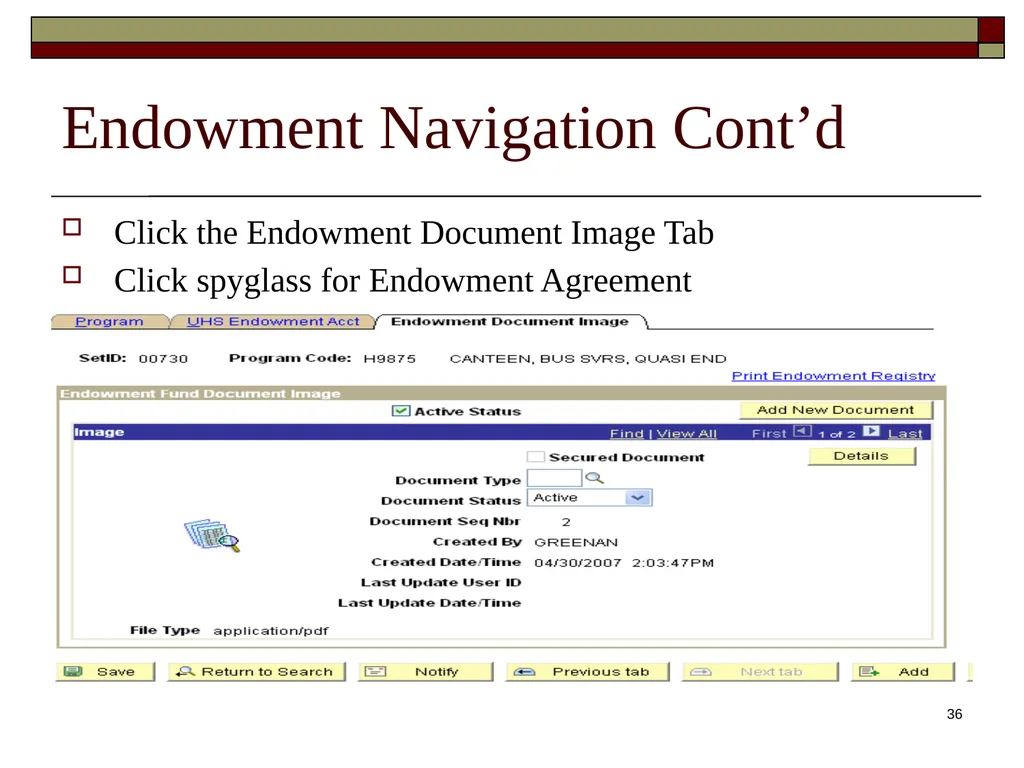
slide36. 36 Endowment Navigation Cont’d Click the Endowment Document Image Tab
Click spyglass for Endowment Agreement<br>
slide37. 37 Tuition and Fee Revenue The University of Houston assesses tuition and fees to students depending on several factors.
Resident or non-resident status
Undergraduate or graduate
Major
There are three components to tuition
State mandated
Designated
Premium (e.g. Law, Pharmacy, Optometry)<br>
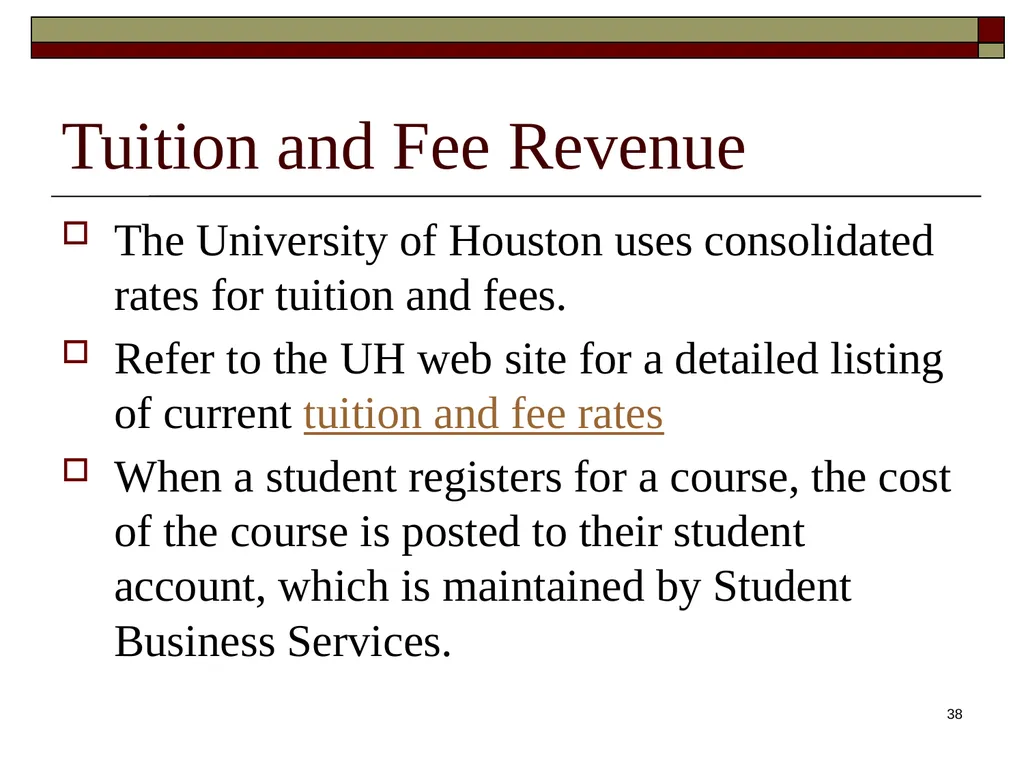
slide38. 38 Tuition and Fee Revenue The University of Houston uses consolidated rates for tuition and fees.
Refer to the UH web site for a detailed listing of current tuition and fee rates
When a student registers for a course, the cost of the course is posted to their student account, which is maintained by Student Business Services.<br>
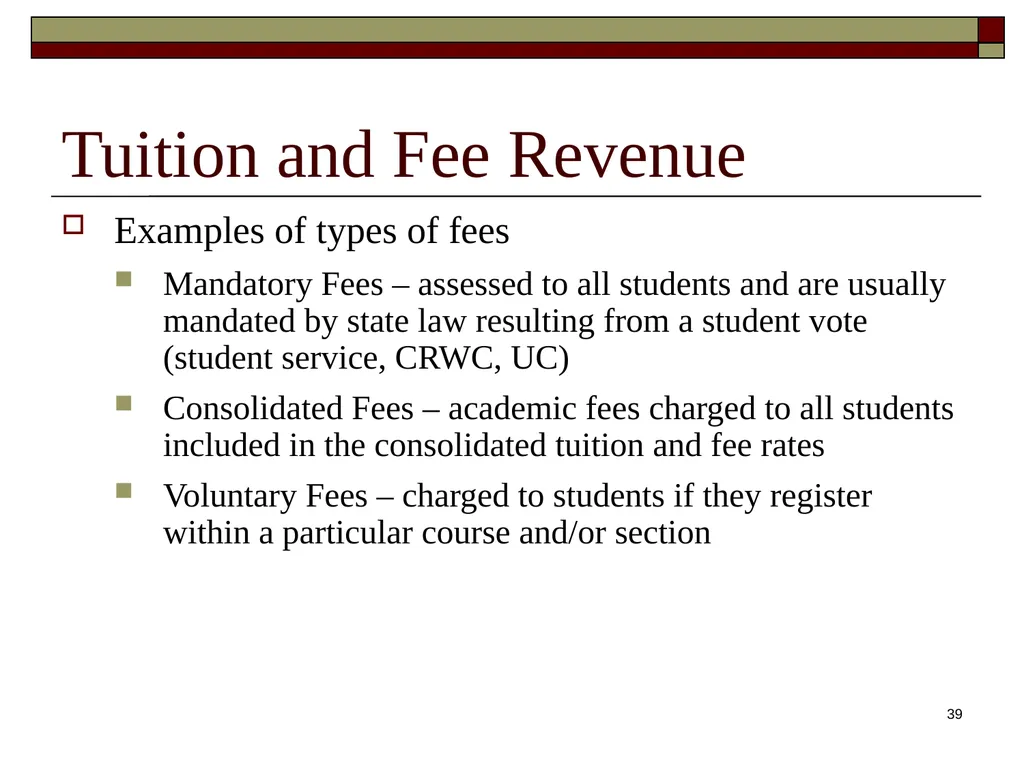
slide39. 39 Tuition and Fee Revenue Examples of types of fees
Mandatory Fees – assessed to all students and are usually mandated by state law resulting from a student vote (student service, CRWC, UC)
Consolidated Fees – academic fees charged to all students included in the consolidated tuition and fee rates
Voluntary Fees – charged to students if they register within a particular course and/or section<br>
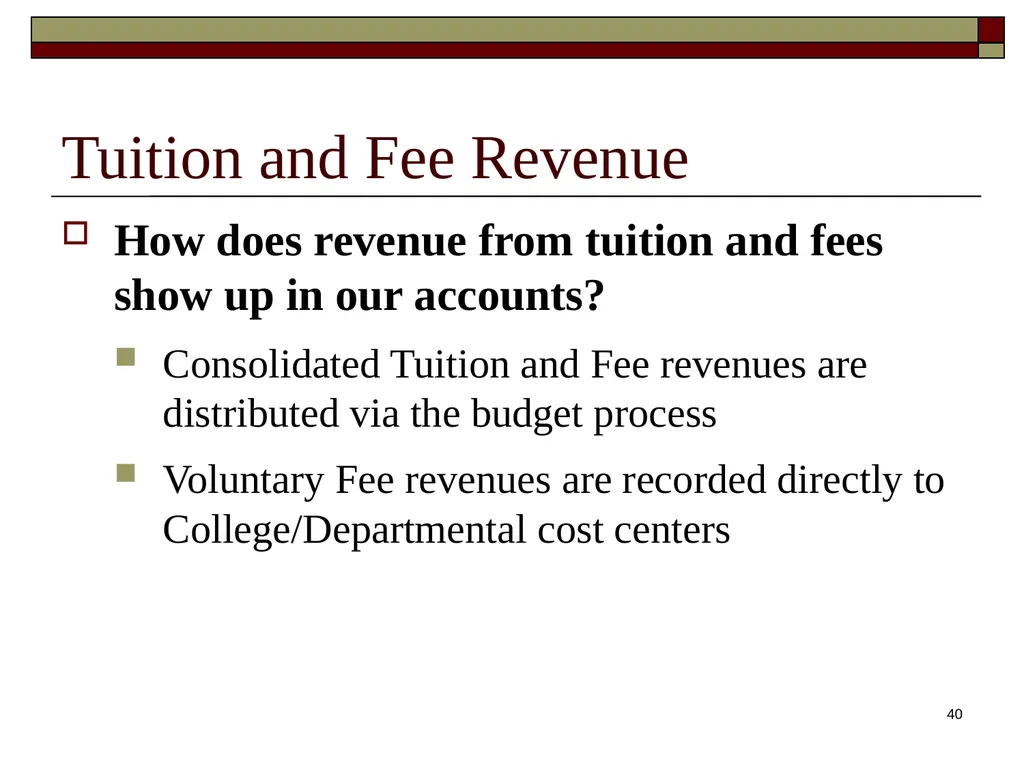
slide40. 40 Tuition and Fee Revenue How does revenue from tuition and fees show up in our accounts?
Consolidated Tuition and Fee revenues are distributed via the budget process
Voluntary Fee revenues are recorded directly to College/Departmental cost centers<br>
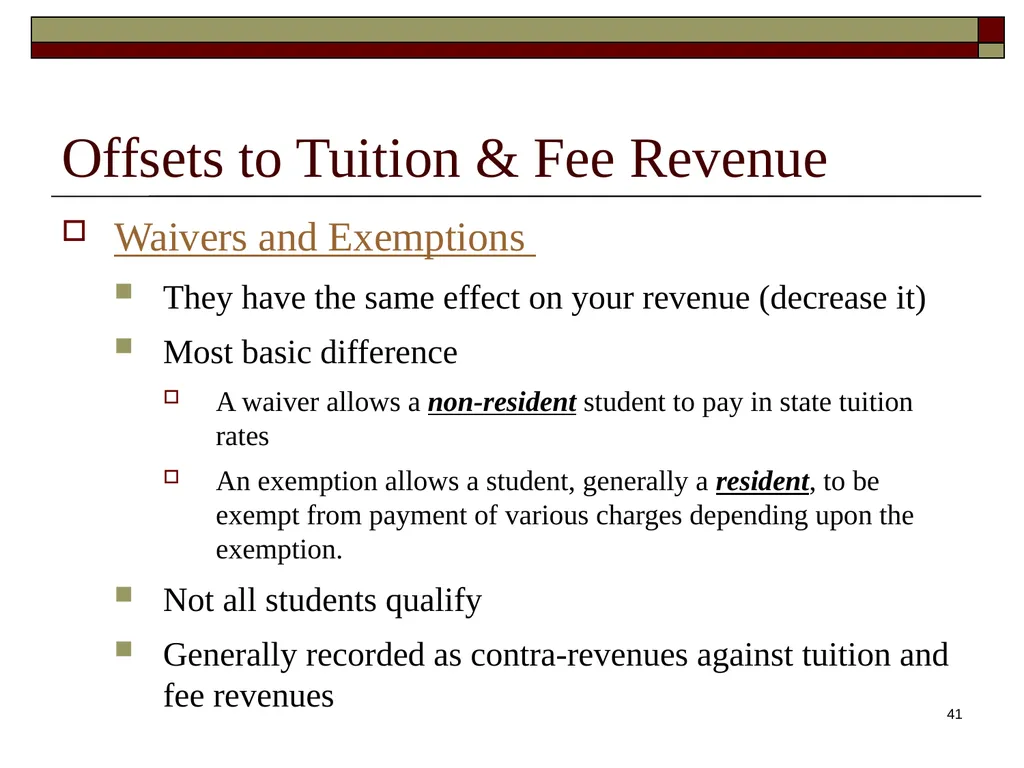
slide41. 41 Offsets to Tuition & Fee Revenue Waivers and Exemptions
They have the same effect on your revenue (decrease it)
Most basic difference
A waiver allows a non-resident student to pay in state tuition rates
An exemption allows a student, generally a resident, to be exempt from payment of various charges depending upon the exemption.
Not all students qualify
Generally recorded as contra-revenues against tuition and fee revenues<br>
slide42. Contacts Fred Burnett - Treasury
713-743-8782
ftburnett@uh.edu
Robbi Puryear – Treasury
713-743-8780
rpuryear@uh.edu
Andy Startz – Student Business Services
713-743-5886
ajstartz@uh.edu
Nancy Tran – Student Financial Services
832-842-9127
ntran@uh.edu Karin Livingston – Accounting Services
713-743-4415
klivingston@uh.edu
Andrew Hoang – Student Accounting
713-743-5629
alhoang4@uh.edu
Gretta McClain – General Accounting
713-743-8729
grmcclai@central.uh.edu
Andrea Tebo – Research Accounting
713-743-8722
adtebo@central.uh.edu 42<br>
slide2. 2 Why Do We Create Journal Entries? Journal entries are created to record the University’s business transactions.
These transactions are posted to the general ledger.
The general ledger records all account activity for the University (i.e. assets, liabilities, fund equity, revenues, and expenses).
The transactions posted to the ledger are used to prepare the University’s financial statements.<br>
slide3. 3 What are Debits and Credits? Debits and Credits are often characterized as either a positive or negative number but in reality a debit or a credit characterizes the type of account being used.
There are five types of accounts used in accounting. They each have either a debit or a credit balance, which is known as its normal balance. The normal balances for each account are as shown in the table to the right.
To reduce the normal balance of the accounts listed a reversing debit or credit would be recorded.<br>
slide4. 4 What is Revenue? Revenue is income earned or received by the University.
The University collects the following types of revenue:
Sales of Goods and Services
Contracts & Grants (federal, state, local, private)
Gifts (current & endowed)
Tuition & Fees
State Appropriations
Auxiliary Enterprise<br>
slide5. 5 Sales of Goods & Services Revenue is recorded when goods are sold and/or services rendered by a department
Types of Sales
Cash Sales
Credit Card Sales
Service Center Sales<br>
slide6. 6 Sales of Goods & Services Cash Sales
Deposit to local bank
Deposit sent to SFS
GL Journal – Routed along WF Path 2
Credit Card Sales
Deposit to credit card bank
Deposit not sent to SFS (unless combined with cash deposit)
GL Journal – Routed along WF Path 1
Note: Cash and Credit Card Sales can be combined on the same
GL Journal, WF Path 2 is selected<br>
slide7. 7 Sales of Goods & Services Service Center Sales
Prepared on SC Voucher (unless a cash sale occurs, GL Journal prepared)
Recovered cost accounts are always used
50050 (local funds)
50051 (state funds)
50053 (cash sales)<br>
slide8. 8 Sales of Goods & Services Supporting Documentation
Cash Deposit Summary Form (with two signatures)
Deposit Slip
Totals Report
http://www.uh.edu/finance/pages/References.htm<br>
slide9. 9 Contract & Grant Revenue Revenue Estimate Budget is the total amount of funds to be received from the sponsoring agency.
The revenue budget should be equal to your expense budget in order to create the appropriate REV actual entry.<br>
slide10. 10 Contract & Grant Revenue Revenue recorded to cover expenses of sponsored or research projects
As expenditures are posted to Ledger 5 cost centers, a weekly revenue recognition process is run to generate a REV (source code) GL Journal entry that records an accounts receivable and revenue
When the payments are received via check or ACH, a manual GL journal is prepared to record the cash receipt and reduce the project accounts receivable.<br>
slide11. 11 Contract & Grant Revenue Once the total amount of the award has been expensed and payments received, revenue and expenditures totals should balance, leaving a zero fund equity and receivable balance.<br>
slide12. 12 Contract & Grant Revenue If the revenue budget is less than the expenditure budget once the actual expense post over the revenue budget, it will cause a deficit fund equity balance.
To clear the deficit fund equity balance, a budget revision needs to be processed by OCG to increase the revenue budget or prepare a manual journal to address the deficit.<br>
slide13. 13 General Accounting Contacts Sales of Goods and Service Revenue
Gretta McClain - ext 3•8729
email: gmcclain@uh.edu
Contract and Grant Revenue
Andrea Tebo – ext 3•8722
email: atebo@uh.edu
Training: www.uh.edu/finance/pages/Training.htm<br>
slide14. 14 Gift Revenue Gift revenue may be monetary or non monetary.
Monetary revenue is money given to the University.
Non monetary revenue is goods and/or services given to University without an exchange of cash to the University. (Ex: property, royalties, gifts-in-kind,etc)<br>
slide15. Gift Revenue Gift Revenue is recorded when money is given to the University or when the University receives goods and/or services from an external entity.
Two general categories of gift revenue
Current operations (non-endowed)
Endowment 15<br>
slide16. 16 Gift Revenue - Current Operations Current gift revenue is recorded to ledger 4 cost centers.
When current gifts are given to the University, the beneficiary department prepares a Gift Transmittal Form.
Journal entries are prepared to record the gift to the General Ledger.<br>
slide17. 17 Gift Revenue - Endowment Endowment revenue is also gift revenue, but endowment contributions are recorded to ledger 6 cost centers.
When money is contributed to an endowment, the donor designates which endowment will receive their contribution.
The University has numerous endowments which provide benefits to specific departments.
Contributions that are received during the fiscal year are invested in the endowment pool.<br>
slide18. 18 Types of Endowments True - principal may never be expended, only the income derived from investment of principal may be used.
Term - principal may be expended after a period of time or the occurrence of an event as stipulated by the donor.
Quasi - created by the University and the principal can be spent if authorized by the board. A five year holding period is required.<br>
slide19. 19 Donating Stock to UH Book entry form (no physical certificates)
The donor’s broker can send the stock to the University electronically.
The instructions vary depending on whether or not the gift is to be endowed.
Treasury can provide instructions.
Physical securities must be in the University’s name or a stock power must be included.<br>
slide20. 20 Establishing an Endowment University Advancement works with the donor to establish an endowment agreement.
An endowment cost center is assigned by Treasury and the cost center is created by the Budget Office.
The beneficiary department is notified to create an income beneficiary cost center. This cost center must reflect restrictions associated with the gift, if any.<br>
slide21. 21 Distributing Income Income is distributed from eligible endowments each year using a certain payout rate.
Income is distributed to the appropriate beneficiary department’s cost center or returned to principal depending on the specifics of the endowment.<br>
slide22. 22 Distributing Income Income may be spent for purposes approved by the donor
Scholarships
Fellowships
Professorships
Program Support
Other restricted purpose
Unrestricted purpose<br>
slide23. 23 Distributing Income Who is responsible for distributing endowment income?
The Treasurer’s Office is responsible for calculating the annual income distribution and works with accounting to post the entries to the general ledger.<br>
slide24. 24 Distributing Income How is the endowment income calculated?
The distribution is based on a percentage of the average market value of the endowment at the end of the previous three years. The Board of Regents determines the payout rate, which is currently 4%.<br>
slide25. Distributing Income What is an under water endowment?
Any endowment whose current market value is less than sum of all donations made to that endowment over its existence. 25<br>
slide26. Distributing Income What is the impact of under water endowments?
Any endowment that is under water will have its distributions suspended. This gives the endowment time to rebuild its value through market appreciation. 26<br>
slide27. 27 Distributing Income When does the income distribution occur?
Revenue and a receivable is posted to the income beneficiary cost center in period 998 after the accounting for all current year gifts.
The receivable is cleared when we move the cash from the endowment.<br>
slide28. 28 Distributing Income Who is responsible for the spending of endowment income?
The department to whom the beneficiary income account belongs is responsible for making sure the income is spent in accordance with the terms of the endowment agreement.
Note: Spending is tested annually by Internal Auditing and the external auditing firm for compliance with donor restrictions.<br>
slide29. 29 Distributing Income Can distributed income be reinvested in the endowment?
Yes, if permitted by the endowment agreement.
The return of income to principal must be approved by the Vice Chancellor/Vice President for Administration and Finance.
The form should be sent to Treasury.<br>
slide30. 30 Correcting Gift Entries A gift was incorrectly deposited to a restricted cost center instead of an endowment or vice versa. Can this be corrected?
Yes, send a transfer request form to University Advancement explaining the circumstances along with donor details.<br>
slide31. 31 L4 Funds and Endowments Can I transfer funds from fund 4 to an endowment?
Only if the restrictions on the ledger 4 account allow it. Documentation is required before funds can be moved. Documentation has to show that the donors knew the gifts donated were to be endowed.<br>
slide32. 32 PeopleSoft Navigation to Endowment Detail Set Up Financial/Supply Chain
Common Definitions
Design Chartfields
Define Values
Chartfield Values
Click on Program Code<br>
slide33. 33 Endowment Navigation Cont’d Your screen will look like this:<br>
slide34. 34 Endowment Navigation Cont’d Click on your search link
Your screen will look like this:<br>
slide35. 35 Click the UHS Endowment Acct tab
This screen provides various endowment details Endowment Navigation Cont’d<br>
slide36. 36 Endowment Navigation Cont’d Click the Endowment Document Image Tab
Click spyglass for Endowment Agreement<br>
slide37. 37 Tuition and Fee Revenue The University of Houston assesses tuition and fees to students depending on several factors.
Resident or non-resident status
Undergraduate or graduate
Major
There are three components to tuition
State mandated
Designated
Premium (e.g. Law, Pharmacy, Optometry)<br>
slide38. 38 Tuition and Fee Revenue The University of Houston uses consolidated rates for tuition and fees.
Refer to the UH web site for a detailed listing of current tuition and fee rates
When a student registers for a course, the cost of the course is posted to their student account, which is maintained by Student Business Services.<br>
slide39. 39 Tuition and Fee Revenue Examples of types of fees
Mandatory Fees – assessed to all students and are usually mandated by state law resulting from a student vote (student service, CRWC, UC)
Consolidated Fees – academic fees charged to all students included in the consolidated tuition and fee rates
Voluntary Fees – charged to students if they register within a particular course and/or section<br>
slide40. 40 Tuition and Fee Revenue How does revenue from tuition and fees show up in our accounts?
Consolidated Tuition and Fee revenues are distributed via the budget process
Voluntary Fee revenues are recorded directly to College/Departmental cost centers<br>
slide41. 41 Offsets to Tuition & Fee Revenue Waivers and Exemptions
They have the same effect on your revenue (decrease it)
Most basic difference
A waiver allows a non-resident student to pay in state tuition rates
An exemption allows a student, generally a resident, to be exempt from payment of various charges depending upon the exemption.
Not all students qualify
Generally recorded as contra-revenues against tuition and fee revenues<br>
slide42. Contacts Fred Burnett - Treasury
713-743-8782
ftburnett@uh.edu
Robbi Puryear – Treasury
713-743-8780
rpuryear@uh.edu
Andy Startz – Student Business Services
713-743-5886
ajstartz@uh.edu
Nancy Tran – Student Financial Services
832-842-9127
ntran@uh.edu Karin Livingston – Accounting Services
713-743-4415
klivingston@uh.edu
Andrew Hoang – Student Accounting
713-743-5629
alhoang4@uh.edu
Gretta McClain – General Accounting
713-743-8729
grmcclai@central.uh.edu
Andrea Tebo – Research Accounting
713-743-8722
adtebo@central.uh.edu 42<br>