DISCUSSION These results suggest the use of the
Description: DISCUSSION These results suggest the use of the Zephyr BioModule as a cardiac ambulatory recording device is as accurate of a method for recording in-flight R-R intervals as a Holter monitor. Future studies utilizing this method of
Related Topics
Download Presentation
"DISCUSSION These results suggest the use of the" is the property of its rightful owner. Permission is granted to download and print the materials on this website for personal, non-commercial use only, and to display it on your personal computer provided you do not modify the materials and that you retain all copyright notices contained in the materials. By downloading content from our website, you accept the terms of this agreement.
Presentation Transcript
slide1. DISCUSSION
These results suggest the use of the Zephyrâ„¢ BioModuleâ„¢ as a cardiac ambulatory recording device is as accurate of a method for recording in-flight R-R intervals as a Holter monitor. Future studies utilizing this method of cardiac monitoring combined with the simultaneous collection of other in-flight physiologic information may yield valuable data that until now has been difficult to procure. The reliable collection of multiple simultaneous physiologic data during military flights operations has the potential to advance aeromedical research into uncharted territories.
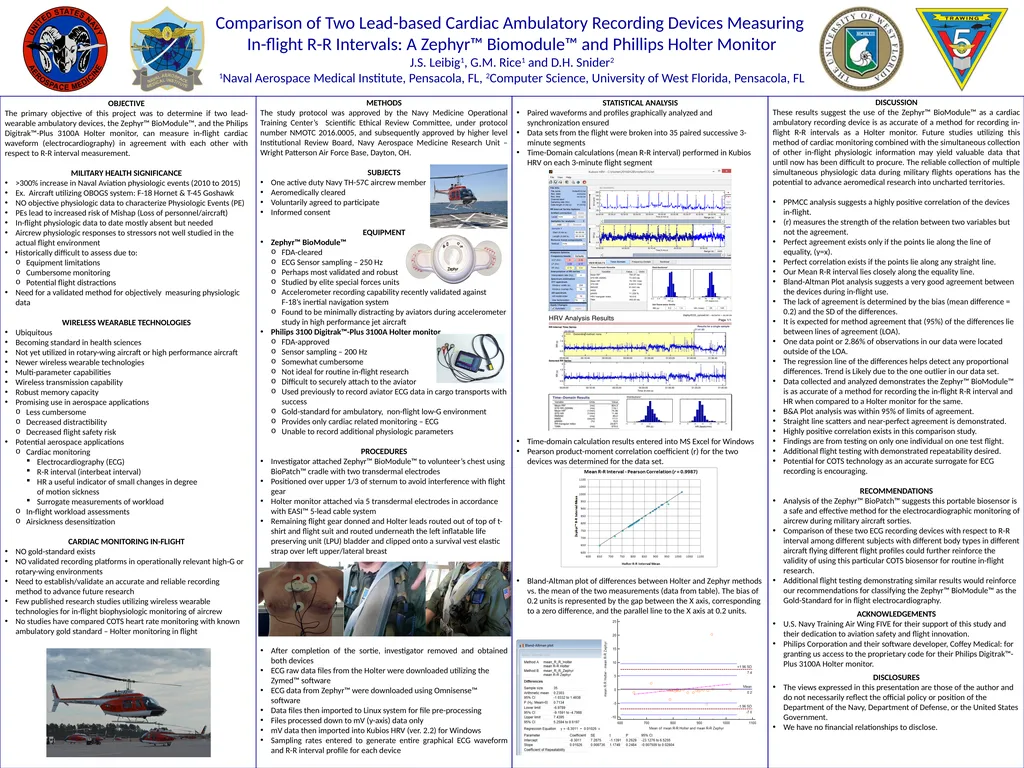
PPMCC analysis suggests a highly positive correlation of the devices in-flight.
(r) measures the strength of the relation between two variables but not the agreement.
Perfect agreement exists only if the points lie along the line of equality, (y=x).
Perfect correlation exists if the points lie along any straight line.
Our Mean R-R interval lies closely along the equality line.
Bland-Altman Plot analysis suggests a very good agreement between the devices during in-flight use.
The lack of agreement is determined by the bias (mean difference = 0.2) and the SD of the differences.
It is expected for method agreement that (95%) of the differences lie between lines of agreement (LOA).
One data point or 2.86% of observations in our data were located outside of the LOA.
The regression line of the differences helps detect any proportional differences. Trend is Likely due to the one outlier in our data set.
Data collected and analyzed demonstrates the Zephyrâ„¢ BioModuleâ„¢ is as accurate of a method for recording the in-flight R-R interval and HR when compared to a Holter monitor for the same.
B&A Plot analysis was within 95% of limits of agreement.
Straight line scatters and near-perfect agreement is demonstrated.
Highly positive correlation exists in this comparison study.
Findings are from testing on only one individual on one test flight.
Additional flight testing with demonstrated repeatability desired.
Potential for COTS technology as an accurate surrogate for ECG recording is encouraging.
RECOMMENDATIONS
Analysis of the Zephyrâ„¢ BioPatchâ„¢ suggests this portable biosensor is a safe and effective method for the electrocardiographic monitoring of aircrew during military aircraft sorties.
Comparison of these two ECG recording devices with respect to R-R interval among different subjects with different body types in different aircraft flying different flight profiles could further reinforce the validity of using this particular COTS biosensor for routine in-flight research.
Additional flight testing demonstrating similar results would reinforce our recommendations for classifying the Zephyrâ„¢ BioModuleâ„¢ as the Gold-Standard for in flight electrocardiography.
ACKNOWLEDGEMENTS
U.S. Navy Training Air Wing FIVE for their support of this study and their dedication to aviation safety and flight innovation.
Philips Corporation and their software developer, Coffey Medical: for granting us access to the proprietary code for their Philips Digitrakâ„¢-Plus 3100A Holter monitor.
DISCLOSURES
The views expressed in this presentation are those of the author and do not necessarily reflect the official policy or position of the Department of the Navy, Department of Defense, or the United States Government.
We have no financial relationships to disclose. STATISTICAL ANALYSIS
Paired waveforms and profiles graphically analyzed and synchronization ensured
Data sets from the flight were broken into 35 paired successive 3-minute segments
Time-Domain calculations (mean R-R interval) performed in Kubios HRV on each 3-minute flight segment
Time-domain calculation results entered into MS Excel for Windows
Pearson product-moment correlation coefficient (r) for the two devices was determined for the data set.
Bland-Altman plot of differences between Holter and Zephyr methods vs. the mean of the two measurements (data from table). The bias of 0.2 units is represented by the gap between the X axis, corresponding to a zero difference, and the parallel line to the X axis at 0.2 units. METHODS
The study protocol was approved by the Navy Medicine Operational Training Center’s Scientific Ethical Review Committee, under protocol number NMOTC 2016.0005, and subsequently approved by higher level Institutional Review Board, Navy Aerospace Medicine Research Unit – Wright Patterson Air Force Base, Dayton, OH.
SUBJECTS
One active duty Navy TH-57C aircrew member
Aeromedically cleared
Voluntarily agreed to participate
Informed consent
EQUIPMENT
Zephyrâ„¢ BioModuleâ„¢
FDA-cleared
ECG Sensor sampling – 250 Hz
Perhaps most validated and robust
Studied by elite special forces units
Accelerometer recording capability recently validated against
F-18’s inertial navigation system
Found to be minimally distracting by aviators during accelerometer study in high performance jet aircraft
Philips 3100 Digitrakâ„¢-Plus 3100A Holter monitor
FDA-approved
Sensor sampling – 200 Hz
Somewhat cumbersome
Not ideal for routine in-flight research
Difficult to securely attach to the aviator
Used previously to record aviator ECG data in cargo transports with success
Gold-standard for ambulatory, non-flight low-G environment
Provides only cardiac related monitoring – ECG
Unable to record additional physiologic parameters
PROCEDURES
Investigator attached Zephyr™ BioModule™ to volunteer’s chest using BioPatch™ cradle with two transdermal electrodes
Positioned over upper 1/3 of sternum to avoid interference with flight gear
Holter monitor attached via 5 transdermal electrodes in accordance with EASIâ„¢ 5-lead cable system
Remaining flight gear donned and Holter leads routed out of top of t-shirt and flight suit and routed underneath the left inflatable life preserving unit (LPU) bladder and clipped onto a survival vest elastic strap over left upper/lateral breast
After completion of the sortie, investigator removed and obtained both devices
ECG raw data files from the Holter were downloaded utilizing the Zymedâ„¢ software
ECG data from Zephyrâ„¢ were downloaded using Omnisenseâ„¢ software
Data files then imported to Linux system for file pre-processing
Files processed down to mV (y-axis) data only
mV data then imported into Kubios HRV (ver. 2.2) for Windows
Sampling rates entered to generate entire graphical ECG waveform and R-R interval profile for each device OBJECTIVE
The primary objective of this project was to determine if two lead-wearable ambulatory devices, the Zephyrâ„¢ BioModuleâ„¢, and the Philips Digitrakâ„¢-Plus 3100A Holter monitor, can measure in-flight cardiac waveform (electrocardiography) in agreement with each other with respect to R-R interval measurement.
MILITARY HEALTH SIGNIFICANCE
>300% increase in Naval Aviation physiologic events (2010 to 2015)
Ex. Aircraft utilizing OBOGS system: F-18 Hornet & T-45 Goshawk
NO objective physiologic data to characterize Physiologic Events (PE)
PEs lead to increased risk of Mishap (Loss of personnel/aircraft)
In-flight physiologic data to date mostly absent but needed
Aircrew physiologic responses to stressors not well studied in the actual flight environment
Historically difficult to assess due to:
Equipment limitations
Cumbersome monitoring
Potential flight distractions
Need for a validated method for objectively measuring physiologic data
WIRELESS WEARABLE TECHNOLOGIES
Ubiquitous
Becoming standard in health sciences
Not yet utilized in rotary-wing aircraft or high performance aircraft
Newer wireless wearable technologies
Multi-parameter capabilities
Wireless transmission capability
Robust memory capacity
Promising use in aerospace applications
Less cumbersome
Decreased distractibility
Decreased flight safety risk
Potential aerospace applications
Cardiac monitoring
Electrocardiography (ECG)
R-R interval (interbeat interval)
HR a useful indicator of small changes in degree
of motion sickness
Surrogate measurements of workload
In-flight workload assessments
Airsickness desensitization
CARDIAC MONITORING IN-FLIGHT
NO gold-standard exists
NO validated recording platforms in operationally relevant high-G or rotary-wing environments
Need to establish/validate an accurate and reliable recording method to advance future research
Few published research studies utilizing wireless wearable technologies for in-flight biophysiologic monitoring of aircrew
No studies have compared COTS heart rate monitoring with known ambulatory gold standard – Holter monitoring in flight Comparison of Two Lead-based Cardiac Ambulatory Recording Devices Measuring
In-flight R-R Intervals: A Zephyrâ„¢ Biomoduleâ„¢ and Phillips Holter Monitor
J.S. Leibig1, G.M. Rice1 and D.H. Snider2
1Naval Aerospace Medical Institute, Pensacola, FL, 2Computer Science, University of West Florida, Pensacola, FL<br>
These results suggest the use of the Zephyrâ„¢ BioModuleâ„¢ as a cardiac ambulatory recording device is as accurate of a method for recording in-flight R-R intervals as a Holter monitor. Future studies utilizing this method of cardiac monitoring combined with the simultaneous collection of other in-flight physiologic information may yield valuable data that until now has been difficult to procure. The reliable collection of multiple simultaneous physiologic data during military flights operations has the potential to advance aeromedical research into uncharted territories.
PPMCC analysis suggests a highly positive correlation of the devices in-flight.
(r) measures the strength of the relation between two variables but not the agreement.
Perfect agreement exists only if the points lie along the line of equality, (y=x).
Perfect correlation exists if the points lie along any straight line.
Our Mean R-R interval lies closely along the equality line.
Bland-Altman Plot analysis suggests a very good agreement between the devices during in-flight use.
The lack of agreement is determined by the bias (mean difference = 0.2) and the SD of the differences.
It is expected for method agreement that (95%) of the differences lie between lines of agreement (LOA).
One data point or 2.86% of observations in our data were located outside of the LOA.
The regression line of the differences helps detect any proportional differences. Trend is Likely due to the one outlier in our data set.
Data collected and analyzed demonstrates the Zephyrâ„¢ BioModuleâ„¢ is as accurate of a method for recording the in-flight R-R interval and HR when compared to a Holter monitor for the same.
B&A Plot analysis was within 95% of limits of agreement.
Straight line scatters and near-perfect agreement is demonstrated.
Highly positive correlation exists in this comparison study.
Findings are from testing on only one individual on one test flight.
Additional flight testing with demonstrated repeatability desired.
Potential for COTS technology as an accurate surrogate for ECG recording is encouraging.
RECOMMENDATIONS
Analysis of the Zephyrâ„¢ BioPatchâ„¢ suggests this portable biosensor is a safe and effective method for the electrocardiographic monitoring of aircrew during military aircraft sorties.
Comparison of these two ECG recording devices with respect to R-R interval among different subjects with different body types in different aircraft flying different flight profiles could further reinforce the validity of using this particular COTS biosensor for routine in-flight research.
Additional flight testing demonstrating similar results would reinforce our recommendations for classifying the Zephyrâ„¢ BioModuleâ„¢ as the Gold-Standard for in flight electrocardiography.
ACKNOWLEDGEMENTS
U.S. Navy Training Air Wing FIVE for their support of this study and their dedication to aviation safety and flight innovation.
Philips Corporation and their software developer, Coffey Medical: for granting us access to the proprietary code for their Philips Digitrakâ„¢-Plus 3100A Holter monitor.
DISCLOSURES
The views expressed in this presentation are those of the author and do not necessarily reflect the official policy or position of the Department of the Navy, Department of Defense, or the United States Government.
We have no financial relationships to disclose. STATISTICAL ANALYSIS
Paired waveforms and profiles graphically analyzed and synchronization ensured
Data sets from the flight were broken into 35 paired successive 3-minute segments
Time-Domain calculations (mean R-R interval) performed in Kubios HRV on each 3-minute flight segment
Time-domain calculation results entered into MS Excel for Windows
Pearson product-moment correlation coefficient (r) for the two devices was determined for the data set.
Bland-Altman plot of differences between Holter and Zephyr methods vs. the mean of the two measurements (data from table). The bias of 0.2 units is represented by the gap between the X axis, corresponding to a zero difference, and the parallel line to the X axis at 0.2 units. METHODS
The study protocol was approved by the Navy Medicine Operational Training Center’s Scientific Ethical Review Committee, under protocol number NMOTC 2016.0005, and subsequently approved by higher level Institutional Review Board, Navy Aerospace Medicine Research Unit – Wright Patterson Air Force Base, Dayton, OH.
SUBJECTS
One active duty Navy TH-57C aircrew member
Aeromedically cleared
Voluntarily agreed to participate
Informed consent
EQUIPMENT
Zephyrâ„¢ BioModuleâ„¢
FDA-cleared
ECG Sensor sampling – 250 Hz
Perhaps most validated and robust
Studied by elite special forces units
Accelerometer recording capability recently validated against
F-18’s inertial navigation system
Found to be minimally distracting by aviators during accelerometer study in high performance jet aircraft
Philips 3100 Digitrakâ„¢-Plus 3100A Holter monitor
FDA-approved
Sensor sampling – 200 Hz
Somewhat cumbersome
Not ideal for routine in-flight research
Difficult to securely attach to the aviator
Used previously to record aviator ECG data in cargo transports with success
Gold-standard for ambulatory, non-flight low-G environment
Provides only cardiac related monitoring – ECG
Unable to record additional physiologic parameters
PROCEDURES
Investigator attached Zephyr™ BioModule™ to volunteer’s chest using BioPatch™ cradle with two transdermal electrodes
Positioned over upper 1/3 of sternum to avoid interference with flight gear
Holter monitor attached via 5 transdermal electrodes in accordance with EASIâ„¢ 5-lead cable system
Remaining flight gear donned and Holter leads routed out of top of t-shirt and flight suit and routed underneath the left inflatable life preserving unit (LPU) bladder and clipped onto a survival vest elastic strap over left upper/lateral breast
After completion of the sortie, investigator removed and obtained both devices
ECG raw data files from the Holter were downloaded utilizing the Zymedâ„¢ software
ECG data from Zephyrâ„¢ were downloaded using Omnisenseâ„¢ software
Data files then imported to Linux system for file pre-processing
Files processed down to mV (y-axis) data only
mV data then imported into Kubios HRV (ver. 2.2) for Windows
Sampling rates entered to generate entire graphical ECG waveform and R-R interval profile for each device OBJECTIVE
The primary objective of this project was to determine if two lead-wearable ambulatory devices, the Zephyrâ„¢ BioModuleâ„¢, and the Philips Digitrakâ„¢-Plus 3100A Holter monitor, can measure in-flight cardiac waveform (electrocardiography) in agreement with each other with respect to R-R interval measurement.
MILITARY HEALTH SIGNIFICANCE
>300% increase in Naval Aviation physiologic events (2010 to 2015)
Ex. Aircraft utilizing OBOGS system: F-18 Hornet & T-45 Goshawk
NO objective physiologic data to characterize Physiologic Events (PE)
PEs lead to increased risk of Mishap (Loss of personnel/aircraft)
In-flight physiologic data to date mostly absent but needed
Aircrew physiologic responses to stressors not well studied in the actual flight environment
Historically difficult to assess due to:
Equipment limitations
Cumbersome monitoring
Potential flight distractions
Need for a validated method for objectively measuring physiologic data
WIRELESS WEARABLE TECHNOLOGIES
Ubiquitous
Becoming standard in health sciences
Not yet utilized in rotary-wing aircraft or high performance aircraft
Newer wireless wearable technologies
Multi-parameter capabilities
Wireless transmission capability
Robust memory capacity
Promising use in aerospace applications
Less cumbersome
Decreased distractibility
Decreased flight safety risk
Potential aerospace applications
Cardiac monitoring
Electrocardiography (ECG)
R-R interval (interbeat interval)
HR a useful indicator of small changes in degree
of motion sickness
Surrogate measurements of workload
In-flight workload assessments
Airsickness desensitization
CARDIAC MONITORING IN-FLIGHT
NO gold-standard exists
NO validated recording platforms in operationally relevant high-G or rotary-wing environments
Need to establish/validate an accurate and reliable recording method to advance future research
Few published research studies utilizing wireless wearable technologies for in-flight biophysiologic monitoring of aircrew
No studies have compared COTS heart rate monitoring with known ambulatory gold standard – Holter monitoring in flight Comparison of Two Lead-based Cardiac Ambulatory Recording Devices Measuring
In-flight R-R Intervals: A Zephyrâ„¢ Biomoduleâ„¢ and Phillips Holter Monitor
J.S. Leibig1, G.M. Rice1 and D.H. Snider2
1Naval Aerospace Medical Institute, Pensacola, FL, 2Computer Science, University of West Florida, Pensacola, FL<br>