
Dissociative Disorders David RM Trotter, PhD
MT
Published · 23 slides · 0 views

1 / 1









Description
Dissociative Disorders David RM Trotter, PhD Associate Professor Departments of Family Medicine and Medical Education Objectives By the end of this presentation, you should be able to: Discuss dissociation from a clinical and non-clinical
Related Topics
Share
Embed code
Download this presentation From Below
"Dissociative Disorders David RM Trotter, PhD" is the property of its rightful owner. Permission is granted to download and print the materials on this website for personal, non-commercial use only, and to display it on your personal computer provided you do not modify the materials and that you retain all copyright notices contained in the materials. By downloading content from our website, you accept the terms of this agreement.
Presentation Transcript
01
Dissociative Disorders David RM Trotter, PhD
Associate Professor
Departments of Family Medicine and Medical Education<br>
Associate Professor
Departments of Family Medicine and Medical Education<br>
02
Objectives By the end of this presentation, you should be able to:
Discuss dissociation from a clinical and non-clinical perspective
Review the epidemiology of Dissociative Disorders
Describe the criteria for the various Dissociative Disorders
Outline common treatments for Dissociative Disorders<br>
Discuss dissociation from a clinical and non-clinical perspective
Review the epidemiology of Dissociative Disorders
Describe the criteria for the various Dissociative Disorders
Outline common treatments for Dissociative Disorders<br>
03
What is Dissociation??? Dissociation is an experience in which there is a discontinuity in conscious awareness. This occurs when there is a disconnection in the usually integrated functions of consciousness, memory, perception, emotions, actions, identity, body representation, and/or motor control.<br>
04
Common Dissociative Experiences Depersonalization: Experiences of unreality, detachment, or being an outside observer with respect to one’s thoughts, feelings, sensations, body, or actions (e.g. perceptual alteration, distorted sense of time, unreal or absent self, emotional and/or physical numbing)
Derealization: Experiences of unreality or detachment with respect to surroundings (e.g. individual or objects are experience as unreal, dreamlike, foggy, lifeless, or visually distorted)
Dissociative Amnesia: Inability to recall important personal information in a way that cannot be explained by ordinary forgetting
Identify Confusion or Alteration:
Confusion: Confusion about who one is. For example, they may at times enjoy activities (e.g. drugs, alcohol, recklessness) that at other times they find repugnant.
Alteration: The shifting of personality states<br>
Derealization: Experiences of unreality or detachment with respect to surroundings (e.g. individual or objects are experience as unreal, dreamlike, foggy, lifeless, or visually distorted)
Dissociative Amnesia: Inability to recall important personal information in a way that cannot be explained by ordinary forgetting
Identify Confusion or Alteration:
Confusion: Confusion about who one is. For example, they may at times enjoy activities (e.g. drugs, alcohol, recklessness) that at other times they find repugnant.
Alteration: The shifting of personality states<br>
05
Positive and Negative Dissociative Symptoms Positive: Addition of an experience not typically there
E.g. fragmentation of identity, depersonalization, derealization
Negative: Lack of a typical experience
E.g. amnesia
NOTE: Think of this in the same way you think of positive and negative psychotic symptoms<br>
E.g. fragmentation of identity, depersonalization, derealization
Negative: Lack of a typical experience
E.g. amnesia
NOTE: Think of this in the same way you think of positive and negative psychotic symptoms<br>
06
Dissociation Occurs on a Continuum: Common Dissociation Daydreaming
Being so absorbed in something (e.g. book/movie) that you are not aware of what is happing around you
Feeling “detached” for your body in some way
Loosing track of time
Feeling emotionally numb<br>
Being so absorbed in something (e.g. book/movie) that you are not aware of what is happing around you
Feeling “detached” for your body in some way
Loosing track of time
Feeling emotionally numb<br>
07
Dissociation Occurs on a Continuum: Less Common Dissociation Chronic Derealization and/or Depersonalization
Amnesia for specific events, types of events, or important personal information
The presents of more than one personality state<br>
Amnesia for specific events, types of events, or important personal information
The presents of more than one personality state<br>
08
Causes for Severe Forms of Dissociation Causes assumed to be largely environmental and genetic
A history of trauma is very common among individuals with dissociative disorders. This may include ACEs (e.g. abuse, neglect) or other intolerable/overwhelming experiences.
Dissociation during a traumatic event predicts likelihood of dissociation occurring later.
Remember, dissociation during a traumatic event is acutely adaptive. However, it may become disrupted later.<br>
A history of trauma is very common among individuals with dissociative disorders. This may include ACEs (e.g. abuse, neglect) or other intolerable/overwhelming experiences.
Dissociation during a traumatic event predicts likelihood of dissociation occurring later.
Remember, dissociation during a traumatic event is acutely adaptive. However, it may become disrupted later.<br>
09
What is the primary function of Dissociation? Defense/Coping Mechanism<br>
10
Dissociative Disorders Dissociative Identity Disorder (Previously Multiple Personality Disorder)
Dissociative Amnesia
Depersonalization/Derealization Disorder
Other/Unspecified Dissociative Disorder<br>
Dissociative Amnesia
Depersonalization/Derealization Disorder
Other/Unspecified Dissociative Disorder<br>
11
Dissociative Identity Disorder Disruption of identity characterized by two or more distinct personality states, which may be described in some cultures as an experience of possession. The disruption in identity involves remarked discontinuity in senses of self and sense of agency, accompanied by related alterations in affect, behaviors, consciousness, memory, perception, cognition and/or sensory-motor functioning. These signs and symptoms may be observed by others or reported by the individual.
Recurrent gaps in the recall of everyday events, important personal information, and /or traumatic evens that are inconsistent with ordinary forgetting.
The symptoms cause distress or impairment
The disturbance is not a normal part of a broadly accepted cultural or religious practice. NOTE: In children, the symptoms are not better explained by imaginary playmates or other fantasy play
Symptoms are not attributable to the psychological effects of a substance or another medical condition<br>
Recurrent gaps in the recall of everyday events, important personal information, and /or traumatic evens that are inconsistent with ordinary forgetting.
The symptoms cause distress or impairment
The disturbance is not a normal part of a broadly accepted cultural or religious practice. NOTE: In children, the symptoms are not better explained by imaginary playmates or other fantasy play
Symptoms are not attributable to the psychological effects of a substance or another medical condition<br>
12
Dissociative Identity Disorder Prevalence (12-month): 1.5% in the general population
Male 1.6%
Female 1.4%
Often comorbid with other issues including depressive, anxiety, substance, self-injury, non-epileptic seizure disorders
Developmental Couse
Often associated with childhood trauma (about 90%)
Decompensation often associated with a trigger: removal from traumatic situation, children reaching same age as they were when abuse began/occurred, later traumatic events (e.g. care accident), death or illness of abuser
70% of outpatients with DID have attempted suicide in the past<br>
Male 1.6%
Female 1.4%
Often comorbid with other issues including depressive, anxiety, substance, self-injury, non-epileptic seizure disorders
Developmental Couse
Often associated with childhood trauma (about 90%)
Decompensation often associated with a trigger: removal from traumatic situation, children reaching same age as they were when abuse began/occurred, later traumatic events (e.g. care accident), death or illness of abuser
70% of outpatients with DID have attempted suicide in the past<br>
13
Dissociative Identity Disorder Differential Diagnosis
Major Depressive Disorder
Bipolar Disorders
PTSD
Psychotic Disorders
Substance/Medication-induced disorders
Personality Disorders
Conversion Disorder
Seizure Disorders
Factitious Disorder and Malingering<br>
Major Depressive Disorder
Bipolar Disorders
PTSD
Psychotic Disorders
Substance/Medication-induced disorders
Personality Disorders
Conversion Disorder
Seizure Disorders
Factitious Disorder and Malingering<br>
14
Dissociative Identity Disorder<br>
15
Dissociative Amnesia An inability to recall important autobiographical information, usually of a traumatic or stressful nature, that is inconsistent with ordinary forgetting. NOTE: Dissociative amnesia most often consists of localized or selective amnesia for a specific event or events; or generalized amnesia for identify and life history
The symptoms cause distress or impairment
The disturbance is not attributable to use of a substance or another medical condition
The disturbance is not attributable to another dissociative disorder
With Dissociative Fugue: Apparently purposeful travel or bewildered wandering that is associated with amnesia for identity or for another important autobiographical information<br>
The symptoms cause distress or impairment
The disturbance is not attributable to use of a substance or another medical condition
The disturbance is not attributable to another dissociative disorder
With Dissociative Fugue: Apparently purposeful travel or bewildered wandering that is associated with amnesia for identity or for another important autobiographical information<br>
16
Dissociative Amnesia Diagnostic Features
Lack of memories is not a function of organic (i.e. neurological damage or toxicity) problems.
Localized Amnesia: Failure to remember events that happened during a specific time frame
Selective Amnesia: Failure to remember some, but not all, or events that happened during a time frame
Generalized Amnesia: A failure to remember ALL one’s life history (very rare). Often associated with dissociative fugue.<br>
Lack of memories is not a function of organic (i.e. neurological damage or toxicity) problems.
Localized Amnesia: Failure to remember events that happened during a specific time frame
Selective Amnesia: Failure to remember some, but not all, or events that happened during a time frame
Generalized Amnesia: A failure to remember ALL one’s life history (very rare). Often associated with dissociative fugue.<br>
17
Dissociative Amnesia Prevalence (12-month): 1.8%
Male: 1.0%
Female: 2.6%
Developmental Course:
Trauma history is very common
Individual is often unaware of the amnesia
Onset of amnesia post trauma can be hours, days, or longer
Amnesia can last decades
After amnesia remits there is often significant depression and anxiety<br>
Male: 1.0%
Female: 2.6%
Developmental Course:
Trauma history is very common
Individual is often unaware of the amnesia
Onset of amnesia post trauma can be hours, days, or longer
Amnesia can last decades
After amnesia remits there is often significant depression and anxiety<br>
18
Dissociative Amnesia Suicide Risk: This risk is high among those with dissociative amnesia, especially if amnesia remits suddenly.
Differential Diagnosis:
DID
PTSD
Neurocognitive Disorders
Substance-related Disorders
TBI
Seizure Disorders
Fictitious Disorder or Malingering
Age related memory changes<br>
Differential Diagnosis:
DID
PTSD
Neurocognitive Disorders
Substance-related Disorders
TBI
Seizure Disorders
Fictitious Disorder or Malingering
Age related memory changes<br>
19
Depersonalization/Derealization Disorder The presence of persistent or recurrent experiences of depersonalization, derealization, or both
During the depersonalization or dereaslization experiences, reality testing remains intact
The symptoms cause distress or impairment
The disturbance is not a function a substance or medication
Not better explained by another disorder (e.g. PTSD, OCD, MDD, another Dissociative Disorder)<br>
During the depersonalization or dereaslization experiences, reality testing remains intact
The symptoms cause distress or impairment
The disturbance is not a function a substance or medication
Not better explained by another disorder (e.g. PTSD, OCD, MDD, another Dissociative Disorder)<br>
20
Depersonalization/Derealization Disorder Prevalence:
About 50% of US adults will report at least one episode of Depersonalization or Derealization every year. However, to meet full criteria for this disorder is less common
Life-Time Prevalence: 2.0% (gender ration 1:1)
Developmental Course:
Mean age of onset is 16-years (only 5% report onset after age 25, onset after age 40 is extremely rare)
1/3 experience a discrete episode, 1/3 report continuous SXS, and 1/3 report intermittent episodes that eventually become continuous<br>
About 50% of US adults will report at least one episode of Depersonalization or Derealization every year. However, to meet full criteria for this disorder is less common
Life-Time Prevalence: 2.0% (gender ration 1:1)
Developmental Course:
Mean age of onset is 16-years (only 5% report onset after age 25, onset after age 40 is extremely rare)
1/3 experience a discrete episode, 1/3 report continuous SXS, and 1/3 report intermittent episodes that eventually become continuous<br>
21
Depersonalization/Derealization Disorder Differential Diagnosis:
MDD
OCD
Illness anxiety disorder
Other Dissociative Disorders
Anxiety disorders
Psychotic disorders
Substance/medication-related disorders
Comorbidity: High with MDD and any anxiety disorder (except PTSD). Also often comorbid with Avoidant, Borderline, and Obsessive-Compulsive Personality Disorders<br>
MDD
OCD
Illness anxiety disorder
Other Dissociative Disorders
Anxiety disorders
Psychotic disorders
Substance/medication-related disorders
Comorbidity: High with MDD and any anxiety disorder (except PTSD). Also often comorbid with Avoidant, Borderline, and Obsessive-Compulsive Personality Disorders<br>
22
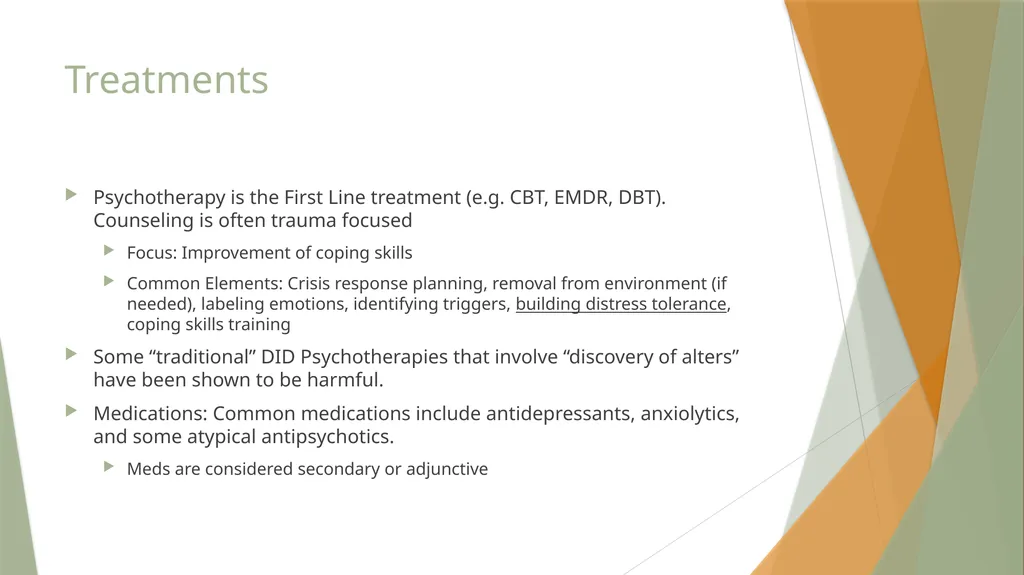
Treatments Psychotherapy is the First Line treatment (e.g. CBT, EMDR, DBT). Counseling is often trauma focused
Focus: Improvement of coping skills
Common Elements: Crisis response planning, removal from environment (if needed), labeling emotions, identifying triggers, building distress tolerance, coping skills training
Some “traditional” DID Psychotherapies that involve “discovery of alters” have been shown to be harmful.
Medications: Common medications include antidepressants, anxiolytics, and some atypical antipsychotics.
Meds are considered secondary or adjunctive<br>
Focus: Improvement of coping skills
Common Elements: Crisis response planning, removal from environment (if needed), labeling emotions, identifying triggers, building distress tolerance, coping skills training
Some “traditional” DID Psychotherapies that involve “discovery of alters” have been shown to be harmful.
Medications: Common medications include antidepressants, anxiolytics, and some atypical antipsychotics.
Meds are considered secondary or adjunctive<br>
23
References American Psychiatric Association: Diagnostic and Statistical Manual of Mental Disorders, Fifth Edition/ Arlington, VA, American Psychiatric Association, 2013.
International Society for the Study of Trauma and Dissociation, Dissociation FAQs (www.isst-d.org, 11/23/2016)
Lilienfeld, S. (2007). Psychological Treatments that Cause Harm. Perspectives on Psychological Science 2 (1), 53-70.<br>
International Society for the Study of Trauma and Dissociation, Dissociation FAQs (www.isst-d.org, 11/23/2016)
Lilienfeld, S. (2007). Psychological Treatments that Cause Harm. Perspectives on Psychological Science 2 (1), 53-70.<br>