
Distributed Systems CS 15-440 Naming Lecture 8,
GB
Published · 21 slides · 0 views
1 / 1

Description
Distributed Systems CS 15-440 Naming Lecture 8, February 07, 2022 Mohammad Hammoud Today Last Session: Architectures Todays Session: Naming Announcements: PS2 is due on Feb 10 Quiz I is on Feb 14 P1 is due on Feb 21 Naming Names are used
Related Topics
Share
Embed code
Download this presentation From Below
"Distributed Systems CS 15-440 Naming Lecture 8," is the property of its rightful owner. Permission is granted to download and print the materials on this website for personal, non-commercial use only, and to display it on your personal computer provided you do not modify the materials and that you retain all copyright notices contained in the materials. By downloading content from our website, you accept the terms of this agreement.
Presentation Transcript
01
Distributed Systems
CS 15-440 Naming
Lecture 8, February 07, 2022
Mohammad Hammoud<br>
Lecture 8, February 07, 2022
Mohammad Hammoud<br>
02
Today… Last Session:
Architectures
Today’s Session:
Naming
Announcements:
PS2 is due on Feb 10
Quiz I is on Feb 14
P1 is due on Feb 21<br>
Architectures
Today’s Session:
Naming
Announcements:
PS2 is due on Feb 10
Quiz I is on Feb 14
P1 is due on Feb 21<br>
03
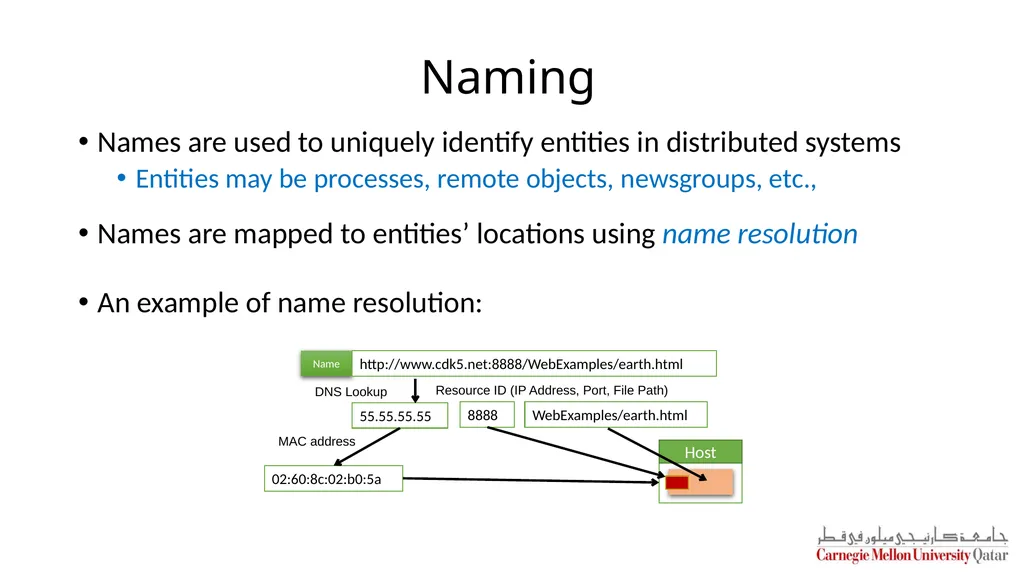
Naming Names are used to uniquely identify entities in distributed systems
Entities may be processes, remote objects, newsgroups, etc.,
Names are mapped to entities’ locations using name resolution
An example of name resolution: Name http://www.cdk5.net:8888/WebExamples/earth.html 55.55.55.55 WebExamples/earth.html 8888 DNS Lookup 02:60:8c:02:b0:5a Resource ID (IP Address, Port, File Path) MAC address<br>
Entities may be processes, remote objects, newsgroups, etc.,
Names are mapped to entities’ locations using name resolution
An example of name resolution: Name http://www.cdk5.net:8888/WebExamples/earth.html 55.55.55.55 WebExamples/earth.html 8888 DNS Lookup 02:60:8c:02:b0:5a Resource ID (IP Address, Port, File Path) MAC address<br>
04
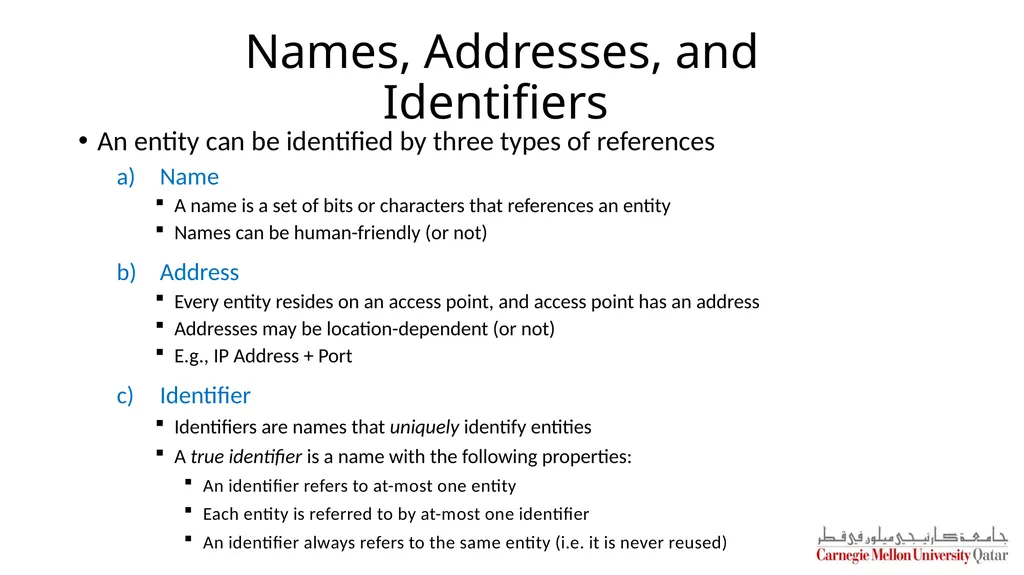
An entity can be identified by three types of references
Name
A name is a set of bits or characters that references an entity
Names can be human-friendly (or not)
Address
Every entity resides on an access point, and access point has an address
Addresses may be location-dependent (or not)
E.g., IP Address + Port
Identifier
Identifiers are names that uniquely identify entities
A true identifier is a name with the following properties:
An identifier refers to at-most one entity
Each entity is referred to by at-most one identifier
An identifier always refers to the same entity (i.e. it is never reused) Names, Addresses, and Identifiers<br>
Name
A name is a set of bits or characters that references an entity
Names can be human-friendly (or not)
Address
Every entity resides on an access point, and access point has an address
Addresses may be location-dependent (or not)
E.g., IP Address + Port
Identifier
Identifiers are names that uniquely identify entities
A true identifier is a name with the following properties:
An identifier refers to at-most one entity
Each entity is referred to by at-most one identifier
An identifier always refers to the same entity (i.e. it is never reused) Names, Addresses, and Identifiers<br>
05
Naming Systems A naming system is simply a middleware that assists in name resolution
Naming systems can be classified into three classes, based on the type of names used:
Flat naming
Structured naming
Attribute-based naming<br>
Naming systems can be classified into three classes, based on the type of names used:
Flat naming
Structured naming
Attribute-based naming<br>
06
Classes of Naming Flat naming
Structured naming
Attribute-based naming<br>
Structured naming
Attribute-based naming<br>
07
Flat Naming In flat naming, identifiers are simply random bits of strings (known as unstructured or flat names)
A flat name does not contain any information on how to locate an entity
We will study four types of name resolution mechanisms for flat names:
Broadcasting
Forwarding pointers
Home-based approaches
Distributed Hash Tables (DHTs)<br>
A flat name does not contain any information on how to locate an entity
We will study four types of name resolution mechanisms for flat names:
Broadcasting
Forwarding pointers
Home-based approaches
Distributed Hash Tables (DHTs)<br>
08
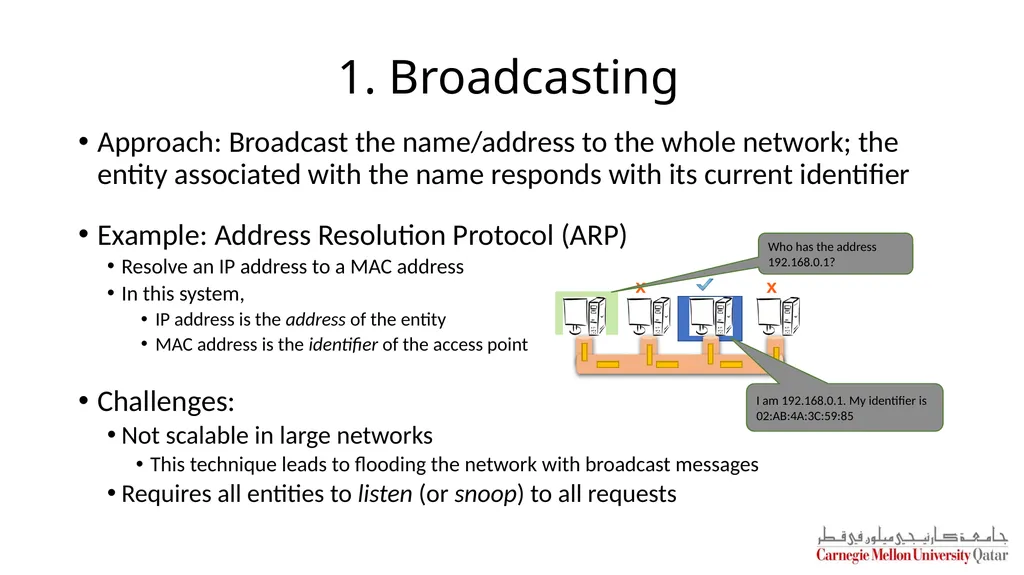
1. Broadcasting Approach: Broadcast the name/address to the whole network; the entity associated with the name responds with its current identifier
Example: Address Resolution Protocol (ARP)
Resolve an IP address to a MAC address
In this system,
IP address is the address of the entity
MAC address is the identifier of the access point
Challenges:
Not scalable in large networks
This technique leads to flooding the network with broadcast messages
Requires all entities to listen (or snoop) to all requests x x Who has the address 192.168.0.1? I am 192.168.0.1. My identifier is 02:AB:4A:3C:59:85<br>
Example: Address Resolution Protocol (ARP)
Resolve an IP address to a MAC address
In this system,
IP address is the address of the entity
MAC address is the identifier of the access point
Challenges:
Not scalable in large networks
This technique leads to flooding the network with broadcast messages
Requires all entities to listen (or snoop) to all requests x x Who has the address 192.168.0.1? I am 192.168.0.1. My identifier is 02:AB:4A:3C:59:85<br>
09
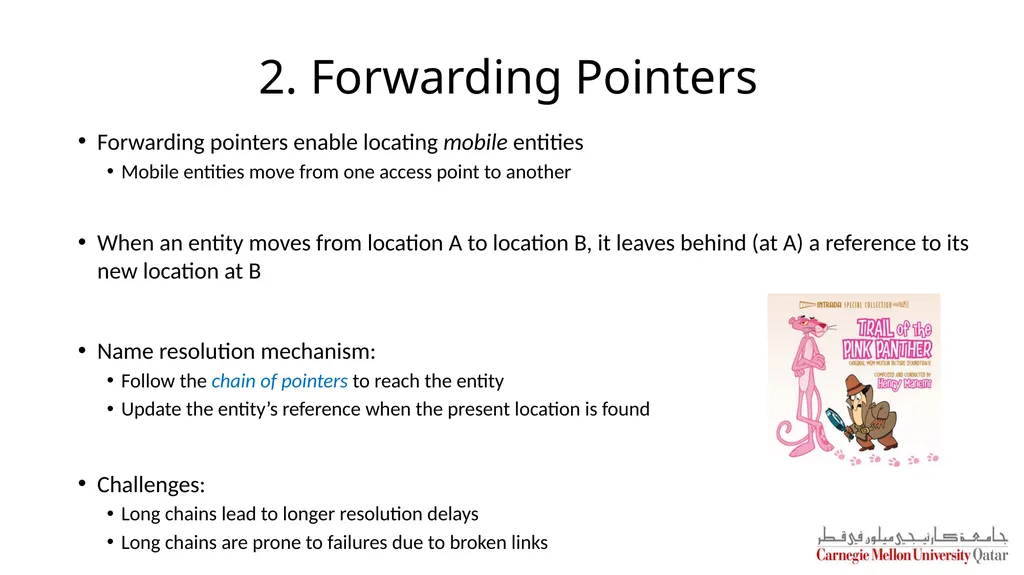
2. Forwarding Pointers Forwarding pointers enable locating mobile entities
Mobile entities move from one access point to another
When an entity moves from location A to location B, it leaves behind (at A) a reference to its new location at B
Name resolution mechanism:
Follow the chain of pointers to reach the entity
Update the entity’s reference when the present location is found
Challenges:
Long chains lead to longer resolution delays
Long chains are prone to failures due to broken links<br>
Mobile entities move from one access point to another
When an entity moves from location A to location B, it leaves behind (at A) a reference to its new location at B
Name resolution mechanism:
Follow the chain of pointers to reach the entity
Update the entity’s reference when the present location is found
Challenges:
Long chains lead to longer resolution delays
Long chains are prone to failures due to broken links<br>
10
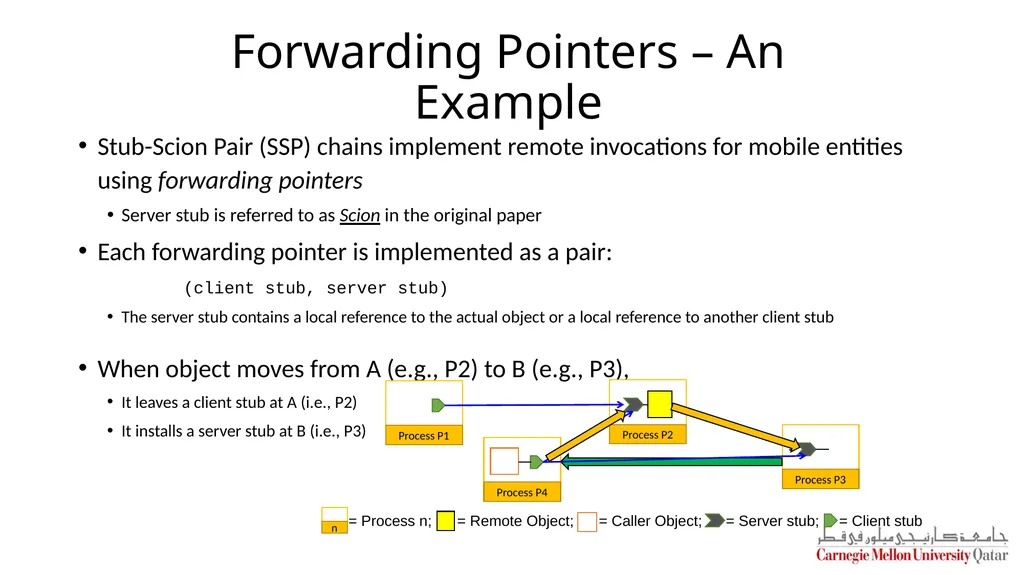
Stub-Scion Pair (SSP) chains implement remote invocations for mobile entities using forwarding pointers
Server stub is referred to as Scion in the original paper
Each forwarding pointer is implemented as a pair:
(client stub, server stub)
The server stub contains a local reference to the actual object or a local reference to another client stub
When object moves from A (e.g., P2) to B (e.g., P3),
It leaves a client stub at A (i.e., P2)
It installs a server stub at B (i.e., P3) Forwarding Pointers – An Example<br>
Server stub is referred to as Scion in the original paper
Each forwarding pointer is implemented as a pair:
(client stub, server stub)
The server stub contains a local reference to the actual object or a local reference to another client stub
When object moves from A (e.g., P2) to B (e.g., P3),
It leaves a client stub at A (i.e., P2)
It installs a server stub at B (i.e., P3) Forwarding Pointers – An Example<br>
11
3. Home-Based Approaches Each entity is assigned a home node
The home node is typically static (has fixed access point and address)
It keeps track of the current address of the entity
Entity-home interaction:
Entity’s home address is registered at a naming service
The entity updates the home about its current address (foreign address) whenever it moves
Name resolution:
Client contacts the home to obtain the foreign address
Client then contacts the entity at the foreign location<br>
The home node is typically static (has fixed access point and address)
It keeps track of the current address of the entity
Entity-home interaction:
Entity’s home address is registered at a naming service
The entity updates the home about its current address (foreign address) whenever it moves
Name resolution:
Client contacts the home to obtain the foreign address
Client then contacts the entity at the foreign location<br>
12
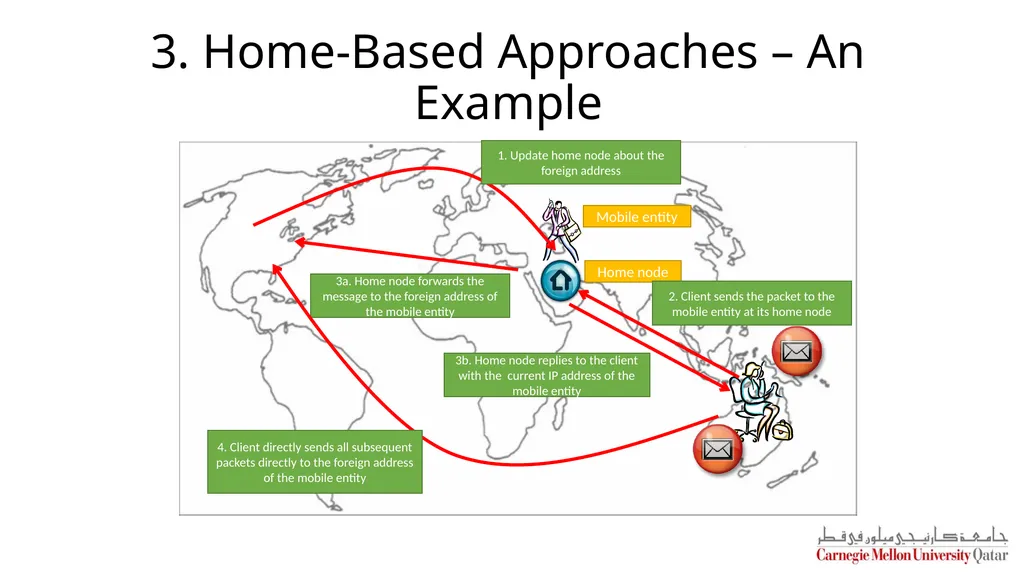
3. Home-Based Approaches – An Example Home node 1. Update home node about the foreign address 2. Client sends the packet to the mobile entity at its home node 3a. Home node forwards the message to the foreign address of the mobile entity 3b. Home node replies to the client with the current IP address of the mobile entity 4. Client directly sends all subsequent packets directly to the foreign address of the mobile entity<br>
13
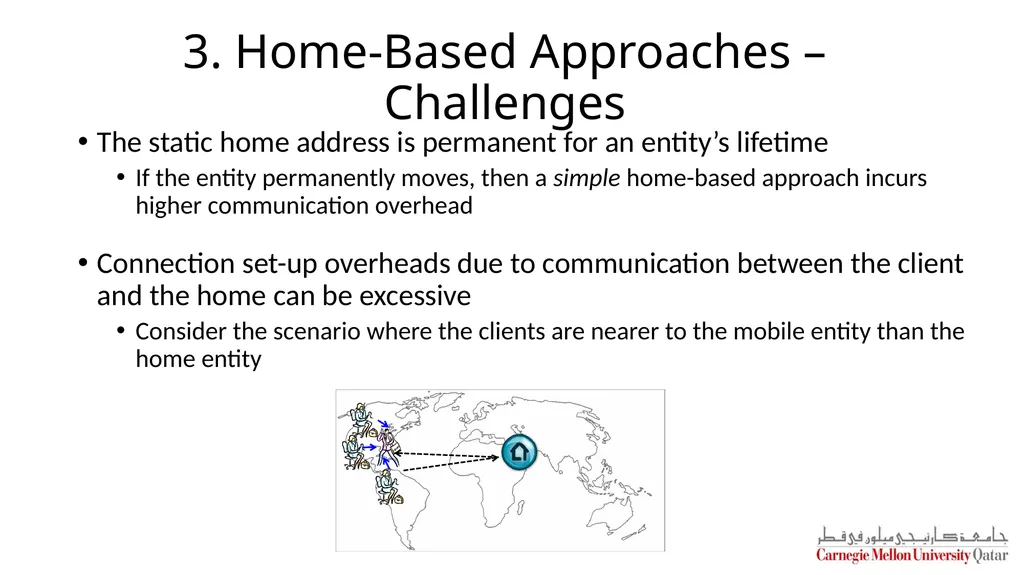
3. Home-Based Approaches – Challenges The static home address is permanent for an entity’s lifetime
If the entity permanently moves, then a simple home-based approach incurs higher communication overhead
Connection set-up overheads due to communication between the client and the home can be excessive
Consider the scenario where the clients are nearer to the mobile entity than the home entity<br>
If the entity permanently moves, then a simple home-based approach incurs higher communication overhead
Connection set-up overheads due to communication between the client and the home can be excessive
Consider the scenario where the clients are nearer to the mobile entity than the home entity<br>
14
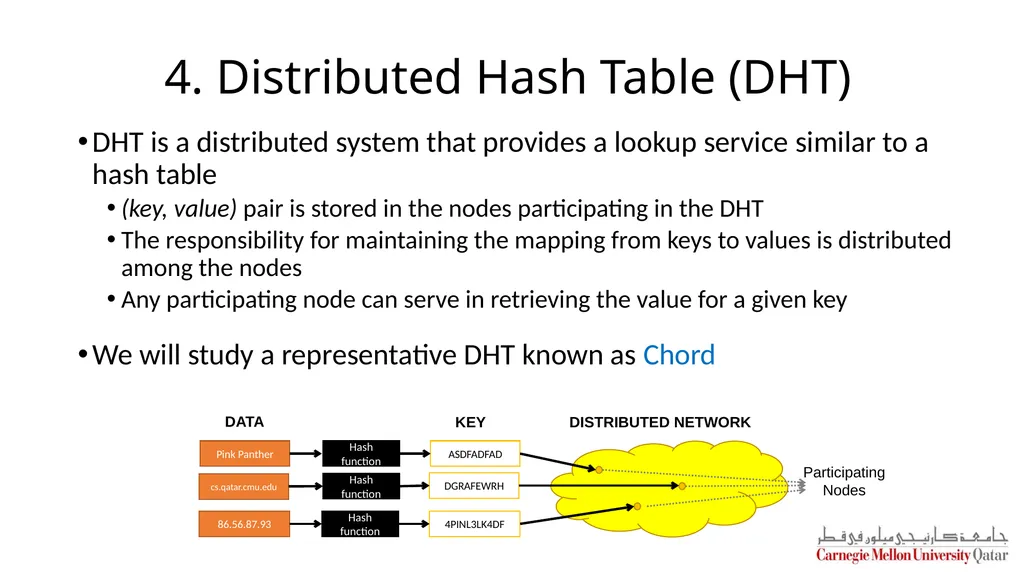
4. Distributed Hash Table (DHT) DHT is a distributed system that provides a lookup service similar to a hash table
(key, value) pair is stored in the nodes participating in the DHT
The responsibility for maintaining the mapping from keys to values is distributed among the nodes
Any participating node can serve in retrieving the value for a given key
We will study a representative DHT known as Chord Pink Panther cs.qatar.cmu.edu 86.56.87.93 Hash function Hash function Hash function ASDFADFAD DGRAFEWRH 4PINL3LK4DF DATA KEY DISTRIBUTED NETWORK Participating Nodes<br>
(key, value) pair is stored in the nodes participating in the DHT
The responsibility for maintaining the mapping from keys to values is distributed among the nodes
Any participating node can serve in retrieving the value for a given key
We will study a representative DHT known as Chord Pink Panther cs.qatar.cmu.edu 86.56.87.93 Hash function Hash function Hash function ASDFADFAD DGRAFEWRH 4PINL3LK4DF DATA KEY DISTRIBUTED NETWORK Participating Nodes<br>
15
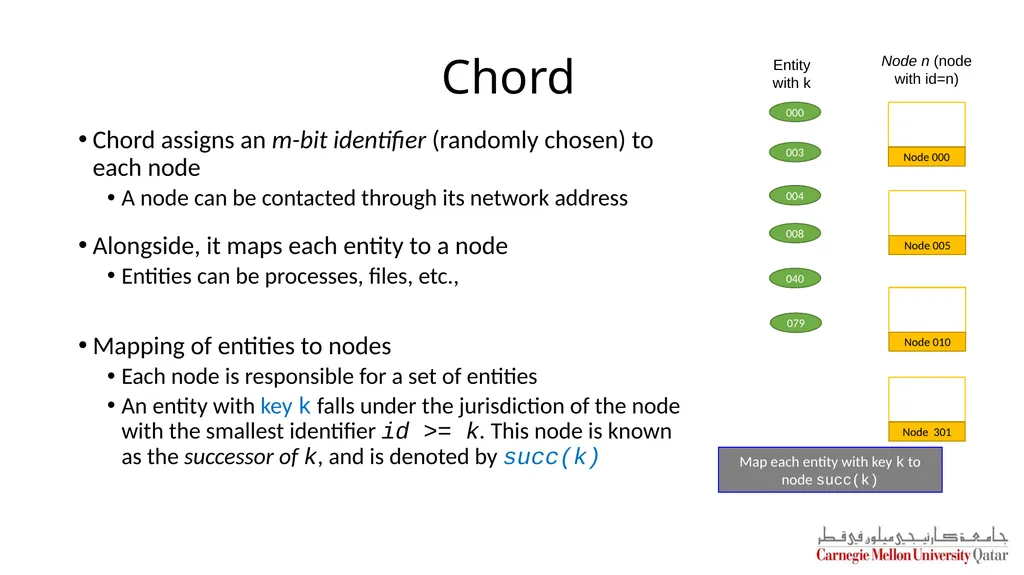
Chord Chord assigns an m-bit identifier (randomly chosen) to each node
A node can be contacted through its network address
Alongside, it maps each entity to a node
Entities can be processes, files, etc.,
Mapping of entities to nodes
Each node is responsible for a set of entities
An entity with key k falls under the jurisdiction of the node with the smallest identifier id >= k. This node is known as the successor of k, and is denoted by succ(k) 000 003 004 008 040 079 Entity with k Node n (node with id=n) Map each entity with key k to node succ(k)<br>
A node can be contacted through its network address
Alongside, it maps each entity to a node
Entities can be processes, files, etc.,
Mapping of entities to nodes
Each node is responsible for a set of entities
An entity with key k falls under the jurisdiction of the node with the smallest identifier id >= k. This node is known as the successor of k, and is denoted by succ(k) 000 003 004 008 040 079 Entity with k Node n (node with id=n) Map each entity with key k to node succ(k)<br>
16
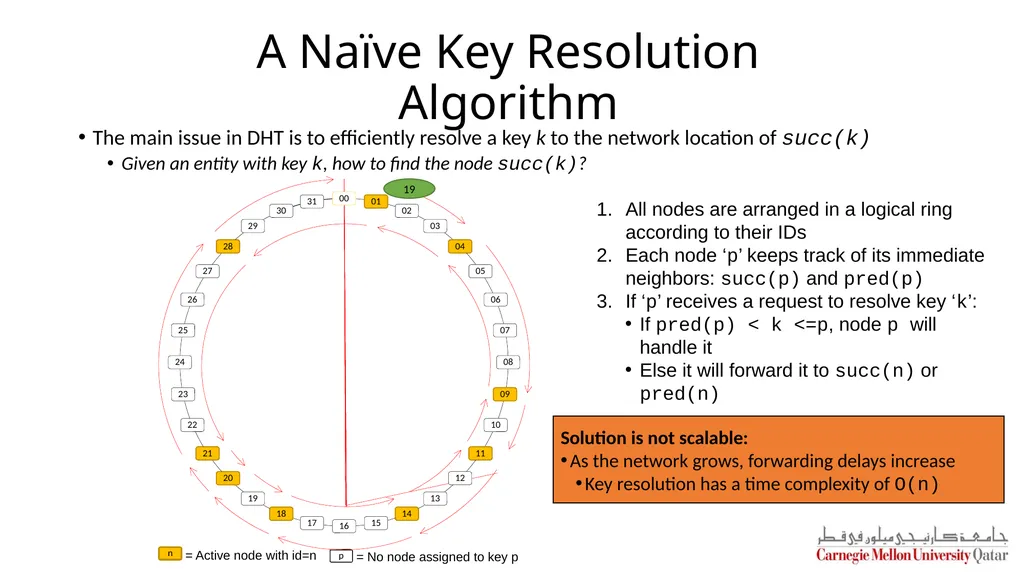
A Naïve Key Resolution Algorithm The main issue in DHT is to efficiently resolve a key k to the network location of succ(k)
Given an entity with key k, how to find the node succ(k)? All nodes are arranged in a logical ring according to their IDs
Each node ‘p’ keeps track of its immediate neighbors: succ(p) and pred(p)
If ‘p’ receives a request to resolve key ‘k’:
If pred(p) < k <=p, node p will handle it
Else it will forward it to succ(n) or pred(n) = Active node with id=n = No node assigned to key p 19 Solution is not scalable:
As the network grows, forwarding delays increase
Key resolution has a time complexity of O(n)<br>
Given an entity with key k, how to find the node succ(k)? All nodes are arranged in a logical ring according to their IDs
Each node ‘p’ keeps track of its immediate neighbors: succ(p) and pred(p)
If ‘p’ receives a request to resolve key ‘k’:
If pred(p) < k <=p, node p will handle it
Else it will forward it to succ(n) or pred(n) = Active node with id=n = No node assigned to key p 19 Solution is not scalable:
As the network grows, forwarding delays increase
Key resolution has a time complexity of O(n)<br>
17
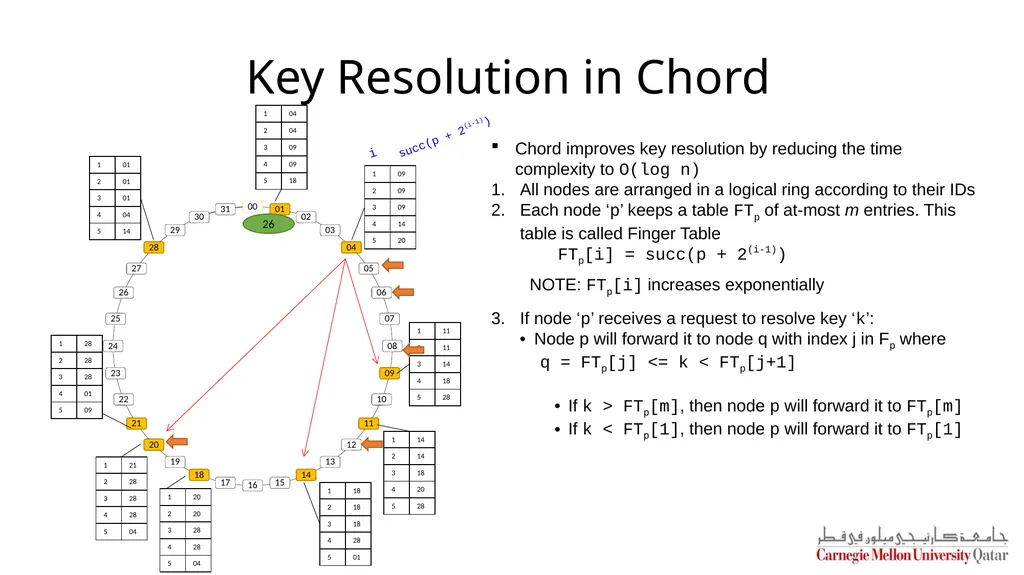
Key Resolution in Chord Chord improves key resolution by reducing the time complexity to O(log n)
All nodes are arranged in a logical ring according to their IDs
Each node ‘p’ keeps a table FTp of at-most m entries. This table is called Finger Table
FTp[i] = succ(p + 2(i-1))
NOTE: FTp[i] increases exponentially
If node ‘p’ receives a request to resolve key ‘k’:
Node p will forward it to node q with index j in Fp where
q = FTp[j] <= k < FTp[j+1]
If k > FTp[m], then node p will forward it to FTp[m]
If k < FTp[1], then node p will forward it to FTp[1] i succ(p + 2(i-1)) 26<br>
All nodes are arranged in a logical ring according to their IDs
Each node ‘p’ keeps a table FTp of at-most m entries. This table is called Finger Table
FTp[i] = succ(p + 2(i-1))
NOTE: FTp[i] increases exponentially
If node ‘p’ receives a request to resolve key ‘k’:
Node p will forward it to node q with index j in Fp where
q = FTp[j] <= k < FTp[j+1]
If k > FTp[m], then node p will forward it to FTp[m]
If k < FTp[1], then node p will forward it to FTp[1] i succ(p + 2(i-1)) 26<br>
18
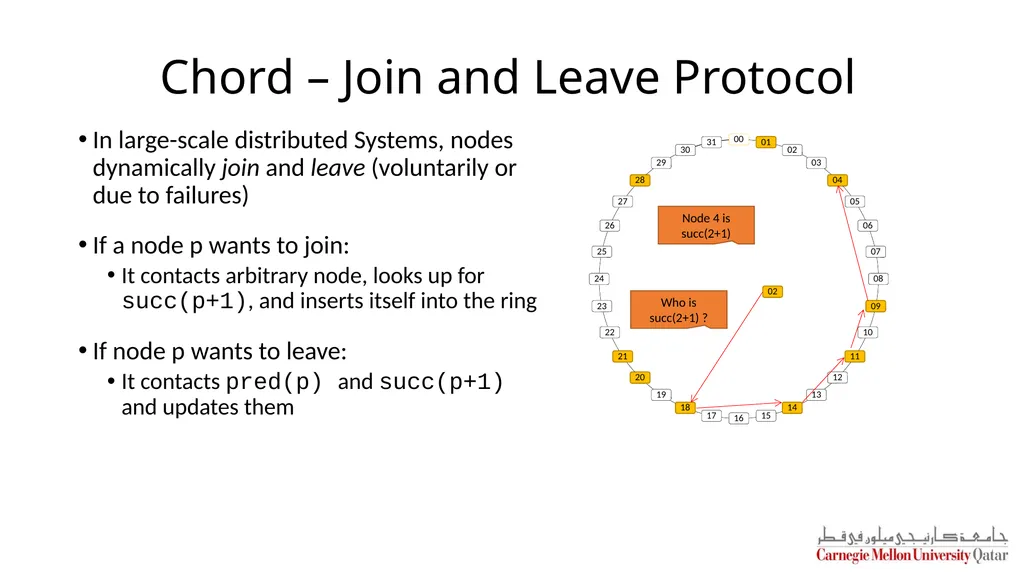
Chord – Join and Leave Protocol In large-scale distributed Systems, nodes dynamically join and leave (voluntarily or due to failures)
If a node p wants to join:
It contacts arbitrary node, looks up for succ(p+1), and inserts itself into the ring
If node p wants to leave:
It contacts pred(p) and succ(p+1) and updates them Who is succ(2+1) ? Node 4 is succ(2+1)<br>
If a node p wants to join:
It contacts arbitrary node, looks up for succ(p+1), and inserts itself into the ring
If node p wants to leave:
It contacts pred(p) and succ(p+1) and updates them Who is succ(2+1) ? Node 4 is succ(2+1)<br>
19
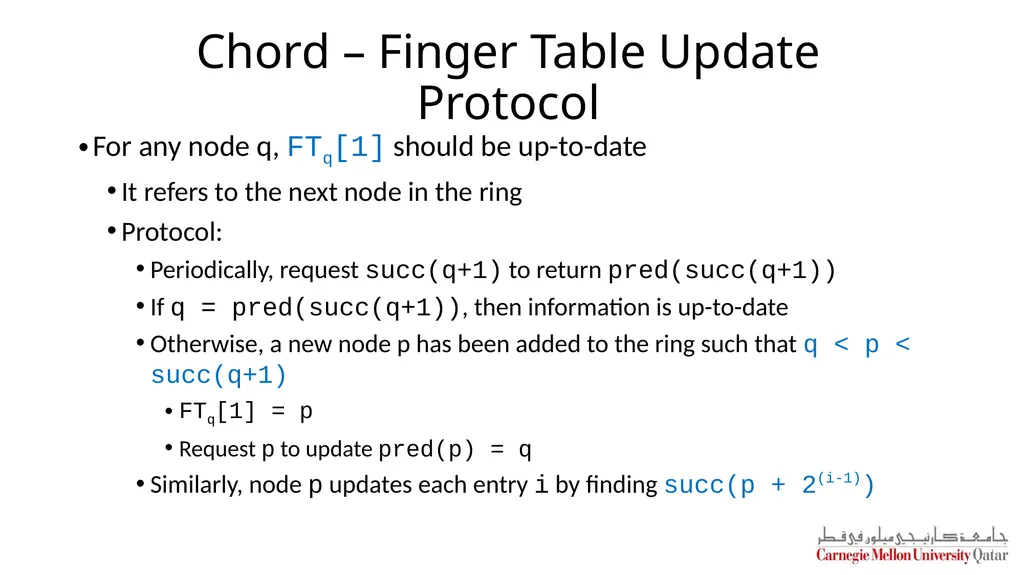
Chord – Finger Table Update Protocol For any node q, FTq[1] should be up-to-date
It refers to the next node in the ring
Protocol:
Periodically, request succ(q+1) to return pred(succ(q+1))
If q = pred(succ(q+1)), then information is up-to-date
Otherwise, a new node p has been added to the ring such that q < p < succ(q+1)
FTq[1] = p
Request p to update pred(p) = q
Similarly, node p updates each entry i by finding succ(p + 2(i-1))<br>
It refers to the next node in the ring
Protocol:
Periodically, request succ(q+1) to return pred(succ(q+1))
If q = pred(succ(q+1)), then information is up-to-date
Otherwise, a new node p has been added to the ring such that q < p < succ(q+1)
FTq[1] = p
Request p to update pred(p) = q
Similarly, node p updates each entry i by finding succ(p + 2(i-1))<br>
20
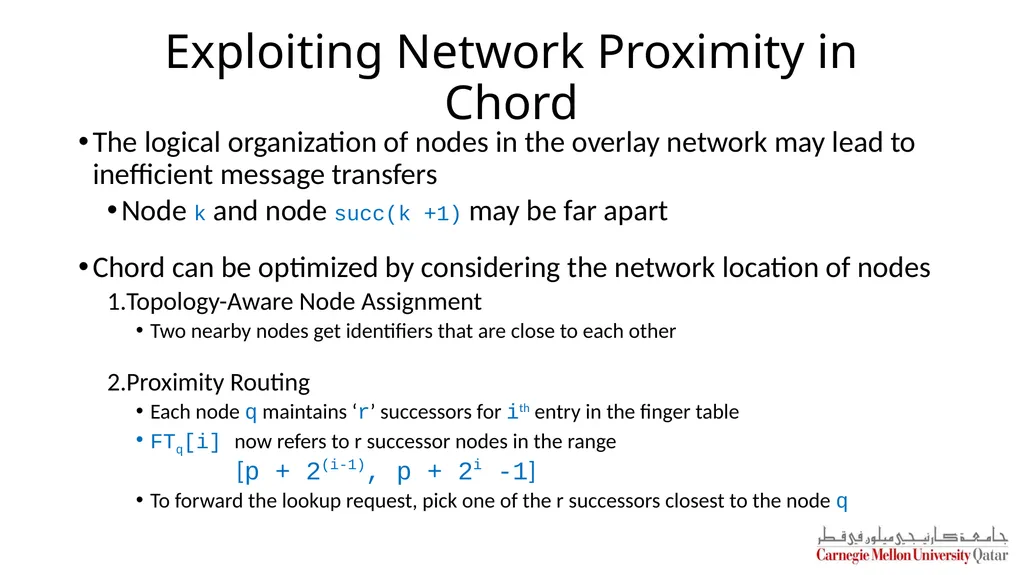
Exploiting Network Proximity in Chord The logical organization of nodes in the overlay network may lead to inefficient message transfers
Node k and node succ(k +1) may be far apart
Chord can be optimized by considering the network location of nodes
Topology-Aware Node Assignment
Two nearby nodes get identifiers that are close to each other
Proximity Routing
Each node q maintains ‘r’ successors for ith entry in the finger table
FTq[i] now refers to r successor nodes in the range
[p + 2(i-1), p + 2i -1]
To forward the lookup request, pick one of the r successors closest to the node q<br>
Node k and node succ(k +1) may be far apart
Chord can be optimized by considering the network location of nodes
Topology-Aware Node Assignment
Two nearby nodes get identifiers that are close to each other
Proximity Routing
Each node q maintains ‘r’ successors for ith entry in the finger table
FTq[i] now refers to r successor nodes in the range
[p + 2(i-1), p + 2i -1]
To forward the lookup request, pick one of the r successors closest to the node q<br>
21
Next Class Structured and attribute-based namings<br>