
Diversity and Inclusion in Historical
PT
Published · 32 slides · 0 views

1 / 1




Description
Diversity and Inclusion in Historical Documentation of Multicultural Architecture Education in the US in a Time of Pandemic Meral Ekincioglu, Ph.D. meralekincioglu.com Visiting Scholar, Massachusetts Institute of Technology, History,
Related Topics
Share
Embed code
Download this presentation From Below
"Diversity and Inclusion in Historical" is the property of its rightful owner. Permission is granted to download and print the materials on this website for personal, non-commercial use only, and to display it on your personal computer provided you do not modify the materials and that you retain all copyright notices contained in the materials. By downloading content from our website, you accept the terms of this agreement.
Presentation Transcript
01
Diversity and Inclusion in Historical Documentation of
Multicultural Architecture Education in the US in a Time of Pandemic
Meral Ekincioglu, Ph.D.
meralekincioglu.com
• Visiting Scholar,
Massachusetts Institute of Technology, History, Theory and Criticism of Architecture
• Research Scholar,
Columbia University, Graduate School of Architecture, Planning and Preservation, Ph.D. Program
• Special Turkish Fellow,
Harvard University, History of Art and Architecture, Ph.D. Program
• Society of American Archivists, member (2019-2020)<br>
02
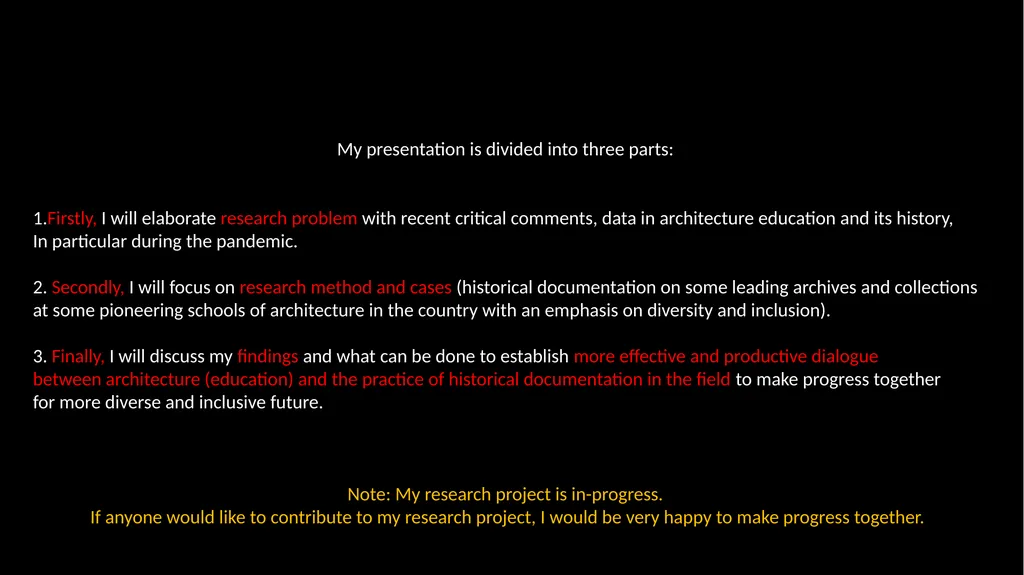
My presentation is divided into three parts:
1.Firstly, I will elaborate research problem with recent critical comments, data in architecture education and its history,
In particular during the pandemic.
2. Secondly, I will focus on research method and cases (historical documentation on some leading archives and collections
at some pioneering schools of architecture in the country with an emphasis on diversity and inclusion).
3. Finally, I will discuss my findings and what can be done to establish more effective and productive dialogue
between architecture (education) and the practice of historical documentation in the field to make progress together
for more diverse and inclusive future.
Note: My research project is in-progress.
If anyone would like to contribute to my research project, I would be very happy to make progress together.<br>
03
1.Research Problem
Although the global pandemic crisis has clearly exposed deep-seated gender, race, ethnicity-based inequalities
in architecture education in the US, and the roots of inequalities are interlinked with how collective memory and historical documentation practice, its methods (and politics) have been constructed so far, there is still a big gap in contents and scopes of archives and collections on these subjects in the field.<br>
04
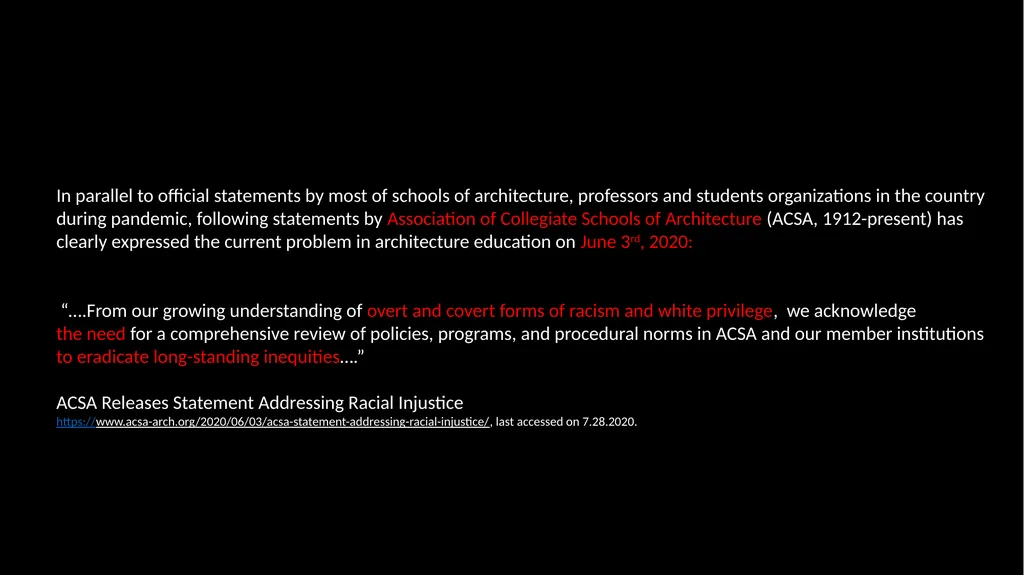
In parallel to official statements by most of schools of architecture, professors and students organizations in the country
during pandemic, following statements by Association of Collegiate Schools of Architecture (ACSA, 1912-present) has
clearly expressed the current problem in architecture education on June 3rd, 2020:
“….From our growing understanding of overt and covert forms of racism and white privilege, we acknowledge
the need for a comprehensive review of policies, programs, and procedural norms in ACSA and our member institutions
to eradicate long-standing inequities….”
ACSA Releases Statement Addressing Racial Injustice
https://www.acsa-arch.org/2020/06/03/acsa-statement-addressing-racial-injustice/, last accessed on 7.28.2020.<br>
05
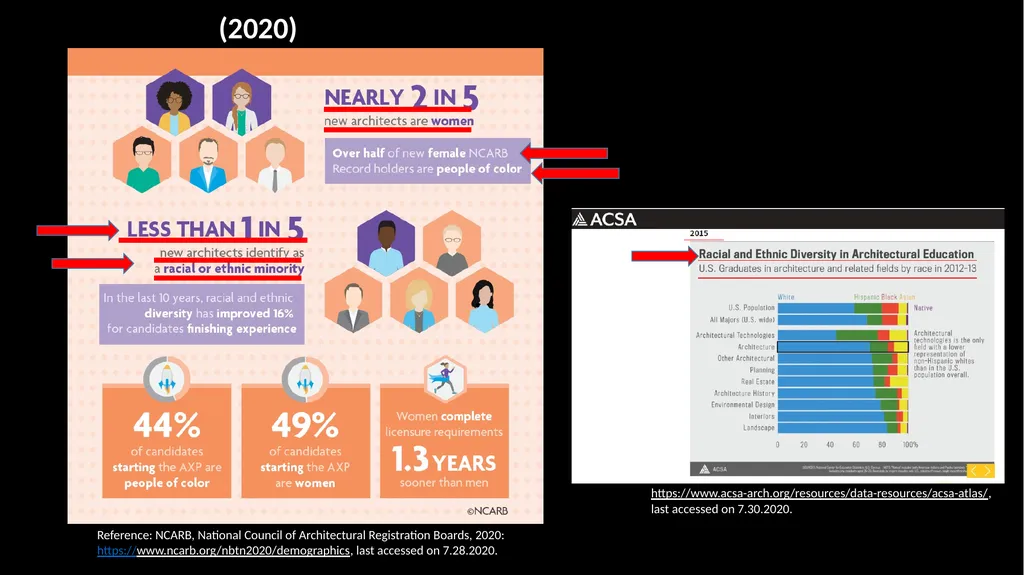
Reference: NCARB, National Council of Architectural Registration Boards, 2020:
https://www.ncarb.org/nbtn2020/demographics, last accessed on 7.28.2020. (2020) https://www.acsa-arch.org/resources/data-resources/acsa-atlas/,
last accessed on 7.30.2020.<br>
https://www.ncarb.org/nbtn2020/demographics, last accessed on 7.28.2020. (2020) https://www.acsa-arch.org/resources/data-resources/acsa-atlas/,
last accessed on 7.30.2020.<br>
06
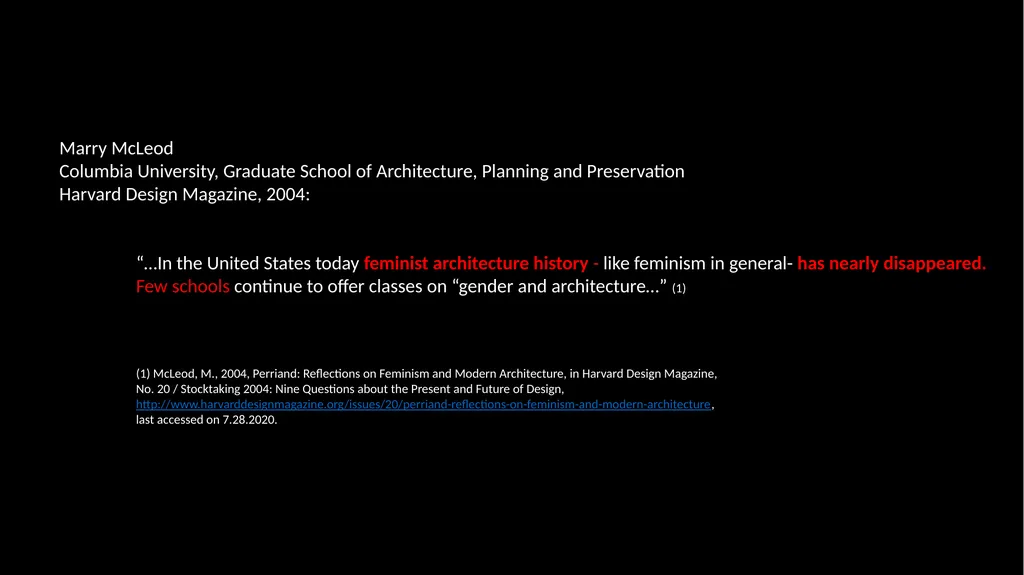
Marry McLeod
Columbia University, Graduate School of Architecture, Planning and Preservation
Harvard Design Magazine, 2004:
“…In the United States today feminist architecture history - like feminism in general- has nearly disappeared.
Few schools continue to offer classes on “gender and architecture…” (1)
(1) McLeod, M., 2004, Perriand: Reflections on Feminism and Modern Architecture, in Harvard Design Magazine,
No. 20 / Stocktaking 2004: Nine Questions about the Present and Future of Design,
http://www.harvarddesignmagazine.org/issues/20/perriand-reflections-on-feminism-and-modern-architecture,
last accessed on 7.28.2020.<br>
07
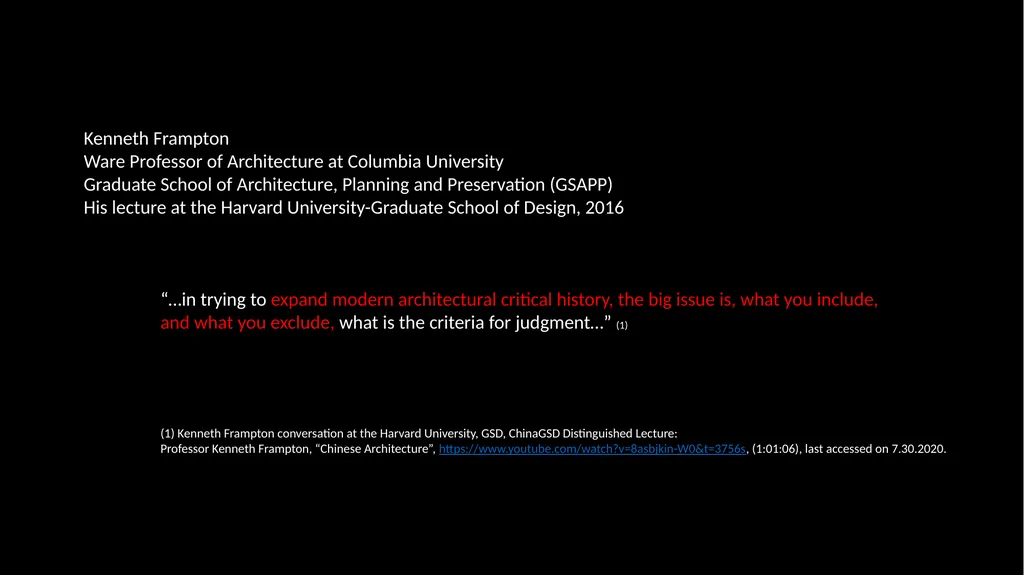
Kenneth Frampton
Ware Professor of Architecture at Columbia University
Graduate School of Architecture, Planning and Preservation (GSAPP)
His lecture at the Harvard University-Graduate School of Design, 2016
“…in trying to expand modern architectural critical history, the big issue is, what you include,
and what you exclude, what is the criteria for judgment…” (1)
(1) Kenneth Frampton conversation at the Harvard University, GSD, ChinaGSD Distinguished Lecture:
Professor Kenneth Frampton, “Chinese Architecture”, https://www.youtube.com/watch?v=8asbjkin-W0&t=3756s, (1:01:06), last accessed on 7.30.2020.<br>
08
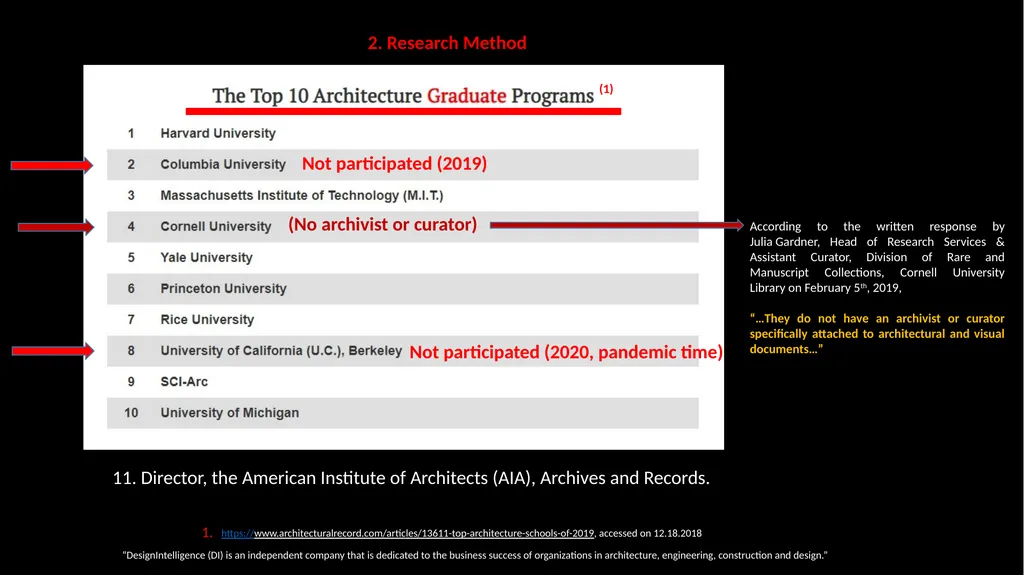
https://www.architecturalrecord.com/articles/13611-top-architecture-schools-of-2019, accessed on 12.18.2018 “DesignIntelligence (DI) is an independent company that is dedicated to the business success of organizations in architecture, engineering, construction and design.” 2. Research Method Not participated (2019) Not participated (2020, pandemic time) According to the written response by Julia Gardner, Head of Research Services & Assistant Curator, Division of Rare and Manuscript Collections, Cornell University Library on February 5th, 2019,
“…They do not have an archivist or curator specifically attached to architectural and visual documents…” (No archivist or curator) 11. Director, the American Institute of Architects (AIA), Archives and Records. (1) 1.<br>
“…They do not have an archivist or curator specifically attached to architectural and visual documents…” (No archivist or curator) 11. Director, the American Institute of Architects (AIA), Archives and Records. (1) 1.<br>
09
1. -“Harvard is the oldest institution of higher education in the United States, established in 1636 by vote of the Great and General Court of the Massachusetts Bay Colony”, https://www.harvard.edu/about-harvard/harvard-glance/history, last accessed on 7.28.2020.
2. -“…Roots of Harvard-GSD go back to 1874, when Professor Charles Eliot Norton admitted architecture history into his College fine arts courses…” (Reference: Bethell, J., T.; Hunt, R. M., Shenton, R., 2004, Harvard A to Z, Harvard University Press, Cambridge, MA, US, p. 175.) Harvard University (1)
Graduate School of Design (GSD) (2)<br>
10
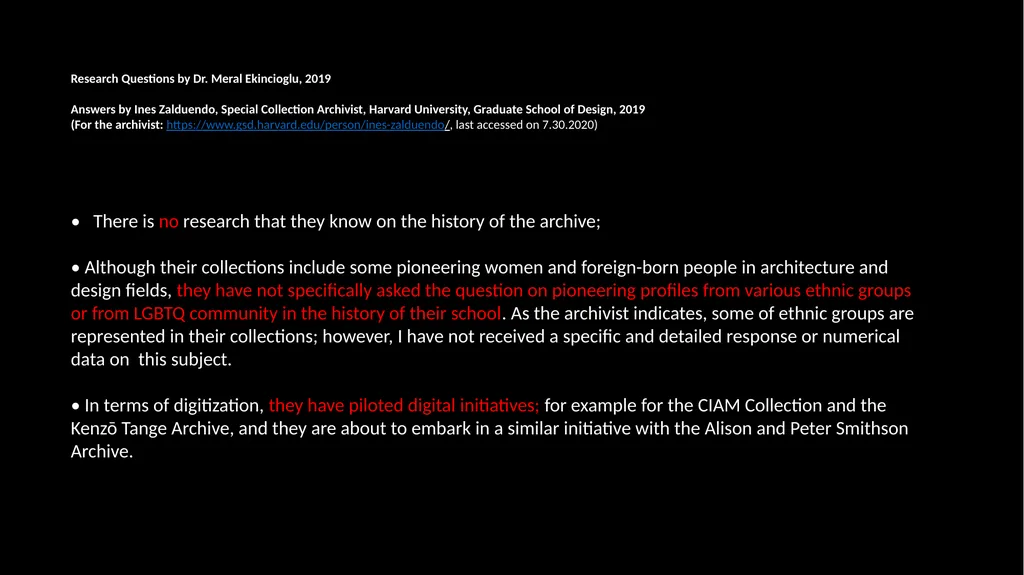
Research Questions by Dr. Meral Ekincioglu, 2019
Answers by Ines Zalduendo, Special Collection Archivist, Harvard University, Graduate School of Design, 2019
(For the archivist: https://www.gsd.harvard.edu/person/ines-zalduendo/, last accessed on 7.30.2020)
• There is no research that they know on the history of the archive;
• Although their collections include some pioneering women and foreign-born people in architecture and design fields, they have not specifically asked the question on pioneering profiles from various ethnic groups or from LGBTQ community in the history of their school. As the archivist indicates, some of ethnic groups are represented in their collections; however, I have not received a specific and detailed response or numerical data on this subject.
• In terms of digitization, they have piloted digital initiatives; for example for the CIAM Collection and the Kenzō Tange Archive, and they are about to embark in a similar initiative with the Alison and Peter Smithson Archive.<br>
11
1.History of MIT goes back to 1861, http://www.mit.edu/about/, last accessed on 7.30.2020.
2. “…The Massachusetts Institute of Technology’s first professor of architecture was William R. Ware, appointed in the fall of 1865 when MIT first opened…The course in architecture opened in October 1868... In 1932 the School of Architecture was established as part of the general academic reorganization of the Institute proposed by President Karl T. Compton….”, https://libraries.mit.edu/mithistory/research/schools-and-departments/school-of-architecture-and-planning/department-of-architecture/, last accessed on 7.28.2020.
MIT has been named the top university in the world for “Architecture/Built Environment” in the subject rankings from QS World University Rankings for 2020, https://architecture.mit.edu/news/mit-named-no-1-university-worldwide-architecturebuilt-environment-no-5-artdesign, last accessed on 7.28.2020. Massachusetts Institute of Technology (1)
Architecture and Design Collections at the MIT-Museum (2)<br>
12
Research questions by Dr. Meral Ekincioglu, e-mail, April, 2019
Answers by Gary Van Zante, Curator, architecture and design at the MIT Museum, May, 2019
(For the curator, https://officesdirectory.mit.edu/mit-museum, last accessed on 7.30.2020).
• There is no (scholarly) research on the history of architecture collections at MIT. However, he has been intending
to publish one, but not soon.
• There is no mission statement in effect for the collection to uncover, support and promote “diversity, equity and
inclusion” related to “a. underrepresented and/or b. immigrant architectural profiles, and communities” in the history
of MIT-Architecture.
• They have an extensive digitization project underway and only a few weeks ago introduced a collections portal online.<br>
13
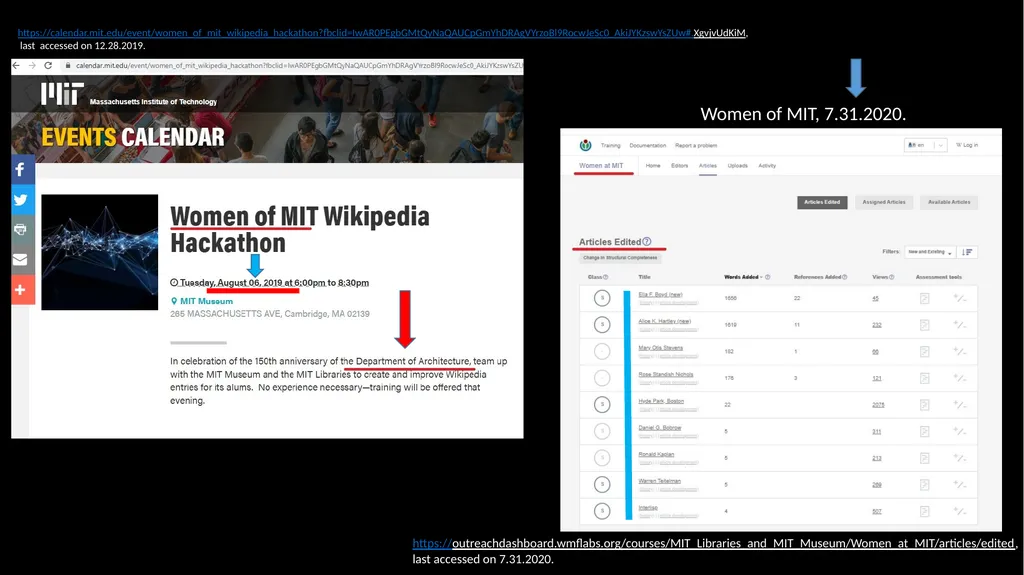
Ref: https://mitmuseum.mit.edu/calendar/women-mit-wikipedia-hackathon, accessed on 9.2.2019<br>
14
https://calendar.mit.edu/event/women_of_mit_wikipedia_hackathon?fbclid=IwAR0PEgbGMtQyNaQAUCpGmYhDRAgVYrzoBl9RocwJeSc0_AkiJYKzswYsZUw#.XgvjvUdKiM,
last accessed on 12.28.2019. https://outreachdashboard.wmflabs.org/courses/MIT_Libraries_and_MIT_Museum/Women_at_MIT/articles/edited, last accessed on 7.31.2020. Women of MIT, 7.31.2020.<br>
last accessed on 12.28.2019. https://outreachdashboard.wmflabs.org/courses/MIT_Libraries_and_MIT_Museum/Women_at_MIT/articles/edited, last accessed on 7.31.2020. Women of MIT, 7.31.2020.<br>
15
Cornell University (1)
College of Architecture, Art and Planning (2)
For Cornell University, according to written response by Julia Gardner, (Head of Research Services & Assistant Curator, Division of Rare and Manuscript Collections, Cornell University Library) on Feb. 5, 2019, they do not have an archivist or curator specifically attached to architectural and visual documents.
(1) Cornell University was established in 1865, https://www.cornell.edu/about/, last accessed on 7.30.2020.
(2) “….In 1871 Andrew Dickson White, the first president of Cornell University, exhorted the Board of Trustees to establish a new program to provide formal academic training in architecture….Providing the first four-year course in architecture in an American university, the college presented an alternative to apprenticeship programs or to study in Europe. The new architecture program was immediately popular, registering 32 students by 1876 and enrolling its first international student in 1879. A year later, Margaret Hicks (A.B. 1878, B.Arch. 1880) became the first woman to graduate from an architecture course at an American university. In the 1920s, Cornell became the first architecture school to extend its curriculum to five years. By 1896, the College of Architecture also offered classes in drawing, painting, and sculpture, and a Department of Art was formally added in 1921. The City and Regional Planning (CRP) program began in 1935, becoming a separate department in 1952….In 1967, the College of Architecture, Art, and Planning (AAP) officially acquired its current name….”,
https://aap.cornell.edu/about/history, last accessed on 7.30.2020.<br>
16
(1) "...The university traces its roots to the 1640s... The school officially became Yale College in 1718...", https://www.cornell.edu/about, last accessed on 7.28.2020.
(2) “…The department of Architecture was established in the School of the Fine Arts in 1916. In 1959 the School of Art and Architecture, as it was then known, was made a fully graduate professional school. In 1972, Yale designated the School of Architecture as its own separate professional school…”., https://www.architecture.yale.edu/about-the-school/history-and-objectives, last accessed on 7.28.2020. Yale University (1)
School of Architecture (2)<br>
17
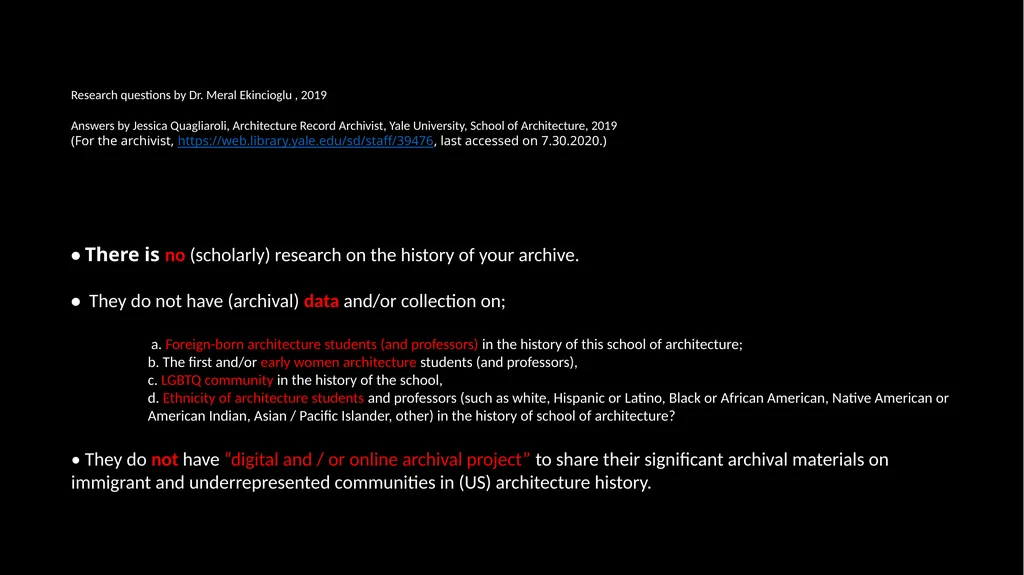
Research questions by Dr. Meral Ekincioglu , 2019
Answers by Jessica Quagliaroli, Architecture Record Archivist, Yale University, School of Architecture, 2019
(For the archivist, https://web.library.yale.edu/sd/staff/39476, last accessed on 7.30.2020.)
• There is no (scholarly) research on the history of your archive.
• They do not have (archival) data and/or collection on;
a. Foreign-born architecture students (and professors) in the history of this school of architecture;
b. The first and/or early women architecture students (and professors),
c. LGBTQ community in the history of the school,
d. Ethnicity of architecture students and professors (such as white, Hispanic or Latino, Black or African American, Native American or American Indian, Asian / Pacific Islander, other) in the history of school of architecture?
• They do not have “digital and / or online archival project” to share their significant archival materials on immigrant and underrepresented communities in (US) architecture history.<br>
18
“…Chartered in 1746, Princeton is the fourth-oldest college in the United States. The University has been led by 20 presidents, spanning colonial times to the 21st century….”, https://www.princeton.edu/meet-princeton/history, last accessed on 7.28.2020.
(2) “…The study of architecture at Princeton University began in 1832 with a course taught by Professor Joseph Henry, an amateur architect and scientist who later became the first secretary of the Smithsonian Institution in Washington, DC. The course, which covered the history of architecture including the classification of architecture, styles, and marbles, was the first humanities course taught at the College. Henry lectured on the subject until 1837, after which faculty members from various disciplines offered the course on a sporadic basis. The study of architecture continued informally throughout the latter part of the 1870s and into the 1880s. The formal study of architecture returned in 1882 when the Department of Art and Archaeology was founded and Professor Allan Marquand offered a course in the history of Christian architecture. A course on the elements of architecture and historical drawing was offered beginning in 1902, and professional design courses were added to the curriculum in 1915. In the same year a committee was formed to investigate the formation of a School of Architecture. Arrangements had been made to open a School of Architecture in the fall of 1917, but World War I delayed the official opening of the School until 1919…”. https://soa.princeton.edu/content/history-school#:~:text=The%20study%20of%20architecture%20at,Smithsonian%20Institution%20in%20Washington%2C%20DC., last accessed on 7.30.2020. Princeton University (1)
School of Architecture (“Old Boys School”) (2)<br>
19
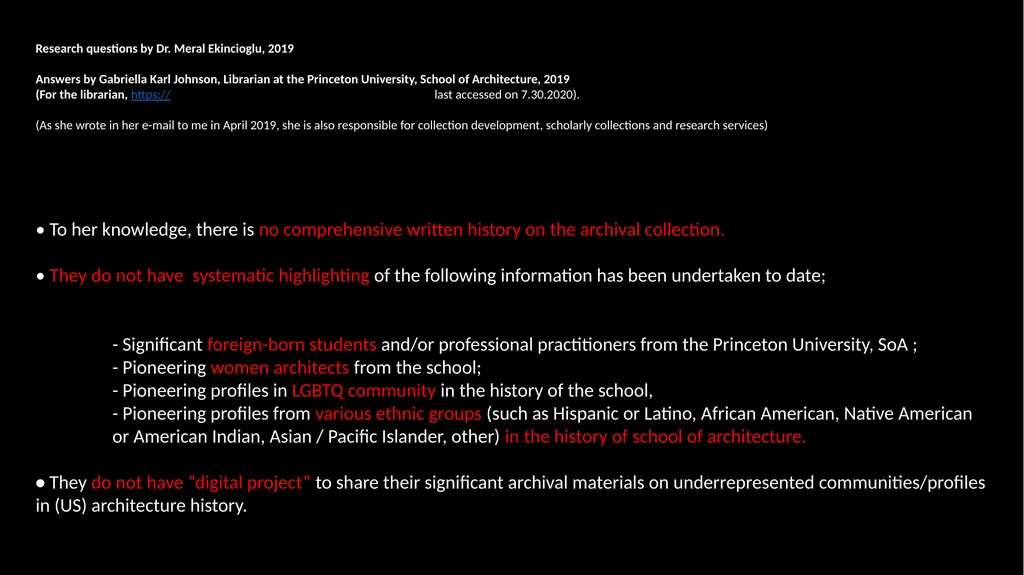
Research questions by Dr. Meral Ekincioglu, 2019
Answers by Gabriella Karl Johnson, Librarian at the Princeton University, School of Architecture, 2019
(For the librarian, https://soa.princeton.edu/content/gabriella-karl-Johnson, last accessed on 7.30.2020).
(As she wrote in her e-mail to me in April 2019, she is also responsible for collection development, scholarly collections and research services)
• To her knowledge, there is no comprehensive written history on the archival collection.
• They do not have systematic highlighting of the following information has been undertaken to date;
- Significant foreign-born students and/or professional practitioners from the Princeton University, SoA ;
- Pioneering women architects from the school;
- Pioneering profiles in LGBTQ community in the history of the school,
- Pioneering profiles from various ethnic groups (such as Hispanic or Latino, African American, Native American
or American Indian, Asian / Pacific Islander, other) in the history of school of architecture.
• They do not have “digital project” to share their significant archival materials on underrepresented communities/profiles
in (US) architecture history.<br>
20
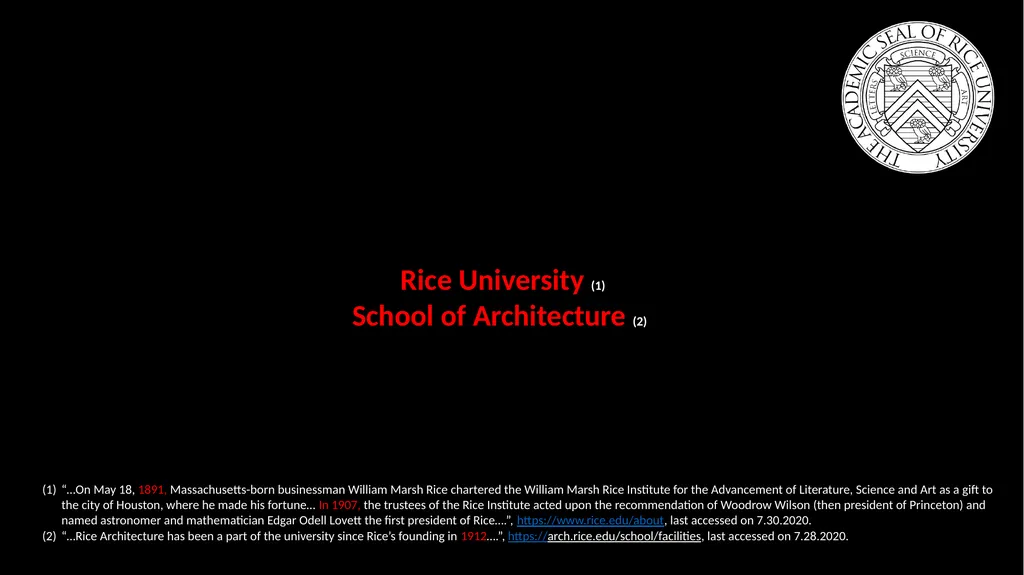
Rice University (1)
School of Architecture (2) “…On May 18, 1891, Massachusetts-born businessman William Marsh Rice chartered the William Marsh Rice Institute for the Advancement of Literature, Science and Art as a gift to the city of Houston, where he made his fortune… In 1907, the trustees of the Rice Institute acted upon the recommendation of Woodrow Wilson (then president of Princeton) and named astronomer and mathematician Edgar Odell Lovett the first president of Rice….”, https://www.rice.edu/about, last accessed on 7.30.2020.
“…Rice Architecture has been a part of the university since Rice’s founding in 1912….”, https://arch.rice.edu/school/facilities, last accessed on 7.28.2020.<br>
21
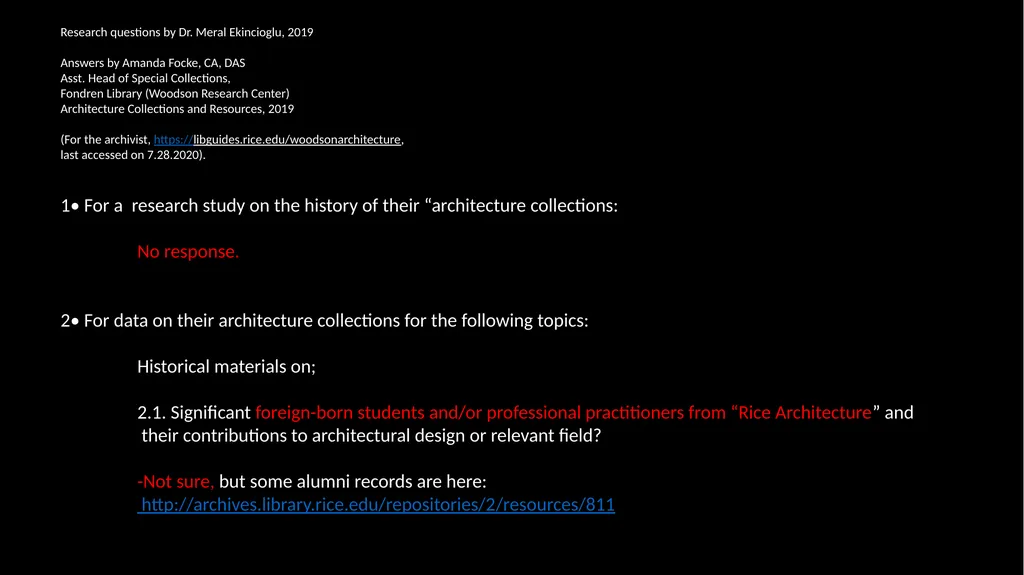
Research questions by Dr. Meral Ekincioglu, 2019
Answers by Amanda Focke, CA, DAS Asst. Head of Special Collections,
Fondren Library (Woodson Research Center)
Architecture Collections and Resources, 2019
(For the archivist, https://libguides.rice.edu/woodsonarchitecture,
last accessed on 7.28.2020).
1• For a research study on the history of their “architecture collections:
No response.
2• For data on their architecture collections for the following topics:
Historical materials on;
2.1. Significant foreign-born students and/or professional practitioners from “Rice Architecture” and
their contributions to architectural design or relevant field?
-Not sure, but some alumni records are here:
http://archives.library.rice.edu/repositories/2/resources/811<br>
22
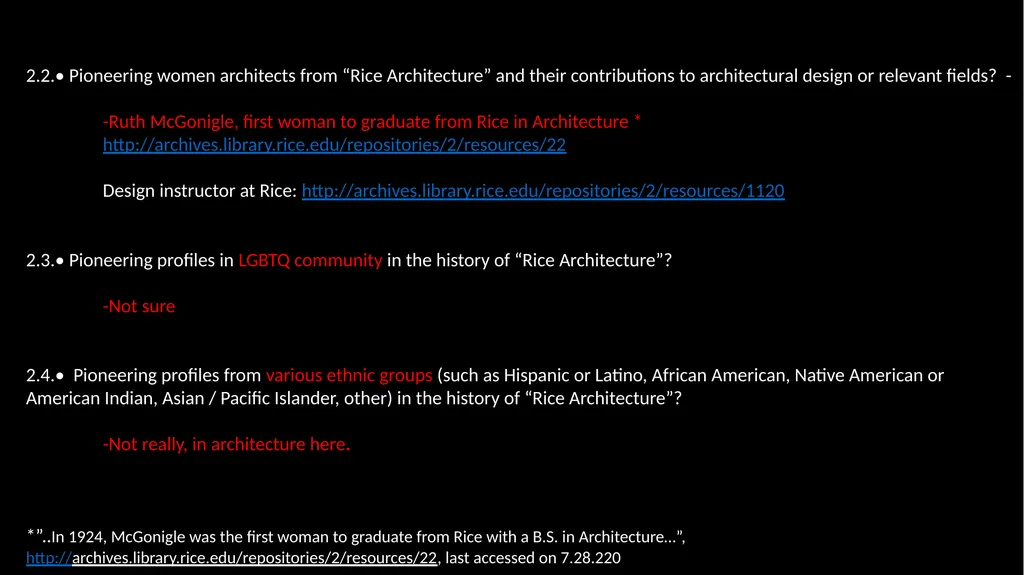
2.2.• Pioneering women architects from “Rice Architecture” and their contributions to architectural design or relevant fields? -
-Ruth McGonigle, first woman to graduate from Rice in Architecture *
http://archives.library.rice.edu/repositories/2/resources/22
Design instructor at Rice: http://archives.library.rice.edu/repositories/2/resources/1120
2.3.• Pioneering profiles in LGBTQ community in the history of “Rice Architecture”?
-Not sure
2.4.• Pioneering profiles from various ethnic groups (such as Hispanic or Latino, African American, Native American or
American Indian, Asian / Pacific Islander, other) in the history of “Rice Architecture”?
-Not really, in architecture here.
*”..In 1924, McGonigle was the first woman to graduate from Rice with a B.S. in Architecture…”,
http://archives.library.rice.edu/repositories/2/resources/22, last accessed on 7.28.220<br>
23
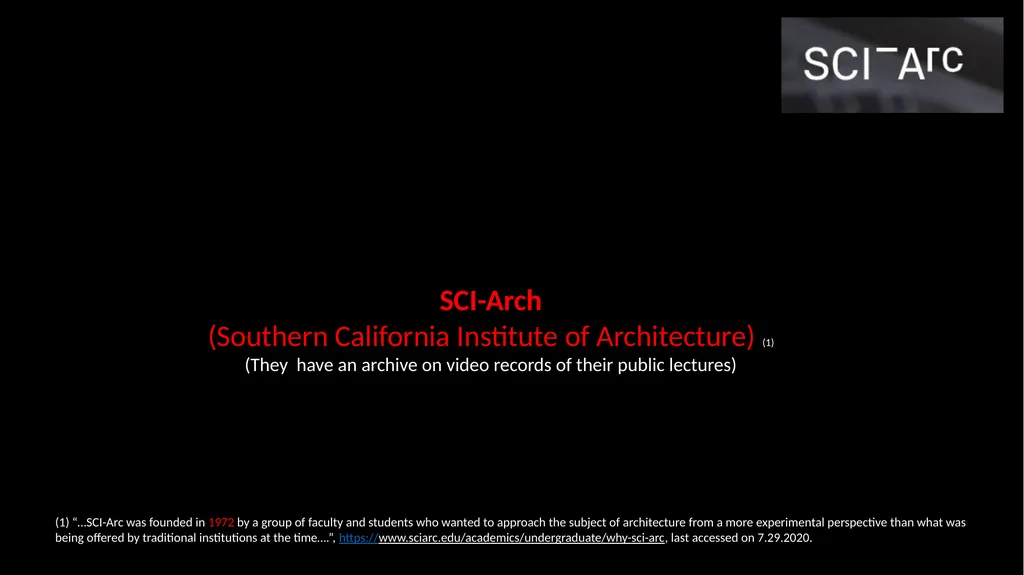
SCI-Arch
(Southern California Institute of Architecture) (1)
(They have an archive on video records of their public lectures) (1) “…SCI-Arc was founded in 1972 by a group of faculty and students who wanted to approach the subject of architecture from a more experimental perspective than what was being offered by traditional institutions at the time….”, https://www.sciarc.edu/academics/undergraduate/why-sci-arc, last accessed on 7.29.2020.<br>
24
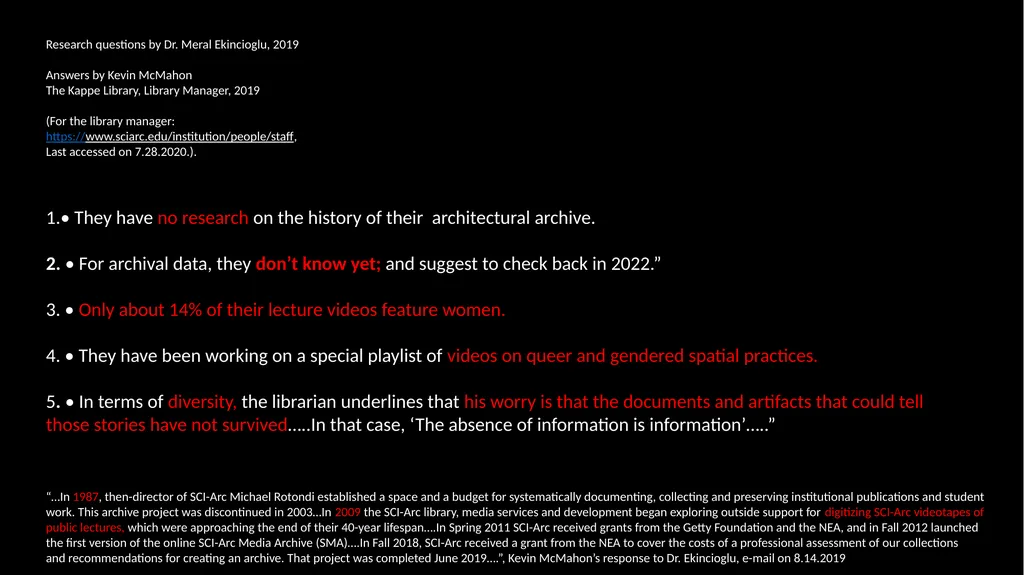
Research questions by Dr. Meral Ekincioglu, 2019
Answers by Kevin McMahon
The Kappe Library, Library Manager, 2019
(For the library manager:
https://www.sciarc.edu/institution/people/staff,
Last accessed on 7.28.2020.).
1.• They have no research on the history of their architectural archive.
2. • For archival data, they don’t know yet; and suggest to check back in 2022.”
3. • Only about 14% of their lecture videos feature women.
4. • They have been working on a special playlist of videos on queer and gendered spatial practices.
5. • In terms of diversity, the librarian underlines that his worry is that the documents and artifacts that could tell
those stories have not survived…..In that case, ‘The absence of information is information’…..”
“…In 1987, then-director of SCI-Arc Michael Rotondi established a space and a budget for systematically documenting, collecting and preserving institutional publications and student
work. This archive project was discontinued in 2003…In 2009 the SCI-Arc library, media services and development began exploring outside support for digitizing SCI-Arc videotapes of
public lectures, which were approaching the end of their 40-year lifespan….In Spring 2011 SCI-Arc received grants from the Getty Foundation and the NEA, and in Fall 2012 launched
the first version of the online SCI-Arc Media Archive (SMA)….In Fall 2018, SCI-Arc received a grant from the NEA to cover the costs of a professional assessment of our collections
and recommendations for creating an archive. That project was completed June 2019….”, Kevin McMahon’s response to Dr. Ekincioglu, e-mail on 8.14.2019<br>
25
University of Michigan (1)
A. Alfred Taubman College of Architecture and Urban Planning (2) “…The University of Michigan was established in Detroit on August 26, 1817…”,
https://wayback.archive-it.org/all/20131101064603/http://bicentennial.umich.edu/resources/u-ms-foundings-in-detroit-and-ann-arbor-key-dates/, last accessed on 7.28.2020.
(2)“1876: Courses in architecture are offered at the University of Michigan by William Le Baron Jenney. 1906: Architecture is recognized as a formal course of study when a program
is established in the Department of Engineering with Emil Lorch as chair. 1913: The University of Michigan grants the program departmental status and full control of its curriculum.
1923: Eliel Saarinen begins teaching architecture courses at UM. 1931: Architecture is established as a separate college with 370 students and 27 faculty members…”,
https://taubmancollege.umich.edu/about/history, last accessed on 7.28.2020.<br>
26
Research questions by Dr. Meral Ekincioglu, 2019
Answers by Rebecca Mary Price
Architecture, Urban Planning, and
Visual Resources Librarian and Liaison for Museum Studies
University of Michigan
Art, Architecture & Engineering Library, 2019
https://www.lib.umich.edu/users/rpw/,
last accessed on 7.28.2020.
1.• A book by Nancy Bartlett includes some coverage of the history of the collections.
Bartlett, N., 1995, More Than a Handsome Box: Education in Architecture at the University of Michigan 1876-1986,
Ann Arbor.
2. • They do not have data for their archival materials on
Significant foreign-born students and/or professional practitioners,
Pioneering women architects
Pioneering profiles in LGBTQ community
Pioneering profiles from various ethnic groups in the history of their school of architecture
3. • For “a digital project” to share their significant archival (or collection) materials on “women and underrepresented communities/profiles in the history of “University of Michigan-Architecture”:
No response.<br>
27
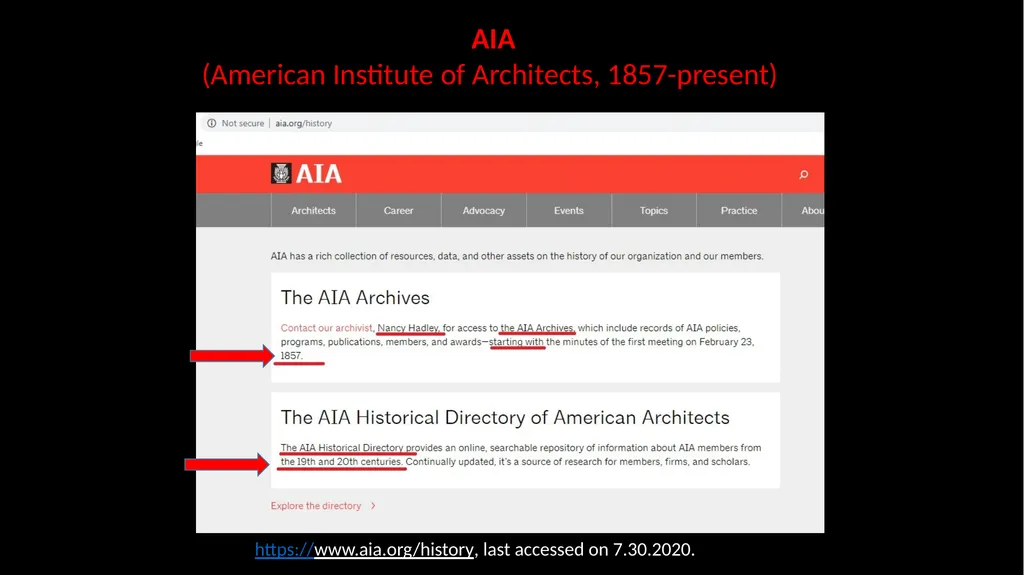
AIA
(American Institute of Architects, 1857-present) https://www.aia.org/history, last accessed on 7.30.2020.<br>
(American Institute of Architects, 1857-present) https://www.aia.org/history, last accessed on 7.30.2020.<br>
28
Since the 1980s, the AIA Archives have been supporting some exhibitions, research, project to make visible women
and underrepresented profiles, communities in architecture.
However, I could not received systematic or well-detailed information or data on their organizational records’ history
with emphasis on gender, race, ethnicity, etc. of their members.<br>
and underrepresented profiles, communities in architecture.
However, I could not received systematic or well-detailed information or data on their organizational records’ history
with emphasis on gender, race, ethnicity, etc. of their members.<br>
29
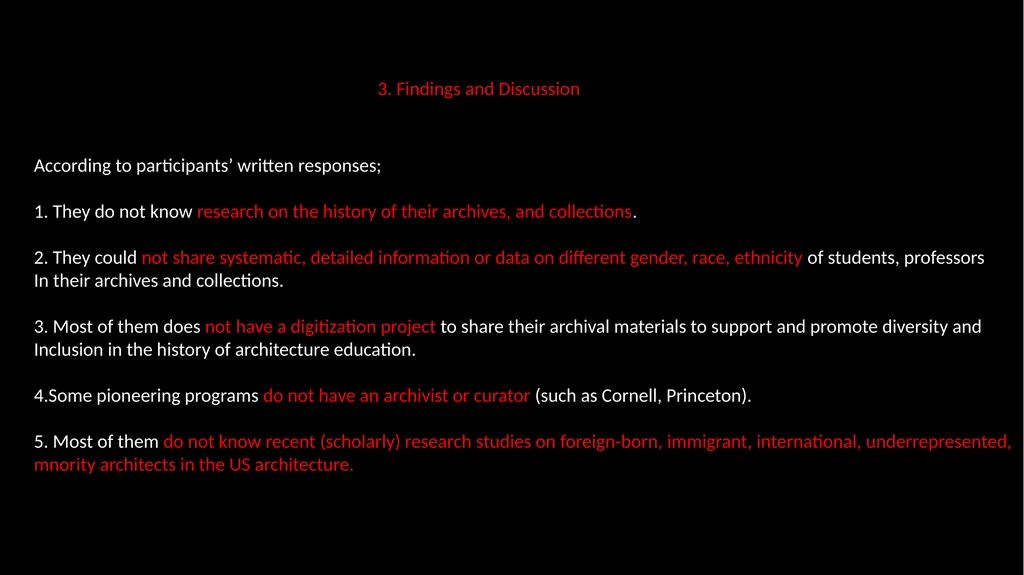
3. Findings and Discussion According to participants’ written responses;
1. They do not know research on the history of their archives, and collections.
2. They could not share systematic, detailed information or data on different gender, race, ethnicity of students, professors
In their archives and collections.
3. Most of them does not have a digitization project to share their archival materials to support and promote diversity and
Inclusion in the history of architecture education.
4.Some pioneering programs do not have an archivist or curator (such as Cornell, Princeton).
5. Most of them do not know recent (scholarly) research studies on foreign-born, immigrant, international, underrepresented,
mnority architects in the US architecture.<br>
30
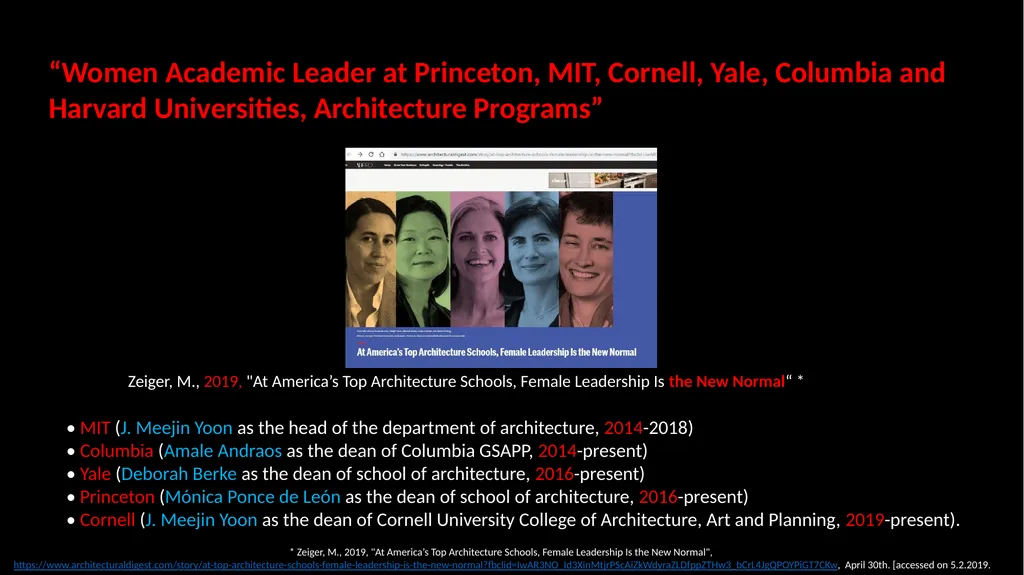
* Zeiger, M., 2019, "At America’s Top Architecture Schools, Female Leadership Is the New Normal",
https://www.architecturaldigest.com/story/at-top-architecture-schools-female-leadership-is-the-new-normal?fbclid=IwAR3NO_Id3XinMtjrPScAiZkWdyraZLDfppZTHw3_bCrL4JgQPOYPiGT7CKw, April 30th. [accessed on 5.2.2019. Zeiger, M., 2019, "At America’s Top Architecture Schools, Female Leadership Is the New Normal“ * • MIT (J. Meejin Yoon as the head of the department of architecture, 2014-2018)
• Columbia (Amale Andraos as the dean of Columbia GSAPP, 2014-present)
• Yale (Deborah Berke as the dean of school of architecture, 2016-present)
• Princeton (Mónica Ponce de León as the dean of school of architecture, 2016-present)
• Cornell (J. Meejin Yoon as the dean of Cornell University College of Architecture, Art and Planning, 2019-present). “Women Academic Leader at Princeton, MIT, Cornell, Yale, Columbia and
Harvard Universities, Architecture Programs”<br>
31
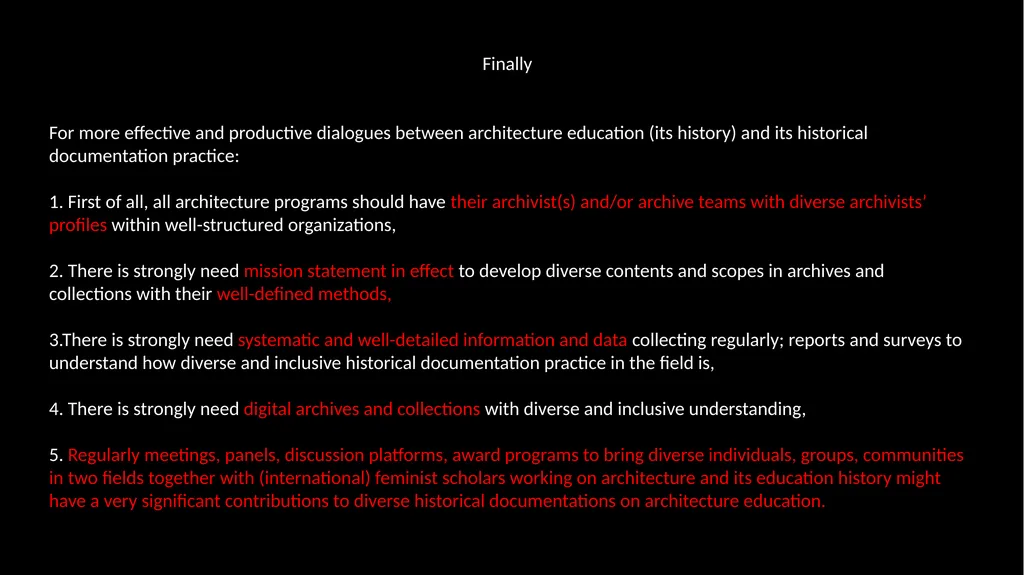
Finally
For more effective and productive dialogues between architecture education (its history) and its historical documentation practice:
1. First of all, all architecture programs should have their archivist(s) and/or archive teams with diverse archivists’ profiles within well-structured organizations,
2. There is strongly need mission statement in effect to develop diverse contents and scopes in archives and collections with their well-defined methods,
3.There is strongly need systematic and well-detailed information and data collecting regularly; reports and surveys to understand how diverse and inclusive historical documentation practice in the field is,
4. There is strongly need digital archives and collections with diverse and inclusive understanding,
5. Regularly meetings, panels, discussion platforms, award programs to bring diverse individuals, groups, communities in two fields together with (international) feminist scholars working on architecture and its education history might have a very significant contributions to diverse historical documentations on architecture education.<br>
32
Thank you for your listening.
Meral Ekincioglu, Ph.D.
meralekincioglu.com
• Visiting Scholar,
Massachusetts Institute of Technology, History, Theory and Criticism of Architecture
• Research Scholar,
Columbia University, Graduate School of Architecture, Planning and Preservation, Ph.D. Program
• Special Turkish Fellow,
Harvard University, History of Art and Architecture, Ph.D. Program
• Society of American Archivists, member (2019-2020)<br>