
Diversity and inclusivity in EU Research policy
A
Published · 10 slides · 0 views

1 / 1

Description
Diversity and inclusivity in EU Research policy and funding Diversity Talks Inclusive Design and Technology TU Delft Servaas Duterloo Head of unit EU Research Funding International Programmes TU Delft Member of the board of the Robo
Related Topics
Share
Embed code
Download this presentation From Below
"Diversity and inclusivity in EU Research policy" is the property of its rightful owner. Permission is granted to download and print the materials on this website for personal, non-commercial use only, and to display it on your personal computer provided you do not modify the materials and that you retain all copyright notices contained in the materials. By downloading content from our website, you accept the terms of this agreement.
Presentation Transcript
01
Diversity and inclusivity
in EU Research policy and funding
Diversity Talks | Inclusive Design and Technology TU Delft
Servaas Duterloo – Head of unit EU Research Funding & International Programmes TU Delft
Member of the board of the Robo Valley Foundation<br>
Servaas Duterloo – Head of unit EU Research Funding & International Programmes TU Delft
Member of the board of the Robo Valley Foundation<br>
02
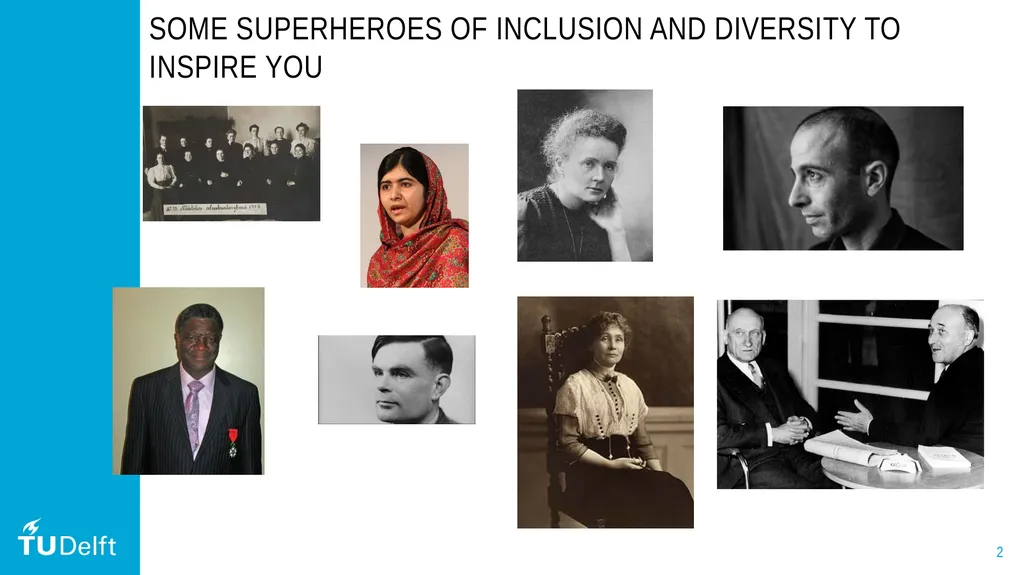
Some superheroes of inclusion and diversity to inspire you<br>
03
Some TRENDS, milestones, developments World (just a few) and general (just a few)
Gender self-identification movement LGBT+ gains momentum…and still controversy
Right to define your own age recently denied in a court case of Emile Ratelband, he wanted to be younger,
The individualisation of identity, read the relativity of such “hokjes denken” in Odes van David van Reybrouk
Yuval Harari Homo Deus, on mankind and Artificial Intelligence
Transhumanism is steadily gaining popularity, see e.g. Extropy Institute
Exploring space to find and identify extraterrestrial life (is that diversity too?)
Share of the population in Western Europe under 14 years is 16%, just for comparison: in the main countries around Sahel between 40 and 50% of the population is younger than 14!
Sustainable Development Goal 5 (11 years to get on target)
Christine Lagarde (IMF managing director), she is the firefighter of the global financial system (2% of bank CEOs are women!), towards a legacy of inclusion, a plea for using the potential of women (see Economist The World in 2019)
Asia? China? Russia? Middle East, Africa?
The Netherlands (just a few) 1919 Women get the right to vote in the Netherlands 2001 Right to same-sex-marriage 2019 New law in the Netherlands: Wet gelijke behandeling transgender en intersekse personen 2019 European Research Area progress country report 2018 The Netherlands: gender still up for improvement<br>
The Netherlands (just a few) 1919 Women get the right to vote in the Netherlands 2001 Right to same-sex-marriage 2019 New law in the Netherlands: Wet gelijke behandeling transgender en intersekse personen 2019 European Research Area progress country report 2018 The Netherlands: gender still up for improvement<br>
04
European research area Six priorities:
1. More effective national research systems 2. Optimal transnational cooperation and competition, including ‘jointly addressing grand challenges’ and ‘research infrastructures’ 3. An open labour market for researchers 4. Gender equality and gender mainstreaming in research* 5. Optimal circulation, access to and transfer of scientific knowledge, including ‘knowledge circulation’ and ‘open access’ 6. International cooperation
*Three objectives have been defined: 1. Remove barriers to the recruitment and career progression of female researchers; 2. Address gender imbalances in decision-making processes; and 3. Strengthen the gender dimension in research content.
Conclusion of the 2018 report
“The majority of countries have made progress in setting up more comprehensive strategies for gender equality in R&I, although progress is slow and uneven across the ERA. Efforts to increase the enrolment and retention of women in science, implement work-life balance policies, reduce the gender pay gap and remove obstacles to women’s career progression as well as better integrate the gender dimension in R&I content are still needed in order to achieve gender equality and gender mainstreaming in the ERA”.<br>
1. More effective national research systems 2. Optimal transnational cooperation and competition, including ‘jointly addressing grand challenges’ and ‘research infrastructures’ 3. An open labour market for researchers 4. Gender equality and gender mainstreaming in research* 5. Optimal circulation, access to and transfer of scientific knowledge, including ‘knowledge circulation’ and ‘open access’ 6. International cooperation
*Three objectives have been defined: 1. Remove barriers to the recruitment and career progression of female researchers; 2. Address gender imbalances in decision-making processes; and 3. Strengthen the gender dimension in research content.
Conclusion of the 2018 report
“The majority of countries have made progress in setting up more comprehensive strategies for gender equality in R&I, although progress is slow and uneven across the ERA. Efforts to increase the enrolment and retention of women in science, implement work-life balance policies, reduce the gender pay gap and remove obstacles to women’s career progression as well as better integrate the gender dimension in R&I content are still needed in order to achieve gender equality and gender mainstreaming in the ERA”.<br>
05
European UNION and EU Research Commission: 28 members, 9 women, European Parliament, 751 members, 37% women
Nobel Prize for Peace in 2012, more than 60 years of peace for its Member States
2012: https://ec.europa.eu/info/sites/info/files/trans_and_intersex_equality_rights.pdf
H2020 EU research funding: gender balance in research, projects, impacts is relevant in evaluation of all proposals yet always pragmatically evaluated…
In the 93 pages Work Programme “Europe in a changing world – Inclusive, innovative and reflective societies” 2018-2020: > “Gender” is mentioned 26, “inclusion”18, “diversity”10 times..! > Call topics are Migration, Governance for the Future, Socioeconomic and cultural transformations in the context of the 4th Industrial Revolution
In the 54 pages work programme “Science with and for Society” 2018-2020: > “Gender” is mentioned 178 (156 in draft), “Inclusion” 4 (4), “Diversity” 3 (1) times…of which 2 times biodiversity that is, <br>
Nobel Prize for Peace in 2012, more than 60 years of peace for its Member States
2012: https://ec.europa.eu/info/sites/info/files/trans_and_intersex_equality_rights.pdf
H2020 EU research funding: gender balance in research, projects, impacts is relevant in evaluation of all proposals yet always pragmatically evaluated…
In the 93 pages Work Programme “Europe in a changing world – Inclusive, innovative and reflective societies” 2018-2020: > “Gender” is mentioned 26, “inclusion”18, “diversity”10 times..! > Call topics are Migration, Governance for the Future, Socioeconomic and cultural transformations in the context of the 4th Industrial Revolution
In the 54 pages work programme “Science with and for Society” 2018-2020: > “Gender” is mentioned 178 (156 in draft), “Inclusion” 4 (4), “Diversity” 3 (1) times…of which 2 times biodiversity that is, <br>
06
Topics to step up support to Gender Equality in Research & Innovation policy include: Access to grants and gender dimension, expected impact: Ensure more gender equal research grant systems in the EU. Advance gender equality in research an innovation as requested in the European Research Area. Ensure that EU research and innovation benefit better from male and female scientists' talents. Improve the quality of research and innovation and their relevance to society.
Analysing gender gaps and biases in the allocation of grants, expected impact: Contribute to more gender equal research grant systems in the EU and to advancing gender equality in research and innovation as requested in the European Research Area. Help EU research and innovation benefit better from male and female scientists' talents and improve the quality of research and innovation and their relevance to society.<br>
Analysing gender gaps and biases in the allocation of grants, expected impact: Contribute to more gender equal research grant systems in the EU and to advancing gender equality in research and innovation as requested in the European Research Area. Help EU research and innovation benefit better from male and female scientists' talents and improve the quality of research and innovation and their relevance to society.<br>
07
European policy for disabled people EU is party to the UN Convention on the rights of persons with disabilities, European Disability Strategy 2010-2020, 8 priorities
1. Accessibility: make goods and services accessible to people with disabilities and promote the market of assistive devices. 2. Participation: ensure that people with disabilities enjoy all benefits of EU citizenship; remove barriers to equal participation in public life and leisure activities; promote the provision of quality community-based services. 3. Equality: combat discrimination based on disability and promote equal opportunities. 4. Employment: raise significantly the share of persons with disabilities working in the open labour market. They represent one-sixth of the EU's overall working-age population, but their employment rate is comparatively low. 5. Education and training: promote inclusive education and lifelong learning for students and pupils with disabilities. Equal access to quality education and lifelong learning enable disabled people to participate fully in society and improve their quality of life. The European Commission has launched several educational initiatives for disabled people. These include the European Agency for Special Needs and Inclusive Education as well as a specific study group on disability and lifelong learning. 6. Social protection: promote decent living conditions, combat poverty and social exclusion. 7. Health: promote equal access to health services and related facilities. 8. External action: promote the rights of people with disabilities in the EU enlargement and international development programmes.<br>
1. Accessibility: make goods and services accessible to people with disabilities and promote the market of assistive devices. 2. Participation: ensure that people with disabilities enjoy all benefits of EU citizenship; remove barriers to equal participation in public life and leisure activities; promote the provision of quality community-based services. 3. Equality: combat discrimination based on disability and promote equal opportunities. 4. Employment: raise significantly the share of persons with disabilities working in the open labour market. They represent one-sixth of the EU's overall working-age population, but their employment rate is comparatively low. 5. Education and training: promote inclusive education and lifelong learning for students and pupils with disabilities. Equal access to quality education and lifelong learning enable disabled people to participate fully in society and improve their quality of life. The European Commission has launched several educational initiatives for disabled people. These include the European Agency for Special Needs and Inclusive Education as well as a specific study group on disability and lifelong learning. 6. Social protection: promote decent living conditions, combat poverty and social exclusion. 7. Health: promote equal access to health services and related facilities. 8. External action: promote the rights of people with disabilities in the EU enlargement and international development programmes.<br>
08
European policy for disabled people: progress Progress report 2017 is 200 pages! Some quotes:
COM(2008) 426 final Proposal for a COUNCIL DIRECTIVE on implementing the principle of equal treatment between persons irrespective of religion or belief, disability, age or sexual orientation is blocked by the Council sofar, in 2017…The Commission continues the negotiations with the Member States to push the Directive forward…
…The public consultation showed that the lack of awareness of EU citizens regarding disability issues remains one of the barriers to the inclusion and participation of people with disabilities.
…The European Disability Strategy 2010-2020 puts forward a human rights approach of disability policies, in line with the UNCRPD. Disability concerns have been mainstreamed in a wealth of EU level actions, policies and laws. In addition, since the adoption of the strategy in 2010, it has been confirmed that a long term perspective is needed for the alignment of EU policies, laws and programmes to the UNCRPD. These efforts must be maintained to ensure the completion of the Strategy within the time horizon set for 2020.<br>
COM(2008) 426 final Proposal for a COUNCIL DIRECTIVE on implementing the principle of equal treatment between persons irrespective of religion or belief, disability, age or sexual orientation is blocked by the Council sofar, in 2017…The Commission continues the negotiations with the Member States to push the Directive forward…
…The public consultation showed that the lack of awareness of EU citizens regarding disability issues remains one of the barriers to the inclusion and participation of people with disabilities.
…The European Disability Strategy 2010-2020 puts forward a human rights approach of disability policies, in line with the UNCRPD. Disability concerns have been mainstreamed in a wealth of EU level actions, policies and laws. In addition, since the adoption of the strategy in 2010, it has been confirmed that a long term perspective is needed for the alignment of EU policies, laws and programmes to the UNCRPD. These efforts must be maintained to ensure the completion of the Strategy within the time horizon set for 2020.<br>
09
some lessons learned:
Progress is made BY EU, IPPO IPPO , 一歩一歩 The EU: a lot of milestones but little progress as the Member States are in charge
The EU main focus and priority for research and education is gender balance
The EU is steadily creating incentives for more and better inclusion and diversity
Inclusion and diversity can take place in many diverse ways
What should and can be changed? It is now the right time to discuss as the EU budget for 2021-2027 is being allocated and EP elections take place in May 2019.
Reflection on roles of personal and political leadership also nationally<br>
The EU main focus and priority for research and education is gender balance
The EU is steadily creating incentives for more and better inclusion and diversity
Inclusion and diversity can take place in many diverse ways
What should and can be changed? It is now the right time to discuss as the EU budget for 2021-2027 is being allocated and EP elections take place in May 2019.
Reflection on roles of personal and political leadership also nationally<br>
10
Sources further reading and inspiration https://ec.europa.eu/info/publications/era-progress-report-2018_en
https://ec.europa.eu/info/sites/info/files/trans_and_intersex_equality_rights.pdf
https://www.rathenau.nl/en/science-figures/personnel/university-personnel-category-and-gender
https://www.un.org/sustainabledevelopment/sustainable-development-goals/
https://www.disability-europe.net/dotcom
https://ec.europa.eu/social/main.jsp?langId=en&catId=1137
Economist, The World in 2019
Odes van David van Reybrouk
Green Book, https://en.wikipedia.org/wiki/Green_Book_(film) “Here's to the crazy ones, the misfits, the rebels, the troublemakers, the round pegs in the square holes. The ones who see things differently; they're not fond of rules. You can quote them, disagree with them, glorify or vilify them, but the only thing you can't do is ignore them because they change things. (Steve Jobs)<br>
https://ec.europa.eu/info/sites/info/files/trans_and_intersex_equality_rights.pdf
https://www.rathenau.nl/en/science-figures/personnel/university-personnel-category-and-gender
https://www.un.org/sustainabledevelopment/sustainable-development-goals/
https://www.disability-europe.net/dotcom
https://ec.europa.eu/social/main.jsp?langId=en&catId=1137
Economist, The World in 2019
Odes van David van Reybrouk
Green Book, https://en.wikipedia.org/wiki/Green_Book_(film) “Here's to the crazy ones, the misfits, the rebels, the troublemakers, the round pegs in the square holes. The ones who see things differently; they're not fond of rules. You can quote them, disagree with them, glorify or vilify them, but the only thing you can't do is ignore them because they change things. (Steve Jobs)<br>