Dixon Ridge 4-H Halter BreakingTraining, Showmanship Steps, and Hair Care Springtime Training Overview Showmanship Training Safety Tips Training: Never wrap the lead rope completely around your hand, arm, or body to prevent injury When
"Dixon Ridge 4-H Halter Breaking/Training," is the property of its rightful owner. Permission is granted to
download and print the materials on this website for personal, non-commercial use only, and to display it
on your personal computer provided you do not modify the materials and that you retain all copyright
notices contained in the materials. By downloading content from our website, you accept the terms of this
agreement.
Presentation Transcript
01
Dixon Ridge 4-H Halter Breaking/Training,
Showmanship Steps, and
Hair Care
Springtime Training Overview<br>
02
Showmanship & Training Safety Tips Training:
Never wrap the lead rope completely around your hand, arm, or body to prevent injury
When halter breaking your animal in the beginning, wear leather gloves whenever possible to help prevent injuries to your hands
When possible, like after school or on the weekends, tie your steer with its head up to a fence for a couple hours. Make sure to check on your steer frequently.
This helps the animal learn patience
Gets your animal used to being tied up at fair
This is also a good time to rinse your steer and/or comb their hair forward to train the hair
Showmanship:
Leave plenty of distance between you and your animal and the animal ahead of you in the ring.
Always use a plastic comb in the show ring and when practicing at home. Metal is fine for grooming in the chute or tied to the fence.
This is important because if your comb falls out of your pocket and you or your animal steps on it, plastic will break helping to prevent injury
Always put your show comb in your back pocket with the teeth facing your back<br>
03
Halter Breaking Show Cattle Training video for working with larger calves:
https://youtu.be/rUc_SJb_Kdg
Tips from the video:
Make every interaction as positive as possible
Start slow, even if its just brushing for 15 mins at a time
When introducing them to being tied up, start with their heads low (for safety) and gradually work up from there
Start walking them in a smaller enclosed area and then gradually increase
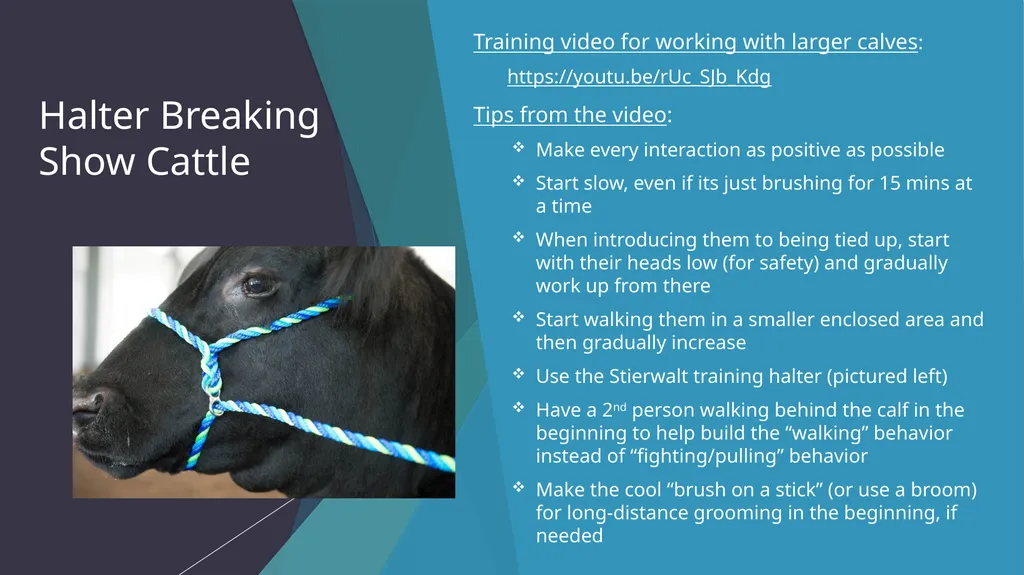
Use the Stierwalt training halter (pictured left)
Have a 2nd person walking behind the calf in the beginning to help build the “walking” behavior instead of “fighting/pulling” behavior
Make the cool “brush on a stick” (or use a broom) for long-distance grooming in the beginning, if needed<br>
04
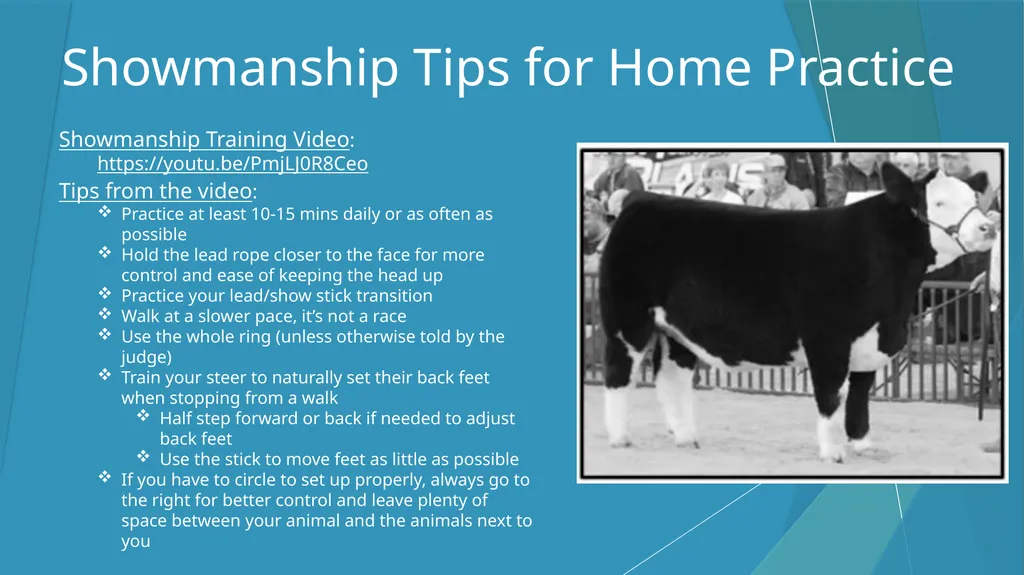
Showmanship Tips for Home Practice Showmanship Training Video:
https://youtu.be/PmjLJ0R8Ceo
Tips from the video:
Practice at least 10-15 mins daily or as often as possible
Hold the lead rope closer to the face for more control and ease of keeping the head up
Practice your lead/show stick transition
Walk at a slower pace, it’s not a race
Use the whole ring (unless otherwise told by the judge)
Train your steer to naturally set their back feet when stopping from a walk
Half step forward or back if needed to adjust back feet
Use the stick to move feet as little as possible
If you have to circle to set up properly, always go to the right for better control and leave plenty of space between your animal and the animals next to you<br>
05
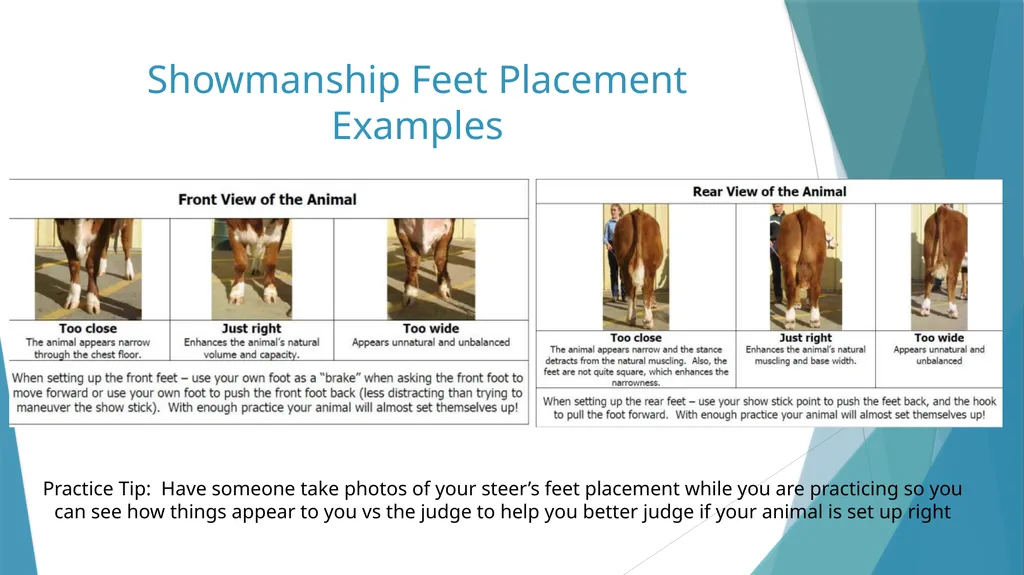
Showmanship Feet Placement Examples Practice Tip: Have someone take photos of your steer’s feet placement while you are practicing so you can see how things appear to you vs the judge to help you better judge if your animal is set up right<br>
06
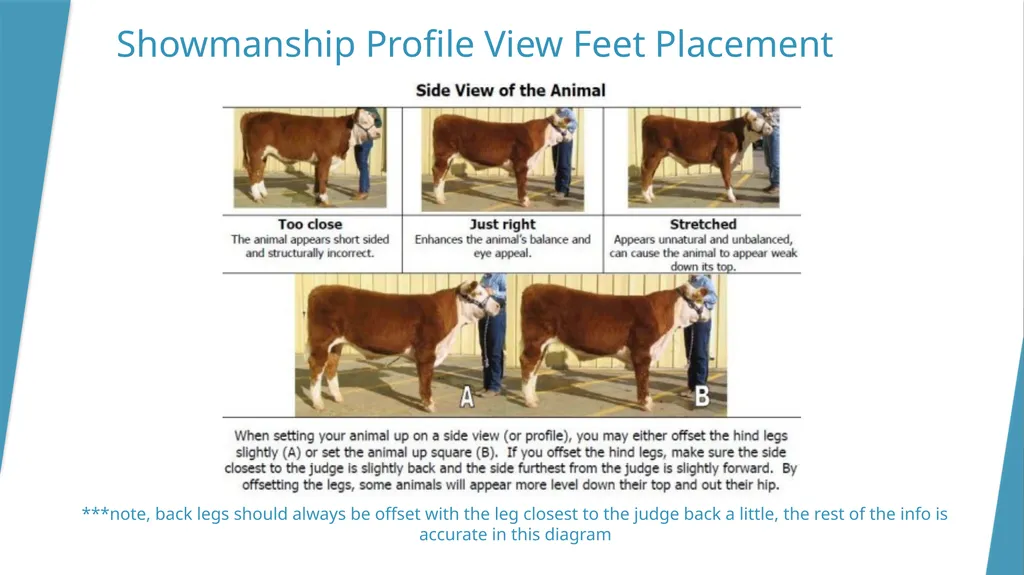
Showmanship Profile View Feet Placement ***note, back legs should always be offset with the leg closest to the judge back a little, the rest of the info is accurate in this diagram<br>
07
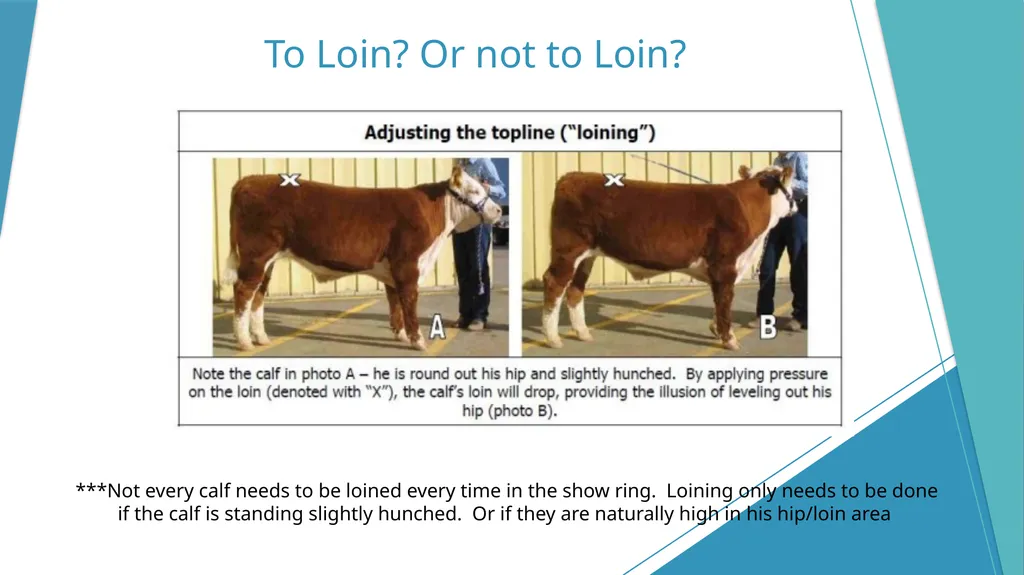
To Loin? Or not to Loin? ***Not every calf needs to be loined every time in the show ring. Loining only needs to be done if the calf is standing slightly hunched. Or if they are naturally high in his hip/loin area<br>
08
Showmanship Tips Always remember to comb the calf after the judge touches it, and make sure the judge sees you do it.
If someone else’s steer bumps into your steer, do you best to comb the hair if possible (Not always possible on side opposite of you)
If the judge doesn’t see it, it doesn’t count
Keep constant eye contact, or as much as you can safely do, with a neutral or happy face. You can be intense without looking angry or upset
When you walk, keep your strides the same as your steer’s front feet, meaning you both step with your left and then you both step with your right. By doing this, you will know which one of their back feet is forward or backward when you stop to place their feet
This makes set up that much faster as you won’t have to try to ½ step forward or backward
Breathe. You calf can sense your nerves or stress. If you are calm, chances are good they will be calm too
Watch at least one showmanship class before your class to see how the judge runs things<br>
09
Showmanship Tips Continued Always be courteous in the show ring
If the steer in front of you isn’t wanting to walk, lightly tap it near it’s tailhead to help get it moving. Be careful that you and your steer don’t get kicked in the process. Use your judgment on if it’s safe to help or if the ring men need to step it to help
If you are lined up profile (nose to tail) and the steer in front of you gets selected to move to a different spot, move your steer up to the previous steer’s place
If the judge asks you a question you don’t know the answer to, say “I don’t know the answer to that question, but I will find out and get back to you.” and then follow through with it
ALWAYS shake the judge’s hand
Make sure you have a long enough show stick. Should be sized to the length of the steer, not the height of the showman
Feed and water your steer before the show. We want them happy and hydrated (this goes for the showman too, stay hydrated!)
Keep extra wash cloths or baby wipes handy. They are great for cleaning poop off the butt and tail before it can be spread anywhere else<br>
10
Hair Care and Hair Training Video: Combing the Right Way
https://youtu.be/ZubmmzG_q1I
Tips from the video:
Combing helps stimulate hair growth
Use different combs as needed
Round fluffer comb for legs if your animal has a lot of leg hair
Comb hair to go all one direction first, then go back and comb desired direction
Part hair down back of calf to help create a seamless look from pole to tailhead
Should only be ¼ wide
After hair is trained, it will naturally fall into that part when combed over
Bellies and chests are very important and are often forgotten
Important part because when the judge steps away it’s part of their silhouette Video: Daily Hair Care
https://youtu.be/o514vBXd5Ug
Tips from the video:
Use a shedding comb to remove dead hair
Daily washing and rinsing is best
2-3 times a week ok too if that’s all you can get in
Use different combs as needed
Condition hair and skin every time you shampoo
Make sure it gets worked down to the skin to prevent dandruff
Use Weaver ProHair or a similar leave in conditioner
Put it on clean, dry hair
Comb it in before blowing dry<br>