Dr. AJIT KUMAR Department of Veterinary Parasitology Bihar Veterinary College Bihar Animal Sciences University Patna-800014 ICZN and SNOAPAD ( General Veterinary Parasitology) Image source: Google image ICZN Image source: Google image
"Dr. AJIT KUMAR Department of Veterinary" is the property of its rightful owner. Permission is granted to
download and print the materials on this website for personal, non-commercial use only, and to display it
on your personal computer provided you do not modify the materials and that you retain all copyright
notices contained in the materials. By downloading content from our website, you accept the terms of this
agreement.
Presentation Transcript
01
Dr. AJIT KUMAR
Department of Veterinary Parasitology
Bihar Veterinary College
Bihar Animal Sciences University
Patna-800014 ICZN and SNOAPAD
( General Veterinary Parasitology) Image source: Google image<br>
02
ICZN Image source: Google image<br>
03
Several thousand of organism in the word.
Several names for same organism and same name for different organisms.
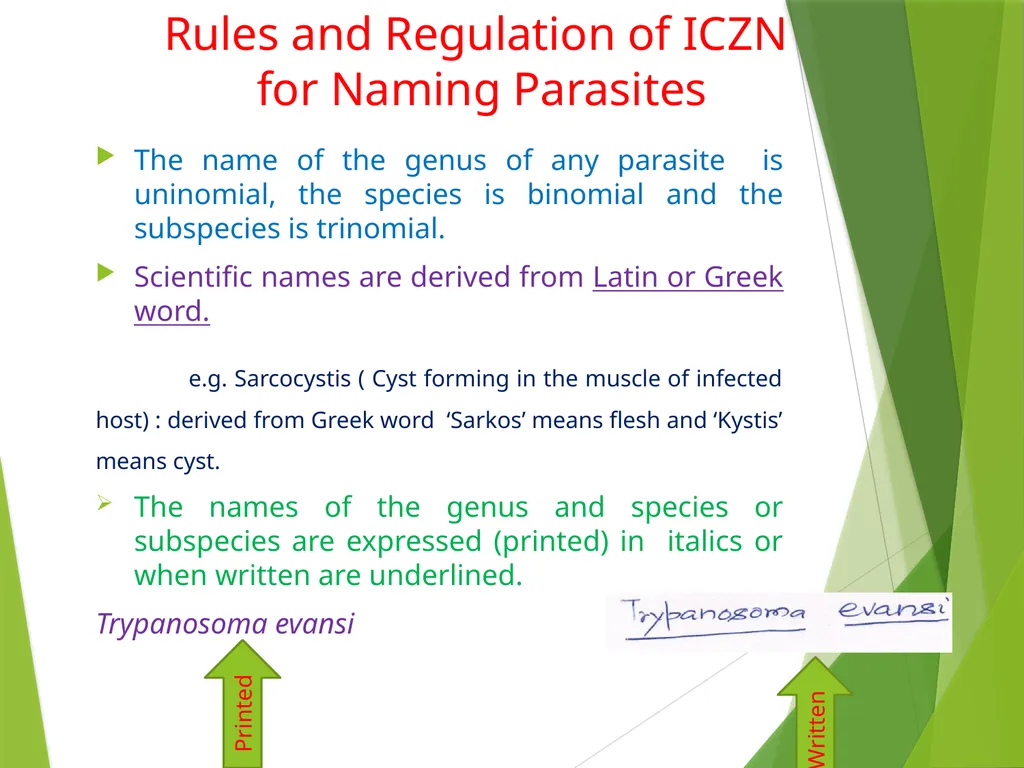
Carolus Linnaeus in the year 1758 given ‘Bionomial nomenclature’ in his book ‘Systema Nature’.
Later, International Code for Zoological Nomenclature ( ICZN) is establish in 1904 to formed rules for naming species and for indicating their relationship. Nomenclature of Parasites Image source: Google image<br>
04
The name of the genus of any parasite is uninomial, the species is binomial and the subspecies is trinomial.
Scientific names are derived from Latin or Greek word.
e.g. Sarcocystis ( Cyst forming in the muscle of infected host) : derived from Greek word ‘Sarkos’ means flesh and ‘Kystis’ means cyst.
The names of the genus and species or subspecies are expressed (printed) in italics or when written are underlined.
Trypanosoma evansi Rules and Regulation of ICZN for Naming Parasites Printed Written<br>
05
Author of a scientific name of an animal is that who first publishes it. If it is desired to cite the author’s name it follows the scientific name. This may be followed, separated by a comma, by the yea in which the name was first published.
Taenia Linnaeus, 1758 Rules and Regulation of ICZN for Naming Parasites Written Written<br>
06
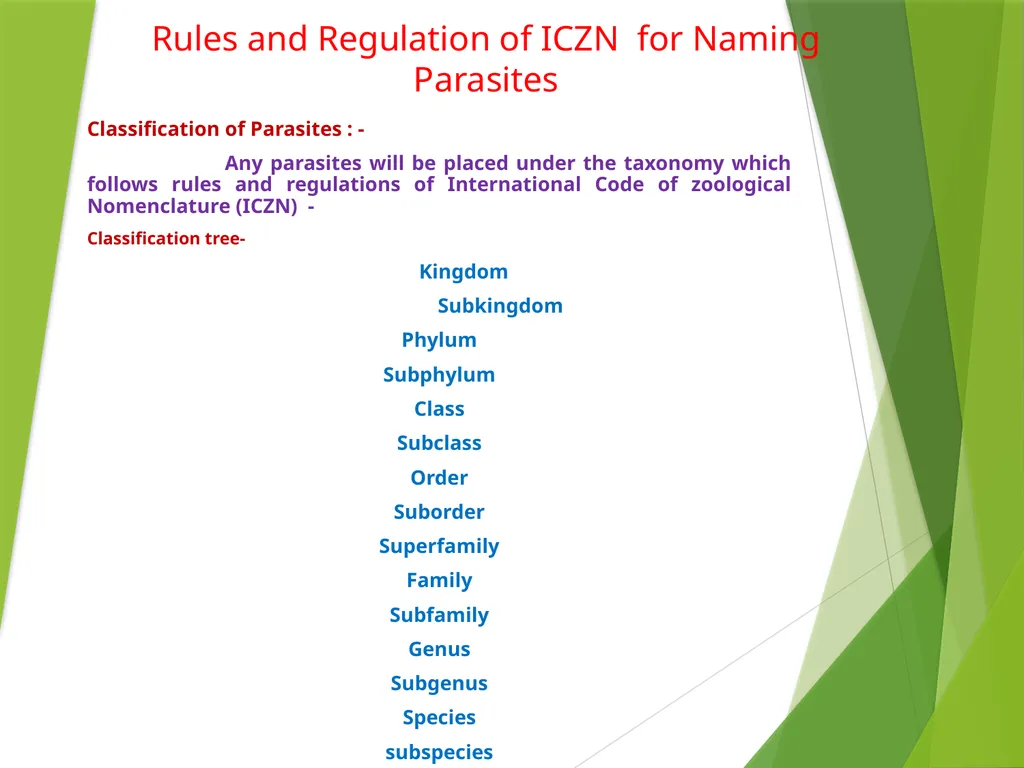
Rules and Regulation of ICZN for Naming Parasites Classification of Parasites : -
Any parasites will be placed under the taxonomy which follows rules and regulations of International Code of zoological Nomenclature (ICZN) -
Classification tree-
Kingdom
Subkingdom
Phylum
Subphylum
Class
Subclass
Order
Suborder
Superfamily
Family
Subfamily
Genus
Subgenus
Species
subspecies<br>
07
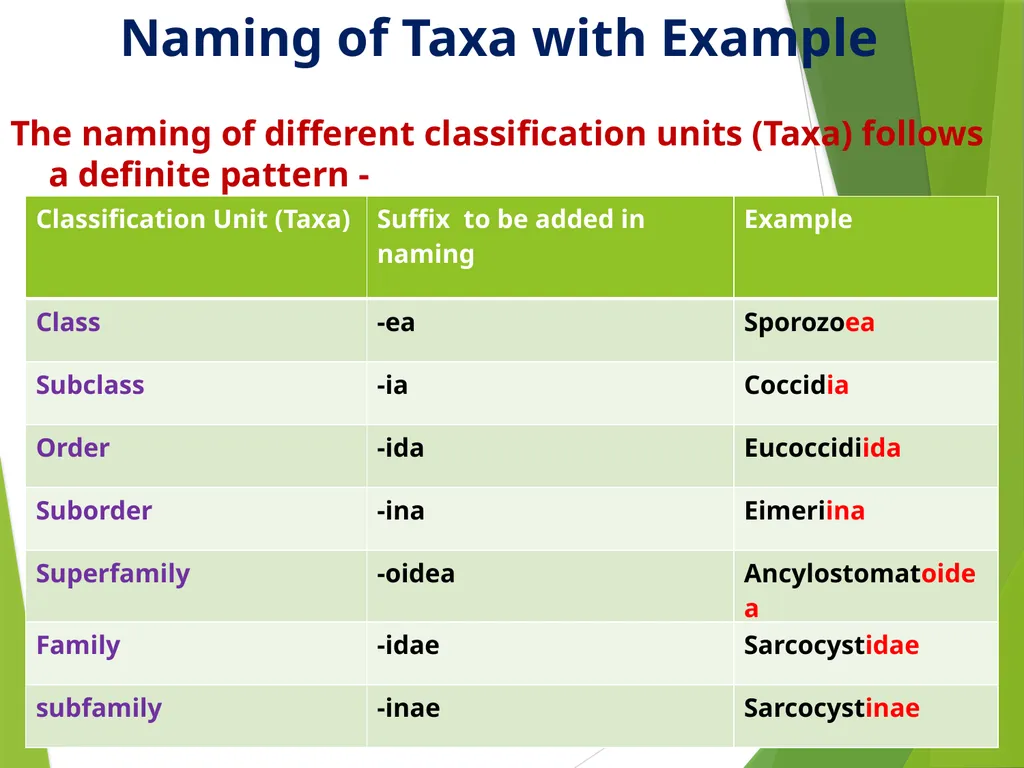
The naming of different classification units (Taxa) follows a definite pattern - Naming of Taxa with Example<br>
08
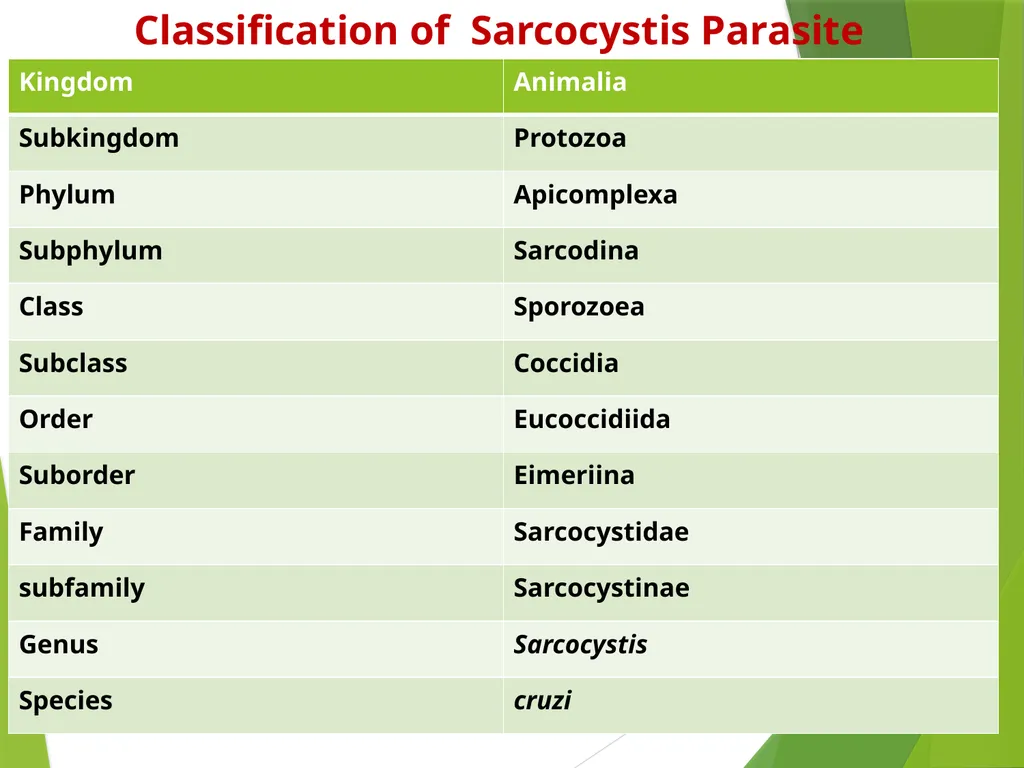
Classification of Sarcocystis Parasite<br>
09
SNOAPAD Image source: Google image<br>
10
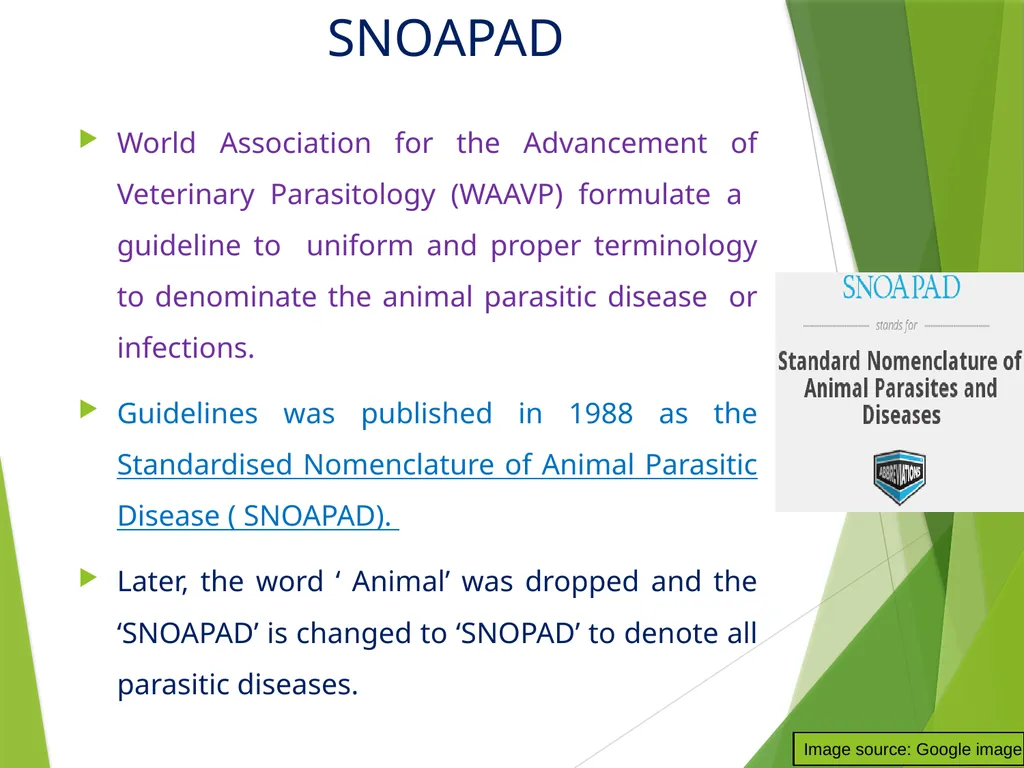
SNOAPAD World Association for the Advancement of Veterinary Parasitology (WAAVP) formulate a guideline to uniform and proper terminology to denominate the animal parasitic disease or infections.
Guidelines was published in 1988 as the Standardised Nomenclature of Animal Parasitic Disease ( SNOAPAD).
Later, the word ‘ Animal’ was dropped and the ‘SNOAPAD’ is changed to ‘SNOPAD’ to denote all parasitic diseases. Image source: Google image<br>
11
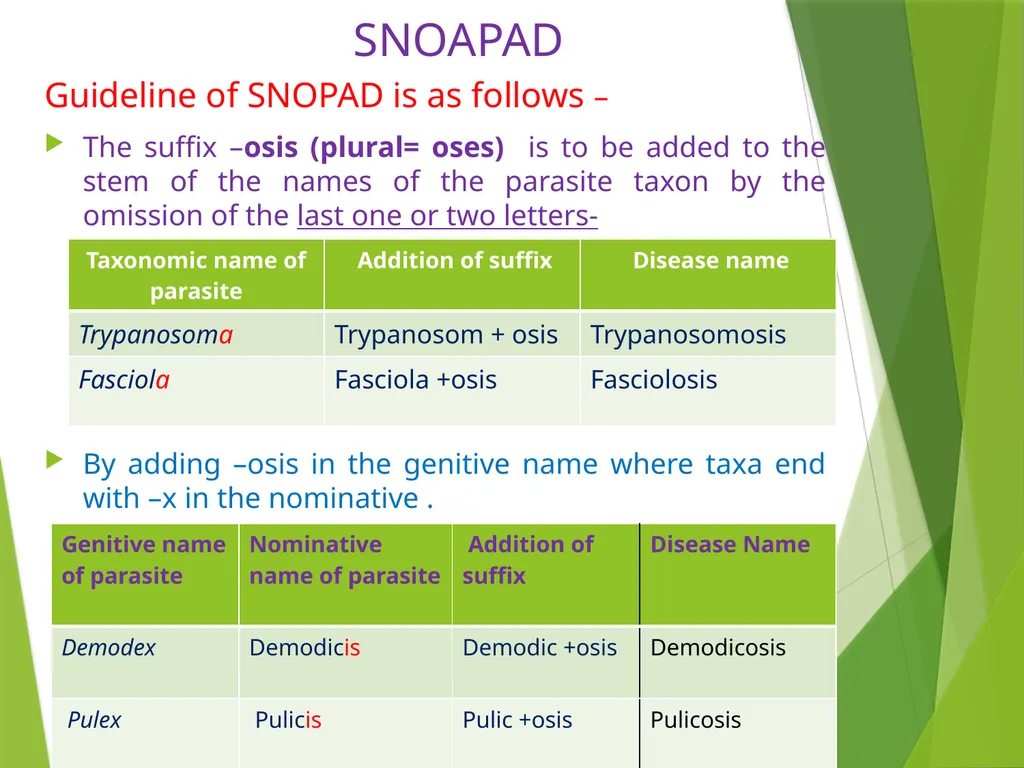
SNOAPAD Guideline of SNOPAD is as follows –
The suffix –osis (plural= oses) is to be added to the stem of the names of the parasite taxon by the omission of the last one or two letters-
By adding –osis in the genitive name where taxa end with –x in the nominative .<br>
12
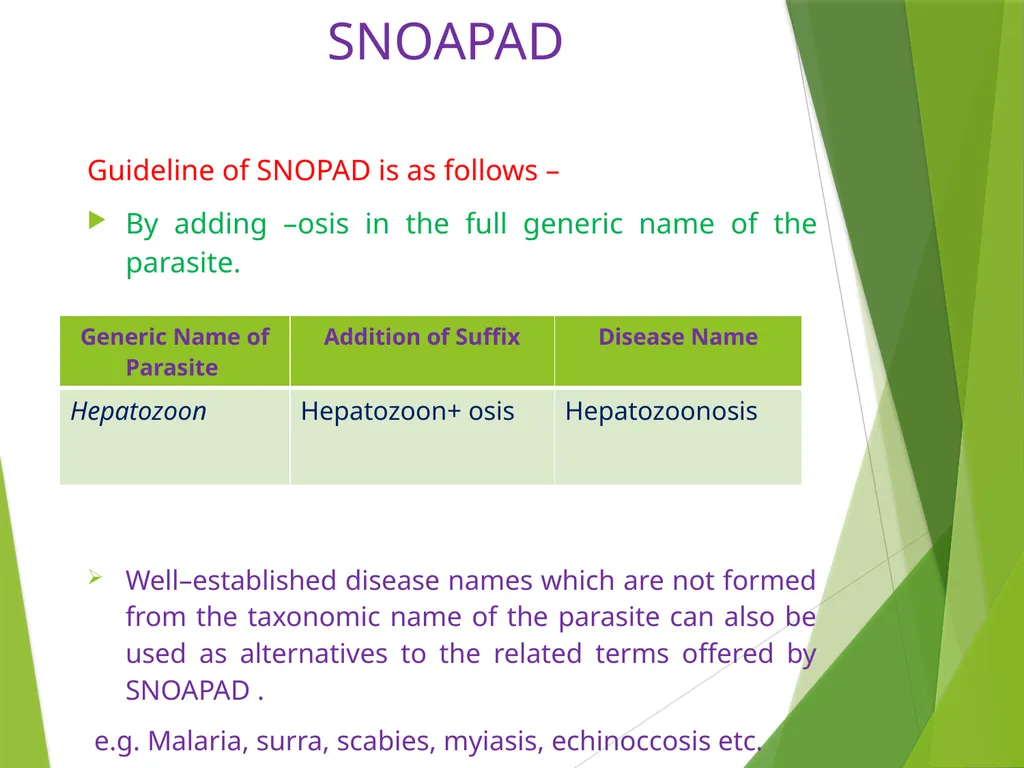
SNOAPAD Guideline of SNOPAD is as follows –
By adding –osis in the full generic name of the parasite.
Well–established disease names which are not formed from the taxonomic name of the parasite can also be used as alternatives to the related terms offered by SNOAPAD .
e.g. Malaria, surra, scabies, myiasis, echinoccosis etc.<br>
13
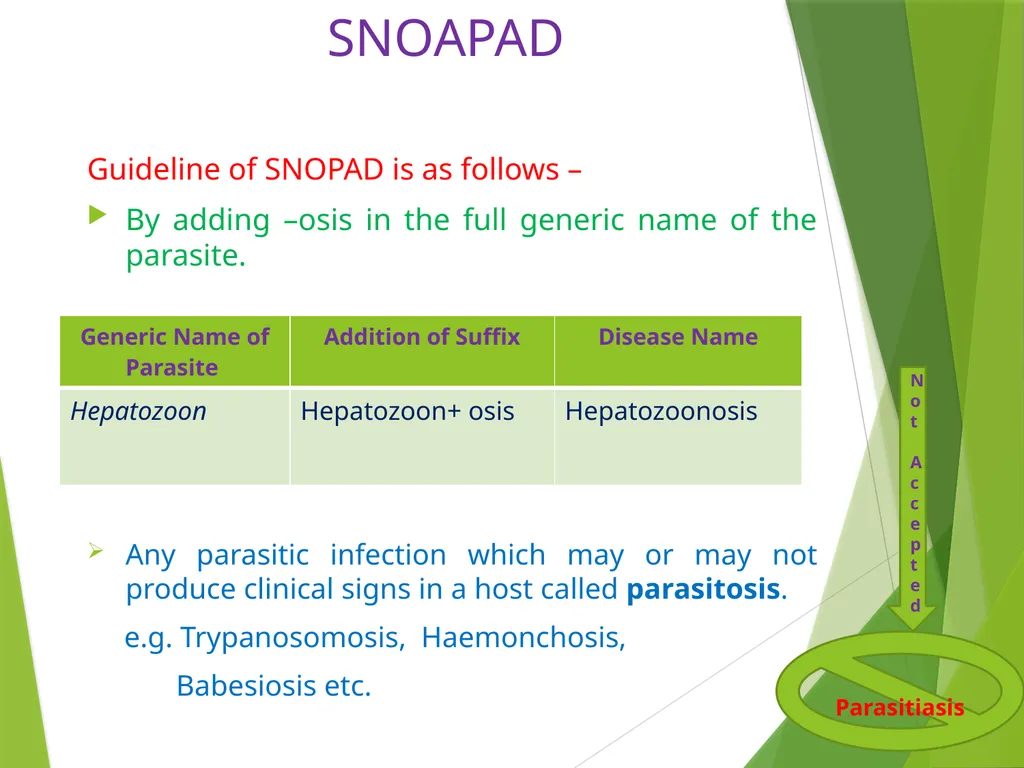
SNOAPAD Guideline of SNOPAD is as follows –
By adding –osis in the full generic name of the parasite.
Any parasitic infection which may or may not produce clinical signs in a host called parasitosis.
e.g. Trypanosomosis, Haemonchosis,
Babesiosis etc. Parasitiasis Not Accepted<br>