
Dr. K.Govindarajan Ph.D Assistant Professor
SN
Published · 30 slides · 0 views

1 / 1
Description
Dr. K.Govindarajan Ph.D Assistant Professor Department of Education Alagappa University Karaikudi Advanced Techniques of Instruction M.Ed., Second Year Unit VIII Educational Learning Theories Learning has been defined by different theorists
Related Topics
Share
Embed code
Download this presentation From Below
"Dr. K.Govindarajan Ph.D Assistant Professor" is the property of its rightful owner. Permission is granted to download and print the materials on this website for personal, non-commercial use only, and to display it on your personal computer provided you do not modify the materials and that you retain all copyright notices contained in the materials. By downloading content from our website, you accept the terms of this agreement.
Presentation Transcript
01
Dr. K.Govindarajan Ph.D
Assistant Professor
Department of Education
Alagappa University
Karaikudi Advanced Techniques of Instruction
M.Ed., Second Year
Unit VIII<br>
02
Educational Learning Theories Learning has been defined by different theorists in different ways. The essence of various definition is that learning is an enduring change in behaviour which results from experiences (Shuell, 1991).
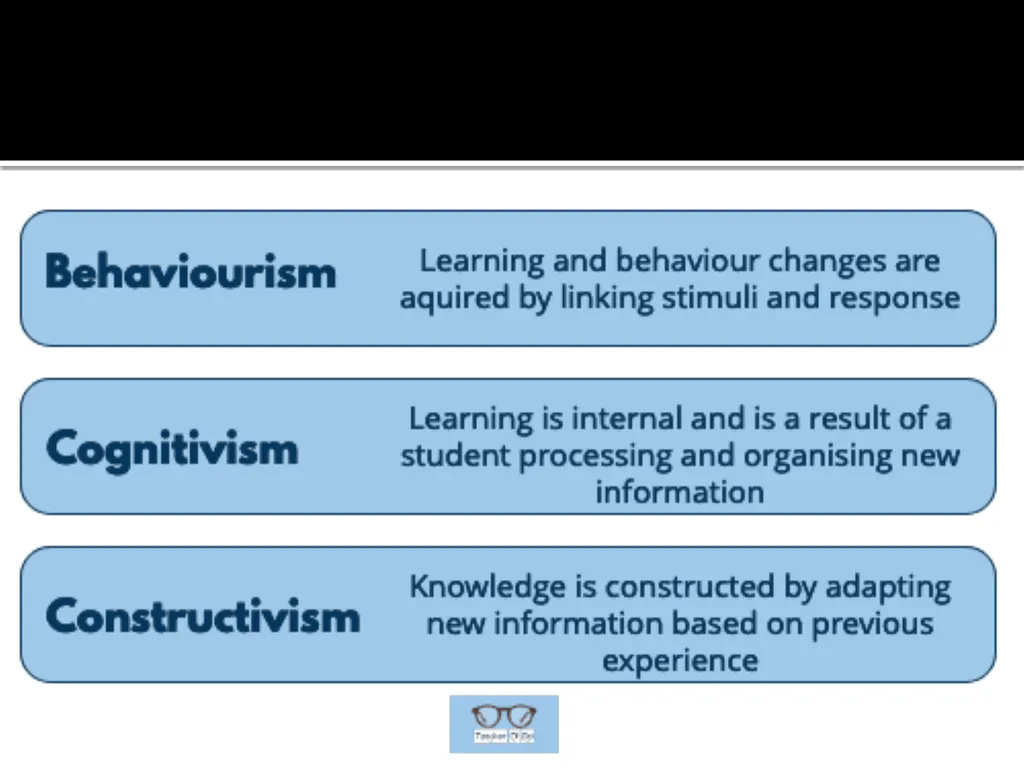
Three theories explained the ways of bringing changes in behaviour as a result of instructional approaches – Behaviourism, Cognitivism and Constructivism. These three are playing important role in the instructional design.
Behaviourism
Cognitivism
Constructivism<br>
Three theories explained the ways of bringing changes in behaviour as a result of instructional approaches – Behaviourism, Cognitivism and Constructivism. These three are playing important role in the instructional design.
Behaviourism
Cognitivism
Constructivism<br>
03
Teaching methods Teachers should make adequate provision for learning experience. The teaching that does not fulfill the needs of the learner cannot bring desirable changes in behaviour.<br>
04
Historically, the empirism and rationalism in epistemology were considered as two major cetegories. Empirism states that knowledge comes only from sensory experiences. In contradactory to it, the another philosophy rationalism is the epistemological view in which the criterian of the truth is not sensory but intellectual and deduction.<br>
05
. Empirism was associated with 'tabula rasa', according to which the human mind is blank at birth and develops its thought only through experiences. Empirism is the view that experience is the major source of knowledge. Learning is associated with the organs and its integration with the environment. Instructional design will focus on environment. Rationalism is the view that at least some human knowledge is gained through rational and insight as distinct from experience. Knowledge arises through direct apprehension by the intellect.<br>
06
Behaviorism Behaviorism describes learning as a connection between stimulus and response.
Environment is considered as the major determinant of behaviour. Learning is considered as the continual interaction with the environment. The method of learning is conditioning. Conditioning is the key to the understanding of behaviour which is the collection of stimulus and associated response. The recollection of an item of knowledge can be made by means of associated with a new unit of knowledge by virtue of similarity, contact or closeness.<br>
Environment is considered as the major determinant of behaviour. Learning is considered as the continual interaction with the environment. The method of learning is conditioning. Conditioning is the key to the understanding of behaviour which is the collection of stimulus and associated response. The recollection of an item of knowledge can be made by means of associated with a new unit of knowledge by virtue of similarity, contact or closeness.<br>
07
Cognitivism In the point of view of cognitive construct instructional theories, learning is viewed as the process of intellectual development of the individual. Learning is considered as a dynamic process. Thus the cognitive approach gives importance to cognition in learning. Learning requires cognitive effort. Importance is given to thinking, concept formation, problem solving etc., rather than overt behaviour of the learner.<br>
08
Constructivism Constructivism is based on the premise that we construct learning new ideas based on our own prior knowledge and experiences. Learning, therefore, is unique to the individual learner. Students adapt their models of understanding either by reflecting on prior theories or resolving misconceptions.
Students need to have a prior base of knowledge for constructivist approaches to be effective.<br>
Students need to have a prior base of knowledge for constructivist approaches to be effective.<br>
09
As students are constructing their own knowledge base, outcomes cannot always be anticipated, therefore, the teacher should check and challenge misconceptions that may have arisen. When consistent outcomes are required, a constructivist approach may not be the ideal theory to use.<br>
10
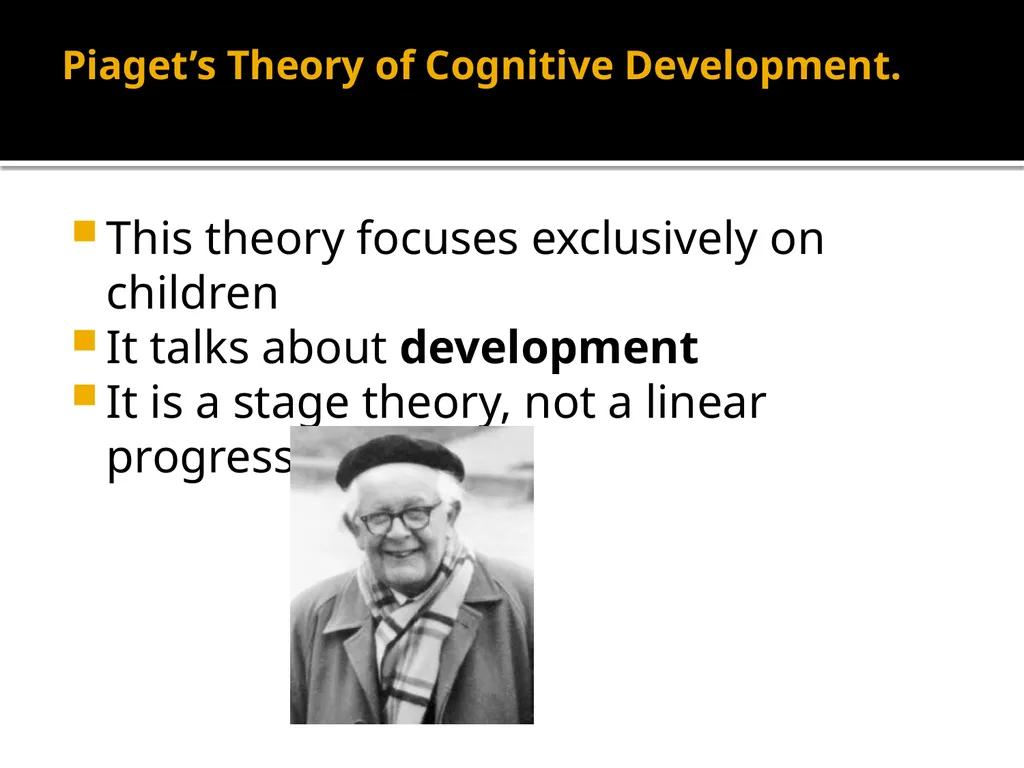
Piaget’s Theory of Cognitive Development. This theory focuses exclusively on children
It talks about development
It is a stage theory, not a linear progression theory.<br>
It talks about development
It is a stage theory, not a linear progression theory.<br>
11
The basic ideas are:
Schemas: The building blocks of knowledge.
[clusters of connected ideas]
Adaptation processes: These allow the transition from one stage to another.
He called these: Equilibrium, Assimilation and Accommodation.
` [When the child uses the schema to deal with a new thing or situation, that Schema is Assimilation and Accommodation happens when the existing Schema isn’t up to the job of explaining what’s going on and needs to be changed]
Stages of Cognitive development: Sensorimotor; Preoperational; Concrete Operational; Formal Operational.<br>
Schemas: The building blocks of knowledge.
[clusters of connected ideas]
Adaptation processes: These allow the transition from one stage to another.
He called these: Equilibrium, Assimilation and Accommodation.
` [When the child uses the schema to deal with a new thing or situation, that Schema is Assimilation and Accommodation happens when the existing Schema isn’t up to the job of explaining what’s going on and needs to be changed]
Stages of Cognitive development: Sensorimotor; Preoperational; Concrete Operational; Formal Operational.<br>
12
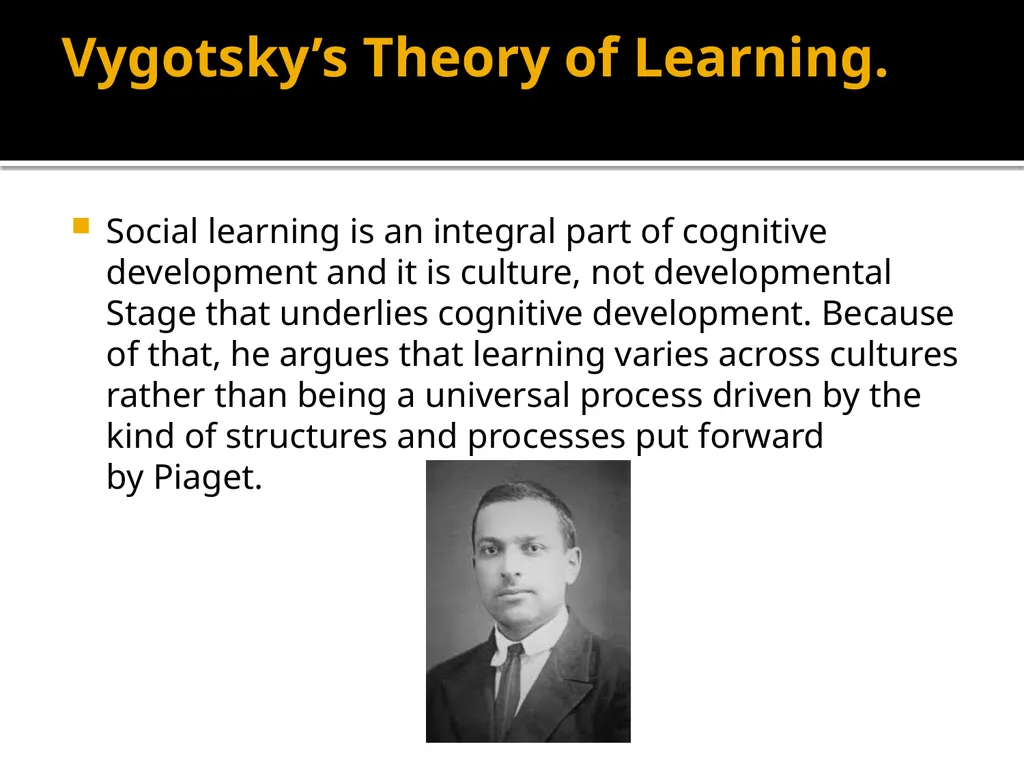
Vygotsky’s Theory of Learning. Social learning is an integral part of cognitive development and it is culture, not developmental Stage that underlies cognitive development. Because of that, he argues that learning varies across cultures rather than being a universal process driven by the kind of structures and processes put forward by Piaget.<br>
13
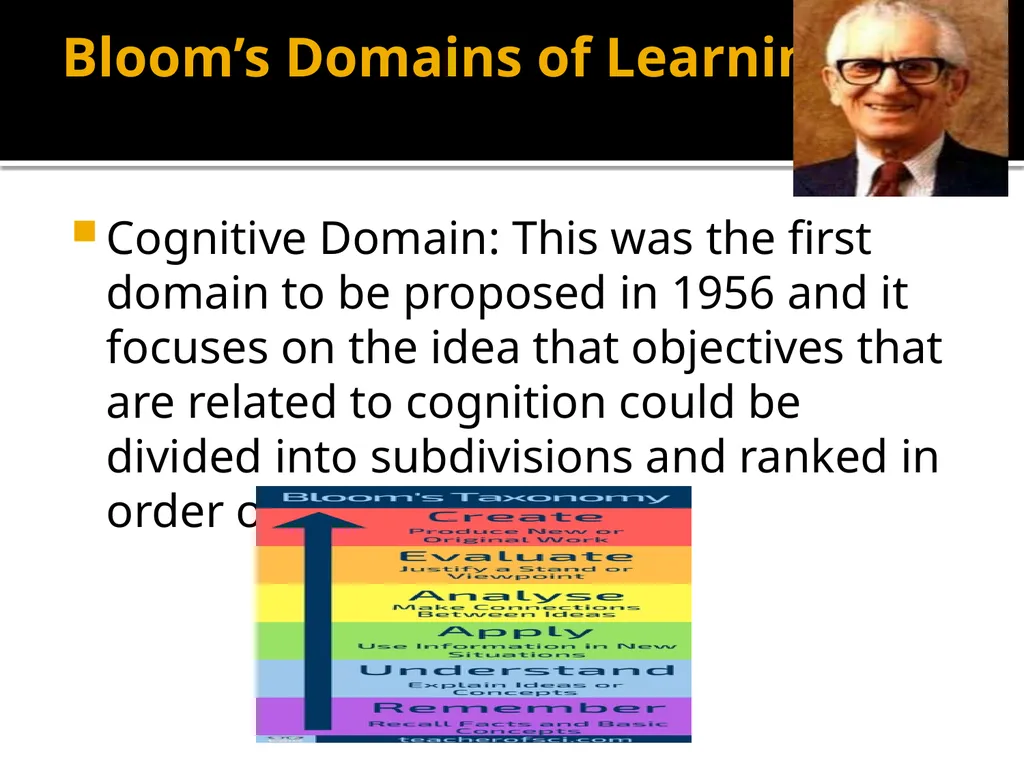
Bloom’s Domains of Learning. Cognitive Domain: This was the first domain to be proposed in 1956 and it focuses on the idea that objectives that are related to cognition could be divided into subdivisions and ranked in order of cognitive difficulty.<br>
14
The affective domain (sometimes referred to as the feeling domain) is concerned with feelings and emotions and also divides objectives into hierarchical subcategories.
The psychomotor domain refers to those objectives that are specific to reflex actions interpretive movements and discreet physical functions.<br>
The psychomotor domain refers to those objectives that are specific to reflex actions interpretive movements and discreet physical functions.<br>
15
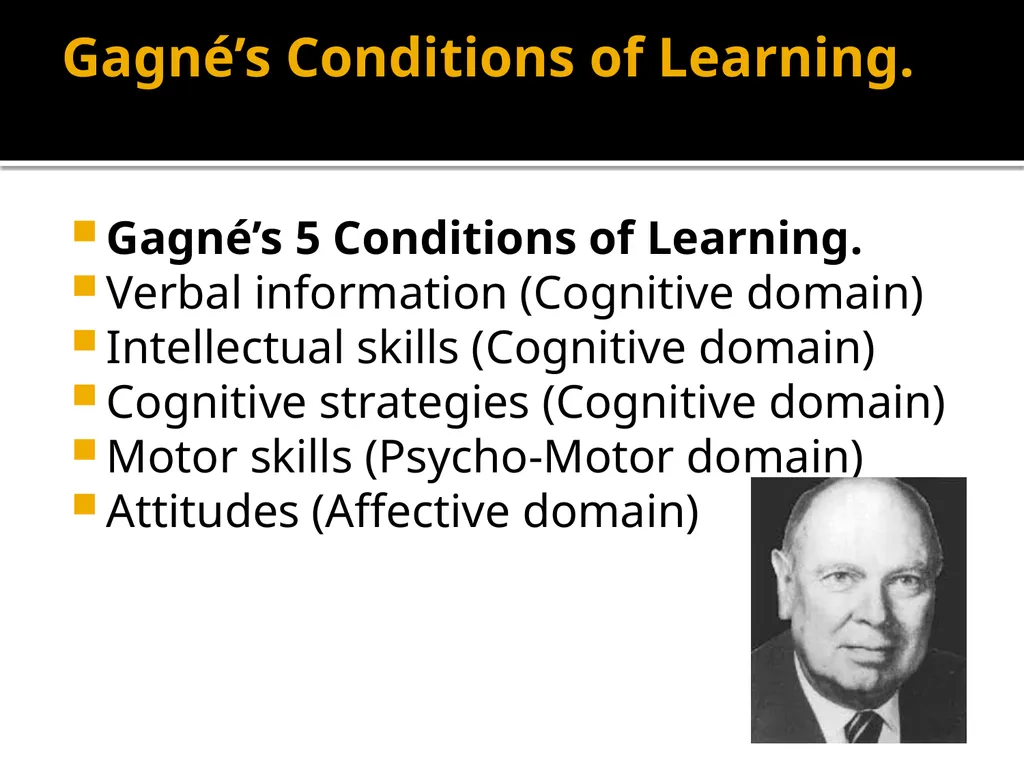
Gagné’s Conditions of Learning. Gagné’s 5 Conditions of Learning.
Verbal information (Cognitive domain)
Intellectual skills (Cognitive domain)
Cognitive strategies (Cognitive domain)
Motor skills (Psycho-Motor domain)
Attitudes (Affective domain)<br>
Verbal information (Cognitive domain)
Intellectual skills (Cognitive domain)
Cognitive strategies (Cognitive domain)
Motor skills (Psycho-Motor domain)
Attitudes (Affective domain)<br>
16
Bruner’s Spiral Curriculum Students revisit the same topic multiple times throughout their school career. This reinforces the learning each time they return to the subject.
The complexity of the topic increases each time a student revisits it. This allows progression through the subject matter as the child’s cognitive ability develops with age.
When a student returns to a topic, new ideas are linked with ones they have previously learned. The student’s familiarity with the keywords and ideas enables them to grasp the more difficult elements of the topic in a stronger way.<br>
The complexity of the topic increases each time a student revisits it. This allows progression through the subject matter as the child’s cognitive ability develops with age.
When a student returns to a topic, new ideas are linked with ones they have previously learned. The student’s familiarity with the keywords and ideas enables them to grasp the more difficult elements of the topic in a stronger way.<br>
17
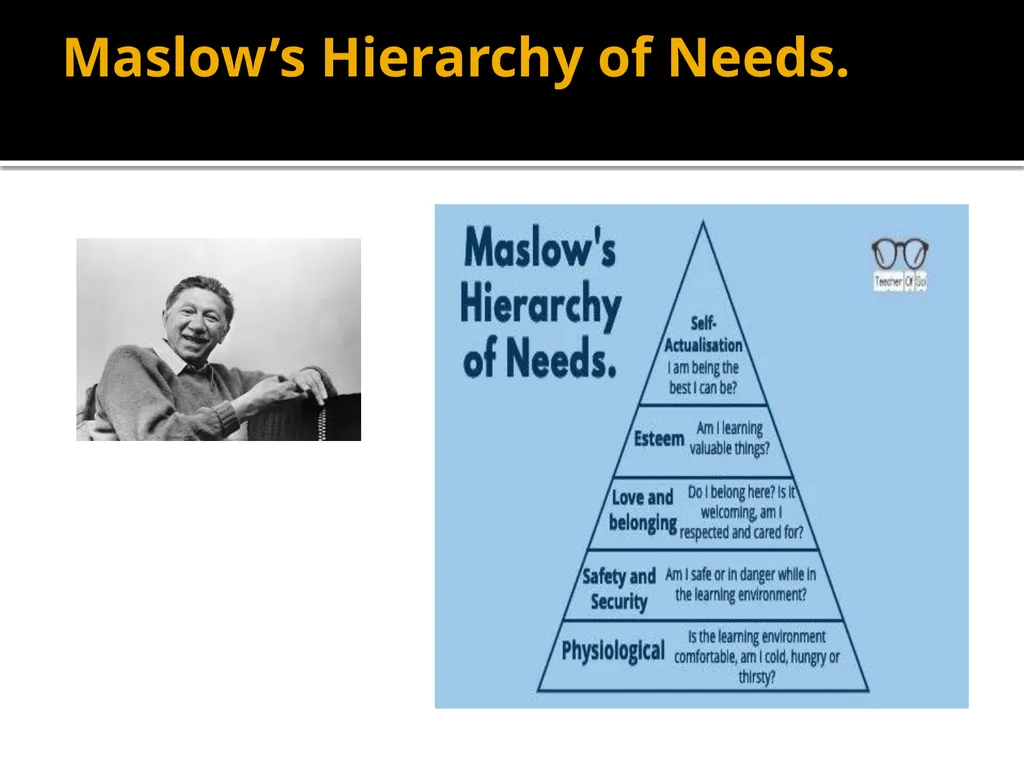
Maslow’s Hierarchy of Needs.<br>
18
Howard Gardner’s Multiple Intelligences Linguistic intelligence. The ability to learn and use language in written and spoken forms to express oneself.
Mathematical intelligence. The ability to solve problems logically, to solve mathematical problems and to perform scientific investigations.
Musical intelligence. Having skill in appreciation, composition and performance of musical patterns, including the ability to recognise tone, pitch and rhythm.
Bodily-kinesthetic intelligence. Using mental abilities to coordinate body movements to solve problems.
Spatial intelligence. Being able to recognise and use patterns in a wide or confined space.
Interpersonal intelligence. The capacity to understand the desires, motivations and intentions of other people.
Intrapersonal intelligence. The capacity to understand your own fears, feelings and motivations.<br>
Mathematical intelligence. The ability to solve problems logically, to solve mathematical problems and to perform scientific investigations.
Musical intelligence. Having skill in appreciation, composition and performance of musical patterns, including the ability to recognise tone, pitch and rhythm.
Bodily-kinesthetic intelligence. Using mental abilities to coordinate body movements to solve problems.
Spatial intelligence. Being able to recognise and use patterns in a wide or confined space.
Interpersonal intelligence. The capacity to understand the desires, motivations and intentions of other people.
Intrapersonal intelligence. The capacity to understand your own fears, feelings and motivations.<br>
19
Erikson’s 8 Stages of Psychological Development. Trust Vs. Mistrust (Age 0 – 1.5). In this first stage, infants must learn that adults can be trusted. If treated poorly children may grow up feeling mistrust towards people.
Autonomy Vs. Shame (Age 1.5 – 3). The “me do it’ stage, children start to make decisions and show preferences of elements in their environment such as what clothes to wear or what toy they prefer. If children are not allowed to explore these preferences they may develop low self-esteem and shame.
Initiative Vs. Guilt (Age 3 – 5). This stage involves children learning to plan and achieve goals involving others. If parents or teachers allow children to explore this and support their choices they will develop a sense of purpose and strong self-confidence.
Industry Vs. Inferiority (Age 5 – 12). In this stage, children start comparing themselves with their peers. Success at this will result in a sense of accomplishment in their school work, social and family activities and sports.
Identity Vs. Role Confusion (Age 12 – 18). Students in this stage are asking themselves “Who am I” and “What do I want to do in my life”. They will try out multiple roles during this time to find what one “fits” best. A strong sense of identity and an ability to defend their core beliefs in the face of other opinions would be considered success at this stage.
Intimacy Vs. Isolation (Age 18 – 40). As students progress into early adulthood their focus shifts to making and maintaining strong, intimate relationships with others.
Generativity Vs. Stagnation (Age 40 – 65). In middle adulthood, people are concerned with contributing to society either through their work or parenthood. Continued self-improvement for the benefit of other people figures strongly here.
Ego Integrity Vs. Despair (Age 65+). Those in late adulthood reflect on their lives, feeling a sense of satisfaction or failure. Those who feel failure will often obsess with ideas of what they “should have” or “could have” done.<br>
Autonomy Vs. Shame (Age 1.5 – 3). The “me do it’ stage, children start to make decisions and show preferences of elements in their environment such as what clothes to wear or what toy they prefer. If children are not allowed to explore these preferences they may develop low self-esteem and shame.
Initiative Vs. Guilt (Age 3 – 5). This stage involves children learning to plan and achieve goals involving others. If parents or teachers allow children to explore this and support their choices they will develop a sense of purpose and strong self-confidence.
Industry Vs. Inferiority (Age 5 – 12). In this stage, children start comparing themselves with their peers. Success at this will result in a sense of accomplishment in their school work, social and family activities and sports.
Identity Vs. Role Confusion (Age 12 – 18). Students in this stage are asking themselves “Who am I” and “What do I want to do in my life”. They will try out multiple roles during this time to find what one “fits” best. A strong sense of identity and an ability to defend their core beliefs in the face of other opinions would be considered success at this stage.
Intimacy Vs. Isolation (Age 18 – 40). As students progress into early adulthood their focus shifts to making and maintaining strong, intimate relationships with others.
Generativity Vs. Stagnation (Age 40 – 65). In middle adulthood, people are concerned with contributing to society either through their work or parenthood. Continued self-improvement for the benefit of other people figures strongly here.
Ego Integrity Vs. Despair (Age 65+). Those in late adulthood reflect on their lives, feeling a sense of satisfaction or failure. Those who feel failure will often obsess with ideas of what they “should have” or “could have” done.<br>
20
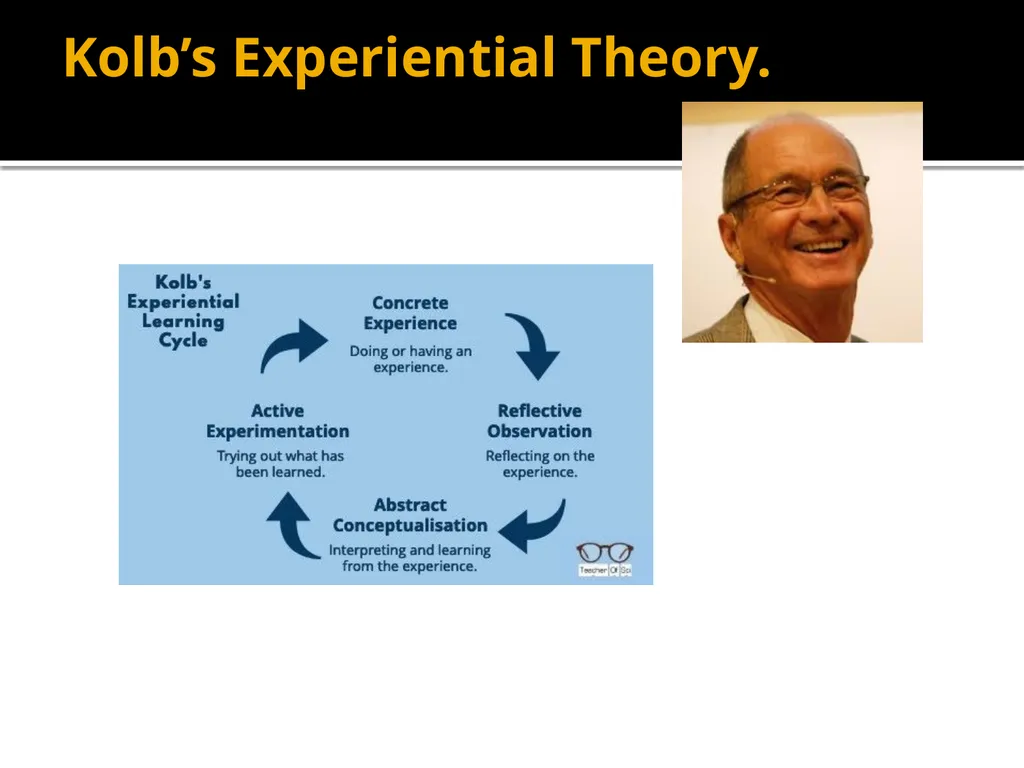
Kolb’s Experiential Theory.<br>
21
The Peter Principle Unconscious Incompetence. Not knowing how to do a task without knowing you don’t know.
Conscious Incompetence. You still don’t know how to do the task but now you know you don’t know. You are aware of a gap in your knowledge.
Conscious Competence. You can now do the task but it requires a lot of concentration.
Unconscious Competence. You can perform the task with ease. This is achieved by repeated practice.<br>
Conscious Incompetence. You still don’t know how to do the task but now you know you don’t know. You are aware of a gap in your knowledge.
Conscious Competence. You can now do the task but it requires a lot of concentration.
Unconscious Competence. You can perform the task with ease. This is achieved by repeated practice.<br>
22
Laird’s Sensory Theory He quoted research that found that 75% of an adult’s knowledge was obtained by seeing. 13% was through hearing, the remaining 12% was learned through touch, smell and taste combined.<br>
23
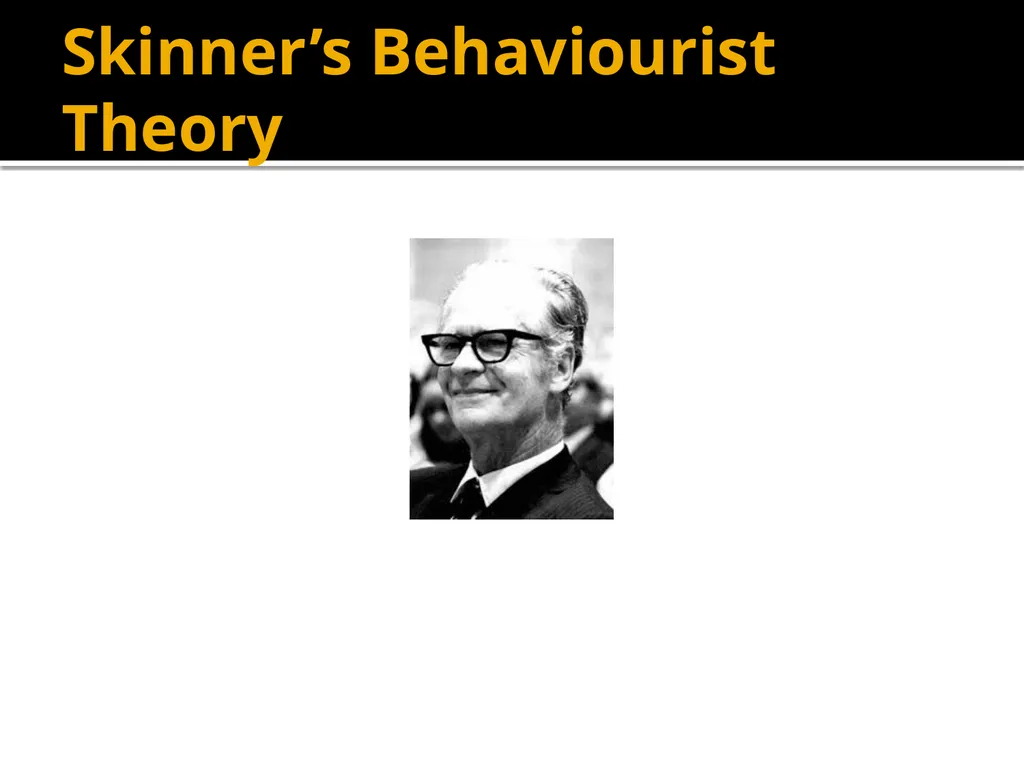
Skinner’s Behaviourist Theory<br>
24
From a classroom management perspective, positive reinforcement is an essential strategy for teaching students how to act and conduct themselves.
Positive reinforcement (e.g. praise) should be given for behaviours that are desirable<br>
Positive reinforcement (e.g. praise) should be given for behaviours that are desirable<br>
25
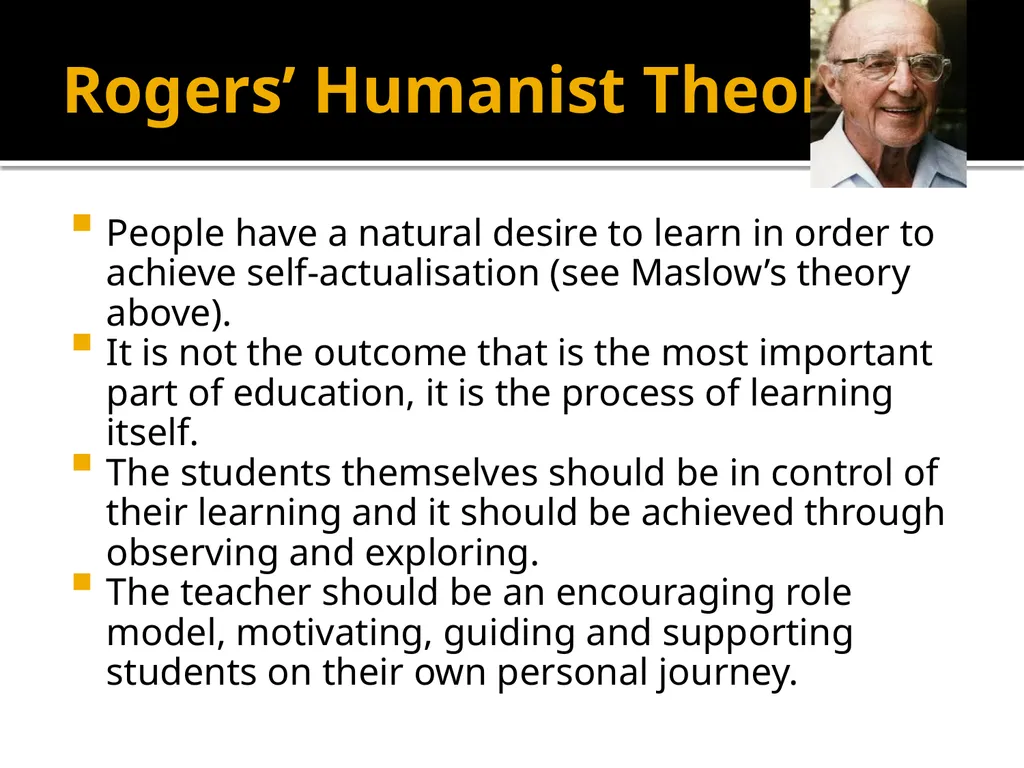
Rogers’ Humanist Theory People have a natural desire to learn in order to achieve self-actualisation (see Maslow’s theory above).
It is not the outcome that is the most important part of education, it is the process of learning itself.
The students themselves should be in control of their learning and it should be achieved through observing and exploring.
The teacher should be an encouraging role model, motivating, guiding and supporting students on their own personal journey.<br>
It is not the outcome that is the most important part of education, it is the process of learning itself.
The students themselves should be in control of their learning and it should be achieved through observing and exploring.
The teacher should be an encouraging role model, motivating, guiding and supporting students on their own personal journey.<br>
26
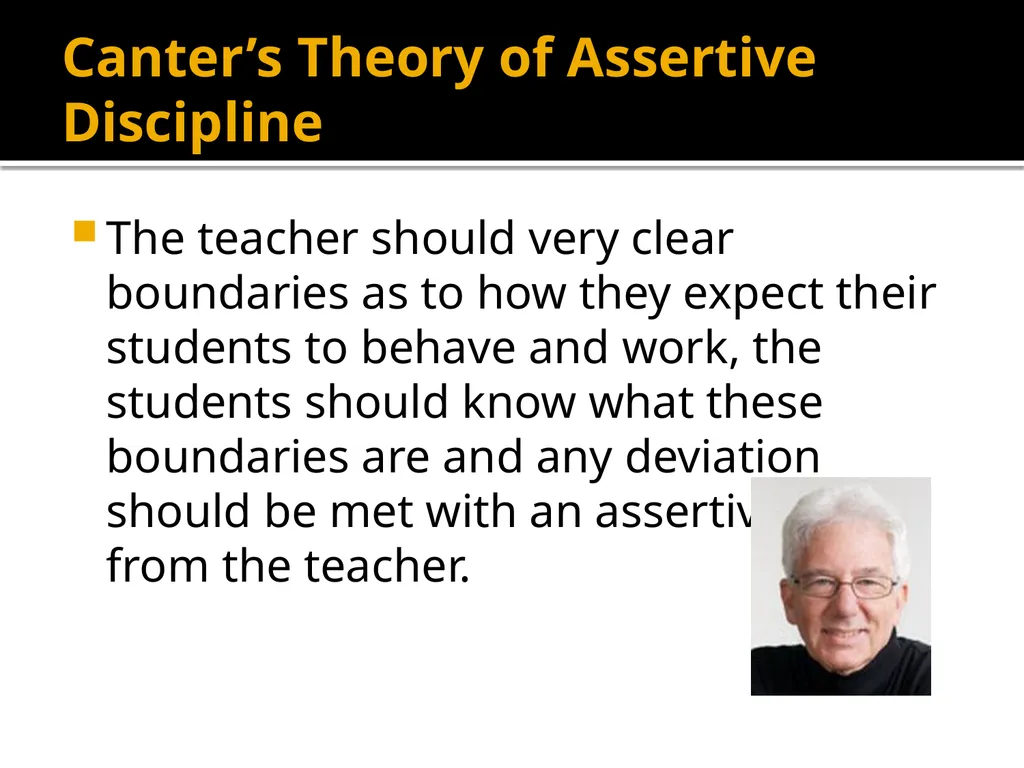
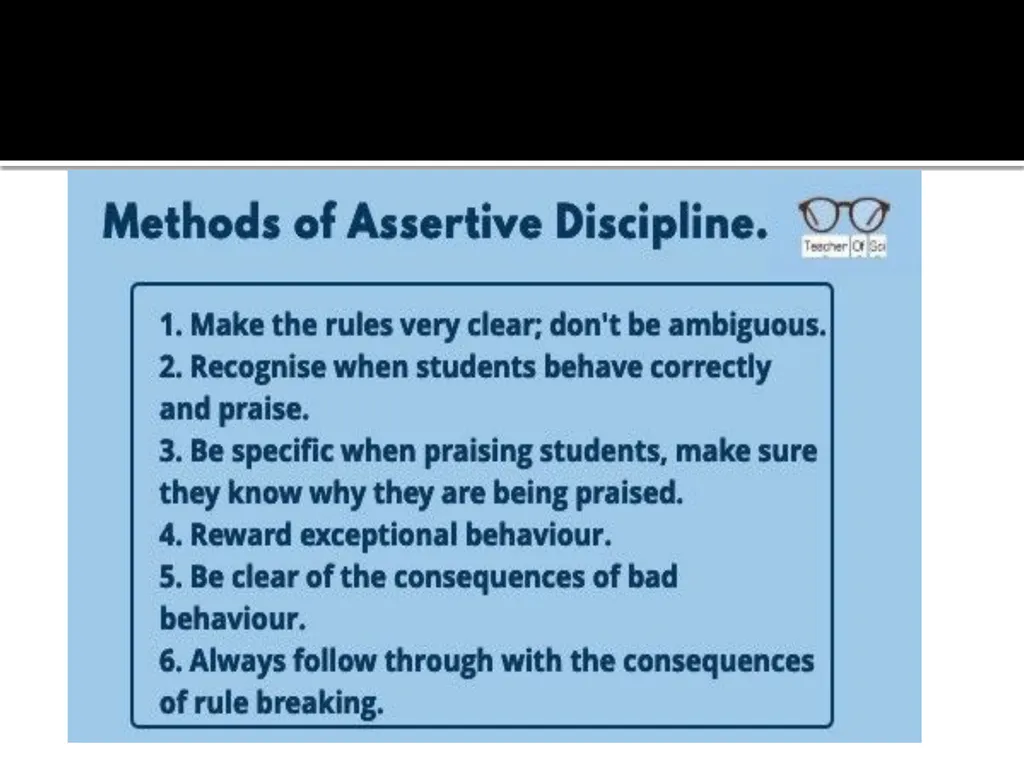
Canter’s Theory of Assertive Discipline The teacher should very clear boundaries as to how they expect their students to behave and work, the students should know what these boundaries are and any deviation should be met with an assertive action from the teacher.<br>
27
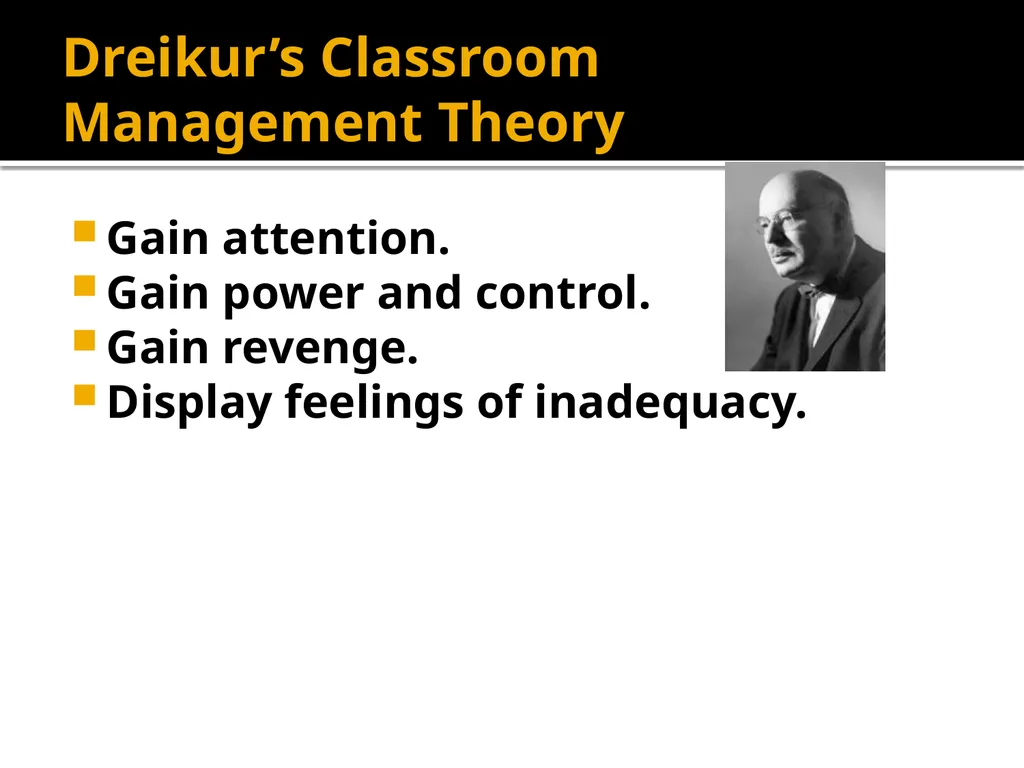
Dreikur’s Classroom Management Theory Gain attention.
Gain power and control.
Gain revenge.
Display feelings of inadequacy.<br>
Gain power and control.
Gain revenge.
Display feelings of inadequacy.<br>
28
References Agarwal.J.C.(2010).Essentials of Educational Technology.New Delhi: Vikas Publishing House Private Limited.
Anderson., Ball.S.,&Murphy.T.(1976).Encyclopedia of Educational Evaluation.London: Jossey Bass.
Askell-Williams, H., Lawson, M.J.,&Skrzpiec, G.(2011).Scaffolding Cognitive and Metacognitive Strategy. Instruction in the regular classroom.Instructional Science.40,413-443.
Ausubel.D.P.(1968).Educational Psychology: A Cognitive View.New York: Holt, Rinehart and Winston, Inc.<br>
Anderson., Ball.S.,&Murphy.T.(1976).Encyclopedia of Educational Evaluation.London: Jossey Bass.
Askell-Williams, H., Lawson, M.J.,&Skrzpiec, G.(2011).Scaffolding Cognitive and Metacognitive Strategy. Instruction in the regular classroom.Instructional Science.40,413-443.
Ausubel.D.P.(1968).Educational Psychology: A Cognitive View.New York: Holt, Rinehart and Winston, Inc.<br>