Dr. Seppo Virtanen, Professor, Faculty of Engineering Sciences Research and teaching interests: Reliability Engineering, Maintenance and Asset Management Probabilistic Risk Assessment and Management b. 1953 Since 1996 prof Virtanens
"Dr. Seppo Virtanen, Professor, Faculty of" is the property of its rightful owner. Permission is granted to
download and print the materials on this website for personal, non-commercial use only, and to display it
on your personal computer provided you do not modify the materials and that you retain all copyright
notices contained in the materials. By downloading content from our website, you accept the terms of this
agreement.
Presentation Transcript
01
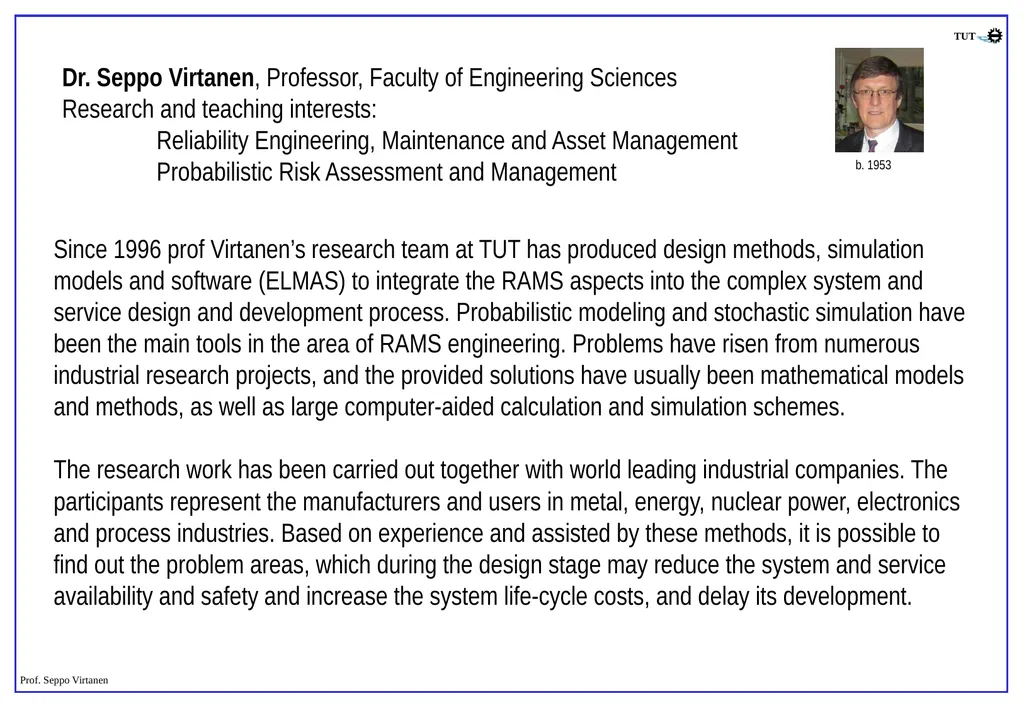
Dr. Seppo Virtanen, Professor, Faculty of Engineering Sciences
Research and teaching interests: Reliability Engineering, Maintenance and Asset Management
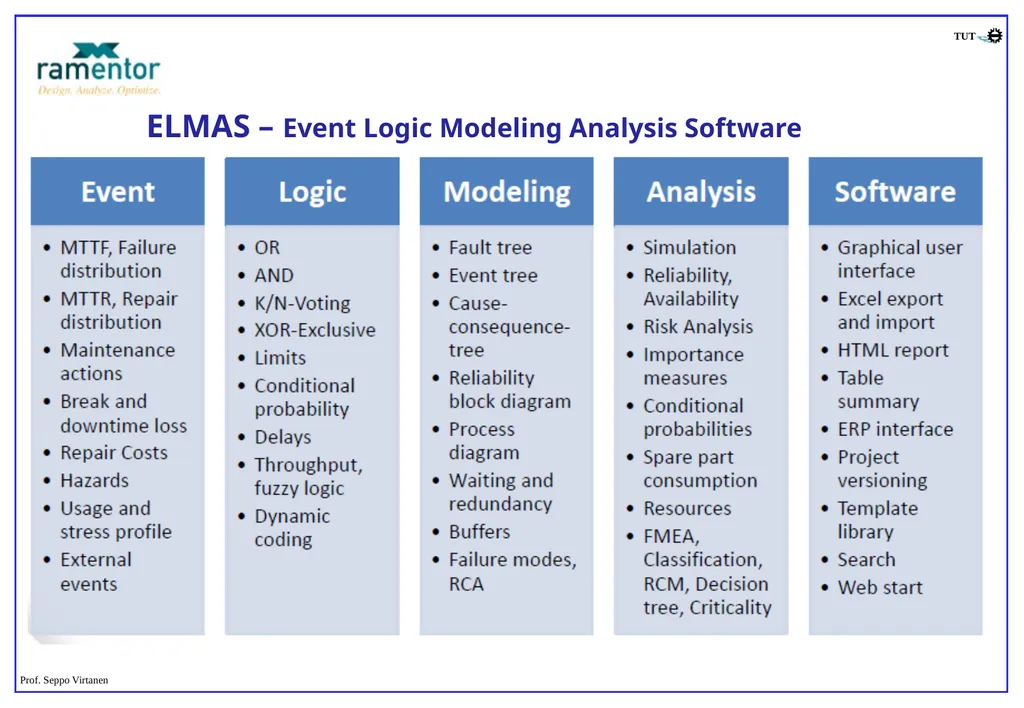
Probabilistic Risk Assessment and Management b. 1953 Since 1996 prof Virtanen’s research team at TUT has produced design methods, simulation models and software (ELMAS) to integrate the RAMS aspects into the complex system and service design and development process. Probabilistic modeling and stochastic simulation have been the main tools in the area of RAMS engineering. Problems have risen from numerous industrial research projects, and the provided solutions have usually been mathematical models and methods, as well as large computer-aided calculation and simulation schemes.
The research work has been carried out together with world leading industrial companies. The participants represent the manufacturers and users in metal, energy, nuclear power, electronics and process industries. Based on experience and assisted by these methods, it is possible to find out the problem areas, which during the design stage may reduce the system and service availability and safety and increase the system life-cycle costs, and delay its development.<br>
02
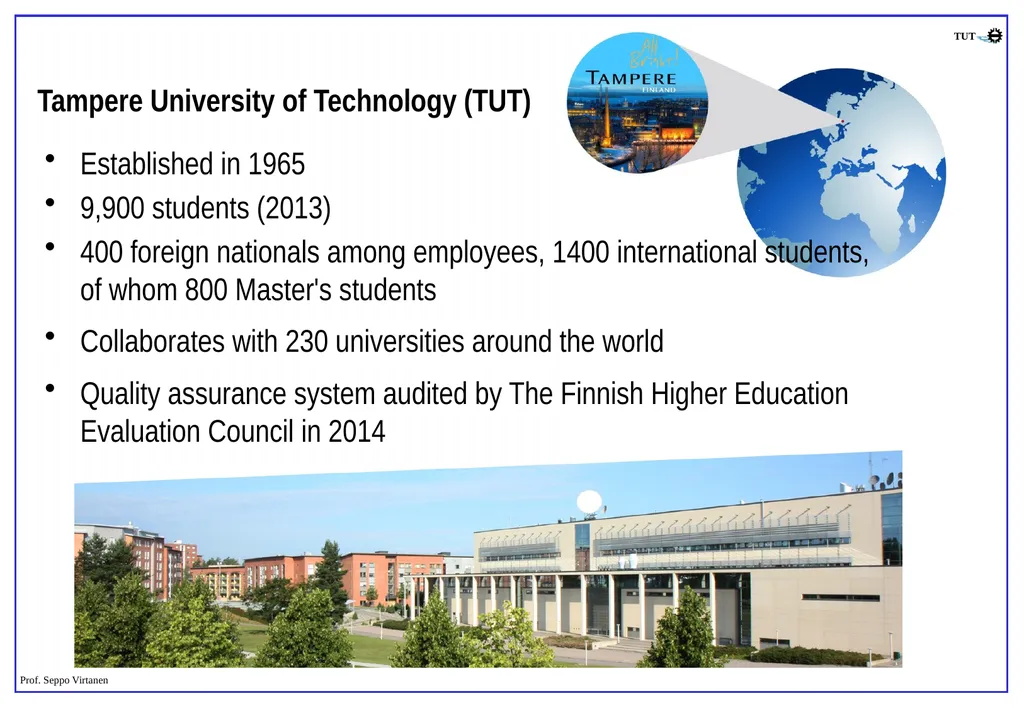
Established in 1965
9,900 students (2013)
400 foreign nationals among employees, 1400 international students, of whom 800 Master's students
Collaborates with 230 universities around the world
Quality assurance system audited by The Finnish Higher Education Evaluation Council in 2014 Tampere University of Technology (TUT)<br>
03
"Reliability, availability, maintainability and safety for FCC"
Objectives: (according to the draft ADDENDUM FCC-GOV-CC-0003 (EDMS 1390679, Peter Sollander and Johannes Gutleber)
1) Carry out RAMS study for the critical Large Hadron Collider (LHC) system
2) Establish the definitions of RAMS-terminology and key performance indicators to be used in the Future Circular Collider (FCC) study. Establish a reference catalogue of processes, methods and tools that should be applied to study and assess RAMS requirements and performance of systems, structures and components of the FCC.
3) Instruct CERN system experts in best practices of applying the established methods, tools and guidelines to study and assess their systems’ RAMS requirements and performance in the FCC study.
4) Carry out a case study to apply the recommended methods and tools in the critical FCC system and assess the RAMS feasibility for large-scale science projects.<br>
04
"Reliability, availability, maintainability and safety for FCC”
Resources:
TUT: Three-doctoral research assistant FTE for the collaboration during the same period, together and under the guidance of Prof. Virtanen 50% FTE.
Arto Niemi: Applied mechanics, methods and tools for intelligent interpretation of system operation and maintenance data. Java programming and data bases.
Jussi-Pekka Penttinen: Event Logic Modeling and Analysis Software used for quantitative risk assessment, maintenance optimization and analysis of RAMS based on stochastic discrete event simulation.
Douzi Imran Khan: Development of RAMS methods and design models for the management and development of large scale accelerator system's RAMS characteristics.
CERN: 50% of post-doc level FTE, to assist the TUT team and ensure a good collaboration with CERN.<br>
05
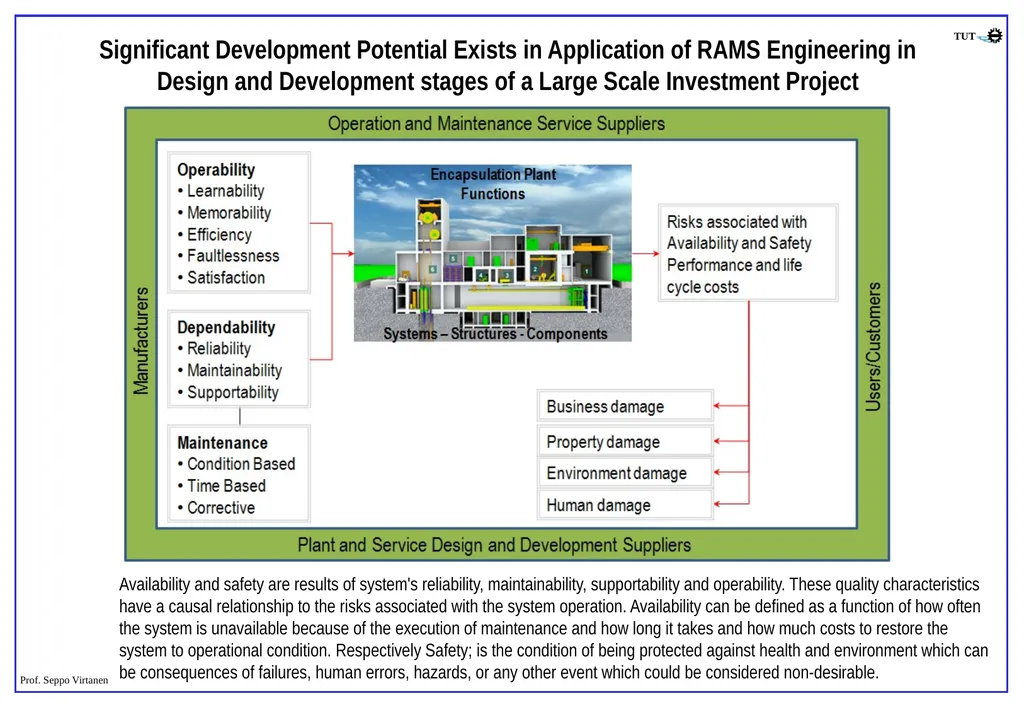
Availability and safety are results of system's reliability, maintainability, supportability and operability. These quality characteristics have a causal relationship to the risks associated with the system operation. Availability can be defined as a function of how often the system is unavailable because of the execution of maintenance and how long it takes and how much costs to restore the system to operational condition. Respectively Safety; is the condition of being protected against health and environment which can be consequences of failures, human errors, hazards, or any other event which could be considered non-desirable. Significant Development Potential Exists in Application of RAMS Engineering in Design and Development stages of a Large Scale Investment Project<br>
06
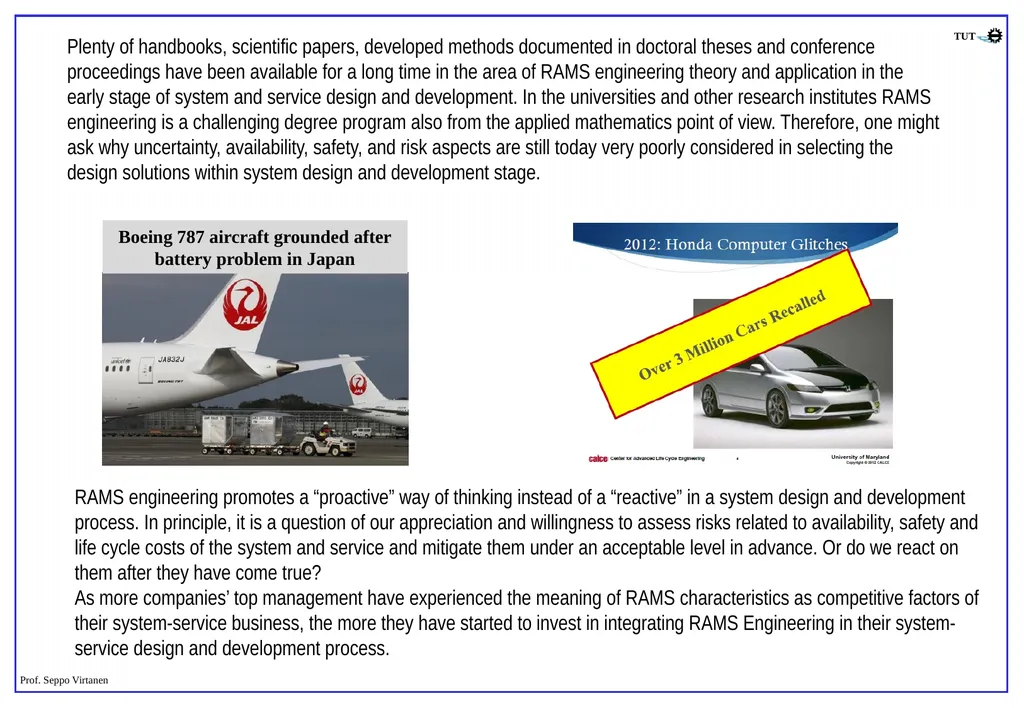
RAMS engineering promotes a “proactive” way of thinking instead of a “reactive” in a system design and development process. In principle, it is a question of our appreciation and willingness to assess risks related to availability, safety and life cycle costs of the system and service and mitigate them under an acceptable level in advance. Or do we react on them after they have come true?
As more companies’ top management have experienced the meaning of RAMS characteristics as competitive factors of their system-service business, the more they have started to invest in integrating RAMS Engineering in their system-service design and development process. Plenty of handbooks, scientific papers, developed methods documented in doctoral theses and conference proceedings have been available for a long time in the area of RAMS engineering theory and application in the early stage of system and service design and development. In the universities and other research institutes RAMS engineering is a challenging degree program also from the applied mathematics point of view. Therefore, one might ask why uncertainty, availability, safety, and risk aspects are still today very poorly considered in selecting the design solutions within system design and development stage. Boeing 787 aircraft grounded after battery problem in Japan<br>