
DSP Dynamic Asset Allocation Fund Defends Against
PT
Published · 19 slides · 0 views
1 / 1



Description
DSP Dynamic Asset Allocation Fund Defends Against Volatility This document is dated 27 Nov 2025 An open ended dynamic asset allocation fund Equity Debt What Is DSP Dynamic Asset Allocation Fund? Fixed Income allocation can help to Earn
Related Topics
Share
Embed code
Download this presentation From Below
"DSP Dynamic Asset Allocation Fund Defends Against" is the property of its rightful owner. Permission is granted to download and print the materials on this website for personal, non-commercial use only, and to display it on your personal computer provided you do not modify the materials and that you retain all copyright notices contained in the materials. By downloading content from our website, you accept the terms of this agreement.
Presentation Transcript
01
DSP Dynamic Asset Allocation Fund Defends Against Volatility This document is dated 27 Nov 2025 An open ended dynamic asset allocation fund Equity Debt<br>
02
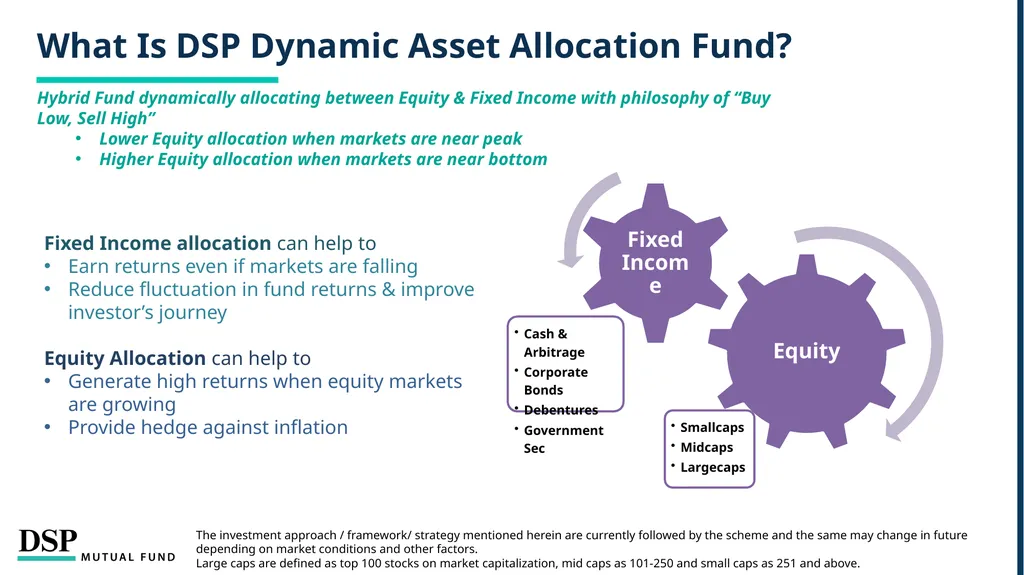
What Is DSP Dynamic Asset Allocation Fund? Fixed Income allocation can help to
Earn returns even if markets are falling
Reduce fluctuation in fund returns & improve investor’s journey
Equity Allocation can help to
Generate high returns when equity markets are growing
Provide hedge against inflation The investment approach / framework/ strategy mentioned herein are currently followed by the scheme and the same may change in future depending on market conditions and other factors.
Large caps are defined as top 100 stocks on market capitalization, mid caps as 101-250 and small caps as 251 and above. Hybrid Fund dynamically allocating between Equity & Fixed Income with philosophy of “Buy Low, Sell High”
Lower Equity allocation when markets are near peak
Higher Equity allocation when markets are near bottom<br>
Earn returns even if markets are falling
Reduce fluctuation in fund returns & improve investor’s journey
Equity Allocation can help to
Generate high returns when equity markets are growing
Provide hedge against inflation The investment approach / framework/ strategy mentioned herein are currently followed by the scheme and the same may change in future depending on market conditions and other factors.
Large caps are defined as top 100 stocks on market capitalization, mid caps as 101-250 and small caps as 251 and above. Hybrid Fund dynamically allocating between Equity & Fixed Income with philosophy of “Buy Low, Sell High”
Lower Equity allocation when markets are near peak
Higher Equity allocation when markets are near bottom<br>
03
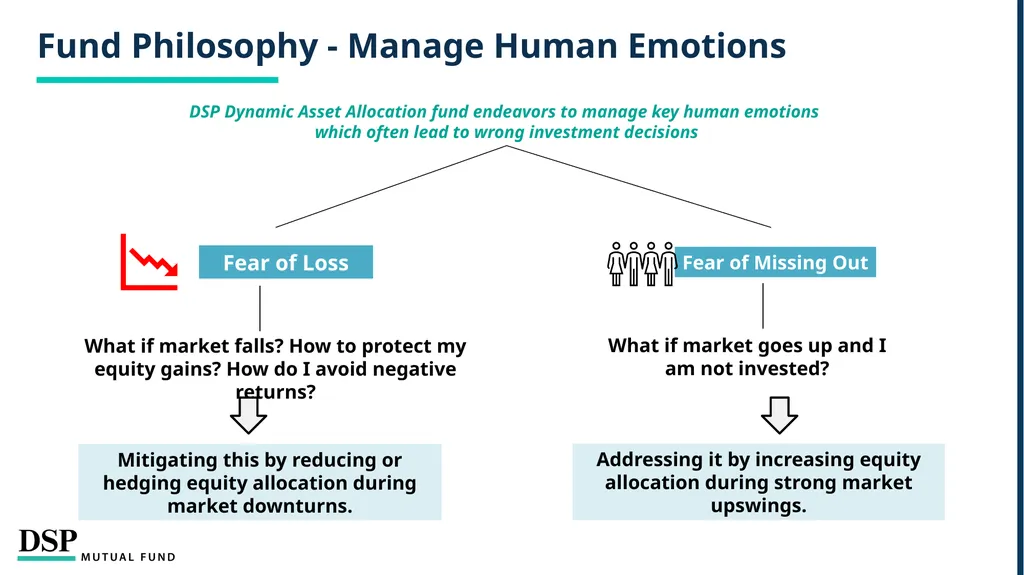
Fund Philosophy - Manage Human Emotions Fear of Loss Fear of Missing Out DSP Dynamic Asset Allocation fund endeavors to manage key human emotions
which often lead to wrong investment decisions What if market falls? How to protect my equity gains? How do I avoid negative returns? Addressing it by increasing equity allocation during strong market upswings. Mitigating this by reducing or hedging equity allocation during market downturns. What if market goes up and I am not invested?<br>
04
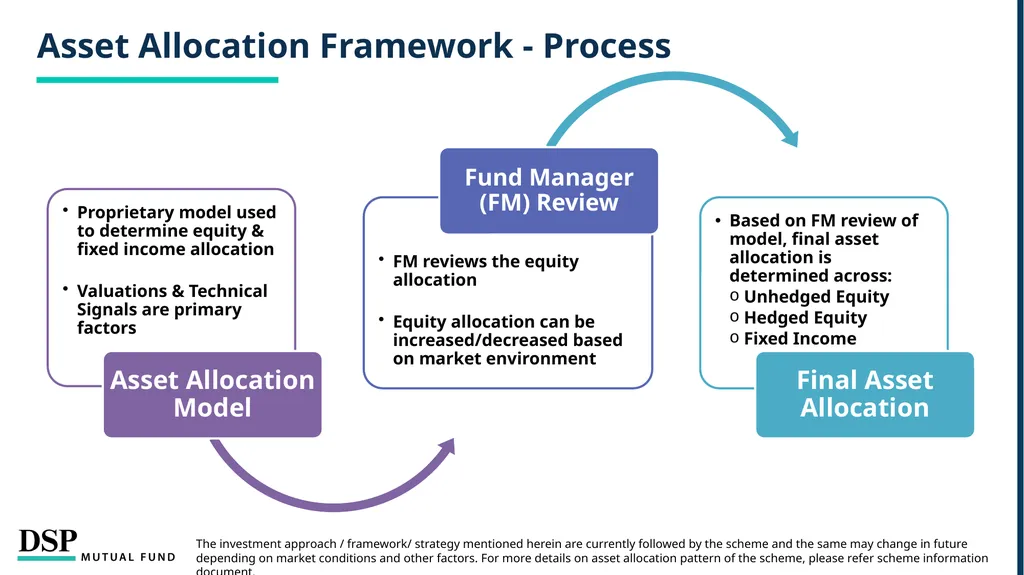
Asset Allocation Framework - Process The investment approach / framework/ strategy mentioned herein are currently followed by the scheme and the same may change in future depending on market conditions and other factors. For more details on asset allocation pattern of the scheme, please refer scheme information document.<br>
05
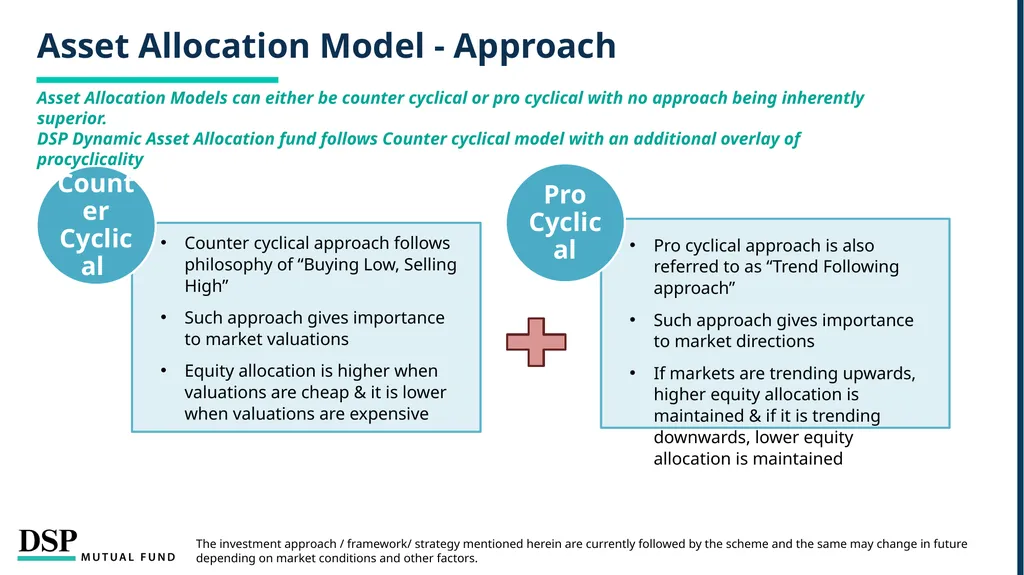
Asset Allocation Model - Approach Counter cyclical approach follows philosophy of “Buying Low, Selling High”
Such approach gives importance to market valuations
Equity allocation is higher when valuations are cheap & it is lower when valuations are expensive Counter Cyclical Pro cyclical approach is also referred to as “Trend Following approach”
Such approach gives importance to market directions
If markets are trending upwards, higher equity allocation is maintained & if it is trending downwards, lower equity allocation is maintained Pro Cyclical The investment approach / framework/ strategy mentioned herein are currently followed by the scheme and the same may change in future depending on market conditions and other factors. Asset Allocation Models can either be counter cyclical or pro cyclical with no approach being inherently superior.
DSP Dynamic Asset Allocation fund follows Counter cyclical model with an additional overlay of procyclicality<br>
Such approach gives importance to market valuations
Equity allocation is higher when valuations are cheap & it is lower when valuations are expensive Counter Cyclical Pro cyclical approach is also referred to as “Trend Following approach”
Such approach gives importance to market directions
If markets are trending upwards, higher equity allocation is maintained & if it is trending downwards, lower equity allocation is maintained Pro Cyclical The investment approach / framework/ strategy mentioned herein are currently followed by the scheme and the same may change in future depending on market conditions and other factors. Asset Allocation Models can either be counter cyclical or pro cyclical with no approach being inherently superior.
DSP Dynamic Asset Allocation fund follows Counter cyclical model with an additional overlay of procyclicality<br>
06
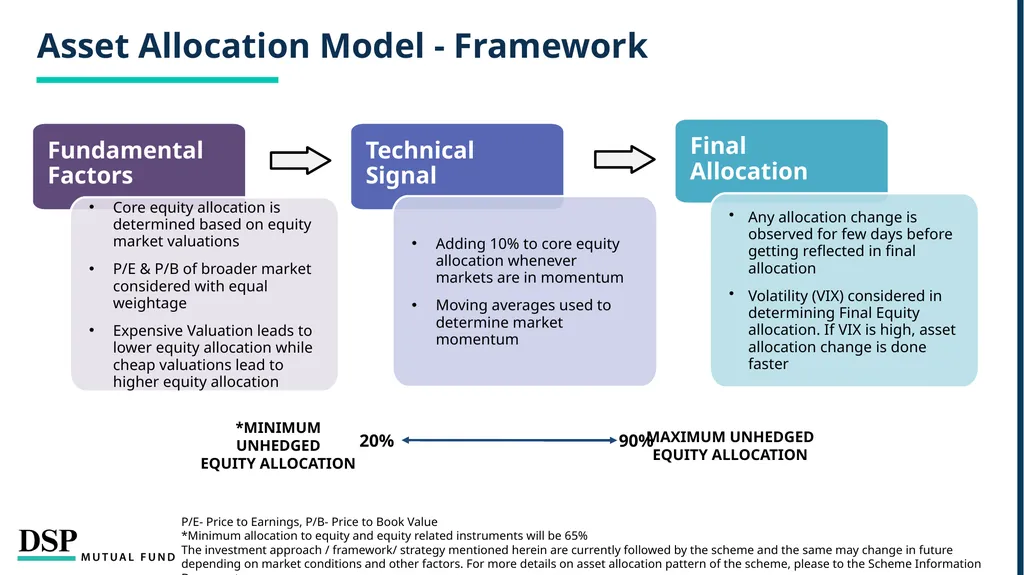
Asset Allocation Model - Framework MAXIMUM UNHEDGED
EQUITY ALLOCATION *MINIMUM UNHEDGED
EQUITY ALLOCATION 20% 90% Fundamental Factors Core equity allocation is determined based on equity market valuations
P/E & P/B of broader market considered with equal weightage
Expensive Valuation leads to lower equity allocation while cheap valuations lead to higher equity allocation Technical Signal Adding 10% to core equity allocation whenever markets are in momentum
Moving averages used to determine market momentum Final Allocation Any allocation change is observed for few days before getting reflected in final allocation
Volatility (VIX) considered in determining Final Equity allocation. If VIX is high, asset allocation change is done faster P/E- Price to Earnings, P/B- Price to Book Value
*Minimum allocation to equity and equity related instruments will be 65%
The investment approach / framework/ strategy mentioned herein are currently followed by the scheme and the same may change in future depending on market conditions and other factors. For more details on asset allocation pattern of the scheme, please to the Scheme Information Document<br>
EQUITY ALLOCATION *MINIMUM UNHEDGED
EQUITY ALLOCATION 20% 90% Fundamental Factors Core equity allocation is determined based on equity market valuations
P/E & P/B of broader market considered with equal weightage
Expensive Valuation leads to lower equity allocation while cheap valuations lead to higher equity allocation Technical Signal Adding 10% to core equity allocation whenever markets are in momentum
Moving averages used to determine market momentum Final Allocation Any allocation change is observed for few days before getting reflected in final allocation
Volatility (VIX) considered in determining Final Equity allocation. If VIX is high, asset allocation change is done faster P/E- Price to Earnings, P/B- Price to Book Value
*Minimum allocation to equity and equity related instruments will be 65%
The investment approach / framework/ strategy mentioned herein are currently followed by the scheme and the same may change in future depending on market conditions and other factors. For more details on asset allocation pattern of the scheme, please to the Scheme Information Document<br>
07
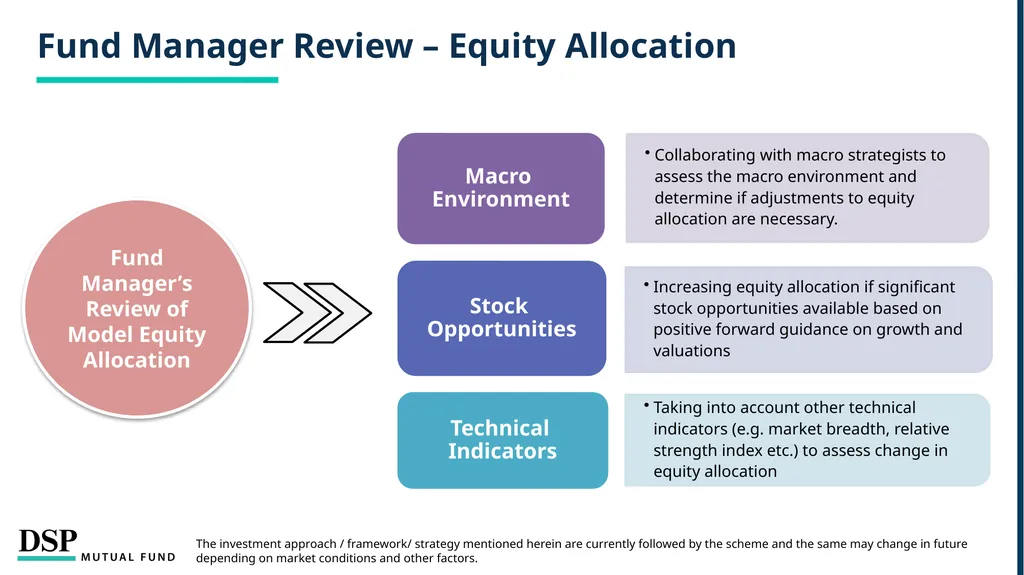
Fund Manager Review – Equity Allocation Fund Manager’s Review of Model Equity Allocation The investment approach / framework/ strategy mentioned herein are currently followed by the scheme and the same may change in future depending on market conditions and other factors.<br>
08
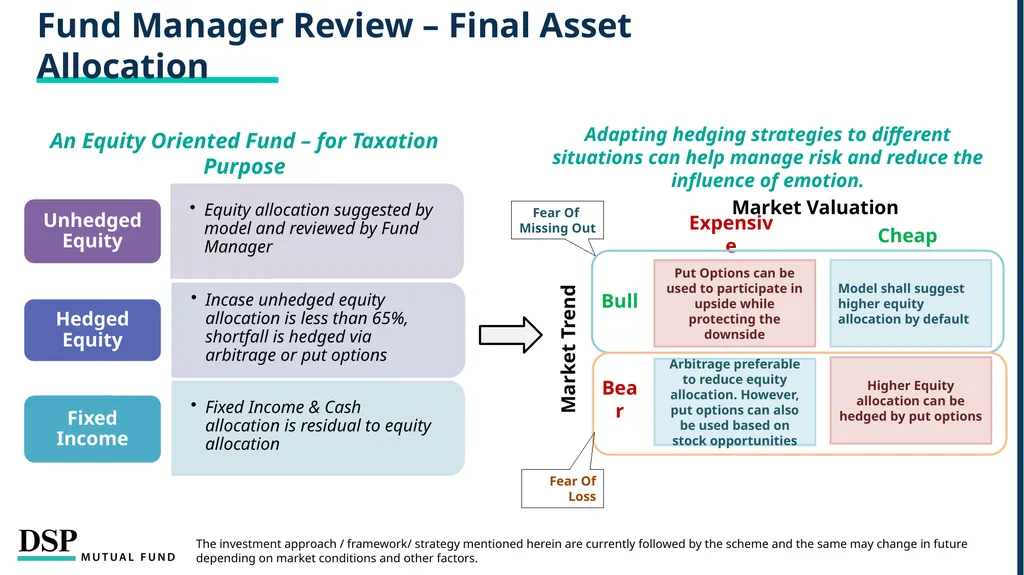
Fund Manager Review – Final Asset Allocation Market Valuation Market Trend Expensive Cheap Bull Bear The investment approach / framework/ strategy mentioned herein are currently followed by the scheme and the same may change in future depending on market conditions and other factors. Put Options can be used to participate in upside while protecting the downside Model shall suggest higher equity allocation by default Arbitrage preferable to reduce equity allocation. However, put options can also be used based on stock opportunities Higher Equity allocation can be hedged by put options An Equity Oriented Fund – for Taxation Purpose Adapting hedging strategies to different situations can help manage risk and reduce the influence of emotion. Fear Of
Missing Out Fear Of Loss<br>
09
Investment Team & Philosophy<br>
10
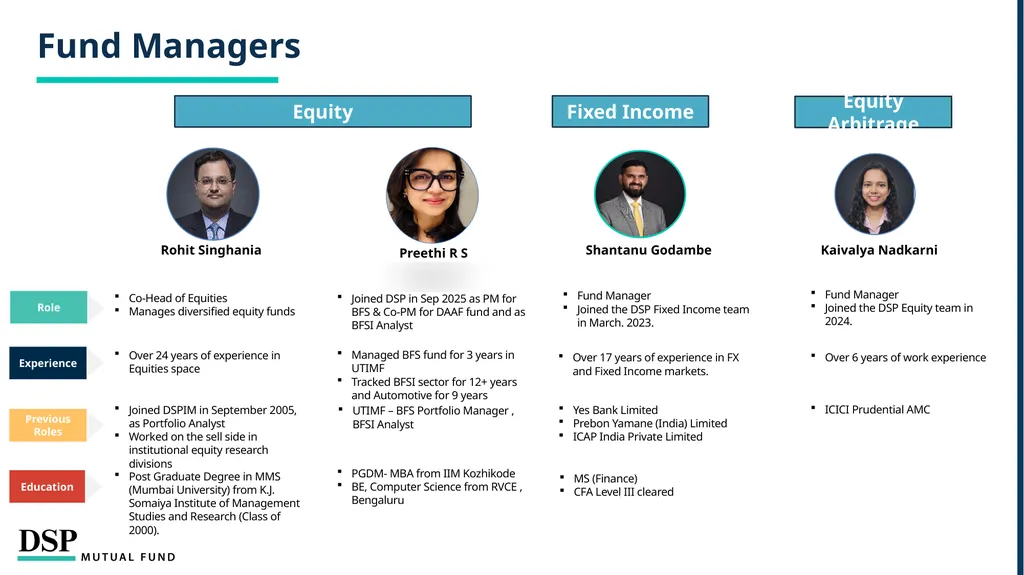
Fund Managers Co-Head of Equities
Manages diversified equity funds Over 24 years of experience in Equities space Joined DSPIM in September 2005, as Portfolio Analyst
Worked on the sell side in institutional equity research divisions Post Graduate Degree in MMS (Mumbai University) from K.J. Somaiya Institute of Management Studies and Research (Class of 2000). Rohit Singhania Joined DSP in Sep 2025 as PM for BFS & Co-PM for DAAF fund and as BFSI Analyst Managed BFS fund for 3 years in UTIMF
Tracked BFSI sector for 12+ years and Automotive for 9 years UTIMF – BFS Portfolio Manager , BFSI Analyst PGDM- MBA from IIM Kozhikode
BE, Computer Science from RVCE , Bengaluru Preethi R S Fund Manager
Joined the DSP Fixed Income team in March. 2023. Over 17 years of experience in FX and Fixed Income markets. Yes Bank Limited
Prebon Yamane (India) Limited
ICAP India Private Limited MS (Finance)
CFA Level III cleared Shantanu Godambe Kaivalya Nadkarni Fund Manager
Joined the DSP Equity team in 2024. Over 6 years of work experience ICICI Prudential AMC Equity Fixed Income Equity Arbitrage<br>
Manages diversified equity funds Over 24 years of experience in Equities space Joined DSPIM in September 2005, as Portfolio Analyst
Worked on the sell side in institutional equity research divisions Post Graduate Degree in MMS (Mumbai University) from K.J. Somaiya Institute of Management Studies and Research (Class of 2000). Rohit Singhania Joined DSP in Sep 2025 as PM for BFS & Co-PM for DAAF fund and as BFSI Analyst Managed BFS fund for 3 years in UTIMF
Tracked BFSI sector for 12+ years and Automotive for 9 years UTIMF – BFS Portfolio Manager , BFSI Analyst PGDM- MBA from IIM Kozhikode
BE, Computer Science from RVCE , Bengaluru Preethi R S Fund Manager
Joined the DSP Fixed Income team in March. 2023. Over 17 years of experience in FX and Fixed Income markets. Yes Bank Limited
Prebon Yamane (India) Limited
ICAP India Private Limited MS (Finance)
CFA Level III cleared Shantanu Godambe Kaivalya Nadkarni Fund Manager
Joined the DSP Equity team in 2024. Over 6 years of work experience ICICI Prudential AMC Equity Fixed Income Equity Arbitrage<br>
11
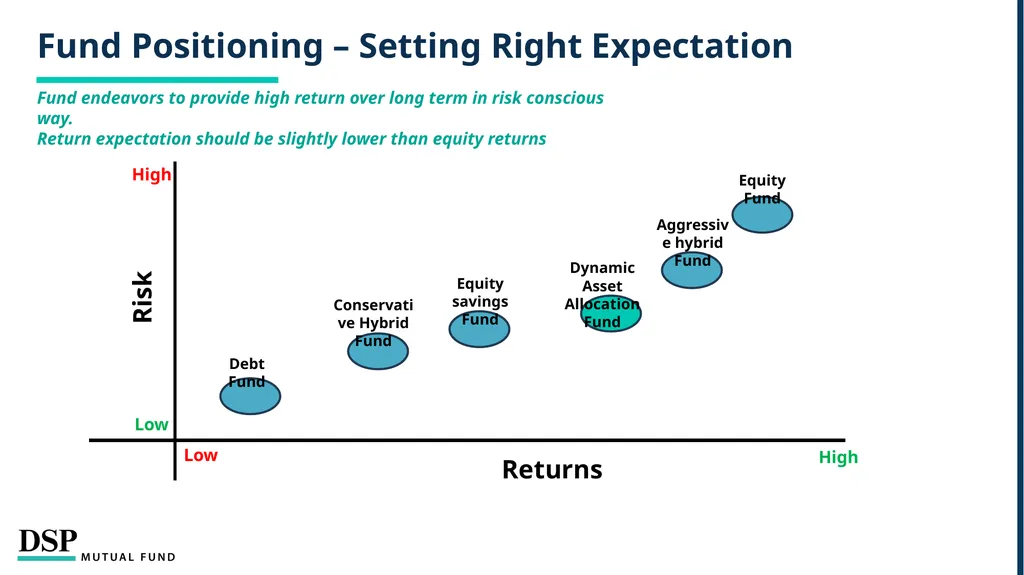
Fund Positioning – Setting Right Expectation Fund endeavors to provide high return over long term in risk conscious way.
Return expectation should be slightly lower than equity returns Returns Risk Low High Low High Conservative Hybrid Fund Debt Fund Equity savings Fund Dynamic Asset Allocation Fund Aggressive hybrid Fund Equity Fund<br>
Return expectation should be slightly lower than equity returns Returns Risk Low High Low High Conservative Hybrid Fund Debt Fund Equity savings Fund Dynamic Asset Allocation Fund Aggressive hybrid Fund Equity Fund<br>
12
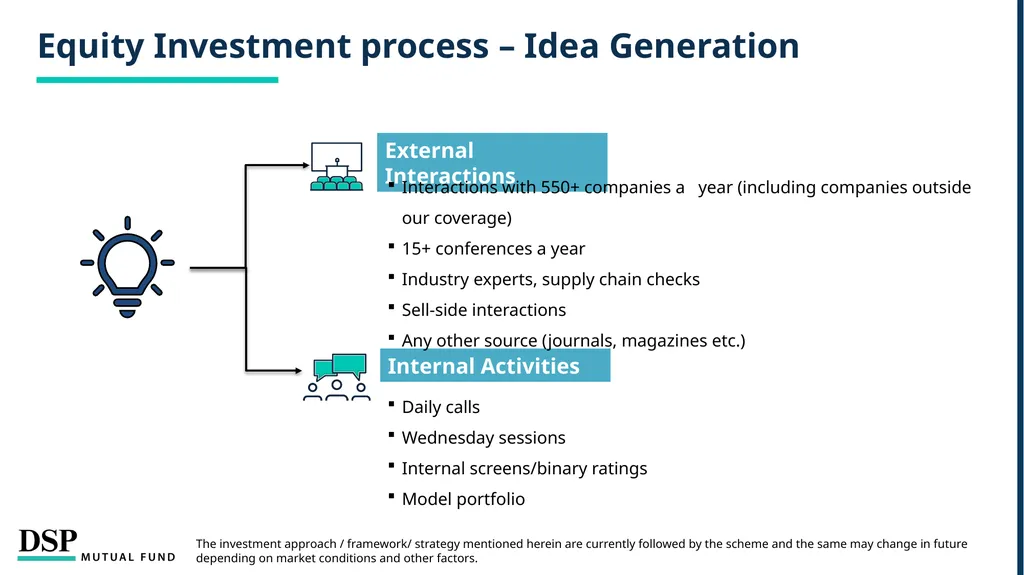
Equity Investment process – Idea Generation External Interactions Internal Activities Interactions with 550+ companies a year (including companies outside our coverage)
15+ conferences a year
Industry experts, supply chain checks
Sell-side interactions
Any other source (journals, magazines etc.) Daily calls
Wednesday sessions
Internal screens/binary ratings
Model portfolio The investment approach / framework/ strategy mentioned herein are currently followed by the scheme and the same may change in future depending on market conditions and other factors.<br>
15+ conferences a year
Industry experts, supply chain checks
Sell-side interactions
Any other source (journals, magazines etc.) Daily calls
Wednesday sessions
Internal screens/binary ratings
Model portfolio The investment approach / framework/ strategy mentioned herein are currently followed by the scheme and the same may change in future depending on market conditions and other factors.<br>
13
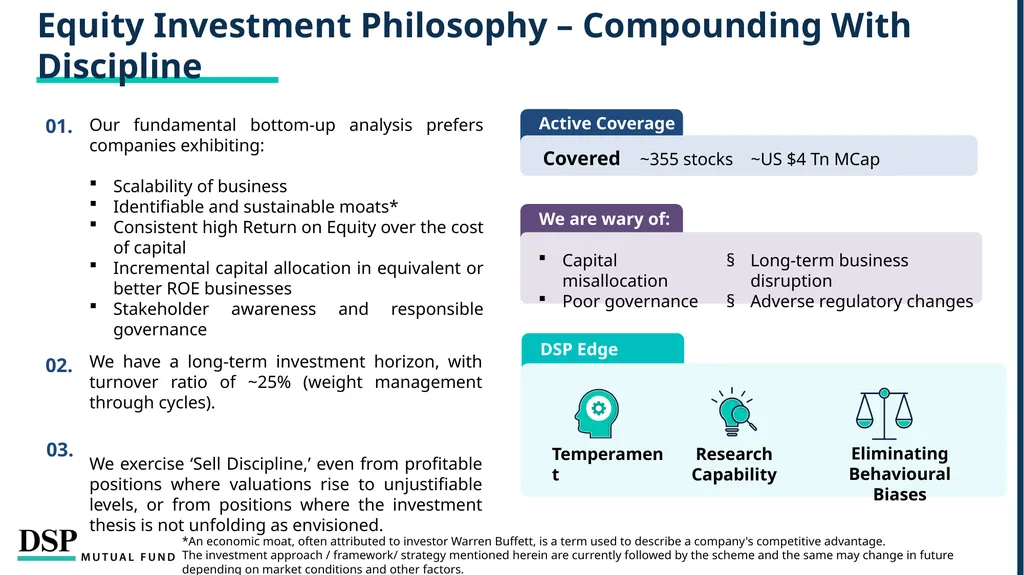
Equity Investment Philosophy – Compounding With Discipline We are wary of: Our fundamental bottom-up analysis prefers companies exhibiting:
Scalability of business
Identifiable and sustainable moats*
Consistent high Return on Equity over the cost of capital
Incremental capital allocation in equivalent or better ROE businesses
Stakeholder awareness and responsible governance We have a long-term investment horizon, with turnover ratio of ~25% (weight management through cycles).
We exercise ‘Sell Discipline,’ even from profitable positions where valuations rise to unjustifiable levels, or from positions where the investment thesis is not unfolding as envisioned. Temperament Research Capability Eliminating Behavioural Biases Active Coverage Covered ~355 stocks ~US $4 Tn MCap DSP Edge 01. 02. 03. *An economic moat, often attributed to investor Warren Buffett, is a term used to describe a company's competitive advantage.
The investment approach / framework/ strategy mentioned herein are currently followed by the scheme and the same may change in future depending on market conditions and other factors.<br>
Scalability of business
Identifiable and sustainable moats*
Consistent high Return on Equity over the cost of capital
Incremental capital allocation in equivalent or better ROE businesses
Stakeholder awareness and responsible governance We have a long-term investment horizon, with turnover ratio of ~25% (weight management through cycles).
We exercise ‘Sell Discipline,’ even from profitable positions where valuations rise to unjustifiable levels, or from positions where the investment thesis is not unfolding as envisioned. Temperament Research Capability Eliminating Behavioural Biases Active Coverage Covered ~355 stocks ~US $4 Tn MCap DSP Edge 01. 02. 03. *An economic moat, often attributed to investor Warren Buffett, is a term used to describe a company's competitive advantage.
The investment approach / framework/ strategy mentioned herein are currently followed by the scheme and the same may change in future depending on market conditions and other factors.<br>
14
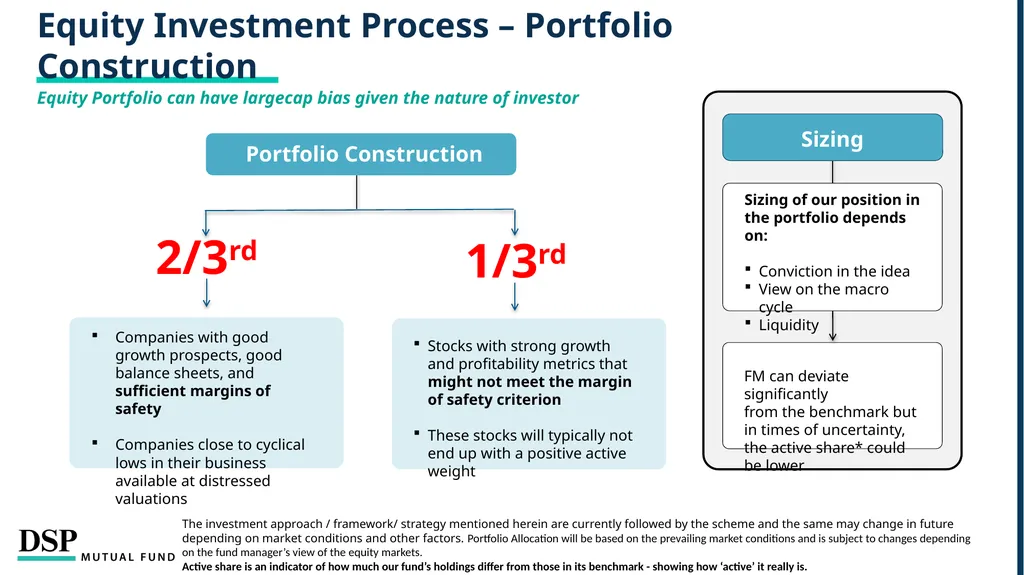
Equity Investment Process – Portfolio Construction Portfolio Construction Sizing Companies with good growth prospects, good balance sheets, and sufficient margins of safety
Companies close to cyclical lows in their business available at distressed valuations Stocks with strong growth and profitability metrics that might not meet the margin of safety criterion
These stocks will typically not end up with a positive active weight Sizing of our position in the portfolio depends on:
Conviction in the idea
View on the macro cycle
Liquidity FM can deviate significantly
from the benchmark but in times of uncertainty, the active share* could be lower 2/3rd 1/3rd The investment approach / framework/ strategy mentioned herein are currently followed by the scheme and the same may change in future depending on market conditions and other factors. Portfolio Allocation will be based on the prevailing market conditions and is subject to changes depending on the fund manager’s view of the equity markets.
Active share is an indicator of how much our fund’s holdings differ from those in its benchmark - showing how ‘active’ it really is. Equity Portfolio can have largecap bias given the nature of investor<br>
Companies close to cyclical lows in their business available at distressed valuations Stocks with strong growth and profitability metrics that might not meet the margin of safety criterion
These stocks will typically not end up with a positive active weight Sizing of our position in the portfolio depends on:
Conviction in the idea
View on the macro cycle
Liquidity FM can deviate significantly
from the benchmark but in times of uncertainty, the active share* could be lower 2/3rd 1/3rd The investment approach / framework/ strategy mentioned herein are currently followed by the scheme and the same may change in future depending on market conditions and other factors. Portfolio Allocation will be based on the prevailing market conditions and is subject to changes depending on the fund manager’s view of the equity markets.
Active share is an indicator of how much our fund’s holdings differ from those in its benchmark - showing how ‘active’ it really is. Equity Portfolio can have largecap bias given the nature of investor<br>
15
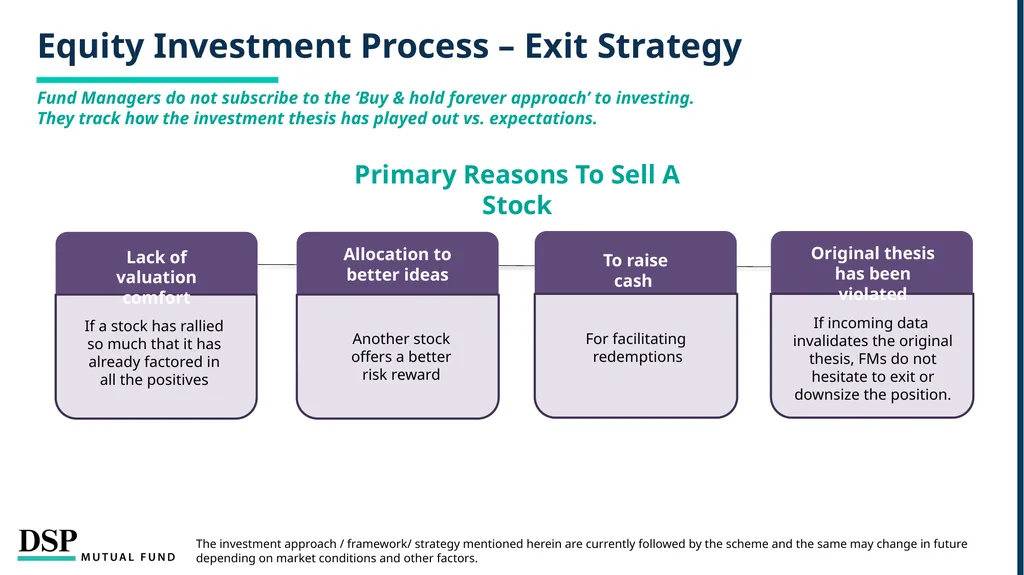
Equity Investment Process – Exit Strategy Lack of valuation
comfort If a stock has rallied so much that it has already factored in all the positives Allocation to
better ideas Another stock offers a better risk reward To raise cash For facilitating
redemptions Original thesis has been violated If incoming data invalidates the original thesis, FMs do not hesitate to exit or downsize the position. The investment approach / framework/ strategy mentioned herein are currently followed by the scheme and the same may change in future depending on market conditions and other factors. Fund Managers do not subscribe to the ‘Buy & hold forever approach’ to investing. They track how the investment thesis has played out vs. expectations. Primary Reasons To Sell A Stock<br>
comfort If a stock has rallied so much that it has already factored in all the positives Allocation to
better ideas Another stock offers a better risk reward To raise cash For facilitating
redemptions Original thesis has been violated If incoming data invalidates the original thesis, FMs do not hesitate to exit or downsize the position. The investment approach / framework/ strategy mentioned herein are currently followed by the scheme and the same may change in future depending on market conditions and other factors. Fund Managers do not subscribe to the ‘Buy & hold forever approach’ to investing. They track how the investment thesis has played out vs. expectations. Primary Reasons To Sell A Stock<br>
16
No restriction on nature of instrument provided issuer qualifies credit quality check Government Securities, Non convertible debentures, money market instruments etc. Short duration would be preferred considering conservative nature of the fund Dynamic Duration management based on interest rate cycles across shorter end of curve Fixed Income Philosophy Credit Quality Duration Instrument High rated credit instrument considering conservative nature of the fund AA+ & above rated instruments including Sovereign securities The investment approach / framework/ strategy mentioned herein are currently followed by the scheme and the same may change in future depending on market conditions and other factors.<br>
17
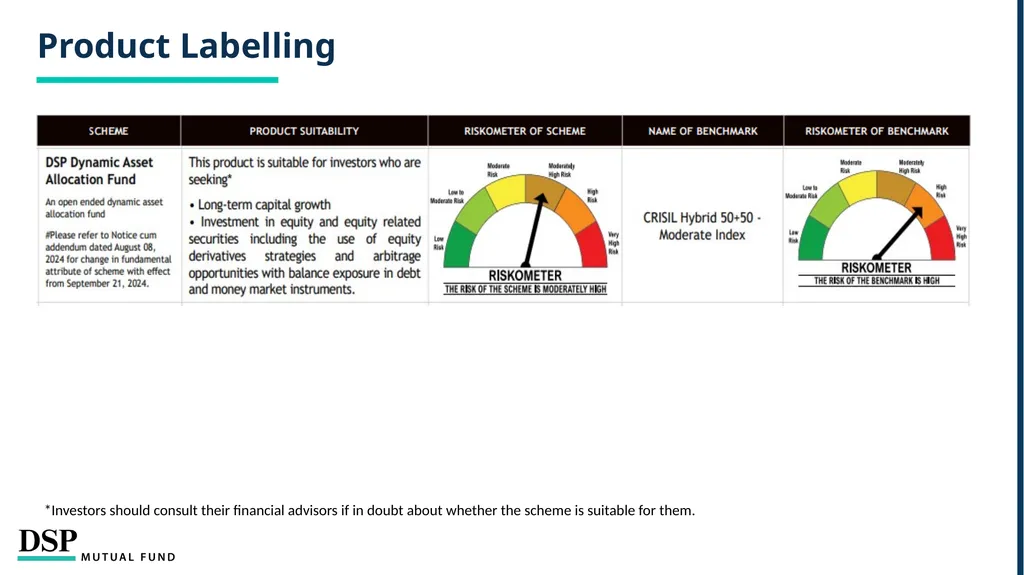
Product Labelling *Investors should consult their financial advisors if in doubt about whether the scheme is suitable for them.<br>
18
Disclaimers: This presentation / note is for information purposes only. It should not be construed as investment advice to any party. In this material DSP Asset Managers Pvt. Ltd. (the AMC) has used information that is publicly available, including information developed in-house. Information gathered and used in this material is believed to be from reliable sources. While utmost care has been exercised while preparing this document, the AMC nor any person connected does not warrant the completeness or accuracy of the information and disclaims all liabilities, losses and damages arising out of the use of this information. The recipient(s) before acting on any information herein should make his/their own investigation and seek appropriate professional advice. The statements contained herein may include statements of future expectations and other forward looking statements that are based on prevailing market conditions / various other factors and involve known and unknown risks and uncertainties that could cause actual results, performance or events to differ materially from those expressed or implied in such statements. Past performance may or may not be sustained in the future and should not be used as a basis for comparison with other investments. The sector(s)/stock(s)/issuer(s) mentioned in this presentation do not constitute any research report/recommendation of the same and the schemes of DSP mutual fund may or may not have any future position in these sector(s)/stock(s)/issuer(s). Large-caps are defined as top 100 stocks on market capitalization, mid-caps as 101-250 , small-caps as 251 and above. Data provided is as on Nov 30, 2025 (unless otherwise specified) The figures pertain to performance of the index and do not in any manner indicate the returns/performance of the Scheme. It is not possible to invest directly in an index. All opinions, figures, charts/graphs and data included in this presentation are as on date and are subject to change without notice. For complete details on investment objective, investment strategy, asset allocation, scheme specific risk factors and more details, please read the Scheme Information Document, Statement of Additional Information and Key Information Memorandum of respective scheme available on ISC of AMC and also available on www.dspim.com. There is no assurance of any returns/capital protection/capital guarantee to the investors in above mentioned Scheme. The presentation indicates the strategy/investment approach currently followed by the above mentioned Scheme and the same may change in future depending on market conditions and other factors.
Dynamic asset allocation funds aim to reduce volatility by adjusting the mix of equities and debt based on market conditions.
Mutual Fund investments are subject to market risks, read all scheme related documents carefully. Disclaimer<br>
Dynamic asset allocation funds aim to reduce volatility by adjusting the mix of equities and debt based on market conditions.
Mutual Fund investments are subject to market risks, read all scheme related documents carefully. Disclaimer<br>
19
#INVESTFORGOOD<br>