
Dynamic Curbside Management: Keeping Pace with New
KB
Published · 31 slides · 0 views
1 / 1



Description
Dynamic Curbside Management: Keeping Pace with New and Emerging Mobility and Technology in the Public Right-of-Way NCHRP Project 20-102 (26) Authors (with affiliation at the time of the research): Meghan Mitman, Alex Rixey, and Tory Gibler:
Related Topics
Share
Embed code
Download this presentation From Below
"Dynamic Curbside Management: Keeping Pace with New" is the property of its rightful owner. Permission is granted to download and print the materials on this website for personal, non-commercial use only, and to display it on your personal computer provided you do not modify the materials and that you retain all copyright notices contained in the materials. By downloading content from our website, you accept the terms of this agreement.
Presentation Transcript
01
Dynamic Curbside Management:
Keeping Pace with New and Emerging Mobility and Technology in the Public Right-of-Way NCHRP Project 20-102 (26)
Authors (with affiliation at the time of the research): Meghan Mitman, Alex Rixey, and Tory Gibler: Fehr & Peers, Amanda Howell and Tiffany Swift: Urbanism Next, Jay Primus: Primus Consulting, Rachel Weinberger: Weinberger & Associates, and Sarah Abel: Institute of Transportation Engineers (ITE)<br>
Keeping Pace with New and Emerging Mobility and Technology in the Public Right-of-Way NCHRP Project 20-102 (26)
Authors (with affiliation at the time of the research): Meghan Mitman, Alex Rixey, and Tory Gibler: Fehr & Peers, Amanda Howell and Tiffany Swift: Urbanism Next, Jay Primus: Primus Consulting, Rachel Weinberger: Weinberger & Associates, and Sarah Abel: Institute of Transportation Engineers (ITE)<br>
02
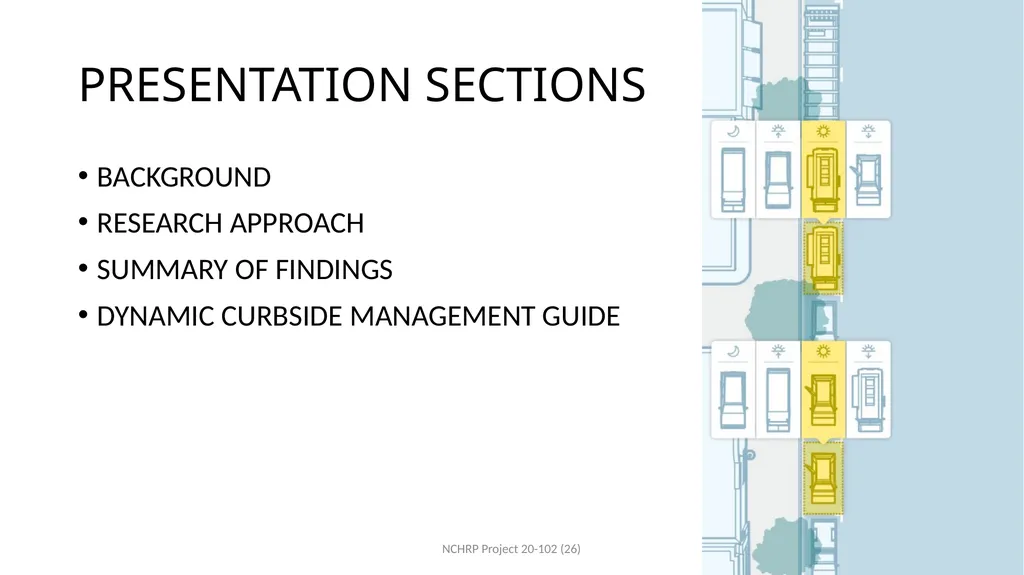
PRESENTATION SECTIONS BACKGROUND
RESEARCH APPROACH
SUMMARY OF FINDINGS
DYNAMIC CURBSIDE MANAGEMENT GUIDE NCHRP Project 20-102 (26) 2<br>
RESEARCH APPROACH
SUMMARY OF FINDINGS
DYNAMIC CURBSIDE MANAGEMENT GUIDE NCHRP Project 20-102 (26) 2<br>
03
BACKGROUND NCHRP Project 20-102 (26) 3<br>
04
BACKGROUND Project Objective and Research Scope
Curbside Management
Dynamic Curbside Management
Project Materials NCHRP Project 20-102 (26) 4<br>
Curbside Management
Dynamic Curbside Management
Project Materials NCHRP Project 20-102 (26) 4<br>
05
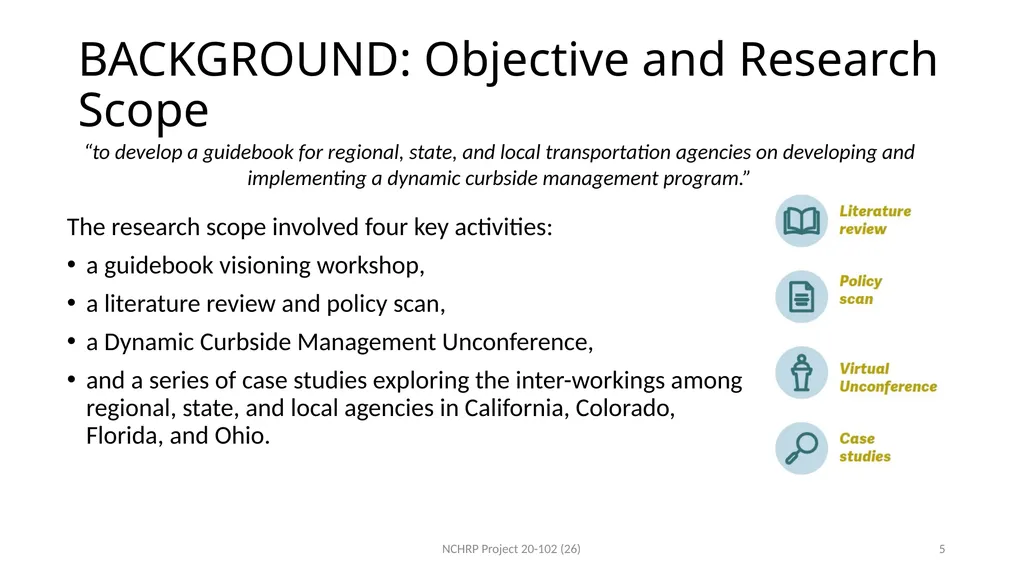
BACKGROUND: Objective and Research Scope The research scope involved four key activities:
a guidebook visioning workshop,
a literature review and policy scan,
a Dynamic Curbside Management Unconference,
and a series of case studies exploring the inter-workings among regional, state, and local agencies in California, Colorado, Florida, and Ohio. NCHRP Project 20-102 (26) 5 “to develop a guidebook for regional, state, and local transportation agencies on developing and implementing a dynamic curbside management program.”<br>
a guidebook visioning workshop,
a literature review and policy scan,
a Dynamic Curbside Management Unconference,
and a series of case studies exploring the inter-workings among regional, state, and local agencies in California, Colorado, Florida, and Ohio. NCHRP Project 20-102 (26) 5 “to develop a guidebook for regional, state, and local transportation agencies on developing and implementing a dynamic curbside management program.”<br>
06
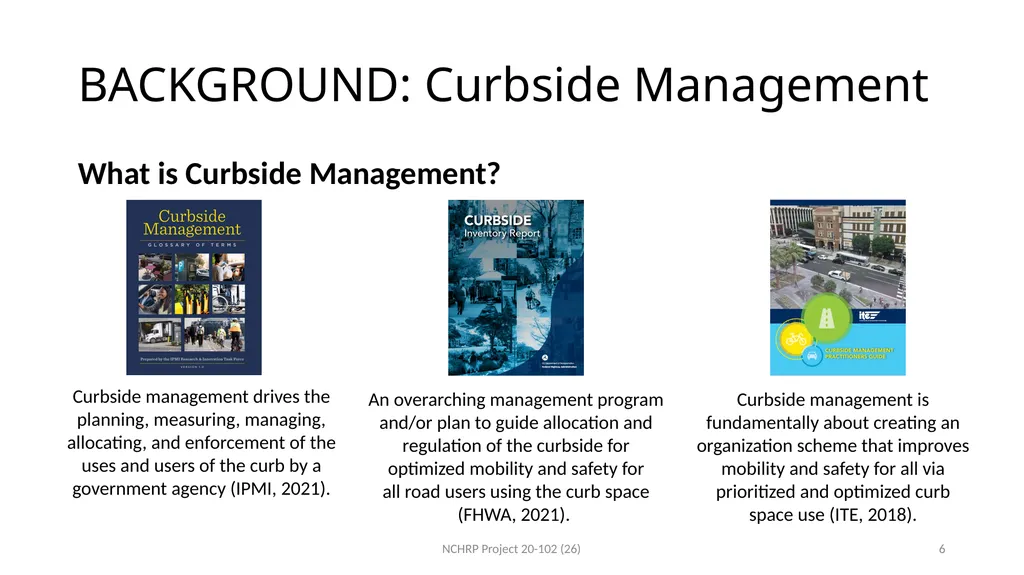
BACKGROUND: Curbside Management What is Curbside Management? NCHRP Project 20-102 (26) 6 Curbside management drives the planning, measuring, managing, allocating, and enforcement of the uses and users of the curb by a government agency (IPMI, 2021). An overarching management program and/or plan to guide allocation and regulation of the curbside for optimized mobility and safety for all road users using the curb space (FHWA, 2021). Curbside management is fundamentally about creating an organization scheme that improves mobility and safety for all via prioritized and optimized curb space use (ITE, 2018).<br>
07
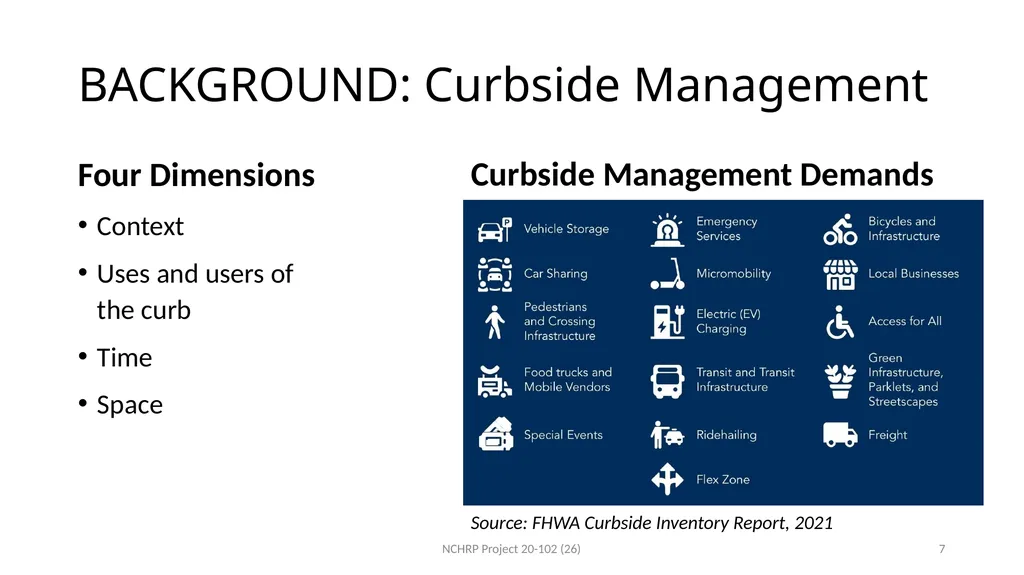
BACKGROUND: Curbside Management Four Dimensions
Context
Uses and users of the curb
Time
Space NCHRP Project 20-102 (26) 7 Curbside Management Demands Source: FHWA Curbside Inventory Report, 2021<br>
Context
Uses and users of the curb
Time
Space NCHRP Project 20-102 (26) 7 Curbside Management Demands Source: FHWA Curbside Inventory Report, 2021<br>
08
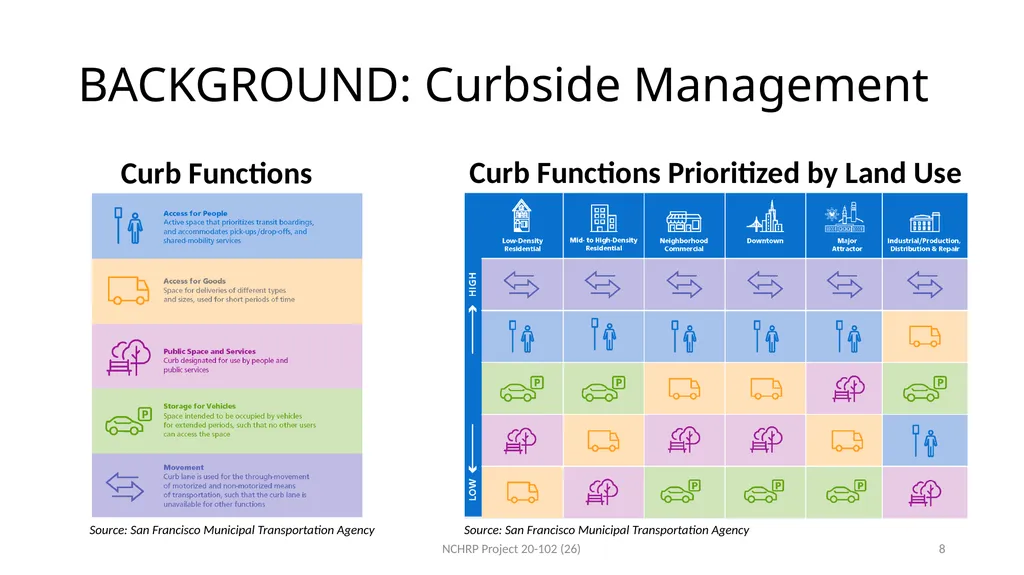
BACKGROUND: Curbside Management Curb Functions NCHRP Project 20-102 (26) 8 Curb Functions Prioritized by Land Use Source: San Francisco Municipal Transportation Agency Source: San Francisco Municipal Transportation Agency<br>
09
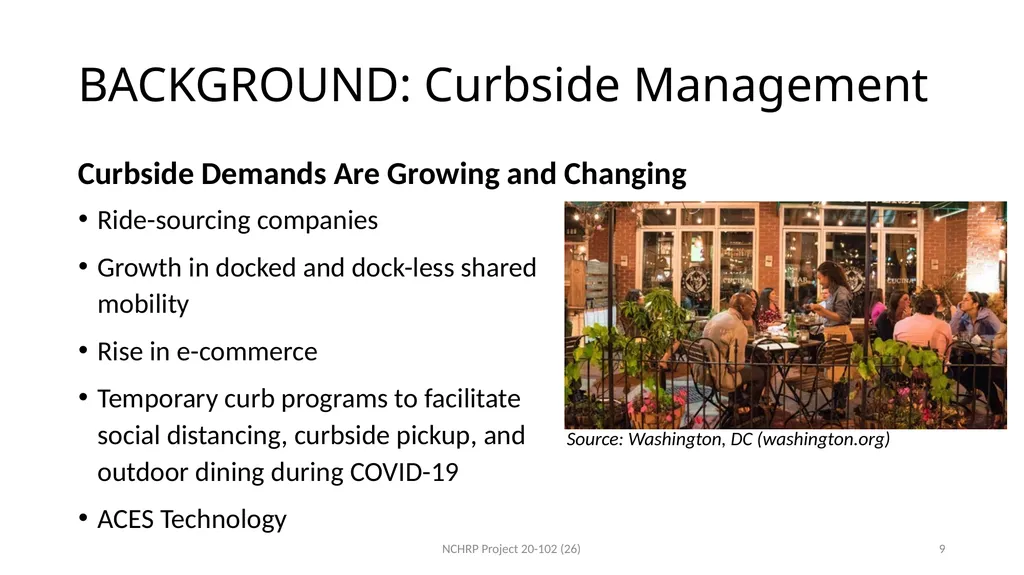
BACKGROUND: Curbside Management Curbside Demands Are Growing and Changing NCHRP Project 20-102 (26) 9 Ride-sourcing companies
Growth in docked and dock-less shared mobility
Rise in e-commerce
Temporary curb programs to facilitate social distancing, curbside pickup, and outdoor dining during COVID-19
ACES Technology Source: Washington, DC (washington.org)<br>
Growth in docked and dock-less shared mobility
Rise in e-commerce
Temporary curb programs to facilitate social distancing, curbside pickup, and outdoor dining during COVID-19
ACES Technology Source: Washington, DC (washington.org)<br>
10
BACKGROUND: Dynamic Curbside Management What is Dynamic Curbside Management? NCHRP Project 20-102 (26) 10 Dynamic curbside management is a distinct subset within curbside management and is defined as:
“the data-driven understanding, allocation, and operation of the curb across space and time to optimally serve curb uses and users as determined by community values. The time (i.e., the duration or limit over the course of a day), space (i.e., the amount of linear space allocated), and regulation (i.e., the price or other terms of its use) can all be dynamic in pursuit of the optimal use.”<br>
“the data-driven understanding, allocation, and operation of the curb across space and time to optimally serve curb uses and users as determined by community values. The time (i.e., the duration or limit over the course of a day), space (i.e., the amount of linear space allocated), and regulation (i.e., the price or other terms of its use) can all be dynamic in pursuit of the optimal use.”<br>
11
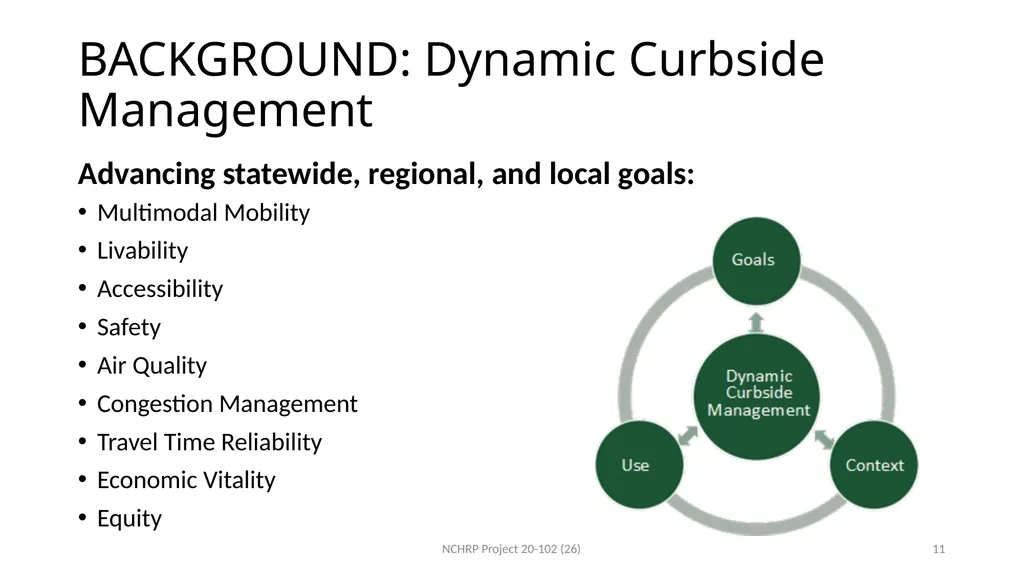
BACKGROUND: Dynamic Curbside Management Advancing statewide, regional, and local goals: NCHRP Project 20-102 (26) 11 Multimodal Mobility
Livability
Accessibility
Safety
Air Quality
Congestion Management
Travel Time Reliability
Economic Vitality
Equity<br>
Livability
Accessibility
Safety
Air Quality
Congestion Management
Travel Time Reliability
Economic Vitality
Equity<br>
12
BACKGROUND: Project Materials Dynamic Curbside Management Guide
Dynamic Curbside Management Quick Start Summary
Dynamic Curbside Management Report NCHRP Project 20-102 (26) 12<br>
Dynamic Curbside Management Quick Start Summary
Dynamic Curbside Management Report NCHRP Project 20-102 (26) 12<br>
13
BACKGROUND: Project Materials Dynamic Curbside Management Guide
Strategies and tools that regional, state, and local transportation agencies can use to develop and implement a dynamic curbside management program.
Introduces fundamental concepts of dynamic curbside management.
Summarizes and assesses dynamic management tools that are currently available.
Discusses the interactions of dynamic curbside management with current and emerging mobility solutions and technologies to prepare transportation agencies to adapt to future challenges at the curb. NCHRP Project 20-102 (26) 13<br>
Strategies and tools that regional, state, and local transportation agencies can use to develop and implement a dynamic curbside management program.
Introduces fundamental concepts of dynamic curbside management.
Summarizes and assesses dynamic management tools that are currently available.
Discusses the interactions of dynamic curbside management with current and emerging mobility solutions and technologies to prepare transportation agencies to adapt to future challenges at the curb. NCHRP Project 20-102 (26) 13<br>
14
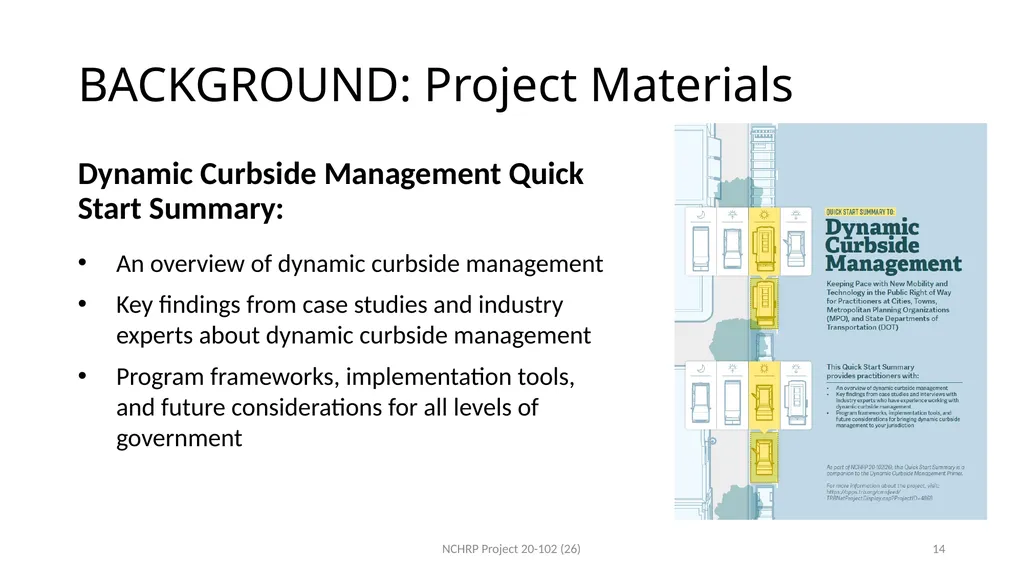
BACKGROUND: Project Materials Dynamic Curbside Management Quick Start Summary: NCHRP Project 20-102 (26) 14 An overview of dynamic curbside management
Key findings from case studies and industry experts about dynamic curbside management
Program frameworks, implementation tools, and future considerations for all levels of government<br>
Key findings from case studies and industry experts about dynamic curbside management
Program frameworks, implementation tools, and future considerations for all levels of government<br>
15
BACKGROUND: Project Materials Dynamic Curbside Management Report
Summarizes literature and policy scan, the Unconference, the case studies, and stakeholder interviews.
Includes findings that informed the development of the final project products of the Dynamic Curbside Management Guide and Dynamic Curbside Management Quick Start Summary NCHRP Project 20-102 (26) 15<br>
Summarizes literature and policy scan, the Unconference, the case studies, and stakeholder interviews.
Includes findings that informed the development of the final project products of the Dynamic Curbside Management Guide and Dynamic Curbside Management Quick Start Summary NCHRP Project 20-102 (26) 15<br>
16
RESEARCH APPROACH NCHRP Project 20-102 (26) 16<br>
17
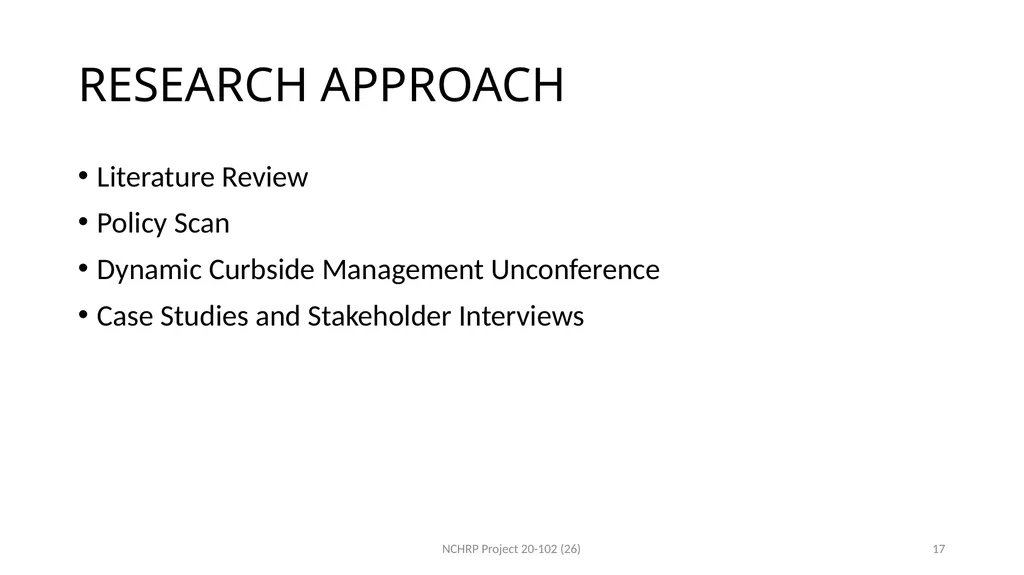
RESEARCH APPROACH Literature Review
Policy Scan
Dynamic Curbside Management Unconference
Case Studies and Stakeholder Interviews NCHRP Project 20-102 (26) 17<br>
Policy Scan
Dynamic Curbside Management Unconference
Case Studies and Stakeholder Interviews NCHRP Project 20-102 (26) 17<br>
18
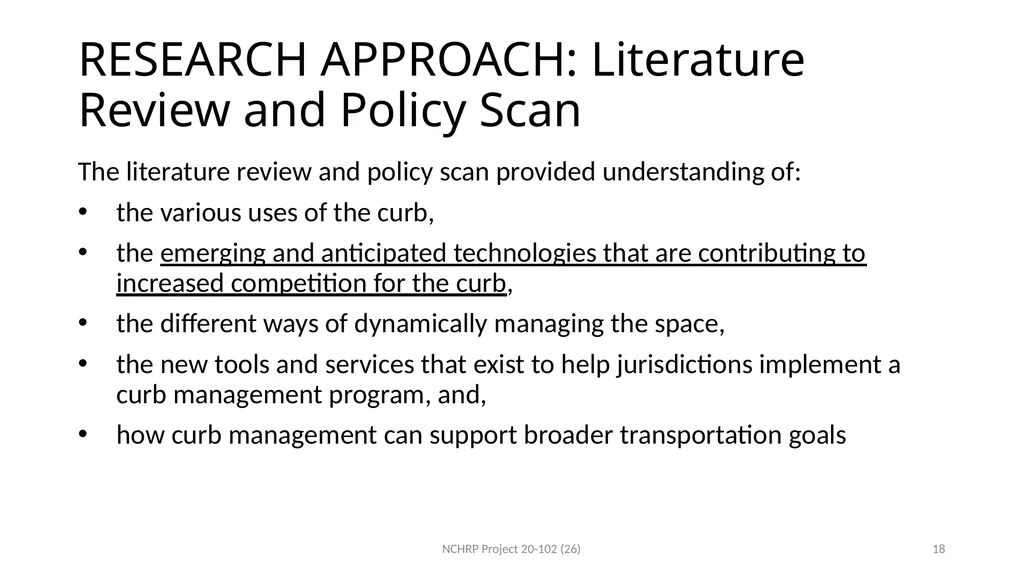
RESEARCH APPROACH: Literature Review and Policy Scan The literature review and policy scan provided understanding of:
the various uses of the curb,
the emerging and anticipated technologies that are contributing to increased competition for the curb,
the different ways of dynamically managing the space,
the new tools and services that exist to help jurisdictions implement a curb management program, and,
how curb management can support broader transportation goals NCHRP Project 20-102 (26) 18<br>
the various uses of the curb,
the emerging and anticipated technologies that are contributing to increased competition for the curb,
the different ways of dynamically managing the space,
the new tools and services that exist to help jurisdictions implement a curb management program, and,
how curb management can support broader transportation goals NCHRP Project 20-102 (26) 18<br>
19
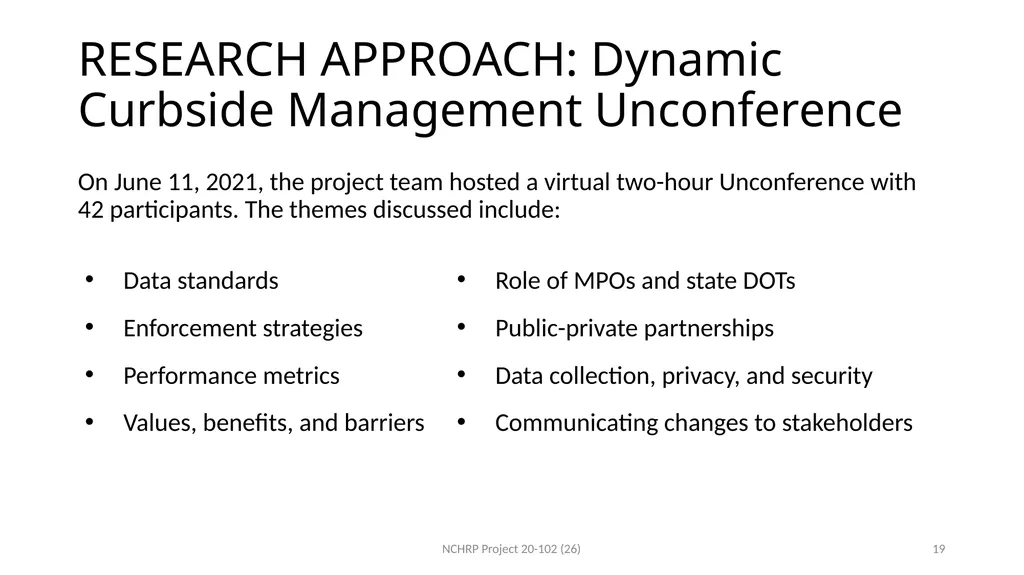
RESEARCH APPROACH: Dynamic Curbside Management Unconference On June 11, 2021, the project team hosted a virtual two-hour Unconference with 42 participants. The themes discussed include: NCHRP Project 20-102 (26) 19 Data standards
Enforcement strategies
Performance metrics
Values, benefits, and barriers Role of MPOs and state DOTs
Public-private partnerships
Data collection, privacy, and security
Communicating changes to stakeholders<br>
Enforcement strategies
Performance metrics
Values, benefits, and barriers Role of MPOs and state DOTs
Public-private partnerships
Data collection, privacy, and security
Communicating changes to stakeholders<br>
20
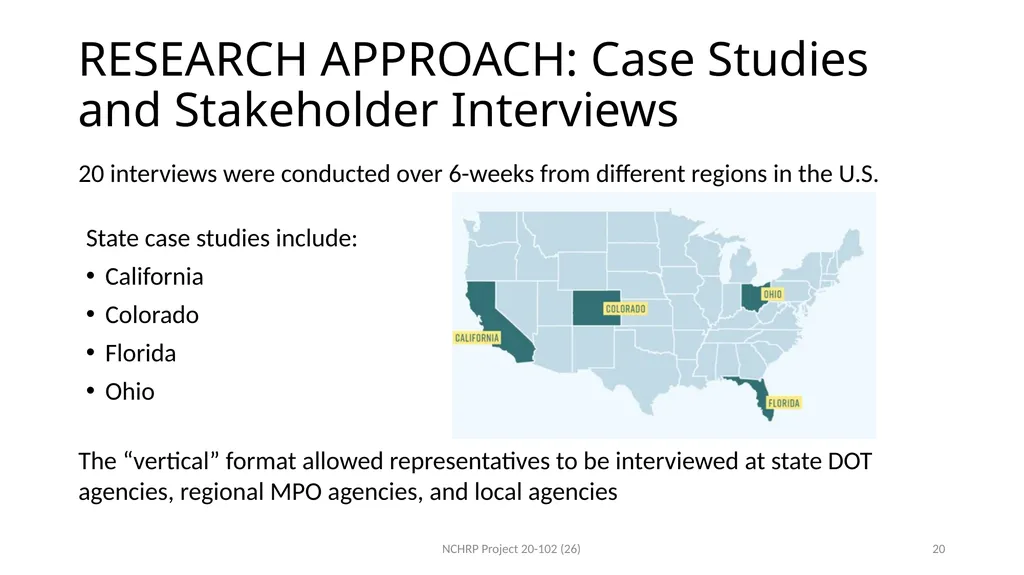
RESEARCH APPROACH: Case Studies and Stakeholder Interviews State case studies include:
California
Colorado
Florida
Ohio NCHRP Project 20-102 (26) 20 20 interviews were conducted over 6-weeks from different regions in the U.S. The “vertical” format allowed representatives to be interviewed at state DOT agencies, regional MPO agencies, and local agencies<br>
California
Colorado
Florida
Ohio NCHRP Project 20-102 (26) 20 20 interviews were conducted over 6-weeks from different regions in the U.S. The “vertical” format allowed representatives to be interviewed at state DOT agencies, regional MPO agencies, and local agencies<br>
21
SUMMARY OF FINDINGS NCHRP Project 20-102 (26) 21<br>
22
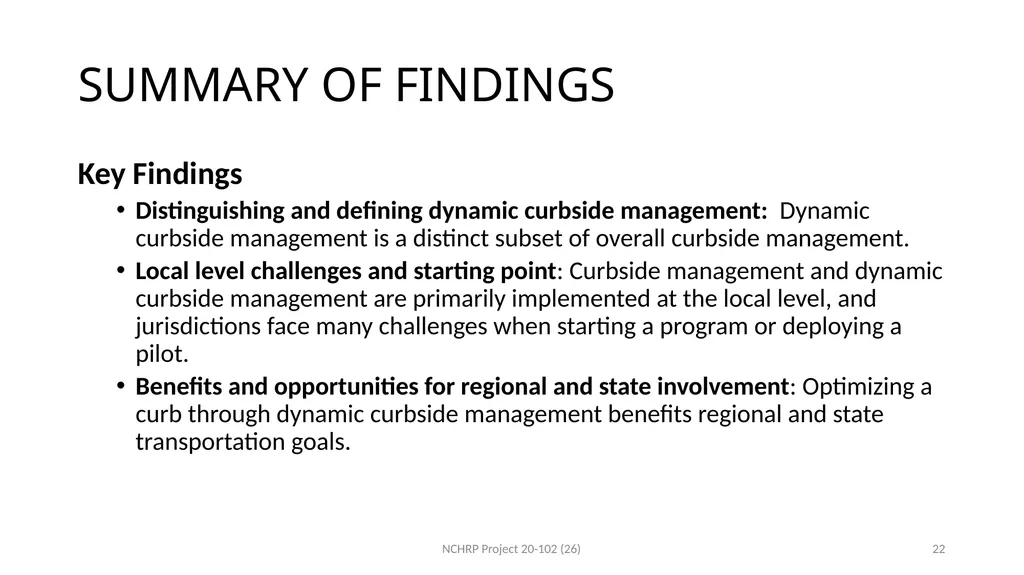
SUMMARY OF FINDINGS Key Findings
Distinguishing and defining dynamic curbside management: Dynamic curbside management is a distinct subset of overall curbside management.
Local level challenges and starting point: Curbside management and dynamic curbside management are primarily implemented at the local level, and jurisdictions face many challenges when starting a program or deploying a pilot.
Benefits and opportunities for regional and state involvement: Optimizing a curb through dynamic curbside management benefits regional and state transportation goals. NCHRP Project 20-102 (26) 22<br>
Distinguishing and defining dynamic curbside management: Dynamic curbside management is a distinct subset of overall curbside management.
Local level challenges and starting point: Curbside management and dynamic curbside management are primarily implemented at the local level, and jurisdictions face many challenges when starting a program or deploying a pilot.
Benefits and opportunities for regional and state involvement: Optimizing a curb through dynamic curbside management benefits regional and state transportation goals. NCHRP Project 20-102 (26) 22<br>
23
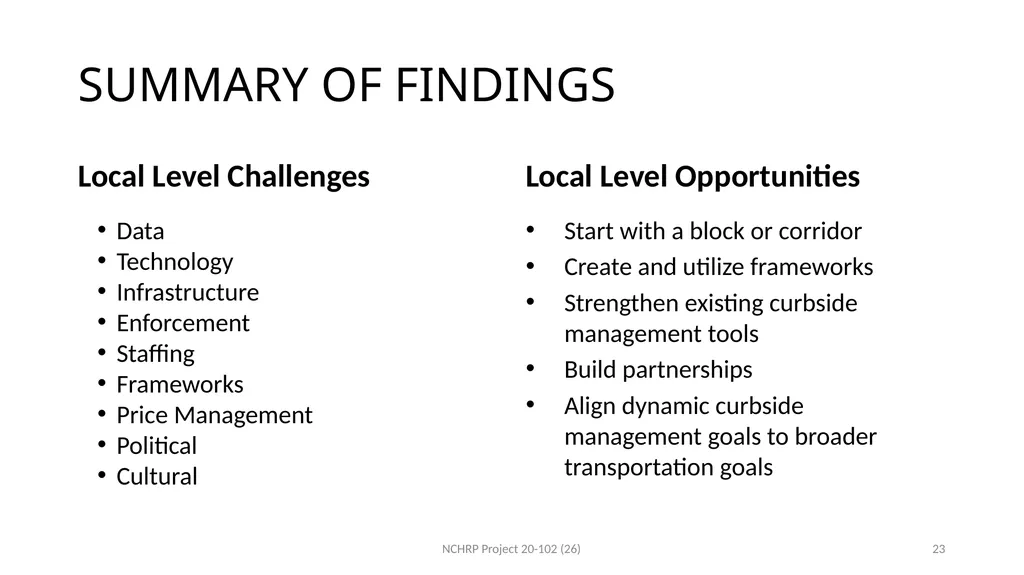
SUMMARY OF FINDINGS Local Level Challenges Data
Technology
Infrastructure
Enforcement
Staffing
Frameworks
Price Management
Political
Cultural Local Level Opportunities Start with a block or corridor
Create and utilize frameworks
Strengthen existing curbside management tools
Build partnerships
Align dynamic curbside management goals to broader transportation goals NCHRP Project 20-102 (26) 23<br>
Technology
Infrastructure
Enforcement
Staffing
Frameworks
Price Management
Political
Cultural Local Level Opportunities Start with a block or corridor
Create and utilize frameworks
Strengthen existing curbside management tools
Build partnerships
Align dynamic curbside management goals to broader transportation goals NCHRP Project 20-102 (26) 23<br>
24
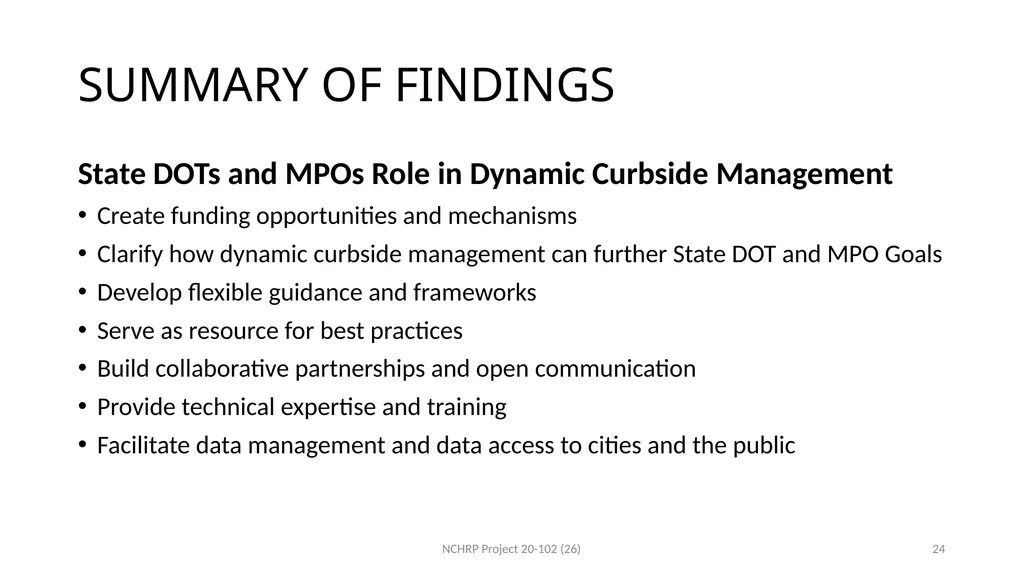
SUMMARY OF FINDINGS State DOTs and MPOs Role in Dynamic Curbside Management
Create funding opportunities and mechanisms
Clarify how dynamic curbside management can further State DOT and MPO Goals
Develop flexible guidance and frameworks
Serve as resource for best practices
Build collaborative partnerships and open communication
Provide technical expertise and training
Facilitate data management and data access to cities and the public NCHRP Project 20-102 (26) 24<br>
Create funding opportunities and mechanisms
Clarify how dynamic curbside management can further State DOT and MPO Goals
Develop flexible guidance and frameworks
Serve as resource for best practices
Build collaborative partnerships and open communication
Provide technical expertise and training
Facilitate data management and data access to cities and the public NCHRP Project 20-102 (26) 24<br>
25
DYNAMIC CURBSIDE MANAGEMENT GUIDE NCHRP Project 20-102 (26) 25<br>
26
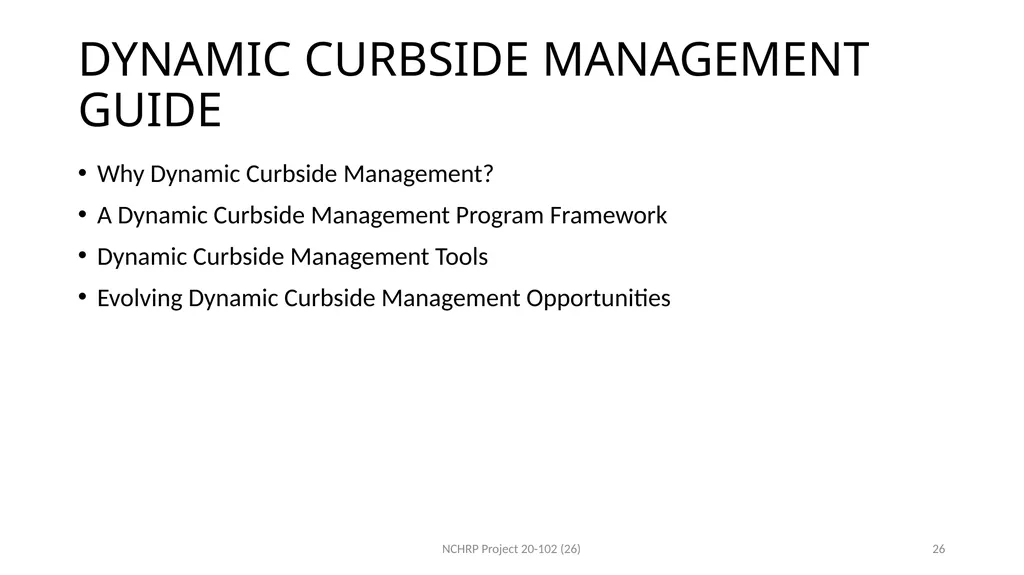
DYNAMIC CURBSIDE MANAGEMENT GUIDE Why Dynamic Curbside Management?
A Dynamic Curbside Management Program Framework
Dynamic Curbside Management Tools
Evolving Dynamic Curbside Management Opportunities NCHRP Project 20-102 (26) 26<br>
A Dynamic Curbside Management Program Framework
Dynamic Curbside Management Tools
Evolving Dynamic Curbside Management Opportunities NCHRP Project 20-102 (26) 26<br>
27
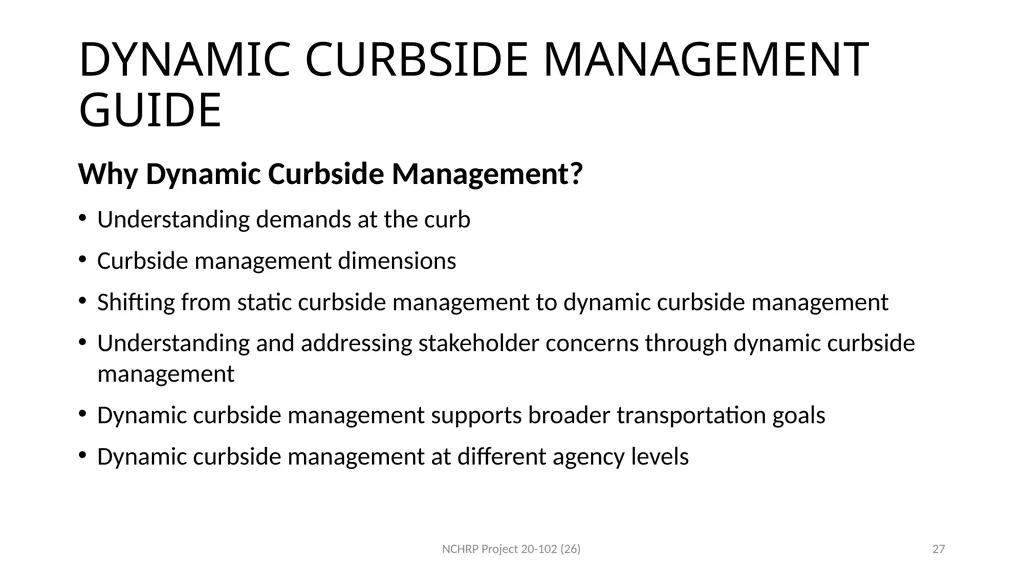
DYNAMIC CURBSIDE MANAGEMENT GUIDE Why Dynamic Curbside Management?
Understanding demands at the curb
Curbside management dimensions
Shifting from static curbside management to dynamic curbside management
Understanding and addressing stakeholder concerns through dynamic curbside management
Dynamic curbside management supports broader transportation goals
Dynamic curbside management at different agency levels NCHRP Project 20-102 (26) 27<br>
Understanding demands at the curb
Curbside management dimensions
Shifting from static curbside management to dynamic curbside management
Understanding and addressing stakeholder concerns through dynamic curbside management
Dynamic curbside management supports broader transportation goals
Dynamic curbside management at different agency levels NCHRP Project 20-102 (26) 27<br>
28
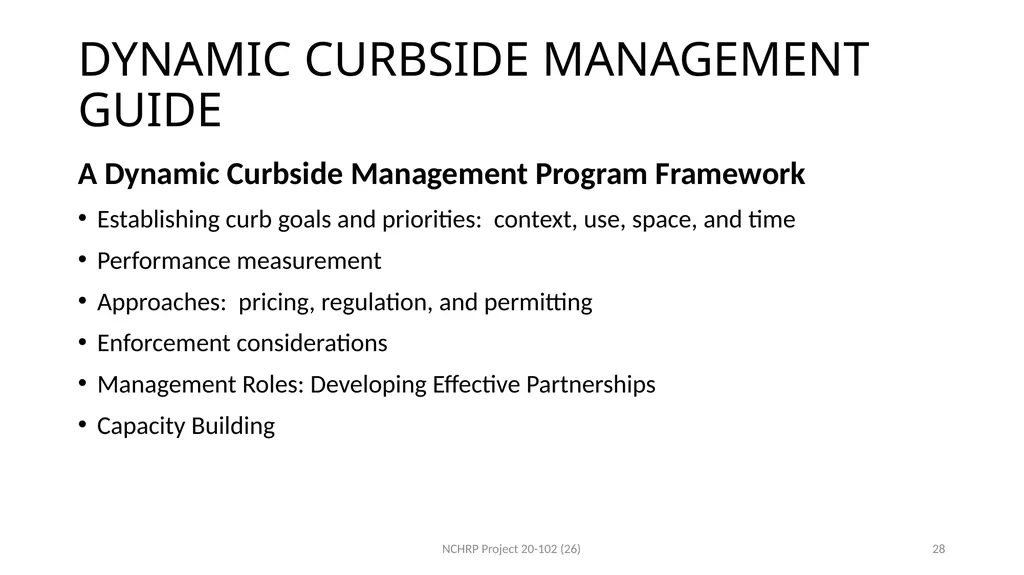
DYNAMIC CURBSIDE MANAGEMENT GUIDE A Dynamic Curbside Management Program Framework
Establishing curb goals and priorities: context, use, space, and time
Performance measurement
Approaches: pricing, regulation, and permitting
Enforcement considerations
Management Roles: Developing Effective Partnerships
Capacity Building NCHRP Project 20-102 (26) 28<br>
Establishing curb goals and priorities: context, use, space, and time
Performance measurement
Approaches: pricing, regulation, and permitting
Enforcement considerations
Management Roles: Developing Effective Partnerships
Capacity Building NCHRP Project 20-102 (26) 28<br>
29
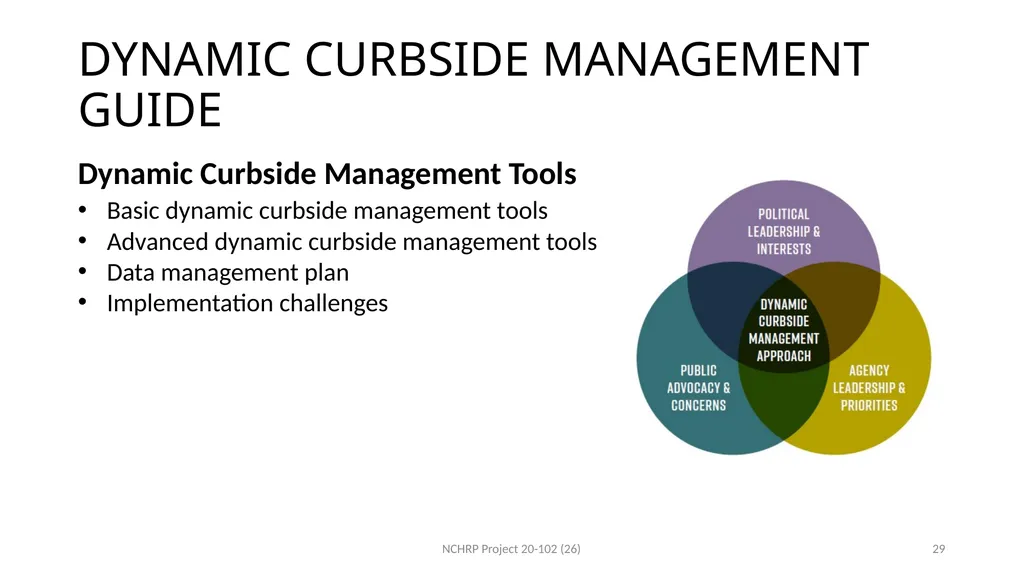
DYNAMIC CURBSIDE MANAGEMENT GUIDE Dynamic Curbside Management Tools NCHRP Project 20-102 (26) 29 Basic dynamic curbside management tools
Advanced dynamic curbside management tools
Data management plan
Implementation challenges<br>
Advanced dynamic curbside management tools
Data management plan
Implementation challenges<br>
30
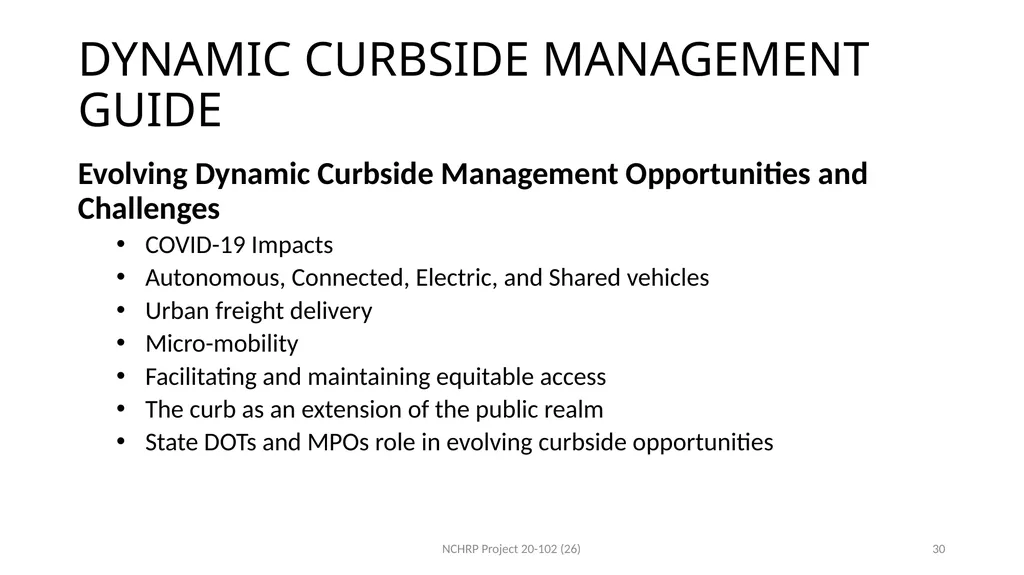
DYNAMIC CURBSIDE MANAGEMENT GUIDE Evolving Dynamic Curbside Management Opportunities and Challenges
COVID-19 Impacts
Autonomous, Connected, Electric, and Shared vehicles
Urban freight delivery
Micro-mobility
Facilitating and maintaining equitable access
The curb as an extension of the public realm
State DOTs and MPOs role in evolving curbside opportunities NCHRP Project 20-102 (26) 30<br>
COVID-19 Impacts
Autonomous, Connected, Electric, and Shared vehicles
Urban freight delivery
Micro-mobility
Facilitating and maintaining equitable access
The curb as an extension of the public realm
State DOTs and MPOs role in evolving curbside opportunities NCHRP Project 20-102 (26) 30<br>
31
For more information about the project, visit:
https://apps.trb.org/cmsfeed/TRBNetProjectDisplay.asp?ProjectID=4868
The National Cooperative Highway Research Program (NCHRP) produces ready-to-implement solutions to the challenges facing transportation professionals. NCHRP is sponsored by the individual state departments of transportation of the American Association of State Highway and Transportation Officials (AASHTO), in cooperation with the Federal Highway Administration (FHWA). NCHRP is administered by the Transportation Research Board (TRB), part of the National Academies of Sciences, Engineering, and Medicine. Any opinions and conclusions expressed or implied in resulting research products are those of the individuals and organizations who performed the research and are not necessarily those of TRB; the National Academies of Sciences, Engineering, and Medicine; or NCHRP sponsors. NCHRP Project 20-102 (26) 31<br>