
DYRS Systems Improvements Matching Risk and Needs
MJ
Published · 44 slides · 0 views
1 / 1

Description
DYRS Systems Improvements Matching Risk and Needs with Better Services Juvenile Justice Conference June 2012 DYRS Community Services Supervision and Services Based on Risk and Needs Lisa DiStefano Susan Burns Shift from a corrections
Related Topics
Share
Embed code
Download this presentation From Below
"DYRS Systems Improvements Matching Risk and Needs" is the property of its rightful owner. Permission is granted to download and print the materials on this website for personal, non-commercial use only, and to display it on your personal computer provided you do not modify the materials and that you retain all copyright notices contained in the materials. By downloading content from our website, you accept the terms of this agreement.
Presentation Transcript
01
DYRS Systems Improvements Matching Risk and Needs with Better Services Juvenile Justice Conference ~ June 2012<br>
02
DYRS Community Services Supervision and Services
Based on Risk and Needs Lisa DiStefano & Susan Burns<br>
Based on Risk and Needs Lisa DiStefano & Susan Burns<br>
03
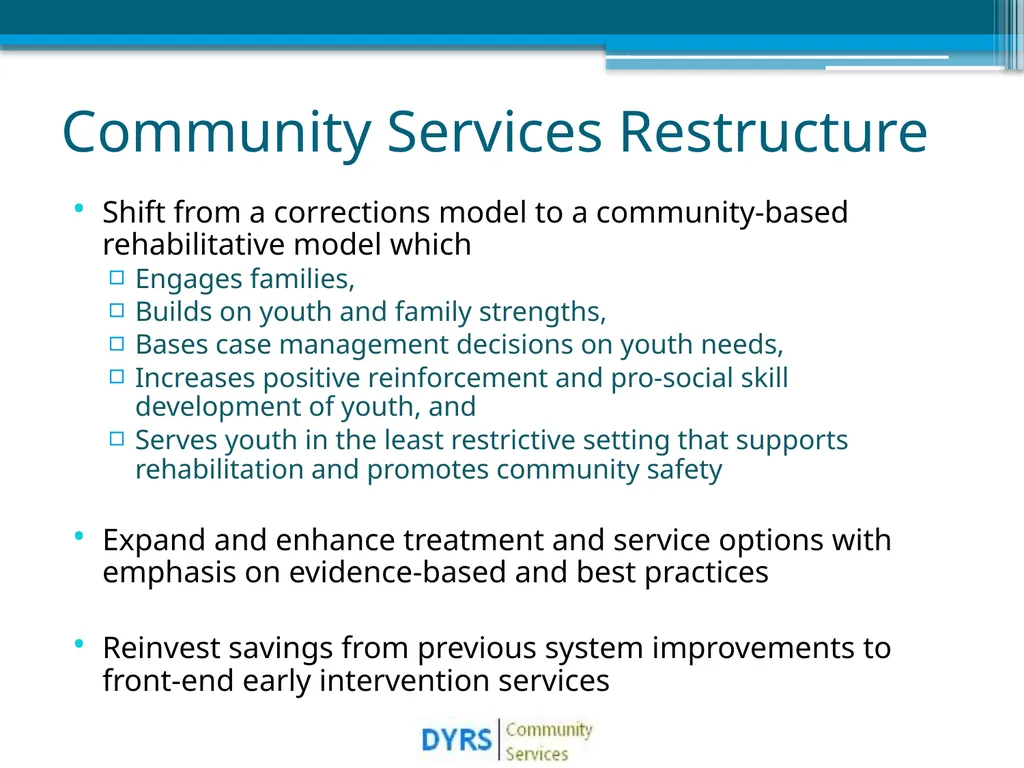
Shift from a corrections model to a community-based rehabilitative model which
Engages families,
Builds on youth and family strengths,
Bases case management decisions on youth needs,
Increases positive reinforcement and pro-social skill development of youth, and
Serves youth in the least restrictive setting that supports rehabilitation and promotes community safety
Expand and enhance treatment and service options with emphasis on evidence-based and best practices
Reinvest savings from previous system improvements to front-end early intervention services Community Services Restructure<br>
Engages families,
Builds on youth and family strengths,
Bases case management decisions on youth needs,
Increases positive reinforcement and pro-social skill development of youth, and
Serves youth in the least restrictive setting that supports rehabilitation and promotes community safety
Expand and enhance treatment and service options with emphasis on evidence-based and best practices
Reinvest savings from previous system improvements to front-end early intervention services Community Services Restructure<br>
04
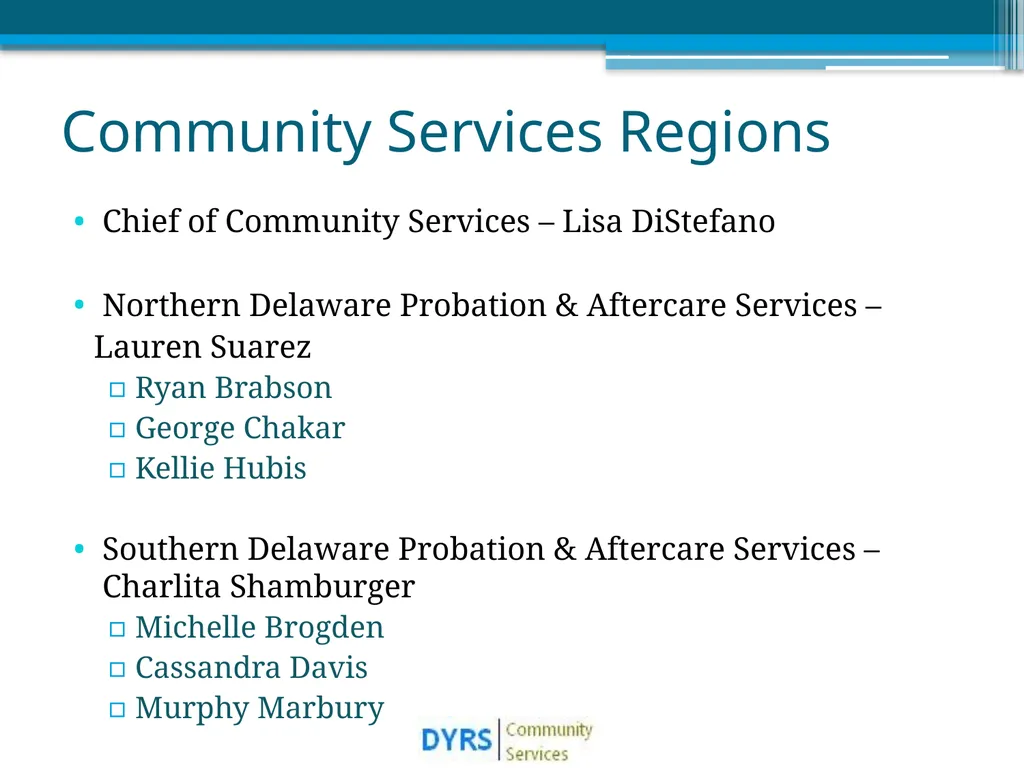
Chief of Community Services – Lisa DiStefano
Northern Delaware Probation & Aftercare Services –
Lauren Suarez
Ryan Brabson
George Chakar
Kellie Hubis
Southern Delaware Probation & Aftercare Services – Charlita Shamburger
Michelle Brogden
Cassandra Davis
Murphy Marbury Community Services Regions<br>
Northern Delaware Probation & Aftercare Services –
Lauren Suarez
Ryan Brabson
George Chakar
Kellie Hubis
Southern Delaware Probation & Aftercare Services – Charlita Shamburger
Michelle Brogden
Cassandra Davis
Murphy Marbury Community Services Regions<br>
05
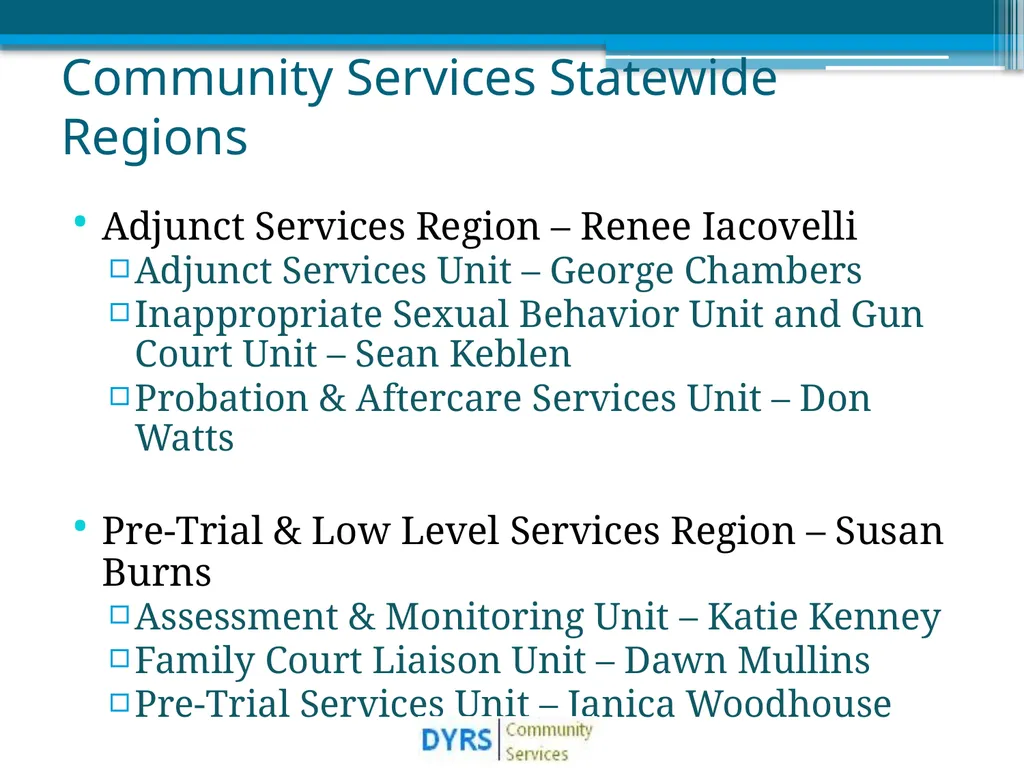
Adjunct Services Region – Renee Iacovelli
Adjunct Services Unit – George Chambers
Inappropriate Sexual Behavior Unit and Gun Court Unit – Sean Keblen
Probation & Aftercare Services Unit – Don Watts
Pre-Trial & Low Level Services Region – Susan Burns
Assessment & Monitoring Unit – Katie Kenney
Family Court Liaison Unit – Dawn Mullins
Pre-Trial Services Unit – Janica Woodhouse Community Services Statewide Regions<br>
Adjunct Services Unit – George Chambers
Inappropriate Sexual Behavior Unit and Gun Court Unit – Sean Keblen
Probation & Aftercare Services Unit – Don Watts
Pre-Trial & Low Level Services Region – Susan Burns
Assessment & Monitoring Unit – Katie Kenney
Family Court Liaison Unit – Dawn Mullins
Pre-Trial Services Unit – Janica Woodhouse Community Services Statewide Regions<br>
06
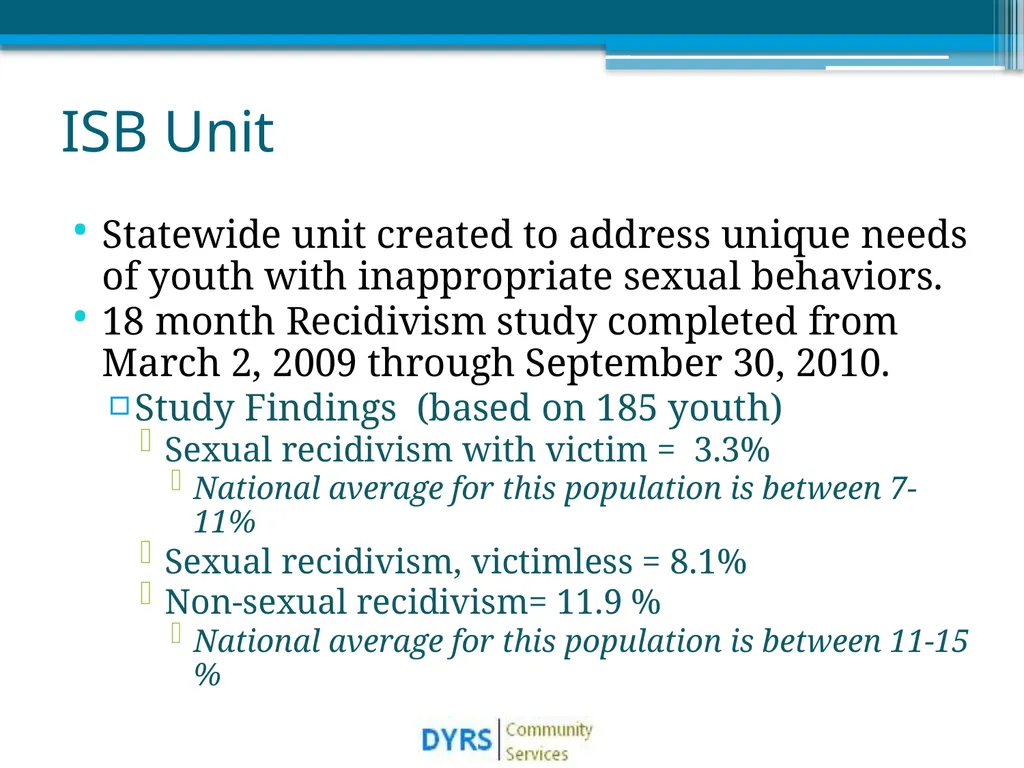
Statewide unit created to address unique needs of youth with inappropriate sexual behaviors.
18 month Recidivism study completed from March 2, 2009 through September 30, 2010.
Study Findings (based on 185 youth)
Sexual recidivism with victim = 3.3%
National average for this population is between 7- 11%
Sexual recidivism, victimless = 8.1%
Non-sexual recidivism= 11.9 %
National average for this population is between 11-15 % ISB Unit<br>
18 month Recidivism study completed from March 2, 2009 through September 30, 2010.
Study Findings (based on 185 youth)
Sexual recidivism with victim = 3.3%
National average for this population is between 7- 11%
Sexual recidivism, victimless = 8.1%
Non-sexual recidivism= 11.9 %
National average for this population is between 11-15 % ISB Unit<br>
07
Intensive case management for high risk youth adjudicated delinquent in Gun Court.
Includes support services provided by the Adjunct Services Unit
GPS Monitoring
Curfew Checks Gun Court Case Management<br>
Includes support services provided by the Adjunct Services Unit
GPS Monitoring
Curfew Checks Gun Court Case Management<br>
08
Provides support services for youth with high risk to re-offend and other youth as needed.
Services include apprehending youth with capiases, curfew checks, escorting for case managers, youth transports and GPS electronic monitoring support.
All GPS Electronic Monitoring has been transferred from contracted providers to the Adjunct Services Unit. Adjunct Services Unit<br>
Services include apprehending youth with capiases, curfew checks, escorting for case managers, youth transports and GPS electronic monitoring support.
All GPS Electronic Monitoring has been transferred from contracted providers to the Adjunct Services Unit. Adjunct Services Unit<br>
09
Case management for youth detained at New Castle County or Stevenson House Detention Centers.
Case management support for youth detained non-securely in a residential alternative to detention:
The Chris Sturmfels Center – Connections
Peoples Place – Townsend & Milford locations
Pre-Trial Supervision and case management for youth in the community pending trial. Pre-Trial Services Unit<br>
Case management support for youth detained non-securely in a residential alternative to detention:
The Chris Sturmfels Center – Connections
Peoples Place – Townsend & Milford locations
Pre-Trial Supervision and case management for youth in the community pending trial. Pre-Trial Services Unit<br>
10
Provide a central point of contact for DSCYF and Family Court when the two interface.
Provide Department perspective in juvenile bail hearings and other court proceedings.
Provide supportive services to DSCYF staff, including:
notification of upcoming delinquency proceedings,
obtaining copies of Court orders and records,
providing information and technical assistance.
Refer youth and families to both informal and formal services as ordered by the court or based on family needs. Family Court Liaison Unit<br>
Provide Department perspective in juvenile bail hearings and other court proceedings.
Provide supportive services to DSCYF staff, including:
notification of upcoming delinquency proceedings,
obtaining copies of Court orders and records,
providing information and technical assistance.
Refer youth and families to both informal and formal services as ordered by the court or based on family needs. Family Court Liaison Unit<br>
11
Statewide unit created to support the implementation of a holistic risk, needs and strengths assessment into the supervision and case planning process.
Unit staff provide administrative case management support and monitoring services for youth with low – moderate risk to re-offend.
Includes six assessors and two administrative case managers. Assessment & Monitoring Unit<br>
Unit staff provide administrative case management support and monitoring services for youth with low – moderate risk to re-offend.
Includes six assessors and two administrative case managers. Assessment & Monitoring Unit<br>
12
Determine youth risk for re-offending in order to target resources toward higher risk youth.
Identify the risk and protective factors linked to delinquent behavior so rehabilitative efforts can be tailored to address each youth’s unique needs.
Develop a responsive approach to supervision and case management focused on reducing risk factors and increasing protective factors.
Provide a mechanism for determining if targeted factors changed as a result of interventions. Assessment Implementation Objectives<br>
Identify the risk and protective factors linked to delinquent behavior so rehabilitative efforts can be tailored to address each youth’s unique needs.
Develop a responsive approach to supervision and case management focused on reducing risk factors and increasing protective factors.
Provide a mechanism for determining if targeted factors changed as a result of interventions. Assessment Implementation Objectives<br>
13
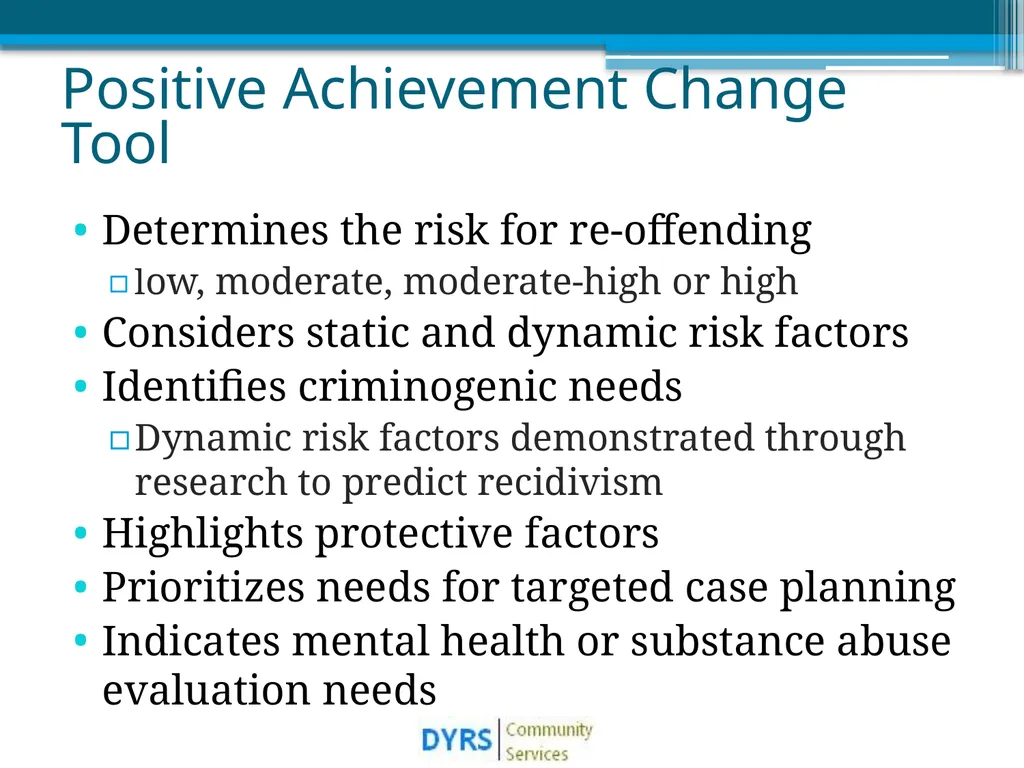
Determines the risk for re-offending
low, moderate, moderate-high or high
Considers static and dynamic risk factors
Identifies criminogenic needs
Dynamic risk factors demonstrated through research to predict recidivism
Highlights protective factors
Prioritizes needs for targeted case planning
Indicates mental health or substance abuse evaluation needs Positive Achievement Change Tool<br>
low, moderate, moderate-high or high
Considers static and dynamic risk factors
Identifies criminogenic needs
Dynamic risk factors demonstrated through research to predict recidivism
Highlights protective factors
Prioritizes needs for targeted case planning
Indicates mental health or substance abuse evaluation needs Positive Achievement Change Tool<br>
14
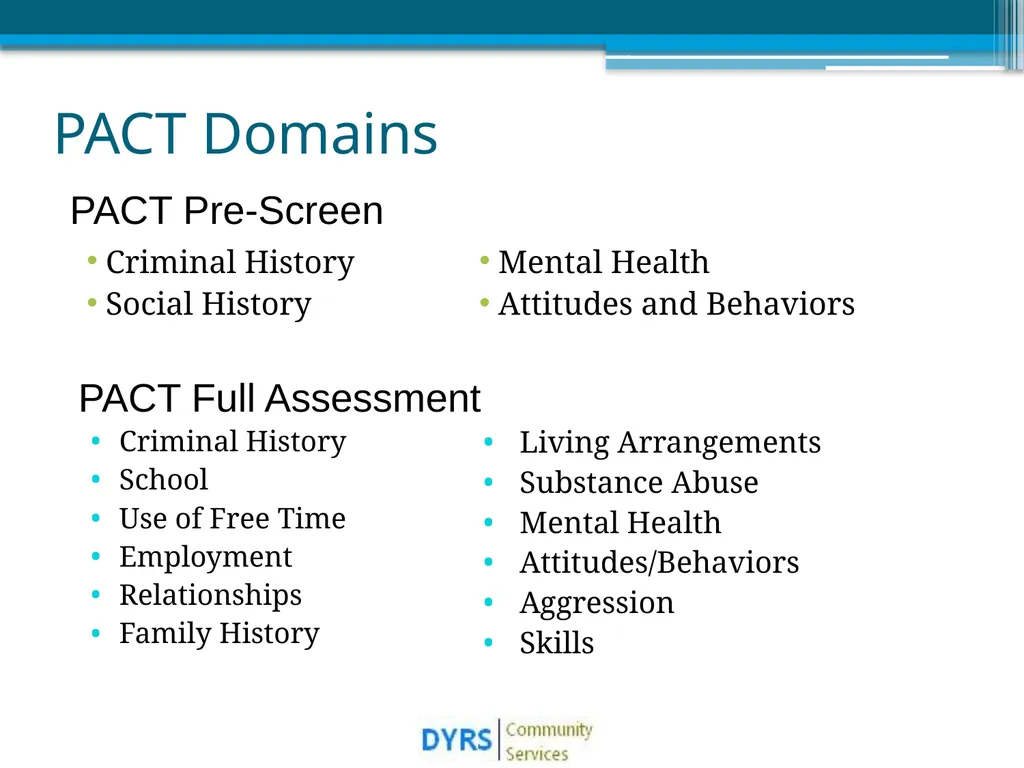
PACT Full Assessment PACT Pre-Screen Criminal History
Social History PACT Domains Criminal History
School
Use of Free Time
Employment
Relationships
Family History Living Arrangements
Substance Abuse
Mental Health
Attitudes/Behaviors
Aggression
Skills Mental Health
Attitudes and Behaviors<br>
Social History PACT Domains Criminal History
School
Use of Free Time
Employment
Relationships
Family History Living Arrangements
Substance Abuse
Mental Health
Attitudes/Behaviors
Aggression
Skills Mental Health
Attitudes and Behaviors<br>
15
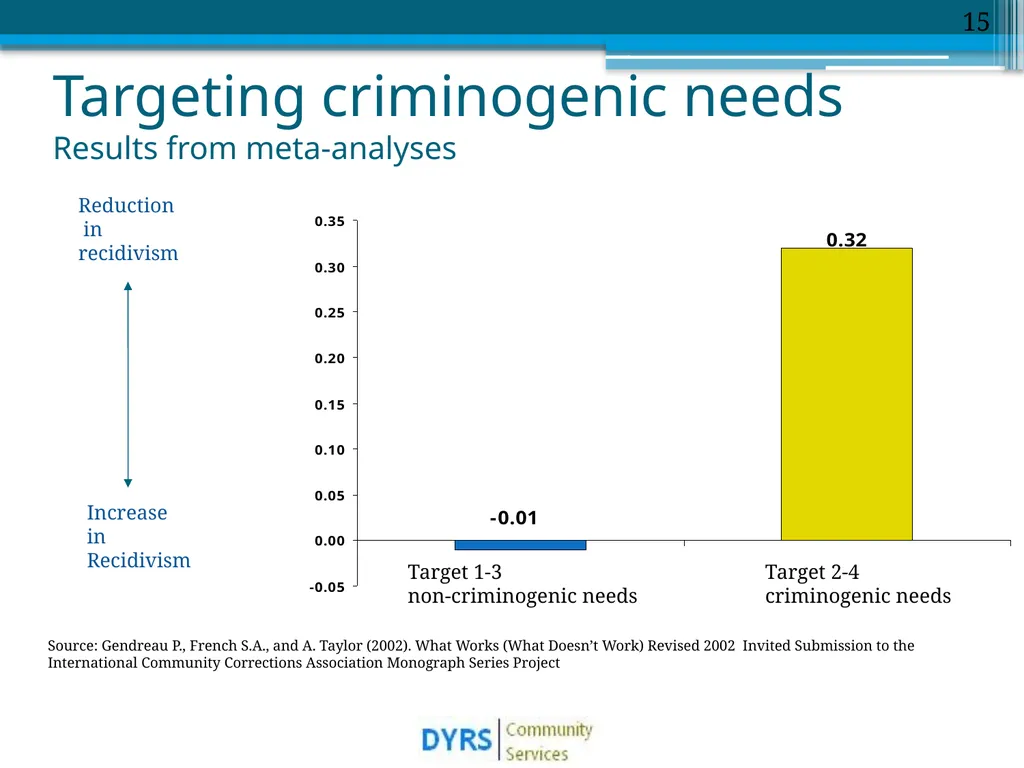
Targeting criminogenic needs
Results from meta-analyses 15 Source: Gendreau P., French S.A., and A. Taylor (2002). What Works (What Doesn’t Work) Revised 2002 Invited Submission to the International Community Corrections Association Monograph Series Project<br>
16
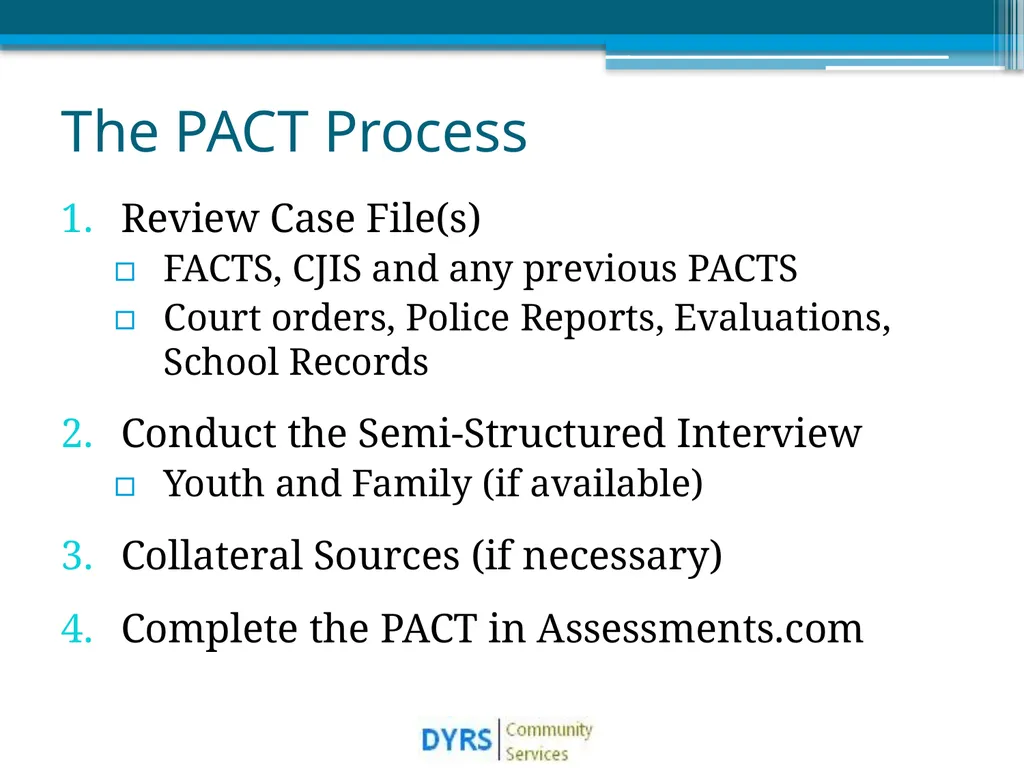
Review Case File(s)
FACTS, CJIS and any previous PACTS
Court orders, Police Reports, Evaluations, School Records
Conduct the Semi-Structured Interview
Youth and Family (if available)
Collateral Sources (if necessary)
Complete the PACT in Assessments.com The PACT Process<br>
FACTS, CJIS and any previous PACTS
Court orders, Police Reports, Evaluations, School Records
Conduct the Semi-Structured Interview
Youth and Family (if available)
Collateral Sources (if necessary)
Complete the PACT in Assessments.com The PACT Process<br>
17
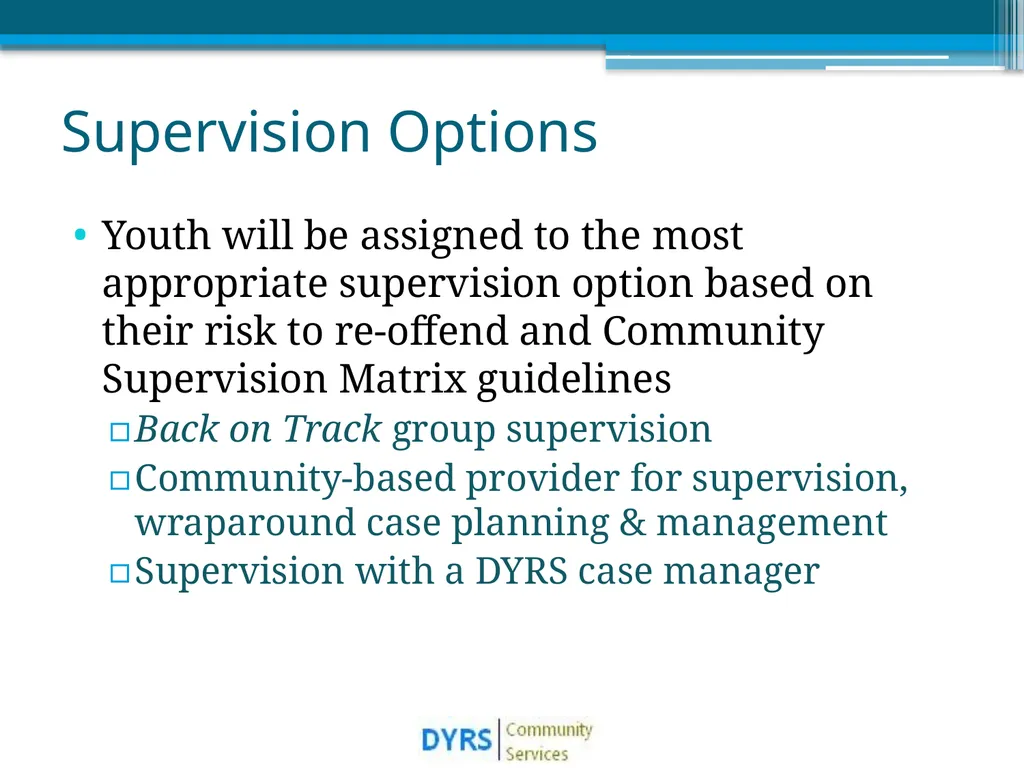
Youth will be assigned to the most appropriate supervision option based on their risk to re-offend and Community Supervision Matrix guidelines
Back on Track group supervision
Community-based provider for supervision, wraparound case planning & management
Supervision with a DYRS case manager Supervision Options<br>
Back on Track group supervision
Community-based provider for supervision, wraparound case planning & management
Supervision with a DYRS case manager Supervision Options<br>
18
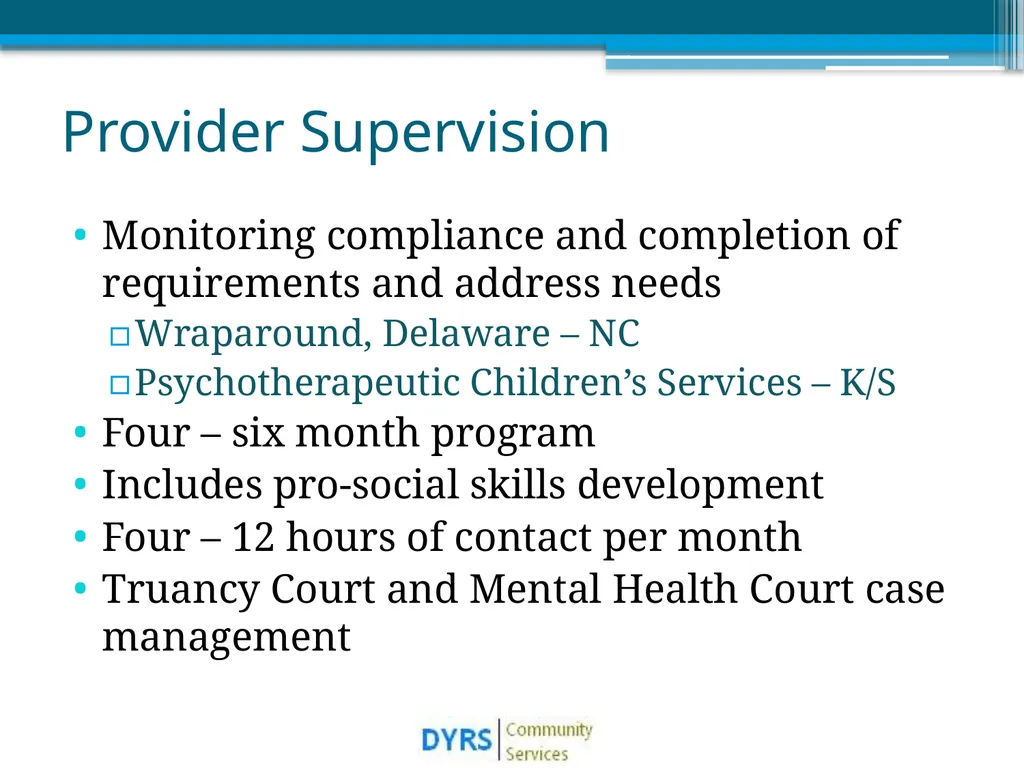
Monitoring compliance and completion of requirements and address needs
Wraparound, Delaware – NC
Psychotherapeutic Children’s Services – K/S
Four – six month program
Includes pro-social skills development
Four – 12 hours of contact per month
Truancy Court and Mental Health Court case management Provider Supervision<br>
Wraparound, Delaware – NC
Psychotherapeutic Children’s Services – K/S
Four – six month program
Includes pro-social skills development
Four – 12 hours of contact per month
Truancy Court and Mental Health Court case management Provider Supervision<br>
19
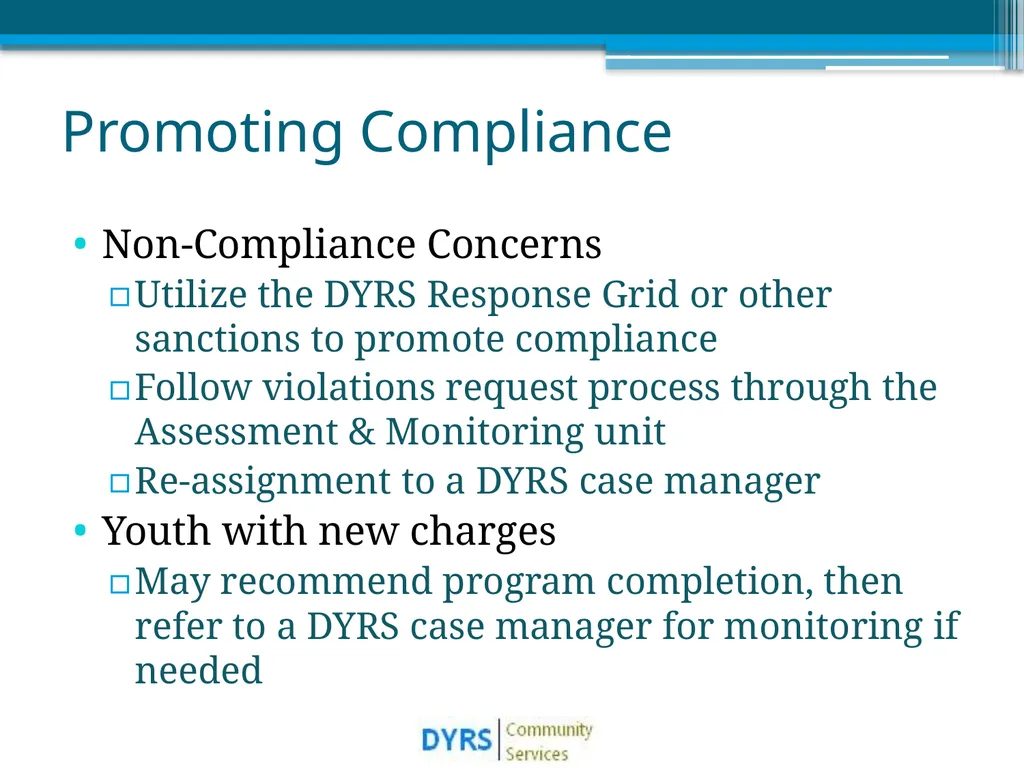
Non-Compliance Concerns
Utilize the DYRS Response Grid or other sanctions to promote compliance
Follow violations request process through the Assessment & Monitoring unit
Re-assignment to a DYRS case manager
Youth with new charges
May recommend program completion, then refer to a DYRS case manager for monitoring if needed Promoting Compliance<br>
Utilize the DYRS Response Grid or other sanctions to promote compliance
Follow violations request process through the Assessment & Monitoring unit
Re-assignment to a DYRS case manager
Youth with new charges
May recommend program completion, then refer to a DYRS case manager for monitoring if needed Promoting Compliance<br>
20
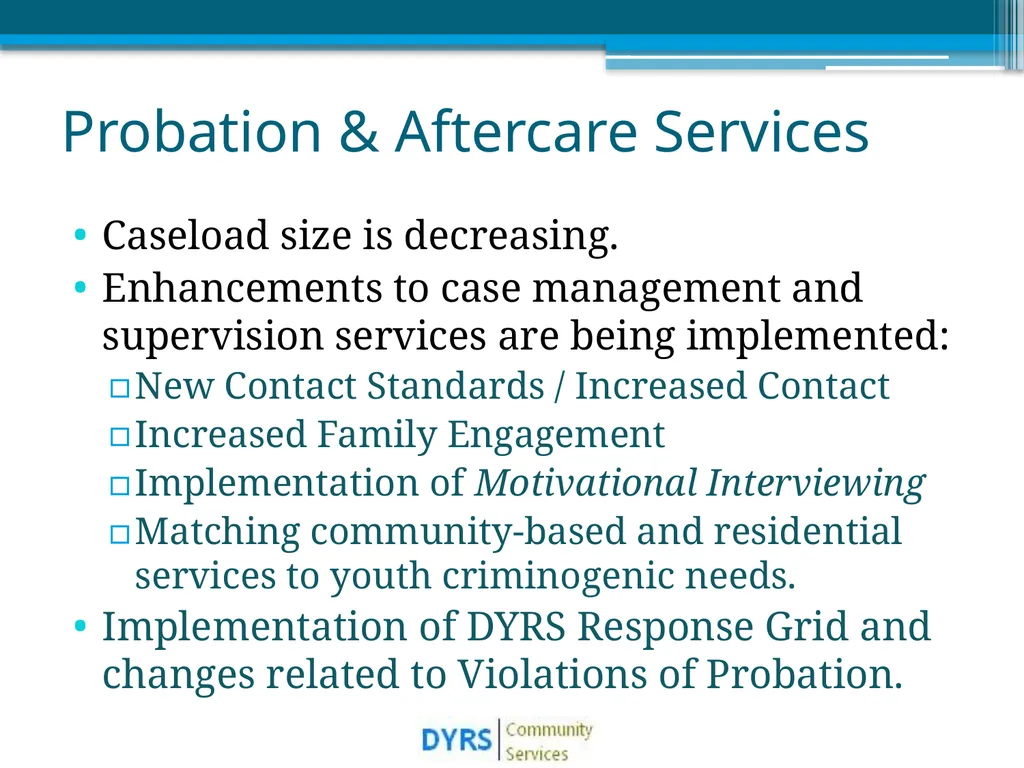
Caseload size is decreasing.
Enhancements to case management and supervision services are being implemented:
New Contact Standards / Increased Contact
Increased Family Engagement
Implementation of Motivational Interviewing
Matching community-based and residential services to youth criminogenic needs.
Implementation of DYRS Response Grid and changes related to Violations of Probation. Probation & Aftercare Services<br>
Enhancements to case management and supervision services are being implemented:
New Contact Standards / Increased Contact
Increased Family Engagement
Implementation of Motivational Interviewing
Matching community-based and residential services to youth criminogenic needs.
Implementation of DYRS Response Grid and changes related to Violations of Probation. Probation & Aftercare Services<br>
21
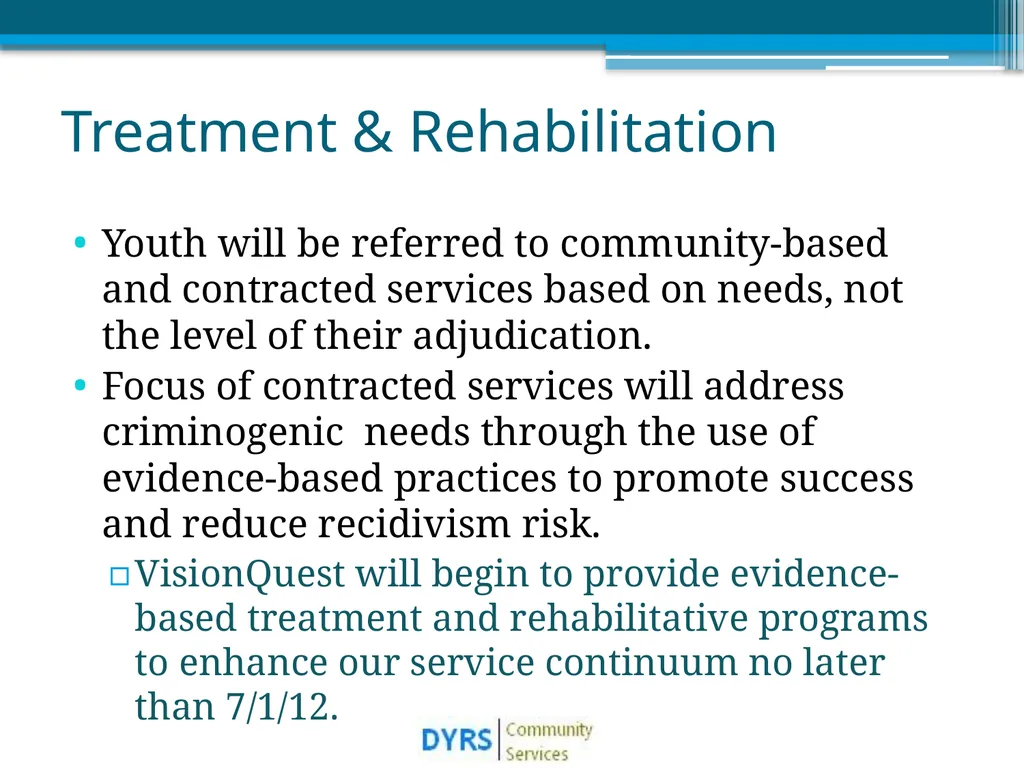
Youth will be referred to community-based and contracted services based on needs, not the level of their adjudication.
Focus of contracted services will address criminogenic needs through the use of evidence-based practices to promote success and reduce recidivism risk.
VisionQuest will begin to provide evidence-based treatment and rehabilitative programs to enhance our service continuum no later than 7/1/12. Treatment & Rehabilitation<br>
Focus of contracted services will address criminogenic needs through the use of evidence-based practices to promote success and reduce recidivism risk.
VisionQuest will begin to provide evidence-based treatment and rehabilitative programs to enhance our service continuum no later than 7/1/12. Treatment & Rehabilitation<br>
22
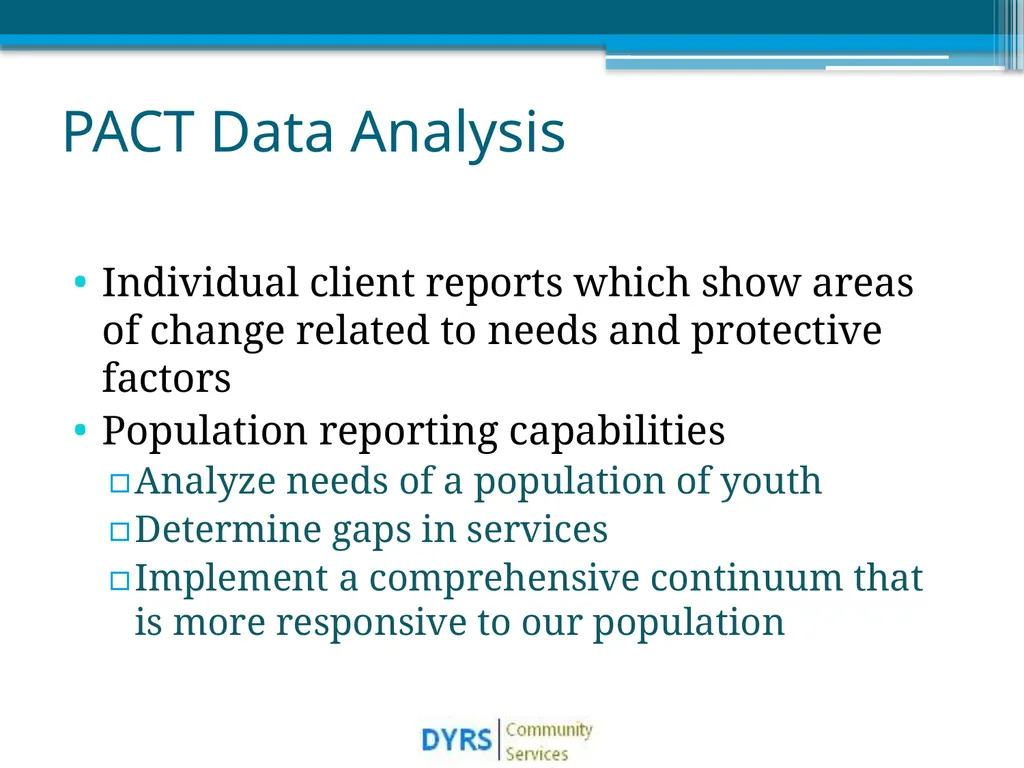
Individual client reports which show areas of change related to needs and protective factors
Population reporting capabilities
Analyze needs of a population of youth
Determine gaps in services
Implement a comprehensive continuum that is more responsive to our population PACT Data Analysis<br>
Population reporting capabilities
Analyze needs of a population of youth
Determine gaps in services
Implement a comprehensive continuum that is more responsive to our population PACT Data Analysis<br>
23
Lisa DiStefano
Chief of Community Services
302-633-2518
elisabeth.distefano@ state.de.us
Susan Burns
Pre-Trial & Low Level Services Manager
302-633-2676
susan.burns@state.de.us Contact Information<br>
Chief of Community Services
302-633-2518
elisabeth.distefano@ state.de.us
Susan Burns
Pre-Trial & Low Level Services Manager
302-633-2676
susan.burns@state.de.us Contact Information<br>
24
Secure Care - Detention New Castle County Detention Center
Stevenson House Detention Center Mitchell Rock & Kendall Wicks<br>
Stevenson House Detention Center Mitchell Rock & Kendall Wicks<br>
25
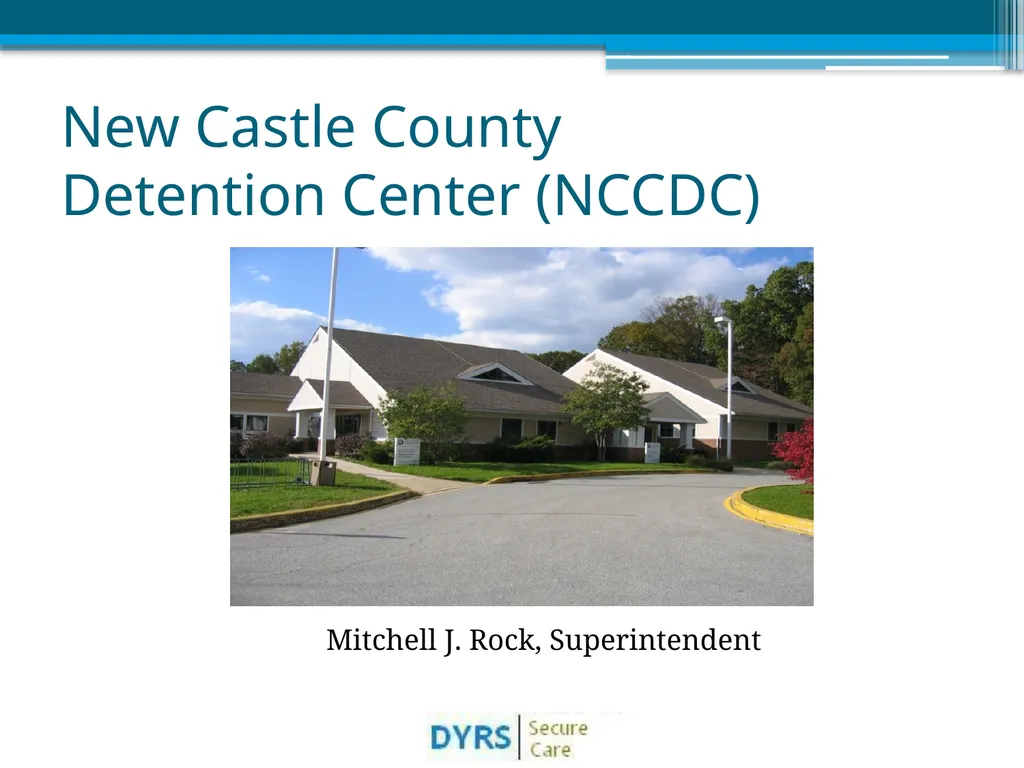
Mitchell J. Rock, Superintendent New Castle County
Detention Center (NCCDC)<br>
Detention Center (NCCDC)<br>
26
Cognitive Behavioral Training (CBT) is our behavioral management system for the facility.
Fosters accountability rewards good behavior
Respect among peers and staff
Acceptance of consequences
Encourages residents to make better choices
ACA Highlights
NCCDC is nationally accredited by the American Correctional Association (ACA). NCCD received a score of 97.5% on our last audit in October 2010. New Castle County
Detention Center<br>
Fosters accountability rewards good behavior
Respect among peers and staff
Acceptance of consequences
Encourages residents to make better choices
ACA Highlights
NCCDC is nationally accredited by the American Correctional Association (ACA). NCCD received a score of 97.5% on our last audit in October 2010. New Castle County
Detention Center<br>
27
Overview / Program Improvement – 24 hour secure care facility housing pre-adjudicated boys and girls with 64 beds.
Facility Upgrades
State -of-the-art security system installed with more cameras for safety and security. Includes new card access system (eliminates the need for most staff to carry keys, provides easier access to all common areas of the facility).
New paint throughout most of the facility
Window coverings replaced
Conference Room Upgraded
Office Equipment Upgraded (Copiers, seating, file storage, etc..)
Signage (Administration Area)
New Resident Phone System (GTL) New Castle County
Detention Center<br>
Facility Upgrades
State -of-the-art security system installed with more cameras for safety and security. Includes new card access system (eliminates the need for most staff to carry keys, provides easier access to all common areas of the facility).
New paint throughout most of the facility
Window coverings replaced
Conference Room Upgraded
Office Equipment Upgraded (Copiers, seating, file storage, etc..)
Signage (Administration Area)
New Resident Phone System (GTL) New Castle County
Detention Center<br>
28
Community Involved Seminars
Red Ribbon Week
Delaware Fatherhood and Family Coalition
Boys & Girls Clubs
Family Nights – Family Engagement New Castle County
Detention Center<br>
Red Ribbon Week
Delaware Fatherhood and Family Coalition
Boys & Girls Clubs
Family Nights – Family Engagement New Castle County
Detention Center<br>
29
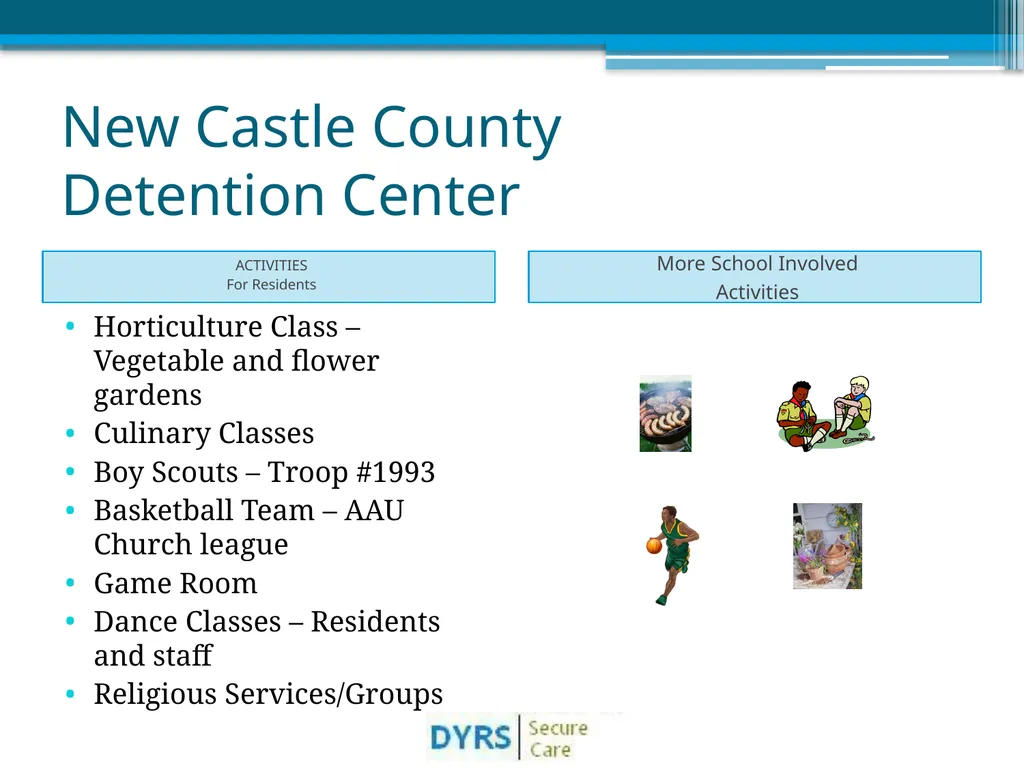
ACTIVITIES
For Residents Horticulture Class – Vegetable and flower gardens
Culinary Classes
Boy Scouts – Troop #1993
Basketball Team – AAU Church league
Game Room
Dance Classes – Residents and staff
Religious Services/Groups More School Involved
Activities New Castle County
Detention Center<br>
For Residents Horticulture Class – Vegetable and flower gardens
Culinary Classes
Boy Scouts – Troop #1993
Basketball Team – AAU Church league
Game Room
Dance Classes – Residents and staff
Religious Services/Groups More School Involved
Activities New Castle County
Detention Center<br>
30
Stevenson House
Detention Center It is our goal to use every available resource to provide the care and maintain the ultimate of standards necessary to accomplish our mission that will reflect a lasting impression on youth served and also on the community. Kendall Wicks<br>
31
Case Management
Special Luncheons
Men’s Mania Stevenson House Detention Center<br>
Special Luncheons
Men’s Mania Stevenson House Detention Center<br>
32
Mental Health
Substance Abuse
Education
Legal Services
Behavior Management Family Nights<br>
Substance Abuse
Education
Legal Services
Behavior Management Family Nights<br>
33
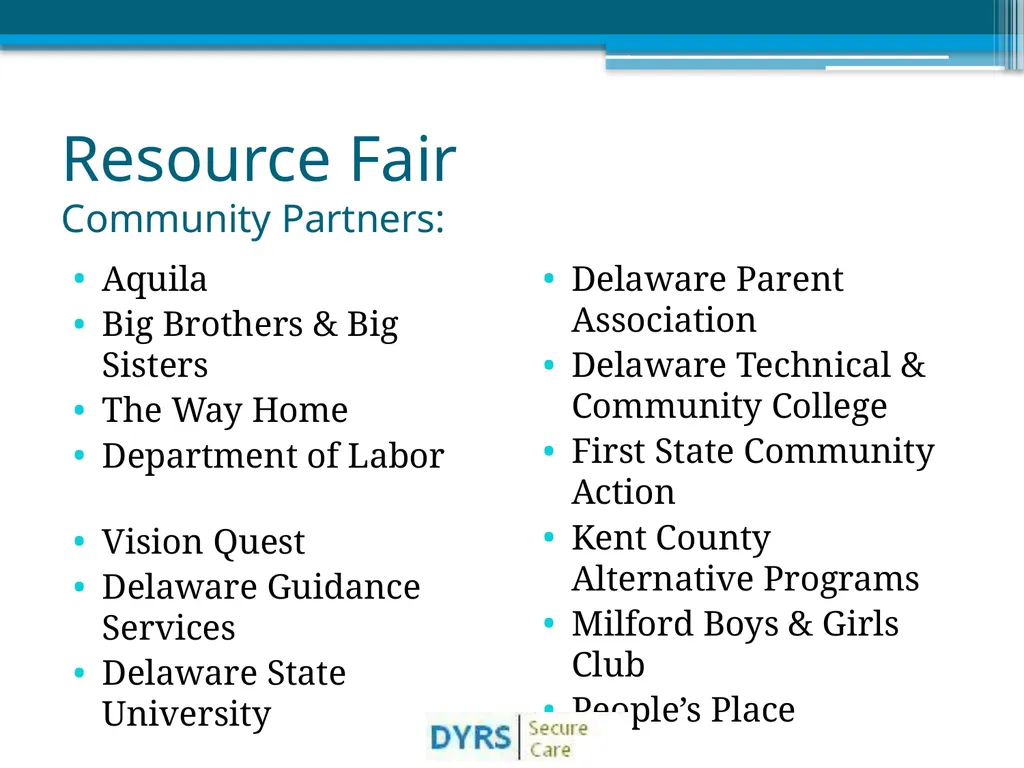
Resource Fair
Community Partners: Aquila
Big Brothers & Big Sisters
The Way Home
Department of Labor
Vision Quest
Delaware Guidance Services
Delaware State University Delaware Parent Association
Delaware Technical & Community College
First State Community Action
Kent County Alternative Programs
Milford Boys & Girls Club
People’s Place<br>
Big Brothers & Big Sisters
The Way Home
Department of Labor
Vision Quest
Delaware Guidance Services
Delaware State University Delaware Parent Association
Delaware Technical & Community College
First State Community Action
Kent County Alternative Programs
Milford Boys & Girls Club
People’s Place<br>
34
DYRS Residential Cottages Grace Cottage
Snowden Cottage
Mowlds Cottage Alison McGonigal<br>
Snowden Cottage
Mowlds Cottage Alison McGonigal<br>
35
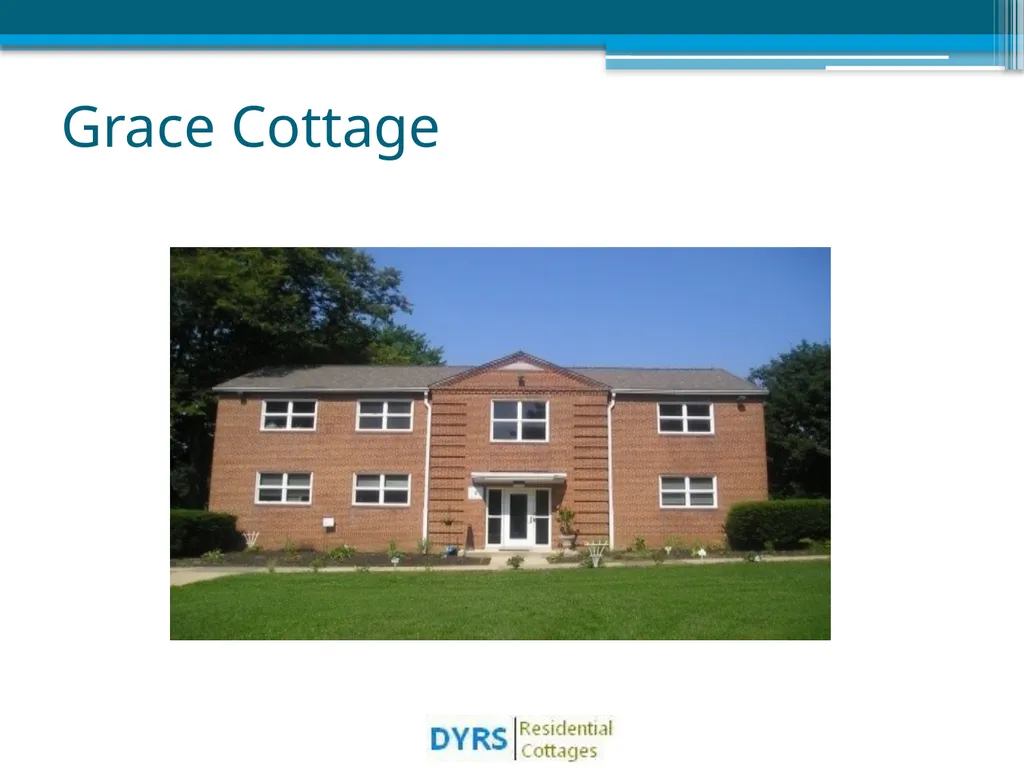
Grace Cottage<br>
36
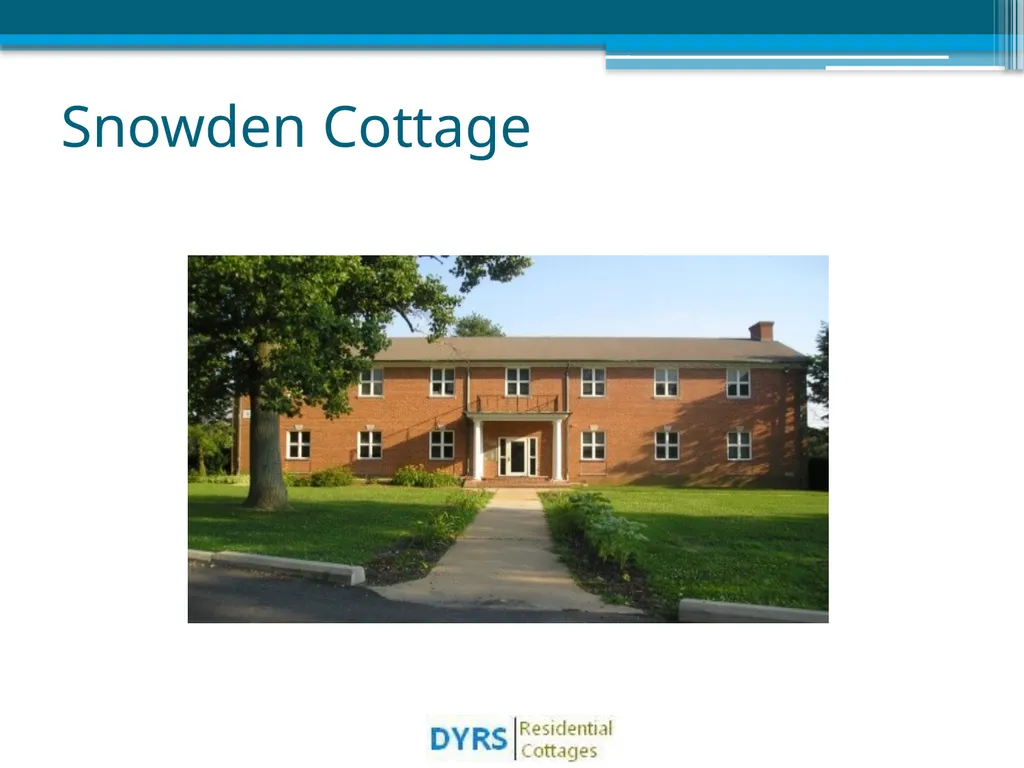
Snowden Cottage<br>
37
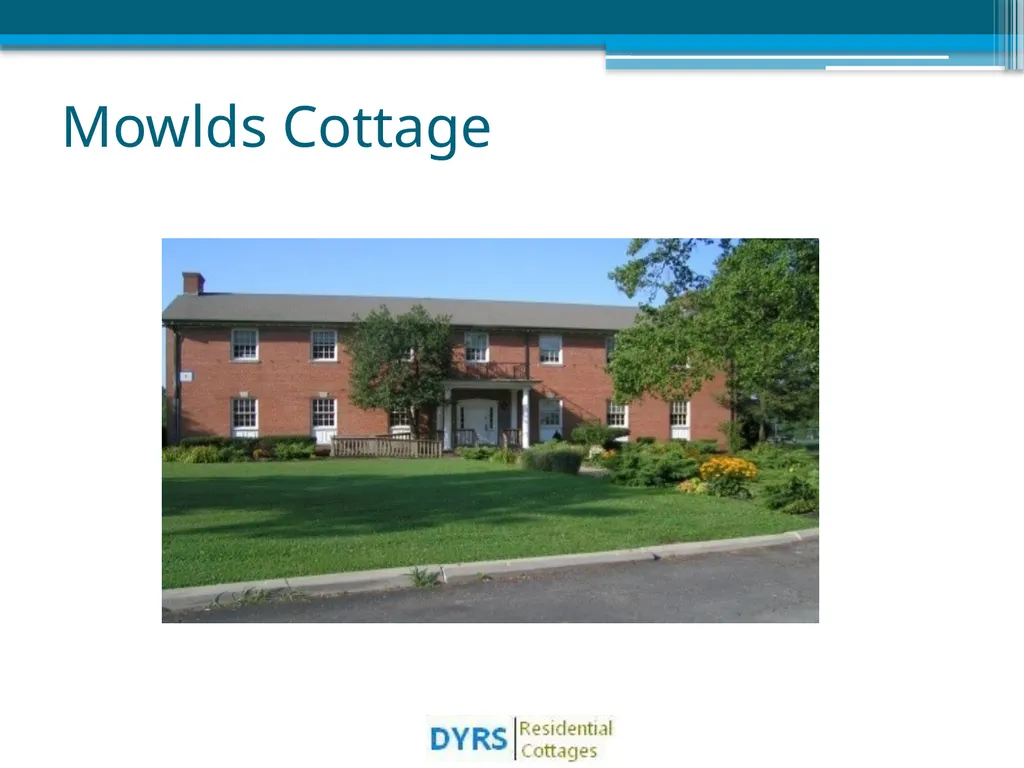
Mowlds Cottage<br>
38
Realignment of Program Unit/Staffing
Standardized Capacity and Target Population
Program Enhancement
Facility Improvement
Performance Measurement
Community Partnerships Residential Cottages<br>
Standardized Capacity and Target Population
Program Enhancement
Facility Improvement
Performance Measurement
Community Partnerships Residential Cottages<br>
39
Ferris School Setting the Standard of Excellence in Transforming Young Men Through Positive Interactions Annette Miller<br>
40
Overview
Cognitive Behavior Training
Behavior Counselors
Clinical Counselors Ferris School<br>
Cognitive Behavior Training
Behavior Counselors
Clinical Counselors Ferris School<br>
41
Mental Health
Assessment
Treatment
Substance Use Treatment
Trauma Informed Care TREATMENT<br>
Assessment
Treatment
Substance Use Treatment
Trauma Informed Care TREATMENT<br>
42
Prescriptive programs
Gun Violence Prevention
Victim Sensitivity
Trauma Informed Care
Drug/Alcohol TREATMENT SERVICES<br>
Gun Violence Prevention
Victim Sensitivity
Trauma Informed Care
Drug/Alcohol TREATMENT SERVICES<br>
43
Core programs
Violence Prevention
HIV/Sex Education
Alcohol and Other Drugs
Restorative Justice
CBT –REBT/Social Skills Program Services<br>
Violence Prevention
HIV/Sex Education
Alcohol and Other Drugs
Restorative Justice
CBT –REBT/Social Skills Program Services<br>
44
Family Engagement
Family Activities
Community Partnerships
Delaware Center for Justice
Jewish Family Services
YMCA Mentoring Program
ARTS Committee
Nemours Community Partnerships<br>
Family Activities
Community Partnerships
Delaware Center for Justice
Jewish Family Services
YMCA Mentoring Program
ARTS Committee
Nemours Community Partnerships<br>