
E-scooter Safety Issues and Solutions Project
CB
Published · 38 slides · 0 views

1 / 1










Description
E-scooter Safety Issues and Solutions Project Overview and Findings From the Behavioral Traffic Safety Cooperative Research Program, BTS-10 Project Slide Deck Overview Introduction Background and project motivation, goals, principles, and
Related Topics
Share
Embed code
Download this presentation From Below
"E-scooter Safety Issues and Solutions Project" is the property of its rightful owner. Permission is granted to download and print the materials on this website for personal, non-commercial use only, and to display it on your personal computer provided you do not modify the materials and that you retain all copyright notices contained in the materials. By downloading content from our website, you accept the terms of this agreement.
Presentation Transcript
01
E-scooter Safety Issues and Solutions Project Overview and Findings From the Behavioral Traffic Safety Cooperative Research Program, BTS-10 Project<br>
02
Slide Deck Overview Introduction
Background and project motivation, goals, principles, and evidence base
General findings
E-scooter usage, context, safety concerns, and injury contributors
Current and potential safety management practices and future research needs
Takeaways for local micromobility program managers
Takeaways for state highway safety officials and policy makers
Summary of project deliverables
Acknowledgements<br>
Background and project motivation, goals, principles, and evidence base
General findings
E-scooter usage, context, safety concerns, and injury contributors
Current and potential safety management practices and future research needs
Takeaways for local micromobility program managers
Takeaways for state highway safety officials and policy makers
Summary of project deliverables
Acknowledgements<br>
03
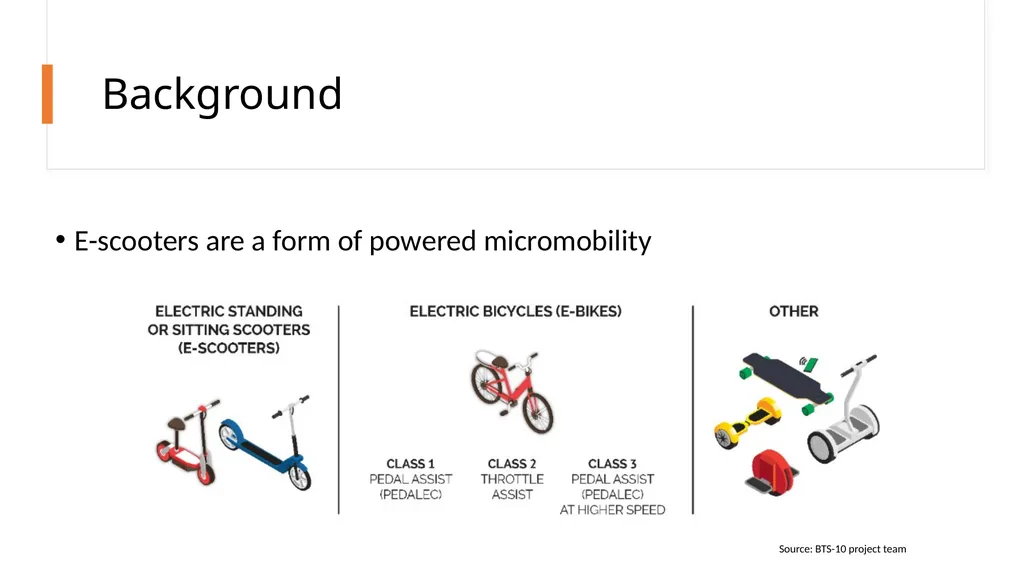
Background E-scooters are a form of powered micromobility Source: BTS-10 project team<br>
04
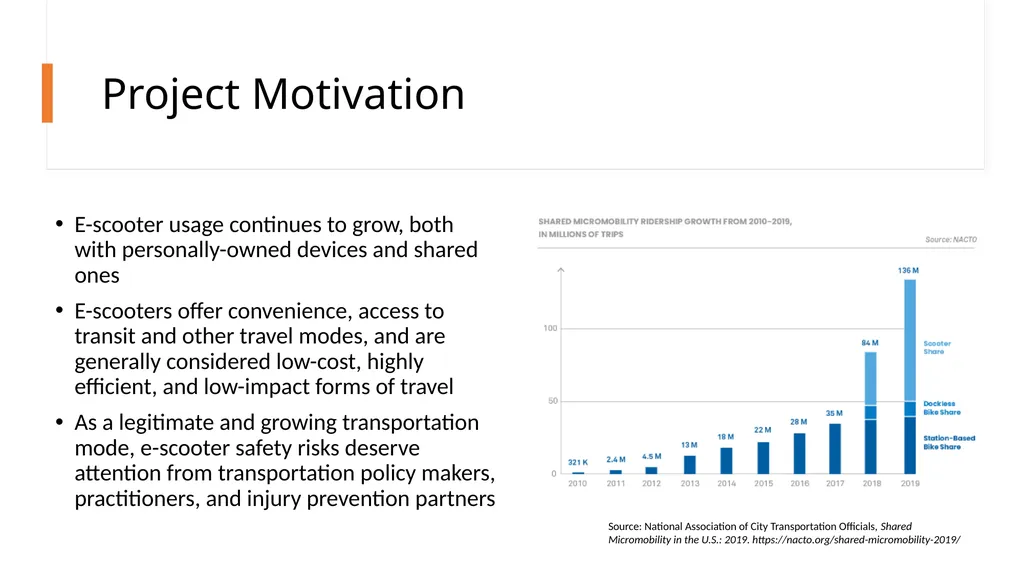
Project Motivation E-scooter usage continues to grow, both with personally-owned devices and shared ones
E-scooters offer convenience, access to transit and other travel modes, and are generally considered low-cost, highly efficient, and low-impact forms of travel
As a legitimate and growing transportation mode, e-scooter safety risks deserve attention from transportation policy makers, practitioners, and injury prevention partners Source: National Association of City Transportation Officials, Shared Micromobility in the U.S.: 2019. https://nacto.org/shared-micromobility-2019/<br>
E-scooters offer convenience, access to transit and other travel modes, and are generally considered low-cost, highly efficient, and low-impact forms of travel
As a legitimate and growing transportation mode, e-scooter safety risks deserve attention from transportation policy makers, practitioners, and injury prevention partners Source: National Association of City Transportation Officials, Shared Micromobility in the U.S.: 2019. https://nacto.org/shared-micromobility-2019/<br>
05
BTS-10 Project Goals This effort used multiple methods of data collection and analysis to describe e-scooter:
Current state of use, context, and safety issues;
Injury information, including circumstances, severity, and comparison of injury trends to other modes;
Safety management practices, both existing and those that may be of interest or are being considered; and
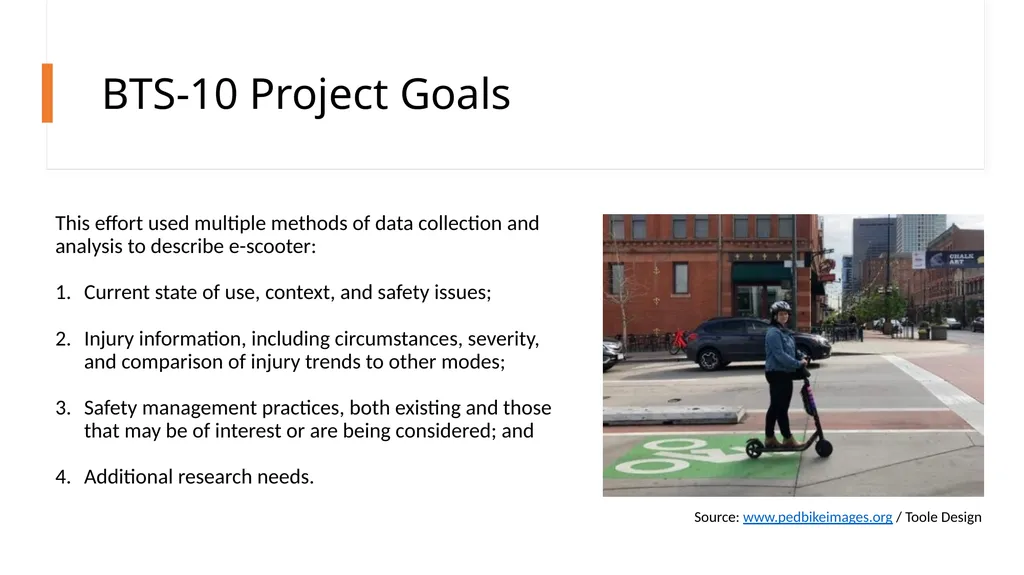
Additional research needs. Source: www.pedbikeimages.org / Toole Design<br>
Current state of use, context, and safety issues;
Injury information, including circumstances, severity, and comparison of injury trends to other modes;
Safety management practices, both existing and those that may be of interest or are being considered; and
Additional research needs. Source: www.pedbikeimages.org / Toole Design<br>
06
BTS-10 Project Lens: A Safe and Equitable System The project team recognized these key Safe System principles in the development of the research project and subsequent deliverables:
E-scooter-related fatalities are unacceptable: Proactive efforts to prevent severe and fatal injuries are critically needed.
Humans make mistakes, have limitations, and are vulnerable: Safety management practices must anticipate and accommodate human behaviors and limitations to help avoid serious and fatal injuries.
Redundancy is critical and responsibility is shared by system designers: Risk reduction involves all parts of the system working together.
An equitable transportation system ensures safe, sustainable, and convenient options for all: Equity principles should be considered within the context of micromobility and support for micromobility in cities and towns.<br>
E-scooter-related fatalities are unacceptable: Proactive efforts to prevent severe and fatal injuries are critically needed.
Humans make mistakes, have limitations, and are vulnerable: Safety management practices must anticipate and accommodate human behaviors and limitations to help avoid serious and fatal injuries.
Redundancy is critical and responsibility is shared by system designers: Risk reduction involves all parts of the system working together.
An equitable transportation system ensures safe, sustainable, and convenient options for all: Equity principles should be considered within the context of micromobility and support for micromobility in cities and towns.<br>
07
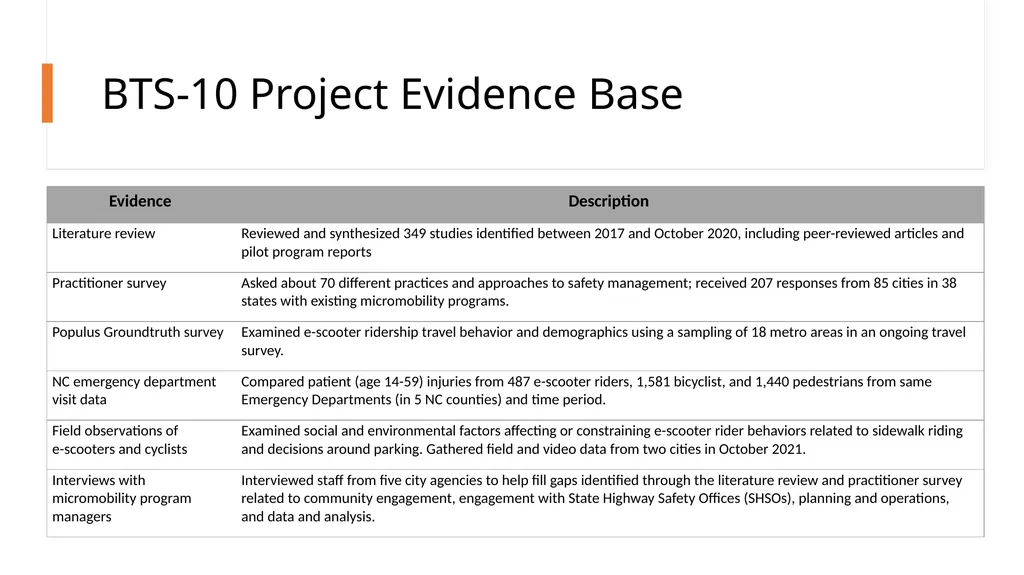
BTS-10 Project Evidence Base<br>
08
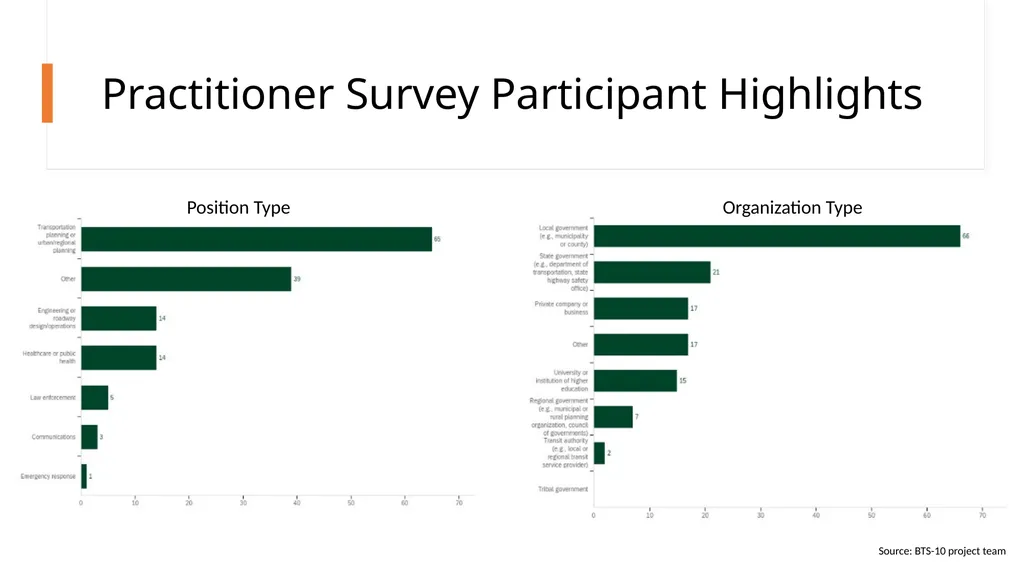
Practitioner Survey Participant Highlights Position Type Organization Type Source: BTS-10 project team<br>
09
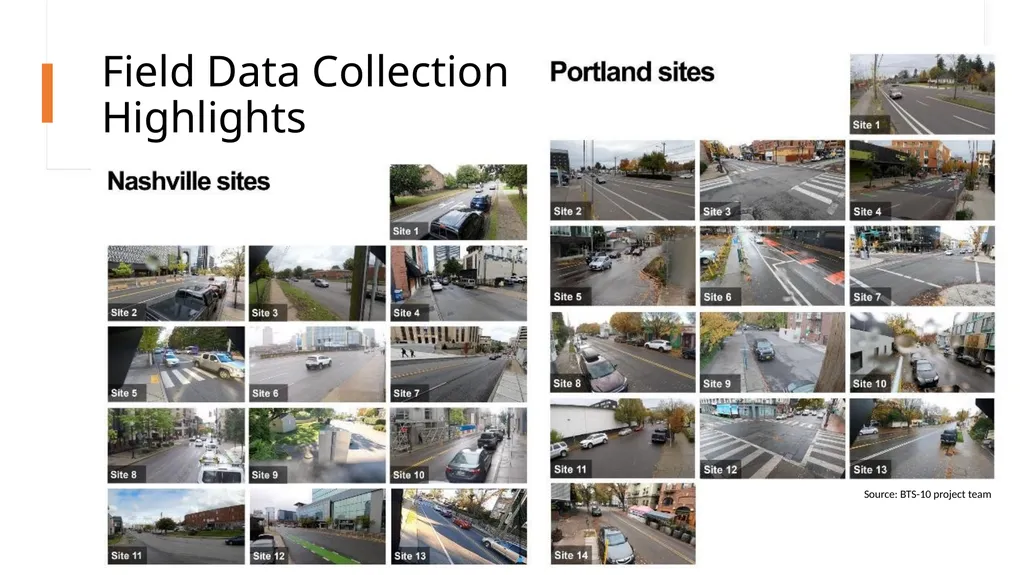
Field Data Collection Highlights Source: BTS-10 project team<br>
10
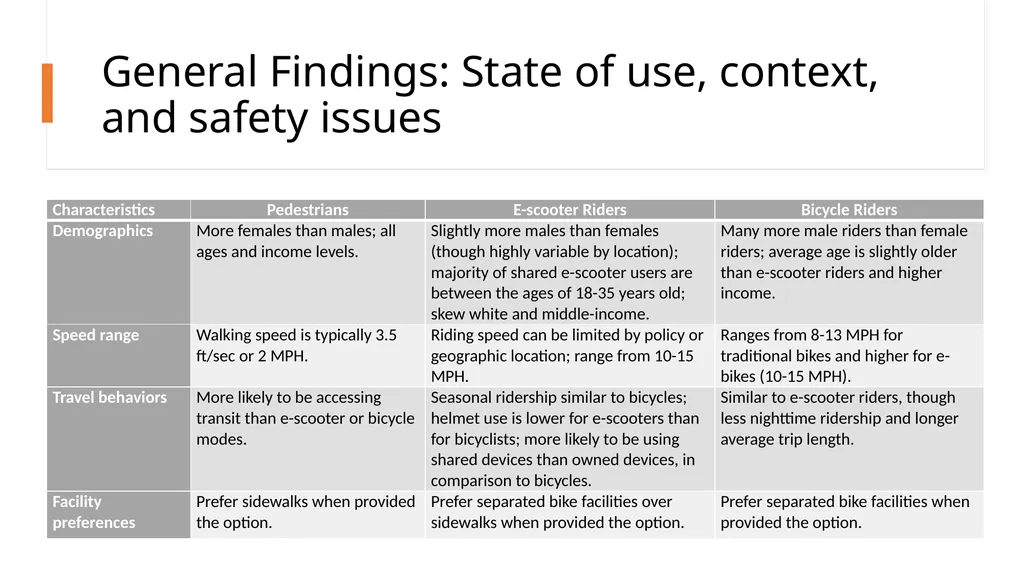
General Findings: State of use, context, and safety issues<br>
11
General Findings: E-scooter injury circumstances and contributing factors<br>
12
Proper helmet-wearing reduces public healthcare costs, but current e-scooter helmet use is low Head injuries, including traumatic brain injuries, are the most common type of e-scooter injury requiring medical treatment (28-40%).
Fractures, particularly involving the lower arm and wrist, are also common (25-31%).
Studies of injured pedestrians in one state found that more than half rely on publicly funded healthcare programs.
This study and others have observed e-scooter helmet use is low, and consistently lower than bicyclist helmet use.<br>
Fractures, particularly involving the lower arm and wrist, are also common (25-31%).
Studies of injured pedestrians in one state found that more than half rely on publicly funded healthcare programs.
This study and others have observed e-scooter helmet use is low, and consistently lower than bicyclist helmet use.<br>
13
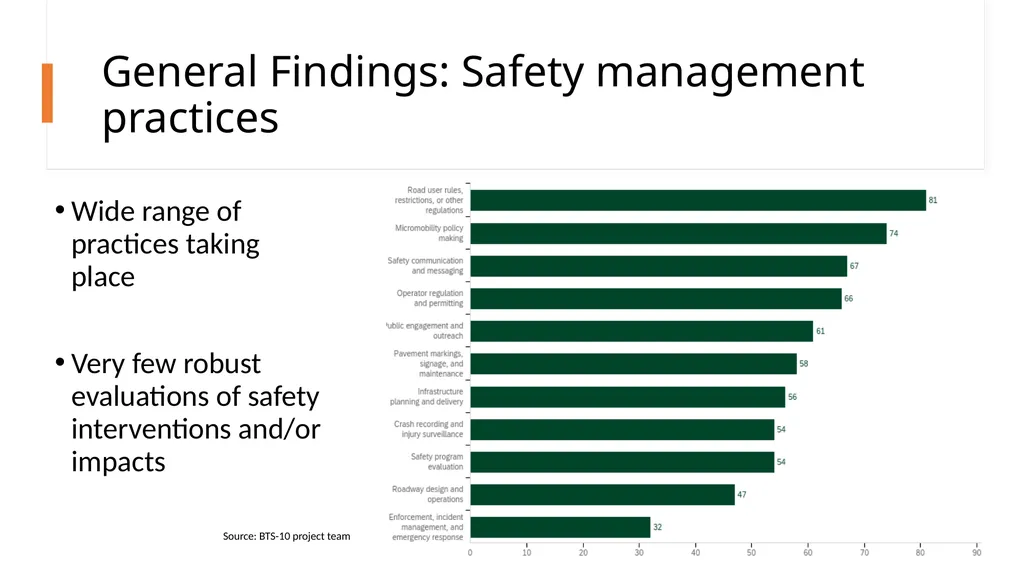
General Findings: Safety management practices Wide range of practices taking place
Very few robust evaluations of safety interventions and/or impacts Source: BTS-10 project team<br>
Very few robust evaluations of safety interventions and/or impacts Source: BTS-10 project team<br>
14
What makes e-scooter riders safe? Safe System principles of:
Separation of road users (in space or in time of facility use)
Spaces for practice and opportunities to gain experience
Inclusive, friendly streets designed for e-scooter usage
Slow vehicle speeds Source: BTS-10 project team<br>
Separation of road users (in space or in time of facility use)
Spaces for practice and opportunities to gain experience
Inclusive, friendly streets designed for e-scooter usage
Slow vehicle speeds Source: BTS-10 project team<br>
15
What can individual riders do to protect themselves? Source: BTS-10 project team<br>
16
Toolbox offering: A summary of safety management practices<br>
17
General Findings: Additional research needs Studies on the experiences, attitudes, and perceptions, and injury outcomes of people with disabilities in relation to e-scooters
Studies on the experiences, attitudes, and perceptions, and injury rates and outcomes of people in different socioeconomic groups (age, gender, race, ethnicity, income)
Studies/evaluations of local e-scooter practices related to speed management, pavement quality management/maintenance, design of transition zones, parking policy/design, and communications/engagement techniques
Studies/evaluations of the equity of various e-scooter practices (geofencing, service restrictions, enforcement, data or other program and permitting requirements)
Evaluations, resources, or guidance on equitable community practices to build civic engagement in e-scooter programs, network planning, and policy decisions<br>
Studies on the experiences, attitudes, and perceptions, and injury rates and outcomes of people in different socioeconomic groups (age, gender, race, ethnicity, income)
Studies/evaluations of local e-scooter practices related to speed management, pavement quality management/maintenance, design of transition zones, parking policy/design, and communications/engagement techniques
Studies/evaluations of the equity of various e-scooter practices (geofencing, service restrictions, enforcement, data or other program and permitting requirements)
Evaluations, resources, or guidance on equitable community practices to build civic engagement in e-scooter programs, network planning, and policy decisions<br>
18
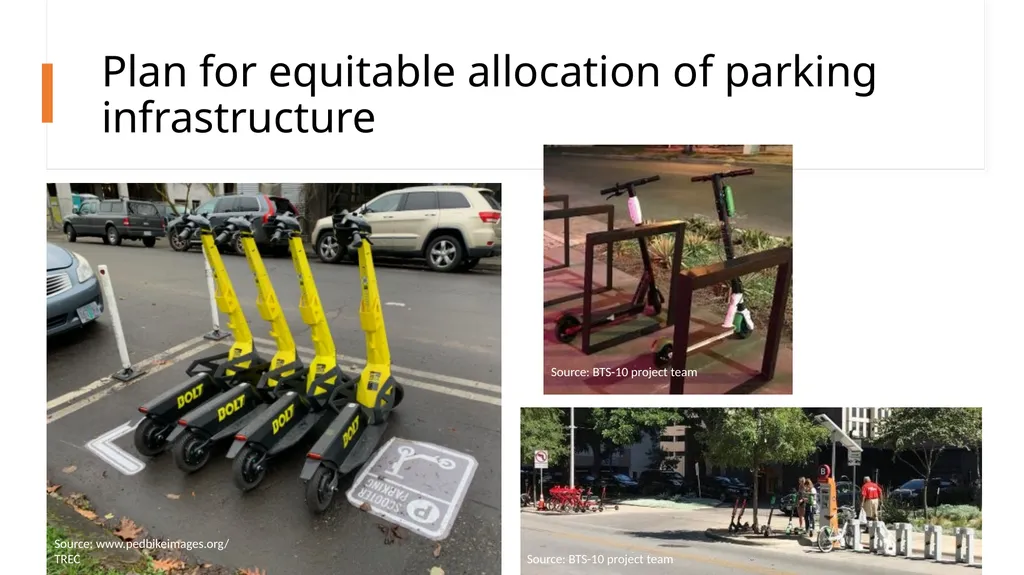
Key Takeaways for Local Micromobility Program Managers Micromobility parking is a civil rights issue and a safety issue
Planning for equitable allocation of parking infrastructure is a must
Micromobility programs will not succeed if riders have bad experiences or are injured
Proactive community engagement and hazard identification can pre-empt injuries and complaints
Seek ways to mitigate harmful behaviors, as well as reduce the harm when injuries do occur
Partner and plan for harm reduction and addressing the deadliest combinations of risk factors
Community engagement offers opportunities to address equity and build a culture around safety<br>
Planning for equitable allocation of parking infrastructure is a must
Micromobility programs will not succeed if riders have bad experiences or are injured
Proactive community engagement and hazard identification can pre-empt injuries and complaints
Seek ways to mitigate harmful behaviors, as well as reduce the harm when injuries do occur
Partner and plan for harm reduction and addressing the deadliest combinations of risk factors
Community engagement offers opportunities to address equity and build a culture around safety<br>
19
Micromobility parking is a civil rights issue and a safety issue “Public rights-of-way and facilities are required to be accessible to persons with disabilities through the following statutes: Section 504 of the Rehabilitation Act of 1973 (Section 504) (29 U.S.C. §794) and Title II of the Americans with Disabilities Act of 1990 (ADA) (42 U.S.C. §§ 12131-12164). These statutes prohibit public agencies from discriminating against persons with disabilities by excluding them from services, programs, or activities. These statutes mean that the agency must provide pedestrian access for persons with disabilities to the agency's streets and sidewalks, whenever a pedestrian facility exists. Regulations implement this requirement by imposing standards for accessible features such as curb cuts, ramps, continuous sidewalks, and detectable warnings." (FHWA).
Planning for parking helps preempt ADA concerns and complaints and reduce tripping and fall hazards
Where you place the parking matters Source: BTS-10 project team Source: BTS-10 project team<br>
Planning for parking helps preempt ADA concerns and complaints and reduce tripping and fall hazards
Where you place the parking matters Source: BTS-10 project team Source: BTS-10 project team<br>
20
Plan for equitable allocation of parking infrastructure Source: www.pedbikeimages.org/ TREC Source: BTS-10 project team Source: BTS-10 project team<br>
21
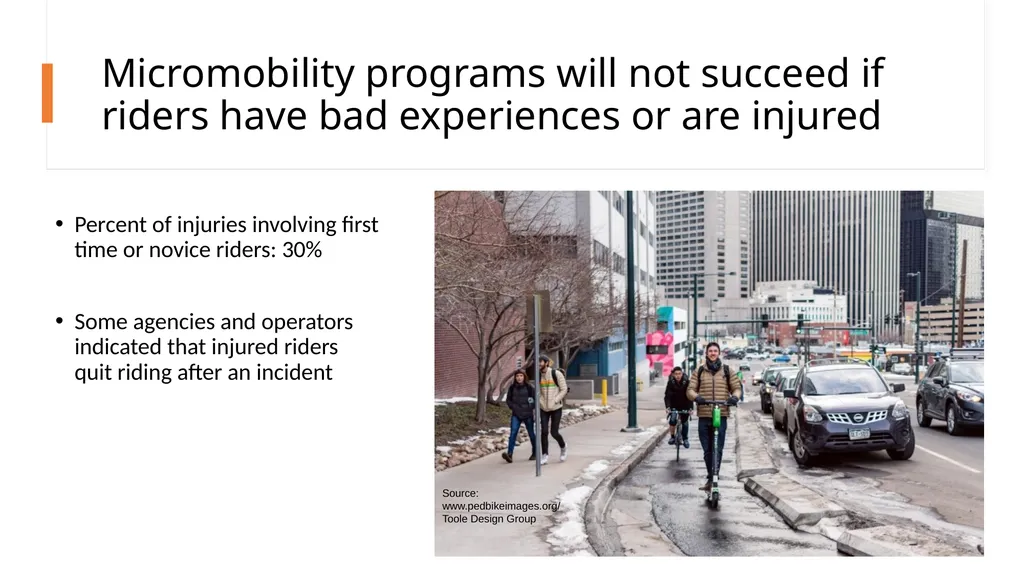
Micromobility programs will not succeed if riders have bad experiences or are injured Percent of injuries involving first time or novice riders: 30%
Some agencies and operators indicated that injured riders quit riding after an incident Source: www.pedbikeimages.org/ Toole Design Group<br>
Some agencies and operators indicated that injured riders quit riding after an incident Source: www.pedbikeimages.org/ Toole Design Group<br>
22
How can communities be proactive about e-scooter safety? Is your risk reporting program adequately staffed?
Do you have a system in place to provide equitable responses?
Do you have a system in place to respond to systemic issues?
Are you leveraging opportunities for community members to share data?
Is your roadway network ready for e-scooters?
Pavement conditions
Transition zones
Separated bicycle facilities<br>
Do you have a system in place to provide equitable responses?
Do you have a system in place to respond to systemic issues?
Are you leveraging opportunities for community members to share data?
Is your roadway network ready for e-scooters?
Pavement conditions
Transition zones
Separated bicycle facilities<br>
23
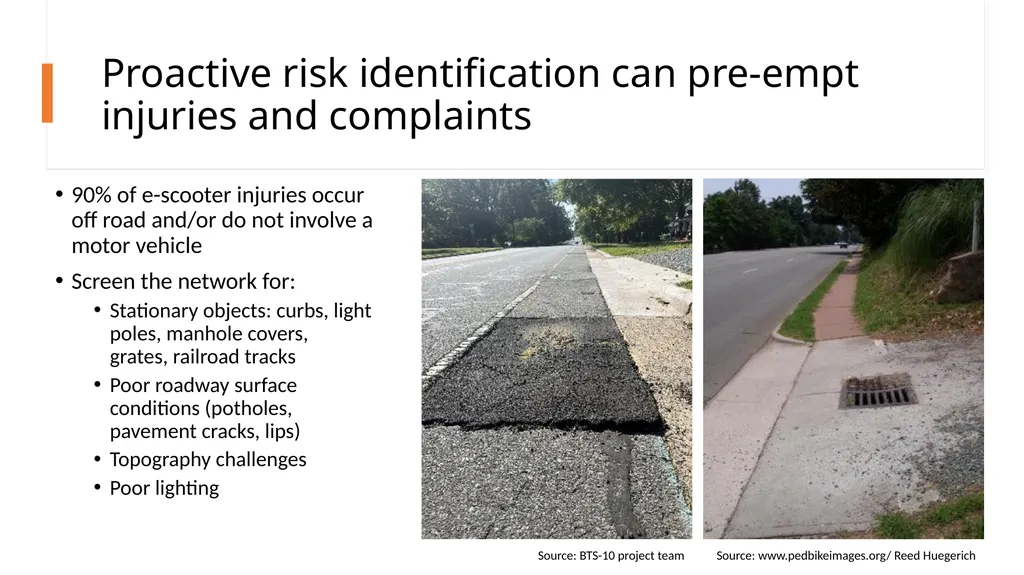
Proactive risk identification can pre-empt injuries and complaints 90% of e-scooter injuries occur off road and/or do not involve a motor vehicle
Screen the network for:
Stationary objects: curbs, light poles, manhole covers, grates, railroad tracks
Poor roadway surface conditions (potholes, pavement cracks, lips)
Topography challenges
Poor lighting Source: www.pedbikeimages.org/ Reed Huegerich Source: BTS-10 project team<br>
Screen the network for:
Stationary objects: curbs, light poles, manhole covers, grates, railroad tracks
Poor roadway surface conditions (potholes, pavement cracks, lips)
Topography challenges
Poor lighting Source: www.pedbikeimages.org/ Reed Huegerich Source: BTS-10 project team<br>
24
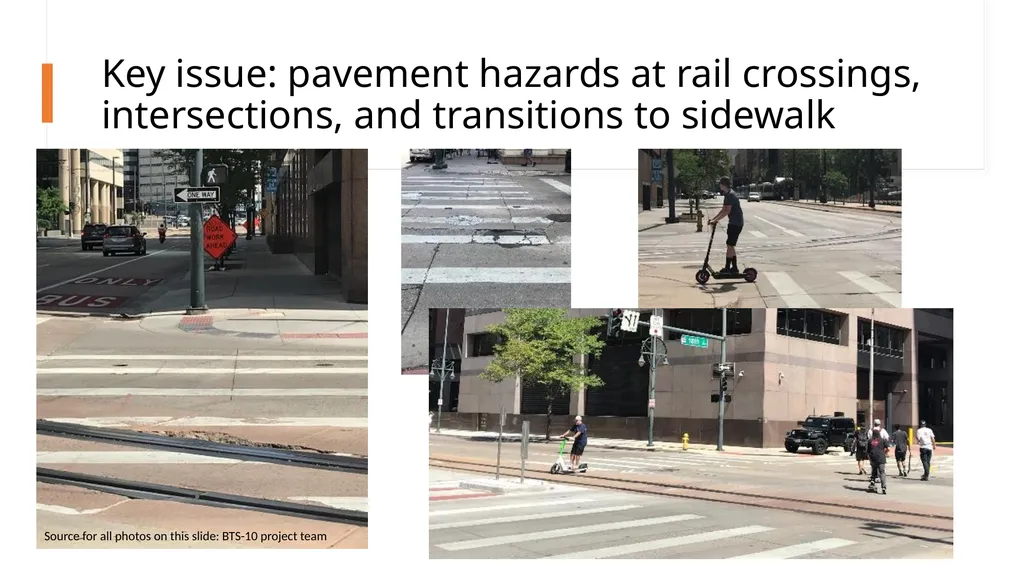
Key issue: pavement hazards at rail crossings, intersections, and transitions to sidewalk Source for all photos on this slide: BTS-10 project team<br>
25
Connected, low stress bike networks also work for e-scooter safety and perceptions of comfort Roads with bike lanes are associated with:
Fewer e-scooter injuries
Less sidewalk riding
More satisfied e-scooter riders Source: Bird Report: A Look at E-scooter Safety, April 2019<br>
Fewer e-scooter injuries
Less sidewalk riding
More satisfied e-scooter riders Source: Bird Report: A Look at E-scooter Safety, April 2019<br>
26
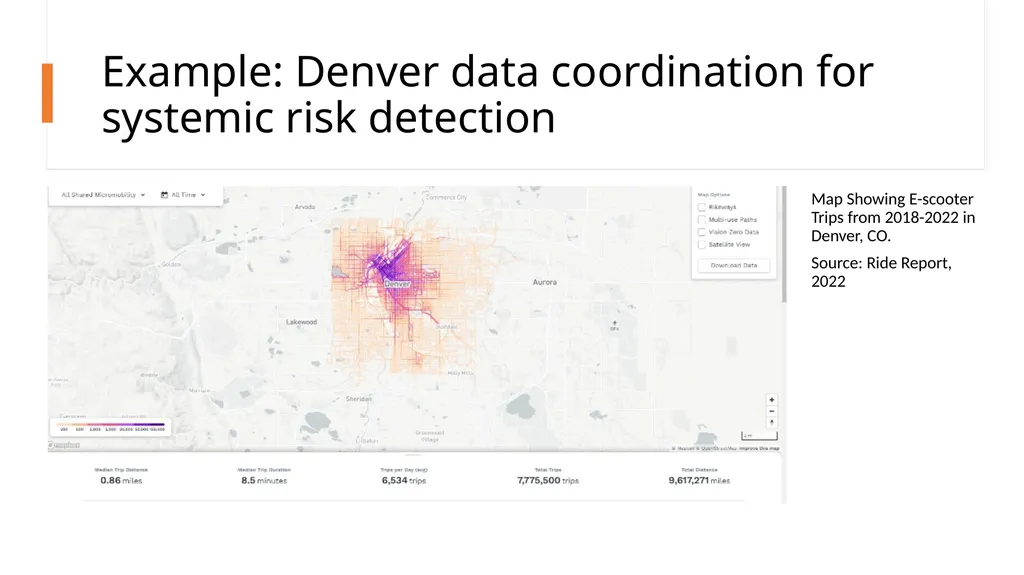
Example: Denver data coordination for systemic risk detection Map Showing E-scooter Trips from 2018-2022 in Denver, CO.
Source: Ride Report, 2022<br>
Source: Ride Report, 2022<br>
27
Toolbox offering:
E-scooter risk assessment tool Provides a list of discussion prompts
Can be used in “road safety audit” like activities, or could be integrated into routine travel surveys Source: BTS-10 project team<br>
Can be used in “road safety audit” like activities, or could be integrated into routine travel surveys Source: BTS-10 project team<br>
28
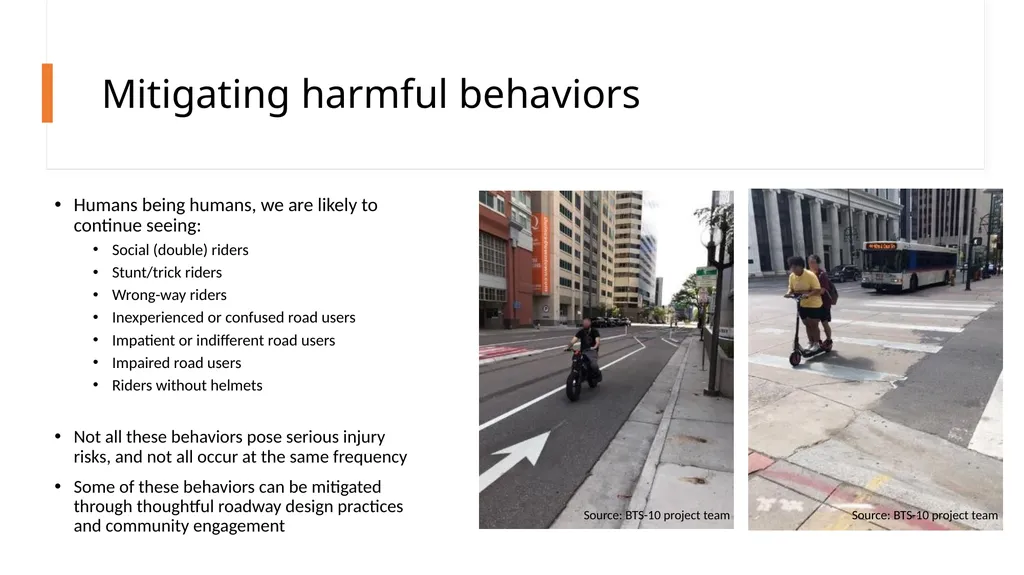
Mitigating harmful behaviors Humans being humans, we are likely to continue seeing:
Social (double) riders
Stunt/trick riders
Wrong-way riders
Inexperienced or confused road users
Impatient or indifferent road users
Impaired road users
Riders without helmets
Not all these behaviors pose serious injury risks, and not all occur at the same frequency
Some of these behaviors can be mitigated through thoughtful roadway design practices and community engagement Source: BTS-10 project team Source: BTS-10 project team<br>
Social (double) riders
Stunt/trick riders
Wrong-way riders
Inexperienced or confused road users
Impatient or indifferent road users
Impaired road users
Riders without helmets
Not all these behaviors pose serious injury risks, and not all occur at the same frequency
Some of these behaviors can be mitigated through thoughtful roadway design practices and community engagement Source: BTS-10 project team Source: BTS-10 project team<br>
29
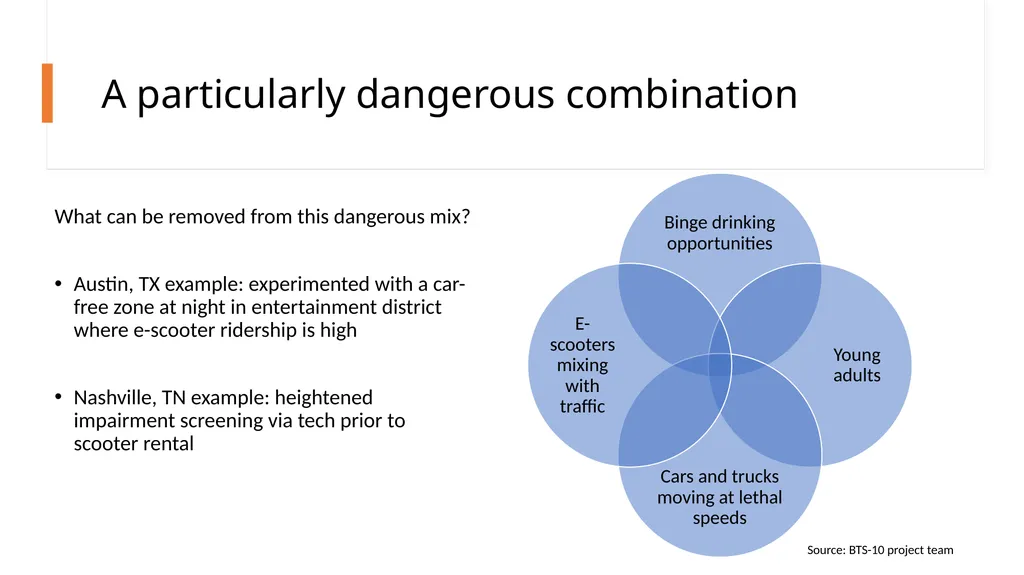
A particularly dangerous combination What can be removed from this dangerous mix?
Austin, TX example: experimented with a car-free zone at night in entertainment district where e-scooter ridership is high
Nashville, TN example: heightened impairment screening via tech prior to scooter rental Source: BTS-10 project team<br>
Austin, TX example: experimented with a car-free zone at night in entertainment district where e-scooter ridership is high
Nashville, TN example: heightened impairment screening via tech prior to scooter rental Source: BTS-10 project team<br>
30
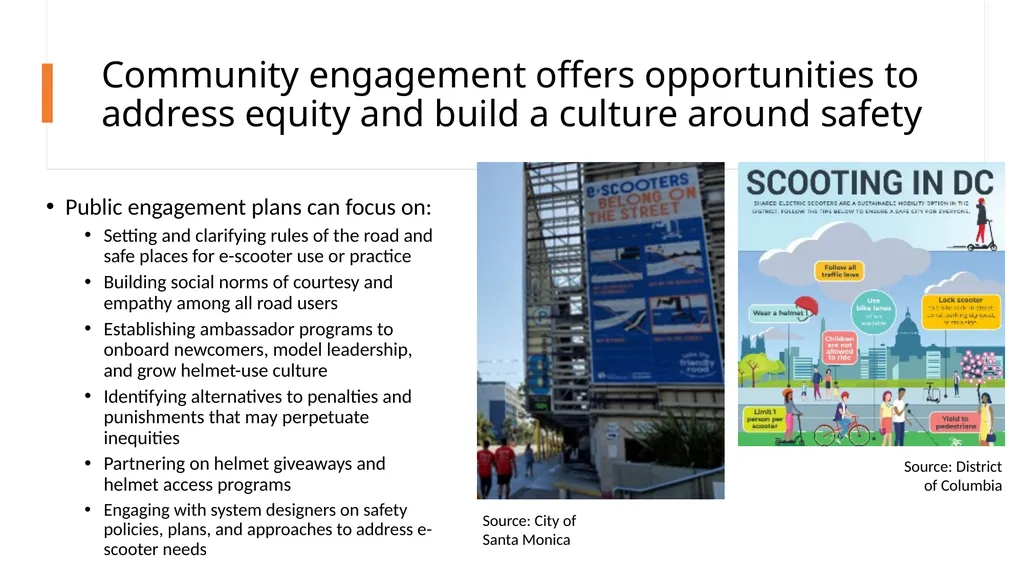
Community engagement offers opportunities to address equity and build a culture around safety Public engagement plans can focus on:
Setting and clarifying rules of the road and safe places for e-scooter use or practice
Building social norms of courtesy and empathy among all road users
Establishing ambassador programs to onboard newcomers, model leadership, and grow helmet-use culture
Identifying alternatives to penalties and punishments that may perpetuate inequities
Partnering on helmet giveaways and helmet access programs
Engaging with system designers on safety policies, plans, and approaches to address e-scooter needs Source: District of Columbia Source: City of Santa Monica Source: City of Spokane<br>
Setting and clarifying rules of the road and safe places for e-scooter use or practice
Building social norms of courtesy and empathy among all road users
Establishing ambassador programs to onboard newcomers, model leadership, and grow helmet-use culture
Identifying alternatives to penalties and punishments that may perpetuate inequities
Partnering on helmet giveaways and helmet access programs
Engaging with system designers on safety policies, plans, and approaches to address e-scooter needs Source: District of Columbia Source: City of Santa Monica Source: City of Spokane<br>
31
Key Takeaways for State Highway Safety Officials and policy makers Definitions and policy support
Local agencies need state-level support in defining emerging devices and prioritizing the safety of vulnerable road users in policy and legislative documents
Data collection and data improvement
State leadership is needed to improve e-scooter safety data standards, data collection, and support for local program evaluation
Program and partner support
State Highway Safety Offices can play a key role in providing local funding and program support as well as coordinating with key partners, such as Emergency Service Providers, to integrate and share plans and safety data<br>
Local agencies need state-level support in defining emerging devices and prioritizing the safety of vulnerable road users in policy and legislative documents
Data collection and data improvement
State leadership is needed to improve e-scooter safety data standards, data collection, and support for local program evaluation
Program and partner support
State Highway Safety Offices can play a key role in providing local funding and program support as well as coordinating with key partners, such as Emergency Service Providers, to integrate and share plans and safety data<br>
32
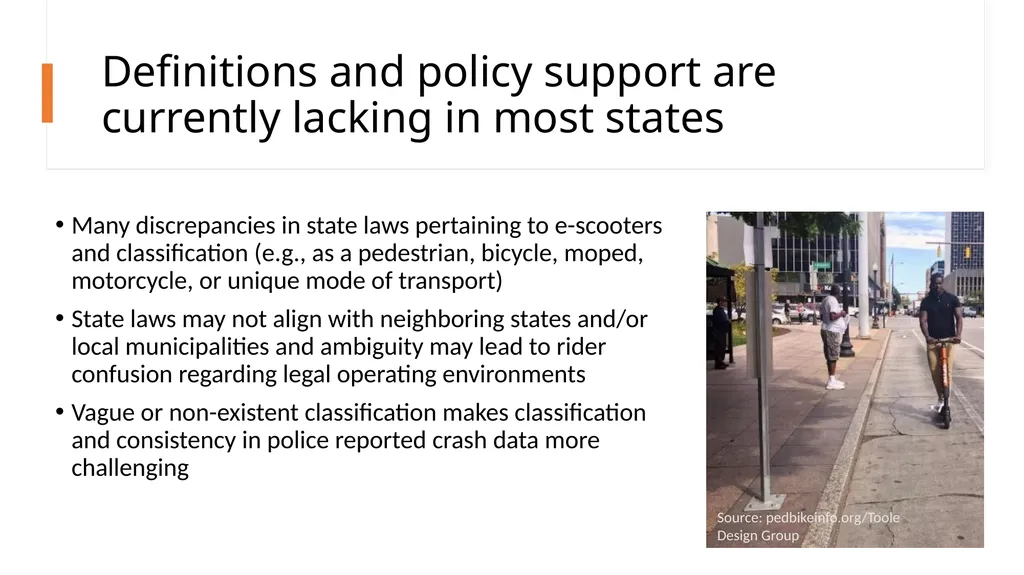
Definitions and policy support are currently lacking in most states Many discrepancies in state laws pertaining to e-scooters and classification (e.g., as a pedestrian, bicycle, moped, motorcycle, or unique mode of transport)
State laws may not align with neighboring states and/or local municipalities and ambiguity may lead to rider confusion regarding legal operating environments
Vague or non-existent classification makes classification and consistency in police reported crash data more challenging Source: pedbikeinfo.org/Toole Design Group<br>
State laws may not align with neighboring states and/or local municipalities and ambiguity may lead to rider confusion regarding legal operating environments
Vague or non-existent classification makes classification and consistency in police reported crash data more challenging Source: pedbikeinfo.org/Toole Design Group<br>
33
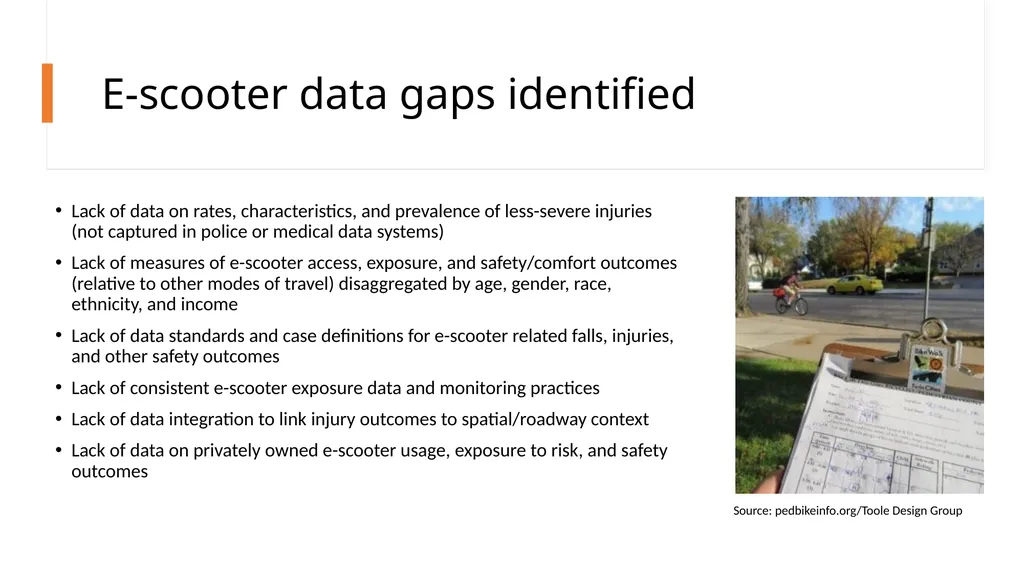
E-scooter data gaps identified Lack of data on rates, characteristics, and prevalence of less-severe injuries (not captured in police or medical data systems)
Lack of measures of e-scooter access, exposure, and safety/comfort outcomes (relative to other modes of travel) disaggregated by age, gender, race, ethnicity, and income
Lack of data standards and case definitions for e-scooter related falls, injuries, and other safety outcomes
Lack of consistent e-scooter exposure data and monitoring practices
Lack of data integration to link injury outcomes to spatial/roadway context
Lack of data on privately owned e-scooter usage, exposure to risk, and safety outcomes Source: pedbikeinfo.org/Toole Design Group<br>
Lack of measures of e-scooter access, exposure, and safety/comfort outcomes (relative to other modes of travel) disaggregated by age, gender, race, ethnicity, and income
Lack of data standards and case definitions for e-scooter related falls, injuries, and other safety outcomes
Lack of consistent e-scooter exposure data and monitoring practices
Lack of data integration to link injury outcomes to spatial/roadway context
Lack of data on privately owned e-scooter usage, exposure to risk, and safety outcomes Source: pedbikeinfo.org/Toole Design Group<br>
34
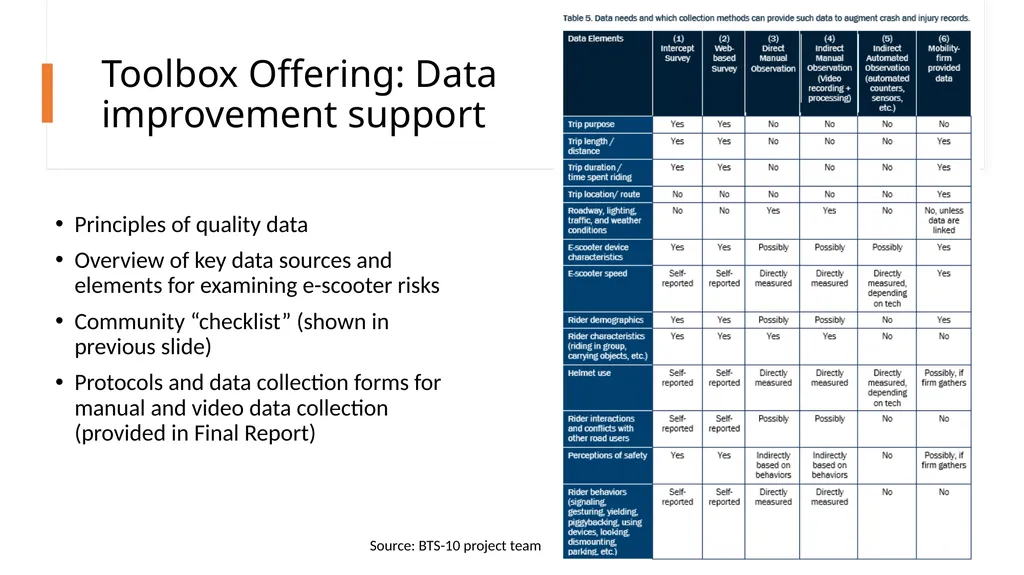
Toolbox Offering: Data improvement support Principles of quality data
Overview of key data sources and elements for examining e-scooter risks
Community “checklist” (shown in previous slide)
Protocols and data collection forms for manual and video data collection (provided in Final Report) Source: BTS-10 project team<br>
Overview of key data sources and elements for examining e-scooter risks
Community “checklist” (shown in previous slide)
Protocols and data collection forms for manual and video data collection (provided in Final Report) Source: BTS-10 project team<br>
35
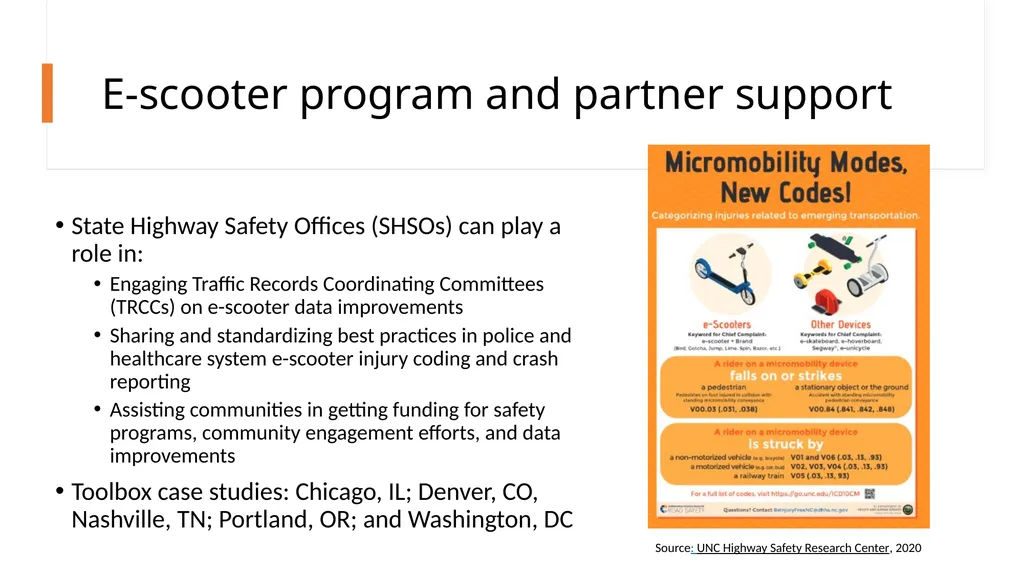
E-scooter program and partner support State Highway Safety Offices (SHSOs) can play a role in:
Engaging Traffic Records Coordinating Committees (TRCCs) on e-scooter data improvements
Sharing and standardizing best practices in police and healthcare system e-scooter injury coding and crash reporting
Assisting communities in getting funding for safety programs, community engagement efforts, and data improvements
Toolbox case studies: Chicago, IL; Denver, CO, Nashville, TN; Portland, OR; and Washington, DC Source: UNC Highway Safety Research Center, 2020<br>
Engaging Traffic Records Coordinating Committees (TRCCs) on e-scooter data improvements
Sharing and standardizing best practices in police and healthcare system e-scooter injury coding and crash reporting
Assisting communities in getting funding for safety programs, community engagement efforts, and data improvements
Toolbox case studies: Chicago, IL; Denver, CO, Nashville, TN; Portland, OR; and Washington, DC Source: UNC Highway Safety Research Center, 2020<br>
36
BTS-10 Research Products for additional info, guidance, and resources Research Results Digest: https://nap.nationalacademies.org/catalog/26756/e-scooter-safety-issues-and-solutions
Toolbox: add link when available or direct to main project page
Fundamental concepts related to e-scooter safety
Promising practices to improve e-scooter safety
Data tools and methods for safety evaluation
Additional resources and examples
Final Report: add link when available or direct to main project page
Implementation Guidance Memo: add link when available or direct to main project page<br>
Toolbox: add link when available or direct to main project page
Fundamental concepts related to e-scooter safety
Promising practices to improve e-scooter safety
Data tools and methods for safety evaluation
Additional resources and examples
Final Report: add link when available or direct to main project page
Implementation Guidance Memo: add link when available or direct to main project page<br>
37
Project Team Acknowledgment This project involved contributions from the following individuals:
Laura Sandt, UNC-HSRC (Principal Investigator)
Alyson West, UNC-HSRC
Katie Harmon, UNC-HSRC
Kristin Blank, UNC-HSRC
Meg Bryson, UNC-HSRC
Tab Combs, UNC-DCRP
Rebecca Sanders, Safe Streets Research & Consulting
Charles T. Brown, Equitable Cities
Regina Clewlow, Populus
Stephanie Seki, Populus
Chris Cherry, UTK
Student Research Assistants: Emma Sexton, Nitesh Shah, Yi Wen, Mojdeh Azad, and Ashkan Neshagarian, all at UTK<br>
Laura Sandt, UNC-HSRC (Principal Investigator)
Alyson West, UNC-HSRC
Katie Harmon, UNC-HSRC
Kristin Blank, UNC-HSRC
Meg Bryson, UNC-HSRC
Tab Combs, UNC-DCRP
Rebecca Sanders, Safe Streets Research & Consulting
Charles T. Brown, Equitable Cities
Regina Clewlow, Populus
Stephanie Seki, Populus
Chris Cherry, UTK
Student Research Assistants: Emma Sexton, Nitesh Shah, Yi Wen, Mojdeh Azad, and Ashkan Neshagarian, all at UTK<br>
38
Acknowledgment This presentation is a deliverable of Behavioral Traffic Safety Cooperative Research Program (BTSCRP) Project BTS-10. BTSCRP is sponsored by the Governors Highway Safety Association and funded by the National Highway Traffic Safety Administration. BTSCRP is administered by the Transportation Research Board (TRB), part of the National Academies of Sciences, Engineering, and Medicine. Any opinions and conclusions expressed or implied in resulting research products are those of the individuals and organizations who performed the research and are not necessarily those of TRB; the National Academies of Sciences, Engineering, and Medicine; or BTSCRP sponsors.<br>