ECODESIGN FOR SUSTAINABLE PRODUCTS REGULATION AND BATTERY DIGITAL PASSPORT Brussels, 8-9 September 2025 Background The Ecodesign for Sustainable Products Regulation (ESPR), which entered into force on 18 July 2024, is the cornerstone of the
"ECODESIGN FOR SUSTAINABLE PRODUCTS REGULATION AND" is the property of its rightful owner. Permission is granted to
download and print the materials on this website for personal, non-commercial use only, and to display it
on your personal computer provided you do not modify the materials and that you retain all copyright
notices contained in the materials. By downloading content from our website, you accept the terms of this
agreement.
Presentation Transcript
01
ECODESIGN FOR SUSTAINABLE PRODUCTS REGULATION AND BATTERY DIGITAL PASSPORT Brussels, 8-9 September 2025<br>
02
Background The Ecodesign for Sustainable Products Regulation (ESPR), which entered into force on 18 July 2024, is the cornerstone of the Commission’s approach to more environmentally sustainable and circular products.
The ESPR is part of a package of measures that are central to achieving the aims of the 2020 Circular Economy Action Plan and fostering the transition to a circular, sustainable, and competitive economy. It will contribute to helping the EU reach its environmental and climate goals, double its circularity rate of material use and achieve its energy efficiency targets by 2030.
The ESPR replaces the Ecodesign Directive 2009/125/EC and establishes a framework for setting ecodesign requirements on specific product groups. It extends the Ecodesign Directive in two ways. Firstly, while the latter applies only to energy-related products, the ESPR extends this scope to cover virtually all physical products. Only a few exemptions apply, for example, for food and feed, and medicinal products. Secondly, the ESPR reinforces the range of ecodesign requirements that can be set for products, which can comprise requirements relating to durability, circularity and the overall reduction of the environmental and climate footprint of products, amongst many others.
This will strengthen the Single Market by avoiding diverging legislation in each Member State and create economic opportunities for innovation and job creation, notably in remanufacturing, maintenance, recycling and repair.<br>
03
Objectives The ESPR aims to significantly improve the sustainability of products placed on the EU market by improving their circularity, energy performance, recyclability and durability.
It will also play a central role in developing a strong, well-functioning single market for sustainable products in the EU.
By doing so, a significant step will be taken towards better protecting our planet, fostering more sustainable business models and strengthening the overall competitiveness and resilience of the EU economy.<br>
04
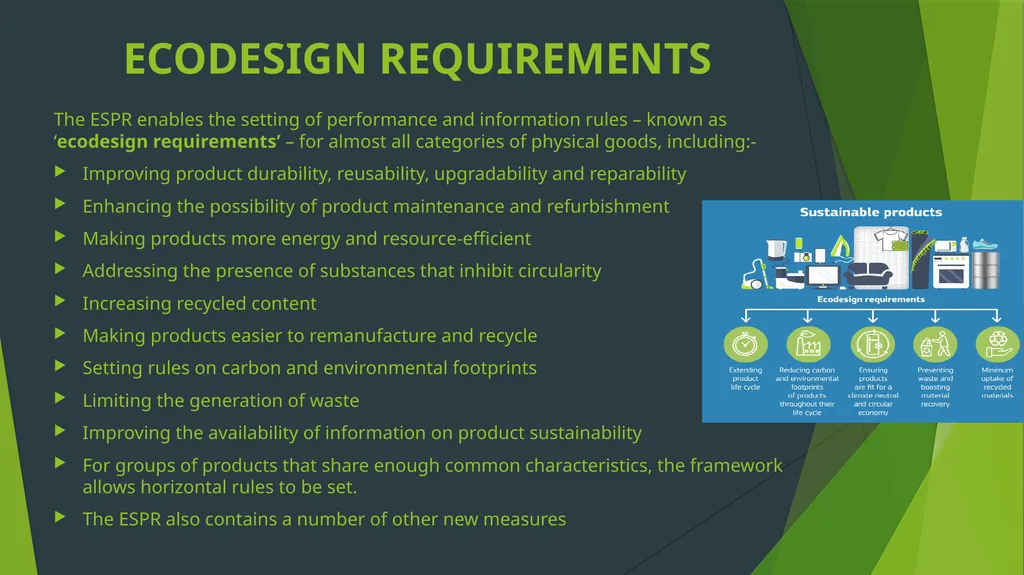
ECODESIGN REQUIREMENTS The ESPR enables the setting of performance and information rules – known as ‘ecodesign requirements’ – for almost all categories of physical goods, including:-
Improving product durability, reusability, upgradability and reparability
Enhancing the possibility of product maintenance and refurbishment
Making products more energy and resource-efficient
Addressing the presence of substances that inhibit circularity
Increasing recycled content
Making products easier to remanufacture and recycle
Setting rules on carbon and environmental footprints
Limiting the generation of waste
Improving the availability of information on product sustainability
For groups of products that share enough common characteristics, the framework allows horizontal rules to be set.
The ESPR also contains a number of other new measures<br>
05
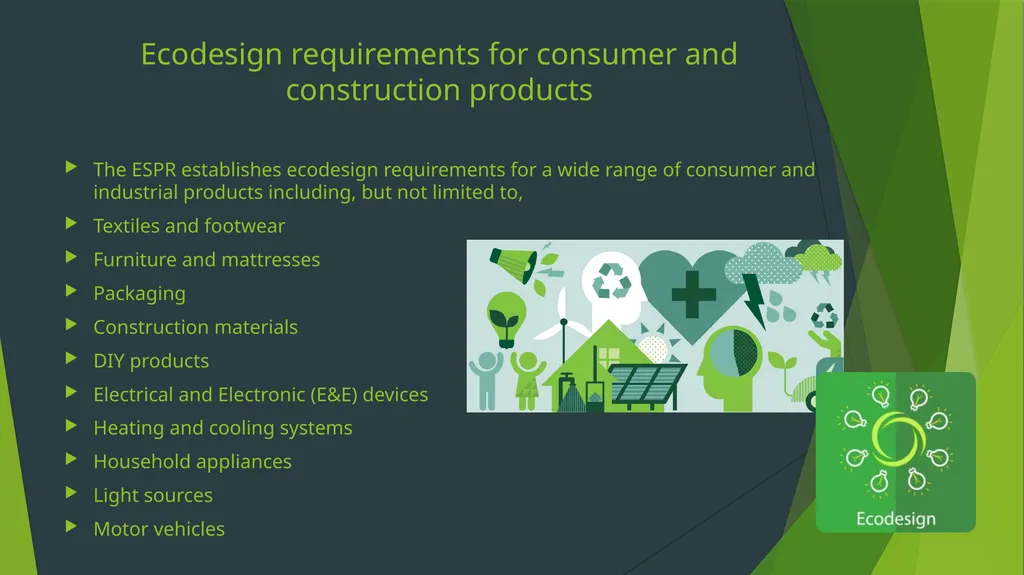
Ecodesign requirements for consumer and construction products The ESPR establishes ecodesign requirements for a wide range of consumer and industrial products including, but not limited to,
Textiles and footwear
Furniture and mattresses
Packaging
Construction materials
DIY products
Electrical and Electronic (E&E) devices
Heating and cooling systems
Household appliances
Light sources
Motor vehicles<br>
06
Digital Product Passport The ESPR will introduce a Digital Product Passport (DPP), a digital identity card for products, components, and materials, which will store relevant information to support products’ sustainability, promote their circularity and strengthen legal compliance.
This information will be accessible electronically, making it easier for consumers, manufacturers, and authorities to make more informed decisions related to sustainability, circularity and regulatory compliance. It will also allow custom authorities to perform automatic checks on the existence and authenticity of the DPPs of imported products.
Information to be included in the DPP will be identified by the Commission, in close consultation with all relevant stakeholders, and will depend on the specific product in question. This information can include:
Product’s technical performance
Materials and their origins
Repair activities
Recycling capabilities
Lifecycle environmental impacts<br>
07
Implementation The ESPR is a piece of framework legislation that lays the foundation for the subsequent adoption of concrete rules, either on a product-by-product basis or horizontally, based on groups of products with similar characteristics.
The process started with a prioritisation exercise, following this, the Commission adopted the first ESPR and Energy Labelling Working Plan in April 2025, setting out which products will be prioritised over the coming years. Product rules will then be developed based on inclusive planning, detailed impact assessments, regular stakeholder consultation within the Ecodesign Forum, and specific consultations.<br>