
Economic and Management Sciences NQF1 Chapter 1:

Description: Economic and Management Sciences NQF1 Chapter 1: Producing the goods www.futuremanagers.com MEETING PEOPLES NEEDS WITH GOODS AND SERVICES We all have needs and wants that have to be met so we can live. For example, everyone needs food,
Related Topics
Download Presentation
"Economic and Management Sciences NQF1 Chapter 1:" is the property of its rightful owner. Permission is granted to download and print the materials on this website for personal, non-commercial use only, and to display it on your personal computer provided you do not modify the materials and that you retain all copyright notices contained in the materials. By downloading content from our website, you accept the terms of this agreement.
Presentation Transcript
slide1. Economic and Management Sciences
NQF1<br>
slide2. Chapter 1:
Producing the goods<br>
slide3. www.futuremanagers.com MEETING PEOPLE’S NEEDS WITH GOODS AND SERVICES
We all have needs and wants that have to be met so we can live. For example, everyone needs food, clothing and a place to live with services like water and electricity. People also need other services like transport, education, and health care. An economy runs on a balance between what people need and want, and meeting those needs with the right goods and services at the right time and price. Unit 1: Getting what we need and want<br>
slide4. www.futuremanagers.com Unit 1: Getting what we need and want (continued) SUPPLY
The supply side of the economy involves everyone who sells goods and services in the economy. In a free market economy such as the one we have in South Africa, the main motive of the supplier in the market is to make as much money or profit as possible.<br>
slide5. www.futuremanagers.com Unit 1: Getting what we need and want (continued) DEMAND
In economic language, demand means everyone who is willing and able to buy goods and services from suppliers at a particular price. This is known as the market. In a free market economy, the main motive of consumers is to get as much value as possible for the money they have to spend.<br>
slide6. www.futuremanagers.com Unit 1: Getting what we need and want (continued) HOW DOES SUPPLY AND DEMAND REALLY WORK WITH PRICE?
We could say that an economy is based on two big ideas:
Idea number 1: Producers will want to produce more of a good or service that they can sell at a high price than a good that sells at a low price.
Idea number 2: Consumers will buy more of a good or service when it is cheap than when it is expensive.<br>
slide7. www.futuremanagers.com Unit 1: Getting what we need and want (continued) FINDING THE RIGHT PRICE
Determining price is a balancing act and there are many other factors to consider in getting it right. Think about things like how much a good or service costs to produce, what other things have to be paid for in producing it, and what it takes to bring the product to the market, that all end up being reflected in the price. The simple rule to bear in mind is: Everything has to be paid for.<br>
slide8. www.futuremanagers.com INTRODUCTION
Everyone has needs and wants, so the economy of a country also has to be planned and controlled by government in order to meet everyone’s needs. Things need to be produced in order to satisfy needs and wants. Unit 2: Producing enough for everyone<br>
slide9. www.futuremanagers.com Unit 2: Producing enough for everyone (continued) WHY DO WE NEED PRODUCTION IN AN ECONOMY?
In today’s economy, there is a need for production. In order for an economy to run, we can say it is all about the production, distribution and consumption of goods and services in order to meet everyone’s needs and wants in a country.<br>
slide10. www.futuremanagers.com Unit 2: Producing enough for everyone (continued) WHAT ARE THE FACTORS OF PRODUCTION?
We need resources to help us get what we need and want. These resources are also called the factors of production. These are:
Land;
Labour;
Capital; and
Entrepreneurship.<br>
slide11. www.futuremanagers.com Unit 2: Producing enough for everyone (continued) FACTORS OF PRODUCTION TO PRODUCE FOOD IN TODAY’S ECONOMY
One of the basic needs for any economy is to make sure enough food is produced for everyone. In today’s economy, food can be produced in many ways. Large companies can produce food using technology. But many small farmers can produce food with just a few tools and animals. Also, different types of food can be produced for different consumers.<br>
slide12. www.futuremanagers.com Unit 2: Producing enough for everyone (continued) PRODUCTION OF ALL KINDS
Large companies (called multinationals) produce a huge range of goods and services, using resources, technology, skilled and unskilled labour, and they can produce for consumers who live in another part of the world from where production happens. This is globalised production. At the same time, millions of people are involved in small-scale production, especially in rural areas of Africa, Asia and South America. These people make little use of technology, mostly use family members for labour and often produce for their own needs.<br>
slide13. www.futuremanagers.com INTRODUCTION
Labour is essential in production because there can be no business without people to do the work, and nothing can be produced without labour. Income from labour is what most households survive on. Households use the income to satisfy their needs and wants, which creates a demand for goods and services. Businesses then produce the goods and services to satisfy the demand – and so the cycle continues. Unit 3: Keeping the country going<br>
slide14. www.futuremanagers.com Unit 3: Keeping the country going (continued) THE LABOUR MARKET
Labour has other characteristics that make it different from goods and services:
Labour depends on people;
The demand for labour depends on the demand for goods and services produced by labour;
The quality of labour will be different depending on people and their skills.<br>
slide15. www.futuremanagers.com Unit 3: Keeping the country going (continued) THE LABOUR DEBATE
Here are two different views on the labour market for you to consider – the Free market view: Many employers argue for a free labour market in which each worker has an individual contract with the employer; and
The trade union view: Labour unions argue that workers should
negotiate together, not individually, because if workers negotiate on their own, they will find their ‘price’ forced down by employers.<br>
slide16. www.futuremanagers.com Unit 3: Keeping the country going (continued) LIMITED LAND AND RESOURCES
Land and resources are geographically uneven;
Most land and resources have to be used in a certain way and resources have to be processed to be useful;
Resources are limited;
Land and resources are owned and unevenly divided.<br>
slide17. www.futuremanagers.com Unit 3: Keeping the country going (continued) FOLLOW THE FLOW OF CAPITAL IN THE ECONOMY
People often think of money as capital. Even though money is needed to buy capital items, it is the items themselves that form capital as a factor of production. So capital can be thought of as physical things like a computer or a baking oven or a minibus taxi (physical capital), as well as the money that it takes to buy these things (financial capital). Whichever type of capital is involved, it is the investment of capital in an existing business or a new business venture that gets it going and keeps it going.<br>
slide18. www.futuremanagers.com Unit 3: Keeping the country going (continued) SOURCES OF CAPITAL
Businesses usually start with the owner’s or investor’s own capital: this is money that the owner has saved or inherited, that gets the business started. But sometimes this is not enough and the owner has to borrow money, usually from a bank or some other kind of investor. The bank or investor is a business on its own whose business is to lend and invest money. Banks and investors will only be interested in investing where there is the possibility of making money on the investment.<br>
slide19. www.futuremanagers.com Unit 3: Keeping the country going (continued) MAKING MONEY WORK – EXCHANGE RATES
Investment by businesses in other countries (foreign investment) is also good for the country because it brings money in the form of foreign currency into the country.<br>
slide20. www.futuremanagers.com Unit 3: Keeping the country going (continued) CONTROLLING THE RATES
The rate of lending is set and controlled by the South African Reserve Bank, which is the bank of government. Government has the responsibility to keep the economy growing but stable for everyone in the country: workers and employers, rich and poor, local businesses and foreign investors alike.<br>
slide21. www.futuremanagers.com Unit 3: Keeping the country going (continued) WHAT CAN ENTREPRENEURSHIP DO FOR THE ECONOMY?
Entrepreneurship is like the final piece of the factors of production puzzle. It takes someone with initiative and drive, who is not afraid to take a risk, to put all the factors together and actually start and run a business. Entrepreneurs create employment for themselves and others. They see an opportunity to meet a want or need and use resources to make or provide something that did not exist before.<br>
slide22. Chapter 2: Economic systems – what works best?<br>
slide23. www.futuremanagers.com INTRODUCTION
All countries throughout the world face the same basic economic problem as ordinary households - how to make the best use of scarce resources and share out the goods and services produced by these resources. Countries choose an economic system that represents a country’s or region’s best choice of system to run and control their economy. Unit 1: Different economic systems<br>
slide24. www.futuremanagers.com Unit 1: Different economic systems (continued) DIFFERENT ECONOMIC SYSTEMS
There are three major economic systems that can be used to organise a national economy:
Centrally planned or command economy;
Free market or free enterprise economy;
Mixed economy.<br>
slide25. www.futuremanagers.com Unit 1: Different economic systems (continued) CENTRALLY PLANNED ECONOMY
Planned systems are where a government controls the allocation of resources and decides what goods and services to produce to meet the needs and wants of the country as a whole (which is why such systems are also called centralised or command economies). Communism and socialism are examples of planned economic systems.<br>
slide26. www.futuremanagers.com Unit 1: Different economic systems (continued) FREE MARKET ECONOMY
In free market systems there are very few restrictions imposed by government on how resources are allocated. The price system determines this function. In reality, there are some essential goods and services that cannot always be produced at a profit, and competition can end up not actually serving consumers very well. Capitalism is an example of a free market economy.<br>
slide27. www.futuremanagers.com Unit 1: Different economic systems (continued) MIXED ECONOMY
Most countries in the world today have mixed systems, combining aspects of free- market and centrally controlled economies. China, for example, is moving away from centrally planned to free enterprise. The USA, on the other hand, always the largest free enterprise economy in the world, now has some state involvement in business. In South Africa the government owned a large share of enterprises, but has steadily moved towards privatisation – or handing over such enterprises to the private business sector.<br>
slide28. www.futuremanagers.com INTRODUCTION
In South Africa, our new Constitution (Act 108 of 1996) guarantees some specific economic rights. Unit 2: The individual within an economic system<br>
slide29. www.futuremanagers.com Unit 2: The individual within an economic system (continued) SECTION 22: FREEDOM OF TRADE, OCCUPATION AND PROFESSION
Every citizen has the right to choose their trade, occupation or profession freely. Laws can be passed to regulate how people practise their trade, occupation or professions.<br>
slide30. www.futuremanagers.com Unit 2: The individual within an economic system (continued) SECTION 23: LABOUR RELATIONS
Everyone has the right to fair labour practices.
Workers have the right to form and join trade unions and go on strike.
Employers have the right to form and join employers’ organisations.
Trade unions and employers’ organisations have the right to:
make decisions about their own administration and activities
organise, form and join a federation
engage in collective bargaining.<br>
slide31. www.futuremanagers.com Unit 2: The individual within an economic system (continued) SECTION 24: ENVIRONMENT
Everyone has the right to:
an environment that is not harmful to their health or well-being
have the environment protected for present and future generations.
The government must pass laws that prevent pollution and damage to our natural resources, promote conservation and make sure that natural resources are developed while also promoting the economic and social development of people.<br>
slide32. www.futuremanagers.com Unit 2: The individual within an economic system (continued) SECTION 25: PROPERTY
No one can have their property taken away from them unless this is done according to a law.<br>
slide33. www.futuremanagers.com Unit 2: The individual within an economic system (continued) SECTION 26: RIGHT OF ACCESS TO HOUSING
Everyone has the right to have access to adequate housing. The government must take reasonable steps within its available resources to provide people with housing and access to land.<br>
slide34. www.futuremanagers.com Unit 2: The individual within an economic system (continued) SECTION 27: RIGHT OF ACCESS TO HEALTH CARE, FOOD, WATER AND SOCIAL SECURITY
Everyone has the right to have access to:
health care services (including childbirth facilities)
enough food and water
social security (which means support for people who cannot support themselves or their dependants).<br>
slide35. www.futuremanagers.com Unit 2: The individual within an economic system (continued) WHAT ARE YOUR ECONOMIC RESPONSIBILITIES?
While our new Constitution guarantees rights for citizens, every right comes with a responsibility – what the citizen must do in return for this right.<br>
slide36. www.futuremanagers.com INTRODUCTION
When apartheid ended and a new democratic government was elected in 1994, South Africa had a number of challenges and choices to make about its economic system. The new government chose a mixed economy. Unit 3: Economic system in South Africa<br>
slide37. www.futuremanagers.com Unit 3: Economic system in South Africa (continued) INFLUENCE OF THE SOUTH AFRICAN GOVERNMENT
South Africa’s mixed economy means that government allows the economy to grow by not placing too many restrictions on free enterprise. However, government is still committed to helping the many poor people who struggle to survive. Many still find it hard to get a house, land, enough education and health care, or to find jobs.<br>
slide38. www.futuremanagers.com Unit 3: Economic system in South Africa (continued) THE ROLE OF THE INFORMAL SECTOR
The “informal sector” speaks to the economically active people who have found the means to start small businesses and enterprises on their own that serve the communities where they live. Government encourages this initiative by helping them grow their businesses, get access to training and resources, and most of all, become taxpayers and eventually participants in the formal sector.<br>
slide39. Chapter 3: Different types of business and legal issues<br>
slide40. www.futuremanagers.com INTRODUCTION
There are as many different kinds of business as there are consumer needs and wants. Unit 1: Businesses of all kinds<br>
slide41. www.futuremanagers.com Unit 1: Businesses of all kinds (continued) WHAT TYPE OF BUSINESS?
Businesses can also be grouped into those that provide goods and services with the aim of making a profit, and those that are not aimed at making a profit.<br>
slide42. www.futuremanagers.com Unit 1: Businesses of all kinds (continued) GOODS AND SERVICES
Goods are things that consumers buy such as bread, shoes, pens, books, computers, washing machines, and cars. Services refer to the work that people do for consumers, such as giving a haircut, booking a flight, providing a ride in a taxi, arranging a funeral policy, checking your teeth, helping you get a divorce, and opening and servicing a bank account.<br>
slide43. www.futuremanagers.com Unit 1: Businesses of all kinds (continued) BUSINESS OWNERSHIP
A business can be in manufacturing, trading or services – or a combination of all three. In order to explain different types of businesses, the following questions have to be asked about the business:
Who owns the business?
Where did it get its finance (capital) to set up?
How is it managed and who makes the decisions?<br>
slide44. www.futuremanagers.com Unit 1: Businesses of all kinds (continued) DIFFERENT TYPES OF OWNERSHIP
Sole trader;
Partnership;
Close corporation (CC);
Company; and
Co-operative.<br>
slide45. www.futuremanagers.com Unit 1: Businesses of all kinds (continued) SOLE TRADERS
Setting up as a sole trader (or sole proprietor) is the simplest form of ownership. A business is owned and managed by one person who takes responsibility for all business decisions. The law does not separate the owner and the business – that is why it is given the name, ‘sole’ proprietor.<br>
slide46. www.futuremanagers.com Unit 1: Businesses of all kinds (continued) PARTNERSHIPS
A partnership is formed when between 2 and 20 people contribute capital, property or skills to the business and agree on how to share the profits or losses. The law does not separate the owners and the business.<br>
slide47. www.futuremanagers.com Unit 1: Businesses of all kinds (continued) CLOSE CORPORATIONS
A close corporation (CC) is formed when between one and 10 members contribute capital, property or skills to the business. The contributions of the members measure what percentage of the business they own. The Companies Act of 2008 regulates existing CC’s but prevents new CC’s from being formed. Existing CC’s were registered and issued with a Certificate of Incorporation. Close corporations have legal personality. The name of the business must end with the letters ‘CC’.<br>
slide48. www.futuremanagers.com Unit 1: Businesses of all kinds (continued) COMPANIES
Most businesses dream of becoming companies one day. However, a company is quite complicated and expensive to set up and there are a number of legal steps to follow.<br>
slide49. www.futuremanagers.com INTRODUCTION
There are many factors to consider when setting up a business. If you rush into a business idea without full knowledge of these factors, you stand a chance that your business will not succeed. Unit 2: Setting up a business<br>
slide50. www.futuremanagers.com Unit 2: Setting up a business (continued) FACTORS IN SETTING UP A BUSINESS
Target group;
Location;
Competition;
Finance;
Labour;
Transport; and
Environment.<br>
slide51. www.futuremanagers.com Unit 2: Setting up a business (continued) SETTING UP AS A SOLE TRADER
To set up business as a sole trader you need:
an acceptable trade name that is in line with the Trade Name Act of 1960
to register the business with the South African Revenue Services (SARS) for the purpose of paying income tax
a trading licence (if the business sells or prepares meals or perishable food (e.g. a restaurant), or provides a health facility (e.g. a gym) or entertainment.<br>
slide52. www.futuremanagers.com Unit 2: Setting up a business (continued) WHERE DO SOLE TRADERS GET THEIR FINANCE?
Either the owner provides the capital, or they apply for a loan or bank overdraft to partly finance the business’s capital needs.<br>
slide53. www.futuremanagers.com Unit 2: Setting up a business (continued) SETTING UP AS A PARTNERSHIP
To set up as a partnership with the aim of making a profit, you need to:
follow the laws that apply to the Trade Name Act of 1960 and the Licence Act of 1962
register the partnership with SARS
sign a written partnership agreement or contract between the two (or more) business owners.<br>
slide54. www.futuremanagers.com Unit 2: Setting up a business (continued) WHERE DOES A PARTNERSHIP GET ITS FINANCE?
Each partner contributes capital or finances that may be in the form of a loan or bank overdraft.<br>
slide55. www.futuremanagers.com Unit 2: Setting up a business (continued) SETTING UP A CLOSE CORPORATION (CC)
Before the Companies Act (71 of 2008):
every member made a contribution in the form of money, assets or services
submitted a funding statement to the Registrar of Close Corporations who will register the CC.<br>
slide56. www.futuremanagers.com Unit 2: Setting up a business (continued) WHERE DOES A CLOSE CORPORATION GET ITS FINANCE?
Each member makes a contribution. Sometimes a CC may have problems getting finance or credit because the liability (legal responsibility) of members for the debts of the CC is limited. They may need to offer a personal asset like a house or a car as security on a bank loan, in case the CC cannot repay the loan.<br>
slide57. www.futuremanagers.com Unit 2: Setting up a business (continued) TAKING OVER AN EXISTING BUSINESS
Sometimes it is better to take over an existing business, rather than going through all the hard work of setting up a new business. However, there could be risks involved in buying a business. Consider: Reason for selling;
Reputation;
Profit;
Market share;
Financial position;
Assets; and
Legal position.<br>
slide58. www.futuremanagers.com INTRODUCTION
When you start a business, one of the things you have to decide is what kind of ownership suits you or suits the business. Based on the choice you make about the form of ownership, there will be legal rules and regulations about what you have to do or how you have to be set up. If you do not follow these requirements, you run the risk of your business being shut down. So, forming a business can have a range of legal implications. Unit 3: What does the law say about setting up a business?<br>
slide59. www.futuremanagers.com Unit 3: What does the law say about setting up a business? (continued) LEGAL IMPLICATIONS OF SOLE TRADERS
Since the business is owned and run by one person, it does not have an independent ‘legal personality’; that is, the business and the owner are seen as one and the same thing when it comes to liability for debts.<br>
slide60. www.futuremanagers.com Unit 3: What does the law say about setting up a business? (continued) LEGAL IMPLICATIONS OF PARTNERSHIPS
Like a sole trader, a partnership does not have a legal personality; it is the partners in their individual capacity who enter into transactions, agreements and contracts, rather than the partnership business.<br>
slide61. www.futuremanagers.com Unit 3: What does the law say about setting up a business? (continued) LEGAL IMPLICATIONS OF CLOSE CORPORATIONS
A close corporation is a legal entity with its own legal personality and therefore the members are not liable in their personal capacity for the debts of the business.<br>
slide62. www.futuremanagers.com Unit 3: What does the law say about setting up a business? (continued) LEGAL IMPLICATIONS OF COMPANIES
Companies are legal entities that exist apart from the owners. There are three different types of companies:
Private;
Public; and
Non-profit.<br>
slide63. www.futuremanagers.com Unit 3: What does the law say about setting up a business? (continued) LEGAL IMPLICATIONS OF CO-OPERATIVES
Co-operative companies are formed by people in the same line of business or occupation. However, unlike partnerships, their arrangement is to provide a service to the members at low cost by cutting out the intermediary, for example a consumer co- operative buys goods directly from producers and supplies them directly to members, without the intermediary of a distributor or retailer.<br>
slide64. www.futuremanagers.com Unit 3: What does the law say about setting up a business? (continued) LEGAL IMPLICATIONS OF DISSOLVING A SOLE TRADER
If the owner decides to stop trading, even though the business is running smoothly, then the business ceases to exist: all the profits and assets belong to the owner, so he or she keeps them or sells them and after paying all debts, keeps the proceeds.<br>
slide65. www.futuremanagers.com Unit 3: What does the law say about setting up a business? (continued) LEGAL IMPLICATIONS OF DISSOLVING A SOLE TRADER
If the owner decides to stop the business because it has failed, and the business goes insolvent: the owner is personally responsible for all the debts of the business and may lose his personal belongings to settle loans or debts.
If the owner dies, the business ceases to exist: all the profits and assets go into the personal estate of the owner and become part of the inheritance of the beneficiaries.<br>
slide66. www.futuremanagers.com Unit 3: What does the law say about setting up a business? (continued) LEGAL IMPLICATIONS OF DISSOLVING A PARTNERSHIP
All the partners in a partnership carry personal responsibility for the debts of the business. If the partnership is dissolved because it has failed, the partners are personally responsible for all the debts of the business and may lose their personal belongings to settle loans or debts. If the partners decide to dissolve the partnership, even if it is going well, the distribution of the assets are done according to the contract or agreement between the partners.<br>
slide67. www.futuremanagers.com Unit 3: What does the law say about setting up a business? (continued) LEGAL IMPLICATIONS OF DISSOLVING A COMPANY
A company is a separate legal entity and is governed by shareholders. When a company is closed, the losses and debts are not carried by the individuals and the personal assets of the shareholders are protected.<br>
slide68. www.futuremanagers.com Unit 3: What does the law say about setting up a business? (continued) LEGAL IMPLICATIONS OF DISSOLVING A CO-OPERATIVE
When a co-operative is dissolved it follows a process of selling all the assets, paying off creditors, distributing any remaining assets to the parent company, and then dissolving the name. This is also referred to as winding up. A co-operative may be wound up voluntarily by its members. A court can also dissolve a co-operative if it has unpaid debts or there is a probability that the co-operative could become unviable. This means it is put into liquidation.<br>
slide69. Chapter 4:
Good management<br>
slide70. www.futuremanagers.com INTRODUCTION
Management has to happen in businesses no matter if they are small, medium or large, or whether they are owned and run by one person, or they are a multinational corporation. Good management is the key to good business – but it takes time to develop this skill. Unit 1: Managerial expertise<br>
slide71. www.futuremanagers.com Unit 1: Managerial expertise (continued) WHAT DO MANAGERS DO?
They organise and take responsibility for tasks in order to get things done. We can say that there are five main tasks (or functions) that managers do:
Planning;
Organising;
Leading;
Controlling;
Decision-making.<br>
slide72. www.futuremanagers.com Unit 1: Managerial expertise (continued) PLANNING
A manager has to ask: ‘How am I (or, we) going to achieve the goals of this business?’ to get a plan started. Then a manager has to work out the activities that need to happen step-by-step to put that plan into action.<br>
slide73. www.futuremanagers.com Unit 1: Managerial expertise (continued) ORGANISING
Organising means you know before you start who will be doing what, when, where, how and with what resources.<br>
slide74. www.futuremanagers.com Unit 1: Managerial expertise (continued) LEADING
Leading means taking responsibility for the whole management process from beginning to end. Leadership is also about how the manager gets on with people and this is key to getting the job done.<br>
slide75. www.futuremanagers.com Unit 1: Managerial expertise (continued) CONTROLLING
You may have a good plan, be a good organiser and the kind of leader people want to support and follow, but unless you are able to control effectively, these will be of no use.<br>
slide76. www.futuremanagers.com Unit 1: Managerial expertise (continued) DECISION-MAKING
There is another important task or function that managers do all the time – they make decisions.<br>
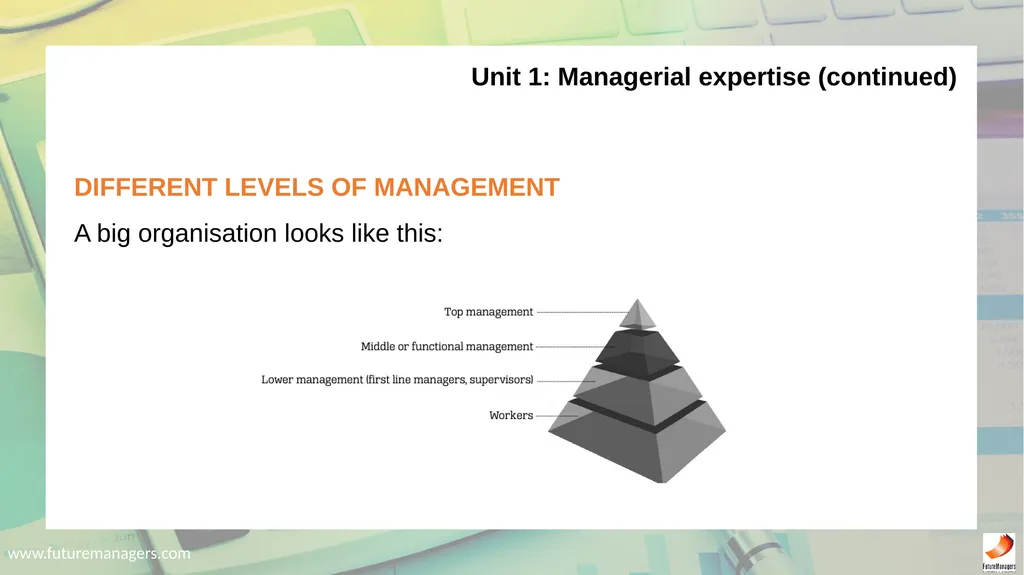
slide77. www.futuremanagers.com Unit 1: Managerial expertise (continued) DIFFERENT LEVELS OF MANAGEMENT
A big organisation looks like this:<br>
slide78. www.futuremanagers.com Unit 1: Managerial expertise (continued) WHAT IS EFFECTIVE MANAGEMENT?
Good management will mean that the business is able to increase its production which will lead to being able to offer better or more goods and services to the market. This will make good profits for the business. If the business is making money, it can afford to increase its workers’ pay. Better-paid workers mean a satisfied workforce that is motivated to contribute more to the business, which leads to an increase in the business’s production.<br>
slide79. www.futuremanagers.com INTRODUCTION
There are many different ways of planning, organising, leading, controlling and making decisions. Take leading: some managers may believe their role is to show strong leadership by setting an example. Others may believe that their role is to motivate people. Unit 2: Different management styles<br>
slide80. www.futuremanagers.com Unit 2: Different management styles (continued) DEMOCRATIC MANAGEMENT STYLE
A democratic manager gives responsibility to his or her staff to complete the tasks of their jobs. This is called delegating authority; it means that staff members use their own work methods to get the job done, as long as they do it on time. Democratic management means that decision-making is slow as so many people need to be consulted all the time. Some employees may also take advantage of having a democratic manager, and sit back and let other staff carry their workload.<br>
slide81. www.futuremanagers.com Unit 2: Different management styles (continued) AUTOCRATIC MANAGEMENT STYLE
The autocratic manager dictates orders to staff and makes all the decisions without consulting them. This type of manager likes to be in complete control. Decision- making is quick but staff start to feel demotivated when they are not part of decision-making, they do not feel valued and may end up leaving the job.<br>
slide82. www.futuremanagers.com Unit 2: Different management styles (continued) LAISSEZ-FAIRE MANAGEMENT STYLE
A laissez-faire manager sets the tasks that staff have to complete and then gives them complete freedom to do this in their own way. This does not mean that the laissez-faire manager is ‘hands- off ’; instead he or she is there to coach, supply information, and help resolve problems. Staff take on more and more responsibility and feel motivated but this style of management has to be done very skilfully, otherwise staff lose direction and do not achieve their goals.<br>
slide83. www.futuremanagers.com Unit 2: Different management styles (continued) PEOPLE MAKE THE DIFFERENCE
All the management functions involve people – it is people who are at the heart and core of a business. Most businesses understand that their human resources – people with all their skills, knowledge and experience – can make the biggest difference in a business.<br>
slide84. www.futuremanagers.com Unit 2: Different management styles (continued) CHANGING MANAGEMENT STYLES
The most important thing about management today is that it is able to change and adapt to new conditions. You have seen how the trend has moved towards getting the best out of employees by motivating and valuing them and their contribution. Managers also need to adapt or change their style, depending on the employee and on the work situation.<br>
slide85. www.futuremanagers.com Unit 2: Different management styles (continued) MANAGING YOUR OWN CHANGE
The world of work is constantly changing. Nowadays people can expect to change their career direction, to try self-employment and even part-time work at some time in their working life. It helps to understand trends in the economy – both locally and in the world – and to be prepared to retrain and to continue learning throughout your life.<br>
slide86. www.futuremanagers.com INTRODUCTION
Every manager needs help with keeping order in a business – this can be by communicating well throughout the business, and by storing and circulating information. Why does a manager need information? The answer is simple: in order to make decisions. Unit 3: Set up administration systems<br>
slide87. www.futuremanagers.com Unit 3: Set up administration systems (continued) MANAGING INFORMATION AS PART OF THE ADMINISTRATIVE FUNCTION
The administration function of a business is about facilitating the flow of information or data, as well as good record keeping. This is done by setting up an administration system. Information moves internally through the business and from the business to the outside world.<br>
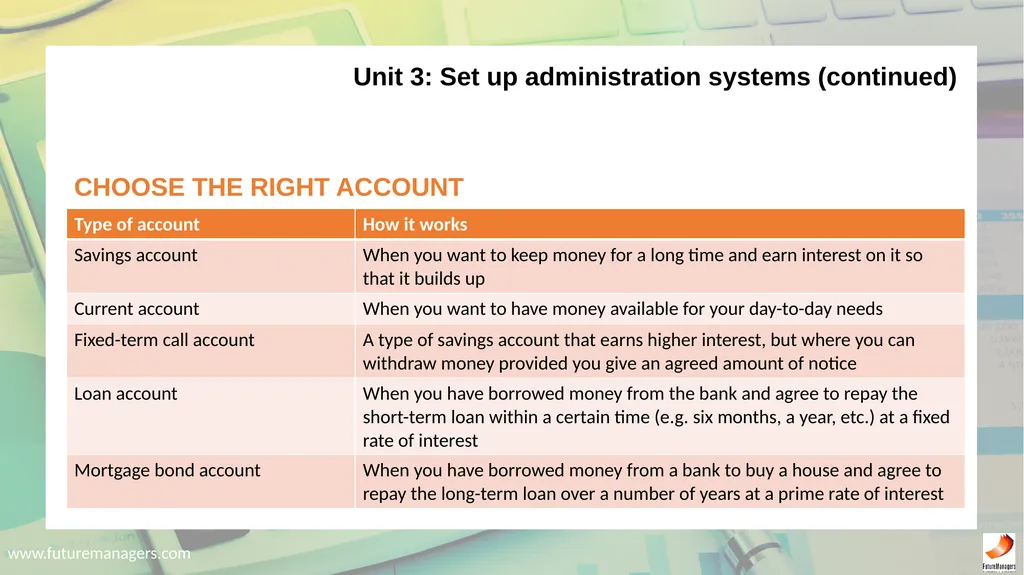
slide88. www.futuremanagers.com Unit 3: Set up administration systems (continued) BANKING TECHNIQUES
Keeping the financial records of the business is one of the most important parts of a business.<br>
slide89. www.futuremanagers.com Unit 3: Set up administration systems (continued) CHOOSE THE RIGHT ACCOUNT<br>
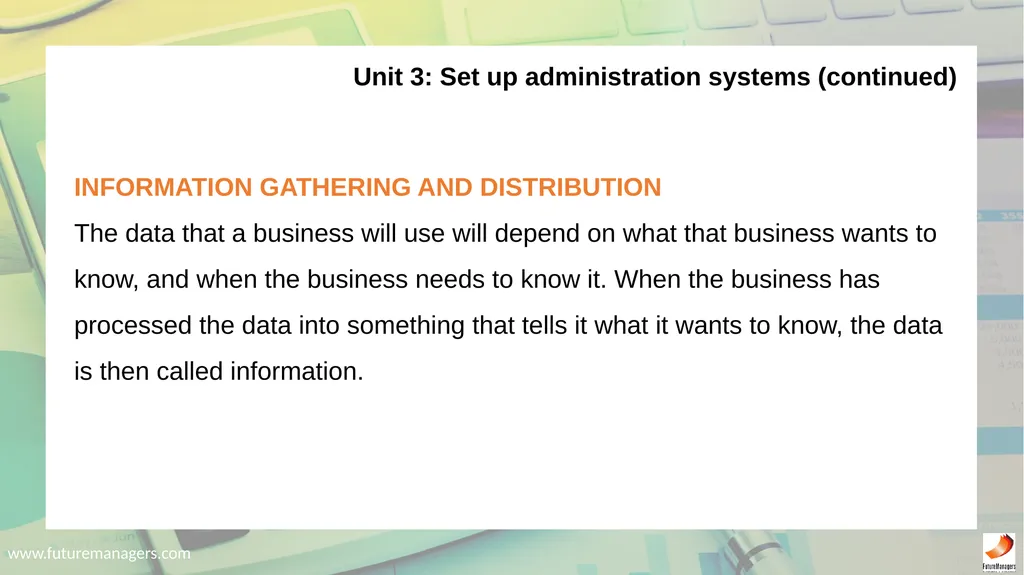
slide90. www.futuremanagers.com Unit 3: Set up administration systems (continued) INFORMATION GATHERING AND DISTRIBUTION
The data that a business will use will depend on what that business wants to know, and when the business needs to know it. When the business has processed the data into something that tells it what it wants to know, the data is then called information.<br>
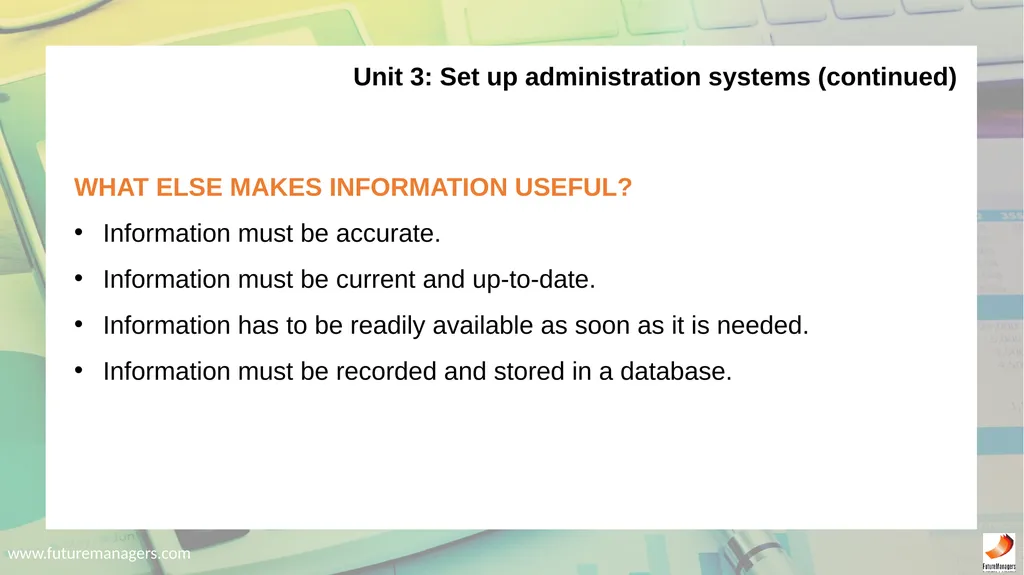
slide91. www.futuremanagers.com Unit 3: Set up administration systems (continued) WHAT ELSE MAKES INFORMATION USEFUL?
Information must be accurate.
Information must be current and up-to-date.
Information has to be readily available as soon as it is needed.
Information must be recorded and stored in a database.<br>
slide92. Chapter 5:
Understanding contracts<br>
slide93. www.futuremanagers.com INTRODUCTION
Business involves the exchange of money, products and services. There are different role-players involved in every aspect of business. All of these people need to be protected. One way to protect the various parties is to establish an agreement or contract between them. If a contract or agreement is properly established, it can be legally binding and protect either party if there is a breach of contract. A breach of contract is when someone does not do what they agreed to do in a contract. Unit 1: What are contracts?<br>
slide94. www.futuremanagers.com Unit 1: What are contracts? (continued) WHAT IS A CONTRACT?
A contract is a legal agreement between people. This means that it is supported and upheld by the legal system if either party wants to take recourse. A contract is generally entered into between two parties (e.g. a marriage contract, or a rental contract).<br>
slide95. www.futuremanagers.com Unit 1: What are contracts? (continued) COMPONENTS OF A CONTRACT
For a contract to be legal, there must be an agreement between the people about what each must do in terms of the contract. (These are called contractual obligations, which you will look at in more detail later.) This means that there must be an offer by one party and an acceptance by the other. The offer must be serious and definite, not vague. If a contract is vague, it will not stand up in a court of law, i.e. the court will not be able to enforce the contract.<br>
slide96. www.futuremanagers.com Unit 1: What are contracts? (continued) ESSENTIAL DETAILS
A contract should include the following elements:
Parties involved;
Date;
Objectives;
Financial responsibilities of parties;
Breach of contract;
Expiry date.<br>
slide97. www.futuremanagers.com Unit 1: What are contracts? (continued) PURPOSE/S AND CONDITIONS OF CONTRACTS
An offer is a clear proposal made by the offeror that indicates that he or she definitely wants to establish a contract. This proposal must contain all the terms that the offeror wants to include in the contract. This is important to keep in mind when considering verbal contracts. An offer must:
Be clear and unambiguous.
State the essential and material terms of the proposed contract.
Be made with the intention of creating a contract.<br>
slide98. www.futuremanagers.com Unit 1: What are contracts? (continued) CONSENSUS
The contract must contain an offer and acceptance without any counter offers. A counter offer would be something agreed to at a later stage that cancels the first offer. Both parties must agree to and have an equal understanding of what the contract involves before they sign or agree to it. It is important that both the offeror and offeree agree on who is liable for what, as well as any hidden costs.<br>
slide99. www.futuremanagers.com Unit 1: What are contracts? (continued) COMPETENT PARTIES
The people making the contract must have the legal power to enter into it (also called contractual capacity). In most countries, people are legally able to enter into contracts when they reach 21 years of age. People who are mentally ill, have any mental disabilities or who are drunk or drugged, are not considered to be competent parties.<br>
slide100. www.futuremanagers.com Unit 1: What are contracts? (continued) LAWFUL PURPOSE
Agreements to do something illegal or immoral or against public policy will not be enforced by the courts (e.g. an agreement to steal, or betting on the result of a soccer match). The courts will also not enforce contracts that are impossible to carry out.<br>
slide101. www.futuremanagers.com Unit 1: What are contracts? (continued) PERFORMANCE MUST BE POSSIBLE
The general rule is that the thing agreed upon must be do-able. Performance means being able to carry out the conditions of the contract. For example, there would be no point in agreeing to transport someone to the moon because this is not something you can do – or at least, not without a lot of help and at huge expense.<br>
slide102. www.futuremanagers.com Unit 1: What are contracts? (continued) OTHER FACTORS
Contracts signed under pressure or duress are not valid. This can be physical, for example to force someone to sign a contract by holding a gun to his or her head. In this case, it is clear that the person who is being forced is not willing and therefore, we say there is no consensus between the parties and so no contract exists. Duress, or the lack of it, is not a contractual requirement but rather something that could result in a contract being declared void.<br>
slide103. www.futuremanagers.com Unit 1: What are contracts? (continued) CONTRACTUAL OBLIGATIONS
It is not really safe, especially in business, to rely only on the word of another person (verbal agreements). When large amounts of money are involved or important deadlines must be met, the parties should enter into a contract so that each party understands his or her contractual obligations. Both parties must be aware of their rights and obligations. They must also be aware of the consequences if they do not meet their contractual obligations.<br>
slide104. www.futuremanagers.com Unit 1: What are contracts? (continued) RIGHTS ON BREACH OF CONTRACT
It is a good idea to set out the parties’ rights if the contract is breached. Confusion can be avoided if attention is paid to the details of the contract and if nothing is left to be negotiated, discussed or agreed upon at a later stage.<br>
slide105. www.futuremanagers.com Unit 1: What are contracts? (continued) USE OF WITNESSES
It is wise to get people to witness the contract. This will be useful if a dispute arises at a later stage. Witnesses may be able to assist in resolving the dispute.<br>
slide106. www.futuremanagers.com Unit 1: What are contracts? (continued) SAFEKEEPING
Both parties must keep copies of the contract and the original should be kept in a safe and secure place, for example at a lawyer’s office or a bank.<br>
slide107. www.futuremanagers.com Unit 1: What are contracts? (continued) REQUIREMENTS FOR VALIDITY
The parties should make sure that all requirements to make the contract valid have been met. For example, an agreement of lease may require revenue stamps in order to be valid and enforceable. A lawyer should be used where a party may be confused or worried about the validity of the contract. It is a good idea to use a lawyer when the contract is drafted as this will prevent disputes arising from a badly written contract.<br>
slide108. www.futuremanagers.com Unit 1: What are contracts? (continued) CONSENSUS IN WRITING
Verbal contracts are difficult to prove, and the details of what was agreed even more so. Someone can easily deny that there was an agreement or, perhaps, a specific condition in a verbal agreement. A dispute is much more difficult to resolve if the terms and conditions are unclear. Always remember that the basis of a contract is consensus, and that an agreement in writing is usually the best way to prove the consensus.<br>
slide109. www.futuremanagers.com INTRODUCTION
Almost every type of relationship between individuals and between parties can be controlled and enforced by a contract. Different contracts include:
Lease contracts;
Employment contracts;
Sale contracts;
Insurance contracts. Unit 2: Different kinds of contracts and their sources<br>
slide110. www.futuremanagers.com Unit 2: Different kinds of contracts and their sources (continued) LEASE CONTRACTS
Lease contracts deal with property or equipment that is leased or rented from the owner. This means that you pay a monthly (or annual) fee to the owner for use of the property or equipment, but do not ever own the property or equipment.<br>
slide111. www.futuremanagers.com Unit 2: Different kinds of contracts and their sources (continued) EMPLOYMENT CONTRACTS
In South Africa, employment is now regulated by legislation (statute law) although common law still applies in a few cases. This means that when drawing up an employment contract, an employer has to begin by including all the information required by statute law. After that the employers can add things that are applicable to the situation.<br>
slide112. www.futuremanagers.com Unit 2: Different kinds of contracts and their sources (continued) SALE CONTRACTS
A contract of sale is an agreement where one person, the seller (offeror), agrees to deliver something to another person, the purchaser (offeree). The purchaser then agrees to pay a certain amount of money to the seller for the goods. When the parties reach agreement on the article to be sold and the price to be paid, the contract can be signed.<br>
slide113. www.futuremanagers.com Unit 2: Different kinds of contracts and their sources (continued) BUSINESS INSURANCE
Insurance is an undertaking by an insurance company to pay an agreed-upon amount of money, referred to as the sum assured, if goods are stolen or damaged (through fire, water, theft or accident). The insurance company will then replace these goods, according to the conditions set out in a signed contract.<br>
slide114. www.futuremanagers.com Unit 2: Different kinds of contracts and their sources (continued) KEY FEATURES OF INSURANCE POLICIES
The terms of the policy (e.g. exactly what is covered by the contract, for how long, what the conditions of payout are, etc.);
Who the life assured is or which goods are insured;
What the sum assured is (i.e. how much money will be paid out);
What the monthly premiums (payments) are;
Any special conditions or exclusions (e.g. no pay-out if there is any criminal act involved in the loss of goods or life, etc.).<br>
slide115. www.futuremanagers.com Unit 2: Different kinds of contracts and their sources (continued) BREACH OF CONTRACT AND WHAT THE LAW SAYS
A written contract should always contain a clause (a reference or sentence) that discusses breach. Common law does allow for any legal action if there is a breach if this is not written in the contract. Breach happens when a party fails to comply with one or more terms or conditions of a contract.<br>
slide116. www.futuremanagers.com Unit 2: Different kinds of contracts and their sources (continued) SOURCES OF LAW
Each country’s laws come from a variety of sources. South African law is drawn from the following sources:
Common law;
Legislation or Statute law;
Judicial precedent;
Custom;
Indigenous law.<br>
slide117. Chapter 6:
Basic accounting practices<br>
slide118. www.futuremanagers.com INTRODUCTION
People who are serious about money know that a sound understanding of how ‘the books’ (records) of a business operate, can be very helpful in running a business. You may think that using a computer accounting package will solve the problem of looking after a business’s money. Unit 1: The cycle of recording transactions<br>
slide119. www.futuremanagers.com Unit 1: The cycle of recording transactions (continued) FROM START TO FINISH
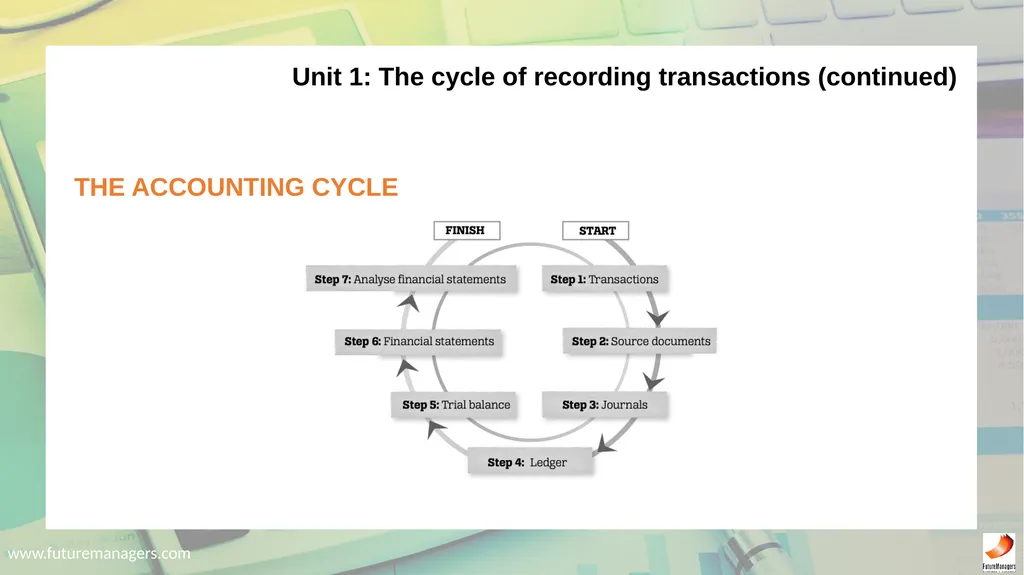
Follow the money’ – you may have heard this saying before. No, it does not mean spending your life chasing after money. But it does mean keeping control of any transactions involving money by keeping good records from start to finish. This is what accountants do and it is a very specialised job. However, it is not difficult to understand the basics of the accounting cycle.<br>
slide120. www.futuremanagers.com Unit 1: The cycle of recording transactions (continued) THE ACCOUNTING CYCLE<br>
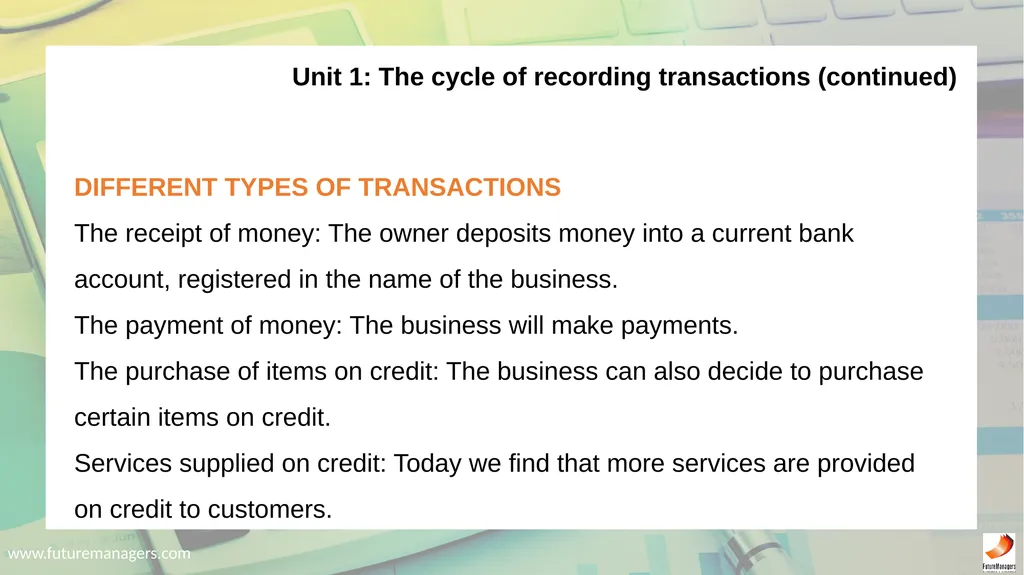
slide121. www.futuremanagers.com Unit 1: The cycle of recording transactions (continued) DIFFERENT TYPES OF TRANSACTIONS
The receipt of money: The owner deposits money into a current bank account, registered in the name of the business.
The payment of money: The business will make payments.
The purchase of items on credit: The business can also decide to purchase certain items on credit.
Services supplied on credit: Today we find that more services are provided on credit to customers.<br>
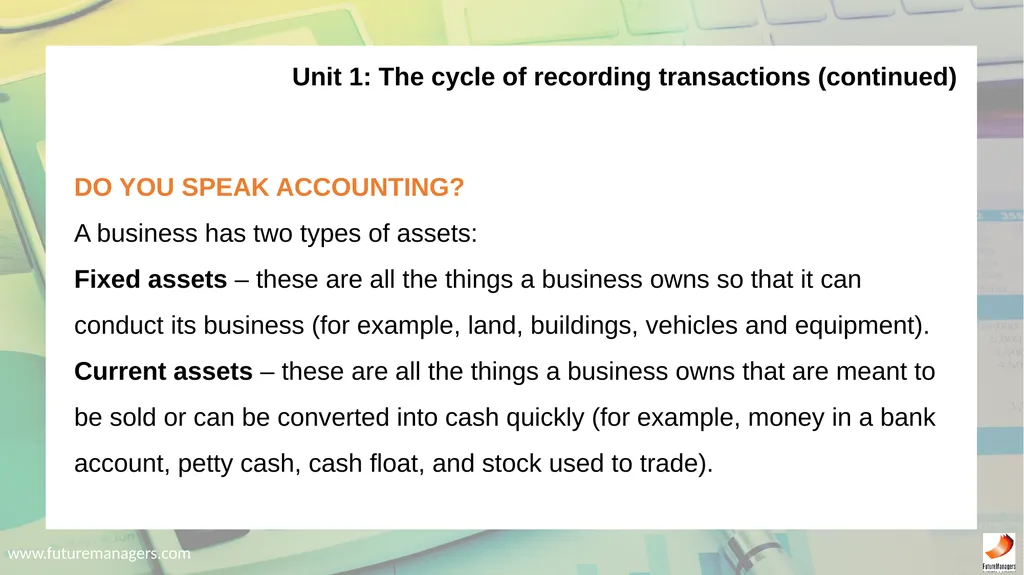
slide122. www.futuremanagers.com Unit 1: The cycle of recording transactions (continued) DO YOU SPEAK ACCOUNTING?
A business has two types of assets:
Fixed assets – these are all the things a business owns so that it can conduct its business (for example, land, buildings, vehicles and equipment).
Current assets – these are all the things a business owns that are meant to be sold or can be converted into cash quickly (for example, money in a bank account, petty cash, cash float, and stock used to trade).<br>
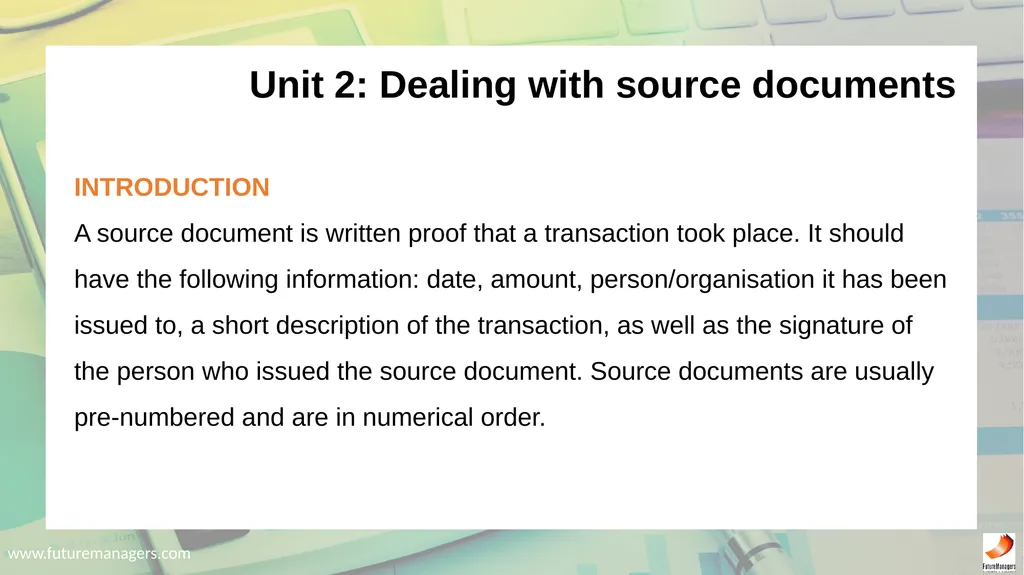
slide123. www.futuremanagers.com INTRODUCTION
A source document is written proof that a transaction took place. It should have the following information: date, amount, person/organisation it has been issued to, a short description of the transaction, as well as the signature of the person who issued the source document. Source documents are usually pre-numbered and are in numerical order. Unit 2: Dealing with source documents<br>
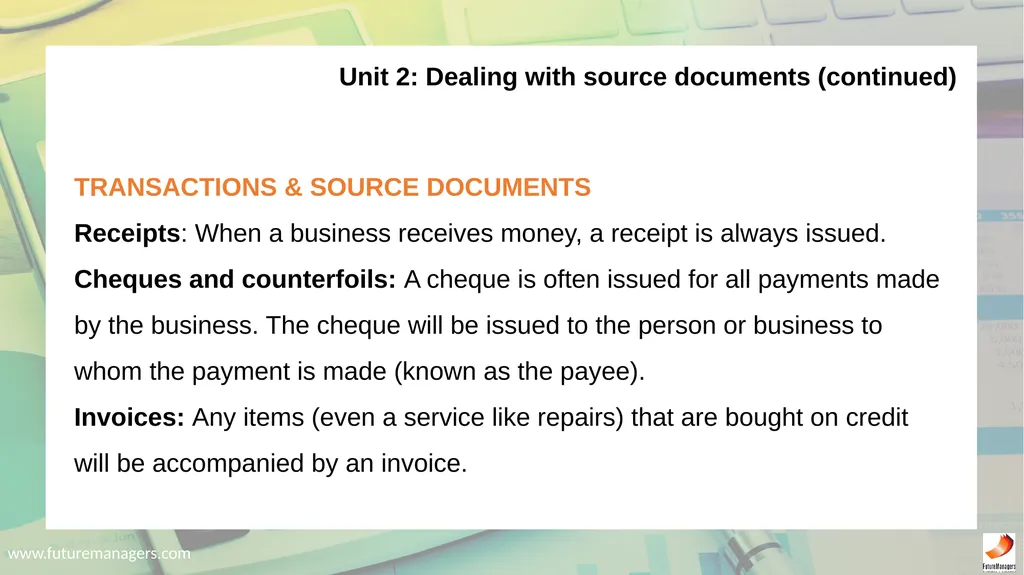
slide124. www.futuremanagers.com Unit 2: Dealing with source documents (continued) TRANSACTIONS & SOURCE DOCUMENTS
Receipts: When a business receives money, a receipt is always issued.
Cheques and counterfoils: A cheque is often issued for all payments made by the business. The cheque will be issued to the person or business to whom the payment is made (known as the payee).
Invoices: Any items (even a service like repairs) that are bought on credit will be accompanied by an invoice.<br>
slide125. www.futuremanagers.com Unit 2: Dealing with source documents (continued) HANDLING PETTY CASH
Petty cash is a small amount of cash that you keep at your business premises to pay for small expenses. You often have to pay for things like milk for tea and coffee, or maybe casual parking. These items usually only cost a few rand and it is not worth the time and bank costs for the business to pay by cheque or to draw money especially for these payments.<br>
slide126. www.futuremanagers.com INTRODUCTION
A journal is a book in which you record events in chronological order (according to date order). Unit 3: All about journals<br>
slide127. www.futuremanagers.com Unit 3: All about journals (continued) JOURNALS
In business, a journal is a daily record of all the business’s transactions and it is the most important and essential record a business can keep. A different journal will be used for each of the four different source documents.<br>
slide128. www.futuremanagers.com INTRODUCTION
The Cash Receipts Journal is referred to as the CRJ. Unit 4: Handling journals<br>
slide129. www.futuremanagers.com Unit 4: Handling journals (continued) IMPORTANT FEATURES OF THE CRJ
The CRJ is completed each day and totalled at the end of the month.
The line drawn beneath the amounts in the Analysis of receipts column indicates that it was the total of the money received on that day. A deposit slip was filled in and deposited in the current bank account of the business.
The Analysis of receipts column can thus represent income to the business.<br>
slide130. www.futuremanagers.com Unit 4: Handling journals (continued) IMPORTANT FEATURES OF THE CRJ
The Bank column represents the current bank account of the business. The money is transferred from the business to the bank (Bank column).
The Current income column will be used only when the money that is received is for the service that the business renders, for example the Current income of a hairdresser will be for that service.
The Folio column will only be used in Step 4 when we will post to the ledger.<br>
slide131. www.futuremanagers.com Unit 4: Handling journals (continued) IMPORTANT FEATURES OF THE CRJ
The Sundry account column is used for any other monies received besides Current income. For this reason, the nature of the receipt must be specified in the details column of Sundry accounts.
All accounts, except the Analysis of receipts column, must be added up.
When money is received for services rendered and no name appears on the receipts, the word ‘cash’ must be written in the Details column.<br>
slide132. www.futuremanagers.com Unit 4: Handling journals (continued) THE CASH PAYMENTS JOURNAL (CPJ)
The cheque counterfoil that remains in the cheque book will be the source document that is used to write up the cash payments journal (CPJ).<br>
slide133. www.futuremanagers.com Unit 4: Handling journals (continued) IMPORTANT FEATURES OF THE CPJ
The CPJ is drawn up on a monthly basis.
The columns for the CPJ in a service business can differ from business to business.
Any payment for which there is not a specific column will be entered in the Sundry accounts column and the nature of the payment will be specified.<br>
slide134. www.futuremanagers.com Unit 4: Handling journals (continued) IMPORTANT FEATURES OF THE CPJ
The Material costs column (also called Consumable goods or Consumable stores column) is used for those usable items you need to purchase in order to perform your service successfully.
‘Equipment’ is the name given to all the items you buy with a relatively long lifespan (assets) that you will use in your business; likewise the name ‘Vehicles’ will be given to any car or delivery van bought.<br>
slide135. www.futuremanagers.com Unit 4: Handling journals (continued) IMPORTANT FEATURES OF THE CPJ
Drawings: If the owner pays for anything of a personal nature by means of a business cheque, it will be known as ‘Drawings’.
All columns must be added up at the end of the month. The total of the bank column at the end of the month must be equal to the sum of the totals of the remaining columns.
The Folio column will only be used in Step 4 when we will post to the ledger.<br>
slide136. www.futuremanagers.com Unit 4: Handling journals (continued) IMPORTANT FEATURES OF THE CREDITORS JOURNAL
The CJ is drawn up on a monthly basis.
The columns in the CJ can differ from business to business.
Any purchase for which there is not a specific column will be entered in the Sundry accounts column and the nature of the purchase will be specified.
The Creditors control column is named as such because it represents the total of all items bought on credit for a specific month from your creditors.<br>
slide137. www.futuremanagers.com Unit 4: Handling journals (continued) IMPORTANT FEATURES OF THE CREDITORS JOURNAL
All items purchased on credit must first be entered in the Creditors control column and then in an Analysis column or the Sundry accounts column.
Because you receive invoices from different creditors, each with their own numbers, you usually renumber the invoices.
The Folio column will only be used in Step 4 when we will post to the ledger.<br>
slide138. www.futuremanagers.com Unit 4: Handling journals (continued) IMPORTANT FEATURES OF THE DEBTORS JOURNAL
The DJ is drawn up on a monthly basis.
The columns of the DJ stay the same for any service business.
The Debtors control column is called this because it represents the total of the service supplied on credit to debtors (clients or the people that owe money to the business).
The Folio column will only be used in Step 4, when we will post to the ledger.<br>
slide139. www.futuremanagers.com INTRODUCTION
Once the journals for a business have been completed, we can now post to the ledger. Unit 5: Posting subsidiary journals to the General Ledger<br>
slide140. www.futuremanagers.com Unit 5: Posting subsidiary journals to the General Ledger (continued) WHAT IS A LEDGER?
A ledger is a book in which a specific page is reserved for each item paid for or received by the business. Let’s compare the journal with the ledger: a journal (CRJ, CPJ, CJ and DJ) will be drawn up every month for a business, while a ledger can be drawn up at any time. However, posting to the ledger can only take place after the journals have been completed. Journals record all financial transactions according to the date. Ledgers record some of the same information but organise it differently.<br>
slide141. www.futuremanagers.com Unit 5: Posting subsidiary journals to the General Ledger (continued) POSTING TO THE GENERAL LEDGER
Concepts you need to remember before a ledger can be completed:
Assets: Fixed assets are items bought by the business with the intention that they will be used by the business and have a relatively long lifespan, for example land and buildings (premises), vehicles and equipment. Current assets are cash or items that can be converted into cash within one year, for example debtors control and bank savings.<br>
slide142. www.futuremanagers.com Unit 5: Posting subsidiary journals to the General Ledger (continued) POSTING TO THE GENERAL LEDGER
Concepts you need to remember before a ledger can be completed:
Owner’s Equity: This represents the owner’s interest in the business. It consists of:
Income for example current income, rent income or donations received.
Expenses for example stationery, consumable goods, telephone and trading licence.<br>
slide143. www.futuremanagers.com Unit 5: Posting subsidiary journals to the General Ledger (continued) POSTING TO THE GENERAL LEDGER
Concepts you need to remember before a ledger can be completed:
Liabilities: Current liabilities are the obligations or debts of the business that must be paid within one year, for example creditors control.<br>
slide144. www.futuremanagers.com INTRODUCTION
Every business must know how it is doing – whether it is making a profit (making money) or running at a loss (losing money). Only by examining the financial statements can a business tell how it is doing; in other words, assess its performance. Unit 6: Preparing final statements<br>
slide145. www.futuremanagers.com Unit 6: Preparing final statements (continued) THE TRIAL BALANCE
A Trial Balance is a summary of the closing/final balances extracted from the General Ledger at the end of each month. The purpose of the Trial Balance is twofold:
To test the numerical accuracy of the work done thus far from the journals and the ledgers.
To test whether the double-entry principle has been followed.<br>
slide146. www.futuremanagers.com Unit 6: Preparing final statements (continued) IMPORTANT FEATURES OF THE TRIAL BALANCE
A Trial Balance is drawn up on the last day of the month after the posting to the General Ledger has been completed.
The accounts will be in the same sequence as they appear in the General Ledger.
The total of the balance in the Debit column must be equal to the total of the balances in the Credit column.
A Trial Balance will be drawn up at the end of each month.<br>
slide147. www.futuremanagers.com Unit 6: Preparing final statements (continued) WHAT IS THE FINANCIAL STATEMENT OF A BUSINESS?
The financial statement consists of:
Income Statement: The purpose is to determine the profit or loss for the financial year.
Balance Sheet: This reflects the financial position of the business on the last day of the financial year (whether it made or lost money in that year).<br>
slide148. www.futuremanagers.com Unit 6: Preparing final statements (continued) IMPORTANT FEATURES OF FINANCIAL STATEMENTS
The Income Statement is drawn up for the year.
The Balance Sheet is drawn up on the last day of the financial year.
The notes form an integral part of the financial statements.
The format of the financial statements is important and you must be able to complete it on your own.
An amount in brackets means ‘subtract’.
Amounts with blocks around mean ‘add’.<br>
slide149. www.futuremanagers.com Unit 6: Preparing final statements (continued) ANALYSIS OF FINANCIAL STATEMENTS – THE FINAL STEP
The financial statements drawn up at the end of a financial year are the starting point for planning the next financial year. Certain ratios can also be calculated to determine whether the business is financially sound and financially viable for the owner.<br>
slide150. Chapter 7:
All about entrepreneurship<br>
slide151. www.futuremanagers.com INTRODUCTION
There are many different definitions of entrepreneurship, but they can all be summarised in one sentence:
Starting your own business with the aim of making a profit. Unit 1: What is entrepreneurship?<br>
slide152. www.futuremanagers.com Unit 1: What is entrepreneurship? (continued) BUSINESS MAKES THE WORLD GO ROUND
People start businesses so that they can earn an income and make a profit. But, to earn an income and make a profit, the business must sell products or provide services that consumers need or want. Consumers must also believe that the price of the goods or services that you sell is fair. If consumers do not buy your product or service, or if you charge too much, your business will not succeed. Choosing the right kind of business and charging a fair price are two very important factors of entrepreneurship.<br>
slide153. www.futuremanagers.com Unit 1: What is entrepreneurship? (continued) MANUFACTURING
A manufacturing business changes raw materials (e.g. wood) into finished products (e.g. furniture). These businesses sell their products to traders or retailers, who then sell them to the public.<br>
slide154. www.futuremanagers.com Unit 1: What is entrepreneurship? (continued) TRADE AND RETAIL INDUSTRIES
Trade and retail industries are businesses that buy finished goods from manufacturers (or wholesalers) and sell these to consumers at a profit. There are many different types of trade and retail businesses such as clothing stores, hardware stores, furniture shops, shops that sell food, sports goods shops, shops that sell bicycles, cafes, and so on.<br>
slide155. www.futuremanagers.com Unit 1: What is entrepreneurship? (continued) SERVICE PROVIDERS
Service providers are businesses that sell services to consumers. Such businesses usually do not sell products, although some of them, like cellphone businesses, may sell products (e.g. cellphones) and services (e.g. cellphone repairs).<br>
slide156. www.futuremanagers.com Unit 1: What is entrepreneurship? (continued) DOES ENTREPRENEURSHIP PAY?
Entrepreneurs start businesses to make a profit. However, to make a profit, an entrepreneur needs to have a good business idea, business skills, technical skills and capital. An entrepreneur must also be willing to take risks and work very hard for long hours.<br>
slide157. www.futuremanagers.com Unit 1: What is entrepreneurship? (continued) ENTREPRENEURSHIP IS NOT ONLY ABOUT THE MONEY!
Entrepreneurship is basically about starting and running a business to make a profit. When you start and run a business you also need to consider other factors such as the impact your business has on your community and the environment. Social investment and showing social responsibility can help entrepreneurs to make bigger profits because the community will usually support a business that helps to take care of people or the environment.<br>
slide158. www.futuremanagers.com Unit 1: What is entrepreneurship? (continued) DEVELOP YOUR ENTREPRENEURIAL SKILLS
Our government tries its best to support entrepreneurs because it knows that entrepreneurship is one of the best ways to create more employment in the country, which will help to reduce poverty so that people have a better standard of living. For this reason, the government has started many organisations that aim to help entrepreneurs develop their entrepreneurial skills. In addition, many non-governmental organisations and private companies have also started programmes that have the same aim.<br>
slide159. www.futuremanagers.com INTRODUCTION
In order to understand what qualities a successful entrepreneur needs, it is important to think about what makes an entrepreneur successful. Unit 2: Characteristics of a successful entrepreneur<br>
slide160. www.futuremanagers.com Unit 2: Characteristics of a successful entrepreneur (continued) CHARACTERISTICS OF A SUCCESSFUL ENTREPRENEUR
A successful entrepreneur is someone who can start and grow a business so that it:
Provides goods and/or services that the community wants and needs
Makes a profit
Provides employment for others
Contributes to community development.<br>
slide161. www.futuremanagers.com Unit 2: Characteristics of a successful entrepreneur (continued) WHY ARE ENTREPRENEURIAL CHARACTERISTICS IMPORTANT?
Entrepreneurial characteristics are important because it is these characteristics that will help an entrepreneur to succeed in his or her business. For example, if someone is lazy and not willing to work long hours, it is unlikely that he or she will succeed as an entrepreneur. In the same way, if someone is dishonest and tries to cheat his or her customers, the customers will soon stop going to that business and it will start to make a loss.<br>
slide162. www.futuremanagers.com INTRODUCTION
If you would like to be an entrepreneur, it is important that you are honest about whether you have the entrepreneurial characteristics that are necessary for success. For example, if you decide to become an entrepreneur but you do not like working hard for long hours, then it is unlikely that you will succeed as an entrepreneur. Unit 3: Develop entrepreneurial characteristics?<br>
slide163. www.futuremanagers.com Unit 3: Develop entrepreneurial characteristics? (continued) DEVELOPING ENTREPRENEURIAL CHARACTERISTICS
Of course, everybody can become an entrepreneur – even if they do not have the necessary characteristics or skills. This is because you can develop these characteristics by learning new skills and doing exercises to build qualities such as confidence, creative thinking and problem solving.<br>
slide164. www.futuremanagers.com INTRODUCTION
Ethics refers to the way that you carry out your business (e.g. whether you are honest in your dealings with your suppliers, customers and employees). This is strongly related to your own values and attitudes because they make up your ethics or your understanding of what is right and wrong in the way you treat yourself and interact with other people. Business ethics therefore refers to the values, attitudes and beliefs a business has or shows when dealing with its employees, customers, suppliers and the general public. Unit 4: Business ethics and social responsibility<br>
slide165. www.futuremanagers.com Unit 4: Business ethics and social responsibility (continued) SOCIAL RESPONSIBILITY IN BUSINESS
Businesses have responsibilities towards their customers. The triple bottom line (TBL) is made up of:
People, which measures how fair the business is to its workers and the people.
Planet, which measures how well the business looks after the natural environment.
Profit, which measures how much profit the business makes.<br>
slide166. www.futuremanagers.com Unit 4: Business ethics and social responsibility (continued) BUSINESS ETHICS AND A CODE OF CONDUCT
When you combine the fact that businesses should operate ethically and be socially responsible, it is clear that businesses need to have a set of rules that they can use to check the way they function. Such a set of rules is called a code of conduct. A code of conduct informs all employees of the values, attitudes and behaviour that are expected from them in the workplace. A code of conduct also usually includes penalties for not obeying the rules as well as what employees can do if they feel they are being treated unfairly.<br>
slide167. Chapter 8:
Which business is for you?<br>
slide168. www.futuremanagers.com INTRODUCTION
This is an important decision to make because anyone who wants to start a business must choose a business that:
They know something about
Is in line with their skills, talents and interests
They will enjoy working in. Unit 1: Explore business ideas<br>
slide169. www.futuremanagers.com Unit 1: Explore business ideas (continued) LOOKING FOR A BUSINESS IDEA
When you want to start a new business, one of the first questions you need to ask yourself is: ‘What kind of business can I start?’ To choose the best type of business for you to start, you need to understand what is meant by a business idea. Basically, a business idea can be summarised as follows:
An idea for a business that can be turned into practical action and that will make you a profit.<br>
slide170. www.futuremanagers.com Unit 1: Explore business ideas (continued) METHODS TO GENERATE BUSINESS IDEAS
There are a number of different methods that you can use to generate business ideas:
Look at what skills you have;
Identify your talents;
Look at what the market needs;
Look at what resources you have and need;
Identify links with existing businesses.<br>
slide171. www.futuremanagers.com Unit 1: Explore business ideas (continued) IDENTIFYING BUSINESS IDEAS
You can use the same methods described above to generate business ideas in all five business areas. The five main business areas are:
The service industry;
Franchises;
Direct selling and multi-level marketing;
Manufacturing;
Trade and retail.<br>
slide172. www.futuremanagers.com INTRODUCTION
A very important stage in deciding what kind of business to start is to eliminate business ideas that you think are not suitable. After this process, you will be left with the best business ideas. We call this process of eliminating unsuitable business ideas, screening. Unit 2: Business ideas that do not work<br>
slide173. www.futuremanagers.com Unit 2: Business ideas that do not work (continued) MARKET SIZE
Your business will not survive if you do not have enough people or other businesses (a market) that want or need your products or services. So, one of the first questions you have to ask yourself when you are planning to start a new business is: ‘Is there a big enough market for my products and/or services?’ If you cannot answer ‘Yes’ for some of your business ideas, then you must eliminate those business ideas.<br>
slide174. www.futuremanagers.com Unit 2: Business ideas that do not work (continued) PRODUCTS AND/OR SERVICES
There are two important factors you need to consider about the products and/or services. Firstly, you must make sure that your market wants or needs your planned products and/or services. If the market does not want or need your planned products and/or services, then your business will not succeed. Business ideas that do not meet market requirements must be eliminated. Secondly, you have to make sure that your products and/or services are of a high quality.<br>
slide175. www.futuremanagers.com Unit 2: Business ideas that do not work (continued) HOW MUCH WILL IT COST?
As with the quality of the products and/or services your business plans to provide, there are two cost factors to consider.
How much will it cost you to provide your products and/or services?
What will you charge for your products and/or services?
It is important to make sure that your proposed market can afford your products and/ or services.<br>
slide176. www.futuremanagers.com Unit 2: Business ideas that do not work (continued) COMPETITION
Competition in business refers to those businesses in your area that sell similar products and/or services to the ones that you plan to sell. If there are too many businesses in the same area selling the same products and/or services, this is called overtrading. When there is too much overtrading in an area, some businesses will almost certainly be forced to close down because of a lack of customers.<br>
slide177. www.futuremanagers.com Unit 2: Business ideas that do not work (continued) SUSTAINABILITY
When you start a new business, it should be your aim to keep the business going for a number of years. In other words, your business must be sustainable. There is little point in making all the effort required to start a business if it is going to last for only a year or two. Of course, starting any business is risky, and factors beyond your control could force your business to close down.<br>
slide178. www.futuremanagers.com Unit 2: Business ideas that do not work (continued) PREMISES
Where you operate your business is another important factor to consider. This is called the location of your business. For most businesses, it is important to be located close to your markets. If consumers have to travel too far to get to your business, they will choose a closer one. Your business will then begin to make a loss and will be forced to close down. If you cannot find suitable premises for your business, it is probably wise to eliminate that business from your list of business idea.<br>
slide179. www.futuremanagers.com Unit 2: Business ideas that do not work (continued) AVAILABILITY OF SKILLS
Probably the most important factor that will decide whether or not your business is successful is the level of your skills and those of your employees. If you do not have the right skills or if you cannot find employees with the right skills, it will be very difficult to make a success of your business idea.<br>
slide180. www.futuremanagers.com Unit 2: Business ideas that do not work (continued) WHICH BUSINESS IDEAS SUIT YOU BEST?
Once you have screened all your business ideas, and eliminated the unsuitable ones, you can shortlist the remaining ideas that you think are workable. In the next unit, you will test your workable business ideas to identify the one that is most suitable for you to turn into an entrepreneurial enterprise.<br>
slide181. www.futuremanagers.com INTRODUCTION
Market research is when you find out (research) things about your market (potential customers or clients) to identify factors such as:
Their needs and wants.
The types of products and/or services they require to fulfil these needs and wants.
How much they would be willing to pay for these products and/or services.
Where they would prefer your business to be located. Unit 3: Choosing the best business opportunities<br>
slide182. www.futuremanagers.com Unit 3: Choosing the best business opportunities (continued) DOOR-TO-DOOR SURVEYS
When you conduct a door-to-door survey, you go to a number of selected homes and interview the people living there to find out if they would be interested in buying the products and/or services you plan to sell.
Decide on your target market;
Choose a residential area or a number of streets as your sample;
Draw up a suitable questionnaire;
Conduct your survey.<br>
slide183. www.futuremanagers.com Unit 3: Choosing the best business opportunities (continued) TELEPHONE SURVEYS
In a telephone survey, you phone people to find out whether or not they would be likely to buy your products and/or services. Basically, you ask them the same questions as you use in a door-to-door survey.<br>
slide184. www.futuremanagers.com Unit 3: Choosing the best business opportunities (continued) INTERVIEWS
As in door-to-door surveys and telephone surveys, you use interviews to find out whether or not your intended target market would be interested in buying your products and/or services. You also use a questionnaire in this method of market research.<br>
slide185. www.futuremanagers.com Unit 3: Choosing the best business opportunities (continued) PERSONAL NEEDS
Depending on the type of businesses you have chosen for your business ideas, you could research the personal needs of your intended market to see if these needs fit in with your business idea. When you have grouped their needs into broad categories, you can focus on a specific need in a particular category to find out if it corresponds with your business idea.<br>
slide186. www.futuremanagers.com Unit 3: Choosing the best business opportunities (continued) USING MARKET RESEARCH TO CHOOSE THE BEST BUSINESS IDEA
When you have chosen the most suitable market research method to test the viability of each of your three business ideas, it is time to conduct your own market research.<br>
slide187. Chapter 9:
Get your business going<br>
slide188. www.futuremanagers.com INTRODUCTION
A business plan is a detailed outline of every aspect of the business: goals, finance, staffing, production, marketing and selling. It describes the objectives of your business and explains how you intend to achieve these objectives. Unit 1: All about business plans<br>
slide189. www.futuremanagers.com Unit 1: All about business plans (continued) WHAT IS A BUSINESS IMPLEMENTATION PLAN?
An implementation plan will help you to complete all the necessary tasks before you open your business to the public:
What must be done to get your business started?
Who must do these things?
How must they be done?
By when must they be done?<br>
slide190. www.futuremanagers.com Unit 1: All about business plans (continued) BUSINESS ACTIVITY CHARTS
A business activity chart shows you the activities you need to start and complete once your business has actually started. It also shows you who must do these activities and by when. A business activity chart also tracks your progress in completing different activities.<br>
slide191. www.futuremanagers.com Unit 1: All about business plans (continued) MEET THE LEGAL REQUIREMENTS
For your new business to run smoothly, you must make sure that you have fulfilled all the necessary legal requirements. Some of the requirements that you need to fulfil include:
Registration for tax (PAYE), for Value-Added Tax (VAT), for UIF, as a partnership or company.
Adherence to certain health and safety regulations and compliance with different labour laws and relevant trading licences.<br>
slide192. www.futuremanagers.com Unit 1: All about business plans (continued) SOUTH AFRICAN REVENUE SERVICE (SARS)
The South African Revenue Service collects taxes from employers (businesses) and employees (workers) for the government to use so that it can supply the public with infrastructure. There are two main types of tax that SARS collects: Income tax (PAYE) and Value-Added Tax (VAT).<br>
slide193. www.futuremanagers.com Unit 1: All about business plans (continued) THE DEPARTMENT OF LABOUR
The Department of Labour is responsible for administering the Unemployment Insurance Fund (UIF) and workplace health and safety regulations.<br>
slide194. www.futuremanagers.com INTRODUCTION
In order to make sure that your business runs smoothly and earns a good income, you need to set up a number of systems. You will look at four systems:
Financial management system;
Human resources system;
Reporting system;
Monitoring system. Unit 2: Running your own business<br>
slide195. www.futuremanagers.com Unit 2: Running your own business (continued) FINANCIAL MANAGEMENT SYSTEM
In any business, money either comes in (from selling products and/or services) or goes out (to pay for expenses or to buy new stock). It is very important that you keep track of this flow of money if you want to make sure that your business stays profitable and grows. To keep track of this flow of money you need to have a financial management system.<br>
slide196. www.futuremanagers.com Unit 2: Running your own business (continued) OTHER IMPORTANT SYSTEMS
Depending on the size of your business, other important systems that you should consider setting up include:
A human resources system;
A reporting system; and
A monitoring system.<br>
slide197. www.futuremanagers.com Unit 2: Running your own business (continued) INTERRELATIONSHIP BETWEEN SYSTEMS
Each of the systems that are set up in a business cannot operate on their own. For a business to run efficiently, effectively and productively, the different systems have to work together. If there is a weakness in one of the systems, this can affect all the systems and end up being the downfall of the whole business.<br>
slide198. www.futuremanagers.com Unit 2: Running your own business (continued) HOW RISKY IS RUNNING A BUSINESS?
Starting and running a business is risky. Not all business people or business ventures become successful, and many fail within the first five years. Preparing a business plan and setting up a business, requires a lot of hard work and long hours. So, if you are not willing to put in long hours and lots of effort, you are unlikely to be successful, even if you have the right business idea.<br>
slide199. www.futuremanagers.com Unit 2: Running your own business (continued) THEFT
Theft is when items belonging to the business disappear. Items are physically removed by people with the intention of taking them from the business. When criminals take your possessions and stock, you will not be able to operate properly until you recover your assets.<br>
slide200. www.futuremanagers.com Unit 2: Running your own business (continued) COMPETITORS
Despite all that a business does, there will always be the risk of competitors beating you at your game. Businesses are constantly competing for customers by offering better priced products, newer products and better value for money. To remain ahead, businesses need to be competitive and provide added value for customers so they will continue supporting you.<br>
slide201. www.futuremanagers.com Unit 2: Running your own business (continued) STRIKES
Strikes are when employees do not come to work, work slower or refuse to work until their demands for better wages or working conditions are met. Strikes can occur at any time. As a result, you may lose hours of production and service will decline or come to a halt.<br>
slide202. www.futuremanagers.com Unit 2: Running your own business (continued) FAILURE OF SYSTEMS
If the business relies on systems to do much of the work and the systems fail, the business will experience great losses. For instance, if the production plant in a food factory has a problem with machinery, raw materials will start to spoil. You will not be able to continue working until the systems are up and running again. This loss of time has to be carried by the owner.<br>
slide203. www.futuremanagers.com Unit 2: Running your own business (continued) POOR MANAGEMENT
Businesses may also fail due to poor management of the key business functions, and failure of the key functions to support one another.<br>
slide204. www.futuremanagers.com Unit 2: Running your own business (continued) NATURAL DISASTERS
Natural disasters include things such as fires, lightning, thunder and floods, which the owner cannot predict or control. Natural disasters can be very detrimental to the operations of the business. Indirectly, they also affect the production of raw materials which, if needed by the business, may mean that the business loses its ability to function/produce.<br>
slide205. www.futuremanagers.com INTRODUCTION
There are a number of factors that can change in a business’s external environments. There are also a number of reasons why these factors can change. The most important thing to remember is that if a business does not adapt to these changing environments, then the business could collapse. Unit 3: Responding to a changing business environment<br>
slide206. www.futuremanagers.com Unit 3: Responding to a changing business environment (continued) GOVERNMENT LAWS AND REGULATIONS
Businesses must identify and adapt to new laws and regulations that the government makes. These laws and regulations are there to protect businesses and the employees. If businesses do not comply with these new laws and regulations, they will not be legal and may be closed down. New legislation takes time to implement and may cost the business a lot of money.<br>
slide207. www.futuremanagers.com Unit 3: Responding to a changing business environment (continued) GLOBALISATION
Globalisation is when businesses trade with one another across national boundaries. This increases the amount of competition that businesses face. For example, a clothing business in South Africa not only competes with other South African clothing businesses, but also with international clothing businesses.<br>
slide208. www.futuremanagers.com Unit 3: Responding to a changing business environment (continued) POLITICAL EVENTS
Political events can also have an influence on the external business environment. For example, if there is political instability in a country, overseas investors withdraw their investment, which means that local businesses will have to find other ways to finance their operations.<br>
slide209. www.futuremanagers.com Unit 3: Responding to a changing business environment (continued) TECHNOLOGICAL CHANGES
Economic and Management Sciences is changing at a rapid rate. If businesses do not keep up with technological changes, then their operations will not function efficiently, they will lose customers, and they will begin to make less profit. Eventually, they may go bankrupt. Technological changes and improvements also require businesses to make sure that their staff members are adequately trained to handle the new technology.<br>
slide210. www.futuremanagers.com Unit 3: Responding to a changing business environment (continued) SOCIAL ENVIRONMENT
All businesses operate in a social environment, which is made up of many factors. Some of the factors that businesses in South Africa need to take into account include:
Crime;
High levels of unemployment and poverty;
HIV/AIDS.<br>
slide211. www.futuremanagers.com Unit 3: Responding to a changing business environment (continued) LABOUR ENVIRONMENT
Businesses cannot be successful if they do not have skilled employees. In South Africa, there is a skills shortage, which is due to skilled workers leaving the country and due to an education system that does not produce enough skilled workers. This means that businesses struggle to find qualified employees. It also means that they need to spend more money on training and development, which can affect their profits.<br>
slide212. www.futuremanagers.com Unit 3: Responding to a changing business environment (continued) FINANCIAL ENVIRONMENT
The change in exchange rates (R/$) have an impact on businesses if they import or export goods. The price of internationally traded goods, often paid for in United States dollars ($), can change on a daily basis. Inflation and the resulting interest rates imposed by the Reserve Bank can also impact on business.<br>
NQF1<br>
slide2. Chapter 1:
Producing the goods<br>
slide3. www.futuremanagers.com MEETING PEOPLE’S NEEDS WITH GOODS AND SERVICES
We all have needs and wants that have to be met so we can live. For example, everyone needs food, clothing and a place to live with services like water and electricity. People also need other services like transport, education, and health care. An economy runs on a balance between what people need and want, and meeting those needs with the right goods and services at the right time and price. Unit 1: Getting what we need and want<br>
slide4. www.futuremanagers.com Unit 1: Getting what we need and want (continued) SUPPLY
The supply side of the economy involves everyone who sells goods and services in the economy. In a free market economy such as the one we have in South Africa, the main motive of the supplier in the market is to make as much money or profit as possible.<br>
slide5. www.futuremanagers.com Unit 1: Getting what we need and want (continued) DEMAND
In economic language, demand means everyone who is willing and able to buy goods and services from suppliers at a particular price. This is known as the market. In a free market economy, the main motive of consumers is to get as much value as possible for the money they have to spend.<br>
slide6. www.futuremanagers.com Unit 1: Getting what we need and want (continued) HOW DOES SUPPLY AND DEMAND REALLY WORK WITH PRICE?
We could say that an economy is based on two big ideas:
Idea number 1: Producers will want to produce more of a good or service that they can sell at a high price than a good that sells at a low price.
Idea number 2: Consumers will buy more of a good or service when it is cheap than when it is expensive.<br>
slide7. www.futuremanagers.com Unit 1: Getting what we need and want (continued) FINDING THE RIGHT PRICE
Determining price is a balancing act and there are many other factors to consider in getting it right. Think about things like how much a good or service costs to produce, what other things have to be paid for in producing it, and what it takes to bring the product to the market, that all end up being reflected in the price. The simple rule to bear in mind is: Everything has to be paid for.<br>
slide8. www.futuremanagers.com INTRODUCTION
Everyone has needs and wants, so the economy of a country also has to be planned and controlled by government in order to meet everyone’s needs. Things need to be produced in order to satisfy needs and wants. Unit 2: Producing enough for everyone<br>
slide9. www.futuremanagers.com Unit 2: Producing enough for everyone (continued) WHY DO WE NEED PRODUCTION IN AN ECONOMY?
In today’s economy, there is a need for production. In order for an economy to run, we can say it is all about the production, distribution and consumption of goods and services in order to meet everyone’s needs and wants in a country.<br>
slide10. www.futuremanagers.com Unit 2: Producing enough for everyone (continued) WHAT ARE THE FACTORS OF PRODUCTION?
We need resources to help us get what we need and want. These resources are also called the factors of production. These are:
Land;
Labour;
Capital; and
Entrepreneurship.<br>
slide11. www.futuremanagers.com Unit 2: Producing enough for everyone (continued) FACTORS OF PRODUCTION TO PRODUCE FOOD IN TODAY’S ECONOMY
One of the basic needs for any economy is to make sure enough food is produced for everyone. In today’s economy, food can be produced in many ways. Large companies can produce food using technology. But many small farmers can produce food with just a few tools and animals. Also, different types of food can be produced for different consumers.<br>
slide12. www.futuremanagers.com Unit 2: Producing enough for everyone (continued) PRODUCTION OF ALL KINDS
Large companies (called multinationals) produce a huge range of goods and services, using resources, technology, skilled and unskilled labour, and they can produce for consumers who live in another part of the world from where production happens. This is globalised production. At the same time, millions of people are involved in small-scale production, especially in rural areas of Africa, Asia and South America. These people make little use of technology, mostly use family members for labour and often produce for their own needs.<br>
slide13. www.futuremanagers.com INTRODUCTION
Labour is essential in production because there can be no business without people to do the work, and nothing can be produced without labour. Income from labour is what most households survive on. Households use the income to satisfy their needs and wants, which creates a demand for goods and services. Businesses then produce the goods and services to satisfy the demand – and so the cycle continues. Unit 3: Keeping the country going<br>
slide14. www.futuremanagers.com Unit 3: Keeping the country going (continued) THE LABOUR MARKET
Labour has other characteristics that make it different from goods and services:
Labour depends on people;
The demand for labour depends on the demand for goods and services produced by labour;
The quality of labour will be different depending on people and their skills.<br>
slide15. www.futuremanagers.com Unit 3: Keeping the country going (continued) THE LABOUR DEBATE
Here are two different views on the labour market for you to consider – the Free market view: Many employers argue for a free labour market in which each worker has an individual contract with the employer; and
The trade union view: Labour unions argue that workers should
negotiate together, not individually, because if workers negotiate on their own, they will find their ‘price’ forced down by employers.<br>
slide16. www.futuremanagers.com Unit 3: Keeping the country going (continued) LIMITED LAND AND RESOURCES
Land and resources are geographically uneven;
Most land and resources have to be used in a certain way and resources have to be processed to be useful;
Resources are limited;
Land and resources are owned and unevenly divided.<br>
slide17. www.futuremanagers.com Unit 3: Keeping the country going (continued) FOLLOW THE FLOW OF CAPITAL IN THE ECONOMY
People often think of money as capital. Even though money is needed to buy capital items, it is the items themselves that form capital as a factor of production. So capital can be thought of as physical things like a computer or a baking oven or a minibus taxi (physical capital), as well as the money that it takes to buy these things (financial capital). Whichever type of capital is involved, it is the investment of capital in an existing business or a new business venture that gets it going and keeps it going.<br>
slide18. www.futuremanagers.com Unit 3: Keeping the country going (continued) SOURCES OF CAPITAL
Businesses usually start with the owner’s or investor’s own capital: this is money that the owner has saved or inherited, that gets the business started. But sometimes this is not enough and the owner has to borrow money, usually from a bank or some other kind of investor. The bank or investor is a business on its own whose business is to lend and invest money. Banks and investors will only be interested in investing where there is the possibility of making money on the investment.<br>
slide19. www.futuremanagers.com Unit 3: Keeping the country going (continued) MAKING MONEY WORK – EXCHANGE RATES
Investment by businesses in other countries (foreign investment) is also good for the country because it brings money in the form of foreign currency into the country.<br>
slide20. www.futuremanagers.com Unit 3: Keeping the country going (continued) CONTROLLING THE RATES
The rate of lending is set and controlled by the South African Reserve Bank, which is the bank of government. Government has the responsibility to keep the economy growing but stable for everyone in the country: workers and employers, rich and poor, local businesses and foreign investors alike.<br>
slide21. www.futuremanagers.com Unit 3: Keeping the country going (continued) WHAT CAN ENTREPRENEURSHIP DO FOR THE ECONOMY?
Entrepreneurship is like the final piece of the factors of production puzzle. It takes someone with initiative and drive, who is not afraid to take a risk, to put all the factors together and actually start and run a business. Entrepreneurs create employment for themselves and others. They see an opportunity to meet a want or need and use resources to make or provide something that did not exist before.<br>
slide22. Chapter 2: Economic systems – what works best?<br>
slide23. www.futuremanagers.com INTRODUCTION
All countries throughout the world face the same basic economic problem as ordinary households - how to make the best use of scarce resources and share out the goods and services produced by these resources. Countries choose an economic system that represents a country’s or region’s best choice of system to run and control their economy. Unit 1: Different economic systems<br>
slide24. www.futuremanagers.com Unit 1: Different economic systems (continued) DIFFERENT ECONOMIC SYSTEMS
There are three major economic systems that can be used to organise a national economy:
Centrally planned or command economy;
Free market or free enterprise economy;
Mixed economy.<br>
slide25. www.futuremanagers.com Unit 1: Different economic systems (continued) CENTRALLY PLANNED ECONOMY
Planned systems are where a government controls the allocation of resources and decides what goods and services to produce to meet the needs and wants of the country as a whole (which is why such systems are also called centralised or command economies). Communism and socialism are examples of planned economic systems.<br>
slide26. www.futuremanagers.com Unit 1: Different economic systems (continued) FREE MARKET ECONOMY
In free market systems there are very few restrictions imposed by government on how resources are allocated. The price system determines this function. In reality, there are some essential goods and services that cannot always be produced at a profit, and competition can end up not actually serving consumers very well. Capitalism is an example of a free market economy.<br>
slide27. www.futuremanagers.com Unit 1: Different economic systems (continued) MIXED ECONOMY
Most countries in the world today have mixed systems, combining aspects of free- market and centrally controlled economies. China, for example, is moving away from centrally planned to free enterprise. The USA, on the other hand, always the largest free enterprise economy in the world, now has some state involvement in business. In South Africa the government owned a large share of enterprises, but has steadily moved towards privatisation – or handing over such enterprises to the private business sector.<br>
slide28. www.futuremanagers.com INTRODUCTION
In South Africa, our new Constitution (Act 108 of 1996) guarantees some specific economic rights. Unit 2: The individual within an economic system<br>
slide29. www.futuremanagers.com Unit 2: The individual within an economic system (continued) SECTION 22: FREEDOM OF TRADE, OCCUPATION AND PROFESSION
Every citizen has the right to choose their trade, occupation or profession freely. Laws can be passed to regulate how people practise their trade, occupation or professions.<br>
slide30. www.futuremanagers.com Unit 2: The individual within an economic system (continued) SECTION 23: LABOUR RELATIONS
Everyone has the right to fair labour practices.
Workers have the right to form and join trade unions and go on strike.
Employers have the right to form and join employers’ organisations.
Trade unions and employers’ organisations have the right to:
make decisions about their own administration and activities
organise, form and join a federation
engage in collective bargaining.<br>
slide31. www.futuremanagers.com Unit 2: The individual within an economic system (continued) SECTION 24: ENVIRONMENT
Everyone has the right to:
an environment that is not harmful to their health or well-being
have the environment protected for present and future generations.
The government must pass laws that prevent pollution and damage to our natural resources, promote conservation and make sure that natural resources are developed while also promoting the economic and social development of people.<br>
slide32. www.futuremanagers.com Unit 2: The individual within an economic system (continued) SECTION 25: PROPERTY
No one can have their property taken away from them unless this is done according to a law.<br>
slide33. www.futuremanagers.com Unit 2: The individual within an economic system (continued) SECTION 26: RIGHT OF ACCESS TO HOUSING
Everyone has the right to have access to adequate housing. The government must take reasonable steps within its available resources to provide people with housing and access to land.<br>
slide34. www.futuremanagers.com Unit 2: The individual within an economic system (continued) SECTION 27: RIGHT OF ACCESS TO HEALTH CARE, FOOD, WATER AND SOCIAL SECURITY
Everyone has the right to have access to:
health care services (including childbirth facilities)
enough food and water
social security (which means support for people who cannot support themselves or their dependants).<br>
slide35. www.futuremanagers.com Unit 2: The individual within an economic system (continued) WHAT ARE YOUR ECONOMIC RESPONSIBILITIES?
While our new Constitution guarantees rights for citizens, every right comes with a responsibility – what the citizen must do in return for this right.<br>
slide36. www.futuremanagers.com INTRODUCTION
When apartheid ended and a new democratic government was elected in 1994, South Africa had a number of challenges and choices to make about its economic system. The new government chose a mixed economy. Unit 3: Economic system in South Africa<br>
slide37. www.futuremanagers.com Unit 3: Economic system in South Africa (continued) INFLUENCE OF THE SOUTH AFRICAN GOVERNMENT
South Africa’s mixed economy means that government allows the economy to grow by not placing too many restrictions on free enterprise. However, government is still committed to helping the many poor people who struggle to survive. Many still find it hard to get a house, land, enough education and health care, or to find jobs.<br>
slide38. www.futuremanagers.com Unit 3: Economic system in South Africa (continued) THE ROLE OF THE INFORMAL SECTOR
The “informal sector” speaks to the economically active people who have found the means to start small businesses and enterprises on their own that serve the communities where they live. Government encourages this initiative by helping them grow their businesses, get access to training and resources, and most of all, become taxpayers and eventually participants in the formal sector.<br>
slide39. Chapter 3: Different types of business and legal issues<br>
slide40. www.futuremanagers.com INTRODUCTION
There are as many different kinds of business as there are consumer needs and wants. Unit 1: Businesses of all kinds<br>
slide41. www.futuremanagers.com Unit 1: Businesses of all kinds (continued) WHAT TYPE OF BUSINESS?
Businesses can also be grouped into those that provide goods and services with the aim of making a profit, and those that are not aimed at making a profit.<br>
slide42. www.futuremanagers.com Unit 1: Businesses of all kinds (continued) GOODS AND SERVICES
Goods are things that consumers buy such as bread, shoes, pens, books, computers, washing machines, and cars. Services refer to the work that people do for consumers, such as giving a haircut, booking a flight, providing a ride in a taxi, arranging a funeral policy, checking your teeth, helping you get a divorce, and opening and servicing a bank account.<br>
slide43. www.futuremanagers.com Unit 1: Businesses of all kinds (continued) BUSINESS OWNERSHIP
A business can be in manufacturing, trading or services – or a combination of all three. In order to explain different types of businesses, the following questions have to be asked about the business:
Who owns the business?
Where did it get its finance (capital) to set up?
How is it managed and who makes the decisions?<br>
slide44. www.futuremanagers.com Unit 1: Businesses of all kinds (continued) DIFFERENT TYPES OF OWNERSHIP
Sole trader;
Partnership;
Close corporation (CC);
Company; and
Co-operative.<br>
slide45. www.futuremanagers.com Unit 1: Businesses of all kinds (continued) SOLE TRADERS
Setting up as a sole trader (or sole proprietor) is the simplest form of ownership. A business is owned and managed by one person who takes responsibility for all business decisions. The law does not separate the owner and the business – that is why it is given the name, ‘sole’ proprietor.<br>
slide46. www.futuremanagers.com Unit 1: Businesses of all kinds (continued) PARTNERSHIPS
A partnership is formed when between 2 and 20 people contribute capital, property or skills to the business and agree on how to share the profits or losses. The law does not separate the owners and the business.<br>
slide47. www.futuremanagers.com Unit 1: Businesses of all kinds (continued) CLOSE CORPORATIONS
A close corporation (CC) is formed when between one and 10 members contribute capital, property or skills to the business. The contributions of the members measure what percentage of the business they own. The Companies Act of 2008 regulates existing CC’s but prevents new CC’s from being formed. Existing CC’s were registered and issued with a Certificate of Incorporation. Close corporations have legal personality. The name of the business must end with the letters ‘CC’.<br>
slide48. www.futuremanagers.com Unit 1: Businesses of all kinds (continued) COMPANIES
Most businesses dream of becoming companies one day. However, a company is quite complicated and expensive to set up and there are a number of legal steps to follow.<br>
slide49. www.futuremanagers.com INTRODUCTION
There are many factors to consider when setting up a business. If you rush into a business idea without full knowledge of these factors, you stand a chance that your business will not succeed. Unit 2: Setting up a business<br>
slide50. www.futuremanagers.com Unit 2: Setting up a business (continued) FACTORS IN SETTING UP A BUSINESS
Target group;
Location;
Competition;
Finance;
Labour;
Transport; and
Environment.<br>
slide51. www.futuremanagers.com Unit 2: Setting up a business (continued) SETTING UP AS A SOLE TRADER
To set up business as a sole trader you need:
an acceptable trade name that is in line with the Trade Name Act of 1960
to register the business with the South African Revenue Services (SARS) for the purpose of paying income tax
a trading licence (if the business sells or prepares meals or perishable food (e.g. a restaurant), or provides a health facility (e.g. a gym) or entertainment.<br>
slide52. www.futuremanagers.com Unit 2: Setting up a business (continued) WHERE DO SOLE TRADERS GET THEIR FINANCE?
Either the owner provides the capital, or they apply for a loan or bank overdraft to partly finance the business’s capital needs.<br>
slide53. www.futuremanagers.com Unit 2: Setting up a business (continued) SETTING UP AS A PARTNERSHIP
To set up as a partnership with the aim of making a profit, you need to:
follow the laws that apply to the Trade Name Act of 1960 and the Licence Act of 1962
register the partnership with SARS
sign a written partnership agreement or contract between the two (or more) business owners.<br>
slide54. www.futuremanagers.com Unit 2: Setting up a business (continued) WHERE DOES A PARTNERSHIP GET ITS FINANCE?
Each partner contributes capital or finances that may be in the form of a loan or bank overdraft.<br>
slide55. www.futuremanagers.com Unit 2: Setting up a business (continued) SETTING UP A CLOSE CORPORATION (CC)
Before the Companies Act (71 of 2008):
every member made a contribution in the form of money, assets or services
submitted a funding statement to the Registrar of Close Corporations who will register the CC.<br>
slide56. www.futuremanagers.com Unit 2: Setting up a business (continued) WHERE DOES A CLOSE CORPORATION GET ITS FINANCE?
Each member makes a contribution. Sometimes a CC may have problems getting finance or credit because the liability (legal responsibility) of members for the debts of the CC is limited. They may need to offer a personal asset like a house or a car as security on a bank loan, in case the CC cannot repay the loan.<br>
slide57. www.futuremanagers.com Unit 2: Setting up a business (continued) TAKING OVER AN EXISTING BUSINESS
Sometimes it is better to take over an existing business, rather than going through all the hard work of setting up a new business. However, there could be risks involved in buying a business. Consider: Reason for selling;
Reputation;
Profit;
Market share;
Financial position;
Assets; and
Legal position.<br>
slide58. www.futuremanagers.com INTRODUCTION
When you start a business, one of the things you have to decide is what kind of ownership suits you or suits the business. Based on the choice you make about the form of ownership, there will be legal rules and regulations about what you have to do or how you have to be set up. If you do not follow these requirements, you run the risk of your business being shut down. So, forming a business can have a range of legal implications. Unit 3: What does the law say about setting up a business?<br>
slide59. www.futuremanagers.com Unit 3: What does the law say about setting up a business? (continued) LEGAL IMPLICATIONS OF SOLE TRADERS
Since the business is owned and run by one person, it does not have an independent ‘legal personality’; that is, the business and the owner are seen as one and the same thing when it comes to liability for debts.<br>
slide60. www.futuremanagers.com Unit 3: What does the law say about setting up a business? (continued) LEGAL IMPLICATIONS OF PARTNERSHIPS
Like a sole trader, a partnership does not have a legal personality; it is the partners in their individual capacity who enter into transactions, agreements and contracts, rather than the partnership business.<br>
slide61. www.futuremanagers.com Unit 3: What does the law say about setting up a business? (continued) LEGAL IMPLICATIONS OF CLOSE CORPORATIONS
A close corporation is a legal entity with its own legal personality and therefore the members are not liable in their personal capacity for the debts of the business.<br>
slide62. www.futuremanagers.com Unit 3: What does the law say about setting up a business? (continued) LEGAL IMPLICATIONS OF COMPANIES
Companies are legal entities that exist apart from the owners. There are three different types of companies:
Private;
Public; and
Non-profit.<br>
slide63. www.futuremanagers.com Unit 3: What does the law say about setting up a business? (continued) LEGAL IMPLICATIONS OF CO-OPERATIVES
Co-operative companies are formed by people in the same line of business or occupation. However, unlike partnerships, their arrangement is to provide a service to the members at low cost by cutting out the intermediary, for example a consumer co- operative buys goods directly from producers and supplies them directly to members, without the intermediary of a distributor or retailer.<br>
slide64. www.futuremanagers.com Unit 3: What does the law say about setting up a business? (continued) LEGAL IMPLICATIONS OF DISSOLVING A SOLE TRADER
If the owner decides to stop trading, even though the business is running smoothly, then the business ceases to exist: all the profits and assets belong to the owner, so he or she keeps them or sells them and after paying all debts, keeps the proceeds.<br>
slide65. www.futuremanagers.com Unit 3: What does the law say about setting up a business? (continued) LEGAL IMPLICATIONS OF DISSOLVING A SOLE TRADER
If the owner decides to stop the business because it has failed, and the business goes insolvent: the owner is personally responsible for all the debts of the business and may lose his personal belongings to settle loans or debts.
If the owner dies, the business ceases to exist: all the profits and assets go into the personal estate of the owner and become part of the inheritance of the beneficiaries.<br>
slide66. www.futuremanagers.com Unit 3: What does the law say about setting up a business? (continued) LEGAL IMPLICATIONS OF DISSOLVING A PARTNERSHIP
All the partners in a partnership carry personal responsibility for the debts of the business. If the partnership is dissolved because it has failed, the partners are personally responsible for all the debts of the business and may lose their personal belongings to settle loans or debts. If the partners decide to dissolve the partnership, even if it is going well, the distribution of the assets are done according to the contract or agreement between the partners.<br>
slide67. www.futuremanagers.com Unit 3: What does the law say about setting up a business? (continued) LEGAL IMPLICATIONS OF DISSOLVING A COMPANY
A company is a separate legal entity and is governed by shareholders. When a company is closed, the losses and debts are not carried by the individuals and the personal assets of the shareholders are protected.<br>
slide68. www.futuremanagers.com Unit 3: What does the law say about setting up a business? (continued) LEGAL IMPLICATIONS OF DISSOLVING A CO-OPERATIVE
When a co-operative is dissolved it follows a process of selling all the assets, paying off creditors, distributing any remaining assets to the parent company, and then dissolving the name. This is also referred to as winding up. A co-operative may be wound up voluntarily by its members. A court can also dissolve a co-operative if it has unpaid debts or there is a probability that the co-operative could become unviable. This means it is put into liquidation.<br>
slide69. Chapter 4:
Good management<br>
slide70. www.futuremanagers.com INTRODUCTION
Management has to happen in businesses no matter if they are small, medium or large, or whether they are owned and run by one person, or they are a multinational corporation. Good management is the key to good business – but it takes time to develop this skill. Unit 1: Managerial expertise<br>
slide71. www.futuremanagers.com Unit 1: Managerial expertise (continued) WHAT DO MANAGERS DO?
They organise and take responsibility for tasks in order to get things done. We can say that there are five main tasks (or functions) that managers do:
Planning;
Organising;
Leading;
Controlling;
Decision-making.<br>
slide72. www.futuremanagers.com Unit 1: Managerial expertise (continued) PLANNING
A manager has to ask: ‘How am I (or, we) going to achieve the goals of this business?’ to get a plan started. Then a manager has to work out the activities that need to happen step-by-step to put that plan into action.<br>
slide73. www.futuremanagers.com Unit 1: Managerial expertise (continued) ORGANISING
Organising means you know before you start who will be doing what, when, where, how and with what resources.<br>
slide74. www.futuremanagers.com Unit 1: Managerial expertise (continued) LEADING
Leading means taking responsibility for the whole management process from beginning to end. Leadership is also about how the manager gets on with people and this is key to getting the job done.<br>
slide75. www.futuremanagers.com Unit 1: Managerial expertise (continued) CONTROLLING
You may have a good plan, be a good organiser and the kind of leader people want to support and follow, but unless you are able to control effectively, these will be of no use.<br>
slide76. www.futuremanagers.com Unit 1: Managerial expertise (continued) DECISION-MAKING
There is another important task or function that managers do all the time – they make decisions.<br>
slide77. www.futuremanagers.com Unit 1: Managerial expertise (continued) DIFFERENT LEVELS OF MANAGEMENT
A big organisation looks like this:<br>
slide78. www.futuremanagers.com Unit 1: Managerial expertise (continued) WHAT IS EFFECTIVE MANAGEMENT?
Good management will mean that the business is able to increase its production which will lead to being able to offer better or more goods and services to the market. This will make good profits for the business. If the business is making money, it can afford to increase its workers’ pay. Better-paid workers mean a satisfied workforce that is motivated to contribute more to the business, which leads to an increase in the business’s production.<br>
slide79. www.futuremanagers.com INTRODUCTION
There are many different ways of planning, organising, leading, controlling and making decisions. Take leading: some managers may believe their role is to show strong leadership by setting an example. Others may believe that their role is to motivate people. Unit 2: Different management styles<br>
slide80. www.futuremanagers.com Unit 2: Different management styles (continued) DEMOCRATIC MANAGEMENT STYLE
A democratic manager gives responsibility to his or her staff to complete the tasks of their jobs. This is called delegating authority; it means that staff members use their own work methods to get the job done, as long as they do it on time. Democratic management means that decision-making is slow as so many people need to be consulted all the time. Some employees may also take advantage of having a democratic manager, and sit back and let other staff carry their workload.<br>
slide81. www.futuremanagers.com Unit 2: Different management styles (continued) AUTOCRATIC MANAGEMENT STYLE
The autocratic manager dictates orders to staff and makes all the decisions without consulting them. This type of manager likes to be in complete control. Decision- making is quick but staff start to feel demotivated when they are not part of decision-making, they do not feel valued and may end up leaving the job.<br>
slide82. www.futuremanagers.com Unit 2: Different management styles (continued) LAISSEZ-FAIRE MANAGEMENT STYLE
A laissez-faire manager sets the tasks that staff have to complete and then gives them complete freedom to do this in their own way. This does not mean that the laissez-faire manager is ‘hands- off ’; instead he or she is there to coach, supply information, and help resolve problems. Staff take on more and more responsibility and feel motivated but this style of management has to be done very skilfully, otherwise staff lose direction and do not achieve their goals.<br>
slide83. www.futuremanagers.com Unit 2: Different management styles (continued) PEOPLE MAKE THE DIFFERENCE
All the management functions involve people – it is people who are at the heart and core of a business. Most businesses understand that their human resources – people with all their skills, knowledge and experience – can make the biggest difference in a business.<br>
slide84. www.futuremanagers.com Unit 2: Different management styles (continued) CHANGING MANAGEMENT STYLES
The most important thing about management today is that it is able to change and adapt to new conditions. You have seen how the trend has moved towards getting the best out of employees by motivating and valuing them and their contribution. Managers also need to adapt or change their style, depending on the employee and on the work situation.<br>
slide85. www.futuremanagers.com Unit 2: Different management styles (continued) MANAGING YOUR OWN CHANGE
The world of work is constantly changing. Nowadays people can expect to change their career direction, to try self-employment and even part-time work at some time in their working life. It helps to understand trends in the economy – both locally and in the world – and to be prepared to retrain and to continue learning throughout your life.<br>
slide86. www.futuremanagers.com INTRODUCTION
Every manager needs help with keeping order in a business – this can be by communicating well throughout the business, and by storing and circulating information. Why does a manager need information? The answer is simple: in order to make decisions. Unit 3: Set up administration systems<br>
slide87. www.futuremanagers.com Unit 3: Set up administration systems (continued) MANAGING INFORMATION AS PART OF THE ADMINISTRATIVE FUNCTION
The administration function of a business is about facilitating the flow of information or data, as well as good record keeping. This is done by setting up an administration system. Information moves internally through the business and from the business to the outside world.<br>
slide88. www.futuremanagers.com Unit 3: Set up administration systems (continued) BANKING TECHNIQUES
Keeping the financial records of the business is one of the most important parts of a business.<br>
slide89. www.futuremanagers.com Unit 3: Set up administration systems (continued) CHOOSE THE RIGHT ACCOUNT<br>
slide90. www.futuremanagers.com Unit 3: Set up administration systems (continued) INFORMATION GATHERING AND DISTRIBUTION
The data that a business will use will depend on what that business wants to know, and when the business needs to know it. When the business has processed the data into something that tells it what it wants to know, the data is then called information.<br>
slide91. www.futuremanagers.com Unit 3: Set up administration systems (continued) WHAT ELSE MAKES INFORMATION USEFUL?
Information must be accurate.
Information must be current and up-to-date.
Information has to be readily available as soon as it is needed.
Information must be recorded and stored in a database.<br>
slide92. Chapter 5:
Understanding contracts<br>
slide93. www.futuremanagers.com INTRODUCTION
Business involves the exchange of money, products and services. There are different role-players involved in every aspect of business. All of these people need to be protected. One way to protect the various parties is to establish an agreement or contract between them. If a contract or agreement is properly established, it can be legally binding and protect either party if there is a breach of contract. A breach of contract is when someone does not do what they agreed to do in a contract. Unit 1: What are contracts?<br>
slide94. www.futuremanagers.com Unit 1: What are contracts? (continued) WHAT IS A CONTRACT?
A contract is a legal agreement between people. This means that it is supported and upheld by the legal system if either party wants to take recourse. A contract is generally entered into between two parties (e.g. a marriage contract, or a rental contract).<br>
slide95. www.futuremanagers.com Unit 1: What are contracts? (continued) COMPONENTS OF A CONTRACT
For a contract to be legal, there must be an agreement between the people about what each must do in terms of the contract. (These are called contractual obligations, which you will look at in more detail later.) This means that there must be an offer by one party and an acceptance by the other. The offer must be serious and definite, not vague. If a contract is vague, it will not stand up in a court of law, i.e. the court will not be able to enforce the contract.<br>
slide96. www.futuremanagers.com Unit 1: What are contracts? (continued) ESSENTIAL DETAILS
A contract should include the following elements:
Parties involved;
Date;
Objectives;
Financial responsibilities of parties;
Breach of contract;
Expiry date.<br>
slide97. www.futuremanagers.com Unit 1: What are contracts? (continued) PURPOSE/S AND CONDITIONS OF CONTRACTS
An offer is a clear proposal made by the offeror that indicates that he or she definitely wants to establish a contract. This proposal must contain all the terms that the offeror wants to include in the contract. This is important to keep in mind when considering verbal contracts. An offer must:
Be clear and unambiguous.
State the essential and material terms of the proposed contract.
Be made with the intention of creating a contract.<br>
slide98. www.futuremanagers.com Unit 1: What are contracts? (continued) CONSENSUS
The contract must contain an offer and acceptance without any counter offers. A counter offer would be something agreed to at a later stage that cancels the first offer. Both parties must agree to and have an equal understanding of what the contract involves before they sign or agree to it. It is important that both the offeror and offeree agree on who is liable for what, as well as any hidden costs.<br>
slide99. www.futuremanagers.com Unit 1: What are contracts? (continued) COMPETENT PARTIES
The people making the contract must have the legal power to enter into it (also called contractual capacity). In most countries, people are legally able to enter into contracts when they reach 21 years of age. People who are mentally ill, have any mental disabilities or who are drunk or drugged, are not considered to be competent parties.<br>
slide100. www.futuremanagers.com Unit 1: What are contracts? (continued) LAWFUL PURPOSE
Agreements to do something illegal or immoral or against public policy will not be enforced by the courts (e.g. an agreement to steal, or betting on the result of a soccer match). The courts will also not enforce contracts that are impossible to carry out.<br>
slide101. www.futuremanagers.com Unit 1: What are contracts? (continued) PERFORMANCE MUST BE POSSIBLE
The general rule is that the thing agreed upon must be do-able. Performance means being able to carry out the conditions of the contract. For example, there would be no point in agreeing to transport someone to the moon because this is not something you can do – or at least, not without a lot of help and at huge expense.<br>
slide102. www.futuremanagers.com Unit 1: What are contracts? (continued) OTHER FACTORS
Contracts signed under pressure or duress are not valid. This can be physical, for example to force someone to sign a contract by holding a gun to his or her head. In this case, it is clear that the person who is being forced is not willing and therefore, we say there is no consensus between the parties and so no contract exists. Duress, or the lack of it, is not a contractual requirement but rather something that could result in a contract being declared void.<br>
slide103. www.futuremanagers.com Unit 1: What are contracts? (continued) CONTRACTUAL OBLIGATIONS
It is not really safe, especially in business, to rely only on the word of another person (verbal agreements). When large amounts of money are involved or important deadlines must be met, the parties should enter into a contract so that each party understands his or her contractual obligations. Both parties must be aware of their rights and obligations. They must also be aware of the consequences if they do not meet their contractual obligations.<br>
slide104. www.futuremanagers.com Unit 1: What are contracts? (continued) RIGHTS ON BREACH OF CONTRACT
It is a good idea to set out the parties’ rights if the contract is breached. Confusion can be avoided if attention is paid to the details of the contract and if nothing is left to be negotiated, discussed or agreed upon at a later stage.<br>
slide105. www.futuremanagers.com Unit 1: What are contracts? (continued) USE OF WITNESSES
It is wise to get people to witness the contract. This will be useful if a dispute arises at a later stage. Witnesses may be able to assist in resolving the dispute.<br>
slide106. www.futuremanagers.com Unit 1: What are contracts? (continued) SAFEKEEPING
Both parties must keep copies of the contract and the original should be kept in a safe and secure place, for example at a lawyer’s office or a bank.<br>
slide107. www.futuremanagers.com Unit 1: What are contracts? (continued) REQUIREMENTS FOR VALIDITY
The parties should make sure that all requirements to make the contract valid have been met. For example, an agreement of lease may require revenue stamps in order to be valid and enforceable. A lawyer should be used where a party may be confused or worried about the validity of the contract. It is a good idea to use a lawyer when the contract is drafted as this will prevent disputes arising from a badly written contract.<br>
slide108. www.futuremanagers.com Unit 1: What are contracts? (continued) CONSENSUS IN WRITING
Verbal contracts are difficult to prove, and the details of what was agreed even more so. Someone can easily deny that there was an agreement or, perhaps, a specific condition in a verbal agreement. A dispute is much more difficult to resolve if the terms and conditions are unclear. Always remember that the basis of a contract is consensus, and that an agreement in writing is usually the best way to prove the consensus.<br>
slide109. www.futuremanagers.com INTRODUCTION
Almost every type of relationship between individuals and between parties can be controlled and enforced by a contract. Different contracts include:
Lease contracts;
Employment contracts;
Sale contracts;
Insurance contracts. Unit 2: Different kinds of contracts and their sources<br>
slide110. www.futuremanagers.com Unit 2: Different kinds of contracts and their sources (continued) LEASE CONTRACTS
Lease contracts deal with property or equipment that is leased or rented from the owner. This means that you pay a monthly (or annual) fee to the owner for use of the property or equipment, but do not ever own the property or equipment.<br>
slide111. www.futuremanagers.com Unit 2: Different kinds of contracts and their sources (continued) EMPLOYMENT CONTRACTS
In South Africa, employment is now regulated by legislation (statute law) although common law still applies in a few cases. This means that when drawing up an employment contract, an employer has to begin by including all the information required by statute law. After that the employers can add things that are applicable to the situation.<br>
slide112. www.futuremanagers.com Unit 2: Different kinds of contracts and their sources (continued) SALE CONTRACTS
A contract of sale is an agreement where one person, the seller (offeror), agrees to deliver something to another person, the purchaser (offeree). The purchaser then agrees to pay a certain amount of money to the seller for the goods. When the parties reach agreement on the article to be sold and the price to be paid, the contract can be signed.<br>
slide113. www.futuremanagers.com Unit 2: Different kinds of contracts and their sources (continued) BUSINESS INSURANCE
Insurance is an undertaking by an insurance company to pay an agreed-upon amount of money, referred to as the sum assured, if goods are stolen or damaged (through fire, water, theft or accident). The insurance company will then replace these goods, according to the conditions set out in a signed contract.<br>
slide114. www.futuremanagers.com Unit 2: Different kinds of contracts and their sources (continued) KEY FEATURES OF INSURANCE POLICIES
The terms of the policy (e.g. exactly what is covered by the contract, for how long, what the conditions of payout are, etc.);
Who the life assured is or which goods are insured;
What the sum assured is (i.e. how much money will be paid out);
What the monthly premiums (payments) are;
Any special conditions or exclusions (e.g. no pay-out if there is any criminal act involved in the loss of goods or life, etc.).<br>
slide115. www.futuremanagers.com Unit 2: Different kinds of contracts and their sources (continued) BREACH OF CONTRACT AND WHAT THE LAW SAYS
A written contract should always contain a clause (a reference or sentence) that discusses breach. Common law does allow for any legal action if there is a breach if this is not written in the contract. Breach happens when a party fails to comply with one or more terms or conditions of a contract.<br>
slide116. www.futuremanagers.com Unit 2: Different kinds of contracts and their sources (continued) SOURCES OF LAW
Each country’s laws come from a variety of sources. South African law is drawn from the following sources:
Common law;
Legislation or Statute law;
Judicial precedent;
Custom;
Indigenous law.<br>
slide117. Chapter 6:
Basic accounting practices<br>
slide118. www.futuremanagers.com INTRODUCTION
People who are serious about money know that a sound understanding of how ‘the books’ (records) of a business operate, can be very helpful in running a business. You may think that using a computer accounting package will solve the problem of looking after a business’s money. Unit 1: The cycle of recording transactions<br>
slide119. www.futuremanagers.com Unit 1: The cycle of recording transactions (continued) FROM START TO FINISH
Follow the money’ – you may have heard this saying before. No, it does not mean spending your life chasing after money. But it does mean keeping control of any transactions involving money by keeping good records from start to finish. This is what accountants do and it is a very specialised job. However, it is not difficult to understand the basics of the accounting cycle.<br>
slide120. www.futuremanagers.com Unit 1: The cycle of recording transactions (continued) THE ACCOUNTING CYCLE<br>
slide121. www.futuremanagers.com Unit 1: The cycle of recording transactions (continued) DIFFERENT TYPES OF TRANSACTIONS
The receipt of money: The owner deposits money into a current bank account, registered in the name of the business.
The payment of money: The business will make payments.
The purchase of items on credit: The business can also decide to purchase certain items on credit.
Services supplied on credit: Today we find that more services are provided on credit to customers.<br>
slide122. www.futuremanagers.com Unit 1: The cycle of recording transactions (continued) DO YOU SPEAK ACCOUNTING?
A business has two types of assets:
Fixed assets – these are all the things a business owns so that it can conduct its business (for example, land, buildings, vehicles and equipment).
Current assets – these are all the things a business owns that are meant to be sold or can be converted into cash quickly (for example, money in a bank account, petty cash, cash float, and stock used to trade).<br>
slide123. www.futuremanagers.com INTRODUCTION
A source document is written proof that a transaction took place. It should have the following information: date, amount, person/organisation it has been issued to, a short description of the transaction, as well as the signature of the person who issued the source document. Source documents are usually pre-numbered and are in numerical order. Unit 2: Dealing with source documents<br>
slide124. www.futuremanagers.com Unit 2: Dealing with source documents (continued) TRANSACTIONS & SOURCE DOCUMENTS
Receipts: When a business receives money, a receipt is always issued.
Cheques and counterfoils: A cheque is often issued for all payments made by the business. The cheque will be issued to the person or business to whom the payment is made (known as the payee).
Invoices: Any items (even a service like repairs) that are bought on credit will be accompanied by an invoice.<br>
slide125. www.futuremanagers.com Unit 2: Dealing with source documents (continued) HANDLING PETTY CASH
Petty cash is a small amount of cash that you keep at your business premises to pay for small expenses. You often have to pay for things like milk for tea and coffee, or maybe casual parking. These items usually only cost a few rand and it is not worth the time and bank costs for the business to pay by cheque or to draw money especially for these payments.<br>
slide126. www.futuremanagers.com INTRODUCTION
A journal is a book in which you record events in chronological order (according to date order). Unit 3: All about journals<br>
slide127. www.futuremanagers.com Unit 3: All about journals (continued) JOURNALS
In business, a journal is a daily record of all the business’s transactions and it is the most important and essential record a business can keep. A different journal will be used for each of the four different source documents.<br>
slide128. www.futuremanagers.com INTRODUCTION
The Cash Receipts Journal is referred to as the CRJ. Unit 4: Handling journals<br>
slide129. www.futuremanagers.com Unit 4: Handling journals (continued) IMPORTANT FEATURES OF THE CRJ
The CRJ is completed each day and totalled at the end of the month.
The line drawn beneath the amounts in the Analysis of receipts column indicates that it was the total of the money received on that day. A deposit slip was filled in and deposited in the current bank account of the business.
The Analysis of receipts column can thus represent income to the business.<br>
slide130. www.futuremanagers.com Unit 4: Handling journals (continued) IMPORTANT FEATURES OF THE CRJ
The Bank column represents the current bank account of the business. The money is transferred from the business to the bank (Bank column).
The Current income column will be used only when the money that is received is for the service that the business renders, for example the Current income of a hairdresser will be for that service.
The Folio column will only be used in Step 4 when we will post to the ledger.<br>
slide131. www.futuremanagers.com Unit 4: Handling journals (continued) IMPORTANT FEATURES OF THE CRJ
The Sundry account column is used for any other monies received besides Current income. For this reason, the nature of the receipt must be specified in the details column of Sundry accounts.
All accounts, except the Analysis of receipts column, must be added up.
When money is received for services rendered and no name appears on the receipts, the word ‘cash’ must be written in the Details column.<br>
slide132. www.futuremanagers.com Unit 4: Handling journals (continued) THE CASH PAYMENTS JOURNAL (CPJ)
The cheque counterfoil that remains in the cheque book will be the source document that is used to write up the cash payments journal (CPJ).<br>
slide133. www.futuremanagers.com Unit 4: Handling journals (continued) IMPORTANT FEATURES OF THE CPJ
The CPJ is drawn up on a monthly basis.
The columns for the CPJ in a service business can differ from business to business.
Any payment for which there is not a specific column will be entered in the Sundry accounts column and the nature of the payment will be specified.<br>
slide134. www.futuremanagers.com Unit 4: Handling journals (continued) IMPORTANT FEATURES OF THE CPJ
The Material costs column (also called Consumable goods or Consumable stores column) is used for those usable items you need to purchase in order to perform your service successfully.
‘Equipment’ is the name given to all the items you buy with a relatively long lifespan (assets) that you will use in your business; likewise the name ‘Vehicles’ will be given to any car or delivery van bought.<br>
slide135. www.futuremanagers.com Unit 4: Handling journals (continued) IMPORTANT FEATURES OF THE CPJ
Drawings: If the owner pays for anything of a personal nature by means of a business cheque, it will be known as ‘Drawings’.
All columns must be added up at the end of the month. The total of the bank column at the end of the month must be equal to the sum of the totals of the remaining columns.
The Folio column will only be used in Step 4 when we will post to the ledger.<br>
slide136. www.futuremanagers.com Unit 4: Handling journals (continued) IMPORTANT FEATURES OF THE CREDITORS JOURNAL
The CJ is drawn up on a monthly basis.
The columns in the CJ can differ from business to business.
Any purchase for which there is not a specific column will be entered in the Sundry accounts column and the nature of the purchase will be specified.
The Creditors control column is named as such because it represents the total of all items bought on credit for a specific month from your creditors.<br>
slide137. www.futuremanagers.com Unit 4: Handling journals (continued) IMPORTANT FEATURES OF THE CREDITORS JOURNAL
All items purchased on credit must first be entered in the Creditors control column and then in an Analysis column or the Sundry accounts column.
Because you receive invoices from different creditors, each with their own numbers, you usually renumber the invoices.
The Folio column will only be used in Step 4 when we will post to the ledger.<br>
slide138. www.futuremanagers.com Unit 4: Handling journals (continued) IMPORTANT FEATURES OF THE DEBTORS JOURNAL
The DJ is drawn up on a monthly basis.
The columns of the DJ stay the same for any service business.
The Debtors control column is called this because it represents the total of the service supplied on credit to debtors (clients or the people that owe money to the business).
The Folio column will only be used in Step 4, when we will post to the ledger.<br>
slide139. www.futuremanagers.com INTRODUCTION
Once the journals for a business have been completed, we can now post to the ledger. Unit 5: Posting subsidiary journals to the General Ledger<br>
slide140. www.futuremanagers.com Unit 5: Posting subsidiary journals to the General Ledger (continued) WHAT IS A LEDGER?
A ledger is a book in which a specific page is reserved for each item paid for or received by the business. Let’s compare the journal with the ledger: a journal (CRJ, CPJ, CJ and DJ) will be drawn up every month for a business, while a ledger can be drawn up at any time. However, posting to the ledger can only take place after the journals have been completed. Journals record all financial transactions according to the date. Ledgers record some of the same information but organise it differently.<br>
slide141. www.futuremanagers.com Unit 5: Posting subsidiary journals to the General Ledger (continued) POSTING TO THE GENERAL LEDGER
Concepts you need to remember before a ledger can be completed:
Assets: Fixed assets are items bought by the business with the intention that they will be used by the business and have a relatively long lifespan, for example land and buildings (premises), vehicles and equipment. Current assets are cash or items that can be converted into cash within one year, for example debtors control and bank savings.<br>
slide142. www.futuremanagers.com Unit 5: Posting subsidiary journals to the General Ledger (continued) POSTING TO THE GENERAL LEDGER
Concepts you need to remember before a ledger can be completed:
Owner’s Equity: This represents the owner’s interest in the business. It consists of:
Income for example current income, rent income or donations received.
Expenses for example stationery, consumable goods, telephone and trading licence.<br>
slide143. www.futuremanagers.com Unit 5: Posting subsidiary journals to the General Ledger (continued) POSTING TO THE GENERAL LEDGER
Concepts you need to remember before a ledger can be completed:
Liabilities: Current liabilities are the obligations or debts of the business that must be paid within one year, for example creditors control.<br>
slide144. www.futuremanagers.com INTRODUCTION
Every business must know how it is doing – whether it is making a profit (making money) or running at a loss (losing money). Only by examining the financial statements can a business tell how it is doing; in other words, assess its performance. Unit 6: Preparing final statements<br>
slide145. www.futuremanagers.com Unit 6: Preparing final statements (continued) THE TRIAL BALANCE
A Trial Balance is a summary of the closing/final balances extracted from the General Ledger at the end of each month. The purpose of the Trial Balance is twofold:
To test the numerical accuracy of the work done thus far from the journals and the ledgers.
To test whether the double-entry principle has been followed.<br>
slide146. www.futuremanagers.com Unit 6: Preparing final statements (continued) IMPORTANT FEATURES OF THE TRIAL BALANCE
A Trial Balance is drawn up on the last day of the month after the posting to the General Ledger has been completed.
The accounts will be in the same sequence as they appear in the General Ledger.
The total of the balance in the Debit column must be equal to the total of the balances in the Credit column.
A Trial Balance will be drawn up at the end of each month.<br>
slide147. www.futuremanagers.com Unit 6: Preparing final statements (continued) WHAT IS THE FINANCIAL STATEMENT OF A BUSINESS?
The financial statement consists of:
Income Statement: The purpose is to determine the profit or loss for the financial year.
Balance Sheet: This reflects the financial position of the business on the last day of the financial year (whether it made or lost money in that year).<br>
slide148. www.futuremanagers.com Unit 6: Preparing final statements (continued) IMPORTANT FEATURES OF FINANCIAL STATEMENTS
The Income Statement is drawn up for the year.
The Balance Sheet is drawn up on the last day of the financial year.
The notes form an integral part of the financial statements.
The format of the financial statements is important and you must be able to complete it on your own.
An amount in brackets means ‘subtract’.
Amounts with blocks around mean ‘add’.<br>
slide149. www.futuremanagers.com Unit 6: Preparing final statements (continued) ANALYSIS OF FINANCIAL STATEMENTS – THE FINAL STEP
The financial statements drawn up at the end of a financial year are the starting point for planning the next financial year. Certain ratios can also be calculated to determine whether the business is financially sound and financially viable for the owner.<br>
slide150. Chapter 7:
All about entrepreneurship<br>
slide151. www.futuremanagers.com INTRODUCTION
There are many different definitions of entrepreneurship, but they can all be summarised in one sentence:
Starting your own business with the aim of making a profit. Unit 1: What is entrepreneurship?<br>
slide152. www.futuremanagers.com Unit 1: What is entrepreneurship? (continued) BUSINESS MAKES THE WORLD GO ROUND
People start businesses so that they can earn an income and make a profit. But, to earn an income and make a profit, the business must sell products or provide services that consumers need or want. Consumers must also believe that the price of the goods or services that you sell is fair. If consumers do not buy your product or service, or if you charge too much, your business will not succeed. Choosing the right kind of business and charging a fair price are two very important factors of entrepreneurship.<br>
slide153. www.futuremanagers.com Unit 1: What is entrepreneurship? (continued) MANUFACTURING
A manufacturing business changes raw materials (e.g. wood) into finished products (e.g. furniture). These businesses sell their products to traders or retailers, who then sell them to the public.<br>
slide154. www.futuremanagers.com Unit 1: What is entrepreneurship? (continued) TRADE AND RETAIL INDUSTRIES
Trade and retail industries are businesses that buy finished goods from manufacturers (or wholesalers) and sell these to consumers at a profit. There are many different types of trade and retail businesses such as clothing stores, hardware stores, furniture shops, shops that sell food, sports goods shops, shops that sell bicycles, cafes, and so on.<br>
slide155. www.futuremanagers.com Unit 1: What is entrepreneurship? (continued) SERVICE PROVIDERS
Service providers are businesses that sell services to consumers. Such businesses usually do not sell products, although some of them, like cellphone businesses, may sell products (e.g. cellphones) and services (e.g. cellphone repairs).<br>
slide156. www.futuremanagers.com Unit 1: What is entrepreneurship? (continued) DOES ENTREPRENEURSHIP PAY?
Entrepreneurs start businesses to make a profit. However, to make a profit, an entrepreneur needs to have a good business idea, business skills, technical skills and capital. An entrepreneur must also be willing to take risks and work very hard for long hours.<br>
slide157. www.futuremanagers.com Unit 1: What is entrepreneurship? (continued) ENTREPRENEURSHIP IS NOT ONLY ABOUT THE MONEY!
Entrepreneurship is basically about starting and running a business to make a profit. When you start and run a business you also need to consider other factors such as the impact your business has on your community and the environment. Social investment and showing social responsibility can help entrepreneurs to make bigger profits because the community will usually support a business that helps to take care of people or the environment.<br>
slide158. www.futuremanagers.com Unit 1: What is entrepreneurship? (continued) DEVELOP YOUR ENTREPRENEURIAL SKILLS
Our government tries its best to support entrepreneurs because it knows that entrepreneurship is one of the best ways to create more employment in the country, which will help to reduce poverty so that people have a better standard of living. For this reason, the government has started many organisations that aim to help entrepreneurs develop their entrepreneurial skills. In addition, many non-governmental organisations and private companies have also started programmes that have the same aim.<br>
slide159. www.futuremanagers.com INTRODUCTION
In order to understand what qualities a successful entrepreneur needs, it is important to think about what makes an entrepreneur successful. Unit 2: Characteristics of a successful entrepreneur<br>
slide160. www.futuremanagers.com Unit 2: Characteristics of a successful entrepreneur (continued) CHARACTERISTICS OF A SUCCESSFUL ENTREPRENEUR
A successful entrepreneur is someone who can start and grow a business so that it:
Provides goods and/or services that the community wants and needs
Makes a profit
Provides employment for others
Contributes to community development.<br>
slide161. www.futuremanagers.com Unit 2: Characteristics of a successful entrepreneur (continued) WHY ARE ENTREPRENEURIAL CHARACTERISTICS IMPORTANT?
Entrepreneurial characteristics are important because it is these characteristics that will help an entrepreneur to succeed in his or her business. For example, if someone is lazy and not willing to work long hours, it is unlikely that he or she will succeed as an entrepreneur. In the same way, if someone is dishonest and tries to cheat his or her customers, the customers will soon stop going to that business and it will start to make a loss.<br>
slide162. www.futuremanagers.com INTRODUCTION
If you would like to be an entrepreneur, it is important that you are honest about whether you have the entrepreneurial characteristics that are necessary for success. For example, if you decide to become an entrepreneur but you do not like working hard for long hours, then it is unlikely that you will succeed as an entrepreneur. Unit 3: Develop entrepreneurial characteristics?<br>
slide163. www.futuremanagers.com Unit 3: Develop entrepreneurial characteristics? (continued) DEVELOPING ENTREPRENEURIAL CHARACTERISTICS
Of course, everybody can become an entrepreneur – even if they do not have the necessary characteristics or skills. This is because you can develop these characteristics by learning new skills and doing exercises to build qualities such as confidence, creative thinking and problem solving.<br>
slide164. www.futuremanagers.com INTRODUCTION
Ethics refers to the way that you carry out your business (e.g. whether you are honest in your dealings with your suppliers, customers and employees). This is strongly related to your own values and attitudes because they make up your ethics or your understanding of what is right and wrong in the way you treat yourself and interact with other people. Business ethics therefore refers to the values, attitudes and beliefs a business has or shows when dealing with its employees, customers, suppliers and the general public. Unit 4: Business ethics and social responsibility<br>
slide165. www.futuremanagers.com Unit 4: Business ethics and social responsibility (continued) SOCIAL RESPONSIBILITY IN BUSINESS
Businesses have responsibilities towards their customers. The triple bottom line (TBL) is made up of:
People, which measures how fair the business is to its workers and the people.
Planet, which measures how well the business looks after the natural environment.
Profit, which measures how much profit the business makes.<br>
slide166. www.futuremanagers.com Unit 4: Business ethics and social responsibility (continued) BUSINESS ETHICS AND A CODE OF CONDUCT
When you combine the fact that businesses should operate ethically and be socially responsible, it is clear that businesses need to have a set of rules that they can use to check the way they function. Such a set of rules is called a code of conduct. A code of conduct informs all employees of the values, attitudes and behaviour that are expected from them in the workplace. A code of conduct also usually includes penalties for not obeying the rules as well as what employees can do if they feel they are being treated unfairly.<br>
slide167. Chapter 8:
Which business is for you?<br>
slide168. www.futuremanagers.com INTRODUCTION
This is an important decision to make because anyone who wants to start a business must choose a business that:
They know something about
Is in line with their skills, talents and interests
They will enjoy working in. Unit 1: Explore business ideas<br>
slide169. www.futuremanagers.com Unit 1: Explore business ideas (continued) LOOKING FOR A BUSINESS IDEA
When you want to start a new business, one of the first questions you need to ask yourself is: ‘What kind of business can I start?’ To choose the best type of business for you to start, you need to understand what is meant by a business idea. Basically, a business idea can be summarised as follows:
An idea for a business that can be turned into practical action and that will make you a profit.<br>
slide170. www.futuremanagers.com Unit 1: Explore business ideas (continued) METHODS TO GENERATE BUSINESS IDEAS
There are a number of different methods that you can use to generate business ideas:
Look at what skills you have;
Identify your talents;
Look at what the market needs;
Look at what resources you have and need;
Identify links with existing businesses.<br>
slide171. www.futuremanagers.com Unit 1: Explore business ideas (continued) IDENTIFYING BUSINESS IDEAS
You can use the same methods described above to generate business ideas in all five business areas. The five main business areas are:
The service industry;
Franchises;
Direct selling and multi-level marketing;
Manufacturing;
Trade and retail.<br>
slide172. www.futuremanagers.com INTRODUCTION
A very important stage in deciding what kind of business to start is to eliminate business ideas that you think are not suitable. After this process, you will be left with the best business ideas. We call this process of eliminating unsuitable business ideas, screening. Unit 2: Business ideas that do not work<br>
slide173. www.futuremanagers.com Unit 2: Business ideas that do not work (continued) MARKET SIZE
Your business will not survive if you do not have enough people or other businesses (a market) that want or need your products or services. So, one of the first questions you have to ask yourself when you are planning to start a new business is: ‘Is there a big enough market for my products and/or services?’ If you cannot answer ‘Yes’ for some of your business ideas, then you must eliminate those business ideas.<br>
slide174. www.futuremanagers.com Unit 2: Business ideas that do not work (continued) PRODUCTS AND/OR SERVICES
There are two important factors you need to consider about the products and/or services. Firstly, you must make sure that your market wants or needs your planned products and/or services. If the market does not want or need your planned products and/or services, then your business will not succeed. Business ideas that do not meet market requirements must be eliminated. Secondly, you have to make sure that your products and/or services are of a high quality.<br>
slide175. www.futuremanagers.com Unit 2: Business ideas that do not work (continued) HOW MUCH WILL IT COST?
As with the quality of the products and/or services your business plans to provide, there are two cost factors to consider.
How much will it cost you to provide your products and/or services?
What will you charge for your products and/or services?
It is important to make sure that your proposed market can afford your products and/ or services.<br>
slide176. www.futuremanagers.com Unit 2: Business ideas that do not work (continued) COMPETITION
Competition in business refers to those businesses in your area that sell similar products and/or services to the ones that you plan to sell. If there are too many businesses in the same area selling the same products and/or services, this is called overtrading. When there is too much overtrading in an area, some businesses will almost certainly be forced to close down because of a lack of customers.<br>
slide177. www.futuremanagers.com Unit 2: Business ideas that do not work (continued) SUSTAINABILITY
When you start a new business, it should be your aim to keep the business going for a number of years. In other words, your business must be sustainable. There is little point in making all the effort required to start a business if it is going to last for only a year or two. Of course, starting any business is risky, and factors beyond your control could force your business to close down.<br>
slide178. www.futuremanagers.com Unit 2: Business ideas that do not work (continued) PREMISES
Where you operate your business is another important factor to consider. This is called the location of your business. For most businesses, it is important to be located close to your markets. If consumers have to travel too far to get to your business, they will choose a closer one. Your business will then begin to make a loss and will be forced to close down. If you cannot find suitable premises for your business, it is probably wise to eliminate that business from your list of business idea.<br>
slide179. www.futuremanagers.com Unit 2: Business ideas that do not work (continued) AVAILABILITY OF SKILLS
Probably the most important factor that will decide whether or not your business is successful is the level of your skills and those of your employees. If you do not have the right skills or if you cannot find employees with the right skills, it will be very difficult to make a success of your business idea.<br>
slide180. www.futuremanagers.com Unit 2: Business ideas that do not work (continued) WHICH BUSINESS IDEAS SUIT YOU BEST?
Once you have screened all your business ideas, and eliminated the unsuitable ones, you can shortlist the remaining ideas that you think are workable. In the next unit, you will test your workable business ideas to identify the one that is most suitable for you to turn into an entrepreneurial enterprise.<br>
slide181. www.futuremanagers.com INTRODUCTION
Market research is when you find out (research) things about your market (potential customers or clients) to identify factors such as:
Their needs and wants.
The types of products and/or services they require to fulfil these needs and wants.
How much they would be willing to pay for these products and/or services.
Where they would prefer your business to be located. Unit 3: Choosing the best business opportunities<br>
slide182. www.futuremanagers.com Unit 3: Choosing the best business opportunities (continued) DOOR-TO-DOOR SURVEYS
When you conduct a door-to-door survey, you go to a number of selected homes and interview the people living there to find out if they would be interested in buying the products and/or services you plan to sell.
Decide on your target market;
Choose a residential area or a number of streets as your sample;
Draw up a suitable questionnaire;
Conduct your survey.<br>
slide183. www.futuremanagers.com Unit 3: Choosing the best business opportunities (continued) TELEPHONE SURVEYS
In a telephone survey, you phone people to find out whether or not they would be likely to buy your products and/or services. Basically, you ask them the same questions as you use in a door-to-door survey.<br>
slide184. www.futuremanagers.com Unit 3: Choosing the best business opportunities (continued) INTERVIEWS
As in door-to-door surveys and telephone surveys, you use interviews to find out whether or not your intended target market would be interested in buying your products and/or services. You also use a questionnaire in this method of market research.<br>
slide185. www.futuremanagers.com Unit 3: Choosing the best business opportunities (continued) PERSONAL NEEDS
Depending on the type of businesses you have chosen for your business ideas, you could research the personal needs of your intended market to see if these needs fit in with your business idea. When you have grouped their needs into broad categories, you can focus on a specific need in a particular category to find out if it corresponds with your business idea.<br>
slide186. www.futuremanagers.com Unit 3: Choosing the best business opportunities (continued) USING MARKET RESEARCH TO CHOOSE THE BEST BUSINESS IDEA
When you have chosen the most suitable market research method to test the viability of each of your three business ideas, it is time to conduct your own market research.<br>
slide187. Chapter 9:
Get your business going<br>
slide188. www.futuremanagers.com INTRODUCTION
A business plan is a detailed outline of every aspect of the business: goals, finance, staffing, production, marketing and selling. It describes the objectives of your business and explains how you intend to achieve these objectives. Unit 1: All about business plans<br>
slide189. www.futuremanagers.com Unit 1: All about business plans (continued) WHAT IS A BUSINESS IMPLEMENTATION PLAN?
An implementation plan will help you to complete all the necessary tasks before you open your business to the public:
What must be done to get your business started?
Who must do these things?
How must they be done?
By when must they be done?<br>
slide190. www.futuremanagers.com Unit 1: All about business plans (continued) BUSINESS ACTIVITY CHARTS
A business activity chart shows you the activities you need to start and complete once your business has actually started. It also shows you who must do these activities and by when. A business activity chart also tracks your progress in completing different activities.<br>
slide191. www.futuremanagers.com Unit 1: All about business plans (continued) MEET THE LEGAL REQUIREMENTS
For your new business to run smoothly, you must make sure that you have fulfilled all the necessary legal requirements. Some of the requirements that you need to fulfil include:
Registration for tax (PAYE), for Value-Added Tax (VAT), for UIF, as a partnership or company.
Adherence to certain health and safety regulations and compliance with different labour laws and relevant trading licences.<br>
slide192. www.futuremanagers.com Unit 1: All about business plans (continued) SOUTH AFRICAN REVENUE SERVICE (SARS)
The South African Revenue Service collects taxes from employers (businesses) and employees (workers) for the government to use so that it can supply the public with infrastructure. There are two main types of tax that SARS collects: Income tax (PAYE) and Value-Added Tax (VAT).<br>
slide193. www.futuremanagers.com Unit 1: All about business plans (continued) THE DEPARTMENT OF LABOUR
The Department of Labour is responsible for administering the Unemployment Insurance Fund (UIF) and workplace health and safety regulations.<br>
slide194. www.futuremanagers.com INTRODUCTION
In order to make sure that your business runs smoothly and earns a good income, you need to set up a number of systems. You will look at four systems:
Financial management system;
Human resources system;
Reporting system;
Monitoring system. Unit 2: Running your own business<br>
slide195. www.futuremanagers.com Unit 2: Running your own business (continued) FINANCIAL MANAGEMENT SYSTEM
In any business, money either comes in (from selling products and/or services) or goes out (to pay for expenses or to buy new stock). It is very important that you keep track of this flow of money if you want to make sure that your business stays profitable and grows. To keep track of this flow of money you need to have a financial management system.<br>
slide196. www.futuremanagers.com Unit 2: Running your own business (continued) OTHER IMPORTANT SYSTEMS
Depending on the size of your business, other important systems that you should consider setting up include:
A human resources system;
A reporting system; and
A monitoring system.<br>
slide197. www.futuremanagers.com Unit 2: Running your own business (continued) INTERRELATIONSHIP BETWEEN SYSTEMS
Each of the systems that are set up in a business cannot operate on their own. For a business to run efficiently, effectively and productively, the different systems have to work together. If there is a weakness in one of the systems, this can affect all the systems and end up being the downfall of the whole business.<br>
slide198. www.futuremanagers.com Unit 2: Running your own business (continued) HOW RISKY IS RUNNING A BUSINESS?
Starting and running a business is risky. Not all business people or business ventures become successful, and many fail within the first five years. Preparing a business plan and setting up a business, requires a lot of hard work and long hours. So, if you are not willing to put in long hours and lots of effort, you are unlikely to be successful, even if you have the right business idea.<br>
slide199. www.futuremanagers.com Unit 2: Running your own business (continued) THEFT
Theft is when items belonging to the business disappear. Items are physically removed by people with the intention of taking them from the business. When criminals take your possessions and stock, you will not be able to operate properly until you recover your assets.<br>
slide200. www.futuremanagers.com Unit 2: Running your own business (continued) COMPETITORS
Despite all that a business does, there will always be the risk of competitors beating you at your game. Businesses are constantly competing for customers by offering better priced products, newer products and better value for money. To remain ahead, businesses need to be competitive and provide added value for customers so they will continue supporting you.<br>
slide201. www.futuremanagers.com Unit 2: Running your own business (continued) STRIKES
Strikes are when employees do not come to work, work slower or refuse to work until their demands for better wages or working conditions are met. Strikes can occur at any time. As a result, you may lose hours of production and service will decline or come to a halt.<br>
slide202. www.futuremanagers.com Unit 2: Running your own business (continued) FAILURE OF SYSTEMS
If the business relies on systems to do much of the work and the systems fail, the business will experience great losses. For instance, if the production plant in a food factory has a problem with machinery, raw materials will start to spoil. You will not be able to continue working until the systems are up and running again. This loss of time has to be carried by the owner.<br>
slide203. www.futuremanagers.com Unit 2: Running your own business (continued) POOR MANAGEMENT
Businesses may also fail due to poor management of the key business functions, and failure of the key functions to support one another.<br>
slide204. www.futuremanagers.com Unit 2: Running your own business (continued) NATURAL DISASTERS
Natural disasters include things such as fires, lightning, thunder and floods, which the owner cannot predict or control. Natural disasters can be very detrimental to the operations of the business. Indirectly, they also affect the production of raw materials which, if needed by the business, may mean that the business loses its ability to function/produce.<br>
slide205. www.futuremanagers.com INTRODUCTION
There are a number of factors that can change in a business’s external environments. There are also a number of reasons why these factors can change. The most important thing to remember is that if a business does not adapt to these changing environments, then the business could collapse. Unit 3: Responding to a changing business environment<br>
slide206. www.futuremanagers.com Unit 3: Responding to a changing business environment (continued) GOVERNMENT LAWS AND REGULATIONS
Businesses must identify and adapt to new laws and regulations that the government makes. These laws and regulations are there to protect businesses and the employees. If businesses do not comply with these new laws and regulations, they will not be legal and may be closed down. New legislation takes time to implement and may cost the business a lot of money.<br>
slide207. www.futuremanagers.com Unit 3: Responding to a changing business environment (continued) GLOBALISATION
Globalisation is when businesses trade with one another across national boundaries. This increases the amount of competition that businesses face. For example, a clothing business in South Africa not only competes with other South African clothing businesses, but also with international clothing businesses.<br>
slide208. www.futuremanagers.com Unit 3: Responding to a changing business environment (continued) POLITICAL EVENTS
Political events can also have an influence on the external business environment. For example, if there is political instability in a country, overseas investors withdraw their investment, which means that local businesses will have to find other ways to finance their operations.<br>
slide209. www.futuremanagers.com Unit 3: Responding to a changing business environment (continued) TECHNOLOGICAL CHANGES
Economic and Management Sciences is changing at a rapid rate. If businesses do not keep up with technological changes, then their operations will not function efficiently, they will lose customers, and they will begin to make less profit. Eventually, they may go bankrupt. Technological changes and improvements also require businesses to make sure that their staff members are adequately trained to handle the new technology.<br>
slide210. www.futuremanagers.com Unit 3: Responding to a changing business environment (continued) SOCIAL ENVIRONMENT
All businesses operate in a social environment, which is made up of many factors. Some of the factors that businesses in South Africa need to take into account include:
Crime;
High levels of unemployment and poverty;
HIV/AIDS.<br>
slide211. www.futuremanagers.com Unit 3: Responding to a changing business environment (continued) LABOUR ENVIRONMENT
Businesses cannot be successful if they do not have skilled employees. In South Africa, there is a skills shortage, which is due to skilled workers leaving the country and due to an education system that does not produce enough skilled workers. This means that businesses struggle to find qualified employees. It also means that they need to spend more money on training and development, which can affect their profits.<br>
slide212. www.futuremanagers.com Unit 3: Responding to a changing business environment (continued) FINANCIAL ENVIRONMENT
The change in exchange rates (R/$) have an impact on businesses if they import or export goods. The price of internationally traded goods, often paid for in United States dollars ($), can change on a daily basis. Inflation and the resulting interest rates imposed by the Reserve Bank can also impact on business.<br>