
EE 193/Bio 196 Modeling,simulating and optimizing


Description: EE 193Bio 196 Modeling,simulating and optimizing biological systems Spring 2020 Tufts University Instructor: Joel Grodstein joel.grodsteintufts.edu Lecture 1: Introduction Big title: modeling, simulating and optimizing biological systems
Related Topics
Download Presentation
"EE 193/Bio 196 Modeling,simulating and optimizing" is the property of its rightful owner. Permission is granted to download and print the materials on this website for personal, non-commercial use only, and to display it on your personal computer provided you do not modify the materials and that you retain all copyright notices contained in the materials. By downloading content from our website, you accept the terms of this agreement.
Presentation Transcript
slide1. EE 193/Bio 196 Modeling,simulating and optimizing biological systems Spring 2020
Tufts University
Instructor: Joel Grodstein
joel.grodstein@tufts.edu
Lecture 1: Introduction<br>
slide2. Big title: modeling, simulating and optimizing biological systems
It’s somewhat of a new class. So, what do you think the course is about? What do you want it to be about? EE 193/Bio 196 Joel Grodstein<br>
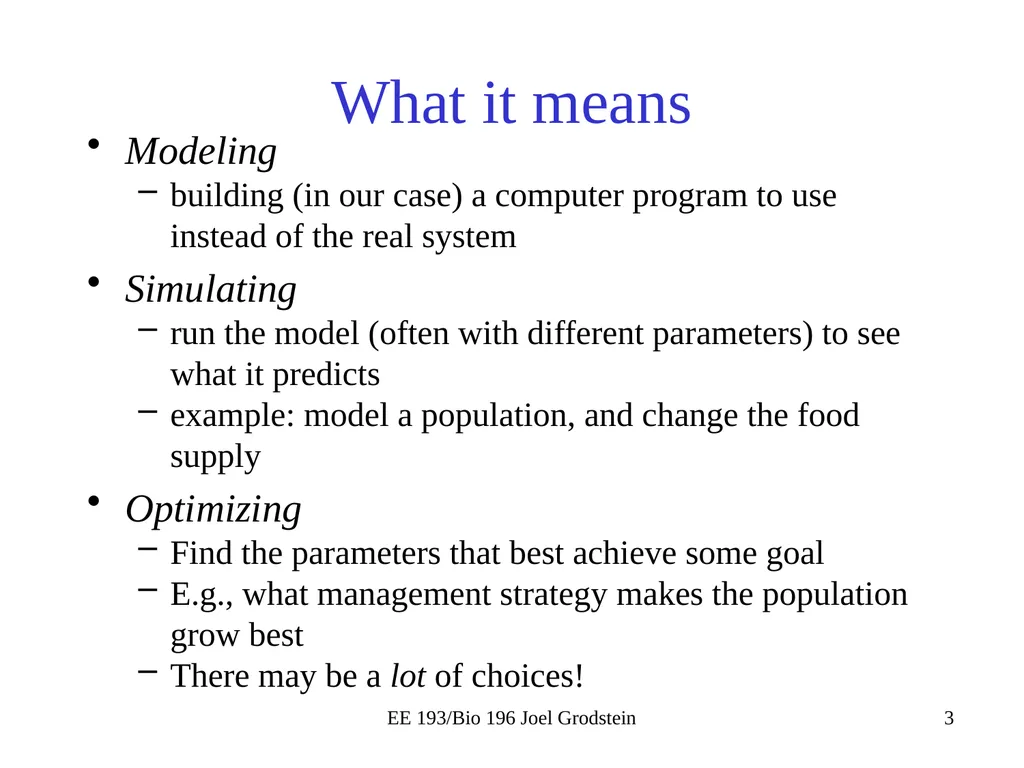
slide3. What it means Modeling
building (in our case) a computer program to use instead of the real system
Simulating
run the model (often with different parameters) to see what it predicts
example: model a population, and change the food supply
Optimizing
Find the parameters that best achieve some goal
E.g., what management strategy makes the population grow best
There may be a lot of choices! EE 193/Bio 196 Joel Grodstein<br>
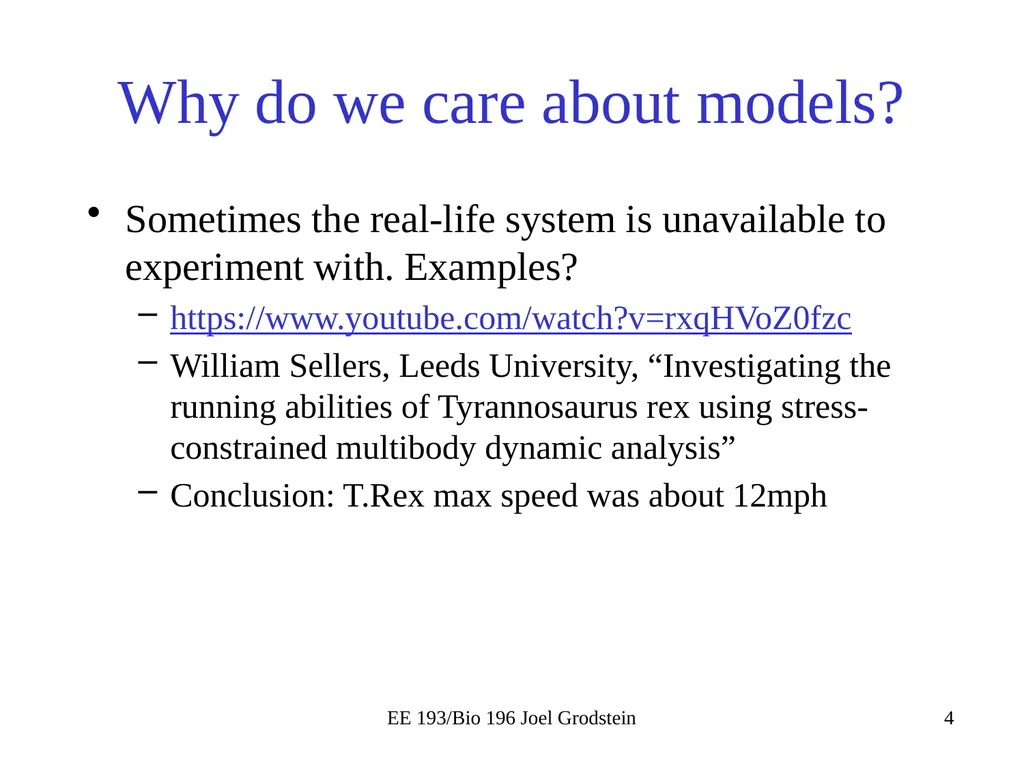
slide4. Why do we care about models? Sometimes the real-life system is unavailable to experiment with. Examples?
https://www.youtube.com/watch?v=rxqHVoZ0fzc
William Sellers, Leeds University, “Investigating the running abilities of Tyrannosaurus rex using stress-constrained multibody dynamic analysis”
Conclusion: T.Rex max speed was about 12mph EE 193/Bio 196 Joel Grodstein<br>
slide5. Instructor Instructor: Joel Grodstein
Office Hours:
Tuesday/Thursday noon-1:15 pm (i.e., somewhat before class)
Can stay after class if you ask me
Or email for an appointment (Tue/Thur mornings usually good)
Office: Halligan 121
My Background
30 years in the computer industry
ECE faculty as a second career
Also teach bioelectricity, modeling for synthetic biology<br>
slide6. Why would we want EE faculty to teach a biology course, anyway?
This is not only a biology course.
The world is becoming more and more interdisciplinary
Interesting problems are becoming hard enough that no one discipline can be an island any more
For the biologists:
The world is becoming more quantitative
Programming is a very useful job skill
For the engineers:
mix of biology and engineering has lots of potential to change the future EE 193/Bio 196 Joel Grodstein<br>
slide7. Why mix engineers & biologists? Original course offering: intended for biologists only
Surprise: as many engineers as biologists showed up!
The mix worked quite well
Making interdisciplinary teams work is really hard
But fun!
Everyone has to at least speak the same language
Bio PhDs will definitely know more about their area than I will
Please have fun correcting my biology mistakes
Learning to live (and thrive) in that environment is part of working on an interdisciplinary team EE 193/Bio 196 Joel Grodstein<br>
slide8. Course web page http://www.ece.tufts.edu/ee/193MSO/
Syllabus, calendar
Lecture foils, HWs EE 193/Bio 196 Joel Grodstein<br>
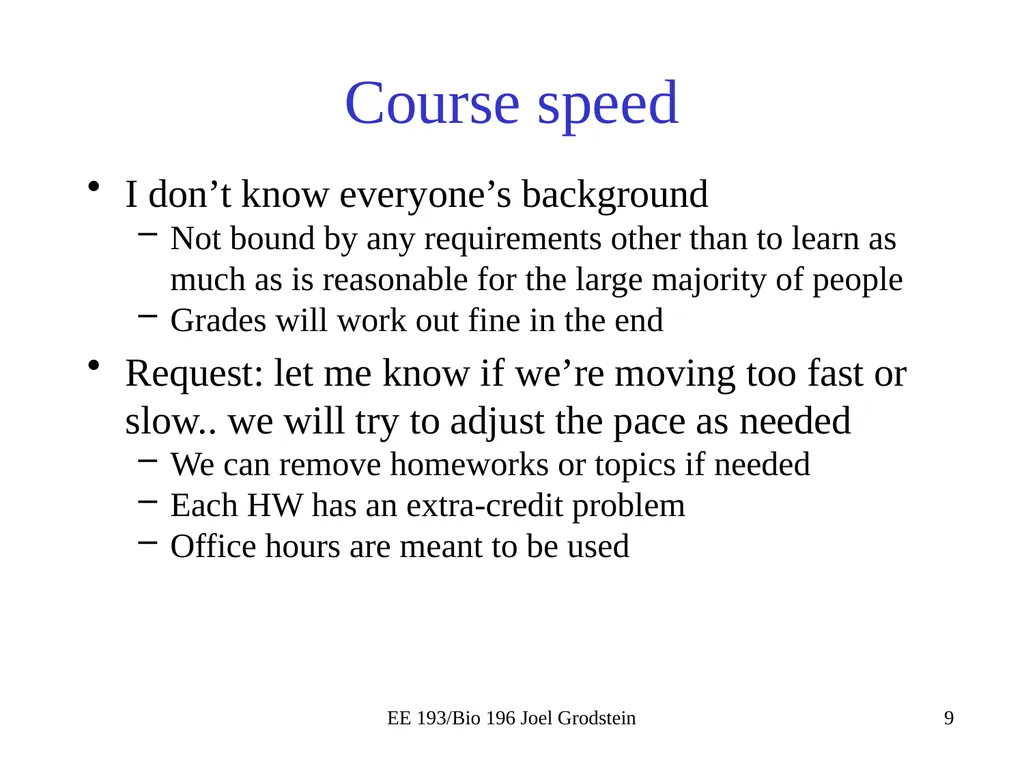
slide9. Course speed I don’t know everyone’s background
Not bound by any requirements other than to learn as much as is reasonable for the large majority of people
Grades will work out fine in the end
Request: let me know if we’re moving too fast or slow.. we will try to adjust the pace as needed
We can remove homeworks or topics if needed
Each HW has an extra-credit problem
Office hours are meant to be used EE 193/Bio 196 Joel Grodstein<br>
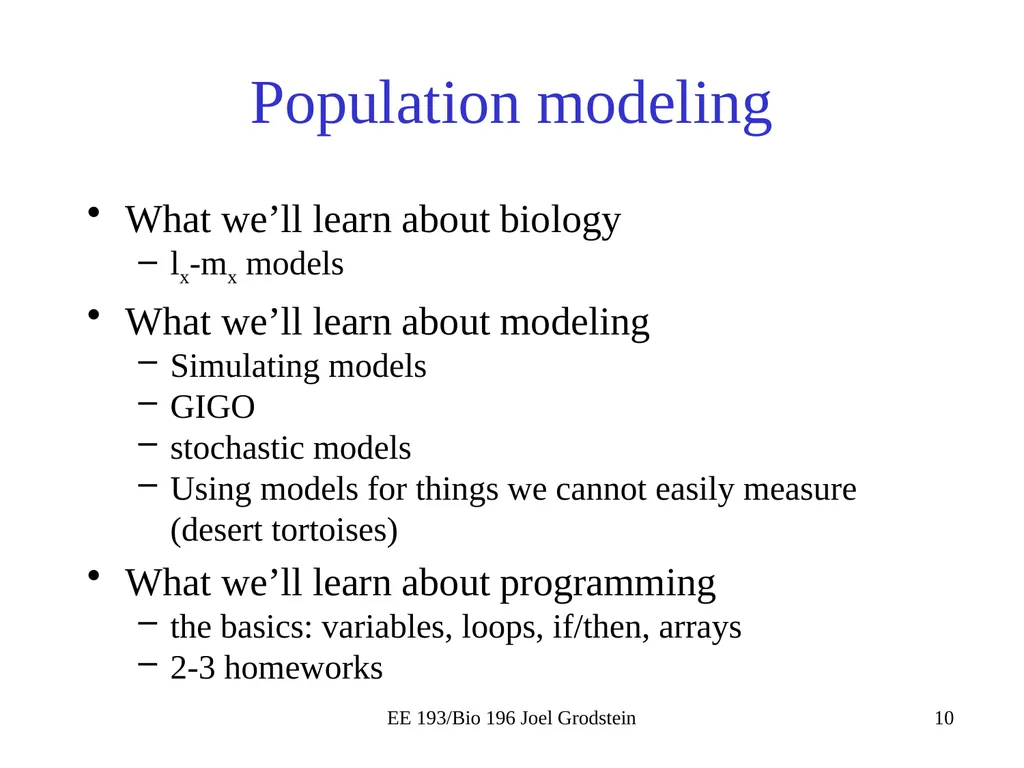
slide10. Population modeling What we’ll learn about biology
lx-mx models
What we’ll learn about modeling
Simulating models
GIGO
stochastic models
Using models for things we cannot easily measure (desert tortoises)
What we’ll learn about programming
the basics: variables, loops, if/then, arrays
2-3 homeworks EE 193/Bio 196 Joel Grodstein<br>
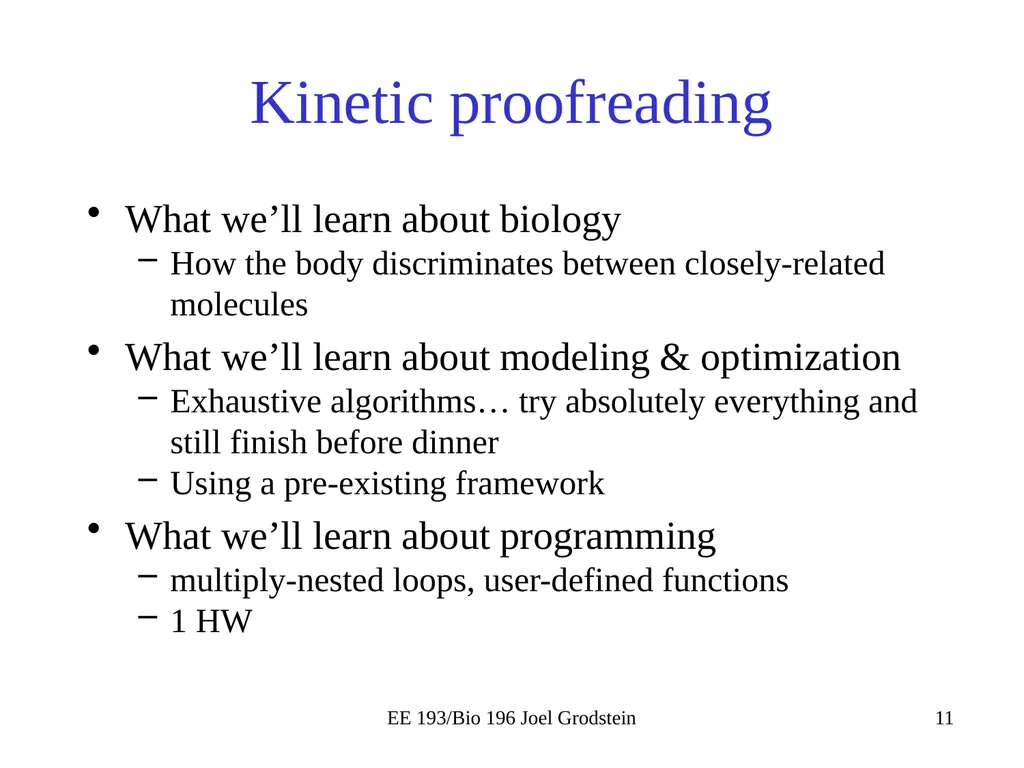
slide11. Kinetic proofreading What we’ll learn about biology
How the body discriminates between closely-related molecules
What we’ll learn about modeling & optimization
Exhaustive algorithms… try absolutely everything and still finish before dinner
Using a pre-existing framework
What we’ll learn about programming
multiply-nested loops, user-defined functions
1 HW EE 193/Bio 196 Joel Grodstein<br>
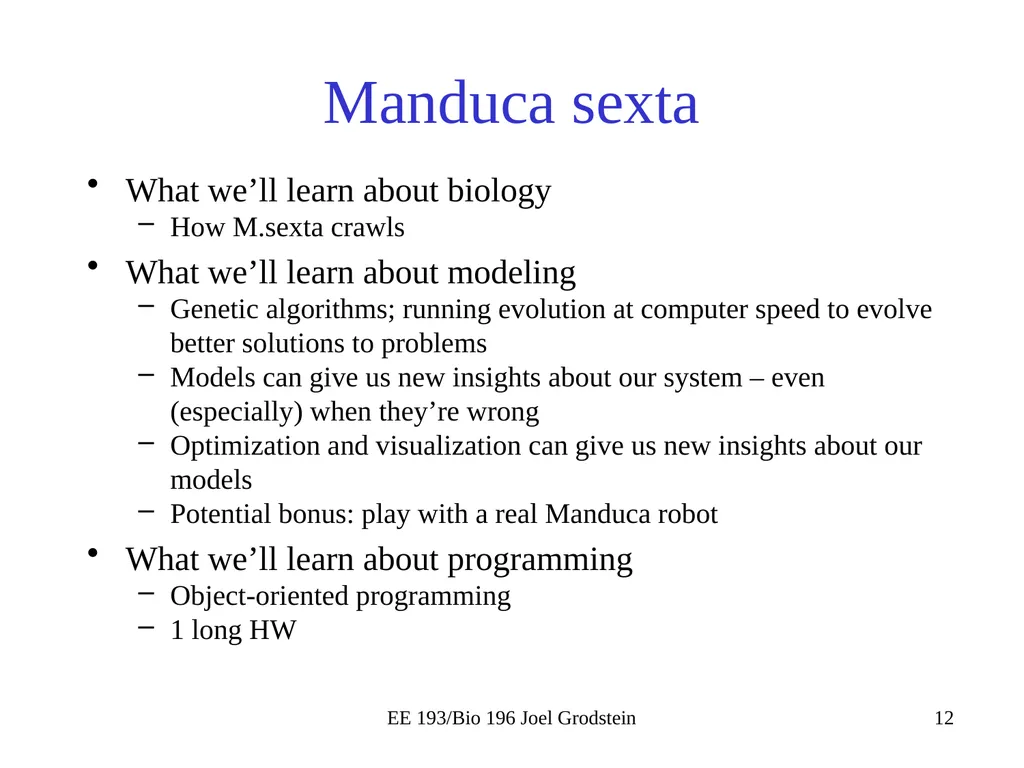
slide12. Manduca sexta What we’ll learn about biology
How M.sexta crawls
What we’ll learn about modeling
Genetic algorithms; running evolution at computer speed to evolve better solutions to problems
Models can give us new insights about our system – even (especially) when they’re wrong
Optimization and visualization can give us new insights about our models
Potential bonus: play with a real Manduca robot
What we’ll learn about programming
Object-oriented programming
1 long HW EE 193/Bio 196 Joel Grodstein<br>
slide13. Bacterial chemotaxis What we’ll learn about biology
How bacteria create goal-directed movement with simple chemical reactions
How bacteria use memory circuits to help them get to their goal
What we’ll learn about modeling
top-down vs. bottom-up modeling
What we’ll learn about programming
Practice, practice… and 1 HW EE 193/Bio 196 Joel Grodstein<br>
slide14. Bioelectricity What we’ll learn about biology
What is bioelectricity, and how is it part of morphogenesis
What we’ll learn about modeling
A framework to model bioelectricity
More on top-down vs. bottom-up modeling
What we’ll learn about programming
Still more practice, and 1 HW EE 193/Bio 196 Joel Grodstein<br>
slide15. Math Differential equations are part of modeling
We’re not going to make everyone into math majors
We’re not going to try
But differential equations are very common in models
We want to understand intuitively what a differential equation is, and what it means
We want you to not be scared when people talk about them
We’re not going to solve them ourselves EE 193/Bio 196 Joel Grodstein<br>
slide16. Python Why learn a computer language?
It’s becoming a more and more valuable job skill
A one-semester intro will not make you a CS major
But we will teach you to write small programs, read other people’s programs, and not be scared of them
Give you the tools to learn more, and the exposure to see if you like it
Why Python?
Easy to learn and still quite powerful
At or near the top in most language-popularity surveys
It has a nice interface to GIS (Geographic Information System).
Named after a British comedy series & movie EE 193/Bio 196 Joel Grodstein<br>
slide17. Recitation session Programming will be a challenge
Like any language, you learn by doing
Weekly recitation, in Halligan PC lab, for help with the programming HW
What times work best? EE 193/Bio 196 Joel Grodstein<br>
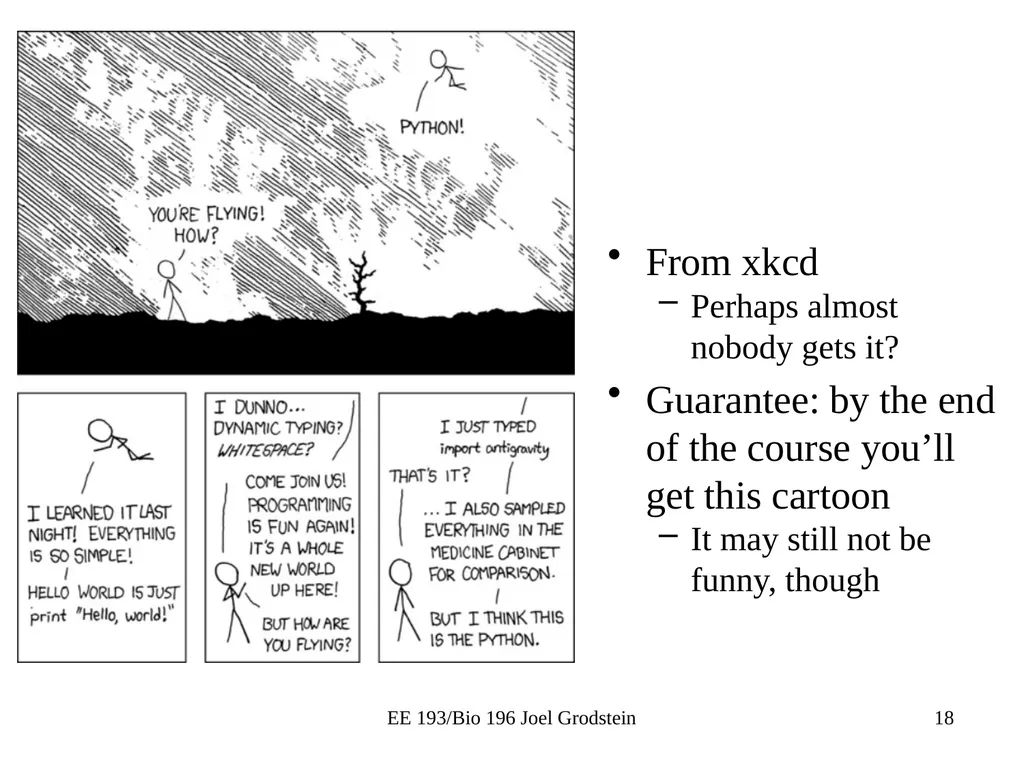
slide18. EE 193/Bio 196 Joel Grodstein From xkcd
Perhaps almost nobody gets it?
Guarantee: by the end of the course you’ll get this cartoon
It may still not be funny, though<br>
slide19. Learning to program Learning any new language takes time and effort
Not something you can cram for… just daily practice
“A physicist is looking for the truth. An engineer just wants to build something.”
Sten Graff Larsen
Programming and modeling make it easy to make stuff<br>
slide20. Expectations (will likely change) About 6 programming assignments (60%)
A few quizzes (30%)
Class participation (10%)
Perhaps a final project
Take a problem and take it further
Work in teams to get more done; will hopefully allocate the last 2 weeks of class
Present during final-exam slot EE 193/Bio 196 Joel Grodstein<br>
slide21. First modeling issue A road map is a model
It is a representation of, e.g., Boston
We don’t really use it for simulation or optimization, but we still do useful things with it
Question: what scale of map is most useful?
OK, Google maps lets you scale in and out dynamically
But what scale is most useful for a paper map?
Too detailed, and the map is unwieldy
Too abstract, and it’s almost useless EE 193/Bio 196 Joel Grodstein<br>
slide22. Too precise… What do you consider the largest map that would be really useful?”
“About six inches to the mile.”
“Only six inches!” exclaimed Mein Herr. “We very soon got to six yards to the mile. Then we tried a hundred yards to the mile. And then came the grandest idea of all! We actually made a map of the country, on the scale of a mile to the mile!”
“Have you used it much?” I enquired.
“It has never been spread out, yet,” said Mein Herr: “the farmers objected: they said it would cover the whole country, and shut out the sunlight! So we now use the country itself, as its own map, and I assure you it does nearly as well.
From Sylvie and Bruno (Lewis Carroll) EE 193/Bio 196 Joel Grodstein<br>
slide23. The other extreme The Bellman’s map, from The hunting of the snark (Lewis Carroll again)
https://people.duke.edu/~ng46/topics/lewis-carroll.htm
Takeaway:
"No model is correct. Some are still useful," George Box
“Art is a lie that helps us to see the truth,” Picasso
Choosing the most useful level of detail for a model is rarely easy
Making the model unwieldy or inaccurate is all too easy
Especially since we’re often modeling systems that we don’t really understand EE 193/Bio 196 Joel Grodstein<br>
slide24. Questions? EE 193/Bio 196 Joel Grodstein<br>
Tufts University
Instructor: Joel Grodstein
joel.grodstein@tufts.edu
Lecture 1: Introduction<br>
slide2. Big title: modeling, simulating and optimizing biological systems
It’s somewhat of a new class. So, what do you think the course is about? What do you want it to be about? EE 193/Bio 196 Joel Grodstein<br>
slide3. What it means Modeling
building (in our case) a computer program to use instead of the real system
Simulating
run the model (often with different parameters) to see what it predicts
example: model a population, and change the food supply
Optimizing
Find the parameters that best achieve some goal
E.g., what management strategy makes the population grow best
There may be a lot of choices! EE 193/Bio 196 Joel Grodstein<br>
slide4. Why do we care about models? Sometimes the real-life system is unavailable to experiment with. Examples?
https://www.youtube.com/watch?v=rxqHVoZ0fzc
William Sellers, Leeds University, “Investigating the running abilities of Tyrannosaurus rex using stress-constrained multibody dynamic analysis”
Conclusion: T.Rex max speed was about 12mph EE 193/Bio 196 Joel Grodstein<br>
slide5. Instructor Instructor: Joel Grodstein
Office Hours:
Tuesday/Thursday noon-1:15 pm (i.e., somewhat before class)
Can stay after class if you ask me
Or email for an appointment (Tue/Thur mornings usually good)
Office: Halligan 121
My Background
30 years in the computer industry
ECE faculty as a second career
Also teach bioelectricity, modeling for synthetic biology<br>
slide6. Why would we want EE faculty to teach a biology course, anyway?
This is not only a biology course.
The world is becoming more and more interdisciplinary
Interesting problems are becoming hard enough that no one discipline can be an island any more
For the biologists:
The world is becoming more quantitative
Programming is a very useful job skill
For the engineers:
mix of biology and engineering has lots of potential to change the future EE 193/Bio 196 Joel Grodstein<br>
slide7. Why mix engineers & biologists? Original course offering: intended for biologists only
Surprise: as many engineers as biologists showed up!
The mix worked quite well
Making interdisciplinary teams work is really hard
But fun!
Everyone has to at least speak the same language
Bio PhDs will definitely know more about their area than I will
Please have fun correcting my biology mistakes
Learning to live (and thrive) in that environment is part of working on an interdisciplinary team EE 193/Bio 196 Joel Grodstein<br>
slide8. Course web page http://www.ece.tufts.edu/ee/193MSO/
Syllabus, calendar
Lecture foils, HWs EE 193/Bio 196 Joel Grodstein<br>
slide9. Course speed I don’t know everyone’s background
Not bound by any requirements other than to learn as much as is reasonable for the large majority of people
Grades will work out fine in the end
Request: let me know if we’re moving too fast or slow.. we will try to adjust the pace as needed
We can remove homeworks or topics if needed
Each HW has an extra-credit problem
Office hours are meant to be used EE 193/Bio 196 Joel Grodstein<br>
slide10. Population modeling What we’ll learn about biology
lx-mx models
What we’ll learn about modeling
Simulating models
GIGO
stochastic models
Using models for things we cannot easily measure (desert tortoises)
What we’ll learn about programming
the basics: variables, loops, if/then, arrays
2-3 homeworks EE 193/Bio 196 Joel Grodstein<br>
slide11. Kinetic proofreading What we’ll learn about biology
How the body discriminates between closely-related molecules
What we’ll learn about modeling & optimization
Exhaustive algorithms… try absolutely everything and still finish before dinner
Using a pre-existing framework
What we’ll learn about programming
multiply-nested loops, user-defined functions
1 HW EE 193/Bio 196 Joel Grodstein<br>
slide12. Manduca sexta What we’ll learn about biology
How M.sexta crawls
What we’ll learn about modeling
Genetic algorithms; running evolution at computer speed to evolve better solutions to problems
Models can give us new insights about our system – even (especially) when they’re wrong
Optimization and visualization can give us new insights about our models
Potential bonus: play with a real Manduca robot
What we’ll learn about programming
Object-oriented programming
1 long HW EE 193/Bio 196 Joel Grodstein<br>
slide13. Bacterial chemotaxis What we’ll learn about biology
How bacteria create goal-directed movement with simple chemical reactions
How bacteria use memory circuits to help them get to their goal
What we’ll learn about modeling
top-down vs. bottom-up modeling
What we’ll learn about programming
Practice, practice… and 1 HW EE 193/Bio 196 Joel Grodstein<br>
slide14. Bioelectricity What we’ll learn about biology
What is bioelectricity, and how is it part of morphogenesis
What we’ll learn about modeling
A framework to model bioelectricity
More on top-down vs. bottom-up modeling
What we’ll learn about programming
Still more practice, and 1 HW EE 193/Bio 196 Joel Grodstein<br>
slide15. Math Differential equations are part of modeling
We’re not going to make everyone into math majors
We’re not going to try
But differential equations are very common in models
We want to understand intuitively what a differential equation is, and what it means
We want you to not be scared when people talk about them
We’re not going to solve them ourselves EE 193/Bio 196 Joel Grodstein<br>
slide16. Python Why learn a computer language?
It’s becoming a more and more valuable job skill
A one-semester intro will not make you a CS major
But we will teach you to write small programs, read other people’s programs, and not be scared of them
Give you the tools to learn more, and the exposure to see if you like it
Why Python?
Easy to learn and still quite powerful
At or near the top in most language-popularity surveys
It has a nice interface to GIS (Geographic Information System).
Named after a British comedy series & movie EE 193/Bio 196 Joel Grodstein<br>
slide17. Recitation session Programming will be a challenge
Like any language, you learn by doing
Weekly recitation, in Halligan PC lab, for help with the programming HW
What times work best? EE 193/Bio 196 Joel Grodstein<br>
slide18. EE 193/Bio 196 Joel Grodstein From xkcd
Perhaps almost nobody gets it?
Guarantee: by the end of the course you’ll get this cartoon
It may still not be funny, though<br>
slide19. Learning to program Learning any new language takes time and effort
Not something you can cram for… just daily practice
“A physicist is looking for the truth. An engineer just wants to build something.”
Sten Graff Larsen
Programming and modeling make it easy to make stuff<br>
slide20. Expectations (will likely change) About 6 programming assignments (60%)
A few quizzes (30%)
Class participation (10%)
Perhaps a final project
Take a problem and take it further
Work in teams to get more done; will hopefully allocate the last 2 weeks of class
Present during final-exam slot EE 193/Bio 196 Joel Grodstein<br>
slide21. First modeling issue A road map is a model
It is a representation of, e.g., Boston
We don’t really use it for simulation or optimization, but we still do useful things with it
Question: what scale of map is most useful?
OK, Google maps lets you scale in and out dynamically
But what scale is most useful for a paper map?
Too detailed, and the map is unwieldy
Too abstract, and it’s almost useless EE 193/Bio 196 Joel Grodstein<br>
slide22. Too precise… What do you consider the largest map that would be really useful?”
“About six inches to the mile.”
“Only six inches!” exclaimed Mein Herr. “We very soon got to six yards to the mile. Then we tried a hundred yards to the mile. And then came the grandest idea of all! We actually made a map of the country, on the scale of a mile to the mile!”
“Have you used it much?” I enquired.
“It has never been spread out, yet,” said Mein Herr: “the farmers objected: they said it would cover the whole country, and shut out the sunlight! So we now use the country itself, as its own map, and I assure you it does nearly as well.
From Sylvie and Bruno (Lewis Carroll) EE 193/Bio 196 Joel Grodstein<br>
slide23. The other extreme The Bellman’s map, from The hunting of the snark (Lewis Carroll again)
https://people.duke.edu/~ng46/topics/lewis-carroll.htm
Takeaway:
"No model is correct. Some are still useful," George Box
“Art is a lie that helps us to see the truth,” Picasso
Choosing the most useful level of detail for a model is rarely easy
Making the model unwieldy or inaccurate is all too easy
Especially since we’re often modeling systems that we don’t really understand EE 193/Bio 196 Joel Grodstein<br>
slide24. Questions? EE 193/Bio 196 Joel Grodstein<br>