Effort Certification What you Need to Know What is Effort? Effort is the time a PI spends on an activity, expressed as a percentage of what the PI spends on their UMASS Dartmouth job duties. These activities are divided into: Sponsored
"Effort Certification What you Need to Know What is" is the property of its rightful owner. Permission is granted to
download and print the materials on this website for personal, non-commercial use only, and to display it
on your personal computer provided you do not modify the materials and that you retain all copyright
notices contained in the materials. By downloading content from our website, you accept the terms of this
agreement.
Presentation Transcript
01
Effort Certification What you Need to Know<br>
02
What is Effort? Effort is the time a PI spends on an activity, expressed as a percentage of what the PI spends on their UMASS Dartmouth job duties.
These activities are divided into:
Sponsored project activities
Federal grants or contracts (e.g. NIH, NSF, DOD)
Non-federal research projects (e.g. state, local or private)
Non-sponsored activities, such as:
Administration, including duties as chair, dean, etc.
Teaching
Research without external funding
Public service and outreach
Serving on University committees
Attending general departmental faculty meetings 2 Source: ORA Website<br>
03
Examples of Effort Determination If the PI works a part-time job, their 100% effort corresponds to everything they do for that job. So, the part-time effort = 100% UMASSD Effort
If the PI works full-time, their 100% effort corresponds to all the activities for which the UMASSD compensates them during that time. 3 Source: ORA Website<br>
04
Activities NOT Included in a PI’s 100% UMASS Effort Outside consulting
Continuing Education Courses
Serving on a NIH study or a NSF peer review panel
Peer review of manuscripts
Leadership in professional societies
Volunteer community or public service not directly related to UMD effort
Unpaid absences
Other duties as listed on the ORA website. 4 Source: ORA Website<br>
05
What is a Sponsored Project ? 5 A Sponsored Project is activity that is funded by a grant, contract or cooperative agreement which includes:
a scope of work
a specific budget
specified terms and conditions
Sponsored Projects requires detailed financial accountability and compliance with the sponsor’s terms and conditions. Source: ORA Website<br>
06
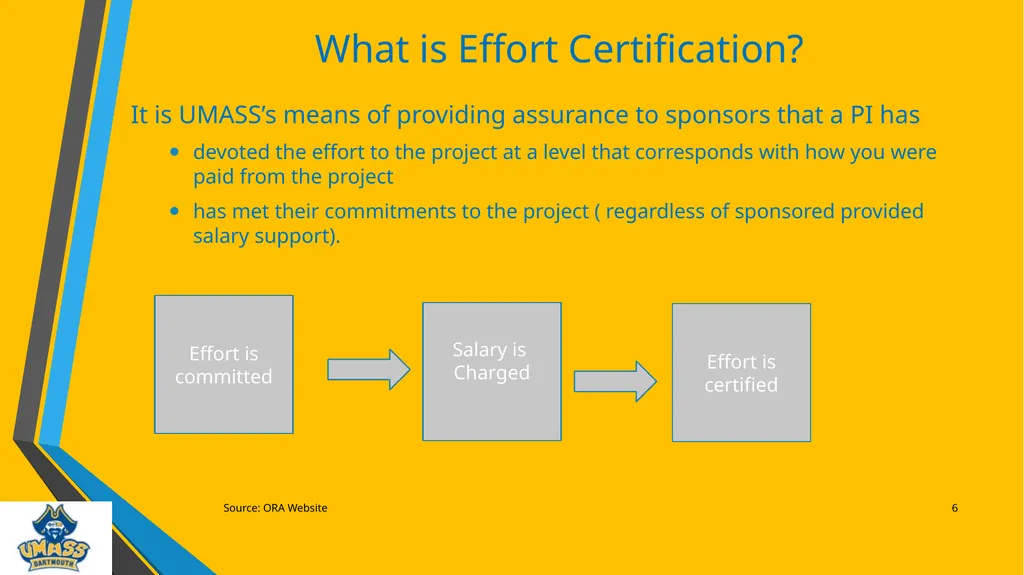
What is Effort Certification? It is UMASS’s means of providing assurance to sponsors that a PI has
devoted the effort to the project at a level that corresponds with how you were paid from the project
has met their commitments to the project ( regardless of sponsored provided salary support). Effort is
committed Salary is
Charged Effort is certified 6 Source: ORA Website<br>
07
Who Must Certify? Effort must be certified by a responsible person with suitable means of verifying that the work was performed. This is a federal requirement. It is never acceptable to circumvent this rule.
Each principal investigator certifies the effort for the professional staff, graduate students, postdoctoral researchers, and classified staff who work on his or her research projects.
Sometimes the PI doesn't have a suitable means of verifying the effort for all the people who work on a project - and someone else, like a lab manager, does. In such cases, the PI and the effort coordinator can work together to establish a designee's authorization to certify for project staff members.
Sometimes a staff person works on multiple projects for two or more PIs. In such cases, each PI certifies the staff persons effort related to the PIs particular project(s). 7 Source: ORA Website<br>
08
Keep in Mind Effort certification should be a reasonable estimate of how time was expended.
The Uniform Guidance Subpart E §200.430(c) states, “It is recognized that teaching, research, service and administration are often inextricably intermingled in an academic setting. When recording salaries and wages charged to Federal awards for IHEs (Institutions of Higher Education) a precise assessment of factors that contribute to costs is therefore not always feasible, nor is it expected.” 8 Source: ORA Website<br>
09
Why do we Have Effort Certification? Effort reporting is a requirement of the Federal Government.
Severe penalties and funding disallowances could result from inaccurate (False Claims), incomplete, or untimely effort reporting. 9 Source: ORA Website<br>
10
How & when do I Certify my Effort? The University of Massachusetts system certifies effort using Effort Certification and Reporting Technology (ECRT) system. For instructions on using ECRT, refer to the PowerPoint Effort Certification HOW TO on the ORA website.
UMASSD certifies effort annually.
Certifiers will receive a system generated email when it is time to certify. 10 Source: ORA Website<br>
11
What do I do the Rest of the Year? Keep track of your effort.
Review your monthly reports and the bimonthly ECRT payroll report for any errors or omissions.
Work with your Grant Manager to resolve any discrepancies as soon as detected.
Since we are only certifying once a year we want to be PROACTIVE..not REACTIVE
If you have any questions, contact Catherine Palmer at X8965 or cpalmer1@umassd.edu. 11 Source: ORA Website<br>