
Effort Reporting Agenda Effort What is effort What
CS
Published · 23 slides · 0 views

1 / 1



Description
Effort Reporting Agenda Effort What is effort What is effort reporting Why we report effort Who is responsible for reporting? What is Effort Effort is defined as the total amount of time that an individual spends on any activity for which
Related Topics
Share
Embed code
Download this presentation From Below
"Effort Reporting Agenda Effort What is effort What" is the property of its rightful owner. Permission is granted to download and print the materials on this website for personal, non-commercial use only, and to display it on your personal computer provided you do not modify the materials and that you retain all copyright notices contained in the materials. By downloading content from our website, you accept the terms of this agreement.
Presentation Transcript
01
Effort Reporting<br>
02
Agenda Effort
What is effort
What is effort reporting
Why we report effort
Who is responsible for reporting?<br>
What is effort
What is effort reporting
Why we report effort
Who is responsible for reporting?<br>
03
What is Effort Effort is defined as the total amount of time that an individual spends on any activity for which they are compensated by the University. Effort is often expressed as a percentage of an employee’s total time spent on University activities. Terms you might hear when talking about effort:
Person Months – a unit of measurement used to express the amount of time that the PI or other senior personnel dedicates to a specific project.
Workload – The % of time assigned to faculty encompassing teaching, service, research and sometimes administrative duties.
Salary percentage – This is the portion of an individual's total work effort that is dedicated to activities funded by a particular grant.
Institutional Base Salary – The annual compensation an employee receives from a university for their work, including activities like research, teaching, service and administration.<br>
04
What is Effort Reporting? Effort Reporting is how we certify the amount of effort that has been attributed to sponsored projects from those faculty, staff and students that are contributing to the work on the sponsored project.
UNT often refers to this process as effort certification.
According to the UNT policy 13.015 on effort certification – “Certification of effort” is a confirmation of the work that has been performed. Each activity is attributed a reasonable percentage of the effort during the reporting period in relation to 100% of total effort for all activities for which an individual is paid by UNT during a specific period.
The charge to each award must be appropriate in relation to the work performed.<br>
05
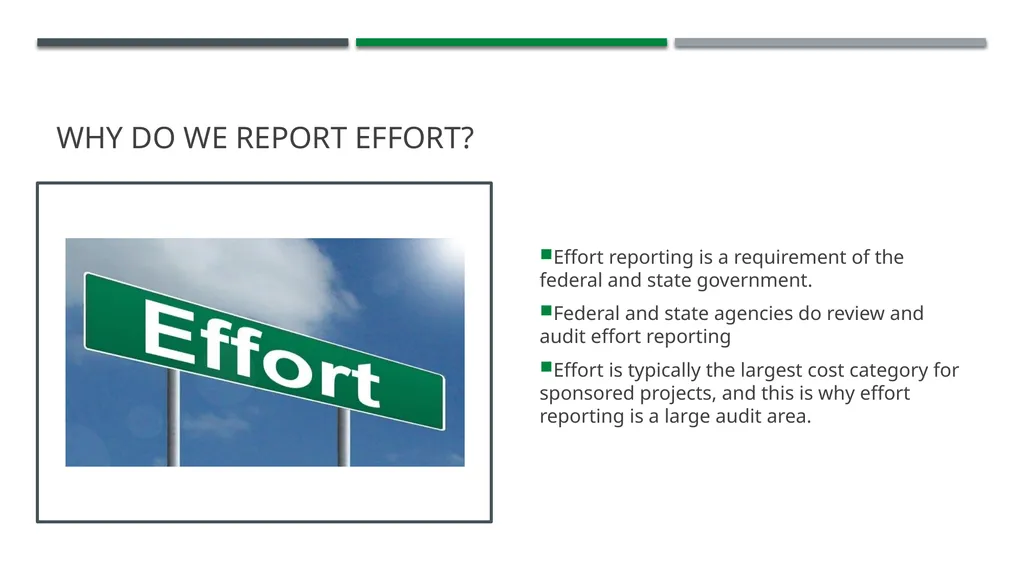
Why Do we report effort? Effort reporting is a requirement of the federal and state government.
Federal and state agencies do review and audit effort reporting
Effort is typically the largest cost category for sponsored projects, and this is why effort reporting is a large audit area.<br>
Federal and state agencies do review and audit effort reporting
Effort is typically the largest cost category for sponsored projects, and this is why effort reporting is a large audit area.<br>
06
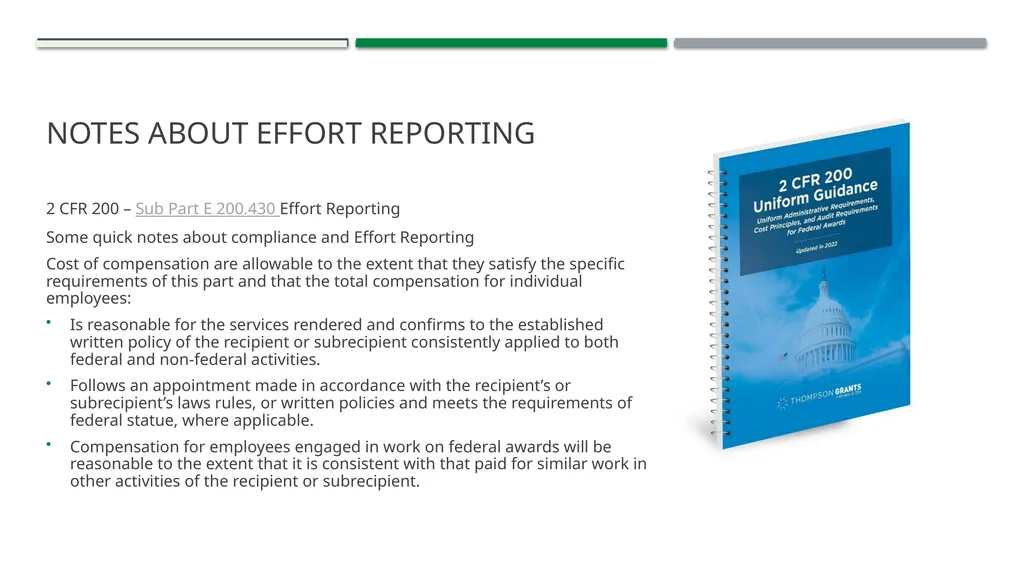
Notes about Effort Reporting 2 CFR 200 – Sub Part E 200.430 Effort Reporting
Some quick notes about compliance and Effort Reporting
Cost of compensation are allowable to the extent that they satisfy the specific requirements of this part and that the total compensation for individual employees:
Is reasonable for the services rendered and confirms to the established written policy of the recipient or subrecipient consistently applied to both federal and non-federal activities.
Follows an appointment made in accordance with the recipient’s or subrecipient’s laws rules, or written policies and meets the requirements of federal statue, where applicable.
Compensation for employees engaged in work on federal awards will be reasonable to the extent that it is consistent with that paid for similar work in other activities of the recipient or subrecipient.<br>
07
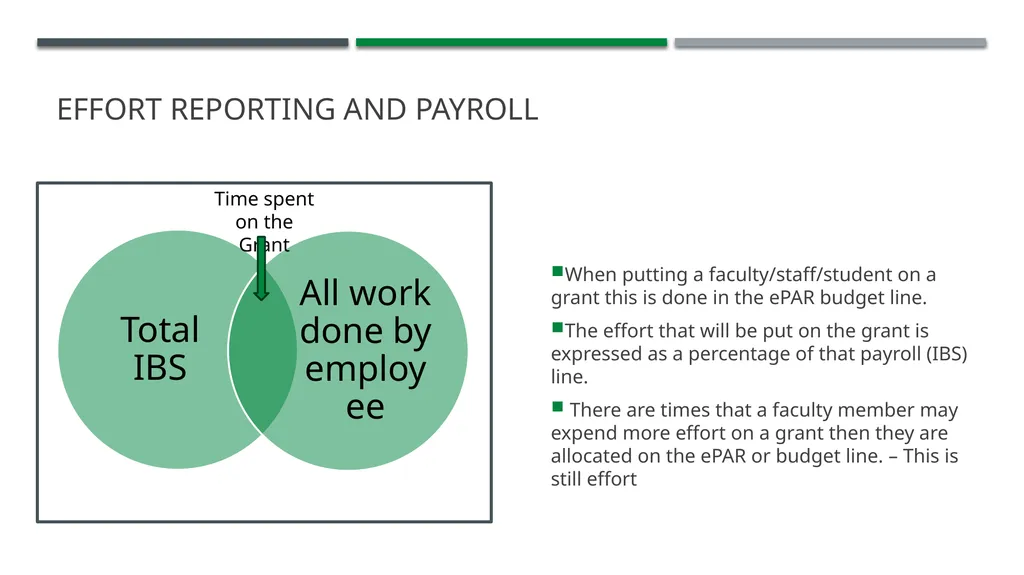
Effort Reporting and Payroll When putting a faculty/staff/student on a grant this is done in the ePAR budget line.
The effort that will be put on the grant is expressed as a percentage of that payroll (IBS) line.
There are times that a faculty member may expend more effort on a grant then they are allocated on the ePAR or budget line. – This is still effort Time spent on the Grant<br>
The effort that will be put on the grant is expressed as a percentage of that payroll (IBS) line.
There are times that a faculty member may expend more effort on a grant then they are allocated on the ePAR or budget line. – This is still effort Time spent on the Grant<br>
08
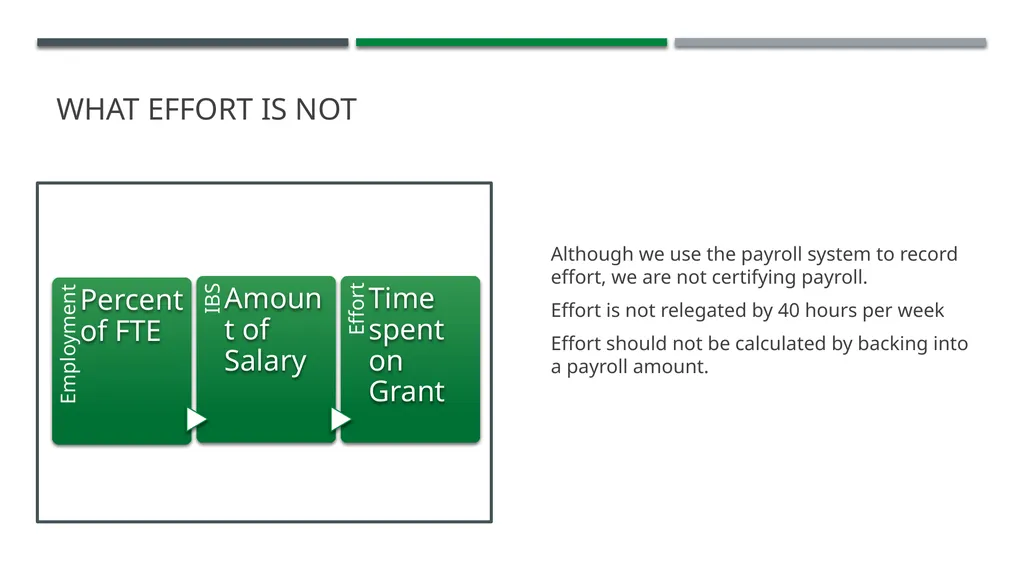
What Effort is not Although we use the payroll system to record effort, we are not certifying payroll.
Effort is not relegated by 40 hours per week
Effort should not be calculated by backing into a payroll amount.<br>
Effort is not relegated by 40 hours per week
Effort should not be calculated by backing into a payroll amount.<br>
09
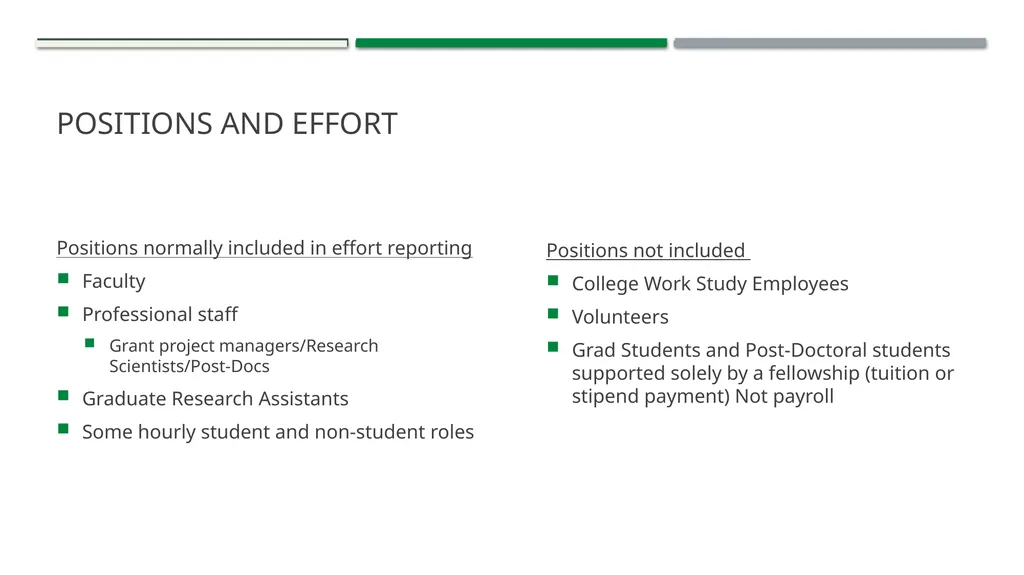
Positions and Effort Positions normally included in effort reporting
Faculty
Professional staff
Grant project managers/Research Scientists/Post-Docs
Graduate Research Assistants
Some hourly student and non-student roles Positions not included
College Work Study Employees
Volunteers
Grad Students and Post-Doctoral students supported solely by a fellowship (tuition or stipend payment) Not payroll<br>
10
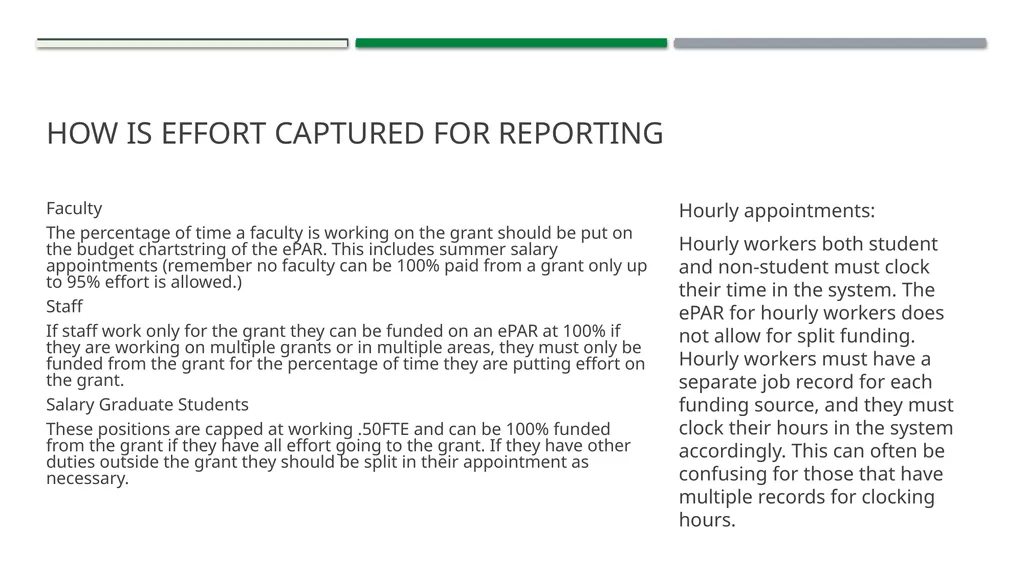
How is Effort captured for Reporting Faculty
The percentage of time a faculty is working on the grant should be put on the budget chartstring of the ePAR. This includes summer salary appointments (remember no faculty can be 100% paid from a grant only up to 95% effort is allowed.)
Staff
If staff work only for the grant they can be funded on an ePAR at 100% if they are working on multiple grants or in multiple areas, they must only be funded from the grant for the percentage of time they are putting effort on the grant.
Salary Graduate Students
These positions are capped at working .50FTE and can be 100% funded from the grant if they have all effort going to the grant. If they have other duties outside the grant they should be split in their appointment as necessary. Hourly appointments:
Hourly workers both student and non-student must clock their time in the system. The ePAR for hourly workers does not allow for split funding. Hourly workers must have a separate job record for each funding source, and they must clock their hours in the system accordingly. This can often be confusing for those that have multiple records for clocking hours.<br>
11
What is excluded from Effort Task payments – the job code for this is excluded from effort reports.
Specific short-term assignments (not routine and are compensated separately) Think contractor work.
Volunteer hours
Any voluntary uncommitted cost sharing Effort<br>
Specific short-term assignments (not routine and are compensated separately) Think contractor work.
Volunteer hours
Any voluntary uncommitted cost sharing Effort<br>
12
Other Thoughts about Effort The only information that will show up on the effort reporting system is that information that is input in the ePAR system. ePAR’s must be correct and come to full approval and if done after as a correction they must run through the reallocation process to show up in the system.
When doing ePARS that affect effort an approved manual CT form should be attached.
Effort reports should be carefully reviewed prior to being certified because changing an effort report after certification is an audit issue as the PI has certified that this was correct in the system.<br>
When doing ePARS that affect effort an approved manual CT form should be attached.
Effort reports should be carefully reviewed prior to being certified because changing an effort report after certification is an audit issue as the PI has certified that this was correct in the system.<br>
13
The effort Certification System UNT uses ECC as our effort reporting system.
It is linked to EIS and pulls directly from our payroll system to find the percentage of effort that has been allocated from all employee types to the sponsored projects they are linked to.
The grant number in the chartstring is how the system links the effort in EIS to the ECC system. Reporting timeline for ECC
Roles in the system
ECC system
Trouble shooting<br>
14
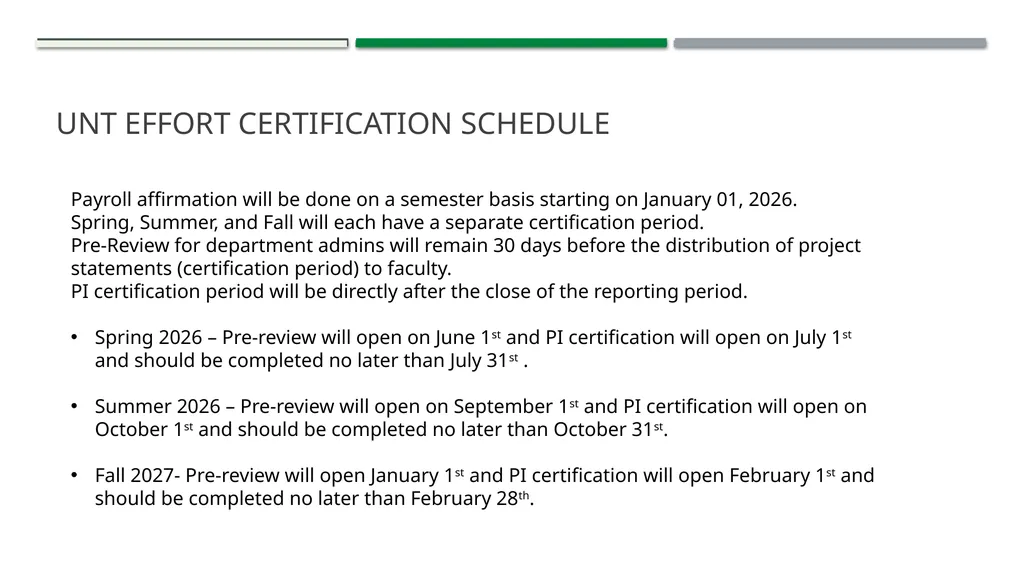
UNT Effort certification Schedule Payroll affirmation will be done on a semester basis starting on January 01, 2026.
Spring, Summer, and Fall will each have a separate certification period.
Pre-Review for department admins will remain 30 days before the distribution of project statements (certification period) to faculty.
PI certification period will be directly after the close of the reporting period.
Spring 2026 – Pre-review will open on June 1st and PI certification will open on July 1st and should be completed no later than July 31st .
Summer 2026 – Pre-review will open on September 1st and PI certification will open on October 1st and should be completed no later than October 31st.
Fall 2027- Pre-review will open January 1st and PI certification will open February 1st and should be completed no later than February 28th.<br>
15
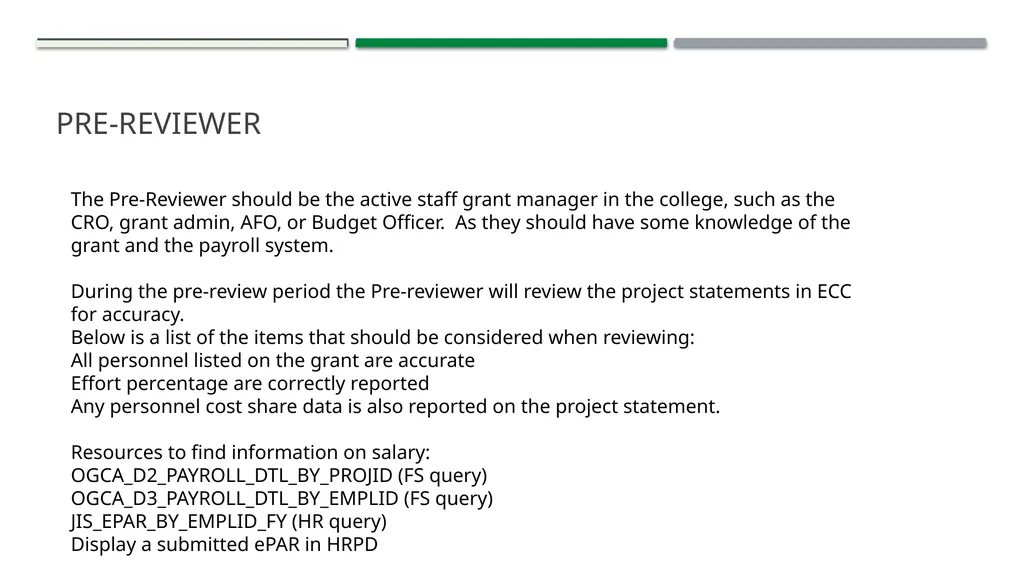
Pre-Reviewer The Pre-Reviewer should be the active staff grant manager in the college, such as the CRO, grant admin, AFO, or Budget Officer. As they should have some knowledge of the grant and the payroll system.
During the pre-review period the Pre-reviewer will review the project statements in ECC for accuracy.
Below is a list of the items that should be considered when reviewing:
All personnel listed on the grant are accurate
Effort percentage are correctly reported
Any personnel cost share data is also reported on the project statement.
Resources to find information on salary:
OGCA_D2_PAYROLL_DTL_BY_PROJID (FS query)
OGCA_D3_PAYROLL_DTL_BY_EMPLID (FS query)
JIS_EPAR_BY_EMPLID_FY (HR query)
Display a submitted ePAR in HRPD<br>
16
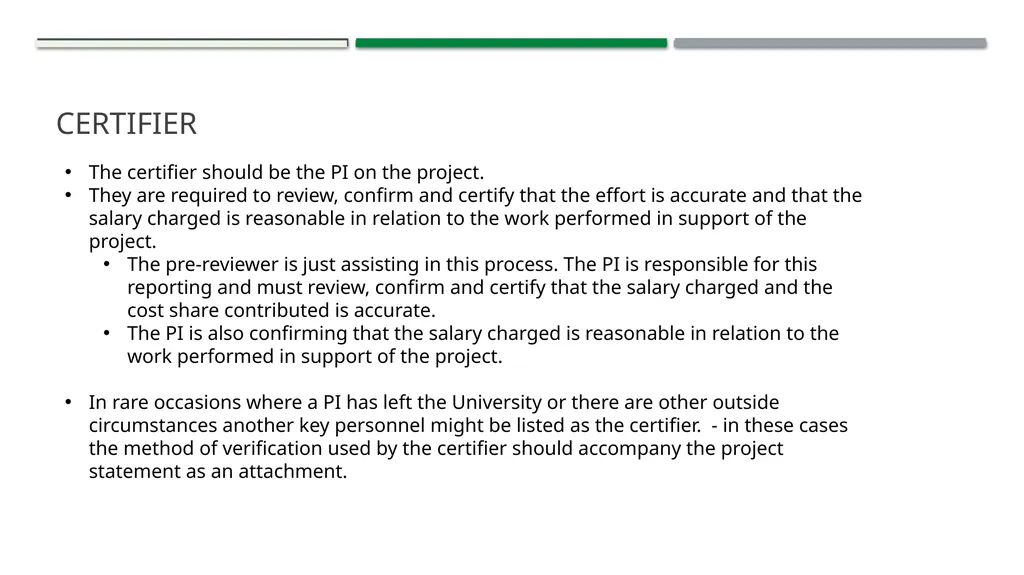
Certifier The certifier should be the PI on the project.
They are required to review, confirm and certify that the effort is accurate and that the salary charged is reasonable in relation to the work performed in support of the project.
The pre-reviewer is just assisting in this process. The PI is responsible for this reporting and must review, confirm and certify that the salary charged and the cost share contributed is accurate.
The PI is also confirming that the salary charged is reasonable in relation to the work performed in support of the project.
In rare occasions where a PI has left the University or there are other outside circumstances another key personnel might be listed as the certifier. - in these cases the method of verification used by the certifier should accompany the project statement as an attachment.<br>
17
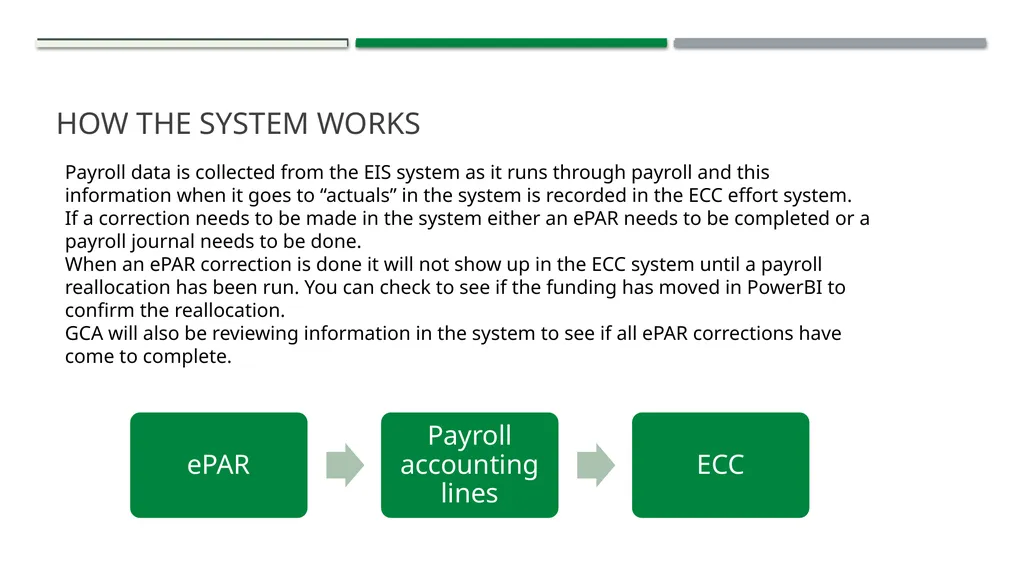
How the system Works Payroll data is collected from the EIS system as it runs through payroll and this information when it goes to “actuals” in the system is recorded in the ECC effort system.
If a correction needs to be made in the system either an ePAR needs to be completed or a payroll journal needs to be done.
When an ePAR correction is done it will not show up in the ECC system until a payroll reallocation has been run. You can check to see if the funding has moved in PowerBI to confirm the reallocation.
GCA will also be reviewing information in the system to see if all ePAR corrections have come to complete.<br>
18
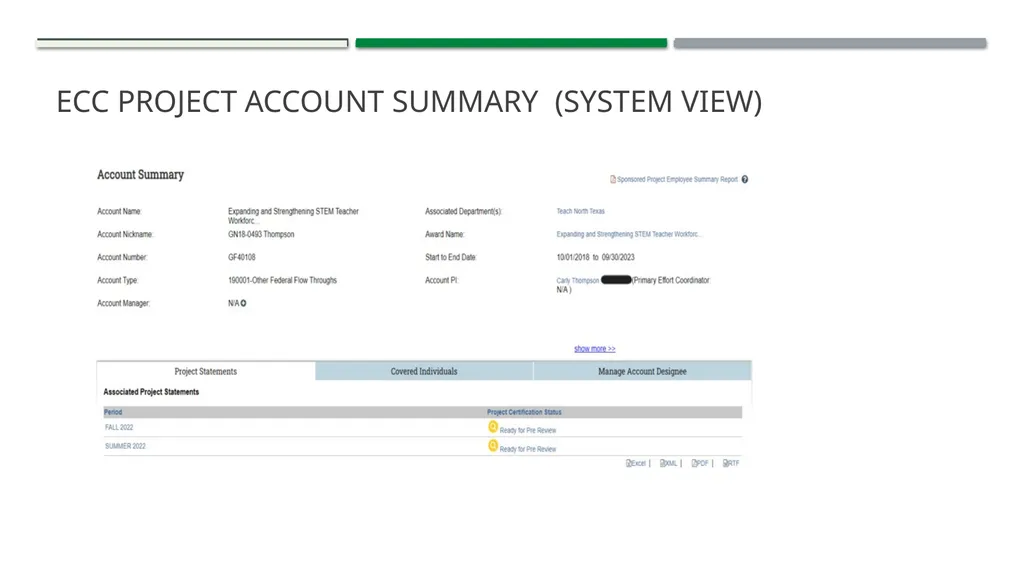
ECC project account summary (system View)<br>
19
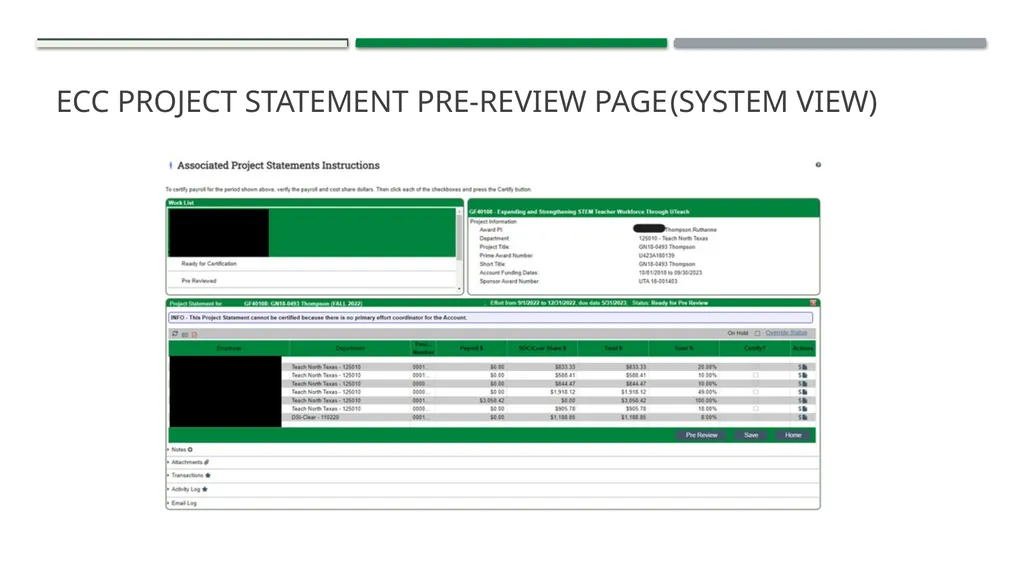
ECC project Statement Pre-Review page (system View)<br>
20
Important Considerations Use the correct percentage on the ePAR for direct charges or cost shared payroll to ensure that the person’s effort and salary charges appear in ECC correctly.
Some Faculty have additional pay lines that should be included in their Institutional base salary (IBS) if that is the case, please contact OGCA to assist with the calculation.
Project statement recertification is not required if the amounts charged are substantially correct, defined as +/- 5 percentage points.
If a project statement was certified in error and the percentage of effort differs significantly form the employee’s actual effort, a project statement can be re-opened by GCA then recertified by the PI.
All project statements must be done through the ECC system. No manual project statements should be recorded.<br>
21
Pre-Reviewers should meet with the Pi’s at the beginning of the effort reporting period to determine who will be working on the sponsored project and how much time a person should show along with salary amount for all individuals.
Pre-Reviewers should also be aware if there is cost-share on the sponsored project and how much should be reflected on the project statement.
Pre-Reviewers should communicate with PI’s before the end date of the reporting period to ensure any changes needed for payroll are processed via ePAR to ensure accurate payroll data on projects.
Due to fiscal year closing for summer payroll corrections and this coinciding with summer effort reporting, quick work is required to make corrections for this reporting period. ECC BEST PRACTICES<br>
22
Policy Updates and Audit Info New Minimum effort required:
PI and Key personnel are required to commit at least 1% effort annually to sponsored projects. (Unless the award does not allow for salary) – This is still in review.
Maximum Effort is the same with no more than 95% effort on projects for PI or faculty.
Please avoid using multi decimal points in ePARs for effort. – It is difficult to quantify effort for audit with multiple decimal places. * This may be different for those with adjusted IBS.
Latest Audit findings:
100% effort on grants for PI’s or Faculty
No efforts on grants
Corrected effort certifications on grants.<br>
23
Thank you GCA Post-Award Team
940-565-3940
GCAPostAward@unt.edu
Post award resources<br>
940-565-3940
GCAPostAward@unt.edu
Post award resources<br>