electronic Long-Term Services & Supports (eLTSS)
Description: electronic Long-Term Services Supports (eLTSS) Initiative CT TEFT October 13th, 2016 Agenda Introduction: Pilot Team Introduction: Organization Who we are? We are CT TEFT, focusing on empowering consumers through the use of Health IT. We
Related Topics
Download Presentation
"electronic Long-Term Services & Supports (eLTSS)" is the property of its rightful owner. Permission is granted to download and print the materials on this website for personal, non-commercial use only, and to display it on your personal computer provided you do not modify the materials and that you retain all copyright notices contained in the materials. By downloading content from our website, you accept the terms of this agreement.
Presentation Transcript
slide1. electronic Long-Term Services & Supports (eLTSS) Initiative CT TEFT
October 13th, 2016<br>
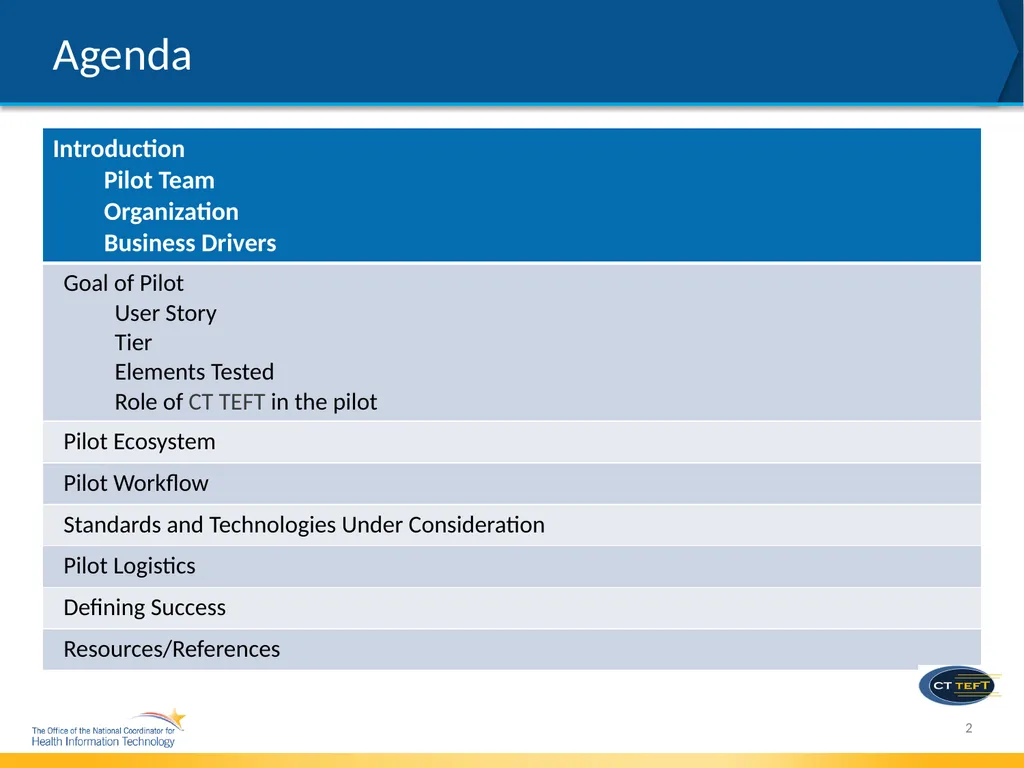
slide2. Agenda<br>
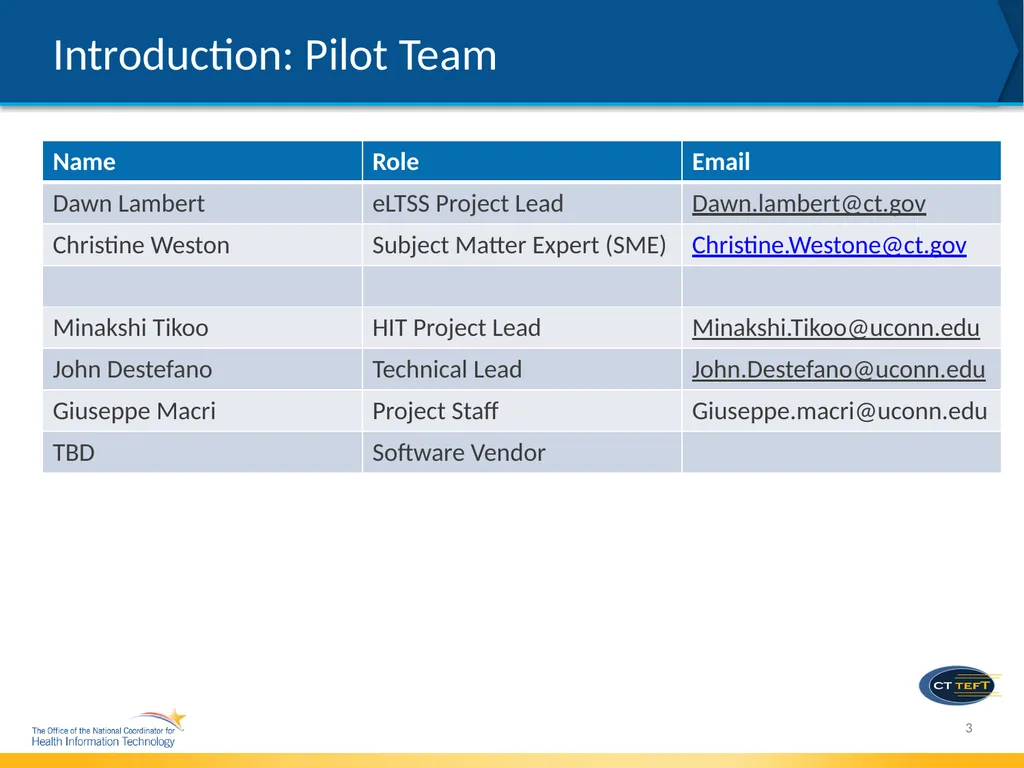
slide3. Introduction: Pilot Team<br>
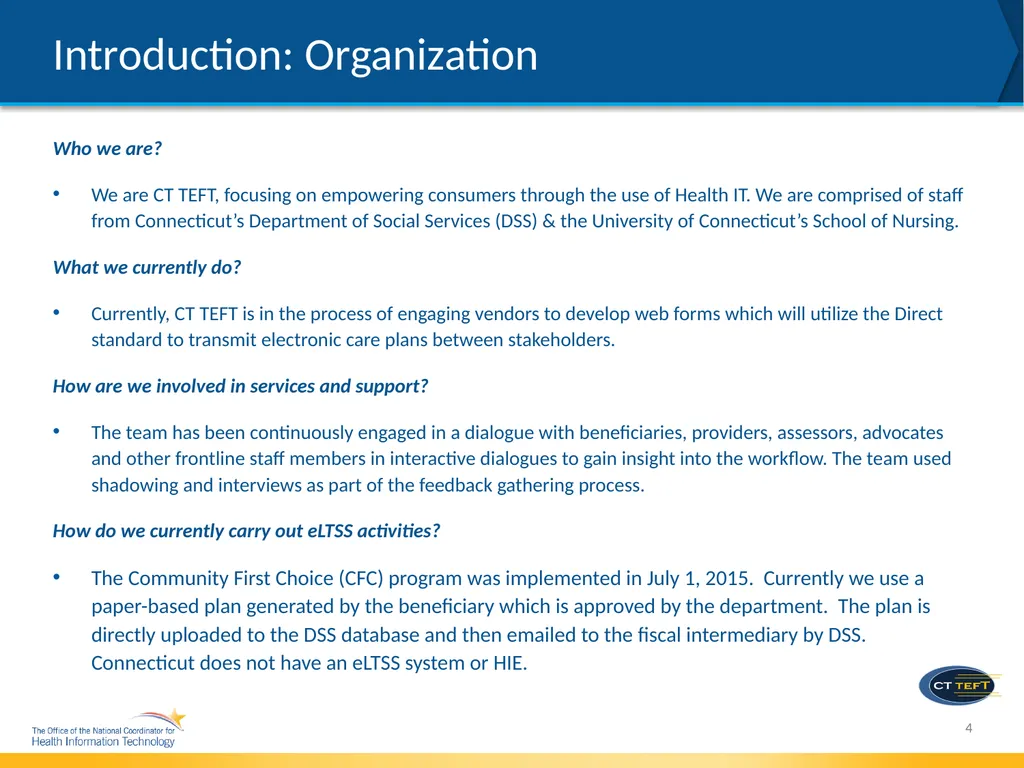
slide4. Introduction: Organization Who we are?
We are CT TEFT, focusing on empowering consumers through the use of Health IT. We are comprised of staff from Connecticut’s Department of Social Services (DSS) & the University of Connecticut’s School of Nursing.
What we currently do?
Currently, CT TEFT is in the process of engaging vendors to develop web forms which will utilize the Direct standard to transmit electronic care plans between stakeholders.
How are we involved in services and support?
The team has been continuously engaged in a dialogue with beneficiaries, providers, assessors, advocates and other frontline staff members in interactive dialogues to gain insight into the workflow. The team used shadowing and interviews as part of the feedback gathering process.
How do we currently carry out eLTSS activities?
The Community First Choice (CFC) program was implemented in July 1, 2015. Currently we use a paper-based plan generated by the beneficiary which is approved by the department. The plan is directly uploaded to the DSS database and then emailed to the fiscal intermediary by DSS. Connecticut does not have an eLTSS system or HIE.<br>
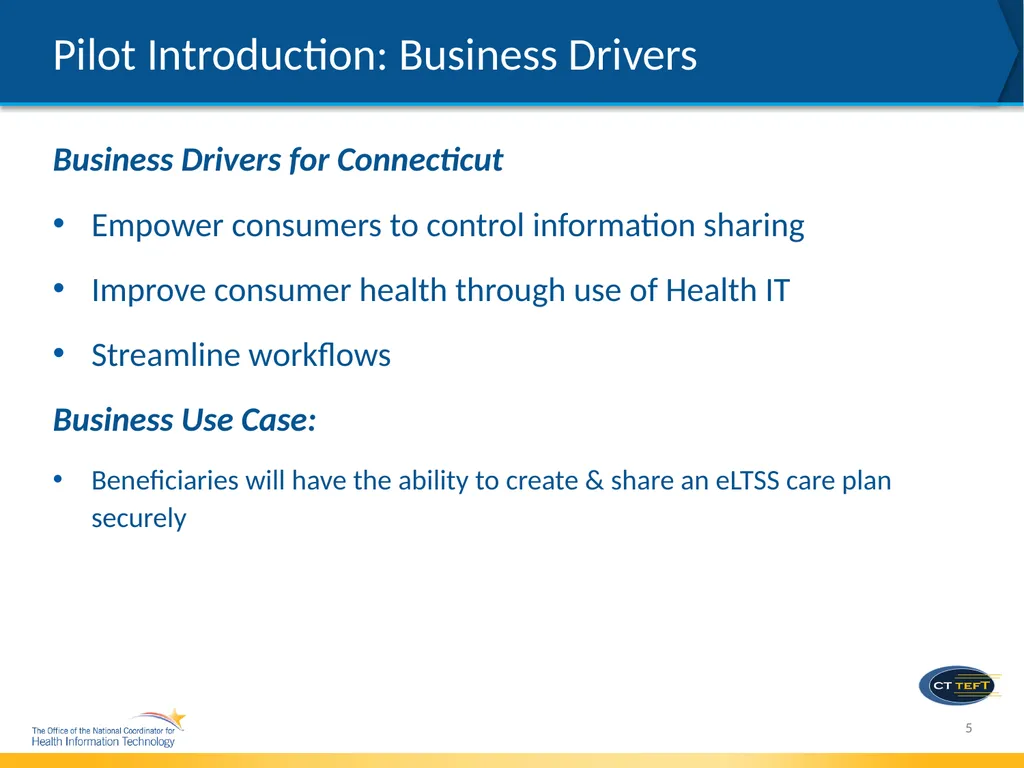
slide5. Pilot Introduction: Business Drivers Business Drivers for Connecticut
Empower consumers to control information sharing
Improve consumer health through use of Health IT
Streamline workflows
Business Use Case:
Beneficiaries will have the ability to create & share an eLTSS care plan securely<br>
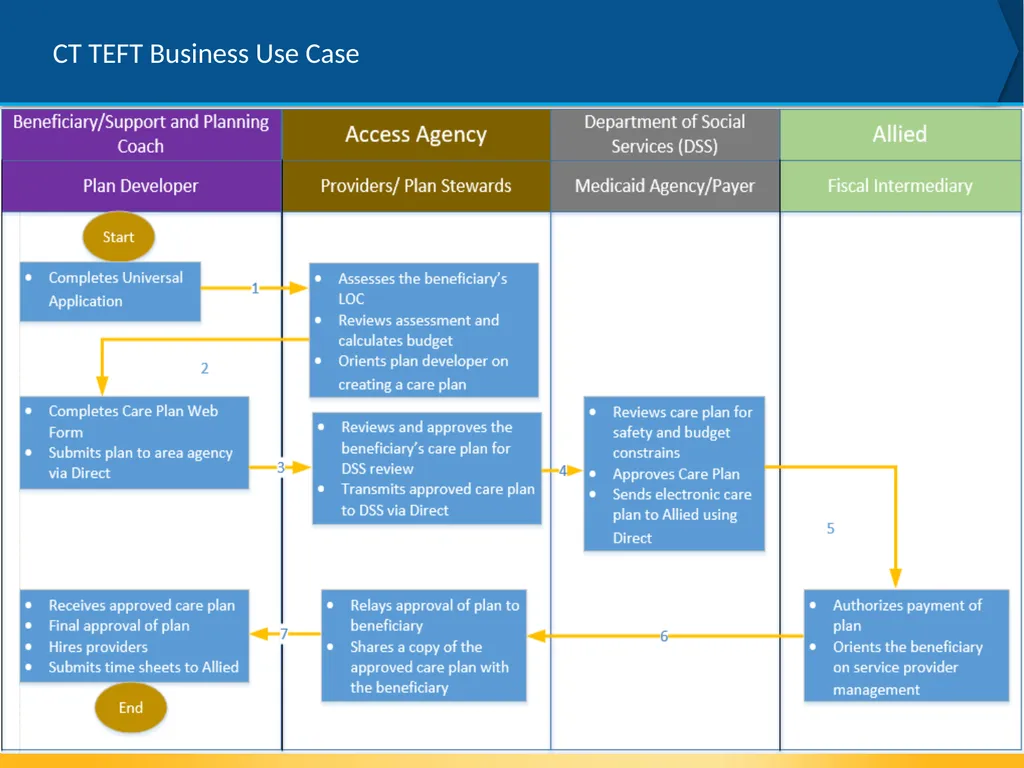
slide6. CT TEFT Business Use Case<br>
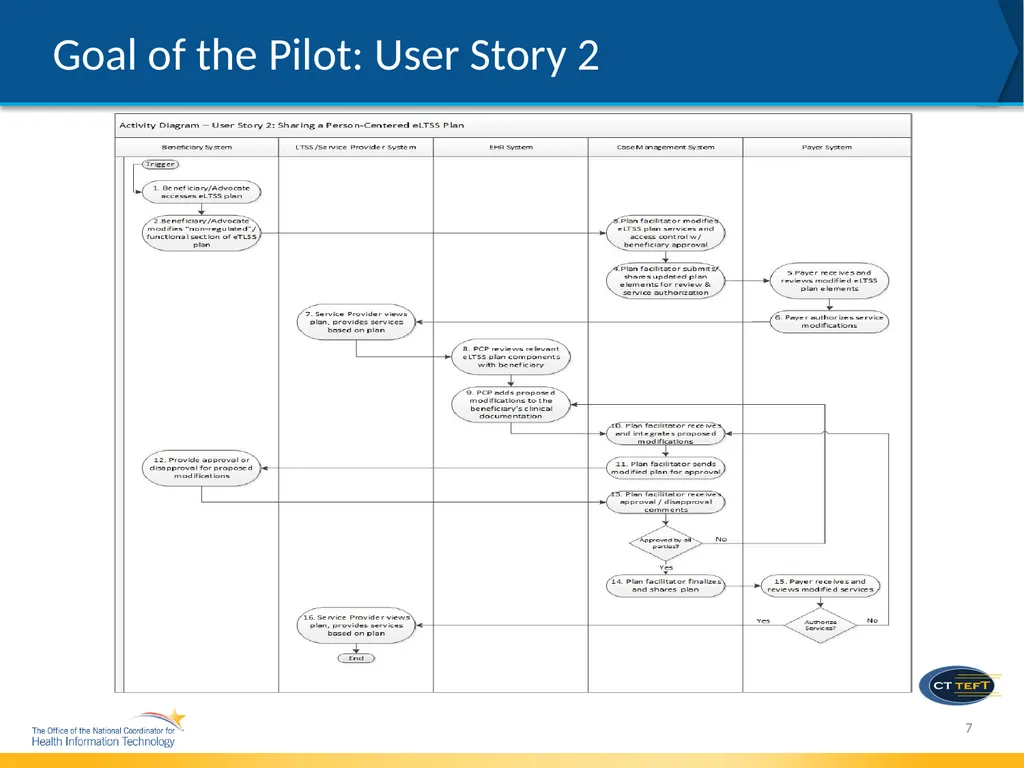
slide7. Goal of the Pilot: User Story 2<br>
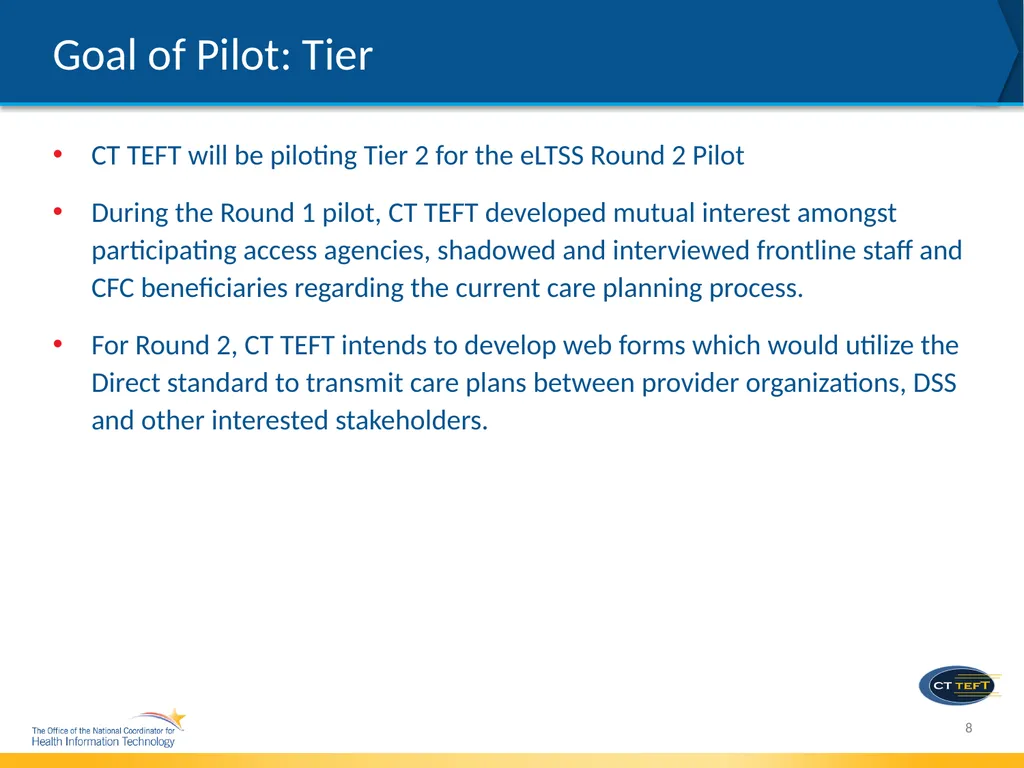
slide8. Goal of Pilot: Tier CT TEFT will be piloting Tier 2 for the eLTSS Round 2 Pilot
During the Round 1 pilot, CT TEFT developed mutual interest amongst participating access agencies, shadowed and interviewed frontline staff and CFC beneficiaries regarding the current care planning process.
For Round 2, CT TEFT intends to develop web forms which would utilize the Direct standard to transmit care plans between provider organizations, DSS and other interested stakeholders.<br>
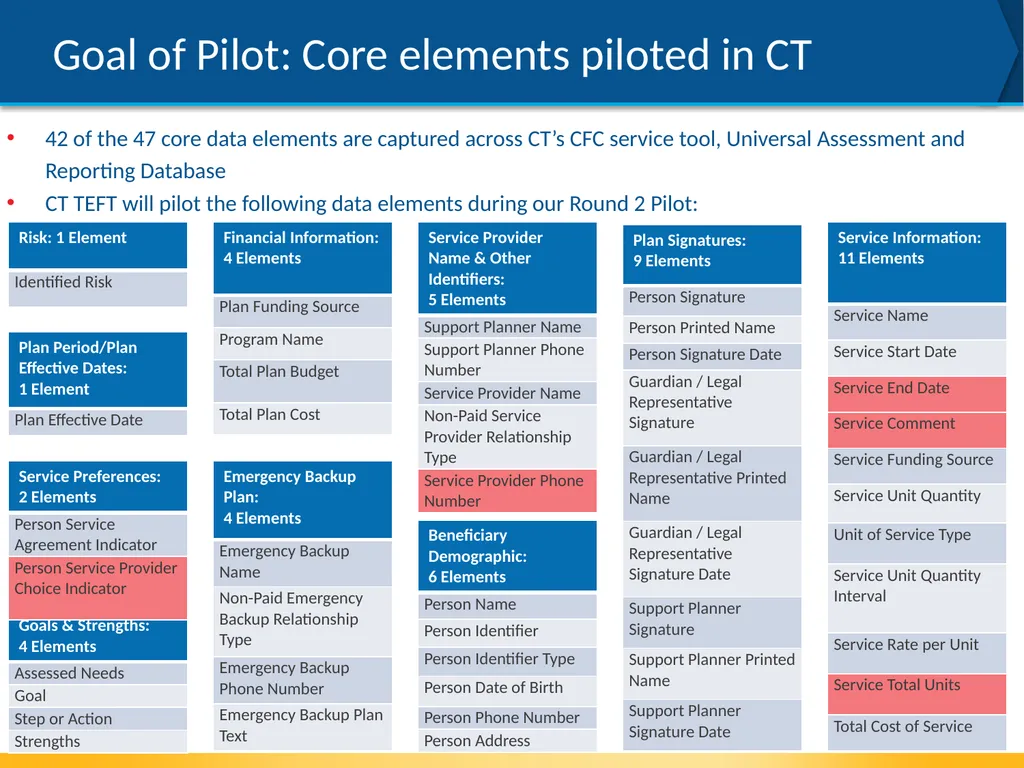
slide9. Goal of Pilot: Core elements piloted in CT 42 of the 47 core data elements are captured across CT’s CFC service tool, Universal Assessment and Reporting Database
CT TEFT will pilot the following data elements during our Round 2 Pilot:<br>
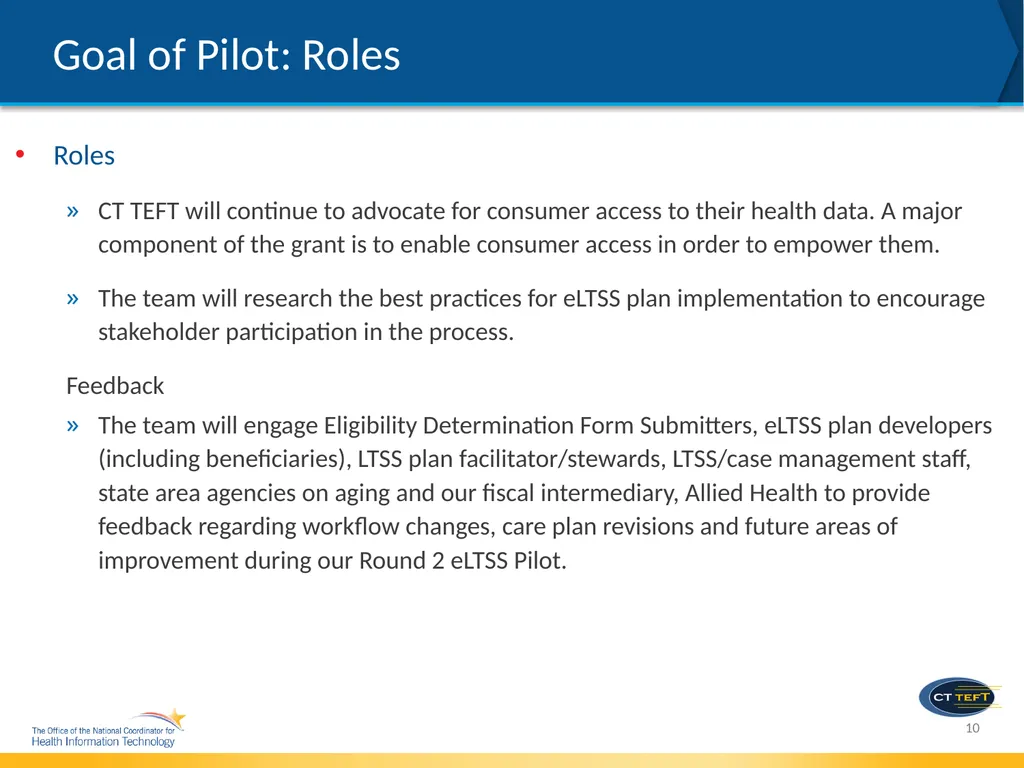
slide10. Goal of Pilot: Roles Roles
CT TEFT will continue to advocate for consumer access to their health data. A major component of the grant is to enable consumer access in order to empower them.
The team will research the best practices for eLTSS plan implementation to encourage stakeholder participation in the process.
Feedback
The team will engage Eligibility Determination Form Submitters, eLTSS plan developers (including beneficiaries), LTSS plan facilitator/stewards, LTSS/case management staff, state area agencies on aging and our fiscal intermediary, Allied Health to provide feedback regarding workflow changes, care plan revisions and future areas of improvement during our Round 2 eLTSS Pilot.<br>
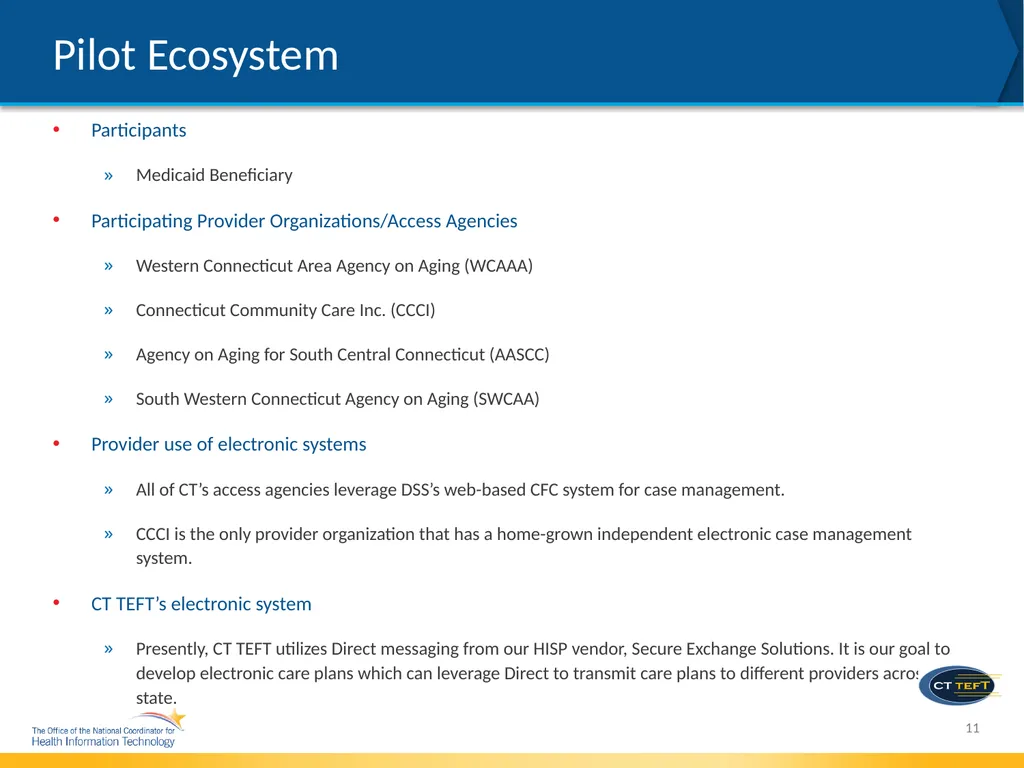
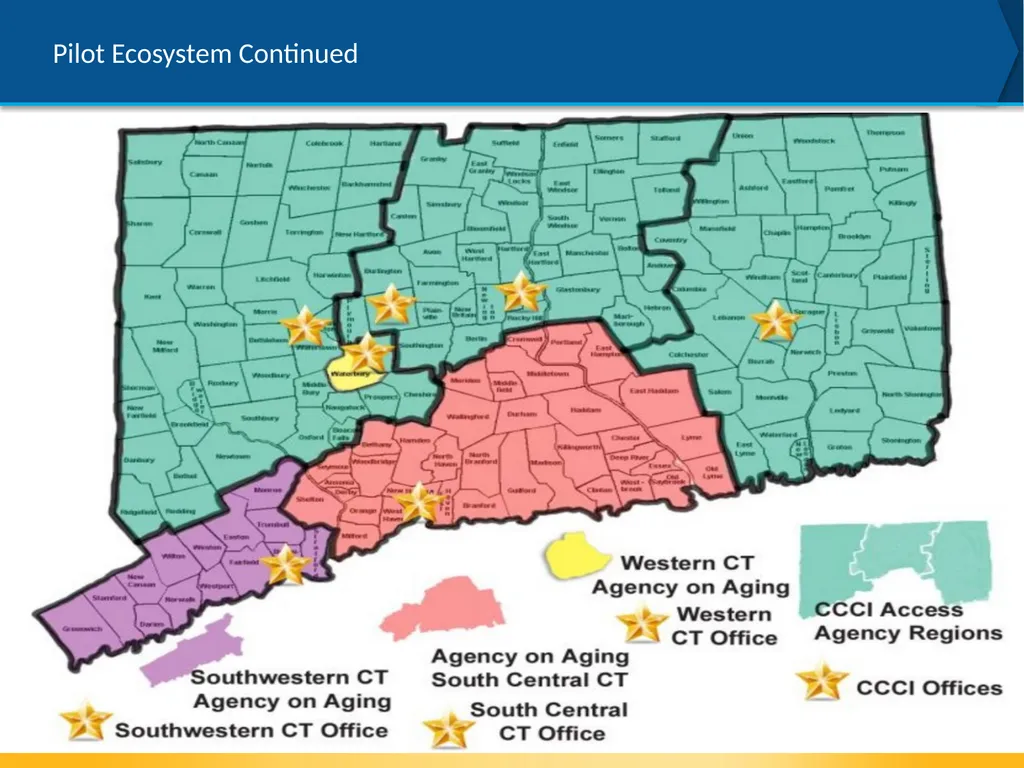
slide11. Pilot Ecosystem Participants
Medicaid Beneficiary
Participating Provider Organizations/Access Agencies
Western Connecticut Area Agency on Aging (WCAAA)
Connecticut Community Care Inc. (CCCI)
Agency on Aging for South Central Connecticut (AASCC)
South Western Connecticut Agency on Aging (SWCAA)
Provider use of electronic systems
All of CT’s access agencies leverage DSS’s web-based CFC system for case management.
CCCI is the only provider organization that has a home-grown independent electronic case management system.
CT TEFT’s electronic system
Presently, CT TEFT utilizes Direct messaging from our HISP vendor, Secure Exchange Solutions. It is our goal to develop electronic care plans which can leverage Direct to transmit care plans to different providers across the state.<br>
slide12. Pilot Ecosystem Continued<br>
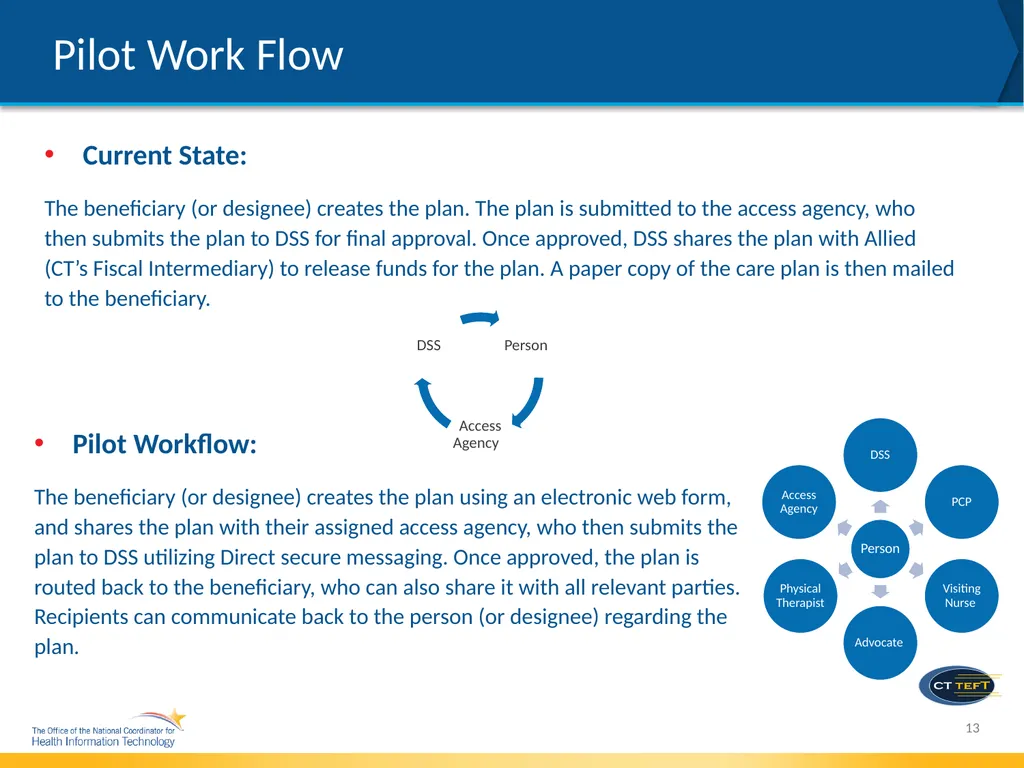
slide13. Pilot Work Flow Current State:
The beneficiary (or designee) creates the plan. The plan is submitted to the access agency, who then submits the plan to DSS for final approval. Once approved, DSS shares the plan with Allied (CT’s Fiscal Intermediary) to release funds for the plan. A paper copy of the care plan is then mailed to the beneficiary. Pilot Workflow:
The beneficiary (or designee) creates the plan using an electronic web form, and shares the plan with their assigned access agency, who then submits the plan to DSS utilizing Direct secure messaging. Once approved, the plan is routed back to the beneficiary, who can also share it with all relevant parties. Recipients can communicate back to the person (or designee) regarding the plan.<br>
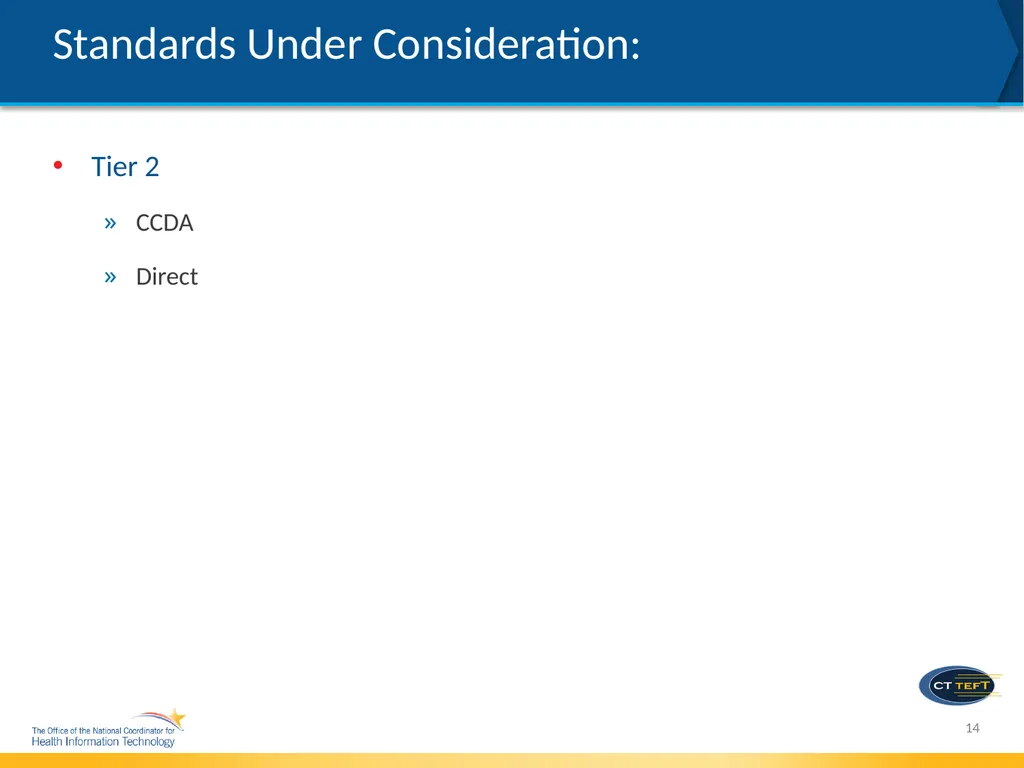
slide14. Standards Under Consideration: Tier 2
CCDA
Direct<br>
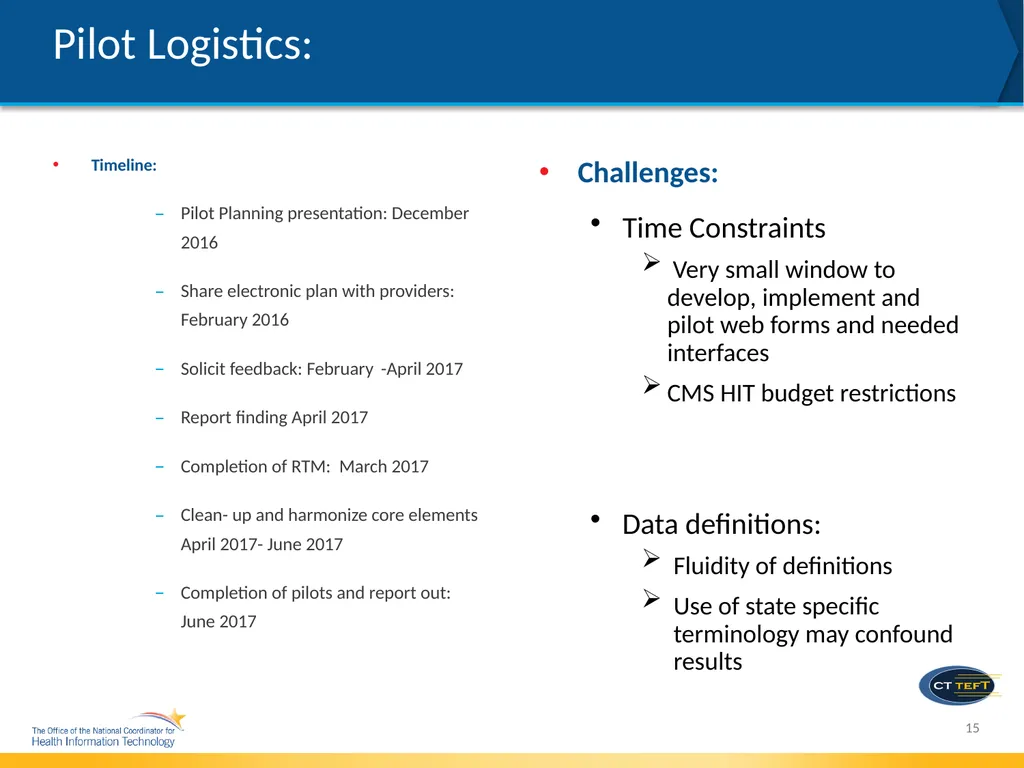
slide15. Pilot Logistics: Timeline:
Pilot Planning presentation: December 2016
Share electronic plan with providers: February 2016
Solicit feedback: February -April 2017
Report finding April 2017
Completion of RTM: March 2017
Clean- up and harmonize core elements April 2017- June 2017
Completion of pilots and report out: June 2017 Challenges:
Time Constraints
Very small window to develop, implement and pilot web forms and needed interfaces
CMS HIT budget restrictions
Data definitions:
Fluidity of definitions
Use of state specific terminology may confound results<br>
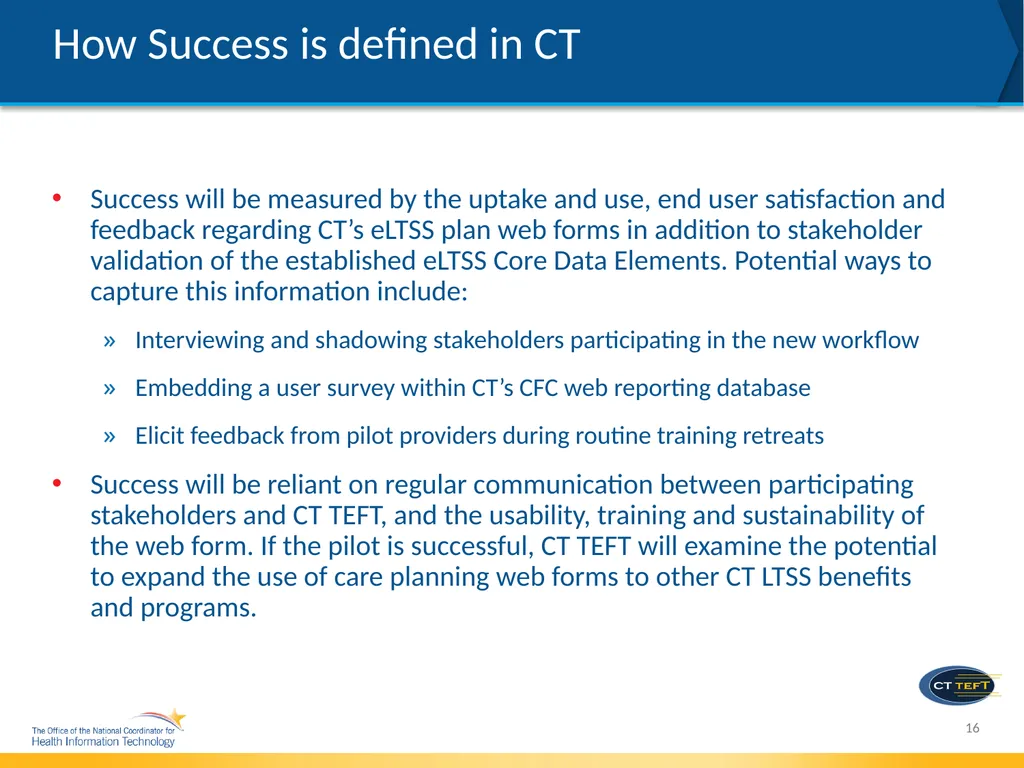
slide16. How Success is defined in CT Success will be measured by the uptake and use, end user satisfaction and feedback regarding CT’s eLTSS plan web forms in addition to stakeholder validation of the established eLTSS Core Data Elements. Potential ways to capture this information include:
Interviewing and shadowing stakeholders participating in the new workflow
Embedding a user survey within CT’s CFC web reporting database
Elicit feedback from pilot providers during routine training retreats
Success will be reliant on regular communication between participating stakeholders and CT TEFT, and the usability, training and sustainability of the web form. If the pilot is successful, CT TEFT will examine the potential to expand the use of care planning web forms to other CT LTSS benefits and programs.<br>
slide17. References/Resources UConn CHATTER Website: www.chatter.uconn.edu
CT TEFT Homepage: www.chatter.uconn.edu/teft
CT Health IT Webpage: http://www.ct.gov/dss/cwp/view.asp?a=3922&q=554932
My Place CT website: http://www.myplacect.org/<br>
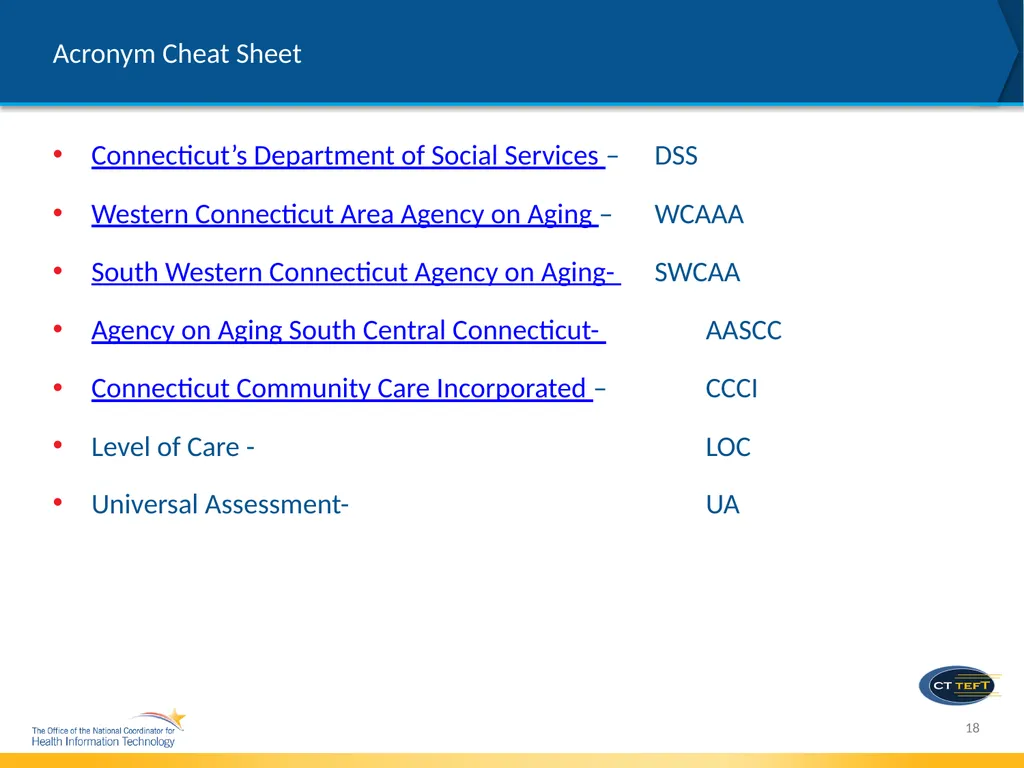
slide18. Acronym Cheat Sheet Connecticut’s Department of Social Services – DSS
Western Connecticut Area Agency on Aging – WCAAA
South Western Connecticut Agency on Aging- SWCAA
Agency on Aging South Central Connecticut- AASCC
Connecticut Community Care Incorporated – CCCI
Level of Care - LOC
Universal Assessment- UA<br>

October 13th, 2016<br>
slide2. Agenda<br>
slide3. Introduction: Pilot Team<br>
slide4. Introduction: Organization Who we are?
We are CT TEFT, focusing on empowering consumers through the use of Health IT. We are comprised of staff from Connecticut’s Department of Social Services (DSS) & the University of Connecticut’s School of Nursing.
What we currently do?
Currently, CT TEFT is in the process of engaging vendors to develop web forms which will utilize the Direct standard to transmit electronic care plans between stakeholders.
How are we involved in services and support?
The team has been continuously engaged in a dialogue with beneficiaries, providers, assessors, advocates and other frontline staff members in interactive dialogues to gain insight into the workflow. The team used shadowing and interviews as part of the feedback gathering process.
How do we currently carry out eLTSS activities?
The Community First Choice (CFC) program was implemented in July 1, 2015. Currently we use a paper-based plan generated by the beneficiary which is approved by the department. The plan is directly uploaded to the DSS database and then emailed to the fiscal intermediary by DSS. Connecticut does not have an eLTSS system or HIE.<br>
slide5. Pilot Introduction: Business Drivers Business Drivers for Connecticut
Empower consumers to control information sharing
Improve consumer health through use of Health IT
Streamline workflows
Business Use Case:
Beneficiaries will have the ability to create & share an eLTSS care plan securely<br>
slide6. CT TEFT Business Use Case<br>
slide7. Goal of the Pilot: User Story 2<br>
slide8. Goal of Pilot: Tier CT TEFT will be piloting Tier 2 for the eLTSS Round 2 Pilot
During the Round 1 pilot, CT TEFT developed mutual interest amongst participating access agencies, shadowed and interviewed frontline staff and CFC beneficiaries regarding the current care planning process.
For Round 2, CT TEFT intends to develop web forms which would utilize the Direct standard to transmit care plans between provider organizations, DSS and other interested stakeholders.<br>
slide9. Goal of Pilot: Core elements piloted in CT 42 of the 47 core data elements are captured across CT’s CFC service tool, Universal Assessment and Reporting Database
CT TEFT will pilot the following data elements during our Round 2 Pilot:<br>
slide10. Goal of Pilot: Roles Roles
CT TEFT will continue to advocate for consumer access to their health data. A major component of the grant is to enable consumer access in order to empower them.
The team will research the best practices for eLTSS plan implementation to encourage stakeholder participation in the process.
Feedback
The team will engage Eligibility Determination Form Submitters, eLTSS plan developers (including beneficiaries), LTSS plan facilitator/stewards, LTSS/case management staff, state area agencies on aging and our fiscal intermediary, Allied Health to provide feedback regarding workflow changes, care plan revisions and future areas of improvement during our Round 2 eLTSS Pilot.<br>
slide11. Pilot Ecosystem Participants
Medicaid Beneficiary
Participating Provider Organizations/Access Agencies
Western Connecticut Area Agency on Aging (WCAAA)
Connecticut Community Care Inc. (CCCI)
Agency on Aging for South Central Connecticut (AASCC)
South Western Connecticut Agency on Aging (SWCAA)
Provider use of electronic systems
All of CT’s access agencies leverage DSS’s web-based CFC system for case management.
CCCI is the only provider organization that has a home-grown independent electronic case management system.
CT TEFT’s electronic system
Presently, CT TEFT utilizes Direct messaging from our HISP vendor, Secure Exchange Solutions. It is our goal to develop electronic care plans which can leverage Direct to transmit care plans to different providers across the state.<br>
slide12. Pilot Ecosystem Continued<br>
slide13. Pilot Work Flow Current State:
The beneficiary (or designee) creates the plan. The plan is submitted to the access agency, who then submits the plan to DSS for final approval. Once approved, DSS shares the plan with Allied (CT’s Fiscal Intermediary) to release funds for the plan. A paper copy of the care plan is then mailed to the beneficiary. Pilot Workflow:
The beneficiary (or designee) creates the plan using an electronic web form, and shares the plan with their assigned access agency, who then submits the plan to DSS utilizing Direct secure messaging. Once approved, the plan is routed back to the beneficiary, who can also share it with all relevant parties. Recipients can communicate back to the person (or designee) regarding the plan.<br>
slide14. Standards Under Consideration: Tier 2
CCDA
Direct<br>
slide15. Pilot Logistics: Timeline:
Pilot Planning presentation: December 2016
Share electronic plan with providers: February 2016
Solicit feedback: February -April 2017
Report finding April 2017
Completion of RTM: March 2017
Clean- up and harmonize core elements April 2017- June 2017
Completion of pilots and report out: June 2017 Challenges:
Time Constraints
Very small window to develop, implement and pilot web forms and needed interfaces
CMS HIT budget restrictions
Data definitions:
Fluidity of definitions
Use of state specific terminology may confound results<br>
slide16. How Success is defined in CT Success will be measured by the uptake and use, end user satisfaction and feedback regarding CT’s eLTSS plan web forms in addition to stakeholder validation of the established eLTSS Core Data Elements. Potential ways to capture this information include:
Interviewing and shadowing stakeholders participating in the new workflow
Embedding a user survey within CT’s CFC web reporting database
Elicit feedback from pilot providers during routine training retreats
Success will be reliant on regular communication between participating stakeholders and CT TEFT, and the usability, training and sustainability of the web form. If the pilot is successful, CT TEFT will examine the potential to expand the use of care planning web forms to other CT LTSS benefits and programs.<br>
slide17. References/Resources UConn CHATTER Website: www.chatter.uconn.edu
CT TEFT Homepage: www.chatter.uconn.edu/teft
CT Health IT Webpage: http://www.ct.gov/dss/cwp/view.asp?a=3922&q=554932
My Place CT website: http://www.myplacect.org/<br>
slide18. Acronym Cheat Sheet Connecticut’s Department of Social Services – DSS
Western Connecticut Area Agency on Aging – WCAAA
South Western Connecticut Agency on Aging- SWCAA
Agency on Aging South Central Connecticut- AASCC
Connecticut Community Care Incorporated – CCCI
Level of Care - LOC
Universal Assessment- UA<br>