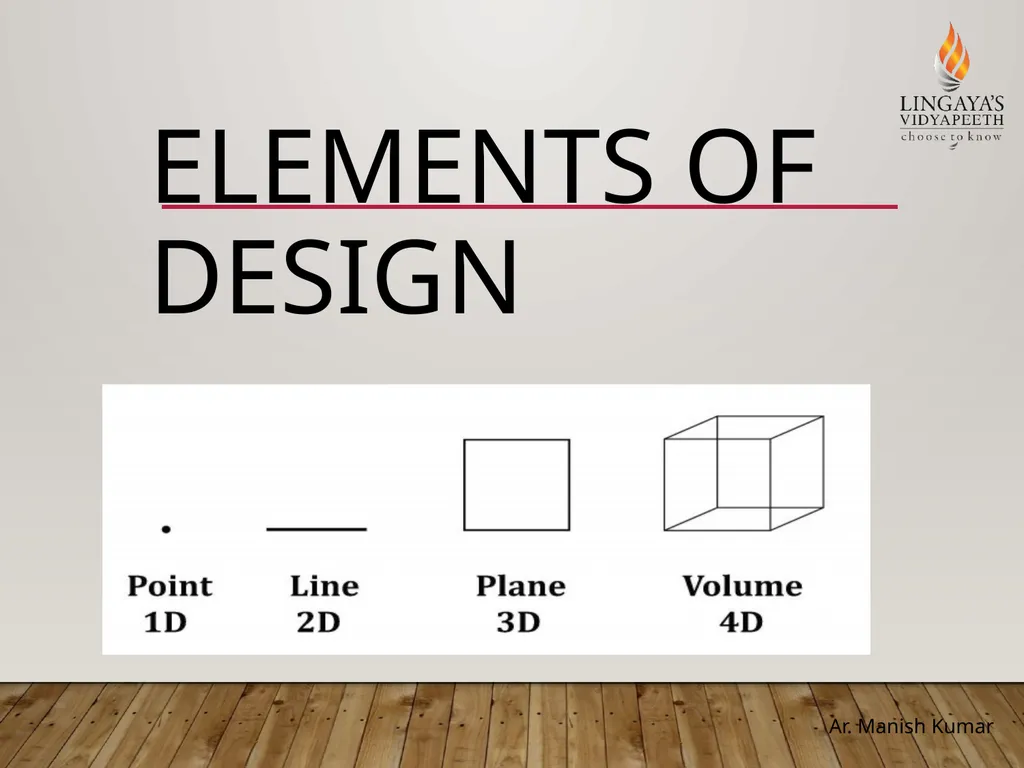
Elements of Design Ar. Manish Kumar the foundation in every architecture design smallest part and the most basic element a geometric element in space with zero dimensions owns its basics in width and length, and the smallest area. A point
"Elements of Design Ar. Manish Kumar the foundation" is the property of its rightful owner. Permission is granted to
download and print the materials on this website for personal, non-commercial use only, and to display it
on your personal computer provided you do not modify the materials and that you retain all copyright
notices contained in the materials. By downloading content from our website, you accept the terms of this
agreement.
Presentation Transcript
01
Elements of Design Ar. Manish Kumar<br>
02
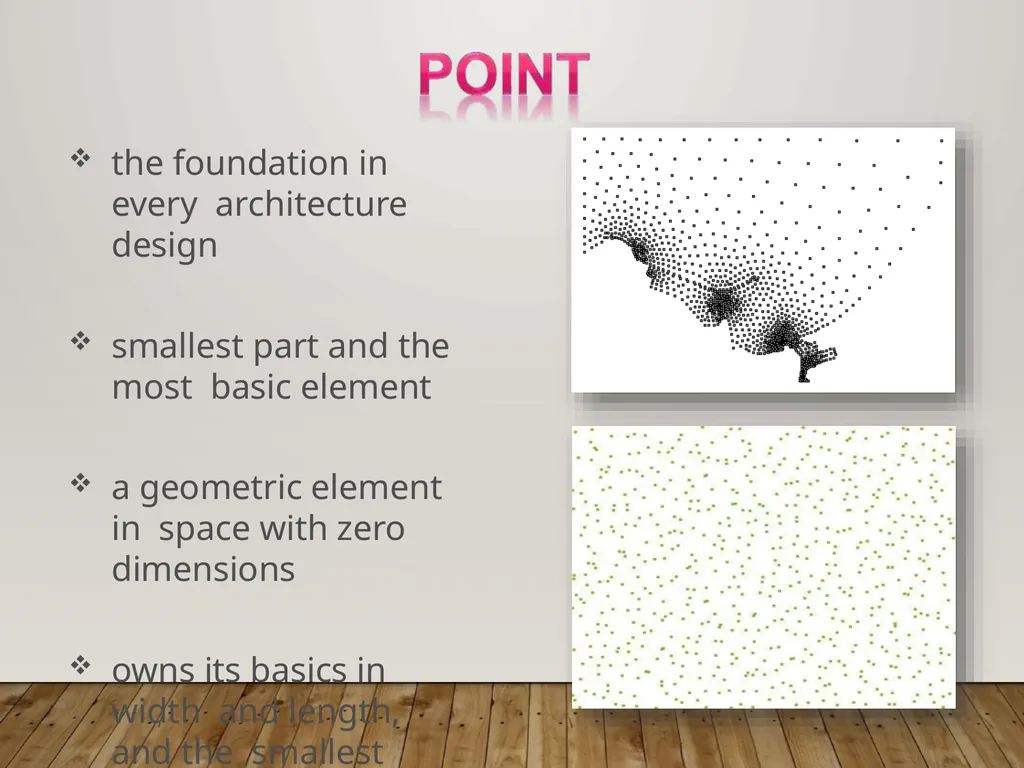
the foundation in every architecture design
smallest part and the most basic element
a geometric element in space with zero dimensions
owns its basics in width and length, and the smallest area.<br>
03
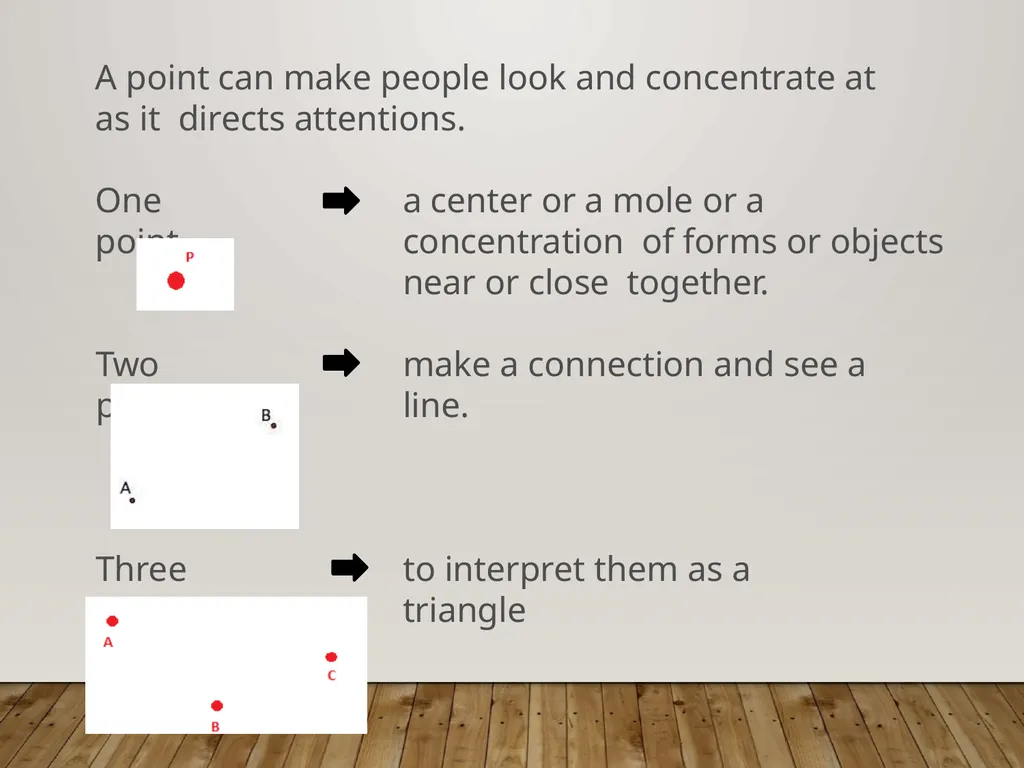
A point can make people look and concentrate at as it directs attentions. One point a center or a mole or a concentration of forms or objects near or close together. Two points make a connection and see a line. Three points to interpret them as a triangle<br>
04
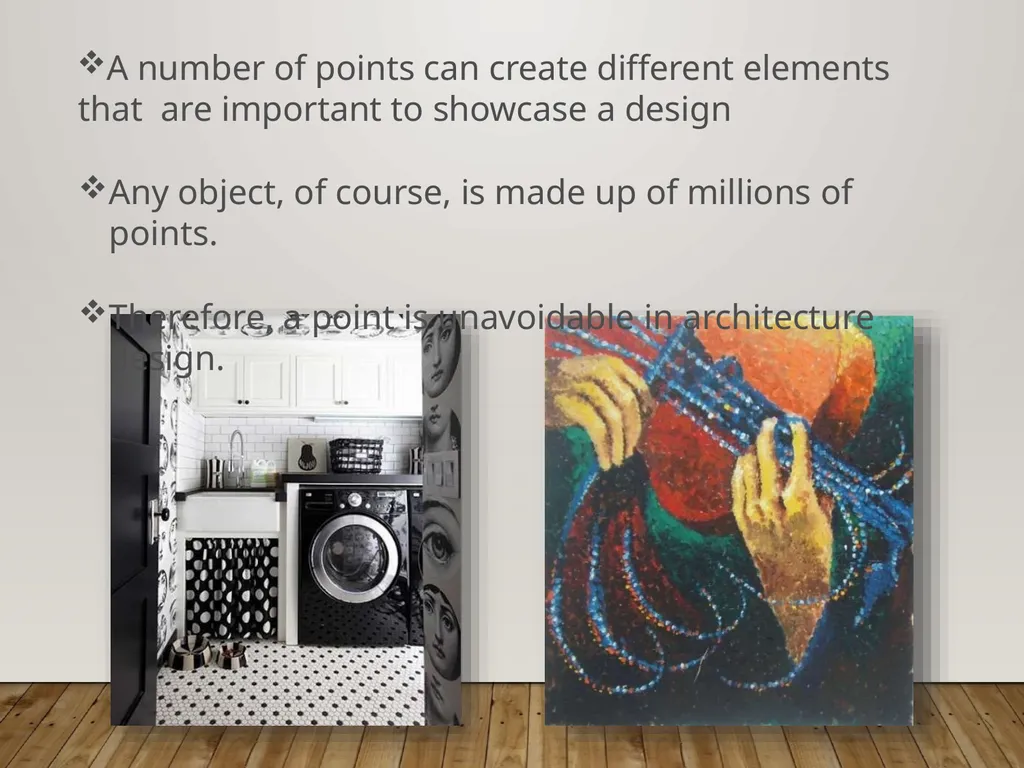
A number of points can create different elements that are important to showcase a design
Any object, of course, is made up of millions of points.
Therefore, a point is unavoidable in architecture design.<br>
05
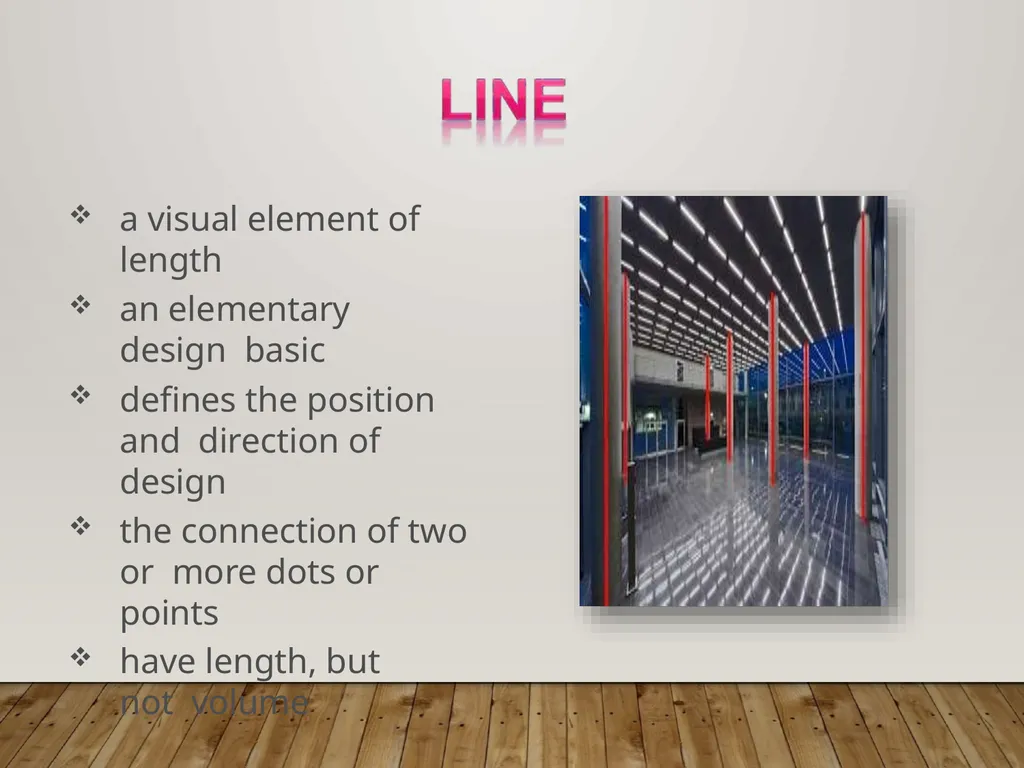
a visual element of
length
an elementary design basic
defines the position and direction of design
the connection of two or more dots or points
have length, but not volume<br>
06
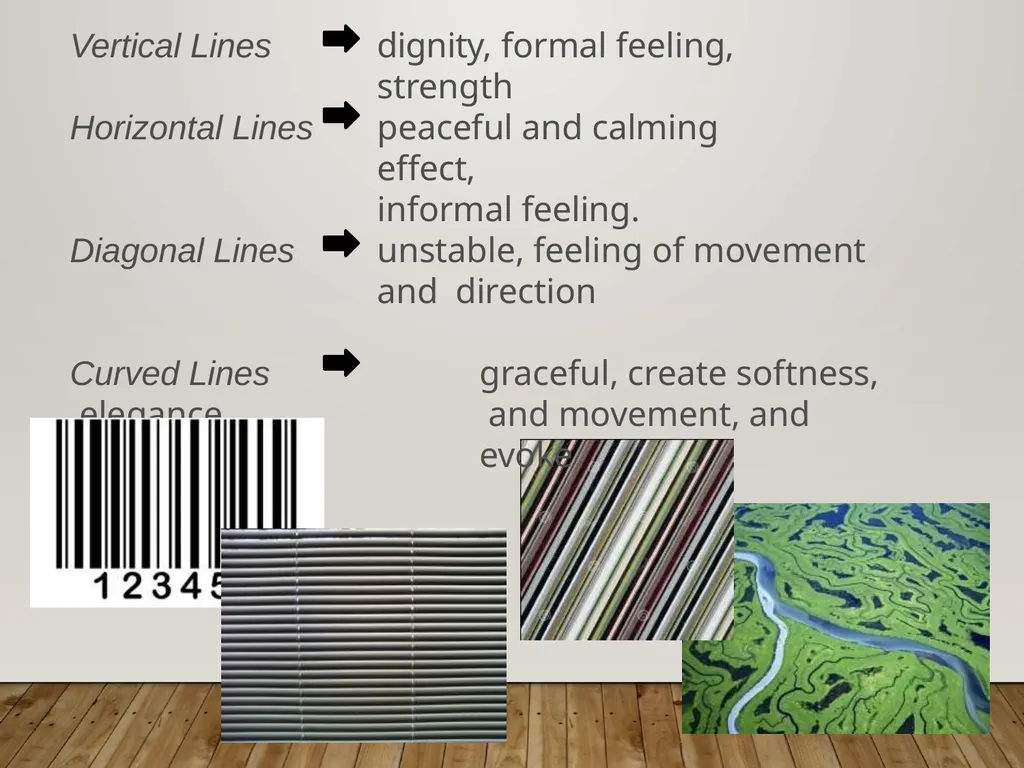
Vertical Lines dignity, formal feeling, strength Horizontal Lines peaceful and calming effect,
informal feeling. Diagonal Lines unstable, feeling of movement and direction graceful, create softness, and movement, and evoke Curved Lines elegance nature<br>
07
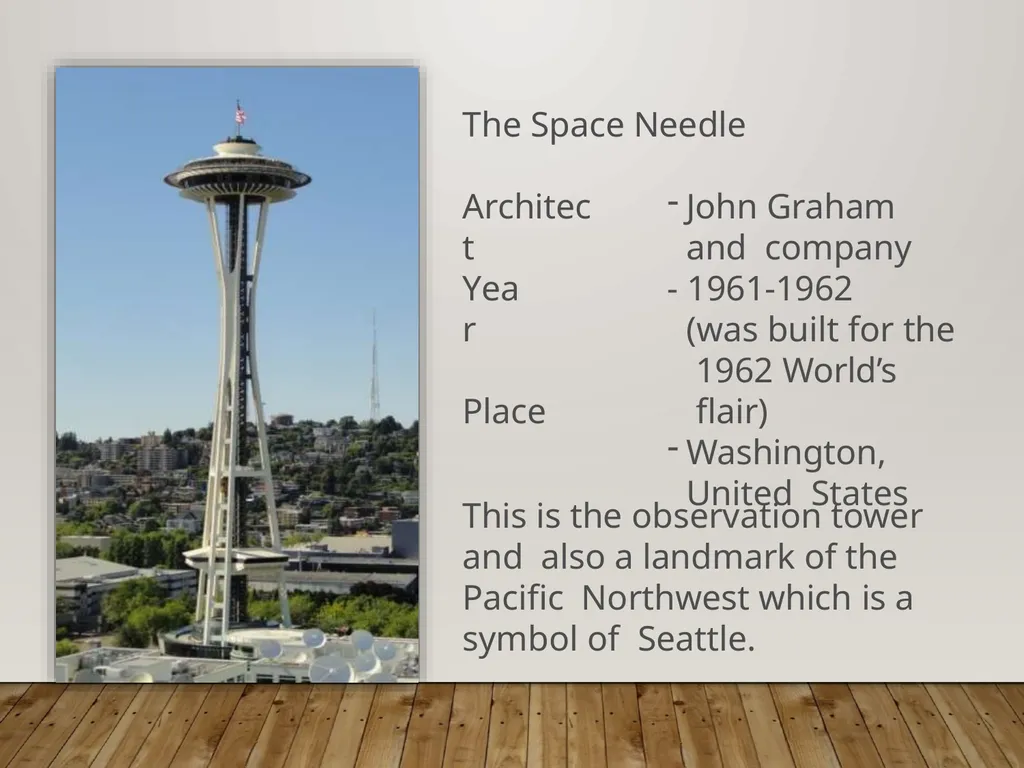
The Space Needle Architect Year Place John Graham and company
- 1961-1962
(was built for the 1962 World’s flair)
Washington, United States This is the observation tower and also a landmark of the Pacific Northwest which is a symbol of Seattle.<br>
08
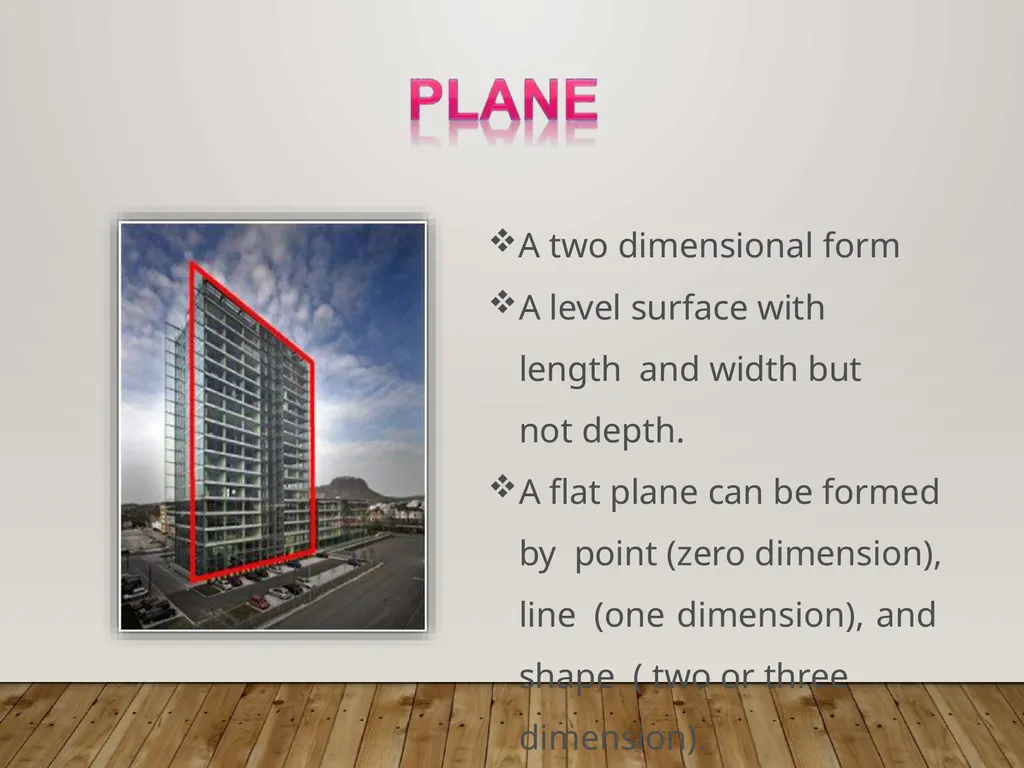
A two dimensional form
A level surface with length and width but not depth.
A flat plane can be formed by point (zero dimension), line (one dimension), and shape ( two or three dimension).<br>
09
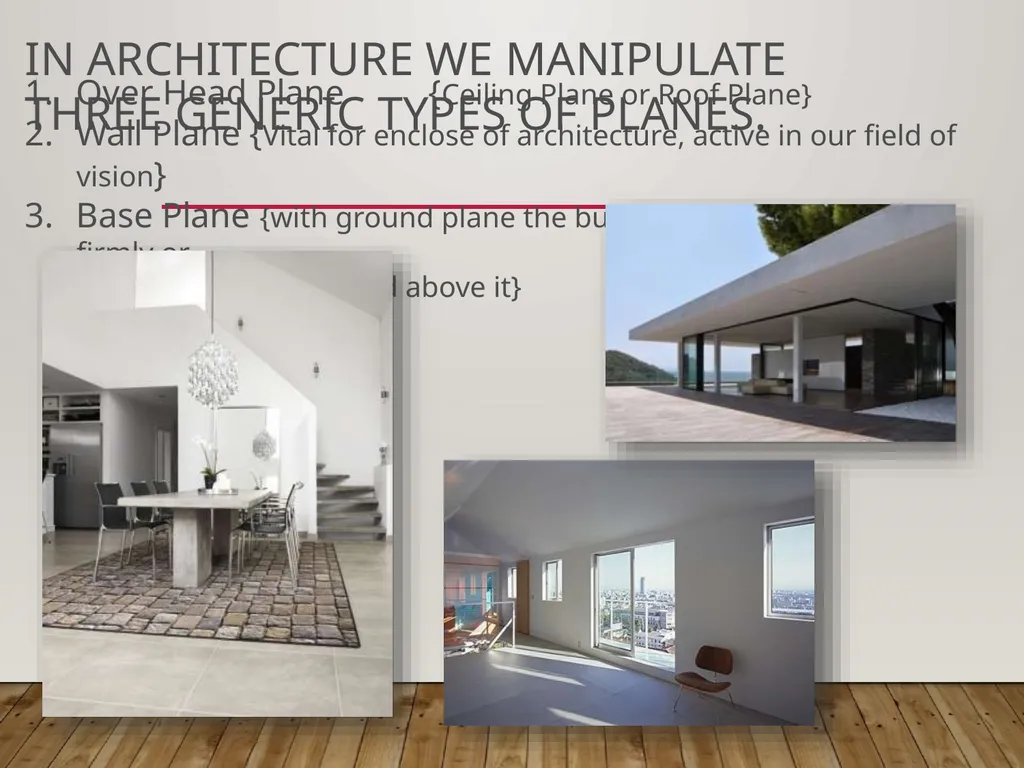
In architecture we manipulate three generic types of planes. Over Head Plane {Ceiling Plane or Roof Plane}
Wall Plane {Vital for enclose of architecture, active in our field of vision}
Base Plane {with ground plane the building can merge, rested firmly or
be elevated above it}<br>
10
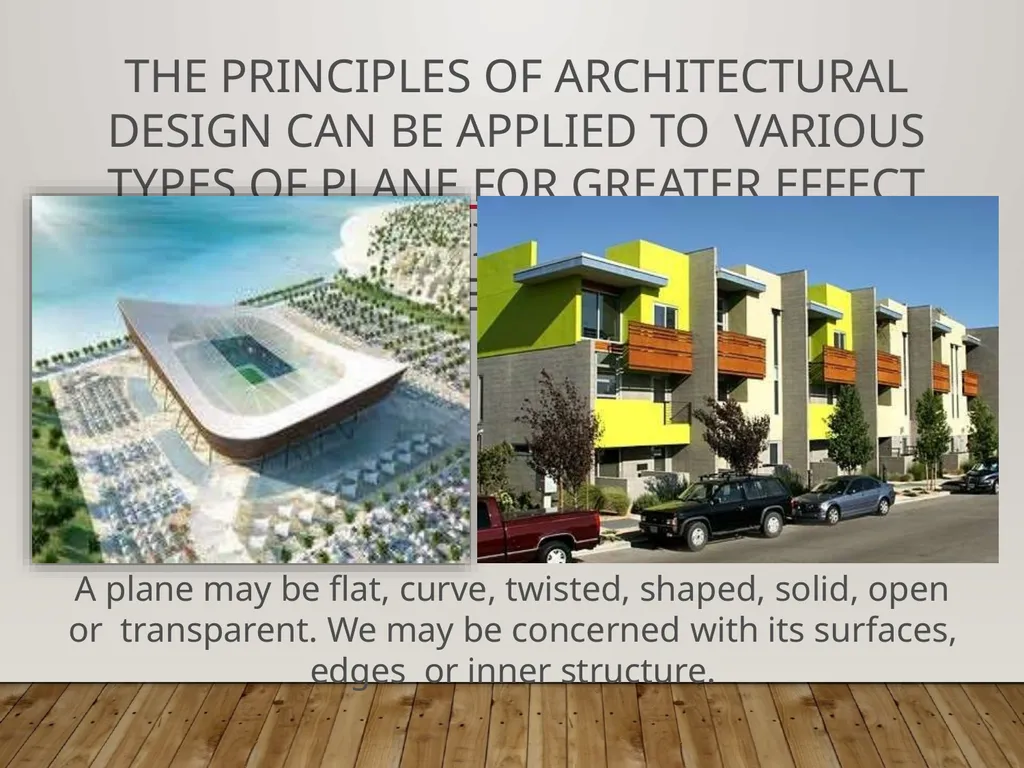
The principles of architectural design can be applied to various types of plane for greater effect and resulting statement relative to the design solution. A plane may be flat, curve, twisted, shaped, solid, open or transparent. We may be concerned with its surfaces, edges or inner structure.<br>
11
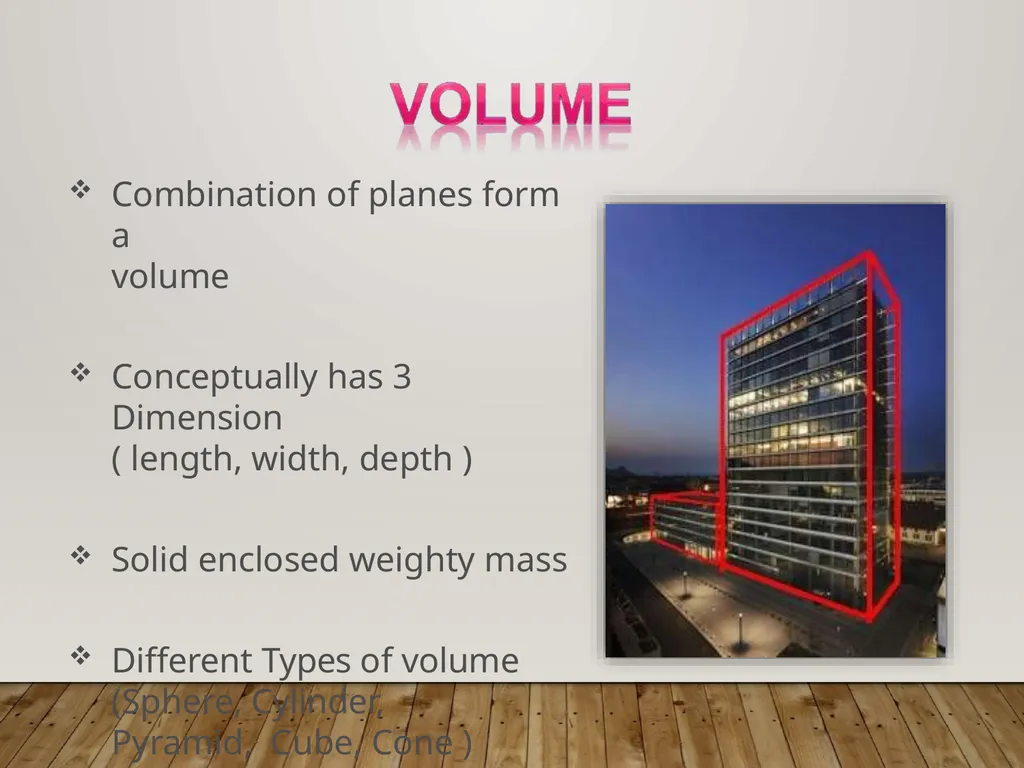
Combination of planes form a
volume
Conceptually has 3 Dimension
( length, width, depth )
Solid enclosed weighty mass
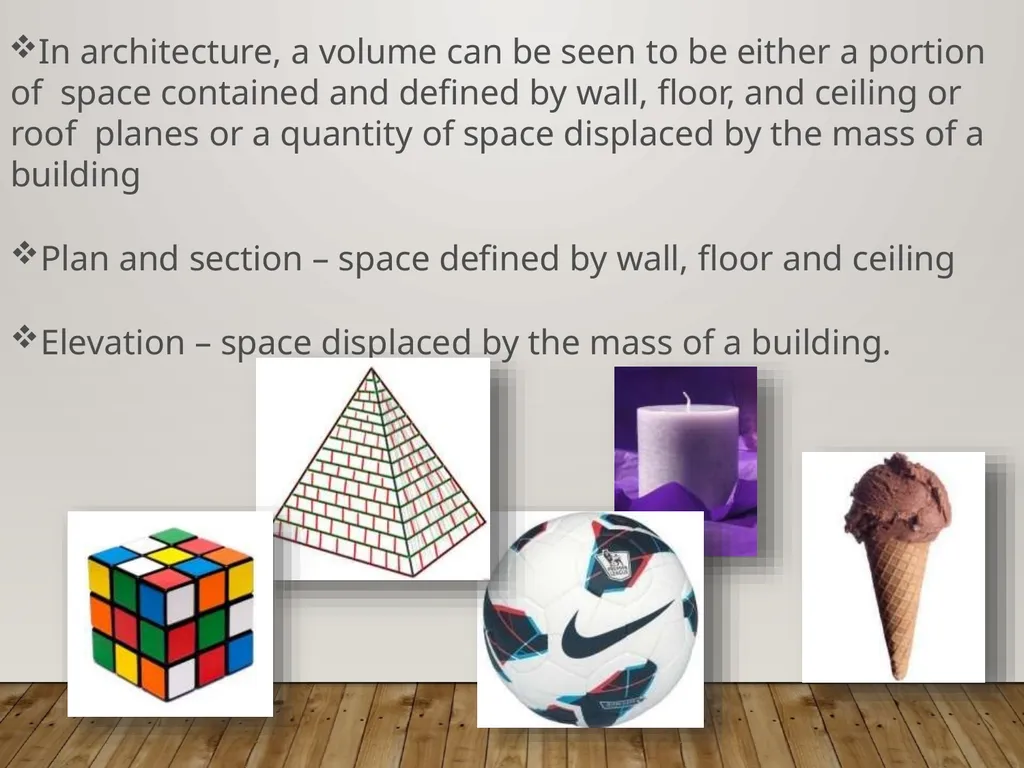
Different Types of volume (Sphere, Cylinder, Pyramid, Cube, Cone )<br>
12
In architecture, a volume can be seen to be either a portion of space contained and defined by wall, floor, and ceiling or roof planes or a quantity of space displaced by the mass of a building
Plan and section – space defined by wall, floor and ceiling
Elevation – space displaced by the mass of a building.<br>
13
La-Tete-au-Carre, Nice, France Berlin Zeiss Planetarium, Berlin, Germany Architect – Yves Bayard
Francis Chapuis
Year – 1996 Architect – Erhard GiBke
Year – 1985<br>
14
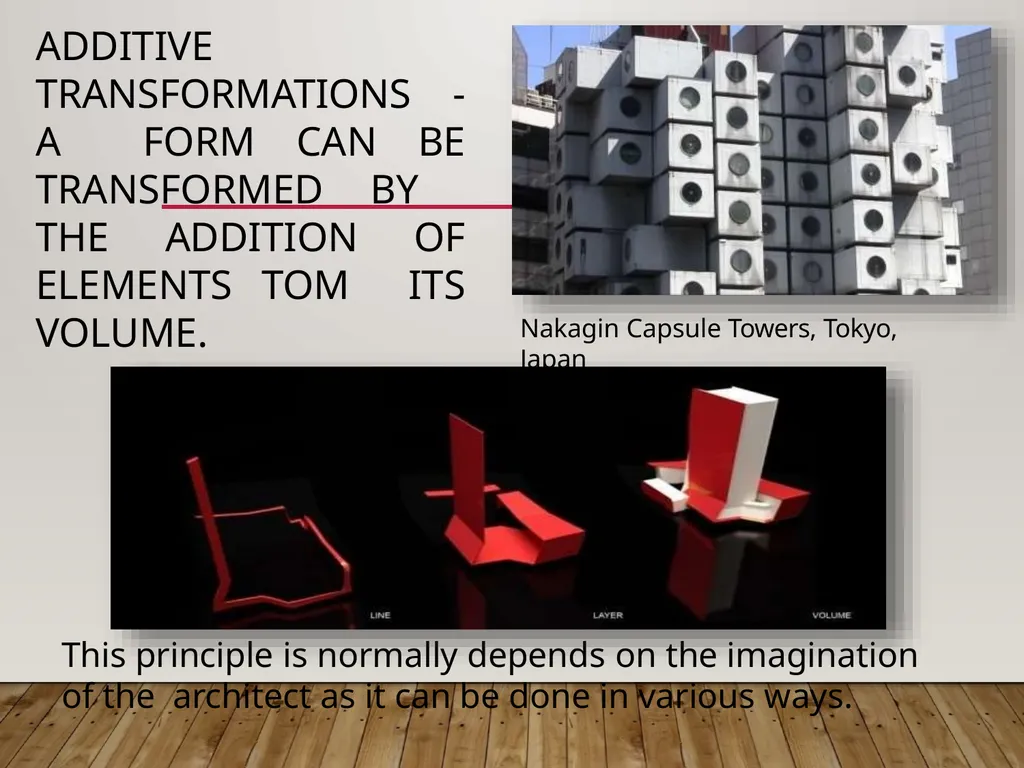
Additive Transformations - A form can be transformed by the addition of elements tom its volume. This principle is normally depends on the imagination of the architect as it can be done in various ways. Nakagin Capsule Towers, Tokyo, Japan<br>