
Eloi OUEDRAOGO Statistician, Agricultural Census
CM
Published · 33 slides · 0 views

1 / 1



Description
Eloi OUEDRAOGO Statistician, Agricultural Census Team FAO Statistics Division (ESS) Planning, budgeting and tabulation plan Technical Session 3: Planning, budgeting and tabulation plan 1 Webinar on the Operational Guidelines of the WCA
Related Topics
Share
Embed code
Download this presentation From Below
"Eloi OUEDRAOGO Statistician, Agricultural Census" is the property of its rightful owner. Permission is granted to download and print the materials on this website for personal, non-commercial use only, and to display it on your personal computer provided you do not modify the materials and that you retain all copyright notices contained in the materials. By downloading content from our website, you accept the terms of this agreement.
Presentation Transcript
01
Eloi OUEDRAOGO
Statistician, Agricultural Census Team
FAO Statistics Division (ESS) Planning, budgeting
and tabulation plan
Technical Session 3: Planning, budgeting and tabulation plan 1 Webinar on the Operational Guidelines of the WCA 2020. Virtual Meeting – Europe and Central Asia 25-29 October 2021<br>
Statistician, Agricultural Census Team
FAO Statistics Division (ESS) Planning, budgeting
and tabulation plan
Technical Session 3: Planning, budgeting and tabulation plan 1 Webinar on the Operational Guidelines of the WCA 2020. Virtual Meeting – Europe and Central Asia 25-29 October 2021<br>
02
Contents Census work plan
Census budget
Outsourcing tasks/census activities
Monitoring and review of the work plan and the budget
Expenditure control
Tabulation
Country example 2<br>
Census budget
Outsourcing tasks/census activities
Monitoring and review of the work plan and the budget
Expenditure control
Tabulation
Country example 2<br>
03
Agricultural Census (AC) & Population and Housing Census (PHC) – complex and expensive statistical operations.
Work Plan & Budget - realistic estimates.
Inadequate planning and/or underestimating the financial requirements are basic reasons for serious problems
The complexity of the planned census modality should be carefully considered.
Planning & Preparation- changes after the previous census.
At least two-three years is required from the initial preparatory work to the dissemination of the final census results, even for a census in a small country. Background 3<br>
Work Plan & Budget - realistic estimates.
Inadequate planning and/or underestimating the financial requirements are basic reasons for serious problems
The complexity of the planned census modality should be carefully considered.
Planning & Preparation- changes after the previous census.
At least two-three years is required from the initial preparatory work to the dissemination of the final census results, even for a census in a small country. Background 3<br>
04
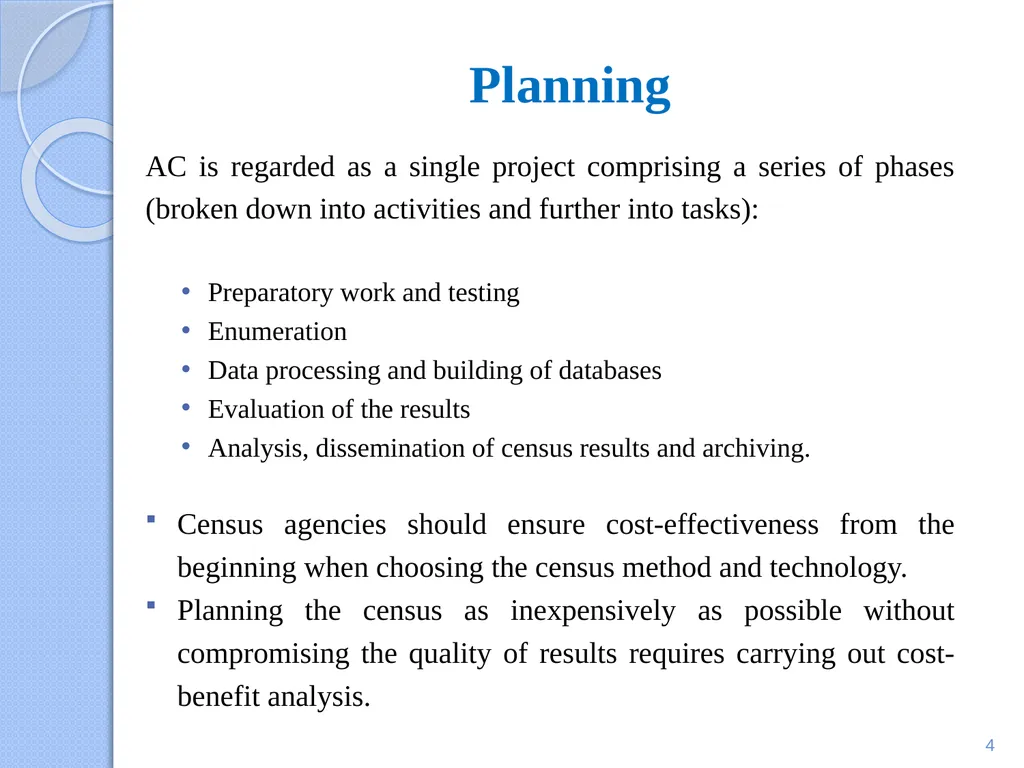
AC is regarded as a single project comprising a series of phases (broken down into activities and further into tasks):
Preparatory work and testing
Enumeration
Data processing and building of databases
Evaluation of the results
Analysis, dissemination of census results and archiving.
Census agencies should ensure cost-effectiveness from the beginning when choosing the census method and technology.
Planning the census as inexpensively as possible without compromising the quality of results requires carrying out cost-benefit analysis. Planning 4<br>
Preparatory work and testing
Enumeration
Data processing and building of databases
Evaluation of the results
Analysis, dissemination of census results and archiving.
Census agencies should ensure cost-effectiveness from the beginning when choosing the census method and technology.
Planning the census as inexpensively as possible without compromising the quality of results requires carrying out cost-benefit analysis. Planning 4<br>
05
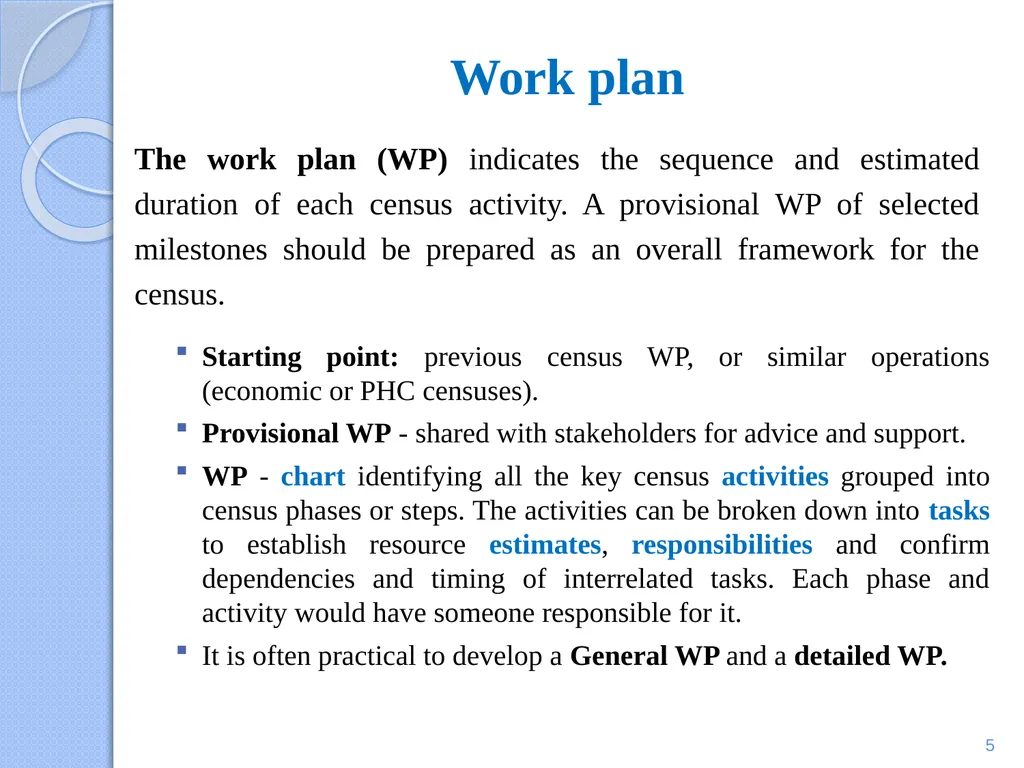
Starting point: previous census WP, or similar operations (economic or PHC censuses).
Provisional WP - shared with stakeholders for advice and support.
WP - chart identifying all the key census activities grouped into census phases or steps. The activities can be broken down into tasks to establish resource estimates, responsibilities and confirm dependencies and timing of interrelated tasks. Each phase and activity would have someone responsible for it.
It is often practical to develop a General WP and a detailed WP. Work plan 5 The work plan (WP) indicates the sequence and estimated duration of each census activity. A provisional WP of selected milestones should be prepared as an overall framework for the census.<br>
Provisional WP - shared with stakeholders for advice and support.
WP - chart identifying all the key census activities grouped into census phases or steps. The activities can be broken down into tasks to establish resource estimates, responsibilities and confirm dependencies and timing of interrelated tasks. Each phase and activity would have someone responsible for it.
It is often practical to develop a General WP and a detailed WP. Work plan 5 The work plan (WP) indicates the sequence and estimated duration of each census activity. A provisional WP of selected milestones should be prepared as an overall framework for the census.<br>
06
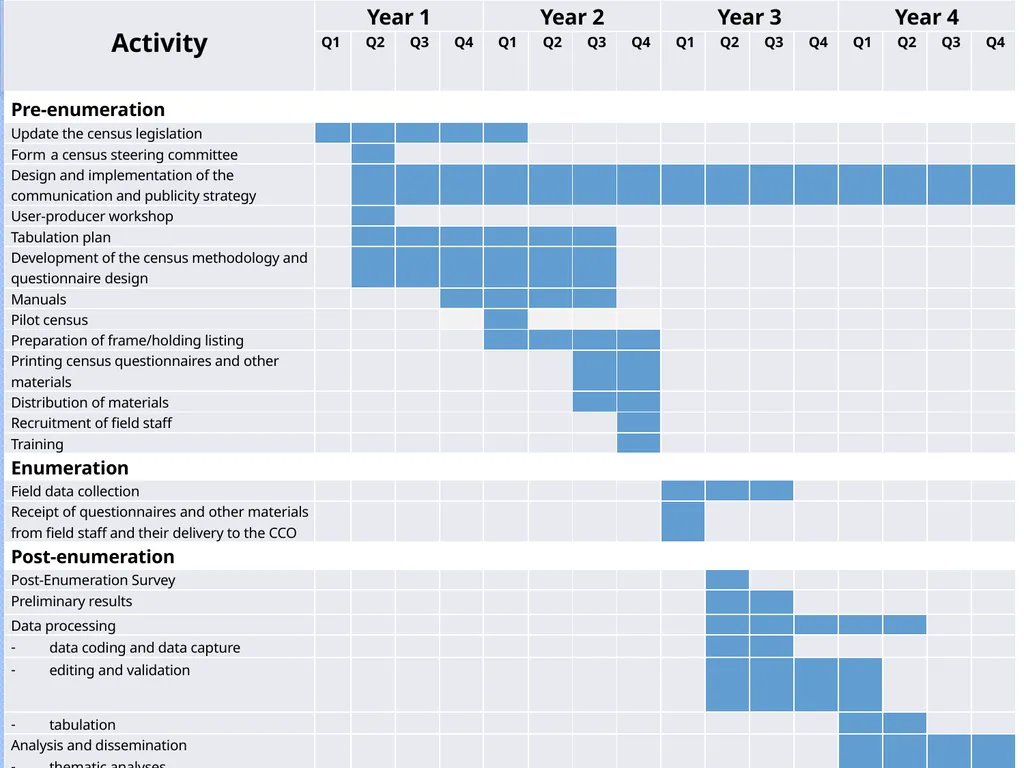
Example of General Work Plan 6<br>
07
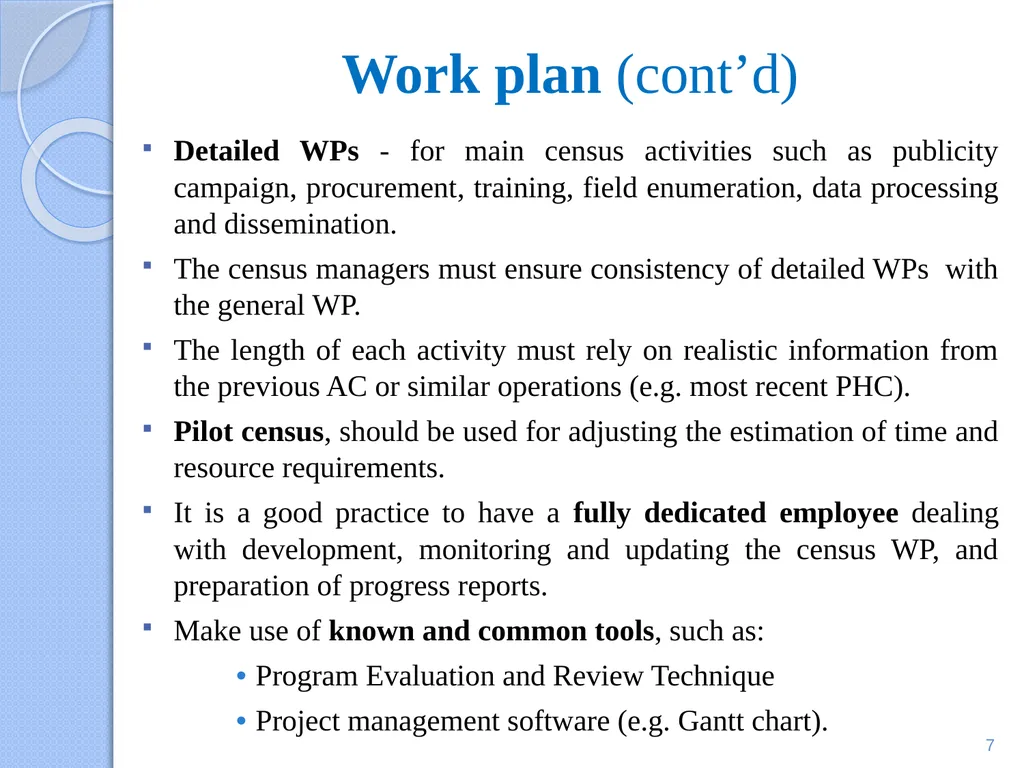
Detailed WPs - for main census activities such as publicity campaign, procurement, training, field enumeration, data processing and dissemination.
The census managers must ensure consistency of detailed WPs with the general WP.
The length of each activity must rely on realistic information from the previous AC or similar operations (e.g. most recent PHC).
Pilot census, should be used for adjusting the estimation of time and resource requirements.
It is a good practice to have a fully dedicated employee dealing with development, monitoring and updating the census WP, and preparation of progress reports.
Make use of known and common tools, such as:
Program Evaluation and Review Technique
Project management software (e.g. Gantt chart). Work plan (cont’d) 7<br>
The census managers must ensure consistency of detailed WPs with the general WP.
The length of each activity must rely on realistic information from the previous AC or similar operations (e.g. most recent PHC).
Pilot census, should be used for adjusting the estimation of time and resource requirements.
It is a good practice to have a fully dedicated employee dealing with development, monitoring and updating the census WP, and preparation of progress reports.
Make use of known and common tools, such as:
Program Evaluation and Review Technique
Project management software (e.g. Gantt chart). Work plan (cont’d) 7<br>
08
Avoid overlapping with large scale societal events
(elections or referendums)
Plan the enumeration period according to the agricultural season (to ensure the collection of reliable primary census data)
Ensure availability of resources in a timely manner (e.g. funds for the remuneration of field staff) Work plan (cont’d) 8 The financial rules and regulations in some countries put a major constraint on census managers to pay salaries/allowances to field staff in time.
Moving the money to the field is a big challenge in some countries.
At planning and budgeting stage, there is needed to have a discussion with financial services on the practical solutions to be made for smooth implementation of field operations.<br>
Plan the enumeration period according to the agricultural season (to ensure the collection of reliable primary census data)
Ensure availability of resources in a timely manner (e.g. funds for the remuneration of field staff) Work plan (cont’d) 8 The financial rules and regulations in some countries put a major constraint on census managers to pay salaries/allowances to field staff in time.
Moving the money to the field is a big challenge in some countries.
At planning and budgeting stage, there is needed to have a discussion with financial services on the practical solutions to be made for smooth implementation of field operations.<br>
09
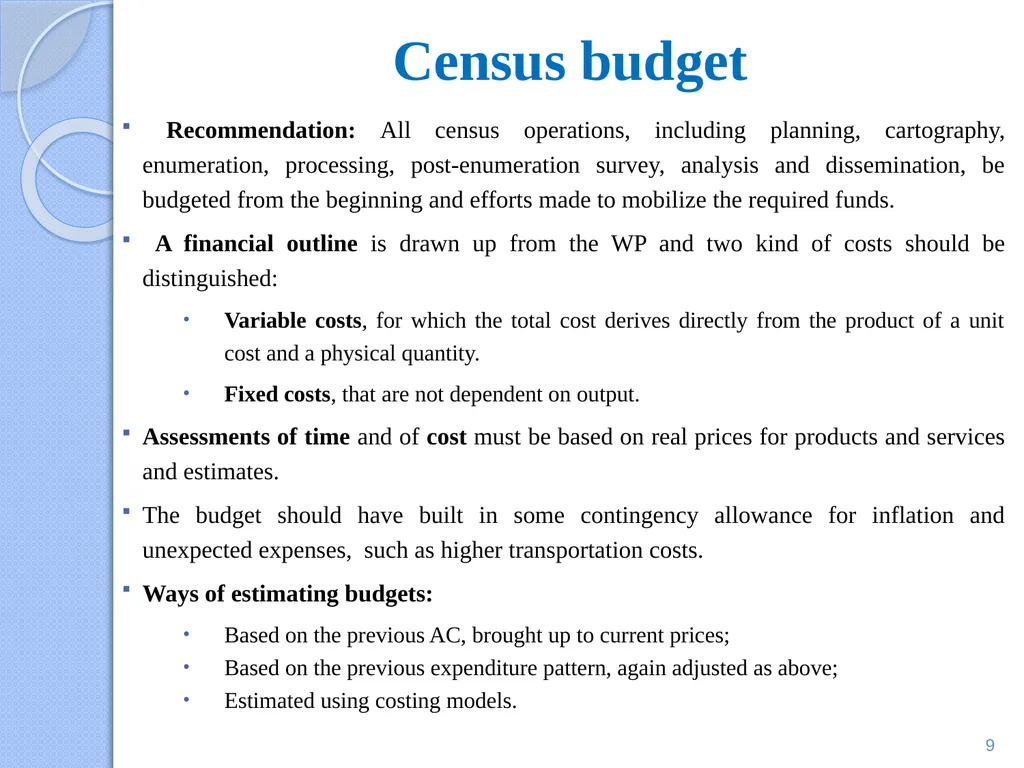
Recommendation: All census operations, including planning, cartography, enumeration, processing, post-enumeration survey, analysis and dissemination, be budgeted from the beginning and efforts made to mobilize the required funds.
A financial outline is drawn up from the WP and two kind of costs should be distinguished:
Variable costs, for which the total cost derives directly from the product of a unit cost and a physical quantity.
Fixed costs, that are not dependent on output.
Assessments of time and of cost must be based on real prices for products and services and estimates.
The budget should have built in some contingency allowance for inflation and unexpected expenses, such as higher transportation costs.
Ways of estimating budgets:
Based on the previous AC, brought up to current prices;
Based on the previous expenditure pattern, again adjusted as above;
Estimated using costing models. Census budget 9<br>
A financial outline is drawn up from the WP and two kind of costs should be distinguished:
Variable costs, for which the total cost derives directly from the product of a unit cost and a physical quantity.
Fixed costs, that are not dependent on output.
Assessments of time and of cost must be based on real prices for products and services and estimates.
The budget should have built in some contingency allowance for inflation and unexpected expenses, such as higher transportation costs.
Ways of estimating budgets:
Based on the previous AC, brought up to current prices;
Based on the previous expenditure pattern, again adjusted as above;
Estimated using costing models. Census budget 9<br>
10
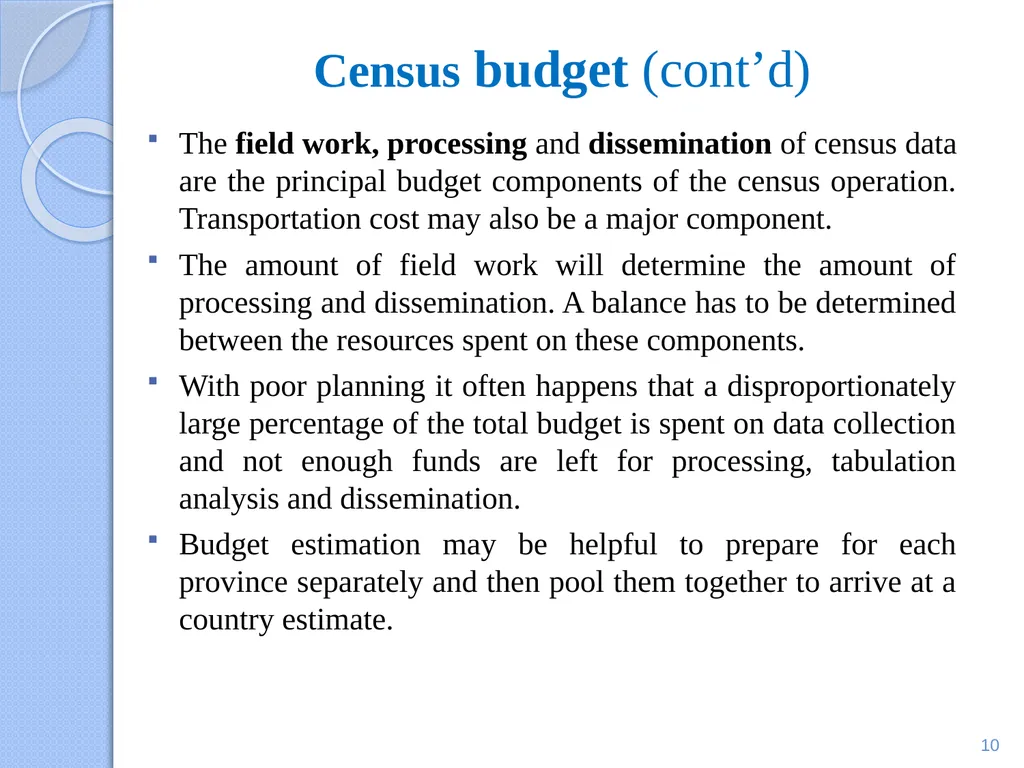
The field work, processing and dissemination of census data are the principal budget components of the census operation. Transportation cost may also be a major component.
The amount of field work will determine the amount of processing and dissemination. A balance has to be determined between the resources spent on these components.
With poor planning it often happens that a disproportionately large percentage of the total budget is spent on data collection and not enough funds are left for processing, tabulation analysis and dissemination.
Budget estimation may be helpful to prepare for each province separately and then pool them together to arrive at a country estimate. 10 Census budget (cont’d)<br>
The amount of field work will determine the amount of processing and dissemination. A balance has to be determined between the resources spent on these components.
With poor planning it often happens that a disproportionately large percentage of the total budget is spent on data collection and not enough funds are left for processing, tabulation analysis and dissemination.
Budget estimation may be helpful to prepare for each province separately and then pool them together to arrive at a country estimate. 10 Census budget (cont’d)<br>
11
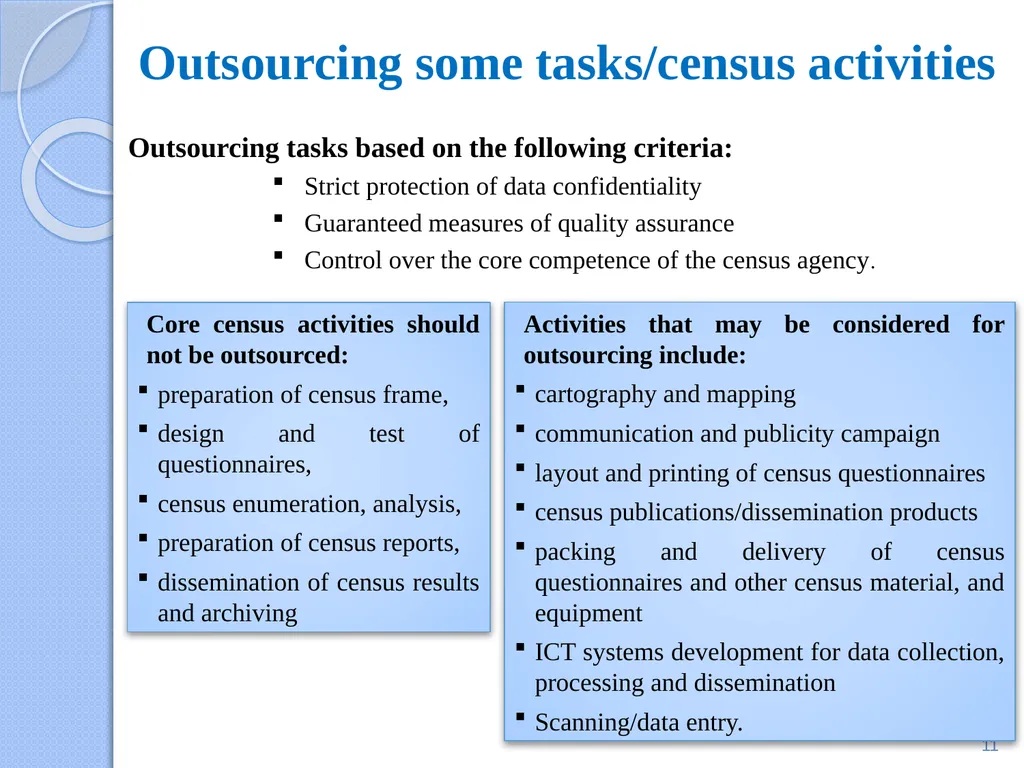
Outsourcing some tasks/census activities 11 Outsourcing tasks based on the following criteria:
Strict protection of data confidentiality
Guaranteed measures of quality assurance
Control over the core competence of the census agency. Core census activities should not be outsourced:
preparation of census frame,
design and test of questionnaires,
census enumeration, analysis,
preparation of census reports,
dissemination of census results and archiving Activities that may be considered for outsourcing include:
cartography and mapping
communication and publicity campaign
layout and printing of census questionnaires
census publications/dissemination products
packing and delivery of census questionnaires and other census material, and equipment
ICT systems development for data collection, processing and dissemination
Scanning/data entry.<br>
Strict protection of data confidentiality
Guaranteed measures of quality assurance
Control over the core competence of the census agency. Core census activities should not be outsourced:
preparation of census frame,
design and test of questionnaires,
census enumeration, analysis,
preparation of census reports,
dissemination of census results and archiving Activities that may be considered for outsourcing include:
cartography and mapping
communication and publicity campaign
layout and printing of census questionnaires
census publications/dissemination products
packing and delivery of census questionnaires and other census material, and equipment
ICT systems development for data collection, processing and dissemination
Scanning/data entry.<br>
12
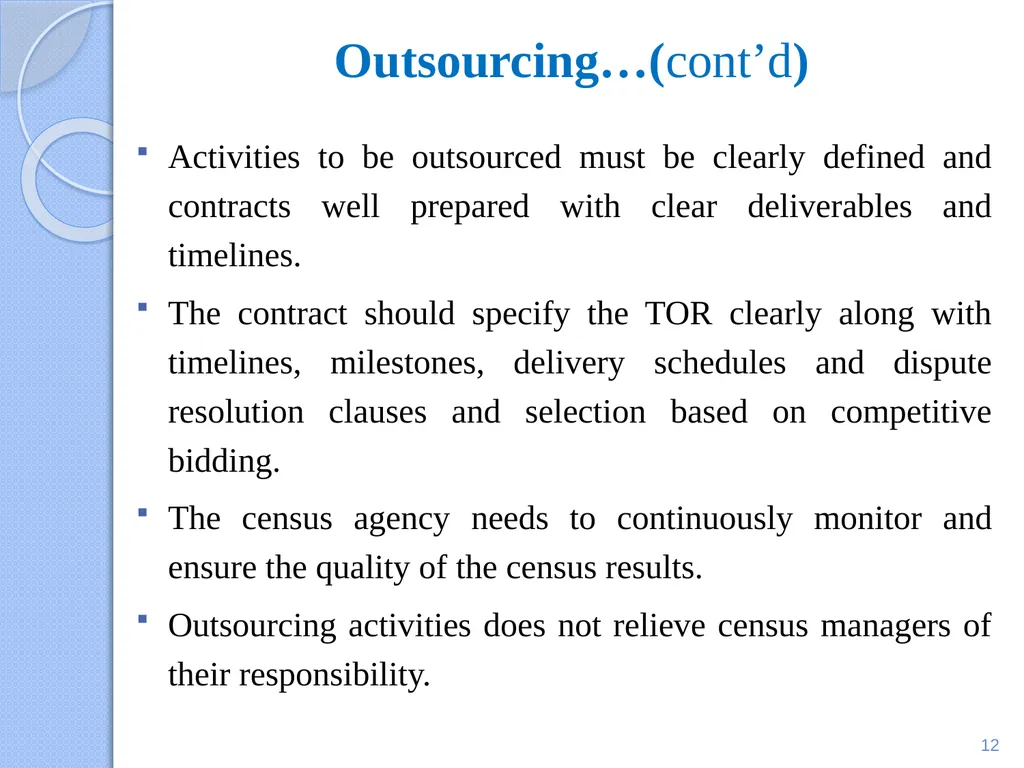
Activities to be outsourced must be clearly defined and contracts well prepared with clear deliverables and timelines.
The contract should specify the TOR clearly along with timelines, milestones, delivery schedules and dispute resolution clauses and selection based on competitive bidding.
The census agency needs to continuously monitor and ensure the quality of the census results.
Outsourcing activities does not relieve census managers of their responsibility. Outsourcing…(cont’d) 12<br>
The contract should specify the TOR clearly along with timelines, milestones, delivery schedules and dispute resolution clauses and selection based on competitive bidding.
The census agency needs to continuously monitor and ensure the quality of the census results.
Outsourcing activities does not relieve census managers of their responsibility. Outsourcing…(cont’d) 12<br>
13
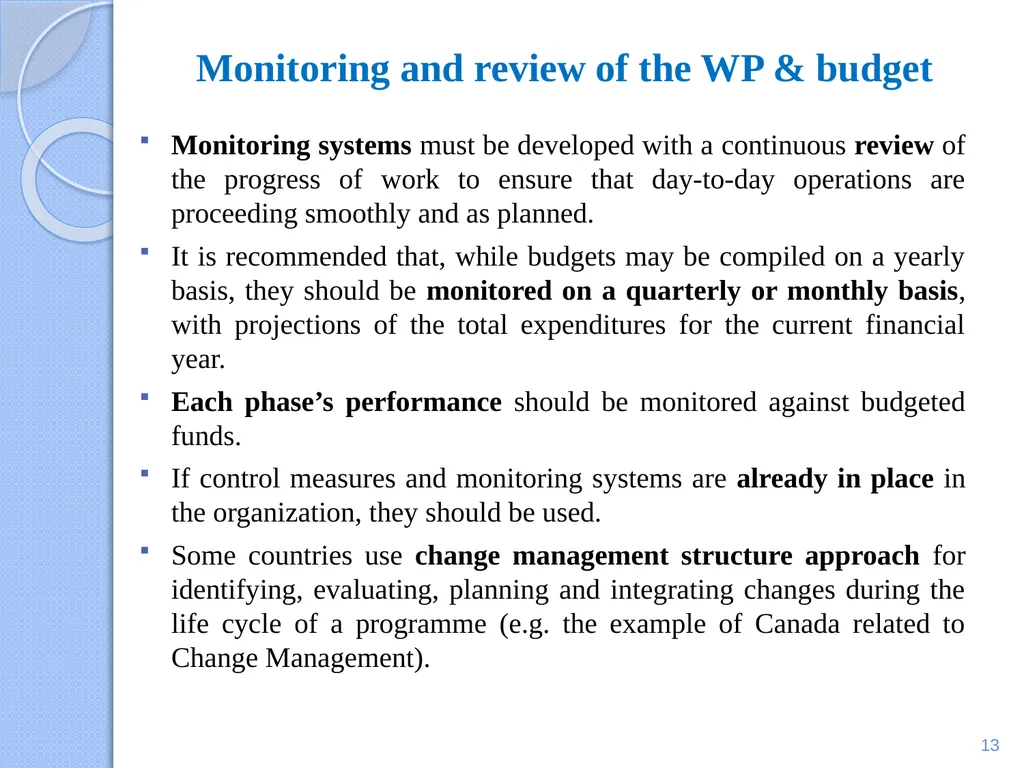
Monitoring systems must be developed with a continuous review of the progress of work to ensure that day-to-day operations are proceeding smoothly and as planned.
It is recommended that, while budgets may be compiled on a yearly basis, they should be monitored on a quarterly or monthly basis, with projections of the total expenditures for the current financial year.
Each phase’s performance should be monitored against budgeted funds.
If control measures and monitoring systems are already in place in the organization, they should be used.
Some countries use change management structure approach for identifying, evaluating, planning and integrating changes during the life cycle of a programme (e.g. the example of Canada related to Change Management). Monitoring and review of the WP & budget 13<br>
It is recommended that, while budgets may be compiled on a yearly basis, they should be monitored on a quarterly or monthly basis, with projections of the total expenditures for the current financial year.
Each phase’s performance should be monitored against budgeted funds.
If control measures and monitoring systems are already in place in the organization, they should be used.
Some countries use change management structure approach for identifying, evaluating, planning and integrating changes during the life cycle of a programme (e.g. the example of Canada related to Change Management). Monitoring and review of the WP & budget 13<br>
14
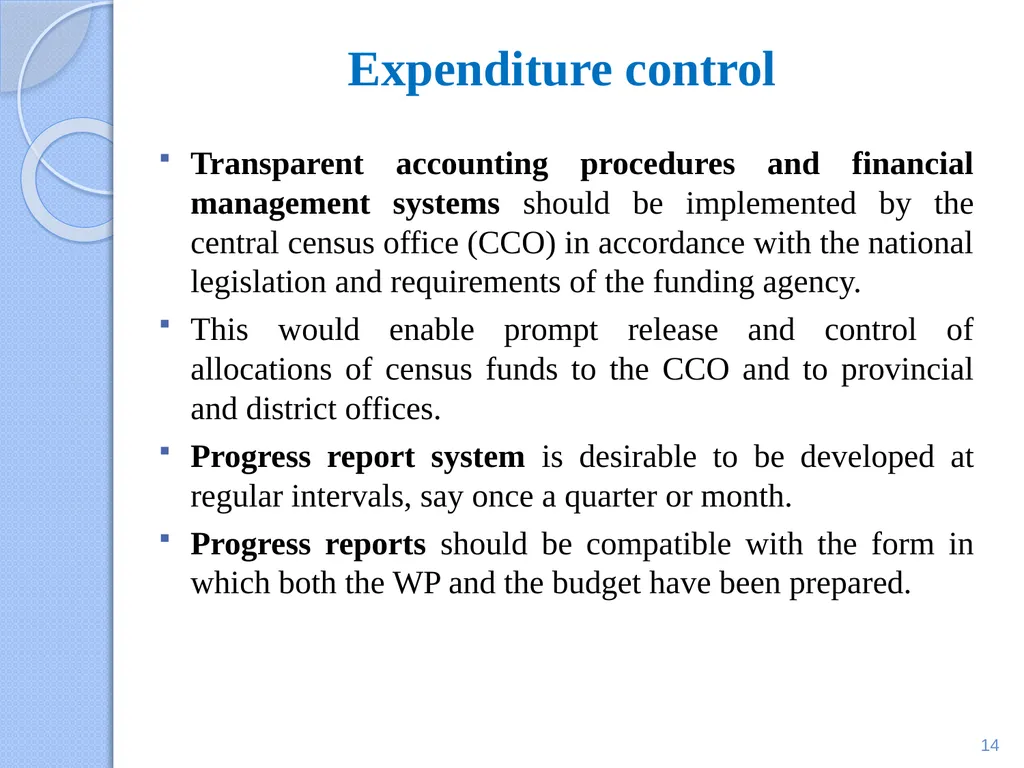
Transparent accounting procedures and financial management systems should be implemented by the central census office (CCO) in accordance with the national legislation and requirements of the funding agency.
This would enable prompt release and control of allocations of census funds to the CCO and to provincial and district offices.
Progress report system is desirable to be developed at regular intervals, say once a quarter or month.
Progress reports should be compatible with the form in which both the WP and the budget have been prepared. Expenditure control 14<br>
This would enable prompt release and control of allocations of census funds to the CCO and to provincial and district offices.
Progress report system is desirable to be developed at regular intervals, say once a quarter or month.
Progress reports should be compatible with the form in which both the WP and the budget have been prepared. Expenditure control 14<br>
15
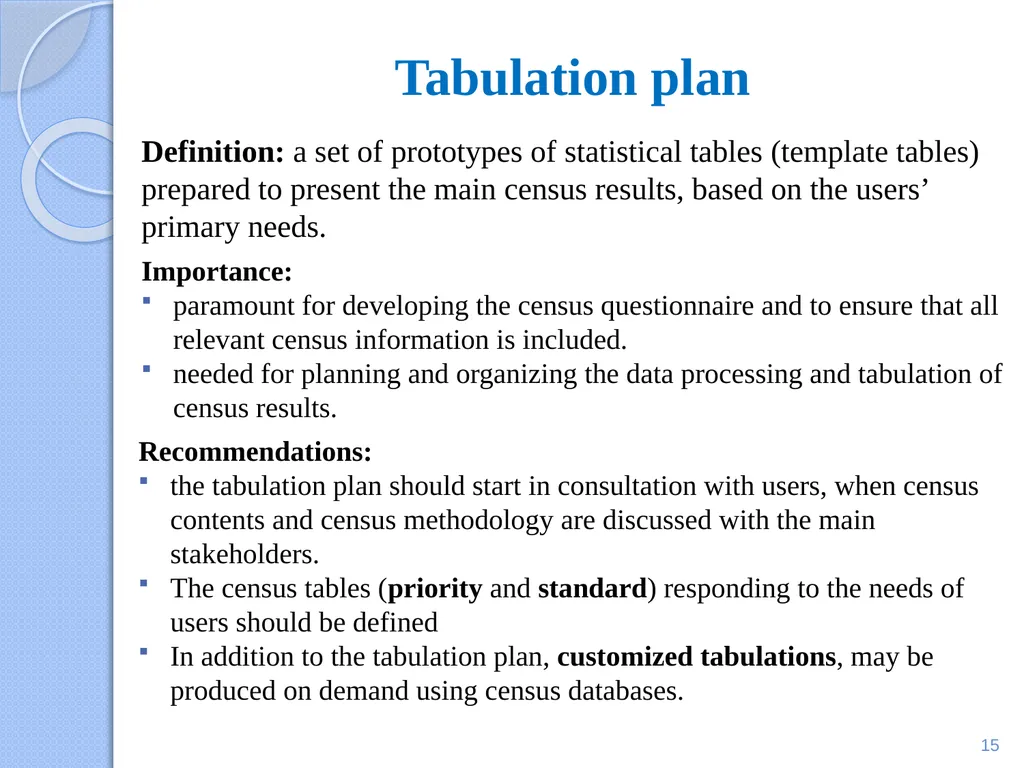
Definition: a set of prototypes of statistical tables (template tables) prepared to present the main census results, based on the users’ primary needs.
Importance:
paramount for developing the census questionnaire and to ensure that all relevant census information is included.
needed for planning and organizing the data processing and tabulation of census results. Tabulation plan 15 Recommendations:
the tabulation plan should start in consultation with users, when census contents and census methodology are discussed with the main stakeholders.
The census tables (priority and standard) responding to the needs of users should be defined
In addition to the tabulation plan, customized tabulations, may be produced on demand using census databases.<br>
Importance:
paramount for developing the census questionnaire and to ensure that all relevant census information is included.
needed for planning and organizing the data processing and tabulation of census results. Tabulation plan 15 Recommendations:
the tabulation plan should start in consultation with users, when census contents and census methodology are discussed with the main stakeholders.
The census tables (priority and standard) responding to the needs of users should be defined
In addition to the tabulation plan, customized tabulations, may be produced on demand using census databases.<br>
16
Coherence and comparability (with):
previous censuses (when available)
other statistical data
relevant and reliable administrative data sources (land cadaster information, agricultural machinery, organic farming, etc.)
international comparability (including the use of recommended classifications/ tabulation classes).
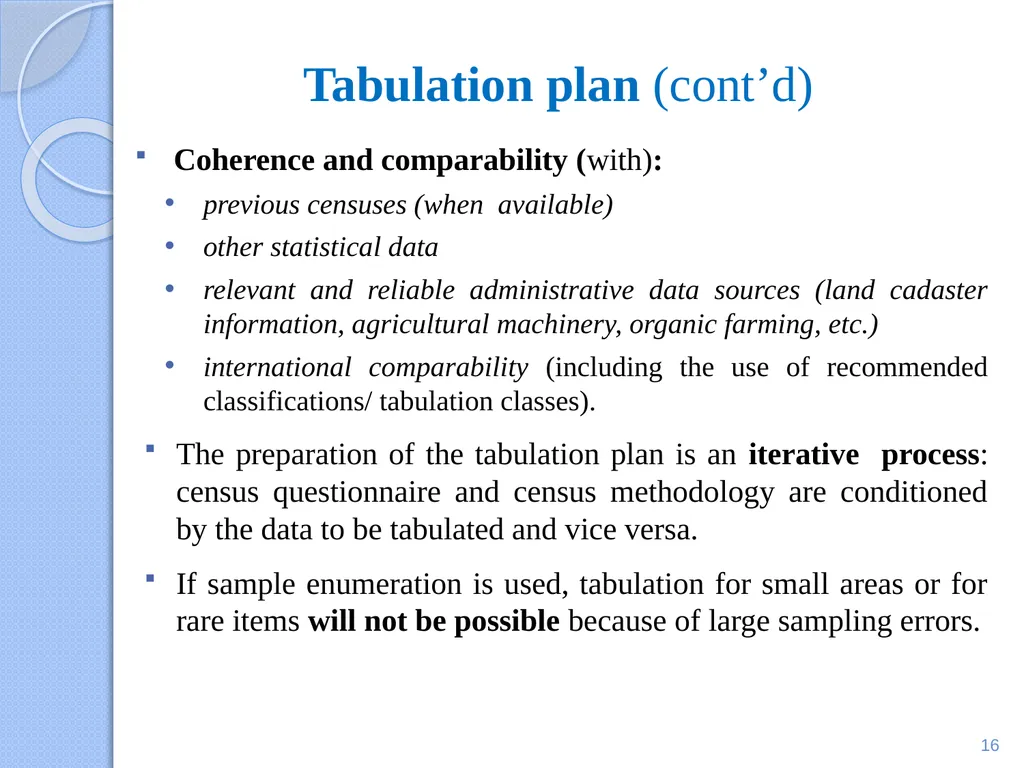
The preparation of the tabulation plan is an iterative process: census questionnaire and census methodology are conditioned by the data to be tabulated and vice versa.
If sample enumeration is used, tabulation for small areas or for rare items will not be possible because of large sampling errors. Tabulation plan (cont’d) 16<br>
previous censuses (when available)
other statistical data
relevant and reliable administrative data sources (land cadaster information, agricultural machinery, organic farming, etc.)
international comparability (including the use of recommended classifications/ tabulation classes).
The preparation of the tabulation plan is an iterative process: census questionnaire and census methodology are conditioned by the data to be tabulated and vice versa.
If sample enumeration is used, tabulation for small areas or for rare items will not be possible because of large sampling errors. Tabulation plan (cont’d) 16<br>
17
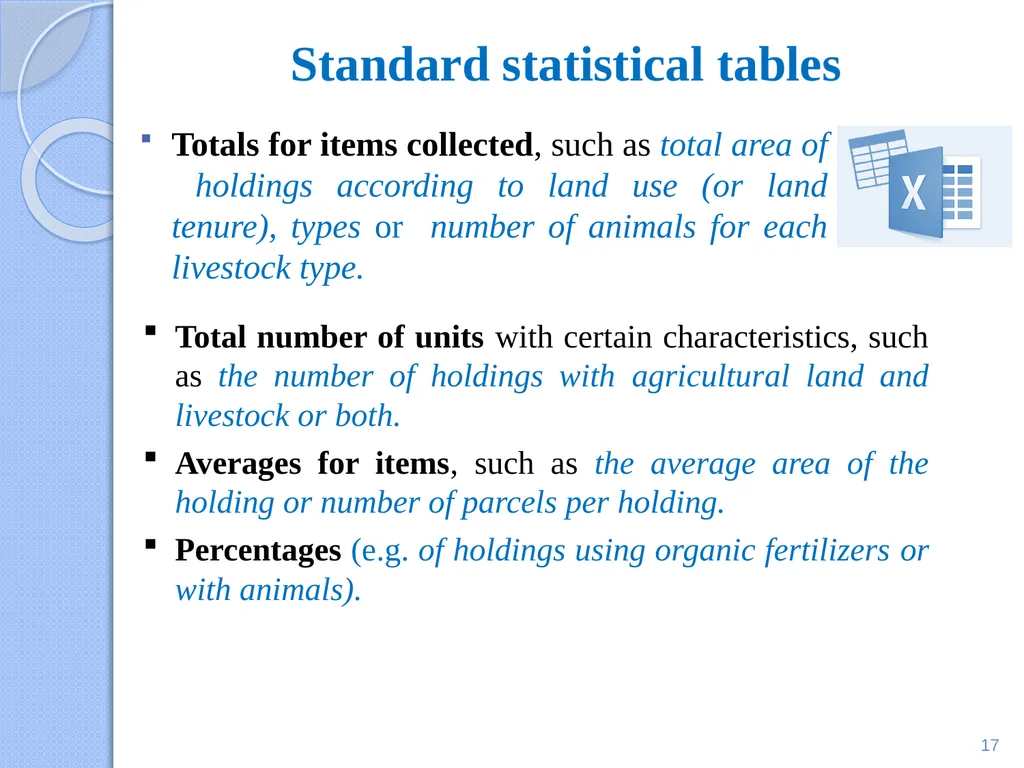
Standard statistical tables Totals for items collected, such as total area of holdings according to land use (or land tenure), types or number of animals for each livestock type. 17 Total number of units with certain characteristics, such as the number of holdings with agricultural land and livestock or both.
Averages for items, such as the average area of the holding or number of parcels per holding.
Percentages (e.g. of holdings using organic fertilizers or with animals).<br>
Averages for items, such as the average area of the holding or number of parcels per holding.
Percentages (e.g. of holdings using organic fertilizers or with animals).<br>
18
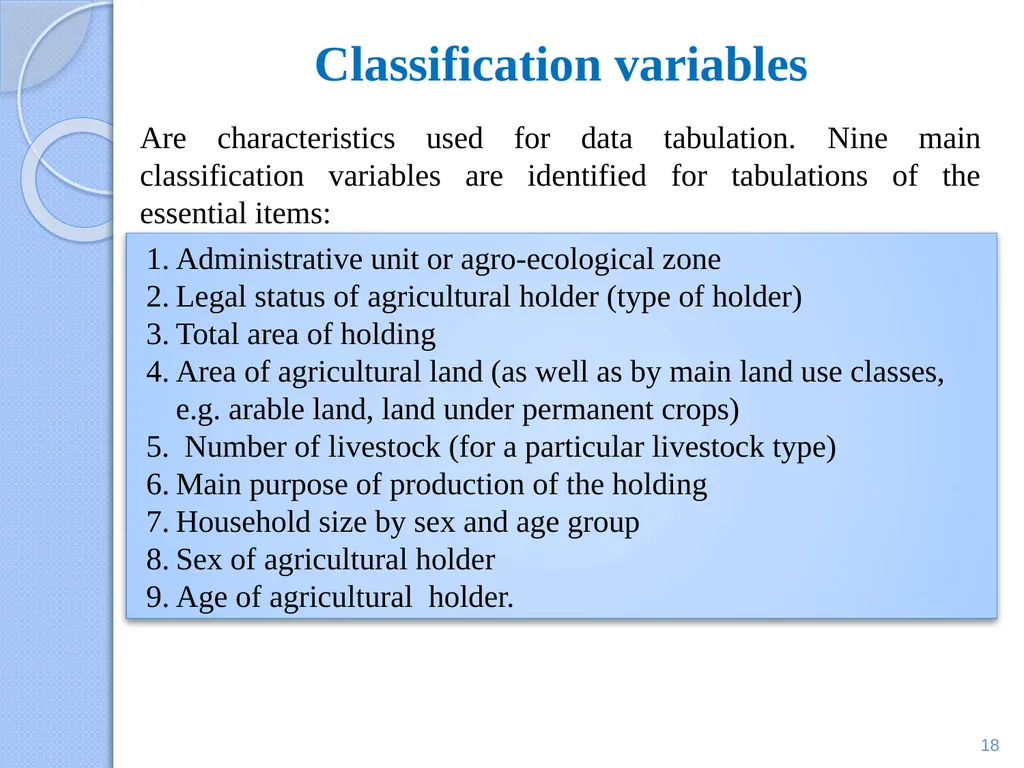
Classification variables Are characteristics used for data tabulation. Nine main classification variables are identified for tabulations of the essential items: 18 Administrative unit or agro-ecological zone
Legal status of agricultural holder (type of holder)
Total area of holding
Area of agricultural land (as well as by main land use classes, e.g. arable land, land under permanent crops)
Number of livestock (for a particular livestock type)
Main purpose of production of the holding
Household size by sex and age group
Sex of agricultural holder
Age of agricultural holder.<br>
Legal status of agricultural holder (type of holder)
Total area of holding
Area of agricultural land (as well as by main land use classes, e.g. arable land, land under permanent crops)
Number of livestock (for a particular livestock type)
Main purpose of production of the holding
Household size by sex and age group
Sex of agricultural holder
Age of agricultural holder.<br>
19
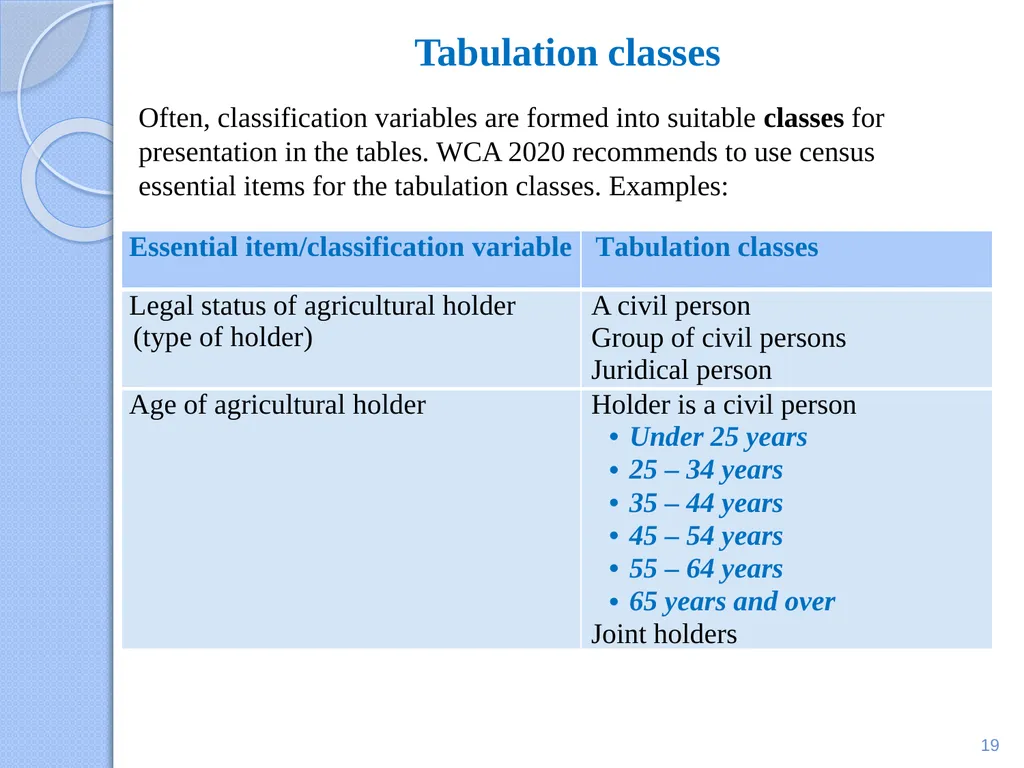
Tabulation classes Often, classification variables are formed into suitable classes for presentation in the tables. WCA 2020 recommends to use census essential items for the tabulation classes. Examples: 19<br>
20
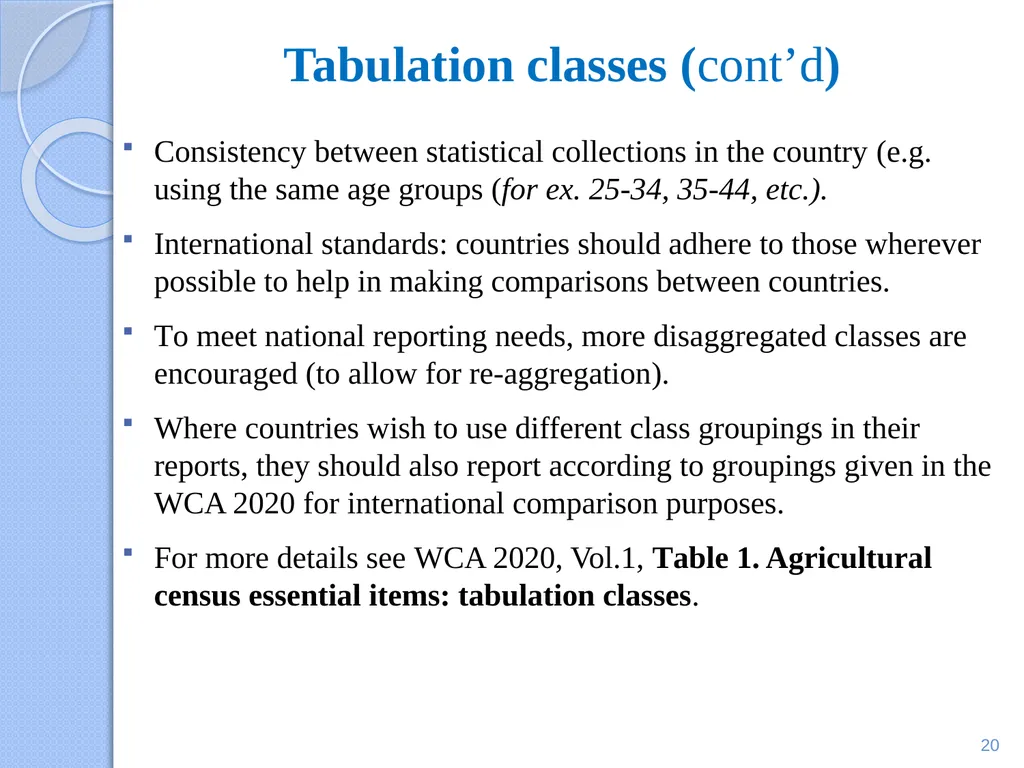
Tabulation classes (cont’d) Consistency between statistical collections in the country (e.g. using the same age groups (for ex. 25-34, 35-44, etc.).
International standards: countries should adhere to those wherever possible to help in making comparisons between countries.
To meet national reporting needs, more disaggregated classes are encouraged (to allow for re-aggregation).
Where countries wish to use different class groupings in their reports, they should also report according to groupings given in the WCA 2020 for international comparison purposes.
For more details see WCA 2020, Vol.1, Table 1. Agricultural census essential items: tabulation classes. 20<br>
International standards: countries should adhere to those wherever possible to help in making comparisons between countries.
To meet national reporting needs, more disaggregated classes are encouraged (to allow for re-aggregation).
Where countries wish to use different class groupings in their reports, they should also report according to groupings given in the WCA 2020 for international comparison purposes.
For more details see WCA 2020, Vol.1, Table 1. Agricultural census essential items: tabulation classes. 20<br>
21
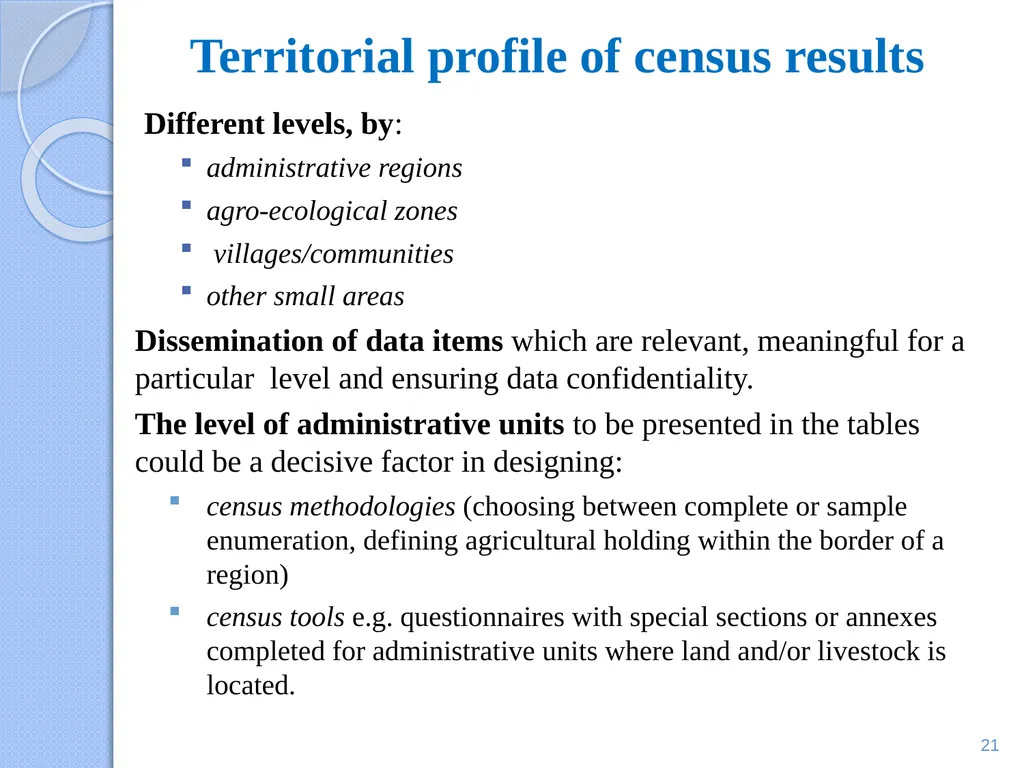
Territorial profile of census results Different levels, by:
administrative regions
agro-ecological zones
villages/communities
other small areas
Dissemination of data items which are relevant, meaningful for a particular level and ensuring data confidentiality.
The level of administrative units to be presented in the tables could be a decisive factor in designing:
census methodologies (choosing between complete or sample enumeration, defining agricultural holding within the border of a region)
census tools e.g. questionnaires with special sections or annexes completed for administrative units where land and/or livestock is located. 21<br>
administrative regions
agro-ecological zones
villages/communities
other small areas
Dissemination of data items which are relevant, meaningful for a particular level and ensuring data confidentiality.
The level of administrative units to be presented in the tables could be a decisive factor in designing:
census methodologies (choosing between complete or sample enumeration, defining agricultural holding within the border of a region)
census tools e.g. questionnaires with special sections or annexes completed for administrative units where land and/or livestock is located. 21<br>
22
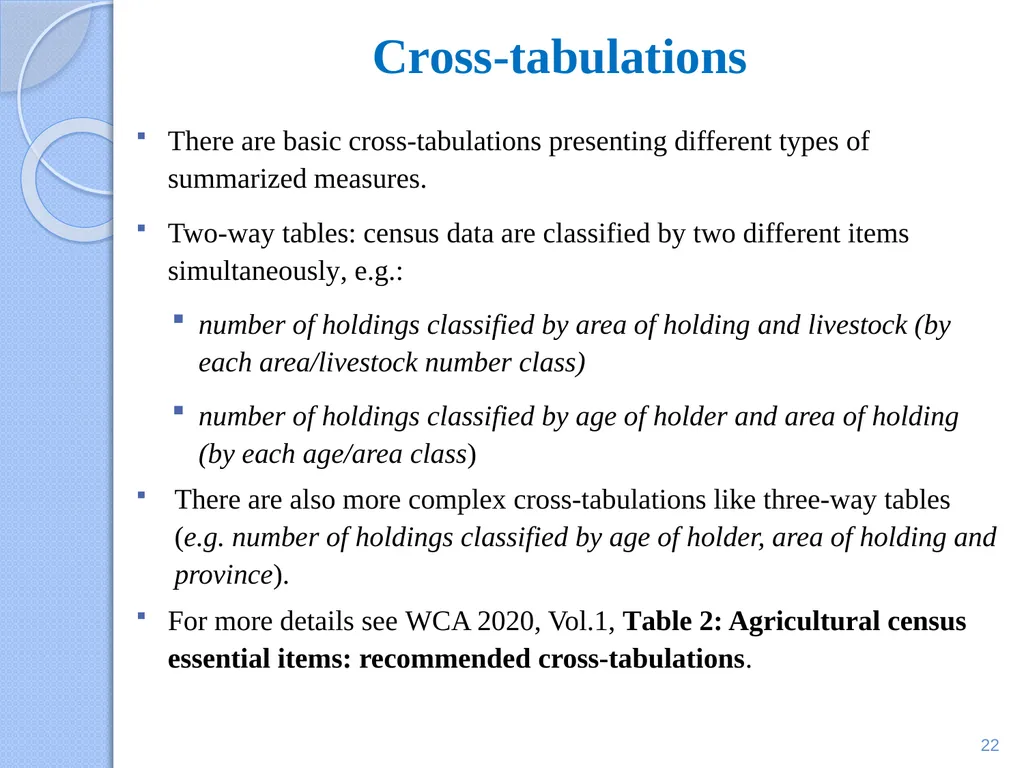
Cross-tabulations There are basic cross-tabulations presenting different types of summarized measures.
Two-way tables: census data are classified by two different items simultaneously, e.g.:
number of holdings classified by area of holding and livestock (by each area/livestock number class)
number of holdings classified by age of holder and area of holding (by each age/area class)
There are also more complex cross-tabulations like three-way tables (e.g. number of holdings classified by age of holder, area of holding and province).
For more details see WCA 2020, Vol.1, Table 2: Agricultural census essential items: recommended cross-tabulations. 22<br>
Two-way tables: census data are classified by two different items simultaneously, e.g.:
number of holdings classified by area of holding and livestock (by each area/livestock number class)
number of holdings classified by age of holder and area of holding (by each age/area class)
There are also more complex cross-tabulations like three-way tables (e.g. number of holdings classified by age of holder, area of holding and province).
For more details see WCA 2020, Vol.1, Table 2: Agricultural census essential items: recommended cross-tabulations. 22<br>
23
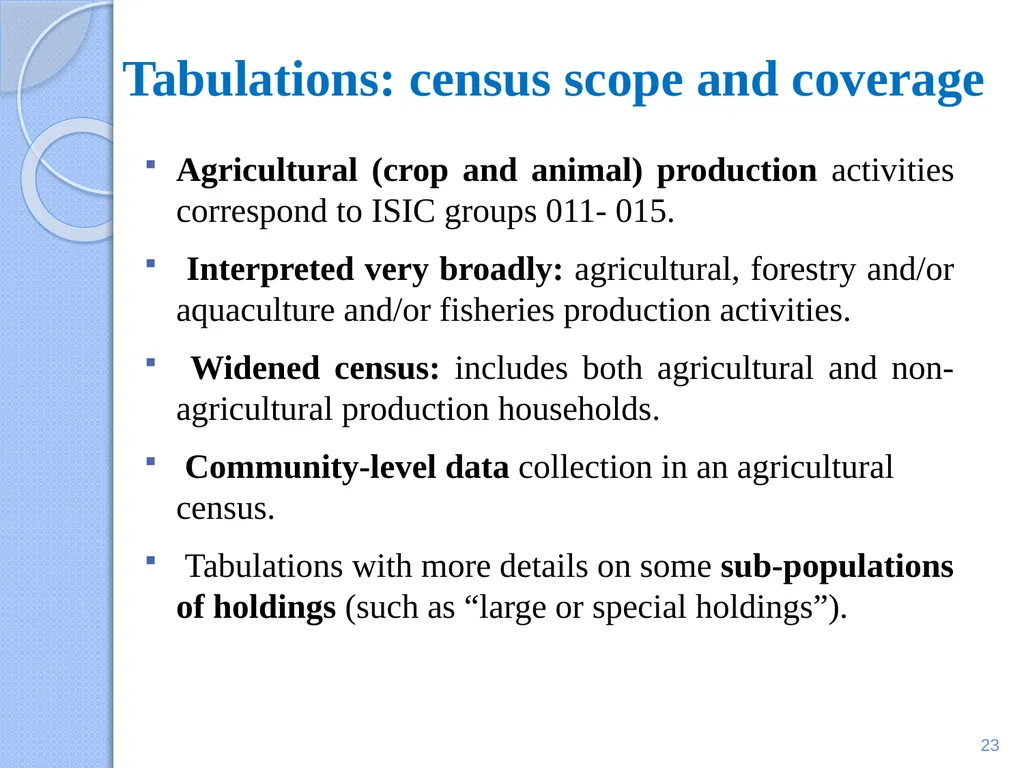
Tabulations: census scope and coverage Agricultural (crop and animal) production activities correspond to ISIC groups 011- 015.
Interpreted very broadly: agricultural, forestry and/or aquaculture and/or fisheries production activities.
Widened census: includes both agricultural and non-agricultural production households.
Community-level data collection in an agricultural census.
Tabulations with more details on some sub-populations of holdings (such as “large or special holdings”). 23<br>
Interpreted very broadly: agricultural, forestry and/or aquaculture and/or fisheries production activities.
Widened census: includes both agricultural and non-agricultural production households.
Community-level data collection in an agricultural census.
Tabulations with more details on some sub-populations of holdings (such as “large or special holdings”). 23<br>
24
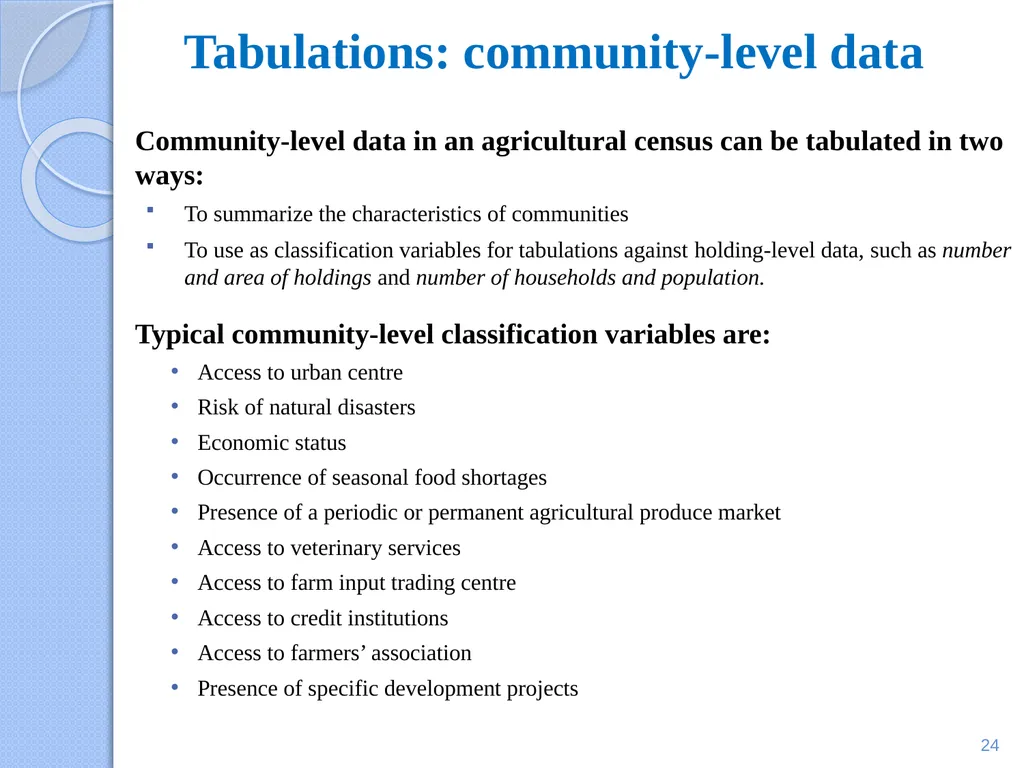
Tabulations: community-level data Community-level data in an agricultural census can be tabulated in two ways:
To summarize the characteristics of communities
To use as classification variables for tabulations against holding-level data, such as number and area of holdings and number of households and population.
Typical community-level classification variables are:
Access to urban centre
Risk of natural disasters
Economic status
Occurrence of seasonal food shortages
Presence of a periodic or permanent agricultural produce market
Access to veterinary services
Access to farm input trading centre
Access to credit institutions
Access to farmers’ association
Presence of specific development projects 24<br>
To summarize the characteristics of communities
To use as classification variables for tabulations against holding-level data, such as number and area of holdings and number of households and population.
Typical community-level classification variables are:
Access to urban centre
Risk of natural disasters
Economic status
Occurrence of seasonal food shortages
Presence of a periodic or permanent agricultural produce market
Access to veterinary services
Access to farm input trading centre
Access to credit institutions
Access to farmers’ association
Presence of specific development projects 24<br>
25
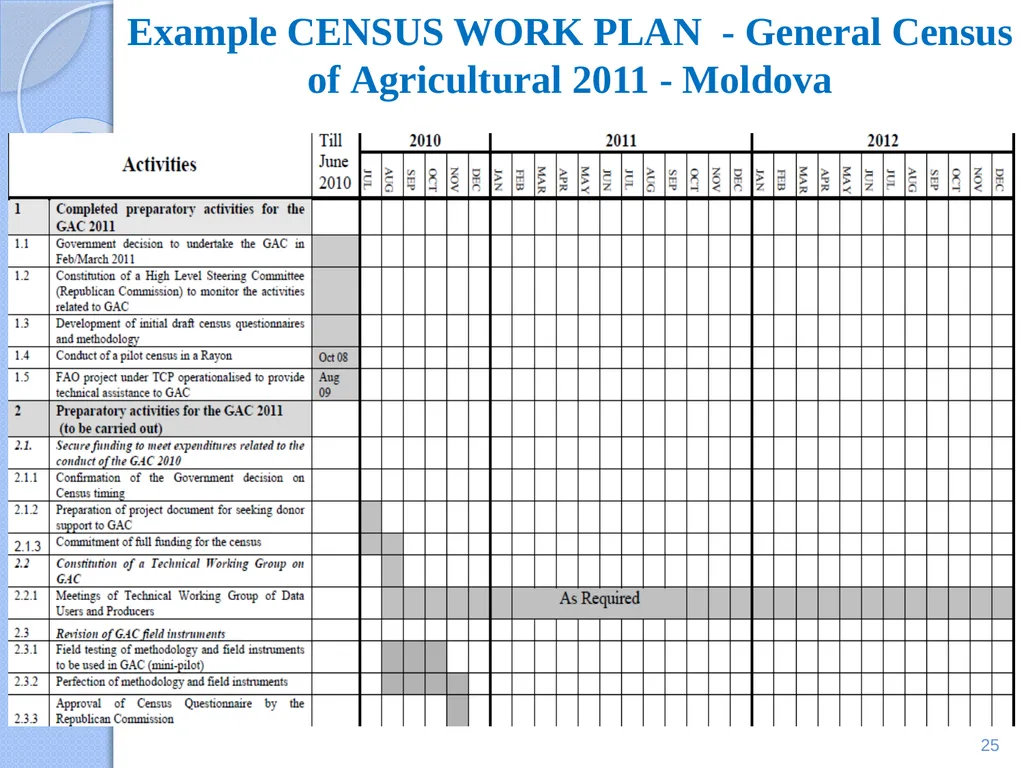
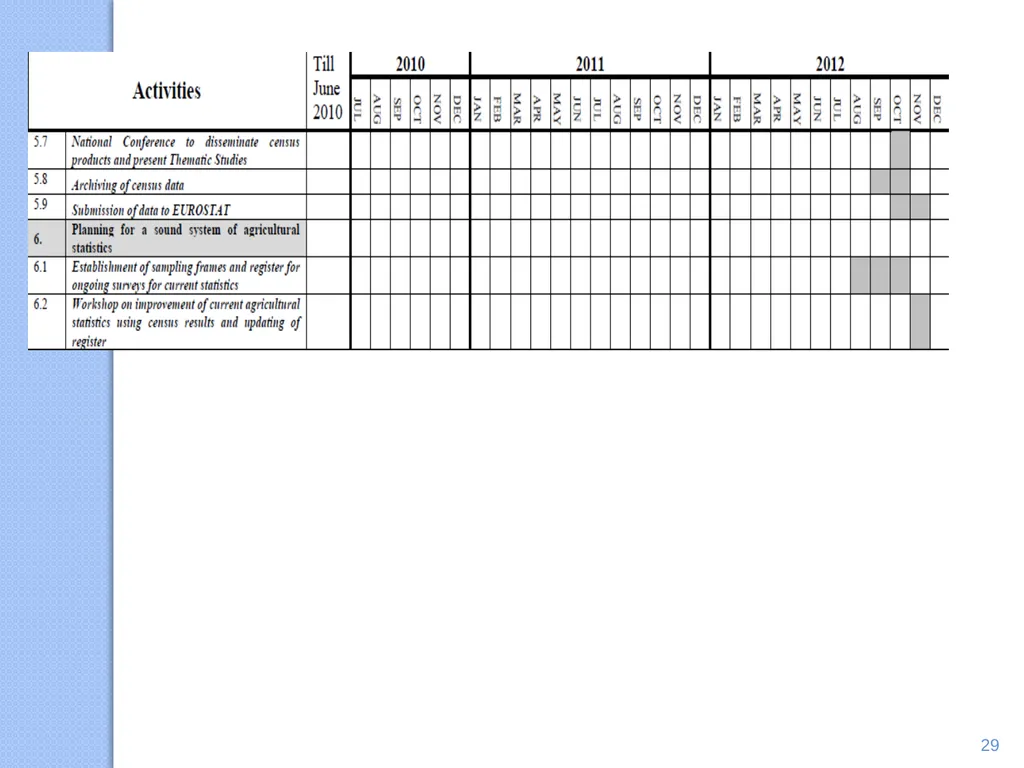
Example CENSUS WORK PLAN - General Census of Agricultural 2011 - Moldova 25<br>
26
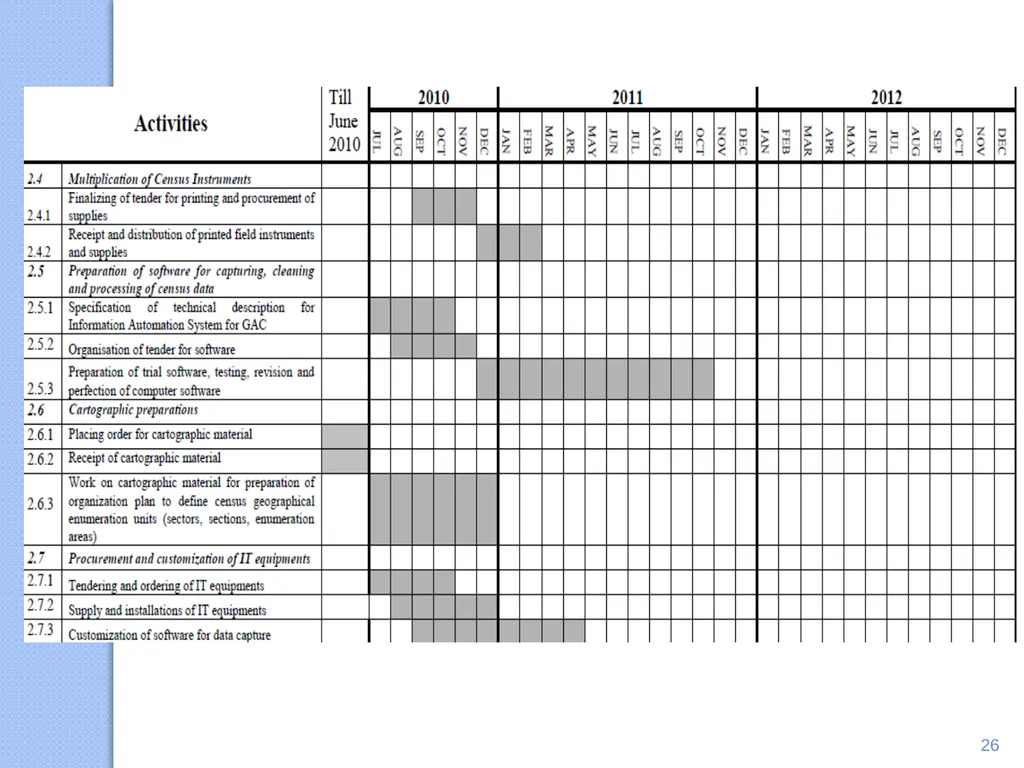
26<br>
27
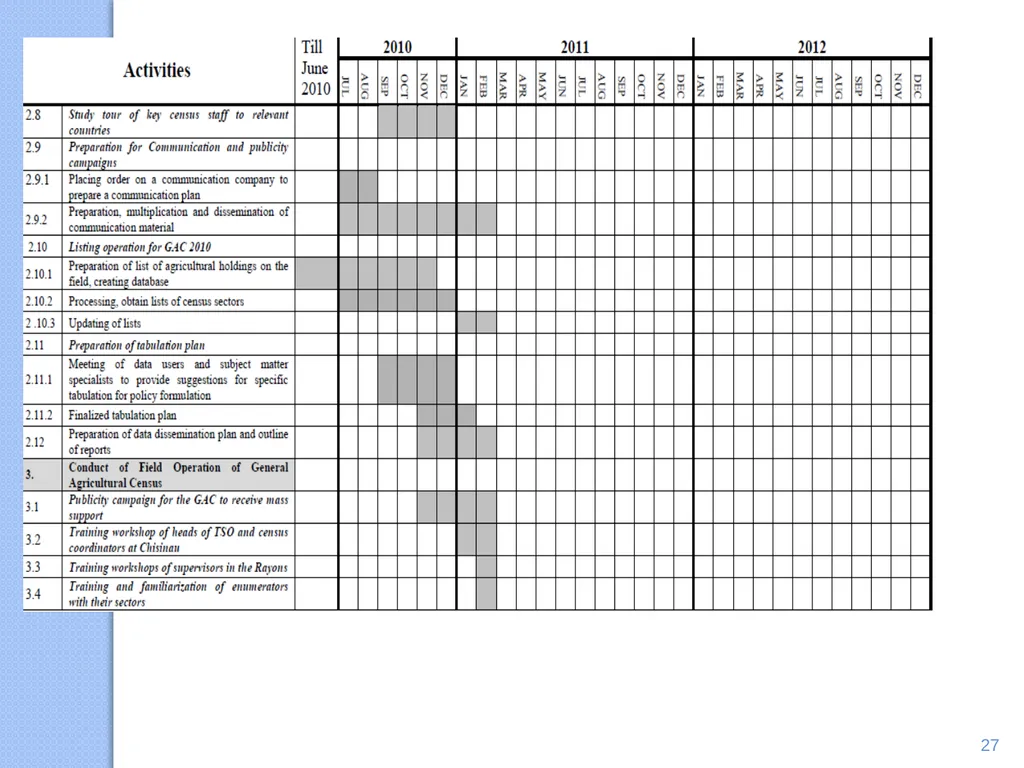
27<br>
28
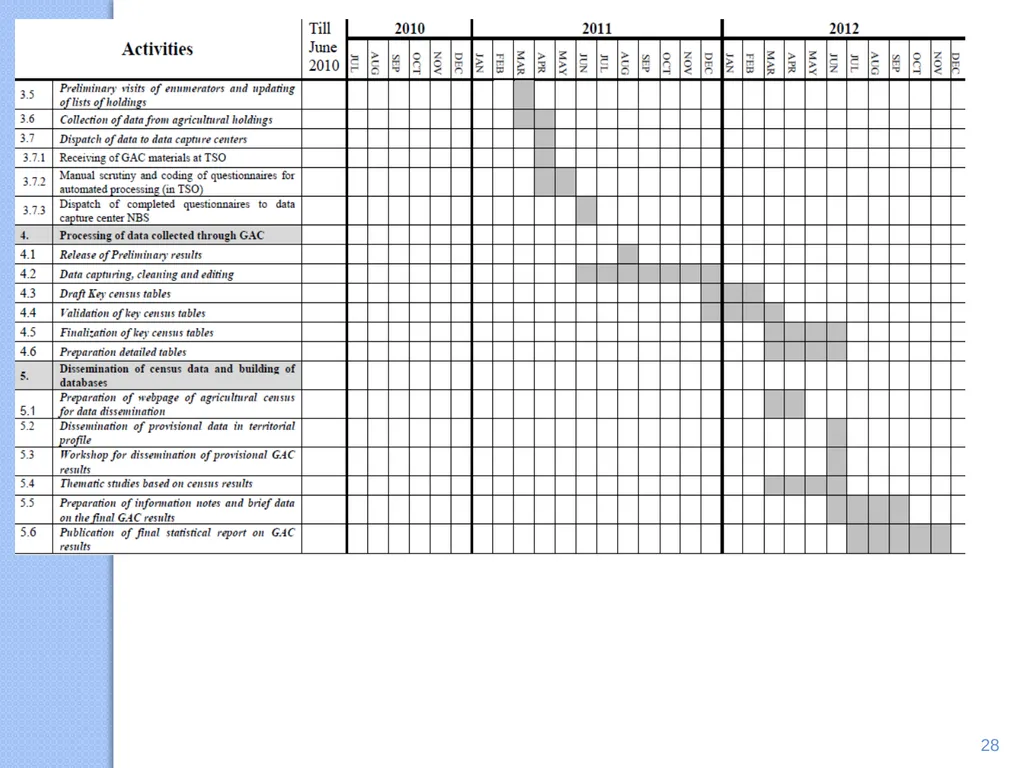
28<br>
29
29<br>
30
The census of agriculture and horticulture (June 2010) conducted under the European law had a questionnaire with 6 sections:
Land area in the holding;
Grassland and non-agriculture land area;
Crop and fallow land area;
Horticulture area;
Livestock number;
People working in the holding.
Several reports were produced.The main ones were the 'Land use and livestock on agricultural holdings' and 'Labour on agricultural holding on 1 June'.
For the 'Land use and livestock on agricultural holdings‘. 11 tables were published in the annex and the body of the report comprised text on analysis of data covering, land use and utilized area, croppable area by type of crop and livestock number by type of livestock. Analysis was supported by figures and maps. 30 Country example - 2010 Census of Agriculture – UK
Census report<br>
Land area in the holding;
Grassland and non-agriculture land area;
Crop and fallow land area;
Horticulture area;
Livestock number;
People working in the holding.
Several reports were produced.The main ones were the 'Land use and livestock on agricultural holdings' and 'Labour on agricultural holding on 1 June'.
For the 'Land use and livestock on agricultural holdings‘. 11 tables were published in the annex and the body of the report comprised text on analysis of data covering, land use and utilized area, croppable area by type of crop and livestock number by type of livestock. Analysis was supported by figures and maps. 30 Country example - 2010 Census of Agriculture – UK
Census report<br>
31
The tables in the annex of the report on 'Land use and livestock on agricultural holdings' were:
Table 1 – Summary of land use on agricultural holdings;
Table 2 – Area of owned and rented land on agricultural holdings;
Table 3 – Arable crops;
Table 4 – Fruit and vegetables grown in the open;
Table 5 – Hardy Nursery stock;
Table 6– Glasshouses and protected crops;
Table 7 – Cattle and calves in agricultural holdings;
Table 8 – Pigs on agricultural holdings;
Table 9 – Sheep and lambs on agricultural holdings
Table 10 – Poultry agricultural holdings
Table 11– All other livestock on agricultural holdings 31 Country example - 2010 Census of Agriculture – UK
Census report<br>
Table 1 – Summary of land use on agricultural holdings;
Table 2 – Area of owned and rented land on agricultural holdings;
Table 3 – Arable crops;
Table 4 – Fruit and vegetables grown in the open;
Table 5 – Hardy Nursery stock;
Table 6– Glasshouses and protected crops;
Table 7 – Cattle and calves in agricultural holdings;
Table 8 – Pigs on agricultural holdings;
Table 9 – Sheep and lambs on agricultural holdings
Table 10 – Poultry agricultural holdings
Table 11– All other livestock on agricultural holdings 31 Country example - 2010 Census of Agriculture – UK
Census report<br>
32
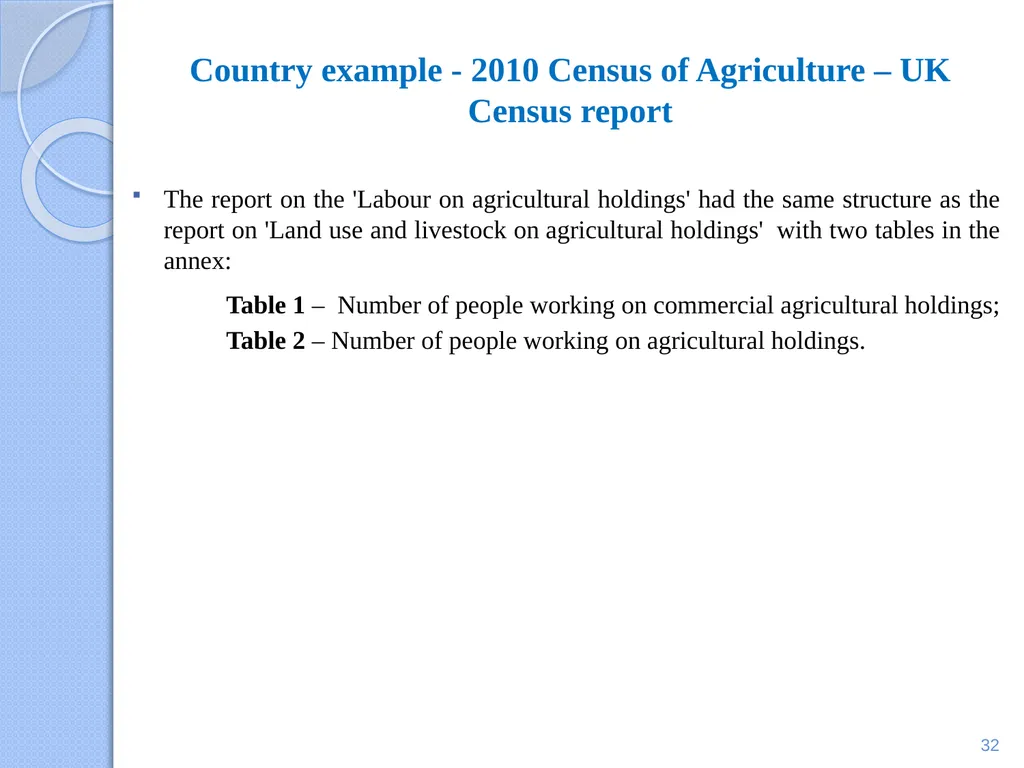
The report on the 'Labour on agricultural holdings' had the same structure as the report on 'Land use and livestock on agricultural holdings' with two tables in the annex:
Table 1 – Number of people working on commercial agricultural holdings;
Table 2 – Number of people working on agricultural holdings. 32 Country example - 2010 Census of Agriculture – UK
Census report<br>
Table 1 – Number of people working on commercial agricultural holdings;
Table 2 – Number of people working on agricultural holdings. 32 Country example - 2010 Census of Agriculture – UK
Census report<br>
33
THANK YOU! 33<br>