
Emerging Technologies: T&E Issues and
AM
Published · 14 slides · 0 views

1 / 1




Description
Emerging Technologies: TE Issues and Recommendations Software-Enabled Systems and Cybersecurity Hypersonics Directed Energy Autonomous Systems and Artificial Intelligence Fully Networked Command, Control, and Communications Technology
Related Topics
Share
Embed code
Download this presentation From Below
"Emerging Technologies: T&E Issues and" is the property of its rightful owner. Permission is granted to download and print the materials on this website for personal, non-commercial use only, and to display it on your personal computer provided you do not modify the materials and that you retain all copyright notices contained in the materials. By downloading content from our website, you accept the terms of this agreement.
Presentation Transcript
01
Emerging Technologies:
T&E Issues and Recommendations<br>
02
Software-Enabled Systems and Cybersecurity
Hypersonics
Directed Energy
Autonomous Systems and Artificial Intelligence
Fully Networked Command, Control, and Communications Technology
Space
Fifth Generation Communications Networks (5G)
Biotechnology
Microelectronics
Quantum Science and Technology DOD’s Emerging Technologies<br>
Hypersonics
Directed Energy
Autonomous Systems and Artificial Intelligence
Fully Networked Command, Control, and Communications Technology
Space
Fifth Generation Communications Networks (5G)
Biotechnology
Microelectronics
Quantum Science and Technology DOD’s Emerging Technologies<br>
03
Software-Enabled Systems and Cybersecurity
Hypersonics
Directed Energy
Autonomous Systems and Artificial Intelligence
Fully Networked Command, Control, and Communications Technology
Space
Fifth Generation Communications Networks (5G)
Biotechnology
Microelectronics
Quantum Science and Technology DOD’s Emerging Technologies<br>
Hypersonics
Directed Energy
Autonomous Systems and Artificial Intelligence
Fully Networked Command, Control, and Communications Technology
Space
Fifth Generation Communications Networks (5G)
Biotechnology
Microelectronics
Quantum Science and Technology DOD’s Emerging Technologies<br>
04
Situated Agency
Sensing the environment, assessing the situation, reasoning about it, making decisions to reach a goal, and then acting on it
Multi-Agent Emergence
Interacting with other agents, human or otherwise, affording novel emergent behavior of the group/team
Experiential Learning
“Learning” new behaviors over time and experience…
Desired properties
Proficiency, trustworthiness, flexibility Enabled by Artificial Intelligence Key Attributes of Autonomous Systems Adaptive Cognition
Using different modes of “thinking”, from low-level rules, to high-level reasoning<br>
Sensing the environment, assessing the situation, reasoning about it, making decisions to reach a goal, and then acting on it
Multi-Agent Emergence
Interacting with other agents, human or otherwise, affording novel emergent behavior of the group/team
Experiential Learning
“Learning” new behaviors over time and experience…
Desired properties
Proficiency, trustworthiness, flexibility Enabled by Artificial Intelligence Key Attributes of Autonomous Systems Adaptive Cognition
Using different modes of “thinking”, from low-level rules, to high-level reasoning<br>
05
Situated Agency
Sensing the environment, assessing the situation, reasoning about it, making decisions to reach a goal, and then acting on it
Multi-Agent Emergence
Interacting with other agents, human or otherwise, affording novel emergent behavior of the group/team
Experiential Learning
“Learning” new behaviors over time and experience…
Desired properties
Proficiency, trustworthiness, flexibility Enabled by Artificial Intelligence Key Attributes of Autonomous Systems Adaptive Cognition
Using different modes of “thinking”, from low-level rules, to high-level reasoning<br>
Sensing the environment, assessing the situation, reasoning about it, making decisions to reach a goal, and then acting on it
Multi-Agent Emergence
Interacting with other agents, human or otherwise, affording novel emergent behavior of the group/team
Experiential Learning
“Learning” new behaviors over time and experience…
Desired properties
Proficiency, trustworthiness, flexibility Enabled by Artificial Intelligence Key Attributes of Autonomous Systems Adaptive Cognition
Using different modes of “thinking”, from low-level rules, to high-level reasoning<br>
06
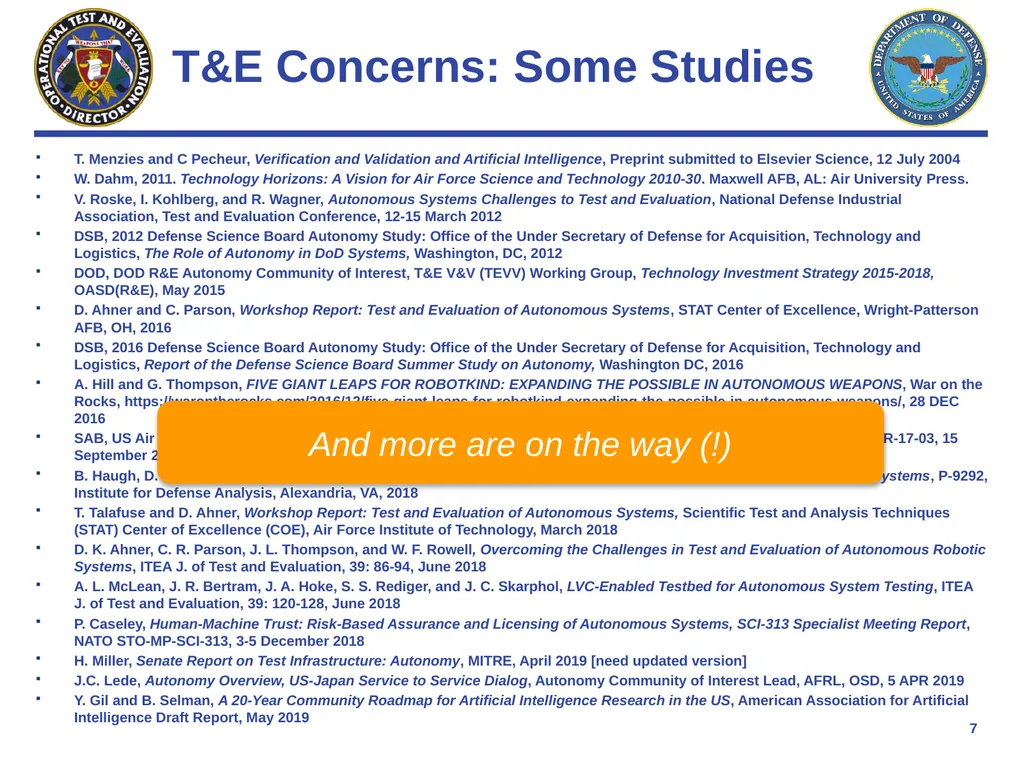
T. Menzies and C Pecheur, Verification and Validation and Artificial Intelligence, Preprint submitted to Elsevier Science, 12 July 2004
W. Dahm, 2011. Technology Horizons: A Vision for Air Force Science and Technology 2010-30. Maxwell AFB, AL: Air University Press.
V. Roske, I. Kohlberg, and R. Wagner, Autonomous Systems Challenges to Test and Evaluation, National Defense Industrial Association, Test and Evaluation Conference, 12-15 March 2012
DSB, 2012 Defense Science Board Autonomy Study: Office of the Under Secretary of Defense for Acquisition, Technology and Logistics, The Role of Autonomy in DoD Systems, Washington, DC, 2012
DOD, DOD R&E Autonomy Community of Interest, T&E V&V (TEVV) Working Group, Technology Investment Strategy 2015-2018, OASD(R&E), May 2015
D. Ahner and C. Parson, Workshop Report: Test and Evaluation of Autonomous Systems, STAT Center of Excellence, Wright-Patterson AFB, OH, 2016
DSB, 2016 Defense Science Board Autonomy Study: Office of the Under Secretary of Defense for Acquisition, Technology and Logistics, Report of the Defense Science Board Summer Study on Autonomy, Washington DC, 2016
A. Hill and G. Thompson, FIVE GIANT LEAPS FOR ROBOTKIND: EXPANDING THE POSSIBLE IN AUTONOMOUS WEAPONS, War on the Rocks, https://warontherocks.com/2016/12/five-giant-leaps-for-robotkind-expanding-the-possible-in-autonomous-weapons/, 28 DEC 2016
SAB, US Air Force Scientific Advisory Board, Adapting Air Force Test and Evaluation to Emerging System Needs, SAB-TR-17-03, 15 September 2017
B. Haugh, D. Sparrow, and D. Tate, The Status of Test, Evaluation, Verification, and Validation (TEV&V) of Autonomous Systems, P-9292, Institute for Defense Analysis, Alexandria, VA, 2018
T. Talafuse and D. Ahner, Workshop Report: Test and Evaluation of Autonomous Systems, Scientific Test and Analysis Techniques (STAT) Center of Excellence (COE), Air Force Institute of Technology, March 2018
D. K. Ahner, C. R. Parson, J. L. Thompson, and W. F. Rowell, Overcoming the Challenges in Test and Evaluation of Autonomous Robotic Systems, ITEA J. of Test and Evaluation, 39: 86-94, June 2018
A. L. McLean, J. R. Bertram, J. A. Hoke, S. S. Rediger, and J. C. Skarphol, LVC-Enabled Testbed for Autonomous System Testing, ITEA J. of Test and Evaluation, 39: 120-128, June 2018
P. Caseley, Human-Machine Trust: Risk-Based Assurance and Licensing of Autonomous Systems, SCI-313 Specialist Meeting Report, NATO STO-MP-SCI-313, 3-5 December 2018
H. Miller, Senate Report on Test Infrastructure: Autonomy, MITRE, April 2019 [need updated version]
J.C. Lede, Autonomy Overview, US-Japan Service to Service Dialog, Autonomy Community of Interest Lead, AFRL, OSD, 5 APR 2019
Y. Gil and B. Selman, A 20-Year Community Roadmap for Artificial Intelligence Research in the US, American Association for Artificial Intelligence Draft Report, May 2019 T&E Concerns: Some Studies<br>
W. Dahm, 2011. Technology Horizons: A Vision for Air Force Science and Technology 2010-30. Maxwell AFB, AL: Air University Press.
V. Roske, I. Kohlberg, and R. Wagner, Autonomous Systems Challenges to Test and Evaluation, National Defense Industrial Association, Test and Evaluation Conference, 12-15 March 2012
DSB, 2012 Defense Science Board Autonomy Study: Office of the Under Secretary of Defense for Acquisition, Technology and Logistics, The Role of Autonomy in DoD Systems, Washington, DC, 2012
DOD, DOD R&E Autonomy Community of Interest, T&E V&V (TEVV) Working Group, Technology Investment Strategy 2015-2018, OASD(R&E), May 2015
D. Ahner and C. Parson, Workshop Report: Test and Evaluation of Autonomous Systems, STAT Center of Excellence, Wright-Patterson AFB, OH, 2016
DSB, 2016 Defense Science Board Autonomy Study: Office of the Under Secretary of Defense for Acquisition, Technology and Logistics, Report of the Defense Science Board Summer Study on Autonomy, Washington DC, 2016
A. Hill and G. Thompson, FIVE GIANT LEAPS FOR ROBOTKIND: EXPANDING THE POSSIBLE IN AUTONOMOUS WEAPONS, War on the Rocks, https://warontherocks.com/2016/12/five-giant-leaps-for-robotkind-expanding-the-possible-in-autonomous-weapons/, 28 DEC 2016
SAB, US Air Force Scientific Advisory Board, Adapting Air Force Test and Evaluation to Emerging System Needs, SAB-TR-17-03, 15 September 2017
B. Haugh, D. Sparrow, and D. Tate, The Status of Test, Evaluation, Verification, and Validation (TEV&V) of Autonomous Systems, P-9292, Institute for Defense Analysis, Alexandria, VA, 2018
T. Talafuse and D. Ahner, Workshop Report: Test and Evaluation of Autonomous Systems, Scientific Test and Analysis Techniques (STAT) Center of Excellence (COE), Air Force Institute of Technology, March 2018
D. K. Ahner, C. R. Parson, J. L. Thompson, and W. F. Rowell, Overcoming the Challenges in Test and Evaluation of Autonomous Robotic Systems, ITEA J. of Test and Evaluation, 39: 86-94, June 2018
A. L. McLean, J. R. Bertram, J. A. Hoke, S. S. Rediger, and J. C. Skarphol, LVC-Enabled Testbed for Autonomous System Testing, ITEA J. of Test and Evaluation, 39: 120-128, June 2018
P. Caseley, Human-Machine Trust: Risk-Based Assurance and Licensing of Autonomous Systems, SCI-313 Specialist Meeting Report, NATO STO-MP-SCI-313, 3-5 December 2018
H. Miller, Senate Report on Test Infrastructure: Autonomy, MITRE, April 2019 [need updated version]
J.C. Lede, Autonomy Overview, US-Japan Service to Service Dialog, Autonomy Community of Interest Lead, AFRL, OSD, 5 APR 2019
Y. Gil and B. Selman, A 20-Year Community Roadmap for Artificial Intelligence Research in the US, American Association for Artificial Intelligence Draft Report, May 2019 T&E Concerns: Some Studies<br>
07
T. Menzies and C Pecheur, Verification and Validation and Artificial Intelligence, Preprint submitted to Elsevier Science, 12 July 2004
W. Dahm, 2011. Technology Horizons: A Vision for Air Force Science and Technology 2010-30. Maxwell AFB, AL: Air University Press.
V. Roske, I. Kohlberg, and R. Wagner, Autonomous Systems Challenges to Test and Evaluation, National Defense Industrial Association, Test and Evaluation Conference, 12-15 March 2012
DSB, 2012 Defense Science Board Autonomy Study: Office of the Under Secretary of Defense for Acquisition, Technology and Logistics, The Role of Autonomy in DoD Systems, Washington, DC, 2012
DOD, DOD R&E Autonomy Community of Interest, T&E V&V (TEVV) Working Group, Technology Investment Strategy 2015-2018, OASD(R&E), May 2015
D. Ahner and C. Parson, Workshop Report: Test and Evaluation of Autonomous Systems, STAT Center of Excellence, Wright-Patterson AFB, OH, 2016
DSB, 2016 Defense Science Board Autonomy Study: Office of the Under Secretary of Defense for Acquisition, Technology and Logistics, Report of the Defense Science Board Summer Study on Autonomy, Washington DC, 2016
A. Hill and G. Thompson, FIVE GIANT LEAPS FOR ROBOTKIND: EXPANDING THE POSSIBLE IN AUTONOMOUS WEAPONS, War on the Rocks, https://warontherocks.com/2016/12/five-giant-leaps-for-robotkind-expanding-the-possible-in-autonomous-weapons/, 28 DEC 2016
SAB, US Air Force Scientific Advisory Board, Adapting Air Force Test and Evaluation to Emerging System Needs, SAB-TR-17-03, 15 September 2017
B. Haugh, D. Sparrow, and D. Tate, The Status of Test, Evaluation, Verification, and Validation (TEV&V) of Autonomous Systems, P-9292, Institute for Defense Analysis, Alexandria, VA, 2018
T. Talafuse and D. Ahner, Workshop Report: Test and Evaluation of Autonomous Systems, Scientific Test and Analysis Techniques (STAT) Center of Excellence (COE), Air Force Institute of Technology, March 2018
D. K. Ahner, C. R. Parson, J. L. Thompson, and W. F. Rowell, Overcoming the Challenges in Test and Evaluation of Autonomous Robotic Systems, ITEA J. of Test and Evaluation, 39: 86-94, June 2018
A. L. McLean, J. R. Bertram, J. A. Hoke, S. S. Rediger, and J. C. Skarphol, LVC-Enabled Testbed for Autonomous System Testing, ITEA J. of Test and Evaluation, 39: 120-128, June 2018
P. Caseley, Human-Machine Trust: Risk-Based Assurance and Licensing of Autonomous Systems, SCI-313 Specialist Meeting Report, NATO STO-MP-SCI-313, 3-5 December 2018
H. Miller, Senate Report on Test Infrastructure: Autonomy, MITRE, April 2019 [need updated version]
J.C. Lede, Autonomy Overview, US-Japan Service to Service Dialog, Autonomy Community of Interest Lead, AFRL, OSD, 5 APR 2019
Y. Gil and B. Selman, A 20-Year Community Roadmap for Artificial Intelligence Research in the US, American Association for Artificial Intelligence Draft Report, May 2019 T&E Concerns: Some Studies And more are on the way (!)<br>
W. Dahm, 2011. Technology Horizons: A Vision for Air Force Science and Technology 2010-30. Maxwell AFB, AL: Air University Press.
V. Roske, I. Kohlberg, and R. Wagner, Autonomous Systems Challenges to Test and Evaluation, National Defense Industrial Association, Test and Evaluation Conference, 12-15 March 2012
DSB, 2012 Defense Science Board Autonomy Study: Office of the Under Secretary of Defense for Acquisition, Technology and Logistics, The Role of Autonomy in DoD Systems, Washington, DC, 2012
DOD, DOD R&E Autonomy Community of Interest, T&E V&V (TEVV) Working Group, Technology Investment Strategy 2015-2018, OASD(R&E), May 2015
D. Ahner and C. Parson, Workshop Report: Test and Evaluation of Autonomous Systems, STAT Center of Excellence, Wright-Patterson AFB, OH, 2016
DSB, 2016 Defense Science Board Autonomy Study: Office of the Under Secretary of Defense for Acquisition, Technology and Logistics, Report of the Defense Science Board Summer Study on Autonomy, Washington DC, 2016
A. Hill and G. Thompson, FIVE GIANT LEAPS FOR ROBOTKIND: EXPANDING THE POSSIBLE IN AUTONOMOUS WEAPONS, War on the Rocks, https://warontherocks.com/2016/12/five-giant-leaps-for-robotkind-expanding-the-possible-in-autonomous-weapons/, 28 DEC 2016
SAB, US Air Force Scientific Advisory Board, Adapting Air Force Test and Evaluation to Emerging System Needs, SAB-TR-17-03, 15 September 2017
B. Haugh, D. Sparrow, and D. Tate, The Status of Test, Evaluation, Verification, and Validation (TEV&V) of Autonomous Systems, P-9292, Institute for Defense Analysis, Alexandria, VA, 2018
T. Talafuse and D. Ahner, Workshop Report: Test and Evaluation of Autonomous Systems, Scientific Test and Analysis Techniques (STAT) Center of Excellence (COE), Air Force Institute of Technology, March 2018
D. K. Ahner, C. R. Parson, J. L. Thompson, and W. F. Rowell, Overcoming the Challenges in Test and Evaluation of Autonomous Robotic Systems, ITEA J. of Test and Evaluation, 39: 86-94, June 2018
A. L. McLean, J. R. Bertram, J. A. Hoke, S. S. Rediger, and J. C. Skarphol, LVC-Enabled Testbed for Autonomous System Testing, ITEA J. of Test and Evaluation, 39: 120-128, June 2018
P. Caseley, Human-Machine Trust: Risk-Based Assurance and Licensing of Autonomous Systems, SCI-313 Specialist Meeting Report, NATO STO-MP-SCI-313, 3-5 December 2018
H. Miller, Senate Report on Test Infrastructure: Autonomy, MITRE, April 2019 [need updated version]
J.C. Lede, Autonomy Overview, US-Japan Service to Service Dialog, Autonomy Community of Interest Lead, AFRL, OSD, 5 APR 2019
Y. Gil and B. Selman, A 20-Year Community Roadmap for Artificial Intelligence Research in the US, American Association for Artificial Intelligence Draft Report, May 2019 T&E Concerns: Some Studies And more are on the way (!)<br>
08
Autonomous Systems:
T&E Issues “Flexible” ASs operating in complex, dynamic, stochastic environments
External variability + internal complexities huge non-convex state spaces
Learning over time and experience can change behaviors non-stationarity
Emergence of behaviors across agents potential for changing CONOPS
Infrastructure shortcomings
Difficulty specifying requirements at an operational/behavioral level
Acquisition pipeline fundamentally materiel-oriented
Lack of common AS architectures/frameworks
Lack of T&E methods, tools, testbeds, ranges, and experienced personnel
No up-front instrumentation or design for “testability” or “explainability”
Current certification methods predominantly manual, subjective, specialized
Unique T&E challenges ensuring safety and security
Real-time monitoring systems for safe operations bring own T&E demands
Conventional cyber attacks can be “tuned” for subtle attacks on performance
And adversarial attacks call for expanded T&E scope to better model threats AS: Autonomous System; CONOPS: Concept of Operations<br>
External variability + internal complexities huge non-convex state spaces
Learning over time and experience can change behaviors non-stationarity
Emergence of behaviors across agents potential for changing CONOPS
Infrastructure shortcomings
Difficulty specifying requirements at an operational/behavioral level
Acquisition pipeline fundamentally materiel-oriented
Lack of common AS architectures/frameworks
Lack of T&E methods, tools, testbeds, ranges, and experienced personnel
No up-front instrumentation or design for “testability” or “explainability”
Current certification methods predominantly manual, subjective, specialized
Unique T&E challenges ensuring safety and security
Real-time monitoring systems for safe operations bring own T&E demands
Conventional cyber attacks can be “tuned” for subtle attacks on performance
And adversarial attacks call for expanded T&E scope to better model threats AS: Autonomous System; CONOPS: Concept of Operations<br>
09
Autonomous Systems:
T&E Recommendations T&E needs to influence requirements, design, and development
Architect ASs using common frameworks and modular subsystems
Support “cognitive instrumentation” via sensors, assessors, and “explainers”
Curate training data and follow accepted HSI design principles
Extend/develop T&E methods/tools to deal with stochastic, adaptive, emergent behaviors, and AS-specific vulnerabilities
Methods/tools for complex, non-stationary, and non-deterministic systems
Account for “emergent behavior” and defining the SUT
New statistical engineering methods for T&E design and analysis
Assessment/mitigation of subtle cyberattacks and adversarial attack vectors
Invest in infrastructure and process
Develop unifying infrastructure for requirements generation/traceability
Move to “T&E Lifecycle” viewpoint and Invest in “digital modernization”
Make massive use of M&S, test automation, & data analytics everywhere
Human-System teaming
View the H-S Team as the SUT and embrace co-development of CONOPS with ASs AS: Autonomous System; SUT: System Under Test; M&S: Modeling and Simulation<br>
Architect ASs using common frameworks and modular subsystems
Support “cognitive instrumentation” via sensors, assessors, and “explainers”
Curate training data and follow accepted HSI design principles
Extend/develop T&E methods/tools to deal with stochastic, adaptive, emergent behaviors, and AS-specific vulnerabilities
Methods/tools for complex, non-stationary, and non-deterministic systems
Account for “emergent behavior” and defining the SUT
New statistical engineering methods for T&E design and analysis
Assessment/mitigation of subtle cyberattacks and adversarial attack vectors
Invest in infrastructure and process
Develop unifying infrastructure for requirements generation/traceability
Move to “T&E Lifecycle” viewpoint and Invest in “digital modernization”
Make massive use of M&S, test automation, & data analytics everywhere
Human-System teaming
View the H-S Team as the SUT and embrace co-development of CONOPS with ASs AS: Autonomous System; SUT: System Under Test; M&S: Modeling and Simulation<br>
10
Autonomous Systems:
T&E Recommendations T&E needs to influence requirements, design, and development
Architect ASs using common frameworks and modular subsystems
Support “cognitive instrumentation” via sensors, assessors, and “explainers”
Curate training data and follow accepted HSI design principles
Extend/develop T&E methods/tools to deal with stochastic, adaptive, emergent behaviors, and AS-specific vulnerabilities
Methods/tools for complex, non-stationary, and non-deterministic systems
Account for “emergent behavior” and defining the SUT
New statistical engineering methods for T&E design and analysis
Assessment/mitigation of subtle cyberattacks and adversarial attack vectors
Invest in infrastructure and process
Develop unifying infrastructure for requirements generation/traceability
Move to “T&E Lifecycle” viewpoint and Invest in “digital modernization”
Make massive use of M&S, test automation, & data analytics everywhere
Human-System teaming
View the H-S Team as the SUT and embrace co-development of CONOPS with ASs AS: Autonomous System; SUT: System Under Test; M&S: Modeling and Simulation<br>
Architect ASs using common frameworks and modular subsystems
Support “cognitive instrumentation” via sensors, assessors, and “explainers”
Curate training data and follow accepted HSI design principles
Extend/develop T&E methods/tools to deal with stochastic, adaptive, emergent behaviors, and AS-specific vulnerabilities
Methods/tools for complex, non-stationary, and non-deterministic systems
Account for “emergent behavior” and defining the SUT
New statistical engineering methods for T&E design and analysis
Assessment/mitigation of subtle cyberattacks and adversarial attack vectors
Invest in infrastructure and process
Develop unifying infrastructure for requirements generation/traceability
Move to “T&E Lifecycle” viewpoint and Invest in “digital modernization”
Make massive use of M&S, test automation, & data analytics everywhere
Human-System teaming
View the H-S Team as the SUT and embrace co-development of CONOPS with ASs AS: Autonomous System; SUT: System Under Test; M&S: Modeling and Simulation<br>
11
Framework for Human-Autonomy Teaming This framework:
Gives specific direction on teaming factors
Enables tests of whether a team is effective in general, not just during the observed task Image Credits: 1. Are Drones Changing the Way We Live?, D!gitalist, Nov. 2019, https://www.digitalistmag.com/digital-economy/2019/11/05/are-drones-changing-way-we-live-06201367/<br>
Gives specific direction on teaming factors
Enables tests of whether a team is effective in general, not just during the observed task Image Credits: 1. Are Drones Changing the Way We Live?, D!gitalist, Nov. 2019, https://www.digitalistmag.com/digital-economy/2019/11/05/are-drones-changing-way-we-live-06201367/<br>
12
Backups<br>
13
Short term
Instances of “partial autonomy” at the component level in test plans are now coming through the office
Working to develop interim guidelines for dealing with these Next Steps for DOT&E Mid term
This trend will accelerate
Working with multiple AI/AS T&E groups throughout DOD covering policy, guidance, technologies, testbeds, and workforce
Reaching out to all of you in how to deal with this nascent technology
Need to execute smartly on the recommendations to get ahead of the expected T&E challenges<br>
Instances of “partial autonomy” at the component level in test plans are now coming through the office
Working to develop interim guidelines for dealing with these Next Steps for DOT&E Mid term
This trend will accelerate
Working with multiple AI/AS T&E groups throughout DOD covering policy, guidance, technologies, testbeds, and workforce
Reaching out to all of you in how to deal with this nascent technology
Need to execute smartly on the recommendations to get ahead of the expected T&E challenges<br>