Emotional Development Etymologically, the word emotion is derived from Latin word emovere which means to stir up, to agitate, and to excite. R.S. Woodworth 1945, by making use of this explanation has defined emotion in this way,
"Emotional Development Etymologically, the word" is the property of its rightful owner. Permission is granted to
download and print the materials on this website for personal, non-commercial use only, and to display it
on your personal computer provided you do not modify the materials and that you retain all copyright
notices contained in the materials. By downloading content from our website, you accept the terms of this
agreement.
Presentation Transcript
01
Emotional Development<br>
02
Etymologically, the word 'emotion' is derived from Latin word 'emovere' which means to 'stir up', 'to agitate', and 'to excite’.
R.S. Woodworth 1945, by making use of this explanation has defined emotion in this way, "Emotion is a moved or stirred up state of an organism”. Introduction<br>
03
Emotional development is one of the major aspect of the human growth and development. Emotions like love, anger, fear, anxiety, etc. plays a great role in the development of a child's personality. Not only his physical growth and development is linked with his emotional make up but his intellectual, social, moral and aesthetic development are also controlled by his emotional behaviour and experiences.<br>
04
Proper training and education will go a long way to enable the young people to control their emotions and obtain mental balance and stability.
It has been rightly said, " To keep one's emotions under control and be able to conceal them is considered a mark of strong character.<br>
05
Emotions may be external or physiological and internal or psychological. Important signs of emotions in an individual are increase in heart, breath, rise in blood pressure, increase in respiration, hair standing on end (Goosebumps), increase in muscle, tension, change in expressions on face, etc. Signs of Emotion<br>
06
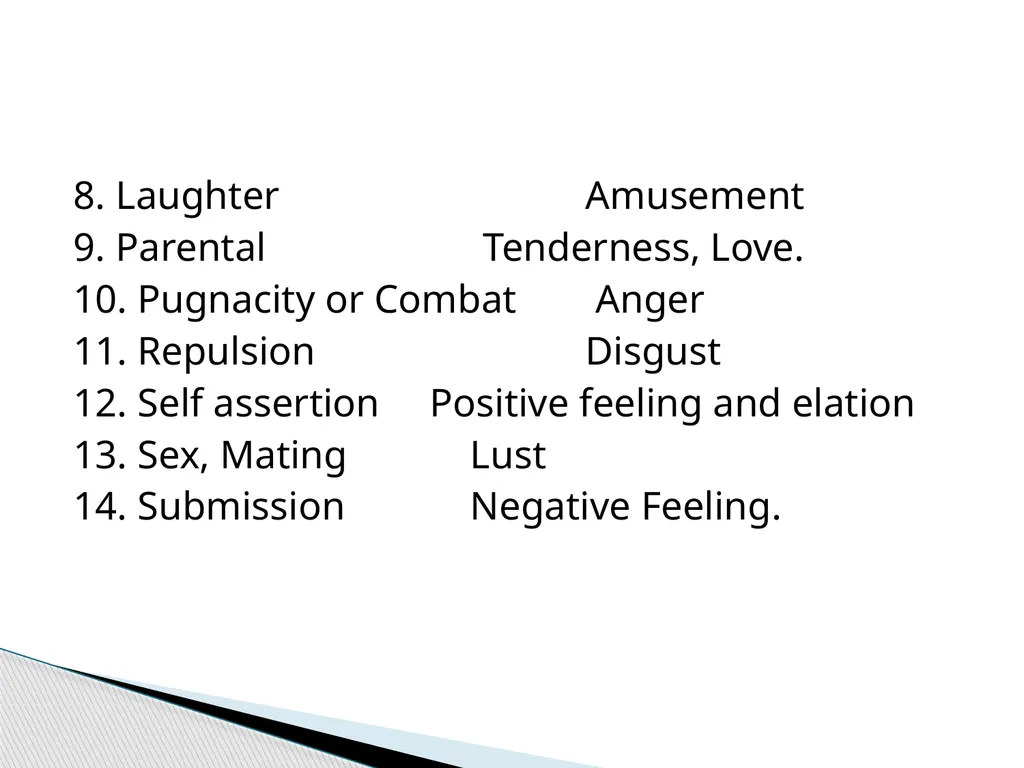
Mc Dougall discovered 14 basic instincts and pointed out that each and every emotion, whatever may be, is the product of some instinctive behaviour.<br>
07
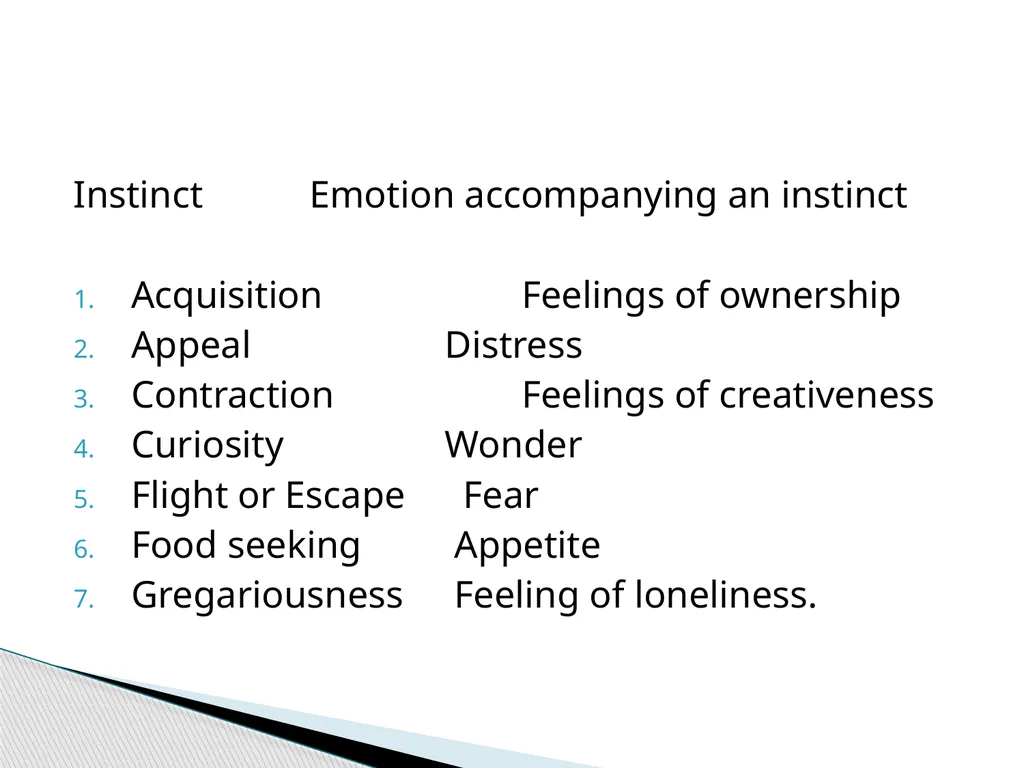
Instinct Emotion accompanying an instinct
Acquisition Feelings of ownership
Appeal Distress
Contraction Feelings of creativeness
Curiosity Wonder
Flight or Escape Fear
Food seeking Appetite
Gregariousness Feeling of loneliness.<br>
Emotions are temporary.
Emotions rise abruptly but die slowly.
The same emotion can be aroused by number of different stimuli – objects or situations.
Emotions differ from person to person.
Emotions are frequent.
Emotions are expressed in relation to concrete objectives or situations. Characteristics of Emotion<br>
10
Every emotional experience involves several physical and psychological changes in the organism. Some of these changes, like bulge of the eyes, flush of the face, flow of tears, pulse rate, are easily observable. Also, there are internal physiological changes like circulation of blood, impact on the digestive system and changes in the functioning of some glands. Characteristics of Emotion<br>
11
Small children fail to hide their emotions and express them indirectly through different activities like crying, nail-biting, thumb-sucking and speech difficulties.
Emotions are prevalent in every living organism.
Emotions are present at all stages of development and can be aroused in young as well as in old people. Characteristics of Emotion<br>
12
One emotion may give rise to a number of likewise emotions. Characteristics of Emotions<br>
13
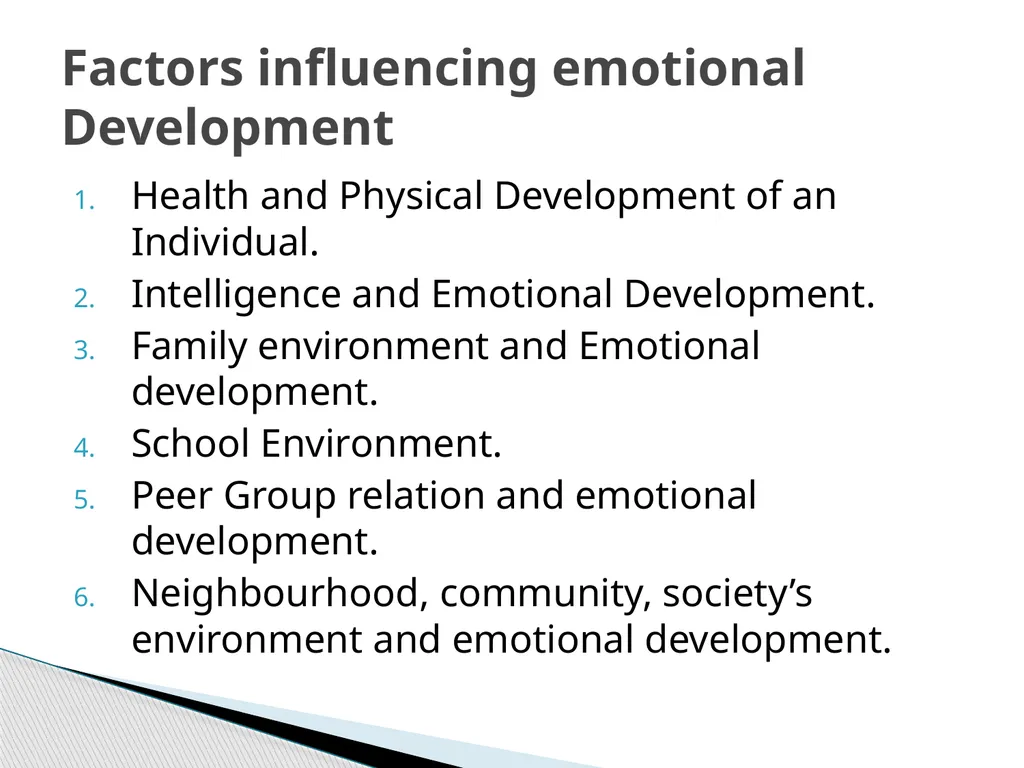
Health and Physical Development of an Individual.
Intelligence and Emotional Development.
Family environment and Emotional development.
School Environment.
Peer Group relation and emotional development.
Neighbourhood, community, society’s environment and emotional development. Factors influencing emotional Development<br>
14
Development of Psychology by Krishna Kumari Chetry References<br>