
Emotional Understanding and Regulation Featuring
AM
Published · 71 slides · 0 views

1 / 1







Description
Emotional Understanding and Regulation Featuring Emotion Talks Kitbag and 5 Point Scale Fife Council Supporting Learners Service ASIST About this resource This pack has been put together to encourage the use of three resources Emotion
Related Topics
Share
Embed code
Download this presentation From Below
"Emotional Understanding and Regulation Featuring" is the property of its rightful owner. Permission is granted to download and print the materials on this website for personal, non-commercial use only, and to display it on your personal computer provided you do not modify the materials and that you retain all copyright notices contained in the materials. By downloading content from our website, you accept the terms of this agreement.
Presentation Transcript
01
Emotional Understanding and Regulation Featuring Emotion Talks / Kitbag and 5 Point Scale Fife Council Supporting Learners' Service ASIST<br>
02
About this resource This pack has been put together to encourage the use of three resources – Emotion Talks / Kitbag and The Incredible 5 Point Scale in collaboration, rather than individually.
All three resources are extremely useful in helping children in a number of ways such as - to develop understanding of emotions, increase resilience and confidence and also develop emotional self regulation – to name just a few. All three resources have a sound theoretical basis.
Links to Curriculum for Excellence are on the next slide.
As the resources can be used with different ages this isn’t a bank of lessons – however it would be extremely useful if people could add lesson ideas that they’ve successfully tried and we can add them to the list.
The basic order of Things to do are in red and the Ideas are in black. Fife Council Supporting Learners' Service<br>
All three resources are extremely useful in helping children in a number of ways such as - to develop understanding of emotions, increase resilience and confidence and also develop emotional self regulation – to name just a few. All three resources have a sound theoretical basis.
Links to Curriculum for Excellence are on the next slide.
As the resources can be used with different ages this isn’t a bank of lessons – however it would be extremely useful if people could add lesson ideas that they’ve successfully tried and we can add them to the list.
The basic order of Things to do are in red and the Ideas are in black. Fife Council Supporting Learners' Service<br>
03
Curriculum for Excellence
Mental and Emotional Health and Wellbeing I am aware of and able to express my feelings and am developing the ability to talk about them.
HWB 0-01a / HWB 1-01a / HWB 2-01a / HWB 3-01a / HWB 4-01a
I know that we all experience a variety of thoughts and emotions that affect how we feel and behave and I am learning ways of managing them.
HWB 0-02a / HWB 1-02a / HWB 2-02a / HWB 3-02a / HWB 4-02a
I understand that there are people I can talk to and that there are a number of ways in which I can gain access to practical and emotional support to help me and others in a range of circumstances.
HWB 0-03a / HWB 1-03a / HWB 2-03a / HWB 3-03a / HWB 4-03a Fife Council Supporting Learners' Service<br>
HWB 0-01a / HWB 1-01a / HWB 2-01a / HWB 3-01a / HWB 4-01a
I know that we all experience a variety of thoughts and emotions that affect how we feel and behave and I am learning ways of managing them.
HWB 0-02a / HWB 1-02a / HWB 2-02a / HWB 3-02a / HWB 4-02a
I understand that there are people I can talk to and that there are a number of ways in which I can gain access to practical and emotional support to help me and others in a range of circumstances.
HWB 0-03a / HWB 1-03a / HWB 2-03a / HWB 3-03a / HWB 4-03a Fife Council Supporting Learners' Service<br>
04
Curriculum for Excellence
Mental and Emotional Health and Wellbeing I understand that my feelings and reactions can change depending upon what is happening within and around me. This helps me to understand my own behaviour and the way others behave.
HWB 0-04a / HWB 1-04a / HWB 2-04a / HWB 3-04a / HWB 4-04a
I know that friendship, caring, sharing, fairness, equality and love are important in building positive relationships. As I develop and value relationships, I care and show respect for myself and others.
HWB 0-05a / HWB 1-05a / HWB 2-05a / HWB 3-05a / HWB 4-05a
I understand the importance of mental wellbeing and that this can be fostered and strengthened through personal coping skills and positive relationships. I know that it is not always possible to enjoy good mental health and that if this happens there is support available.
HWB 0-06a / HWB 1-06a / HWB 2-06a / HWB 3-06a / HWB 4-06a Fife Council Supporting Learners' Service<br>
HWB 0-04a / HWB 1-04a / HWB 2-04a / HWB 3-04a / HWB 4-04a
I know that friendship, caring, sharing, fairness, equality and love are important in building positive relationships. As I develop and value relationships, I care and show respect for myself and others.
HWB 0-05a / HWB 1-05a / HWB 2-05a / HWB 3-05a / HWB 4-05a
I understand the importance of mental wellbeing and that this can be fostered and strengthened through personal coping skills and positive relationships. I know that it is not always possible to enjoy good mental health and that if this happens there is support available.
HWB 0-06a / HWB 1-06a / HWB 2-06a / HWB 3-06a / HWB 4-06a Fife Council Supporting Learners' Service<br>
05
Introduction 1. Watch all or part of ‘Inside Out’ video (Whatever is appropriate)
After watching all or parts of Inside Out complete appropriate follow up activities.
2. Introducing Kit Bag
Use the Kitbag animals to explore the words on the cards (Resource 10)
Follow up ideas –
Build up understandings of basic emotions over a series of lessons. Ensure pupil’s understandings of basic emotions before introducing others. (like / don’t like, happy / sad, angry, scared)
Inside Out - Complete the sheets (slides 5-15) describing the characters in Inside Out – the children may choose to draw or write, in groups or individually – whatever is age appropriate. The examples are only there as a very rough guide.
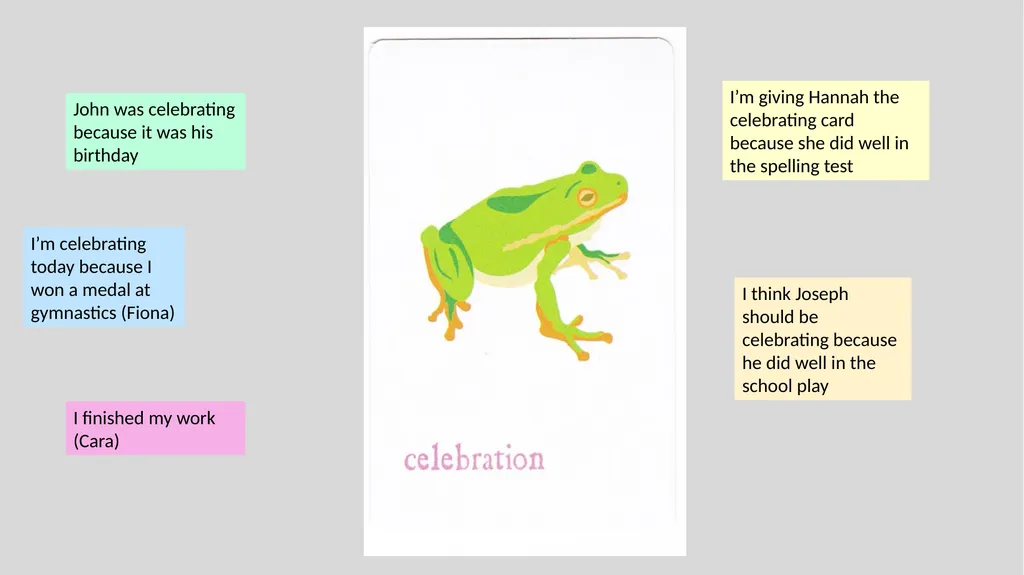
Display the animal cards and allow the children to add post-its (example below) Fife Council Supporting Learners' Service<br>
After watching all or parts of Inside Out complete appropriate follow up activities.
2. Introducing Kit Bag
Use the Kitbag animals to explore the words on the cards (Resource 10)
Follow up ideas –
Build up understandings of basic emotions over a series of lessons. Ensure pupil’s understandings of basic emotions before introducing others. (like / don’t like, happy / sad, angry, scared)
Inside Out - Complete the sheets (slides 5-15) describing the characters in Inside Out – the children may choose to draw or write, in groups or individually – whatever is age appropriate. The examples are only there as a very rough guide.
Display the animal cards and allow the children to add post-its (example below) Fife Council Supporting Learners' Service<br>
06
John was celebrating because it was his birthday I’m giving Hannah the celebrating card because she did well in the spelling test I’m celebrating today because I won a medal at gymnastics (Fiona) I think Joseph should be celebrating because he did well in the school play I finished my work (Cara) Fife Council Supporting Learners' Service<br>
07
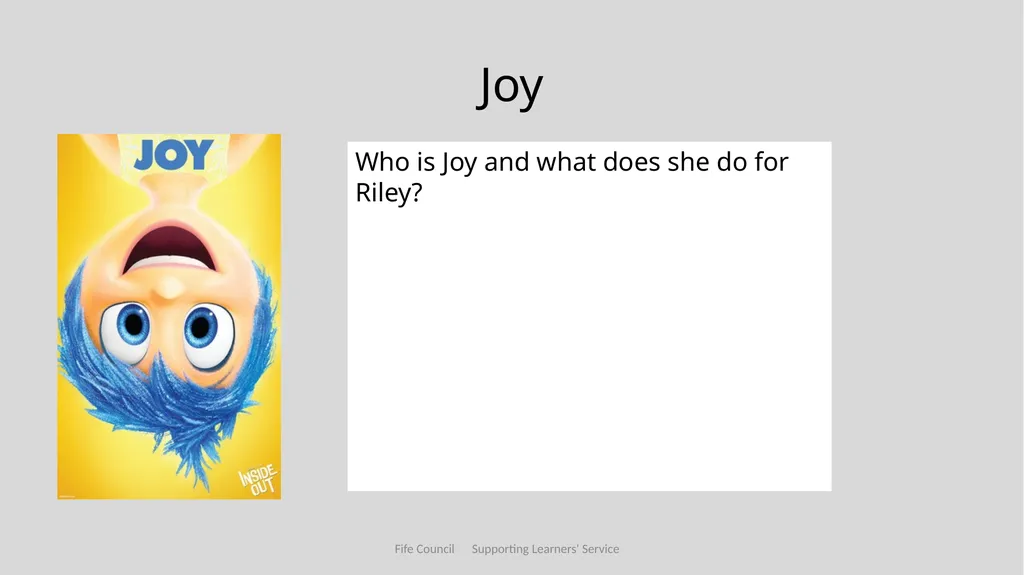
Joy Who is Joy and what does she do for Riley? Fife Council Supporting Learners' Service<br>
08
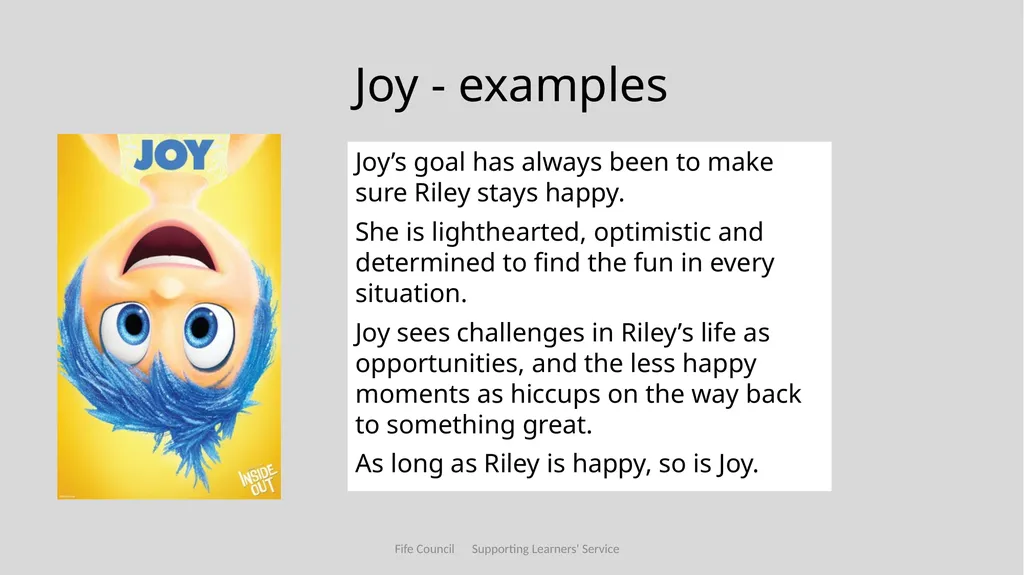
Joy - examples Joy’s goal has always been to make sure Riley stays happy.
She is lighthearted, optimistic and determined to find the fun in every situation.
Joy sees challenges in Riley’s life as opportunities, and the less happy moments as hiccups on the way back to something great.
As long as Riley is happy, so is Joy. Fife Council Supporting Learners' Service<br>
She is lighthearted, optimistic and determined to find the fun in every situation.
Joy sees challenges in Riley’s life as opportunities, and the less happy moments as hiccups on the way back to something great.
As long as Riley is happy, so is Joy. Fife Council Supporting Learners' Service<br>
09
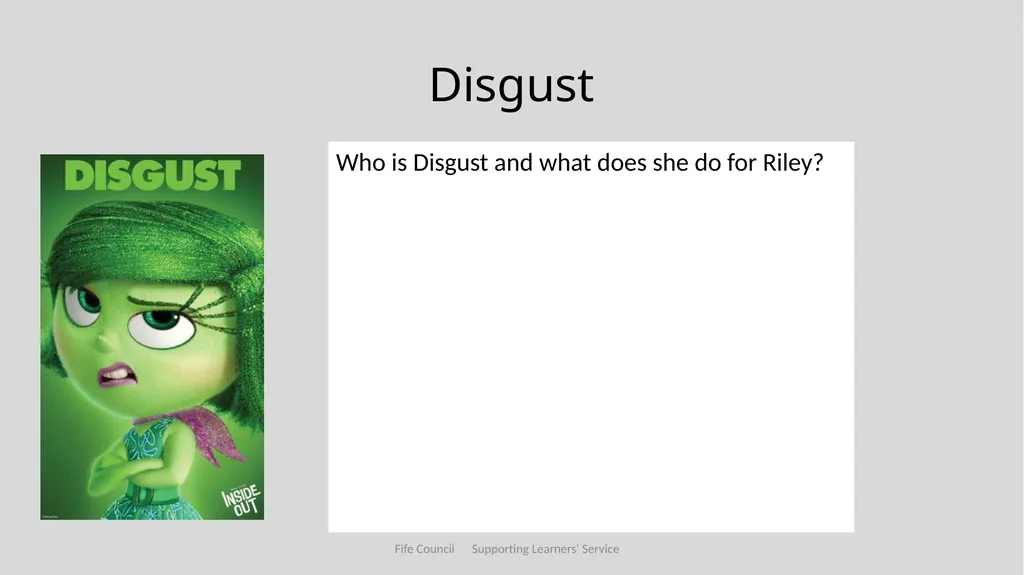
Disgust Who is Disgust and what does she do for Riley? Fife Council Supporting Learners' Service<br>
10
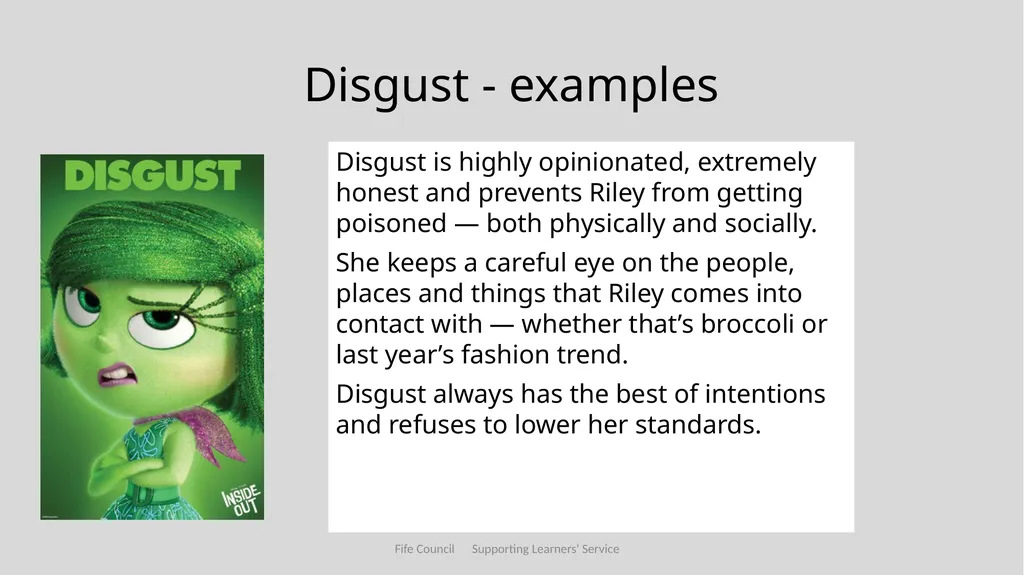
Disgust - examples Disgust is highly opinionated, extremely honest and prevents Riley from getting poisoned — both physically and socially.
She keeps a careful eye on the people, places and things that Riley comes into contact with — whether that’s broccoli or last year’s fashion trend.
Disgust always has the best of intentions and refuses to lower her standards. Fife Council Supporting Learners' Service<br>
She keeps a careful eye on the people, places and things that Riley comes into contact with — whether that’s broccoli or last year’s fashion trend.
Disgust always has the best of intentions and refuses to lower her standards. Fife Council Supporting Learners' Service<br>
11
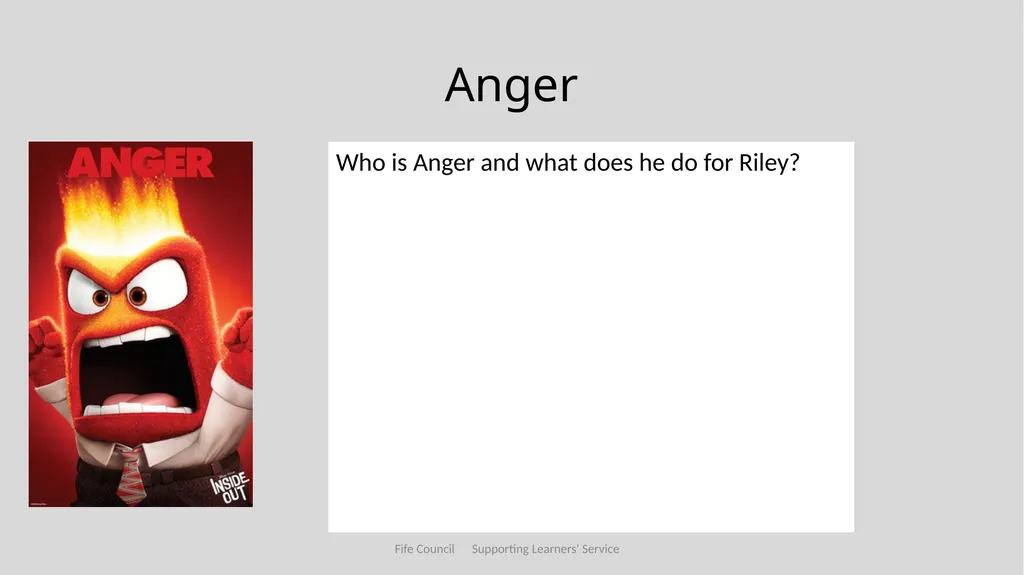
Anger Who is Anger and what does he do for Riley? Fife Council Supporting Learners' Service<br>
12
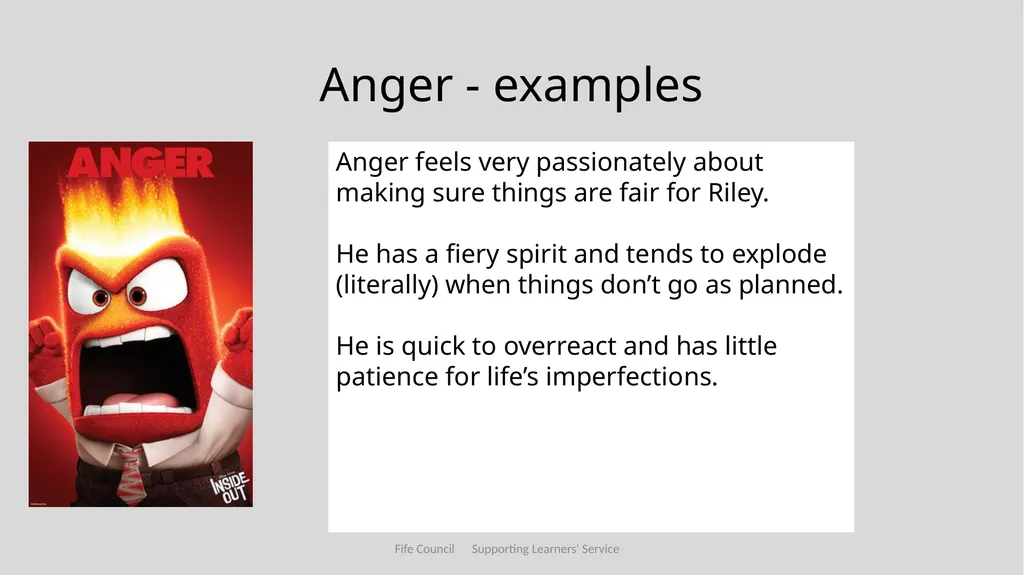
Anger - examples Anger feels very passionately about making sure things are fair for Riley.
He has a fiery spirit and tends to explode (literally) when things don’t go as planned.
He is quick to overreact and has little patience for life’s imperfections. Fife Council Supporting Learners' Service<br>
He has a fiery spirit and tends to explode (literally) when things don’t go as planned.
He is quick to overreact and has little patience for life’s imperfections. Fife Council Supporting Learners' Service<br>
13
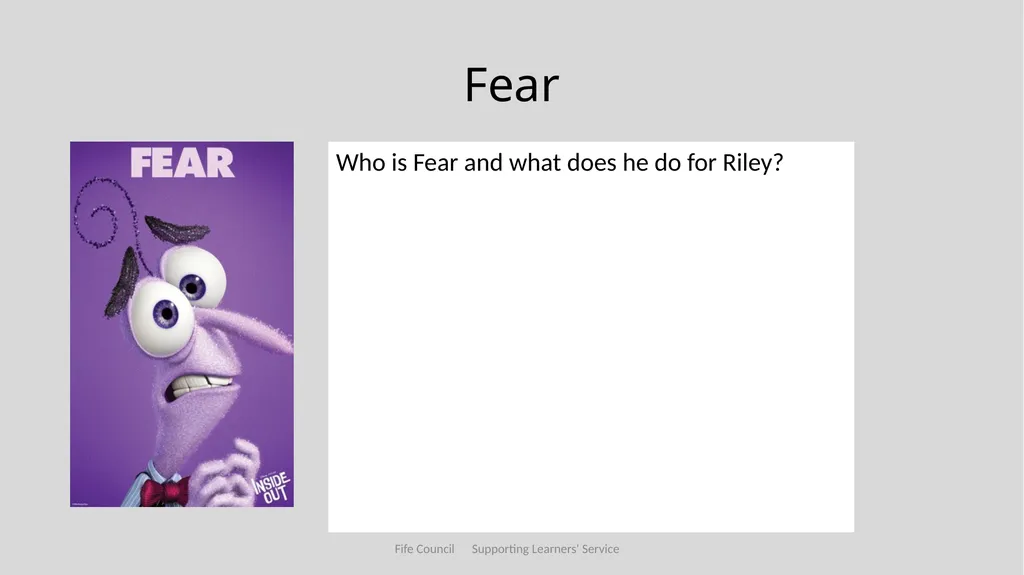
Fear Who is Fear and what does he do for Riley? Fife Council Supporting Learners' Service<br>
14
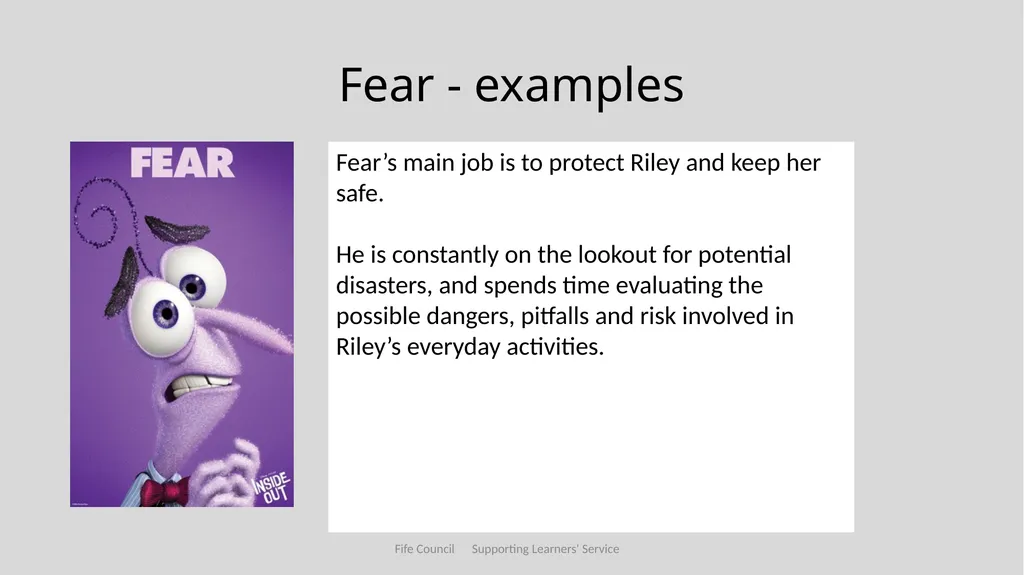
Fear - examples Fear’s main job is to protect Riley and keep her safe.
He is constantly on the lookout for potential disasters, and spends time evaluating the possible dangers, pitfalls and risk involved in Riley’s everyday activities. Fife Council Supporting Learners' Service<br>
He is constantly on the lookout for potential disasters, and spends time evaluating the possible dangers, pitfalls and risk involved in Riley’s everyday activities. Fife Council Supporting Learners' Service<br>
15
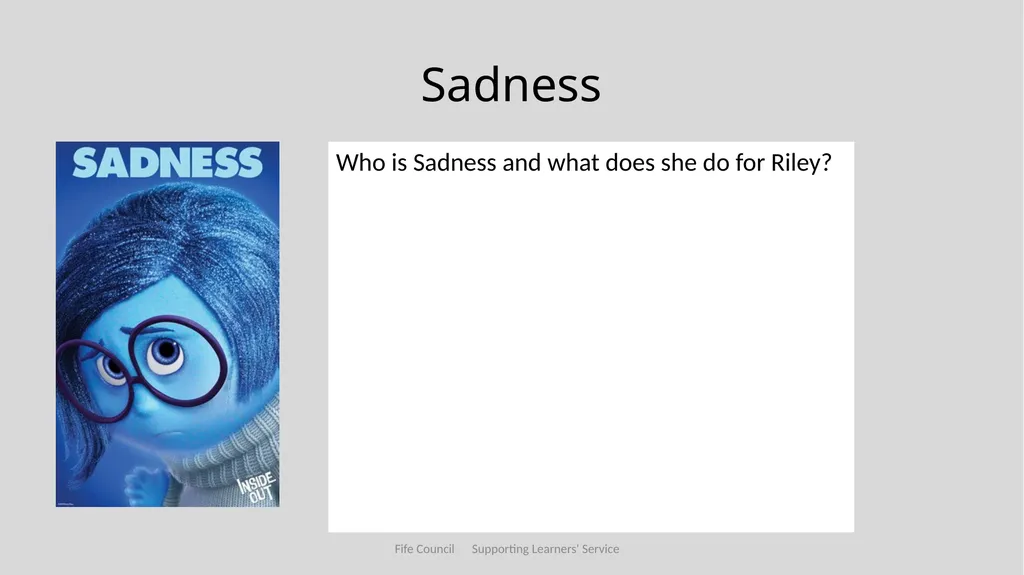
Sadness Who is Sadness and what does she do for Riley? Fife Council Supporting Learners' Service<br>
16
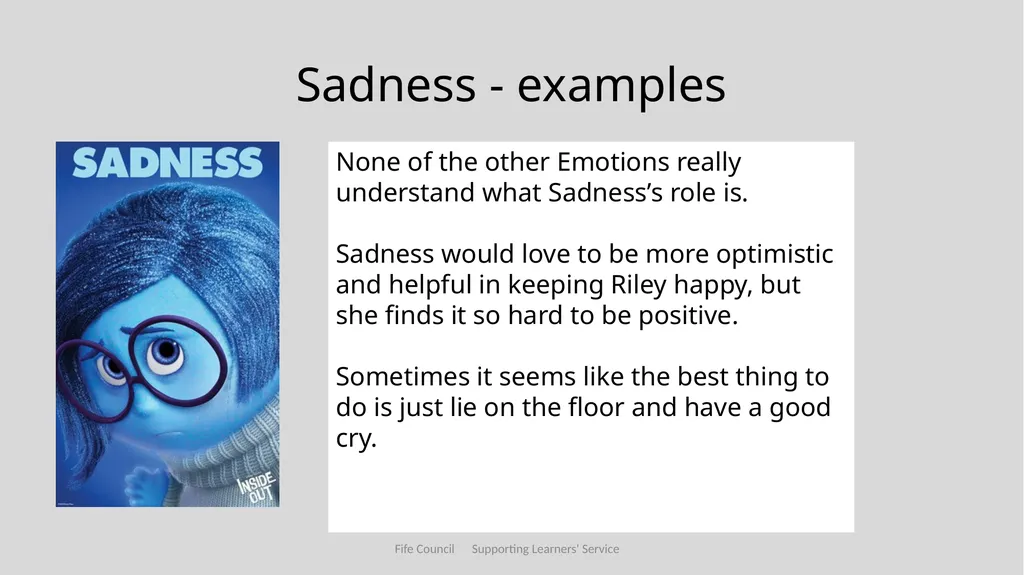
Sadness - examples None of the other Emotions really understand what Sadness’s role is.
Sadness would love to be more optimistic and helpful in keeping Riley happy, but she finds it so hard to be positive.
Sometimes it seems like the best thing to do is just lie on the floor and have a good cry. Fife Council Supporting Learners' Service<br>
Sadness would love to be more optimistic and helpful in keeping Riley happy, but she finds it so hard to be positive.
Sometimes it seems like the best thing to do is just lie on the floor and have a good cry. Fife Council Supporting Learners' Service<br>
17
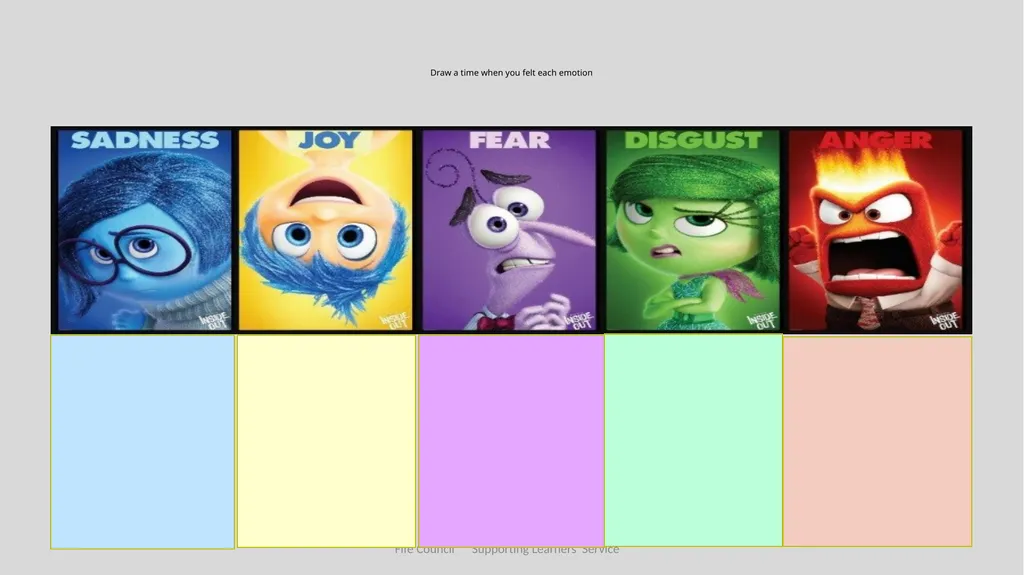
Draw a time when you felt each emotion Fife Council Supporting Learners' Service<br>
18
Introducing Kitbag Introduce Kitbag and all the different components
Explain that we’re going to play lots of games using the different parts of the kit – they may want to make up games / activities of their own.
Explain that sometimes small groups will do more other work using Kitbag / sometimes we’ll use parts of the Kitbag only.
Ongoing ideas -
On a regular basis use the colour chart to chat in small groups using Talking Stick and colour charts
Play games with the animal cards – allow children to make up their own
Children make up their own slogan for Kitbag (other great names we’ve seen include Kindness Bag / Relax and Chillax @Kitbag) Fife Council Supporting Learners' Service<br>
Explain that we’re going to play lots of games using the different parts of the kit – they may want to make up games / activities of their own.
Explain that sometimes small groups will do more other work using Kitbag / sometimes we’ll use parts of the Kitbag only.
Ongoing ideas -
On a regular basis use the colour chart to chat in small groups using Talking Stick and colour charts
Play games with the animal cards – allow children to make up their own
Children make up their own slogan for Kitbag (other great names we’ve seen include Kindness Bag / Relax and Chillax @Kitbag) Fife Council Supporting Learners' Service<br>
19
Emotion Talks - Nice Feelings
(Feel free to change the pictures to suit interest / age etc. ) Look at Slide 1 - Footballer (Resource 1)
Describe a time when you had a similar emotion – bring in a photo perhaps
Choose one of the Kitbag animal cards which you could give to the footballer
Look at Slide 2 - Little Girl (Resource 2)
Choose one of the Kitbag animal cards which you could give to the little girl
Can you think of other words to describe how she is feeling?
Follow up ideas –
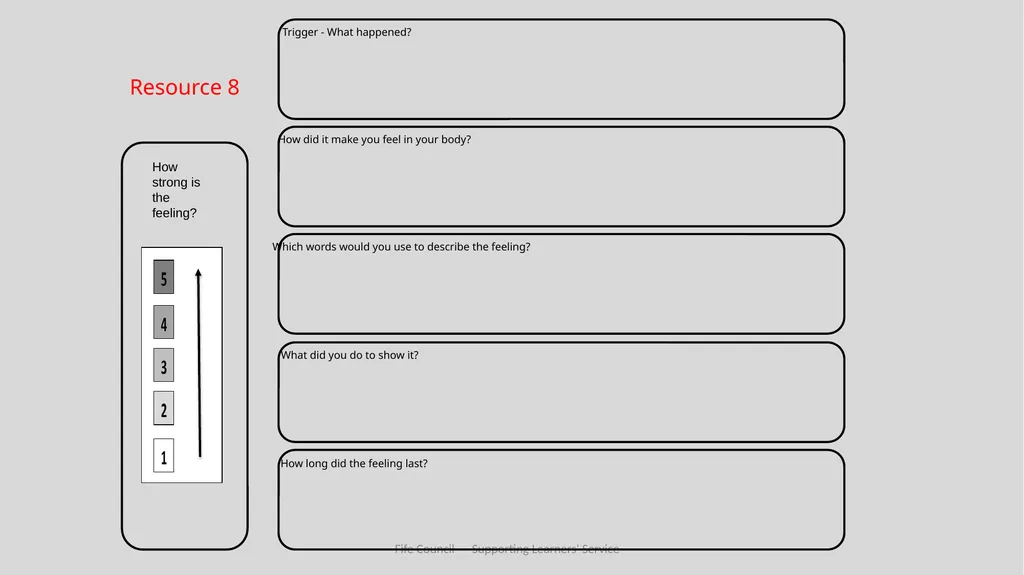
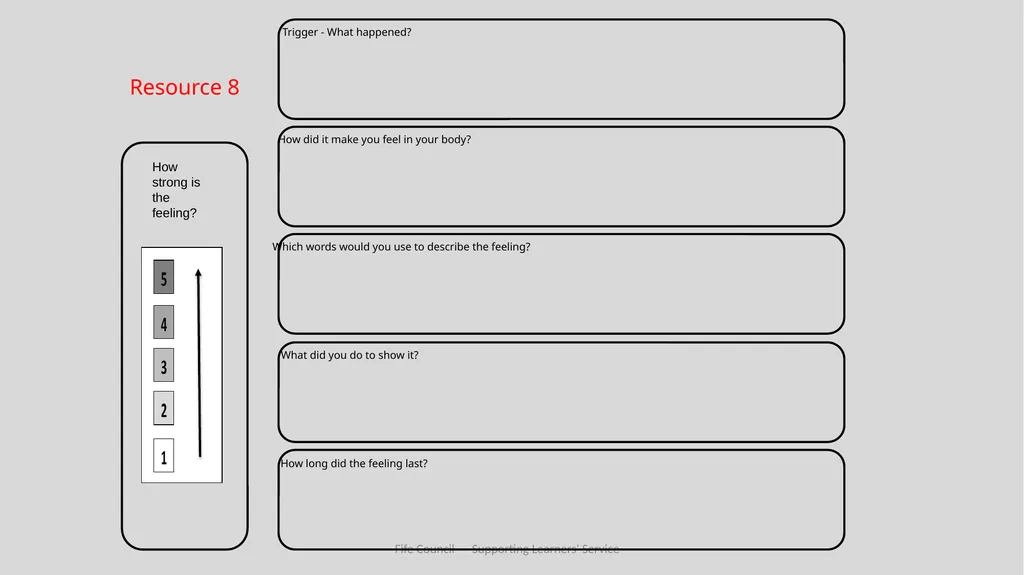
Choose one of the other pictures (Picture Bank) and write about it using. Feel free to use your own choice of pictures / stimuli here. (Resource 8) Fife Council Supporting Learners' Service<br>
Describe a time when you had a similar emotion – bring in a photo perhaps
Choose one of the Kitbag animal cards which you could give to the footballer
Look at Slide 2 - Little Girl (Resource 2)
Choose one of the Kitbag animal cards which you could give to the little girl
Can you think of other words to describe how she is feeling?
Follow up ideas –
Choose one of the other pictures (Picture Bank) and write about it using. Feel free to use your own choice of pictures / stimuli here. (Resource 8) Fife Council Supporting Learners' Service<br>
20
How strong is the feeling? Fife Council Supporting Learners' Service<br>
21
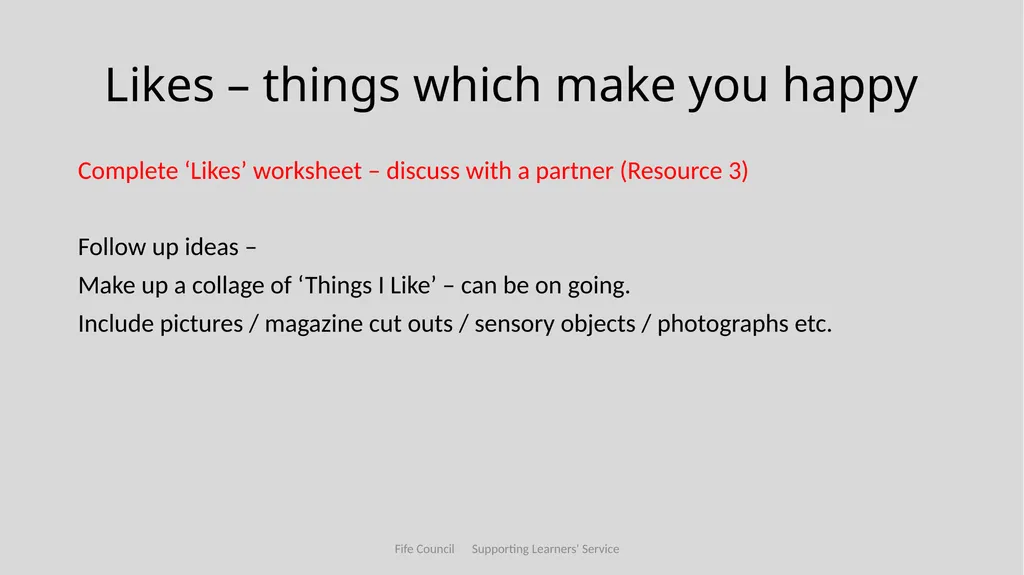
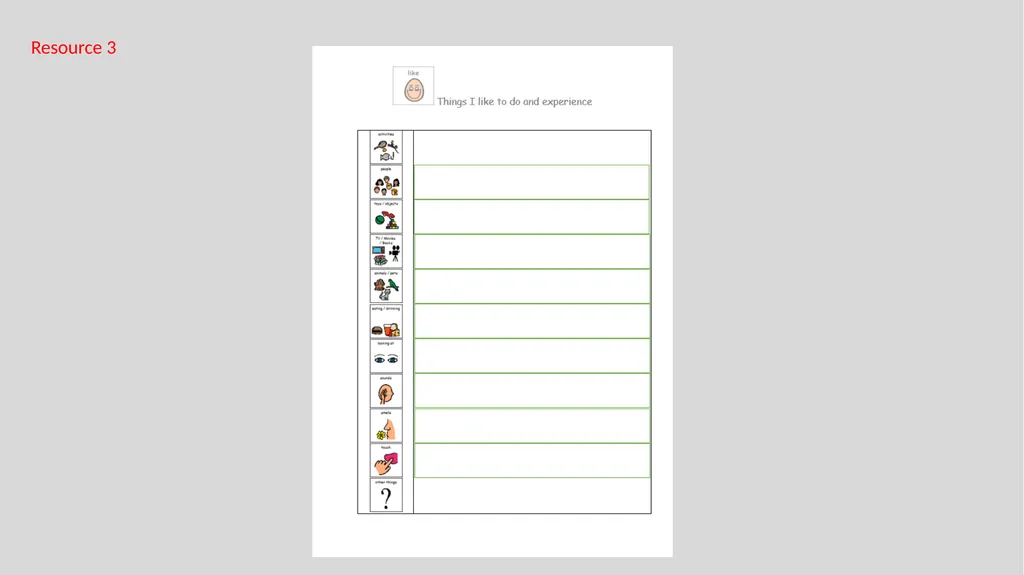
Likes – things which make you happy Complete ‘Likes’ worksheet – discuss with a partner (Resource 3)
Follow up ideas –
Make up a collage of ‘Things I Like’ – can be on going.
Include pictures / magazine cut outs / sensory objects / photographs etc. Fife Council Supporting Learners' Service<br>
Follow up ideas –
Make up a collage of ‘Things I Like’ – can be on going.
Include pictures / magazine cut outs / sensory objects / photographs etc. Fife Council Supporting Learners' Service<br>
22
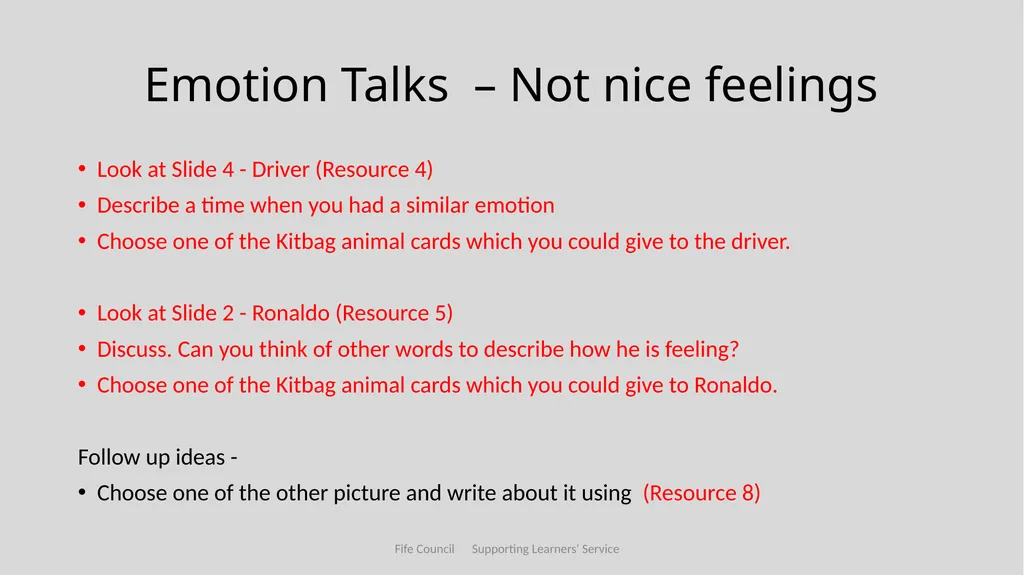
Emotion Talks – Not nice feelings Look at Slide 4 - Driver (Resource 4)
Describe a time when you had a similar emotion
Choose one of the Kitbag animal cards which you could give to the driver.
Look at Slide 2 - Ronaldo (Resource 5)
Discuss. Can you think of other words to describe how he is feeling?
Choose one of the Kitbag animal cards which you could give to Ronaldo.
Follow up ideas -
Choose one of the other picture and write about it using (Resource 8) Fife Council Supporting Learners' Service<br>
Describe a time when you had a similar emotion
Choose one of the Kitbag animal cards which you could give to the driver.
Look at Slide 2 - Ronaldo (Resource 5)
Discuss. Can you think of other words to describe how he is feeling?
Choose one of the Kitbag animal cards which you could give to Ronaldo.
Follow up ideas -
Choose one of the other picture and write about it using (Resource 8) Fife Council Supporting Learners' Service<br>
23
How strong is the feeling? Fife Council Supporting Learners' Service<br>
24
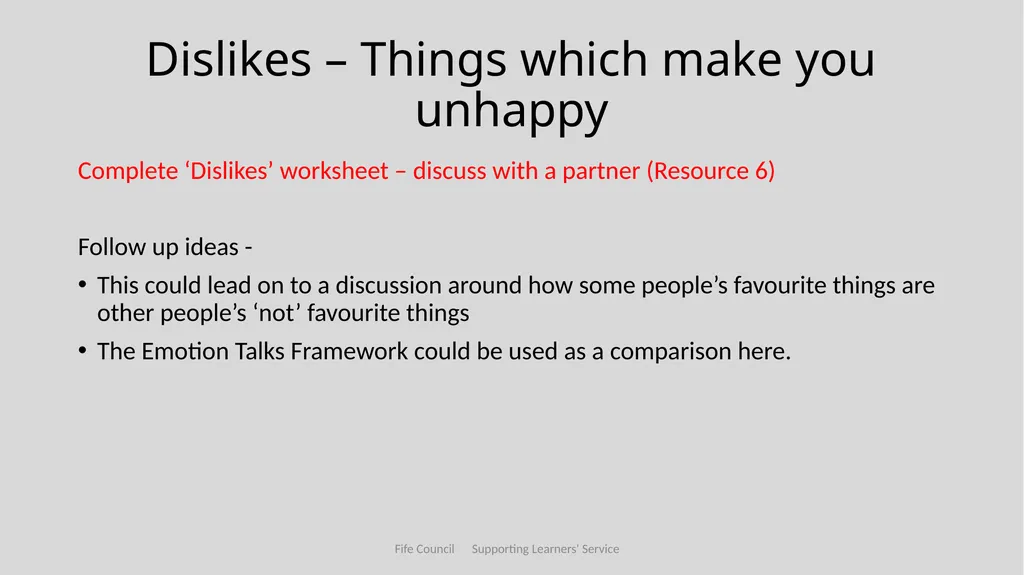
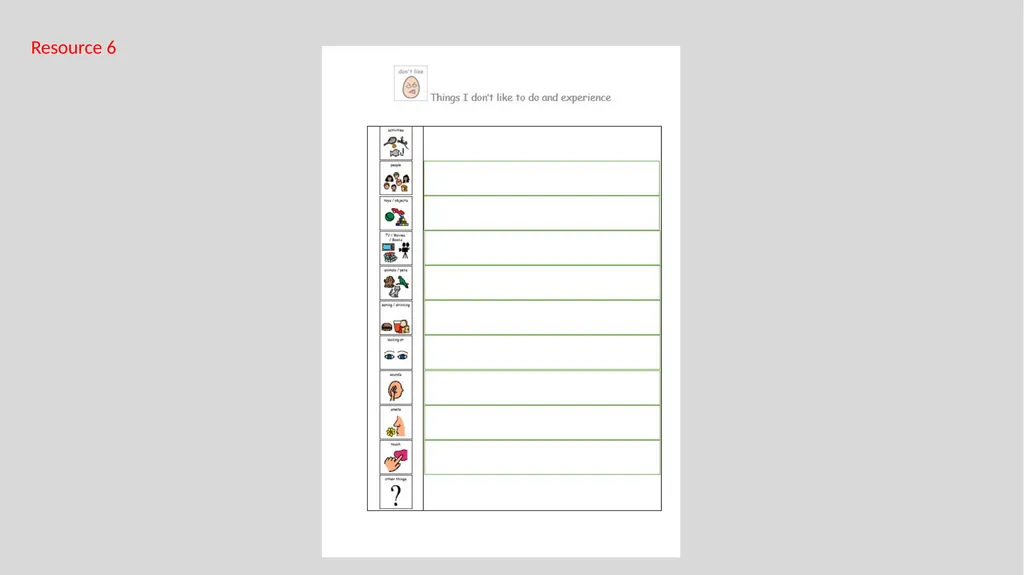
Dislikes – Things which make you unhappy Complete ‘Dislikes’ worksheet – discuss with a partner (Resource 6)
Follow up ideas -
This could lead on to a discussion around how some people’s favourite things are other people’s ‘not’ favourite things
The Emotion Talks Framework could be used as a comparison here. Fife Council Supporting Learners' Service<br>
Follow up ideas -
This could lead on to a discussion around how some people’s favourite things are other people’s ‘not’ favourite things
The Emotion Talks Framework could be used as a comparison here. Fife Council Supporting Learners' Service<br>
25
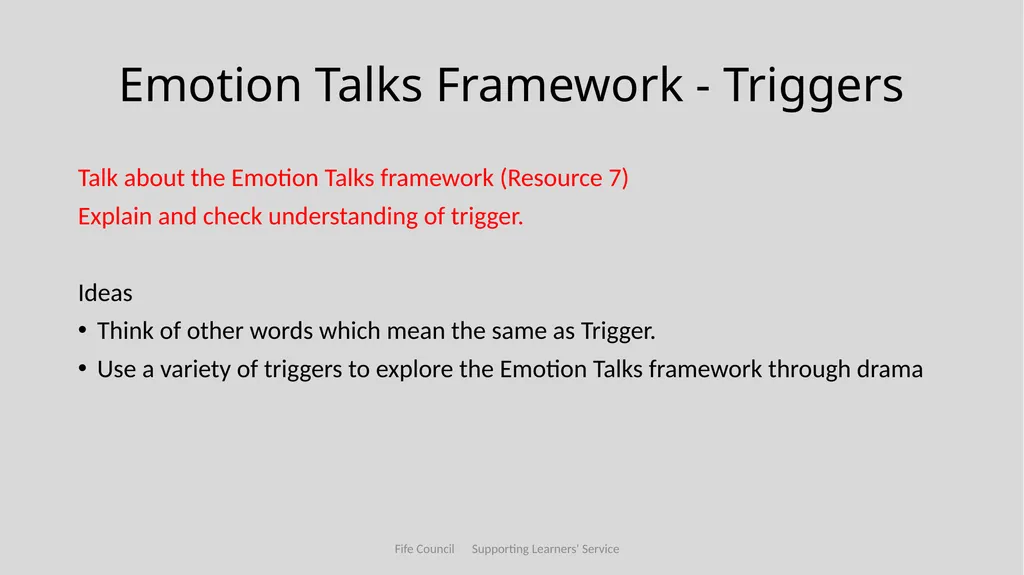
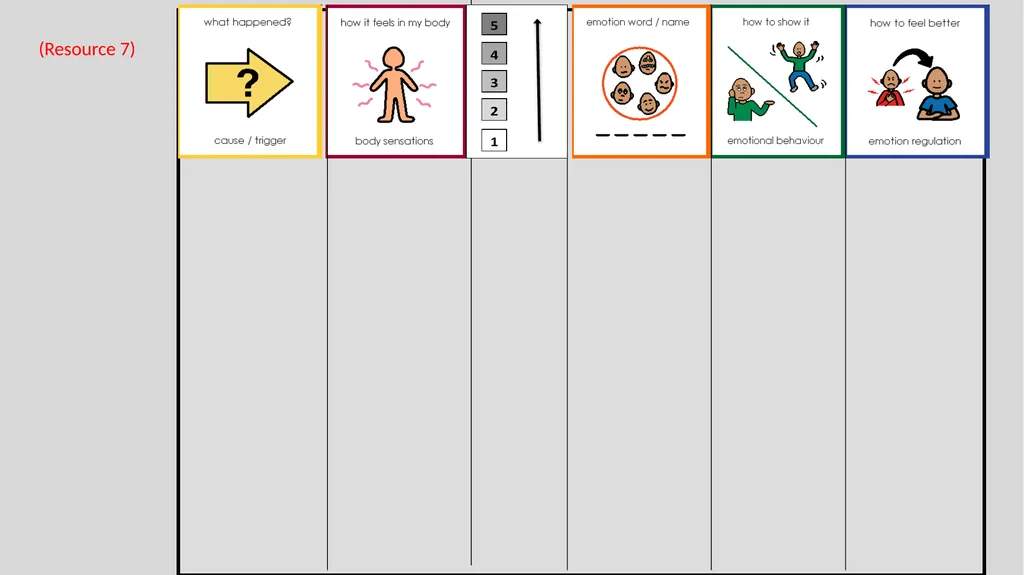
Emotion Talks Framework - Triggers Talk about the Emotion Talks framework (Resource 7)
Explain and check understanding of trigger.
Ideas
Think of other words which mean the same as Trigger.
Use a variety of triggers to explore the Emotion Talks framework through drama Fife Council Supporting Learners' Service<br>
Explain and check understanding of trigger.
Ideas
Think of other words which mean the same as Trigger.
Use a variety of triggers to explore the Emotion Talks framework through drama Fife Council Supporting Learners' Service<br>
26
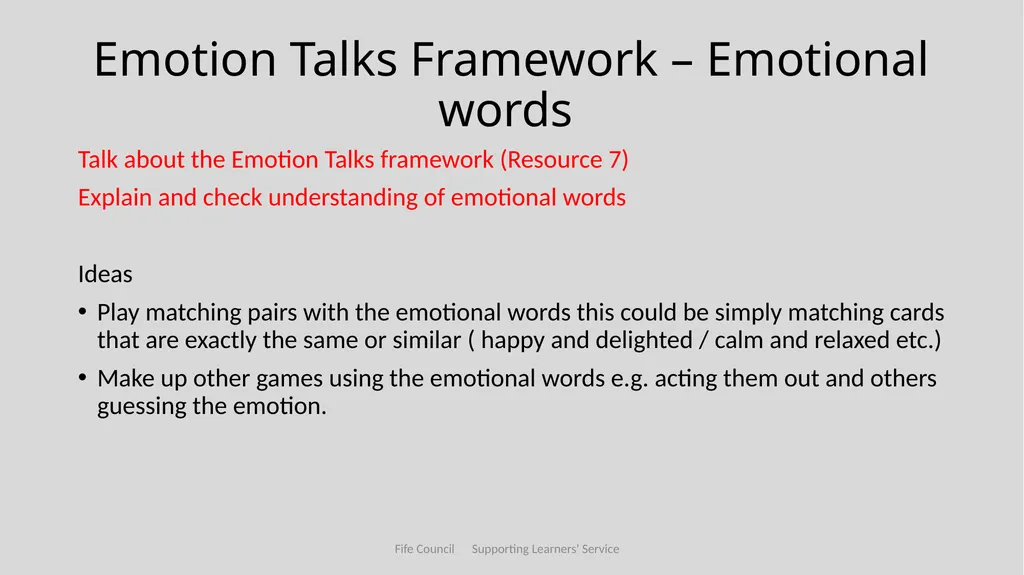
Emotion Talks Framework – Emotional words Talk about the Emotion Talks framework (Resource 7)
Explain and check understanding of emotional words
Ideas
Play matching pairs with the emotional words this could be simply matching cards that are exactly the same or similar ( happy and delighted / calm and relaxed etc.)
Make up other games using the emotional words e.g. acting them out and others guessing the emotion. Fife Council Supporting Learners' Service<br>
Explain and check understanding of emotional words
Ideas
Play matching pairs with the emotional words this could be simply matching cards that are exactly the same or similar ( happy and delighted / calm and relaxed etc.)
Make up other games using the emotional words e.g. acting them out and others guessing the emotion. Fife Council Supporting Learners' Service<br>
27
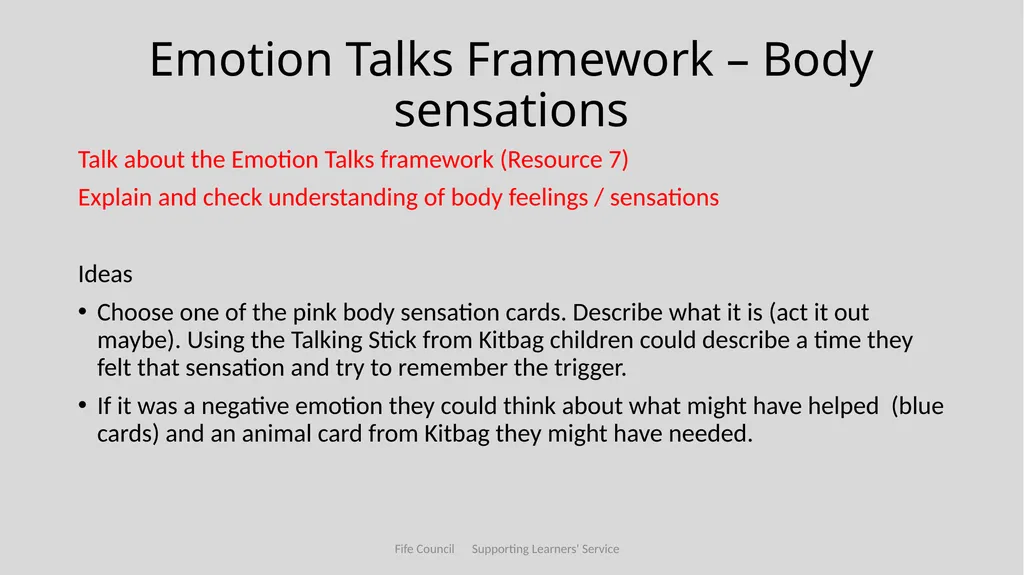
Emotion Talks Framework – Body sensations Talk about the Emotion Talks framework (Resource 7)
Explain and check understanding of body feelings / sensations
Ideas
Choose one of the pink body sensation cards. Describe what it is (act it out maybe). Using the Talking Stick from Kitbag children could describe a time they felt that sensation and try to remember the trigger.
If it was a negative emotion they could think about what might have helped (blue cards) and an animal card from Kitbag they might have needed. Fife Council Supporting Learners' Service<br>
Explain and check understanding of body feelings / sensations
Ideas
Choose one of the pink body sensation cards. Describe what it is (act it out maybe). Using the Talking Stick from Kitbag children could describe a time they felt that sensation and try to remember the trigger.
If it was a negative emotion they could think about what might have helped (blue cards) and an animal card from Kitbag they might have needed. Fife Council Supporting Learners' Service<br>
28
Emotion Talks Framework – How to show it Talk about the Emotion Talks framework (Resource 7)
Explain and check understanding of emotional behaviours
Ideas
Drama activities linking behaviour to emotion Fife Council Supporting Learners' Service<br>
Explain and check understanding of emotional behaviours
Ideas
Drama activities linking behaviour to emotion Fife Council Supporting Learners' Service<br>
29
Emotion Talks Framework – Intensity scale Talk about the Emotion Talks framework (Resource 7)
Explain and check understanding of intensity scale.
Ideas
Explore the idea of different intensities from 1 to 5 -
loudness of voice (warn other staff you’re going to do this though!!). Voice Scale (Resource 13) can be used here. Fife Council Supporting Learners' Service<br>
Explain and check understanding of intensity scale.
Ideas
Explore the idea of different intensities from 1 to 5 -
loudness of voice (warn other staff you’re going to do this though!!). Voice Scale (Resource 13) can be used here. Fife Council Supporting Learners' Service<br>
30
Emotion Talks Framework – How to feel better Talk about the Emotion Talks framework (Resource 7)
Explain and check understanding of ‘how to feel better’
Ideas
Explore different strategies to help children feel better (the feeling better will be closely linked to their ‘Likes’)
Aspects of Kitbag could me mentioned again here – relaxation techniques etc.
Children exploring and identifying their own personal strategies to make things better (examples on next slide) Fife Council Supporting Learners' Service<br>
Explain and check understanding of ‘how to feel better’
Ideas
Explore different strategies to help children feel better (the feeling better will be closely linked to their ‘Likes’)
Aspects of Kitbag could me mentioned again here – relaxation techniques etc.
Children exploring and identifying their own personal strategies to make things better (examples on next slide) Fife Council Supporting Learners' Service<br>
31
How to Feel Better Fife Council Supporting Learners' Service<br>
32
(Resource 7) Fife Council Supporting Learners' Service<br>
33
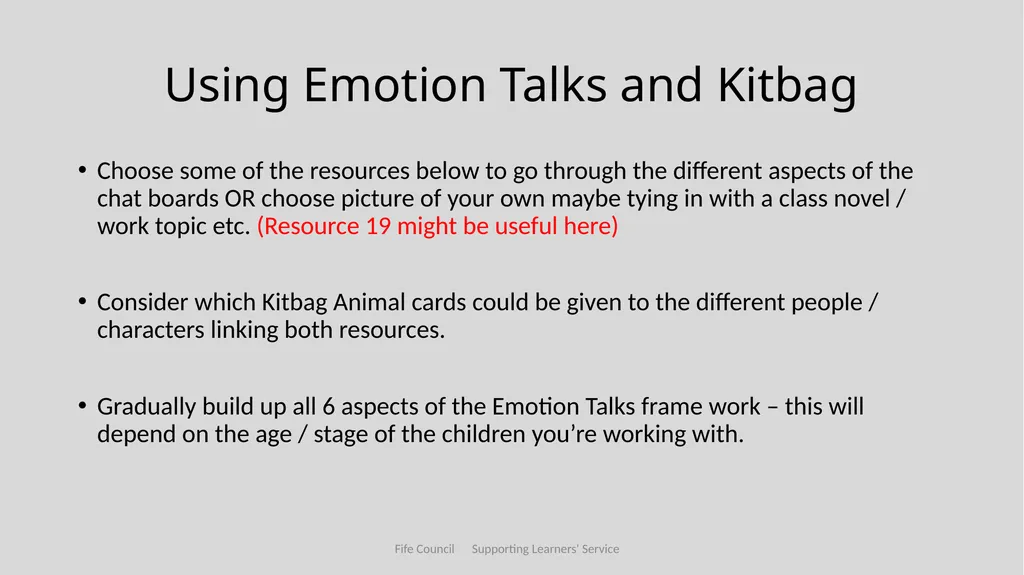
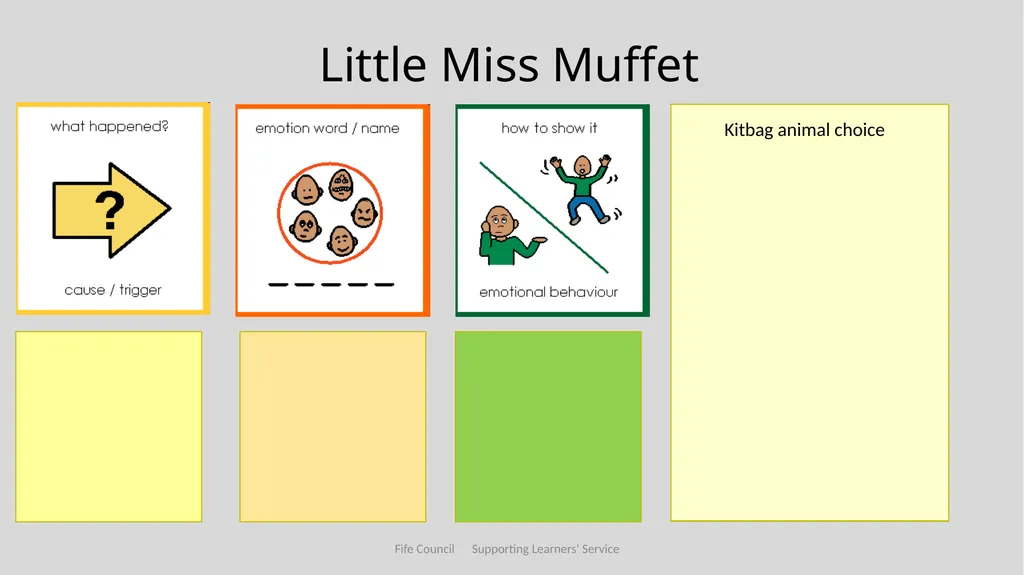
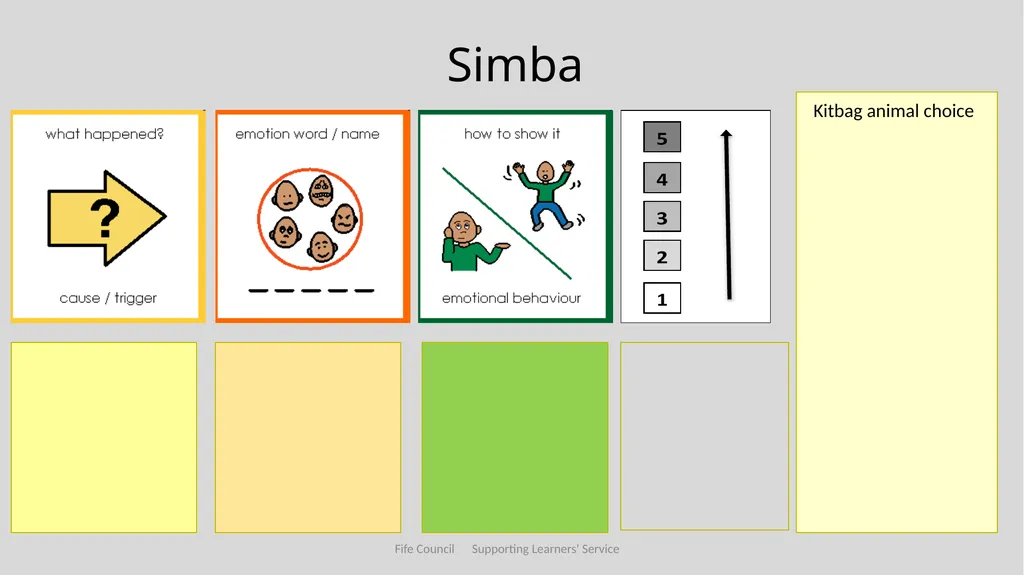
Using Emotion Talks and Kitbag Choose some of the resources below to go through the different aspects of the chat boards OR choose picture of your own maybe tying in with a class novel / work topic etc. (Resource 19 might be useful here)
Consider which Kitbag Animal cards could be given to the different people / characters linking both resources.
Gradually build up all 6 aspects of the Emotion Talks frame work – this will depend on the age / stage of the children you’re working with. Fife Council Supporting Learners' Service<br>
Consider which Kitbag Animal cards could be given to the different people / characters linking both resources.
Gradually build up all 6 aspects of the Emotion Talks frame work – this will depend on the age / stage of the children you’re working with. Fife Council Supporting Learners' Service<br>
34
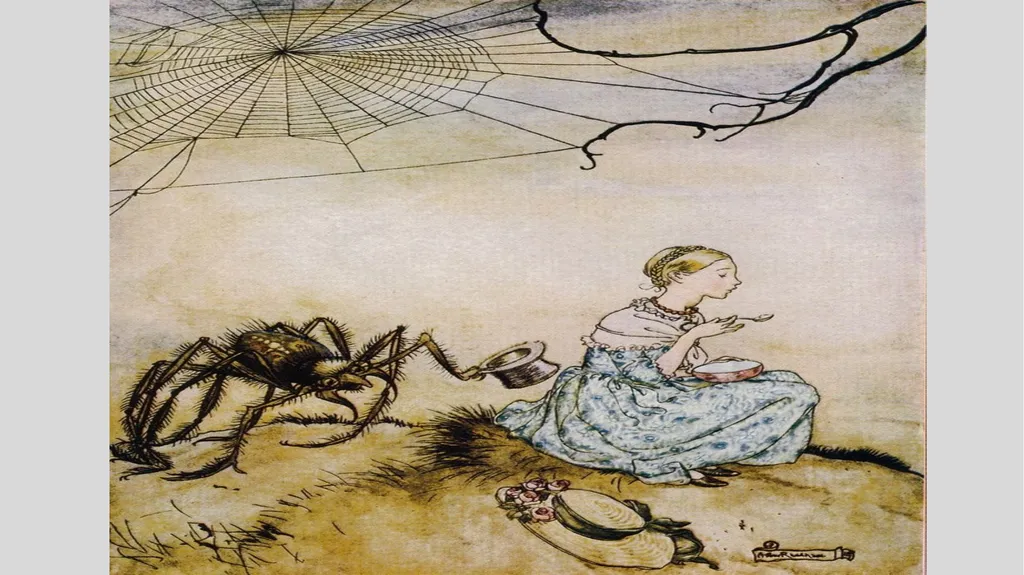
Little Miss Muffet Kitbag animal choice Fife Council Supporting Learners' Service<br>
35
Fife Council Supporting Learners' Service<br>
36
Simba Kitbag animal choice Fife Council Supporting Learners' Service<br>
37
Fife Council Supporting Learners' Service<br>
38
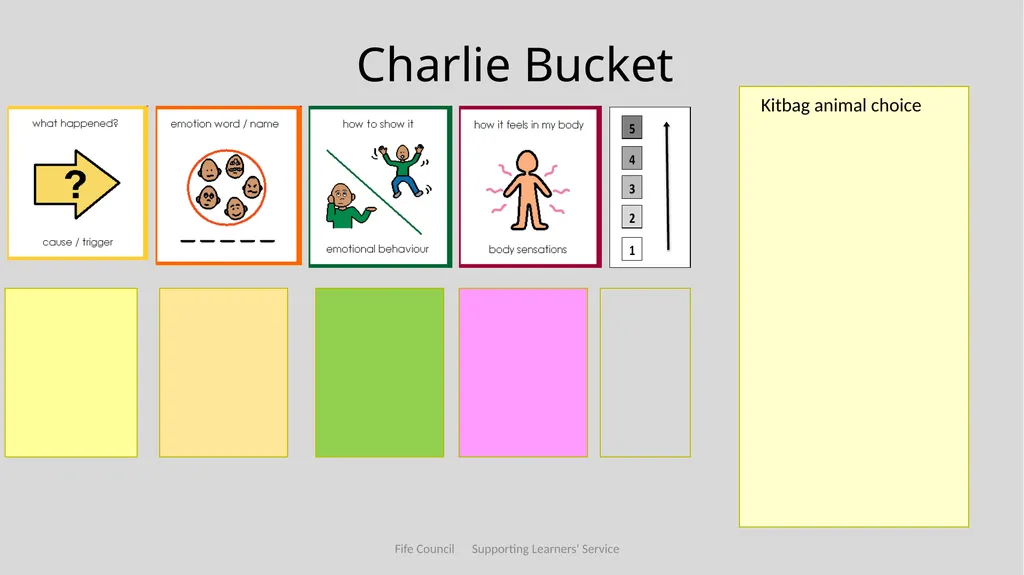
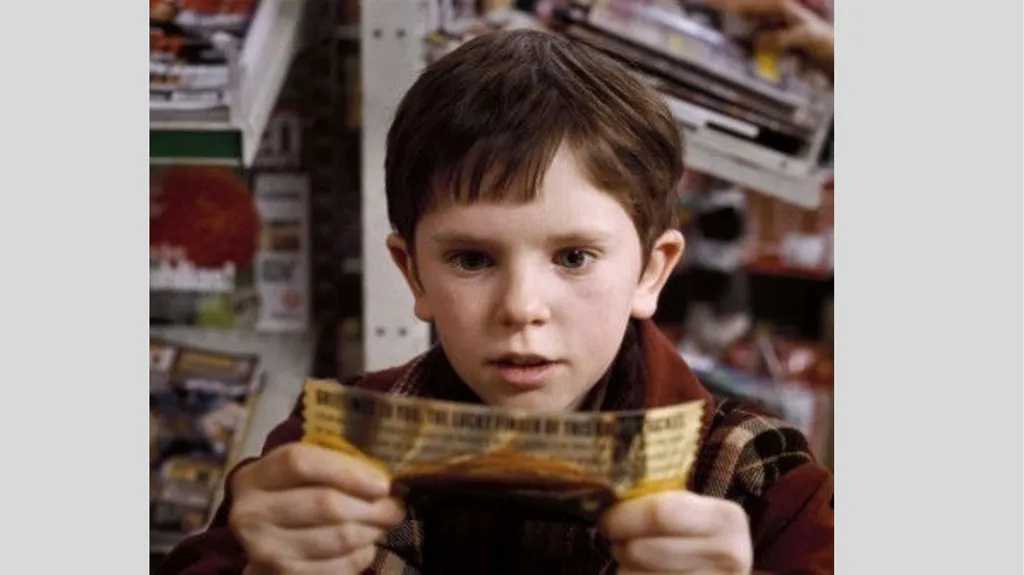
Charlie Bucket Kitbag animal choice Fife Council Supporting Learners' Service<br>
39
Fife Council Supporting Learners' Service<br>
40
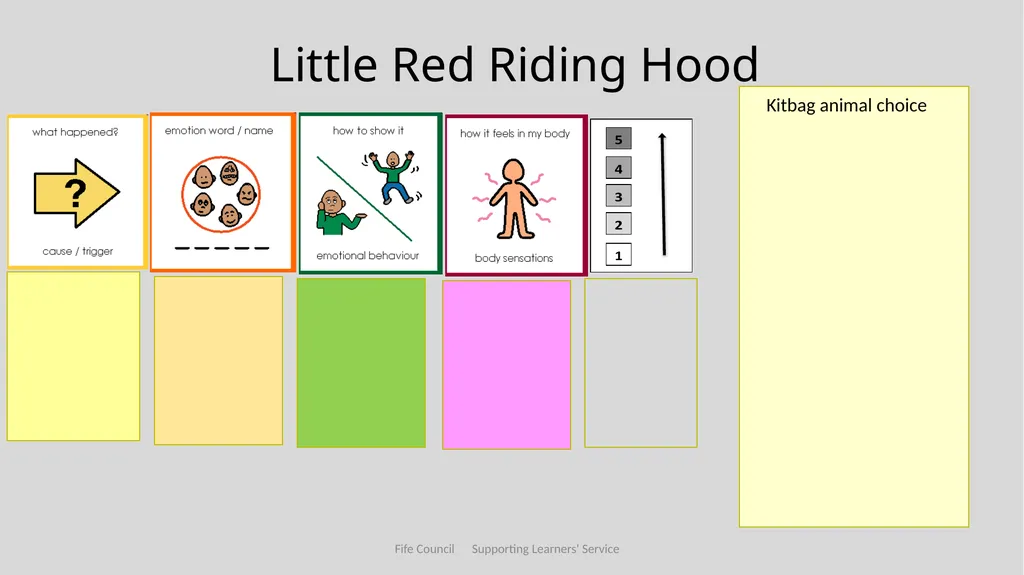
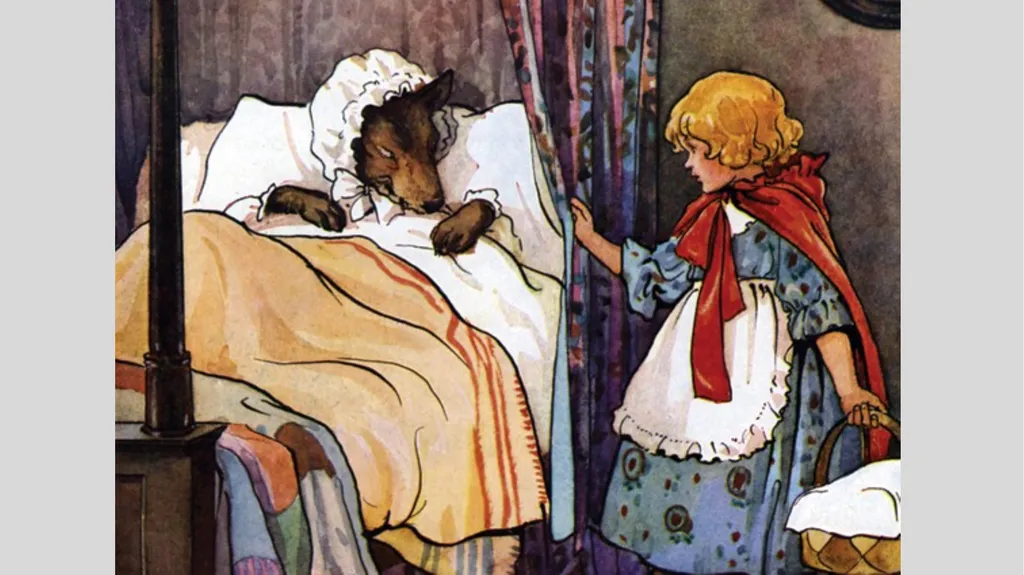
Little Red Riding Hood Kitbag animal choice Fife Council Supporting Learners' Service<br>
41
Fife Council Supporting Learners' Service<br>
42
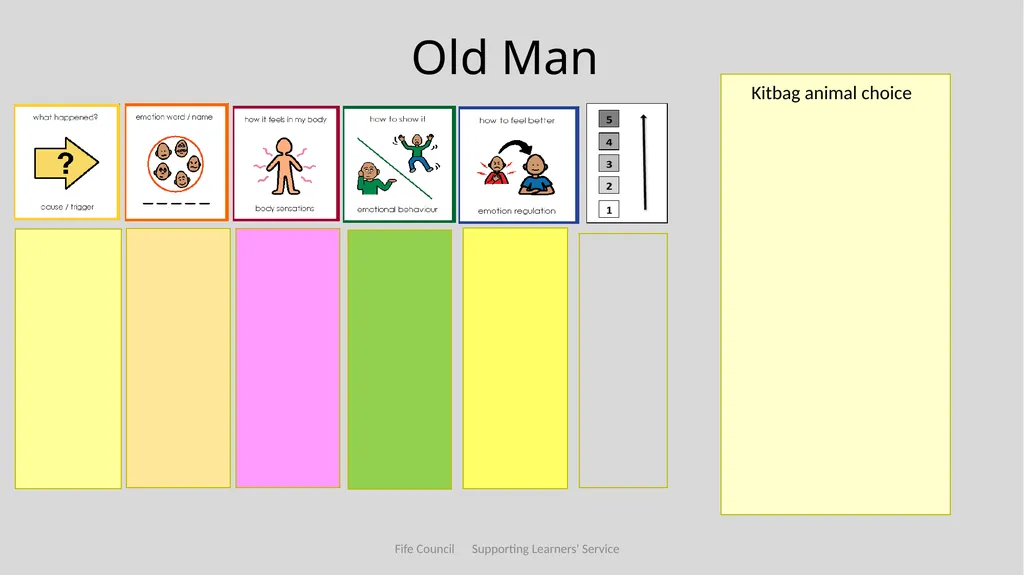
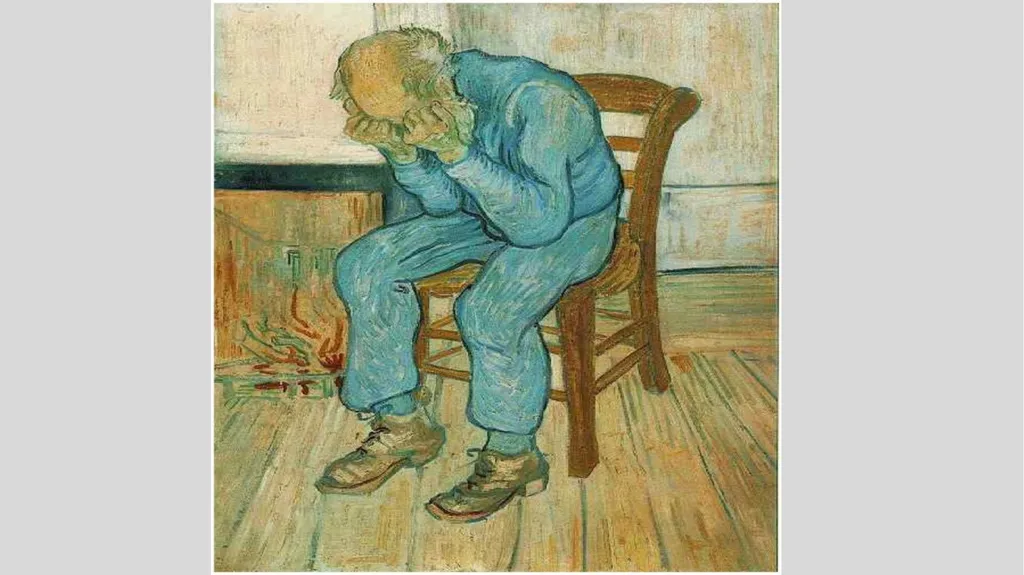
Old Man Kitbag animal choice Fife Council Supporting Learners' Service<br>
43
Fife Council Supporting Learners' Service<br>
44
Little girl in bed Kitbag animal choice Fife Council Supporting Learners' Service<br>
45
Fife Council Supporting Learners' Service<br>
46
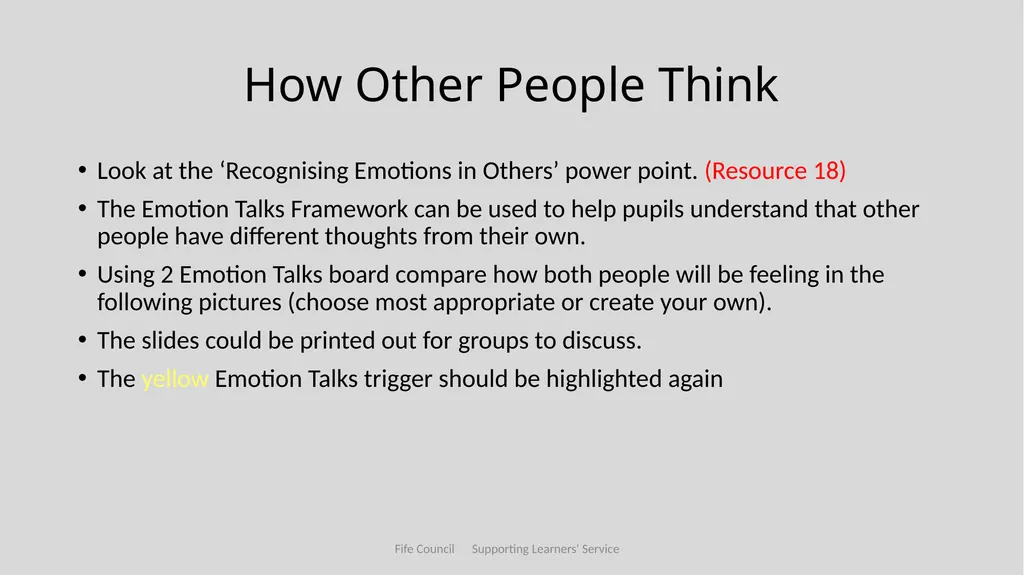
How Other People Think Look at the ‘Recognising Emotions in Others’ power point. (Resource 18)
The Emotion Talks Framework can be used to help pupils understand that other people have different thoughts from their own.
Using 2 Emotion Talks board compare how both people will be feeling in the following pictures (choose most appropriate or create your own).
The slides could be printed out for groups to discuss.
The yellow Emotion Talks trigger should be highlighted again Fife Council Supporting Learners' Service<br>
The Emotion Talks Framework can be used to help pupils understand that other people have different thoughts from their own.
Using 2 Emotion Talks board compare how both people will be feeling in the following pictures (choose most appropriate or create your own).
The slides could be printed out for groups to discuss.
The yellow Emotion Talks trigger should be highlighted again Fife Council Supporting Learners' Service<br>
47
What happened - I went to Jenny’s birthday party. It was so much fun.
I blew out the candles on the cake before she could. Me Jenny Fife Council Supporting Learners' Service<br>
48
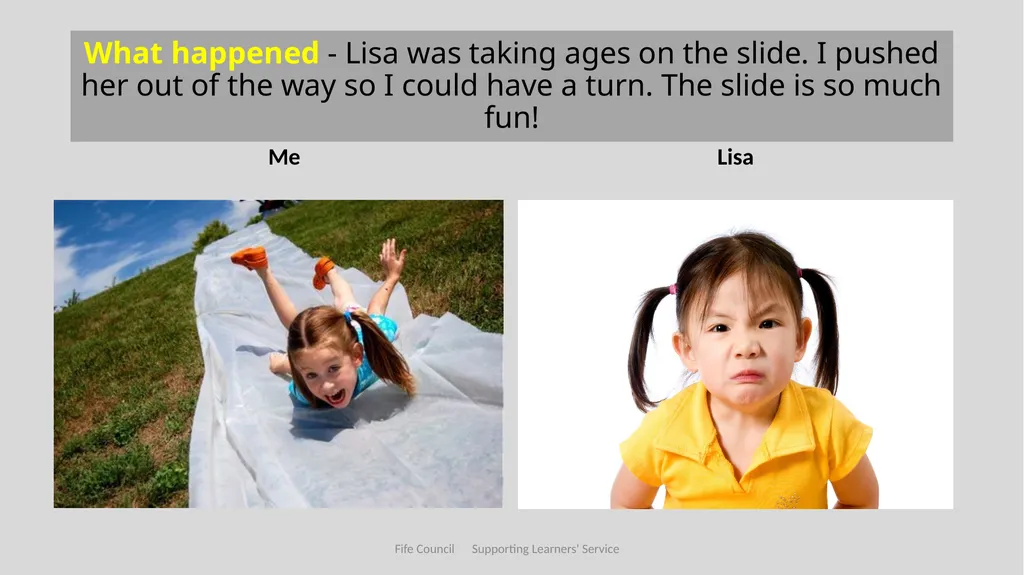
What happened - Lisa was taking ages on the slide. I pushed her out of the way so I could have a turn. The slide is so much fun! Me Lisa Fife Council Supporting Learners' Service<br>
49
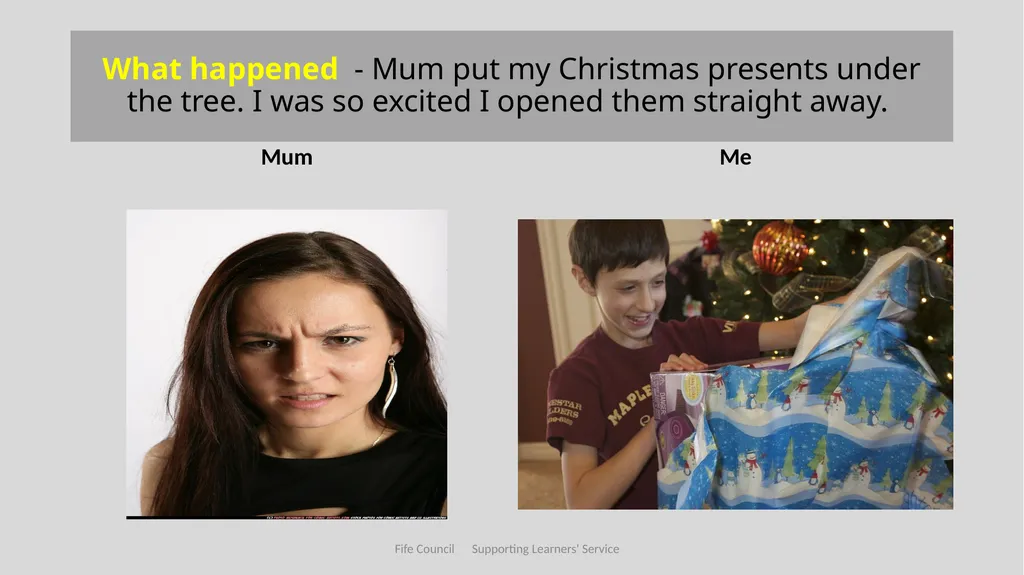
What happened - Mum put my Christmas presents under the tree. I was so excited I opened them straight away. Mum Me Fife Council Supporting Learners' Service<br>
50
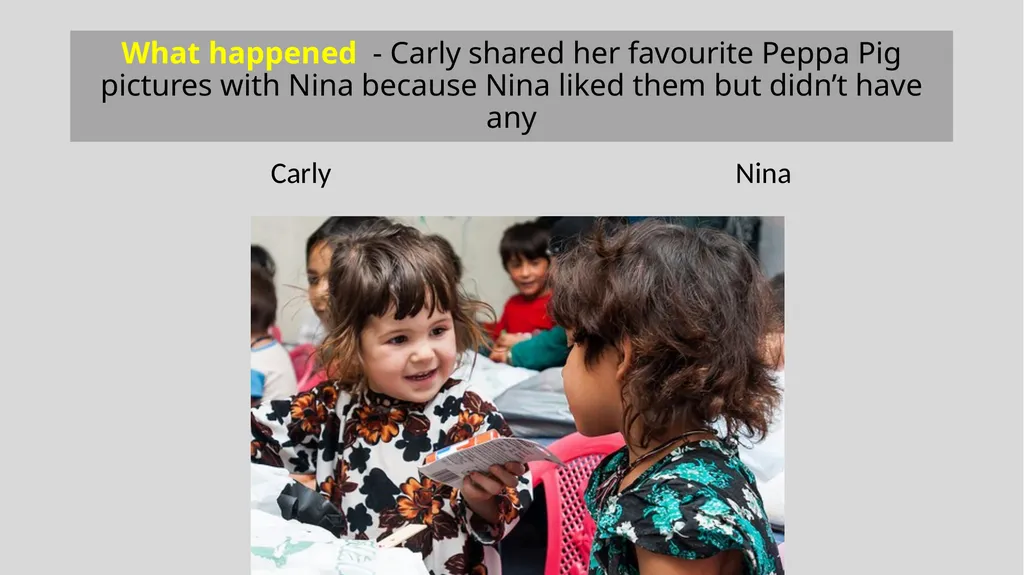
What happened - Carly shared her favourite Peppa Pig pictures with Nina because Nina liked them but didn’t have any Carly Nina Fife Council Supporting Learners' Service<br>
51
What happened - Ann and Sarah laughed at Molly when she got the wrong answer in class. She’s so stupid. Ann and Sarah Molly Fife Council Supporting Learners' Service<br>
52
What happened - Fred said ‘Congratulations’ to Josh when he won the game. He played so well. Fred Josh Fife Council Supporting Learners' Service<br>
53
What happened - I said ‘Good Luck’ to Arran before his race. I hope he wins. Arran’s thoughts Fife Council Supporting Learners' Service<br>
54
Act it out
What happened - You are standing in the queue with your friends waiting to go on a rollercoaster. One of your friends begin to feel really nervous. How do they feel?
What words describe how they feel?
How do they show it?
How can you make them feel better? Fife Council Supporting Learners' Service<br>
What words describe how they feel?
How do they show it?
How can you make them feel better? Fife Council Supporting Learners' Service<br>
55
Act it out
What happened - Someone doesn’t let your friend join in the game that you are all playing. How do they feel?
What words describe how they feel?
How do they show it?
How can you make them feel better? Fife Council Supporting Learners' Service<br>
What words describe how they feel?
How do they show it?
How can you make them feel better? Fife Council Supporting Learners' Service<br>
56
Act it out
What happened - One morning you go to visit your friend and discover that his pet died the evening before. How do they feel?
What words describe how they feel?
How do they show it?
How can you make them feel better? Fife Council Supporting Learners' Service<br>
What words describe how they feel?
How do they show it?
How can you make them feel better? Fife Council Supporting Learners' Service<br>
57
Act it out
What happened - Your little brother tried to open his favourite crisps but the packet burst and spilled on the floor. How does he feel?
What words describe how he feel?
How does he show it?
How can you make him feel better? Fife Council Supporting Learners' Service<br>
What words describe how he feel?
How does he show it?
How can you make him feel better? Fife Council Supporting Learners' Service<br>
58
Extra activity - Kind Hearts Story Here’s a story that will help children understand why it’s important to be kind to their classmates. Cut a large heart out of red construction paper and hold it in your lap as you begin to tell the story below:
This is a story about a special friend named _____. He always came to school with a smile
on his face and a big heart full of love for his classmates. (Hold up the big heart.) ______
listened to his teacher, did his best work, and helped his friends. However, some of his
friends weren’t always so kind. Joe made fun of his shoes and broke a little of his
heart. (Tear off a piece of the heart and let it drop to the floor.) Ann said, “I’m saving
this seat and you can’t sit here” at story time and broke a little more of his heart. Sammy
wouldn’t share his crayons (tear off a little of the heart) and Sara called him a mean
name. What are some other things that might break his heart? (Let the children name
other things that cause hurt feelings as you let the pieces fall to the floor.) By the end of
the day his heart was all in pieces and it was so sad.
Who can tell me how to put his heart back together? What are some kind things you can do for your friends? As children name different acts of kindness pick the pieces of the heart off the floor. Glue the pieces together on a poster as a reminder to have a kind heart. Encourage children to write friends’ names on the poster when they are kind and helpful to them! Fife Council Supporting Learners' Service<br>
This is a story about a special friend named _____. He always came to school with a smile
on his face and a big heart full of love for his classmates. (Hold up the big heart.) ______
listened to his teacher, did his best work, and helped his friends. However, some of his
friends weren’t always so kind. Joe made fun of his shoes and broke a little of his
heart. (Tear off a piece of the heart and let it drop to the floor.) Ann said, “I’m saving
this seat and you can’t sit here” at story time and broke a little more of his heart. Sammy
wouldn’t share his crayons (tear off a little of the heart) and Sara called him a mean
name. What are some other things that might break his heart? (Let the children name
other things that cause hurt feelings as you let the pieces fall to the floor.) By the end of
the day his heart was all in pieces and it was so sad.
Who can tell me how to put his heart back together? What are some kind things you can do for your friends? As children name different acts of kindness pick the pieces of the heart off the floor. Glue the pieces together on a poster as a reminder to have a kind heart. Encourage children to write friends’ names on the poster when they are kind and helpful to them! Fife Council Supporting Learners' Service<br>
59
Fife Council Supporting Learners' Service<br>
60
Introducing 5 Point Scale - Lesson 1 Talk about things you like and dislike (Use Resources 3 and 6 again – children may want to add to / change this)
Talk about things that make you happy and sad
Follow up ideas
Have a few emotion cards on the board or in groups. Ask children to talk about things they think of when looking at the emotion card. Fife Council Supporting Learners' Service<br>
Talk about things that make you happy and sad
Follow up ideas
Have a few emotion cards on the board or in groups. Ask children to talk about things they think of when looking at the emotion card. Fife Council Supporting Learners' Service<br>
61
Resource 3 Fife Council Supporting Learners' Service<br>
62
Resource 6 Fife Council Supporting Learners' Service<br>
63
5 Point Scale - Lesson 2 Recap on previous lesson.
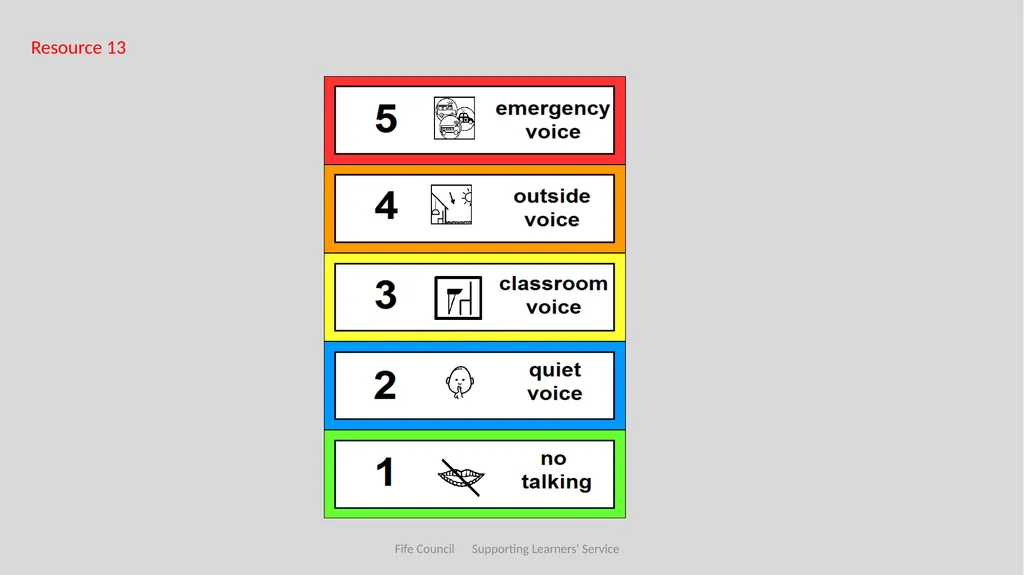
Introduce Voice Scale (Resource 13)
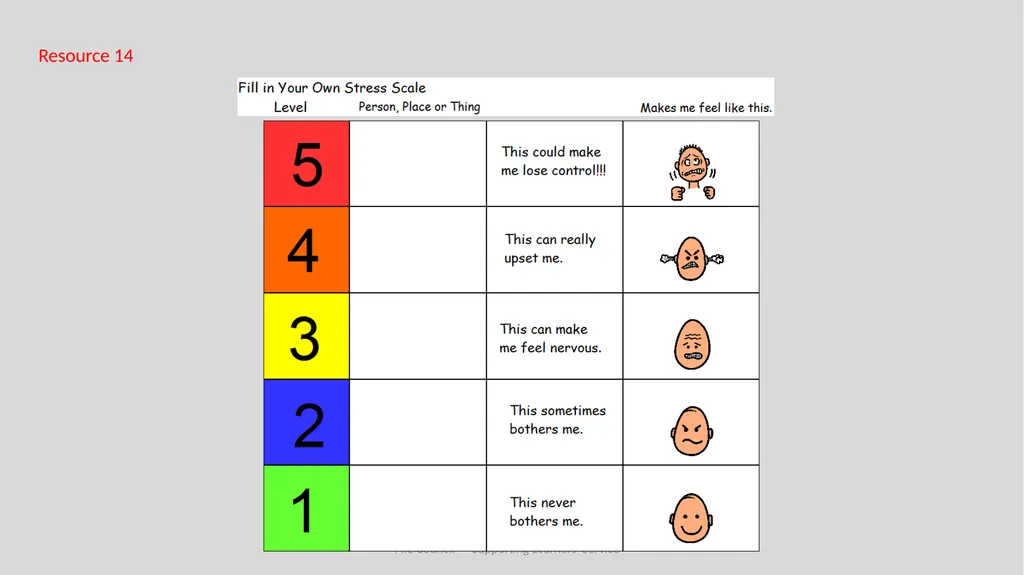
Talk about ‘How I feel Scale’ (Resource 14) – discuss when your emotions get more intense that your behaviour starts to change as a result.
Ideas
Share worksheets with a partner.
Practice using different voice examples from the voice scale to show escalation from 1 to 5.
Children can use previous worksheets to help give them ideas on what to put in each section of ‘How I feel Scale’. Children can write or draw their answers depending on year group. Fife Council Supporting Learners' Service<br>
Introduce Voice Scale (Resource 13)
Talk about ‘How I feel Scale’ (Resource 14) – discuss when your emotions get more intense that your behaviour starts to change as a result.
Ideas
Share worksheets with a partner.
Practice using different voice examples from the voice scale to show escalation from 1 to 5.
Children can use previous worksheets to help give them ideas on what to put in each section of ‘How I feel Scale’. Children can write or draw their answers depending on year group. Fife Council Supporting Learners' Service<br>
64
Resource 13 Fife Council Supporting Learners' Service<br>
65
Resource 14 Fife Council Supporting Learners' Service<br>
66
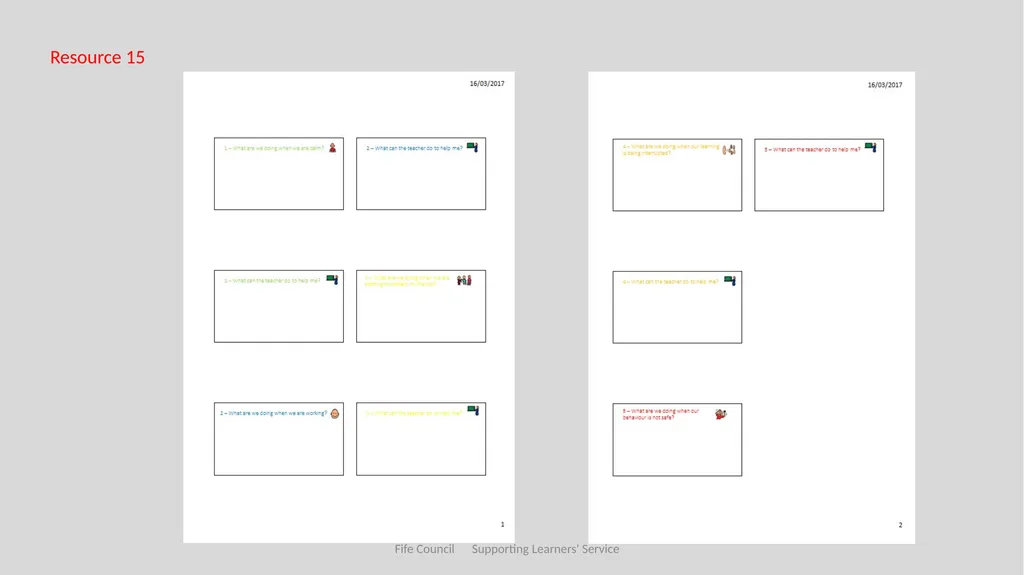
5 Point Scale - Lesson 3 Work through Resource 15 slides with class. This can be done in small groups and collate answers or done as a whole class activity.
Remind children that the left side of the scale is identifying behaviour not feelings and thoughts. The right side is what they would like the teacher to do to help.
Ideas
Use some of the Emotion Talk symbols (from booklet) to help with adding images to the scale.
Make sure most children are in agreement of what the adults support should be.
Discuss what a time out or break from the class would look like. Could an area outside the class be developed for children to go to calm down or have a break from their learning when needed? Fife Council Supporting Learners' Service<br>
Remind children that the left side of the scale is identifying behaviour not feelings and thoughts. The right side is what they would like the teacher to do to help.
Ideas
Use some of the Emotion Talk symbols (from booklet) to help with adding images to the scale.
Make sure most children are in agreement of what the adults support should be.
Discuss what a time out or break from the class would look like. Could an area outside the class be developed for children to go to calm down or have a break from their learning when needed? Fife Council Supporting Learners' Service<br>
67
Resource 15 Fife Council Supporting Learners' Service<br>
68
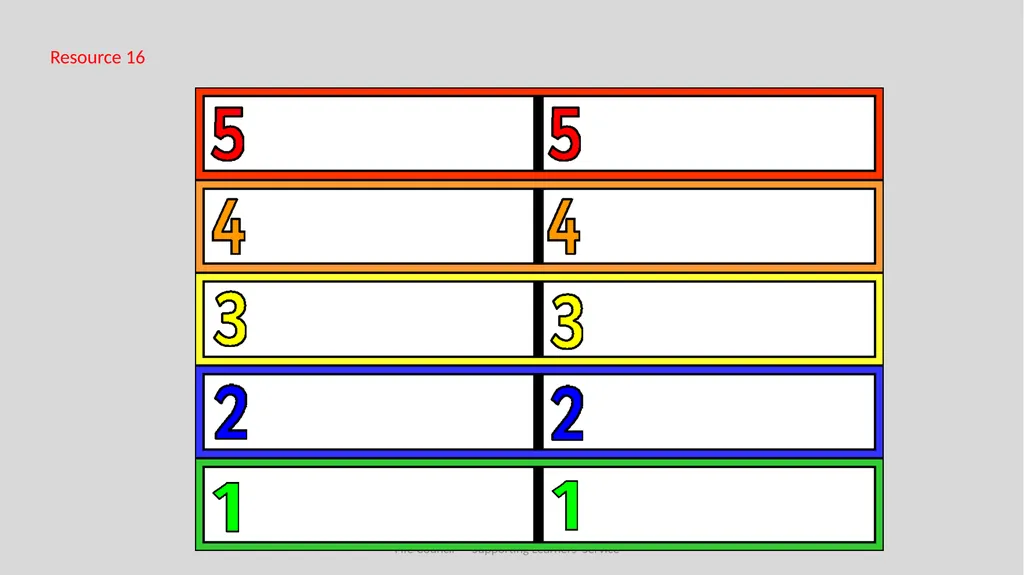
5 Point Scale - Lesson 4 Recap what happened last lesson.
Look at examples of ‘how I feel’ worksheets
Complete ‘Class 5 point scale slides’ (Resources 16)
Ideas
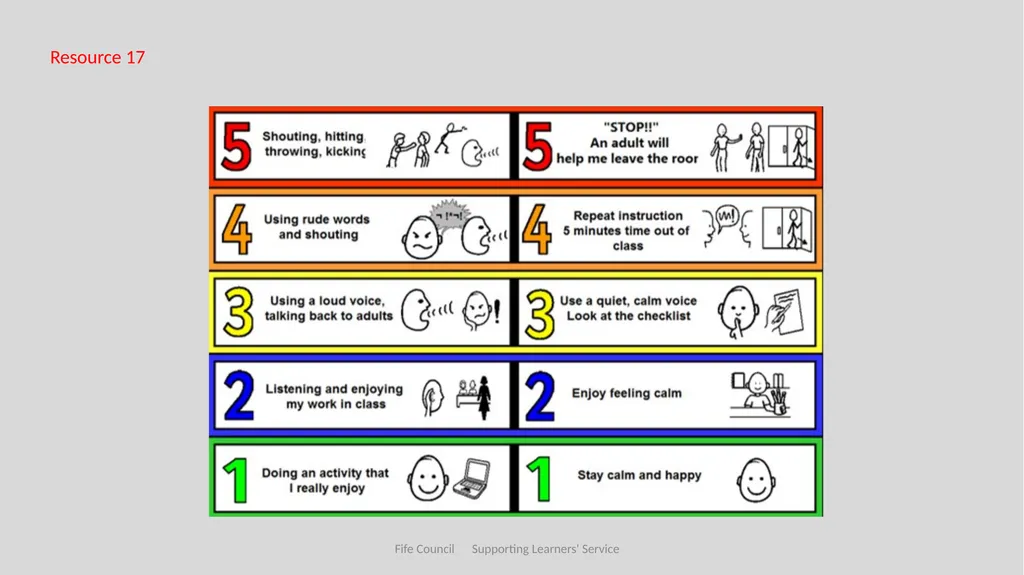
Using the slides completed last lesson. Begin to minimise the language and agree on 1 sentence or a few words for each section.
Discuss what images would be helpful in each section for the children to remember.
Role play scenarios and children can decide what action the teacher needs to take. Fife Council Supporting Learners' Service<br>
Look at examples of ‘how I feel’ worksheets
Complete ‘Class 5 point scale slides’ (Resources 16)
Ideas
Using the slides completed last lesson. Begin to minimise the language and agree on 1 sentence or a few words for each section.
Discuss what images would be helpful in each section for the children to remember.
Role play scenarios and children can decide what action the teacher needs to take. Fife Council Supporting Learners' Service<br>
69
Resource 16 Fife Council Supporting Learners' Service<br>
70
Resource 17 Fife Council Supporting Learners' Service<br>
71
Fife Council Supporting Learners' Service<br>