
Enquiry: When did the Normans complete their
JO
Published · 13 slides · 0 views
1 / 1
Description
Enquiry: When did the Normans complete their conquest? SOURCE BOOKLET This booklet contains the sources that you will need to use in this enquiry. Key information about the provenance of the source is given, in addition to extracts that
Related Topics
Share
Embed code
Download this presentation From Below
"Enquiry: When did the Normans complete their" is the property of its rightful owner. Permission is granted to download and print the materials on this website for personal, non-commercial use only, and to display it on your personal computer provided you do not modify the materials and that you retain all copyright notices contained in the materials. By downloading content from our website, you accept the terms of this agreement.
Presentation Transcript
01
Enquiry: When did the Normans complete their conquest?
SOURCE BOOKLET This booklet contains the sources that you will need to use in this enquiry. Key information about the provenance of the source is given, in addition to extracts that will help you to answer the overarching enquiry question.
Please bring this booklet to every lesson for this enquiry!
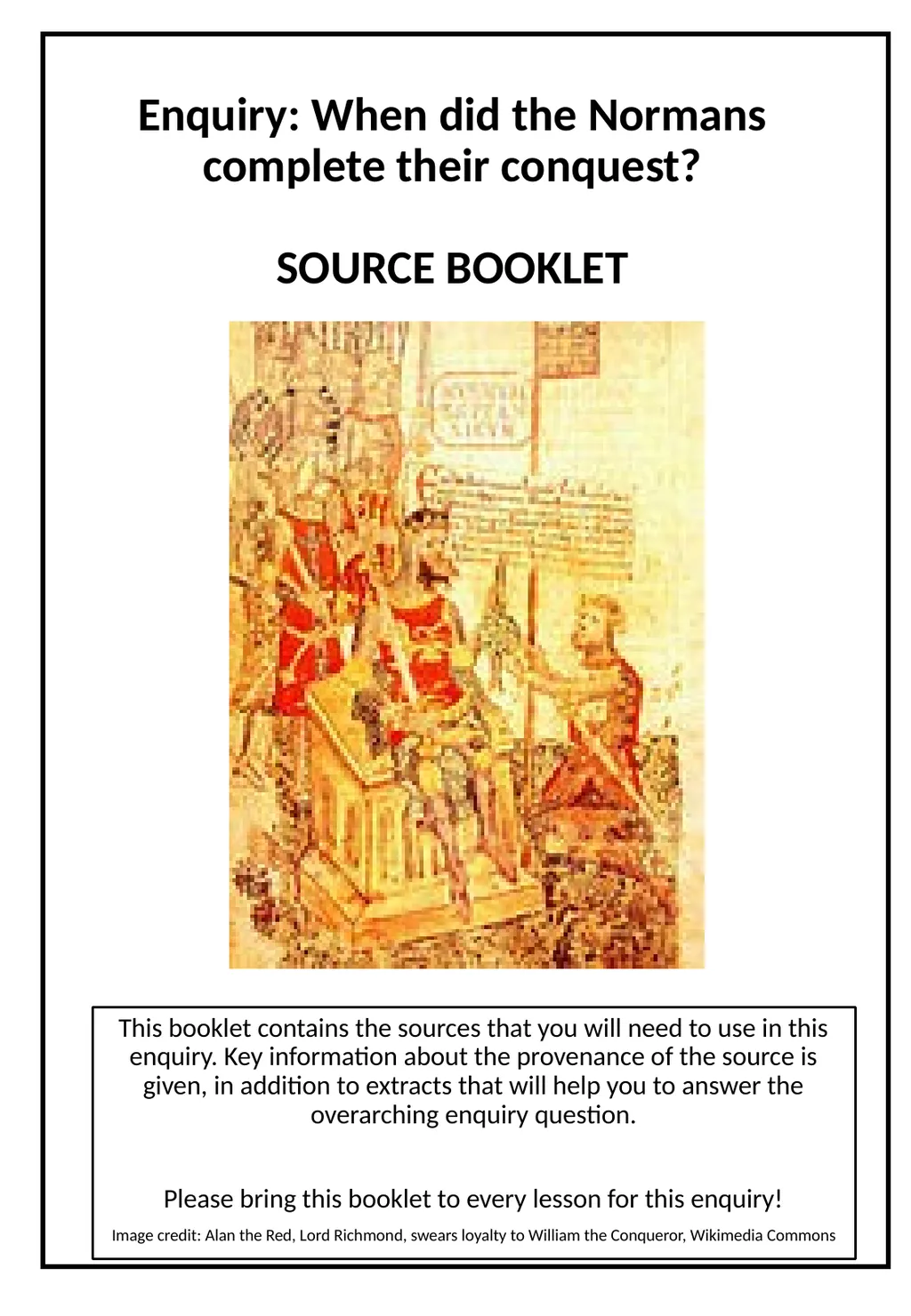
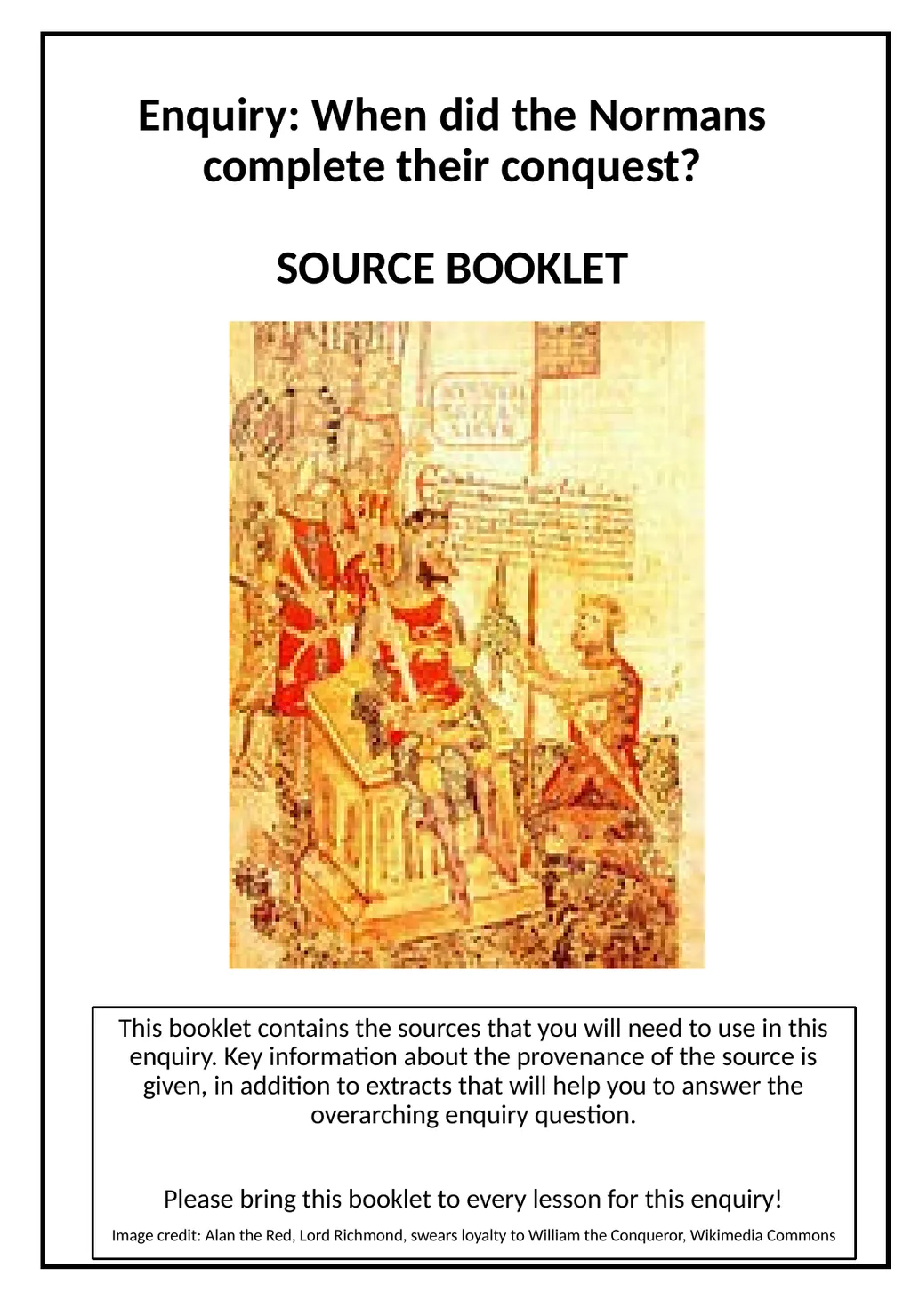
Image credit: Alan the Red, Lord Richmond, swears loyalty to William the Conqueror, Wikimedia Commons<br>
Please bring this booklet to every lesson for this enquiry!
Image credit: Alan the Red, Lord Richmond, swears loyalty to William the Conqueror, Wikimedia Commons<br>
02
When did the Normans complete their conquest?
Evidential thinking: Using historical sources What are historical sources?
Historical sources are contemporary documents that have survived and have the potential to tell us more about the past. Sources can be almost anything – artefacts (objects), letters, drawings, photographs, newspapers, government reports, surveys and so on. You will be using a range of different sources in this enquiry.
Are historical sources the same as evidence?
No. Historical sources become evidence that we can use to find out more about the past when we begin to examine and interrogate them. This usually means asking questions of them. For example, we are going to be thinking about our overarching enquiry question (When did the Normans complete their conquest?) when we think about some different sources over the next few lessons.
Aren’t all historical sources biased?
First of all, we need to think about the term ‘biased’. It’s not really a very useful term to use when we’re discussing historical sources, as it’s often used to dismiss them as being somehow untrustworthy and therefore worthless. This certainly isn’t the case. It’s true that all sources were created from a particular perspective – they probably reflect the viewpoint of the person who created them at the time, and may have also been created to achieve a particular purpose. BUT this does not mean that they are not useful. In fact, as long as we are aware of the potential viewpoint of the creator of a source, they are incredibly useful to historians in finding out about the past. Our enquiry
Over the next few lessons, we are going to use historical sources to build up a picture of William’s conquest of England after his victory at Hastings.
We will be using several different historical sources to find evidence to help us to answer our enquiry question. This is similar to the way in which an historian might begin to build up an interpretation of the past.
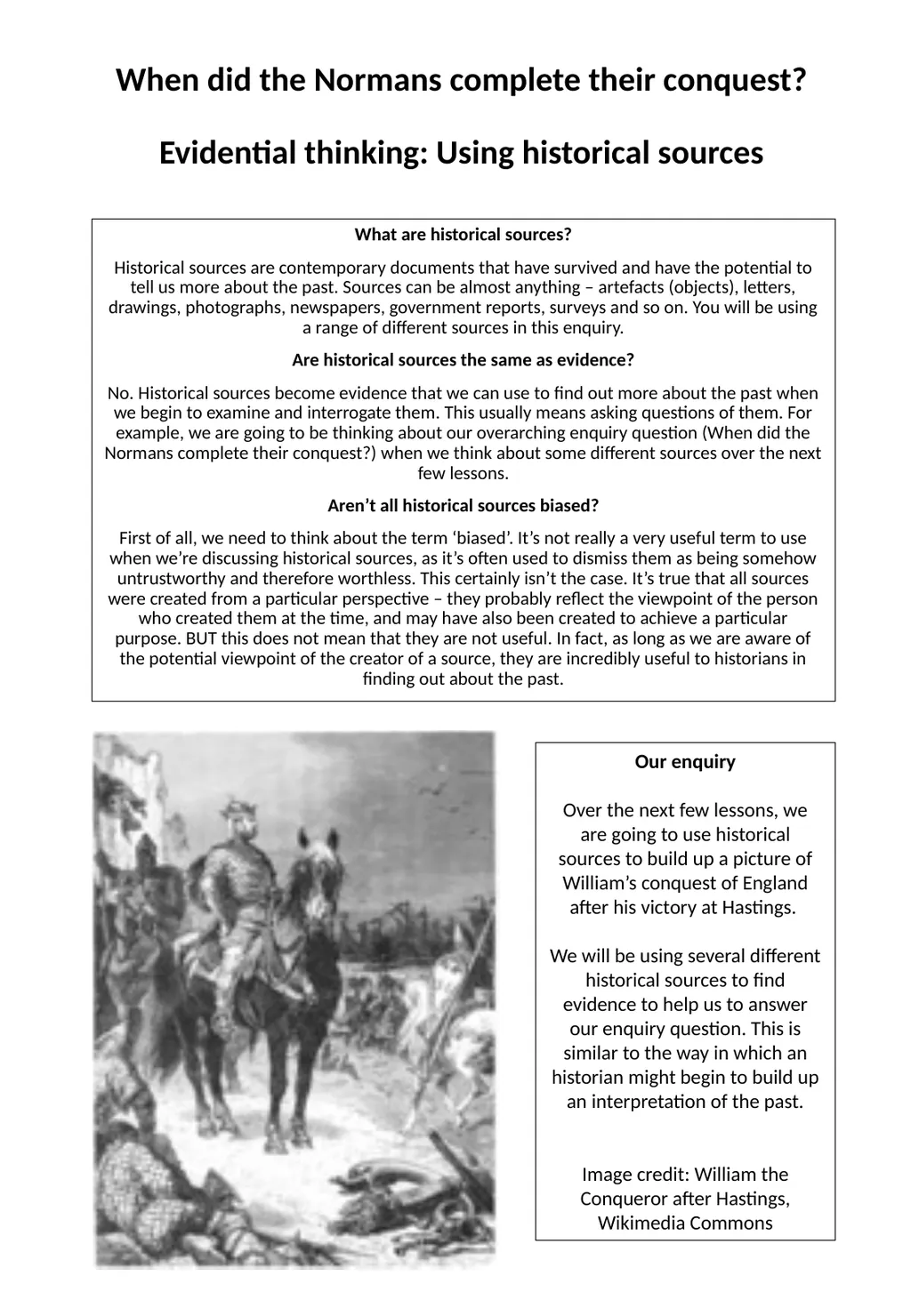
Image credit: William the Conqueror after Hastings, Wikimedia Commons<br>
03
The Sources The Carmen de Hastingae Proelio (Song of the Battle of Hastings) of Guy, Bishop of Amiens
The Carmen covers the events between September and December 1066. It is attributed to Guy of Amiens, noble of Ponthieu, who became chaplain for Matilda of Flanders, William I’s queen. It is the earliest account of the events of 1066, and is likely to have been composed at some time in 1067. It is written in poetic form, and was possibly commissioned as a form of entertainment/to memorialise William’s conquest through performances at royal festivities in Normandy.
The Anglo-Saxon Chronicle (ASC)
The Anglo-Saxon Chronicle is a collection of annals (a record of events year by year), mostly written in Old English, recording the history of the Anglo-Saxons. The original manuscript was created in the late ninth century, probably in Wessex, during the reign of Alfred the Great. Multiple copies of this original were distributed to monasteries across England, where they were independently updated, leading to different versions. The original does not survive but some of the versions created from it do.
There are occasions when comparison with other medieval sources makes it clear that the scribe who wrote the chronicles omitted events or told particular versions of stories, and there are also places where the different versions contradict each other. But, as a whole, the Anglo-Saxon Chronicle is the single most important historical source for this period, as much of the information recorded in it is not recorded elsewhere.
Geffrei Gaimar’s Estoire des Engleis (History of the English People)
This is an Anglo-Norman chronicle written for the wife of a landowner in Lincolnshire and Hampshire. It is the oldest known chronicle in the French language and it is likely to have been written in the middle to late 1130s. It was largely based on pre-existing chronicles and documents English history from about 495 to 1100, although an earlier section has been lost. It states that the Normans were the true successors to the English throne and was written in couplets.
The Gesta Normannorum Ducum of William of Jumièges
This is a chronicle created by the monk William of Jumièges in about 1060. It is likely that William I had William of Jumièges extend the work in about 1070 to include the events of the Conquest to that point. It praises and glorifies the Norman Conquest.
Brut y Tywysogion
The Brut y Twysogion (translation: Chronicle of the Princes) is a significant source for Welsh history in this period. It is a collection of annals, and has survived as Welsh translations of an original Latin version (now lost). The most complete version is known as the Peniarth MS. 20. This begins in 682 and ends in 1332. The entries for the early years are brief, but events such as significant deaths and natural occurrences like plagues or eclipses are noted. Later entries go into greater detail. The main focus is on the rulers (‘Princes’) of the Welsh kingdoms of Deheubarth, Gwynedd and Powys. Some Church events are also recorded, and occasionally important events in England, Scotland and Ireland are also mentioned.
Henry of Huntingdon’s The History of the English People 1000–1154
Henry of Huntingdon was an Anglo-Norman historian who served as the archdeacon of Huntingdon. This work (Historia Anglorum) was an attempt to write a history of England up to modern times. The first edition is likely to have been published in 1129, and new editions were published as the years went by. The final version ends in 1154, with the death of King Stephen. Henry of Huntingdon’s writing includes many famous anecdotes, which make it entertaining to read. He was encouraged to write this history by the Bishop of Lincoln. The Bishop’s household was often with the royal court of the day, which may account for the fact that some historians have noted that many details provided by Henry regarding the royal family seem to be accurate.
The Domesday Book
The Domesday Book is Britain’s earliest surviving public record. It is a compilation of the results of an enormous survey ordered by William I to record details of land and landholding in England. It was completed in 1086, and survives today in two volumes – Great and Little Domesday.<br>
04
When did the Normans complete their conquest?
LONDON, winter 1066
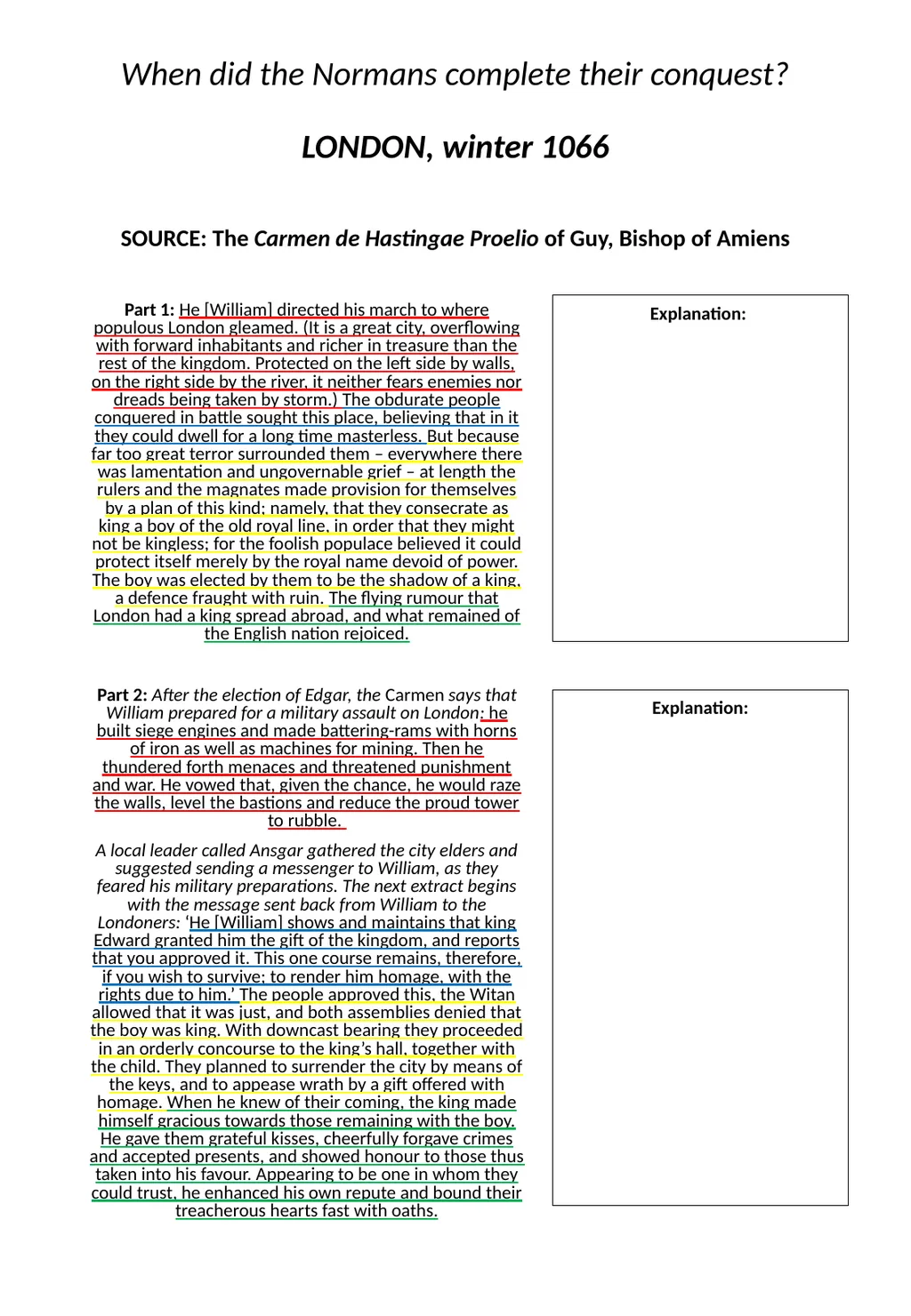
SOURCE: The Carmen de Hastingae Proelio of Guy, Bishop of Amiens Part 1: He [William] directed his march to where populous London gleamed. (It is a great city, overflowing with forward inhabitants and richer in treasure than the rest of the kingdom. Protected on the left side by walls, on the right side by the river, it neither fears enemies nor dreads being taken by storm.) The obdurate people conquered in battle sought this place, believing that in it they could dwell for a long time masterless. But because far too great terror surrounded them – everywhere there was lamentation and ungovernable grief – at length the rulers and the magnates made provision for themselves by a plan of this kind; namely, that they consecrate as king a boy of the old royal line, in order that they might not be kingless; for the foolish populace believed it could protect itself merely by the royal name devoid of power. The boy was elected by them to be the shadow of a king, a defence fraught with ruin. The flying rumour that London had a king spread abroad, and what remained of the English nation rejoiced.
Part 2: After the election of Edgar, the Carmen says that William prepared for a military assault on London: he built siege engines and made battering-rams with horns of iron as well as machines for mining. Then he thundered forth menaces and threatened punishment and war. He vowed that, given the chance, he would raze the walls, level the bastions and reduce the proud tower to rubble.
A local leader called Ansgar gathered the city elders and suggested sending a messenger to William, as they feared his military preparations. The next extract begins with the message sent back from William to the Londoners: ‘He [William] shows and maintains that king Edward granted him the gift of the kingdom, and reports that you approved it. This one course remains, therefore, if you wish to survive; to render him homage, with the rights due to him.’ The people approved this, the Witan allowed that it was just, and both assemblies denied that the boy was king. With downcast bearing they proceeded in an orderly concourse to the king’s hall, together with the child. They planned to surrender the city by means of the keys, and to appease wrath by a gift offered with homage. When he knew of their coming, the king made himself gracious towards those remaining with the boy. He gave them grateful kisses, cheerfully forgave crimes and accepted presents, and showed honour to those thus taken into his favour. Appearing to be one in whom they could trust, he enhanced his own repute and bound their treacherous hearts fast with oaths. Explanation: Explanation:<br>
05
When did the Normans complete their conquest?
LONDON, winter 1066
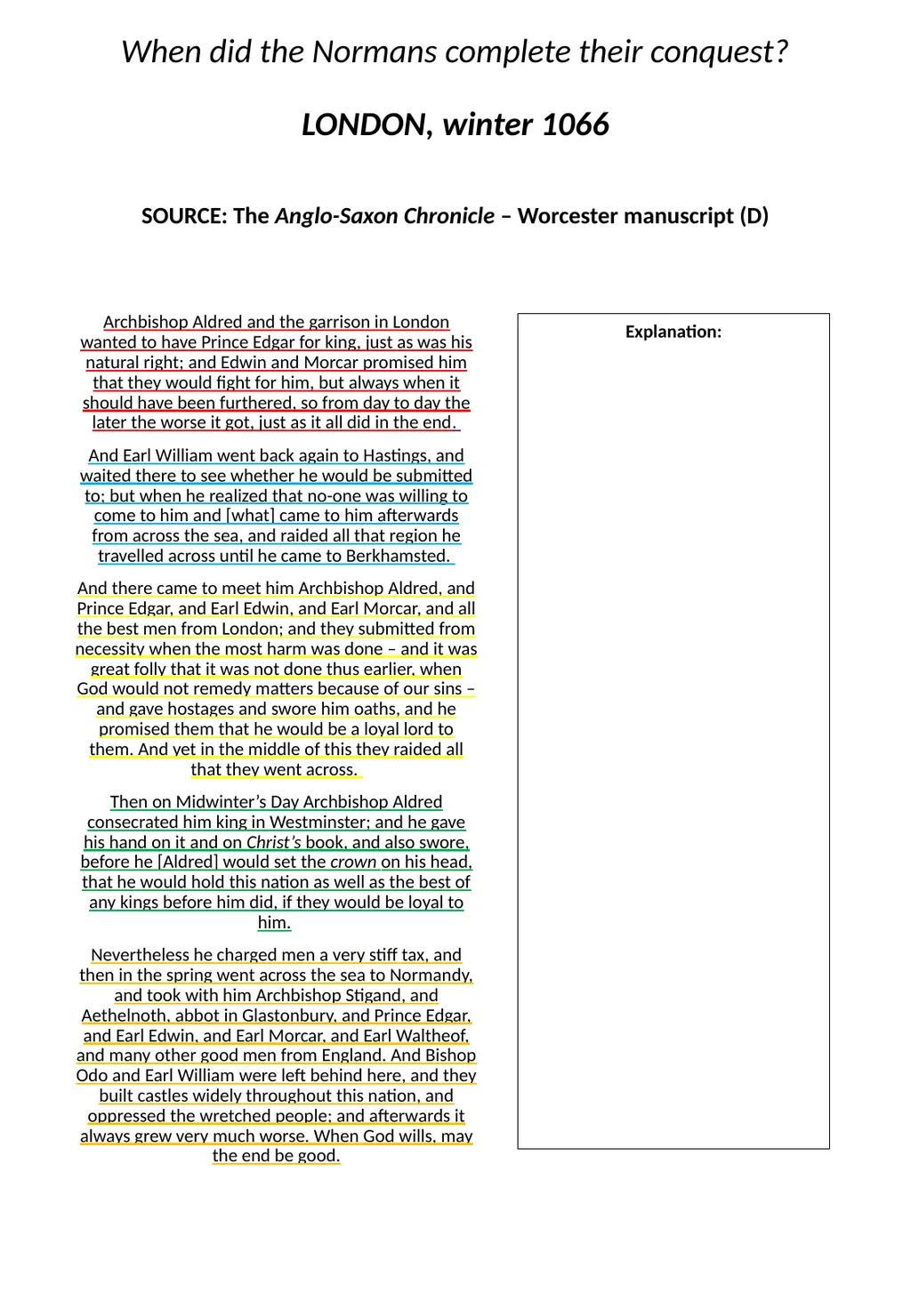
SOURCE: The Anglo-Saxon Chronicle – Worcester manuscript (D) Archbishop Aldred and the garrison in London wanted to have Prince Edgar for king, just as was his natural right; and Edwin and Morcar promised him that they would fight for him, but always when it should have been furthered, so from day to day the later the worse it got, just as it all did in the end.
And Earl William went back again to Hastings, and waited there to see whether he would be submitted to; but when he realized that no-one was willing to come to him and [what] came to him afterwards from across the sea, and raided all that region he travelled across until he came to Berkhamsted.
And there came to meet him Archbishop Aldred, and Prince Edgar, and Earl Edwin, and Earl Morcar, and all the best men from London; and they submitted from necessity when the most harm was done – and it was great folly that it was not done thus earlier, when God would not remedy matters because of our sins – and gave hostages and swore him oaths, and he promised them that he would be a loyal lord to them. And yet in the middle of this they raided all that they went across.
Then on Midwinter’s Day Archbishop Aldred consecrated him king in Westminster; and he gave his hand on it and on Christ’s book, and also swore, before he [Aldred] would set the crown on his head, that he would hold this nation as well as the best of any kings before him did, if they would be loyal to him.
Nevertheless he charged men a very stiff tax, and then in the spring went across the sea to Normandy, and took with him Archbishop Stigand, and Aethelnoth, abbot in Glastonbury, and Prince Edgar, and Earl Edwin, and Earl Morcar, and Earl Waltheof, and many other good men from England. And Bishop Odo and Earl William were left behind here, and they built castles widely throughout this nation, and oppressed the wretched people; and afterwards it always grew very much worse. When God wills, may the end be good. Explanation:<br>
06
When did the Normans complete their conquest?
LONDON, winter 1066
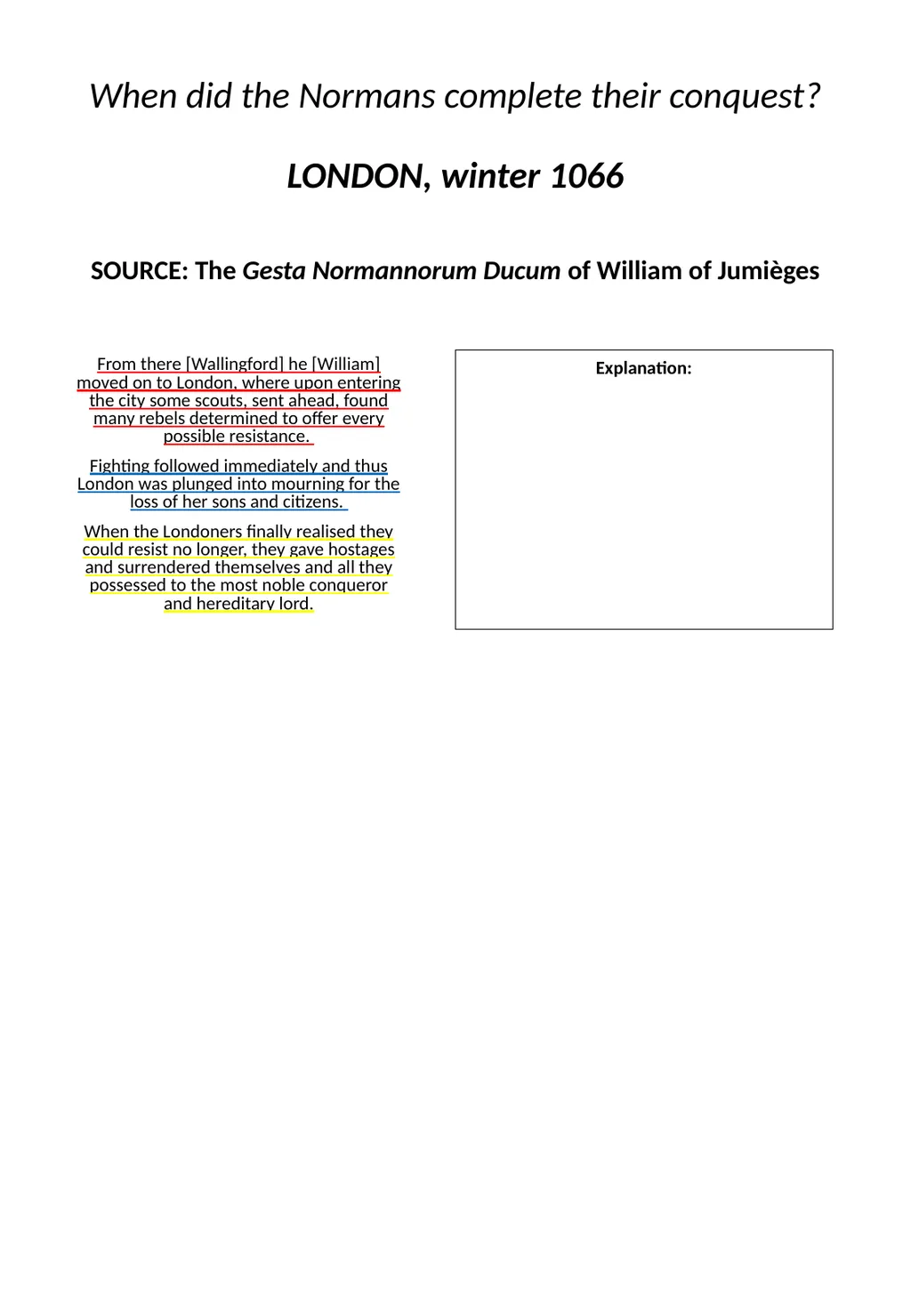
SOURCE: The Gesta Normannorum Ducum of William of Jumièges From there [Wallingford] he [William] moved on to London, where upon entering the city some scouts, sent ahead, found many rebels determined to offer every possible resistance.
Fighting followed immediately and thus London was plunged into mourning for the loss of her sons and citizens.
When the Londoners finally realised they could resist no longer, they gave hostages and surrendered themselves and all they possessed to the most noble conqueror and hereditary lord. Explanation:<br>
07
When did the Normans complete their conquest?
REBELLION in the NORTH, 1067–78
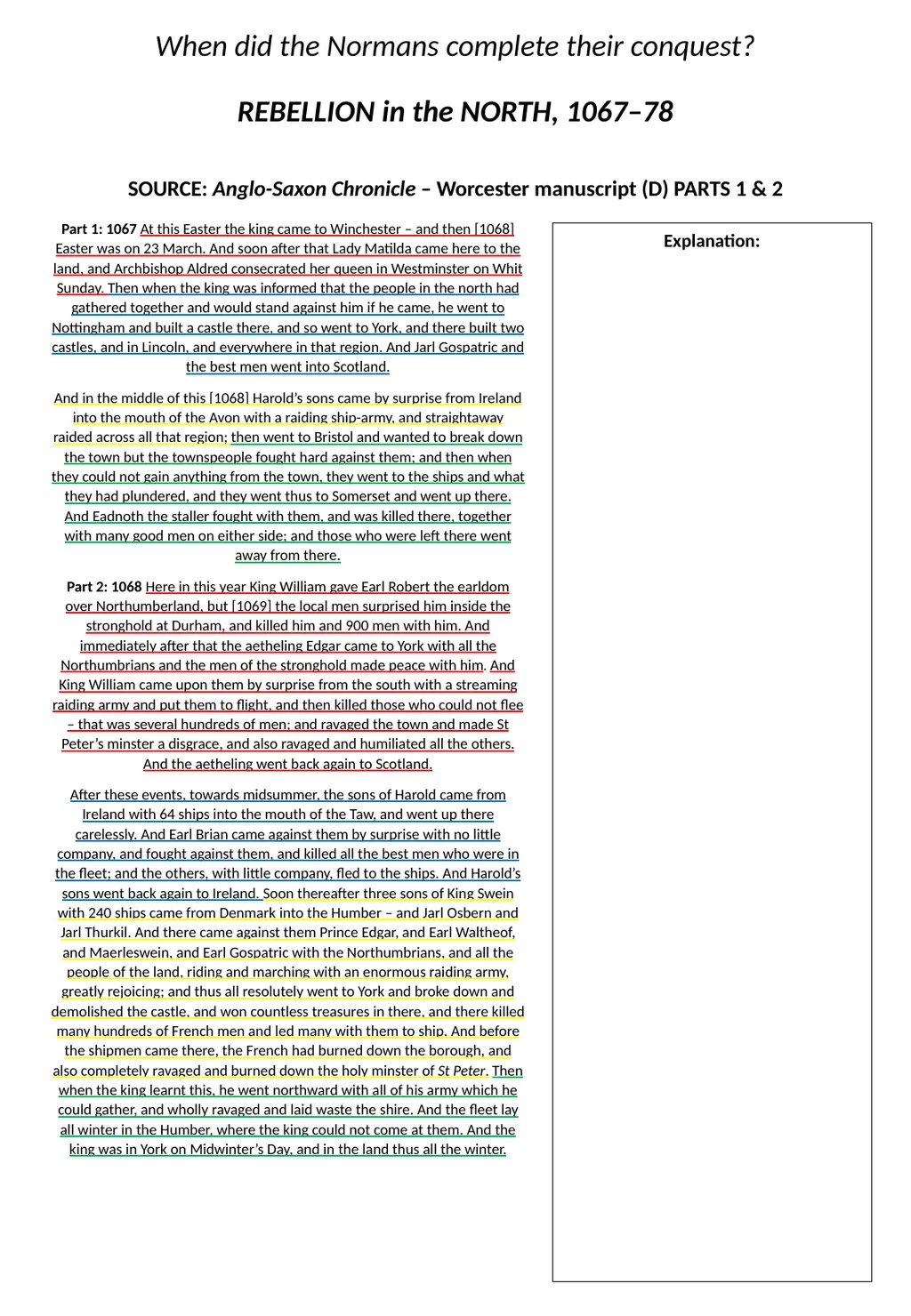
SOURCE: Anglo-Saxon Chronicle – Worcester manuscript (D) PARTS 1 & 2 Part 1: 1067 At this Easter the king came to Winchester – and then [1068] Easter was on 23 March. And soon after that Lady Matilda came here to the land, and Archbishop Aldred consecrated her queen in Westminster on Whit Sunday. Then when the king was informed that the people in the north had gathered together and would stand against him if he came, he went to Nottingham and built a castle there, and so went to York, and there built two castles, and in Lincoln, and everywhere in that region. And Jarl Gospatric and the best men went into Scotland.
And in the middle of this [1068] Harold’s sons came by surprise from Ireland into the mouth of the Avon with a raiding ship-army, and straightaway raided across all that region; then went to Bristol and wanted to break down the town but the townspeople fought hard against them; and then when they could not gain anything from the town, they went to the ships and what they had plundered, and they went thus to Somerset and went up there. And Eadnoth the staller fought with them, and was killed there, together with many good men on either side; and those who were left there went away from there.
Part 2: 1068 Here in this year King William gave Earl Robert the earldom over Northumberland, but [1069] the local men surprised him inside the stronghold at Durham, and killed him and 900 men with him. And immediately after that the aetheling Edgar came to York with all the Northumbrians and the men of the stronghold made peace with him. And King William came upon them by surprise from the south with a streaming raiding army and put them to flight, and then killed those who could not flee – that was several hundreds of men; and ravaged the town and made St Peter’s minster a disgrace, and also ravaged and humiliated all the others. And the aetheling went back again to Scotland.
After these events, towards midsummer, the sons of Harold came from Ireland with 64 ships into the mouth of the Taw, and went up there carelessly. And Earl Brian came against them by surprise with no little company, and fought against them, and killed all the best men who were in the fleet; and the others, with little company, fled to the ships. And Harold’s sons went back again to Ireland. Soon thereafter three sons of King Swein with 240 ships came from Denmark into the Humber – and Jarl Osbern and Jarl Thurkil. And there came against them Prince Edgar, and Earl Waltheof, and Maerleswein, and Earl Gospatric with the Northumbrians, and all the people of the land, riding and marching with an enormous raiding army, greatly rejoicing; and thus all resolutely went to York and broke down and demolished the castle, and won countless treasures in there, and there killed many hundreds of French men and led many with them to ship. And before the shipmen came there, the French had burned down the borough, and also completely ravaged and burned down the holy minster of St Peter. Then when the king learnt this, he went northward with all of his army which he could gather, and wholly ravaged and laid waste the shire. And the fleet lay all winter in the Humber, where the king could not come at them. And the king was in York on Midwinter’s Day, and in the land thus all the winter. Explanation:<br>
08
When did the Normans complete their conquest?
REBELLION in the NORTH, 1067–78
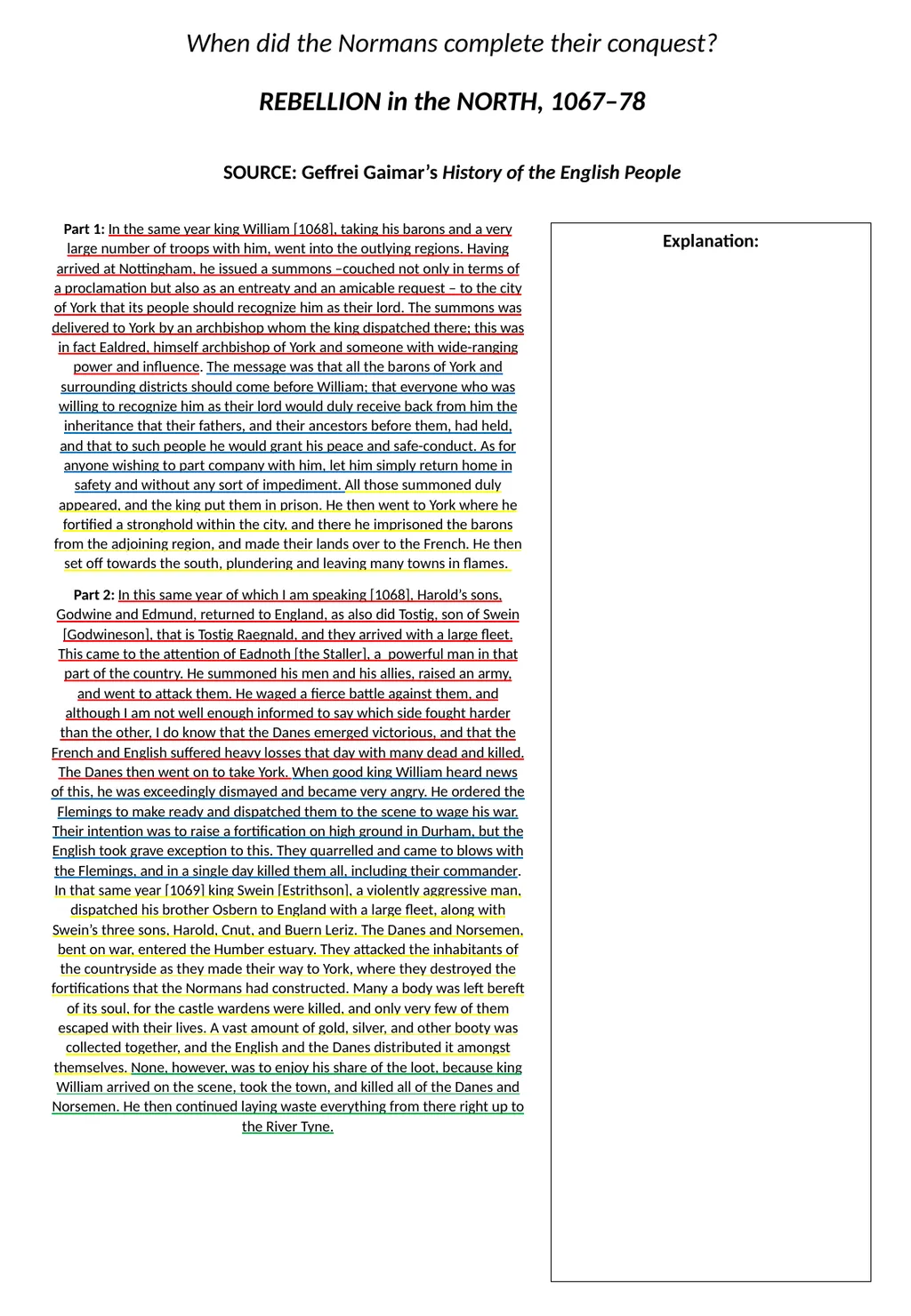
SOURCE: Geffrei Gaimar’s History of the English People Part 1: In the same year king William [1068], taking his barons and a very large number of troops with him, went into the outlying regions. Having arrived at Nottingham, he issued a summons –couched not only in terms of a proclamation but also as an entreaty and an amicable request – to the city of York that its people should recognize him as their lord. The summons was delivered to York by an archbishop whom the king dispatched there; this was in fact Ealdred, himself archbishop of York and someone with wide-ranging power and influence. The message was that all the barons of York and surrounding districts should come before William; that everyone who was willing to recognize him as their lord would duly receive back from him the inheritance that their fathers, and their ancestors before them, had held, and that to such people he would grant his peace and safe-conduct. As for anyone wishing to part company with him, let him simply return home in safety and without any sort of impediment. All those summoned duly appeared, and the king put them in prison. He then went to York where he fortified a stronghold within the city, and there he imprisoned the barons from the adjoining region, and made their lands over to the French. He then set off towards the south, plundering and leaving many towns in flames.
Part 2: In this same year of which I am speaking [1068], Harold’s sons, Godwine and Edmund, returned to England, as also did Tostig, son of Swein [Godwineson], that is Tostig Raegnald, and they arrived with a large fleet. This came to the attention of Eadnoth [the Staller], a powerful man in that part of the country. He summoned his men and his allies, raised an army, and went to attack them. He waged a fierce battle against them, and although I am not well enough informed to say which side fought harder than the other, I do know that the Danes emerged victorious, and that the French and English suffered heavy losses that day with many dead and killed. The Danes then went on to take York. When good king William heard news of this, he was exceedingly dismayed and became very angry. He ordered the Flemings to make ready and dispatched them to the scene to wage his war. Their intention was to raise a fortification on high ground in Durham, but the English took grave exception to this. They quarrelled and came to blows with the Flemings, and in a single day killed them all, including their commander. In that same year [1069] king Swein [Estrithson], a violently aggressive man, dispatched his brother Osbern to England with a large fleet, along with Swein’s three sons, Harold, Cnut, and Buern Leriz. The Danes and Norsemen, bent on war, entered the Humber estuary. They attacked the inhabitants of the countryside as they made their way to York, where they destroyed the fortifications that the Normans had constructed. Many a body was left bereft of its soul, for the castle wardens were killed, and only very few of them escaped with their lives. A vast amount of gold, silver, and other booty was collected together, and the English and the Danes distributed it amongst themselves. None, however, was to enjoy his share of the loot, because king William arrived on the scene, took the town, and killed all of the Danes and Norsemen. He then continued laying waste everything from there right up to the River Tyne. Explanation:<br>
Part 2: In this same year of which I am speaking [1068], Harold’s sons, Godwine and Edmund, returned to England, as also did Tostig, son of Swein [Godwineson], that is Tostig Raegnald, and they arrived with a large fleet. This came to the attention of Eadnoth [the Staller], a powerful man in that part of the country. He summoned his men and his allies, raised an army, and went to attack them. He waged a fierce battle against them, and although I am not well enough informed to say which side fought harder than the other, I do know that the Danes emerged victorious, and that the French and English suffered heavy losses that day with many dead and killed. The Danes then went on to take York. When good king William heard news of this, he was exceedingly dismayed and became very angry. He ordered the Flemings to make ready and dispatched them to the scene to wage his war. Their intention was to raise a fortification on high ground in Durham, but the English took grave exception to this. They quarrelled and came to blows with the Flemings, and in a single day killed them all, including their commander. In that same year [1069] king Swein [Estrithson], a violently aggressive man, dispatched his brother Osbern to England with a large fleet, along with Swein’s three sons, Harold, Cnut, and Buern Leriz. The Danes and Norsemen, bent on war, entered the Humber estuary. They attacked the inhabitants of the countryside as they made their way to York, where they destroyed the fortifications that the Normans had constructed. Many a body was left bereft of its soul, for the castle wardens were killed, and only very few of them escaped with their lives. A vast amount of gold, silver, and other booty was collected together, and the English and the Danes distributed it amongst themselves. None, however, was to enjoy his share of the loot, because king William arrived on the scene, took the town, and killed all of the Danes and Norsemen. He then continued laying waste everything from there right up to the River Tyne. Explanation:<br>
09
When did the Normans complete their conquest?
ELY, 1071
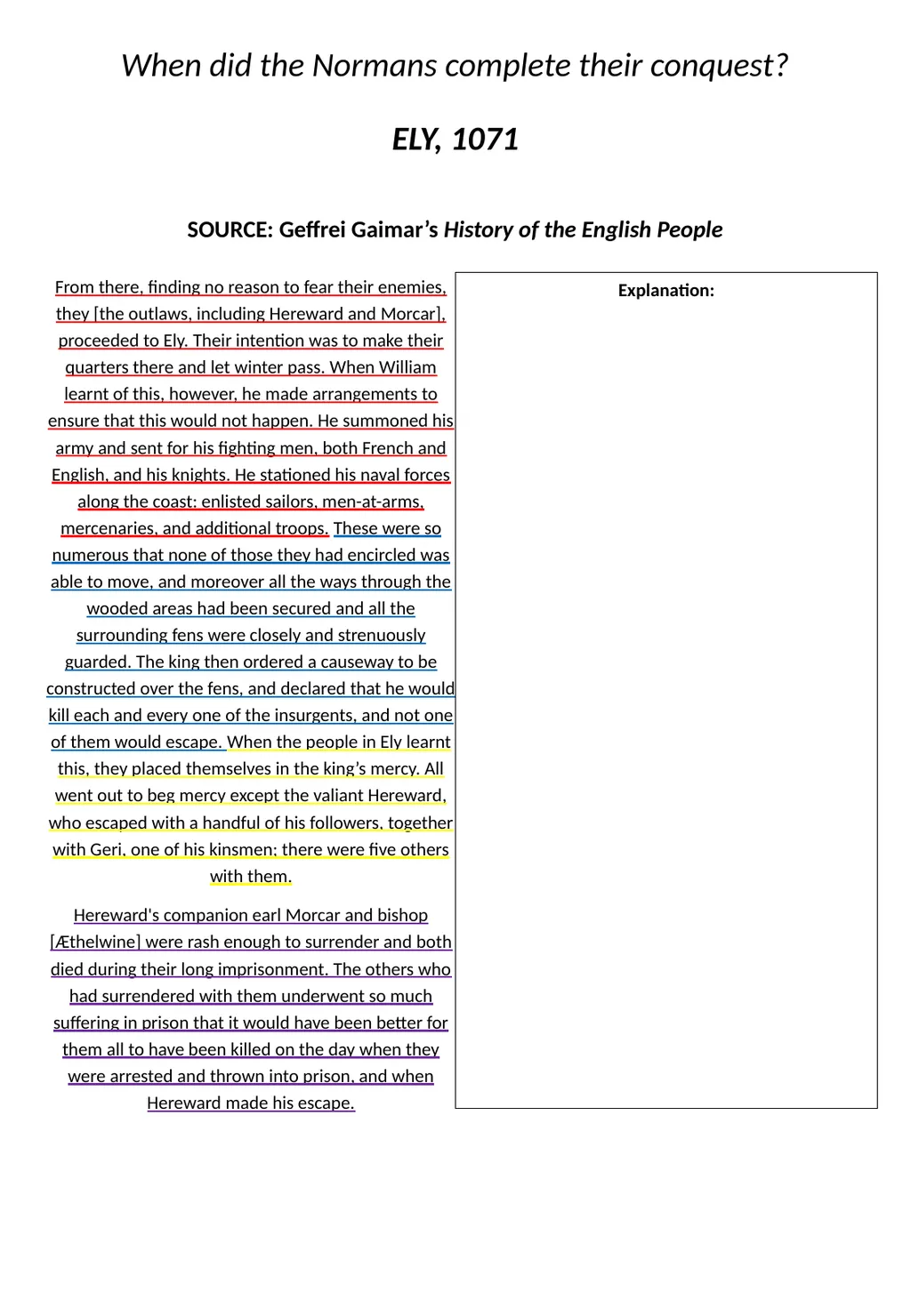
SOURCE: Geffrei Gaimar’s History of the English People From there, finding no reason to fear their enemies, they [the outlaws, including Hereward and Morcar], proceeded to Ely. Their intention was to make their quarters there and let winter pass. When William learnt of this, however, he made arrangements to ensure that this would not happen. He summoned his army and sent for his fighting men, both French and English, and his knights. He stationed his naval forces along the coast: enlisted sailors, men-at-arms, mercenaries, and additional troops. These were so numerous that none of those they had encircled was able to move, and moreover all the ways through the wooded areas had been secured and all the surrounding fens were closely and strenuously guarded. The king then ordered a causeway to be constructed over the fens, and declared that he would kill each and every one of the insurgents, and not one of them would escape. When the people in Ely learnt this, they placed themselves in the king’s mercy. All went out to beg mercy except the valiant Hereward, who escaped with a handful of his followers, together with Geri, one of his kinsmen; there were five others with them.
Hereward's companion earl Morcar and bishop [Æthelwine] were rash enough to surrender and both died during their long imprisonment. The others who had surrendered with them underwent so much suffering in prison that it would have been better for them all to have been killed on the day when they were arrested and thrown into prison, and when Hereward made his escape. Explanation:<br>
Hereward's companion earl Morcar and bishop [Æthelwine] were rash enough to surrender and both died during their long imprisonment. The others who had surrendered with them underwent so much suffering in prison that it would have been better for them all to have been killed on the day when they were arrested and thrown into prison, and when Hereward made his escape. Explanation:<br>
10
When did the Normans complete their conquest?
ELY, 1071
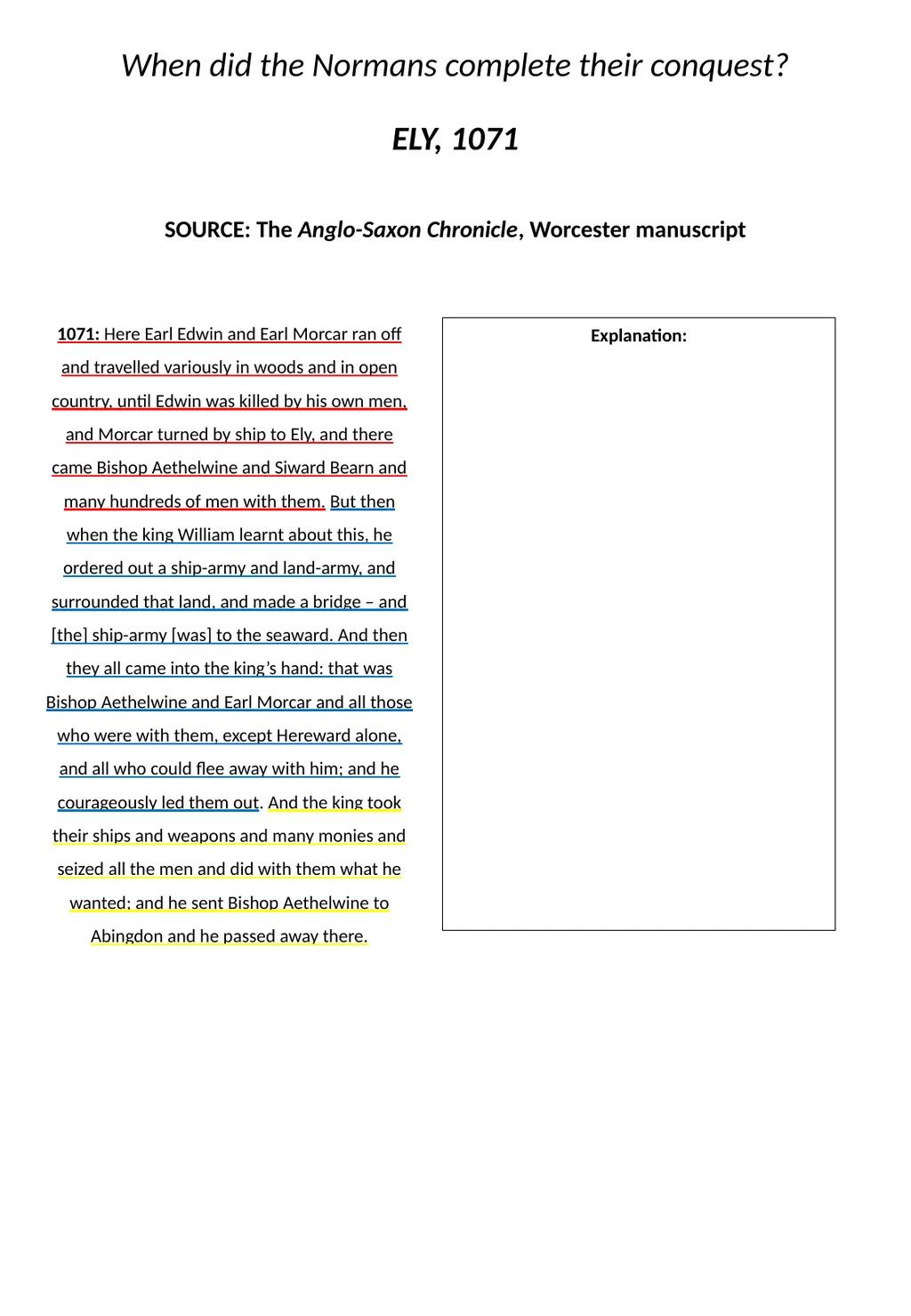
SOURCE: The Anglo-Saxon Chronicle, Worcester manuscript 1071: Here Earl Edwin and Earl Morcar ran off and travelled variously in woods and in open country, until Edwin was killed by his own men, and Morcar turned by ship to Ely, and there came Bishop Aethelwine and Siward Bearn and many hundreds of men with them. But then when the king William learnt about this, he ordered out a ship-army and land-army, and surrounded that land, and made a bridge – and [the] ship-army [was] to the seaward. And then they all came into the king’s hand: that was Bishop Aethelwine and Earl Morcar and all those who were with them, except Hereward alone, and all who could flee away with him; and he courageously led them out. And the king took their ships and weapons and many monies and seized all the men and did with them what he wanted; and he sent Bishop Aethelwine to Abingdon and he passed away there. Explanation:<br>
11
When did the Normans complete their conquest?
WALES
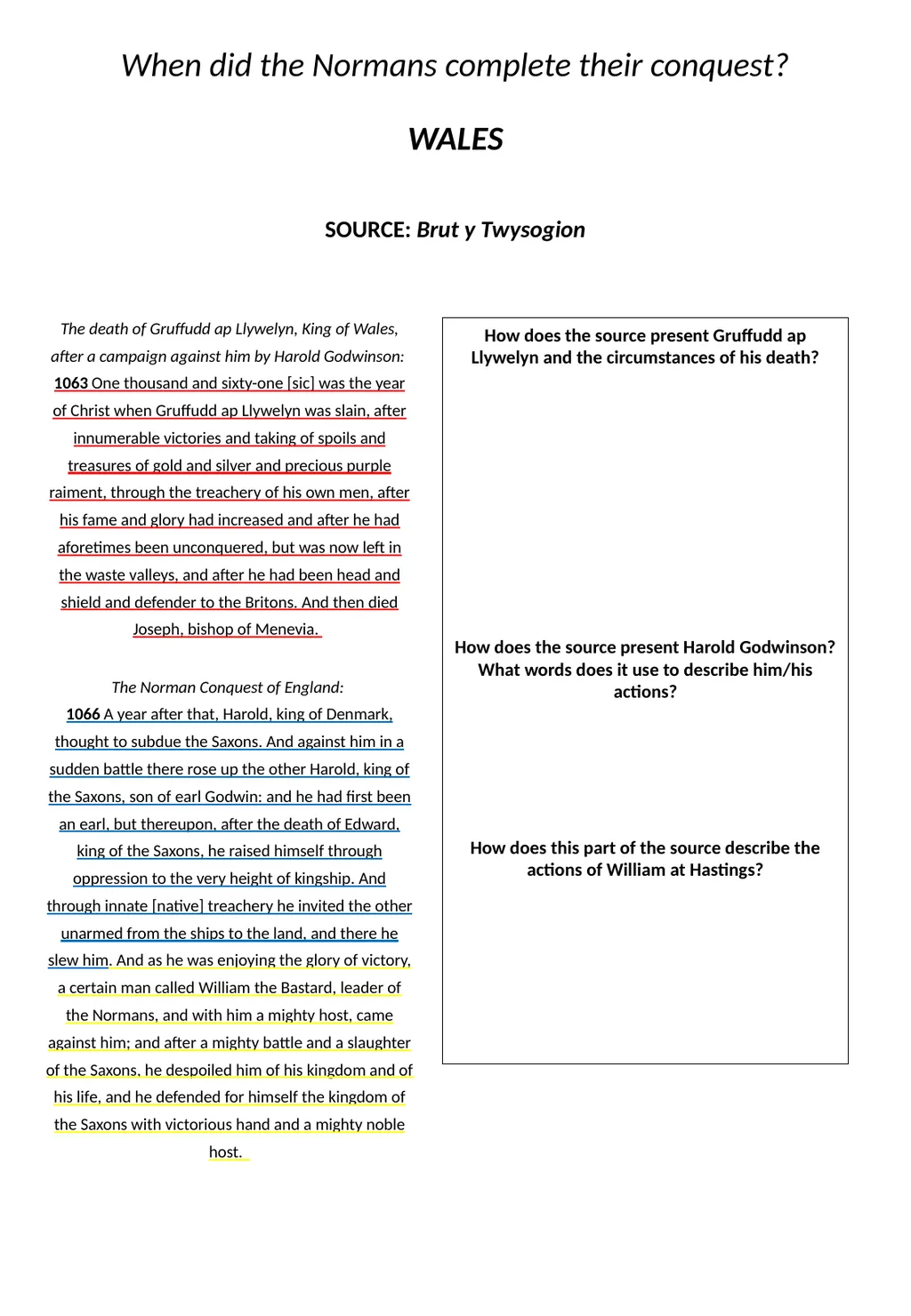
SOURCE: Brut y Twysogion The death of Gruffudd ap Llywelyn, King of Wales, after a campaign against him by Harold Godwinson:
1063 One thousand and sixty-one [sic] was the year of Christ when Gruffudd ap Llywelyn was slain, after innumerable victories and taking of spoils and treasures of gold and silver and precious purple raiment, through the treachery of his own men, after his fame and glory had increased and after he had aforetimes been unconquered, but was now left in the waste valleys, and after he had been head and shield and defender to the Britons. And then died Joseph, bishop of Menevia.
The Norman Conquest of England:
1066 A year after that, Harold, king of Denmark, thought to subdue the Saxons. And against him in a sudden battle there rose up the other Harold, king of the Saxons, son of earl Godwin: and he had first been an earl, but thereupon, after the death of Edward, king of the Saxons, he raised himself through oppression to the very height of kingship. And through innate [native] treachery he invited the other unarmed from the ships to the land, and there he slew him. And as he was enjoying the glory of victory, a certain man called William the Bastard, leader of the Normans, and with him a mighty host, came against him; and after a mighty battle and a slaughter of the Saxons, he despoiled him of his kingdom and of his life, and he defended for himself the kingdom of the Saxons with victorious hand and a mighty noble host. How does the source present Gruffudd ap Llywelyn and the circumstances of his death?
How does the source present Harold Godwinson? What words does it use to describe him/his actions?
How does this part of the source describe the actions of William at Hastings?<br>
12
When did the Normans complete their conquest?
WALES
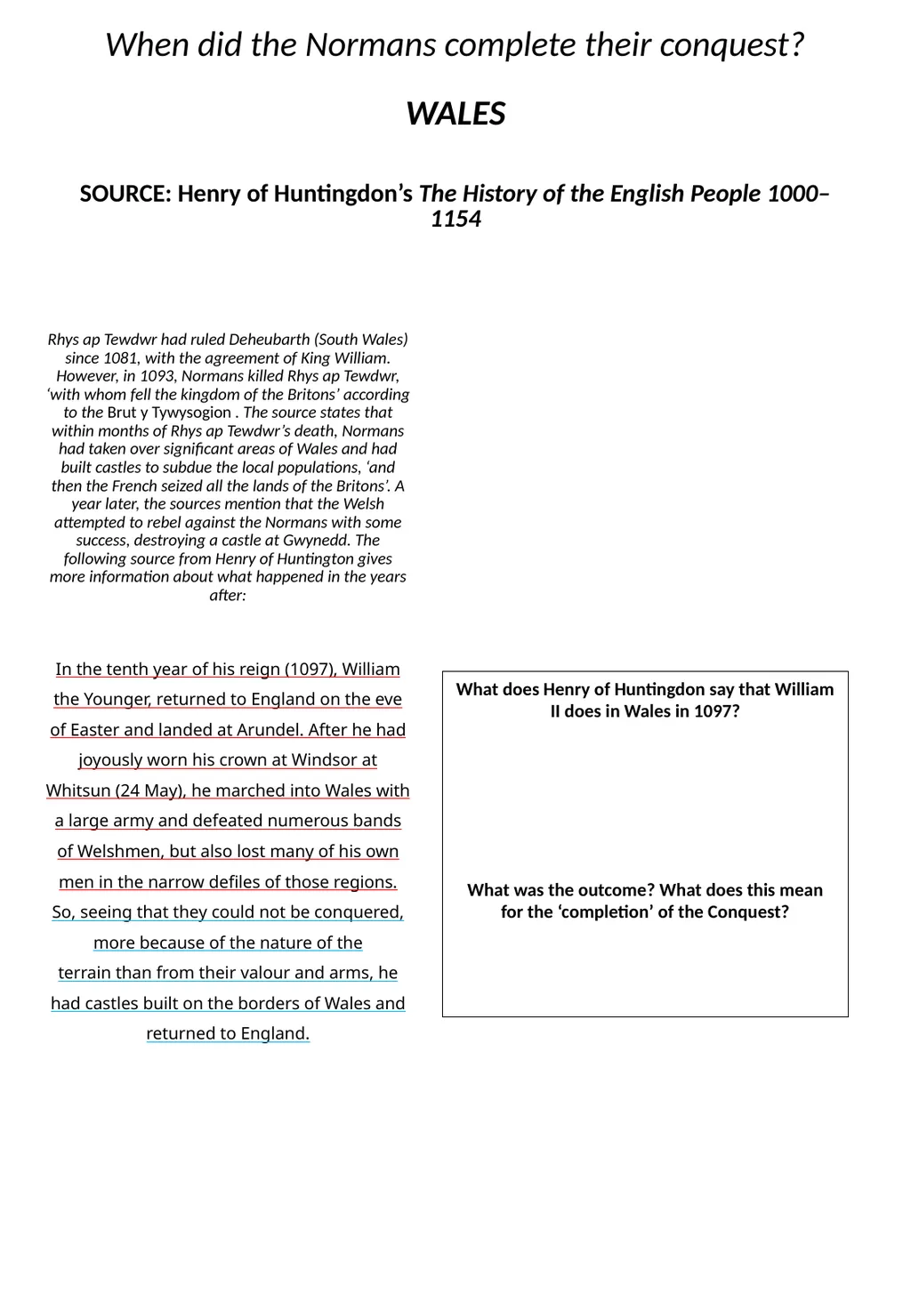
SOURCE: Henry of Huntingdon’s The History of the English People 1000–1154 Rhys ap Tewdwr had ruled Deheubarth (South Wales) since 1081, with the agreement of King William. However, in 1093, Normans killed Rhys ap Tewdwr, ‘with whom fell the kingdom of the Britons’ according to the Brut y Tywysogion . The source states that within months of Rhys ap Tewdwr’s death, Normans had taken over significant areas of Wales and had built castles to subdue the local populations, ‘and then the French seized all the lands of the Britons’. A year later, the sources mention that the Welsh attempted to rebel against the Normans with some success, destroying a castle at Gwynedd. The following source from Henry of Huntington gives more information about what happened in the years after:
In the tenth year of his reign (1097), William the Younger, returned to England on the eve of Easter and landed at Arundel. After he had joyously worn his crown at Windsor at Whitsun (24 May), he marched into Wales with a large army and defeated numerous bands of Welshmen, but also lost many of his own men in the narrow defiles of those regions. So, seeing that they could not be conquered, more because of the nature of the terrain than from their valour and arms, he had castles built on the borders of Wales and returned to England. What does Henry of Huntingdon say that William II does in Wales in 1097?
What was the outcome? What does this mean for the ‘completion’ of the Conquest?<br>
13
When did the Normans complete their conquest?
CASTLES, CATHEDRALS and DOMESDAY
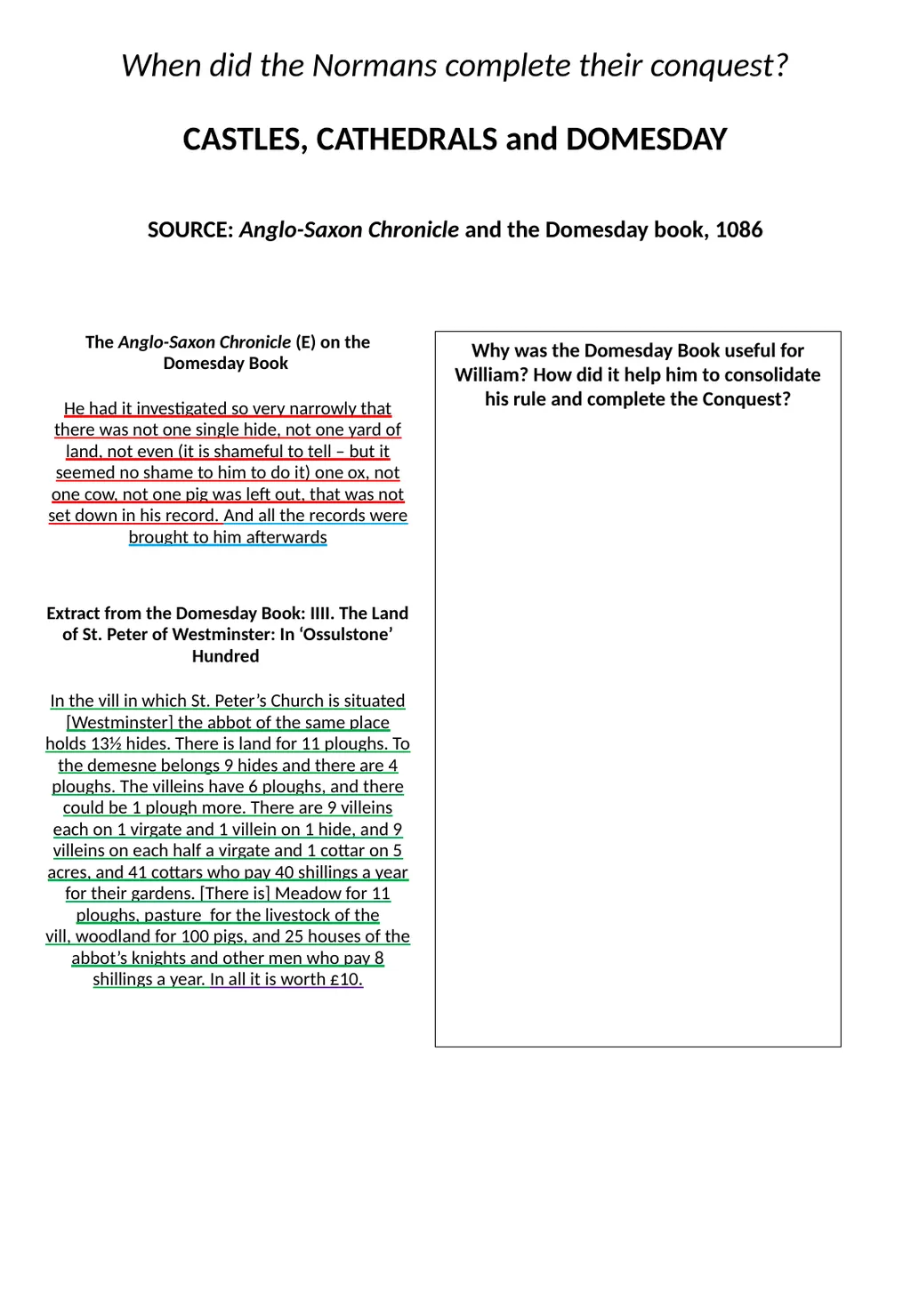
SOURCE: Anglo-Saxon Chronicle and the Domesday book, 1086 The Anglo-Saxon Chronicle (E) on the Domesday Book
He had it investigated so very narrowly that there was not one single hide, not one yard of land, not even (it is shameful to tell – but it seemed no shame to him to do it) one ox, not one cow, not one pig was left out, that was not set down in his record. And all the records were brought to him afterwards
Extract from the Domesday Book: IIII. The Land of St. Peter of Westminster: In ‘Ossulstone’ Hundred
In the vill in which St. Peter’s Church is situated [Westminster] the abbot of the same place holds 13½ hides. There is land for 11 ploughs. To the demesne belongs 9 hides and there are 4 ploughs. The villeins have 6 ploughs, and there could be 1 plough more. There are 9 villeins each on 1 virgate and 1 villein on 1 hide, and 9 villeins on each half a virgate and 1 cottar on 5 acres, and 41 cottars who pay 40 shillings a year for their gardens. [There is] Meadow for 11 ploughs, pasture for the livestock of the vill, woodland for 100 pigs, and 25 houses of the abbot’s knights and other men who pay 8 shillings a year. In all it is worth £10. Why was the Domesday Book useful for William? How did it help him to consolidate his rule and complete the Conquest?<br>